 Скачать презентацию 1 Air pollution 2 Water problems 3 Desertification
776a2b32b2a0b4c1f98a701a4b8c61de.ppt
- Количество слайдов: 19




1. Air pollution. 2. Water problems. 3. Desertification. 4. Deforestation. 5. Acoustic pollution. 6. Light pollution. 7. Loss of biodiversity.
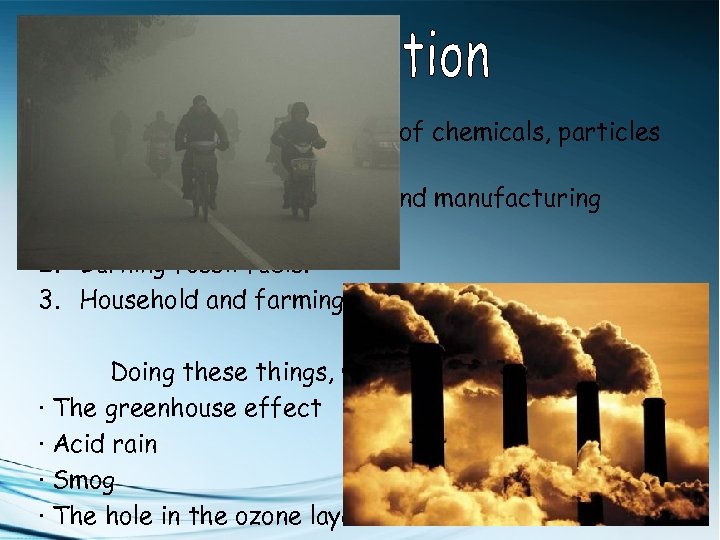
It’s caused by the expel of chemicals, particles and gases: 1. Emissions from industries and manufacturing activities. 2. Burning fossil fuels. 3. Household and farming chemicals. Doing these things, we contribute to generate: · The greenhouse effect · Acid rain · Smog · The hole in the ozone layer
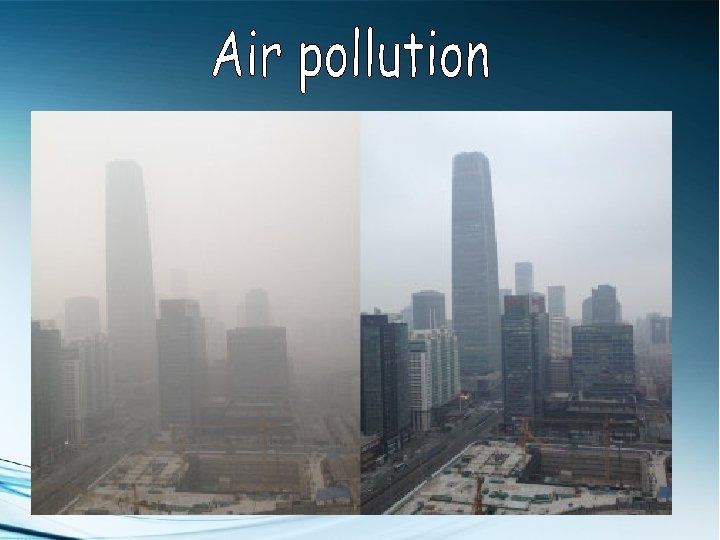
There are many solutions to this type of pollution. Some of them are: • Use public transportation or bikes. • Buy energy-efficient light bulbs. • Choose recycled products.
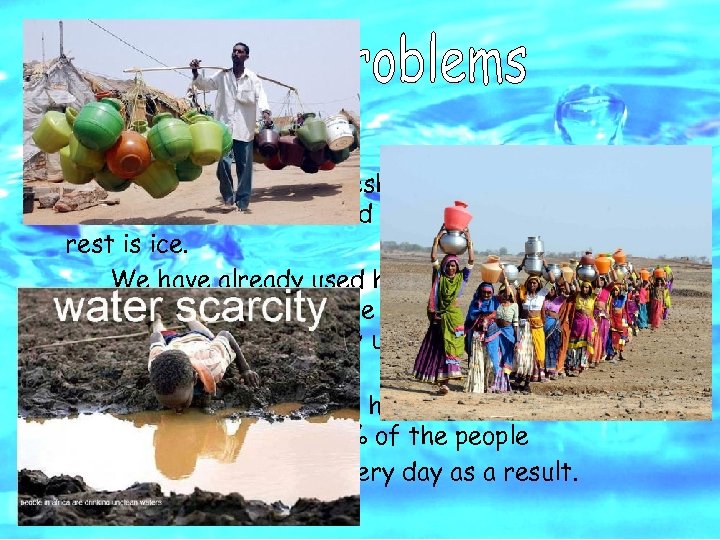
Scarcity: Only the 2. 59% is fresh water and only the 0. 014% of the water could be consumed because the rest is ice. We have already used half of the total fresh water in the earth and the UN calculates that in 2025 we will have already used between the 70 and the 90%. 1 in 5 people on Earth has no access to safe water to drink; in 2030 the 40% of the people 5, 000 children die every day as a result.
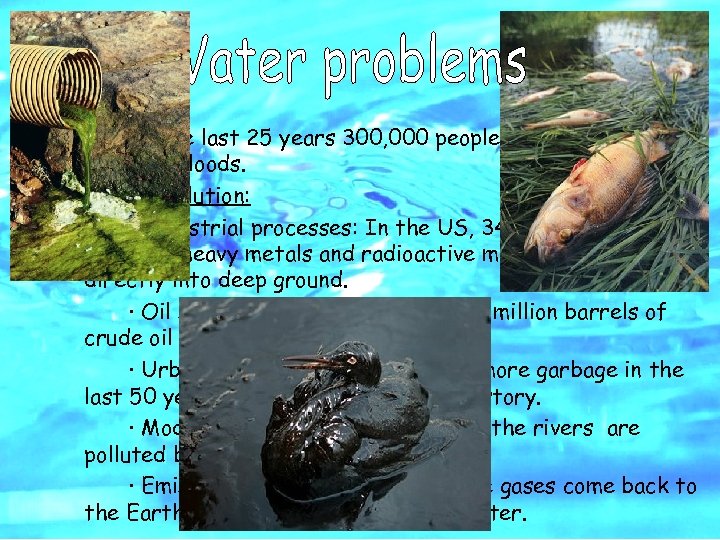
Floods: In the last 25 years 300, 000 people have been killed by floods. Water pollution: · Industrial processes: In the US, 34 billion liters of solvents, heavy metals and radioactive materials are injected directly into deep ground. · Oil spills: In the biggest oil spill 5 million barrels of crude oil were spilled. · Urban waste: We have produced more garbage in the last 50 years than in the rest of our history. · Modern agriculture: In the US all the rivers are polluted by pesticides. · Emission of pollutant gases: These gases come back to the Earth in the rain and pollute the water.
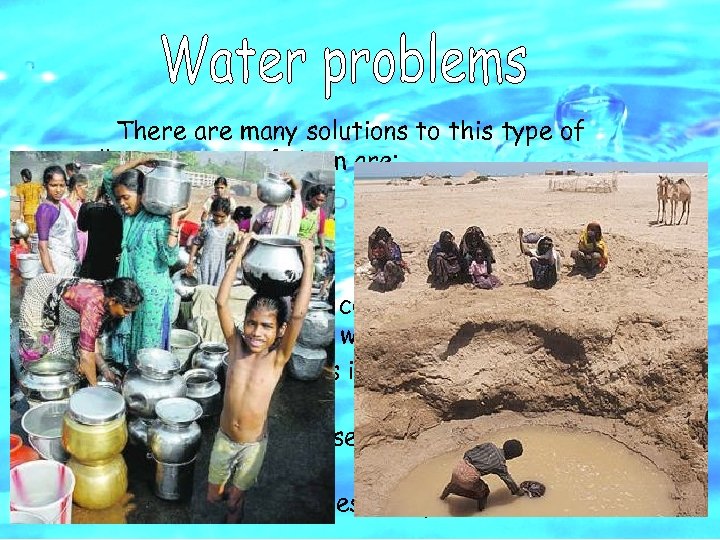
There are many solutions to this type of pollution. Some of them are: · Recycling the water. · Desalting salt water. ·Building structures to control the flows of the rivers so that no flood will occur. · Not throw the wastes into the water but recycle them. · Not emit pollutant gases that can pollute the air and water. · Change pollutant processes by others that aren’t.
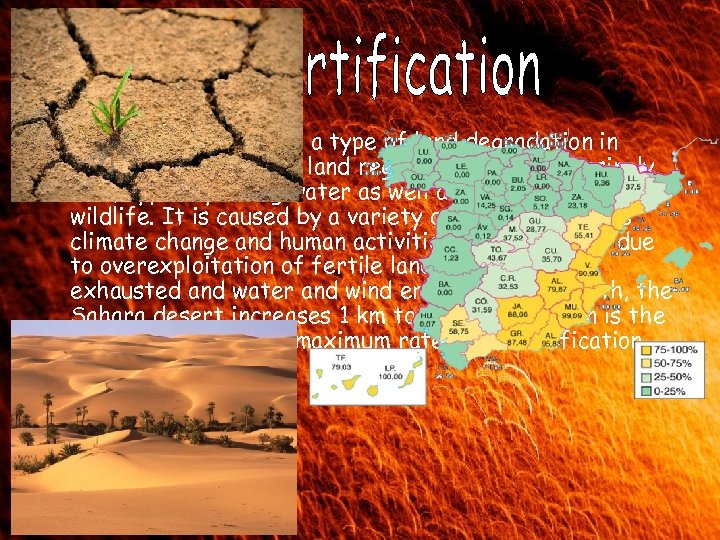
Desertification is a type of land degradation in which a relatively dry land region becomes increasingly arid, typically losing water as well as vegetation and wildlife. It is caused by a variety of factors, such as climate change and human activities. It is specially due to overexploitation of fertile land, that becomes exhausted and water and wind erode it. Each month, the Sahara desert increases 1 km to the south. Spain is the EU country with the maximum rate of desertification.
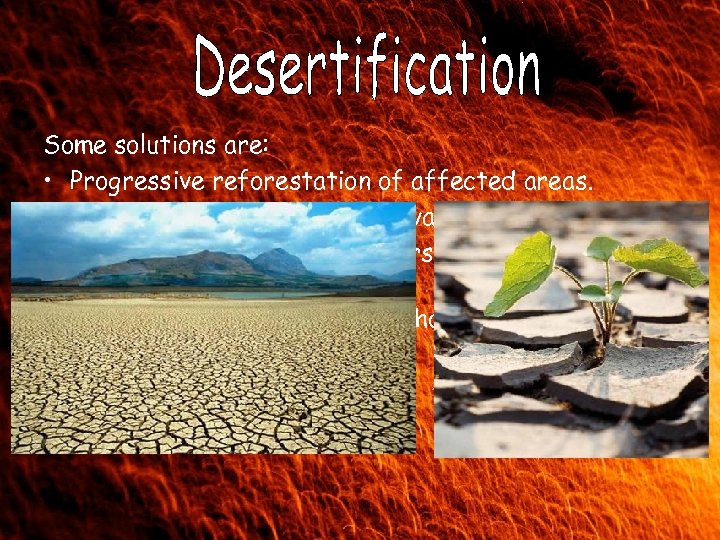
Some solutions are: • Progressive reforestation of affected areas. • Change the type of crop cultivated each year. • Cultivate crops not every years, but every two years. • Don’t contribute to the greenhouse effect.
Deforestation is the process of destructing and removing indigenous forests and woodlands. Now, there is only more or less 21% of the earth’s land surface covered with indigenous forests. An area of forest equal to 20 football fields is lost every minute.
Deforestation is caused by: · Overgrazing. · Forest fires. · Urban construction. · Industrialization. · Experimentation purposes. · Conversion into agricultural grounds.
Some consequences are: · Soil erosion. · Extinction of species. · Desertification. · Alteration of local and global climate. · Silting of water courses, lakes and dams. · Depletion of biodiversity.
Some solutions are: · Reforestation, plant indigenous trees. · Use wood sparingly, without wasting it. · Water managment. · Keep forests and green areas clean. An important organization that tries to put solutions to deforestation is Greenpeace.
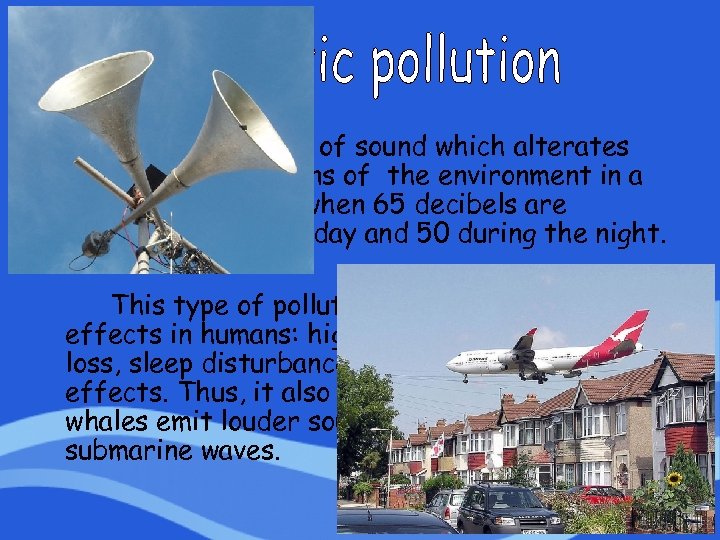
It is the excess of sound which alterates the normal conditions of the environment in a place. It is caused when 65 decibels are reached during the day and 50 during the night. This type of pollution causes a lot of effects in humans: high stress levels, hearing loss, sleep disturbances, among other harmful effects. Thus, it also has effects in animals: whales emit louder sounds when they dettect submarine waves.
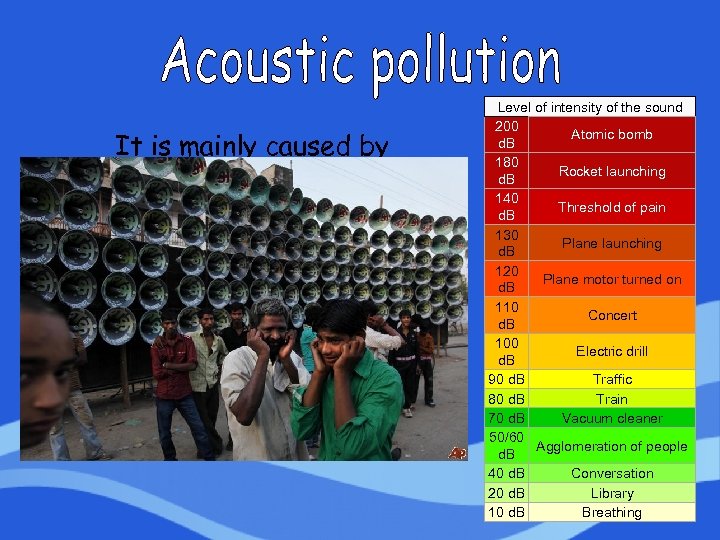
It is mainly caused by transportation, industries and daily life in urban areas. Some solutions are: • Using absorbents of sound. • Using earplugs • Putting insulators in the walls, like those make of cork. Level of intensity of the sound 200 Atomic bomb d. B 180 Rocket launching d. B 140 Threshold of pain d. B 130 Plane launching d. B 120 Plane motor turned on d. B 110 Concert d. B 100 Electric drill d. B 90 d. B Traffic 80 d. B Train 70 d. B Vacuum cleaner 50/60 Agglomeration of people d. B 40 d. B Conversation 20 d. B Library 10 d. B Breathing
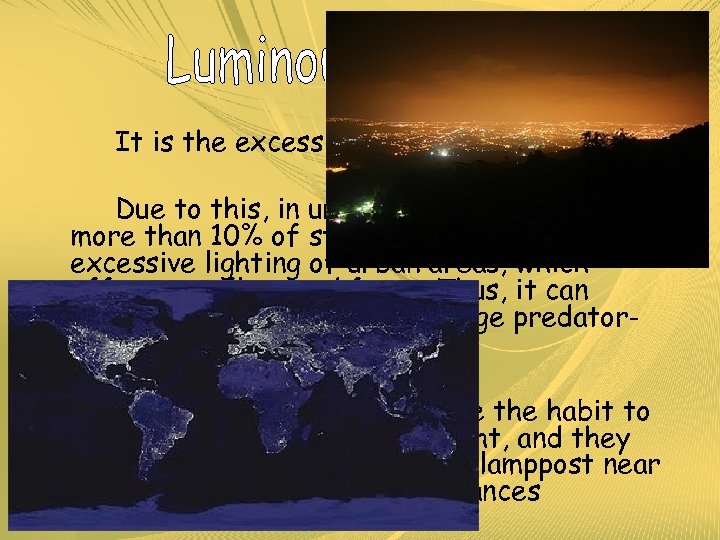
It is the excess of artificial light. Due to this, in urban areas we can’t see more than 10% of stars. This is caused by the excessive lighting of urban areas, which affects us, flora and fauna. Thus, it can confuse animal navigation, change predatorprey relations, etc. Some people in summer have the habit to open the window during the night, and they can’t do it because they have a lamppost near them. This cause sleep disturbances
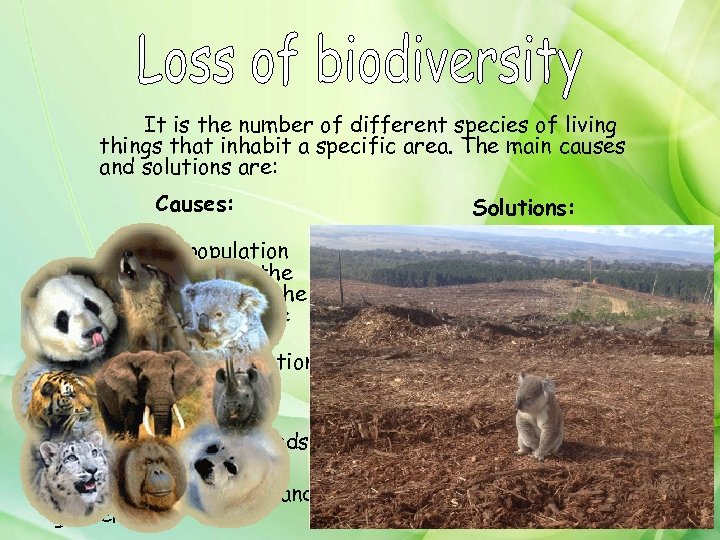
It is the number of different species of living things that inhabit a specific area. The main causes and solutions are: Causes: · Human population growth (because of the enviromental impact, the search of land, and the construction) · Habitat destruction · Pollution · Agriculture (destruction of wildlands) · Global warming · Hunting, fishing and gathering Solutions: · Stop deforestation · Reduce enviromental pollution · Protect native ecosystems from invasive species · Stop overfishing and overhunting

BY: Lucía Aranda Mendoza Mónica García González Eduardo Diego Lozano Escobar Abel Maestre Pérez de Villar Marta Meireles da Silva Gil
Скачать презентацию 1 Air pollution 2 Water problems 3 Desertification
776a2b32b2a0b4c1f98a701a4b8c61de.ppt