 Скачать презентацию 1 5 1 Global assessments peer reviews some
b0fe9ca3f60b642e9196026b3b604870.ppt
- Количество слайдов: 8



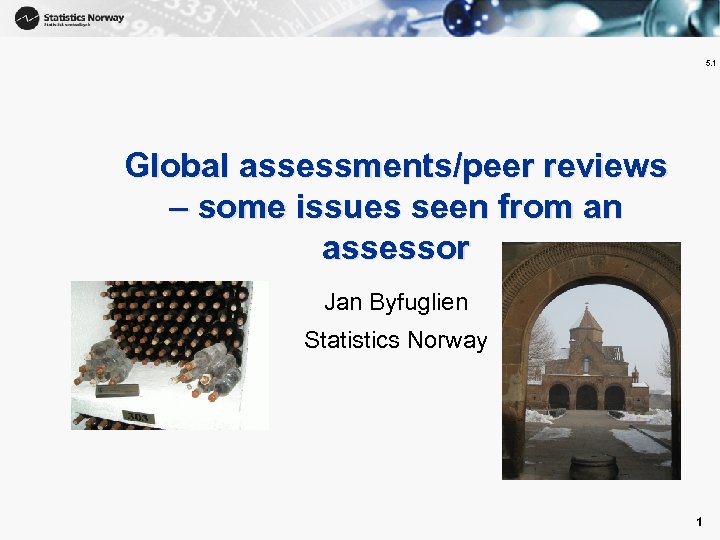
1 5. 1 Global assessments/peer reviews – some issues seen from an assessor Jan Byfuglien Statistics Norway 1
My background • In Statistics Norway since 1972 – with different functions and responsibilities: i. a. demographic statistics, regional statistics, international affairs, internal planning and human resource management • 4, 5 Years in Eurostat/EFTA • Participated in 3 peer reviews, 2 as head • Participated in 2 global assessments • Responsible for 2 Statistical Capacity Master Plan (WB) • Involved in review of 6 national statistical data producers • Several other international tasks/consultancies 2
What are the common goals for global assessments, peer reviews, master plans… • To support the improvement of national statistical systems • The external review should help to align the national system with international recommendations, standards and best practices • The agreed assessment/review should be useful both in relation to national stakeholders and the international community – and form the basis for a national action plan 3
What are the most important factors to provide a successful outcome of an assessment process? • The process in advance of the review could be the most important part: – Ensure internal reflection and preparation – Update and provide documentation – in a foreign language • The review itself: – Ability of reviewers to put the right questions – and understand the answers – Willingness and openness of the organisation to give as correct information as possible – The possibility to get second-hand opinion from external stakeholders, data providers and users • After the review: How are the results disseminated and taken into account for improvement actions? 4
What can be the most difficult areas? • The relationship of the NSI with political authorities and degree of independence • Low status of official statistics, low trust in the NSI and its products, limited and outdated dissemination • Relationship between NSIs and other partners – especially in decentralised systems • Quality issues, especially of data based on sample surveys • Actual degree of compliance with international standards • The historic legacy of the organisation – especially an outdated regional organisation administratively decided, but also outdated legislation 5
General considerations: • The basis for the review is the self-assessment, legislation of office and other management documents, web site…. • Systematic consultation with non-management staff and external partners/users important to get an outside view • The peers and the reviewed organisation should have a common interest in as much as possible an objective and fact based review • The scope of assessing a national statistical system is very extensive – and the time/resources available for the process limited 6
General considerations (cont. ) • Questions prepared in advance need to be adapted in order to focus on the most important and critical aspects • No organisation is perfect, and the action plan for improvement should be a key result – but need to set priorities • No reviewer is perfect and knows all areas in detail – can mainly act as facilitator and catalyst • The review has elements of knowledge transfer and benchmarking – and could be followed up by more direct benchmarking and cooperation between institutions 7
8 Thanks for your attention! Any comments/questions? 8
Скачать презентацию 1 5 1 Global assessments peer reviews some
b0fe9ca3f60b642e9196026b3b604870.ppt