


 Скачать презентацию 1 3 Physical Resource Flows Lo From where
a6e68580c7eff79873c480fa5ad8321b.ppt
- Количество слайдов: 22
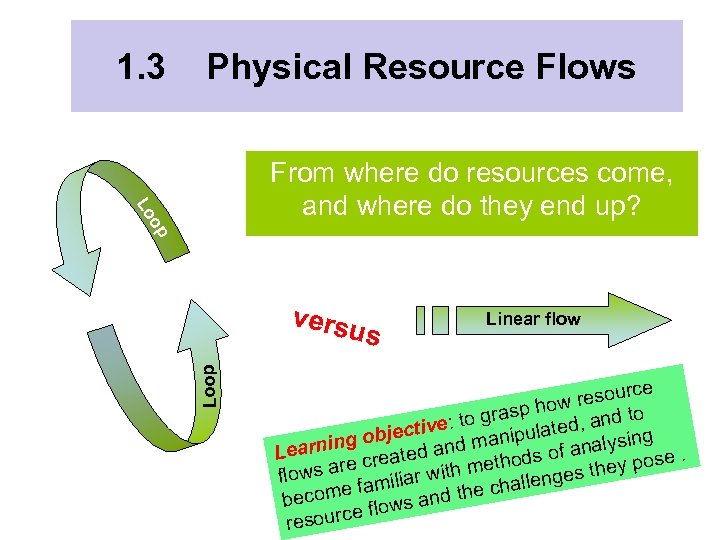 1. 3 Physical Resource Flows Lo From where do resources come, and where do they end up? op Loop versu s Linear flow e resourc ow grasp h d, and to : to jective manipulate g ob nalysin e. arning eated and Le of a pos e cr ethods ith m ws ar s they e flo rw familia d the challeng e becom flows an e resourc
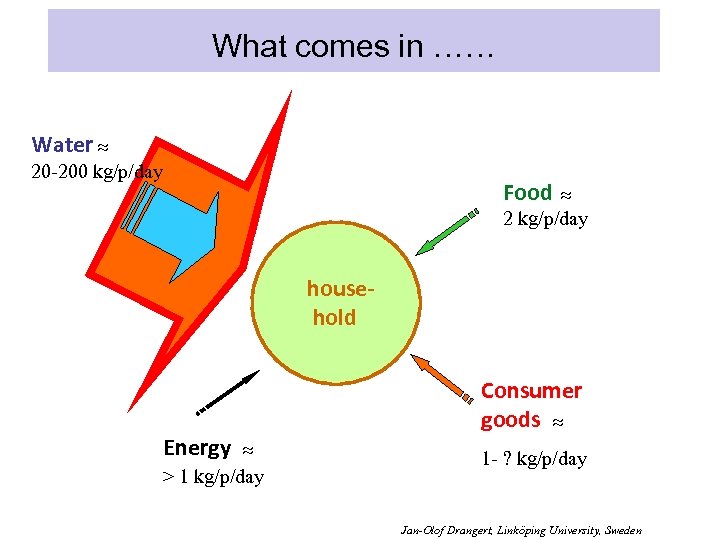 What comes in …… Water 20 -200 kg/p/day Food 2 kg/p/day household Energy Consumer goods > 1 kg/p/day 1 - ? kg/p/day Jan-Olof Drangert, Linköping University, Sweden
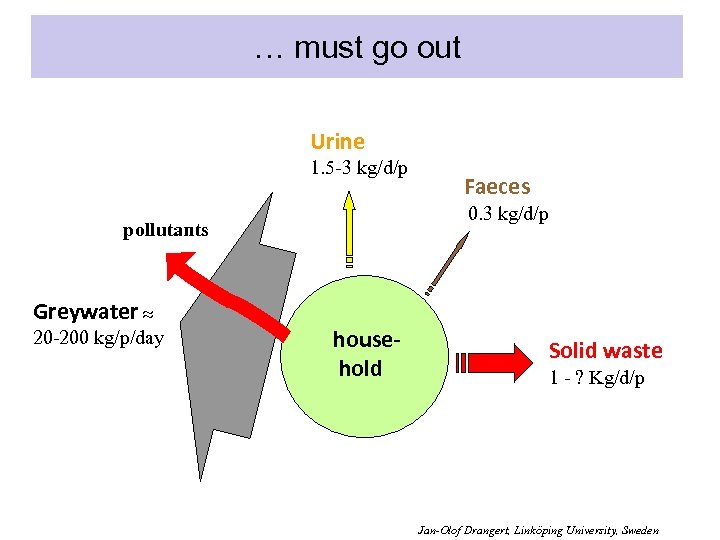 … must go out Urine 1. 5 -3 kg/d/p 0. 3 kg/d/p pollutants Greywater 20 -200 kg/p/day Faeces household Solid waste 1 - ? Kg/d/p Jan-Olof Drangert, Linköping University, Sweden
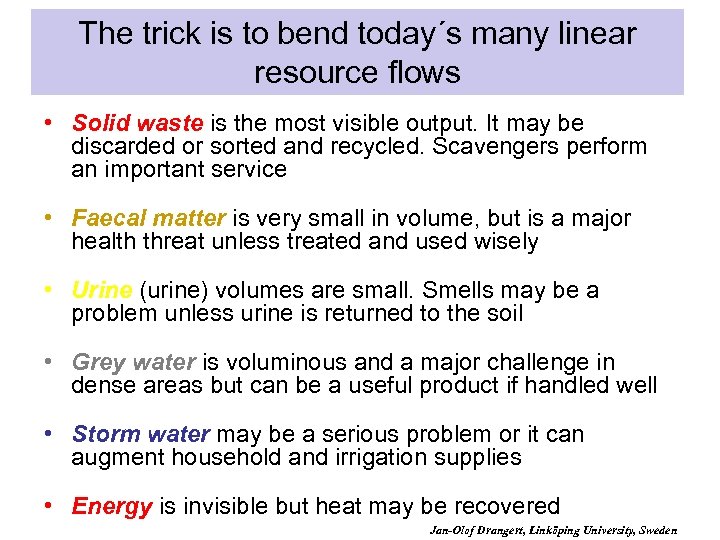 The trick is to bend today´s many linear resource flows • Solid waste is the most visible output. It may be discarded or sorted and recycled. Scavengers perform an important service • Faecal matter is very small in volume, but is a major health threat unless treated and used wisely • Urine (urine) volumes are small. Smells may be a problem unless urine is returned to the soil • Grey water is voluminous and a major challenge in dense areas but can be a useful product if handled well • Storm water may be a serious problem or it can augment household and irrigation supplies • Energy is invisible but heat may be recovered Jan-Olof Drangert, Linköping University, Sweden
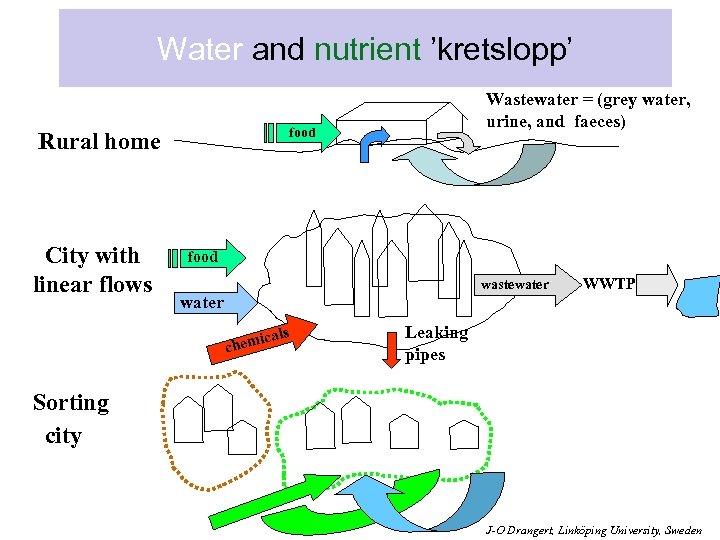 Water and nutrient ’kretslopp’ food Rural home City with linear flows Wastewater = (grey water, urine, and faeces) food wastewater cals i chem WWTP Leaking pipes Sorting city J-O Drangert, Linköping University, Sweden
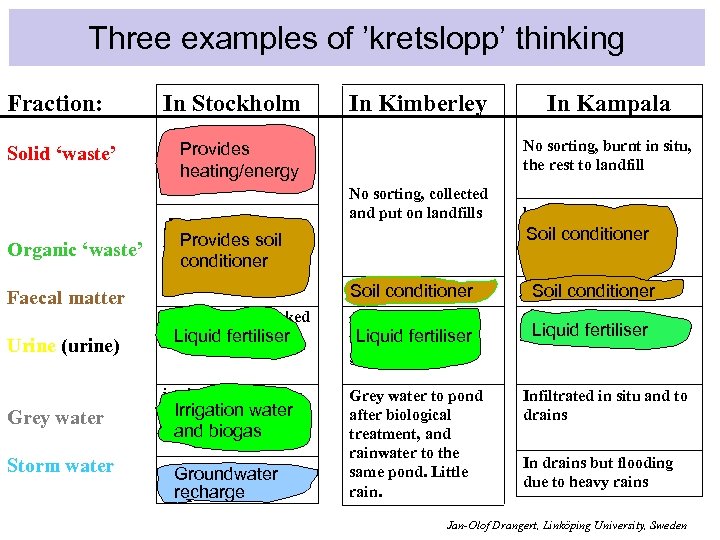 Three examples of ’kretslopp’ thinking Fraction: In Stockholm Solid ‘waste’ sorted in 8 fractions, Provides collected and reused Organic ‘waste’ Faecal matter Urine (urine) Grey water Storm water In Kimberley No sorting, burnt in situ, the rest to landfill heating/energy organics composted Provides hygientogether with soil conditioner ised dry faecal material In Kampala No sorting, collected and put on landfills banana peels etc to animal feed Soil conditioner driedconditioner Soil and composted dried and composted Soil conditioner collected and trucked to. Liquid fertiliser farm used in situ or by Liquid fertiliser truck to council gardens in situ or collected in situ after Irrigation water biological treatment Grey water to pond after biological treatment, and rainwater to the same pond. Little rain. Infiltrated in situ and to drains and biogas infiltration (no heavy Groundwater rains) recharge Liquid fertiliser In drains but flooding due to heavy rains Jan-Olof Drangert, Linköping University, Sweden
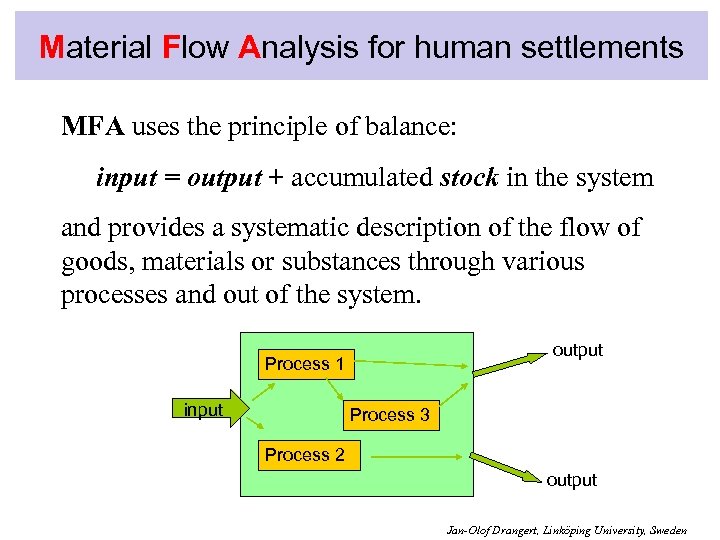 Material Flow Analysis for human settlements MFA uses the principle of balance: input = output + accumulated stock in the system and provides a systematic description of the flow of goods, materials or substances through various processes and out of the system. output Process 1 input Process 3 Process 2 output Jan-Olof Drangert, Linköping University, Sweden
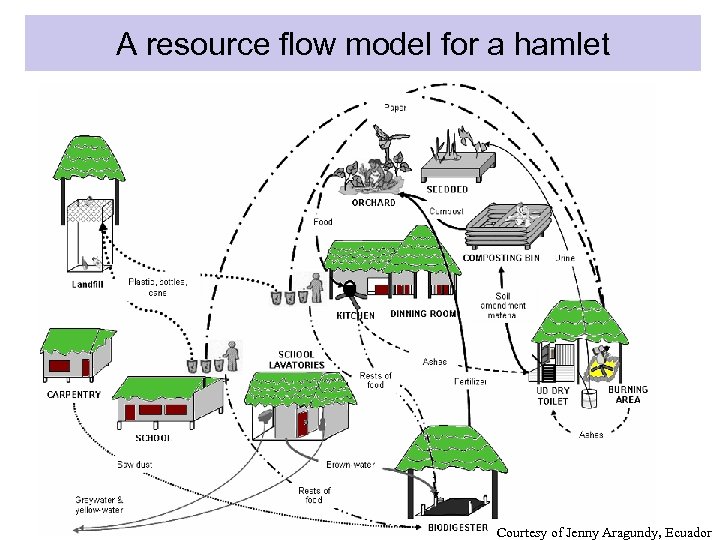 A resource flow model for a hamlet 8 Courtesy of Jenny Aragundy, Ecuador
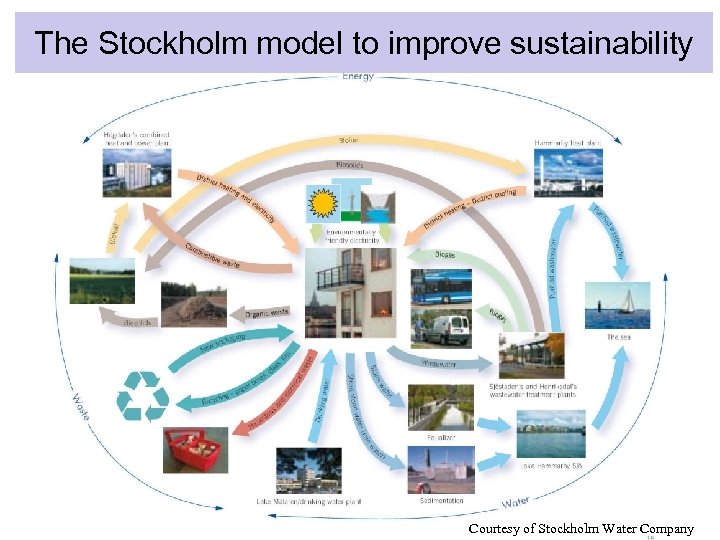 The Stockholm model to improve sustainability 9 Courtesy of Stockholm Water Company
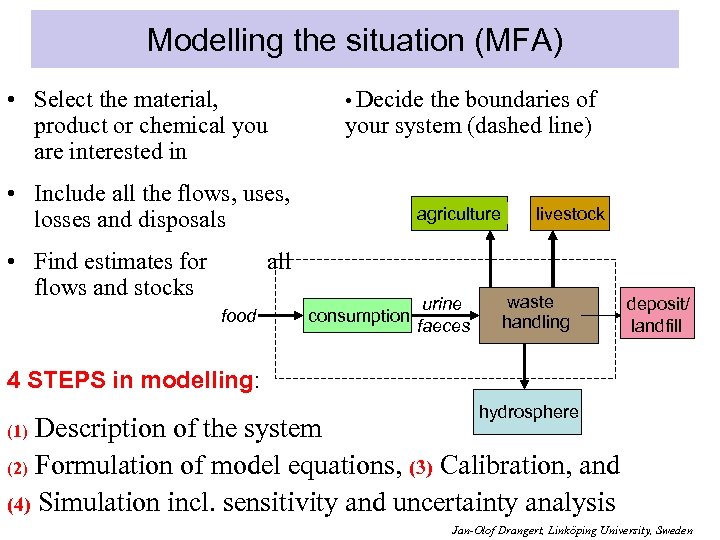 Modelling the situation (MFA) • Select the material, product or chemical you are interested in • Decide the boundaries of your system (dashed line) • Include all the flows, uses, losses and disposals • Find estimates for flows and stocks agriculture livestock all food consumption urine faeces waste handling deposit/ landfill 4 STEPS in modelling: hydrosphere Description of the system (2) Formulation of model equations, (3) Calibration, and (4) Simulation incl. sensitivity and uncertainty analysis (1) Jan-Olof Drangert, Linköping University, Sweden
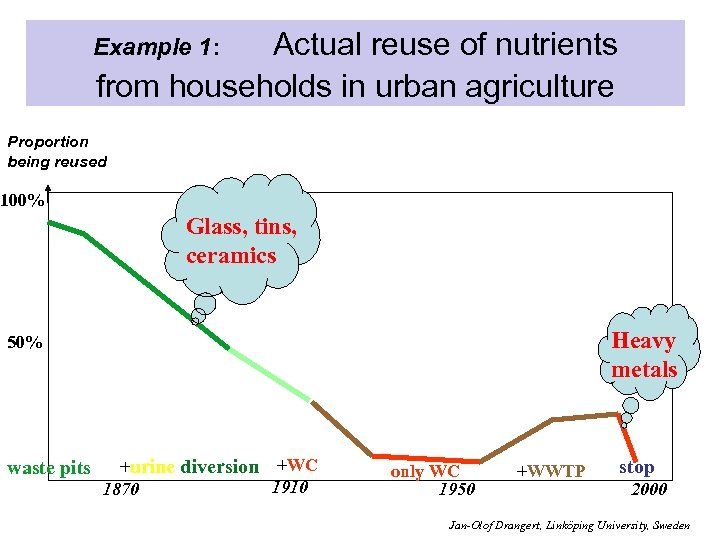 Actual reuse of nutrients from households in urban agriculture Example 1: Proportion being reused 100% Glass, tins, ceramics Heavy metals 50% waste pits +urine diversion +WC 1910 1870 only WC 1950 +WWTP stop 2000 Jan-Olof Drangert, Linköping University, Sweden
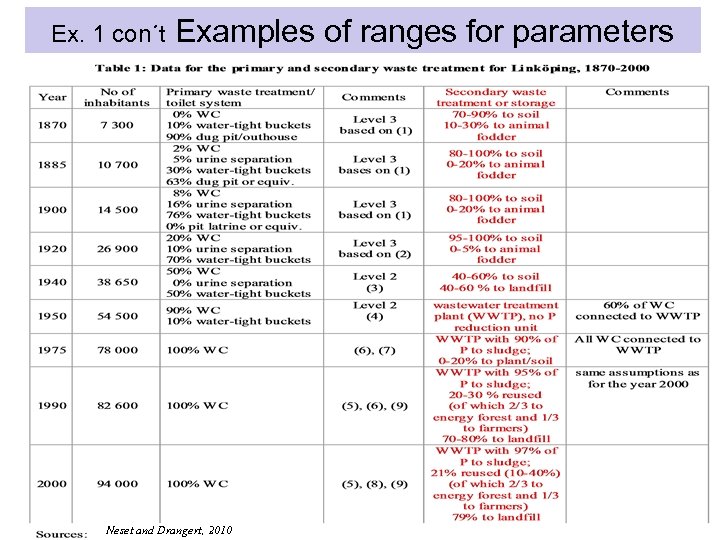 Ex. 1 con´t Examples of ranges for parameters Neset and Drangert, 2010
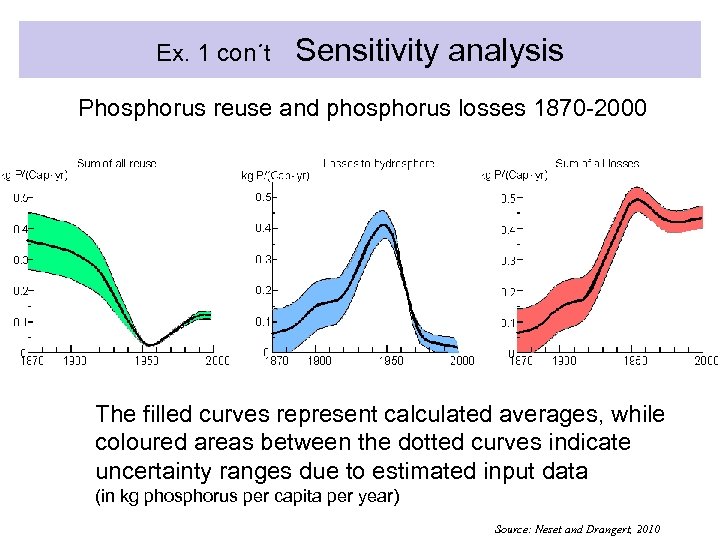 Ex. 1 con´t Sensitivity analysis Phosphorus reuse and phosphorus losses 1870 -2000 The filled curves represent calculated averages, while coloured areas between the dotted curves indicate uncertainty ranges due to estimated input data (in kg phosphorus per capita per year) Source: Neset and Drangert, 2010
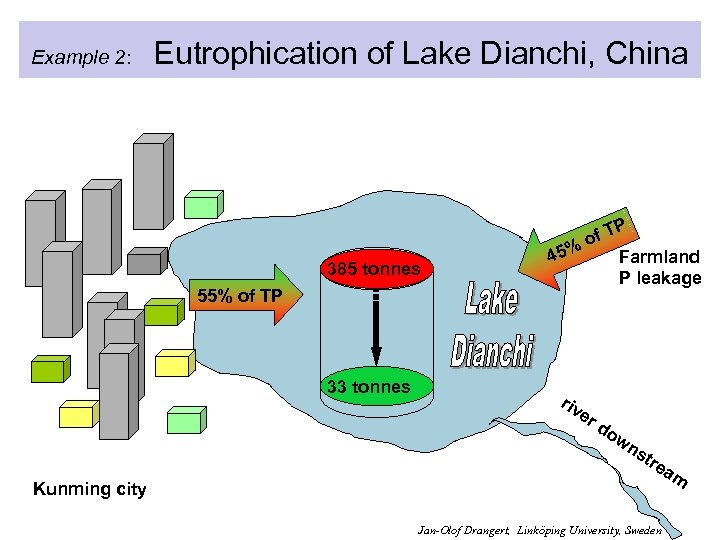 Example 2: Eutrophication of Lake Dianchi, China P of T % 385 tonnes 45 55% of TP 33 tonnes riv er Farmland P leakage do w ns tr Kunming city ea Jan-Olof Drangert, Linköping University, Sweden m
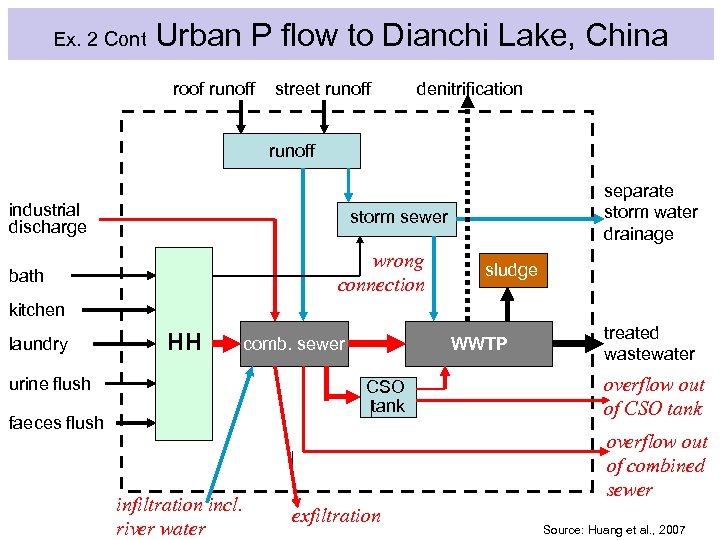 Ex. 2 Cont Urban P flow to Dianchi Lake, China Dianchi roof runoff street runoff denitrification runoff industrial discharge separate storm water drainage storm sewer wrong connection bath sludge kitchen laundry HH urine flush comb. sewer WWTP CSO tank faeces flush infiltration incl. river water treated wastewater overflow out of CSO tank overflow out of combined sewer exfiltration Source: Huang et al. , 2007
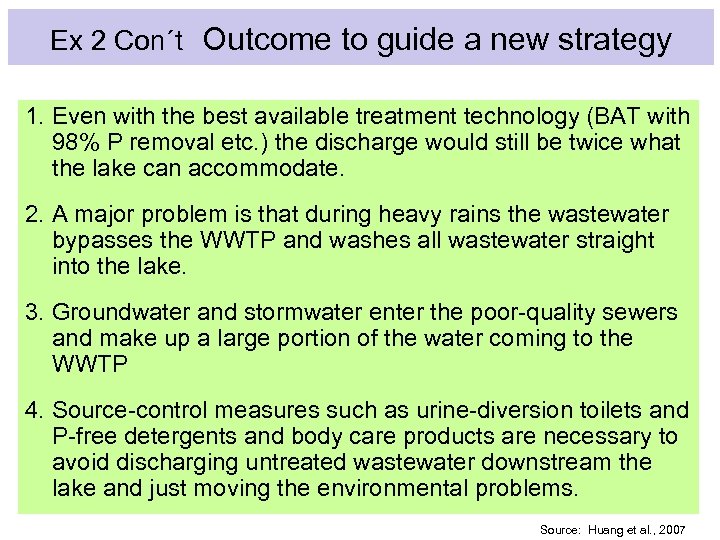 Ex 2 Con´t Outcome to guide a new strategy 1. Even with the best available treatment technology (BAT with 98% P removal etc. ) the discharge would still be twice what the lake can accommodate. 2. A major problem is that during heavy rains the wastewater bypasses the WWTP and washes all wastewater straight into the lake. 3. Groundwater and stormwater enter the poor-quality sewers and make up a large portion of the water coming to the WWTP 4. Source-control measures such as urine-diversion toilets and P-free detergents and body care products are necessary to avoid discharging untreated wastewater downstream the lake and just moving the environmental problems. Source: Huang et al. , 2007
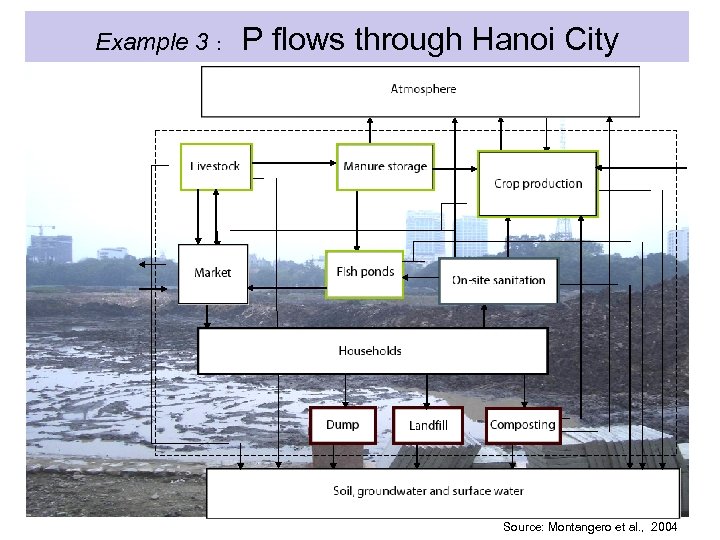 Example 3 : P flows through Hanoi City Source: Montangero et al. , 2004
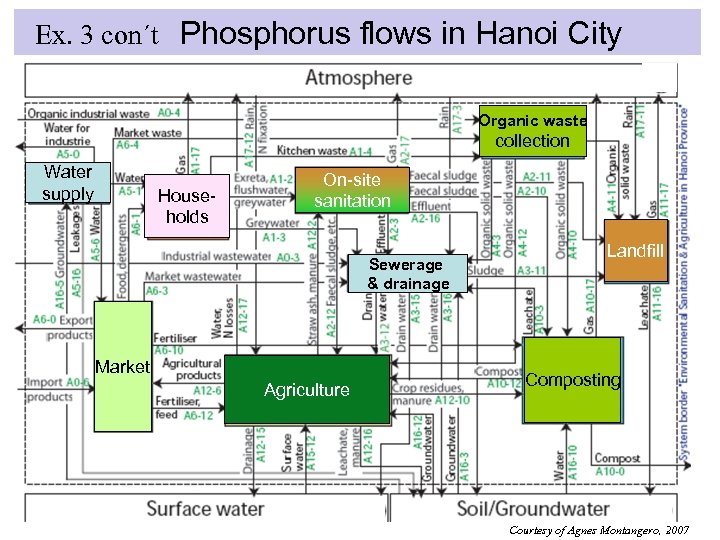 Ex. 3 con´t Phosphorus flows in Hanoi City Organic waste collection Water supply Households On-site sanitation Sewerage & drainage Market Agriculture Landfill Composting Courtesy of Agnes Montangero, 2007
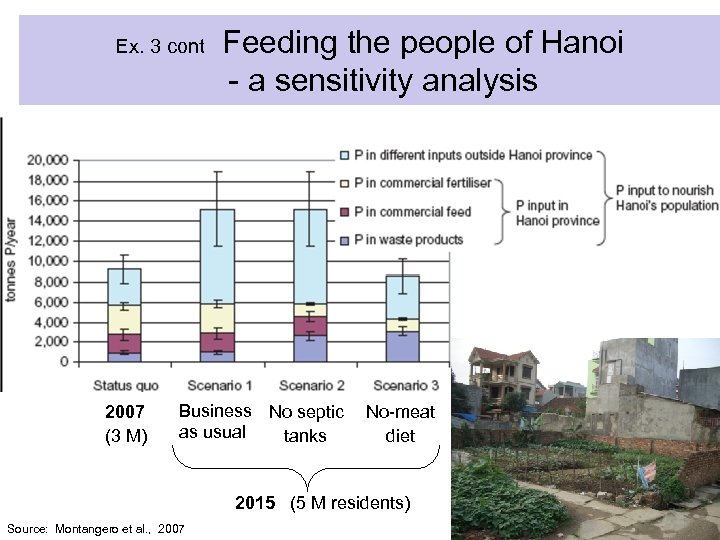 Ex. 3 cont 2007 (3 M) Feeding the people of Hanoi - a sensitivity analysis Business No septic as usual tanks No-meat diet 2015 (5 M residents) Source: Montangero et al. , 2007
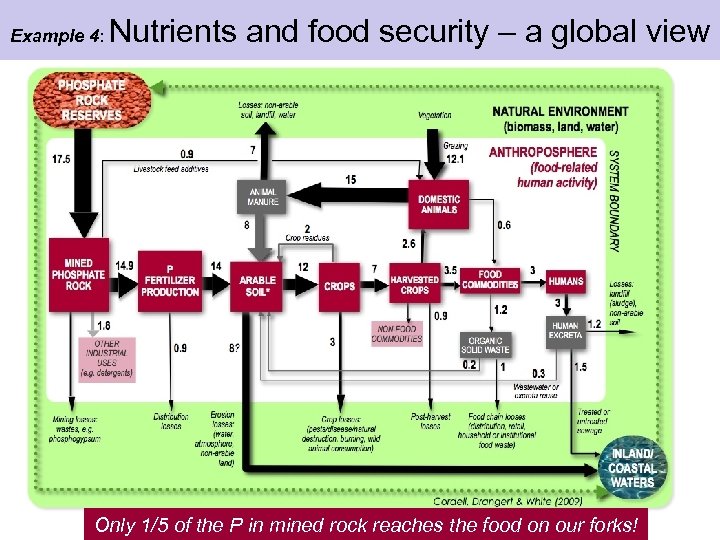 Example 4: Nutrients and food security – a global view Only 1/5 of the P in mined rock reaches the food on our forks!
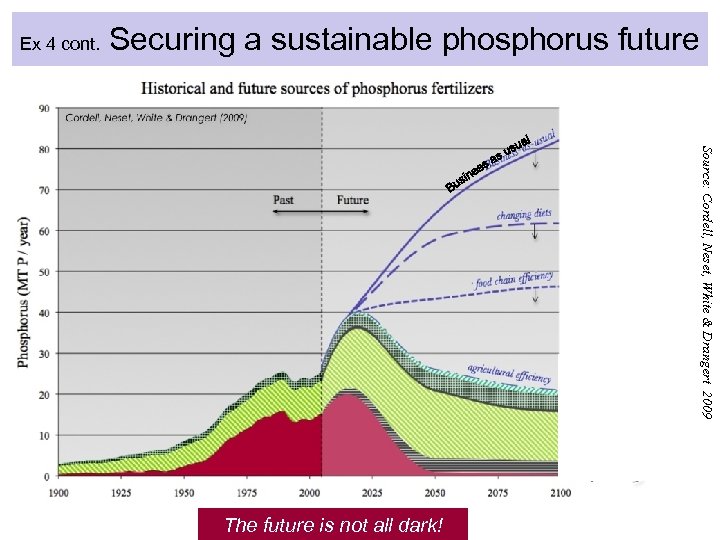 Ex 4 cont. Securing a sustainable phosphorus future Source: Cordell, Neset, White & Drangert 2009 The future is not all dark!
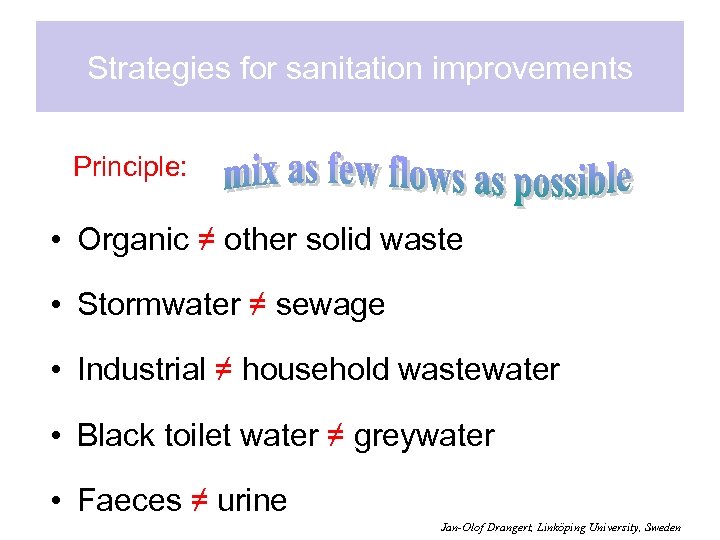 Strategies for sanitation improvements Principle: • Organic ≠ other solid waste • Stormwater ≠ sewage • Industrial ≠ household wastewater • Black toilet water ≠ greywater • Faeces ≠ urine Jan-Olof Drangert, Linköping University, Sweden