


1. 2. 3. The problem of the definition of the phrase. The phrase and the sentence. Classification of phrases. Syntactic relations between the components of a phrase.
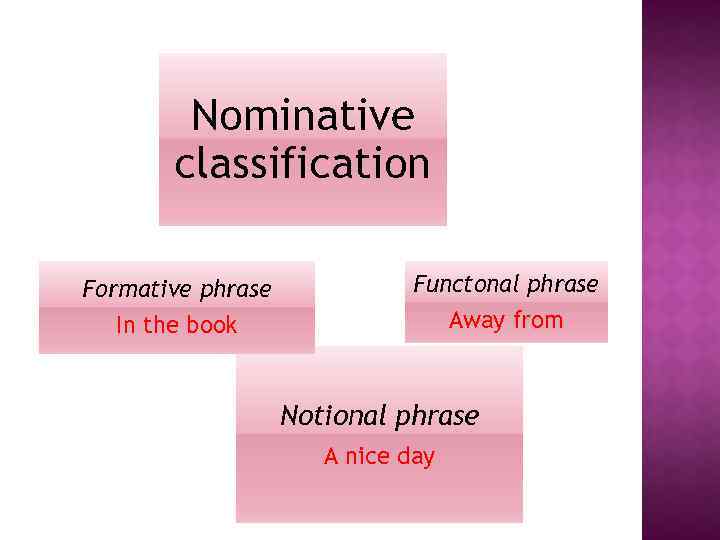
Nominative classification Formative phrase Functonal phrase In the book Away from Notional phrase A nice day
SUBBORDINATIVE (poor Mary), COORDINATIVE (Tom and Mary), PREDICATIVE (he came, his coming), PREPOSITIONAL (besides Ann).
The members of a coordinative group may be connected by other words – syndetic connection or have no connectives – asyndetic connection. Accordingly, we distinguish linked groups and unlinked groups. E. g. five and twenty; of an unlinked group : a low soft voice.
Subordination is traditionally considered to be based on the inequality of units, which are combined. The dominating unit is called a center, or a kernel (K) / a head-word (H); the subordinate unit is an adjunct (A). Subordinated structures, which are often called close phrases, are used more widely than others. Coordination meant a certain looseness of words in a phrase, that is, the words can easily change their places. Thus, very often these phrases were called loose. Today the opinion that coordination means equality and independence is rejected. It has been proved that the members of a coordinative group can not always change their places (nice and beautiful, you and me). Another point of view: coordinative phrases are only those groups, components of which equally correspond to a third unit: Nick had been shocked and upset. Had been shocked and had been upset.
Agreement. It takes place when the subordinate word assumes a form similar to that of the word to which it is subordinate. In English agreement is typical only of the category of number in demonstrative pronouns Government takes place when the subordinate word is used in a certain form required by its head word, the form of the subordinate word not coinciding with the form of the head word. The expression of government is the use of the objective case of personal pronouns and of the pronoun "who" when they are used in a verbal phrase or follow a preposition.
Agglutination, or adjoinment is usually given a "negative" definition: it is described as absence both of agreement and of government, it is typical of the syntagma "adverb + head word". In case of agglutination the elements are combined without any changes, e. g. nodded his head silently. By enclosure some element is put between the two parts of another constituent of a phrase. One of the most widely used types of enclosure in English is the enclosure of all kinds of attributes between the article (determiner) and its head-noun.
