



 1
1
 2
2
 3
3
 4
4
 5
5
 6
6
 7
7
 8
8
 9
9
 10
10
 11
11
 12
12
 13
13
 14
14
 15
15
 16
16
 17
17
 18
18
 19
19
 20
20
 21
21
 22
22
 23
23
 24
24
 25
25
 26
26
 27
27
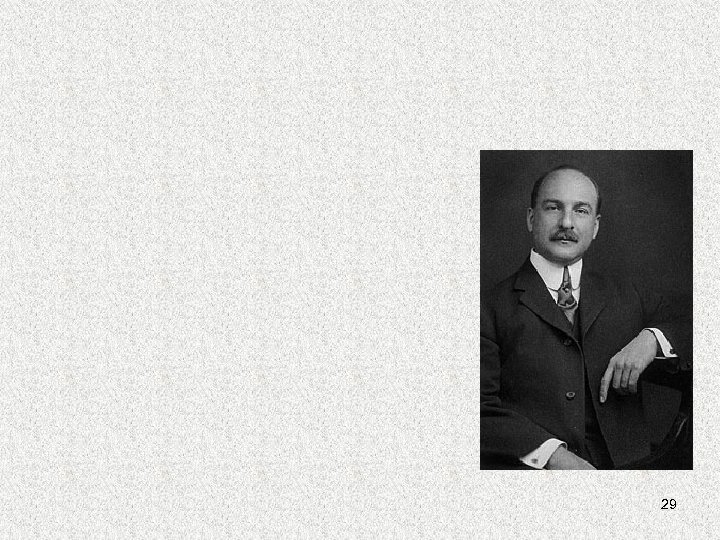
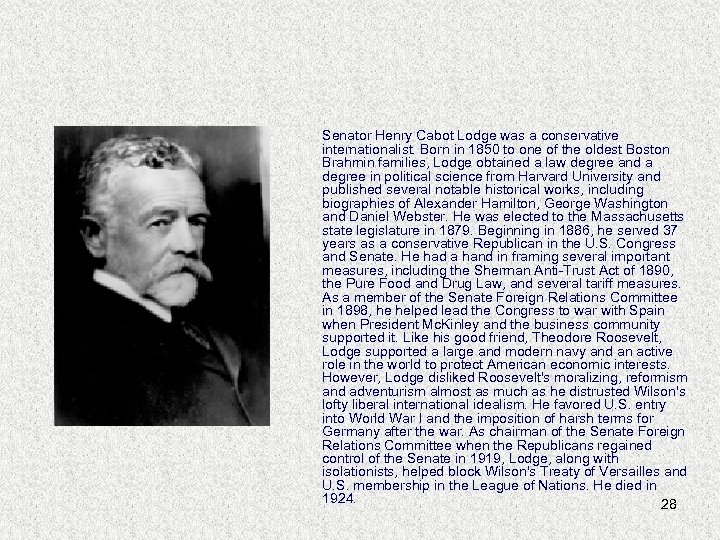 Senator Henry Cabot Lodge was a conservative internationalist. Born in 1850 to one of the oldest Boston Brahmin families, Lodge obtained a law degree and a degree in political science from Harvard University and published several notable historical works, including biographies of Alexander Hamilton, George Washington and Daniel Webster. He was elected to the Massachusetts state legislature in 1879. Beginning in 1886, he served 37 years as a conservative Republican in the U. S. Congress and Senate. He had a hand in framing several important measures, including the Sherman Anti-Trust Act of 1890, the Pure Food and Drug Law, and several tariff measures. As a member of the Senate Foreign Relations Committee in 1898, he helped lead the Congress to war with Spain when President Mc. Kinley and the business community supported it. Like his good friend, Theodore Roosevelt, Lodge supported a large and modern navy and an active role in the world to protect American economic interests. However, Lodge disliked Roosevelt's moralizing, reformism and adventurism almost as much as he distrusted Wilson's lofty liberal international idealism. He favored U. S. entry into World War I and the imposition of harsh terms for Germany after the war. As chairman of the Senate Foreign Relations Committee when the Republicans regained control of the Senate in 1919, Lodge, along with isolationists, helped block Wilson's Treaty of Versailles and U. S. membership in the League of Nations. He died in 1924. 28
 29
29
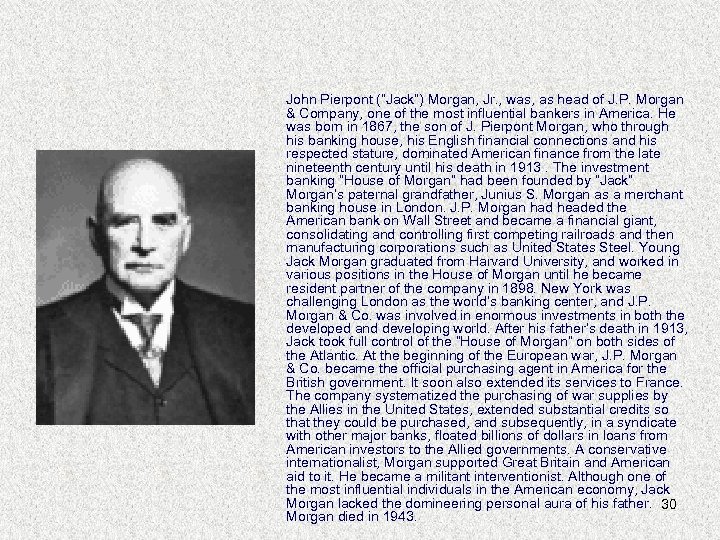 John Pierpont (“Jack”) Morgan, Jr. , was, as head of J. P. Morgan & Company, one of the most influential bankers in America. He was born in 1867, the son of J. Pierpont Morgan, who through his banking house, his English financial connections and his respected stature, dominated American finance from the late nineteenth century until his death in 1913. The investment banking “House of Morgan” had been founded by “Jack” Morgan’s paternal grandfather, Junius S. Morgan as a merchant banking house in London. J. P. Morgan had headed the American bank on Wall Street and became a financial giant, consolidating and controlling first competing railroads and then manufacturing corporations such as United States Steel. Young Jack Morgan graduated from Harvard University, and worked in various positions in the House of Morgan until he became resident partner of the company in 1898. New York was challenging London as the world’s banking center, and J. P. Morgan & Co. was involved in enormous investments in both the developed and developing world. After his father’s death in 1913, Jack took full control of the “House of Morgan” on both sides of the Atlantic. At the beginning of the European war, J. P. Morgan & Co. became the official purchasing agent in America for the British government. It soon also extended its services to France. The company systematized the purchasing of war supplies by the Allies in the United States, extended substantial credits so that they could be purchased, and subsequently, in a syndicate with other major banks, floated billions of dollars in loans from American investors to the Allied governments. A conservative internationalist, Morgan supported Great Britain and American aid to it. He became a militant interventionist. Although one of the most influential individuals in the American economy, Jack Morgan lacked the domineering personal aura of his father. 30 Morgan died in 1943.
 31
31
 32
32
 33
33
 34
34
 35
35
 36
36
 37
37
 38
38
 39
39
 40
40
 41
41
 42
42
 43
43
 44
44
 45
45
 46
46
 47
47
 48
48