


 Скачать презентацию 1 1 Coen 001 Understanding Digital Technologies Ron
507921d14906472de920851d559d9610.ppt
- Количество слайдов: 17
 (1. 1) Coen 001 Understanding Digital Technologies Ron Danielson Fall 2000
 Introductions · Professor – Ron Danielson » » computer engineering faculty member chief information officer 24 years at SCU 8 years managing university computing and communication services – office Orradre 129, phone 554 -6813, email rdanielson@scu. edu – office hours » M 12: 00 - 1: 00, F 2: 15 - 3: 00 » by appointment (1. 2)
 (1. 3) · Students
 Administrative Stuff (1. 4) · Text – Danielson, Understanding Digital Technologies, draft manuscript, 1999 · Objectives – learn about significant concepts of digital computers » » semiconductor devices and processing computer hardware software development and systems computer networks
 Administrative Stuff (continued) (1. 5) · Objectives (continued) – gain » understanding of workings of digital technology » appreciation for relationships between components of digital systems » apply that knowledge to new instances of digital technologies » understanding of positive and negative impacts on individuals and society
 Administrative Stuff (continued) (1. 6) · Core curriculum technology requirement learning outcomes: demonstrate an understanding of – the nature of technology – technology’s social context – the ways computer networks are structured – how to use networks as sources of information – some discipline-specific tools
 (1. 7) Administrative Stuff (continued) · Web site – http: //www. cse. scu. edu/~rdaniels/ · Web board – http: //wb. scu. edu/~rdanielson · Grading – 2 midterms – homeworks – Web board participation – student presentation – final 35% 7. 5% 25%
 Historical Trends (1. 8) · Amazing price-performance improvement of digital computers – over history » ENIAC, 1947 • 1, 600 square feet; many tons; 5, 000 adds per second » modern PC • 2 square feet; 20 pounds; 100, 000 adds per second; 1, 000 times lower cost! – over shorter periods of time » Cray Y-MP (1988 - fastest supercomputer) vs. IBM Power-2 (1993 - fastest workstation) » equal or better performance for 1/10 of price
 Historical Trends (continued) (1. 9) · Price-performance (continued) – for individual people » IBM 360/75 at U of I for academic computing needs of 35, 000 students (1975) » Intel 486 PC in my office at home (1993) » faster, more memory, more storage, graphics for 1/1000 of price
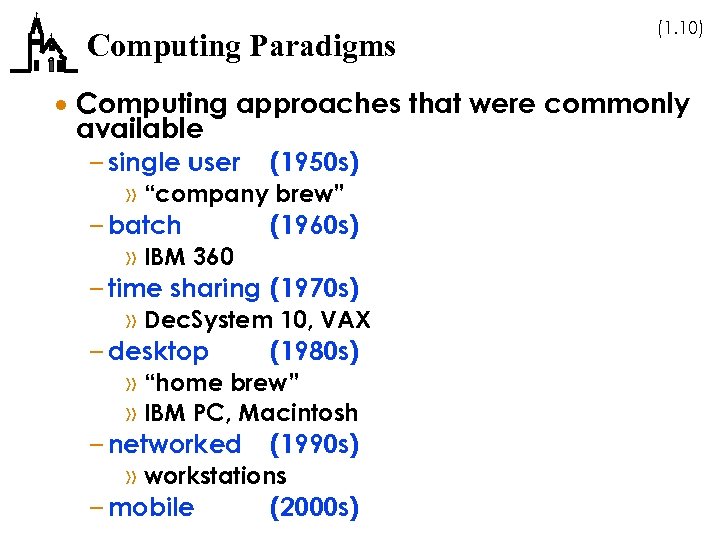 Computing Paradigms (1. 10) · Computing approaches that were commonly available – single user (1950 s) » “company brew” – batch (1960 s) » IBM 360 – time sharing (1970 s) » Dec. System 10, VAX – desktop (1980 s) » “home brew” » IBM PC, Macintosh – networked (1990 s) » workstations – mobile (2000 s)
 Computing Paradigms (continued) · History repeats itself – network computers (1. 11)
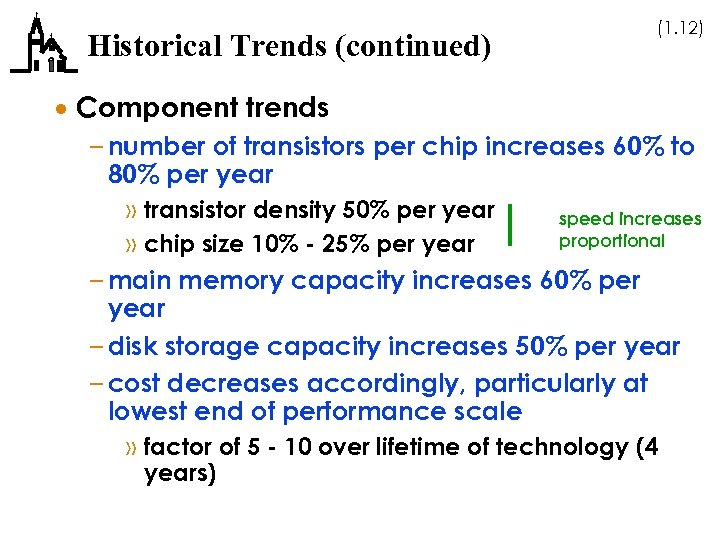 Historical Trends (continued) (1. 12) · Component trends – number of transistors per chip increases 60% to 80% per year » transistor density 50% per year » chip size 10% - 25% per year speed increases proportional – main memory capacity increases 60% per year – disk storage capacity increases 50% per year – cost decreases accordingly, particularly at lowest end of performance scale » factor of 5 - 10 over lifetime of technology (4 years)
 (1. 13) Historical Trends (continued) · What does this mean for people who use computers? – dedicated computing capacity – software with more functionality – penetration of computer use into daily activities – willingness to let the computer be idle changes in behavior
 (1. 14) Why Bother? · Ubiquitous computers – apparent (PCs, mainframes) – hidden (thermostats and dishwashers) – tremendous change of » speed » cost » size no sign of slowdown · Personal impact – work » productivity tools » accelerated communication » shift of jobs • content and location » learning – play » games and Internet
 Why Bother (continued)? · Societal impact – access » haves and have-nots » content related to personal and community standards – education – reliability – privacy – medical (1. 15)
 What’s Understanding? · Coverage – major areas of digital technologies » » semiconductors hardware software and systems networks – concepts – current capabilities – future directions (1. 16)
 What’s Understanding (continued)? (1. 17) · Scientific understanding – physical and logical principles · Engineering understanding – organization – analysis – improvement · Society – what are the impacts of a technology? – what impacts are inherent to the technology? – what impacts are due to misapplication?