


 Скачать презентацию 1 -1 Chapter 15 Wholesaling and Logistics
a52ef1194d5a9762b42b3f40e5dad498.ppt
- Количество слайдов: 20
 1 -1
1 -1
 Chapter 15 Wholesaling and Logistics Management 1 -2 c. Graw-Hill/Irwin M Copyright © 2004 by The Mc. Graw-Hill Companies, Inc. All rights reserved.
 After studying this chapter you should be able to: ¢ ¢ Identify and discuss the roles of different types of full -service and limited-function wholesalers. ¢ Explain differences among the functions of agents, brokers, and commission merchants. ¢ 1 -3 Understand wholesaling and describe three basic categories of wholesalers. Understand the differences between manufacturers’ sales branches and offices.
 After studying this chapter you should be able to: ¢ ¢ Define logistics management and explain its key role in marketing. ¢ Understand logistics activities. ¢ 1 -4 Appreciate how slow growth rates and globalization will affect wholesaling in the future. Discuss how some of the key ethical and legal issues affect logistics.
 Wholesaling and Logistics Management ¢ Wholesalers: l ¢ Logistics Management: l 1 -5 Intermediaries in the marketing channel that sell to customers other than individual or house hold consumers. The planning, implementing, and movement of goods, services, and related information from point of origin to point of consumption.
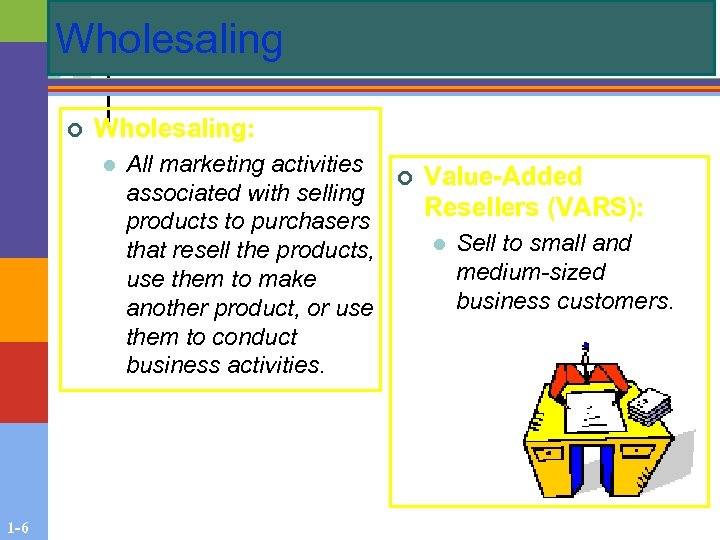 Wholesaling ¢ Wholesaling: l 1 -6 All marketing activities associated with selling products to purchasers that resell the products, use them to make another product, or use them to conduct business activities. ¢ Value-Added Resellers (VARS): l Sell to small and medium-sized business customers.
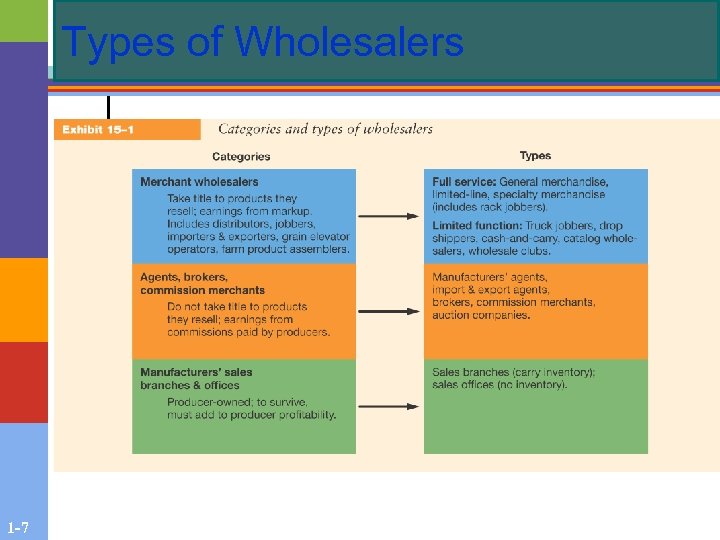 Types of Wholesalers 1 -7
 Merchant Wholesalers ¢ Are also called “Distributors” and can be: Full-service wholesalers l Limited-function wholesalers l More then 375, 000 merchant wholesalers are based in the U. S. ! 1 -8
 Full-Service Wholesalers ¢ TYPES: General Merchandise Wholesalers l Limited-line Wholesalers l Specialty-line Wholesalers l Rack Jobbers l 1 -9
 Limited-Function Wholesalers ¢ TYPES: Truck Jobbers l Drop Shippers l Cash-and-Carry Wholesalers l Catalog Wholesalers l Wholesale Clubs l 1 -10
 Agents, Brokers, and Commission Merchants ¢ Agents: Manufacturers’ agents, also called “manufacturers’ representatives” or “reps” l Auction Houses l Import Agents l Export Agents l Almost 48, 000 agent, broker, and commission merchant organizations operate at the wholesale level! 1 -11
 Agents, Brokers, and Commission Merchants ¢ ¢ ¢ 1 -12 Brokers Commission Merchants Manufacturers’ Sales Branches and Offices
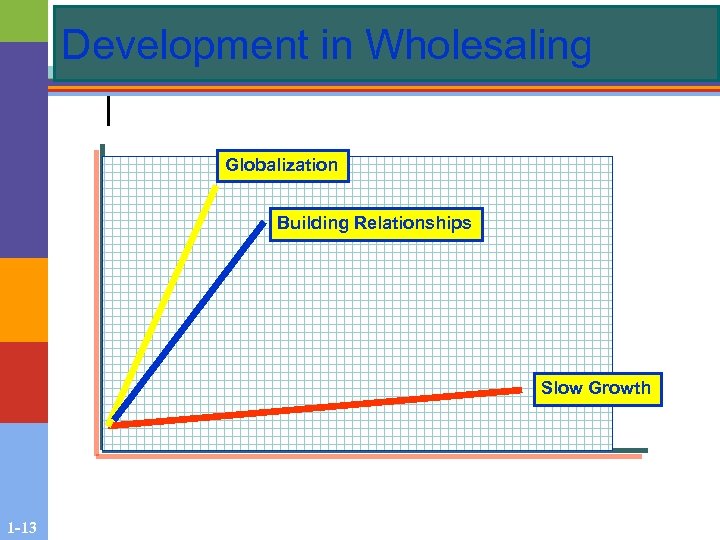 Development in Wholesaling Globalization Building Relationships Slow Growth 1 -13
 Logistics Management ¢ Logistics Management: l 1 -14 Managing the movement of goods, services, and related information from point of origin to point of consumption.
 Importance of Logistics to Marketing ¢ 1 -15 Customer Expectations of Suppliers’ Logistics Systems: l Timely pickups for outgoing orders. l On-time delivery. l Prompt claim settlement for lost or damaged goods. l Accurate invoicing. l Interactive Website for tracking & customer service. l Well-trained drivers and customer support staff. l Process for analyzing and correcting service failures. l Centralized, accessible customer service. l Good communication with customers. l Responsiveness form all supplier departments.
 Key Activities in Logistics ¢ ¢ Materials Handling: l Bar Coding l RFID ¢ 1 -16 Warehousing: l Private Warehouses l Public Warehouses l Distribution Centers Inventory Control: l JIT l QR l SCM l EDI
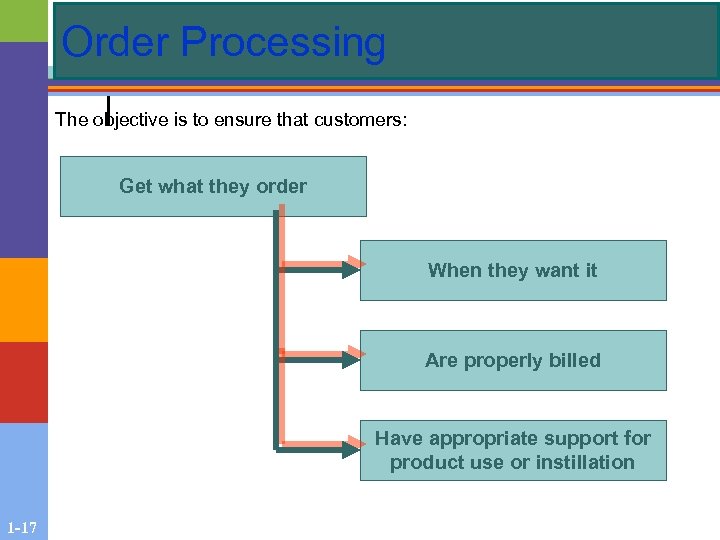 Order Processing The objective is to ensure that customers: Get what they order When they want it Are properly billed Have appropriate support for product use or instillation 1 -17
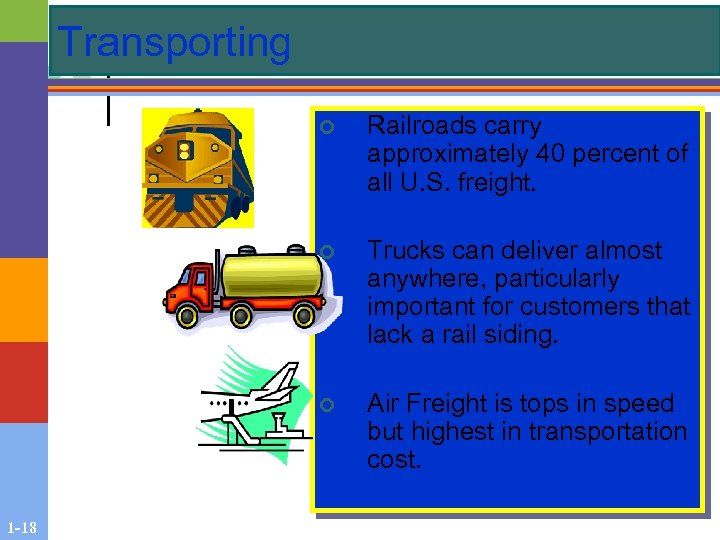 Transporting ¢ ¢ Trucks can deliver almost anywhere, particularly important for customers that lack a rail siding. ¢ 1 -18 Railroads carry approximately 40 percent of all U. S. freight. Air Freight is tops in speed but highest in transportation cost.
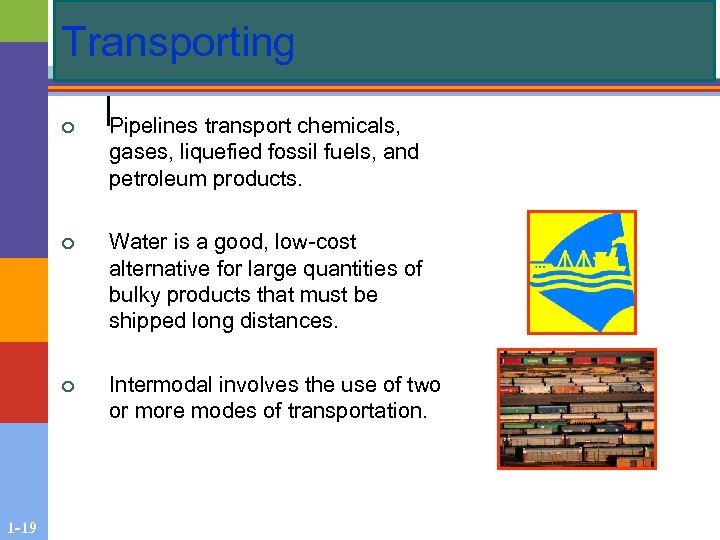 Transporting ¢ ¢ Water is a good, low-cost alternative for large quantities of bulky products that must be shipped long distances. ¢ 1 -19 Pipelines transport chemicals, gases, liquefied fossil fuels, and petroleum products. Intermodal involves the use of two or more modes of transportation.
 Ethical and Legal Issues in Logistics ¢ ¢ ¢ Deregulation Ethical Issues Safety Issues Shippers have a responsibility to protect their employees and the general public from unsafe practices and materials! 1 -20