


 Скачать презентацию 1 1 A question of what and how
Lecture 3_1. Man&Mat_Flows.ppt
- Количество слайдов: 35
 1. 1 A question of what and how much • For his survival and pleasure man is using all kinds of material from the surrounding world: – For food; – For shelter; – For transportation – Other needs and demands in everyday life. 2/11/2018 Lecture 5. Man and Materials Flows 1
 Turnover of materials caused by man • In “nature state” society and today – Quantitative and qualitative difference; – materials turnover amounts to 60 tones per year and per capita (German society) 2/11/2018 Lecture 5. Man and Materials Flows 2
 How long it can continue? ? ? ! Is it sustainable? • Factor of four • and Factor of ten • Weitszekker 2/11/2018 Lecture 5. Man and Materials Flows 3
 Changes in natural cycles • • • Nitrogen Carbon Phosphorus Sulfur And – metals – Chemical compounds 2/11/2018 Lecture 5. Man and Materials Flows 4
 1. 3 The need for a system perspective • Four the most important trends: – From local to global (philosophy of dilution) – From specific to diffuse – From short delay to long delay – From low complexity to high complexity 2/11/2018 Lecture 5. Man and Materials Flows 5
 1. 4 Matter is conserved • Thermodynamics deals with different forms of energy and matter and conversions between them; • The first low of thermodynamics (the low of mass conservation) – Different levels (forms) of matter 2/11/2018 Lecture 5. Man and Materials Flows 6
 1. 5 Flows and transformation of materials • Flows of materials means transformation of materials between different forms, not movement; • Man is extracting natural materials in a raw form and transform them into more valuable forms; • There is a material flow between forms. 2/11/2018 Lecture 5. Man and Materials Flows 7
 Thermodynamics • Is heavily connected to structure and changes at the molecular/atomic level; • Exergy needed in a chain of transformations is normally dominated by the chemical extraction of the valuable material from the raw; • Modern industrial processed are quite near these limits; • Further forming in manufacturing is done on a macrolevel with a small input of exergy; • On the other hand the industrial practices in these processes are generally far from thermodynamics limits. 2/11/2018 Lecture 5. Man and Materials Flows 8
 Types of flow • the flows of the conserved entities can be of two general kinds: – Linear – Circular 2/11/2018 Lecture 5. Man and Materials Flows 9
 Roots of resources and environmental problems • Many resources and environmental problems have their roots in this fundamental aspect of conservation of matter, for instance use of fossil fuels: – Exhaustion scarce resources of energy-rich compounds containing reduced carbon; – Accumulation of carbon dioxide in the atmosphere; – This ultimately changes the radiation balance and climate on the Earth. 2/11/2018 Lecture 5. Man and Materials Flows 10
 By-flows (побічні потоки) • Transferred into processes (like sulfur, nitrogen , heavy metals in fossils) • Material, which are not incorporated in the final products but are still coupled to it (water, cleaning agents, lubricants – мастила). Often they are lost in the waste stream; • Flows of overburden and useless common rock, they are much larger then the extracted valuable material; • Bulding of roads and other infrastructure; • Flows which are not involved into any flow (leakage, losses) • Transportation of people, materials, and information transportation. 2/11/2018 Lecture 5. Man and Materials Flows 11
 Summary • The human-caused materials flows are much larger then natural; • Man is heavily disturbing the natural cycles of the elements and the basic prerequisites of the natural ecosystems; • The character of the environmental problem is changing. They penetrate in a complex way deep into the metabolism of the industrial society; • the necessary adaptation is needed but its realization and understanding what a sustainable society look like are unknown. 2/11/2018 Lecture 5. Man and Materials Flows 12
 3. 1. MIPS: a materials intensity concept Materials input per service unit Wuppertal Institute of Climate, Environment and Energy, Germany 2/11/2018 Lecture 5. Man and Materials Flows 13
 Main ideas • Industrialized society is an enormous mobilizer of materials; • Size and characteristics of these anthropogenic flows are the matter of the discussion; • MIPS concept was developed to catch and describe the overall materials mobilization. 2/11/2018 Lecture 5. Man and Materials Flows 14
 Big idea to remember: the law of mass conservation • Due to Einstein formula: E=mc 2 • (If we disregards nuclear reactions and radioactive decay) The number of atoms/ions of a certain nuclide is conserved as well as a total number of electrons; • (In a system in which there also no chemical reactions) The number of various molecules is conserved. • Hence chemical substances which are constantly emitted to the environment will remain and accumulate somewhere unless it is broken down or changed in chemical reactions. 2/11/2018 Lecture 5. Man and Materials Flows 15
 Materials intensity is a measure of the amount of materials used to provide a certain amount of service. Two kind of flows: • Extracted from nature and • Fed into society. 2/11/2018 Lecture 5. Man and Materials Flows 16
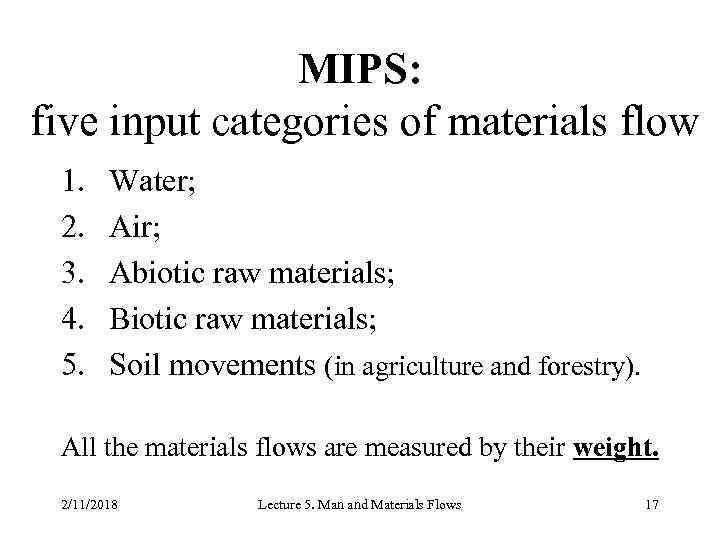 MIPS: five input categories of materials flow 1. 2. 3. 4. 5. Water; Air; Abiotic raw materials; Biotic raw materials; Soil movements (in agriculture and forestry). All the materials flows are measured by their weight. 2/11/2018 Lecture 5. Man and Materials Flows 17
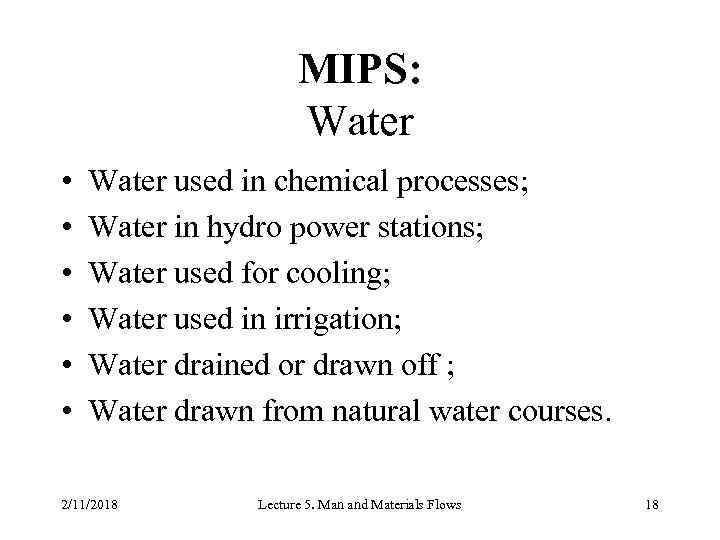 MIPS: Water • • • Water used in chemical processes; Water in hydro power stations; Water used for cooling; Water used in irrigation; Water drained or drawn off ; Water drawn from natural water courses. 2/11/2018 Lecture 5. Man and Materials Flows 18
 MIPS: Air • Air used in combustion; • Air used as a raw material in chemical or physical processes. 2/11/2018 Lecture 5. Man and Materials Flows 19
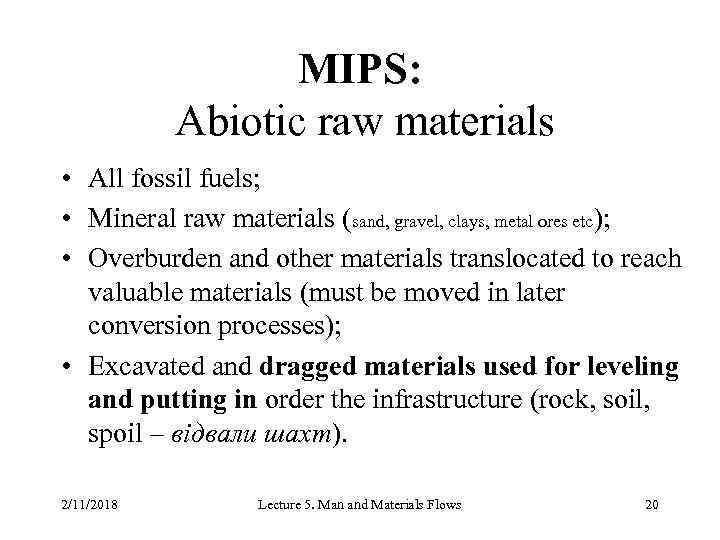 MIPS: Abiotic raw materials • All fossil fuels; • Mineral raw materials (sand, gravel, clays, metal ores etc); • Overburden and other materials translocated to reach valuable materials (must be moved in later conversion processes); • Excavated and dragged materials used for leveling and putting in order the infrastructure (rock, soil, spoil – відвали шахт). 2/11/2018 Lecture 5. Man and Materials Flows 20
 MIPS: Biotic raw materials Biomass both from • human-maintained ecosystems; • and natural ecosystems. 2/11/2018 Lecture 5. Man and Materials Flows 21
 MIPS: Soil movements (in agriculture and forestry) • The working on soils in agriculture; • The erosion of soils due to human activity. 2/11/2018 Lecture 5. Man and Materials Flows 22
 MIPS: five input categories (measured by their weight) • • • Water; Air; Abiotic raw materials; Biotic raw materials; Soil movements (in agriculture and forestry). 1. What do the overall material flows look like? 2. Which flows dominate? 3. What are the characteristics of societal metabolism? 2/11/2018 Lecture 5. Man and Materials Flows 23
 3. 3. The Ecological Rucksack, (Schmidt-Bleek, 1994) flows of materials that are not included at all in products but are necessary part of extraction or are more or less unavoidable by-flows. 2/11/2018 Lecture 5. Man and Materials Flows 24
 3. 3. The Ecological Rucksack, (Schmidt-Bleek, 1994) Example of German economy: Annual domestic extraction of abiotic materials is about 4, 000 Mtones (50 tones per capita). About one-third is non-saleable materials (like overburden – пуста порода). 2/11/2018 Lecture 5. Man and Materials Flows 25
 Extraction of mineral raw materials is dominating by: • Building materials (sand, gravel); • Energy minerals (fossil fuels): – Coal – open cast mining. 2/11/2018 Lecture 5. Man and Materials Flows 26
 Extraction of mineral raw materials Metals • Iron: use volume is too high - 700 Mtones per year; • copper is used in relatively small amounts (10 Mtones), but its grade on ore is too low; • Aluminum (20 Mtones). 2/11/2018 Lecture 5. Man and Materials Flows 27
 Extraction of mineral raw materials Nonmetallic minerals • Phosphorus; • Concrete production. Their rucksack consists mainly of large dumps (руда) and translocated materials. 2/11/2018 Lecture 5. Man and Materials Flows 28
 Global extraction of biomass 9, 000 Mtones per year (like fossil fuels) • Food / animal feed (5, 000 Mtones); • Materials (2, 000 Mtones); • energy (2, 000 Mtones). 2/11/2018 Lecture 5. Man and Materials Flows 29
 Harvest of the sea • 0, 1 Mtones per year Fish catches gives 25% of the human intake of animal protein. 2/11/2018 Lecture 5. Man and Materials Flows 30
 3. 5. Intake of materials to technosphere Only a part of the totally mobilized materials flows is brought to society. How this intake of materials made up? 2/11/2018 Lecture 5. Man and Materials Flows 31
 3. 6. Accumulation and outflow of materials from technosphere From material conservation law: Mobilized material brought into technosphere can either • Accumulate in the built technosphere (period -? ) or • Contribute to the outflow of materials from the technosphere. 2/11/2018 Lecture 5. Man and Materials Flows 32
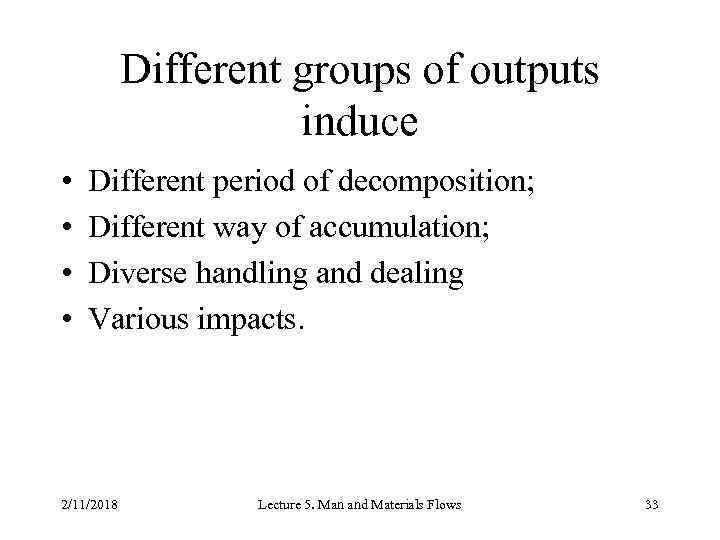 Different groups of outputs induce • • Different period of decomposition; Different way of accumulation; Diverse handling and dealing Various impacts. 2/11/2018 Lecture 5. Man and Materials Flows 33
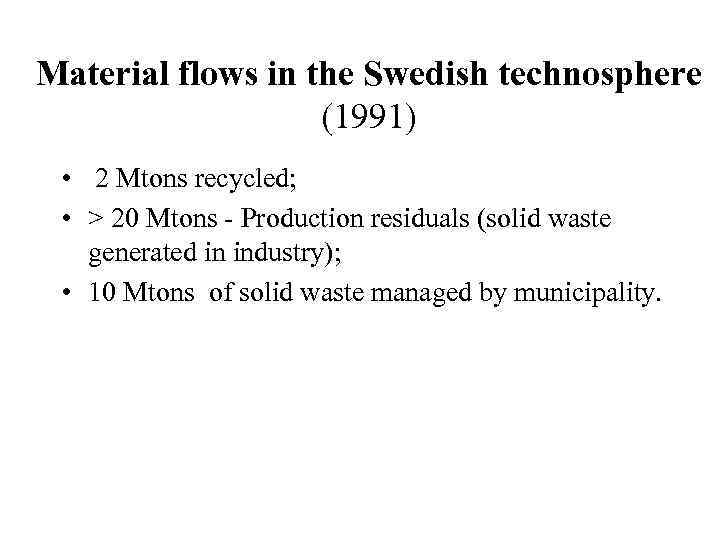 Material flows in the Swedish technosphere (1991) • 2 Mtons recycled; • > 20 Mtons - Production residuals (solid waste generated in industry); • 10 Mtons of solid waste managed by municipality. 2/11/2018 Lecture 5. Man and Materials Flows 34
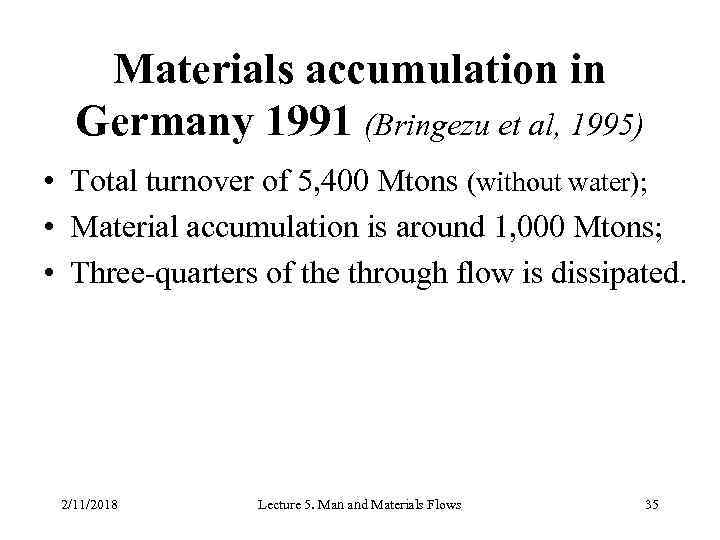 Materials accumulation in Germany 1991 (Bringezu et al, 1995) • Total turnover of 5, 400 Mtons (without water); • Material accumulation is around 1, 000 Mtons; • Three-quarters of the through flow is dissipated. 2/11/2018 Lecture 5. Man and Materials Flows 35