


 Скачать презентацию 1 040 1 401 ESD 018 Project Management Spring 2007
985a48520127c279b2616aae2f557adc.ppt
- Количество слайдов: 60
 1. 040/1. 401/ESD. 018 Project Management, Spring 2007 Lecture 15 Project Control Samuel Labi and Fred Moavenzadeh Department of Civil and Environmental Engineering Massachusetts Institute of Technology
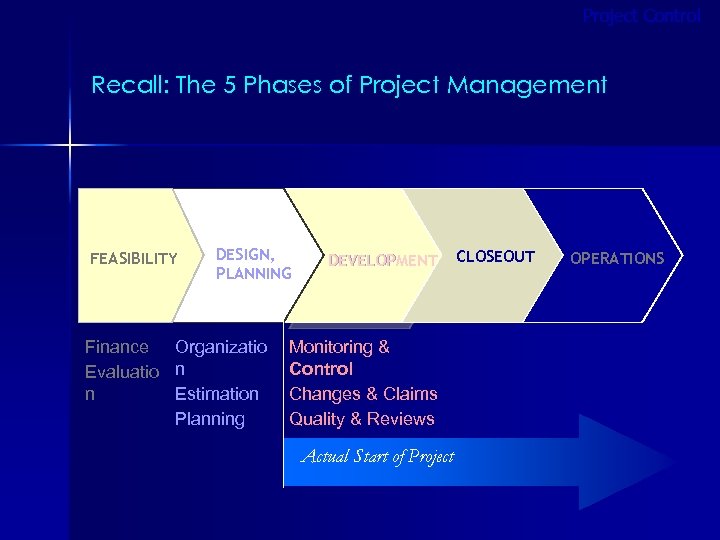 Project Control Recall: The 5 Phases of Project Management FEASIBILITY DESIGN, PLANNING Finance Organizatio Evaluatio n Estimation n Planning CLOSEOUT DEVELOPMENT CLOSEOUT Monitoring & Control Changes & Claims Quality & Reviews Actual Start of Project OPERATIONS
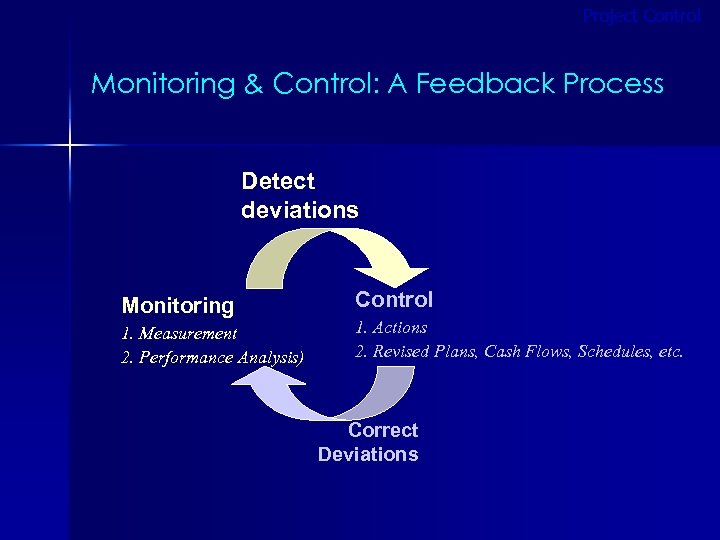 Project Control Monitoring & Control: A Feedback Process Detect deviations Monitoring 1. Measurement 2. Performance Analysis) Control 1. Actions 2. Revised Plans, Cash Flows, Schedules, etc. Correct Deviations
 Project Control: The Big Picture … Given Project is Off -track
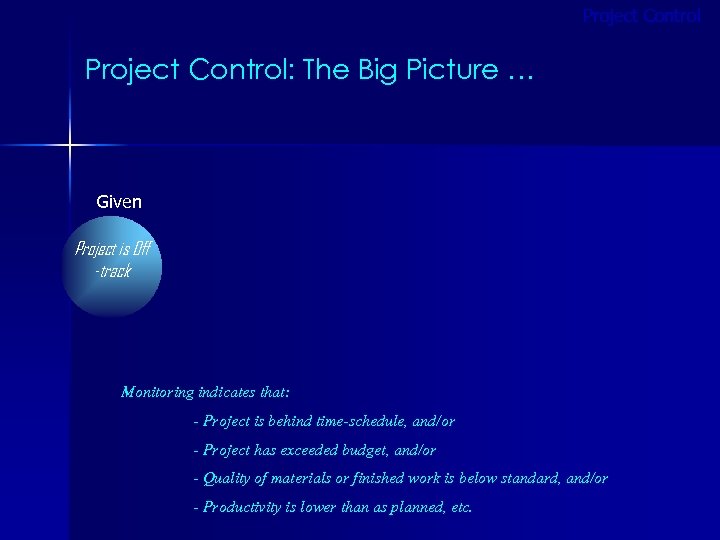 Project Control: The Big Picture … Given Project is Off -track Monitoring indicates that: - Project is behind time-schedule, and/or - Project has exceeded budget, and/or - Quality of materials or finished work is below standard, and/or - Productivity is lower than as planned, etc.
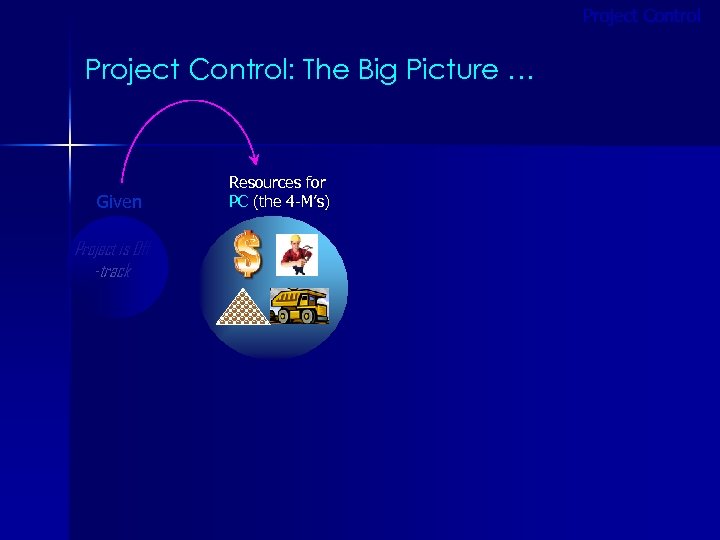 Project Control: The Big Picture … Given Project is Off -track Resources for PC (the 4 -M’s)
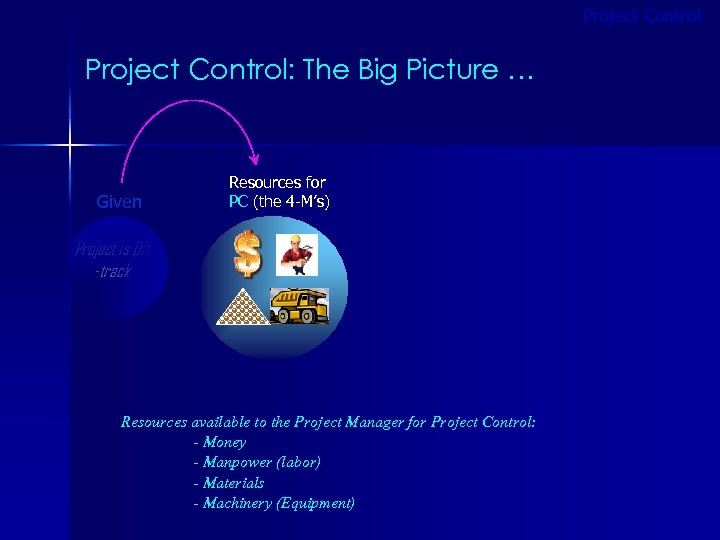 Project Control: The Big Picture … Given Resources for PC (the 4 -M’s) Project is Off -track Resources available to the Project Manager for Project Control: - Money - Manpower (labor) - Materials - Machinery (Equipment)
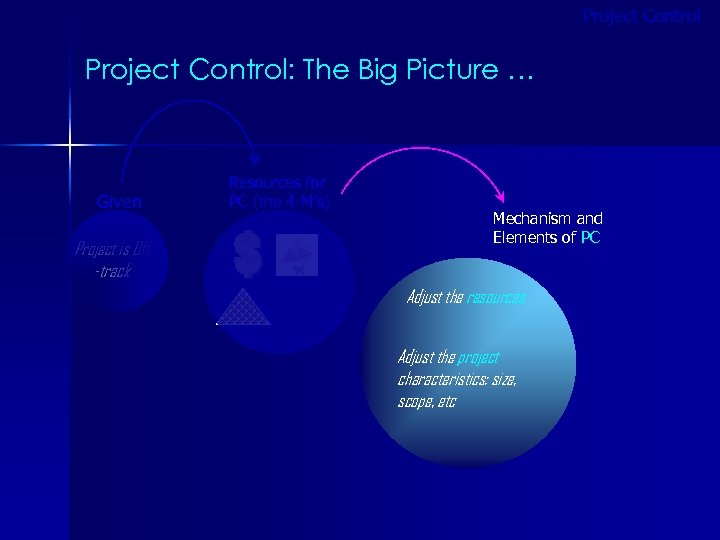 Project Control: The Big Picture … Given Project is Off -track Resources for PC (the 4 -M’s) Mechanism and Elements of PC Adjust the resources Adjust the project characteristics: size, scope, etc
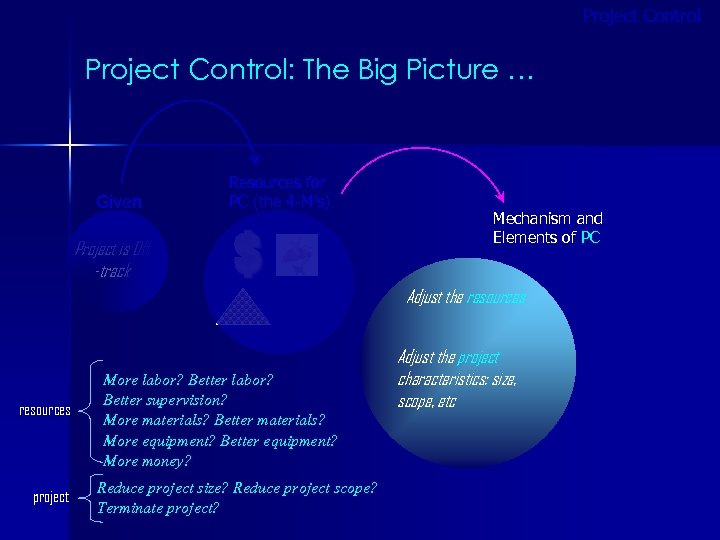 Project Control: The Big Picture … Given Resources for PC (the 4 -M’s) Project is Off -track Mechanism and Elements of PC Adjust the resources project More labor? Better supervision? More materials? Better materials? More equipment? Better equipment? More money? Reduce project size? Reduce project scope? Terminate project? Adjust the project characteristics: size, scope, etc
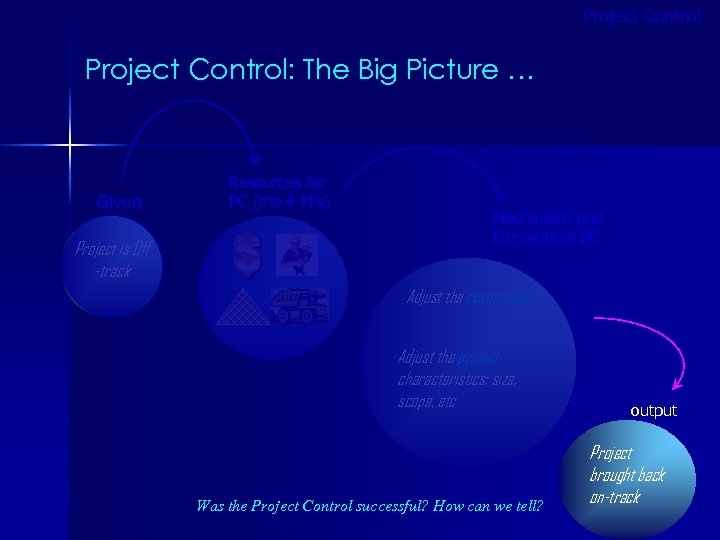 Project Control: The Big Picture … Given Project is Off -track Resources for PC (the 4 -M’s) Mechanism and Elements of PC Adjust the resources Adjust the project characteristics: size, scope, etc Was the Project Control successful? How can we tell? output Project brought back on-track
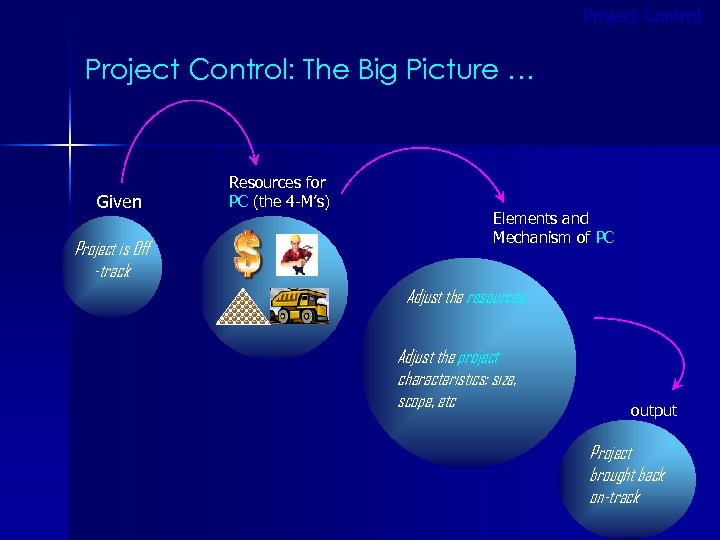 Project Control: The Big Picture … Given Project is Off -track Resources for PC (the 4 -M’s) Elements and Mechanism of PC Adjust the resources Adjust the project characteristics: size, scope, etc output Project brought back on-track
 Project Control Outline of this Lecture: 1. How can we tell when PC is needed? 2. What resources are available for PC? 3. What are the elements of PC? 4. What is the mechanism of PC? 5. Some important issues in Project Control
 Part 1 How can we tell when Project Control is needed?
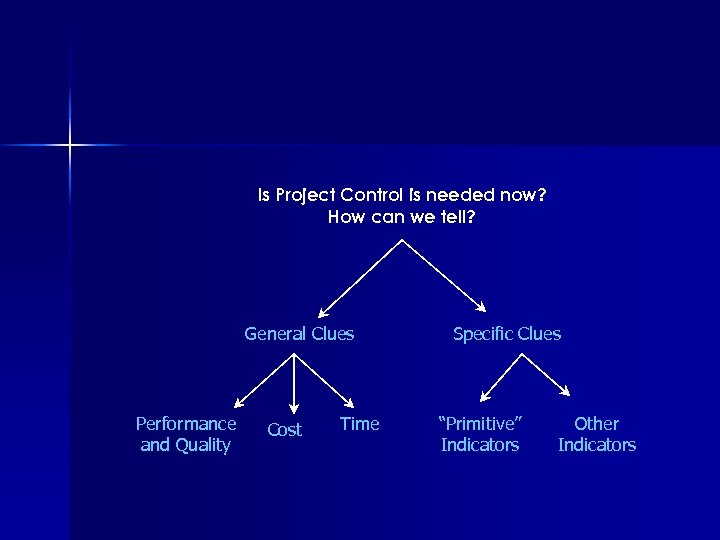 Is Project Control is needed now? How can we tell? General Clues Performance and Quality Cost Time Specific Clues “Primitive” Indicators Other Indicators
 How can we tell when Project Control is needed? GENERAL CLUES (Meredith and Mantel, 2006) n Performance - Unexpected technical problems arise - Insufficient resources are unavailable when needed - Quality or reliability problems occur - Owner/Client requires changes in technical specifications - Inter-functional complications and conflicts arise - Market changes that increase/decrease the project’s value
 How can we tell when Project Control is needed? GENERAL CLUES (Meredith and Mantel, 2006) n Cost - Technical difficulties that require more resources - Scope of work increases - Bid amount (accepted for the contract award) is too low - Reporting of the monitoring results are poor/late - Project budgeting for contractor cash flows not done right - Changes in market prices of the inputs
 How can we tell when Project Control is needed? GENERAL CLUES (Meredith and Mantel, 2006) n Time - Technical difficulties require more time to solve - Scope of work increases - Unexpected utilities needing relocation - Task sequencing not done right - Required material, labor/equipment unavailable when needed - Key preceding tasks were not completed on time.
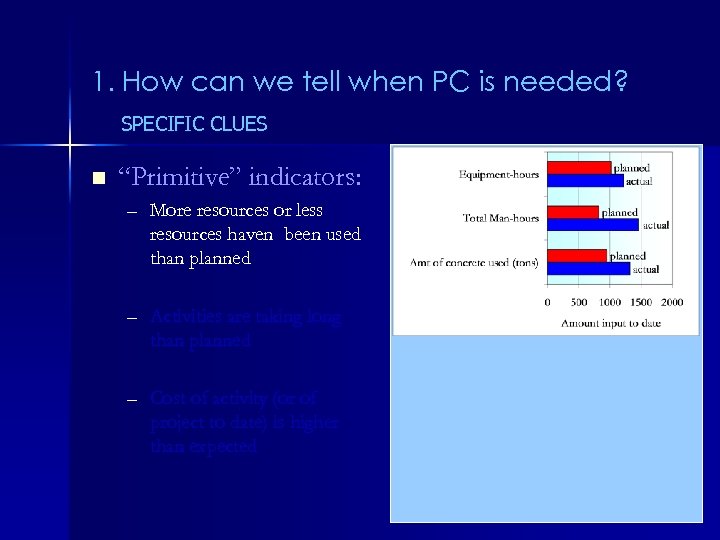 1. How can we tell when PC is needed? SPECIFIC CLUES n “Primitive” indicators: – More resources or less resources haven been used than planned – Activities are taking long than planned – Cost of activity (or of project to date) is higher than expected
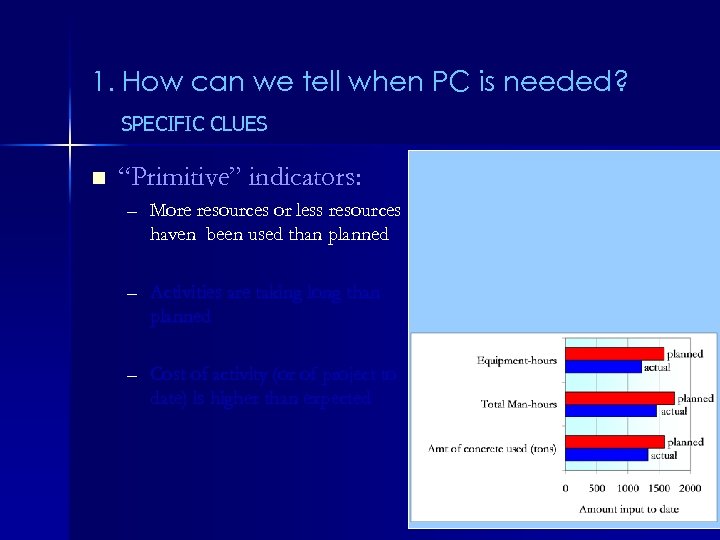 1. How can we tell when PC is needed? SPECIFIC CLUES n “Primitive” indicators: – More resources or less resources haven been used than planned – Activities are taking long than planned – Cost of activity (or of project to date) is higher than expected
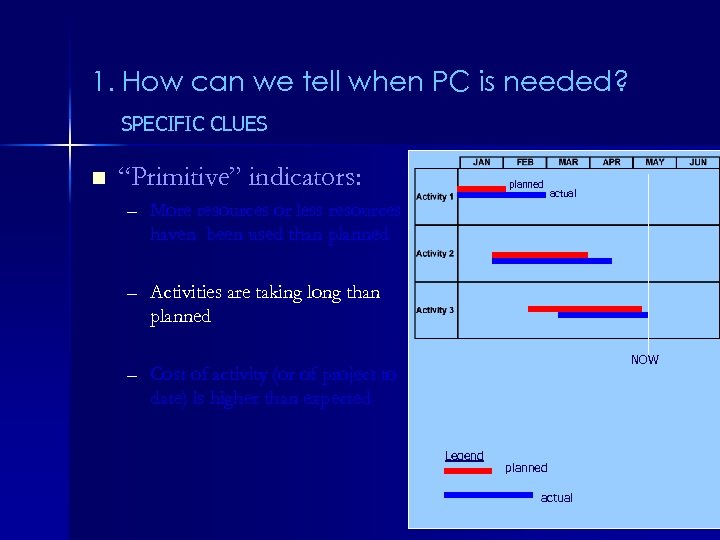 1. How can we tell when PC is needed? SPECIFIC CLUES n “Primitive” indicators: planned – More resources or less resources haven been used than planned actual – Activities are taking long than planned NOW – Cost of activity (or of project to date) is higher than expected Legend planned actual
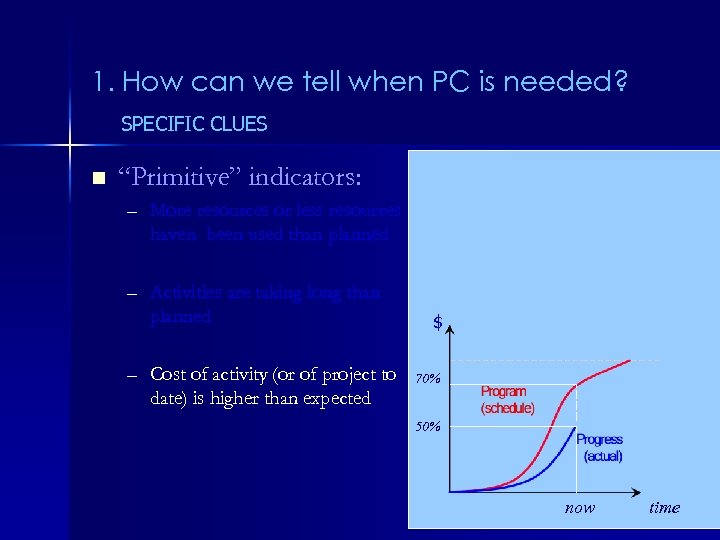 1. How can we tell when PC is needed? SPECIFIC CLUES n “Primitive” indicators: – More resources or less resources haven been used than planned – Activities are taking long than planned – Cost of activity (or of project to date) is higher than expected $ 70% 50% now time
 1. How can we tell when PC is needed? SPECIFIC CLUES Why are they “primitive”? - May be biased. - Do not consider that progress may be overestimated or underestimated due to: - execution of unscheduled work done, or execution of more work of low value and less work of high value
 1. How can we tell when PC is needed? SPECIFIC CLUES
 1. How can we tell when PC is needed? SPECIFIC CLUES now
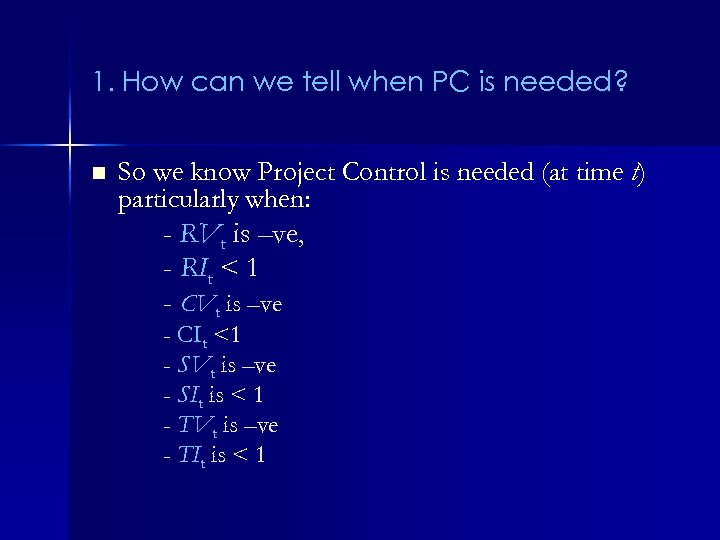 1. How can we tell when PC is needed? n So we know Project Control is needed (at time t) particularly when: - RVt is –ve, - RIt < 1 - CVt is –ve - CIt <1 - SVt is –ve - SIt is < 1 - TVt is –ve - TIt is < 1
 Part 2 Resources for Project Control
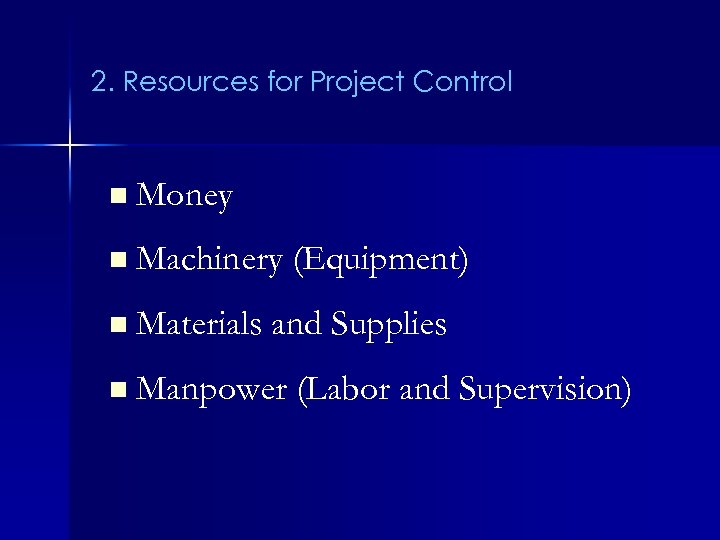 2. Resources for Project Control n Money n Machinery (Equipment) n Materials and Supplies n Manpower (Labor and Supervision)
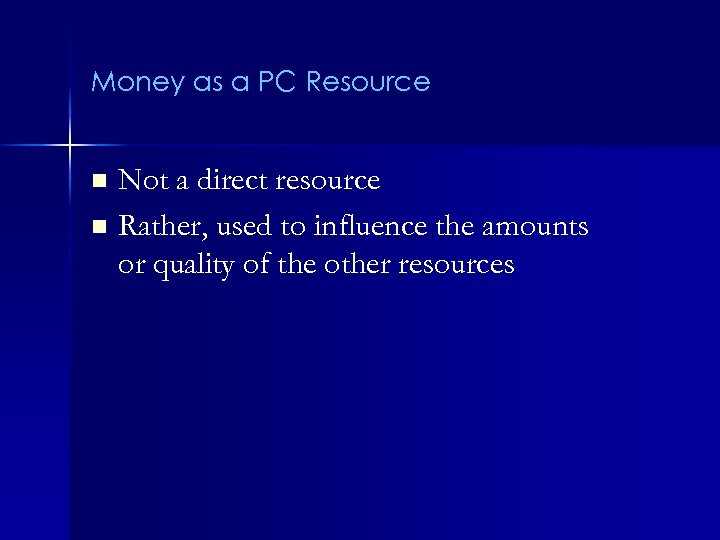 Money as a PC Resource Not a direct resource n Rather, used to influence the amounts or quality of the other resources n
 Using Equipment for PC n Often used to augment labor in order to speed up project n Can be expensive n May involve renting or purchasing
 Materials and Supplies as a PC Resource n Increase in quality or quantity may be necessary to enhance project control n Improved inventory systems for materials
 Manpower as a PC Resource n Project problems (time delays, excess costs, poor performance, etc. ) are partly due to the human element (action or inaction) n In using Manpower as a tool for project control, PM encounters human emotions (anger, fear, frustration, etc. )
 Part 3 Elements of Project Control
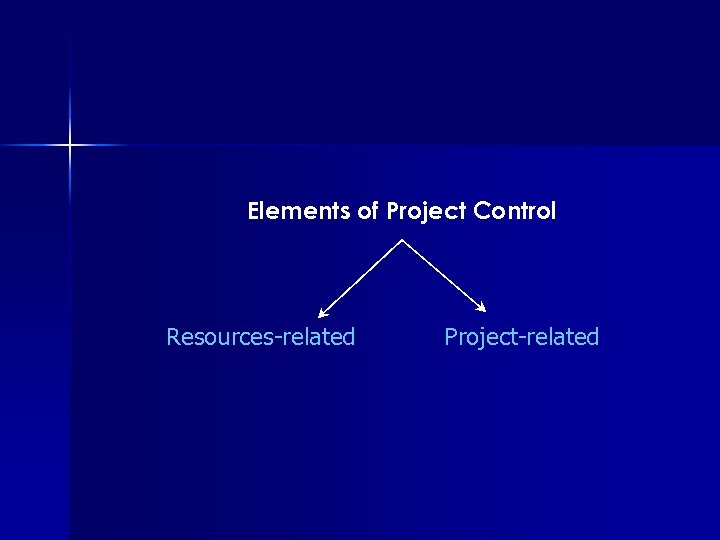 Elements of Project Control Resources-related Project-related
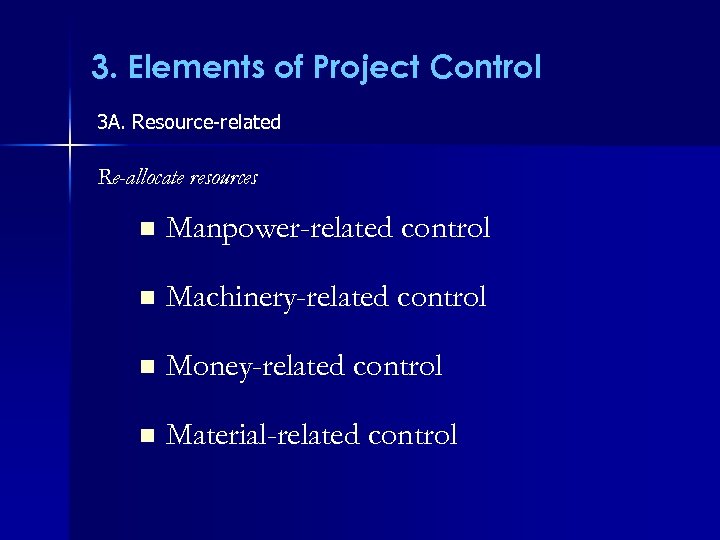 3. Elements of Project Control 3 A. Resource-related Re-allocate resources n Manpower-related control n Machinery-related control n Money-related control n Material-related control
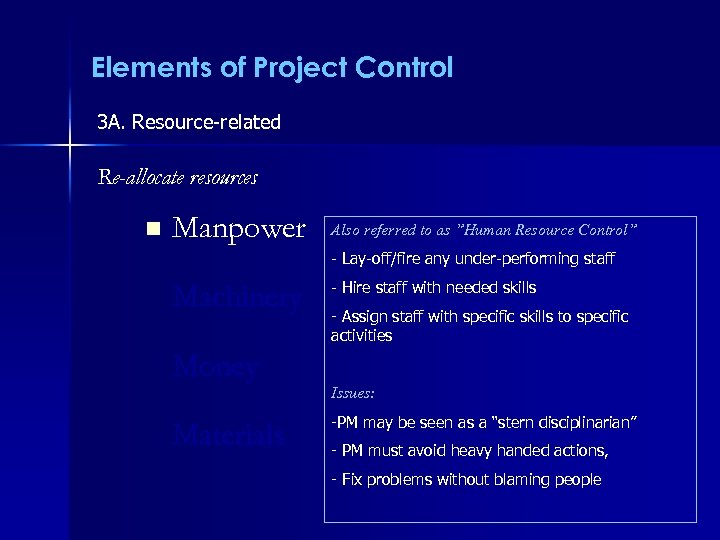 Elements of Project Control 3 A. Resource-related Re-allocate resources n Manpower Also referred to as ”Human Resource Control” - Lay-off/fire any under-performing staff Machinery Money Materials - Hire staff with needed skills - Assign staff with specific skills to specific activities Issues: -PM may be seen as a “stern disciplinarian” - PM must avoid heavy handed actions, - Fix problems without blaming people
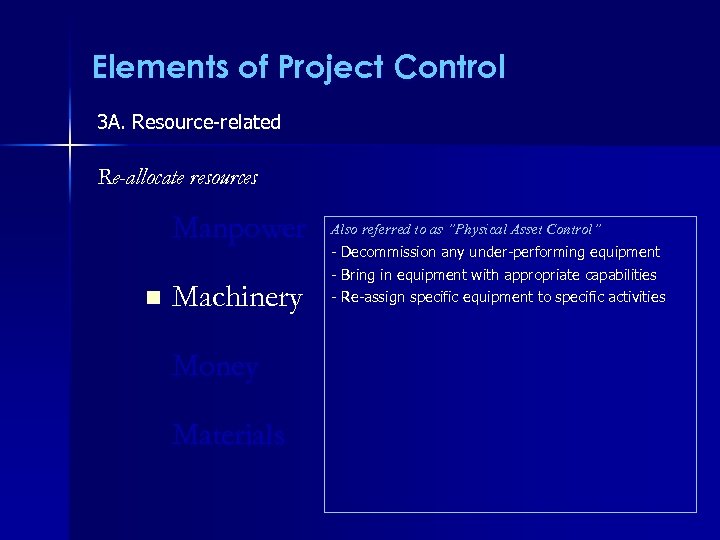 Elements of Project Control 3 A. Resource-related Re-allocate resources Manpower n Also referred to as ”Physical Asset Control” Machinery - Re-assign specific equipment to specific activities Money Materials - Decommission any under-performing equipment - Bring in equipment with appropriate capabilities
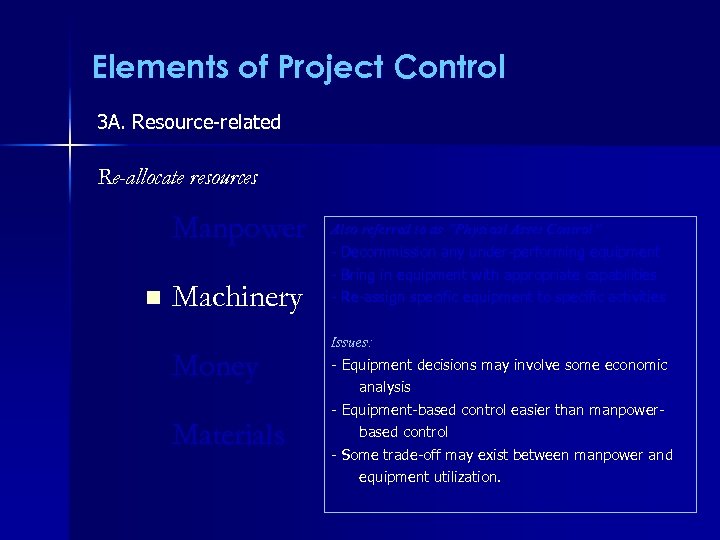 Elements of Project Control 3 A. Resource-related Re-allocate resources Manpower n Also referred to as ”Physical Asset Control” Machinery - Re-assign specific equipment to specific activities Money Materials - Decommission any under-performing equipment - Bring in equipment with appropriate capabilities Issues: - Equipment decisions may involve some economic analysis - Equipment-based control easier than manpowerbased control - Some trade-off may exist between manpower and equipment utilization.
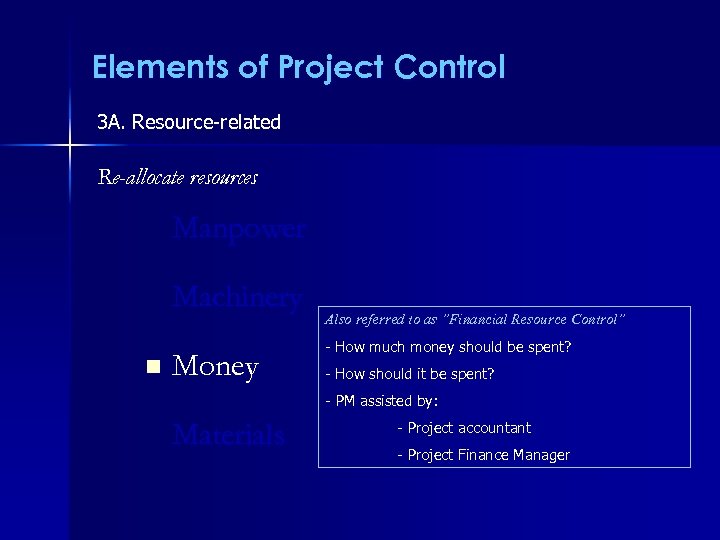 Elements of Project Control 3 A. Resource-related Re-allocate resources Manpower Machinery n Money Also referred to as ”Financial Resource Control” - How much money should be spent? - How should it be spent? - PM assisted by: Materials - Project accountant - Project Finance Manager
 Elements of Project Control 3 A. Resource-related Re-allocate resources Manpower Machinery Money n Materials - Discontinue use of sub-standard material - Seek new sources of superior material
 Elements of Project Control 3 B. Project-related n Options: - Reduce project size? - Reduce project scope? - Terminate project?
 Part 4 Mechanisms of Project Control
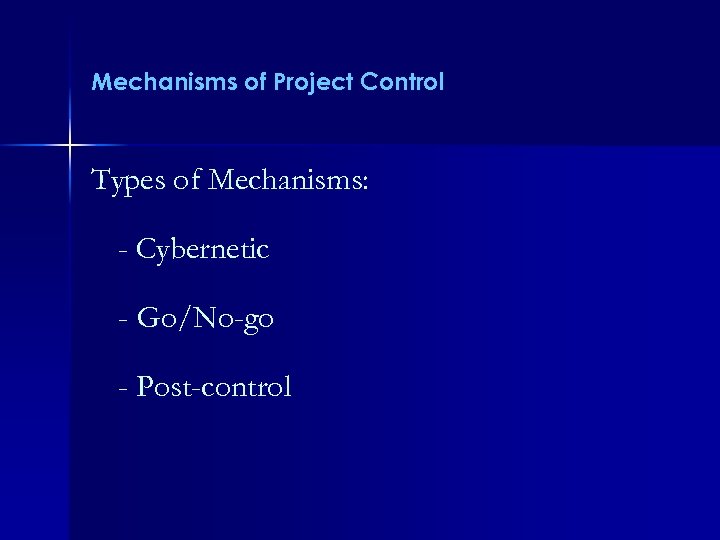 Mechanisms of Project Control Types of Mechanisms: - Cybernetic - Go/No-go - Post-control
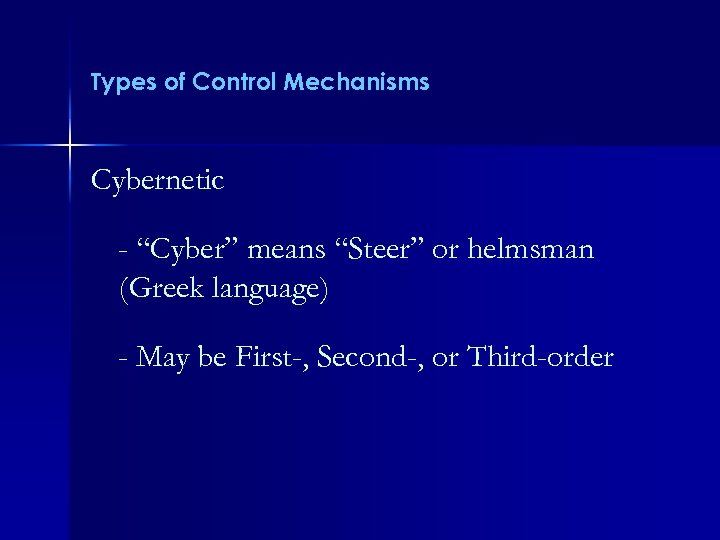 Types of Control Mechanisms Cybernetic - “Cyber” means “Steer” or helmsman (Greek language) - May be First-, Second-, or Third-order
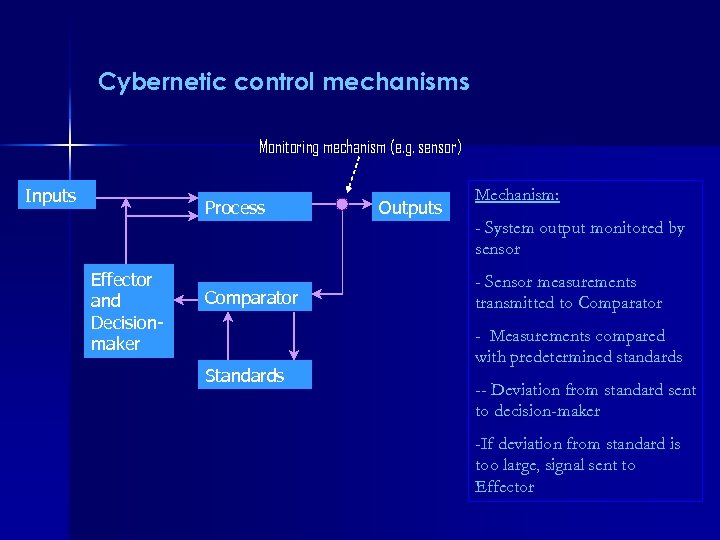 Cybernetic control mechanisms Monitoring mechanism (e. g. sensor) Inputs Process Effector and Decisionmaker Comparator Standards Outputs Mechanism: - System output monitored by sensor - Sensor measurements transmitted to Comparator - Measurements compared with predetermined standards -- Deviation from standard sent to decision-maker -If deviation from standard is too large, signal sent to Effector
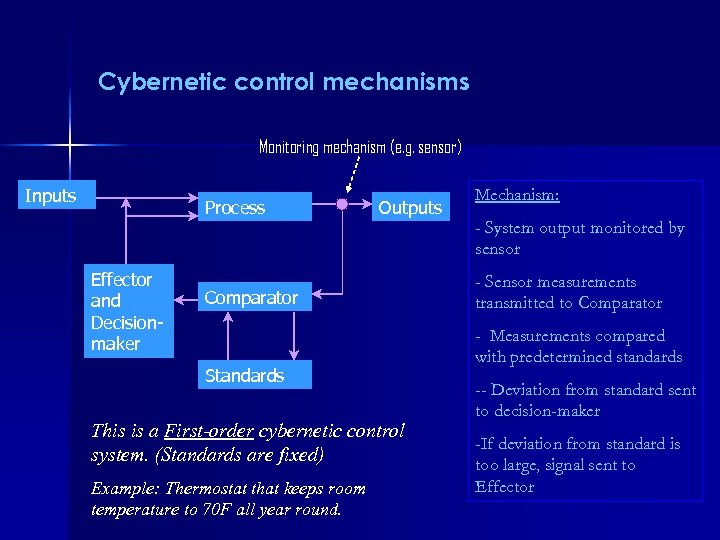 Cybernetic control mechanisms Monitoring mechanism (e. g. sensor) Inputs Process Effector and Decisionmaker Outputs Comparator Standards This is a First-order cybernetic control system. (Standards are fixed) Example: Thermostat that keeps room temperature to 70 F all year round. Mechanism: - System output monitored by sensor - Sensor measurements transmitted to Comparator - Measurements compared with predetermined standards -- Deviation from standard sent to decision-maker -If deviation from standard is too large, signal sent to Effector
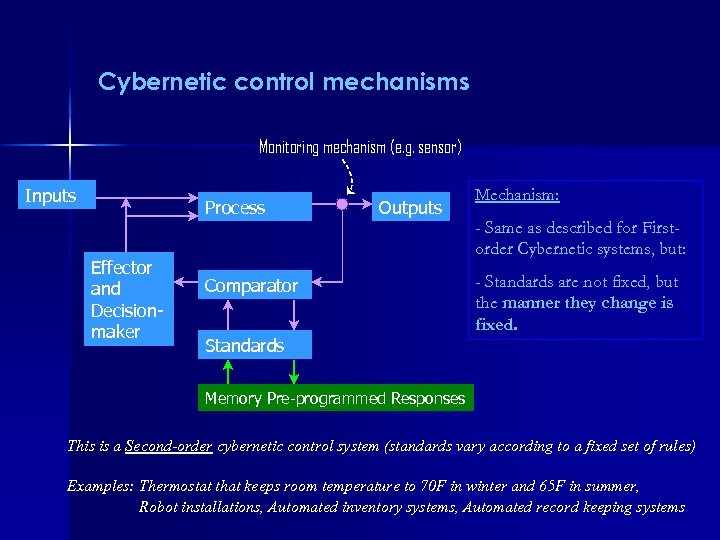 Cybernetic control mechanisms Monitoring mechanism (e. g. sensor) Inputs Process Effector and Decisionmaker Outputs Comparator Standards Mechanism: - Same as described for Firstorder Cybernetic systems, but: - Standards are not fixed, but the manner they change is fixed. Memory Pre-programmed Responses This is a Second-order cybernetic control system (standards vary according to a fixed set of rules) Examples: Thermostat that keeps room temperature to 70 F in winter and 65 F in summer, Robot installations, Automated inventory systems, Automated record keeping systems
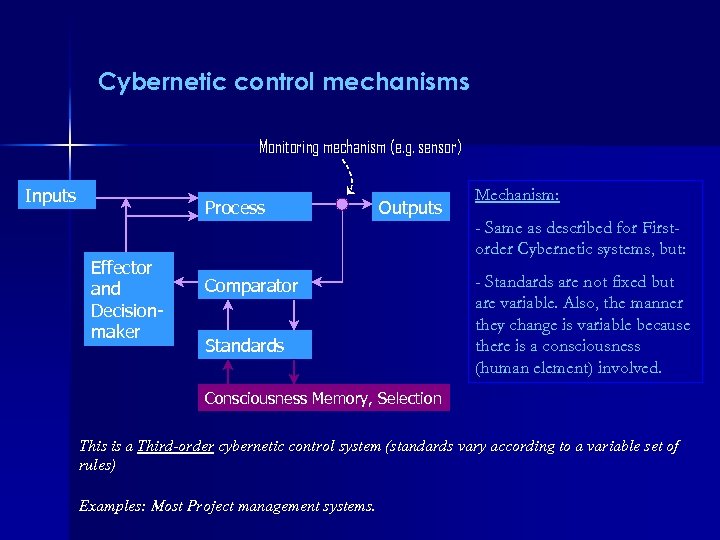 Cybernetic control mechanisms Monitoring mechanism (e. g. sensor) Inputs Process Effector and Decisionmaker Outputs Comparator Standards Mechanism: - Same as described for Firstorder Cybernetic systems, but: - Standards are not fixed but are variable. Also, the manner they change is variable because there is a consciousness (human element) involved. Consciousness Memory, Selection This is a Third-order cybernetic control system (standards vary according to a variable set of rules) Examples: Most Project management systems.
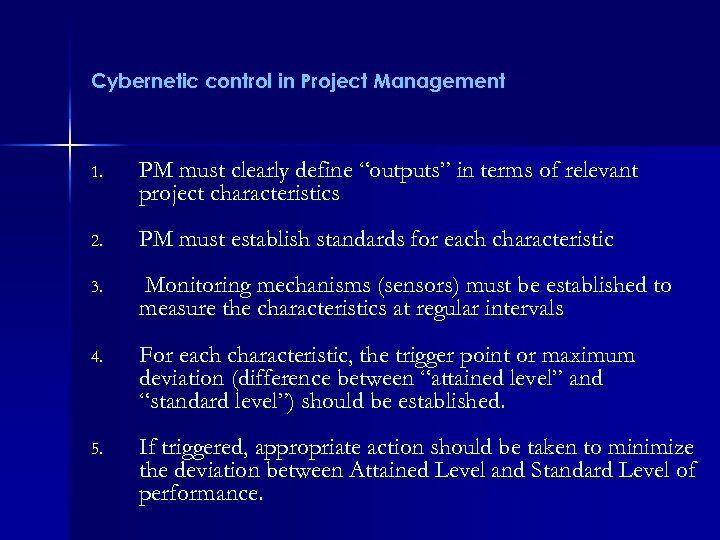 Cybernetic control in Project Management 1. PM must clearly define “outputs” in terms of relevant project characteristics 2. PM must establish standards for each characteristic 3. Monitoring mechanisms (sensors) must be established to measure the characteristics at regular intervals 4. For each characteristic, the trigger point or maximum deviation (difference between “attained level” and “standard level”) should be established. 5. If triggered, appropriate action should be taken to minimize the deviation between Attained Level and Standard Level of performance.
 “Go/No-go” Mechanisms of Project Control n Testing to see if some specific precondition has been achieved n Yes/No (discrete) n Control in most PM fall into this category (Cooper, 1994; Meredith and Mantel, 2006) n Example: Was Activity X completed within 6 months? n Did Activity Y cost exceed its budget of $1. 5 million? n Some engineering judgment is necessary in exercising these types of controls.
 Post-Control Types of Project Control n n Also called: Post-performance control, Post-performance review Is done after the activity or project is over n Like a post-mortem or report card n Is it “Locking the barn door after the horse has escaped”? n Or is it “We need to learn from the past to avoid future mistakes”? n Generates lessons from current projects so that future projects can be controlled better.
 Desired characteristics of a project control mechanism n Flexible – PC should be able to react to changes in system performance n Cost-effective – Value of PC should exceed cost of PC n Useful – Must really satisfy the needs of project, not the whims of the PM n Timely – Be able to react quickly before the problem overwhelms the project n Simple –Easy to understand operate n Adjustable – Capable of being adjusted to reflect changing priorities n Documented – so that training is possible
 Some Interesting Issues in Project Control Flexibility n Trade-offs n Some things to watch out for n Impediments to Project acceleration n Cost-only and time-only actions to control projects n
 Some Interesting Issues in Project Control Value of Flexibility in Project Planning n Flexibility is primary defense against risk n Planning too tightly may highly complicate control n Flexibility in construction is key during control n Want adequate float and contingency to change plans if needed Be careful on value engineering that limits flexibility! n
 Some Interesting Issues in Project Control Trade-offs between Performance Measures during Project Control n Can sometimes only correct for one performance measure at a time – Time – Cost – Quality n Need to understand tradeoffs and triage – Pick where to make tradeoffs (e. g. non-critical activities)
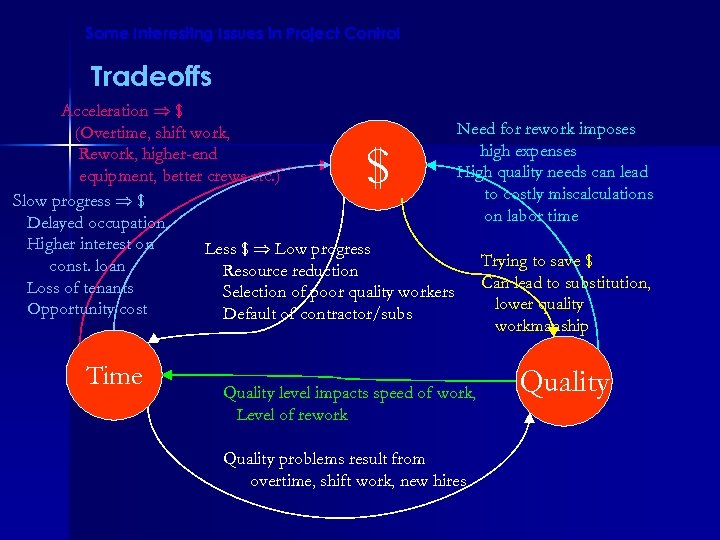 Some Interesting Issues in Project Control Tradeoffs Acceleration $ Need for rework imposes (Overtime, shift work, high expenses Rework, higher-end High quality needs can lead equipment, better crews etc. ) to costly miscalculations Slow progress $ on labor time Delayed occupation, Higher interest on Less $ Low progress Trying to save $ const. loan Resource reduction Can lead to substitution, Loss of tenants Selection of poor quality workers lower quality Opportunity cost Default of contractor/subs workmanship $ Time Quality level impacts speed of work, Level of rework Quality problems result from overtime, shift work, new hires Quality
 Some Interesting Issues in Project Control Trade-offs: The Time-Quality-Money Triage n In many cases, the best we can do is to pick the areas where tradeoffs do the least harm e. g. – Move resources from non-critical activities – Accelerate only critical activities – Sacrifice quality on non-critical items that can be remedied after substantial completion
 Some Interesting Issues in Project Control Some things to watch out for: Overreacting/Improvisation, etc. ) n n When trying to correct, often bump up against other limiting factors – Space constraints/Hiring time/Morale/Coordination difficulties Improvisation dangerous (working w/o planning) – Often can lead to “Snowballing” (increased problems at a rapidly accelerating rate) – Confusion, discoordination, cascading unanticipated effects, suboptimal work efficiency, lack of morale – Breaking “Job rhythm” and learning curves can really inhibit productivity!
 Some Interesting Issues in Project Controlling the Time Schedule – Project Crashing – Adding new project resources – Changing the “production function” (Change the technology) – Change operation conditions by altering the precedence, sequence, or timing of work n n n Fast-track, activity overlapping Overtime Shift work – Changes in the tools, methods, operating conditions – Work in more sheltered location
 Some Interesting Issues in Project Control Impediments to Project Acceleration n Human resources – Multiple-shift work Environmental/safety issues, High cost, Neighborhood objections – Overtime/extended workdays Fatigue, Lower morale, Rework – Increasing # of workers Training (takes time of most experienced!), Space constraints, Hiring time n Technology – Using more, larger or more efficient equipment Training/learning curve, Procurement time, Space constraints – Using faster-installing materials Procurement, Submittals for owner approval – Alternate construction methods Skill set, Learning curve, Unknown side-effects
 Some Interesting Issues in Project Control Impediments to Project Acceleration n Human resources – Multiple-shift work Environmental/safety issues, High cost, Neighborhood objections – Overtime/extended workdays Fatigue, Lower morale, Rework – Increasing # of workers Training (takes time of most experienced!), Space constraints, Hiring time n Technology – Using more, larger or more efficient equipment Training/learning curve, Procurement time, Space constraints – Using faster-installing materials Procurement, Submittals for owner approval – Alternate construction methods Skill set, Learning curve, Unknown side-effects