 Скачать презентацию 1 研討大綱 1 過去之研究進展 2 我們之提案 Jan
59986bc04801b2677b966cd0f2eb410a.ppt
- Количество слайдов: 47




1
研討大綱: 1. 過去之研究進展 2. 我們之提案 Jan, J. K. and Chen, Y. Y. (1998): Paramita. Wisdom Password Authentication Scheme without Verification Tables, The Journal of Systems and Software, U. S. A. , Vol. 42, Aug. 1998, PP. 45 -57. [SCI] 3. 小結語 2
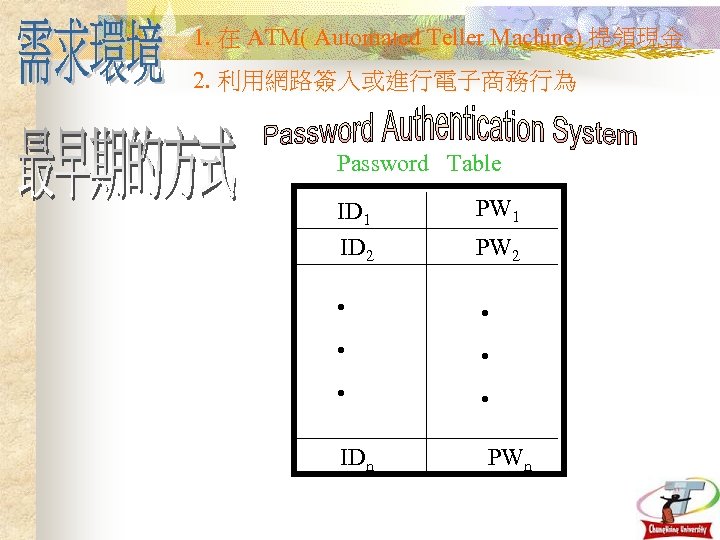
1. 在 ATM( Automated Teller Machine) 提領現金 2. 利用網路簽入或進行電子商務行為 Password Table ID 1 ID 2 PW 1 • • • IDn PW 2 3
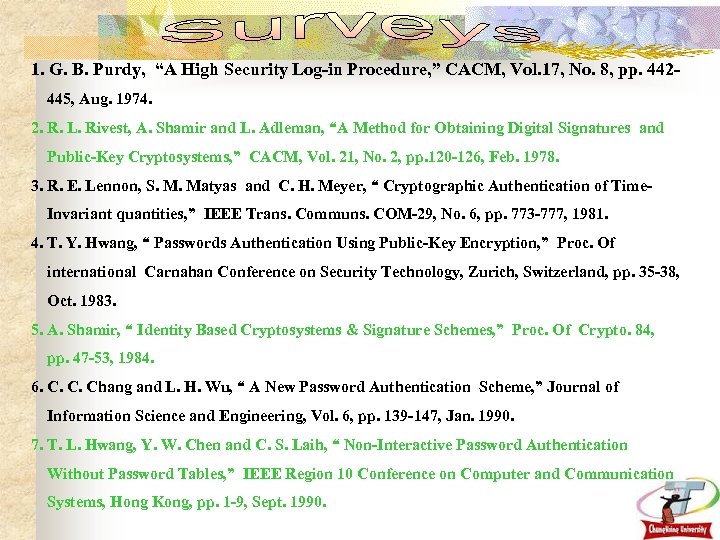
1. G. B. Purdy, “A High Security Log-in Procedure, ” CACM, Vol. 17, No. 8, pp. 442 - 445, Aug. 1974. 2. R. L. Rivest, A. Shamir and L. Adleman, “A Method for Obtaining Digital Signatures and Public-Key Cryptosystems, ” CACM, Vol. 21, No. 2, pp. 120 -126, Feb. 1978. 3. R. E. Lennon, S. M. Matyas and C. H. Meyer, “ Cryptographic Authentication of Time Invariant quantities, ” IEEE Trans. Communs. COM-29, No. 6, pp. 773 -777, 1981. 4. T. Y. Hwang, “ Passwords Authentication Using Public-Key Encryption, ” Proc. Of international Carnahan Conference on Security Technology, Zurich, Switzerland, pp. 35 -38, Oct. 1983. 5. A. Shamir, “ Identity Based Cryptosystems & Signature Schemes, ” Proc. Of Crypto. 84, pp. 47 -53, 1984. 6. C. C. Chang and L. H. Wu, “ A New Password Authentication Scheme, ” Journal of Information Science and Engineering, Vol. 6, pp. 139 -147, Jan. 1990. 7. T. L. Hwang, Y. W. Chen and C. S. Laih, “ Non-Interactive Password Authentication Without Password Tables, ” IEEE Region 10 Conference on Computer and Communication Systems, Hong Kong, pp. 1 -9, Sept. 1990. 4
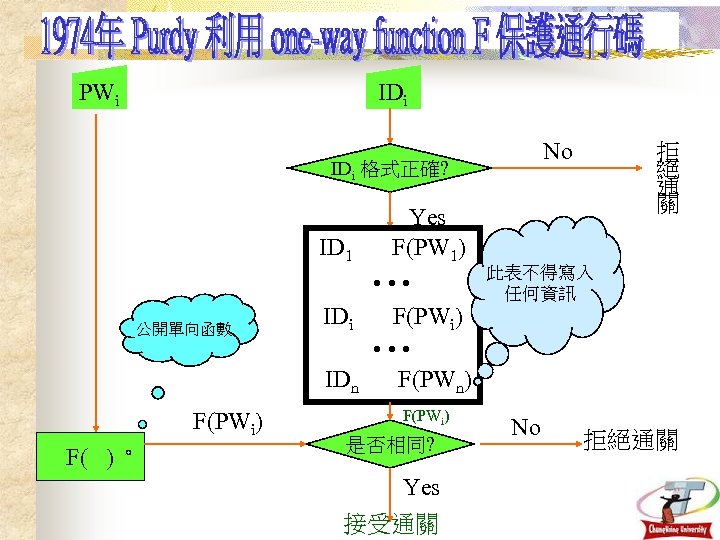
PWi IDi No IDi 格式正確? 公開單向函數 F(PWi) F( ) Yes ID 1 F(PW 1) • • • IDi F(PWi) • • • IDn F(PWn) F(PWi) 是否相同? Yes 接受通關 拒 絕 通 關 此表不得寫入 任何資訊 No 拒絕通關 5
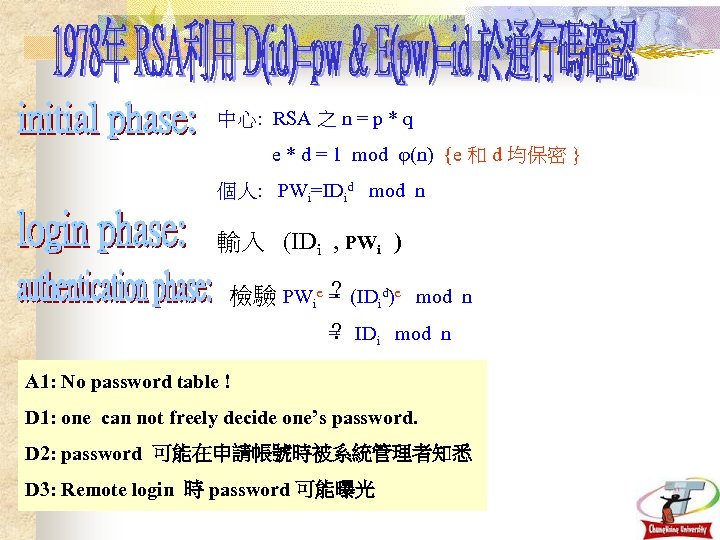
中心: RSA 之 n = p * q e * d = 1 mod (n) {e 和 d 均保密 } 個人: PWi=IDid mod n 輸入 (IDi , PWi ) ? 檢驗 PWie = (IDid)e mod n ? = IDi mod n A 1: No password table ! D 1: one can not freely decide one’s password. D 2: password 可能在申請帳號時被系統管理者知悉 D 3: Remote login 時 password 可能曝光 6
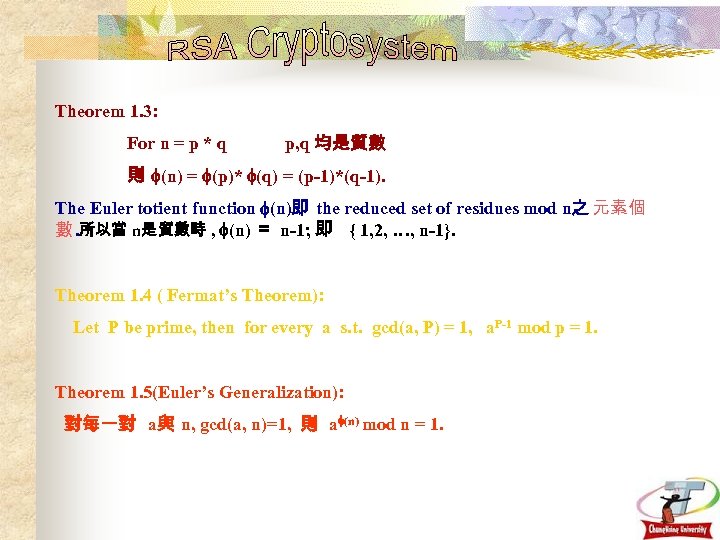
Theorem 1. 3: For n = p * q p, q 均是質數 則 (n) = (p)* (q) = (p-1)*(q-1). The Euler totient function (n)即 the reduced set of residues mod n之 元素個 數. 所以當 n是 質數時 , (n) = n-1; 即 { 1, 2, …, n-1}. Theorem 1. 4 ( Fermat’s Theorem): Let P be prime, then for every a s. t. gcd(a, P) = 1, a. P-1 mod p = 1. Theorem 1. 5(Euler’s Generalization): 對每一對 a與 n, gcd(a, n)=1, 則 a (n) mod n = 1. 7
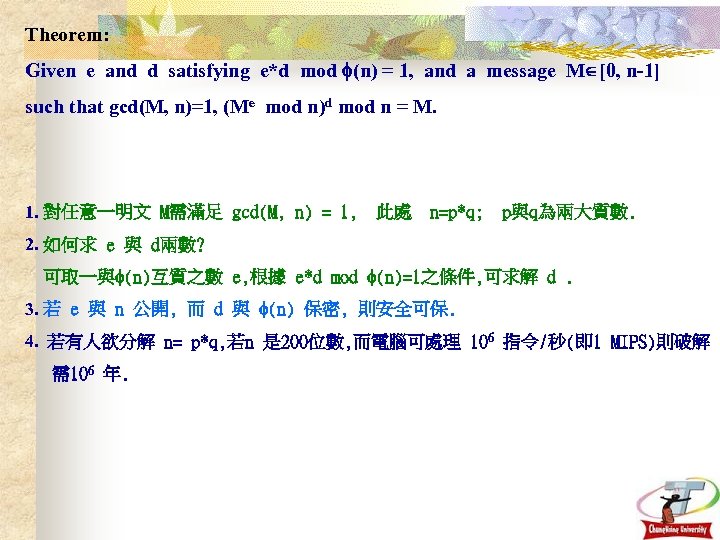
Theorem: Given e and d satisfying e*d mod (n) = 1, and a message M [0, n-1] such that gcd(M, n)=1, (Me mod n)d mod n = M. 1. 對任意一明文 M需滿足 gcd(M, n) = 1, 此處 n=p*q; p與q為兩大質數. 2. 如何求 e 與 d兩數? 可取一與 (n)互質之數 e, 根據 e*d mod (n)=1之條件, 可求解 d. 3. 若 e 與 n 公開, 而 d 與 (n) 保密, 則安全可保. 4. 若有人欲分解 n= p*q, 若n 是 200位數, 而電腦可處理 106 指令/秒(即 1 MIPS)則破解 需106 年. 8
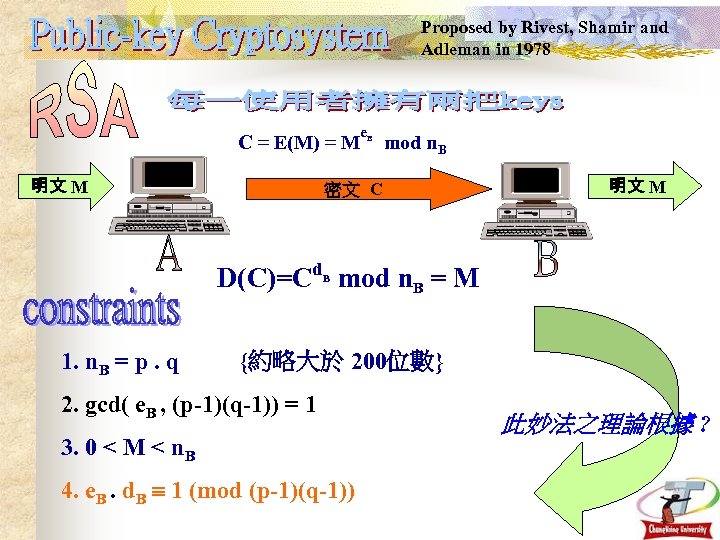
Proposed by Rivest, Shamir and Adleman in 1978 e. B C = E(M) = M mod n. B 明文 M 密文 C 明文 M D(C)=Cd mod n. B = M B 1. n. B = p. q {約略大於 200位數} 2. gcd( e. B , (p-1)(q-1)) = 1 3. 0 < M < n. B 4. e. B. d. B 1 (mod (p-1)(q-1)) 此妙法之理論根據 ? 9
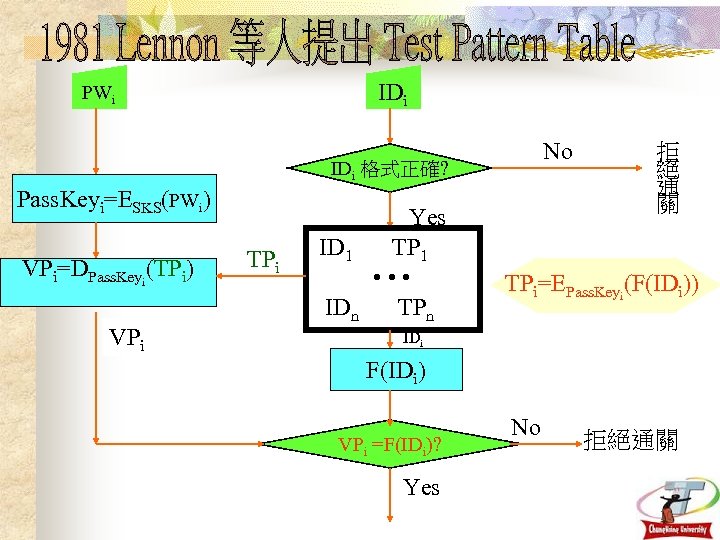
IDi PWi No IDi 格式正確? Pass. Keyi=ESKS(PWi) VPi=DPass. Keyi(TPi) VPi TPi Yes ID 1 TP 1 • • • IDn TPn 拒 絕 通 關 TPi=EPass. Keyi(F(IDi)) IDi F(IDi) VPi =F(IDi)? No 拒絕通關 Yes 10
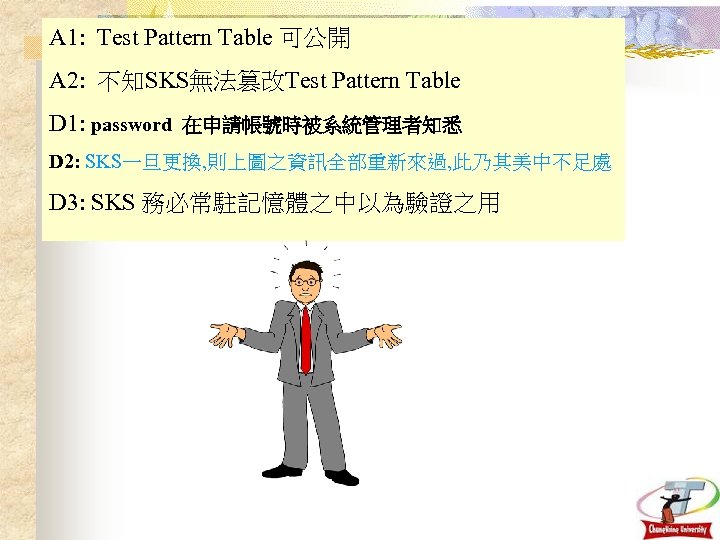
A 1: Test Pattern Table 可公開 A 2: 不知SKS無法篡改Test Pattern Table D 1: password 在申請帳號時被系統管理者知悉 D 2: SKS一旦更換, 則上圖之資訊全部重新來過, 此乃其美中不足處 D 3: SKS 務必常駐記憶體之中以為驗證之用 11
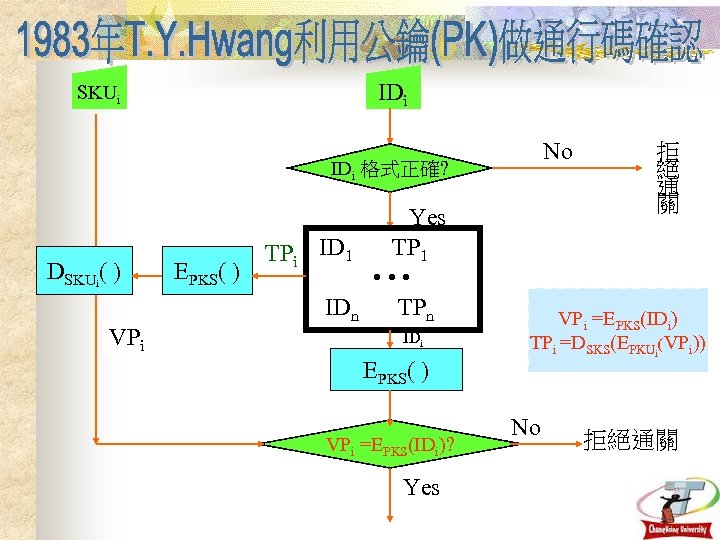
IDi SKUi No IDi 格式正確? DSKUi( ) VPi EPKS( ) TPi Yes ID 1 TP 1 • • • IDn TPn IDi EPKS( ) VPi =EPKS(IDi)? 拒 絕 通 關 VPi =EPKS(IDi) TPi =DSKS(EPKUi(VPi)) No 拒絕通關 Yes 12
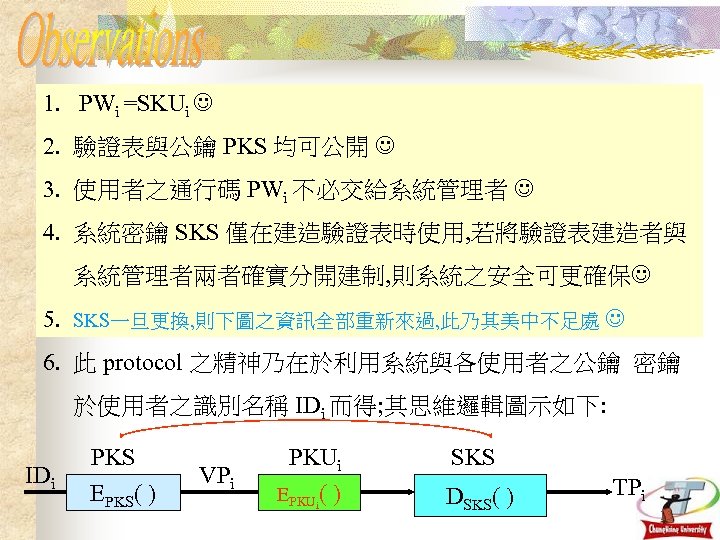
1. PWi =SKUi 2. 驗證表與公鑰 PKS 均可公開 3. 使用者之通行碼 PWi 不必交給系統管理者 4. 系統密鑰 SKS 僅在建造驗證表時使用, 若將驗證表建造者與 系統管理者兩者確實分開建制, 則系統之安全可更確保 5. SKS一旦更換, 則下圖之資訊全部重新來過, 此乃其美中不足處 6. 此 protocol 之精神乃在於利用系統與各使用者之公鑰 密鑰 於使用者之識別名稱 IDi 而得; 其思維邏輯圖示如下: IDi PKS EPKS( ) VPi PKUi EPKUi( ) SKS DSKS( ) TPi 13
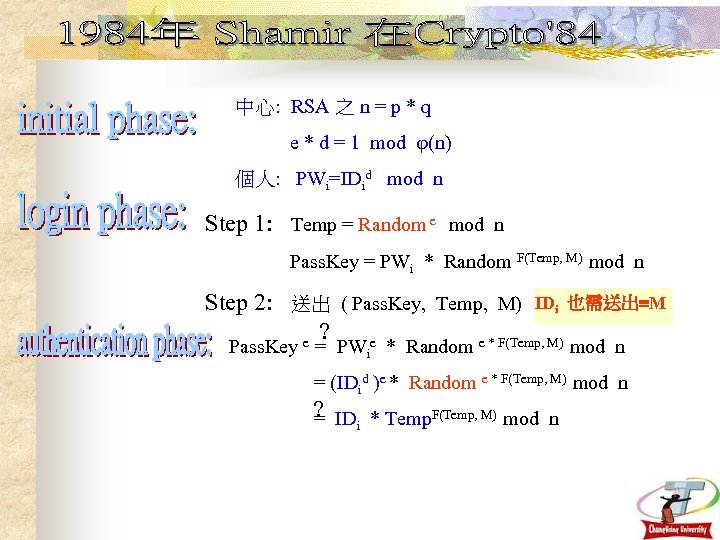
中心: RSA 之 n = p * q e * d = 1 mod (n) 個人: PWi=IDid mod n Step 1: Temp = Random e mod n Pass. Key = PWi * Random F(Temp, M) mod n Step 2: 送出 ( Pass. Key, Temp, M) IDi 也需送出 M ? e e e * F(Temp, M) Pass. Key = PWi * Random mod n = (IDid )e * Random e * F(Temp, M) mod n ? ID * Temp. F(Temp, M) mod n = i 14
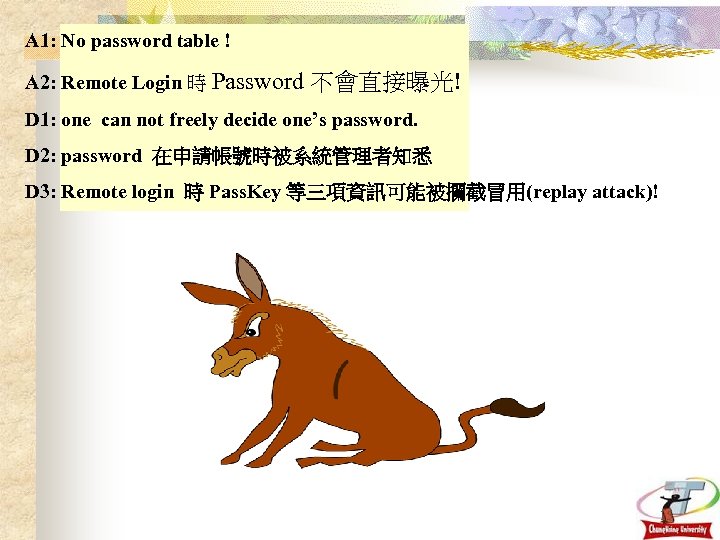
A 1: No password table ! A 2: Remote Login 時 Password 不會直接曝光! D 1: one can not freely decide one’s password. D 2: password 在申請帳號時被系統管理者知悉 D 3: Remote login 時 Pass. Key 等三項資訊可能被攔截冒用(replay attack)! 15
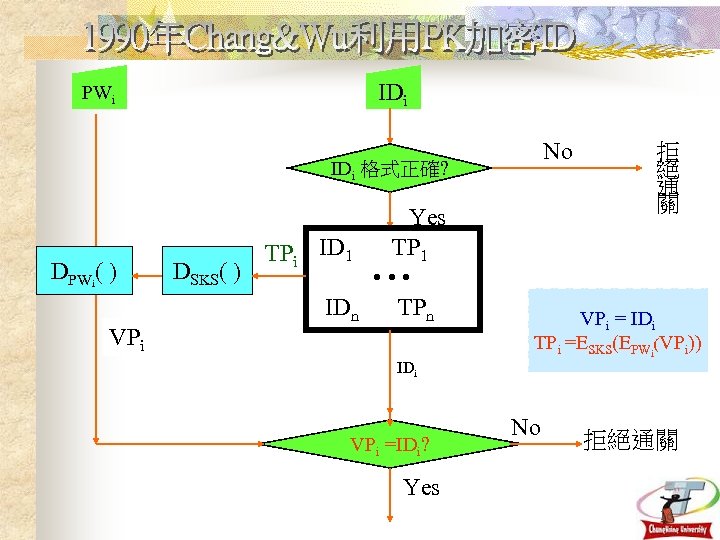
IDi PWi No IDi 格式正確? DPWi( ) VPi DSKS( ) TPi Yes ID 1 TP 1 • • • IDn TPn IDi VPi =IDi? 拒 絕 通 關 VPi = IDi TPi =ESKS(EPWi(VPi)) No 拒絕通關 Yes 16
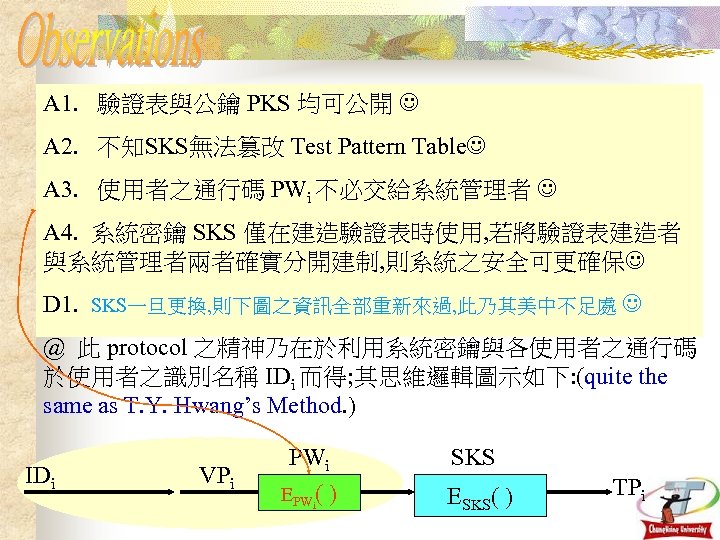
A 1. 驗證表與公鑰 PKS 均可公開 A 2. 不知SKS無法篡改 Test Pattern Table A 3. 使用者之通行碼 PWi 不必交給系統管理者 A 4. 系統密鑰 SKS 僅在建造驗證表時使用, 若將驗證表建造者 與系統管理者兩者確實分開建制, 則系統之安全可更確保 D 1. SKS一旦更換, 則下圖之資訊全部重新來過, 此乃其美中不足處 @ 此 protocol 之精神乃在於利用系統密鑰與各使用者之通行碼 於使用者之識別名稱 IDi 而得; 其思維邏輯圖示如下: (quite the same as T. Y. Hwang’s Method. ) IDi VPi PWi EPWi( ) SKS ESKS( ) TPi 17
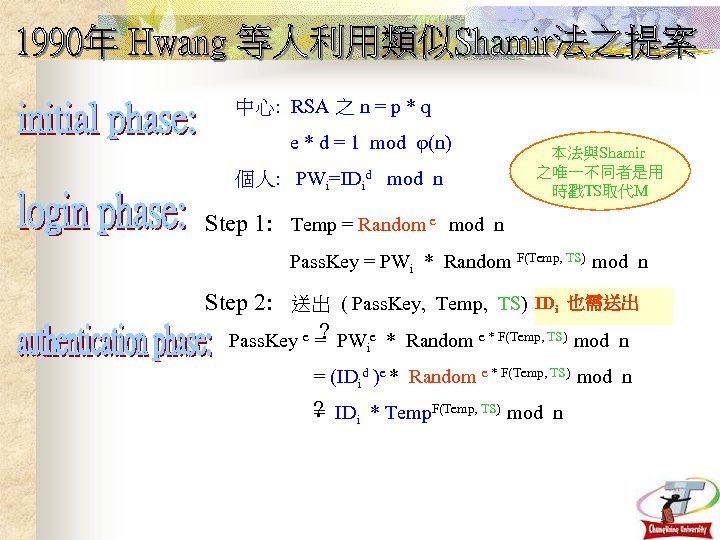
中心: RSA 之 n = p * q e * d = 1 mod (n) 個人: PWi=IDid mod n 本法與Shamir 之唯一不同者是用 時戳TS取代M Step 1: Temp = Random e mod n Pass. Key = PWi * Random F(Temp, TS) mod n Step 2: 送出 ( Pass. Key, Temp, TS) IDi 也需送出 ? Pass. Key e = PW e * Random e * F(Temp, TS) mod n i = (IDid )e * Random e * F(Temp, TS) mod n ? IDi * Temp. F(Temp, TS) mod n = 18
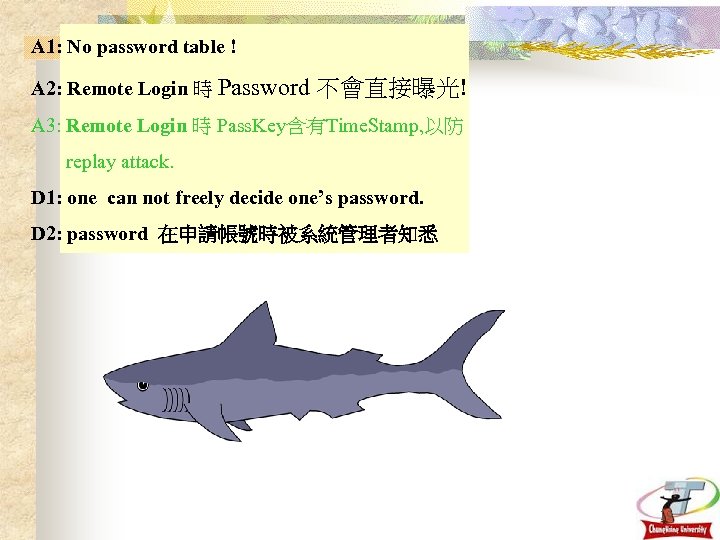
A 1: No password table ! A 2: Remote Login 時 Password 不會直接曝光! A 3: Remote Login 時 Pass. Key含有Time. Stamp, 以防 replay attack. D 1: one can not freely decide one’s password. D 2: password 在申請帳號時被系統管理者知悉 19
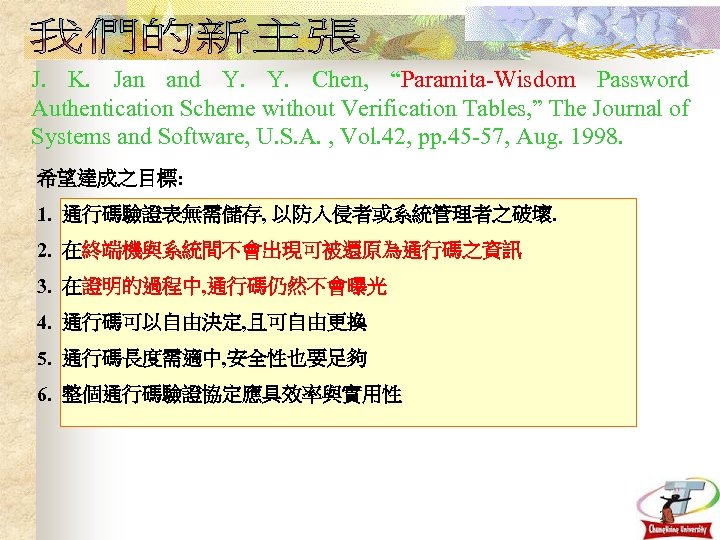
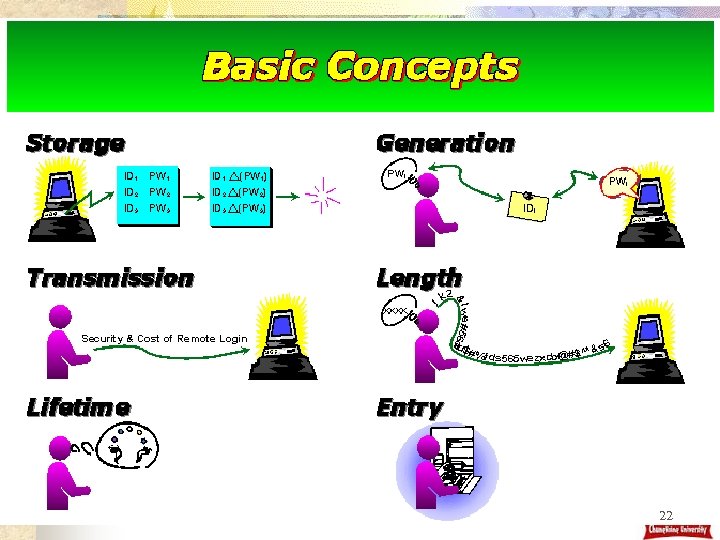
J. K. Jan and Y. Y. Chen, “Paramita-Wisdom Password Authentication Scheme without Verification Tables, ” The Journal of Systems and Software, U. S. A. , Vol. 42, pp. 45 -57, Aug. 1998. 希望達成之目標: 1. 通行碼驗證表無需儲存, 以防入侵者或系統管理者之破壞. 2. 在終端機與系統間不會出現可被還原為通行碼之資訊 3. 在證明的過程中, 通行碼仍然不會曝光 4. 通行碼可以自由決定, 且可自由更換 5. 通行碼長度需適中, 安全性也要足夠 6. 整個通行碼驗證協定應具效率與實用性 20
21
22
23
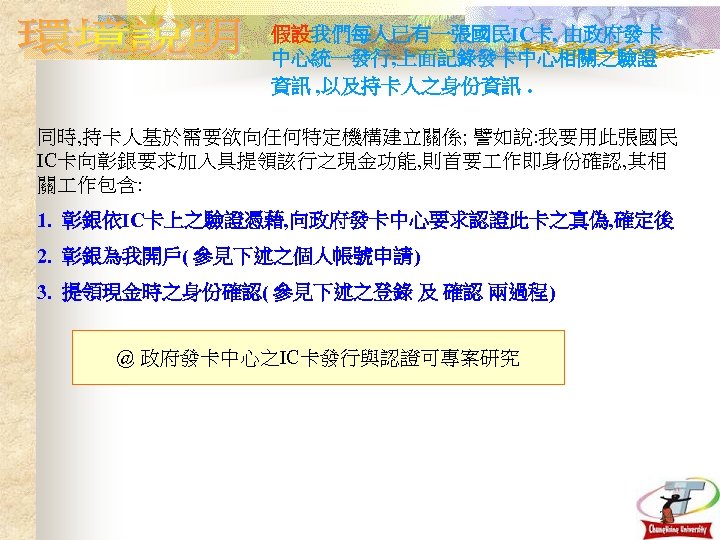
假設我們每人已有一張國民IC卡, 由政府發卡 中心統一發行; 上面記錄發卡中心相關之驗證 資訊 , 以及持卡人之身份資訊. 同時, 持卡人基於需要欲向任何特定機構建立關係; 譬如說: 我要用此張國民 IC卡向彰銀要求加入具提領該行之現金功能, 則首要 作即身份確認, 其相 關 作包含: 1. 彰銀依IC卡上之驗證憑藉, 向政府發卡中心要求認證此卡之真偽, 確定後 2. 彰銀為我開戶( 參見下述之個人帳號申請) 3. 提領現金時之身份確認( 參見下述之登錄 及 確認 兩過程) @ 政府發卡中心之IC卡發行與認證可專案研究 24
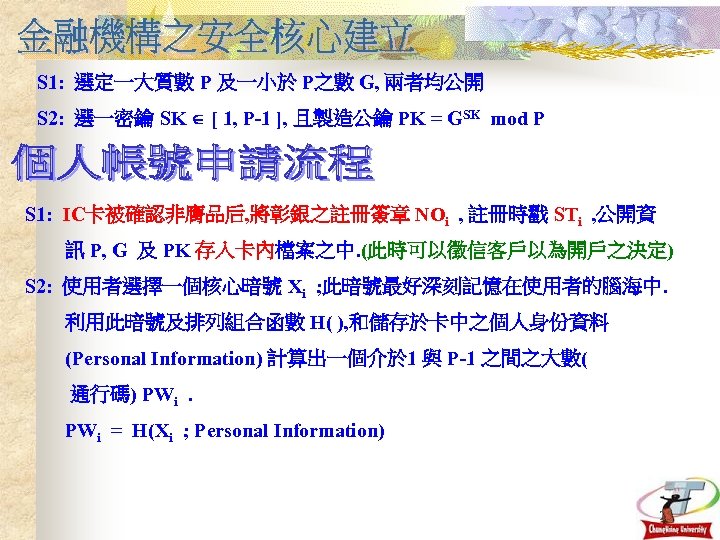
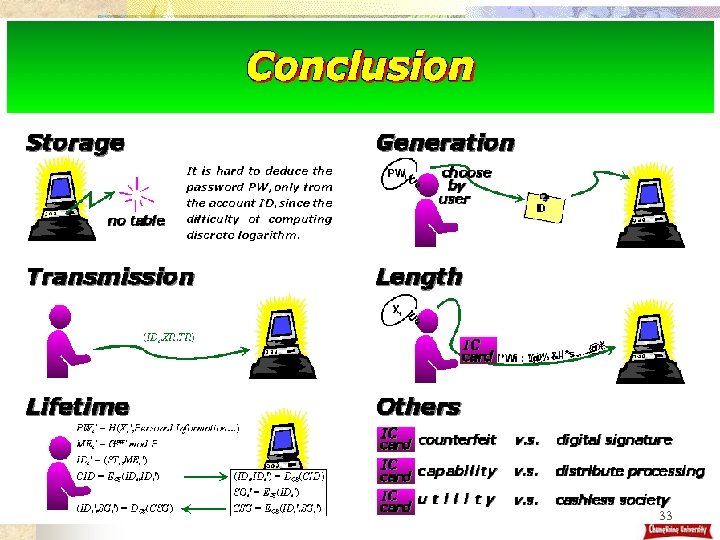
S 1: 選定一大質數 P 及一小於 P之數 G, 兩者均公開 S 2: 選一密鑰 SK [ 1, P-1 ], 且製造公鑰 PK = GSK mod P S 1: IC卡被確認非膺品后, 將彰銀之註冊簽章 NOi , 註冊時戳 STi , 公開資 訊 P, G 及 PK 存入卡內檔案之中. (此時可以徵信客戶以為開戶之決定) S 2: 使用者選擇一個核心暗號 Xi ; 此暗號最好深刻記憶在使用者的腦海中. 利用此暗號及排列組合函數 H( ), 和儲存於卡中之個人身份資料 (Personal Information) 計算出一個介於 1 與 P-1 之間之大數( 通行碼) PWi . PWi = H(Xi ; Personal Information) 25
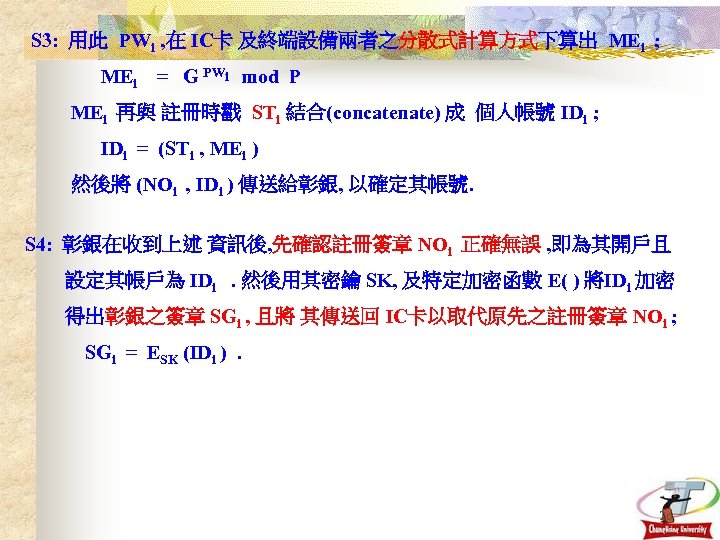
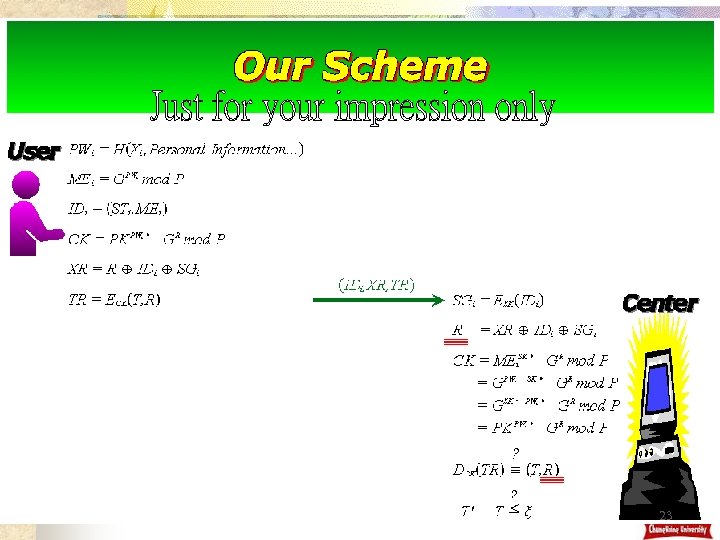
S 3: 用此 PWi , 在 IC卡 及終端設備兩者之分散式計算方式下算出 MEi ; MEi = G PWi mod P MEi 再與 註冊時戳 STi 結合(concatenate) 成 個人帳號 IDi ; IDi = (STi , MEi ) 然後將 (NOi , IDi ) 傳送給彰銀, 以確定其帳號. S 4: 彰銀在收到上述 資訊後, 先確認註冊簽章 NOi 正確無誤 , 即為其開戶且 設定其帳戶為 IDi . 然後用其密鑰 SK, 及特定加密函數 E( ) 將IDi 加密 得出彰銀之簽章 SGi , 且將 其傳送回 IC卡以取代原先之註冊簽章 NOi ; SGi = ESK (IDi ) . 26
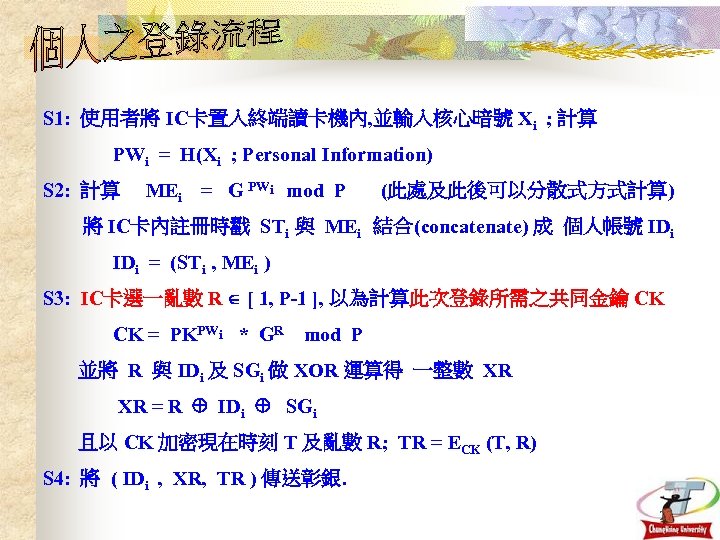
S 1: 使用者將 IC卡置入終端讀卡機內, 並輸入核心暗號 Xi ; 計算 PWi = H(Xi ; Personal Information) S 2: 計算 MEi = G PWi mod P (此處及此後可以分散式方式計算) 將 IC卡內註冊時戳 STi 與 MEi 結合(concatenate) 成 個人帳號 IDi IDi = (STi , MEi ) S 3: IC卡選一亂數 R [ 1, P-1 ], 以為計算此次登錄所需之共同金鑰 CK CK = PKPWi * GR mod P 並將 R 與 IDi 及 SGi 做 XOR 運算得 一整數 XR XR = R IDi SGi 且以 CK 加密現在時刻 T 及亂數 R; TR = ECK (T, R) S 4: 將 ( IDi , XR, TR ) 傳送彰銀. 27
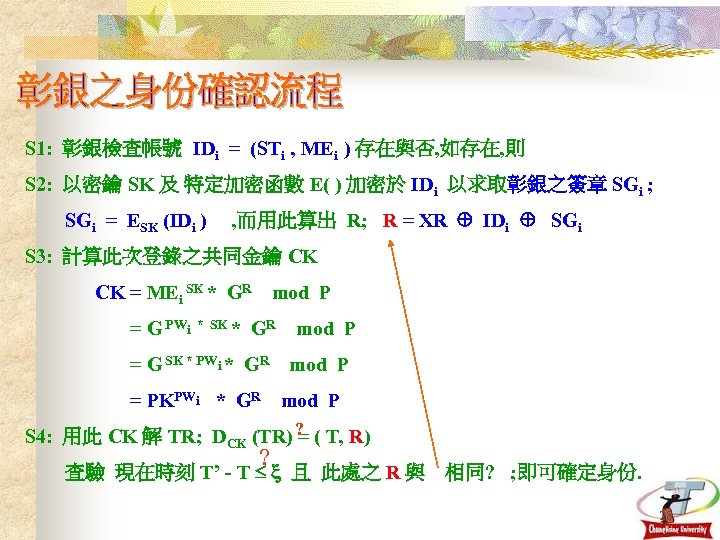
S 1: 彰銀檢查帳號 IDi = (STi , MEi ) 存在與否, 如存在, 則 S 2: 以密鑰 SK 及 特定加密函數 E( ) 加密於 IDi 以求取彰銀之簽章 SGi ; SGi = ESK (IDi ) , 而用此算出 R; R = XR IDi SGi S 3: 計算此次登錄之共同金鑰 CK CK = MEi SK * GR mod P = G PWi * SK * GR mod P = G SK * PWi * GR mod P = PKPWi * GR mod P ? S 4: 用此 CK 解 TR; DCK (TR) = ( T, R) ? 查驗 現在時刻 T’ - T 且 此處之 R 與 相同? ; 即可確定身份. 28
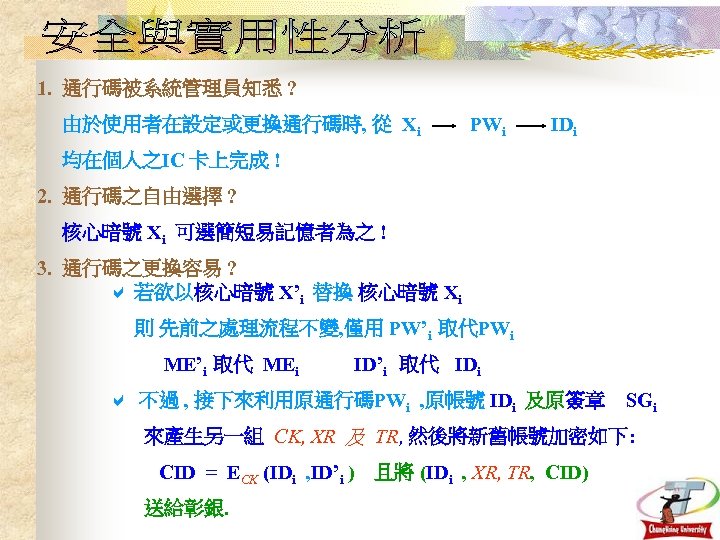
1. 通行碼被系統管理員知悉 ? 由於使用者在設定或更換通行碼時, 從 Xi PWi IDi 均在個人之IC 卡上完成 ! 2. 通行碼之自由選擇 ? 核心暗號 Xi 可選簡短易記憶者為之 ! 3. 通行碼之更換容易 ? 若欲以核心暗號 X’i 替換 核心暗號 Xi 則 先前之處理流程不變, 僅用 PW’i 取代PWi ME’i 取代 MEi ID’i 取代 IDi 不過 , 接下來利用原通行碼PWi , 原帳號 IDi 及原簽章 SGi 來產生另一組 CK, XR 及 TR, 然後將新舊帳號加密如下: CID = ECK (IDi , ID’i ) 且將 (IDi , XR, TR, CID) 送給彰銀. 29
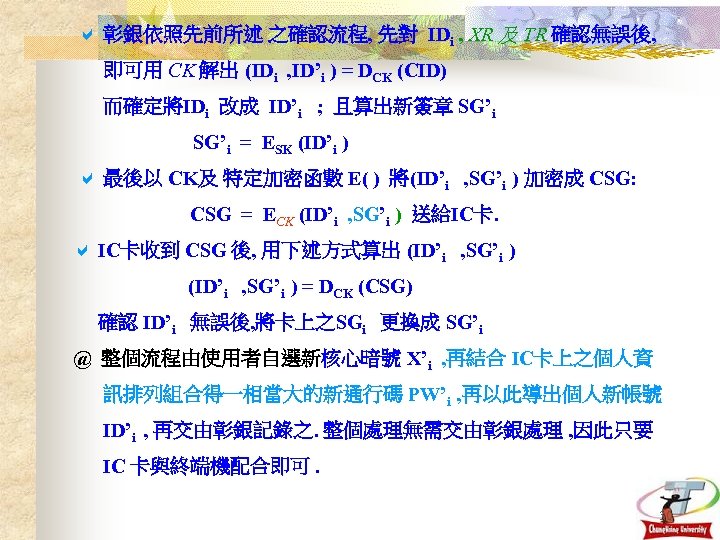
彰銀依照先前所述 之確認流程, 先對 IDi , XR 及 TR 確認無誤後, 即可用 CK 解出 (IDi , ID’i ) = DCK (CID) 而確定將IDi 改成 ID’i ; 且算出新簽章 SG’i SG’i = ESK (ID’i ) 最後以 CK及 特定加密函數 E( ) 將(ID’i , SG’i ) 加密成 CSG: CSG = ECK (ID’i , SG’i ) 送給IC卡. IC卡收到 CSG 後, 用下述方式算出 (ID’i , SG’i ) (ID’i , SG’i ) = DCK (CSG) 確認 ID’i 無誤後, 將卡上之SGi 更換成 SG’i @ 整個流程由使用者自選新核心暗號 X’i , 再結合 IC卡上之個人資 訊排列組合得一相當大的新通行碼 PW’i , 再以此導出個人新帳號 ID’i , 再交由彰銀記錄之. 整個處理無需交由彰銀處理 , 因此只要 IC 卡與終端機配合即可. 30
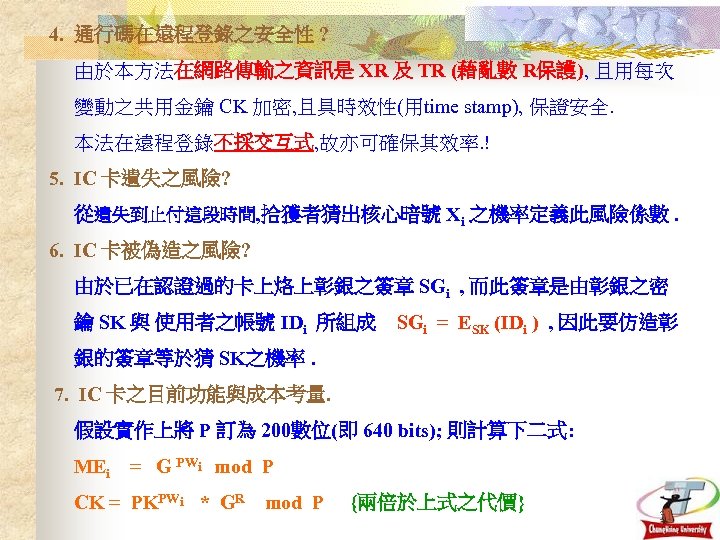
4. 通行碼在遠程登錄之安全性 ? 由於本方法在網路傳輸之資訊是 XR 及 TR (藉亂數 R保護), 且用每次 變動之共用金鑰 CK 加密, 且具時效性(用time stamp), 保證安全. 本法在遠程登錄不採交互式, 故亦可確保其效率. ! 5. IC 卡遺失之風險? 從遺失到止付這段時間, 拾獲者猜出核心暗號 Xi 之機率定義此風險係數. 6. IC 卡被偽造之風險? 由於已在認證過的卡上烙上彰銀之簽章 SGi , 而此簽章是由彰銀之密 鑰 SK 與 使用者之帳號 IDi 所組成 SGi = ESK (IDi ) , 因此要仿造彰 銀的簽章等於猜 SK之機率. 7. IC 卡之目前功能與成本考量. 假設實作上將 P 訂為 200數位(即 640 bits); 則計算下二式: MEi = G PWi mod P CK = PKPWi * GR mod P {兩倍於上式之代價} 31
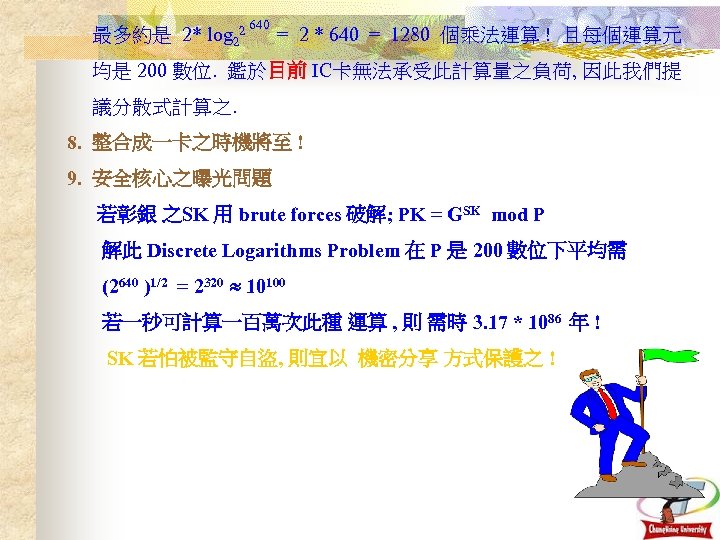
最多約是 2* log 22 640 = 2 * 640 = 1280 個乘法運算 ! 且每個運算元 均是 200 數位. 鑑於目前 IC卡無法承受此計算量之負荷, 因此我們提 議分散式計算之. 8. 整合成一卡之時機將至 ! 9. 安全核心之曝光問題 若彰銀 之SK 用 brute forces 破解; PK = GSK mod P 解此 Discrete Logarithms Problem 在 P 是 200 數位下平均需 (2640 )1/2 = 2320 10100 若一秒可計算一百萬次此種 運算 , 則 需時 3. 17 * 1086 年 ! SK 若怕被監守自盜, 則宜以 機密分享 方式保護之 ! 32
33

2. 2. Improved Scheme Based on Geometric Approach 34
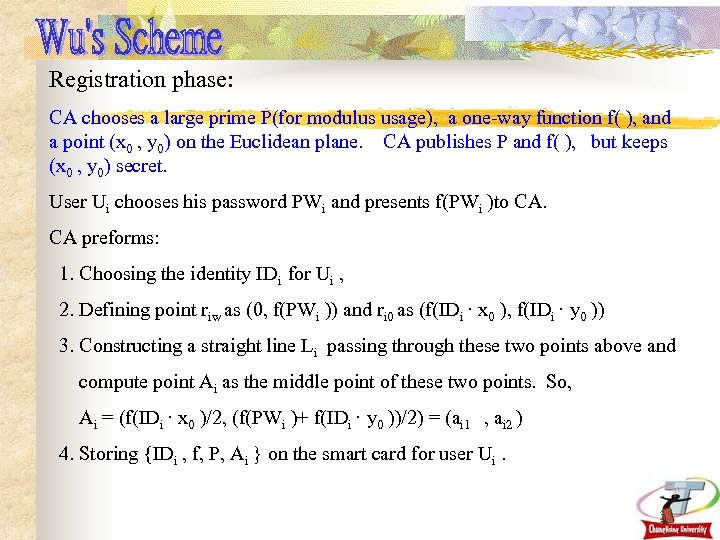
Registration phase: CA chooses a large prime P(for modulus usage), a one-way function f( ), and a point (x 0 , y 0) on the Euclidean plane. CA publishes P and f( ), but keeps (x 0 , y 0) secret. User Ui chooses his password PWi and presents f(PWi )to CA. CA preforms: 1. Choosing the identity IDi for Ui , 2. Defining point riw as (0, f(PWi )) and ri 0 as (f(IDi · x 0 ), f(IDi · y 0 )) 3. Constructing a straight line Li passing through these two points above and compute point Ai as the middle point of these two points. So, Ai = (f(IDi · x 0 )/2, (f(PWi )+ f(IDi · y 0 ))/2) = (ai 1 , ai 2 ) 4. Storing {IDi , f, P, Ai } on the smart card for user Ui. 35
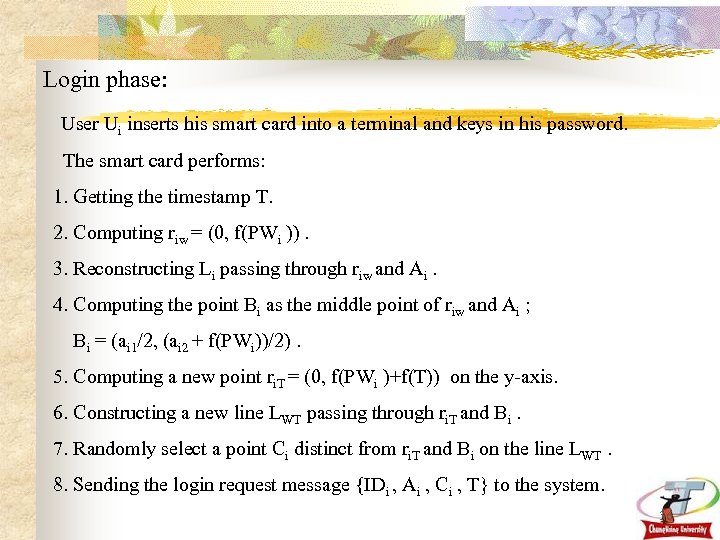
Login phase: User Ui inserts his smart card into a terminal and keys in his password. The smart card performs: 1. Getting the timestamp T. 2. Computing riw = (0, f(PWi )). 3. Reconstructing Li passing through riw and Ai. 4. Computing the point Bi as the middle point of riw and Ai ; Bi = (ai 1/2, (ai 2 + f(PWi))/2). 5. Computing a new point ri. T = (0, f(PWi )+f(T)) on the y-axis. 6. Constructing a new line LWT passing through ri. T and Bi. 7. Randomly select a point Ci distinct from ri. T and Bi on the line LWT. 8. Sending the login request message {IDi , Ai , Ci , T} to the system. 36
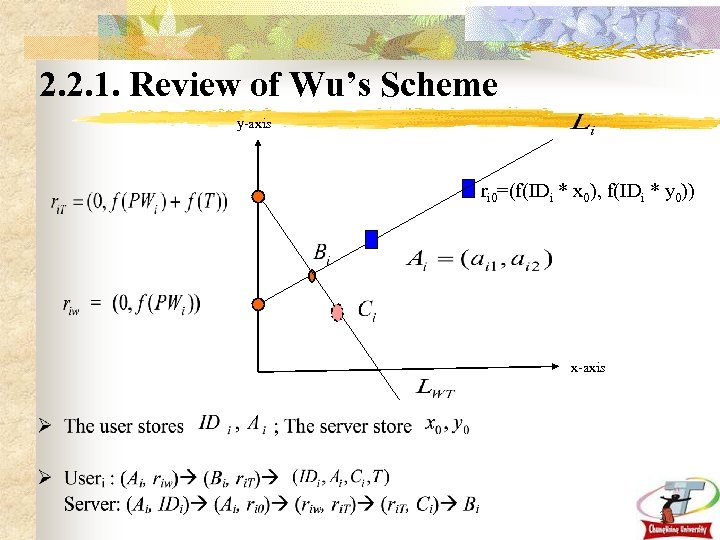
2. 2. 1. Review of Wu’s Scheme y-axis ri 0=(f(IDi * x 0), f(IDi * y 0)) x-axis 37
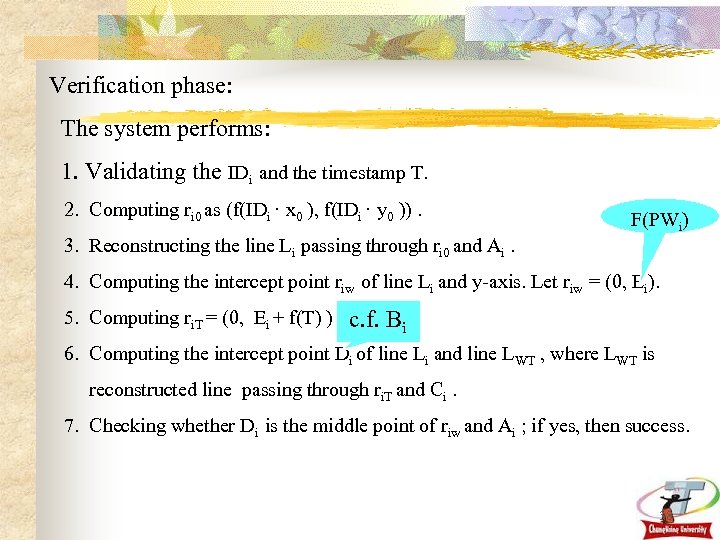
Verification phase: The system performs: 1. Validating the IDi and the timestamp T. 2. Computing ri 0 as (f(IDi · x 0 ), f(IDi · y 0 )). F(PWi) 3. Reconstructing the line Li passing through ri 0 and Ai. 4. Computing the intercept point riw of line Li and y-axis. Let riw = (0, Ei). 5. Computing ri. T = (0, Ei + f(T) ). c. f. Bi 6. Computing the intercept point Di of line Li and line LWT , where LWT is reconstructed line passing through ri. T and Ci. 7. Checking whether Di is the middle point of riw and Ai ; if yes, then success. 38
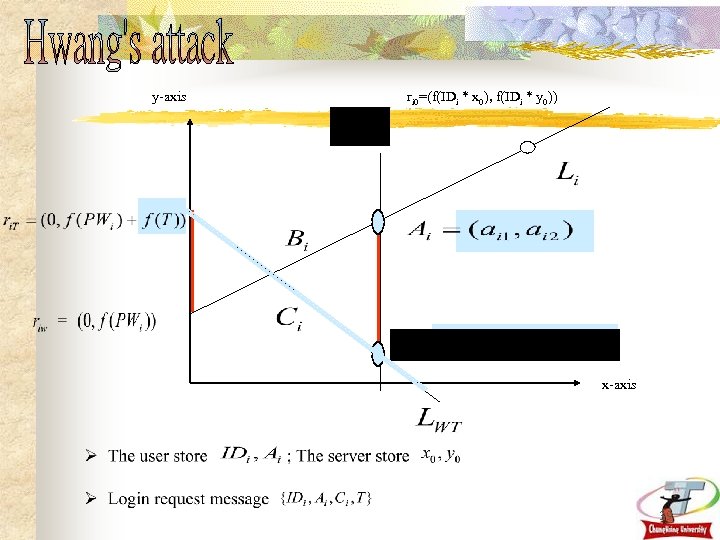
y-axis ri 0=(f(IDi * x 0), f(IDi * y 0)) x-axis 39
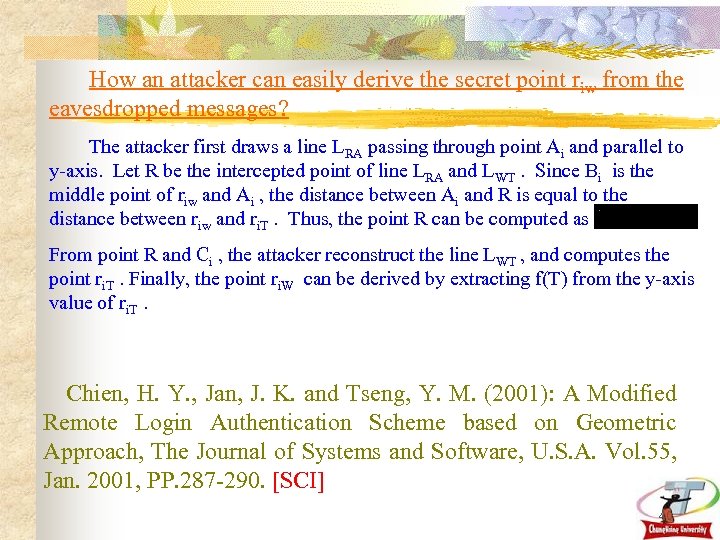
How an attacker can easily derive the secret point riw from the eavesdropped messages? The attacker first draws a line LRA passing through point Ai and parallel to y-axis. Let R be the intercepted point of line LRA and LWT. Since Bi is the middle point of riw and Ai , the distance between Ai and R is equal to the distance between riw and ri. T. Thus, the point R can be computed as From point R and Ci , the attacker reconstruct the line LWT , and computes the point ri. T. Finally, the point ri. W can be derived by extracting f(T) from the y-axis value of ri. T. Chien, H. Y. , Jan, J. K. and Tseng, Y. M. (2001): A Modified Remote Login Authentication Scheme based on Geometric Approach, The Journal of Systems and Software, U. S. A. Vol. 55, Jan. 2001, PP. 287 -290. [SCI] 40
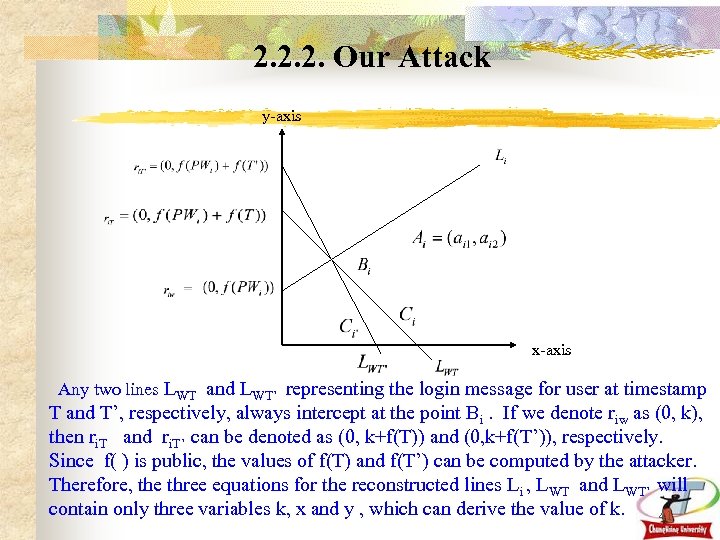
2. 2. 2. Our Attack y-axis x-axis Any two lines LWT and LWT’ representing the login message for user at timestamp T and T’, respectively, always intercept at the point Bi. If we denote riw as (0, k), then ri. T and ri. T’ can be denoted as (0, k+f(T)) and (0, k+f(T’)), respectively. Since f( ) is public, the values of f(T) and f(T’) can be computed by the attacker. Therefore, the three equations for the reconstructed lines Li , LWT and LWT’ will contain only three variables k, x and y , which can derive the value of k. 41
2. 2. 3. Improved Scheme 42
2. 4. Novel Scheme Chien, H. Y. Jan, J. K. and Tseng, Y. M. (2002): An Efficient and Practical Solution to Remote Authentication: Smart Card, Computers & Security, Oxford, England, Vol. 21, No. 4, . June 2002, PP. 372 -375. [SCI] 43
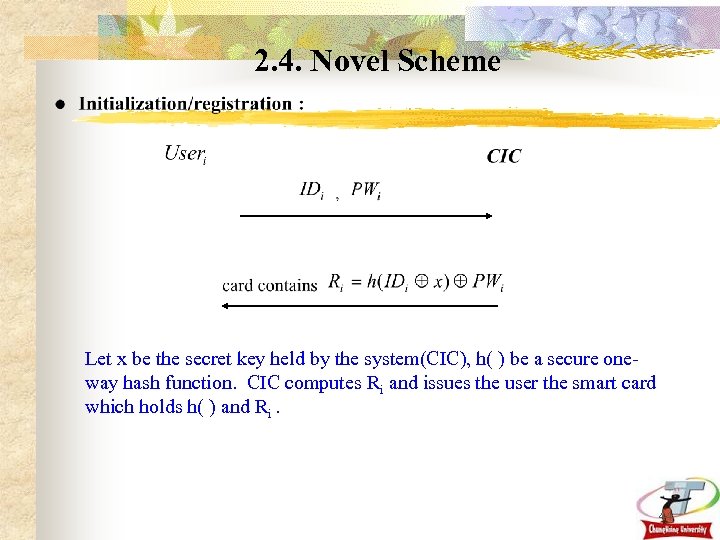
2. 4. Novel Scheme Let x be the secret key held by the system(CIC), h( ) be a secure oneway hash function. CIC computes Ri and issues the user the smart card which holds h( ) and Ri. 44
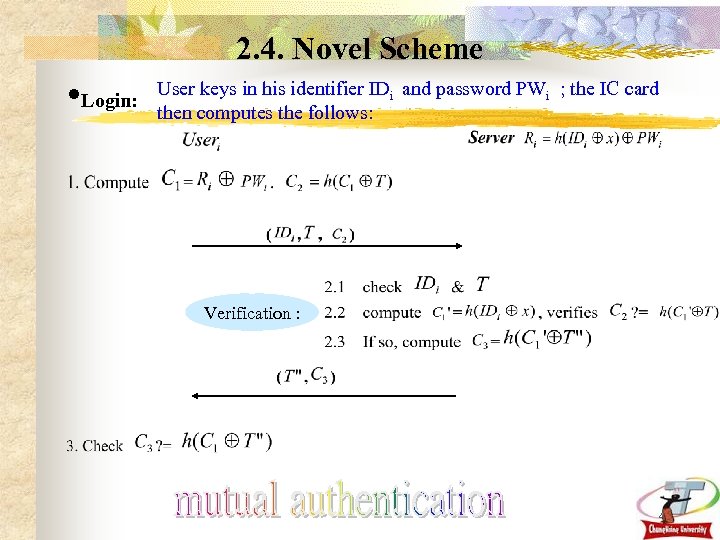
2. 4. Novel Scheme • Login: User keys in his identifier IDi and password PWi ; the IC card then computes the follows: Verification : 45
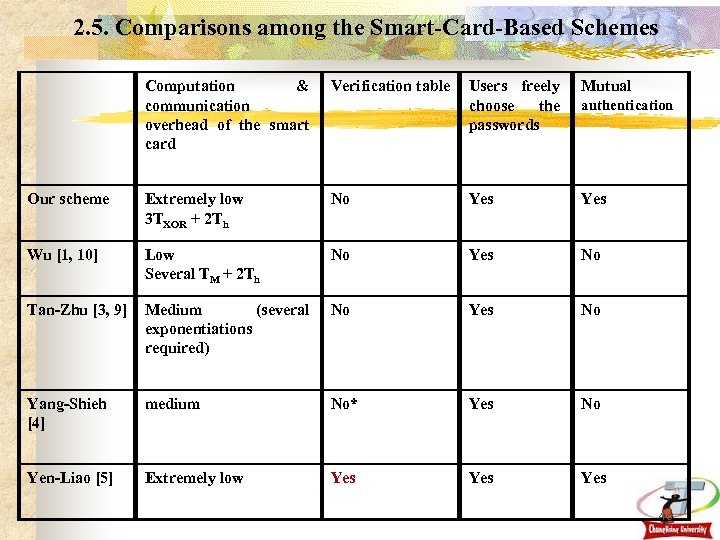
2. 5. Comparisons among the Smart-Card-Based Schemes Computation & communication overhead of the smart card Verification table Users freely choose the passwords Mutual Our scheme Extremely low 3 TXOR + 2 Th No Yes Wu [1, 10] Low Several TM + 2 Th No Yes No Tan-Zhu [3, 9] Medium (several exponentiations required) No Yes No Yang-Shieh [4] medium No* Yes No Yen-Liao [5] Extremely low Yes Yes authentication 46
![2. 5. Comparisons among the Smart-Card-Based Schemes Wu-Sung [6] low No Yes No Jan-Chen](https://present5.com/presentation/59986bc04801b2677b966cd0f2eb410a/image-47.jpg "2. 5. Comparisons among the Smart-Card-Based Schemes Wu-Sung [6] low No Yes No Jan-Chen")
2. 5. Comparisons among the Smart-Card-Based Schemes Wu-Sung [6] low No Yes No Jan-Chen [7] medium No* Yes No Wang-Chang Medium [8] No* Yes No Chang-Wu [19, 20] Low + No No No Hwang-Li [11] medium No No No Sun [12] Extremely low No No No * a table is used to store some user specific or card specific data. 47
Скачать презентацию 1 研討大綱 1 過去之研究進展 2 我們之提案 Jan
59986bc04801b2677b966cd0f2eb410a.ppt