 Скачать презентацию 09 Test Automation Let s Talk Business Igor
9bfe23cecb25646c68d9a68b08e14775.ppt
- Количество слайдов: 39



‘ 09 Test Automation Let’s Talk Business Igor Gershovich Connected Testing, Inc. www. connectedtesting. com Madrid, 27 th-29 th of October 2009
About Connected Testing, Inc • Connected Testing is an independent consulting company specializing in Test Automation and Performance Testing • We are located in Denver, Colorado, USA • We have extensive experience across a range of industries including Financial Services, Healthcare, Aerospace, Transportation, Telecommunications Madrid, 27 th-29 th of October 2009 ‘ 09
Overview • Test Automation Myths • Return on Investment (ROI) • Frameworks Madrid, 27 th-29 th of October 2009 ‘ 09
Test Automation Myths Madrid, 27 th-29 th of October 2009 ‘ 09
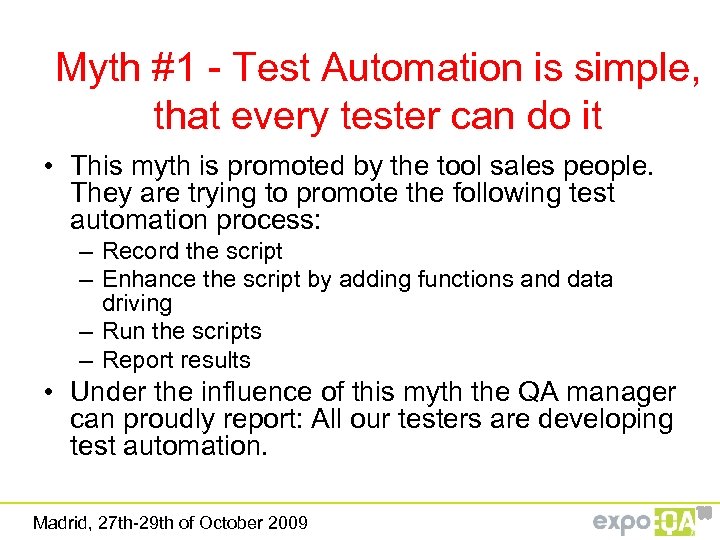
Myth #1 - Test Automation is simple, that every tester can do it • This myth is promoted by the tool sales people. They are trying to promote the following test automation process: – Record the script – Enhance the script by adding functions and data driving – Run the scripts – Report results • Under the influence of this myth the QA manager can proudly report: All our testers are developing test automation. Madrid, 27 th-29 th of October 2009 ‘ 09
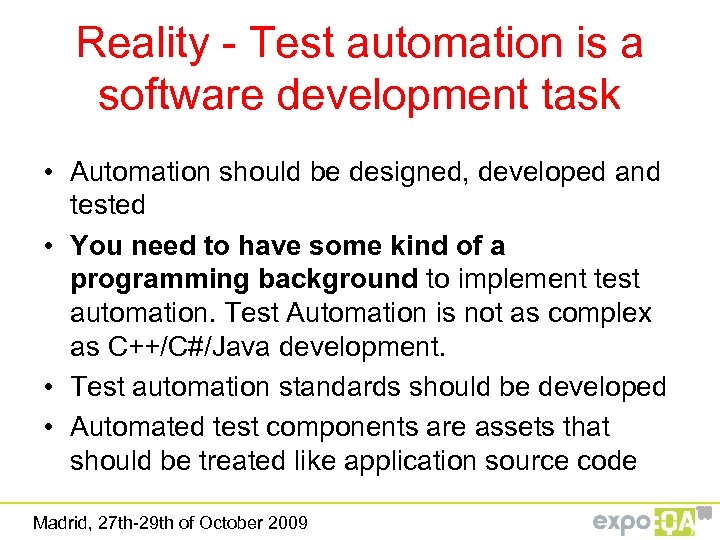
Reality - Test automation is a software development task • Automation should be designed, developed and tested • You need to have some kind of a programming background to implement test automation. Test Automation is not as complex as C++/C#/Java development. • Test automation standards should be developed • Automated test components are assets that should be treated like application source code Madrid, 27 th-29 th of October 2009 ‘ 09
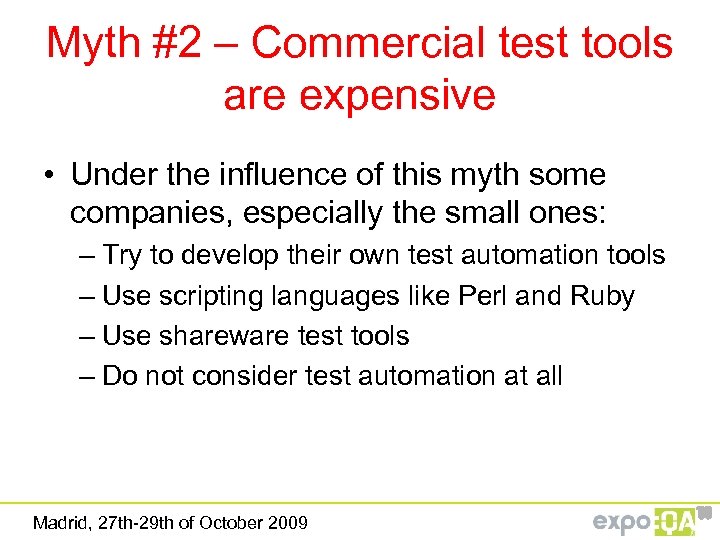
Myth #2 – Commercial test tools are expensive • Under the influence of this myth some companies, especially the small ones: – Try to develop their own test automation tools – Use scripting languages like Perl and Ruby – Use shareware test tools – Do not consider test automation at all Madrid, 27 th-29 th of October 2009 ‘ 09
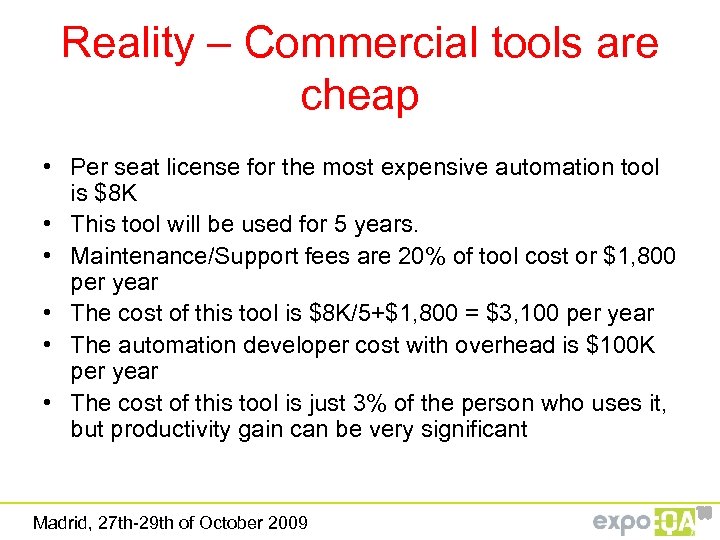
Reality – Commercial tools are cheap • Per seat license for the most expensive automation tool is $8 K • This tool will be used for 5 years. • Maintenance/Support fees are 20% of tool cost or $1, 800 per year • The cost of this tool is $8 K/5+$1, 800 = $3, 100 per year • The automation developer cost with overhead is $100 K per year • The cost of this tool is just 3% of the person who uses it, but productivity gain can be very significant Madrid, 27 th-29 th of October 2009 ‘ 09
Commercial Tool Benefits: • Customer support. Many of the open source tools come and go with little to no support • Most commercial tools are constantly being updated as technologies change • Most commercial tools usually have more functionality (QTP can test various GUI applications: Web, . Net, Java, VB, C/C++, Power. Builder, etc. vs. WATIR – Web only) • Commercial tools usually have a large community of users, which translates into better availability of qualified resources • Commercial tools require less advanced programming • More test automation frameworks are available for commercial tools • Commercial tools are integrated with Test Management tools which makes reporting and execution much simpler. Madrid, 27 th-29 th of October 2009 ‘ 09
Over 300 Test Tools are available (http: //www. softwareqatest. com) • • Load/Performance tools – 54 Web Functional/Regression – 60 Java Test tools - 48 Other Web tools – 76 Which tool is right for you? Madrid, 27 th-29 th of October 2009 ‘ 09
Some Requirements for Tool evaluation • • Technologies that should be supported Available training and documentation Cost Support Distributed execution Non-proprietary language Tool Audience (The skills of people involved in test automation) • Easy to maintain automated tests with a central repository Madrid, 27 th-29 th of October 2009 ‘ 09
Main Reasons for Test Automation failures • Lack of Management Support • Inexperienced Test Automation staff • Over-engineering Madrid, 27 th-29 th of October 2009 ‘ 09
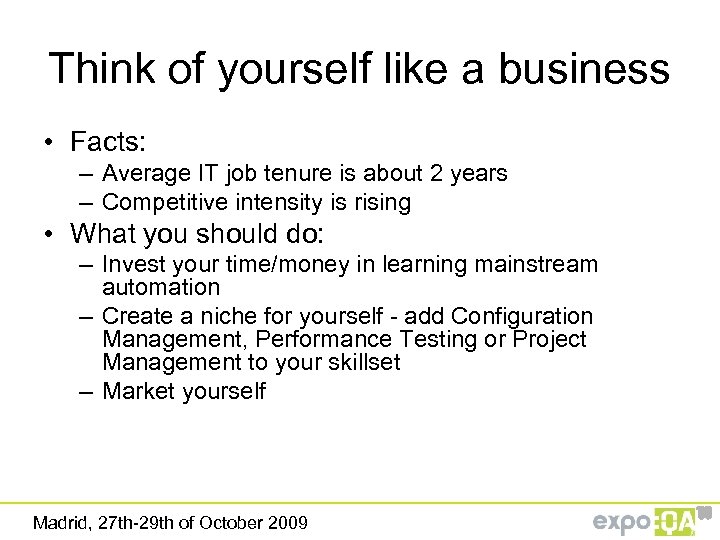
Think of yourself like a business • Facts: – Average IT job tenure is about 2 years – Competitive intensity is rising • What you should do: – Invest your time/money in learning mainstream automation – Create a niche for yourself - add Configuration Management, Performance Testing or Project Management to your skillset – Market yourself Madrid, 27 th-29 th of October 2009 ‘ 09
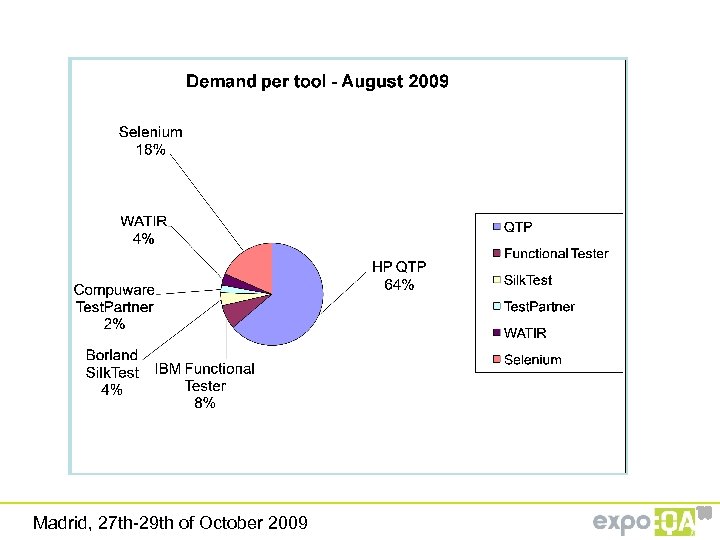
Absolutely Unscientific research: Employer demand by tool expertise May, 2008 and Aug, 2009 Madrid, 27 th-29 th of October 2009 ‘ 09
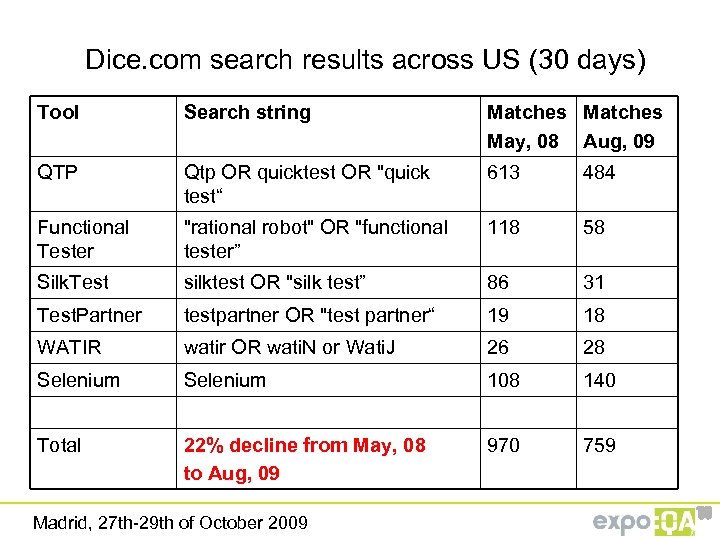
Dice. com search results across US (30 days) Tool Search string Matches May, 08 Aug, 09 QTP Qtp OR quicktest OR "quick test“ 613 484 Functional Tester "rational robot" OR "functional tester” 118 58 Silk. Test silktest OR "silk test” 86 31 Test. Partner testpartner OR "test partner“ 19 18 WATIR watir OR wati. N or Wati. J 26 28 Selenium 108 140 Total 22% decline from May, 08 to Aug, 09 970 759 Madrid, 27 th-29 th of October 2009 ‘ 09
Madrid, 27 th-29 th of October 2009 ‘ 09
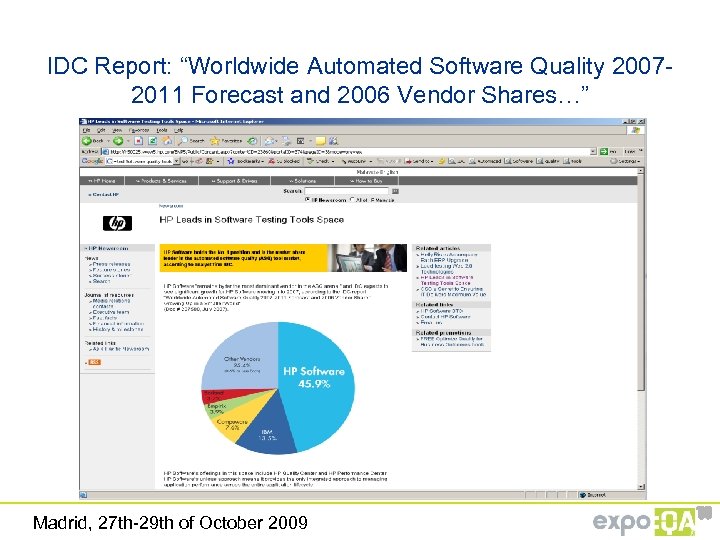
IDC Report: “Worldwide Automated Software Quality 20072011 Forecast and 2006 Vendor Shares…” Madrid, 27 th-29 th of October 2009 ‘ 09
Return On Investment (ROI) Madrid, 27 th-29 th of October 2009 ‘ 09
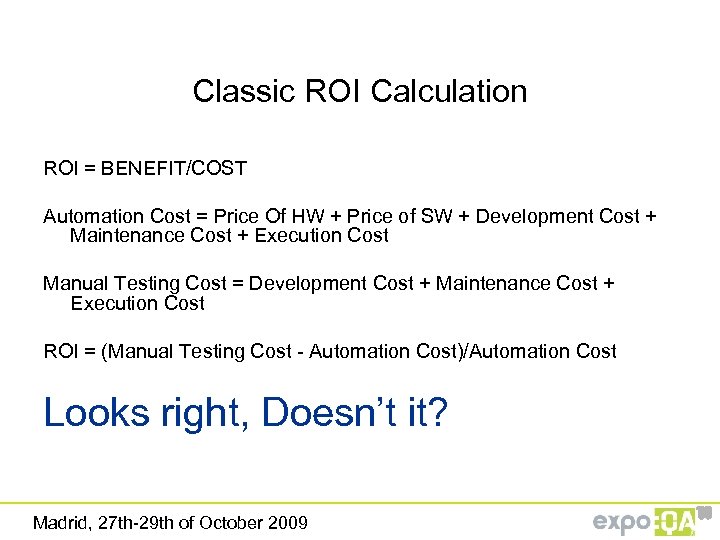
Classic ROI Calculation ROI = BENEFIT/COST Automation Cost = Price Of HW + Price of SW + Development Cost + Maintenance Cost + Execution Cost Manual Testing Cost = Development Cost + Maintenance Cost + Execution Cost ROI = (Manual Testing Cost - Automation Cost)/Automation Cost Looks right, Doesn’t it? Madrid, 27 th-29 th of October 2009 ‘ 09
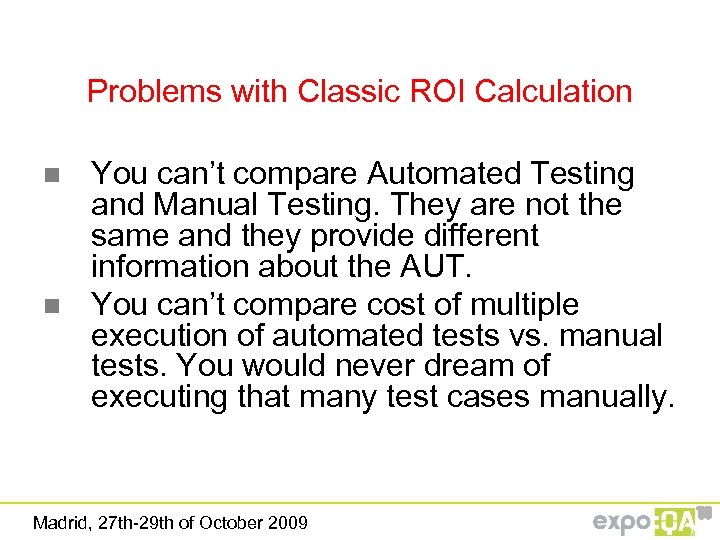
Problems with Classic ROI Calculation n n You can’t compare Automated Testing and Manual Testing. They are not the same and they provide different information about the AUT. You can’t compare cost of multiple execution of automated tests vs. manual tests. You would never dream of executing that many test cases manually. Madrid, 27 th-29 th of October 2009 ‘ 09
Automation Real ROI q. ROI value IS NOT the value of Automation vs. Cost of executing these tests manually q. Automation ROI value IS the benefit of this type of testing, and it can be: q. Reducing Time to Market q. Increased Test Efficiency (Productivity) q. Increased Test Effectiveness Madrid, 27 th-29 th of October 2009 ‘ 09
Reduced Time to Market • Can get a greater market share • Makes people available to work on other projects • Higher margins, if no competitive products are currently available Madrid, 27 th-29 th of October 2009 ‘ 09
Productivity and Effectiveness • More testing gets done faster, increasing the odds of finding defects • Defects found early have better chances of being fixed • Manual Testers can concentrate on clever ways to finding defects, instead of typing test inputs and verify output. • About 7% of bug fixes create new bugs, sometimes in already tested parts of the system. With automation you can rerun tests for those modules. This almost never happens when testing is done manually. Madrid, 27 th-29 th of October 2009 ‘ 09
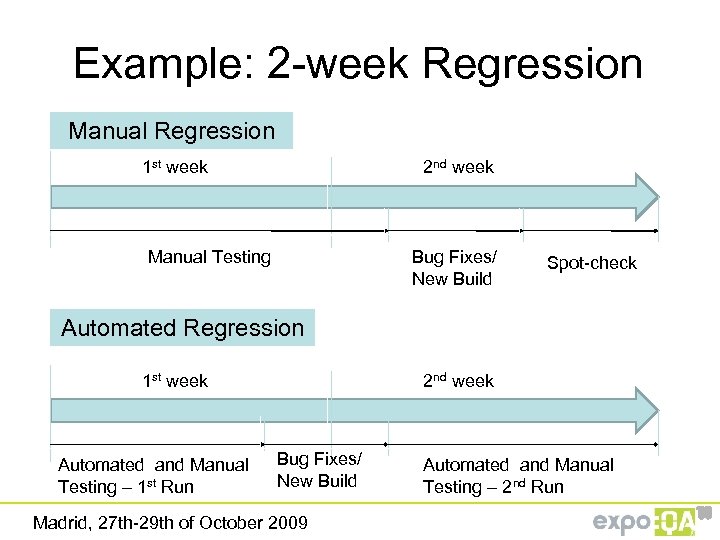
Example: 2 -week Regression Manual Regression 1 st week 2 nd week Manual Testing Bug Fixes/ New Build Spot-check Automated Regression 1 st week Automated and Manual Testing – 1 st Run 2 nd week Bug Fixes/ New Build Madrid, 27 th-29 th of October 2009 Automated and Manual Testing – 2 nd Run ‘ 09
Advantages of automated regression testing • 2 full regression runs • Most of bugs were found early and have a better chance to be fixed Result: – Better quality – much happier customer Madrid, 27 th-29 th of October 2009 ‘ 09
ROI summary • Each project requires different types of automation - there is often no easy formula available to calculate ROI • Performing ROI calculation can help to determine upfront what type of automation, what level of skills, what tools will be required. Madrid, 27 th-29 th of October 2009 ‘ 09
Automation Frameworks Madrid, 27 th-29 th of October 2009 ‘ 09
Test Automation Framework • A Test Automation Framework is a set of assumptions, concepts and tools that provide support for Automated Software Testing. • A correctly implemented Test Automation Framework can further improve ROI by reducing the development and maintenance costs. Madrid, 27 th-29 th of October 2009 ‘ 09
Types of Test Automation Frameworks • • Modular Data-Driven Keyword–Driven Model-Based Madrid, 27 th-29 th of October 2009 ‘ 09
Modular framework • The Modular framework is the natural progression derived from Record-and-Playback • The modular framework seeks to minimize repetition of code by grouping similar actions into “modules” (e. g. : login) • Test Data is in a script or in an internal table This is what tool sales people are promoting. Madrid, 27 th-29 th of October 2009 ‘ 09
Data-Driven/Keyword Driven • These frameworks are similar in that the data is separated from the test script • The script is just a "driver" or delivery mechanism for the data. • The difference: – In keyword-driven testing, the navigation data and test data are contained in the data source – In data-driven testing, only test data is contained in the data source. Madrid, 27 th-29 th of October 2009 ‘ 09
Model-Based testing • Model-based testing is software testing in which test cases are derived in whole or in part from a model that describes some (usually functional) aspects of the system. • Model-based testing for complex software systems is still an evolving field. Madrid, 27 th-29 th of October 2009 ‘ 09
We’ll be concentrating on Keyword-Driven testing since it is the most beneficial framework for large-scale test automation. Madrid, 27 th-29 th of October 2009 ‘ 09
Advantages of Keyword-Driven Test automation • This Framework addresses the most common problem with test automation: Automation Engineers do not have domain knowledge and the End Users (Subject Matter Experts/Test Engineers) usually do not have automation expertise. • When properly implemented and maintained, it presents a superior ROI because each business event is designed, automated and maintained as a discrete entity. • Keywords can then be used to design test cases, but the design and automation overhead for the keyword has already been paid. Madrid, 27 th-29 th of October 2009 ‘ 09
Advantages of Keyword-Driven Test automation • Reduced the cost and time spent maintaining and updating tests • The modular structure of keyword-driven testing means that new tests can easily be created from pre-existing modules • The test team is capable of entirely automating tests, even without programming knowledge • Can be easily modified to use with different test tool • Reusability across different projects Madrid, 27 th-29 th of October 2009 ‘ 09
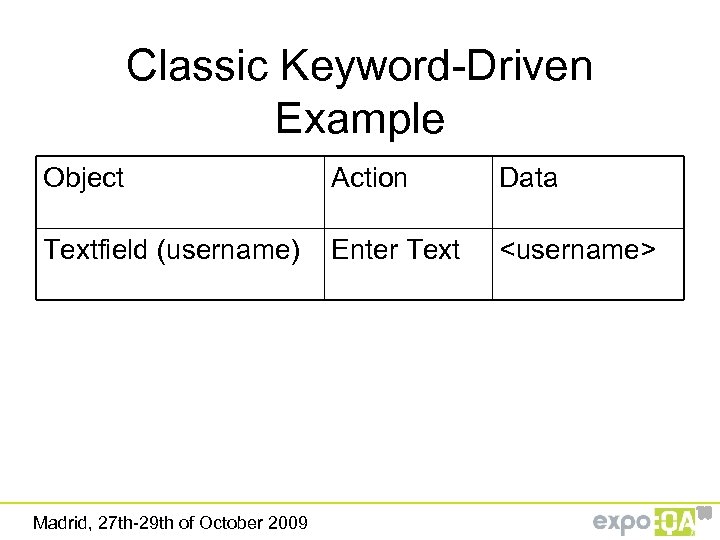
Classic Keyword-Driven Example Object Action Data Textfield (username) Enter Text <username> Madrid, 27 th-29 th of October 2009 ‘ 09
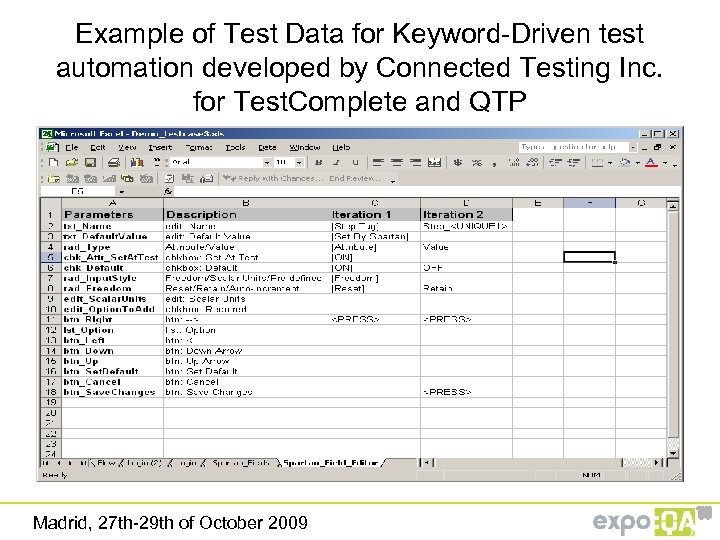
Example of Test Data for Keyword-Driven test automation developed by Connected Testing Inc. for Test. Complete and QTP Madrid, 27 th-29 th of October 2009 ‘ 09
Resources • “Everything you want to know about Test Automation…” by Brian Le Suer • “Manager’s Guide to GUI Test Automation” by Yury Makedonov • “The ROI of Test Automation” by Michael Kelly • “What is my ROI? ” by m. Verify Corporation • SQA Forums • “An Overview of Test Automation Frameworks” by Nathaniel Ritmeyer • “The benefits of keyword-based software test automation” by David W. Johnson • Wikipedia Madrid, 27 th-29 th of October 2009 ‘ 09
Igor Gershovich Company: Connected Testing, Inc. E-Mail: igershovich@connectedtesting. com Phone: 720 -933 -9395 Website: www. connectedtesting. com Madrid, 27 th-29 th of October 2009 ‘ 09
Скачать презентацию 09 Test Automation Let s Talk Business Igor
9bfe23cecb25646c68d9a68b08e14775.ppt