


 Скачать презентацию 09 00 — 13 00 ILIAS meeting Convener Dominique
fdea325919909a830824e8396d1deb2a.ppt
- Количество слайдов: 23
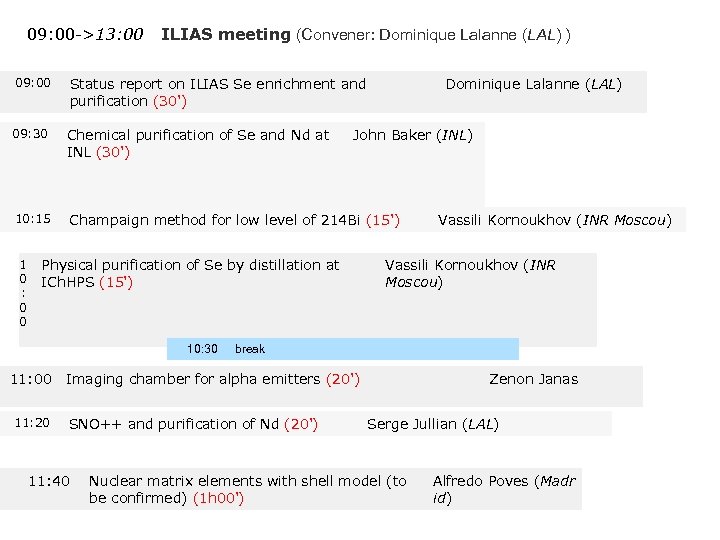 09: 00 ->13: 00 ILIAS meeting (Convener: Dominique Lalanne (LAL) ) 09: 00 Status report on ILIAS Se enrichment and purification (30') 09: 30 Chemical purification of Se and Nd at INL (30') 10: 15 Champaign method for low level of 214 Bi (15') 1 0 : 0 0 John Baker (INL) Physical purification of Se by distillation at ICh. HPS (15') 10: 30 11: 00 11: 20 Dominique Lalanne (LAL) Vassili Kornoukhov (INR Moscou) break Imaging chamber for alpha emitters (20') SNO++ and purification of Nd (20') 11: 40 Vassili Kornoukhov (INR Moscou) Zenon Janas Serge Jullian (LAL) Nuclear matrix elements with shell model (to be confirmed) (1 h 00') Alfredo Poves (Madr id)
 Integrated Large Infrastructures for Astroparticle Science ILIAS-JRA 2 Production of enriched Selenium -2 kilos « ITEP-Kurchatov » -New contacts with ECP-Krasnoyarsk -New production from Tomsk -What’s next ?
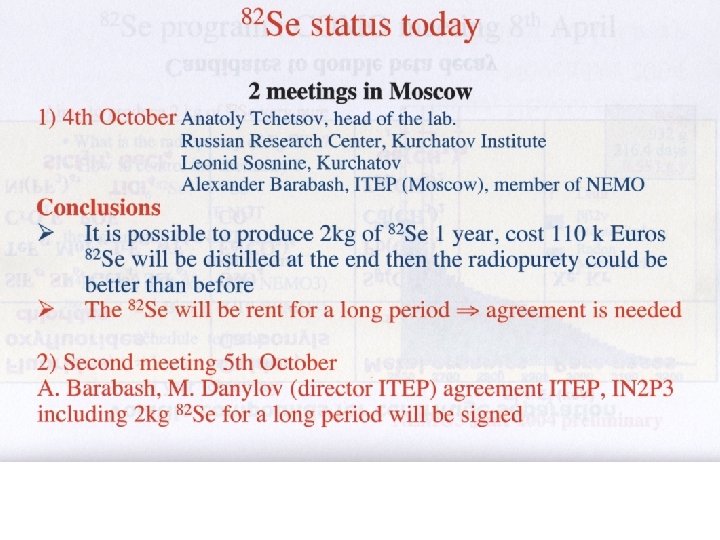
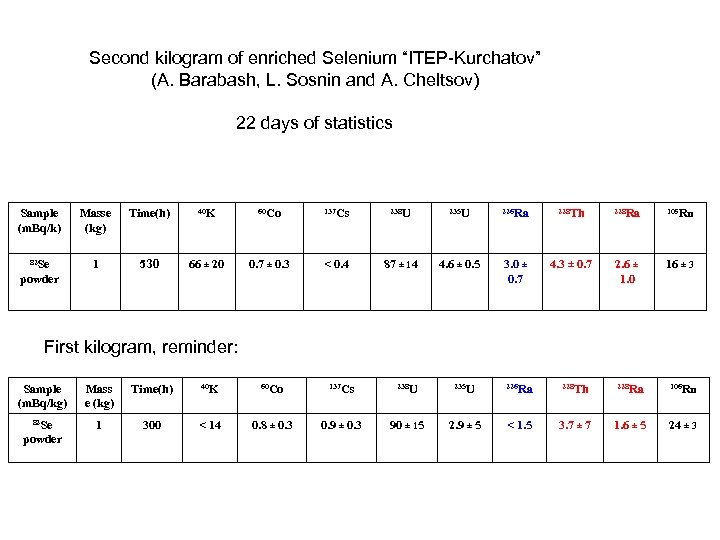 Second kilogram of enriched Selenium “ITEP-Kurchatov” (A. Barabash, L. Sosnin and A. Cheltsov) 22 days of statistics Sample (m. Bq/k) Masse (kg) Time(h) 40 K 60 Co 137 Cs 238 U 235 U 226 Ra 228 Th 228 Ra 106 Ru 82 Se 1 530 66 ± 20 0. 7 ± 0. 3 < 0. 4 87 ± 14 4. 6 ± 0. 5 3. 0 ± 0. 7 4. 3 ± 0. 7 2. 6 ± 1. 0 16 ± 3 powder First kilogram, reminder: Sample (m. Bq/kg) Mass e (kg) Time(h) 40 K 60 Co 137 Cs 238 U 235 U 226 Ra 228 Th 228 Ra 106 Ru 82 Se 1 300 < 14 0. 8 ± 0. 3 0. 9 ± 0. 3 90 ± 15 2. 9 ± 5 < 1. 5 3. 7 ± 7 1. 6 ± 5 24 ± 3 powder
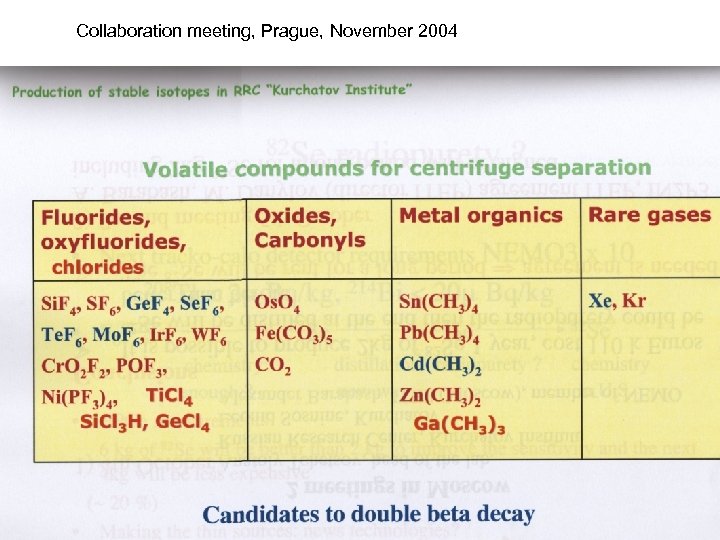 Collaboration meeting, Prague, November 2004
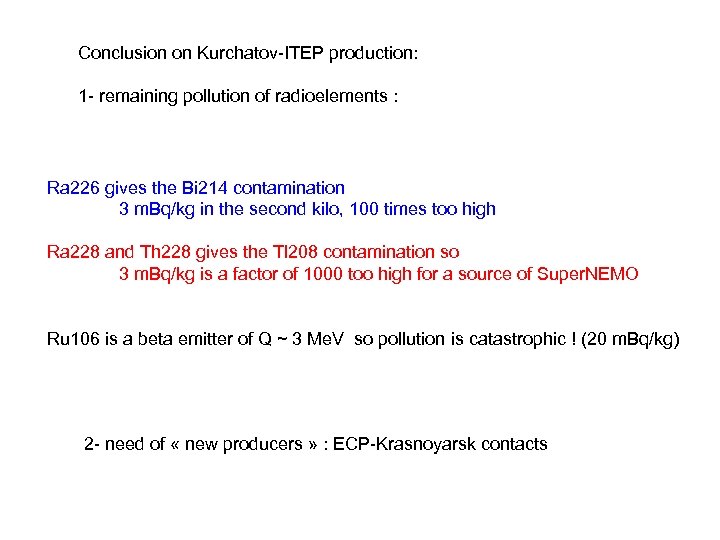 Conclusion on Kurchatov-ITEP production: 1 - remaining pollution of radioelements : Ra 226 gives the Bi 214 contamination 3 m. Bq/kg in the second kilo, 100 times too high Ra 228 and Th 228 gives the Tl 208 contamination so 3 m. Bq/kg is a factor of 1000 too high for a source of Super. NEMO Ru 106 is a beta emitter of Q ~ 3 Me. V so pollution is catastrophic ! (20 m. Bq/kg) 2 - need of « new producers » : ECP-Krasnoyarsk contacts
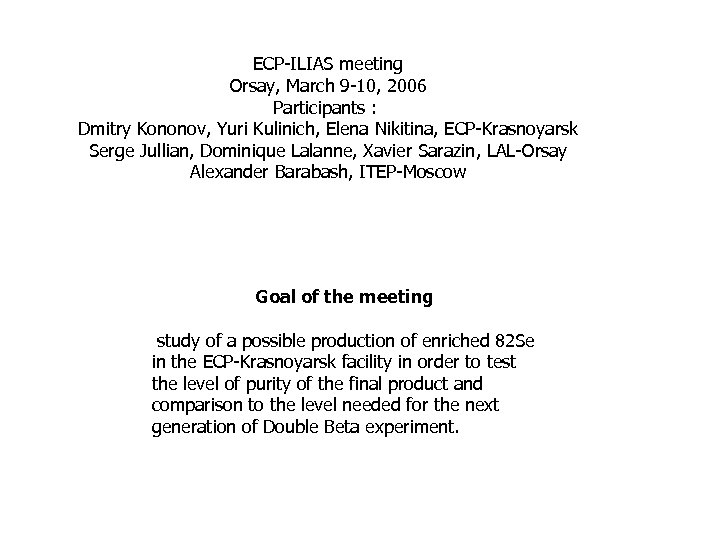 ECP-ILIAS meeting Orsay, March 9 -10, 2006 Participants : Dmitry Kononov, Yuri Kulinich, Elena Nikitina, ECP-Krasnoyarsk Serge Jullian, Dominique Lalanne, Xavier Sarazin, LAL-Orsay Alexander Barabash, ITEP-Moscow Goal of the meeting study of a possible production of enriched 82 Se in the ECP-Krasnoyarsk facility in order to test the level of purity of the final product and comparison to the level needed for the next generation of Double Beta experiment.
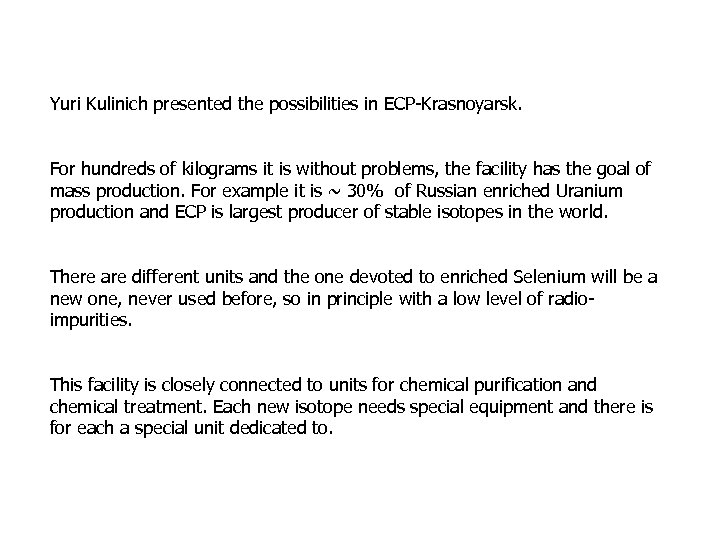 Yuri Kulinich presented the possibilities in ECP-Krasnoyarsk. For hundreds of kilograms it is without problems, the facility has the goal of mass production. For example it is ~ 30% of Russian enriched Uranium production and ECP is largest producer of stable isotopes in the world. There are different units and the one devoted to enriched Selenium will be a new one, never used before, so in principle with a low level of radioimpurities. This facility is closely connected to units for chemical purification and chemical treatment. Each new isotope needs special equipment and there is for each a special unit dedicated to.
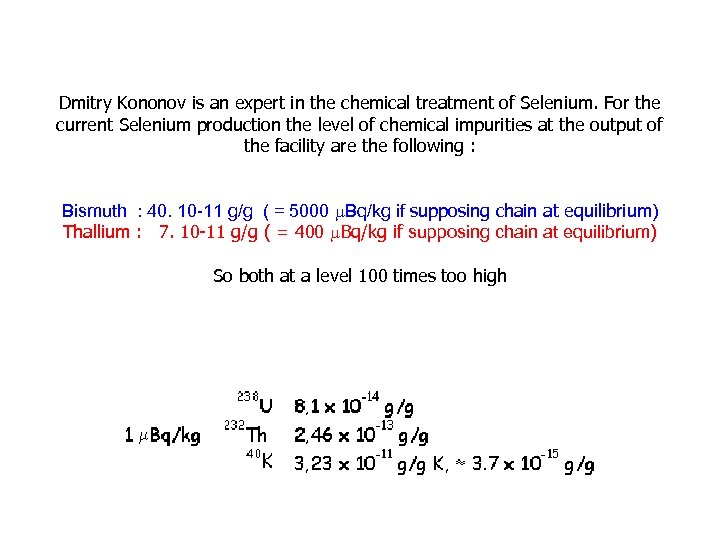 Dmitry Kononov is an expert in the chemical treatment of Selenium. For the current Selenium production the level of chemical impurities at the output of the facility are the following : Bismuth : 40. 10 -11 g/g ( = 5000 m. Bq/kg if supposing chain at equilibrium) Thallium : 7. 10 -11 g/g ( = 400 m. Bq/kg if supposing chain at equilibrium) So both at a level 100 times too high
 Tender in June 2006 for a production of 1. 5 kilo of enriched Se 82 SURPRISE : ECP-Krasnoyarsk… …and a second answer : Chemgas -Tomsk Choice done for Chemgas-Tomst (better price) According the procedure, not possible to make a different choice Need of a new order to ECP, but of lower amount of money and a new funding, ILIAS being not enough
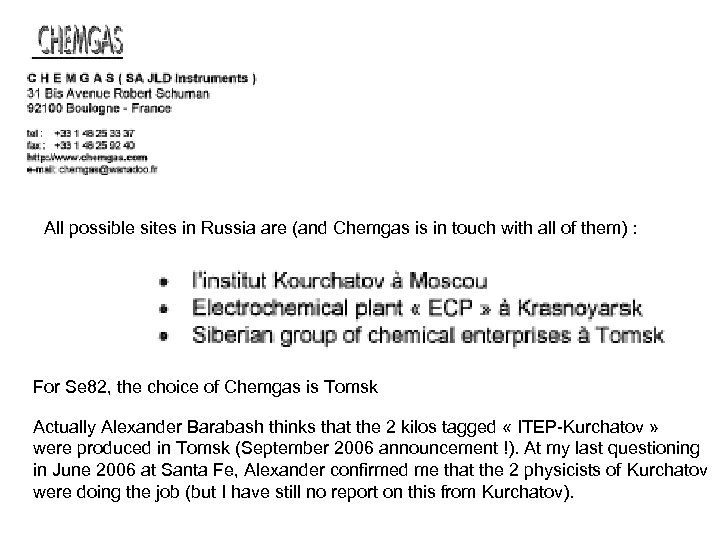 All possible sites in Russia are (and Chemgas is in touch with all of them) : For Se 82, the choice of Chemgas is Tomsk Actually Alexander Barabash thinks that the 2 kilos tagged « ITEP-Kurchatov » were produced in Tomsk (September 2006 announcement !). At my last questioning in June 2006 at Santa Fe, Alexander confirmed me that the 2 physicists of Kurchatov were doing the job (but I have still no report on this from Kurchatov).
 ILIAS work summary In 2003, what we thought : 1 - Selenium was not possible to buy, but as in NEMO 3 we have to rent it (possible for years…) 2 - Kurchatov (via ITEP) was the only producer in our case So, we did a Convention with ITEP for a rent of 2 kilos In 2006 what we know : 1 - after a meeting in Munich with the Gerda team : it is possible to buy Selenium as they do for Germanium 2 - There is 3 possible plants in Russia, Krasnoyarsk (able to produce hundreds of kg), Tomsk (almost able of hundred), Kurchatov (for kilograms). 3 - there is a French importer (Chemgas) in touch with these 3 centers, ready to organize meetings with the real producers.
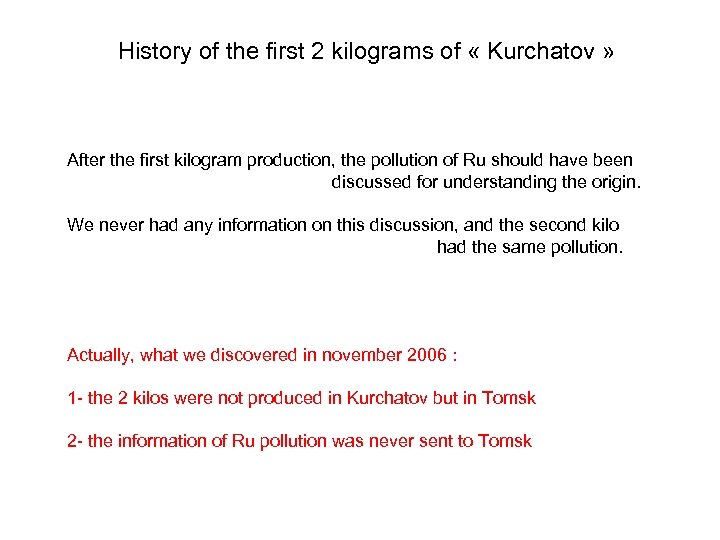 History of the first 2 kilograms of « Kurchatov » After the first kilogram production, the pollution of Ru should have been discussed for understanding the origin. We never had any information on this discussion, and the second kilo had the same pollution. Actually, what we discovered in november 2006 : 1 - the 2 kilos were not produced in Kurchatov but in Tomsk 2 - the information of Ru pollution was never sent to Tomsk
 ILIAS-JRA 2 Purification of Selenium Chemical purification at INL results of sample of natural selenium purification of the first kilo of ITEP-Kurchatov Physical purification Kurchatov team ICh. HPS team
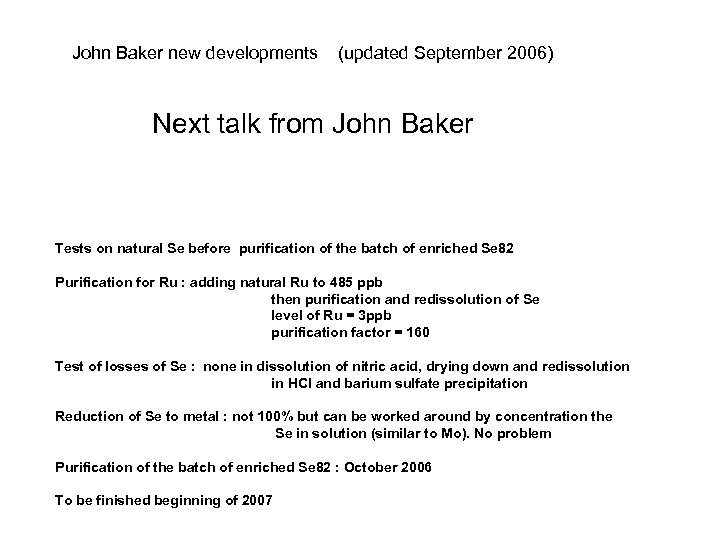 John Baker new developments (updated September 2006) Next talk from John Baker Tests on natural Se before purification of the batch of enriched Se 82 Purification for Ru : adding natural Ru to 485 ppb then purification and redissolution of Se level of Ru = 3 ppb purification factor = 160 Test of losses of Se : none in dissolution of nitric acid, drying down and redissolution in HCl and barium sulfate precipitation Reduction of Se to metal : not 100% but can be worked around by concentration the Se in solution (similar to Mo). No problem Purification of the batch of enriched Se 82 : October 2006 To be finished beginning of 2007
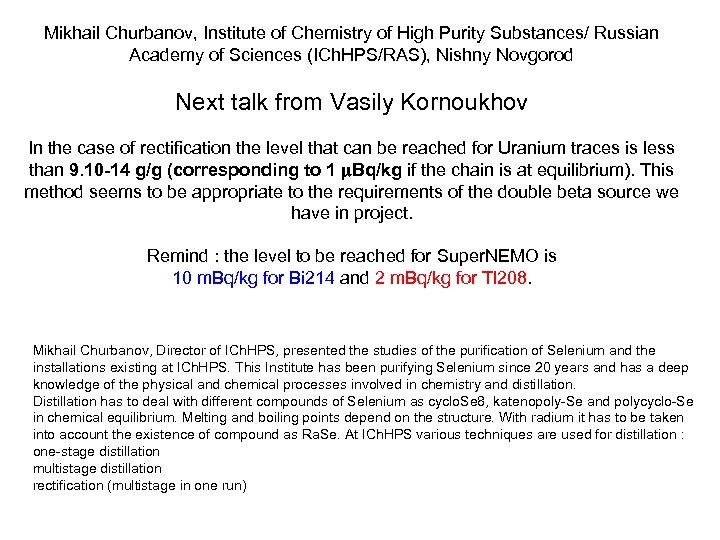 Mikhail Churbanov, Institute of Chemistry of High Purity Substances/ Russian Academy of Sciences (ICh. HPS/RAS), Nishny Novgorod Next talk from Vasily Kornoukhov In the case of rectification the level that can be reached for Uranium traces is less than 9. 10 -14 g/g (corresponding to 1 m. Bq/kg if the chain is at equilibrium). This method seems to be appropriate to the requirements of the double beta source we have in project. Remind : the level to be reached for Super. NEMO is 10 m. Bq/kg for Bi 214 and 2 m. Bq/kg for Tl 208. Mikhail Churbanov, Director of ICh. HPS, presented the studies of the purification of Selenium and the installations existing at ICh. HPS. This Institute has been purifying Selenium since 20 years and has a deep knowledge of the physical and chemical processes involved in chemistry and distillation. Distillation has to deal with different compounds of Selenium as cyclo. Se 8, katenopoly-Se and polycyclo-Se in chemical equilibrium. Melting and boiling points depend on the structure. With radium it has to be taken into account the existence of compound as Ra. Se. At ICh. HPS various techniques are used for distillation : one-stage distillation multistage distillation rectification (multistage in one run)
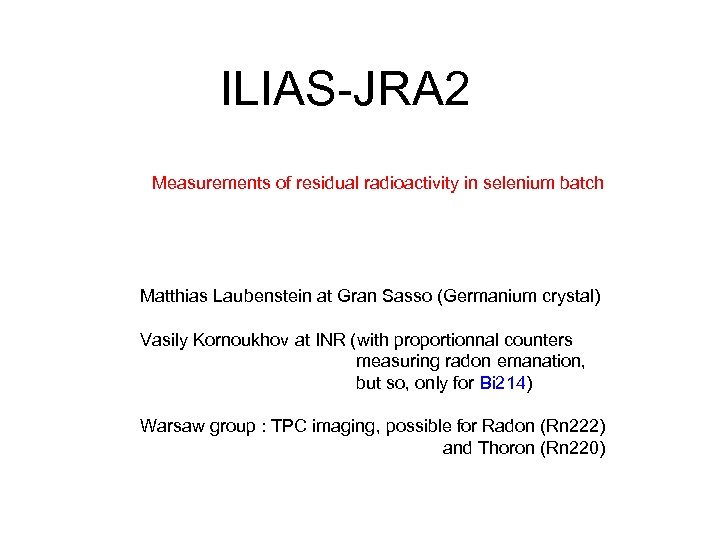 ILIAS-JRA 2 Measurements of residual radioactivity in selenium batch Matthias Laubenstein at Gran Sasso (Germanium crystal) Vasily Kornoukhov at INR (with proportionnal counters measuring radon emanation, but so, only for Bi 214) Warsaw group : TPC imaging, possible for Radon (Rn 222) and Thoron (Rn 220)
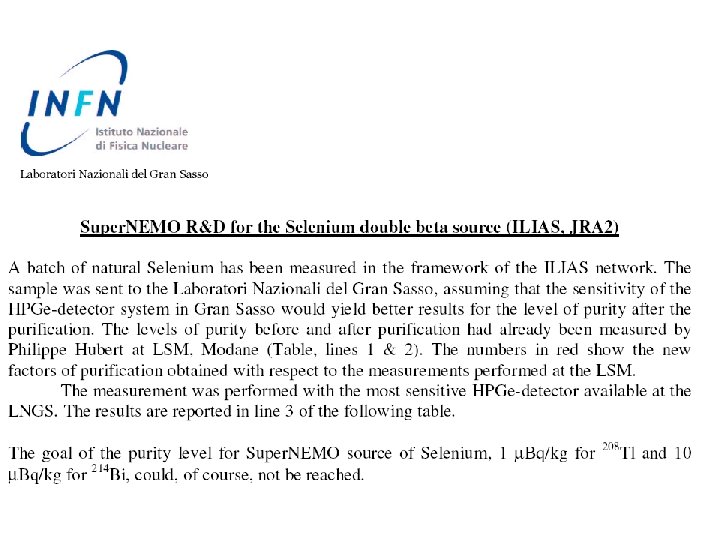
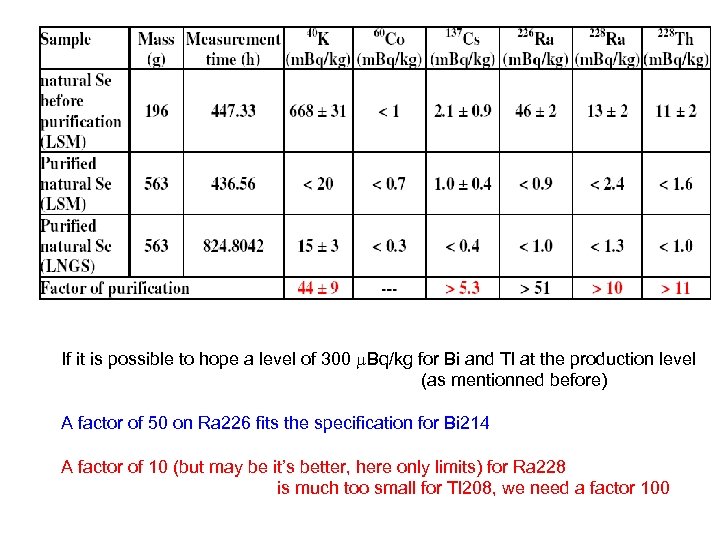 If it is possible to hope a level of 300 m. Bq/kg for Bi and Tl at the production level (as mentionned before) A factor of 50 on Ra 226 fits the specification for Bi 214 A factor of 10 (but may be it’s better, here only limits) for Ra 228 is much too small for Tl 208, we need a factor 100
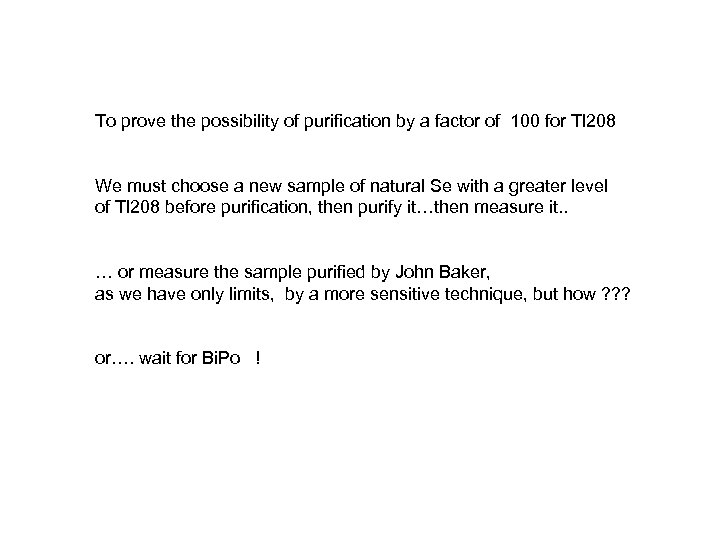 To prove the possibility of purification by a factor of 100 for Tl 208 We must choose a new sample of natural Se with a greater level of Tl 208 before purification, then purify it…then measure it. . … or measure the sample purified by John Baker, as we have only limits, by a more sensitive technique, but how ? ? ? or…. wait for Bi. Po !
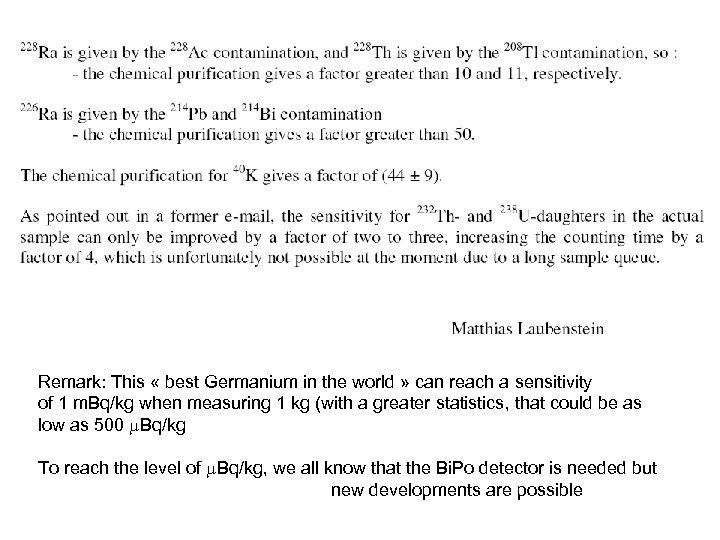 Remark: This « best Germanium in the world » can reach a sensitivity of 1 m. Bq/kg when measuring 1 kg (with a greater statistics, that could be as low as 500 m. Bq/kg To reach the level of m. Bq/kg, we all know that the Bi. Po detector is needed but new developments are possible
 Proportional counters and radon degassing (old technique but with new inputs) (Vasily Kornoukhov, INR) Development scheduled in 2007 Next talk from Vasily Kornoukhov
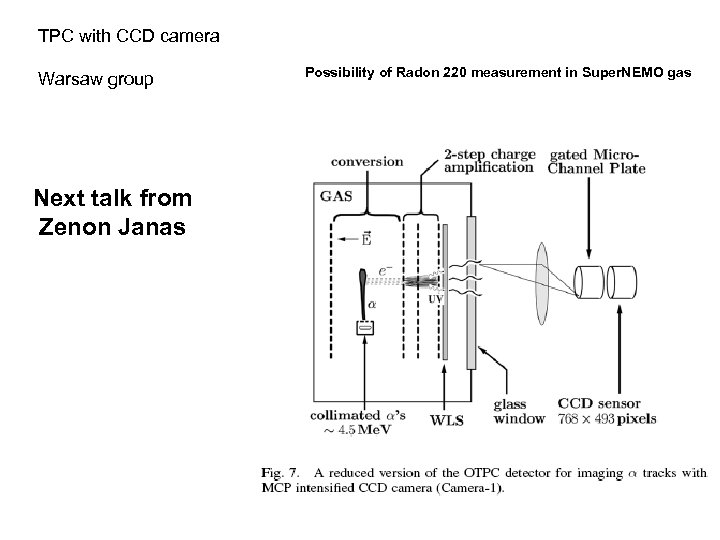 TPC with CCD camera Warsaw group Next talk from Zenon Janas Possibility of Radon 220 measurement in Super. NEMO gas