


 Скачать презентацию 03 -23 -05 Architecture Transition Framework ATF 1
1c7babf730dac85e0c7a5af1ebd16408.ppt
- Количество слайдов: 21
 03 -23 -05 Architecture Transition Framework (ATF 1. 0) A presentation at SOA for E-Gov Conference, October 30 – 31, 2006 Satish Gattadahalli, Senior Enterprise Architect, EDS, US Government Solutions page 1
 Agenda • ATF Goals • The Framework • Domains and Transition Elements (including notional waves) • Recommended Actions • Closing Thoughts/Key Messages ATF 1. 0 – pathway to IT Transformation Oct 2006 2
 ATF Goals • Identify the scope for enterprise transition strategy--sequence planning • Enable the strategic role of IT in Business Transformation • Conceive a “system of systems” and ecosystem approach (mitigate risks and oversight concerns) • Inform CXOs, LOB managers, enterprise architects, chief engineers, solution architects, CPIC staff, etc for planning and governance activities • Address demands for innovation, flexibility, and agility (e. g. , SOA) • Promote cross-LOB/cross-organizational dialogue related to transformation • Leverage industry and government best practices and evidence related to enterprise-scale transformation ATF 1. 0 – pathway to IT Transformation Oct 2006 3
 The Framework • 9 Pillars/Domains: 6 core, 3 enabling (end-to-end and supporting the core) • Domains are decomposed into product states or milestones – Transition Elements (TEs) delivered as a product, service, or a capability; can be resourced and associated with a timeline • Each TE is ranked within their logical domain: – Sensitivity to Costs – Alignment with Business Strategy – Sensitivity to business drivers and federal/legislative mandates – Benefits, effectiveness, and contribution to overall business value – Sensitivity to risk – Ability to measure performance – Cross-functional/LOB impact – Operational necessity – Ability to optimize resources – Time to implement – Dependency relative to business life cycle ATF 1. 0 – pathway to IT Transformation Oct 2006 4
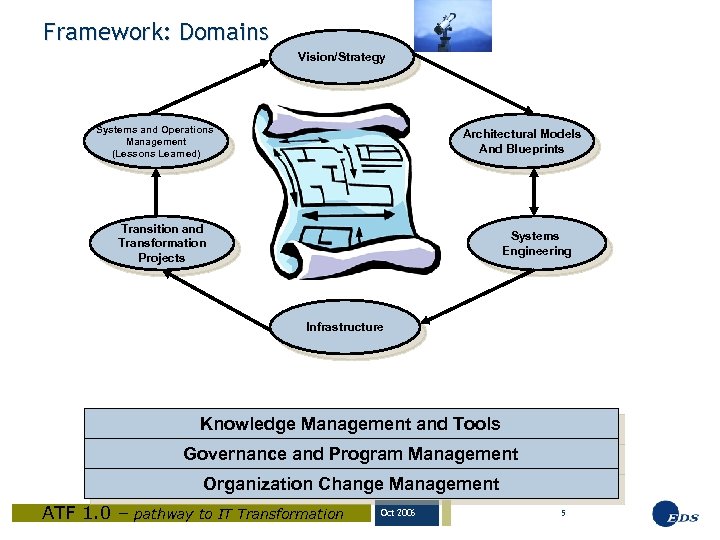 Framework: Domains Vision/Strategy Systems and Operations Management (Lessons Learned) Architectural Models And Blueprints Transition and Transformation Projects Systems Engineering Infrastructure Knowledge Management and Tools Governance and Program Management Organization Change Management ATF 1. 0 – pathway to IT Transformation Oct 2006 5
 Vision/Strategy • Ratify agency/departmental strategic/scenario plan • Ratify CONOPS • Ratify Drivers (business and technology such as SOA) • Ratify principles • Approve business case for transformation • Baseline customer and stakeholder analysis (business questions inventory) • Define Critical Success Factors • Formulate IT Strategies {SOA is a key component} in support of business strategy ATF 1. 0 – pathway to IT Transformation Oct 2006 6
 Architecture Models and Blueprints (incremental build) • Complete baseline (as-is) models: business, information, apps, infrastructure, etc • Complete applications and interface inventory; and portfolio analyses • Abstract as-is requirements • Complete transition architecture models • Establish future state models: business process architecture, information, interoperability, service models, security architecture (SOA impacts), etc • Complete services taxonomy [also, cross-walk with FEA/SCM] • Ratify IT policies, technical (e. g. , SOA), and interoperability standards profile • Baseline to-be architecture requirements • Identify target applications portfolio ATF 1. 0 – pathway to IT Transformation Oct 2006 7
 Systems Engineering • Baseline and allocate business rules and system requirements • Develop integrated (end-to-end) process for managing requirements • Ratify systems life cycle methodology • Implement capacity planning and performance engineering capability • Deploy simulation capability (e. g. , business process, infrastructure) • Validate selected architecture (following trade-off analyses) • Establish systems quality and SOA metrics • Establish Integration and Testing Strategy (including COTS, GOTS) • Incorporate usability and human factors engineering • Establish risk management process • Formulate configuration management strategy ATF 1. 0 – pathway to IT Transformation Oct 2006 8
 Systems Engineering (contd. ) • Collect and manage life cycle costs • Develop interface engineering and management strategy • Develop a strategy for reliability and survivability engineering • Develop data migration strategy • Develop acquisitions strategy (with SOA implications); build vs. buy • Achieve CMMI goal – at-least level 3 ATF 1. 0 – pathway to IT Transformation Oct 2006 9
 Infrastructure: Keep a Strategic Perspective • Ratify infrastructure rationalization plan • Publish deployment architecture • Complete network modernization (LAN, CAN, WAN, wireless, Auto. ID) • Migrate/consolidate infrastructure (e. g. , exchange, e-auth, IPV 6) • Modernize data centers (incorporate COOP) • Establish software development environment, common office, and integrated collaborative environment • Stabilize production environment; implement virtualization • Implement process automation (workflow, BPM, BPEL, Business Rules, BAM) • Select and implement Enterprise Service Bus (ESB) ATF 1. 0 – pathway to IT Transformation Oct 2006 10
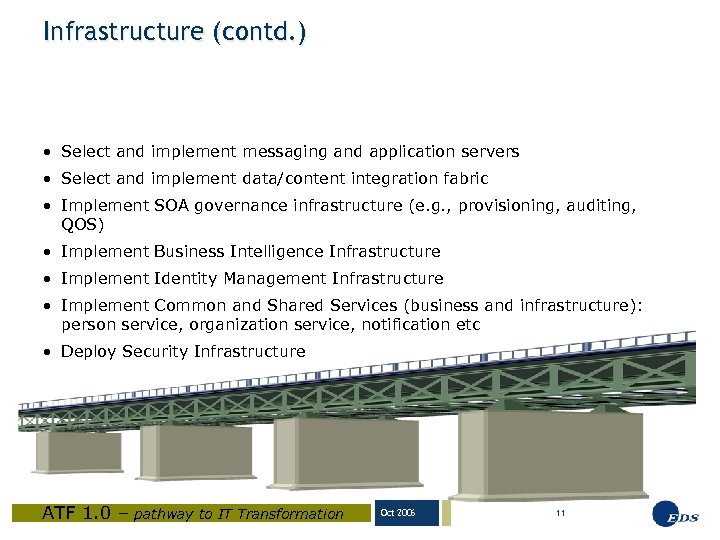 Infrastructure (contd. ) • Select and implement messaging and application servers • Select and implement data/content integration fabric • Implement SOA governance infrastructure (e. g. , provisioning, auditing, QOS) • Implement Business Intelligence Infrastructure • Implement Identity Management Infrastructure • Implement Common and Shared Services (business and infrastructure): person service, organization service, notification etc • Deploy Security Infrastructure ATF 1. 0 – pathway to IT Transformation Oct 2006 11
 Transition and Transformation Projects • Complete transition projects: code re-factor, re-architect, re-host, reinterface, incremental updates to select systems • Implement SQA Processes • Complete phased implementation of transformation/projects [involves significant process reengineering, OMB 300 s with milestone reviews] • Implement E-Gov/LOB consolidation and inter-departmental projects • Implement self-service, composite, and other applications at the edge • Perform decommission analysis • Begin phased decommissioning of legacy IT systems/projects ATF 1. 0 – pathway to IT Transformation Oct 2006 12
 Systems and Operations Management • Ratify Enterprise System Management (ESM) framework --- leverage ITIL • Implement ESM capability • Implement feedback mechanisms (e. g. , fault, failure, performance) • Implement SLAs • Implement workload and policy management • Implement service monitoring and auditing • Analyze system metrics (e. g. , SOA metrics) • Implement single management console • Document lessons learned • Conduct post-implementation reviews ATF 1. 0 – pathway to IT Transformation Oct 2006 13
 Knowledge Management and Tools • Publish enterprise glossary (e. g. , SOA, BI, KM vocabulary) and ontology • Implement developer portal (with best practices, templates, patterns) • Deploy modeling suite intended for collaboration • Implement asset repositories (EA, RM, etc) with high degree of interoperability, integration, and collaboration • Implement registries (services, interface, metadata, standards) • Implement EA visualization and analytics (with data collector interfaces) • Implement patterns library (e. g. , infrastructure, ESB usage) • Implement standard terminology and master data management services • Implement semantic-web technologies • Develop a strategy for Intellectual Property Management ATF 1. 0 – pathway to IT Transformation Oct 2006 14
 Governance and Program Management • Develop and ratify program plan with resource and budget • Ratify IT modernization plan: apps, infrastructure, data, services • Identify operational and enabling capabilities • Ratify governance model • Establish Governance Boards (Business Architecture, Requirements, ARB, CCB, SOA, Data Management); data and metadata stewardship • Institute processes: service registration, approval, certification, and publication; business case analysis; data standardization; EA compliance • Establish policies: SOA, software engineering, security, interoperability, etc • Establish MOUs and Business Partner Agreements • Implement Data Center Governance • Formulate enterprise license and smart-buy strategies • Publish CPIC Guide ATF 1. 0 – pathway to IT Transformation Oct 2006 15
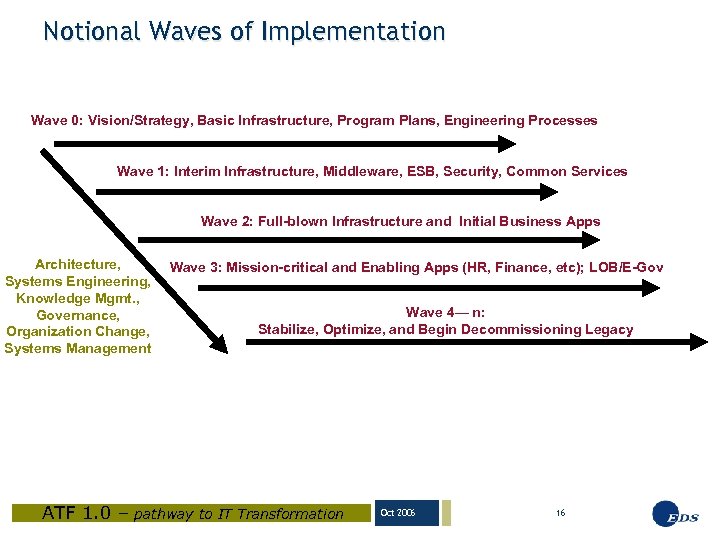 Notional Waves of Implementation Wave 0: Vision/Strategy, Basic Infrastructure, Program Plans, Engineering Processes Wave 1: Interim Infrastructure, Middleware, ESB, Security, Common Services Wave 2: Full-blown Infrastructure and Initial Business Apps Architecture, Systems Engineering, Knowledge Mgmt. , Governance, Organization Change, Systems Management Wave 3: Mission-critical and Enabling Apps (HR, Finance, etc); LOB/E-Gov Wave 4— n: Stabilize, Optimize, and Begin Decommissioning Legacy ATF 1. 0 – pathway to IT Transformation Oct 2006 16
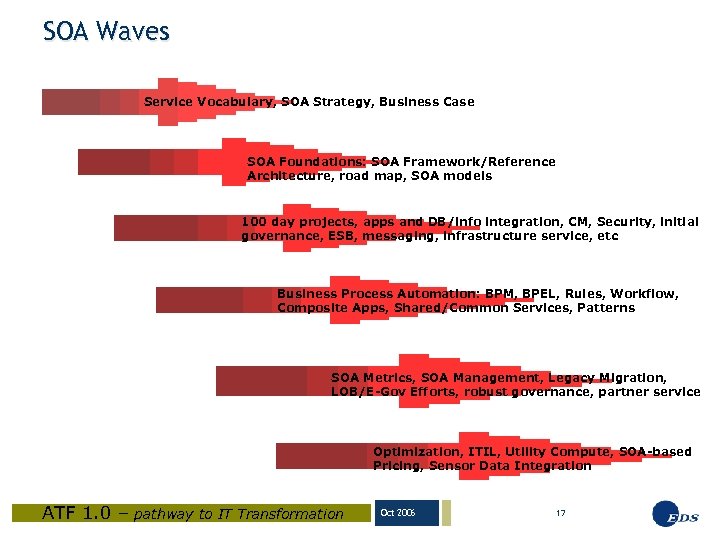 SOA Waves Service Vocabulary, SOA Strategy, Business Case SOA Foundations: SOA Framework/Reference Architecture, road map, SOA models 100 day projects, apps and DB/info integration, CM, Security, initial governance, ESB, messaging, infrastructure service, etc Business Process Automation: BPM, BPEL, Rules, Workflow, Composite Apps, Shared/Common Services, Patterns SOA Metrics, SOA Management, Legacy Migration, LOB/E-Gov Efforts, robust governance, partner service Optimization, ITIL, Utility Compute, SOA-based Pricing, Sensor Data Integration ATF 1. 0 – pathway to IT Transformation Oct 2006 17
 Organization Change Management • Reengineer facilities • Reengineer standard forms • Establish skills and competency database (human capital management) • Develop training and marketing materials; and implement training program • Implement quality management (e. g. , Six Sigma, Benchmarking) • Implement communications strategy • Establish SOA mentors and coaches • Establish centers of excellence (e. g. , SOA competency center) • Institute awards/incentives • Develop user groups • Develop strategies for academic, advisory, and industry alliances; and standards advocacy ATF 1. 0 – pathway to IT Transformation Oct 2006 18
 Recommended Actions • Engage broader community of stakeholders and customers for input and vetting • Use collaborative workshops for ranking • Leverage ATF to construct enterprise sequence plan • Cross-walk with system and release plans • Populate the content into a tool to create a true collaborative, integrated, and dynamic environment • Institutionalize and enable IT management and operational decisions • Provide input to mature OMB and GAO EA Maturity Model Framework • Continue to mature ATF as more evidence is gathered, lessons learned ATF 1. 0 – pathway to IT Transformation Oct 2006 19
 Closing Thoughts/Key Messages • IT must play a strategic role in business transformation • IT Transformation must be viewed from a “system of systems” and ecosystem perspective • SOA is pivotal to IT and business transformation– establish sound foundations to enable agility • Services must be business driven– alignment with business goals, drivers, business architecture (including business processes) are key • Shared services and common components are critical to Government and Industry transformation • Getting infrastructure right is strategic to long-term transformation • ATF is a catalyst for all of the above ATF 1. 0 – pathway to IT Transformation Oct 2006 20
 03 -23 -05 Satish Gattadahalli, Senior Enterprise Architect, USGS EDS 13600 EDS Drive, A 3 N-C 54 Herndon, VA 20171 703 -742 -2398 Satish. gattadahalli@eds. com page 21