 Скачать презентацию 0 Broadband Competition Policy in Japan March 2008
36e82b085007c0a817b4c4206d057208.ppt
- Количество слайдов: 64



0 Broadband Competition Policy in Japan March 2008 Yasu TANIWAKI (y-taniwa@soumu. go. jp) Director, Telecommunications Policy Division Telecommunications Bureau Ministry of Internal Affairs & Communications (MIC), JAPAN
1 Broadband Competition Policy in Japan ✔ ■Current Status of Broadband Market in Japan ■Outline of “New Competition Policy Program 2010” ■Specific Issues □Network Neutrality Issues □Focus on Openness for Platform Functions □Revitalization of Mobile Business □Review of Universal Service System □Terminal Equipment Policy in the IP era
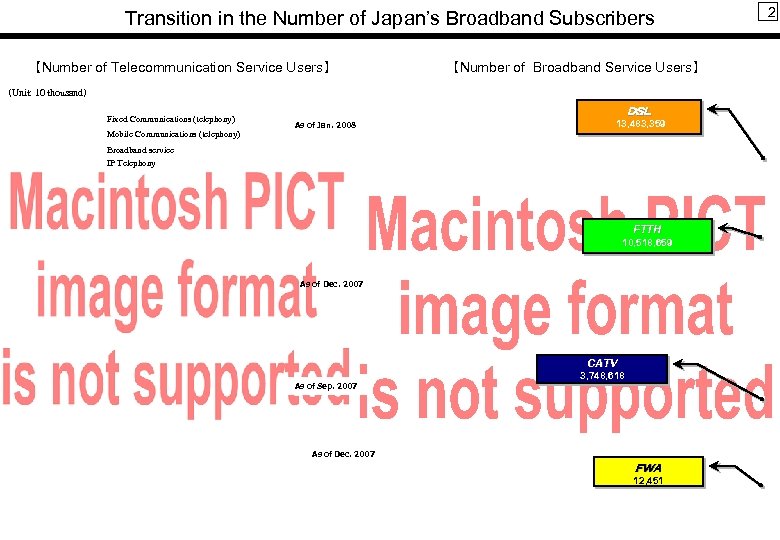
Transition in the Number of Japan’s Broadband Subscribers 【Number of Telecommunication Service Users】 【Number of Broadband Service Users】 (Unit: 10 thousand) Fixed Communications (telephony) Mobile Communications (telephony) DSL As of Jan. 2008 13, 483, 359 Broadband service IP Telephony FTTH 10, 518, 659 As of Dec. 2007 CATV As of Sep. 2007 3, 748, 618 As of Dec. 2007 FWA 12, 451 2
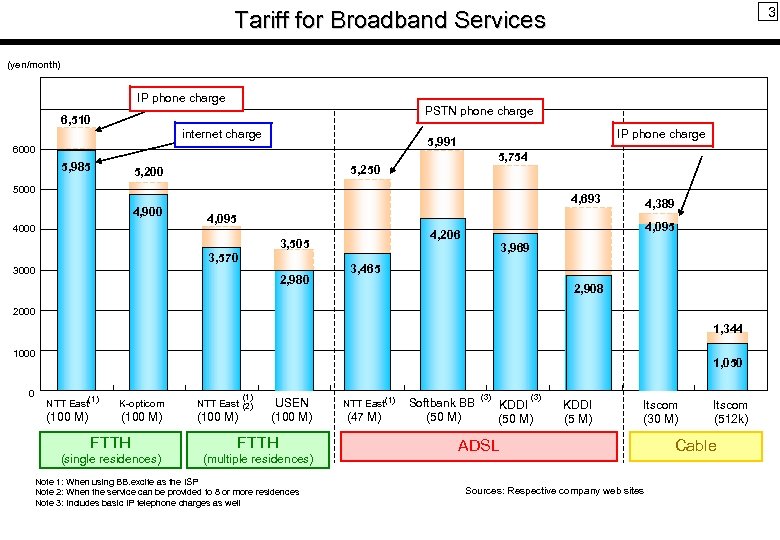
3 Tariff for Broadband Services (yen/month) IP phone charge PSTN phone charge 6, 510 internet charge 6000 5, 985 IP phone charge 5, 991 5, 754 5, 250 5, 200 5000 4, 693 4, 900 4000 4, 389 4, 095 3, 505 3, 570 3000 2, 980 4, 095 4, 206 3, 969 3, 465 2, 908 2000 1, 344 1000 0 1, 050 NTT East(1) K-opticom NTT East (100 M) (1) (2) USEN (100 M) FTTH (single residences) (multiple residences) Note 1: When using BB. excite as the ISP Note 2: When the service can be provided to 8 or more residences Note 3: Includes basic IP telephone charges as well NTT East(1) (47 M) Softbank BB (50 M) (3) KDDI (50 M) KDDI (5 M) Itscom (30 M) ADSL Sources: Respective company web sites Itscom (512 k) Cable
Japanese Broadband Service in Global Comparison Broadband prices (100 kbit/s) Speed of DSL (US dollar) (Mbit/s) Source : ITU Internet Reports 2006 ”digital. life”(December 2006) 4
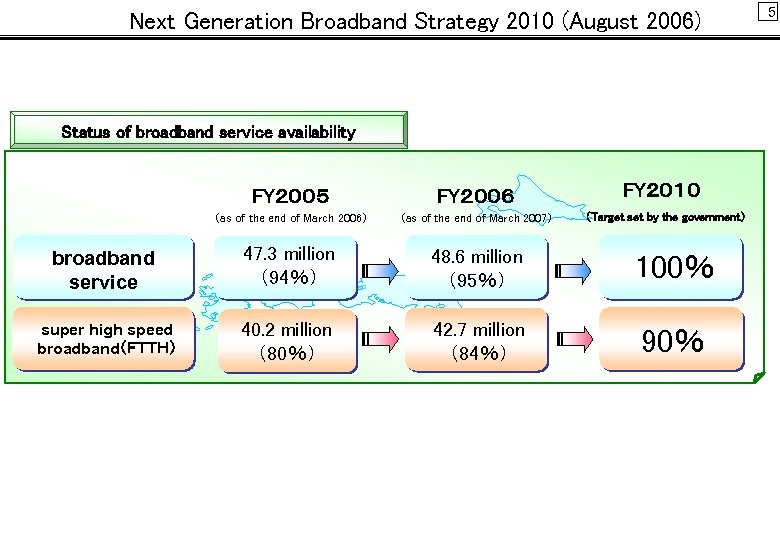
Next Generation Broadband Strategy 2010 (August 2006) Status of broadband service availability FY2005 FY2006 FY2010 (as of the end of March 2006) (as of the end of March 2007) (Target set by the government) broadband service 47. 3 million (94%) 48. 6 million (95%) 100% super high speed broadband(FTTH) 40. 2 million (80%) 42. 7 million (84%) 90% 5
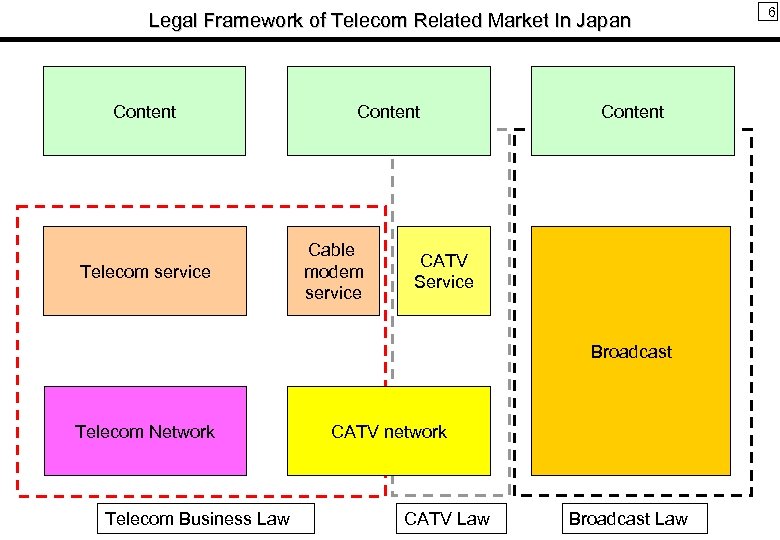
Legal Framework of Telecom Related Market In Japan Content Telecom service Content Cable modem service Content CATV Service Broadcast Telecom Network Telecom Business Law CATV network CATV Law Broadcast Law 6
7 Broadband Competition Policy in Japan ■Current Status of Broadband Market in Japan ✔ of “New Competition Policy Program 2010” ■Outline ■Specific Issues □Network Neutrality Issues □Focus on Openness for Platform Functions □Revitalization of Mobile Business □Review of Universal Service System □Terminal Equipment Policy in the IP era
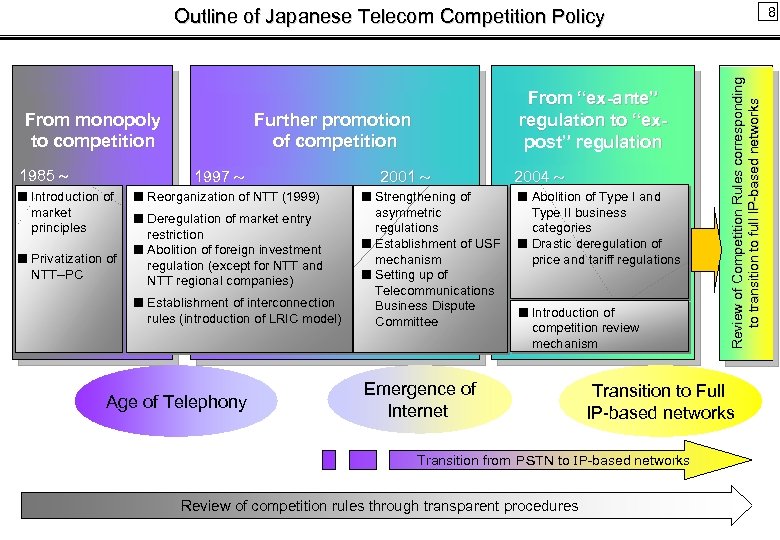
8 From monopoly to competition Further promotion of competition 1997 1985 Introduction of market principles Privatization of NTT--PC From “ex-ante” regulation to “expost” regulation Reorganization of NTT (1999) Deregulation of market entry restriction Abolition of foreign investment regulation (except for NTT and NTT regional companies) Establishment of interconnection rules (introduction of LRIC model) Age of Telephony 2001 Strengthening of asymmetric regulations Establishment of USF mechanism Setting up of Telecommunications Business Dispute Committee 2004 Abolition of Type I and Type II business categories Drastic deregulation of price and tariff regulations Introduction of competition review mechanism Emergence of Internet Transition to Full IP-based networks Transition from PSTN to IP-based networks Review of competition rules through transparent procedures Review of Competition Rules corresponding to transition to full IP-based networks Outline of Japanese Telecom Competition Policy
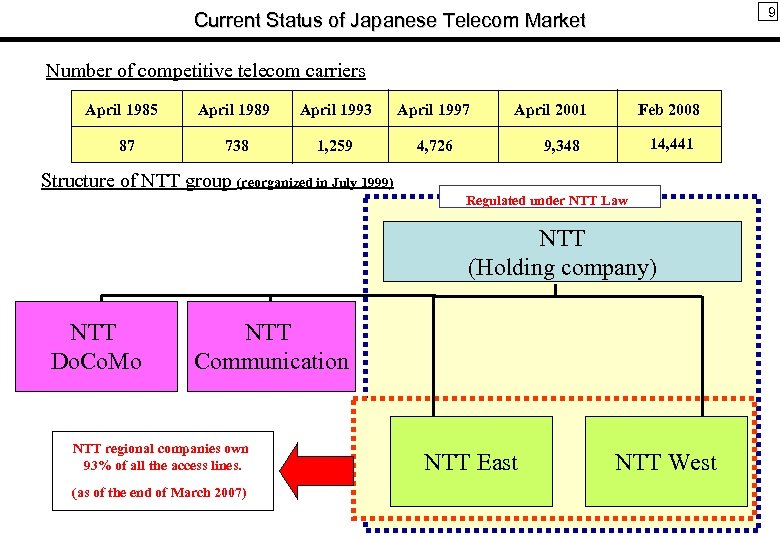
9 Current Status of Japanese Telecom Market Number of competitive telecom carriers April 1985 87 April 1989 April 1993 April 1997 738 1, 259 April 2001 4, 726 Feb 2008 14, 441 9, 348 Structure of NTT group (reorganized in July 1999) Regulated under NTT Law NTT (Holding company) NTT Do. Co. Mo NTT Communication NTT regional companies own 93% of all the access lines. (as of the end of March 2007) NTT East NTT West
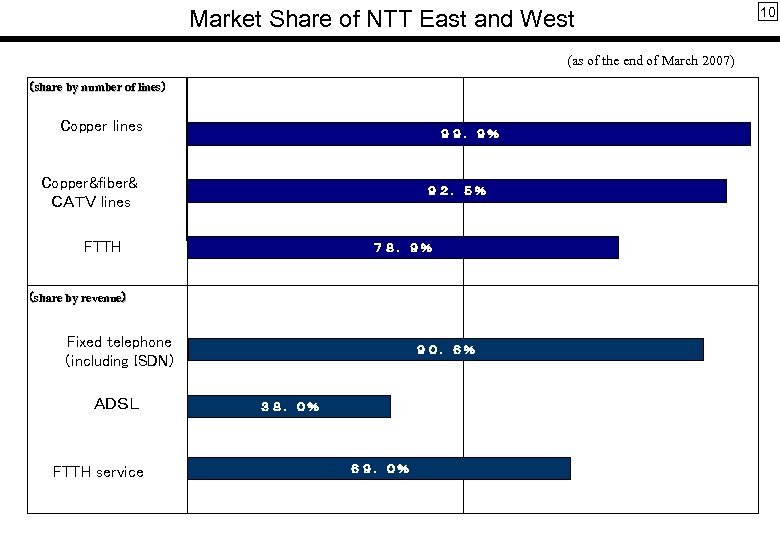
Market Share of NTT East and West (as of the end of March 2007) (share by number of lines) Copper lines 99.9% Copper&fiber& CATV lines 92.5% FTTH 78.9% (share by revenue) Fixed telephone (including ISDN) ADSL FTTH service 90.6% 38.0% 69.0% 10
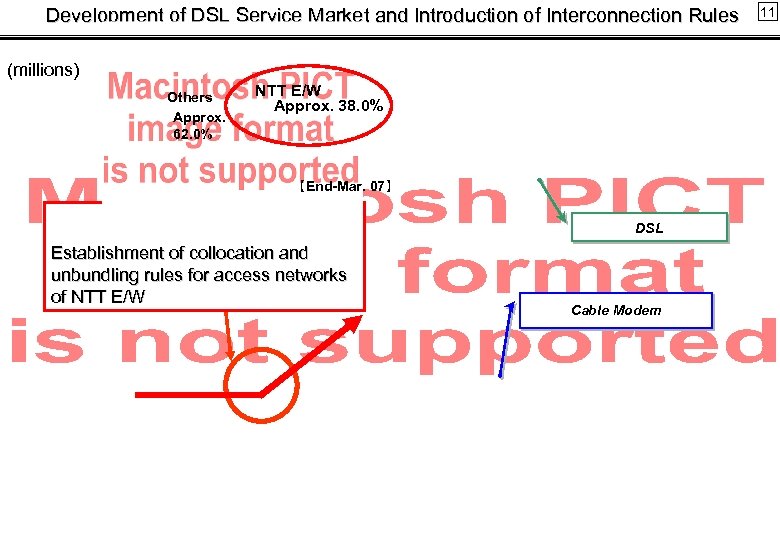
Development of DSL Service Market and Introduction of Interconnection Rules (millions) Others Approx. 62. 0% NTT E/W Approx. 38. 0% 【End-Mar. 07】 Autumn 2000 Establishment of collocation and unbundling rules for access networks 0 7 8 of NTT E/W DSL Cable Modem 11
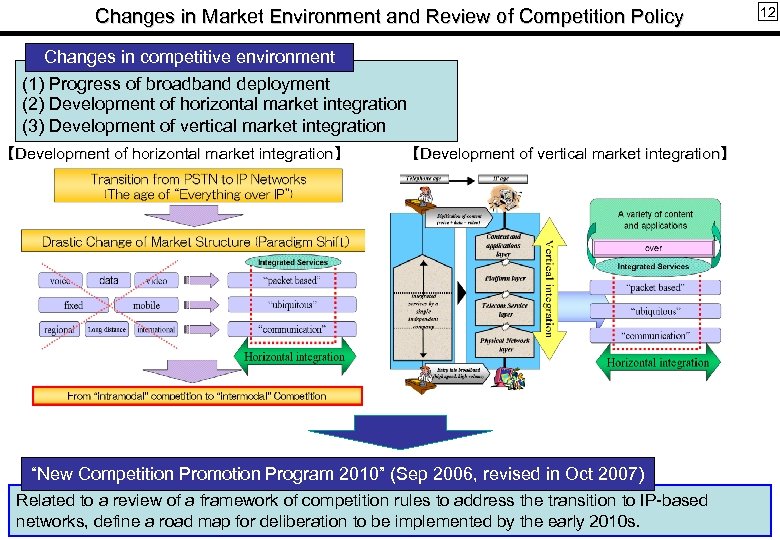
Changes in Market Environment and Review of Competition Policy Changes in competitive environment (1) Progress of broadband deployment (2) Development of horizontal market integration (3) Development of vertical market integration 【Development of horizontal market integration】 【Development of vertical market integration】 “New Competition Promotion Program 2010” (Sep 2006, revised in Oct 2007) Related to a review of a framework of competition rules to address the transition to IP-based networks, define a road map for deliberation to be implemented by the early 2010 s. 12
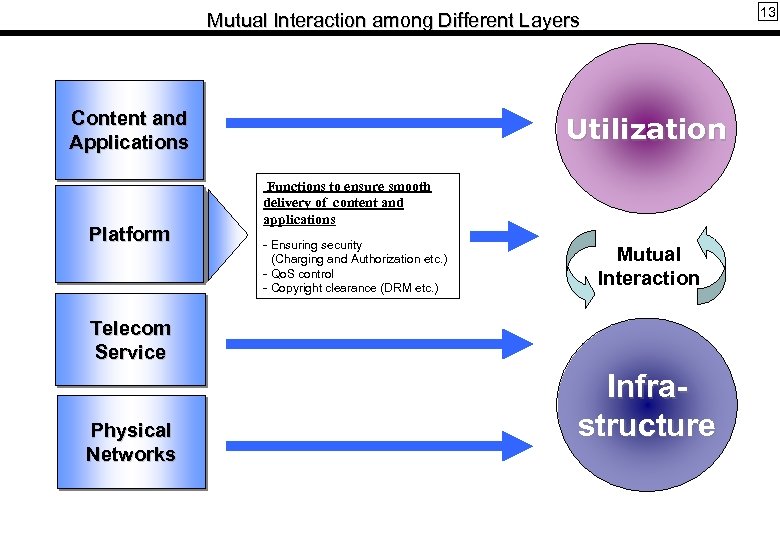
13 Mutual Interaction among Different Layers Content and Applications Platform Utilization Functions to ensure smooth delivery of content and applications - Ensuring security (Charging and Authorization etc. ) - Qo. S control - Copyright clearance (DRM etc. ) Mutual Interaction Telecom Service Physical Networks Infrastructure
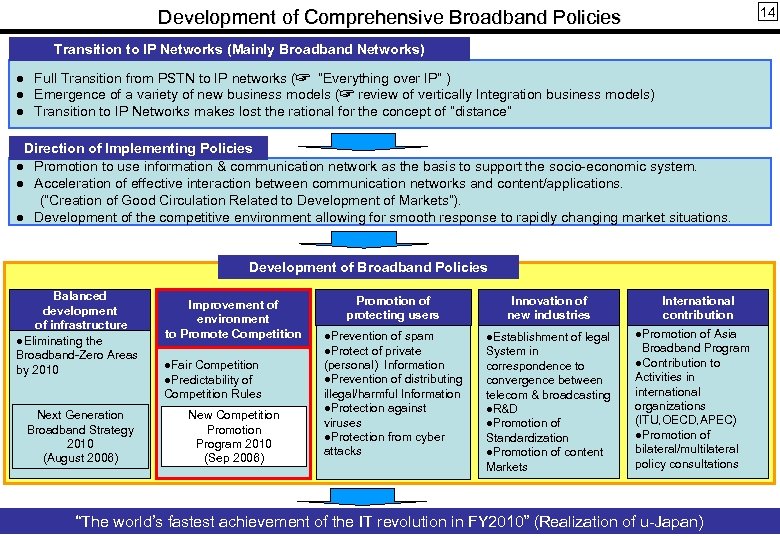
14 Development of Comprehensive Broadband Policies Transition to IP Networks (Mainly Broadband Networks) ● Full Transition from PSTN to IP networks (☞ “Everything over IP” ) ● Emergence of a variety of new business models (☞ review of vertically Integration business models) ● Transition to IP Networks makes lost the rational for the concept of “distance” Direction of Implementing Policies ● Promotion to use information & communication network as the basis to support the socio-economic system. ● Acceleration of effective interaction between communication networks and content/applications. (“Creation of Good Circulation Related to Development of Markets”). ● Development of the competitive environment allowing for smooth response to rapidly changing market situations. Development of Broadband Policies Balanced development of infrastructure ●Eliminating the Broadband-Zero Areas by 2010 Next Generation Broadband Strategy 2010 (August 2006) Improvement of environment to Promote Competition ●Fair Competition ●Predictability of Competition Rules New Competition Promotion Program 2010 (Sep 2006) Promotion of protecting users Innovation of new industries ●Prevention of spam ●Protect of private (personal) Information ●Prevention of distributing illegal/harmful Information ●Protection against viruses ●Protection from cyber attacks ●Establishment of legal System in correspondence to convergence between telecom & broadcasting ●R&D ●Promotion of Standardization ●Promotion of content Markets International contribution ●Promotion of Asia Broadband Program ●Contribution to Activities in international organizations (ITU, OECD, APEC) ●Promotion of bilateral/multilateral policy consultations “The world’s fastest achievement of the IT revolution in FY 2010” (Realization of u-Japan)
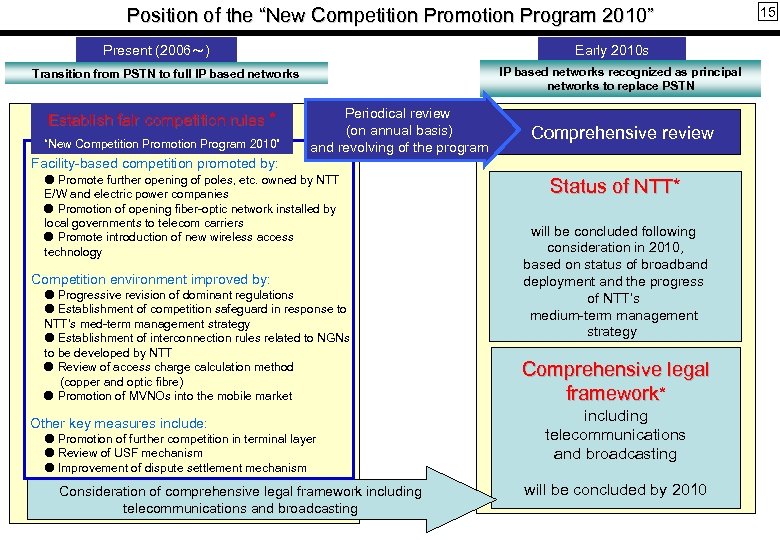
Position of the “New Competition Promotion Program 2010” Present (2006~) Early 2010 s IP based networks recognized as principal networks to replace PSTN Transition from PSTN to full IP based networks Establish fair competition rules * “New Competition Promotion Program 2010” Periodical review (on annual basis) and revolving of the program Comprehensive review Facility-based competition promoted by: Promote further opening of poles, etc. owned by NTT E/W and electric power companies Promotion of opening fiber-optic network installed by local governments to telecom carriers Promote introduction of new wireless access technology Competition environment improved by: Progressive revision of dominant regulations Establishment of competition safeguard in response to NTT’s med-term management strategy Establishment of interconnection rules related to NGNs to be developed by NTT Review of access charge calculation method (copper and optic fibre) Promotion of MVNOs into the mobile market Other key measures include: Promotion of further competition in terminal layer Review of USF mechanism Improvement of dispute settlement mechanism Consideration of comprehensive legal framework including telecommunications and broadcasting Status of NTT* NTT will be concluded following consideration in 2010, based on status of broadband deployment and the progress of NTT’s medium-term management strategy Comprehensive legal framework* including telecommunications and broadcasting will be concluded by 2010 15
16 Broadband Competition Policy in Japan ■Current Status of Broadband Market in Japan ■Outline of “New Competition Policy Program 2010” ✔ ■Specific Issues □Network Neutrality Issues □Focus on Openness for Platform Functions □Revitalization of Mobile Business □Review of Universal Service System □Terminal Equipment Policy in the IP era
17 Broadband Competition Policy in Japan ■Current Status of Broadband Market in Japan ■Outline of “New Competition Policy Program 2010” ■Specific Issues ✔ □Network Neutrality Issues □Focus on Openness for Platform Functions □Revitalization of Mobile Business □Review of Universal Service System □Terminal Equipment Policy in the IP era
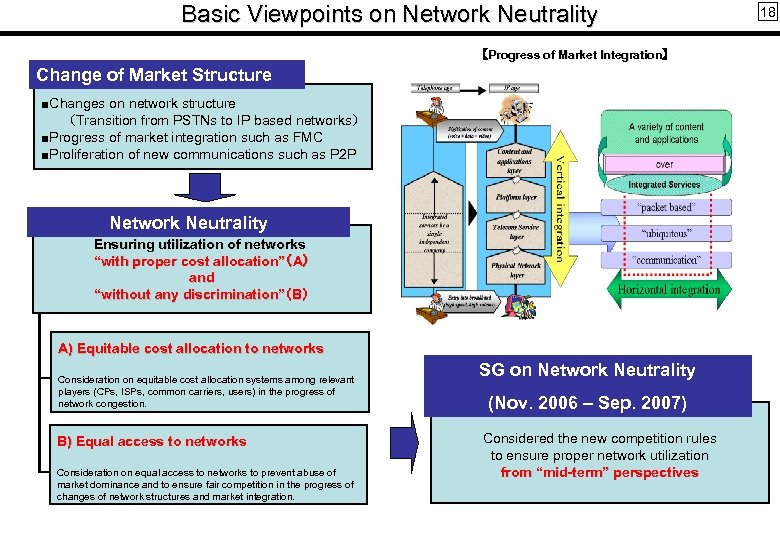
Basic Viewpoints on Network Neutrality 【Progress of Market Integration】 Change of Market Structure ■Changes on network structure (Transition from PSTNs to IP based networks) ■Progress of market integration such as FMC ■Proliferation of new communications such as P 2 P Network Neutrality Ensuring utilization of networks “with proper cost allocation”(A) allocation”( and “without any discrimination”(B) discrimination”( A) Equitable cost allocation to networks Consideration on equitable cost allocation systems among relevant players (CPs, ISPs, common carriers, users) in the progress of network congestion. B) Equal access to networks Consideration on equal access to networks to prevent abuse of market dominance and to ensure fair competition in the progress of changes of network structures and market integration. SG on Network Neutrality (Nov. 2006 – Sep. 2007) Considered the new competition rules to ensure proper network utilization from “mid-term” perspectives 18
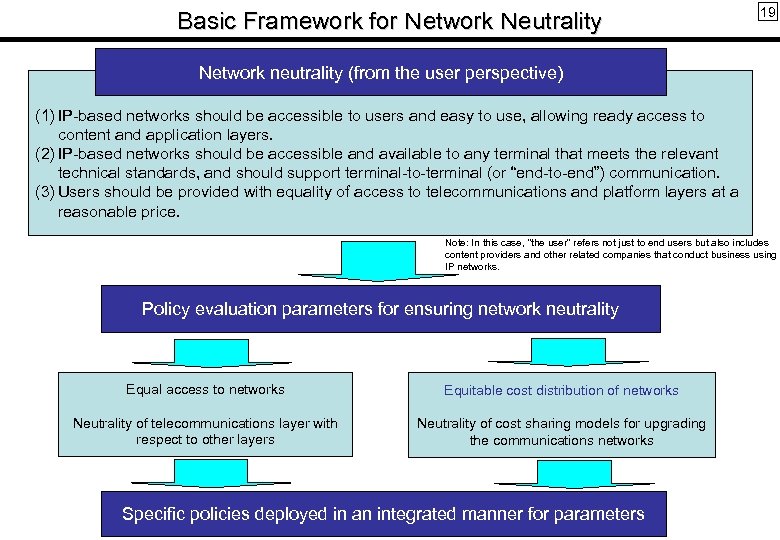
Basic Framework for Network Neutrality 19 Network neutrality (from the user perspective) (1) IP-based networks should be accessible to users and easy to use, allowing ready access to content and application layers. (2) IP-based networks should be accessible and available to any terminal that meets the relevant technical standards, and should support terminal-to-terminal (or “end-to-end”) communication. (3) Users should be provided with equality of access to telecommunications and platform layers at a reasonable price. Note: In this case, "the user" refers not just to end users but also includes content providers and other related companies that conduct business using IP networks. Policy evaluation parameters for ensuring network neutrality Equal access to networks Equitable cost distribution of networks Neutrality of telecommunications layer with respect to other layers Neutrality of cost sharing models for upgrading the communications networks Specific policies deployed in an integrated manner for parameters
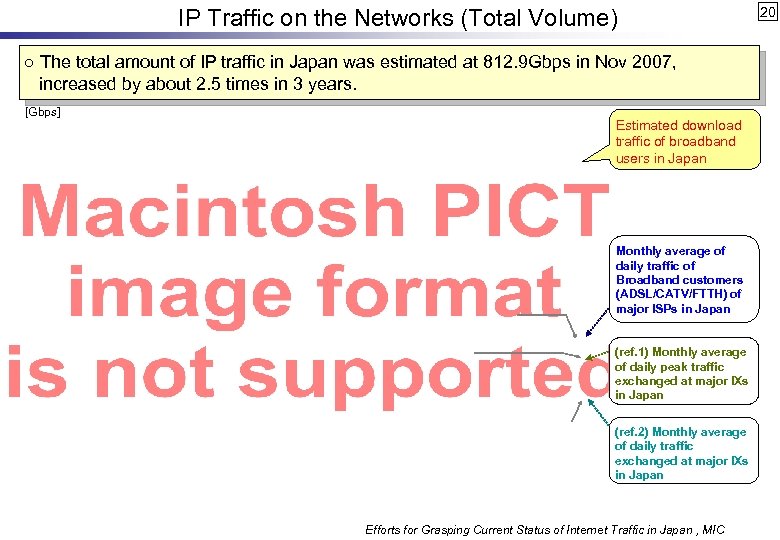
IP Traffic on the Networks (Total Volume) ○ The total amount of IP traffic in Japan was estimated at 812. 9 Gbps in Nov 2007, increased by about 2. 5 times in 3 years. [Gbps] Estimated download traffic of broadband users in Japan Monthly average of daily traffic of Broadband customers (ADSL/CATV/FTTH) of major ISPs in Japan (ref. 1) Monthly average of daily peak traffic exchanged at major IXs in Japan (ref. 2) Monthly average of daily traffic exchanged at major IXs in Japan Efforts for Grasping Current Status of Internet Traffic in Japan , MIC 20
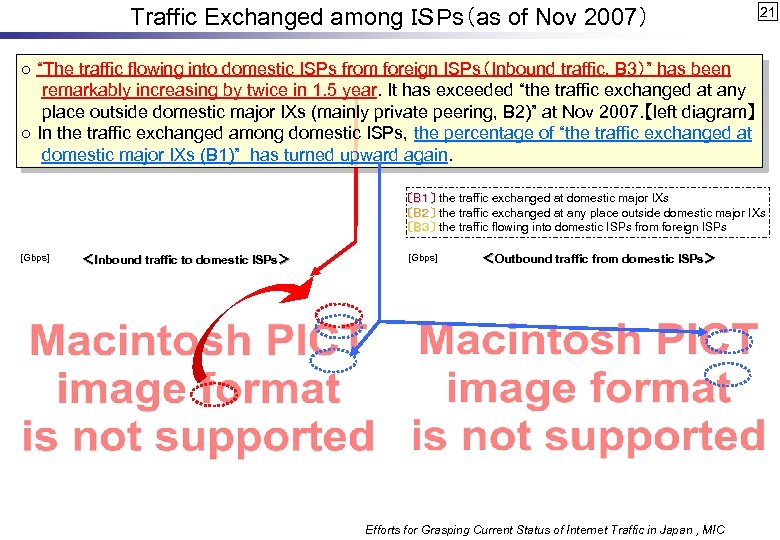
Traffic Exchanged among ISPs(as of Nov 2007) 21 ○ “The traffic flowing into domestic ISPs from foreign ISPs(Inbound traffic, B 3)” has been remarkably increasing by twice in 1. 5 year. It has exceeded “the traffic exchanged at any place outside domestic major IXs (mainly private peering, B 2)” at Nov 2007. 【left diagram】 ○ In the traffic exchanged among domestic ISPs, the percentage of “the traffic exchanged at domestic major IXs (B 1)” has turned upward again. 〔B1〕 the traffic exchanged at domestic major IXs 〔B2〕 the traffic exchanged at any place outside domestic major IXs 〔B3〕 the traffic flowing into domestic ISPs from foreign ISPs [Gbps] <Inbound traffic to domestic ISPs> [Gbps] <Outbound traffic from domestic ISPs> Efforts for Grasping Current Status of Internet Traffic in Japan , MIC
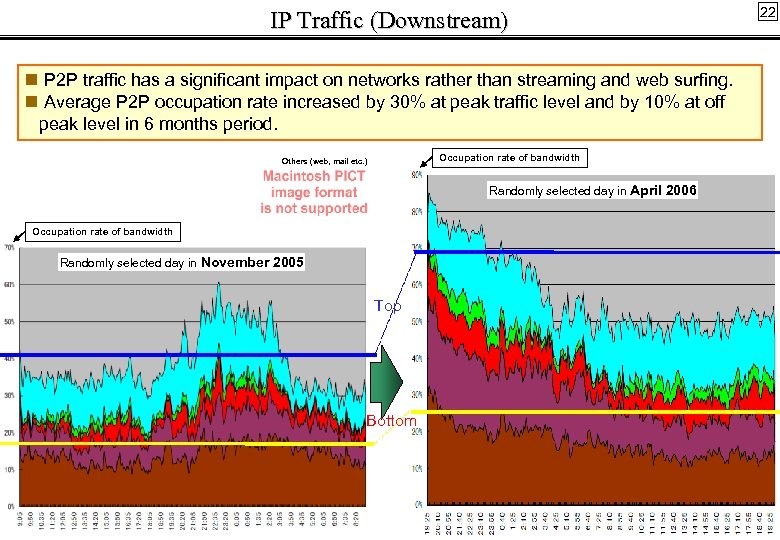
IP Traffic (Downstream) P 2 P traffic has a significant impact on networks rather than streaming and web surfing. Average P 2 P occupation rate increased by 30% at peak traffic level and by 10% at off peak level in 6 months period. Occupation rate of bandwidth Others (web, mail etc. ) Randomly selected day in April 2006 Occupation rate of bandwidth Randomly selected day in November 2005 Top Bottom 22
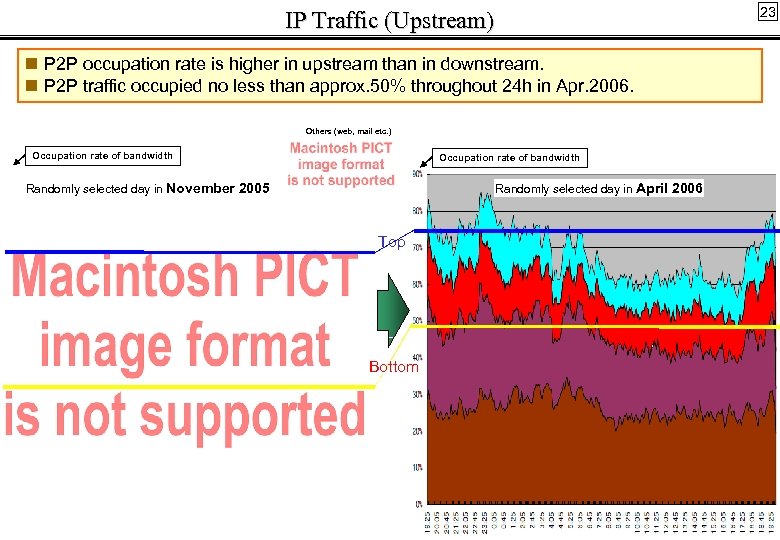
23 IP Traffic (Upstream) P 2 P occupation rate is higher in upstream than in downstream. P 2 P traffic occupied no less than approx. 50% throughout 24 h in Apr. 2006. Others (web, mail etc. ) Occupation rate of bandwidth Randomly selected day in November 2005 Randomly selected day in April 2006 Top Bottom
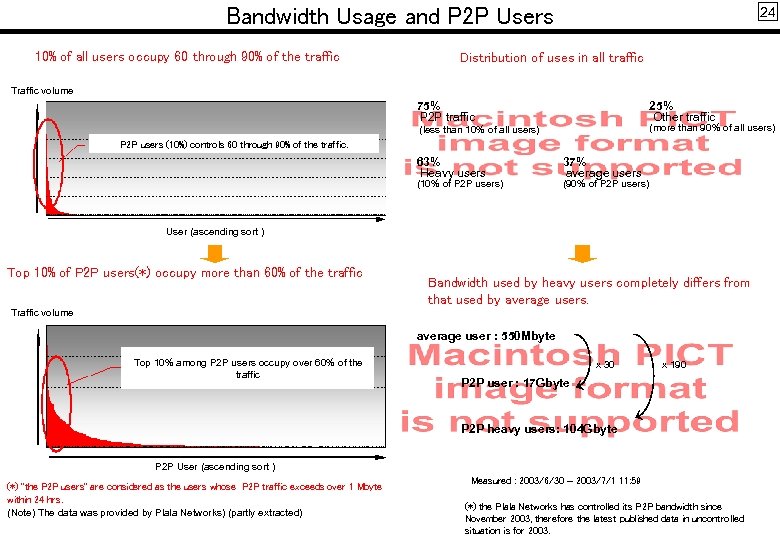
Bandwidth Usage and P 2 P Users 10% of all users occupy 60 through 90% of the traffic 24 Distribution of uses in all traffic Traffic volume 75% P 2 P traffic 25% Other traffic (more than 90% of all users) (less than 10% of all users) P 2 P users (10%) controls 60 through 90% of the traffic. 63% Heavy users (10% of P 2 P users) 37% average users (90% of P 2 P users) User (ascending sort ) Top 10% of P 2 P users(*) occupy more than 60% of the traffic Bandwidth used by heavy users completely differs from that used by average users. Traffic volume average user : 550 Mbyte Top 10% among P 2 P users occupy over 60% of the traffic x 30 x 190 P 2 P user : 17 Gbyte P 2 P heavy users: 104 Gbyte P 2 P User (ascending sort ) (*) “the P 2 P users” are considered as the users whose P 2 P traffic exceeds over 1 Mbyte within 24 hrs. (Note) The data was provided by Plala Networks) (partly extracted) Measured : 2003/6/30 – 2003/7/1 11: 59 (*) the Plala Networks has controlled its P 2 P bandwidth since November 2003, therefore the latest published data in uncontrolled situation is for 2003.
Background of Dramatic Traffic Increase ■Broadly usage of P 2 P-based file exchange, driven by increasing availability for broader upload bandwidth in response to proliferation of FTTH service ■In addition to increase of rich content including video, many new business models with CGC (Consumer Generated Content) have emerged. ⇒Content may flow into the network from a variety of network edges ■Some new factors possibly to making Internet traffic increase. ●Emergence of new communications represented by M 2 M in line with progress of ubiquitous economy ●Increase of network utilization including Saa. S within firms ●Proliferation of grid computing 25
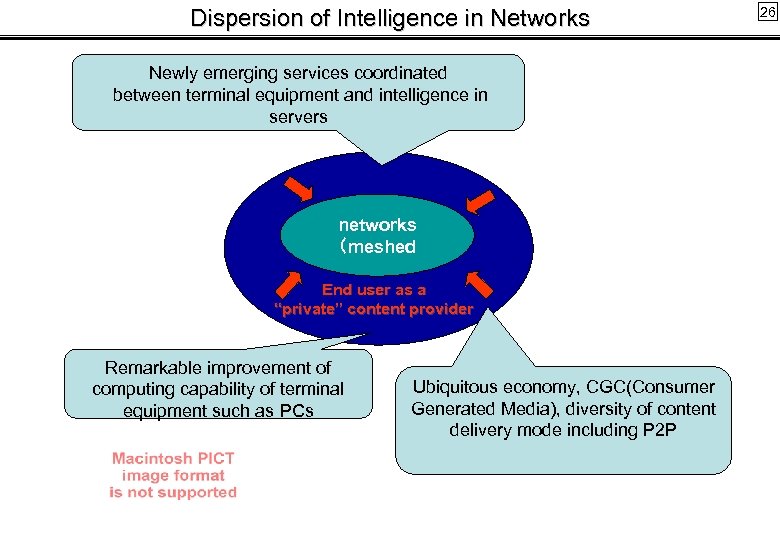
Dispersion of Intelligence in Networks Newly emerging services coordinated between terminal equipment and intelligence in servers networks (meshed End user as a “private” content provider Remarkable improvement of computing capability of terminal equipment such as PCs Ubiquitous economy, CGC(Consumer Generated Media), diversity of content delivery mode including P 2 P 26
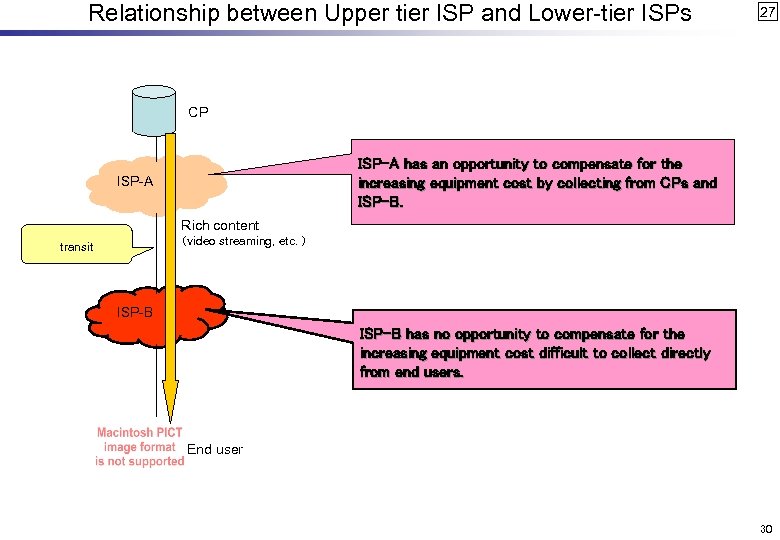
Relationship between Upper tier ISP and Lower-tier ISPs 27 CP ISP-A has an opportunity to compensate for the increasing equipment cost by collecting from CPs and ISP-B. ISP-A Rich content (video streaming, etc. ) transit ISP-B has no opportunity to compensate for the increasing equipment cost difficult to collect directly from end users. End user 30
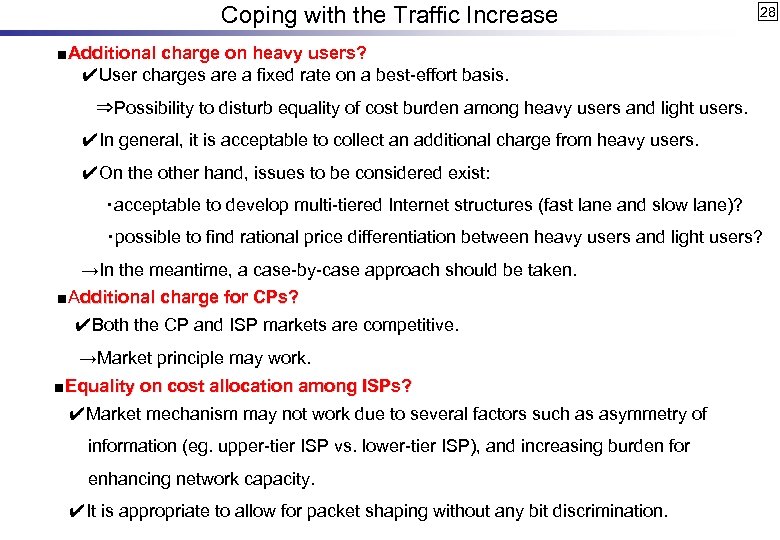
Coping with the Traffic Increase 28 ■Additional charge on heavy users? ✔User charges are a fixed rate on a best-effort basis. ⇒Possibility to disturb equality of cost burden among heavy users and light users. ✔In general, it is acceptable to collect an additional charge from heavy users. ✔On the other hand, issues to be considered exist: ・acceptable to develop multi-tiered Internet structures (fast lane and slow lane)? ・possible to find rational price differentiation between heavy users and light users? →In the meantime, a case-by-case approach should be taken. ■Additional charge for CPs? ✔Both the CP and ISP markets are competitive. →Market principle may work. ■Equality on cost allocation among ISPs? ✔Market mechanism may not work due to several factors such as asymmetry of information (eg. upper-tier ISP vs. lower-tier ISP), and increasing burden for enhancing network capacity. ✔It is appropriate to allow for packet shaping without any bit discrimination.
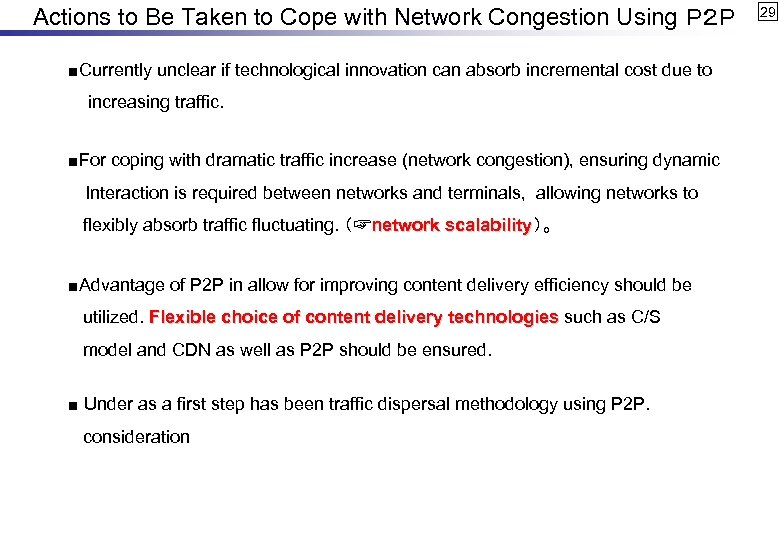
Actions to Be Taken to Cope with Network Congestion Using P2P ■Currently unclear if technological innovation can absorb incremental cost due to increasing traffic. ■For coping with dramatic traffic increase (network congestion), ensuring dynamic Interaction is required between networks and terminals, allowing networks to flexibly absorb traffic fluctuating. (☞network scalability)。 scalability ■Advantage of P 2 P in allow for improving content delivery efficiency should be utilized. Flexible choice of content delivery technologies such as C/S model and CDN as well as P 2 P should be ensured. ■ Under as a first step has been traffic dispersal methodology using P 2 P. consideration 29
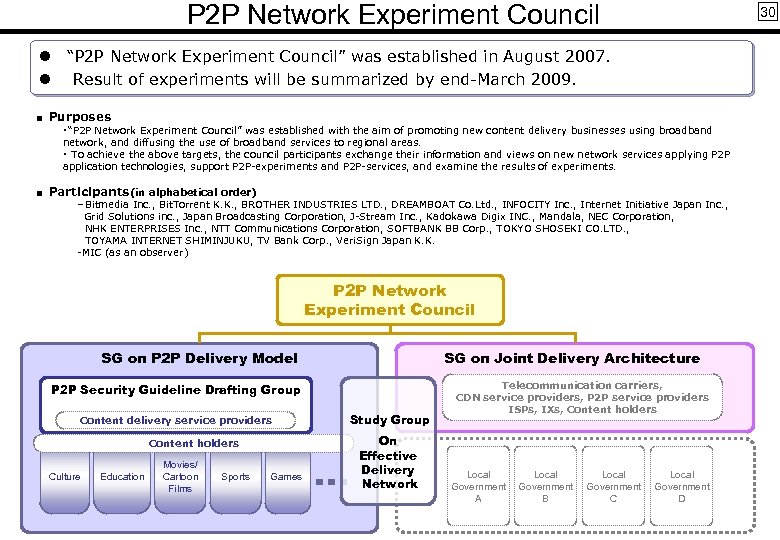
P 2 P Network Experiment Council 30 l “P 2 P Network Experiment Council” was established in August 2007. l Result of experiments will be summarized by end-March 2009. ■ Purposes ・“P 2 P Network Experiment Council” was established with the aim of promoting new content delivery businesses using broadband network, and diffusing the use of broadband services to regional areas. ・ To achieve the above targets, the council participants exchange their information and views on new network services applying P 2 P application technologies, support P 2 P-experiments and P 2 P-services, and examine the results of experiments. ■ Participants(in alphabetical order) – Bitmedia Inc. , Bit. Torrent K. K. , BROTHER INDUSTRIES LTD. , DREAMBOAT Co. Ltd. , INFOCITY Inc. , Internet Initiative Japan Inc. , Grid Solutions inc. , Japan Broadcasting Corporation, J-Stream Inc. , Kadokawa Digix INC. , Mandala, NEC Corporation, NHK ENTERPRISES Inc. , NTT Communications Corporation, SOFTBANK BB Corp. , TOKYO SHOSEKI CO. LTD. , TOYAMA INTERNET SHIMINJUKU, TV Bank Corp. , Veri. Sign Japan K. K. -MIC (as an observer) P 2 P Network Experiment Council SG on P 2 P Delivery Model SG on Joint Delivery Architecture P 2 P Security Guideline Drafting Group Content delivery service providers Content holders Culture Education Movies/ Cartoon Films Sports Games Study Group On Effective Delivery Network Telecommunication carriers, CDN service providers, P 2 P service providers ISPs, IXs, Content holders Local Government A Local Government B Local Government C Local Government D
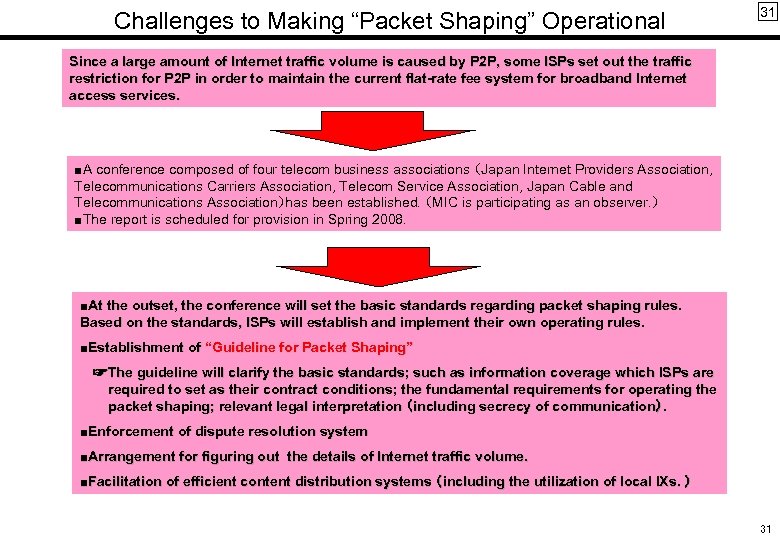
Challenges to Making “Packet Shaping” Operational 31 Since a large amount of Internet traffic volume is caused by P 2 P, some ISPs set out the traffic restriction for P 2 P in order to maintain the current flat-rate fee system for broadband Internet access services. ■A conference composed of four telecom business associations (Japan Internet Providers Association, Telecommunications Carriers Association, Telecom Service Association, Japan Cable and Telecommunications Association)has been established. (MIC is participating as an observer. ) ■The report is scheduled for provision in Spring 2008. ■At the outset, the conference will set the basic standards regarding packet shaping rules. Based on the standards, ISPs will establish and implement their own operating rules. ■Establishment of “Guideline for Packet Shaping” ☞The guideline will clarify the basic standards; such as information coverage which ISPs are required to set as their contract conditions; the fundamental requirements for operating the packet shaping; relevant legal interpretation (including secrecy of communication) ■Enforcement of dispute resolution system ■Arrangement for figuring out the details of Internet traffic volume. ■Facilitation of efficient content distribution systems (including the utilization of local IXs. ) 31
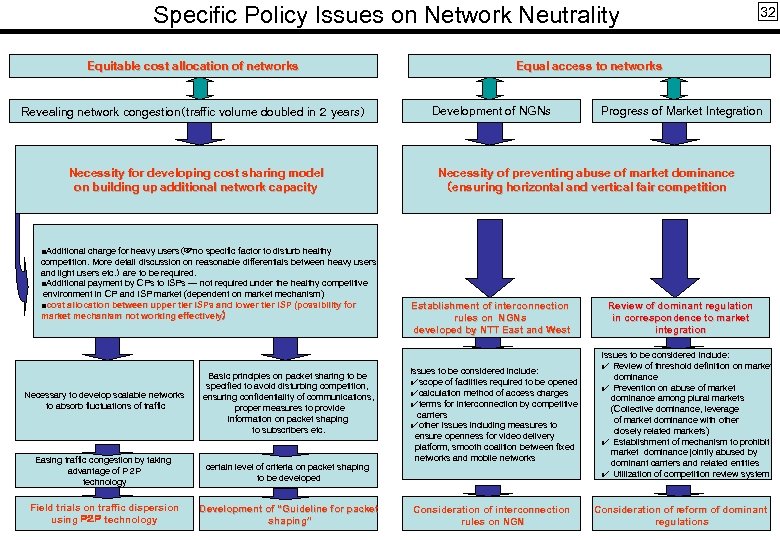
Specific Policy Issues on Network Neutrality Equitable cost allocation of networks Revealing network congestion(traffic volume doubled in 2 years) Necessity for developing cost sharing model on building up additional network capacity ■Additional charge for heavy users(☞no specific factor to disturb healthy competition. More detail discussion on reasonable differentials between heavy users and light users etc. ) are to be required. ■Additional payment by CPs to ISPs --- not required under the healthy competitive environment in CP and ISP market (dependent on market mechanism) ■cost allocation between upper tier ISPs and lower tier ISP (possibility for cost market mechanism not working effectively) Necessary to develop scalable networks to absorb fluctuations of traffic Basic principles on packet sharing to be specified to avoid disturbing competition, ensuring confidentiality of communications, proper measures to provide Information on packet shaping to subscribers etc. Easing traffic congestion by taking advantage of P2P technology certain level of criteria on packet shaping to be developed Field trials on traffic dispersion using P2P technology Development of “Guideline for packet shaping” 32 Equal access to networks Development of NGNs Progress of Market Integration Necessity of preventing abuse of market dominance (ensuring horizontal and vertical fair competition Establishment of interconnection rules on NGNs developed by NTT East and West Issues to be considered include: ✔scope of facilities required to be opened ✔calculation method of access charges ✔terms for interconnection by competitive carriers ✔other issues including measures to ensure openness for video delivery platform, smooth coalition between fixed networks and mobile networks Consideration of interconnection rules on NGN Review of dominant regulation in correspondence to market correspondence integration Issues to be considered include: ✔ Review of threshold definition on market dominance ✔ Prevention on abuse of market dominance among plural markets (Collective dominance, leverage of market dominance with other closely related markets) ✔ Establishment of mechanism to prohibit market dominance jointly abused by dominant carriers and related entities ✔ Utilization of competition review system Consideration of reform of dominant regulations
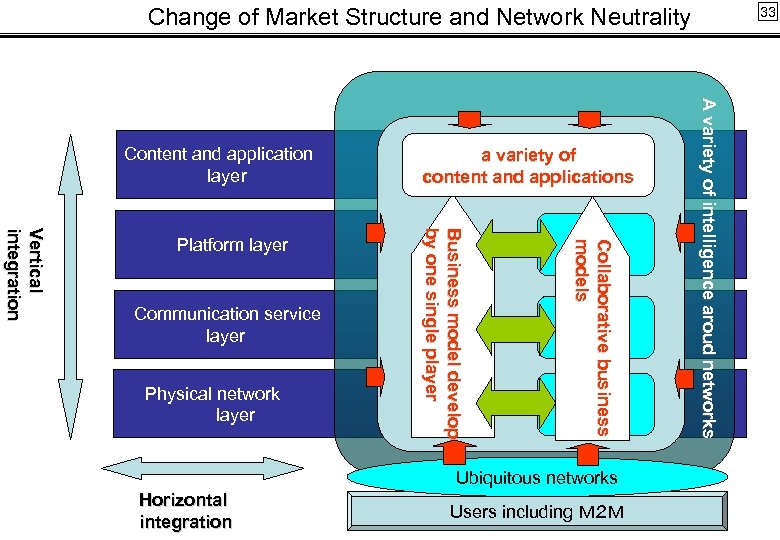
Ubiquitous networks A v a r i e ty o f i n te l l i g e n c e a r o u d n e tw o r k s Users including M2M Horizontal integration C o l l a b o r a ti v e b u s i n e s s mo d el s Physical network layer Bu si n ess mo d el d evel o p ed b y o n e si n g l e p l ayer V e r ti c a l i n te g r a ti o n Communication service layer Platform layer a variety of content and applications Content and application layer 33 Change of Market Structure and Network Neutrality
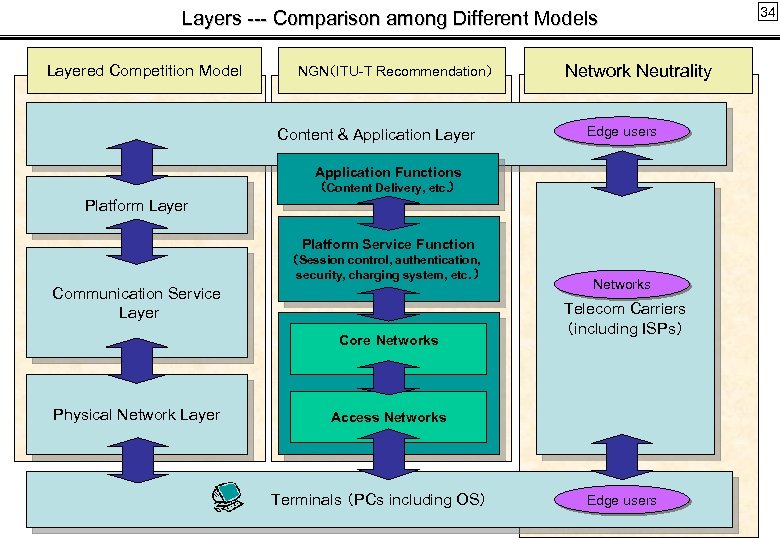
Layers --- Comparison among Different Models Layered Competition Model NGN(ITU-T Recommendation) Content & Application Layer Network Neutrality Edge users Application Functions (Content Delivery, etc. ) Platform Layer Platform Service Function (Session control, authentication, security, charging system, etc. ) Communication Service Layer Core Networks Physical Network Layer Networks Telecom Carriers (including ISPs) Access Networks Terminals (PCs including OS) Edge users 34
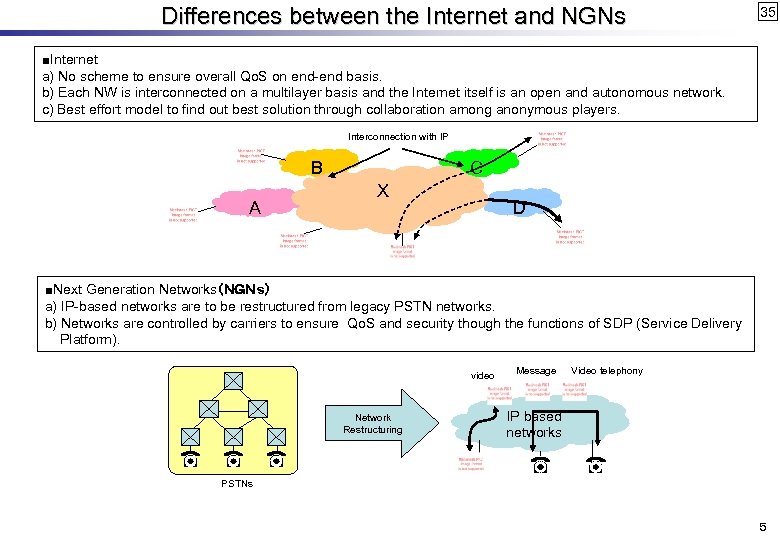
Differences between the Internet and NGNs 35 ■Internet a) No scheme to ensure overall Qo. S on end-end basis. b) Each NW is interconnected on a multilayer basis and the Internet itself is an open and autonomous network. c) Best effort model to find out best solution through collaboration among anonymous players. Interconnection with IP B A C X D ■Next Generation Networks(NGNs) a) IP-based networks are to be restructured from legacy PSTN networks. b) Networks are controlled by carriers to ensure Qo. S and security though the functions of SDP (Service Delivery Platform). video Network Restructuring Message Video telephony IP based networks PSTNs 5
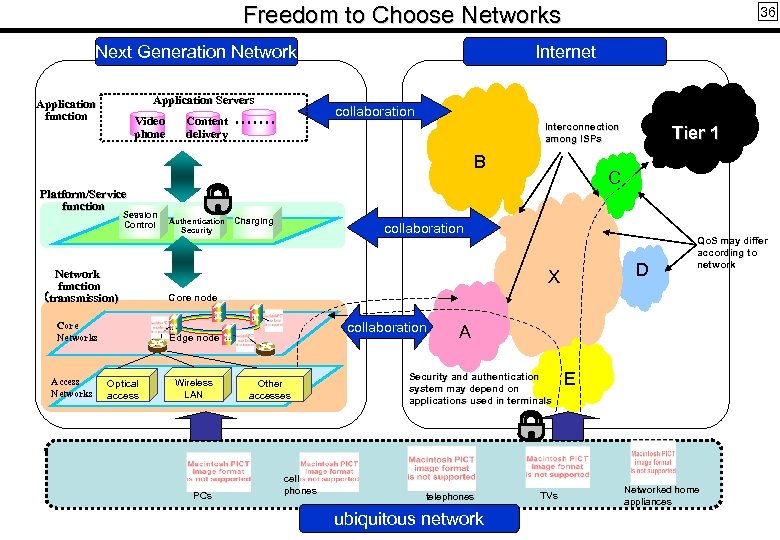
Freedom to Choose Networks Next Generation Network Application Servers Application function Video phone 36 Internet collaboration Content ・・・・・・・ delivery Interconnection among ISPs B Tier 1 C Platform/Service function Session Control Authentication Security Charging collaboration D X Network function (transmission) Core node Core Networks Edge node Qo. S may differ according to network Access Networks Optical access Wireless LAN PCs collaboration Other accesses cell phones A Security and authentication system may depend on applications used in terminals telephones ubiquitous network TVs E Networked home appliances
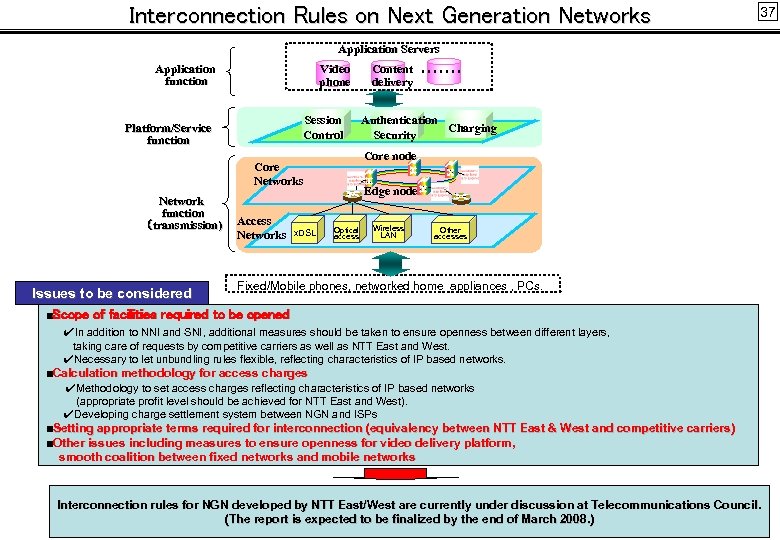
Interconnection Rules on Next Generation Networks 37 Application Servers Application function Video phone Content ・・・・・・・ delivery Session Control Platform/Service function Core node Core Networks Network function (transmission) Access Networks x. DSL Authentication Charging Security Edge node Optical access Wireless LAN Other accesses Fixed/Mobile phones, networked home appliances , PCs. Issues to be considered ■Scope of facilities required to be opened ✔In addition to NNI and SNI, additional measures should be taken to ensure openness between different layers, taking care of requests by competitive carriers as well as NTT East and West. ✔Necessary to let unbundling rules flexible, reflecting characteristics of IP based networks. ■Calculation methodology for access charges Calculation ✔Methodology to set access charges reflecting characteristics of IP based networks (appropriate profit level should be achieved for NTT East and West). ✔Developing charge settlement system between NGN and ISPs ■Setting appropriate terms required for interconnection (equivalency between NTT East & West and competitive carriers) Setting ■Other issues including measures to ensure openness for video delivery platform, Other smooth coalition between fixed networks and mobile networks Interconnection rules for NGN developed by NTT East/West are currently under discussion at Telecommunications Council. (The report is expected to be finalized by the end of March 2008. )
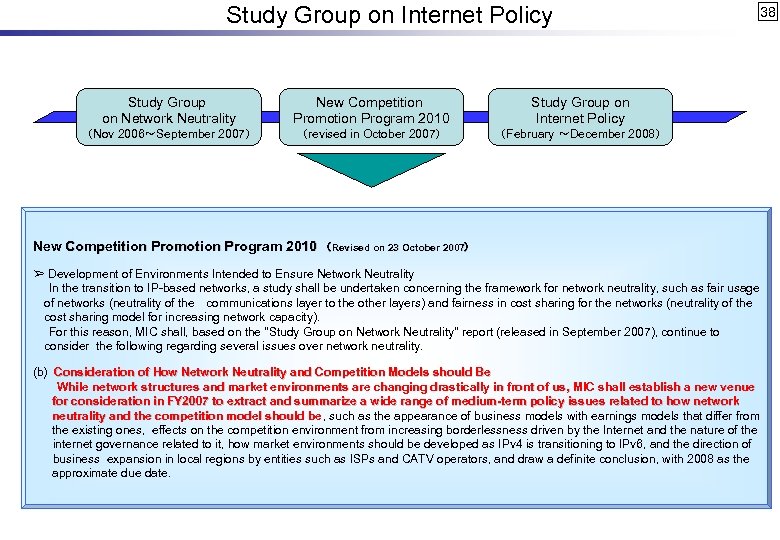
Study Group on Internet Policy Study Group on Network Neutrality New Competition Promotion Program 2010 Study Group on Internet Policy (Nov 2006~September 2007) (revised in October 2007) (February ~December 2008) New Competition Promotion Program 2010 (Revised on 23 October 2007) 2010 ➢ Development of Environments Intended to Ensure Network Neutrality In the transition to IP-based networks, a study shall be undertaken concerning the framework for network neutrality, such as fair usage of networks (neutrality of the communications layer to the other layers) and fairness in cost sharing for the networks (neutrality of the cost sharing model for increasing network capacity). For this reason, MIC shall, based on the "Study Group on Network Neutrality" report (released in September 2007), continue to consider the following regarding several issues over network neutrality. (b) Consideration of How Network Neutrality and Competition Models should Be While network structures and market environments are changing drastically in front of us, MIC shall establish a new venue While for consideration in FY 2007 to extract and summarize a wide range of medium-term policy issues related to how network neutrality and the competition model should be, such as the appearance of business models with earnings models that differ from be the existing ones, effects on the competition environment from increasing borderlessness driven by the Internet and the nature of the internet governance related to it, how market environments should be developed as IPv 4 is transitioning to IPv 6, and the direction of business expansion in local regions by entities such as ISPs and CATV operators, and draw a definite conclusion, with 2008 as the approximate due date. 38
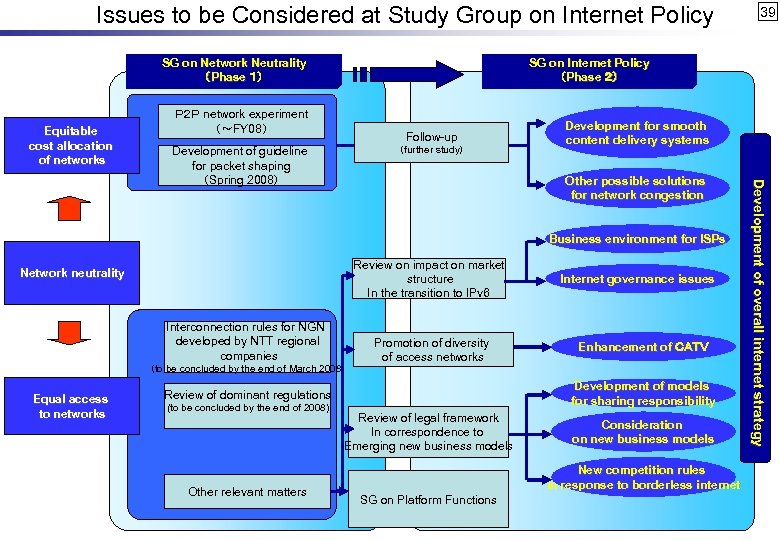
Issues to be Considered at Study Group on Internet Policy SG on Network Neutrality (Phase 1) Equitable cost allocation of networks SG on Internet Policy (Phase 2) P2P network experiment (~FY 08) Follow-up (further study) Other possible solutions for network congestion Review on impact on market structure In the transition to IPv 6 Network neutrality Interconnection rules for NGN developed by NTT regional companies (to be concluded by the end of March 2008) Promotion of diversity of access networks Other relevant matters Enhancement of CATV Development of models for sharing responsibility Review of dominant regulations (to be concluded by the end of 2008) Internet governance issues Review of legal framework In correspondence to Emerging new business models Consideration on new business models New competition rules in response to borderless internet SG on Platform Functions D e v e l o p m e n t o f o v e r a l l i n te r n e t s tr a te g y Development of guideline for packet shaping (Spring 2008) Development for smooth content delivery systems Business environment for ISPs Equal access to networks 39
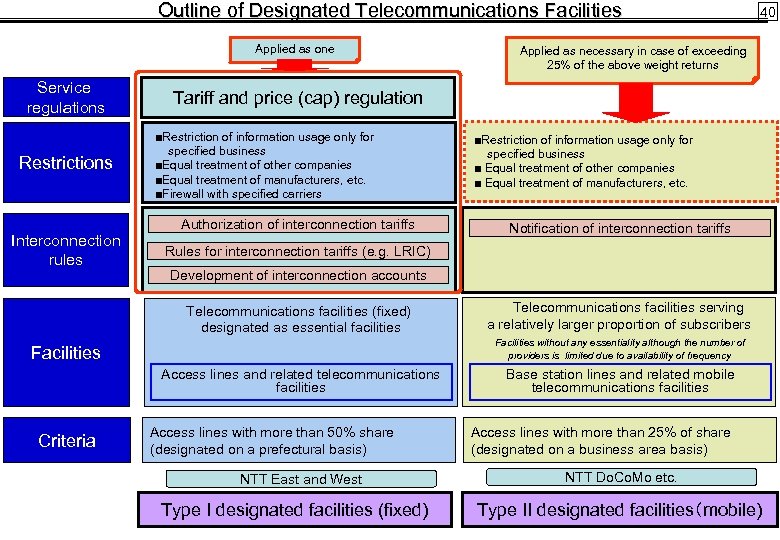
Outline of Designated Telecommunications Facilities Applied as one Service regulations Restrictions Interconnection rules Applied as necessary in case of exceeding 25% of the above weight returns Tariff and price (cap) regulation ■Restriction of information usage only for specified business ■Equal treatment of other companies ■Equal treatment of manufacturers, etc. ■Firewall with specified carriers Authorization of interconnection tariffs Rules for interconnection tariffs (e. g. LRIC) Development of interconnection accounts Telecommunications facilities (fixed) designated as essential facilities ■Restriction of information usage only for specified business ■ Equal treatment of other companies ■ Equal treatment of manufacturers, etc. Notification of interconnection tariffs Telecommunications facilities serving a relatively larger proportion of subscribers Facilities without any essentiality although the number of providers is limited due to availability of frequency Facilities Access lines and related telecommunications facilities Criteria 40 Access lines with more than 50% share (designated on a prefectural basis) NTT East and West Type I designated facilities (fixed) Base station lines and related mobile telecommunications facilities Access lines with more than 25% of share (designated on a business area basis) NTT Do. Co. Mo etc. Type II designated facilities(mobile)
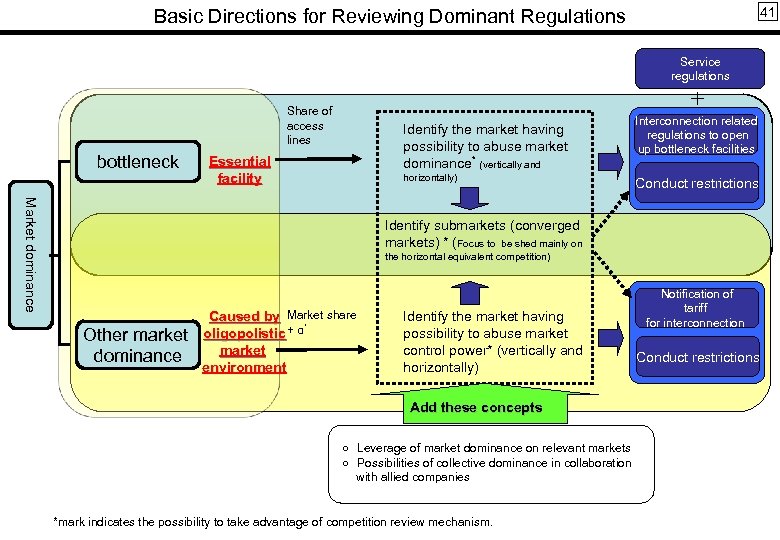
41 Basic Directions for Reviewing Dominant Regulations Service regulations + Share of access lines bottleneck Identify the market having possibility to abuse market dominance* (vertically and Essential facility horizontally) Interconnection related regulations to open up bottleneck facilities Conduct restrictions Market dominance Identify submarkets (converged markets) * (Focus to be shed mainly on the horizontal equivalent competition) Other market dominance Caused by Market share * oligopolistic + α market environment Identify the market having possibility to abuse market control power* (vertically and horizontally) Add these concepts ○ Leverage of market dominance on relevant markets ○ Possibilities of collective dominance in collaboration with allied companies *mark indicates the possibility to take advantage of competition review mechanism. Notification of tariff for interconnection Conduct restrictions
42 Broadband Competition Policy in Japan ■Current Status of Broadband Market in Japan ■Outline of “New Competition Policy Program 2010” ■Specific Issues □Network Neutrality Issues ✔ □Focus on Openness for Platform Functions □Revitalization of Mobile Business □Review of Universal Service System □Terminal Equipment Policy in the IP era
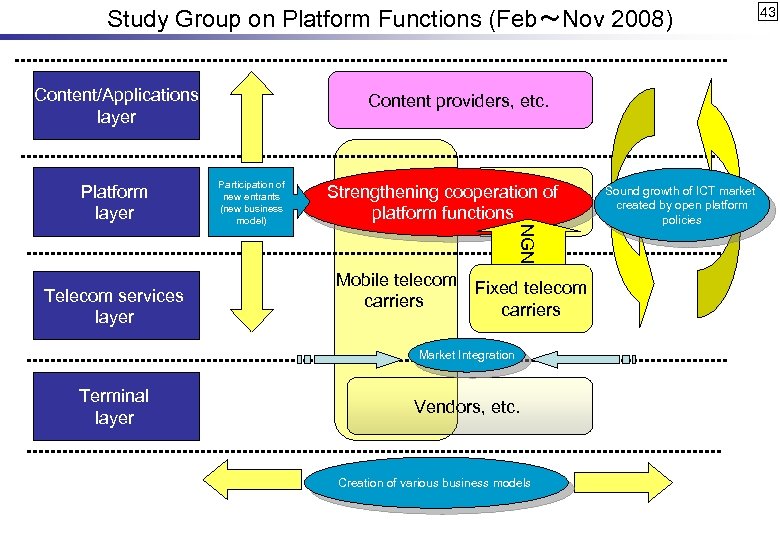
Study Group on Platform Functions (Feb~Nov 2008) Content/Applications layer Platform layer Participation of new entrants (new business model) Strengthening cooperation of platform functions NGN Telecom services layer Content providers, etc. Mobile telecom carriers Fixed telecom carriers Market Integration Terminal layer Vendors, etc. Creation of various business models Sound growth of ICT market created by open platform policies 43
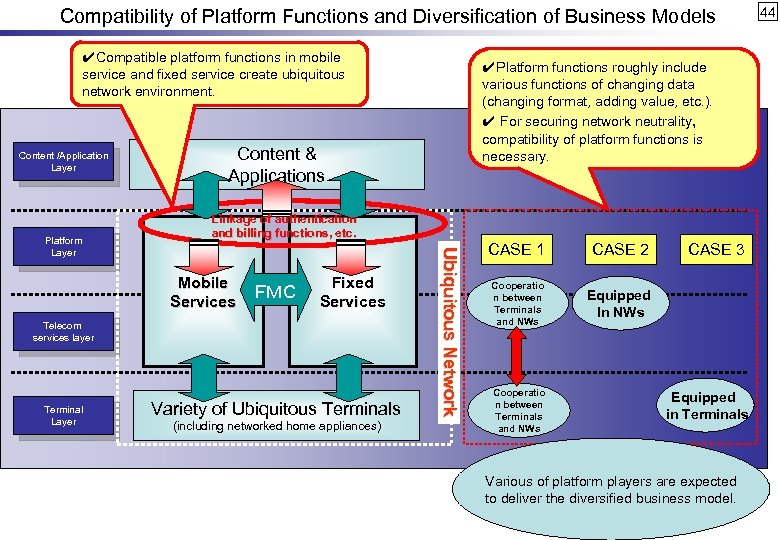
Compatibility of Platform Functions and Diversification of Business Models ✔Compatible platform functions in mobile service and fixed service create ubiquitous network environment. Content /Application Layer Content & Applications Linkage of authentication and billing functions, etc. Mobile Services FMC Fixed Services Telecom services layer Terminal Layer Variety of Ubiquitous Terminals (including networked home appliances) U b i q u i to u s N e tw o r k Platform Layer ✔Platform functions roughly include various functions of changing data (changing format, adding value, etc. ). ✔ For securing network neutrality, compatibility of platform functions is necessary. CASE 1 CASE 2 Cooperatio n between Terminals and NWs Equipped In NWs Cooperatio n between Terminals and NWs CASE 3 Equipped in Terminals Various of platform players are expected to deliver the diversified business model. 44
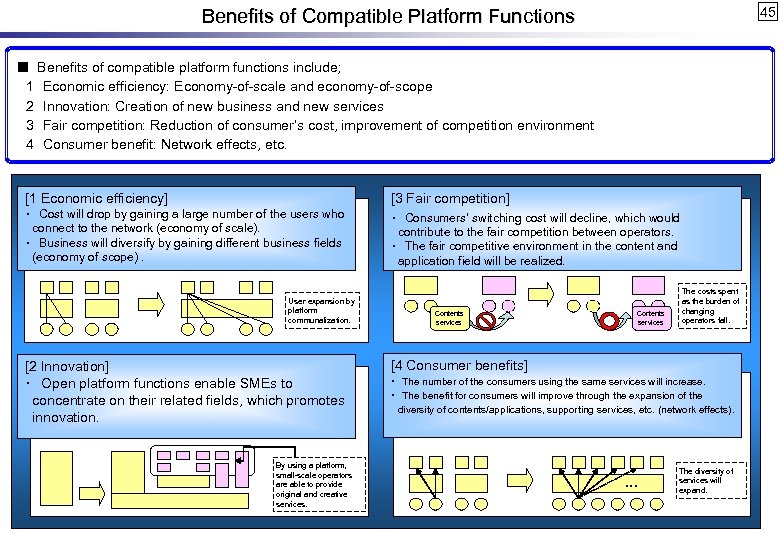
Benefits of Compatible Platform Functions 45 ■ Benefits of compatible platform functions include; 1 Economic efficiency: Economy-of-scale and economy-of-scope 2 Innovation: Creation of new business and new services 3 Fair competition: Reduction of consumer’s cost, improvement of competition environment 4 Consumer benefit: Network effects, etc. [1 Economic efficiency] [3 Fair competition] ・ Cost will drop by gaining a large number of the users who connect to the network (economy of scale). ・ Business will diversify by gaining different business fields (economy of scope). ・ Consumers’ switching cost will decline, which would contribute to the fair competition between operators. ・ The fair competitive environment in the content and application field will be realized. User expansion by platform communalization. [2 Innovation] ・ Open platform functions enable SMEs to concentrate on their related fields, which promotes innovation. By using a platform, small-scale operators are able to provide original and creative services. Contents services The costs spent as the burden of changing operators fall. [4 Consumer benefits] ・ The number of the consumers using the same services will increase. ・ The benefit for consumers will improve through the expansion of the diversity of contents/applications, supporting services, etc. (network effects). . The diversity of services will expand.
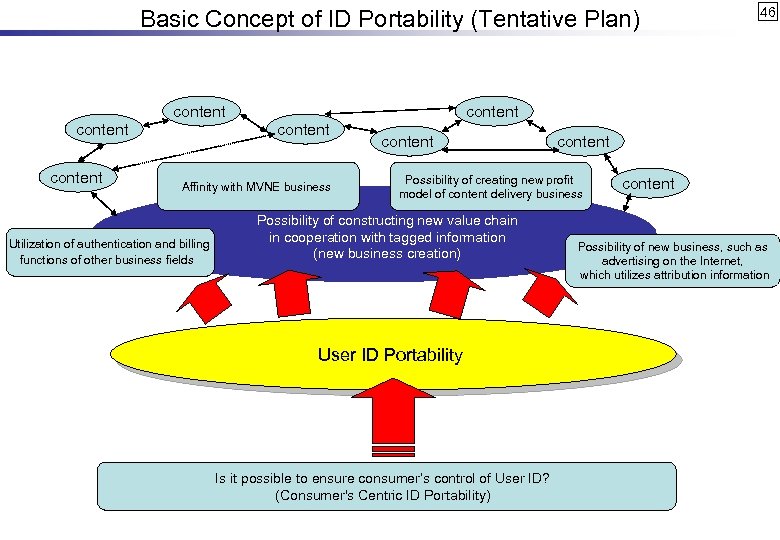
Basic Concept of ID Portability (Tentative Plan) content content Affinity with MVNE business Utilization of authentication and billing functions of other business fields 46 content Possibility of creating new profit model of content delivery business Possibility of constructing new value chain in cooperation with tagged information (new business creation) User ID Portability Is it possible to ensure consumer’s control of User ID? (Consumer's Centric ID Portability) content Possibility of new business, such as advertising on the Internet, which utilizes attribution information
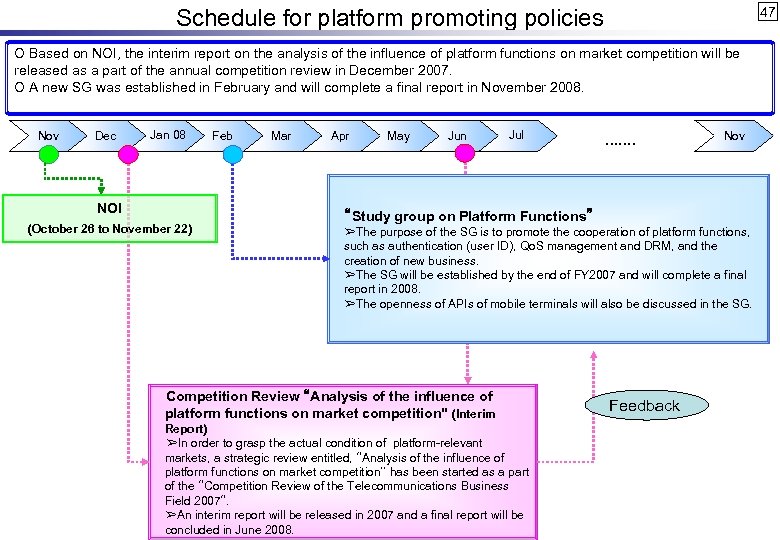
Schedule for platform promoting policies 47 O Based on NOI, the interim report on the analysis of the influence of platform functions on market competition will be released as a part of the annual competition review in December 2007. O A new SG was established in February and will complete a final report in November 2008. Nov Dec Jan 08 NOI (October 26 to November 22) Feb Mar Apr May Jun Jul . . . . Nov “Study group on Platform Functions” ➢The purpose of the SG is to promote the cooperation of platform functions, such as authentication (user ID), Qo. S management and DRM, and the creation of new business. ➢The SG will be established by the end of FY 2007 and will complete a final report in 2008. ➢The openness of APIs of mobile terminals will also be discussed in the SG. Competition Review “Analysis of the influence of platform functions on market competition" (Interim Report) ➢In order to grasp the actual condition of platform-relevant markets, a strategic review entitled, “Analysis of the influence of platform functions on market competition” has been started as a part of the “Competition Review of the Telecommunications Business Field 2007“. ➢An interim report will be released in 2007 and a final report will be concluded in June 2008. Feedback
48 Broadband Competition Policy in Japan ■Current Status of Broadband Market in Japan ■Outline of “New Competition Policy Program 2010” ■Specific Issues □Network Neutrality Issues □Focus on Openness for Platform Functions ✔ □Revitalization of Mobile Business □Review of Universal Service System □Terminal Equipment Policy in the IP era
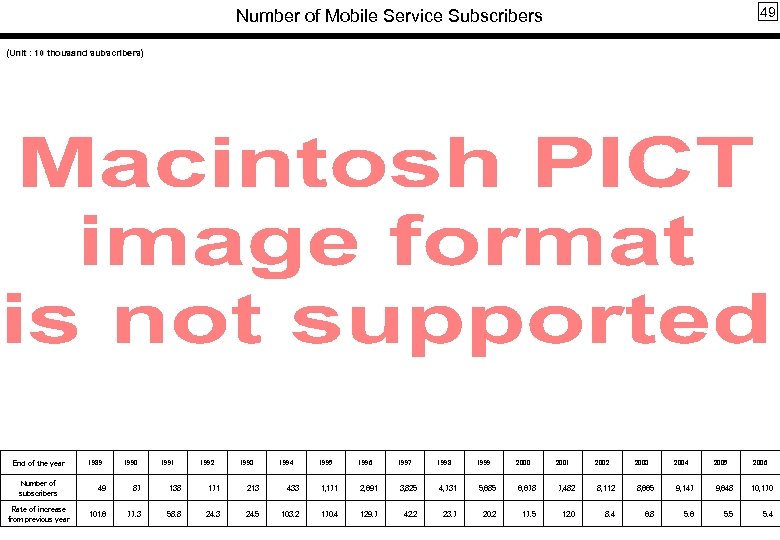
49 Number of Mobile Service Subscribers (Unit : 10 thousand subscribers) End of the year Number of subscribers Rate of increase from previous year 1989 1990 1991 1992 1993 1994 1995 1996 1997 1998 1999 2000 2001 2002 2003 2004 2005 2006 49 87 138 171 213 433 1, 171 2, 691 3, 825 4, 731 5, 685 6, 678 7, 482 8, 112 8, 665 9, 147 9, 648 10, 170 101. 6 77. 3 58. 8 24. 3 24. 5 103. 2 170. 4 129. 7 42. 2 23. 7 20. 2 17. 5 12. 0 8. 4 6. 8 5. 6 5. 5 5. 4
50 Change of APRU for Mobile Business (US$ per year) ARPU(2003) The ratio of the data APRU in the whole APRU (*)ARPU(Average Rate Per User) (MIC)
Market share by main mobile phone operators 51 HHI(*) share Docomo group au group (including Tu-ka) Softbank mobile (previous Vodafone) Others (exclude PHS/Docomo) (*)HHI(Herfindahl-Hirschman Index) one of the indicator to measure the degree of monopolizing market. Squares the number of each operator’s market share and adds up. its range is from 0 to 10, 000, and means higher degree of monopoly when it close to 10, 000. (right) (from MIC)
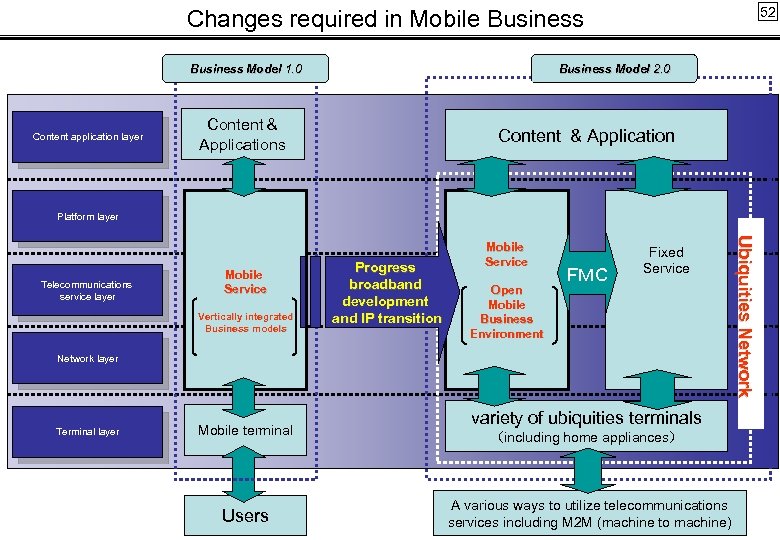
52 Changes required in Mobile Business Model 1. 0 Content application layer Business Model 2. 0 Content & Applications Content & Application Platform layer Mobile Service Vertically integrated Business models Progress broadband development and IP transition FMC Fixed Service Open Mobile Business Environment Network layer Terminal layer Mobile terminal Users variety of ubiquities terminals (including home appliances) A various ways to utilize telecommunications services including M 2 M (machine to machine) U b i q u i ti e s N e tw o r k Telecommunications service layer Mobile Service
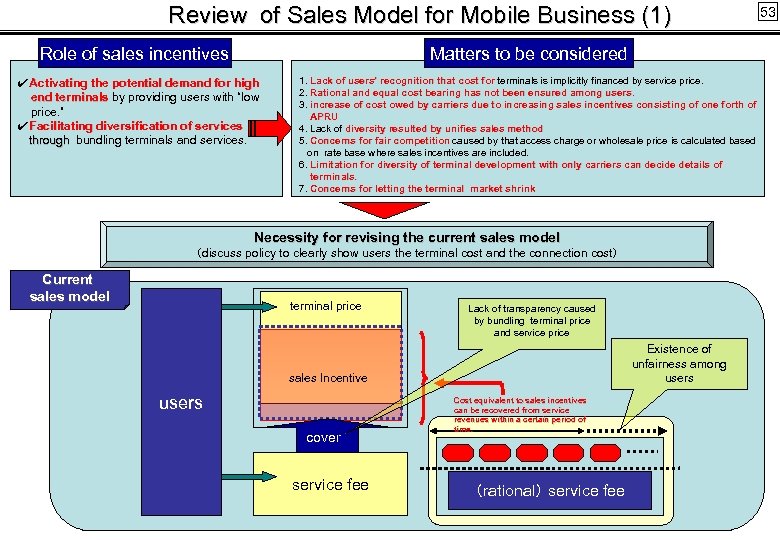
Review of Sales Model for Mobile Business (1) Role of sales incentives Matters to be considered ✔Activating the potential demand for high Activating end terminals by providing users with “low price. ” ✔Facilitating diversification of services Facilitating through bundling terminals and services. 1. Lack of users’ recognition that cost for terminals is implicitly financed by service price. 2. Rational and equal cost bearing has not been ensured among users. 3. increase of cost owed by carriers due to increasing sales incentives consisting of one forth of APRU 4. Lack of diversity resulted by unifies sales method 5. Concerns for fair competition caused by that access charge or wholesale price is calculated based on rate base where sales incentives are included. 6. Limitation for diversity of terminal development with only carriers can decide details of terminals. 7. Concerns for letting the terminal market shrink Necessity for revising the current sales model (discuss policy to clearly show users the terminal cost and the connection cost) Current sales model terminal price Lack of transparency caused by bundling terminal price and service price Existence of unfairness among users sales Incentive users cover service fee Cost equivalent to sales incentives can be recovered from service revenues within a certain period of time. (rational) service fee 53
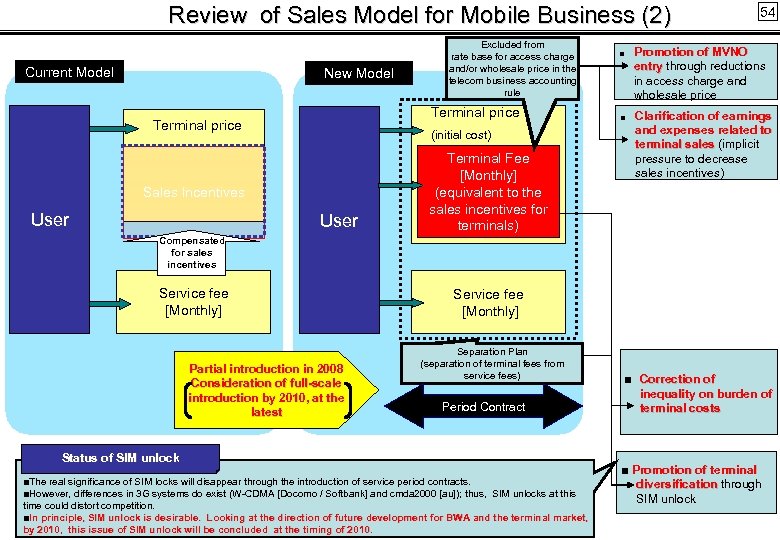
Review of Sales Model for Mobile Business (2) Current Model New Model Terminal price (initial cost) Sales Incentives User Excluded from rate base for access charge and/or wholesale price in the telecom business accounting rule User Terminal Fee [Monthly] (equivalent to the sales incentives for terminals) 54 ■ Promotion of MVNO entry through reductions in access charge and wholesale price ■ Clarification of earnings and expenses related to terminal sales (implicit pressure to decrease sales incentives) Compensated for sales incentives Service fee [Monthly] Partial introduction in 2008 Consideration of full-scale introduction by 2010, at the latest Service fee [Monthly] Separation Plan (separation of terminal fees from service fees) Period Contract Status of SIM unlock ■The real significance of SIM locks will disappear through the introduction of service period contracts. ■However, differences in 3 G systems do exist (W-CDMA [Docomo / Softbank] and cmda 2000 [au]); thus, SIM unlocks at this time could distort competition. ■In principle, SIM unlock is desirable. Looking at the direction of future development for BWA and the terminal market, In by 2010, this issue of SIM unlock will be concluded at the timing of 2010. ■ Correction of inequality on burden of terminal costs ■ Promotion of terminal diversification through SIM unlock
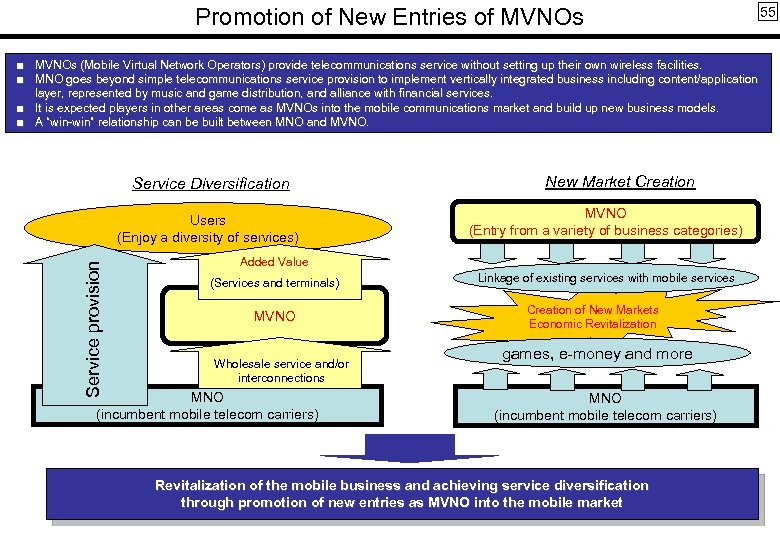
Promotion of New Entries of MVNOs ■ MVNOs (Mobile Virtual Network Operators) provide telecommunications service without setting up their own wireless facilities. ■ MNO goes beyond simple telecommunications service provision to implement vertically integrated business including content/application layer, represented by music and game distribution, and alliance with financial services. ■ It is expected players in other areas come as MVNOs into the mobile communications market and build up new business models. ■ A “win-win” relationship can be built between MNO and MVNO. Service Diversification Service provision Users (Enjoy a diversity of services) New Market Creation MVNO (Entry from a variety of business categories) Added Value (Services and terminals) MVNO Wholesale service and/or interconnections MNO (incumbent mobile telecom carriers) Linkage of existing services with mobile services Creation of New Markets Economic Revitalization games, e-money and more MNO (incumbent mobile telecom carriers) Revitalization of the mobile business and achieving service diversification through promotion of new entries as MVNO into the mobile market 55
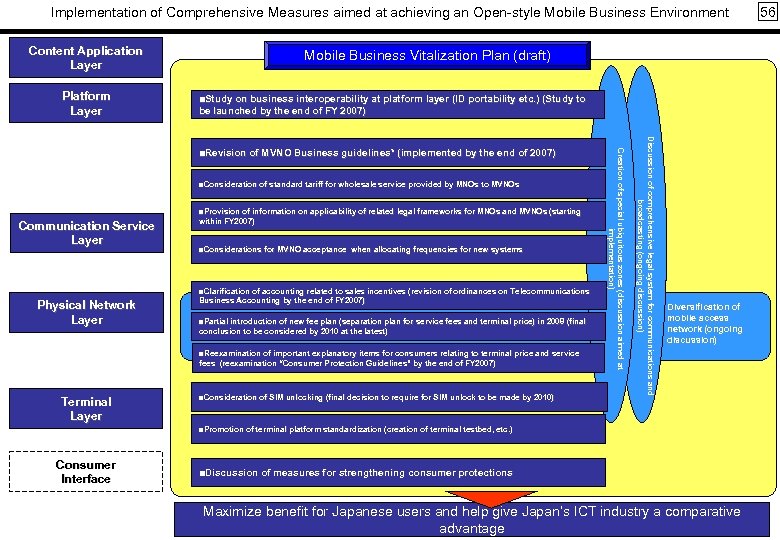
Implementation of Comprehensive Measures aimed at achieving an Open-style Mobile Business Environment Content Application Layer Platform Layer Mobile Business Vitalization Plan (draft) ■Study on business interoperability at platform layer (ID portability etc. ) (Study to be launched by the end of FY 2007) Communication Service Layer Physical Network Layer ■Provision of information on applicability of related legal frameworks for MNOs and MVNOs (starting within FY 2007) ■Considerations for MVNO acceptance when allocating frequencies for new systems ■Clarification of accounting related to sales incentives (revision of ordinances on Telecommunications Business Accounting by the end of FY 2007) ■Partial introduction of new fee plan (separation plan for service fees and terminal price) in 2008 (final conclusion to be considered by 2010 at the latest) ■Reexamination of important explanatory items for consumers relating to terminal price and service fees (reexamination “Consumer Protection Guidelines” by the end of FY 2007) Terminal Layer ■Consideration of SIM unlocking (final decision to require for SIM unlock to be made by 2010) Discussion of comprehensive legal system for communications and broadcasting (ongoing discussion) ■Consideration of standard tariff for wholesale service provided by MNOs to MVNOs Creation of special ubiquitous zones (discussion aimed at implementation) ■Revision of MVNO Business guidelines* (implemented by the end of 2007) Diversification of mobile access network (ongoing discussion) ■Promotion of terminal platform standardization (creation of terminal testbed, etc. ) Consumer Interface ■Discussion of measures for strengthening consumer protections Maximize benefit for Japanese users and help give Japan’s ICT industry a comparative advantage 56
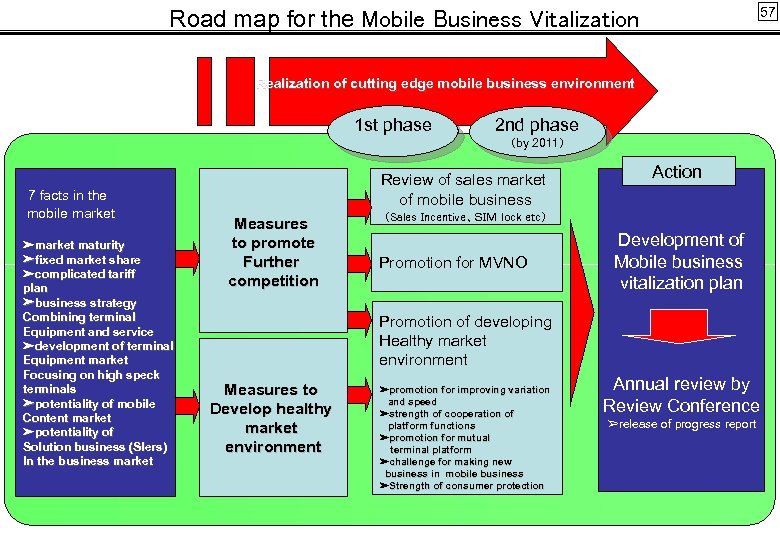
Road map for the Mobile Business Vitalization Realization of cutting edge mobile business environment 1 st phase 2 nd phase (by 2011) 7 facts in the mobile market ➢market maturity ➢fixed market share ➢complicated tariff plan ➢business strategy Combining terminal Equipment and service ➢development of terminal Equipment market Focusing on high speck terminals ➢potentiality of mobile Content market ➢potentiality of Solution business (SIers) In the business market Review of sales market of mobile business Measures to promote Further competition Action (Sales Incentive、SIM lock etc) Promotion for MVNO Development of Mobile business vitalization plan Promotion of developing Healthy market environment Measures to Develop healthy market environment ➢promotion for improving variation and speed ➢strength of cooperation of platform functions ➢promotion for mutual terminal platform ➢challenge for making new business in mobile business ➢Strength of consumer protection Annual review by Review Conference ➢release of progress report 57
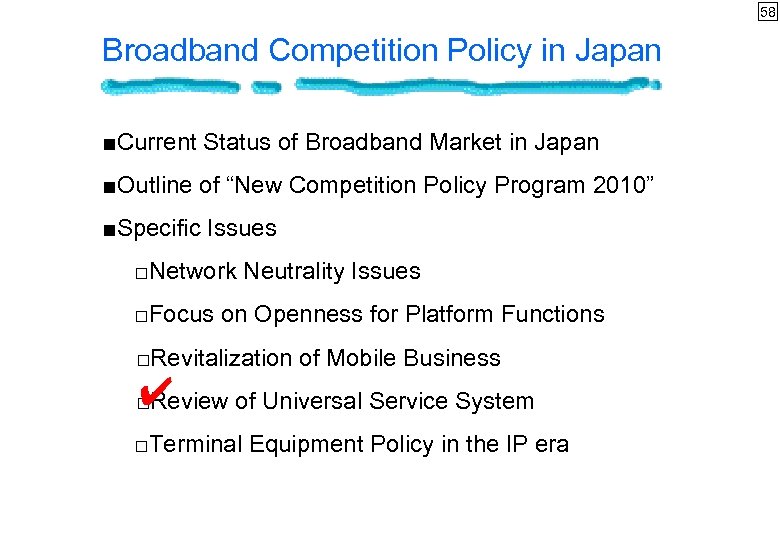
58 Broadband Competition Policy in Japan ■Current Status of Broadband Market in Japan ■Outline of “New Competition Policy Program 2010” ■Specific Issues □Network Neutrality Issues □Focus on Openness for Platform Functions □Revitalization of Mobile Business ✔ □Review of Universal Service System □Terminal Equipment Policy in the IP era
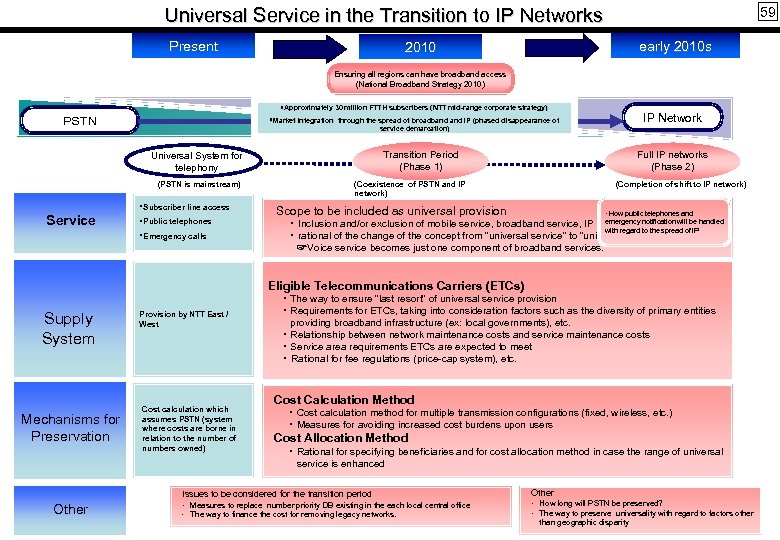
Universal Service in the Transition to IP Networks Present 59 early 2010 s 2010 Ensuring all regions can have broadband access (National Broadband Strategy 2010) ・Approximately 30 million FTTH subscribers (NTT mid-range corporate strategy) PSTN ・Market integration through the spread of broadband IP (phased disappearance of service demarcation) Universal System for telephony (PSTN is mainstream) ・Subscriber line access Service ・Public telephones ・Emergency calls IP Network Full IP networks (Phase 2) Transition Period (Phase 1) (Coexistence of PSTN and IP network) (Completion of shift to IP network) Scope to be included as universal provision ・How public telephones and emergency notification ・ Inclusion and/or exclusion of mobile service, broadband service, IP phone service will be handled with regard to the spread of IP ・ rational of the change of the concept from “universal service” to “universal access” ☞Voice service becomes just one component of broadband services. Eligible Telecommunications Carriers (ETCs) Supply System Mechanisms for Preservation Other Provision by NTT East / West Cost calculation which assumes PSTN (system where costs are borne in relation to the number of numbers owned) ・ The way to ensure “last resort” of universal service provision ・ Requirements for ETCs, taking into consideration factors such as the diversity of primary entities providing broadband infrastructure (ex: local governments), etc. ・ Relationship between network maintenance costs and service maintenance costs ・ Service area requirements ETCs are expected to meet ・ Rational for fee regulations (price-cap system), etc. Cost Calculation Method ・ Cost calculation method for multiple transmission configurations (fixed, wireless, etc. ) ・ Measures for avoiding increased cost burdens upon users Cost Allocation Method ・ Rational for specifying beneficiaries and for cost allocation method in case the range of universal service is enhanced Issues to be considered for the transition period ・ Measures to replace number priority DB existing in the each local central office ・ The way to finance the cost for removing legacy networks. Other ・ How long will PSTN be preserved? ・ The way to preserve universality with regard to factors other than geographic disparity
60 Broadband Competition Policy in Japan ■Current Status of Broadband Market in Japan ■Outline of “New Competition Policy Program 2010” ■Specific Issues □Network Neutrality Issues □Focus on Openness for Platform Functions □Revitalization of Mobile Business □Review of Universal Service System ✔ □Terminal Equipment Policy in the IP era
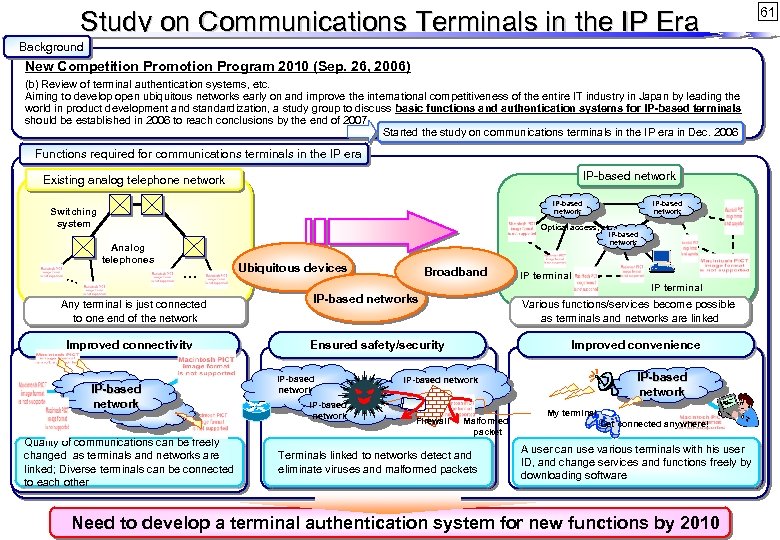
Study on Communications Terminals in the IP Era Background New Competition Promotion Program 2010 (Sep. 26, 2006) (b) Review of terminal authentication systems, etc. Aiming to develop open ubiquitous networks early on and improve the international competitiveness of the entire IT industry in Japan by leading the world in product development and standardization, a study group to discuss basic functions and authentication systems for IP-based terminals should be established in 2006 to reach conclusions by the end of 2007. Started the study on communications terminals in the IP era in Dec. 2006 Functions required for communications terminals in the IP era IP-based network Existing analog telephone network IP-based network Switching system IP-based network Optical access, etc. Analog telephones … IP-based network … Any terminal is just connected to one end of the network Improved connectivity IP-based network Quality of communications can be freely changed as terminals and networks are linked; Diverse terminals can be connected to each other Ubiquitous devices Broadband IP terminal IP-based networks Various functions/services become possible as terminals and networks are linked Improved convenience Ensured safety/security IP-based network IP terminal IP-based network Firewall Malformed packet Terminals linked to networks detect and eliminate viruses and malformed packets My terminal Get connected anywhere! A user can use various terminals with his user ID, and change services and functions freely by downloading software Need to develop a terminal authentication system for new functions by 2010 61
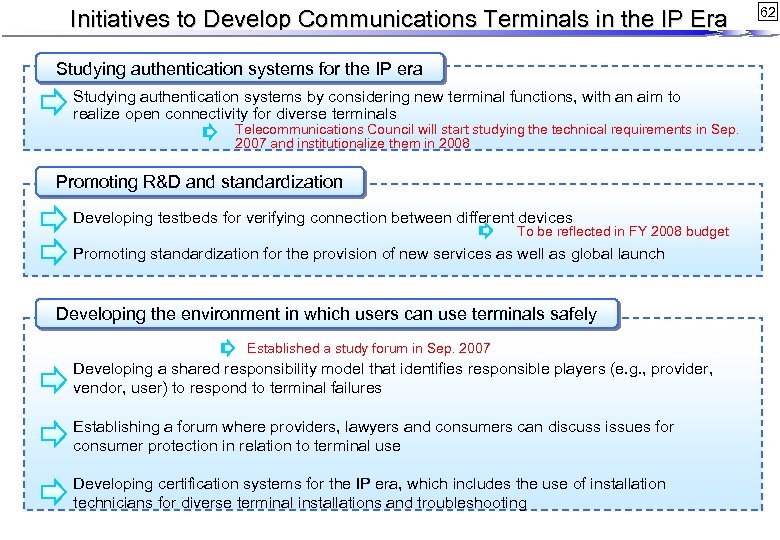
Initiatives to Develop Communications Terminals in the IP Era Studying authentication systems for the IP era Studying authentication systems by considering new terminal functions, with an aim to realize open connectivity for diverse terminals Telecommunications Council will start studying the technical requirements in Sep. 2007 and institutionalize them in 2008 Promoting R&D and standardization Developing testbeds for verifying connection between different devices To be reflected in FY 2008 budget Promoting standardization for the provision of new services as well as global launch Developing the environment in which users can use terminals safely Established a study forum in Sep. 2007 Developing a shared responsibility model that identifies responsible players (e. g. , provider, vendor, user) to respond to terminal failures Establishing a forum where providers, lawyers and consumers can discuss issues for consumer protection in relation to terminal use Developing certification systems for the IP era, which includes the use of installation technicians for diverse terminal installations and troubleshooting 62

63 Any Question?
Скачать презентацию 0 Broadband Competition Policy in Japan March 2008
36e82b085007c0a817b4c4206d057208.ppt