 Скачать презентацию 차세대 통신시스템 개발을 통한 사업기회 창출 2003 11
c70d91fc89dd6dc4dfa9ff39060e56d5.ppt
- Количество слайдов: 88



차세대 통신시스템 개발을 통한 사업기회 창출 2003. 11. 이황수 EECS Dept. KAIST
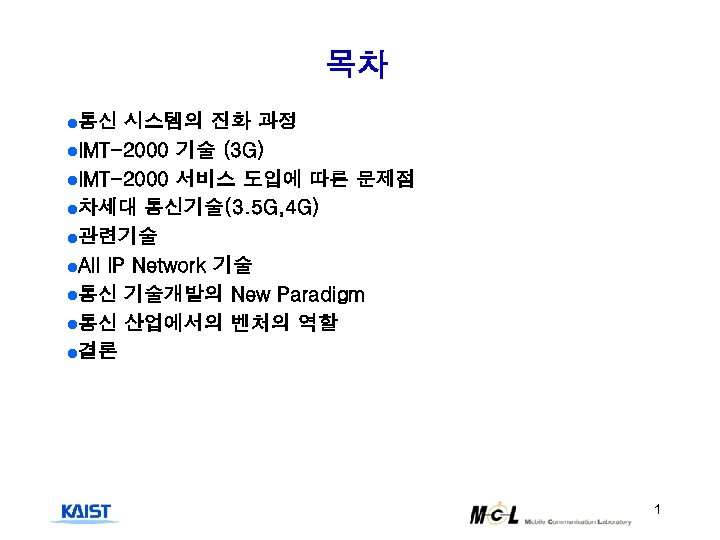
목차 l통신 시스템의 진화 과정 l. IMT-2000 기술 (3 G) l. IMT-2000 서비스 도입에 따른 문제점 l차세대 통신기술(3. 5 G, 4 G) l관련기술 l. All IP Network 기술 l통신 기술개발의 New Paradigm l통신 산업에서의 벤처의 역할 l결론 1
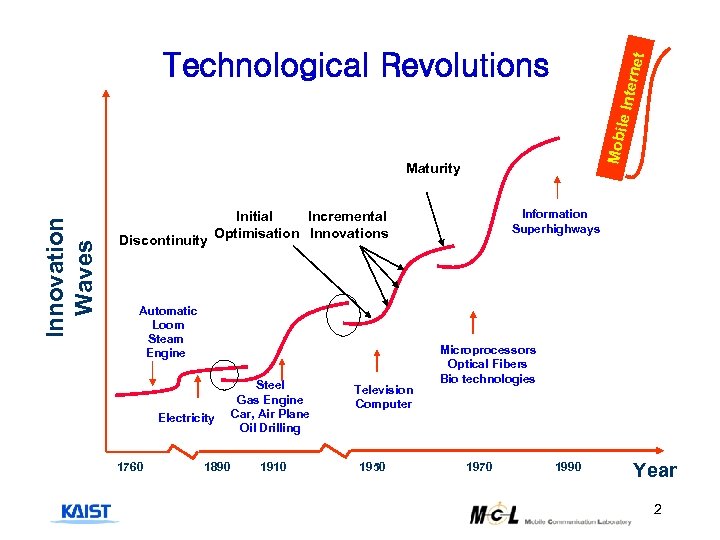
Mobi le Int ernet Technological Revolutions Innovation Waves Maturity Discontinuity Automatic Loom Steam Engine Telephony Electricity 1760 Information Superhighways Initial Incremental Optimisation Innovations 1890 Steel Gas Engine Car, Air Plane Oil Drilling 1910 Television Computer 1950 Microprocessors Optical Fibers Bio technologies 1970 1990 Year 2
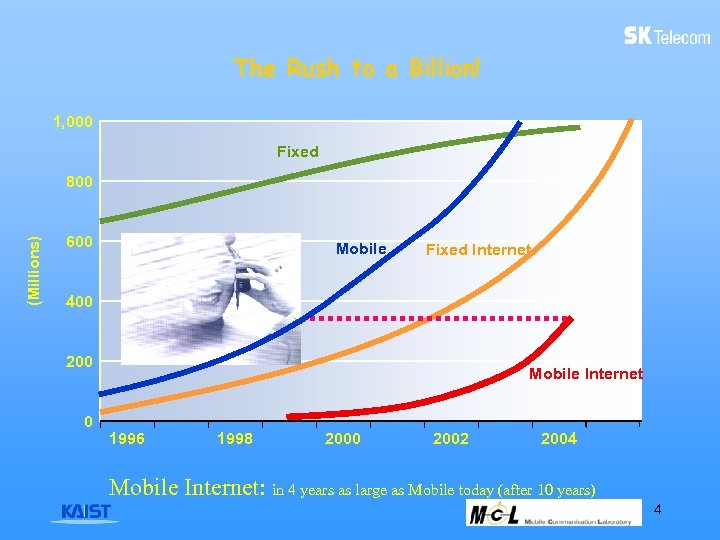
The Rush to a Billion! 1, 000 Fixed (Millions) 800 600 Mobile Fixed Internet 400 200 0 Mobile Internet 1996 1998 2000 2002 2004 Mobile Internet: in 4 years as large as Mobile today (after 10 years) 4
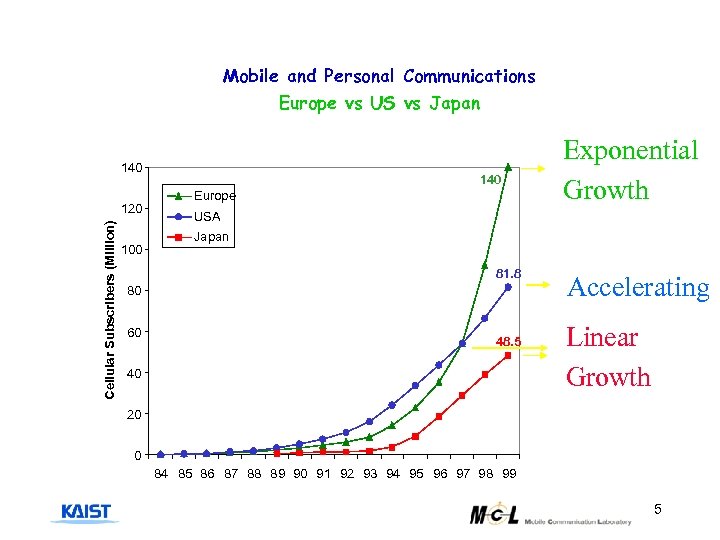
Mobile and Personal Communications Europe vs US vs Japan 140 Cellular Subscribers (Million) 120 100 140 Europe USA Japan 81. 8 80 60 Exponential Growth 48. 5 40 Accelerating Linear Growth 20 0 84 85 86 87 88 89 90 91 92 93 94 95 96 97 98 99 5
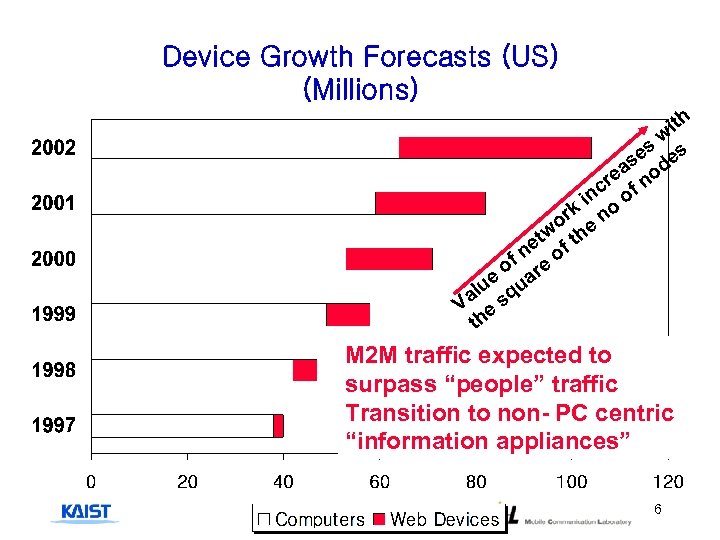
Device Growth Forecasts (US) (Millions) ith w s s e e as od e cr of n in o k or e n w et f th fn eo o e uar u al sq V e th M 2 M traffic expected to surpass “people” traffic Transition to non- PC centric “information appliances” 6
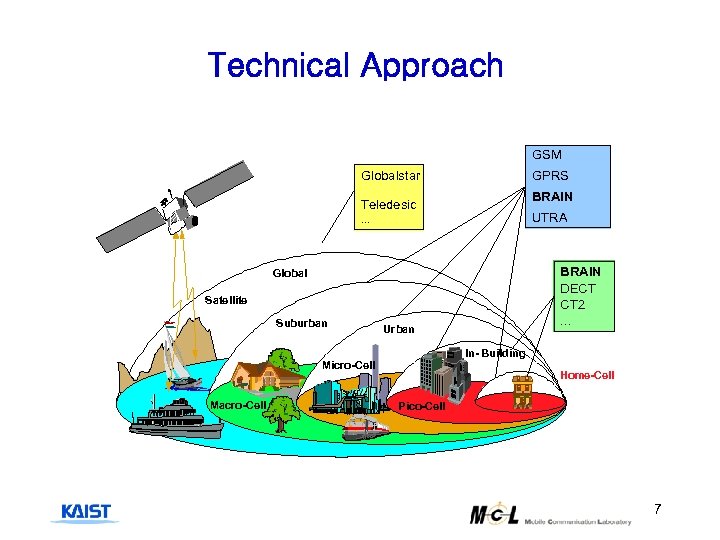
Technical Approach GSM Globalstar GPRS BRAIN Teledesic. . . UTRA BRAIN DECT CT 2. . . Global Satellite Suburban Urban In- Building Micro-Cell Macro-Cell Home-Cell Pico-Cell 7
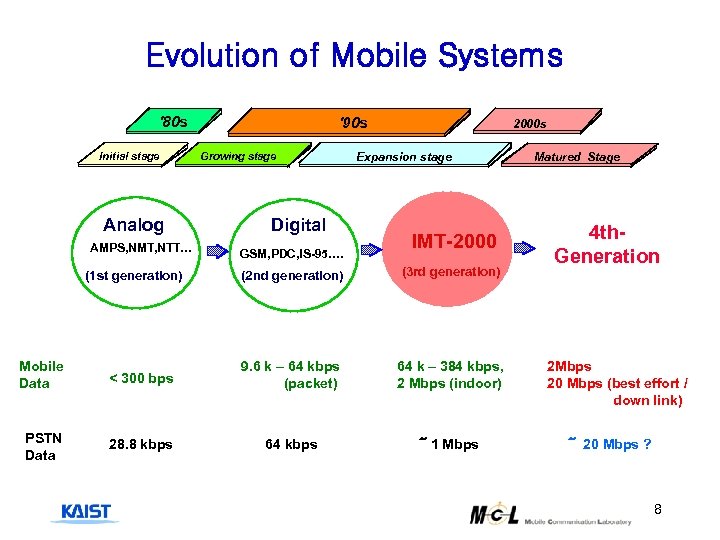
Evolution of Mobile Systems '80 s Initial stage Analog AMPS, NMT, NTT… (1 st generation) '90 s Growing stage Digital GSM, PDC, IS-95…. 2000 s Expansion stage IMT-2000 (2 nd generation) (3 rd generation) Mobile Data < 300 bps 9. 6 k – 64 kbps (packet) 64 k – 384 kbps, 2 Mbps (indoor) PSTN Data 28. 8 kbps 64 kbps ~ 1 Mbps Matured Stage 4 th. Generation 2 Mbps 20 Mbps (best effort / down link) ~ 20 Mbps ? 8
이동통신 시스템 진화과정 9
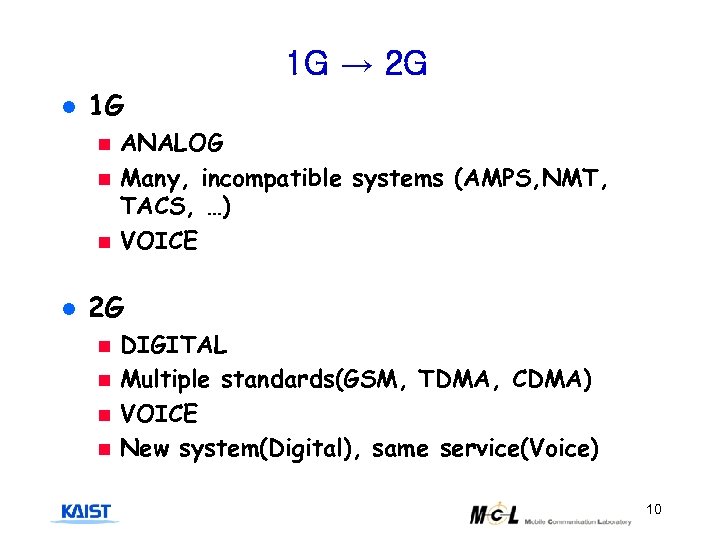
1 G → 2 G l 1 G ANALOG n Many, incompatible systems (AMPS, NMT, TACS, …) n VOICE n l 2 G DIGITAL n Multiple standards(GSM, TDMA, CDMA) n VOICE n New system(Digital), same service(Voice) n 10

2 G → 3 G l 2 G Multiple standards n VOICE n l 3 G Single standard (member of IMT-2000 family) n MOBILE MULTIMEDIA n New system(UMTS), new service(MM) n 11

IMT-2000 Basic l언제, 어디서나, 다양한 서비스 제공 기존 시스팀으로 부터의 smooth & easy evolution 통신지역별 상이한 여건을 수용 다양한 망 구성기술의 연동 및 수용 A single world standard to support a wide range of radio operating environments and service types 12
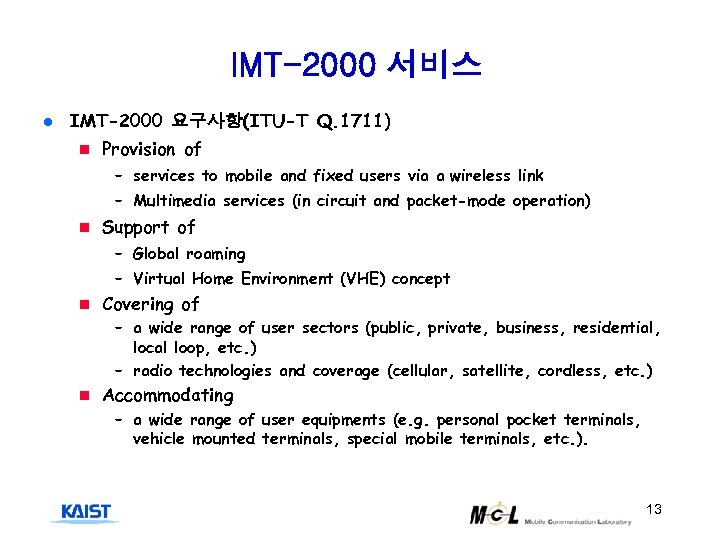
IMT-2000 서비스 l IMT-2000 요구사항(ITU-T Q. 1711) n Provision of – services to mobile and fixed users via a wireless link – Multimedia services (in circuit and packet-mode operation) n Support of – Global roaming – Virtual Home Environment (VHE) concept n Covering of – a wide range of user sectors (public, private, business, residential, local loop, etc. ) – radio technologies and coverage (cellular, satellite, cordless, etc. ) n Accommodating – a wide range of user equipments (e. g. personal pocket terminals, vehicle mounted terminals, special mobile terminals, etc. ). 13
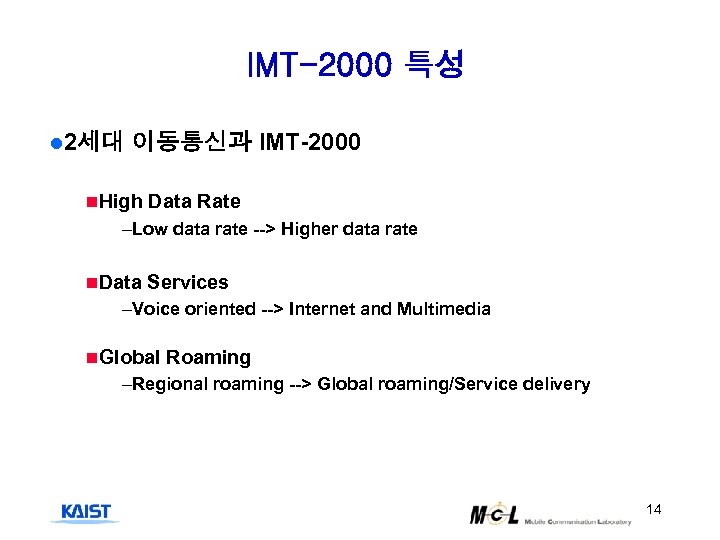
IMT-2000 특성 l 2세대 이동통신과 IMT-2000 n. High Data Rate –Low data rate --> Higher data rate n. Data Services –Voice oriented --> Internet and Multimedia n. Global Roaming –Regional roaming --> Global roaming/Service delivery 14

Global Roaming l 2세대 이동통신 n. Regional roaming(GSM, ANSI) l. IMT-2000 n. Global Roaming n. Global Service Delivery –VHE(Virtual Home Environment) l. A user can enjoy the same enhanced services, both of telephony and, hopefully, of Internet, offered by his home network, via a visited network. –IN(Intelligent Network) 15
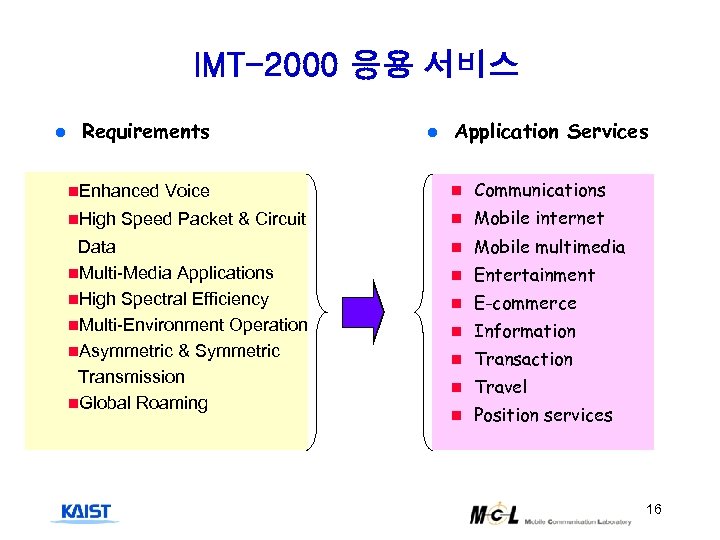
IMT-2000 응용 서비스 l Requirements l Application Services n Communications Speed Packet & Circuit n Mobile internet Data n. Multi-Media Applications n. High Spectral Efficiency n. Multi-Environment Operation n. Asymmetric & Symmetric Transmission n. Global Roaming n Mobile multimedia n Entertainment n E-commerce n Information n Transaction n Travel n Position services n. Enhanced n. High Voice 16
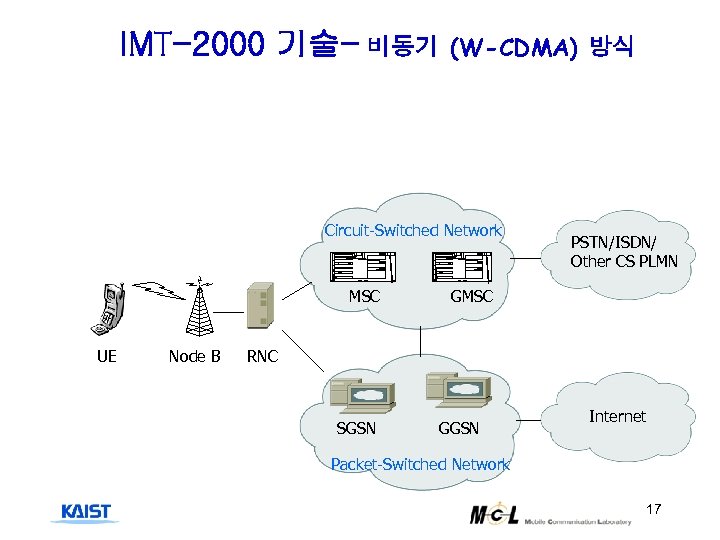
IMT-2000 기술- 비동기 (W-CDMA) 방식 Circuit-Switched Network MSC UE Node B PSTN/ISDN/ Other CS PLMN GMSC RNC SGSN GGSN Internet Packet-Switched Network 17
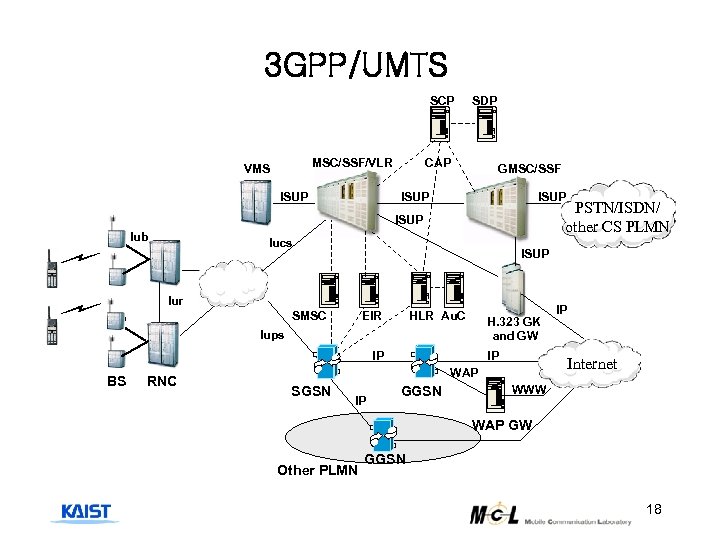
3 GPP/UMTS SCP MSC/SSF/VLR VMS ISUP SDP CAP GMSC/SSF ISUP PSTN/ISDN/ other CS PLMN ISUP Iub Iucs ISUP Iur SMSC BS EIR HLR Au. C H. 323 GK and GW Iups IP BS RNC IP Internet WAP SGSN IP GGSN IP WWW WAP GW Other PLMN GGSN 18
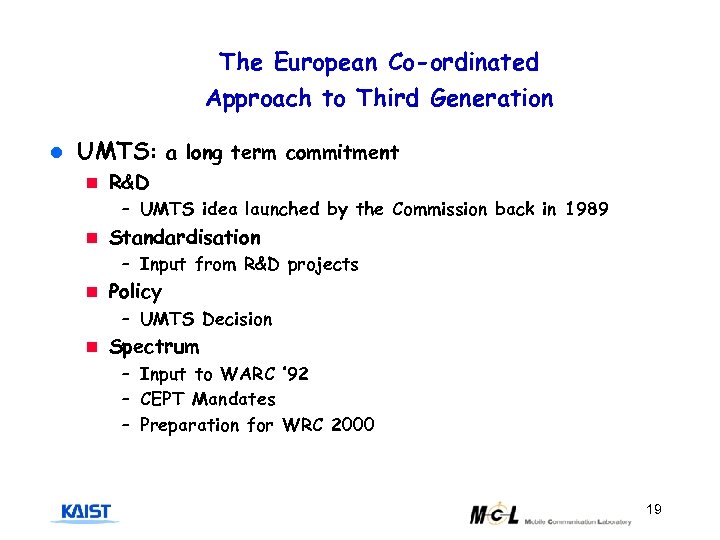
The European Co-ordinated Approach to Third Generation l UMTS: a long term commitment n R&D – UMTS idea launched by the Commission back in 1989 n Standardisation – Input from R&D projects n Policy – UMTS Decision n Spectrum – Input to WARC ’ 92 – CEPT Mandates – Preparation for WRC 2000 19
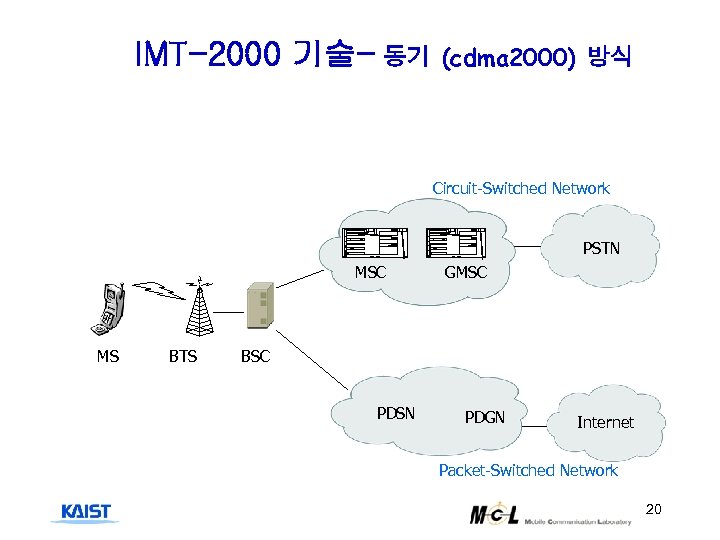
IMT-2000 기술- 동기 (cdma 2000) 방식 Circuit-Switched Network PSTN MSC MS BTS GMSC BSC PDSN PDGN Internet Packet-Switched Network 20

cdma 2000 network architecture MSC, VLR, HLR, IN 망요소 등 PDSN PRF/FA (PCF) AAA HA 21

IMT-2000 서비스에 따른 문제점 l. TELCO 중심의 표준화 과정 n 1989년부터 n기술 10년간에 걸친 표준화 위주의 표준화기간 동안에 시장환경 급변 Spec 작성시 통신환경 l. Analog Cellular - 음성 l. Voice 위주의 통신 l 2. 4~4. 8 kbps 전화선 모뎀을 이용한 협대역 Data 통신 l. Circuit Switch 위주의 통화로 및 교환기 사용 l비교적 비싼 통신요금-시간에 따른 과금 n기술 22

IMT-2000 서비스 도입에 따른 문제점 Spec 완성시 통신환경 l. Digital Cellular - 음성 및 Data l디지탈사회로 급속히 발전-Internet 사용 급증 l. Mobile 통신 수요 급증 lx. DSL, Cable Modem 등을 통한 광대역 통신 가입자 급증 l고속 Data 통신 수요 급증 – 수백 kbps ~ 10 Mbps l월정 고정 요금제의 확산 l각종 통신 서비스 별로 별도의 망 구축사용 l. Packet 망 사용의 보편화 l기술 23

IMT-2000 서비스 도입에 따른 문제점 l구체적인 Business Model이 없음 Internet 위주 서비스로는 수익 창출이 어려움 n. Internet Phone의 출현으로 저렴한 음성통화 가능 n수익 창출을 위한 Killer Application 부족 n현재의 l표준화된 망구조의 변화 n기존 망에서의 진화 중심의 망구조로 표준화 개발 n각종 망의 효율적 통합 수용이 불가능 – 설치 및 운용 비용 증가 n. All IP 망 개발은 아직 미완성 24

기술환경 향후 기술환경의 변화를 몰고 올 Major Driver는 디지털화와 인터넷이며, 이로 인한 네트웍/서비스/단말기/산업간의 융합화는 보다 가속화 될 전망임 Digital 혁명 Internet 혁명 • Digital 부호화 기술 - 다양한 컨텐츠(Mega Media)가 네트웍을 통해 유통 • 데이터압축 기술 - 망용량의 한계극복, 고품질 영상전송 가능 • 개방형 기술표준 - 서비스가 네트웍에 비의존적(Independent) • 저비용 특성 - 장시간 접속시에도 데이터 전송량에 비례한 요금부과 • User-Driven 환경 • Digital 전송 기술 - 대용량, 고효율 전송으로 Cost개념의 획기적 변화 - 사업자가 아닌 개인 베이스의 서비스 개발 융합화 (Convergency) (네트웍, 서비스, 단말, 산업의 융합) • 인터넷이 정보유통 애플리케이션의 기반 환경으로 부상 “Internet Changes All” - 음성과 인터넷 트래픽을 동시에 처리 가능한 복합네트웍으로의 발전 필요 • 시장중심의 De facto 표준이 중요 Global 벤더와의 전략적 제휴는 선택이 아닌 필수 25 중앙연구원

기술 및 시장환경 • 향후 기술환경 변화의 Key Driver는 디지털과 인터넷 디지털: 고품질 영상전송/망 용량 한계극복, 인터넷: 개방형 기술표준/User-Driven 환경 • 기술발달로 유무선간 요금격차가 점진적으로 해소됨에 따라 Network의 통합추세, 서비스 Bundling 경쟁 본격화 • 트래픽 패턴이 데이터 중심으로 급변하지만 Revenue는 비례적으로 증가하지 않음 인터넷 기반의 고부가가치 Platform 사업 필요함 시외 요금격차 축소, 유무선통합 사업영역 ※ JP. Morgan 98. 11보고서 시 장 규 모 미국 일본 한국 음성/데이터 Traffic 역전 터 무선 데 이 요 금 수 준 음성 무선 [별첨 # 2] 시외 시내 Revenue Platform 사업 시내 1997 ‘ 98 ‘ 99 2000 2003 ‘ 98 2001 2002 2005 중앙연구원

User Scenarios 27

Value Chain의 변화 • 인터넷과 디지털 혁명으로 기존 정보통신 산업의 Value Chain 분화를 가져오고 있으며, Platform 분야가 향후 경쟁력을 좌우함 단말기 네트웍 현재 Value Chain 분화 향후 플랫폼 컨텐츠 애플리 케이션 • 영화/음악 • 게임/오락 • 신문/출판 • 금융 • 교육/의료 • 전자지도 네트웍 단말기 Location • PDA 인트라넷 멀티미디어 복합 Network Ecommerce • 스마트폰 • Auto PC (셀룰러, IMT-2000, WLL, Netsgo) 교통정보 서버 Portal 정보 가전 • Web TV 등 중앙연구원

Value Chain Telecommunication Value Chain traditional New ! Network Equipment Network Operation Middleware Applications Content Implementation Terminal Equipment Service Provision Application provision Application Value Chain Requirement assessment Application design Application prototyping The value chain is getting more extensive Content Value Chain Content creation Content packaging, customization Content provision Enter new areas to secure and increase revenues 29

Business Model Content Service Provider Content Server Application Service Provider Proxy Service Provider Ex. Location Server Infrastructure Service Provider Private Hiperlan Type 2 Network Service Provider Public Hiperlan Type 2 IP Core Network GPRS UTRAN Terminal Supplier User Terminal Customer 30

Open Architecture l. Control layer와 Transport layer 분리 n. Layered Structure n. API(Standard Interface)를 이용한 Transport layer 제어 - 예) 3 GPP의 SAT, MEx. E, CAMEL n망 구축 비용 절감 - 사용장비 및 3 rd party 이용 n부가서비스 Control Layer Transport layer 창출 용이 Call control Signaling Resource control management Service control Number translation Location handling PSTN Gateway BS PSTN Networks Switch Packet Gateway Packet Networks 31

통신 시스템 REVOLUTION- AII IP Network 알렉산더 그래함벨 (A. G. Bell) 전화 발명 (1876) 美 DARPA Project (1970) 공간분할 교환기(Analog)/시분할 교환기(Digital) TDX (1981) 2000년 3 G 2005년 4 G 2010년 Circuit Switched Network LUCENT ERICSSON NORTEL …… Packet Switched Network Computer Telephony Integration CISCO 3 COM …… Radio Integration Network Integration Service Integration All IP Network CISCO 3 COM NORTEL …… -Router -DWDM -Broadband Access (wireless/ wireline) Big Business Chance For Manufacturer Service Provider Contents Provider 32

All IP 네트웍 등장 배경 인터넷이 보편화 되면서 저렴하고 Total Solution을 요구하는 사용자 요구 충족 필요 User 무선 인터넷 서비스 요구 4 저가격의 통신 서비스 요구 4 Total Solution 요구 4 Operator 유선 망과 무선 망 통합 4 패킷 망과 서킷 망 통합 4 신규 서비스 도입 용이 4 All IP Network Manufacturer 새로운 시장 창출 4 컴퓨터와 통신의 결합 및 경쟁 격화 4 기술 표준에서의 주도권 확보 경쟁 33 4

All IP 네트웍 구조 All IP망 구조는 IP Backbone 위에 직접 기지국이 접속하는 형태가 될 것이며 호 처리를 위한 서버들은 어느 위치에 존재해도 가능 전통적 네트웍 회선 교환 영역 패킷 교환 영역 MSC Server HLR Server All IP 네트웍 G/W PSTN BSC Server BSC BTS BTS BSC Server BTS IP Network BTS Corporate BTS BTS Corporate Voice & Data 34

All IP 네트웍 특징 및 장점 단일 IP 망으로 음성 / 데이터 / 멀티미디어 등을 다양한 형태 의 Access망을 통하여 전송 단일 네트웍으로 모든 서비스 통합 음성 / 데이터 / 멀티미디어 트래픽이 IP Packet으로 전송 Packet Network 과 IP Telephony에 기반한 망 구조 도입 및 운용 비용 절감 데이터 전송을 위한 전송 망과 서비스 제어를 위한 망의 논리적 분리 신규서비스 도입 용이 인터넷 기반의 멀티미디어 서비스를 효율적으로 제공 유, 무선 통합 서비스 제공 Access망에 비 의존적인 망 구조 지향 35

All IP 네트웍 도입시 고려사항 All IP 네트웍은 가격과 유연성에서 많은 장점을 가지고 있 으나 고품질의 서비스를 위한 Issue들이 해결 되어야 함 해결해야 할 기술적 사항 Qo. S, Stability, Delay 문제 비연결형 서비스의 특성상 과금관리가 어려움 네트웍 폭주를 위한 트래픽 엔지니어링 문제 해결 기술 기존 사업자로서의 고려사항 기술적 안정화 시기 및 투자금액 2 G 망과의 연동 문제 및 Handover 해결 Evolution 또는 Revolution 공중망에서 대규모 사용자 대상으로의 경험 부족 All IP 망으로의 진화는 확실시 됨 Internet 서비스 통해 기술 검증 됨 36

All IP 네트웍으로의 진화 과정 (Interim) 초기단계에서 투자 비용의 최소화를 위하여 게이트웨이를 통한 기존 망과의 연동 기능 제공 IP 망 기존 망 37

All IP 네트웍으로의 진화 과정 최종적인 All IP망은 데이터 전송을 위한 IP Backbone 과 제어기능 및 서비스를 제공하는 서버들로 구성 38

IMT-2000 Evolution/Migration Concept GSM IS-136 IS-95 PDC CT 2 DECT PHS GMPCS WATM Global System for Mobile Communication TDMA Cellular System (N. A. ) CDMA Cellular System (N. A. ) Personal Digital Cellular Cordless Telephony 2 Digital European Cordless Telecommunications Pocket Handy Phone Global Mobile Personal Communications by Satellite Wireless ATM • Market • Technology • Regulations • Standards IMT-2000 GSM IS 136 IS-95 PDC Radio Evolution and Revolution IP Evolution GSM 2+ Network CT 2 GMPCS DECT Evolution ISDN PHS PCS B-ISDN (Phase 1) Service Evolution WATM 1999 2000 IMT-2000 Networks will evolve from existing wireless & wireline networks All IP is the next of IMT-2000, not only with evolved Core-net, but also with IP RAN 39

Evolution towards an all-IP solution All-IP 3 G (UMTS/ IMT-2000) Node B INTERNET MPLS RNC LSP Multimedia End-user IPSec GTP End-user Node B IP flow tunnel IP flow DNS Broadband BTS 3 G Narrowband SGSN IP network GGSN Gb BTS SMS Packet W@P BSC A switched Low speed Abis MSC /VLR Data 2. 5 G Voice Circuit BTS HLR PSTN/ISDN GMSC switched 2 G IPv 6 will integrate different 3 G systems, and those with legacy 2 G systems 40

All-IP Network l. All-IP 망 구성 예 n. Realtime Services: H. 323/SIP n. Unified wireless multimedia services Call Controller HLR Server 4 G RAN POTS Signaling gateway IP Core Network Media gateway Access Node LAN Internet AAA PSTN/ISDN Other PLMN 41

All-IP Conceptual Model All-IP Core Network IN Networks (Application & Services) Service Management SS 7 SGW IN service Mobility Management User profile AAA MGC Call & Signalling Management PS RAN MRC Call Control GW 1 G/2 G CS RAN Multimedia Management Qo. S service HLR All IP GW Base Core Service GW PGW 2. 5 G/3 G 회선 기타 CS PLMN IWF Signalling Control GW 2. 5 G/3 G CS RAN PSTN/ISDN 망 및 1 G/2 G CS RAN 2. 5 G/3 G CS RAN 3 G Packet only Public Internet Network (Mobile IP/Vo. IP) IP Phone 42

All-IP Network l. Why All-IP ? n. Ability to offer seamless services, through the use of IP, regardless of means of access n. Synergy with generic IP developments and reduced cost of service n. Efficient solution for simultaneous multi-media services including voice, data, and advanced real time services. n. Higher level of control of services n. Integrated, and cost reduced OA&M through IP n. Take advantage of Internet applications by supporting terminals which are IP clients n. Cost reduction through packet transport 43

IPv 6 l. Cerf’s n 32 Predictions bits should be enough address space for Internet ØFamous last words: address space shortage in sight n 100% of all traffic will be packetized by 2010! IPv 6: 128 bit addresses ~ 108 x 1010 Everything over IP IPv 6 over Everything 44

통신 기술개발의 “New Paradigm” l. IT 산업의 Paradigm 변화 n(Client/Agent/Server 분산 시스템) 개방형 시스템 구조 Client Server Client Ethernet 모듈 구조 Client Main Frame • 대기업형 산업 - 중소기업: 단말 및 주변기기 하청업체 • 시장규모 한정 - 기업 전산 시스템 등 • 폐쇄형 구조 • 서비스 – 시스템 개발 회사에 의존 • 벤처기업형 산업 • 시장규모 확대 • 개방형 구조, 표준화, 모듈화 • 서비스 – Open API에 맞도록 각자 개발, 생산 • 가격대비 성능 대폭향상 • 연관산업 파급효과 - 수많은 비즈니스 창출(H/W, S/W, Internet) 45

통신 기술개발의 “New Paradigm” l통신 산업의 Paradigm 변화 개방형 시스템구조 통합 관리 통합 보안 통합 서비스 통합 과금 Internet/packet network (ATM/IP) wireless wired data 모듈구조 • 대형 회선 교환식 시스템 • 폐쇄형 구조 <- 비호환성 <- 사설표준 • 대기업형 제조업 위주 산업 - 전세계 5~6개 정도 • 모듈화된 시스템 • 개방형 구조 <- 호환성 보장 <- 표준화 사양 • 벤처/중소기업형 지식산업 육성 • 원천기술 확보에 의한 국가기술경쟁력 확보 • 예: IMT-2000 비동기 시스템 (3 GPP) 46

All IP Network 기술 n All IP 특징 n n n Services - 사용자에게 Voice/Data/Multimedia 서비스 제공 Core Network - 단일 IP Backbone Access Networks - IP 기반 유무선 Access 기술 지원 Services Voice Services Data Services Dispatch Core Network Management Control Multimedia Services Gateways IP Backbone Network Services PSTN Internet Access Network Cellular WLL Cable Enterprise Subscribers Satellite Wireline 47

MSMP(Multi Service Multi Plug-in) 개념 • 앞으로의 시스템개발 패러다임은 스위치 HW와 서비스제어시스템이 완전 독립된 MSMP 형태로 개발해야 Vendor Control 및 서비스 차별화가 가능 • 사업자에 의해 서비스가 간편히 창출되고 지속적으로 확장 유지 가능 < 기존 시스템 > 서비스 제어부 < 개방형 시스템 > 유 선 전 화 V O D 인 터 넷 이 동 통 신 미들웨어 계층 표준 API 스위치부 제 어 부 정합부 스 위 칭 부 응용서비스 계층 정 합 부 하드웨어 계층 표준 HW 인터페이스 ※ MSMP : Multi-Service Multi-Plug-in(개방형 통신시스템)으로서 시스템의 SW와 HW를 표준화된 Plug-in 들의 집합체 형태로 개발한 통신시스템 48 중앙연구원

MSMP(Multi Service Multi Plug-in) 개념 구분 기존 통신 시스템 개방형 통신시스템 서비스 개발주체 제조업체 중심 사업자 중심 기능 구조 일체형 기능구조 완전분리형 기능구조 시스템 Upgrade 고정형 기능구조 기능블럭재사용, 조합형 형상변경 HW, SW의 최초형상유지 Plug-in 방식으로 다양한 서비스, 용도에 유연하게 적용가능성 49 중앙연구원

Network Customization by Reconfiguration 서비스 정의 통신망 설계 기술 및 운용 know-how를 활용하여 특정기업이나 지역(공공)사업에 가장 적합하게 통신망 설계, 시스템 구축 및 운영 등 turnkey-base의 통신서비스 제공. 통신망 설계 신공항 사업 신도시 · 인공섬 Project 망·시스템 구축 Cellular / IMT-2000 Internet Teleport 타망 통신망 운용 Campus, Complex Teleco 망 50 중앙연구원

ION(Integrated On-Demand Network) 초기단계 빌딩 내에 독립 셀을 구성하여 건물 안에서는 구내전화, 건물 밖에서는 이동전화 서비스 제공 초기단계 ION CDMA망 MSC BTS BSC MSC 초기단계 형상 m. BS PABX • 기존 시스템을 활용, 개발 기간 최소화 • 빌딩 내 VPN개념 도입 Router PSTN망 Internet망 • 다양한 요금 체계 필요 51 중앙연구원

ION(Integrated On-Demand Network) 발전단계 복합교환기를 이용, 유선에서 제공하던 음성 및 데이터 서비스를 무선으로 대체하여 제공하고 서비스 Bundling을 통해 Total Solution 제공 발전단계 ION CDMA망 MSC LAN BTS BSC MSC 발전단계 형상 • 유선을 무선으로 대체 • Multimedia 서비스 제공 - 음성 + 데이터 • 서비스 Bundling PSTN망 m. BS 복합교환기 (PABX+Router) Internet망 52 중앙연구원

Wireless Personal Area Networks (1) l. Wireless communication is not only a question of Global connectivity l. The wireless connectivity in the Personal environment is not less important l. The development of WPANs intends to nreplace wires nreplace infrared connections nenable ad hoc communication nprovide LAN-like functionality 53

Wireless Personal Area Networks (2) 54

Digital Wireless Connections 55

Wireless Personal Area Networks (3) 56

Software Defined Radio (SDR) 기술 l하드웨어의 수정 없이 모듈화된 소프트웨어의 변경만으로 단일의 송수신 시스템을 통해 다수의 무선 통신 규격을 통합 수용하는 무선 인터페이스 기술 DSP, 고속의 재구성 가능한 (reconfigurable) FPGA와 광 대역 ADC 및 DAC 등을 사용하여, 기저대역에서 구성 가능한 신호 (software-defined waveform)를 IF대역으로 최대한 천이시켜 유연 한 시스템을 구성 l고성능 시스템 (legacy system)과 새로운 규격 (standards)의 출 현에 따른 미래 시스템 모두에 적용 가능한 경제적이며 효율적인 시 스템 구성 기반 제공 l기존의 57

SDR 기술 (계속) 이상적인 무선 송수신 시스템의 구성 (“Software Radio”) 58

Multi mode and reconfigurable terminals mode 1 RF BB signal processing RF 1 mode 2 RF BB signal processing RF 2 mode n RF BB signal processing multi mode terminal with parallel modes flexible and adaptive RF frontend RF n memory for parameter sets BB signal processing multi mode terminal with software defined signal processing programmable high power BB signal processing fully adaptive software reconfigurable terminal 59

Smart Antenna Concept l. Key benefit nimprove system capacity nreduce power control requirement nsame range coverage with lower power nlarger carrier to interference ratio → channel efficiency by reducing MAI → capacity improvement 60

Smart Antenna • A fully adaptive antenna array using spatial processing with two users 61

Smart Antenna • Difference between switched beam and adaptive beam 62

Advanced antenna concepts RF frontend RF RF BB RF signal . . . processing BB signal processing RF frontend RF Diversity concepts Multiple antenna concepts RF RF. . RF . BB signal processing RF Adaptive antenna concepts 63

New service delivery models Payment Billing Service broker Value added service providers Home Environment Subscriber user Service management e. g IST or corporate network Communications AOL-Time Warner-EMI Vodaphone -Vivendi Nokia-News Corp etc Content providers Access network operator Core network operator 64

Handover Today -“Handover” is Intra Network and based on the Physical Layer -Based on Characteristics of the Signal (strength, error rate, range…. ) In the Future -Inter-Network “Handover” or “Transfer” demands new technology e. g. Transfer based on required Quality of Service (QOS) and available Qo. S -Transfer based on Cost -Transfer Based on Optimum Use of Spectrum 65

Future Inter-Network “Handover” Technology -May not necessarily be Real-Time -May be based on Higher Level) Layers (e. g. Application -Needs to take into account different Network Techniques and legacies. -Capability to re-format Content required (# bearer capabilities) 66

Network Architecture (BRAIN) Other Networks BTS Location Database BSC IP Backbone GSM BSS Supports: SGSN UTRAN Node B - Qo. S for realtime services - Multicast - Handover IP WAN RNC SGSN Vertical Handover Radio Cells Horizontal Handover Roaming One Subnet Inter-Network “Handover” is a must 67

Layered structure of seamless future network distribution layer • full coverage • global access • full mobility • not necessary individual links DAB and/or DVB possible returnhannels c • full coverage and hot spots • global roaming • full mobility • individual links 2 G: e. g. GSM cellular layer IMT-2000 UMTS • local coverage • hot spots • global roaming • local mobility • individual links WLAN type e. g. ETSI BRAN hot spot layer • short range communication (e. g. Bluetooth, DECT) • global roaming • individual links personal network layer fixed(wired layer ) X X • no mobility • global roaming • individual links Vertical handover between systems X X X Horizontal handover within a system X X 68

Seamless future network including multiple interworking access systems 69

Mobile Communications. Digital Broadcasting Convergence • Delivery of video and audio to mobile terminals Audio Broadcasting Digital • Total traffic asymmetry DAB • Will UMTS be an extension of DVB ? • Boundaries between communications and broadcasting become blurred IP • Spectrum reallocations needed? 470 -862 MHz GSM (900 or 1800 MHz) UMTS (2000 MHz) Digital Video Broadcasting DVB-T-S IP IP From 9. 6 Kbits/s to 2 Mbits/s 70

Motivation l Demand for high-end mobile multimedia services is increasing n l initially in vehicular environments later on as personal handsets Variety of Requirements: n high bandwidth, asymmetry, interactivity, location dependency, …) Issues: l l l Harmonization of additional spectrum worldwide difficult Dynamic spectrum allocations, services redefinition Distinct technologies for delivery (GSM, UMTS) and (DVB, DAB) with fixed long term spectrum allocation Broadcasters starting to think beyond content and Telecommunications operators starting to think beyond delivery technologies Can mobile communication technologies be used as return channels for interactive broadcasting Convergence of terminals (from MHP and HS to MPP) 71

A New Definition of Broadcasting Working Parties 10 A and 10 B (ITU-R) proposed: “Broadcast services are those vision, sound, multimedia and data services intended for use by the public, inclusive of those using access control or interactivity. They make use of “point-to-everywhere” information delivery aimed at the general public through widely available, non-proprietary consumer receivers. They typically use an asymmetrical distribution infrastructure that allows high capacity information downloading to the public with a low capacity backward link to the service provider…. . 72

Towards life in 2010 l 90% of traffic on mobile networks will be data l. Domestic demand reaches 100 Mbits/s per home l. Cellular phone locations used in traffic management systems l. All new cars fitted with automated distress system l 90% of calls will be tetherless l 1 Terabit memory chip l. Chips with 10 billion transistors l. DNA storage device l. Household access by facial recognition l. Voice interface for home appliances l. In-store positioning systems enable personalized guides l 25% of UK workforce telework at least 2 days/week l. Worldwide population of 65 s increases by 1 million a month 73

From 3 G to 4 G l. Single standard (member of IMT-2000 family) l. MOBILE MULTIMEDIA All systems, All services Integrated provision of personalised, enhanced services over the most efficient/ preferred networks l l Many, seamlessly integrated systems PERSONALISED SERVICES MARKET driven 74

Mobile Systems beyond IMT-2000 Mobility Vehicular 4 G System 5 G Syst. ( 4 th Generation ) IMT-2000 Pedestrian Wireless Access Wireless LAN Stationary 0. 1 1 10 100 Data Rate (Mbit/s) 75

4 G: What it is NOT. . . Not just higher data rates Not just public systems Not Technology driven 76

From Coexistence. . . to Integration Information bit rate 4 G 3 G 2 G Mobile Multimedia 1 G Voice 1972 Integrated Wireless World Voice + Data GSM 900/1800 DECT 1992 ? UMTS/IMT-2000 MBS BB-WLANs 2002 2012 2022 ©JPER 77

4 G as the Integrator Wireless S-UMTS Information Society Satellite Broadband DVB-S Satellite/HAP DVB-T DAB Broadcasting GPRS GSM Cellular Broadband W-LAN Bluetooth Body LANs IR Personal Broadband Area Networks WFA MWS Local Area Networks MBS 60 4 th Generation EDGE UMTS ++ UMTS IPv 6 MBS 40 x. MDS Wireless Local Loop Quasi-Cellular 78 ©JPER

Addressing the Proliferation of Standards THE PROBLEM l. Europe 450/900/1800 n. DECT THE SOLUTION n. GSM l. US n. AMPS WCDMA TD/CDMA n. IS-95 CDMA n. IS-136 TDMA n. GSM 1900 l. Japan n. PDC n. PHS cdma 2000 IWC-136 WCDMA Reconfigurable Radio WCDMA WTO requirement of technology neutrality 79

Reconfigurable Radio Systems and Networks l. Looks beyond the Terminal, covering the whole System, extending through the Network into Service creation and Applications development, relying upon a number of Enabling Technologies nan open architecture effectively promotes the involvement of new players, resulting in a revamped Business Model nnetwork reconfigurability will allow “enhancements” of legacy applications without having to wait for reconfigurable radios l. It pays attention to institutional issues like Standardisation and Regulation and, most importantly, by enabling efficient Spectrum management, will allow in the long run full spectrum sharing nsoftware download will allow the reconfiguration of Terminals, Networks, Services and Applications, and enable personalised, seamless service across heterogeneous networks 80

4 G Cell and Network Contents Server (Media Server) Vehicle Mobile Public Transportation 4 G Network Micro-Cell IP Back bone/ Internet Macro-Cell R-LAN WLL Cordless Subscriber Loop Indoor Cordless Pico-Cell 2, 3 G Network PSTN ISDN 81

Difficulty of 4 G System Higher Speed Higher Frequency (3 - 10 GHz) Increasing Propagation Loss Increasing RF Circuit Loss Increasing Output Power !! • ≈Frequency 2. 6 • ≈Information Bit. Rate For example : 5 GHz, 2 Mbit/s 200 Times more than 2 GHz, 100 kbit/s 82

Requirements and Technologies High Speed Data Ultra High Capacity Cost Down Nationwide Coverage Smaller Terminals Attractive Services Adaptive Array Antenna (BS & MS) Micro & Pico Cell (with Macro Cell) Wireless/Optical Entrance Link Co-existence with IMT 2000 Software Radio Multi-Band (Microwave & UHF) Manufacturing Technology Location Identification WDM IP Networking Wearable Terminals New Applications Specialized to Mobile 83

Expectations for 4 G System ・High Speed (Vehicular: 2 Mbps, Pedestrian/Indoor: 20 Mbit/s) ・ Next Generation Internet support (IPv 6, Qo. S, Mo-IP) ・ High-capacity 5~ 10 times to 3 G ・ Seamless Services with Fixed NW and private NW. ・ Flexible for Providing New Services ・ Utilize Higher Frequencies (For example 3~ 8 GHz) ・ Lower System Cost (1/10 of IMT 2000? ) 84

통신산업에서의 벤처기업의 역할 서비스 사업자 + 벤처 기업 컨소시엄 n 통신 Big 산업발전 Business Paradigm의 Chance 변화 3 G, 4 G 원천기술 연구개발 - 지적 재산권 확보 국제 표준화 활동 n 사업화에 필요한 규격 제시 n - 개발 선점 - 사업자와 벤처 기업간 공동개발/ 직거래 국내시장 및 세계시장 진출의 교두보 기업간 시너지 효과를 얻기 위한 지식산업 단지조성 필요 - Silicon Valley 모델 n 85

벤처 단지 조성 제안 n All IP 개발을 위한 기반 환경 정부 (중앙/지방) 통신 산업의 발전 통신 혁명 Paradigm의 변화 All IP Network 개발 컴퓨터와 통신의 결합 유무선 환경 통합 기반 환경 구축 벤처기업협회 중심의 정보통신 벤처 기업 국가차원의 서비스 제공 계획 수립 서비스에 필요한 Network 진화 예측 Network 진화에 따른 필요 장비 예측 인터넷, 통신, 부품, 시스템, 콘텐츠 분야의 전문화된 기업간의 협력 체계 필요 통신 사업자 (SK/LG/KT) IPR 국제표준 통신사업자와 벤처기업간 공동개발 필요 학교 (KAIST) 대표적 지식산업 학제적 연구개발 및 고급인력 양성 필요 86

벤처 단지 조성 제안 n 벤처 지식산업단지 조성의 필요성 관련 정보, 기술력의 집중 필요 ? 정부 (중앙/지방) 컨소시엄 구성 벤처기업협회 중심의 정보통신 벤처 기업 통신 사업자 (SK/LG/KT) 학교 (KAIST) 필요성 벤처 단지조성 • 고급지식과 연구인력 확보가 유리하도록 전문기업, 대학이 밀집되어야 함. • 컴퓨터와 통신의 결합, 유무선 통신의 통합에 따라 관련 전문 기업간의 협력이 필수. 원천기술 개발 필요 공동 연구개발 All IP 통신시스템 개발 • 국내 통신산업의 구조적 문제 외형적 발전 이루었으나 기술 자생력 없음. 위치 IPR 국제표준 • 정보통신 관련 기업, 연구소 및 학교 접근성 • 고급인력 선호 • 교통의 요지 / 교통수요 분산 87

결론 l통신기술 발달 n 1세대(AMPS) -> 2세대(CDMA/GSM) -> 3세대(WCDMA/cdma 2000) -> All IP Network -> 4세대(Integrated, Seamless Service) l. New Paradigm -> 개방형, 모듈형, 표준화 n. CS -> CS/PS -> PS(All IP) n. Market Driven n폐쇄형 l지식산업 중심의 새로운 비즈니스 창출 n. Paradigm 변화에 따른 새로운 비즈니스 모델 창출 n 3 G -> 4 G로 변화에 대한 준비 / 국제 표준화 주도 n국내시장 및 세계시장 경쟁력 확보 n침체된 Internet 관련 벤처 산업의 새로운 활로 제공 l벤처 비즈니스 활성화를 위한 지식산업 Cluster 조성 필요 n산학연 Synergy 창출로 체계적인 IT 벤처산업 육성 88
Скачать презентацию 차세대 통신시스템 개발을 통한 사업기회 창출 2003 11
c70d91fc89dd6dc4dfa9ff39060e56d5.ppt