 Скачать презентацию 제 7주 응용-3 Entertainment Creatures Artificial Life Autonomous
edb7e3dfa6721ee6be31491b6fc6b706.ppt
- Количество слайдов: 6



제 7주. 응용-3: Entertainment Creatures: Artificial Life Autonomous Software Agents for Home Entertainment S. Grand, D. Cliff and A. Malhotra, Proc. of Int. Conf on Autonomous Agents, pp. 22~29, 1997 학습목표 인공생명 기법을 이용한 상용 S/W Creatures의 구조를 통해 서 Entertainment 분야에 어떻게 응용할 수 있는지 이해
개요 4 Creatures – Commercial home-entertainment software package – Simulated environment with synthetic agents to interact in real-time – Virtual pets inspired by animal biology • Neural network: sensory-motor coordination / behavior selection • Artificial biochemistry: energy metabolism with hormonal system to model diffuse modulation of neuronal activity & staged ontogenetic development • Hebbian learning: adapt neural network during lifetime • Variable-length genetic encoding: evolutionary adaptation through sexual reproduction 4 내용 – Technical details – Scientific implications
Introduction 4 Creatures – – – Autonomous software agents entertainment industry Interactive entertainment product Based on artificial life and adaptive behavior research Interact in real-time with synthetic agents Windows 95 (486/66 Mhz) and Macintosh platforms
Related Works 4 Autonomous agents for entertainment – Reynolds: autonomous agents for behavioral animation operated with broad choreographic commands – Terzopolous: faithful kinematic simulations of fish visual accuracy – Blumberg: behavioral control mechanism from ethology – Reynolds: automatic adaptation with genetic programming – Sims 4 Other relevant entertainment products – Sim. Life by Maxis: observe and interact with a “simulated ecosystem” – El. Fish by Maxis: electronic aquarium S/W toys creative, ongoing, open-ended experience – Dogz and Catz by PFMagic – Fin-Fin by Fujitsu Interactive Inc. : 3 D rendering – Galapagos by Anark: six-legged agent with NN-like controller
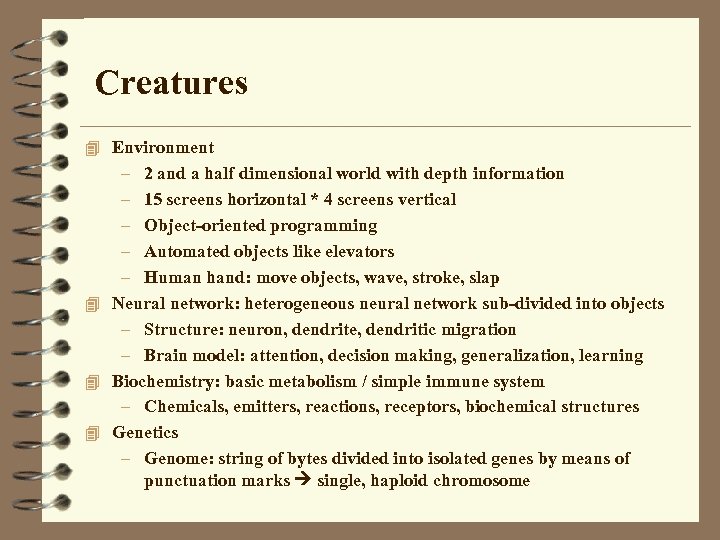
Creatures 4 Environment – 2 and a half dimensional world with depth information – 15 screens horizontal * 4 screens vertical – Object-oriented programming – Automated objects like elevators – Human hand: move objects, wave, stroke, slap 4 Neural network: heterogeneous neural network sub-divided into objects – Structure: neuron, dendrite, dendritic migration – Brain model: attention, decision making, generalization, learning 4 Biochemistry: basic metabolism / simple immune system – Chemicals, emitters, reactions, receptors, biochemical structures 4 Genetics – Genome: string of bytes divided into isolated genes by means of punctuation marks single, haploid chromosome
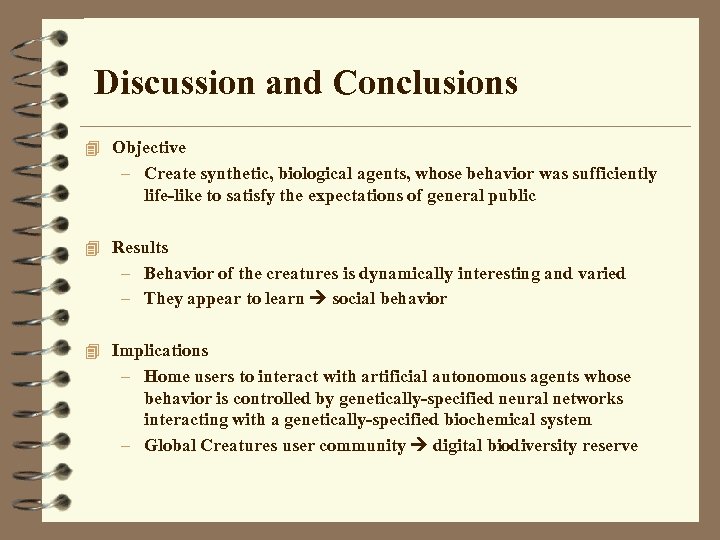
Discussion and Conclusions 4 Objective – Create synthetic, biological agents, whose behavior was sufficiently life-like to satisfy the expectations of general public 4 Results – Behavior of the creatures is dynamically interesting and varied – They appear to learn social behavior 4 Implications – Home users to interact with artificial autonomous agents whose behavior is controlled by genetically-specified neural networks interacting with a genetically-specified biochemical system – Global Creatures user community digital biodiversity reserve
Скачать презентацию 제 7주 응용-3 Entertainment Creatures Artificial Life Autonomous
edb7e3dfa6721ee6be31491b6fc6b706.ppt