 Скачать презентацию 미국특허청 심사평가제도 February 13 2008 Korean Intellectual Property
e6bd78779016a358365789a080f5f719.ppt
- Количество слайдов: 74



미국특허청 심사평가제도 February 13, 2008 Korean Intellectual Property Office Daejeon, Korea
Junghoon Kenneth Oh n Bar Admissions: US Patent Bar, 1998 New York, New Jersey, 1997 n Education: Albany Law School of Union University (J. D. , 1996) Rensselaer Polytechnic Institute (MBA, 1996) Rensselaer Polytechnic Institute (M. S. in Physics and completed doctorate courses in Physics, 1992) Rensselaer Polytechnic Institute (B. S. in Physics, 1990) n Experience: 법무(유)법인/특허법인 태평양 법무법인 중앙 United States Patent and Trademark Office JKO@BKL. co. kr
n 1. Patent Organization of USPTO n 2. Production System n 3. Office of Patent Quality Assurance (OPQA) n 4. Examiner PAP (Performance Appraisal Plan)
Patent Organization of United States Patent and Trademark Office
Trademarks n Core process: examination of applications for trademark registration n Examining attorneys: - Search electronic databases for confusingly similar marks - Prepare letters informing applicants of findings - Approve applications to be published for opposition - Examine statements of use in applications filed under Intent-to-Use
Patents n Core process: examination of inventor’s application n - - for a patent Patent examiner duties include: Comparing claimed subject matter to body of technological information to determine whether invention is : New/ Useful / Non-obvious Preparing correspondence to inform applicants of findings Preparing examiner’s answer for appealed applications
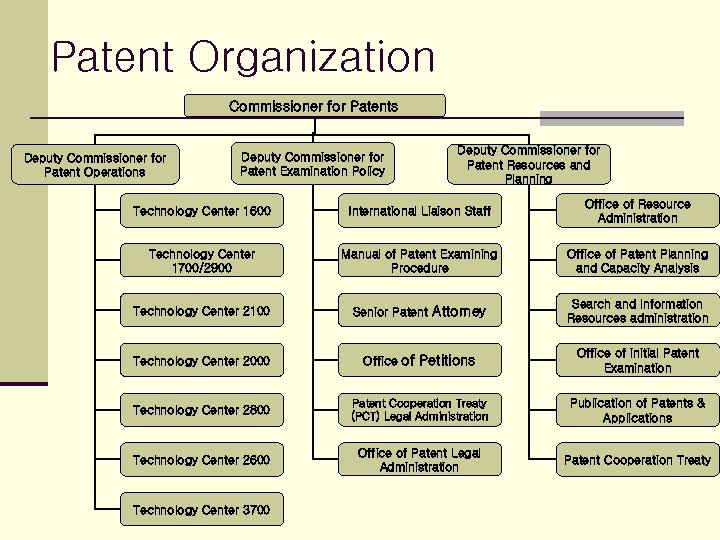
Patent Organization Commissioner for Patents Deputy Commissioner for Patent Operations Deputy Commissioner for Patent Examination Policy Deputy Commissioner for Patent Resources and Planning Technology Center 1600 International Liaison Staff Office of Resource Administration Technology Center 1700/2900 Manual of Patent Examining Procedure Office of Patent Planning and Capacity Analysis Technology Center 2100 Senior Patent Attorney Search and Information Resources administration Technology Center 2000 Office of Petitions Office of initial Patent Examination Technology Center 2800 Patent Cooperation Treaty (PCT) Legal Administration Publication of Patents & Applications Technology Center 2600 Office of Patent Legal Administration Patent Cooperation Treaty Technology Center 3700
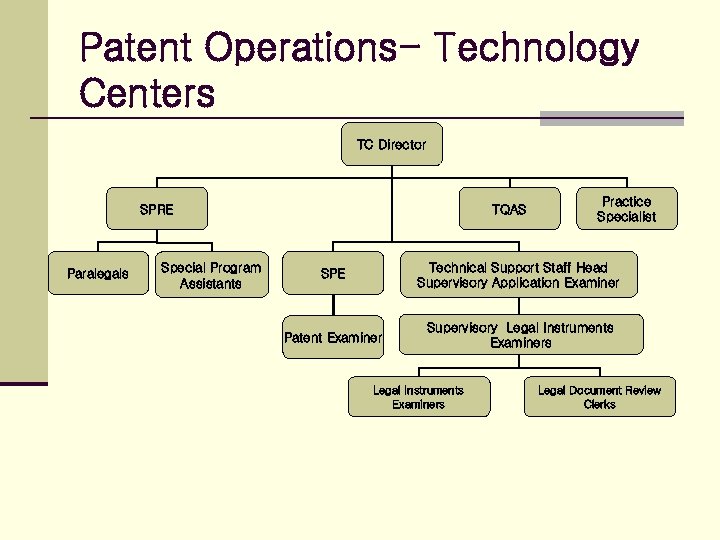
Patent Operations- Technology Centers TC Director SPRE Paralegals Special Program Assistants TQAS Practice Specialist SPE Technical Support Staff Head Supervisory Application Examiner Patent Examiner Supervisory Legal Instruments Examiners Legal Document Review Clerks
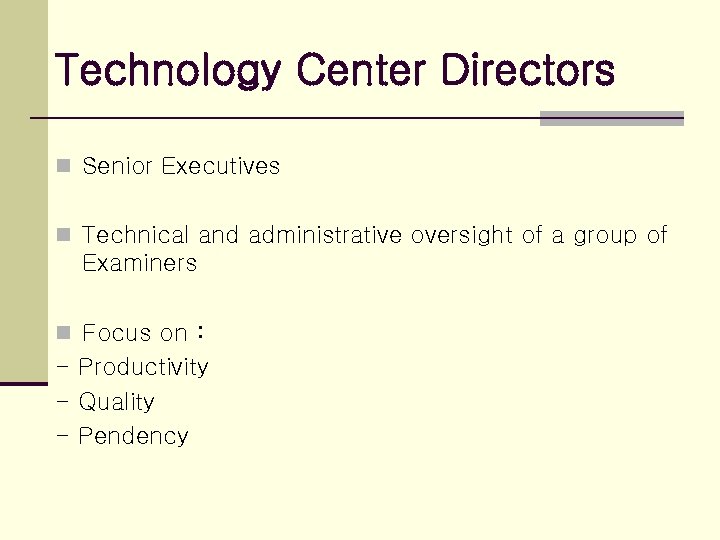
Technology Center Directors n Senior Executives n Technical and administrative oversight of a group of Examiners n Focus on : - Productivity - Quality - Pendency
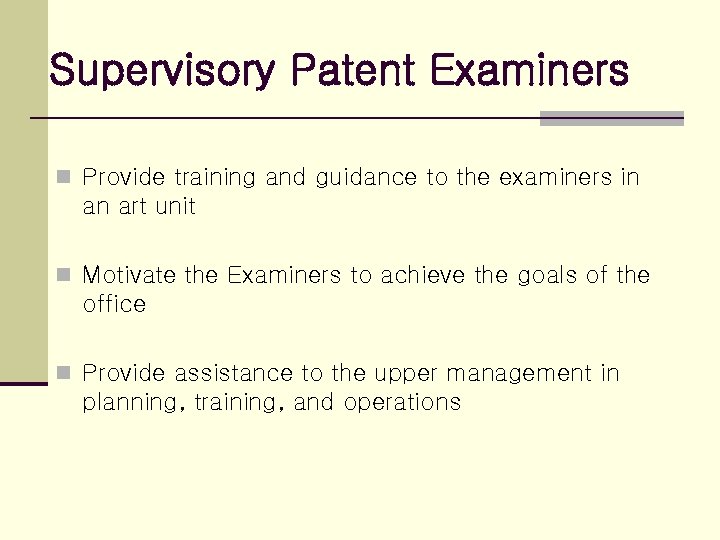
Supervisory Patent Examiners n Provide training and guidance to the examiners in an art unit n Motivate the Examiners to achieve the goals of the office n Provide assistance to the upper management in planning, training, and operations
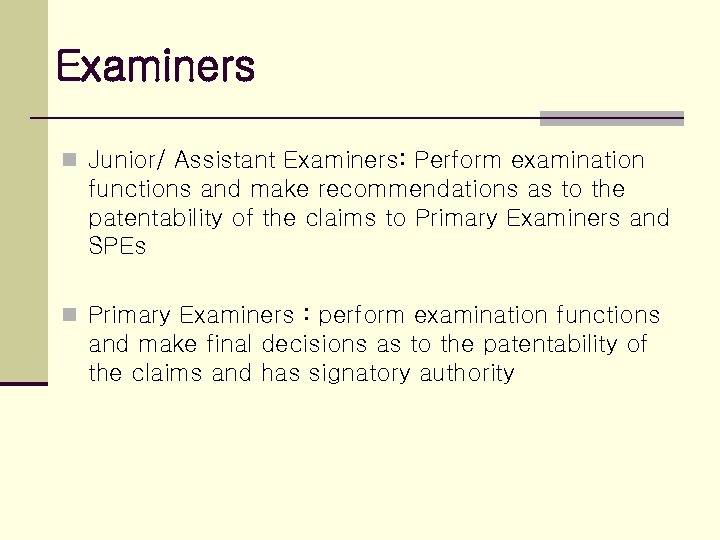
Examiners n Junior/ Assistant Examiners: Perform examination functions and make recommendations as to the patentability of the claims to Primary Examiners and SPEs n Primary Examiners : perform examination functions and make final decisions as to the patentability of the claims and has signatory authority
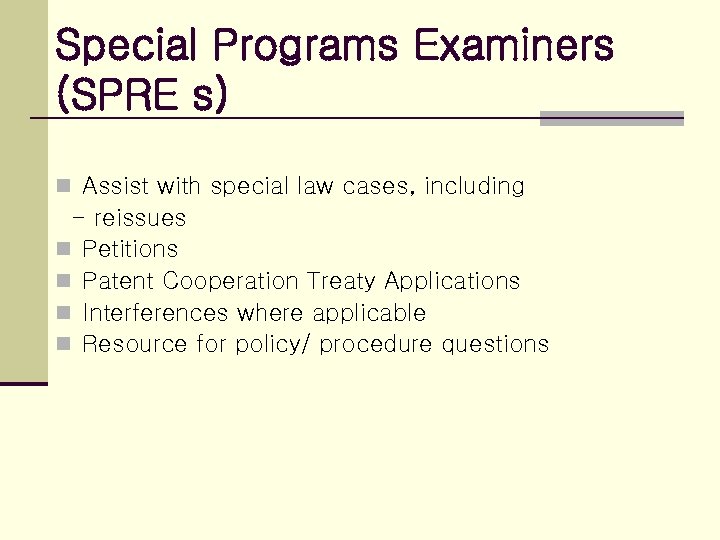
Special Programs Examiners (SPRE s) n Assist with special law cases, including - reissues n Petitions n Patent Cooperation Treaty Applications n Interferences where applicable n Resource for policy/ procedure questions
Training Quality Assurance Specialist (TQAS) n Resource for process and procedure questions -Combining references -Search Strategy -Appeal conferences -SAWS (sensitive application warning system) -Review of cases return by Quality Review
Practice Specialists n Assist TC Directors in administering quality improvement programs -Develop/deliver training n Advise TC Directors on technical and examination issues n Serve as resource to the TC staff and the public on examination policy and procedure n Mediate dispute resolution in patent examination
Head Supervisory Application Examiners (HSAEs) n Oversee and number of Supervisory Legal Instrument n n Examiners ( Team Leaders) Experts in application processing Ensure quality standards are met Work to minimize workflow processing times to reduce or maintain total patent pendency Point of contact for TSS procedural questions form internal and external customers
Supervisory Legal Instruments Examiners (Team Leaders) n Supervise LIEs and LDRCs n Evaluate quality of team products and processes through random sampling of work products n Insure appropriate quality feedback and training is provided n Allocate TSS resources to ensure quality and production targets are met n Provide customer assistance in resolving complaints
Legal Instruments Examiners (LIEs) n Process all documents in Patent applications using IFW in accordance with the requirements in the MPEP, currents statutes and rules of practice n Process time and attendance records in NFC and PALM n Serve as a point of contact for internal and external customer questions on application processing
Legal Document Review Clerks (LDRCs) n Process some documents in patent applications using IFW in accordance with the requirements in the MPEP, currents statutes and rules of practice n Calculate claim fees, process information disclosure statements (IDS) n Serve as a point of contact for internal and external customer questions and application processing
Patent Examination Policy n International Liaison Staff n Manual of Patent Examining Procedure n Senior Patent Attorney n Office of Petitions n Patent Cooperation Treaty (PCT) Legal Administration n Office of Patent Legal Administration
International Liaison Staff n World Intellectual Property Organization (WIPO) n WIPO’s Standing Committee on Information n n n Technologies (SCIT) WIPO Standards International Patent Classification ( IPC) IPC Reclassification IPC Revision Working Group Trilateral Cooperation Trilateral Projects
Manual of Patent Examining Procedure Staff n Assists DC for Patent Examination Policy in developing and formulating new guidelines, examining practices and procedures as well as revising existing guidelines, practices and procedures n Updates MPEP and form paragraphs n Disseminates revised policies and procedures n Assists examiners in properly interpreting existing practices and procedures
Senior Patent Attorney n Manages Patents rule makings n Keeps the Deputy Commissioner for Patent Examination Policy apprised of : -Pending legislation -International developments -New court decisions of note n Provides staff assistance
Office of Petitions n Reviews and decides petitions relations to : -Filing of patent applications -Revival of abandoned applications -Reinstatement of expired patents -Withdrawal of patent applications from issue -Small entity entitlement -Review of previous decision of the TCs -Suspension of regulations -Questions not specifically provided for by regulations
Office of PCT Legal Administration n Provides training for examiners on : -Performing a search on an international application and preparing forms in Chapter 1. International Search Report Written Opinion of the ISA n Performing a preliminary examination of an international application under chapter 2 and preparing international preliminary report on patentability n Unity of invention and “ 371” national stage practice
Office of PCT Legal Administration (continued) n Provides training on PCT practice and procedures n n for patent attorneys, agents and paralegals Staffs the PCT Help Desk and answers questions from customers on all aspects of the PCT Decides petitions filed during the international stage and national stage Works with WIPO to simply the PCT Amends US rules for consistency with PCT
Office of Patent Legal Administration n Provides legal and policy guidance to the Commissioner for Patents and his Deputy Commissioners n Assists in development and implementation of patent law and formulates the accompanying regulations and practices n Provides MPEP staff with suggested MPEP changes as a result of patents rules changes n Responsible for updating majority of forms used by the examining corps and USPTO customers to reflect rules changes and policy initiatives
Patent Resources and Planning n Office of Patent Resource Administration n Office of Patent Planning and Capacity Analysis n Search and Information Resources Administration(SIRA) n Office of Initial Patent Examination n Publication of Patents & Application n Patent Cooperation Treaty
Office of Patent Resource Administration n Provides patent program-specific budget and finance management support to patent program areas n Compiles operational, financial and resource- specific reports to monitor the Patent business day to day goals and responsibilities n Establishes patent program evaluation plans n Develops, maintains, and disseminates statistical data related to Patent business objectives.
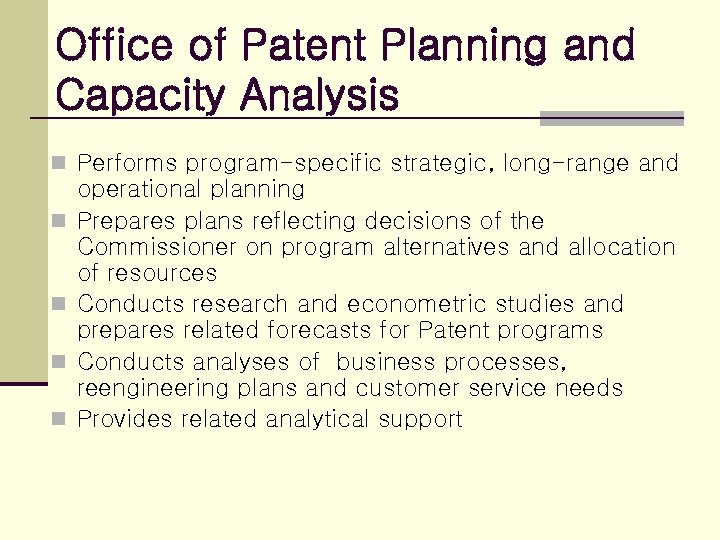
Office of Patent Planning and Capacity Analysis n Performs program-specific strategic, long-range and n n operational planning Prepares plans reflecting decisions of the Commissioner on program alternatives and allocation of resources Conducts research and econometric studies and prepares related forecasts for Patent programs Conducts analyses of business processes, reengineering plans and customer service needs Provides related analytical support
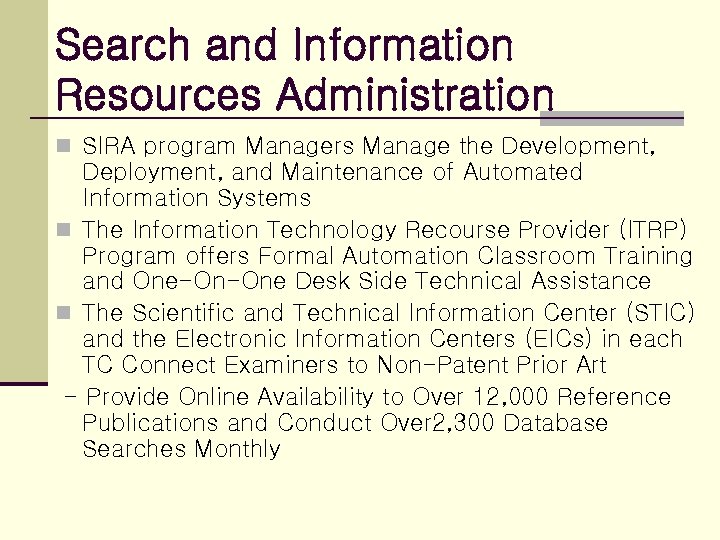
Search and Information Resources Administration n SIRA program Managers Manage the Development, Deployment, and Maintenance of Automated Information Systems n The Information Technology Recourse Provider (ITRP) Program offers Formal Automation Classroom Training and One-On-One Desk Side Technical Assistance n The Scientific and Technical Information Center (STIC) and the Electronic Information Centers (EICs) in each TC Connect Examiners to Non-Patent Prior Art - Provide Online Availability to Over 12, 000 Reference Publications and Conduct Over 2, 300 Database Searches Monthly
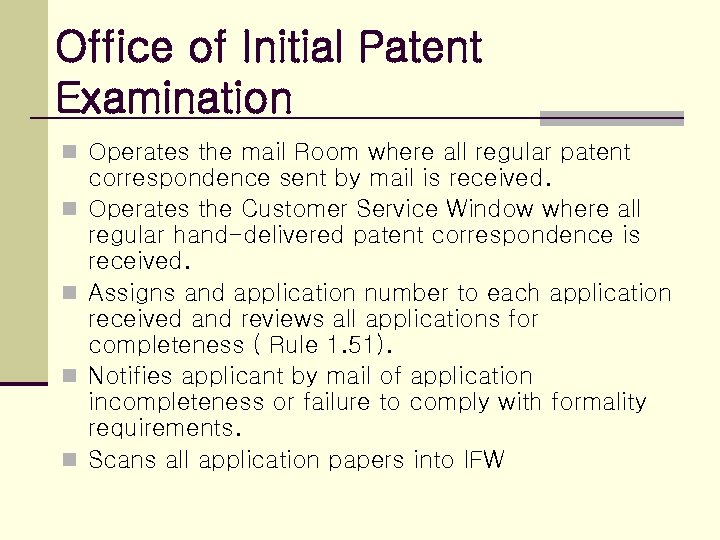
Office of Initial Patent Examination n Operates the mail Room where all regular patent n n correspondence sent by mail is received. Operates the Customer Service Window where all regular hand-delivered patent correspondence is received. Assigns and application number to each application received and reviews all applications for completeness ( Rule 1. 51). Notifies applicant by mail of application incompleteness or failure to comply with formality requirements. Scans all application papers into IFW
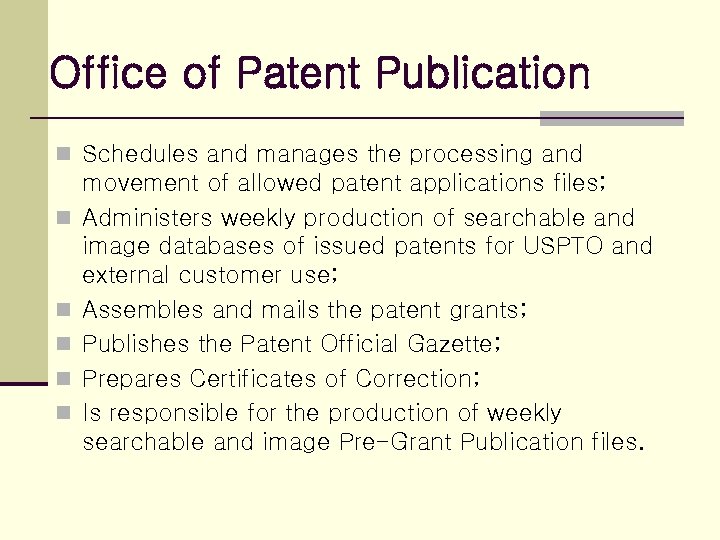
Office of Patent Publication n Schedules and manages the processing and n n n movement of allowed patent applications files; Administers weekly production of searchable and image databases of issued patents for USPTO and external customer use; Assembles and mails the patent grants; Publishes the Patent Official Gazette; Prepares Certificates of Correction; Is responsible for the production of weekly searchable and image Pre-Grant Publication files.
Patent Cooperation Treaty n Educates and assists the patent community with respect to the patent Cooperation Treaty n Provides training courses to help patent applicants and practitioners file PCT applications n Provides instructions to patent examiners at the USPTO concerning the search and examination of PCT applications n Provides direct assistance regarding PCT applications via the PCT Help Desk
Introduction of Production System
Examiner “Counts” n Examiners are given production counts for certain actions that occur during the examination process. - Examiner may perform some actions, such as completing office actions. - Office Actions: documents an Examiner produces as part of the examining process - Applicants may perform other actions. (EX. RC, Express abandonment, etc. )
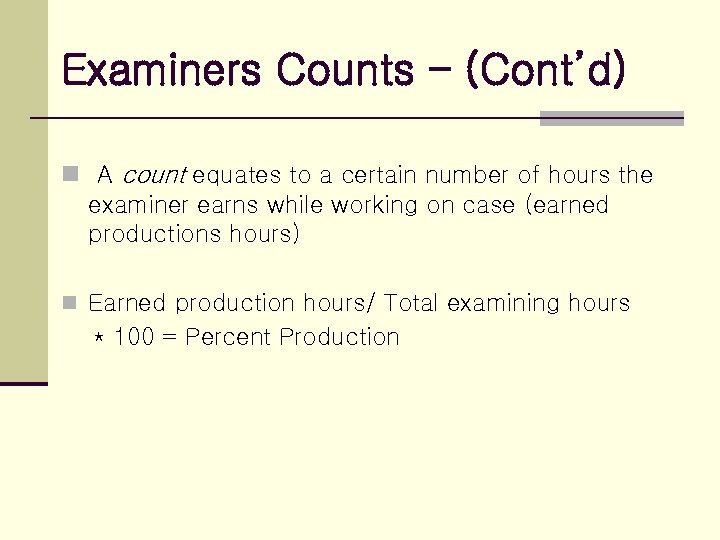
Examiners Counts – (Cont’d) n A count equates to a certain number of hours the examiner earns while working on case (earned productions hours) n Earned production hours/ Total examining hours * 100 = Percent Production
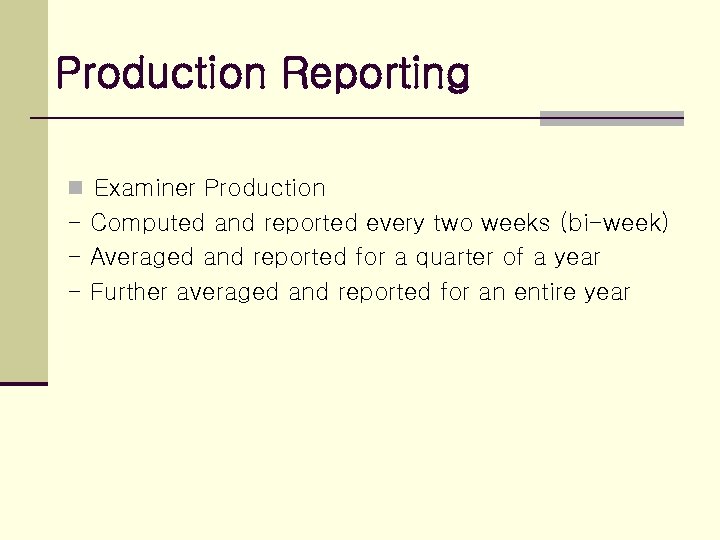
Production Reporting n Examiner Production - Computed and reported every two weeks (bi-week) - Averaged and reported for a quarter of a year - Further averaged and reported for an entire year
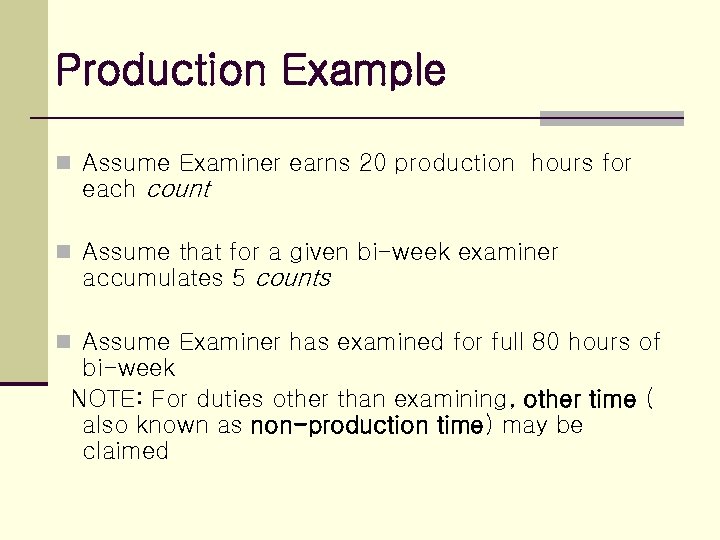
Production Example n Assume Examiner earns 20 production hours for each count n Assume that for a given bi-week examiner accumulates 5 counts n Assume Examiner has examined for full 80 hours of bi-week NOTE: For duties other than examining, other time ( also known as non-production time) may be claimed
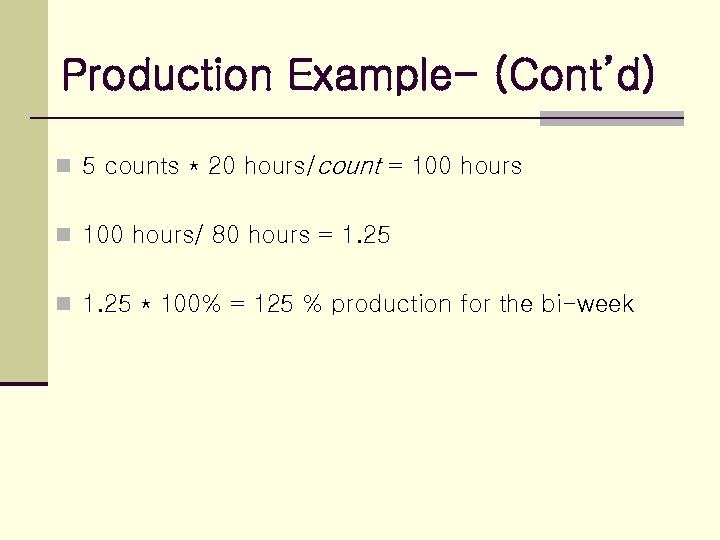
Production Example- (Cont’d) n 5 counts * 20 hours/count = 100 hours n 100 hours/ 80 hours = 1. 25 n 1. 25 * 100% = 125 % production for the bi-week
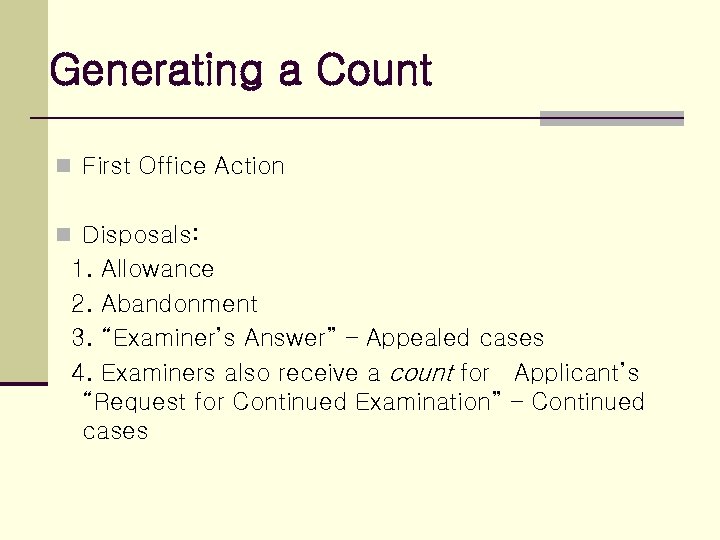
Generating a Count n First Office Action n Disposals: 1. Allowance 2. Abandonment 3. “Examiner’s Answer” – Appealed cases 4. Examiners also receive a count for Applicant’s “Request for Continued Examination” – Continued cases
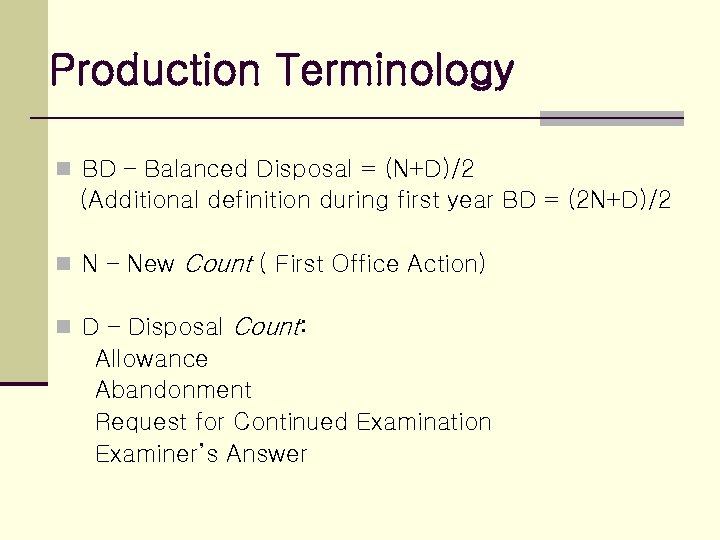
Production Terminology n BD – Balanced Disposal = (N+D)/2 (Additional definition during first year BD = (2 N+D)/2 n N – New Count ( First Office Action) n D – Disposal Count: Allowance Abandonment Request for Continued Examination Examiner’s Answer
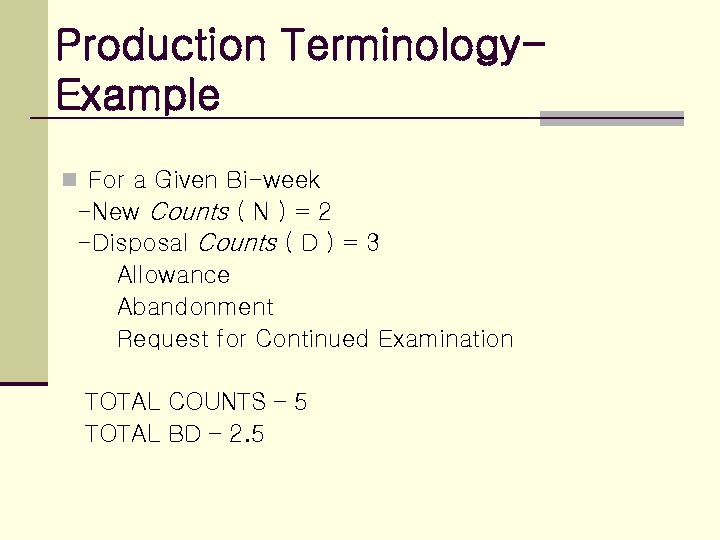
Production Terminology. Example n For a Given Bi-week -New Counts ( N ) = 2 -Disposal Counts ( D ) = 3 Allowance Abandonment Request for Continued Examination TOTAL COUNTS – 5 TOTAL BD – 2. 5
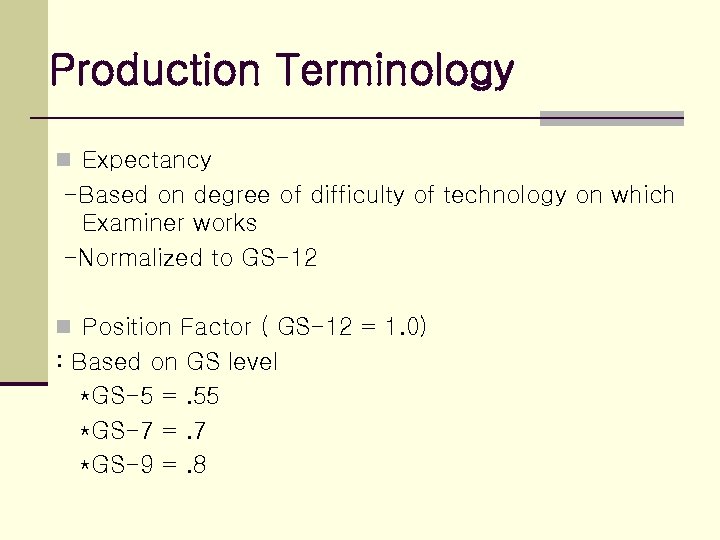
Production Terminology n Expectancy -Based on degree of difficulty of technology on which Examiner works -Normalized to GS-12 n Position Factor ( GS-12 = 1. 0) : Based on GS level *GS-5 =. 55 *GS-7 =. 7 *GS-9 =. 8
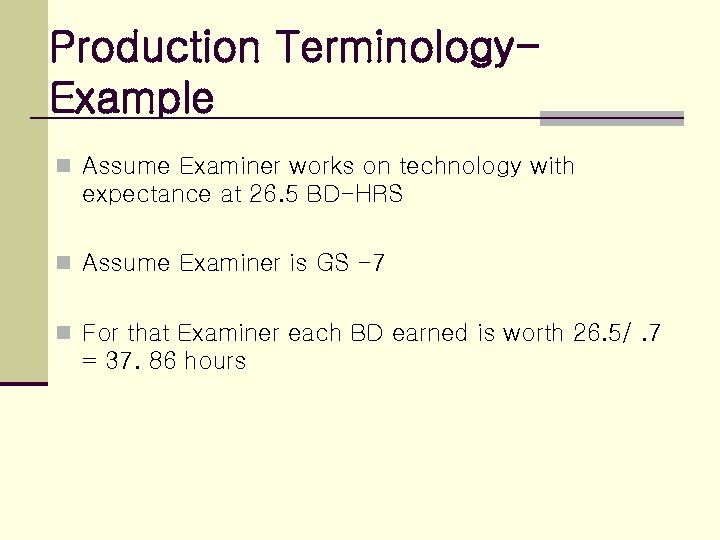
Production Terminology. Example n Assume Examiner works on technology with expectance at 26. 5 BD-HRS n Assume Examiner is GS -7 n For that Examiner each BD earned is worth 26. 5/. 7 = 37. 86 hours
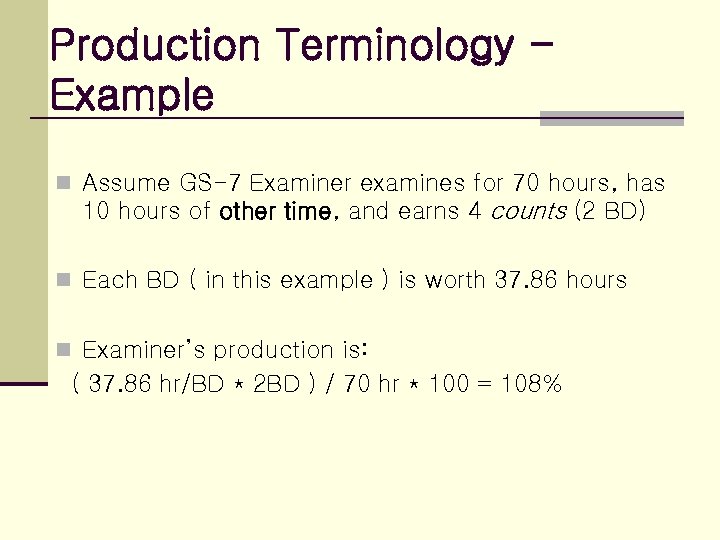
Production Terminology Example n Assume GS-7 Examiner examines for 70 hours, has 10 hours of other time, and earns 4 counts (2 BD) n Each BD ( in this example ) is worth 37. 86 hours n Examiner’s production is: ( 37. 86 hr/BD * 2 BD ) / 70 hr * 100 = 108%
Office of Patent Quality Assurance (OPQA)
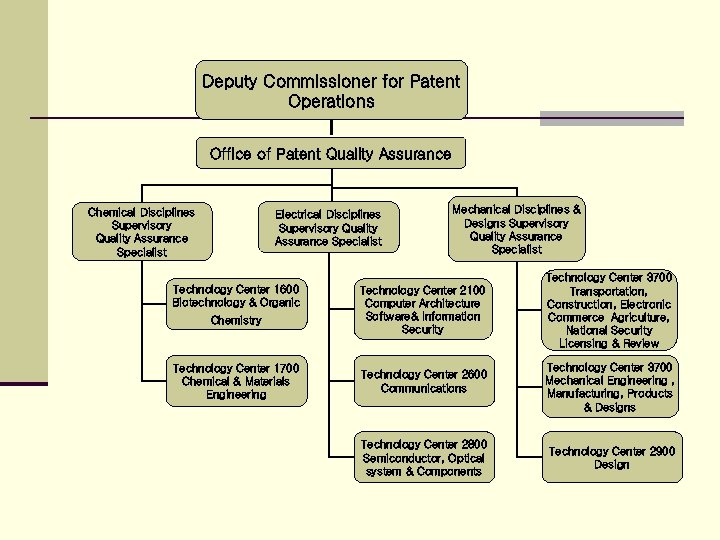
Deputy Commissioner for Patent Operations Office of Patent Quality Assurance Chemical Disciplines Supervisory Quality Assurance Specialist Electrical Disciplines Supervisory Quality Assurance Specialist Technology Center 1600 Biotechnology & Organic Chemistry Technology Center 1700 Chemical & Materials Engineering Mechanical Disciplines & Designs Supervisory Quality Assurance Specialist Technology Center 2100 Computer Architecture Software& Information Security Technology Center 2600 Communications Technology Center 2800 Semiconductor, Optical system & Components Technology Center 3700 Transportation, Construction, Electronic Commerce Agriculture, National Security Licensing & Review Technology Center 3700 Mechanical Engineering , Manufacturing, Products & Designs Technology Center 2900 Design
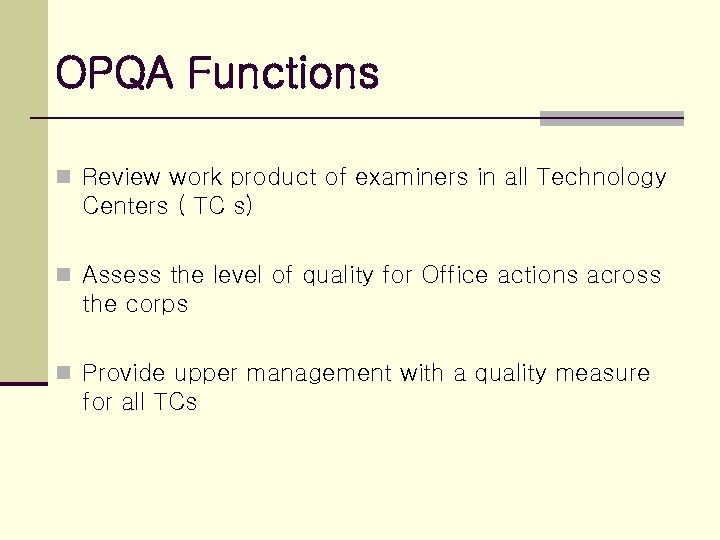
OPQA Functions n Review work product of examiners in all Technology Centers ( TC s) n Assess the level of quality for Office actions across the corps n Provide upper management with a quality measure for all TCs
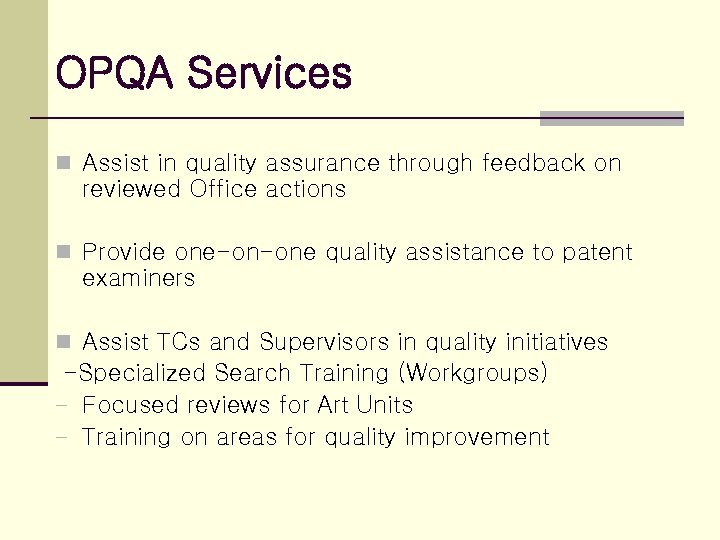
OPQA Services n Assist in quality assurance through feedback on reviewed Office actions n Provide one-on-one quality assistance to patent examiners n Assist TCs and Supervisors in quality initiatives -Specialized Search Training (Workgroups) - Focused reviews for Art Units - Training on areas for quality improvement
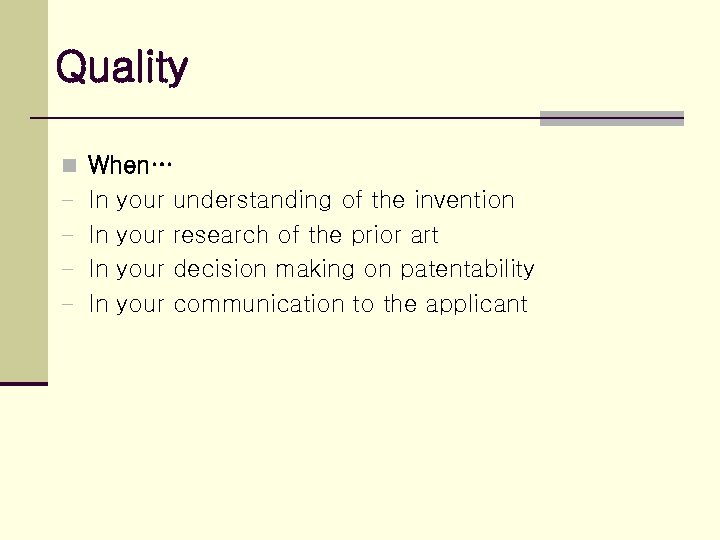
Quality n When… - In your understanding of the invention - In your research of the prior art - In your decision making on patentability - In your communication to the applicant
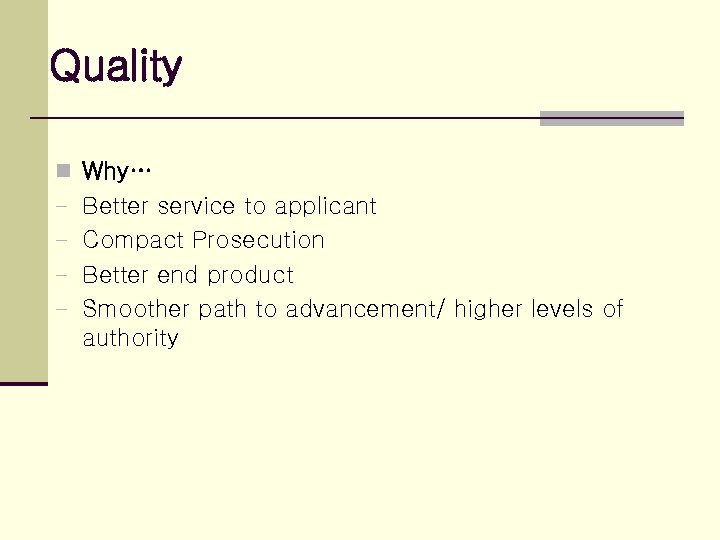
Quality n Why… - Better service to applicant - Compact Prosecution - Better end product - Smoother path to advancement/ higher levels of authority
Examiner PAP (Performance Appraisal Plan)
The PAP Plan Explained n Every patent examiner should be given a PAP Plan when starting to work at the United States Patent and Trademark Office ( USPTO ). n The PAP Plan provides a formal statement of the major duties and responsibilities of the Patent Examiner’s position. n Examiners are to receive a new PAP Plan with each promotion or change in job status.
The PAP Plan Explained n The PAP is used evaluate and rate the examiner’s yearly performance – the Examiner’s rating official ( usually the Supervisory Patent Examiner <SPE>) completes the PAP at least twice a year and formally review it with the employee during an appraisal meeting. - Once at mid- year (March) : This is a progress review. - Once at the end of the fiscal year (October) : This is the final review and summary rating. - Will also occur if a new employee receives a 120 -day performance evaluation and at other times after a performance deficiency has been officially noted.
The Critical Elements n A patent Examiner is rated in four critical elements, through the GS-5 to GS- 13 grades. n Those Elements are as follows: - Patent Examining Function - Production - Workflow - Customer Service
The Critical Elements n When an Examiner becomes a GS-13 and passes the partial Signatory Program, a fifth critical element is added – Action Taking. n When Examiner passes the Full Signatory Program, a sixth critical element is added- Patentability Determination.
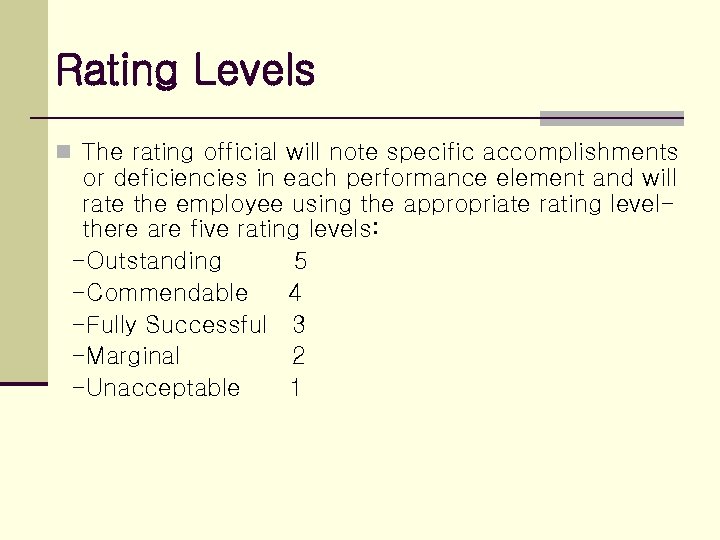
Rating Levels n The rating official will note specific accomplishments or deficiencies in each performance element and will rate the employee using the appropriate rating levelthere are five rating levels: -Outstanding 5 -Commendable 4 -Fully Successful 3 -Marginal 2 -Unacceptable 1
Rating Levels n A final rating is then provided based on the summary of al critical element ratings – note that some critical elements are more heavily weighted than others. n It is important to note that if any critical elements is rated less than fully successful, the final rating can be no higher than the lowest critical rating elements.
Probationary Examiners n Probationary Examiners are Examiners who have not reached a one year anniversary and have not yet been made permanent employees. n Probationary Examiners are not rated formally on production ( there will be no critical production element in the PAP plan during the first year): however, evaluations are based on the Examiner’s ability to perform patent examining functions that will permit meeting future production goals.
The Probationary Addendum n The probationary addendum describes how newly hired patent examiners will be evaluated during the 1 st and 2 nd six months. -After twelve months, all Examiners are evaluated with respect to the actual GS level for all assigned functions. NOTE: GS-5 Examiners evaluated under same criteria in 1 st and 2 nd six months, with responsibilities added in 2 nd six months for Examiners at GS-7 and above. n Examiners should talk to appropriate SPE regarding specific expectations for 1 st and 2 nd six- month probationary periods.
The First Critical Element. Patent Examining Function ( PEF ) n This critical element evaluates the Examiner’s abilities to formulate appropriate actions and/or recommendations with respect to the grant or denial of a patent application. n Examiners are responsible for specific major activities in this element, which do increase with advancement in grade. n This critical element basically evaluates all that the Examiner does in examining the patent application.
PEF-Major Activities and How They Change n Activities for a GS-5 After receiving specific and detailed preliminary instruction, the Examiner performs patent examining functions of simple nature, assigned primarily for training purposes. The assigned functions may included, by way of example, those of the following: -Checking applications for compliance with formal requirements and technological accuracy -Treating disclosure statements and claims of priority -Conduction the search -Submitting Office Actions in draft form
PEF- Major Activities and How They Change n Activities for a GS-7 After receiving preliminary instructions, the Examiner performs the following patent examining functions and formulates or recommends appropriate action: -Checking applications for compliance with formal requirements and technological accuracy -Analyzing disclosure and claims for compliance with 35 USC 112 -Treating disclosure statements and claims of priority -Planning and conducting the search -Formulating rejections under 35 USC 102 and 103 with supporting rationale -Determining how the claims distinguish over the prior art -Submitting Office Actions in draft form
PEF-Major Activities and How They Change n Activities for a GS-9 With NO preliminary instruction, the Examiner performs the following patent examining functions and formulates or recommends appropriate action: -Checking applications for compliance with formal requirements and technological accuracy -Treating disclosure statements and claims of priority -Analyzing disclosure and claims for compliance with 35 USC 112 -Planning and conducting the search -Formulating rejections under 35 USC 102 and 103 with supporting rationale -Determining how the claims distinguish over the prior art -Submitting Office Actions in draft form
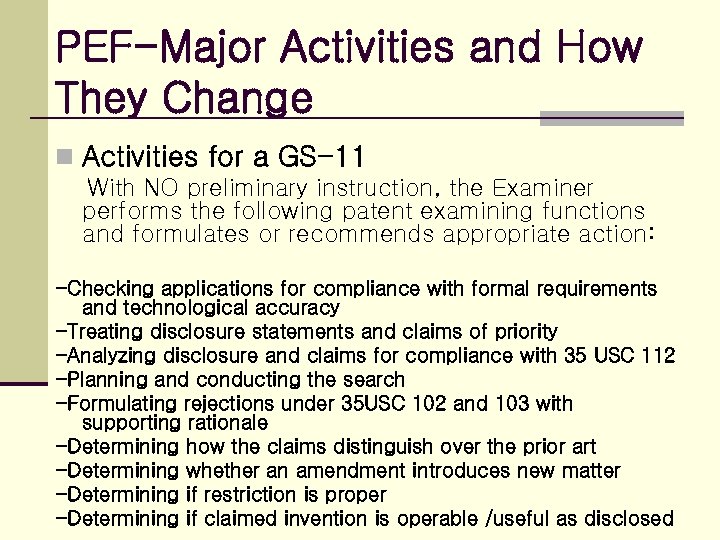
PEF-Major Activities and How They Change n Activities for a GS-11 With NO preliminary instruction, the Examiner performs the following patent examining functions and formulates or recommends appropriate action: -Checking applications for compliance with formal requirements and technological accuracy -Treating disclosure statements and claims of priority -Analyzing disclosure and claims for compliance with 35 USC 112 -Planning and conducting the search -Formulating rejections under 35 USC 102 and 103 with supporting rationale -Determining how the claims distinguish over the prior art -Determining whether an amendment introduces new matter -Determining if restriction is proper -Determining if claimed invention is operable /useful as disclosed
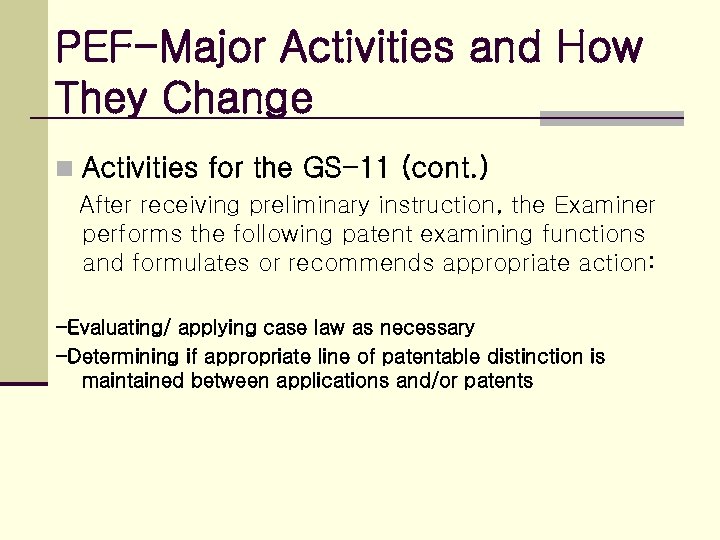
PEF-Major Activities and How They Change n Activities for the GS-11 (cont. ) After receiving preliminary instruction, the Examiner performs the following patent examining functions and formulates or recommends appropriate action: -Evaluating/ applying case law as necessary -Determining if appropriate line of patentable distinction is maintained between applications and/or patents
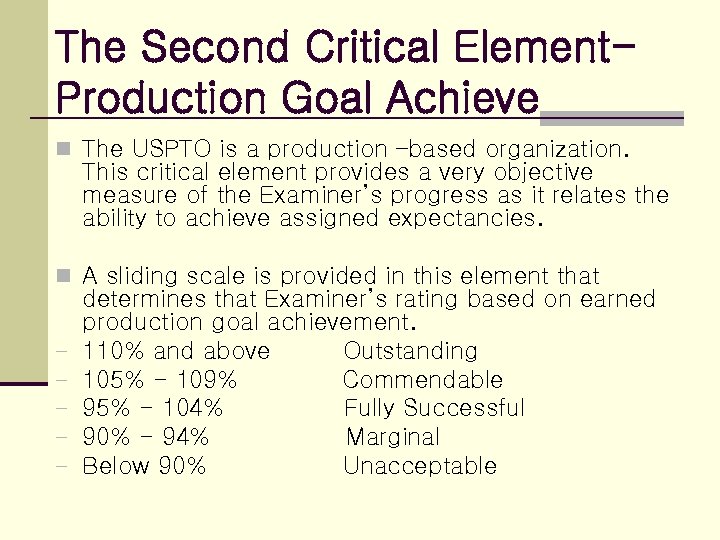
The Second Critical Element. Production Goal Achieve n The USPTO is a production –based organization. This critical element provides a very objective measure of the Examiner’s progress as it relates the ability to achieve assigned expectancies. n A sliding scale is provided in this element that - determines that Examiner’s rating based on earned production goal achievement. 110% and above Outstanding 105% - 109% Commendable 95% - 104% Fully Successful 90% - 94% Marginal Below 90% Unacceptable
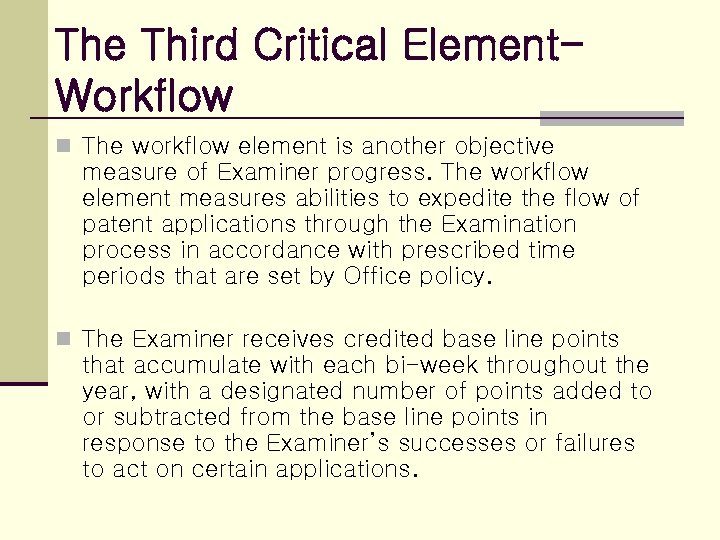
The Third Critical Element. Workflow n The workflow element is another objective measure of Examiner progress. The workflow element measures abilities to expedite the flow of patent applications through the Examination process in accordance with prescribed time periods that are set by Office policy. n The Examiner receives credited base line points that accumulate with each bi-week throughout the year, with a designated number of points added to or subtracted from the base line points in response to the Examiner’s successes or failures to act on certain applications.
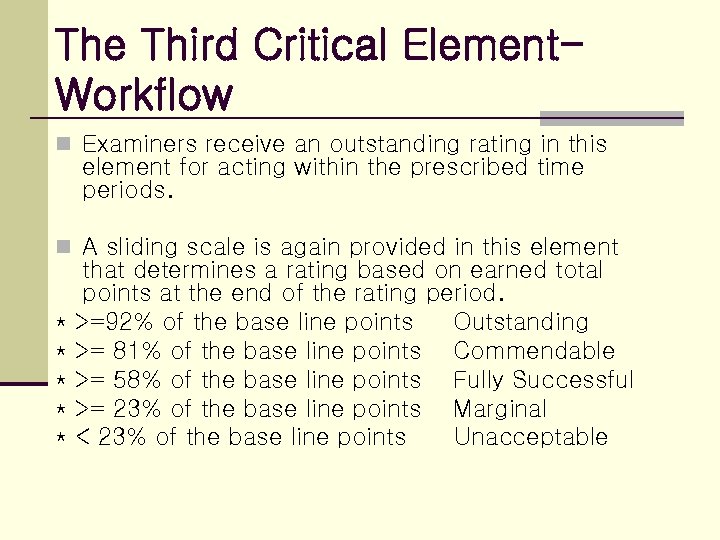
The Third Critical Element. Workflow n Examiners receive an outstanding rating in this element for acting within the prescribed time periods. n A sliding scale is again provided in this element * * * that determines a rating based on earned total points at the end of the rating period. >=92% of the base line points Outstanding >= 81% of the base line points Commendable >= 58% of the base line points Fully Successful >= 23% of the base line points Marginal < 23% of the base line points Unacceptable
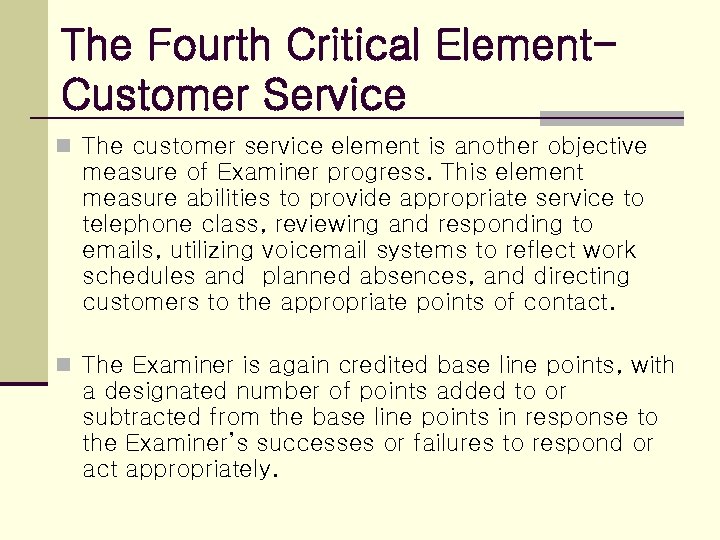
The Fourth Critical Element. Customer Service n The customer service element is another objective measure of Examiner progress. This element measure abilities to provide appropriate service to telephone class, reviewing and responding to emails, utilizing voicemail systems to reflect work schedules and planned absences, and directing customers to the appropriate points of contact. n The Examiner is again credited base line points, with a designated number of points added to or subtracted from the base line points in response to the Examiner’s successes or failures to respond or act appropriately.
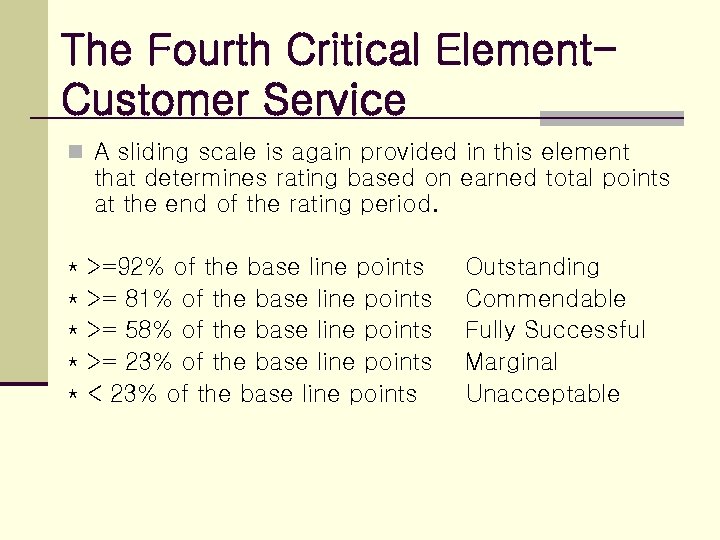
The Fourth Critical Element. Customer Service n A sliding scale is again provided in this element that determines rating based on earned total points at the end of the rating period. * * * >=92% of the base line points >= 81% of the base line points >= 58% of the base line points >= 23% of the base line points < 23% of the base line points Outstanding Commendable Fully Successful Marginal Unacceptable
Communication! n The Examiner should have a general idea of the performance goals for the Office and ongoing progress toward meeting those goals on a bi-weekly basis. The production report alone contains a wealth of information regarding personal progress and performance achievements. - There should be no surprises during formal appraisal meeting with the rating official. n Both the SPE and the employee need to communicate – Examiners must take responsibility for asking questions and ensuring the supervisor knows of any outstanding questions and/or concerns.
Q&A
-감사합니다-
Скачать презентацию 미국특허청 심사평가제도 February 13 2008 Korean Intellectual Property
e6bd78779016a358365789a080f5f719.ppt