 Скачать презентацию 동북아 근해운송의 전망 Short Sea Shipping System in
26b77fc8effe2536bcac95d23198e672.ppt
- Количество слайдов: 59



동북아 근해운송의 전망 Short Sea Shipping System in Northeast Asia 2006. 2. 10 -13 제 3차 선상물류 세미나 인하대학교 교수 이재욱 주관 : 한국로지스틱스학회, 선상물류동우회, 물류신문사
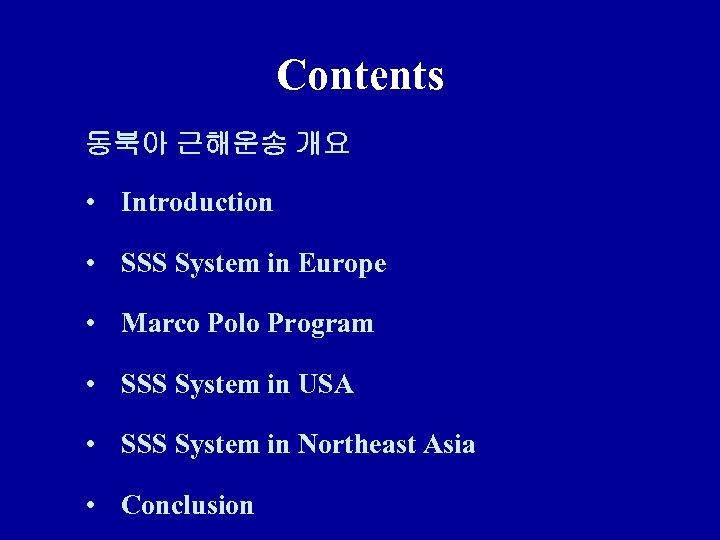
Contents 동북아 근해운송 개요 • Introduction • SSS System in Europe • Marco Polo Program • SSS System in USA • SSS System in Northeast Asia • Conclusion

동북아 근해운송 개요(1) Ø 근해운송시스템(Short Sea Shipping) ; 기존 연안해운과는 수송모드, 물류방식, 적용기술, 운용형식 등에서 차별됨. 현재 유럽의 지중해, 북해 및 발트해에서 발달되어 있음. 미국, 캐나다 및 멕시코는 근해운송 활성화를 공동 개발 중에 있음. 연안해운과 근해운송의 비교 구분 연안해운 근해운송(SSS) 수송모드 해운 단독 육-해-공 복합연계수송 물류방식 고전물류 통합물류 적용기술 재래식 기술 신기술 운용형식 Feeder 기대효과 - 환경영향 - Feeder, Freight Ferry, 열차페리, Sea & Air 등 도로정체 완화, 고부가 물류시스템 창출 환경친화형

동북아 근해운송 개요(2) Ø 동북아 물류시장 확대에 따른 한중일 근해운송시스템의 활성화 Ø 한중일 3국을 근해운송망으로 연결하여 항공 및 육상교통과 통합된 물류체계로 수송효율을 높이고 물류비 절감으로 경쟁력 강화 Ø 동북아 근해운송 발전을 위한 기술개발, 제도 의 표준화 등 공동연구 및 협력체제 필요 Ø 한중일 근해운송 표준화 Pilot 사업의 산학연 공동추진 - 한중일 간 해상항로와 한중일 내륙교통망을 연결하는 복합수송망 구축 - 근해운송시스템의 표준화 Pilot 사업을 한중일 3국이 공동으로 참여 추진

1. Introduction

q What is Short Sea Shipping ? Ø Maritime transport between ports in Asia, including ; § national coastal shipping between two ports of the same country. § intra-Asian international shipping whose ports of origin and destinations are Asian ports. § the Asian leg of inter-ocean trades. * Source : ECMC, Short Sea Shipping in Europe

q Why Short Sea Shipping ? Ø To promote Asian trade competitiveness Ø To decrease unit cost of transport Ø To relieve road congestion from road based networks Ø To mitigate pollution ØTo develop vital transport links

q Background Ø European short sea shipping has achieved great success for last 15 years to shift cargos from road transport Ø Road congestion results increase of transport cost & air pollution in Europe Ø Short sea shipping is a turning point from road congestion for Northeast Asia Ø Short Sea Shipping in C-J-K region is best practices for users, operators, regulators and infrastructure providers

Background Ø Modal Split Deviation (%, t-km) Mode USA EU-15 China Japan Korea Road 28. 0 45. 0 24. 0 53. 8 76. 0 Rail 39. 8 7. 8 55. 1 3. 8 5. 9 Inland Waterways 9. 0 4. 0 5. 5 N. A. Coastal Sea 7. 6 40. 4 15. 4 42. 0 18. 0 Pipelines 15. 3 2. 8 N. A. * Data based on year of 2002, Pentaport project

q Objectives Ø To strengthen competitiveness of logistics in Northeast Asia Ø To establish the foundation of SSS system for China-Japan-Korea region ØTo develop new standards for C-J-K SSS System equivalent to the international standards (ISO Standards)

2. SSS System in Europe

q Outline of SSS Promotion Policy in Europe Ø A first communication policy on SSS (1985) • Towards a common transport policy on Maritime Transport Ø Communication Policy on SSS (1986 -1997) • The Development of Short Sea Shipping in Europe • Backing for measures to promote short sea shipping • Sea Ports and Maritime Infrastructure Ø White Paper on European Transport Policy (2001) • To ensure competitive and sustainable mobility in Europe by 2010, the majority of which is SSS.

Outline of SSS Promotion Policy in Europe Ø Competitive and Sustainable Growth (2002) • ‘ITIP(Innovative Technologies for Intermodal Transfer Points)’ has been presented. Ø Program for Promotion of Short Sea Shipping (2003) • 14 individual actions subdivided into measures. • Divided into Legislative, Technical and Operational measures.


- year 2000 Figure 2 : - year 2000

q Actions of EC Commission for SSS Legislative Actions Deadline 1. IMO FAL - Implementation of the Directive on certain reporting formalities for ships to arrive in and/or depart from ports in the Member States. From 09. 2003 2. Marco Polo - Modal Shift from road transport 1 st 2003 -2006 2 nd , 2007 -2013 3. Intermodal Loading Unit - Development of Pallet, Swap Body, Container etc. 1 st 2004. Continue 4. Motorways of the Sea - TEN-T(Trans European Network) From 2003 5. Improving the Environmental Performance of Short Sea Shipping - Improve the environmental performance of SSS, including the adoption and implementation of the legal proposal to reduce the sulphur content of marine fuels. 1 st 2005. Continue

Actions of Commission of EC for SSS Technical Actions Deadline 6. Guide to Customs Procedures for Short Sea Shipping - Guide to Customs Procedures for Short Sea Shipping From 2003 7. Identification and Elimination of Obstacles to Making Short Sea Shipping More Successful that It is Today - Scrutinize the identified obstacles systematically, item by item, with a view to eliminating them. 1 st 2003. Continue 8. Approximate National Applications and Computerization of Community Customs Procedures - Adoption of NCTS (New Computerized Transit System) for abt. 3, 000 customs offices of 22 EU countries continue 9. Research and Technological Development (RTD) - To advance Short Sea Shipping and port procedures in line with the latest technological innovations. continue

Actions of Commission of EC for SSS Operational Actions Deadline 10. One-Stop Administrative Shop - Simplify and speed up the formalities relating to the arrival, departure and clearance of ships. continue 11. Ensuring the Vital Role of Short Sea Shipping Focal Points From 1999 12. Ensuring Good Functions of and Guidance to Short Sea Promotion Centers continue 13. Promote the image of Short Sea Shipping as a successful Transport - Distribution of information on the mode and participation in conferences, seminars and workshops. continue 14. Collection of Statistical Information - Database of collecting statistical data from European Sea Ports Organisation (ESPO) By 2006

Motorway of the Sea (TEN-T) 1. Motorway of the Baltic Sea 2. Motorway of the Sea of Western Europe 3. Motorway of the Sea of Southeast Europe 4. Motorway of the Sea of Southwest Europe Actions of Commission of EC for SSS

q European SSS Markets for 2001 -2010 Ø EU long-distance transport on annual SSS traffic growth rates - Germany & UK : 4 -5% - Spain & Germany, Benelux : 10 -11% - Iberian Peninsula & British Isles : 9 -10% - Italy & Spain : 11 -12% Ø The expansion of the UE to the East will bring new flows with rapid growth rates : - Poland & Baltic States to Atlantic destinations - Rumania & Bulgaria to Mediterranean destinations * Source : ISO TC/8 Seminar June, 2002

3. Marco Polo Program

q Objects of Marco Polo Project Ø To reduce road congestion Ø To enhance traffic safety and to improve the environmental performance of the freight transport system Ø Contributing to an efficient and sustainable transport system

q Scope of Marco Polo Project Ø Marco Polo I (1 st Stage) : 2003 – 2006 - Total Budget : 100 Mil. Euros - Target of Modal Shift : 12 Billion ton-km/year Ø Marco Polo II (2 nd Stage) : 2007 – 2013 - Total Budget : 740 Mil. Euros - Target of Modal Shift : 21 Billion ton-km/year

q Aims of Marco Polo Project Off the road target in EU-25 (billion ton-kilometer) 2006 Road Transport International road transport Off the road target 2007 2008 2009 2010 2011 2012 2013 1, 762 1, 813 1, 864 1, 915 1, 966 2, 019 2, 073 2, 126 696 717 737 757 777 798 819 840 20. 2 21. 0 As of 2002

q Actions of Marco Polo II 1. Modal Shift Action (Just shift freight off road) - Setting up a new service or link -Increasing efficiency at terminals and borders - IT (tracking and tracing) and vehicle technology - New terminals and transhipment equipment - Ancillary infrastructure 2. Motorways of the Sea (Innovative on a European level) - High frequency and high quality intermodal services - Flexible and efficient port services - Good access to ports and efficient hinterland connections - Simplified procedures and inspections

Actions of Marco Polo II 3. Rail Synergy (Innovative on a European level) - Combined freight-passenger use of platforms and stations - Higher utilization of existing transport infrastructure - Road journeys remain as short as possible in “door-to-door” services 4. Catalyst Action (Overcome structural market barriers) - High speed and non-stop intermodal services - Tri-modal compatible and other innovative loading units - Reliable transport and logistics information systems

5. Transport Efficiency Actions of Marco Polo II - Services that increase load factors & services with less empty running - Vehicle technologies with improved and enlarged cargo deck - Relocation of production or distribution sites & Less links in logistical chain - Product design and product modifications to diminish goods volume/ weight - Extract water or air from the goods & diminishing empty packaging - Digitalize the goods - Reduction of waste flows 6. Common Learning Action - Improve cooperation and sharing of know -how of Modal Split and Traffic Avoidance - Feasibility studies and improving stakeholders' understanding - Improving and adapting procedures and methods - Training

4. SSS System in USA


U. S. global maritime trade expected to double by 2020 10, 000 more trucks per day projected on the I-95 corridor Cost of expanding U. S. highway system is significant: New highway $32 Million per lane mile New interchange over $100 Million Maritime Administration - Short Sea Shipping

25, 000 miles of Inland Coastal Waterways Waterway links to 460, 000 miles of pipelines Maritime Administration - Short Sea Shipping Waterways connections to 152, 000 miles of rail Port connections to 45, 000 miles of interstate highways

Share Information Support Commercial Initiatives Form Cooperative Program Develop Legislative Initiatives Maritime Administration - Short Sea Shipping

Program Success Requires: Support for Maritime Solutions Backing for Outreach Support for Start-Up Operations Cooperative Program Support Remove Obstacles to Transportation Initiatives Maritime Administration - Short Sea Shipping

5. SSS System in Northeast Asia

q Global Shipping routes between Europe & Asia


q Short Sea Shipping in NE Asia Coastal (15. 4%) Road Inland (24. 0%) Waterway (5. 5%) Coastal (42. 0%) Road(53. 8%) Coastal (18. 0%) Rail(5. 9%) Road(76. 0%) Rail(55. 1%) Rail(3. 8%) China Japan Korea Ø Lessons from EU - Efficient, modern marine transportation - Ports, Ships, Swap bodies, Customs Ø Modal share of Goods transportation (Korea) - Road : rapid increase - Rail : decrease - Coastal : 18% (in weight), no increase

How to develop the C-J-K SSS System ?

unit : 10, 000 TEU year Container Trade Volume among C-J-K

q Standardization of SSS System in C-J-K Region Ø Ships objective : - Fast Container Carrier - Train Ferry - Barge, etc Ø Terminal Facilities : - Cargo handling systems - Transshipment, etc. Ø SSS Support Systems : - SSS Information Networks - Identification and Location Technologies for Intermodal Transport - Customs Clearance - Container Security Initiatives etc.

q Ships objective New or Old Technologies New: Shanghai Super Express(20. 8 kts) Old: Pusher Barge Fleet

Ships Objective Fast or Slow Ships New Camellia (23. 5 knots) Barges (less than 10 knots)

Ships Objective Train Ferry System • Train Ferry System for Korea-China and Korea-Japan • Short Sea Shipping linkage to TAR (Trans Asian Railway) • Standardization Target : Ship and Harbor Facility Train Ferry in Baltic Sea SSS linkages to TAR

q Terminal Facilities Inland Waterway Container Terminal INLAND CONTAINER TERMINAL, LO/LO BARGE ACCESS Rail Mounted Gantry Crane WAREHOUSES-CFS Loaded Container Stack To/from Over-the-Road Vans To/from Grounded ISO Container Direct Delivery of Container from Barge to Warehouse Door LO/LO Container Barge Two-way Container On Chassis Loading Lane

Terminal Facilities Floating Container Terminal Container crane Fixing Anchor Max. Min. Sh ip Absorbing Devices 10. 0 m Connection Bridge Floating Container Terminal Couplings Bridge support CTYS Contai ner cranes Max. Min. 10. 0 m Absorb ing Device s Floatin g Contai ner Termin al CTYS

Cargo Handling Systems Terminal Facilities Ro. Pax (Pallet Loading/Unloading) System of EU

Terminal Facilities • Train Loader • Container Pallet handling system patented by CTYS, Inha University CTYS 2000 Train Loader Container Pallet handling system

q Study on SSS System in C-J-K region Ø Domestic cargo movements by transport modes Ø Trade cargo volume within Northeast Asia Ø Distance from the cargo origin and destination Ø SSS transport model for typical shipping network • economical analysis • transport reliability • transport efficiency

q Strategies for Standardization of SSS System Ø Formation of C-J-K co-research team - Seminars and meetings Ø Establishment of work scope - working groups, experts - SSS network, ship & transshipment technologies, freight unit container standardization etc. Ø Seek governmental support in policies and finance to promote NE Asian SSS system. - Pilot project for C-J-K SSS System

Strategies for Standardization of SSS System Ø Governmental agreement for SSS promotion is essential for success of S-dialogue of C-J-K. Ø Extend common effort for standardization and promotion of the SSS system to ASEAN region

Strategies for Standardization of SSS System C-J-K SSS System Promotion Committee MOU · Project Selection · Establishing Guidelines and Strategies · Organization of each W/G Working Group-I Legislative Sys · Standardization of procedures and documents for C-J-K SSS system · Standardization of inter modal loading units · Develop “Sea Motorways” in Northeast Asia Working Group-II Technical Sys · Standardization of Ships, Port Facilities, Trans shipment equipments etc. · Improvement of customs procedures · Develop identification & location technologies for intermodal transport Working Group-III Operational Sys · Develop C-J-K SSS network system · Simplification and reduction of procedures and documents. · Develop Interconnection and interoperability of land sea.

Conclusion

q Topics to improve SSS System in C-J-K region Ø SSS Communication & Promotion Projects Ø SSS Networks & Pilot Projects Ø Standardization of SSS System : - Unit Loading System - Customs Clearances - Port Services - Port Security, etc Ø Short Sea Promotion Centers

q C-J-K Cooperation for SSS System Ø To induce synergetic effects in enhancing logistics chain among three countries. Ø To reduce social cost caused by improper domestic logistics chain. (air pollution, infra costs, traffic accident, congestion, etc. ) Ø To promote technical and systematic C-J-K joint research programs to initiate; § Sea-hinterland intermodal system § Sea Motorways of C-J-K § Pilot Projects in SSS Ø To implement one-stop seamless logistics in NE Asia.

2005 2006 2007 2008 2009 2010 2011 -2015 C-J-K Standardization Organization of Committee & W/G Case Study of Int’l STD & Regulations Works for C-J-K STD Publication of C-J-K STD Hardware Standardization of SSS Ships (Ro-Ro, High Speed Container Ship, Train Ferry, Barge, etc. ) Standardization of SSS Information Networks Software Technologies Standardization of Intermodal System (Road, Railway & Air) Standardization of High Speed Loading/Unloading Equipments & Transshipment Equipments Standardization of Identification & Location System Standardization of custom clearance &documentation Standardization of Security Initiatives for SSS system

The Virtual Port of the Future


TMGR TMR 미주 TKR Yantai TCR Lianyungang 동남아/유럽 KTX JR
 Скачать презентацию 동북아 근해운송의 전망 Short Sea Shipping System in
26b77fc8effe2536bcac95d23198e672.ppt