 Скачать презентацию 대명사 Pronoun 학 습 대명사의 종류 인칭대명사 지시대명사
b459889bb21d4f1f47a9ae0eeb5b877a.ppt
- Количество слайдов: 36



대명사(Pronoun)
학 습 대명사의 종류 인칭대명사 지시대명사 부정대명사 It의 특별용법 안 내
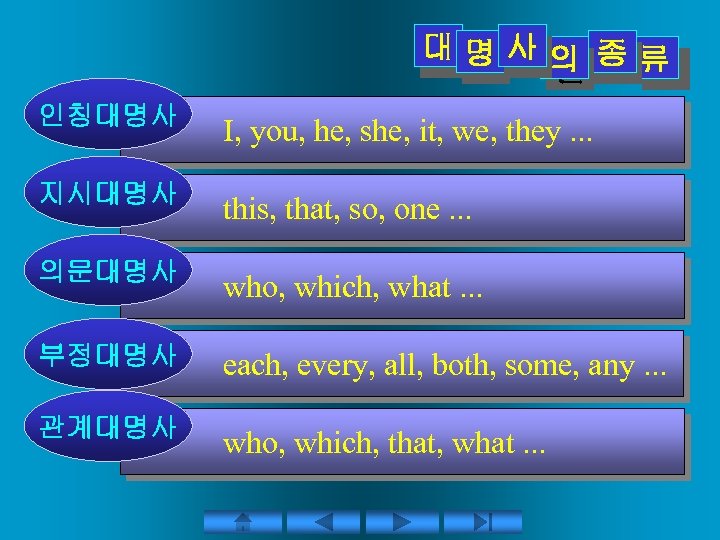
대명사의 종류 인인인인 인 인 인칭대명사 I, you, he, she, it, we, they. . . 지시대명사 this, that, so, one. . . 의문대명사 who, which, what. . . 부정대명사 each, every, all, both, some, any. . . 관계대명사 who, which, that, what. . .
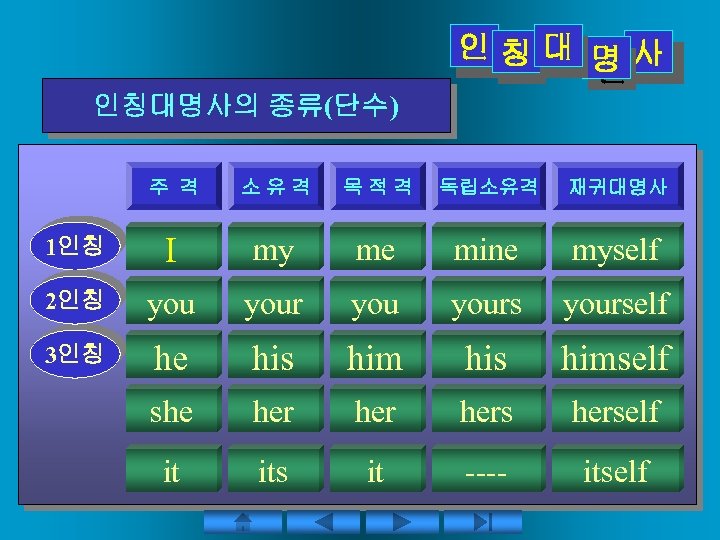
인칭대 명사 인인인 인 인 인칭대명사의 종류(단수) 주 격 소유격 목적격 독립소유격 재귀대명사 1인칭 I my me mine myself 2인칭 you yourself 3인칭 he his himself she her herself it its it ---- itself
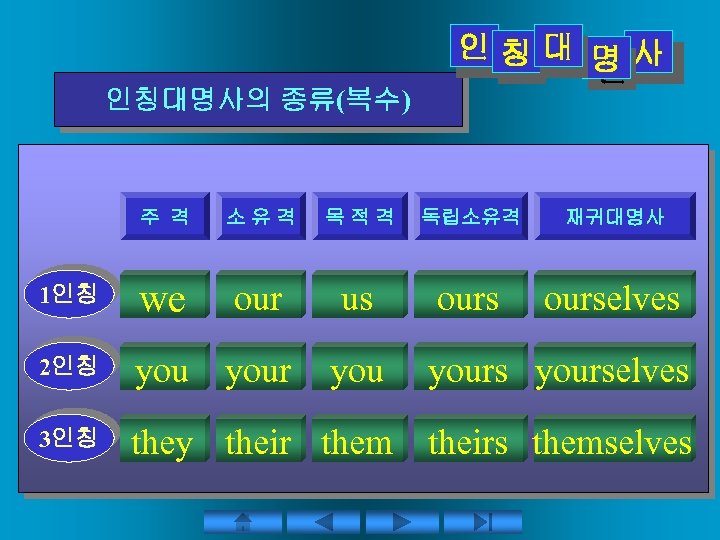
인칭대명사의 종류(복수) 인칭대 명사 인인인 인 인 주 격 소유격 목적격 독립소유격 재귀대명사 1인칭 we our us ourselves 2인칭 your you 3인칭 they their them theirs themselves yourselves
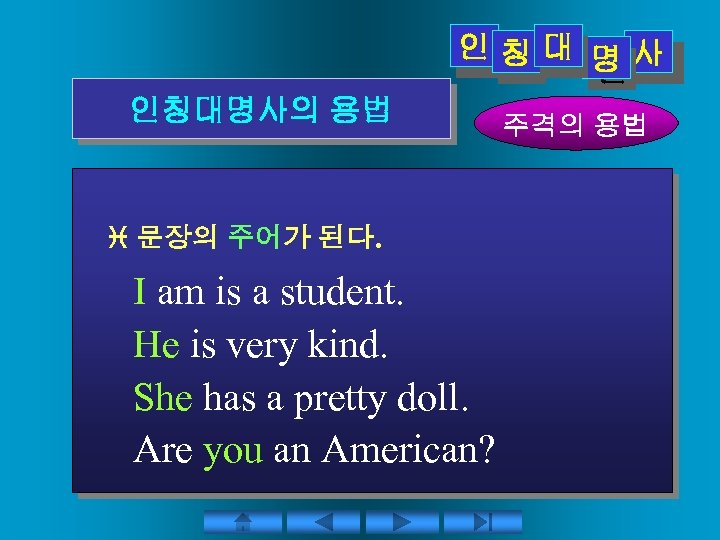
인칭대 명사 인인인 인 인 인칭대명사의 용법 문장의 주어가 된다. I am is a student. He is very kind. She has a pretty doll. Are you an American? 주격의 용법
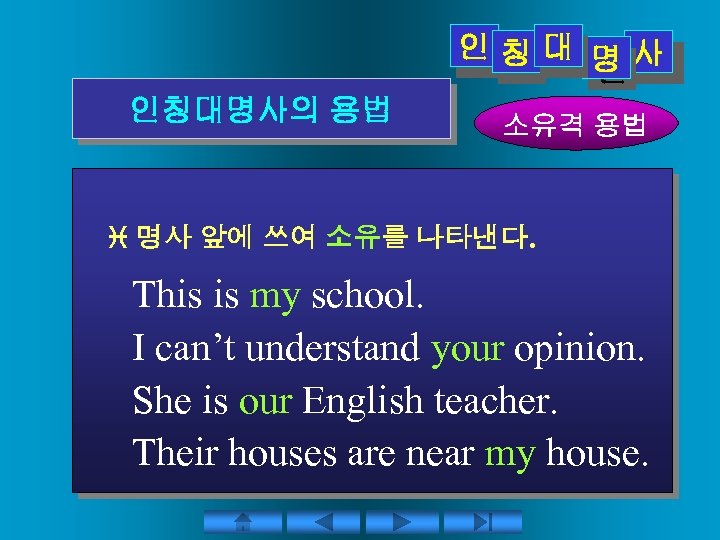
인칭대 명사 인인인 인 인 인칭대명사의 용법 소유격 용법 명사 앞에 쓰여 소유를 나타낸다. This is my school. I can’t understand your opinion. She is our English teacher. Their houses are near my house.
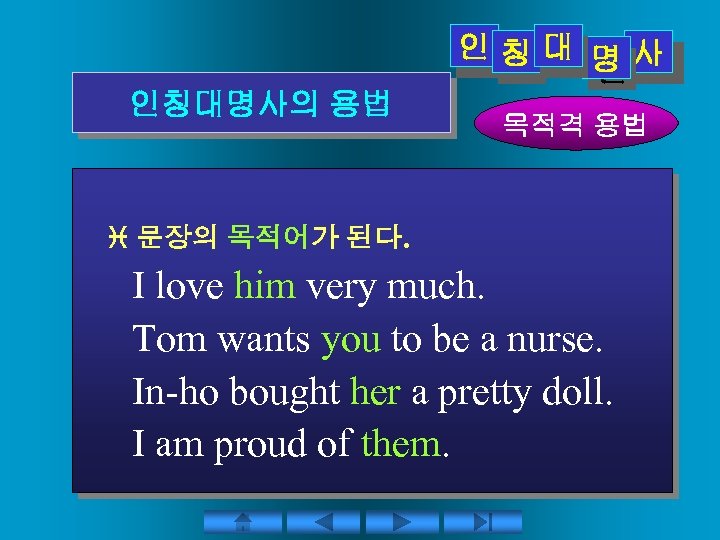
인칭대 명사 인인인 인 인 인칭대명사의 용법 목적격 용법 문장의 목적어가 된다. I love him very much. Tom wants you to be a nurse. In-ho bought her a pretty doll. I am proud of them.
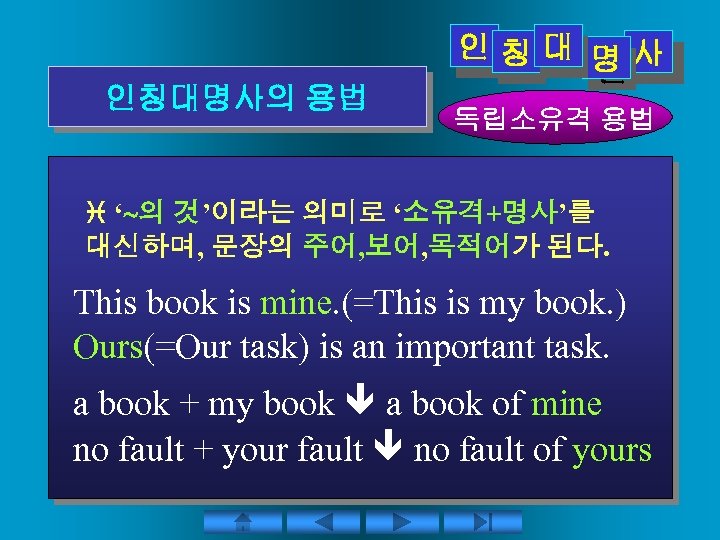
인칭대명사의 용법 인칭대 명사 인인인 인 인 독립소유격 용법 ‘ 의 것’이라는 의미로 ‘소유격+명사’를 대신하며, 문장의 주어, 보어, 목적어가 된다. This book is mine. (=This is my book. ) Ours(=Our task) is an important task. a book + my book a book of mine no fault + your fault no fault of yours
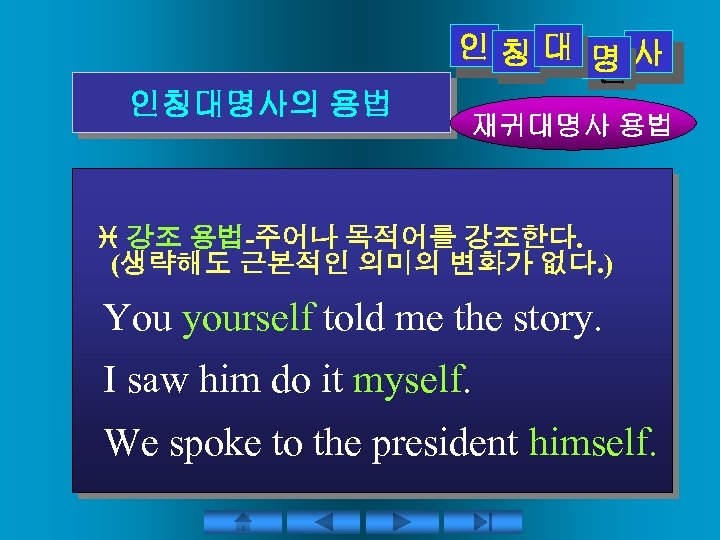
인칭대 명사 인인인 인 인 인칭대명사의 용법 재귀대명사 용법 강조 용법-주어나 목적어를 강조한다. (생략해도 근본적인 의미의 변화가 없다. ) You yourself told me the story. I saw him do it myself. We spoke to the president himself.
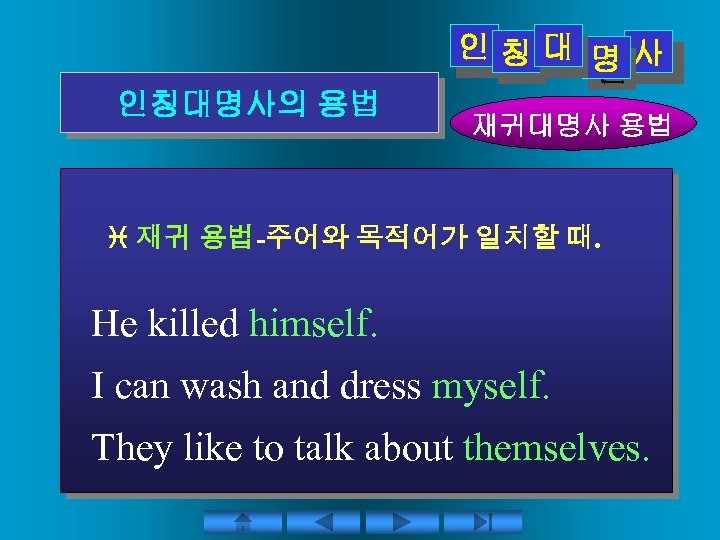
인칭대 명사 인인인 인 인 인칭대명사의 용법 재귀대명사 용법 재귀 용법-주어와 목적어가 일치할 때. He killed himself. I can wash and dress myself. They like to talk about themselves.
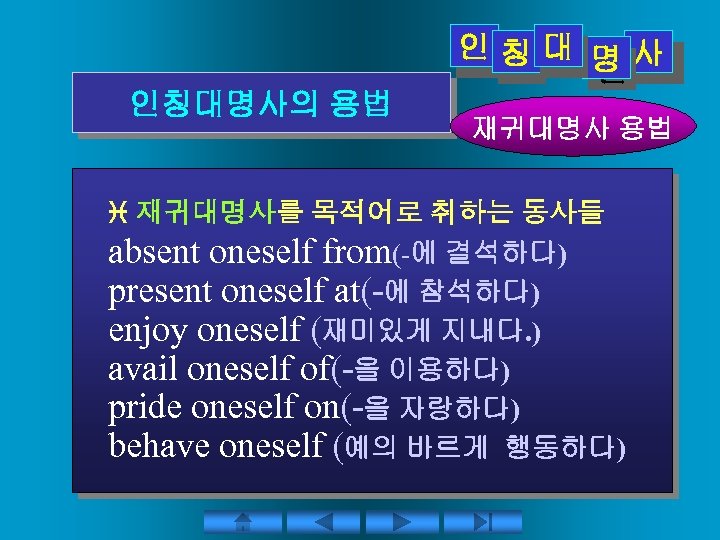
인칭대 명사 인인인 인 인 인칭대명사의 용법 재귀대명사 용법 재귀대명사를 목적어로 취하는 동사들 absent oneself from(-에 결석하다) present oneself at(-에 참석하다) enjoy oneself (재미있게 지내다. ) avail oneself of(-을 이용하다) pride oneself on(-을 자랑하다) behave oneself (예의 바르게 행동하다)
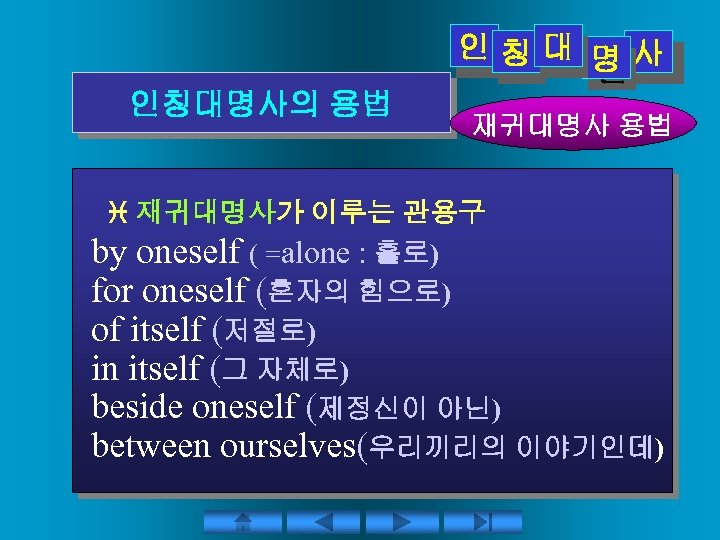
인칭대 명사 인인인 인 인 인칭대명사의 용법 재귀대명사 용법 재귀대명사가 이루는 관용구 by oneself ( =alone : 홀로) for oneself (혼자의 힘으로) of itself (저절로) in itself (그 자체로) beside oneself (제정신이 아닌) between ourselves(우리끼리의 이야기인데)
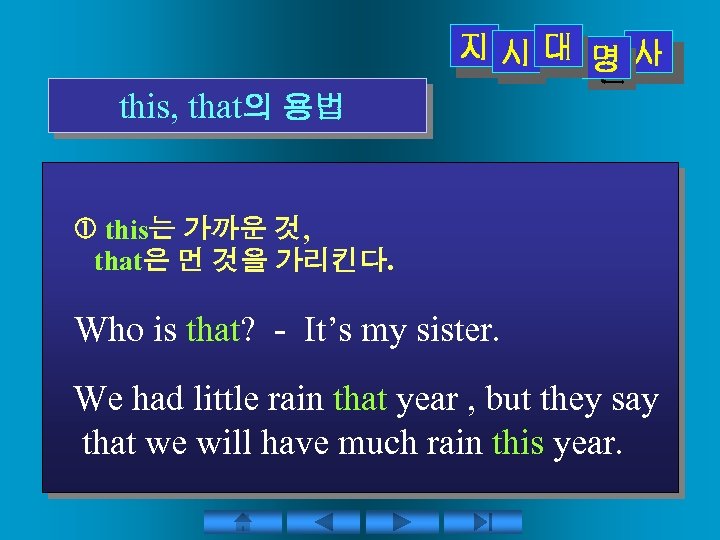
this, that의 용법 지시대 명사 인인인 인 인 this는 가까운 것, that은 먼 것을 가리킨다. Who is that? - It’s my sister. We had little rain that year , but they say that we will have much rain this year.

this, that의 용법 지시대 명사 인인인 인 인 전화할 때 this는 송화자와 수화자를 나타낸다. Who is this Speaking? This is Tom Brown speaking.

this, that의 용법 지시대 명사 인인인 인 인 this는 후자(=the latter)를 that은 전자(-the former)를 나타낸다. . Work and play are both necessary to health ; this gives us rest, and that gives us energy.

this, that의 용법 지시대 명사 인인인 인 인 ‘the + 명사’를 대신하는 that/those The climate of Korea is different from that of Italy. Though his face was that of an angel, his actions were those of a devil.

one의 용법 부정대 명사 인인인 인 인 하나의 뜻을 가진 one If you have pencils, please lend me one. (= a pencil) One of your brothers came to see me. (= a brother)

one의 용법 부정대 명사 인인인 인 인 일반인의 뜻을 가진 one One has only to do one’s best. I don’t think one should overwork oneself.

one의 용법 부정대 명사 인인인 인 인 < a + 형용사 + one >의 형태 Brown’s old car is a good one. (= a good car) I prefer red roses to white ones. (= white roses)

some, any의 용법 부정대 명사 인인인 인 인 some은 긍정문에 any는 부정문, 의문문에 쓰인다. Did you buy any eggs? -Yes, I bought some. -No, I didn’t buy any.

some, any의 용법 부정대 명사 인인인 인 인 some 다음에 단수 명사가 오면 ’어떤’의 뜻이 된다. I met her in some city. He went to some place in France.

some, any의 용법 부정대 명사 인인인 인 인 권유, 부탁을 하여 긍정의 대답을 기대 할 때에는 의문문이라도 some을 쓴다. Would you like some coffee? Can you lend me some money?

some, any의 용법 부정대 명사 인인인 인 인 any를 긍정문에 사용할 경우 ‘어떤 라도’의 뜻이 된다. Any(=Every) boy can do it. Any kind will do.

some, any의 용법 부정대 명사 인인인 인 인 some과 any 다음에 -thing, -body, -one을 붙여 한 단어로 쓸 수 있다. Do you want something to drink? I didn’t see anybody.

부정대 명사 인인인 인 인 other, others, another의 용법 one/the other : ‘(둘 중) 하나는 , 나머지 하나는 ’ I have two dogs. One is black, and the other is white.

부정대 명사 인인인 인 인 other, others, another의 용법 one/another/the third : ‘(셋 중) 하나는 , 다른 하나는 ’ I have three pens. One is red, another is blue, and the third is green.

부정대 명사 인인인 인 인 other, others, another의 용법 one/the others: ‘ 하나는 , 나머지 모두는 ’ One of the books is mine, the others are my sister’s.

all, none의 용법 부정대 명사 인인인 인 인 all은 일반적으로 복수로 취급한다. All of my friends live in London. ‘all(of)+명사’ All boys like sports. none은 단수, 복수에 모두 사용한다. Are there any books? -No, there is none. None of the boys are my friends.

부정대 명사 인인인 인 인 both, either, neither의 용법 both는 복수 취급을 한다. Both boys are students. They both came. either, neither는 단수, 복수 로 사용한다. Either[Neither] of the books are Jane’s. = Either[Neither] book is Jane’s.
![every, each의 용법 부정대 명사 인인인 인 인 every, each다음에는 단수명사를 쓴다. Every[Each] seat](https://present5.com/presentation/b459889bb21d4f1f47a9ae0eeb5b877a/image-31.jpg "every, each의 용법 부정대 명사 인인인 인 인 every, each다음에는 단수명사를 쓴다. Every[Each] seat")
every, each의 용법 부정대 명사 인인인 인 인 every, each다음에는 단수명사를 쓴다. Every[Each] seat in the bus was taken. everything, everybody 등도 단수 취급 Everybody had a problem. every는 셋 이상, each는 둘 사이에 사용 Each of my parents has a car. Every girl likes Bill.

비인칭으로 사용 It 특 별 용 법 인인인 인 인 1. It is very cold today. (날씨) 2. What time is it now? (시간) 3. How far is it from here to the station? (거리) 4. What day is it today? (요일) 5. It’s the fourth of January. (날짜)

It 특 별 용 법 인인인 인 인 가주어, 가목적어로 사용 1. To learn English is fun. It is fun to learn English. 2. I think it foolish reading this book.

It 특 별 용 법 인인인 인 인 It… that 강조 용법으로 사용 I met her in the park. It was I that met her in the park.

It 특 별 용 법 인인인 인 인 It… that 강조 용법으로 사용 I met her in the park. It was her that I met in the park.

It 특 별 용 법 인인인 인 인 It… that 강조 용법으로 사용 I met her in the park. It was in the park that I met her.
Скачать презентацию 대명사 Pronoun 학 습 대명사의 종류 인칭대명사 지시대명사
b459889bb21d4f1f47a9ae0eeb5b877a.ppt