 Скачать презентацию 香港僱員信心 作滿意度 及年齡歧視問題調查 Employee Confidence Job Satisfaction and
ef9c851e0eccc4d3b78a9c5a01d1faaf.ppt
- Количество слайдов: 79



香港僱員信心、 作滿意度 及年齡歧視問題調查 Employee Confidence, Job Satisfaction and Age Discrimination Survey 香港城市大學管理學系應用研究 梁覺教授、葉景明博士 Applied Research Conducted by Prof. Kwok LEUNG and Dr. Olivia Ip Department of Management, City University of Hong Kong Press Release on 28 May 2007 1
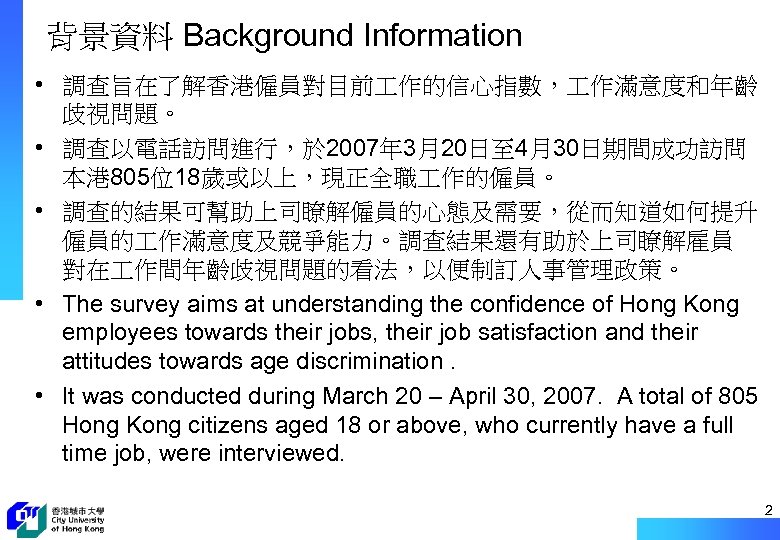
背景資料 Background Information • 調查旨在了解香港僱員對目前 作的信心指數, 作滿意度和年齡 歧視問題。 • 調查以電話訪問進行,於 2007年 3月20日至 4月30日期間成功訪問 本港 805位18歲或以上,現正全職 作的僱員。 • 調查的結果可幫助上司瞭解僱員的心態及需要,從而知道如何提升 僱員的 作滿意度及競爭能力。調查結果還有助於上司瞭解雇員 對在 作間年齡歧視問題的看法,以便制訂人事管理政策。 • The survey aims at understanding the confidence of Hong Kong employees towards their jobs, their job satisfaction and their attitudes towards age discrimination. • It was conducted during March 20 – April 30, 2007. A total of 805 Hong Kong citizens aged 18 or above, who currently have a full time job, were interviewed. 2
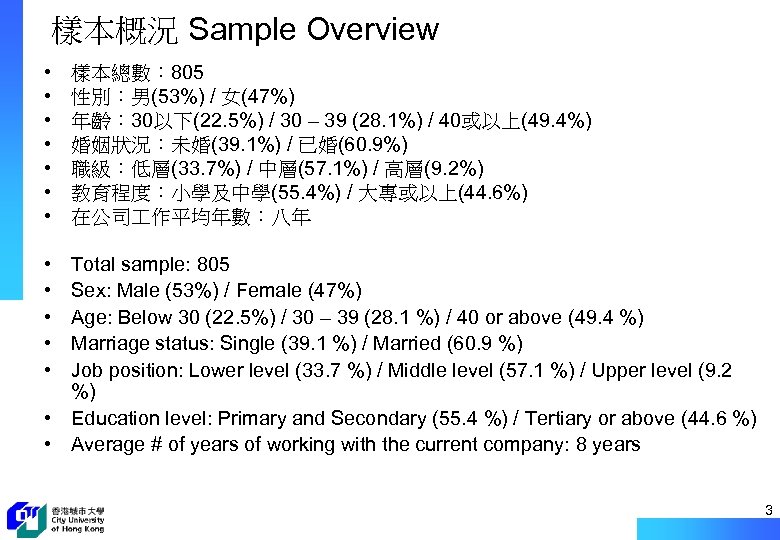
樣本概況 Sample Overview • • 樣本總數: 805 性別:男(53%) / 女(47%) 年齡: 30以下(22. 5%) / 30 – 39 (28. 1%) / 40或以上(49. 4%) 婚姻狀況:未婚(39. 1%) / 已婚(60. 9%) 職級:低層(33. 7%) / 中層(57. 1%) / 高層(9. 2%) 教育程度:小學及中學(55. 4%) / 大專或以上(44. 6%) 在公司 作平均年數:八年 • • • Total sample: 805 Sex: Male (53%) / Female (47%) Age: Below 30 (22. 5%) / 30 – 39 (28. 1 %) / 40 or above (49. 4 %) Marriage status: Single (39. 1 %) / Married (60. 9 %) Job position: Lower level (33. 7 %) / Middle level (57. 1 %) / Upper level (9. 2 %) • Education level: Primary and Secondary (55. 4 %) / Tertiary or above (44. 6 %) • Average # of years of working with the current company: 8 years 3
香港僱員信心指數 Hong Kong Employee Confidence Index (HKECI) 4
• 香港僱員信心指數 (HKECI – 簡稱ECI ) 量度僱員對 作上不同 層面的觀點及滿意程度。 • ECI 內的10題問題包括 3個方面: 作滿意度、 作安全感,及 作前景。 • Hong Kong Employee Confidence Index (HKECI – shortened to ECI ) aims to measure employees’ views and satisfaction towards various aspects of their jobs. • The 10 questions in ECI fall into 3 categories: Well-Being, Job Security, and Job Prospect. 5
• ECI 是以 0 -10分來評分,分數越高便表示僱員的信心越高。 • 此外,受訪者也被問及對目前香港的就業市場的看法。 • ECI is measured on a scale of 0 -10. A higher score represents a higher overall confidence of the employee. • In addition, respondents were also asked about their views on the overall job market in Hong Kong. 6
僱員信心指數 – 分層分析及與2005/2006年比較 ECI – Analyses by Sectors and Comparison with 2005/2006 7
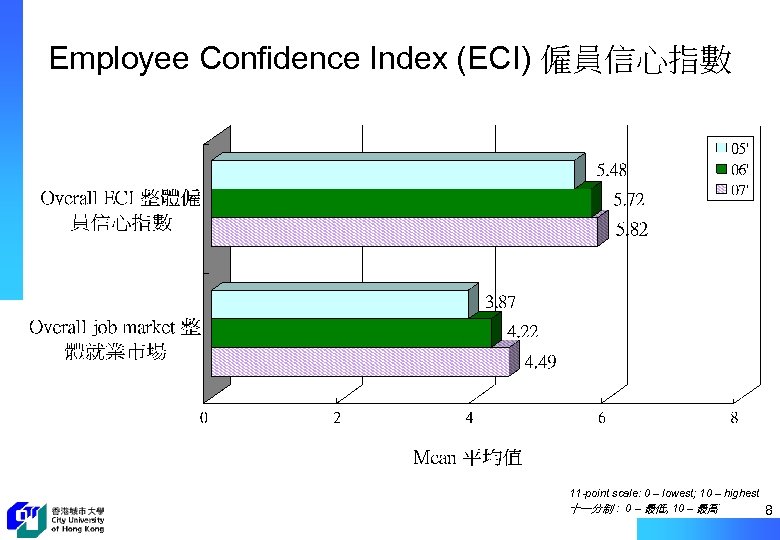
Employee Confidence Index (ECI) 僱員信心指數 11 -point scale: 0 – lowest; 10 – highest 十一分制 : 0 – 最低, 10 – 最高 8
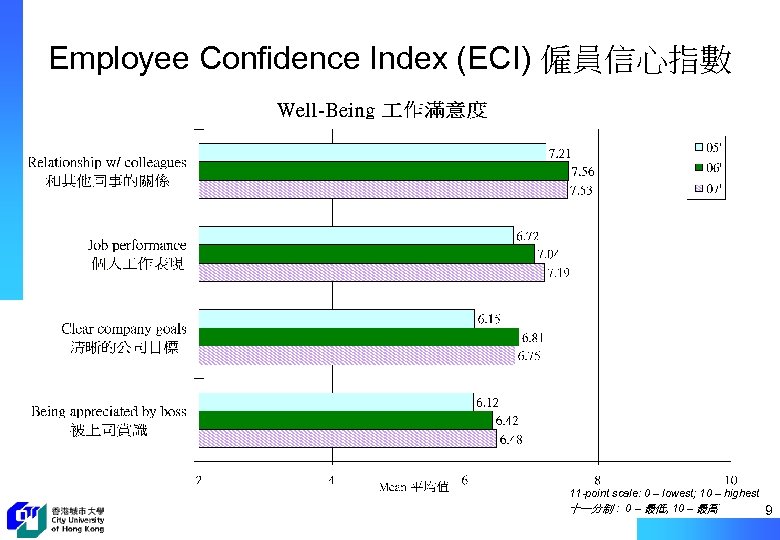
Employee Confidence Index (ECI) 僱員信心指數 11 -point scale: 0 – lowest; 10 – highest 十一分制 : 0 – 最低, 10 – 最高 9
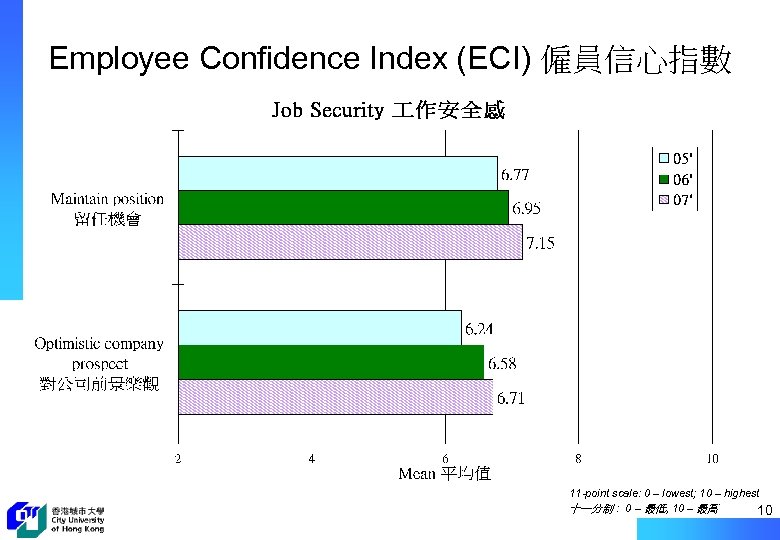
Employee Confidence Index (ECI) 僱員信心指數 11 -point scale: 0 – lowest; 10 – highest 十一分制 : 0 – 最低, 10 – 最高 10
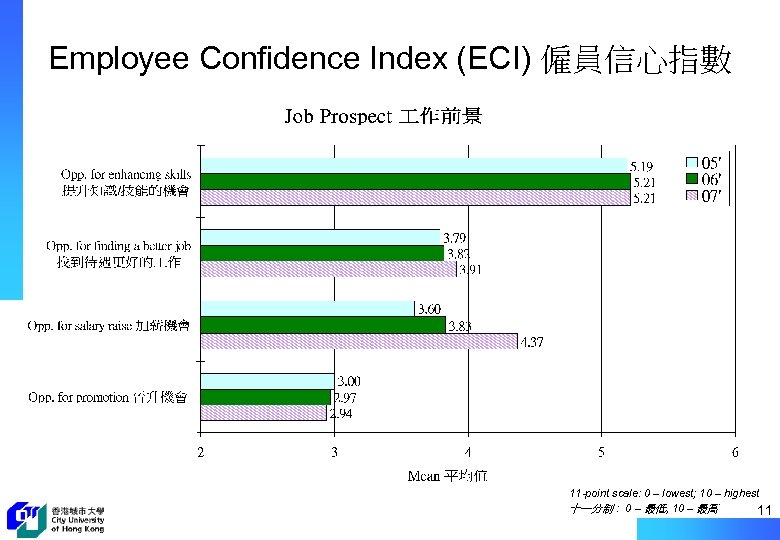
Employee Confidence Index (ECI) 僱員信心指數 11 -point scale: 0 – lowest; 10 – highest 十一分制 : 0 – 最低, 10 – 最高 11
主要研究結果 (I) Major Findings (I) • 有關 ECI的 作滿意度,在雇員“個人 作表現” 方面比過去兩 年進步。 • 在 作前景方面,加薪機會持續增長 (由 2006 年的3. 83上升到 4. 37。 • With regards to Well-being, compared to the last two years, employees’ perception of Job performance has improved. • With regards to Job Prospect, employees’ view of Opportunity for salary raise is substantially better than that of 2006 and 2005. 12
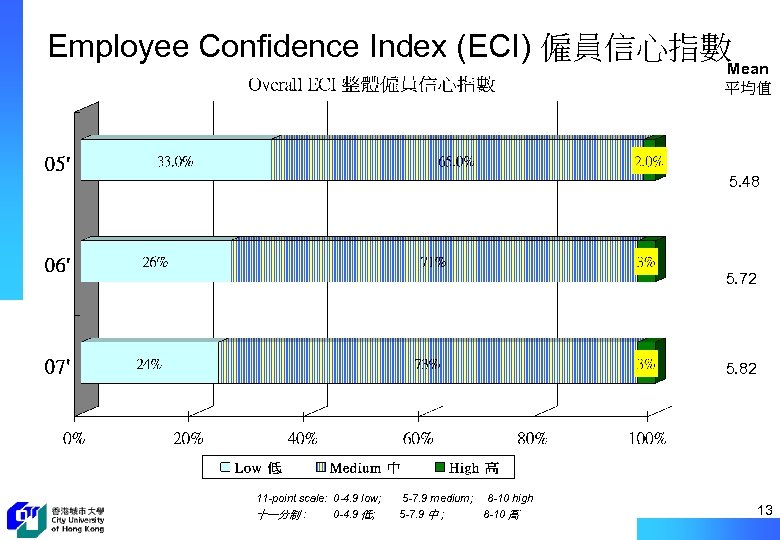
Employee Confidence Index (ECI) 僱員信心指數 Mean 平均值 5. 48 5. 72 5. 82 11 -point scale: 0 -4. 9 low; 十一分制 : 0 -4. 9 低; 5 -7. 9 medium; 8 -10 high 5 -7. 9 中 ; 8 -10 高 13
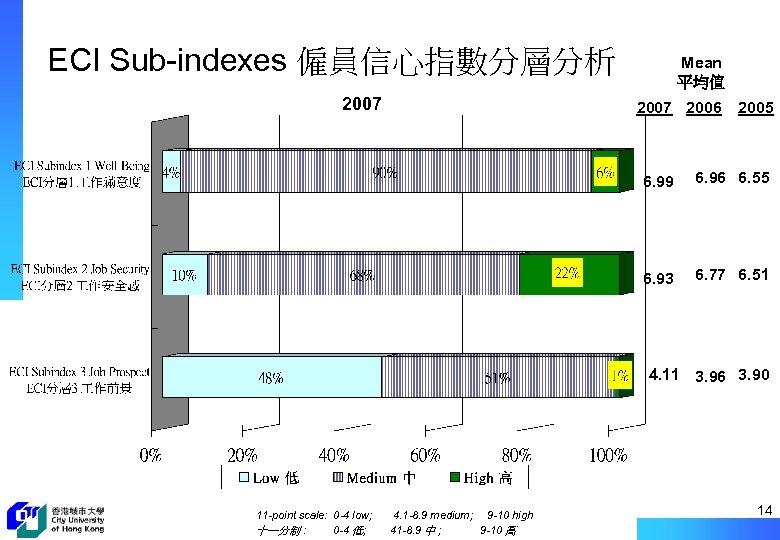
ECI Sub-indexes 僱員信心指數分層分析 2007 Mean 平均值 2007 2006 2005 6. 99 6. 96 6. 55 6. 93 6. 77 6. 51 4. 11 3. 96 3. 90 11 -point scale: 0 -4 low; 十一分制 : 0 -4 低; 4. 1 -8. 9 medium; 9 -10 high 41 -8. 9 中 ; 9 -10 高 14
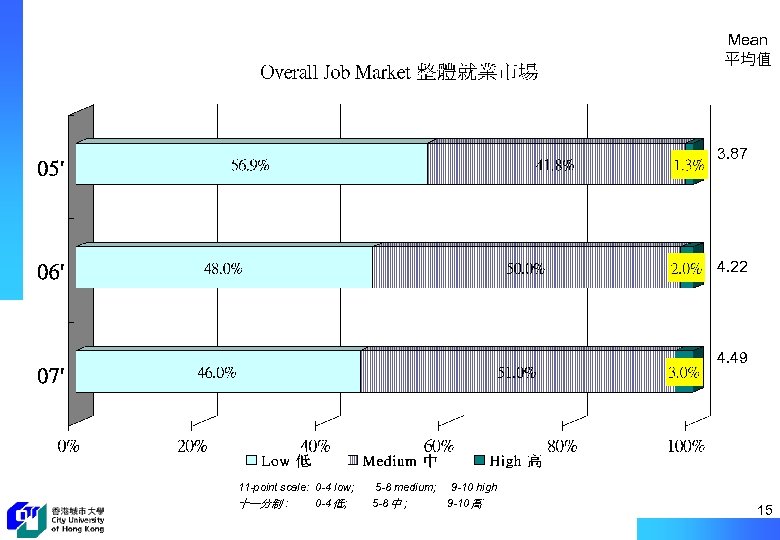
Mean 平均值 3. 87 4. 22 4. 49 11 -point scale: 0 -4 low; 十一分制 : 0 -4 低; 5 -8 medium; 9 -10 high 5 -8 中 ; 9 -10 高 15
主要研究結果 (II) Major Findings (II) • 調查顯示香港僱員的信心只屬一般,平均有5. 82分,但較2006 年略微上升。 • 約有70%的受訪者的信心指數是屬於中等,而約3%的信心是屬 於高. 與2006年比較,中等水準信心指數的受訪者比例上升 。 • This survey shows that the employee confidence level of Hong Kong is moderate, with an ECI mean of 5. 82, which is slightly higher than that of 2006. • About 70% of the respondents have an average level of ECI, while about 3% have a high ECI. Compared to the results of 2006, the proportion of respondents with a middle level of ECI increased. 16
主要研究結果 (II) Major Findings (II) • 作滿意度(平均值 6. 99)及 作安全感(平均值 6. 93) 都比 作前 景(平均值 4. 11)為高,但總體來說,這三方面都較過去兩年有 一定程度的改善。顯示出被訪者認為 作上及市場的環境比去 年為好,但對於找到一份理想的 作還是信心不大。 • The mean scores of Well-being (6. 99) and Job security (6. 93) are higher than those of Job prospect (4. 11). Compared to the results of the past two years, these three aspects have been improved to a certain degree, which shows that respondents regarded their well-being and the market as better than before, but they didn’t have enough confidence for finding a better job. 17
主要研究結果 (II) Major Findings (II) • 另外,香港僱員對整體就業市場的信心屬中等(平均 4. 49分),這表示他們認為目前在香港「搵 」尚算 可以。 • 相比起 2006年的4. 22分,受訪者認為 2007年的整體就 業市場有一定程度的提升。 • There is moderate optimism towards the overall job market (average score 4. 49). This indicates that job search prospects are all right. • Compared to the score of 2006 (average score 4. 22), respondents think that the overall job market has improved (4. 49). 18
僱員信心指數 – 不同行業分析 (分層) ECI – Analyses by Industry (by Sector) 19
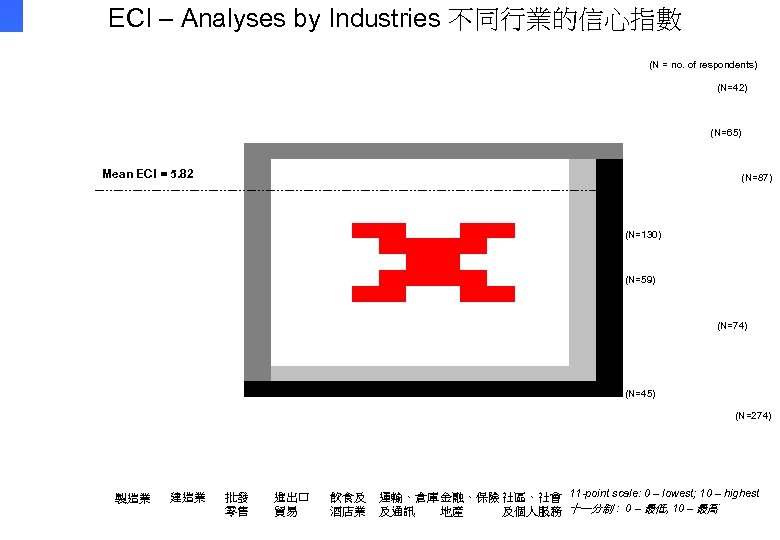
ECI – Analyses by Industries 不同行業的信心指數 (N = no. of respondents) (N=42) (N=65) Mean ECI = 5. 82 (N=87) (N=130) (N=59) (N=74) (N=45) (N=274) 製造業 建造業 批發 零售 進出口 貿易 飲食及 酒店業 運輸、倉庫 金融、保險 社區、社會 11 -point scale: 0 – lowest; 10 – highest 及通訊 地產 及個人服務 十一分制 : 0 – 最低, 10 – 最高 20
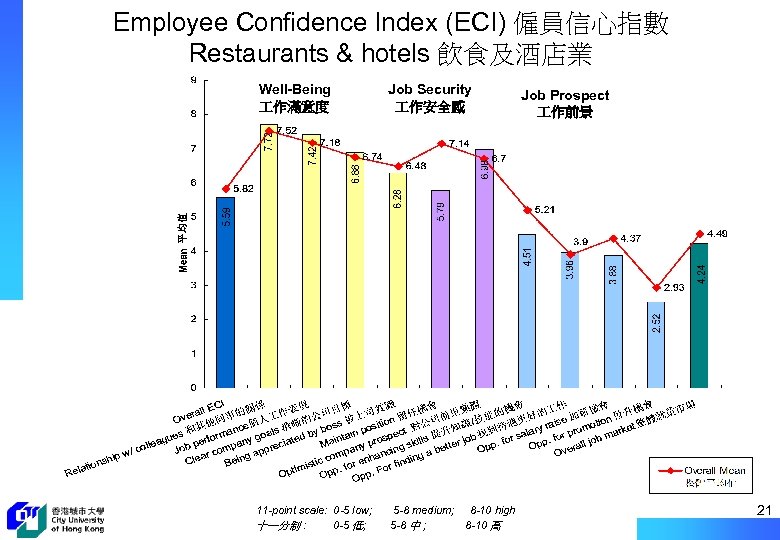
Employee Confidence Index (ECI) 僱員信心指數 Restaurants & hotels 飲食及酒店業 Well-Being 作滿意度 Job Security 作安全感 11 -point scale: 0 -5 low; 十一分制 : 0 -5 低; 5 -8 medium; 8 -10 high 5 -8 中 ; 8 -10 高 Job Prospect 作前景 21
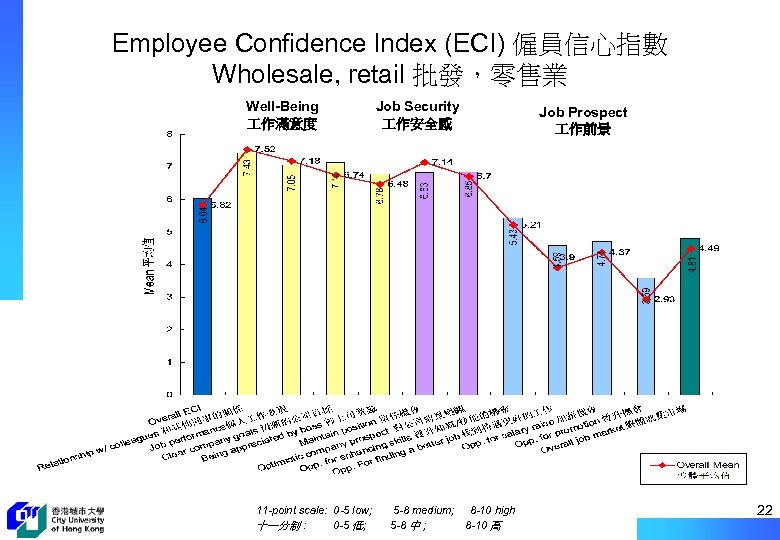
Employee Confidence Index (ECI) 僱員信心指數 Wholesale, retail 批發,零售業 Well-Being 作滿意度 11 -point scale: 0 -5 low; 十一分制 : 0 -5 低; Job Security 作安全感 5 -8 medium; 8 -10 high 5 -8 中 ; 8 -10 高 Job Prospect 作前景 22
主要研究結果 (III) Major Findings (III) • 從行業方面,飲食及酒店業(平均值 5. 59)、製造業(平均值 5. 62) 及建造業(平均值 5. 72)從業員的信心指數比其他行業為低。批 發零售業(平均值 6. 04)從業員的信心指數比其他行業高。金融、 保險、地產及商用服務業(平均值 5. 93)從業員的信心指數第二。 • With regards to differences between industries, restaurants and hotels (average score 5. 59), manufacturing (average score 5. 62) and construction (average score 5. 72) have lower scores than others. Wholesale,retail (average score 6. 04) has a higher score than other industries. 23
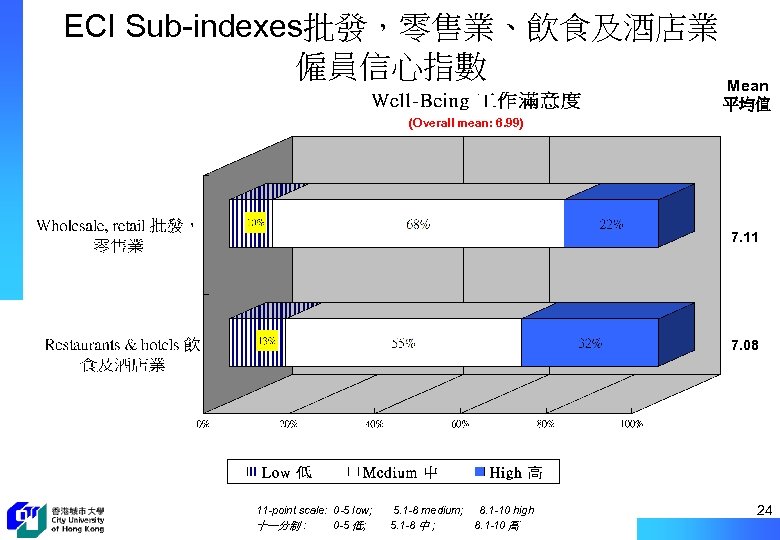
ECI Sub-indexes批發,零售業、飲食及酒店業 僱員信心指數 Mean 平均值 (Overall mean: 6. 99) 7. 11 7. 08 11 -point scale: 0 -5 low; 十一分制 : 0 -5 低; 5. 1 -8 medium; 8. 1 -10 high 5. 1 -8 中 ; 8. 1 -10 高 24
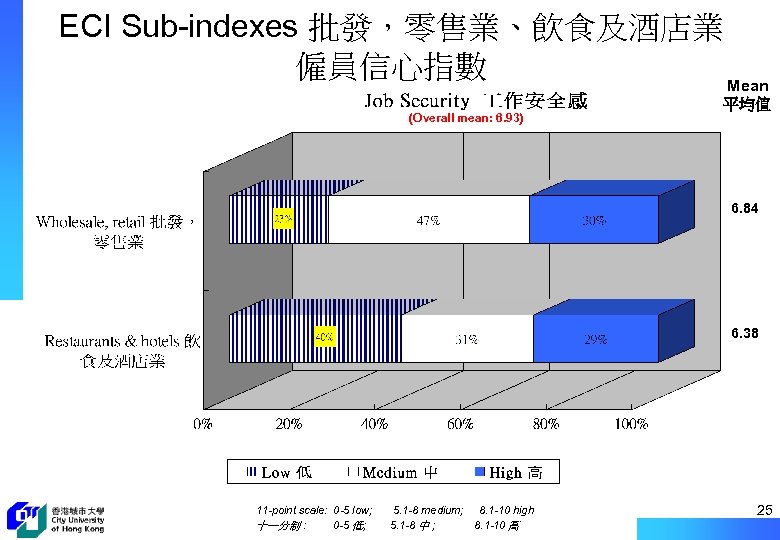
ECI Sub-indexes 批發,零售業、飲食及酒店業 僱員信心指數 Mean (Overall mean: 6. 93) 平均值 6. 84 6. 38 11 -point scale: 0 -5 low; 十一分制 : 0 -5 低; 5. 1 -8 medium; 8. 1 -10 high 5. 1 -8 中 ; 8. 1 -10 高 25
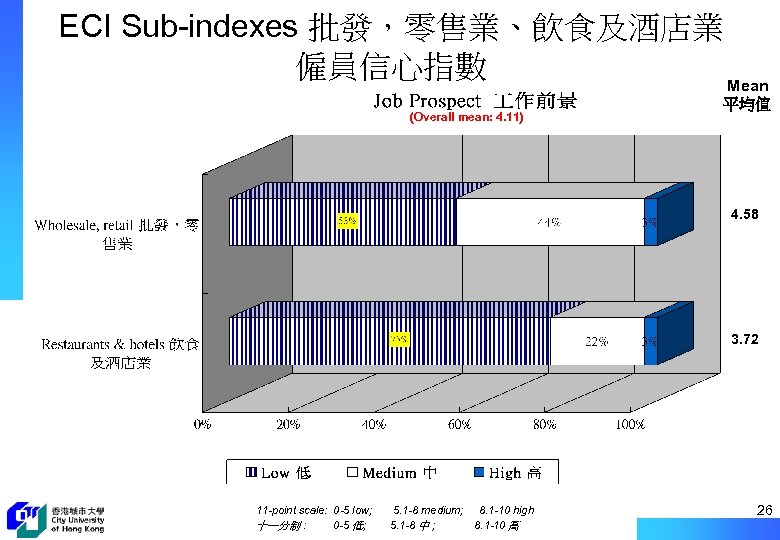
ECI Sub-indexes 批發,零售業、飲食及酒店業 僱員信心指數 Mean (Overall mean: 4. 11) 平均值 4. 58 3. 72 11 -point scale: 0 -5 low; 十一分制 : 0 -5 低; 5. 1 -8 medium; 8. 1 -10 high 5. 1 -8 中 ; 8. 1 -10 高 26
主要研究結果 (IV) Major Findings (IV) • 在批發、零售業,與在飲食及酒店業 作的受訪者, 他們的 作滿意度相若。但是,在 作安全感及 作 前景方面,前者比後者有較大信心。 • Respondents in the Wholesale, retail industries and the Restaurants and hotels industries reported similar levels of confidence in regards to Well-being. However, the former indicated much higher levels of confidence than the latter in regards to Job Security and Job Prospect.
僱員信心指數 – 分層分析 ECI – Analyses by Demographics 28
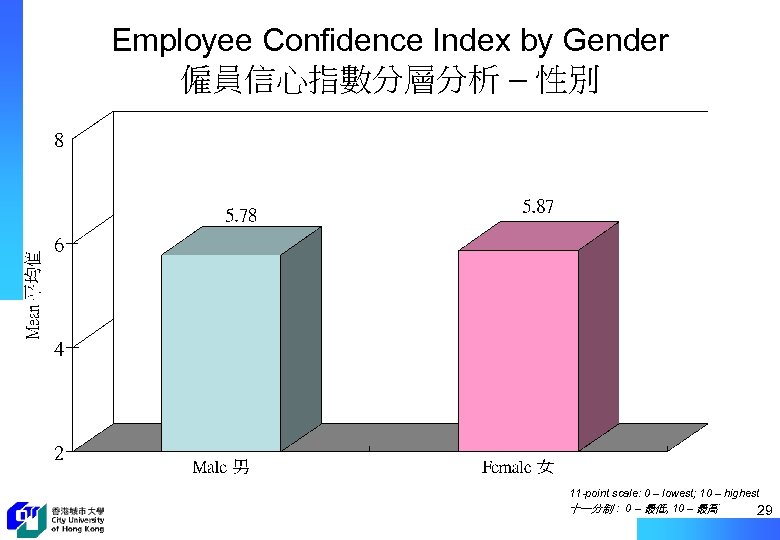
Employee Confidence Index by Gender 僱員信心指數分層分析 – 性別 11 -point scale: 0 – lowest; 10 – highest 十一分制 : 0 – 最低, 10 – 最高 29
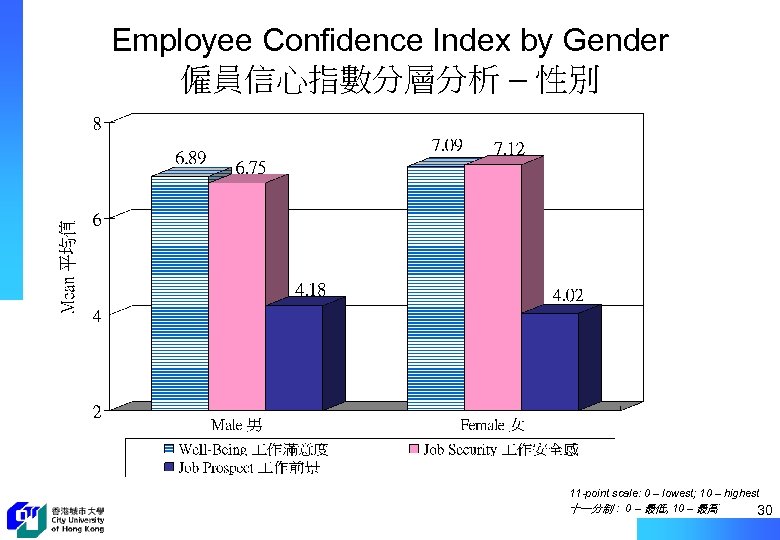
Employee Confidence Index by Gender 僱員信心指數分層分析 – 性別 11 -point scale: 0 – lowest; 10 – highest 十一分制 : 0 – 最低, 10 – 最高 30
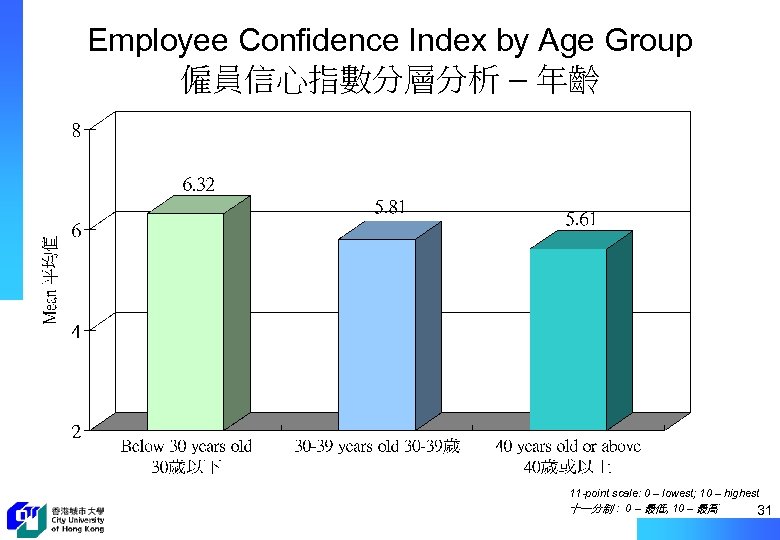
Employee Confidence Index by Age Group 僱員信心指數分層分析 – 年齡 11 -point scale: 0 – lowest; 10 – highest 十一分制 : 0 – 最低, 10 – 最高 31
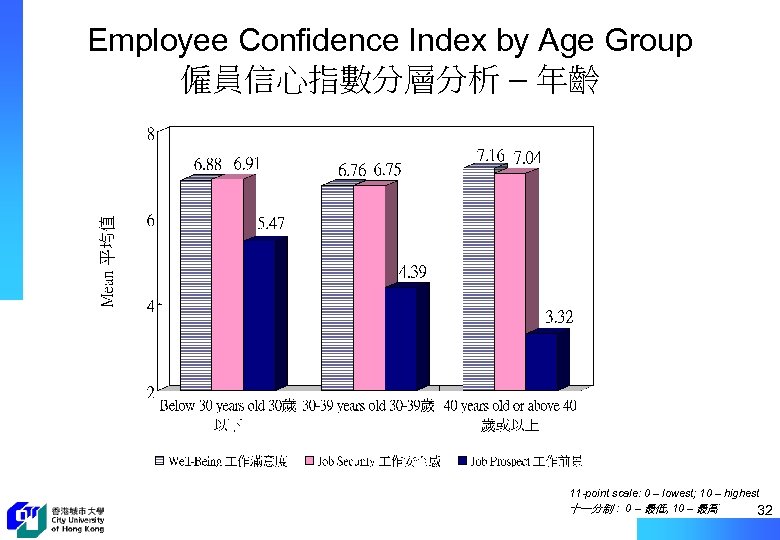
Employee Confidence Index by Age Group 僱員信心指數分層分析 – 年齡 11 -point scale: 0 – lowest; 10 – highest 十一分制 : 0 – 最低, 10 – 最高 32
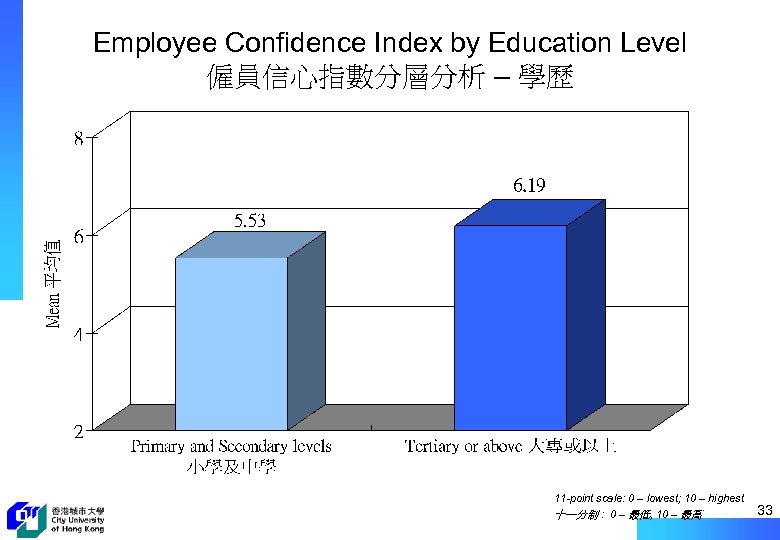
Employee Confidence Index by Education Level 僱員信心指數分層分析 – 學歷 11 -point scale: 0 – lowest; 10 – highest 十一分制 : 0 – 最低, 10 – 最高 33
Employee Confidence Index by Education Level 僱員信心指數分層分析 – 學歷 11 -point scale: 0 – lowest; 10 – highest 十一分制 : 0 – 最低, 10 – 最高 34
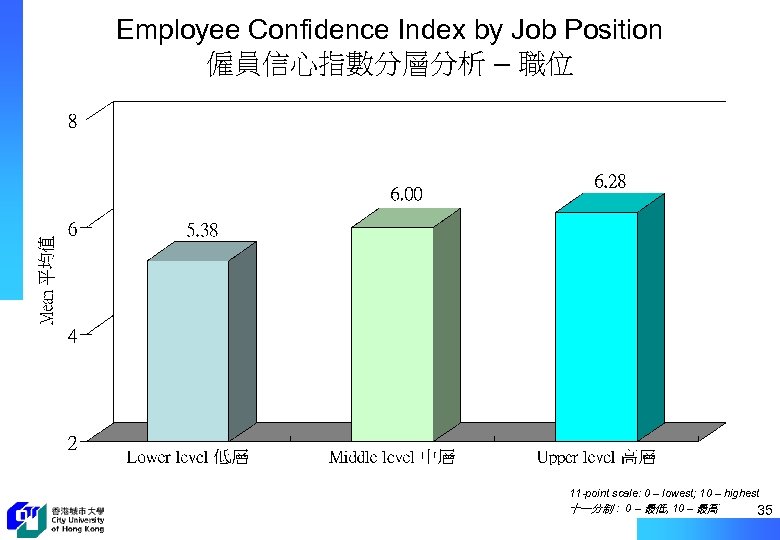
Employee Confidence Index by Job Position 僱員信心指數分層分析 – 職位 11 -point scale: 0 – lowest; 10 – highest 十一分制 : 0 – 最低, 10 – 最高 35
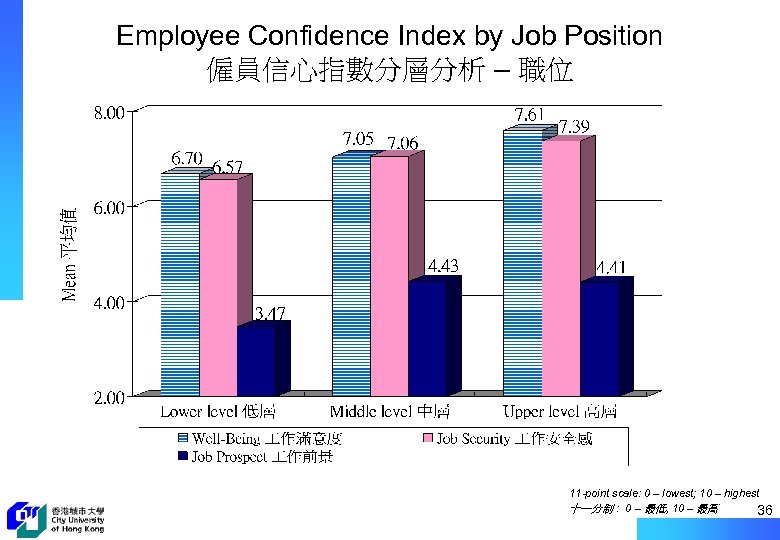
Employee Confidence Index by Job Position 僱員信心指數分層分析 – 職位 11 -point scale: 0 – lowest; 10 – highest 十一分制 : 0 – 最低, 10 – 最高 36
主要研究結果 (V) Major Findings (V) • 女性的信心指數較男性高。 • 女性在 作安全感, 作滿意度方面的指數比男性高, 作前 景方面比男性低 • 40歲以上和學歷較低人士,信心指數最低。30歲以下和高學歷 人士,信心指數最高。 • 40歲以上人士對 作前景的信心尤其低,和其他年齡段的人士 比較起來,他們的 作滿意度和安全感較強。 • 低職位人士相對於中級和高級職位人士,信心指數較低。 37
主要研究結果 (V) Major Findings (V) • ECI of females is higher than that of males. • Job security and Job well-being of females are higher than those of males, while Job prospect of females is lower than that of males. • Employees aged 40 and above 40, and with less education, tend to have lower ECI. However, employees aged below 30, and with higher education tend to have higher ECI. • Compared with people aged below 40, employees aged 40 and above 40 tend to have the lowest confidence with regards to their own Job prospect. • Compared with people in middle or senior positions, people in low-level positions tend to have lower ECI. 38
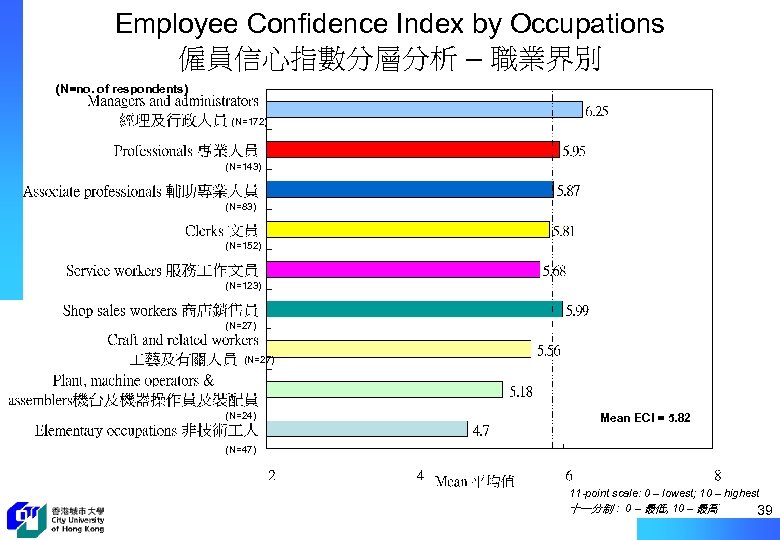
Employee Confidence Index by Occupations 僱員信心指數分層分析 – 職業界別 (N=no. of respondents) (N=172) (N=143) (N=83) (N=152) (N=123) (N=27) (N=24) Mean ECI = 5. 82 (N=47) 11 -point scale: 0 – lowest; 10 – highest 十一分制 : 0 – 最低, 10 – 最高 39
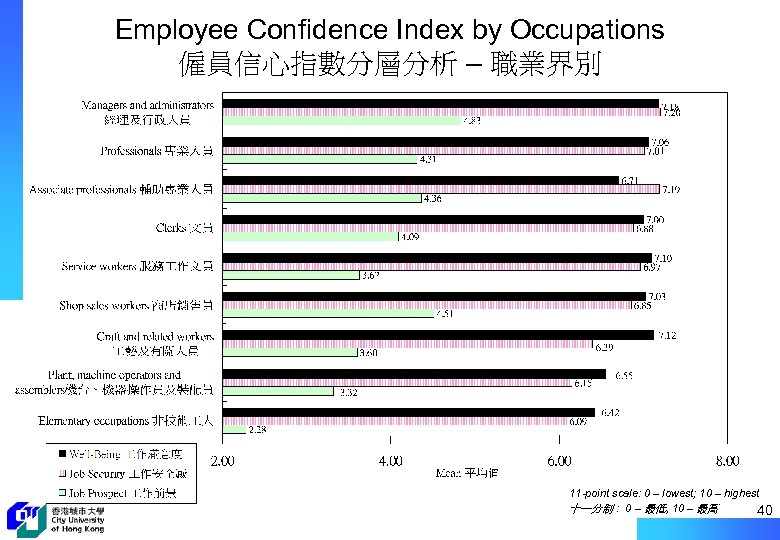
Employee Confidence Index by Occupations 僱員信心指數分層分析 – 職業界別 11 -point scale: 0 – lowest; 10 – highest 十一分制 : 0 – 最低, 10 – 最高 40
主要研究結果 (VI) Major Findings (VI) • 經理及行政人員及商店銷售員的信心指數最高,而非技術 人 的信心指數最低。 • 經理/行政人員、 藝及有關人員的 作滿意度較高,而非技術 人的 作滿意度最低。 • 經理/行政人員及輔助專業人員的 作安全感較高,而非技術 人的 作安全感最低。 • 經理/行政人員及商店銷售員對 作前景的信心較高 , 而非技術 的人 作前景最低。 41
主要研究結果 (VI) Major Findings (VI) • Managers/ administrators and Shop sales workers tend to have higher ECI, while those employed in Elementary occupations having the lowest ECI. • Managers/ administrators and Craft and related workers report high Job well-being scores, while those employed in Elementary occupations report the lowest Job well-being scores. • Managers/ administrators and Associate professionals tend to have higher Job security, while those employed in Elementary occupations tend to have low Job security. • Managers/administrators and Shop sales workers report the highest scores on Job prospect, while those employed in Elementary occupations report the lowest scores on Job prospect. 42
Employees’ Job Satisfaction 僱員 作滿意度 43
• 僱員 作滿意度量度僱員對 作上不同方面的滿意程度。 • 僱員 作滿意度共有11條問題,包括對薪酬、福利及 作時數 等的滿意程度。 • 這 11條問題是以 1 – 7分來評分,分數越高便表示僱員的滿意 度越高。 • Employees’ Job Satisfaction aims to measure employees’ satisfaction towards various aspects of their work. • There are 11 questions in this index, including satisfaction about salary, fringe benefits and work hour, etc. • The 11 questions are based on a scale of 1 – 7, and a higher score represents a higher overall level of employee satisfaction. 44
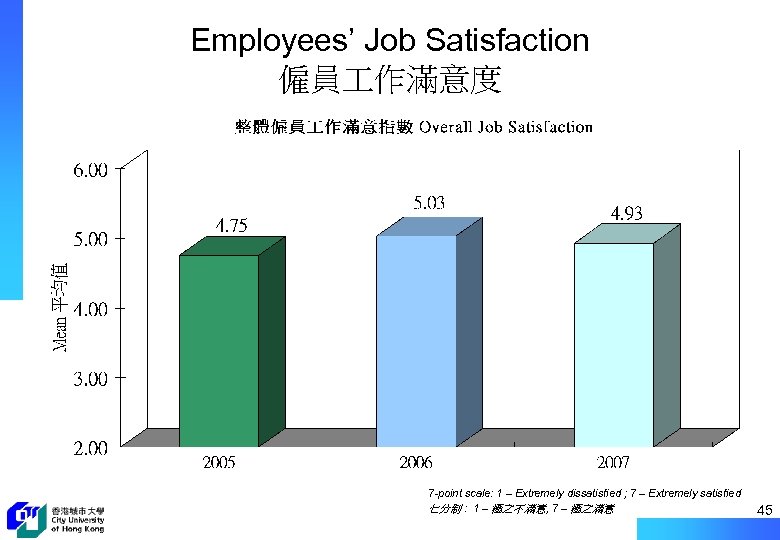
Employees’ Job Satisfaction 僱員 作滿意度 7 -point scale: 1 – Extremely dissatisfied ; 7 – Extremely satisfied 七分制 : 1 – 極之不滿意, 7 – 極之滿意 45
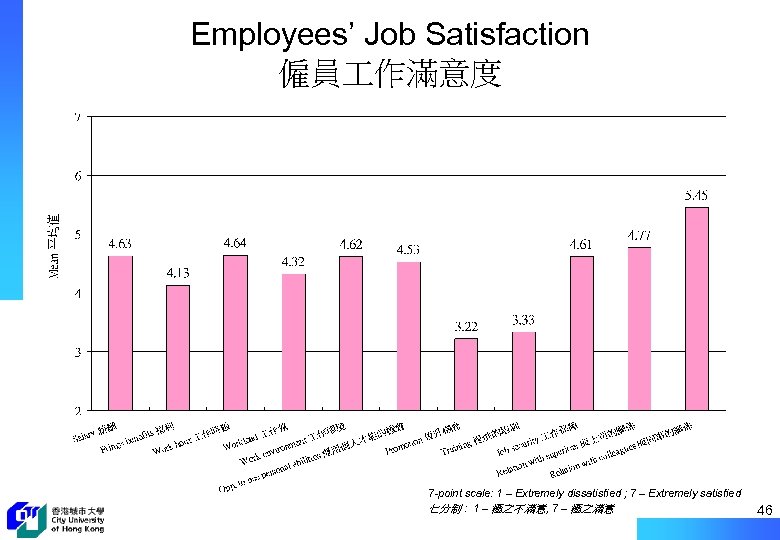
Employees’ Job Satisfaction 僱員 作滿意度 7 -point scale: 1 – Extremely dissatisfied ; 7 – Extremely satisfied 七分制 : 1 – 極之不滿意, 7 – 極之滿意 46
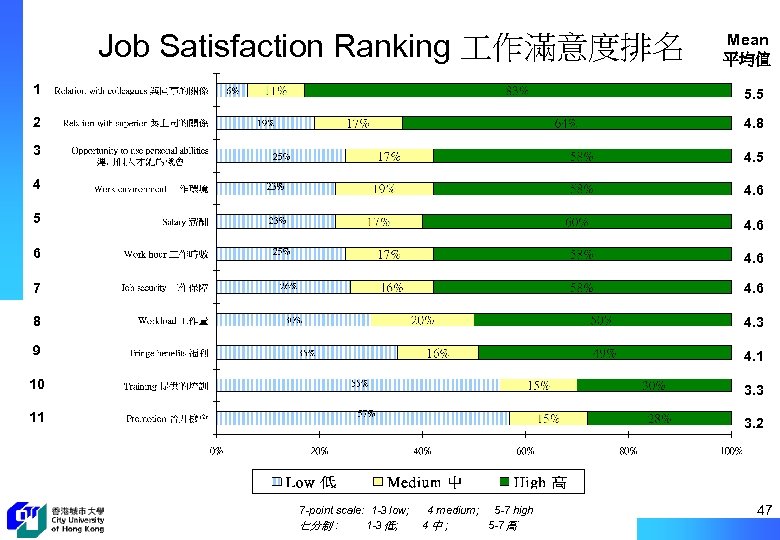
Job Satisfaction Ranking 作滿意度排名 Mean 平均值 1 5. 5 2 4. 8 3 4. 5 4 4. 6 5 4. 6 6 4. 6 7 4. 6 8 4. 3 9 4. 1 10 3. 3 11 3. 2 7 -point scale: 1 -3 low; 七分制 : 1 -3 低; 4 medium; 5 -7 high 4中; 5 -7 高 47
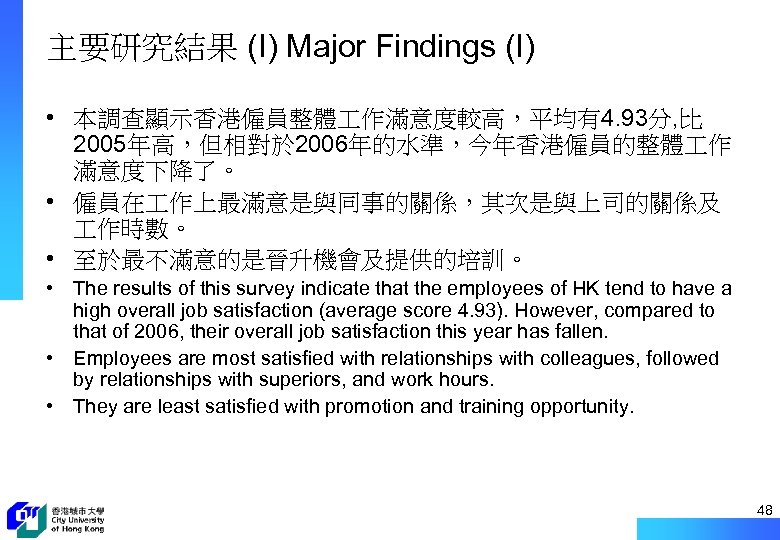
主要研究結果 (I) Major Findings (I) • 本調查顯示香港僱員整體 作滿意度較高,平均有4. 93分, 比 2005年高,但相對於 2006年的水準,今年香港僱員的整體 作 滿意度下降了。 • 僱員在 作上最滿意是與同事的關係,其次是與上司的關係及 作時數。 • 至於最不滿意的是晉升機會及提供的培訓。 • The results of this survey indicate that the employees of HK tend to have a high overall job satisfaction (average score 4. 93). However, compared to that of 2006, their overall job satisfaction this year has fallen. • Employees are most satisfied with relationships with colleagues, followed by relationships with superiors, and work hours. • They are least satisfied with promotion and training opportunity. 48
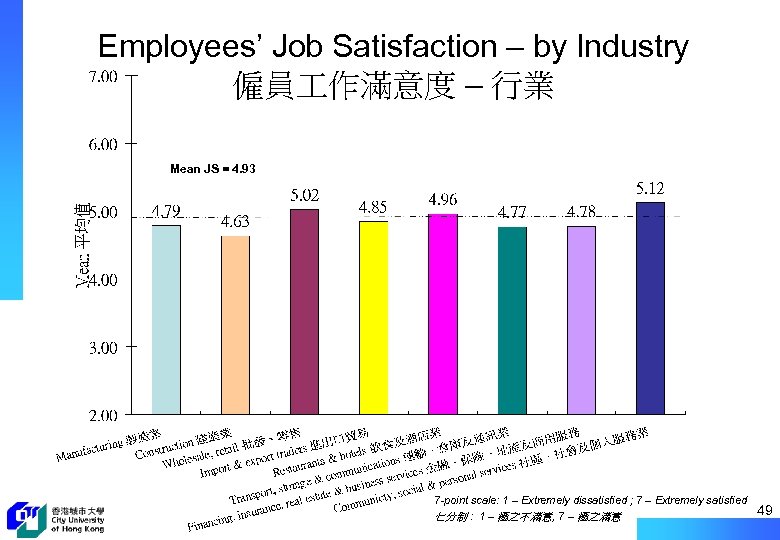
Employees’ Job Satisfaction – by Industry 僱員 作滿意度 – 行業 Mean JS = 4. 93 7 -point scale: 1 – Extremely dissatisfied ; 7 – Extremely satisfied 七分制 : 1 – 極之不滿意, 7 – 極之滿意 49
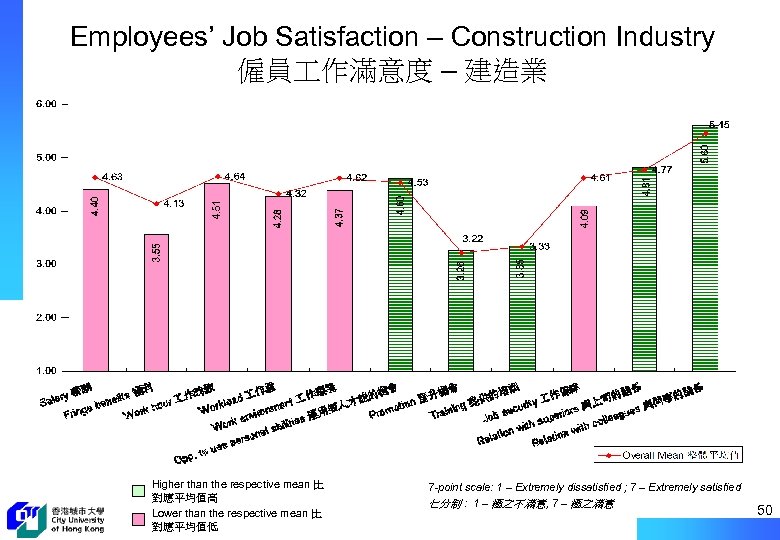
Employees’ Job Satisfaction – Construction Industry 僱員 作滿意度 – 建造業 Higher than the respective mean 比 對應平均值高 Lower than the respective mean 比 對應平均值低 7 -point scale: 1 – Extremely dissatisfied ; 7 – Extremely satisfied 七分制 : 1 – 極之不滿意, 7 – 極之滿意 50
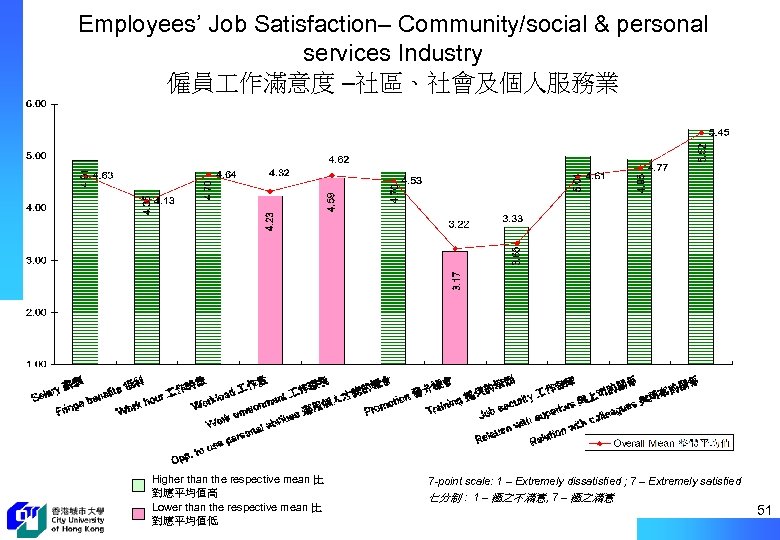
Employees’ Job Satisfaction– Community/social & personal services Industry 僱員 作滿意度 –社區、社會及個人服務業 Higher than the respective mean 比 對應平均值高 Lower than the respective mean 比 對應平均值低 7 -point scale: 1 – Extremely dissatisfied ; 7 – Extremely satisfied 七分制 : 1 – 極之不滿意, 7 – 極之滿意 51
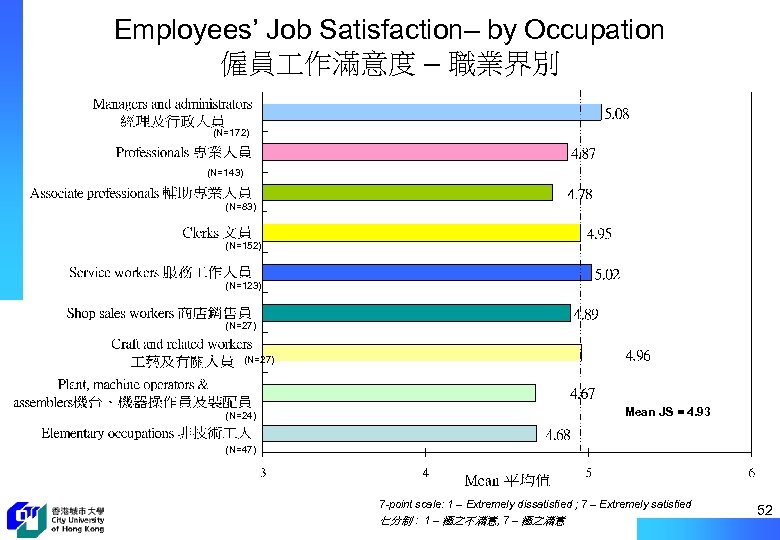
Employees’ Job Satisfaction– by Occupation 僱員 作滿意度 – 職業界別 (N=172) (N=143) (N=83) (N=152) (N=123) (N=27) (N=24) Mean JS = 4. 93 (N=47) 7 -point scale: 1 – Extremely dissatisfied ; 7 – Extremely satisfied 七分制 : 1 – 極之不滿意, 7 – 極之滿意 52
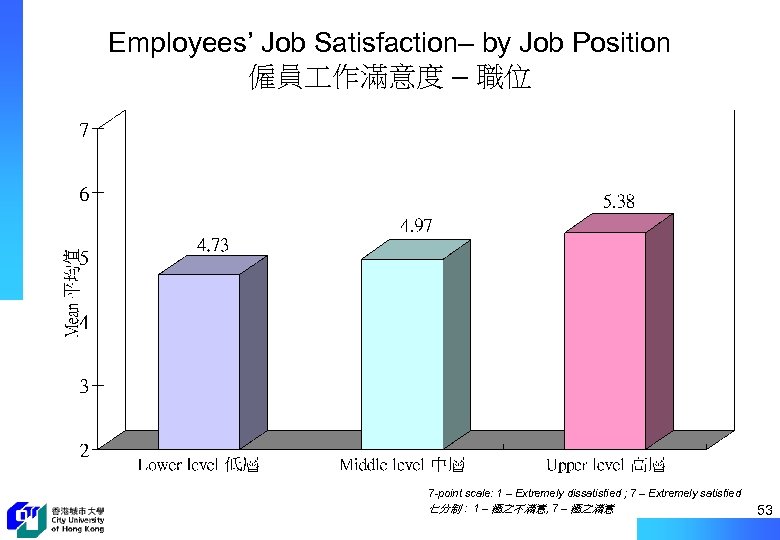
Employees’ Job Satisfaction– by Job Position 僱員 作滿意度 – 職位 7 -point scale: 1 – Extremely dissatisfied ; 7 – Extremely satisfied 七分制 : 1 – 極之不滿意, 7 – 極之滿意 53
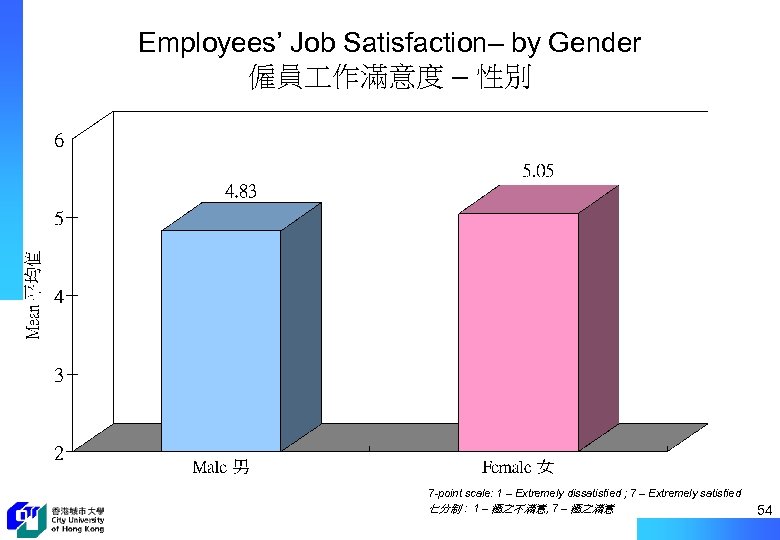
Employees’ Job Satisfaction– by Gender 僱員 作滿意度 – 性別 7 -point scale: 1 – Extremely dissatisfied ; 7 – Extremely satisfied 七分制 : 1 – 極之不滿意, 7 – 極之滿意 54
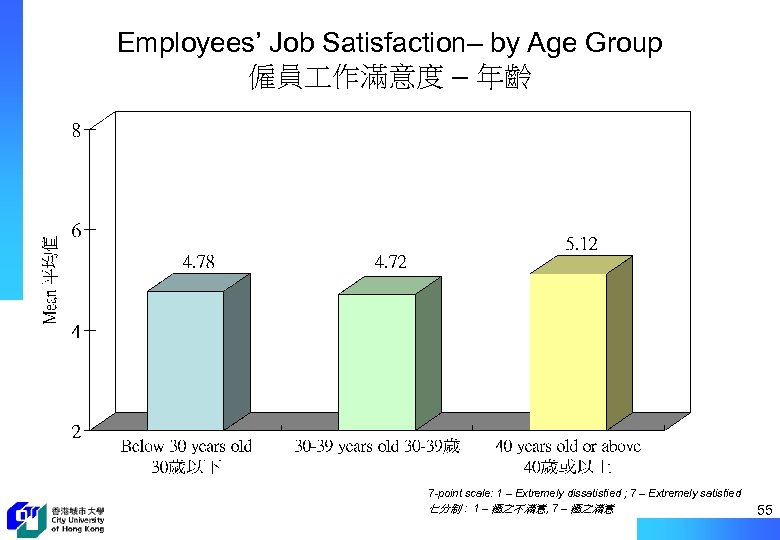
Employees’ Job Satisfaction– by Age Group 僱員 作滿意度 – 年齡 7 -point scale: 1 – Extremely dissatisfied ; 7 – Extremely satisfied 七分制 : 1 – 極之不滿意, 7 – 極之滿意 55
主要研究結果 (II) Major Findings (II) • 建造業的從業人員的 作滿意度最低(平均值 4. 63),社區、社 會及個人服務業的 作滿意度最高(平均值 5. 12) • 調查顯示屬於經理及行政人員的受訪者有最高的 作滿意度; 而屬於機台、機器操作員及裝配員的受訪者, 非技術 人則有 較低的 作滿意度。 • 職位越高,女性和年紀越大的受訪者有較高的 作滿意度。 56
主要研究結果 (II) Major Findings (II) • Construction industry employees tend to have the lowest overall job satisfaction (average score 4. 63), while the employees of Community, social & personal services tend to have the highest overall job satisfaction (average score 5. 12). • This survey shows that respondents working as managers and administrators tend to have higher job satisfaction. • Respondents working as Plant, machine operators & assemblers and Elementary occupations have lower job satisfaction. • More senior, female and older respondents tend to have higher job satisfaction. 57
Age discrimination (AD) 年齡歧視 58
• 年齡歧視 (AD)是一個量度年齡歧視問題的指數。 • AD主要包括 3個方面的問題:年齡歧視指數、年齡歧 視原因,及對消除年齡歧視的看法。 • “年齡歧視指數 (ADI)”包括 5條, “年齡歧視原因”包括 3 條,以 1 – 5分來評分,分數越高表示僱員認為年齡歧 視的問題越嚴重。 • “有關消除年齡歧視的看法”包括 2條,以 1— 5分來評分, 分數越高,表示雇員越同意消除年齡歧視。 • 此外,受訪者還被問及公司規定的的實際退休年齡, 及雇員的理想退休年齡等。 59
• Age Discrimination (AD) aims to measure the issue of age discrimination in employment. • AD has 3 aspects: Age Discrimination Index (ADI) , Reasons of age discrimination, Elimination of age discrimination. • Age Discrimination Index (ADI) includes 5 items. Reasons of age discrimination includes 3 items, based on a scale of 1 – 5. Higher scores reflect serious age discrimination. • The elimination of age discrimination includes 2 items, based on a scale of 1— 5. Higher scores reflect higher consensus to eliminate age discrimination. 60
Age Discrimination (AD) 年齡歧視 61 N=805
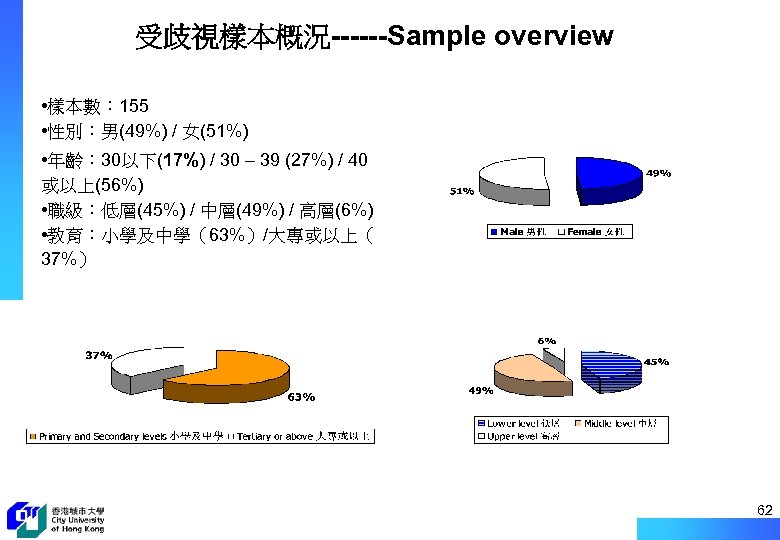
受歧視樣本概況------Sample overview • 樣本數: 155 • 性別:男(49%) / 女(51%) • 年齡: 30以下(17%) / 30 – 39 (27%) / 40 或以上(56%) • 職級:低層(45%) / 中層(49%) / 高層(6%) • 教育:小學及中學(63%)/大專或以上( 37%) 62
Age Discrimination Index (ADI) 年齡歧視指數 N=155 Mean平均值 5 -point scale: 1 – Extremely disagree; 5 – Extremely agree 五分制 : 1 – 極之不同意, 5 – 極之同意 63
Age Discrimination (AD) 年齡歧視 The reasons of age discrimination 年齡歧視原因 N=155 Mean平均值 5 -point scale: 1 – Extremely disagree; 5 – Extremely agree 五分制 : 1 – 極之不同意, 5 – 極之同意 64
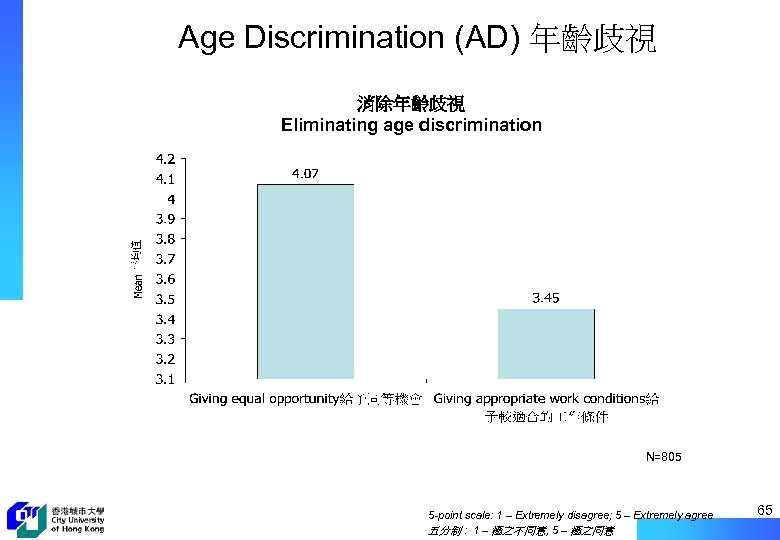
Age Discrimination (AD) 年齡歧視 消除年齡歧視 Eliminating age discrimination N=805 5 -point scale: 1 – Extremely disagree; 5 – Extremely agree 五分制 : 1 – 極之不同意, 5 – 極之同意 65
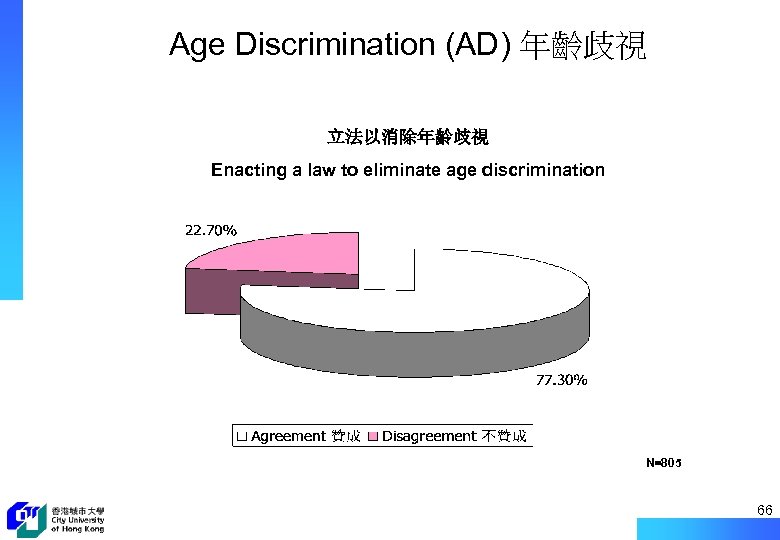
Age Discrimination (AD) 年齡歧視 立法以消除年齡歧視 Enacting a law to eliminate age discrimination N=805 66
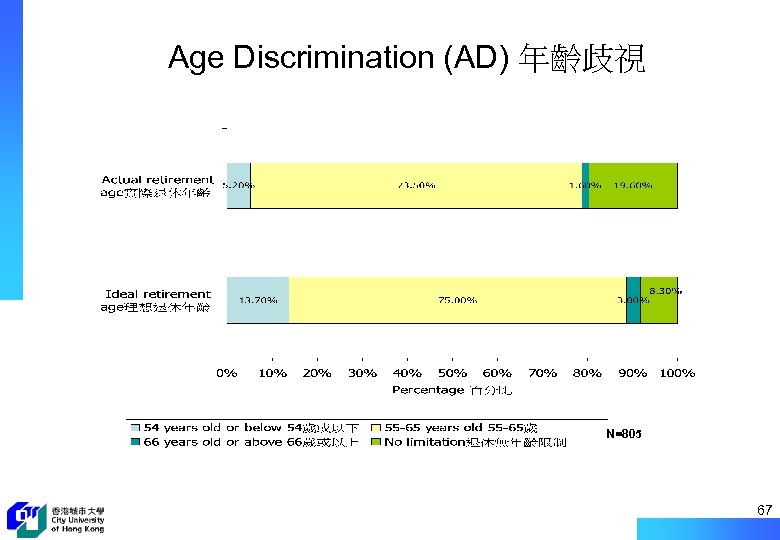
Age Discrimination (AD) 年齡歧視 N=805 67
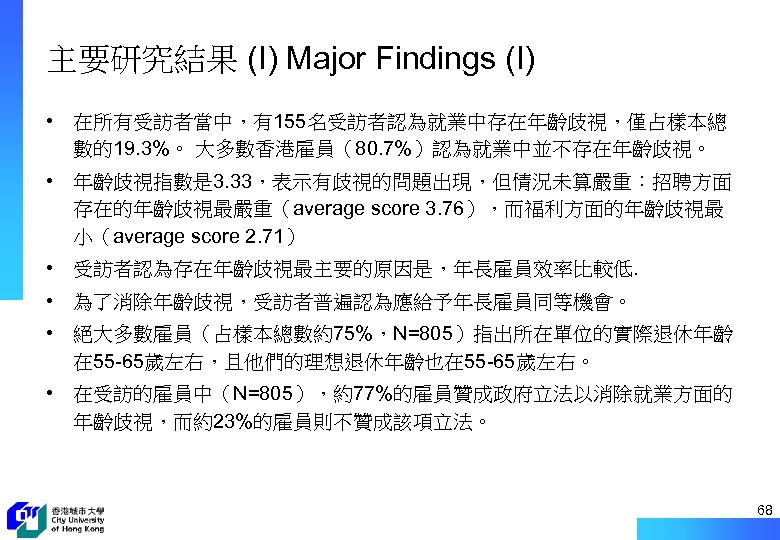
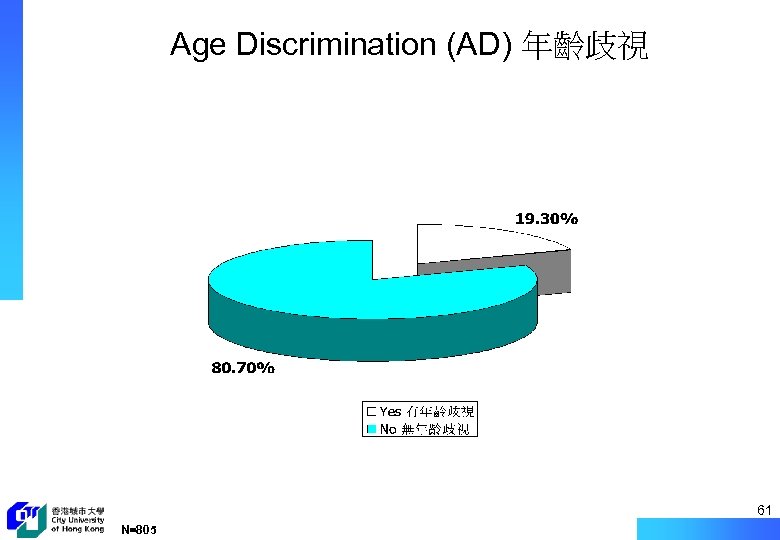
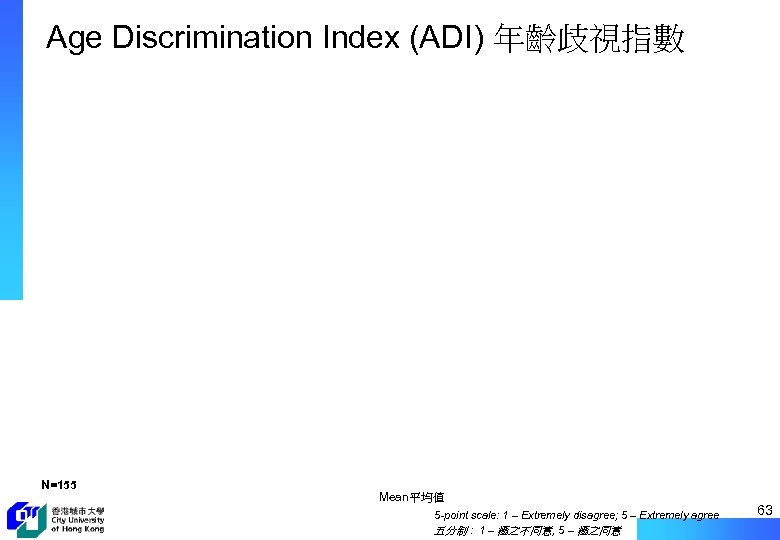
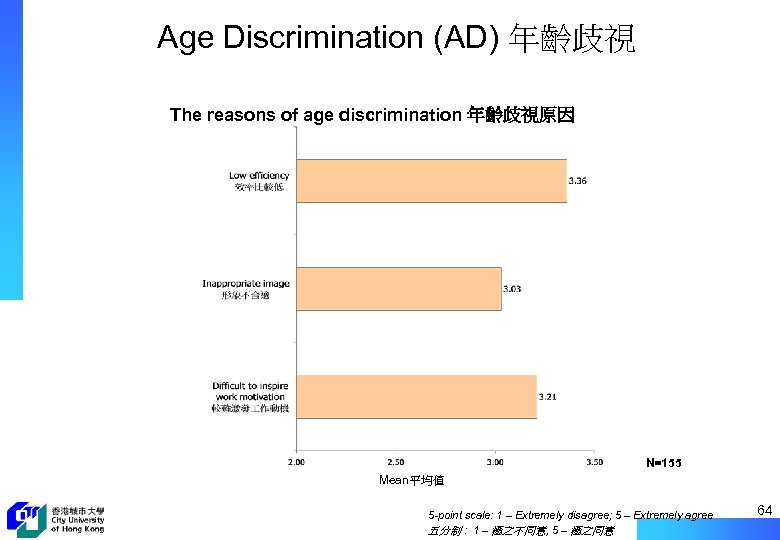
主要研究結果 (I) Major Findings (I) • 在所有受訪者當中,有155名受訪者認為就業中存在年齡歧視,僅占樣本總 數的19. 3%。 大多數香港雇員(80. 7%)認為就業中並不存在年齡歧視。 • 年齡歧視指數是 3. 33,表示有歧視的問題出現,但情況未算嚴重:招聘方面 存在的年齡歧視最嚴重(average score 3. 76),而福利方面的年齡歧視最 小(average score 2. 71) • 受訪者認為存在年齡歧視最主要的原因是,年長雇員效率比較低. • 為了消除年齡歧視,受訪者普遍認為應給予年長雇員同等機會。 • 絕大多數雇員(占樣本總數約75%,N=805)指出所在單位的實際退休年齡 在 55 -65歲左右,且他們的理想退休年齡也在 55 -65歲左右。 • 在受訪的雇員中(N=805),約77%的雇員贊成政府立法以消除就業方面的 年齡歧視,而約23%的雇員則不贊成該項立法。 68
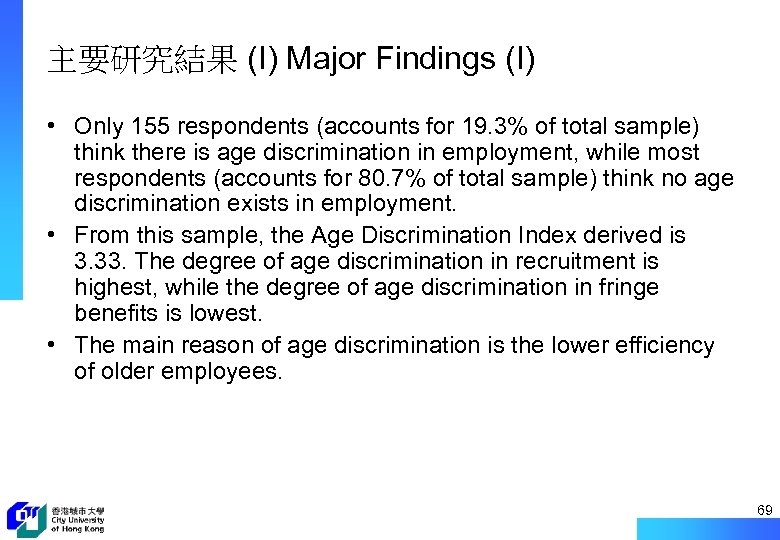
主要研究結果 (I) Major Findings (I) • Only 155 respondents (accounts for 19. 3% of total sample) think there is age discrimination in employment, while most respondents (accounts for 80. 7% of total sample) think no age discrimination exists in employment. • From this sample, the Age Discrimination Index derived is 3. 33. The degree of age discrimination in recruitment is highest, while the degree of age discrimination in fringe benefits is lowest. • The main reason of age discrimination is the lower efficiency of older employees. 69
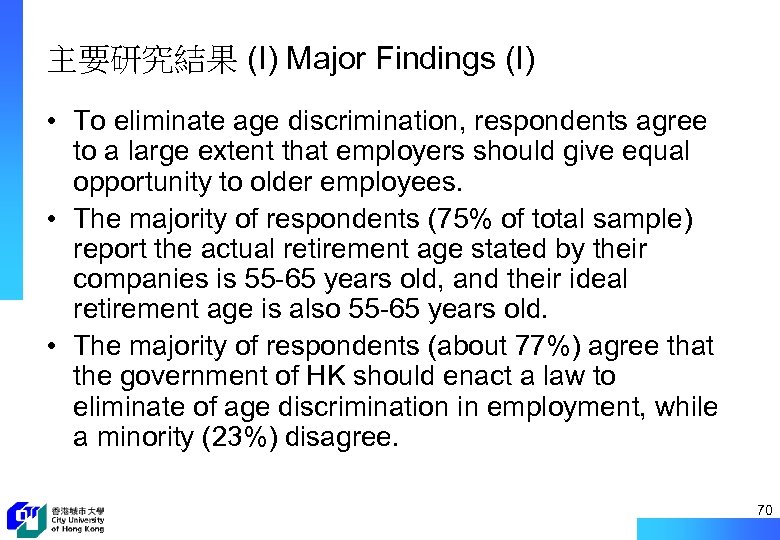
主要研究結果 (I) Major Findings (I) • To eliminate age discrimination, respondents agree to a large extent that employers should give equal opportunity to older employees. • The majority of respondents (75% of total sample) report the actual retirement age stated by their companies is 55 -65 years old, and their ideal retirement age is also 55 -65 years old. • The majority of respondents (about 77%) agree that the government of HK should enact a law to eliminate of age discrimination in employment, while a minority (23%) disagree. 70
年齡歧視指數 ——分層分析 ADI – Analyses ——by Sector 71
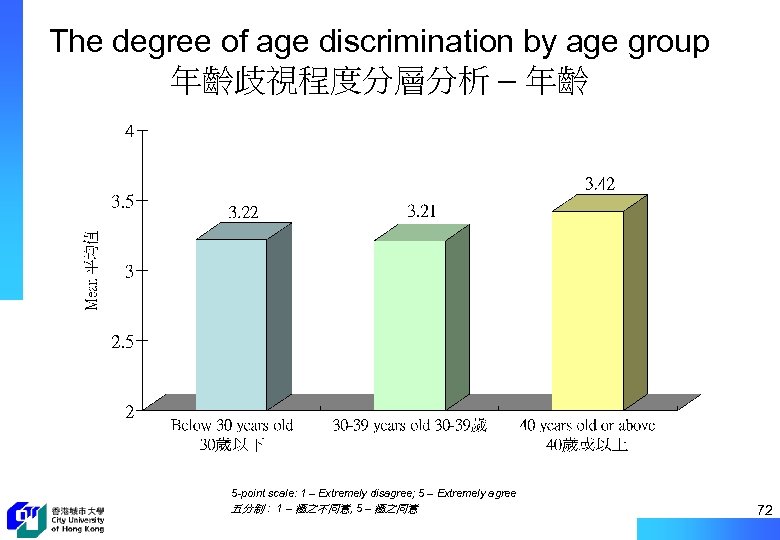
The degree of age discrimination by age group 年齡歧視程度分層分析 – 年齡 5 -point scale: 1 – Extremely disagree; 5 – Extremely agree 五分制 : 1 – 極之不同意, 5 – 極之同意 72
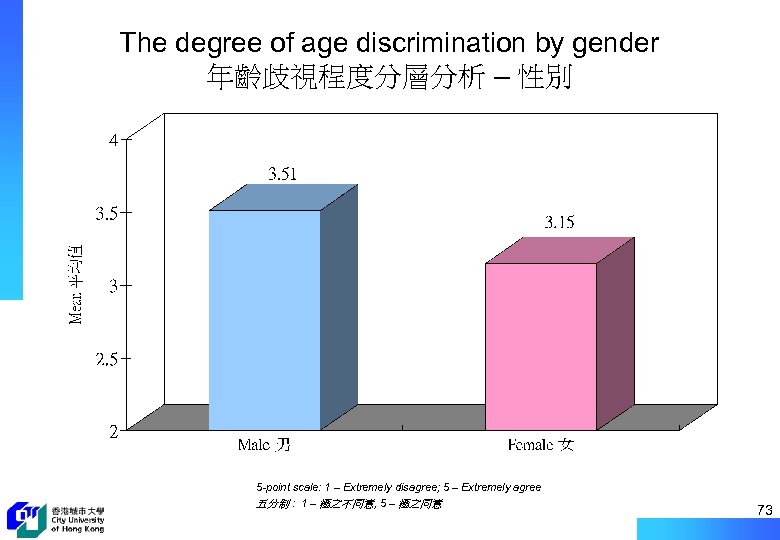
The degree of age discrimination by gender 年齡歧視程度分層分析 – 性別 5 -point scale: 1 – Extremely disagree; 5 – Extremely agree 五分制 : 1 – 極之不同意, 5 – 極之同意 73
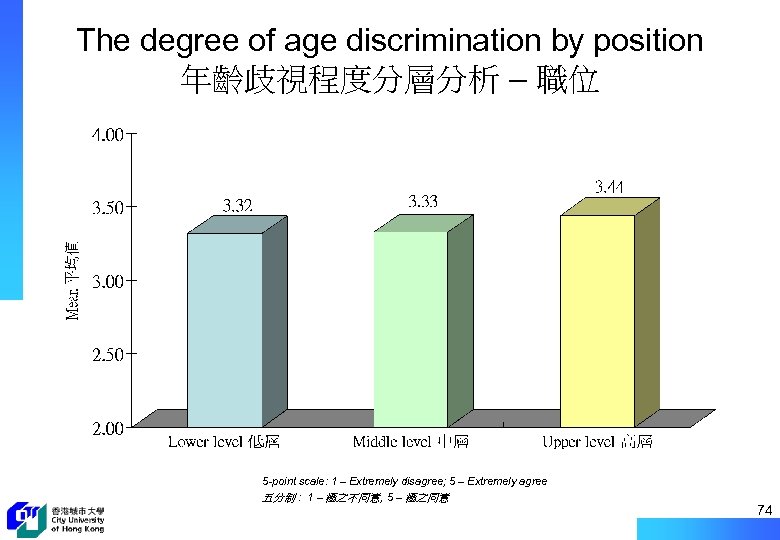
The degree of age discrimination by position 年齡歧視程度分層分析 – 職位 5 -point scale: 1 – Extremely disagree; 5 – Extremely agree 五分制 : 1 – 極之不同意, 5 – 極之同意 74
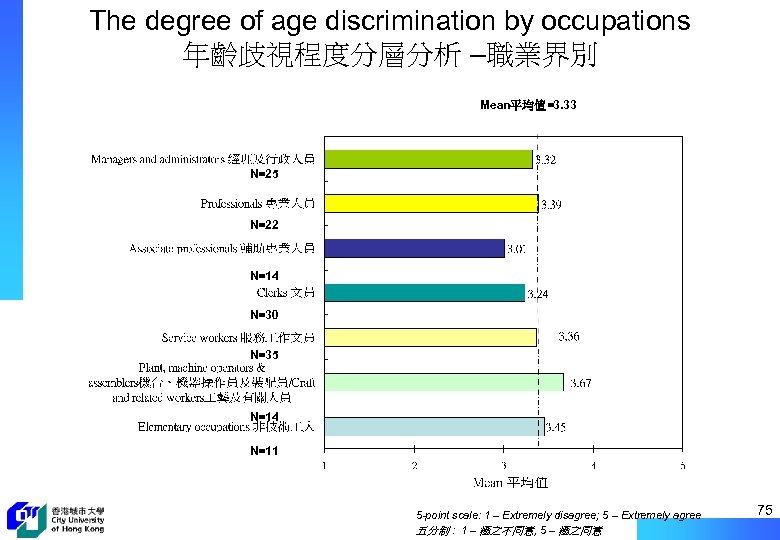
The degree of age discrimination by occupations 年齡歧視程度分層分析 –職業界別 Mean平均值=3. 33 N=25 N=22 N=14 N=30 N=35 N=14 N=11 5 -point scale: 1 – Extremely disagree; 5 – Extremely agree 五分制 : 1 – 極之不同意, 5 – 極之同意 75
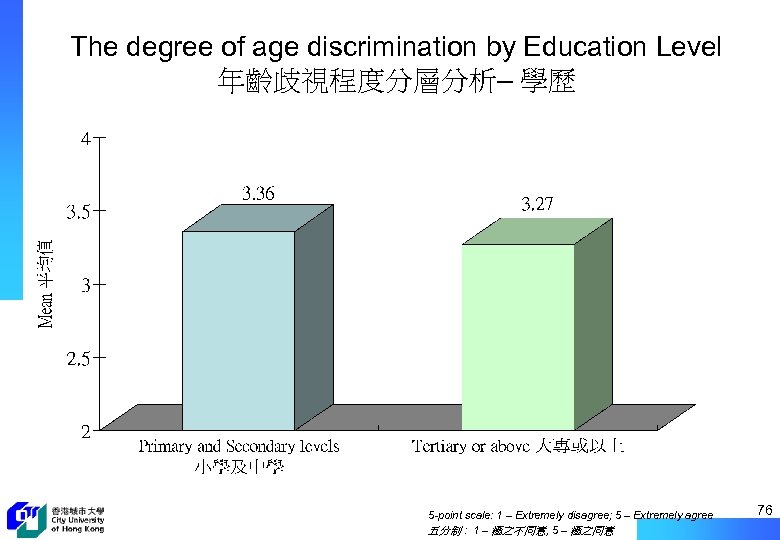
The degree of age discrimination by Education Level 年齡歧視程度分層分析– 學歷 5 -point scale: 1 – Extremely disagree; 5 – Extremely agree 五分制 : 1 – 極之不同意, 5 – 極之同意 76
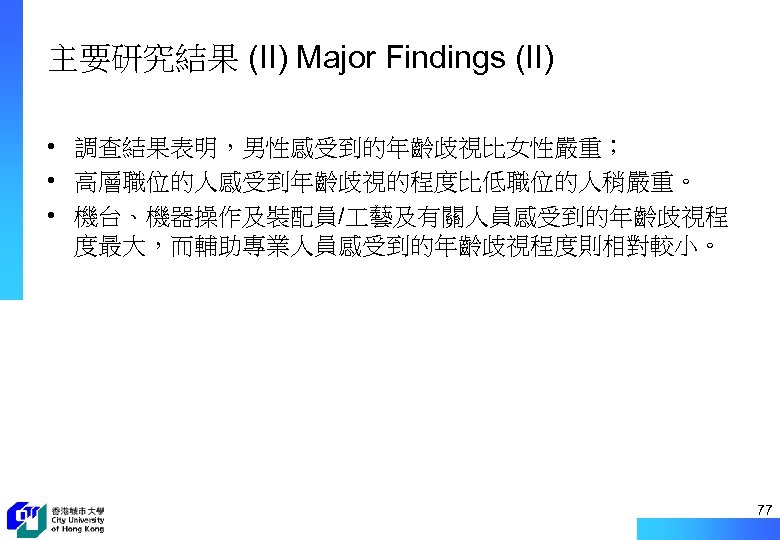
主要研究結果 (II) Major Findings (II) • 調查結果表明,男性感受到的年齡歧視比女性嚴重; • 高層職位的人感受到年齡歧視的程度比低職位的人稍嚴重。 • 機台、機器操作及裝配員/ 藝及有關人員感受到的年齡歧視程 度最大,而輔助專業人員感受到的年齡歧視程度則相對較小。 77
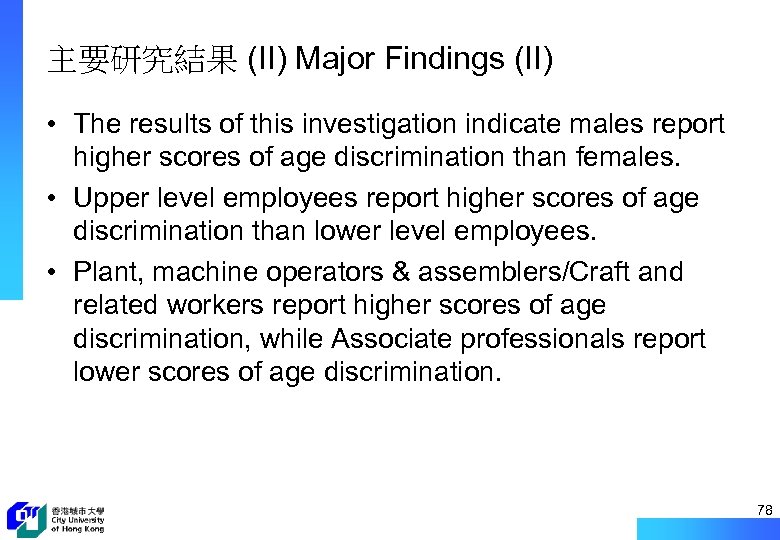
主要研究結果 (II) Major Findings (II) • The results of this investigation indicate males report higher scores of age discrimination than females. • Upper level employees report higher scores of age discrimination than lower level employees. • Plant, machine operators & assemblers/Craft and related workers report higher scores of age discrimination, while Associate professionals report lower scores of age discrimination. 78
End of Presentation. Thank you!
Скачать презентацию 香港僱員信心 作滿意度 及年齡歧視問題調查 Employee Confidence Job Satisfaction and
ef9c851e0eccc4d3b78a9c5a01d1faaf.ppt