 Скачать презентацию 雲端世代的 資訊安全防護 張晃崚 CCIE 13673 麟瑞科技 區域銷售事業處
84b1992376f642f37f8c5fee5d33fc46.ppt
- Количество слайдов: 38



雲端世代的 資訊安全防護 張晃崚 CCIE #13673 麟瑞科技 區域銷售事業處
什麼是雲端運算 ? © 2009 Cisco Systems, Inc. All rights reserved. Cisco Public 2
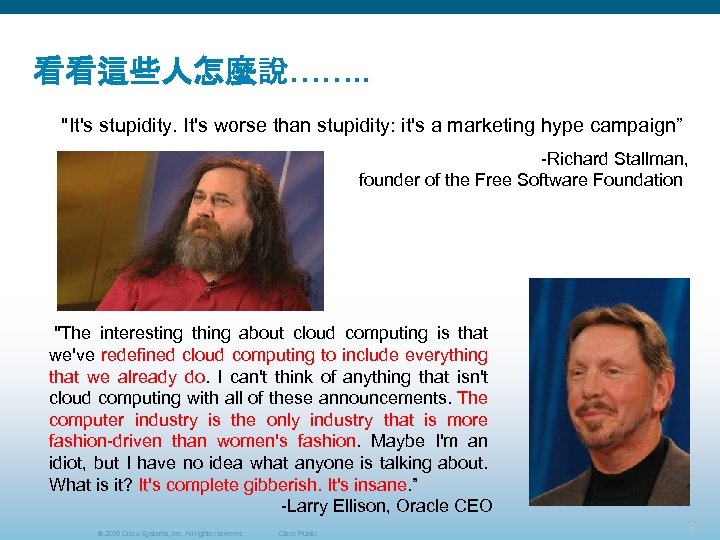
看看這些人怎麼說……. . "It's stupidity. It's worse than stupidity: it's a marketing hype campaign” -Richard Stallman, founder of the Free Software Foundation "The interesting thing about cloud computing is that we've redefined cloud computing to include everything that we already do. I can't think of anything that isn't cloud computing with all of these announcements. The computer industry is the only industry that is more fashion-driven than women's fashion. Maybe I'm an idiot, but I have no idea what anyone is talking about. What is it? It's complete gibberish. It's insane. ” -Larry Ellison, Oracle CEO © 2009 Cisco Systems, Inc. All rights reserved. Cisco Public 3
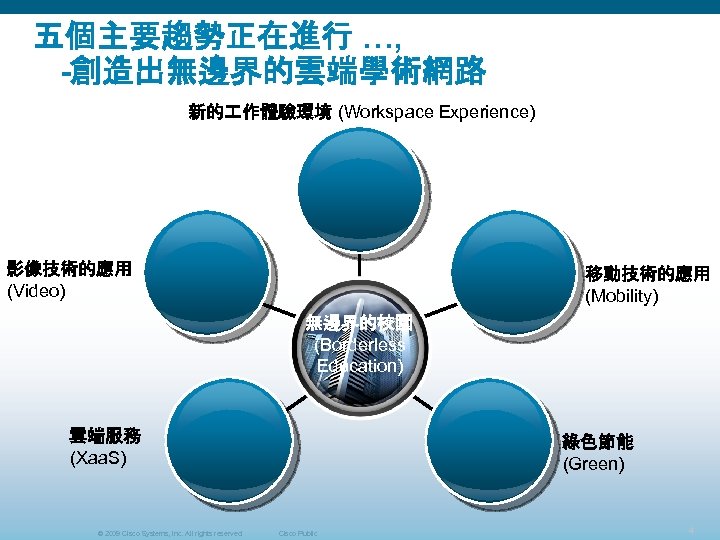
五個主要趨勢正在進行 …, -創造出無邊界的雲端學術網路 新的 作體驗環境 (Workspace Experience) 影像技術的應用 (Video) 移動技術的應用 (Mobility) 無邊界的校園 (Borderless Education) 雲端服務 (Xaa. S) © 2009 Cisco Systems, Inc. All rights reserved. 綠色節能 (Green) Cisco Public 4
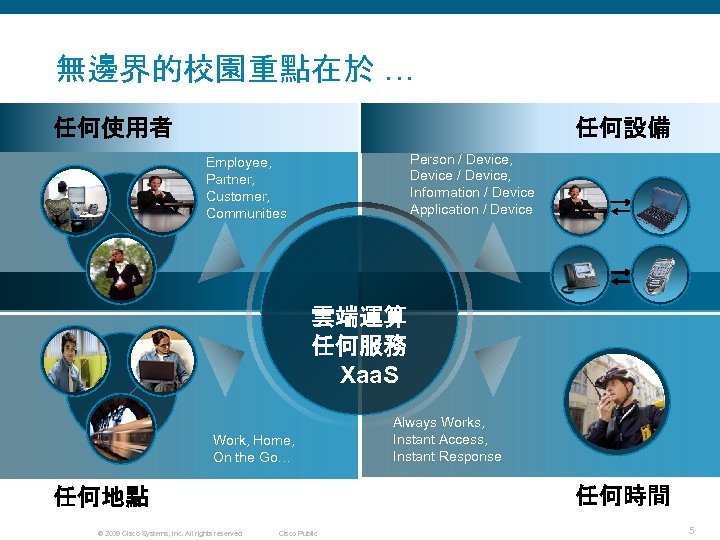
無邊界的校園重點在於 … 任何使用者 任何設備 Person / Device, Device / Device, Information / Device Application / Device Employee, Partner, Customer, Communities 雲端運算 任何服務 Xaa. S Work, Home, On the Go… 任何時間 任何地點 © 2009 Cisco Systems, Inc. All rights reserved. Always Works, Instant Access, Instant Response Cisco Public 5
NIST 所定義的雲端運算 § Cloud computing is a model for enabling convenient, ondemand network access to a shared pool of configurable computing resources (e. g. , networks, servers, storage, applications, and services) that can be rapidly provisioned and released with minimal management effort or service provider interaction. § 雲計算是一種模式使方便,按需網絡訪問共享池配置的計 算資源(如網絡,服務器,存儲,應用程序和服務),可 以迅速配置和發布以最小的管理 作或服務提供商相互作 用 Source: National Institute of Standards and Technology, Version 15, 10 -7 -09 © 2009 Cisco Systems, Inc. All rights reserved. Cisco Public 6
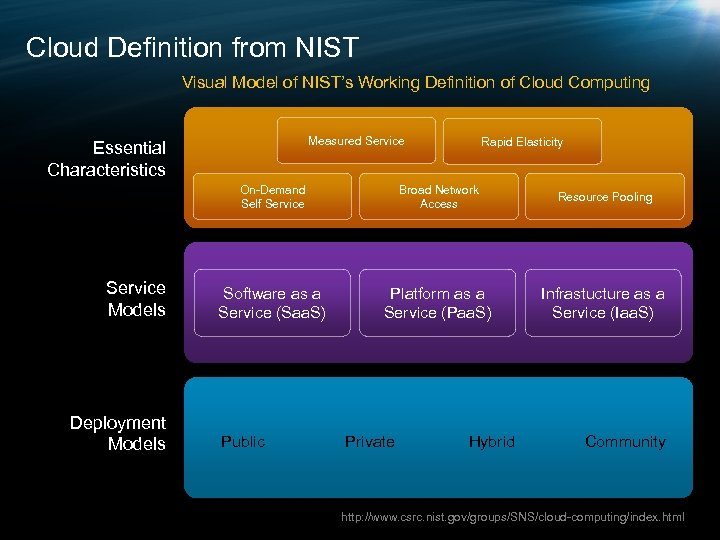
Cloud Definition from NIST Visual Model of NIST’s Working Definition of Cloud Computing Measured Service Essential Characteristics Rapid Elasticity On-Demand Self Service Models Deployment Models Broad Network Access Resource Pooling Software as a Service (Saa. S) Platform as a Service (Paa. S) Infrastucture as a Service (Iaa. S) Public Private Hybrid Community http: //www. csrc. nist. gov/groups/SNS/cloud-computing/index. html Cisco Confidential Copyright © 2009 Cisco Systems, Inc. All rights reserved. Internet Business Solutions Group
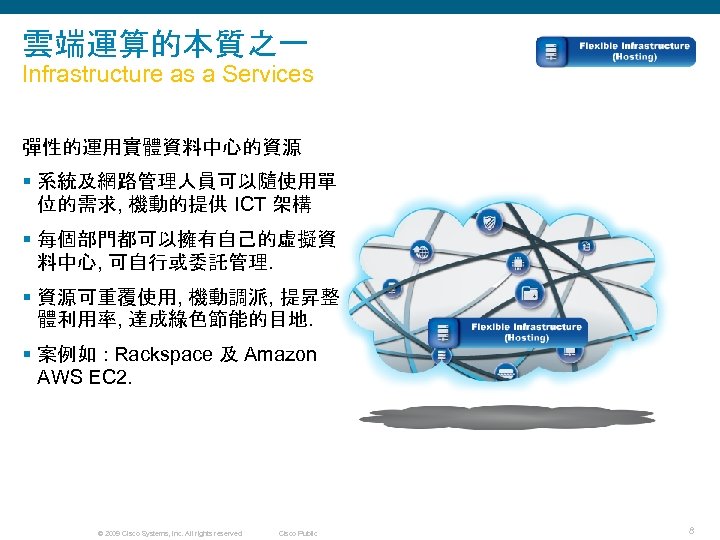
雲端運算的本質之一 Infrastructure as a Services 彈性的運用實體資料中心的資源 § 系統及網路管理人員可以隨使用單 位的需求, 機動的提供 ICT 架構 § 每個部門都可以擁有自己的虛擬資 料中心, 可自行或委託管理. § 資源可重覆使用, 機動調派, 提昇整 體利用率, 達成綠色節能的目地. § 案例如 : Rackspace 及 Amazon AWS EC 2. © 2009 Cisco Systems, Inc. All rights reserved. Cisco Public 8
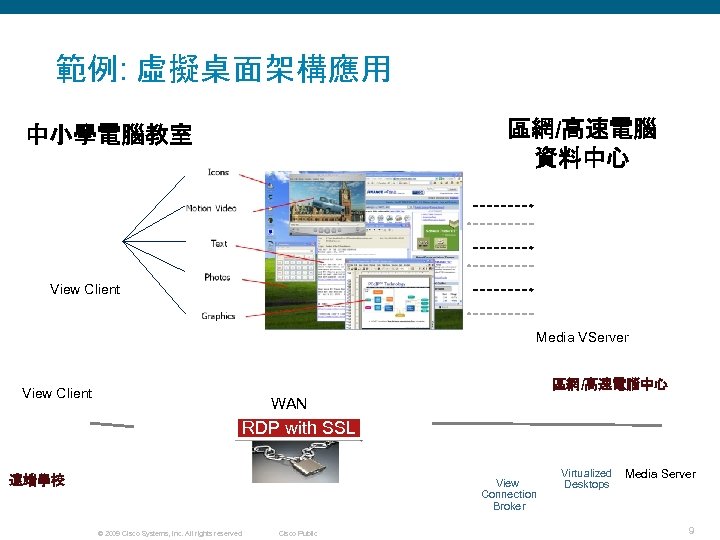
範例: 虛擬桌面架構應用 區網/高速電腦 資料中心 中小學電腦教室 View Client Media VServer 區網/高速電腦中心 View Client WAN RDP with SSL 遠端學校 View Connection Broker © 2009 Cisco Systems, Inc. All rights reserved. Cisco Public Virtualized Desktops Media Server 9
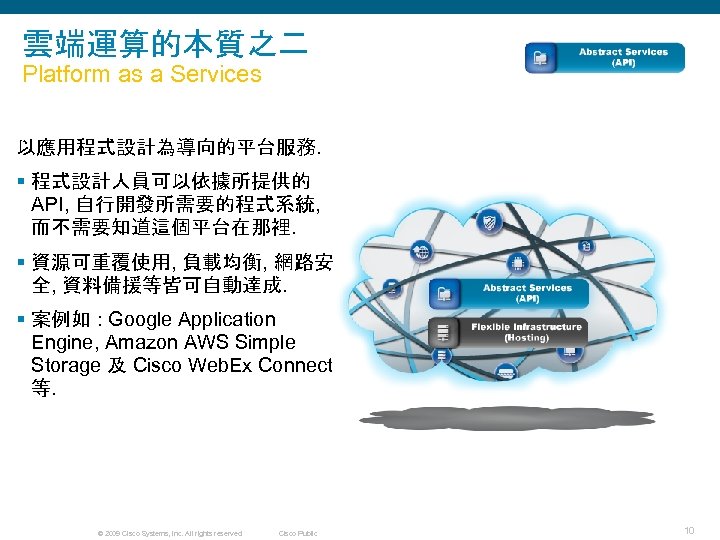
雲端運算的本質之二 Platform as a Services 以應用程式設計為導向的平台服務. § 程式設計人員可以依據所提供的 API, 自行開發所需要的程式系統, 而不需要知道這個平台在那裡. § 資源可重覆使用, 負載均衡, 網路安 全, 資料備援等皆可自動達成. § 案例如 : Google Application Engine, Amazon AWS Simple Storage 及 Cisco Web. Ex Connect 等. © 2009 Cisco Systems, Inc. All rights reserved. Cisco Public 10
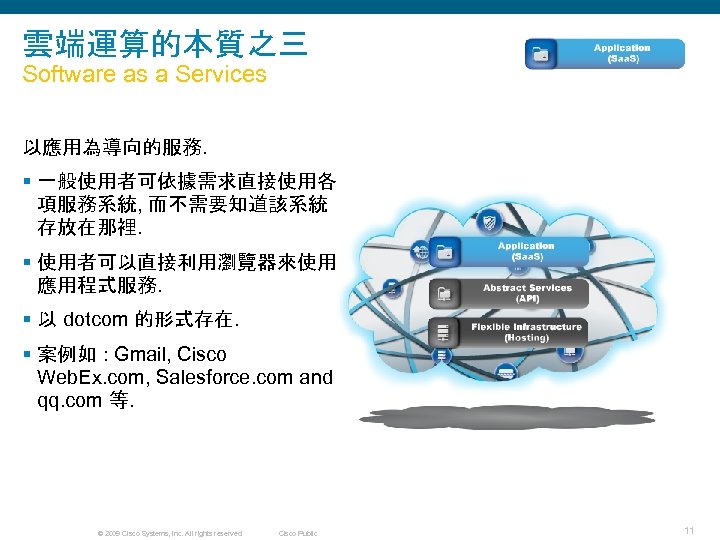
雲端運算的本質之三 Software as a Services 以應用為導向的服務. § 一般使用者可依據需求直接使用各 項服務系統, 而不需要知道該系統 存放在那裡. § 使用者可以直接利用瀏覽器來使用 應用程式服務. § 以 dotcom 的形式存在. § 案例如 : Gmail, Cisco Web. Ex. com, Salesforce. com and qq. com 等. © 2009 Cisco Systems, Inc. All rights reserved. Cisco Public 11
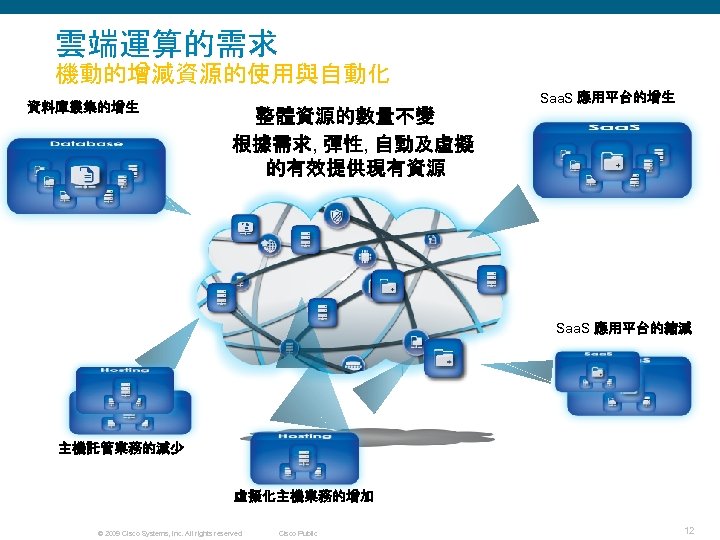
雲端運算的需求 機動的增減資源的使用與自動化 資料庫叢集的增生 Saa. S 應用平台的增生 整體資源的數量不變 根據需求, 彈性, 自動及虛擬 的有效提供現有資源 Saa. S 應用平台的縮減 主機託管業務的減少 虛擬化主機業務的增加 © 2009 Cisco Systems, Inc. All rights reserved. Cisco Public 12
Common Cloud Characteristics • Cloud computing often leverages: – Massive scale – Homogeneity – Virtualization – Resilient computing – Low cost software – Geographic distribution – Service orientation – Advanced security technologies © 2009 Cisco Systems, Inc. All rights reserved. Cisco Public 14
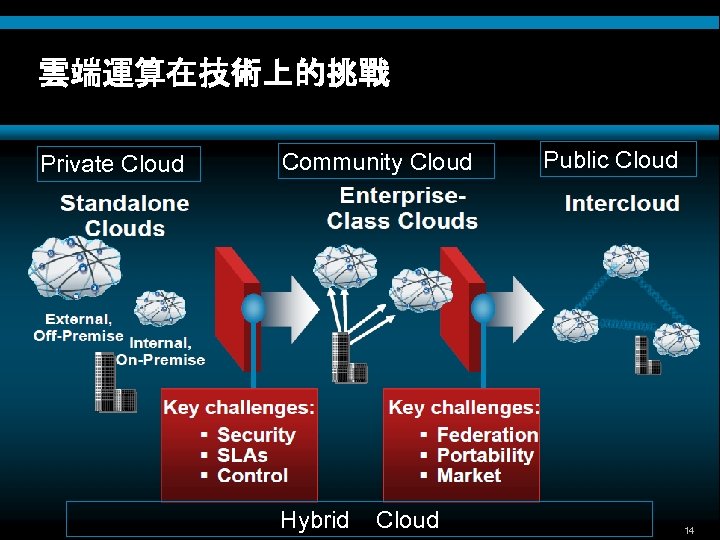
雲端運算在技術上的挑戰 Private Cloud © 2009 Cisco Systems, Inc. All rights reserved. Community Cloud Hybrid Cisco Public Cloud 14
Cloud Computing Security 16
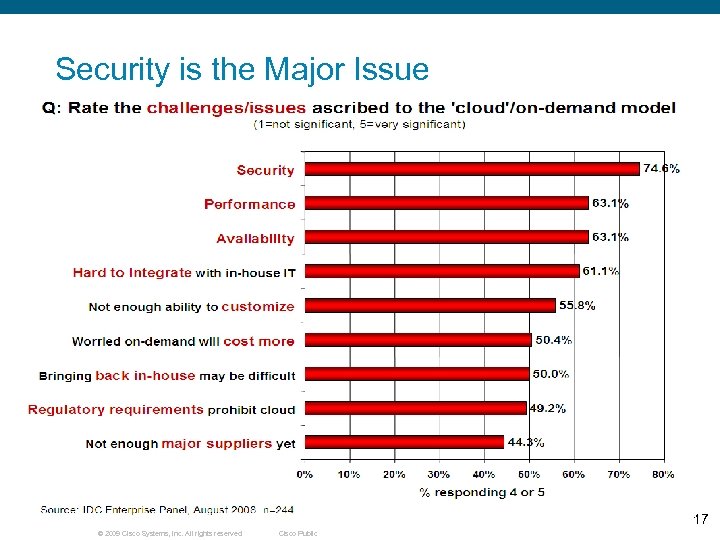
Security is the Major Issue 17 © 2009 Cisco Systems, Inc. All rights reserved. Cisco Public
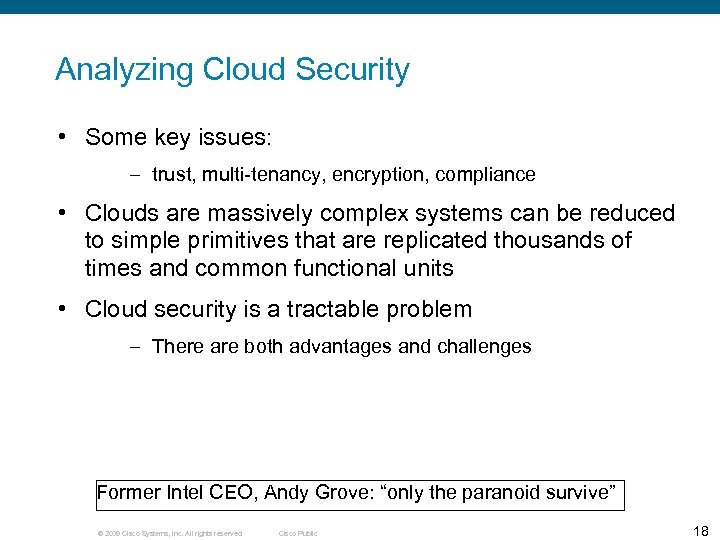
Analyzing Cloud Security • Some key issues: – trust, multi-tenancy, encryption, compliance • Clouds are massively complex systems can be reduced to simple primitives that are replicated thousands of times and common functional units • Cloud security is a tractable problem – There are both advantages and challenges Former Intel CEO, Andy Grove: “only the paranoid survive” © 2009 Cisco Systems, Inc. All rights reserved. Cisco Public 18
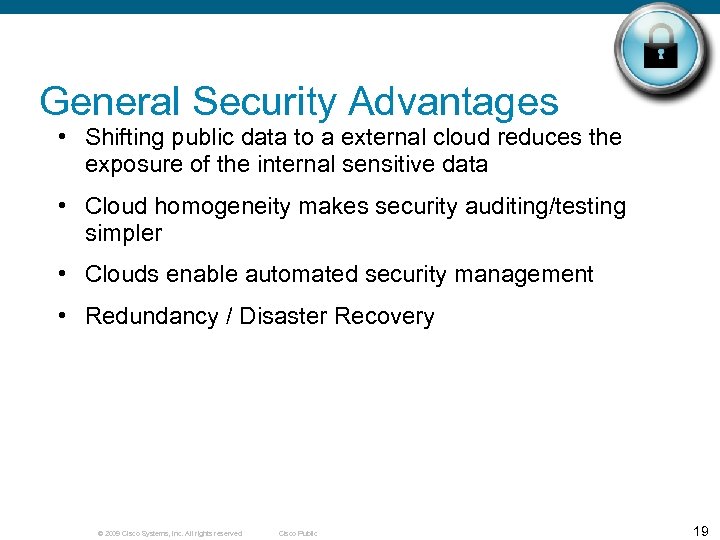
General Security Advantages • Shifting public data to a external cloud reduces the exposure of the internal sensitive data • Cloud homogeneity makes security auditing/testing simpler • Clouds enable automated security management • Redundancy / Disaster Recovery © 2009 Cisco Systems, Inc. All rights reserved. Cisco Public 19
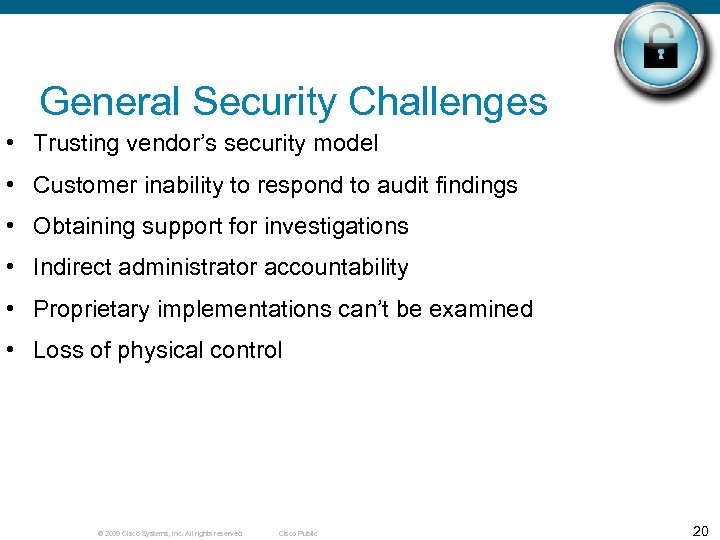
General Security Challenges • Trusting vendor’s security model • Customer inability to respond to audit findings • Obtaining support for investigations • Indirect administrator accountability • Proprietary implementations can’t be examined • Loss of physical control © 2009 Cisco Systems, Inc. All rights reserved. Cisco Public 20
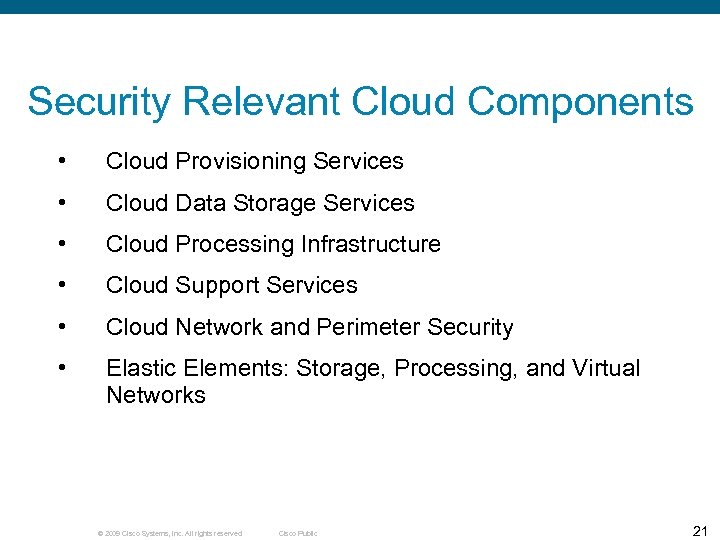
Security Relevant Cloud Components • Cloud Provisioning Services • Cloud Data Storage Services • Cloud Processing Infrastructure • Cloud Support Services • Cloud Network and Perimeter Security • Elastic Elements: Storage, Processing, and Virtual Networks © 2009 Cisco Systems, Inc. All rights reserved. Cisco Public 21
Provisioning Service • Advantages – Rapid reconstitution of services – Enables availability • Provision in multiple data centers / multiple instances – Advanced honey net capabilities • Challenges – Impact of compromising the provisioning service © 2009 Cisco Systems, Inc. All rights reserved. Cisco Public 22
Data Storage Services • Advantages – Data fragmentation and dispersal – Automated replication – Provision of data zones (e. g. , by country) – Encryption at rest and in transit – Automated data retention • Challenges – Isolation management / data multi-tenancy – Storage controller • Single point of failure / compromise? – Exposure of data to foreign governments © 2009 Cisco Systems, Inc. All rights reserved. Cisco Public 23
Cloud Processing Infrastructure • Advantages – Ability to secure masters and push out secure images • Challenges – Application multi-tenancy – Reliance on hypervisors – Process isolation / Application sandboxes © 2009 Cisco Systems, Inc. All rights reserved. Cisco Public 24
Cloud Support Services • Advantages – On demand security controls (e. g. , authentication, logging, firewalls…) • Challenges – Additional risk when integrated with customer applications – Needs certification and accreditation as a separate application – Code updates © 2009 Cisco Systems, Inc. All rights reserved. Cisco Public 25
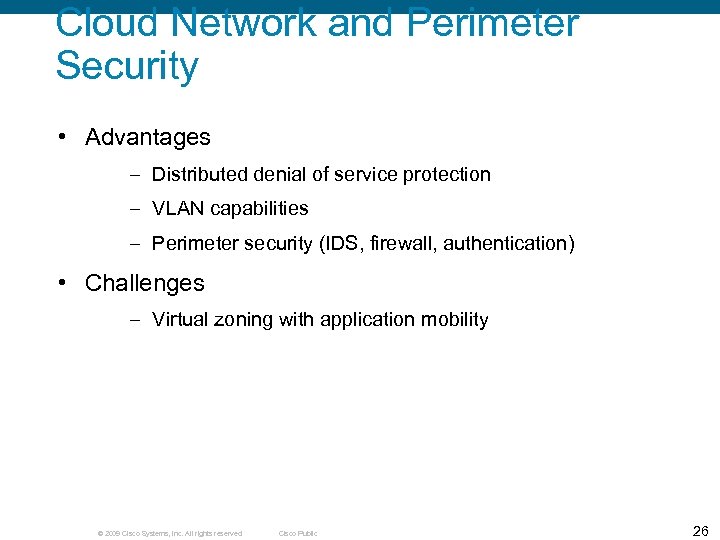
Cloud Network and Perimeter Security • Advantages – Distributed denial of service protection – VLAN capabilities – Perimeter security (IDS, firewall, authentication) • Challenges – Virtual zoning with application mobility © 2009 Cisco Systems, Inc. All rights reserved. Cisco Public 26
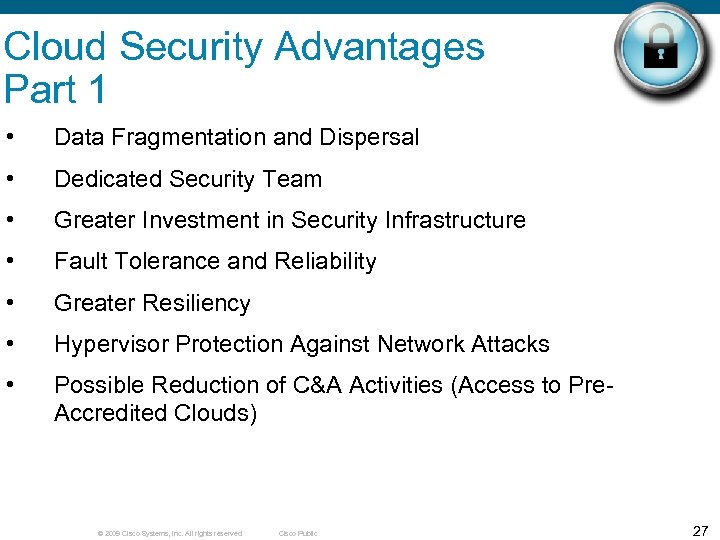
Cloud Security Advantages Part 1 • Data Fragmentation and Dispersal • Dedicated Security Team • Greater Investment in Security Infrastructure • Fault Tolerance and Reliability • Greater Resiliency • Hypervisor Protection Against Network Attacks • Possible Reduction of C&A Activities (Access to Pre. Accredited Clouds) © 2009 Cisco Systems, Inc. All rights reserved. Cisco Public 27
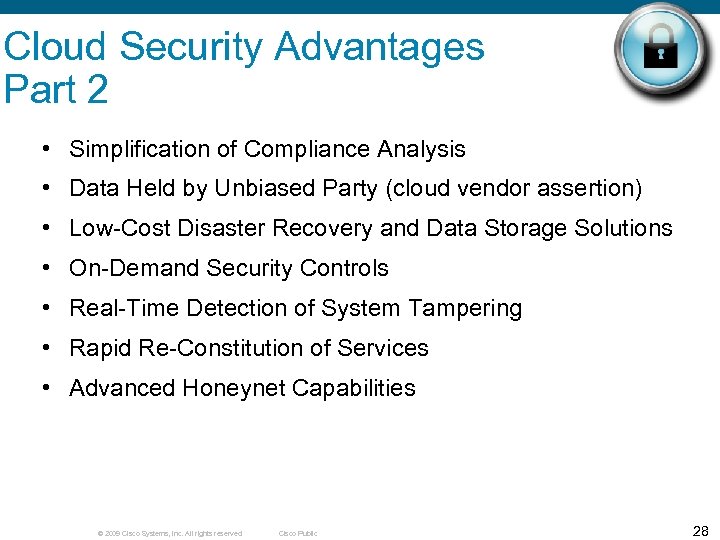
Cloud Security Advantages Part 2 • Simplification of Compliance Analysis • Data Held by Unbiased Party (cloud vendor assertion) • Low-Cost Disaster Recovery and Data Storage Solutions • On-Demand Security Controls • Real-Time Detection of System Tampering • Rapid Re-Constitution of Services • Advanced Honeynet Capabilities © 2009 Cisco Systems, Inc. All rights reserved. Cisco Public 28
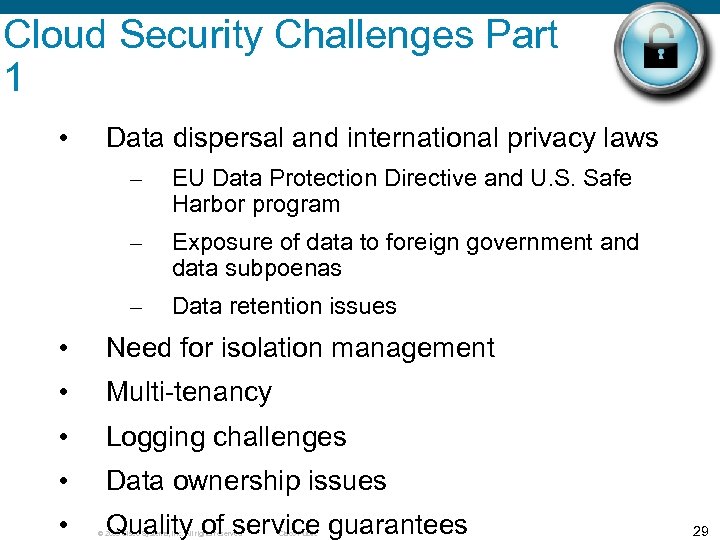
Cloud Security Challenges Part 1 • Data dispersal and international privacy laws – EU Data Protection Directive and U. S. Safe Harbor program – Exposure of data to foreign government and data subpoenas – Data retention issues • Need for isolation management • Multi-tenancy • Logging challenges • Data ownership issues • Quality of service guarantees © 2009 Cisco Systems, Inc. All rights reserved. Cisco Public 29
Cloud Security Challenges Part 2 • Dependence on secure hypervisors • Attraction to hackers (high value target) • Security of virtual OSs in the cloud • Possibility for massive outages • Encryption needs for cloud computing – Encrypting access to the cloud resource control interface – Encrypting administrative access to OS instances – Encrypting access to applications – Encrypting application data at rest © 2009 Cisco Systems, Inc. All rights reserved. Cisco Public 30
Additional Issues • Issues with moving PII and sensitive data to the cloud – • Using SLAs to obtain cloud security – – • • Privacy impact assessments Suggested requirements for cloud SLAs Issues with cloud forensics Contingency planning and disaster recovery for cloud implementations Handling compliance – – FISMA HIPAA SOX PCI © 2009 Cisco Systems, Inc. All rights reserved. Cisco Public 31
Secure Migration Paths for Cloud Computing 32
The ‘Why’ and ‘How’ of Cloud Migration • There are many benefits that explain why to migrate to clouds – Cost savings, power savings, green savings, increased agility in software deployment • Cloud security issues may drive and define how we adopt and deploy cloud computing solutions © 2009 Cisco Systems, Inc. All rights reserved. Cisco Public 33
Balancing Threat Exposure and Cost Effectiveness • Private clouds may have less threat exposure than community clouds which have less threat exposure than public clouds. • Massive public clouds may be more cost effective than large community clouds which may be more cost effective than small private clouds. • Doesn’t strong security controls mean that I can adopt the most cost effective approach? © 2009 Cisco Systems, Inc. All rights reserved. Cisco Public 34
Cloud Migration and Cloud Security Architectures • Clouds typically have a single security architecture but have many customers with different demands – Clouds should attempt to provide configurable security mechanisms • Organizations have more control over the security architecture of private clouds followed by community and then public – This doesn’t say anything about actual security • Higher sensitivity data is likely to be processed on clouds where organizations have control over the security model © 2009 Cisco Systems, Inc. All rights reserved. Cisco Public 35
Putting it Together • Most clouds will require very strong security controls • All models of cloud may be used for differing tradeoffs between threat exposure and efficiency • There is no one “cloud”. There are many models and architectures. • How does one choose? © 2009 Cisco Systems, Inc. All rights reserved. Cisco Public 36
Migration Paths for Cloud Adoption • Use public clouds • Develop private clouds – Build a private cloud – Procure an outsourced private cloud – Migrate data centers to be private clouds (fully virtualized) • Build or procure community clouds – Organization wide Saa. S – Paa. S and Iaa. S – Disaster recovery for private clouds • Use hybrid-cloud technology © 2009 Cisco Systems, Inc. All rights reserved. Cisco Public 37
Possible Effects of Cloud Computing • Small enterprises use public Saa. S and public clouds and minimize growth of data centers • Large enterprise data centers may evolve to act as private clouds • Large enterprises may use hybrid cloud infrastructure software to leverage both internal and public clouds • Public clouds may adopt standards in order to run workloads from competing hybrid cloud infrastructures © 2009 Cisco Systems, Inc. All rights reserved. Cisco Public 38
© 2009 Cisco Systems, Inc. All rights reserved. Cisco Public 38
Скачать презентацию 雲端世代的 資訊安全防護 張晃崚 CCIE 13673 麟瑞科技 區域銷售事業處
84b1992376f642f37f8c5fee5d33fc46.ppt