 Скачать презентацию 開始 SPECIALIZATION BRIEFING May 30 2014 Curtis
f1289141ba833238222c217bca1ae65a.ppt
- Количество слайдов: 102




開始


SPECIALIZATION BRIEFING May 30, 2014 Curtis L. Harrington The PATENTAX 浪人 Harrington & Harrington Box No. 91719 Long Beach, CA 90809 -1719 (562) 594 -9784 curt@patentax. com http: //www. patentax. com
DISCLAIMER-Educational Only This Power Point Presentation is Educational Only and no part of this presentation can be considered as anything other than my own personal opinion
INDEX 1. Resistance 2. Pro-Specialization 3. Advertising Entanglement 4. Certification Objectives 5. Specialization Today 6. Restricted Practice
RESISTANCE An independent, egalitarian & unitary bar is such that members of the bar are expected to perform any type of legal work competently. All lawyers are presumed competent.
RESISTANCE Specialization would be a formal acknowledgement of the differences among bar members & have a negative effect upon competition within the profession.
RESISTANCE Reluctance to undertake the rigors and costs of creating and maintaining a specialization program.
RESISTANCE The overarching fear that in the long term, specialization might raise standards in an area and create a de facto barrier to practice in that area.
RESISTANCE Concern that specialization might destroy cohesiveness of the bar and harm camaraderie.
RESISTANCE Specialization might lead to the formation of outside groups and voluntary specialty bar associations that might compete with or oppose the state bars.
RESISTANCE Specialization might effectively become a trade association, rather than a professional society.
RESISTANCE Fear that certified specialists might be perceived by the public as “better than” unspecialized general attorneys by the general public.
RESISTANCE Fear that as more and more lawyers became specialized that the public might be “deprived” of the availability of “good generalist lawyers. ”
RESISTANCE Specialists might “charge more” than non-specialists and thereby increase a consumer’s legal costs.
PRO-SPECIALIZATION As areas of the law have become increasingly complex, the need for specialization has increased.
PRO-SPECIALIZATION Protection of the public and the bar via an ability to identify practitioners who are well versed in a given area.
PRO-SPECIALIZATION Easier access and identification of lawyers having particular specialization abilities and experience.
PRO-SPECIALIZATION Some indication of lawyer differentiation for public consumption by a person or organization independent of the representations of the attorney.
ADVERTISING ENTANGLEMENT Providing some indication to the public of differentiation of specialists & non-specialists, some communication (gasp) “Advertising” might occur.
ADVERTISING ENTANGLEMENT The goal of easier access to excellent attorneys practically will occur only by advertising within channels likely to reach the target public segment for that specialization area.
ADVERTISING ENTANGLEMENT Given free speech, effective control over specialization advertising is achieved by controlling some statutory “magic words” & otherwise punishing outrageous content.
CERTIFICATION OBJECTIVES Specialists are given an opportunity to show: Knowledge Competence

CERTIFICATION OBJECTIVES Specialists are given an opportunity to show: Educational Qualifications
CERTIFICATION OBJECTIVES Specialists are given an opportunity to show: Substantial Involvement in the Specialty Area of Law
CERTIFICATION OBJECTIVES Specialists are given an opportunity to show: Peer Acceptance (hopefully competence rather than resentment)

CERTIFICATION OBJECTIVES Specialists are given an opportunity to show: Continued Specialist Qualification & Knowledge via Continuing Education

CERTIFICATION OBJECTIVES Periodic Re-Testing? (Gasp!) Well, Enrolled Agents were offered a chance to take the exam again instead of showing continuing education. This might be a time saver for the super-smart
CERTIFICATION OBJECTIVES Specialists are given an opportunity to show: That Standards for recognition of Specialist Status have been met.
CERTIFICATION OBJECTIVES Specialists are given an opportunity to show: That Grounds for decertification don’t apply.
SPECIALIZATION TODAY My wife Ann volunteered to have a conversation with states that do not currently have a specialization program. We provided our contact data & notes to ABA.

SPECIALIZATION TODAY U. S. Jurisdictions that do not currently have a specialization program:
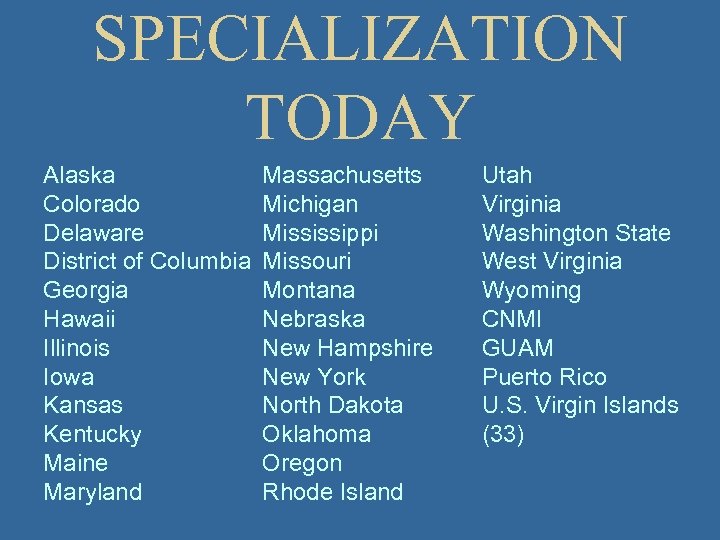
SPECIALIZATION TODAY Alaska Colorado Delaware District of Columbia Georgia Hawaii Illinois Iowa Kansas Kentucky Maine Maryland Massachusetts Michigan Mississippi Missouri Montana Nebraska New Hampshire New York North Dakota Oklahoma Oregon Rhode Island Utah Virginia Washington State West Virginia Wyoming CNMI GUAM Puerto Rico U. S. Virgin Islands (33)
SPECIALIZATION TODAY CANADA (geo-predictor) Ontario: Yes (Law Society of Upper Canada) Other Provinces: No.
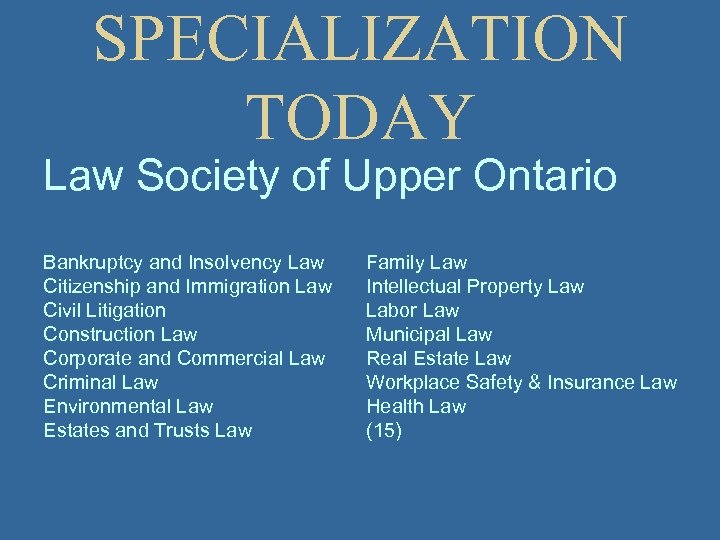
SPECIALIZATION TODAY Law Society of Upper Ontario Bankruptcy and Insolvency Law Citizenship and Immigration Law Civil Litigation Construction Law Corporate and Commercial Law Criminal Law Environmental Law Estates and Trusts Law Family Law Intellectual Property Law Labor Law Municipal Law Real Estate Law Workplace Safety & Insurance Law Health Law (15)
SPECIALIZATION TODAY Disclaimers: (1) Its sometimes difficult to characterize a specialty as a single specialty where the state direct program either has it divided into two sub specialties (FL includes both Business Litigation & Civil Trial Lawyer) or subsumed into one specialty (CA Appellate includes both criminal and civil) (2) My source is the public web sites, without too much further investigation.
SPECIALIZATION TODAY Disclaimers: (3) Divided state programs into categories I consider to: (A) Have no program & no recognition of specialization (B) Have no program & permitted recognition of specialization by the individual attorney if it is not misleading (C) Have a self administered specialty (D) Have official recognition of outside administered specialties (E) A combination of (C) and (D) So, overlap should be factored into perception of the data.

SPECIALIZATION TODAY Disclaimers: (4) Because outside administered specialty programs are: (A) Typically pre-existing, pre-packaged & have known cost & (B) May be typically introduced into a state’s outside administered programs as a further addition, The number and order of addition of a state’s outside administered program is expected to: (A) Reflect a lowered threshold for participation and demand in order to be adopted, and (B) Not give as much of an indication on the direction for the identity of the next self administered specialty
SPECIALIZATION TODAY Disclaimers: (5) Self-Administered is defined as the ability to become certified without having to either seek or contact a 3 rd party certification or exam provider. (6) Some specialization providers offer a waiver of examination based upon certification before another organization. If an applicant “CAN” possibly meet the exam requirements without contacting a national certifier / exam giver, they count as a self-administered program.
SPECIALIZATION TODAY Disclaimers: (7) Since the object is to measure the frequency of completely self-administered specialties: (a) Where a self administering jurisdiction offers both selfadministered programs and non-self administered programs, the non-self administered programs are ignored. (b) Where a jurisdiction offers the same type of specialty as an externally administered program and a self administered program, the externally administered programs are ignored.
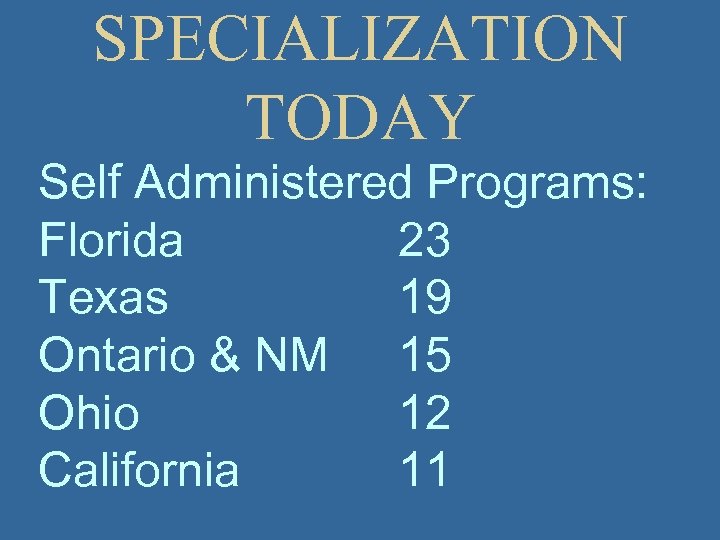
SPECIALIZATION TODAY Self Administered Programs: Florida 23 Texas 19 Ontario & NM 15 Ohio 12 California 11
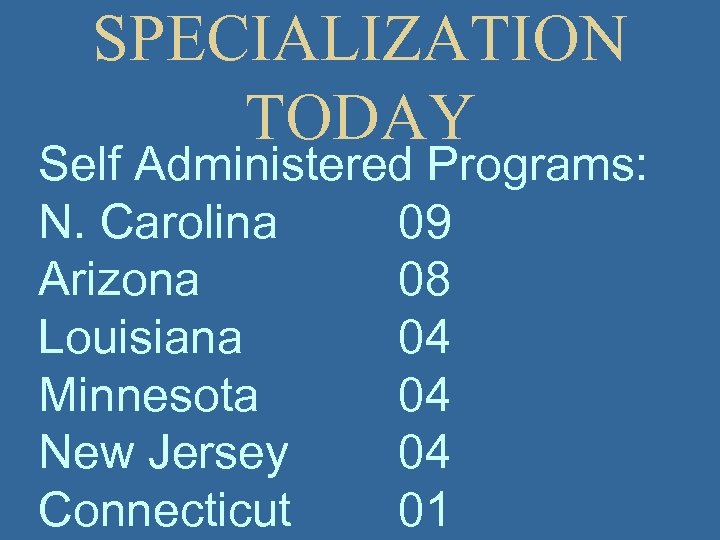
SPECIALIZATION TODAY Self Administered Programs: N. Carolina 09 Arizona 08 Louisiana 04 Minnesota 04 New Jersey 04 Connecticut 01

SPECIALIZATION TODAY Self Administered Programs: New Mexico 15 Caveat: No Exams given just application and payments
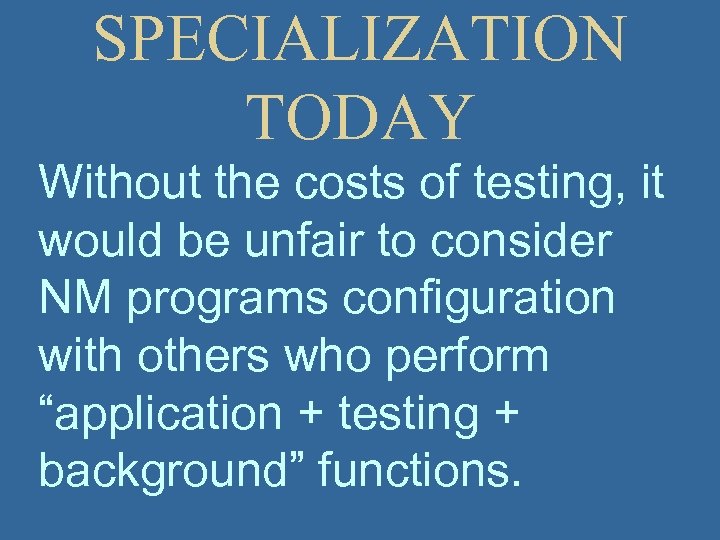
SPECIALIZATION TODAY Without the costs of testing, it would be unfair to consider NM programs configuration with others who perform “application + testing + background” functions.
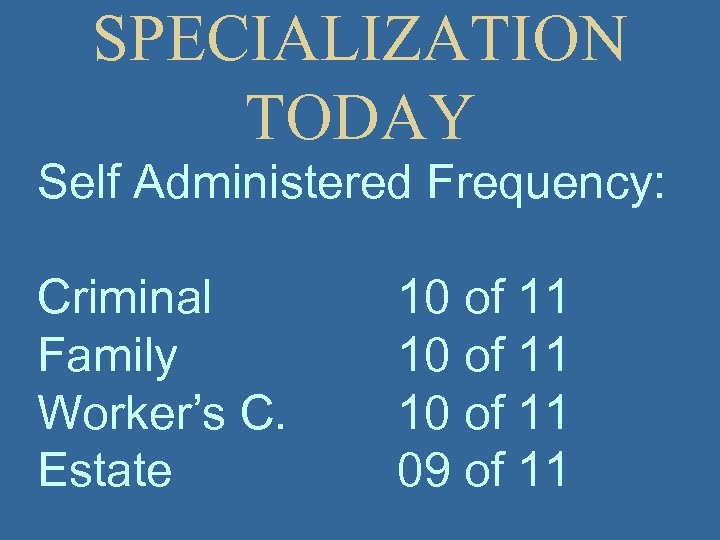
SPECIALIZATION TODAY Self Administered Frequency: Criminal Family Worker’s C. Estate 10 of 11 09 of 11
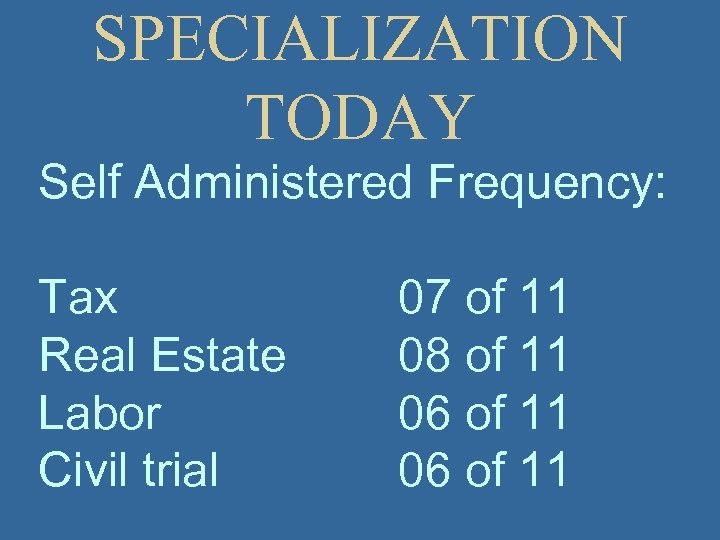
SPECIALIZATION TODAY Self Administered Frequency: Tax Real Estate Labor Civil trial 07 of 11 08 of 11 06 of 11
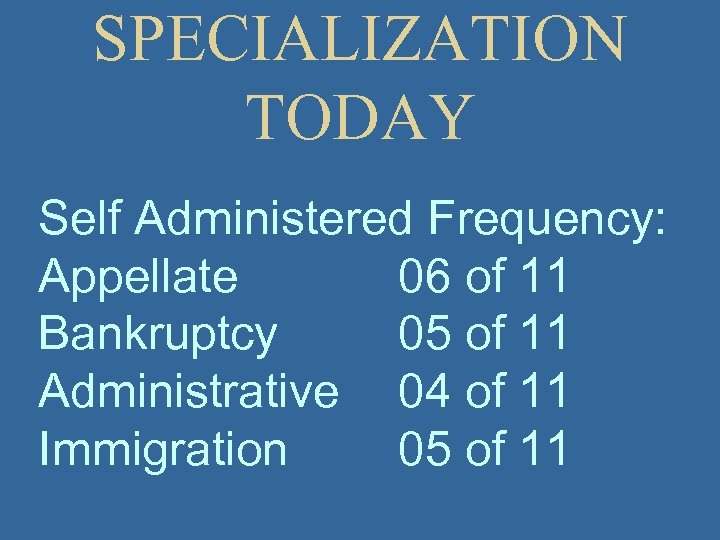
SPECIALIZATION TODAY Self Administered Frequency: Appellate 06 of 11 Bankruptcy 05 of 11 Administrative 04 of 11 Immigration 05 of 11
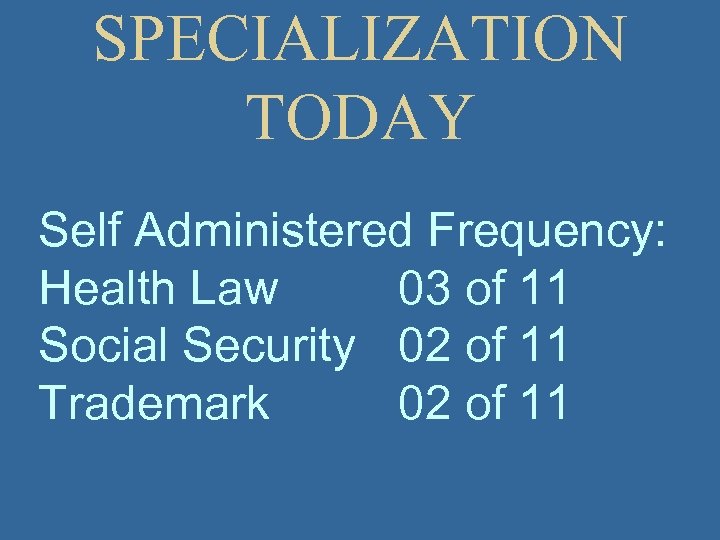
SPECIALIZATION TODAY Self Administered Frequency: Health Law 03 of 11 Social Security 02 of 11 Trademark 02 of 11
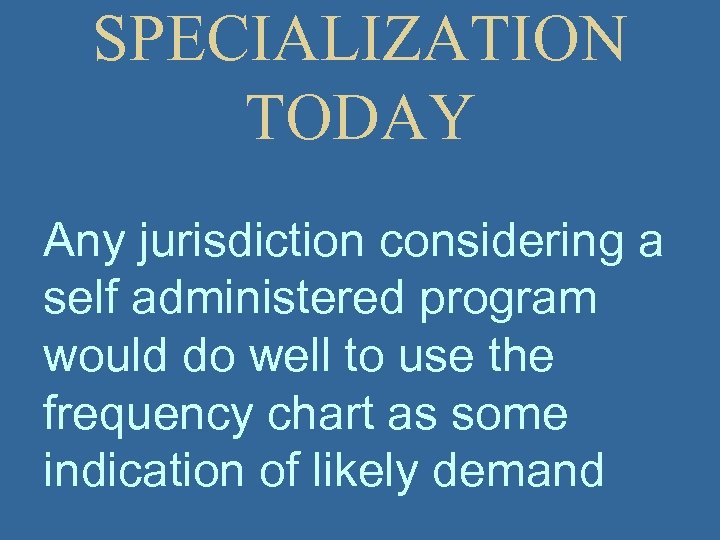
SPECIALIZATION TODAY Any jurisdiction considering a self administered program would do well to use the frequency chart as some indication of likely demand
SPECIALIZATION TODAY The chart might be a composite reflection of: 1. Number of Attorneys interested in the specialty. 2. Ease of the area of law
SPECIALIZATION TODAY The chart might be a composite reflection of: 3. Lack of volatility in those areas of law 4. Attorneys interested in the specialty.
SPECIALIZATION TODAY The chart might be a composite reflection of: 5. Specificity of the law area to the state, AND the lack of universality of the law area to other jurisdictions.
SPECIALIZATION TODAY The chart might be a composite reflection of: 6. Importance of the law area to the health, safety & welfare of the state and the need to INSURE attorney familiarity with local law & procedure.
SPECIALIZATION TODAY Advantages of Self Administered Programs (1) The program can be much more closely integrated with & test upon state law specific rules. Best public protection is to insure that locals have access to local law experts.
SPECIALIZATION TODAY Advantages of Self Administered Programs (2) Economic Incentive Control by the ability to influence local rules, statutes and traditions. Example, in California worker’s comp specialists receive additional compensation.
SPECIALIZATION TODAY Advantages of Self Administered Programs (3) Statistical Control: a) Ability to test many specialties in a common format for comparison & adjustment. b) Employ the use of data to defend pass rates & policies.
SPECIALIZATION TODAY Advantages of Self Administered Programs (3) Statistical Control cont’d: c) Ability to grandfather new specialists to start new specialties. d) Ability to quickly adjust the test syllabi to changes in the law.
SPECIALIZATION TODAY Advantages of Self Administered Programs (3) Statistical Control cont’d: e) Control the depth of testing. f) Ability to interrelatedly manage program budgets. g) Greater propensity to drop specialties with no demand.
SPECIALIZATION TODAY Advantages of National & International jurisdiction Programs (1) Inexpensive to implement (2) Extensive overhead coverage (3) Better Match for National Law areas (e. g. Social Security Law, Federal Criminal Law, ERISA, , , )
SPECIALIZATION TODAY (survey) We sent out a survey which included five questions to each of he 33 jurisdictions that had no specialization. Only 6 responded. The Results, which may not surprise you, are: “Not only does the hinterland not care about legal specialization, they don’t generally care to discuss it, and they would prefer not to be surveyed about it.
SPECIALIZATION TODAY (survey) 1. What has been the largest barrier to installing a specialization program in your state? 2. What indications do you have regarding consumer demand in your state for a trustworthy legal specialist credential? 3. What efforts have been made to perform surveys to gauge consumer demand for attorney specialization? 4. If you were to adopt a specialization program, what area of specialization do you believe is the most important, and why? 5. If specialization area content and an exam bank were available for your state was available, to what extent would it encourage adoption of a program for that most important specialty (from question 4)your state? (Very)(unknown)(not at all)
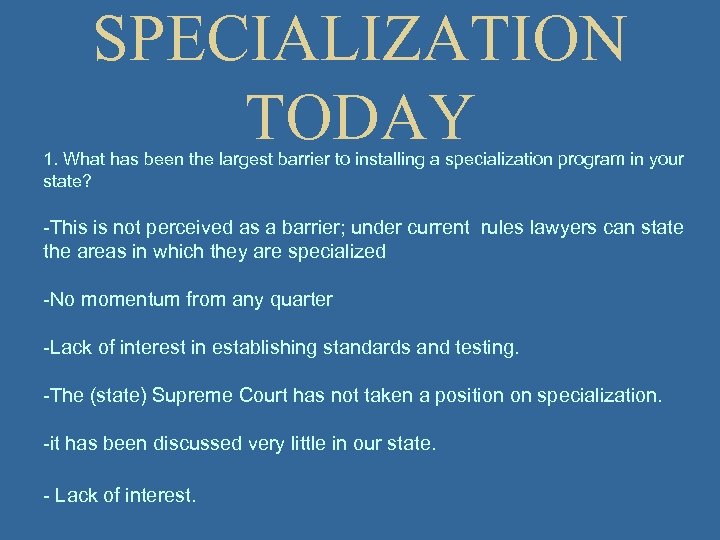
SPECIALIZATION TODAY 1. What has been the largest barrier to installing a specialization program in your state? -This is not perceived as a barrier; under current rules lawyers can state the areas in which they are specialized -No momentum from any quarter -Lack of interest in establishing standards and testing. -The (state) Supreme Court has not taken a position on specialization. -it has been discussed very little in our state. - Lack of interest.

SPECIALIZATION TODAY 2. What indications do you have regarding consumer demand in your state for a trustworthy legal specialist credential? -None I'm aware of - none - None - none - No indications that there is a demand.
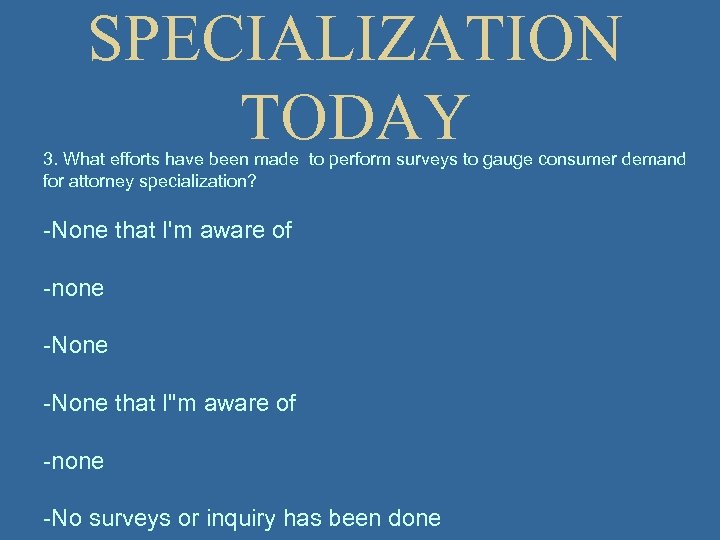
SPECIALIZATION TODAY 3. What efforts have been made to perform surveys to gauge consumer demand for attorney specialization? -None that I'm aware of -none -None that I"m aware of -none -No surveys or inquiry has been done
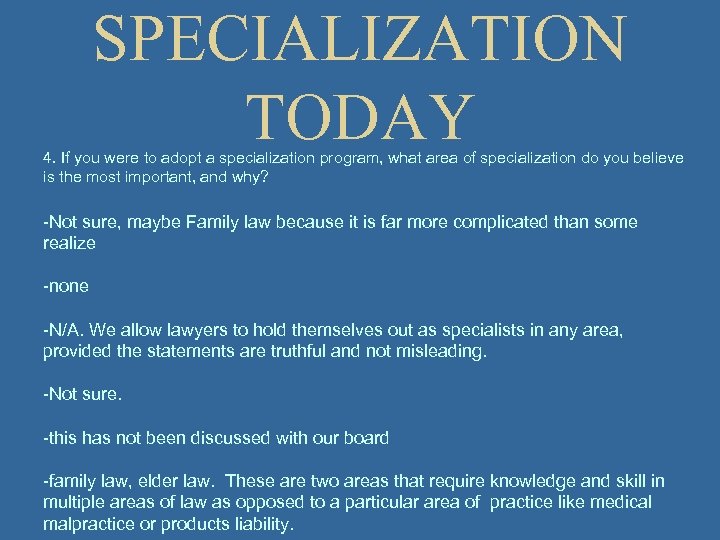
SPECIALIZATION TODAY 4. If you were to adopt a specialization program, what area of specialization do you believe is the most important, and why? -Not sure, maybe Family law because it is far more complicated than some realize -none -N/A. We allow lawyers to hold themselves out as specialists in any area, provided the statements are truthful and not misleading. -Not sure. -this has not been discussed with our board -family law, elder law. These are two areas that require knowledge and skill in multiple areas of law as opposed to a particular area of practice like medical malpractice or products liability.
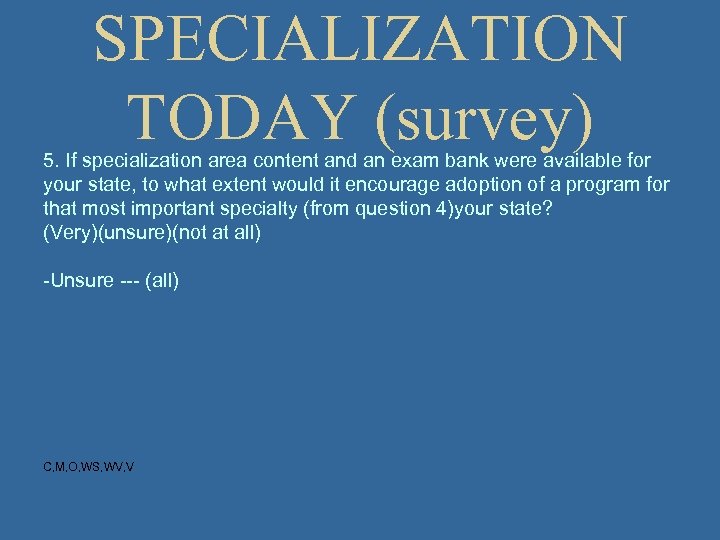
SPECIALIZATION TODAY (survey) 5. If specialization area content and an exam bank were available for your state, to what extent would it encourage adoption of a program for that most important specialty (from question 4)your state? (Very)(unsure)(not at all) -Unsure --- (all) C, M, O, WS, WV, V
SPECIALIZATION TODAY (conversation) Based upon conversations my wife Ann had with state officials, there were three states having bar officials who were (a) quite knowledgeable about specialization but (b) very skeptical that their states would undertake specialization in the near future (perhaps despite their own personal wishes and efforts to see specialization be adopted).
RESTRICTED PRACTICE Learning about specialization can also be helped by looking at what it is not, namely, restricted practice. Specialization can be thought of as more of a “blessing”/”accreditation” by some entity and proper/permitted communication of that “blessing”/”accreditation” to the public. If its some arm of the state bar, the blessing has a special perceived “state endorsed” significance.
RESTRICTED PRACTICE 3 Examples of practice restrictions: (1) Exclusive: US Patent Office (2) Non Exclusive: (a) IRS Practice (b) Tax Court Practice (c) Japan’s Certified Administrative Procedures Legal Specialist Act (1951)
RESTRICTED PRACTICE Practice before US Patent Office: Separate Exam (Patent Bar) If you pass and you are an attorney, your certificate reads “Patent Attorney” If you pass and you are not an attorney, your certificate reads “Patent Agent”
RESTRICTED PRACTICE Practice before US Patent Office: Rationale: Only individuals with a technical background that also know the rules of practice are allowed to practice. If you don’t have command of the technical aspects, you won’t have a ghost of a chance
RESTRICTED PRACTICE Sperry v. Florida. (Sperry v. Florida ex rel. Florida Bar) 373 US 379 (1963 ) Florida Bar tried to regulate & restrict a patent agent. Florida lost with prejudice. The decision is short and terse. (1) Was this person practicing law? Yes;
RESTRICTED PRACTICE Sperry v. Florida. (Sperry v. Florida ex rel. Florida Bar) 373 US 379 (1963 ) (2) Limits of practice? Do whatever is necessary to represent clients before the (Agency of Admission) Patent Office (3) Geographical practice restriction? NONE Therefore, No Local Law regulation of federal practice
RESTRICTED PRACTICE (1) Non Exclusive: IRS Practice (a) Attorneys: Any state or territorial bar (b) Certified Public Accountants any state or territory (c) Enrolled Agents- Anyone who takes the IRS Enrolled Agent Exam (18+)
RESTRICTED PRACTICE (2) Non Exclusive: IRS Practice (d) IRS Enrolled Plan Agents (ERISA) (e) IRS Enrolled Actuaries (ERISA) (3) Territory (a) Attorneys & CPA’s eligibility controlled by their states & territories of practice (b) Enrolled Agents / Actuaries can be anywhere (Sperry) (Japan Soc. of IRS EA’s)
RESTRICTED PRACTICE (1) Non Exclusive: U. S. Tax Court Practice (a) Attorneys: Any state or territorial bar can be admitted on application & fee (b) ANYONE over 18 years old can take the Tax Court Admission Examination & practice before the U. S. Tax Court. (2 y) (c) Territory: Anywhere (Sperry)

RESTRICTED PRACTICE (1) Non Exclusive: Japan’s Certified Administrative Procedures Legal Specialist Act (1951) 行政書士 (gyou sei shoshi) (a)A person who has passed the Certified Administrative Procedures Legal Specialist Examination; (b)A person who is qualified to be an Attorney at law; (c)A person who is qualified to be a Patent Attorney
RESTRICTED PRACTICE Japan’s Certified Administrative Procedures Legal Specialist Act (cont’d) (d) A person who is qualified to be a Certified Public Accountant; (e) A person who is qualified to be a Tax Accountant; or, (f) The head employee of a unit of national or local government.
RESTRICTED PRACTICE Japan’s Certified Administrative Procedures Legal Specialist Act (cont’d) (2) Purpose ensure the appropriateness of business, contribute to the smooth enforcement of administrative procedures, & for the convenience of citizens (3) Territory Very localized by Prefecture + district
RESTRICTED ADVERTISING I am fortunate to have been a Texas Attorney present in Texas at a time when attorney restrictions were severe, and just after Texas Legal Specialization was getting traction. My remembrances of starting practice there in 1983 probably cause me to focus more on Texas than I should
RESTRICTED ADVERTISING Texas Ethics Canon 39 (to 1972) PROFESSIONAL CARD. The professional card of a member may with propriety contain only a statement of the member's name (and the names of lawyers associated with him), profession, address, telephone number, and special branches of the profession practiced. “Special branches” submitted were regularly refused.
RESTRICTED ADVERTISING Texas Ethics OPINION 418 – Oct. 1984 Questions Presented : May a lawyer place in a “public advertisement” of his degrees earned, the area of study of each degree, the school attended & date of graduation? advertising media, printed media, radio or TV , mail; newspapers; magazines; telephone directories; legal directories and law lists. – Sure; BUT
RESTRICTED ADVERTISING Texas Ethics OPINION 418 – Oct. 1984 Con’td: DR 2‑ 102: A lawyer or law firm shall not use professional cards except name as a lawyer, address, telephone numbers & name of firm. Business card is not an advertisement…. (Drat!!) Information of DR 2‑ 105. (patents and admiralty) or DR 2 -102(A)(6) legal directory is ok.
RESTRICTED ADVERTISING Texas Ethics OPINION 418 – Oct. 1984 Con’td – Language that funnels info beyond tombstone language on ads (& maybe cards) directly to specialization: DR 2‑ 101(C) permits description of a practice (which is perhaps on a card or ad), but requires an accompanying statement with regard to each area:

RESTRICTED ADVERTISING Texas Ethics OPINION 418 – Oct. 1984 Con’td – If the attorney advertises an area of law in which he has a Texas Board of Legal Specialization Certificate of Special Competence, he must state: "Board Certified, (specific area of specialization) Texas Board of Legal Specialization. " If he is not Board certified, he must state, "Not Certified by the Texas Board of Legal Specialization. "
RESTRICTED ADVERTISING Texas Rules of Disciplinary Conduct 1990 An ad that designates an area of practice is not false or misleading unless competence is lacking But certification conclusively establishes (competence) in the areas certified. (Nice). . (and it blocks a charge of incompetence)
RESTRICTED ADVERTISING Texas Rules of Disciplinary Conduct 1990 (2) shall not include a statement that the lawyer has been certified or designated by an organization as possessing special competence or a statement that the lawyer is a member of an organization the name of which implies that its members possess special competence, except that:
RESTRICTED ADVERTISING Texas Rules of Disciplinary Conduct 1990 (i) a lawyer who has been awarded a Certificate of Special Competence by the Texas Board of Legal Specialization in the area so advertised, may state with respect to each such area, "Board Certified, [area of specialization] - Texas Board of Legal Specialization; " and
RESTRICTED ADVERTISING Texas Rules of Disciplinary Conduct 1990 (ii) a lawyer who is a member of an organization the name of which implies that its members possess special competence, or who has been certified or designated by an organization as possessing special competence, may include a factually accurate statement of such membership or may include a factually accurate statement, "Certified [area of specialization] [name of certifying organization], " but such statements may be made only if that organization has been accredited by the Texas Board of Legal Specialization as a bona fide organization that admits to membership or grants certification only on the basis of objective, exacting, publicly available standards (including high standards of individual character, conduct, and reputation) that are reasonably relevant to the special training or special competence that is implied and that are in excess of the level of training and competence generally required for admission to the Bar; and ….

RESTRICTED ADVERTISING California Rules of Professional Conduct Rule 1 -400: Advertising and Solicitation (D) A communication or a solicitation (as defined herein) shall not: (6) State that a member is a “certified specialist” unless the member holds a current certificate as a specialist issued by the Board of Legal Specialization, or any other entity accredited by the State Bar to designate specialists pursuant to standards adopted by the Board of Governors, and states the complete name of the entity which granted certification.
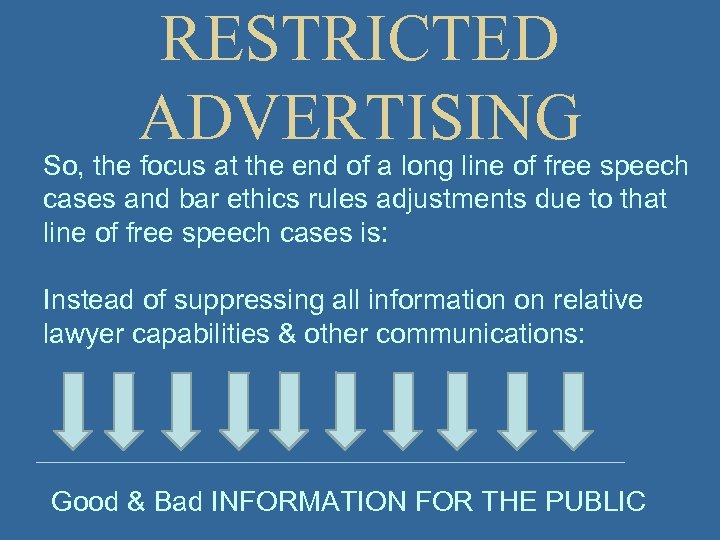
RESTRICTED ADVERTISING So, the focus at the end of a long line of free speech cases and bar ethics rules adjustments due to that line of free speech cases is: Instead of suppressing all information on relative lawyer capabilities & other communications: Good & Bad INFORMATION FOR THE PUBLIC
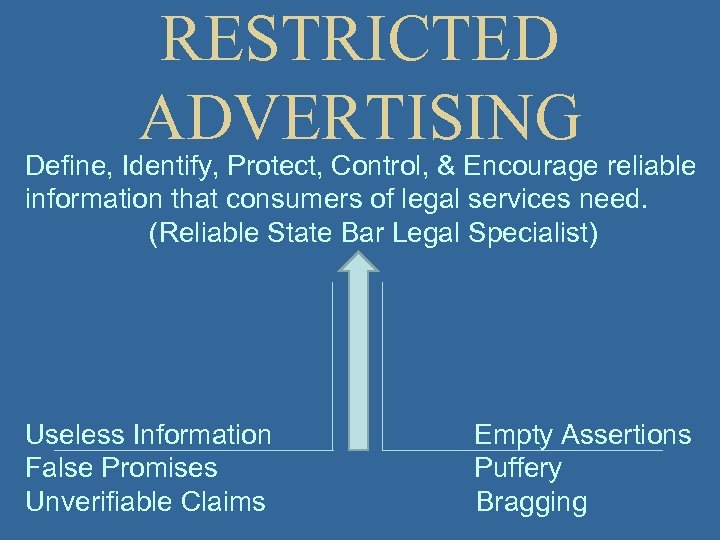
RESTRICTED ADVERTISING Define, Identify, Protect, Control, & Encourage reliable information that consumers of legal services need. (Reliable State Bar Legal Specialist) Useless Information False Promises Unverifiable Claims Empty Assertions Puffery Bragging
RESTRICTED ADVERTISING These past few slides emphasize a transition from negative suppression of anything “positive”, to a permissive allowability only of selected, controlled and defined “positive” aspects above minimum practice levels. Changes in 1 st Amendment commercial speech law were such that there would either be no regulation, OR that regulation would be directed into specialization…
RESTRICTED ADVERTISING The Cases: Bates & O’Steen v. State Bar of Arizona 433 U. S. 350 (1977): Permitted Attorney advertising, but was somewhat vague about the limits of control. In re R. M. J. 455 U. S. 491 (1982), the court struck down restrictions on formulaic words, jurisdictions of practice & announcements.
RESTRICTED ADVERTISING The Cases: Peel v. Attorney Registration and Disciplinary Comm’n of Ill. , 496 U. S. 91 (1990). Petitioner Peel is (1) licensed in Illinois, Missouri, & Arizona, " , (2) has a "Certificate in Civil Trial Advocacy" from the National Board of Trial Advocacy (NBTA) , & shows both on his letterhead.

RESTRICTED ADVERTISING The Cases: Peel v. Illinois, cont’d: The two statements on his letterhead triggered a charge of “holding himself out as a certified legal specialist because the public could confuse the State and NBTA as the sources of his license to practice & his certification, AND the certification could be read as a claim of superior quality.
RESTRICTED ADVERTISING The Cases: Peel v. Illinois, cont’d: Held: (1) not actually or inherently misleading, (2) facts stated on his letterhead are true & verifiable, and (3) there has been no finding of actual deception or misunderstanding. implied "claim" as to the "quality" of Peel's legal services confuses the distinction
RESTRICTED ADVERTISING The Cases: Peel v. Illinois, cont’d: “Implied "claim" as to the "quality" of Peel's legal services confuses the distinction between statements of opinion or quality and statements of objective facts that may support an inference of quality. ” In other words, facts establishing a potential for quality are not indicative quality will occur.

RESTRICTED ADVERTISING The Cases: IBANEZ v. FLORIDA DEPARTMENT OF BUSINESS AND PROFESSIONAL REGULATION, BOARD OF ACCOUNTANCY 512 U. S. 136 (1994). Attorney, CPA, CFP used these designations in ads, on business cards and stationery. Despite its truth, the Board reprimanded for “false, deceptive,
RESTRICTED ADVERTISING The Cases: Ibanez v Florida. . cont’d Florida Board alleged that the words used in the designation—particularly, the word “certified”—so closely resemble “the terms protected by state licensure itself, ” that their unappoved use inherently misleads the public into believing that state approval and recognition exists. ”
RESTRICTED ADVERTISING The Cases: Ibanez v Florida. . cont’d Held: “On the bare record made in this case, the Board has not shown that the restrictions burden no more of Ibanez’ constitutionally protected speech than necessary. ”

終
Скачать презентацию 開始 SPECIALIZATION BRIEFING May 30 2014 Curtis
f1289141ba833238222c217bca1ae65a.ppt