 Скачать презентацию 软 件 程 Software Engineering 主讲教师 鹿旭东 Instructor Lu
a132a147611629dfceddca61e7029e35.ppt
- Количество слайдов: 61



软 件 程 Software Engineering 主讲教师:鹿旭东 Instructor: Lu Xudong E-mail : dongxul@sdu. edu. cn 13708938881 1
Software Engineering Introduction (to this lesson) 2 The position or role of the SE(软件 程地位及角色) oversea: two degrees ----computer science and technology ----software engineering [SE] (see the websites of famous universities) domestic: ----more important than ever as an industry (行业) ----finding a job or obtain employment actuality: SE have standard: CMM---certification (资质) of software construction in international market.
Software Engineering CMM现状(2004年 4月) § 中国,162家。2002年 8月还是 37家,2003年 4月73家 v 5级 7家(包括独资、合资等) § 印度,330家。2002年 8月他们的数据是 187家, 2003年 4月238家。 § 5级 60家(印度本土) § 美国现在有1838家,2003年 4月份时为 1671家 § 5级? 家 CMM现状(2006年 6月) § 5级 11家(包括独资、合资等) 3
Software Engineering 4 Extent and Arrangement(授课范围与安排) A: Advantage B: Arrangement part 1: chapter 1 – 3(introduction、project plan and management) part 2: chapter 4– 11(major steps in process ) part 3: chapter 12– 14(evaluation、improvement) C: Focus on ----examples D: Goal : excellent (Analyst and Designer ? ) or Project Manager E: manifesto: good exercise example will be awarded !
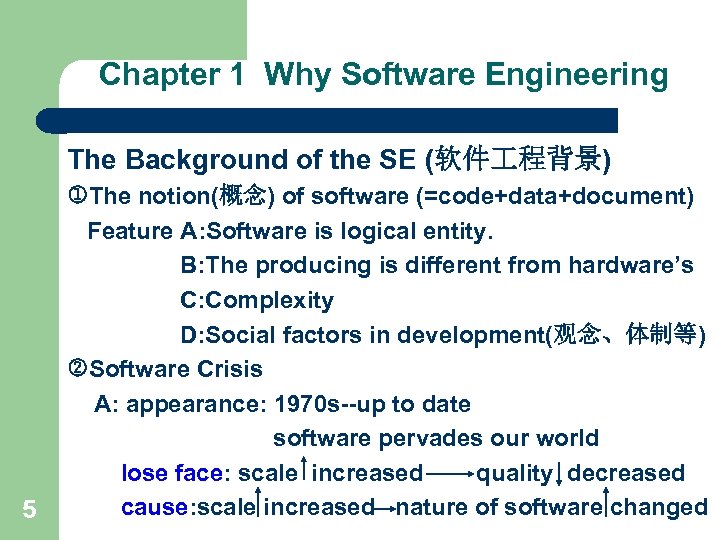
Chapter 1 Why Software Engineering The Background of the SE (软件 程背景) 5 The notion(概念) of software (=code+data+document) Feature A: Software is logical entity. B: The producing is different from hardware’s C: Complexity D: Social factors in development(观念、体制等) Software Crisis A: appearance: 1970 s--up to date software pervades our world lose face: scale increased quality decreased cause: scale increased nature of software changed
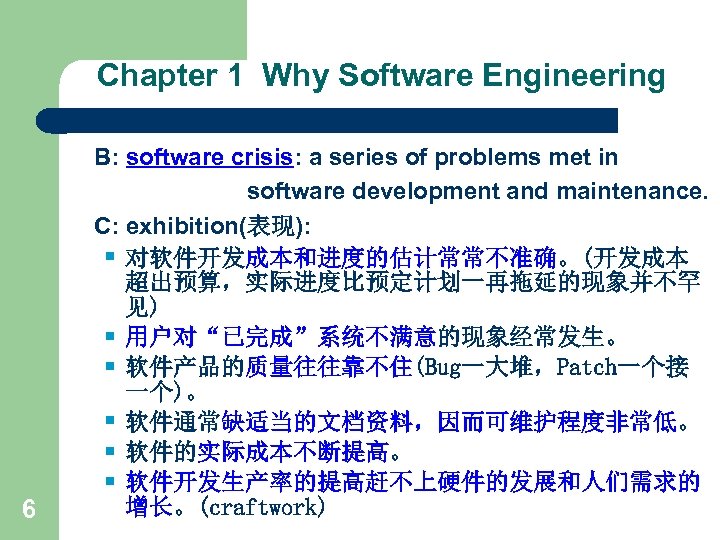
Chapter 1 Why Software Engineering 6 B: software crisis: a series of problems met in software development and maintenance. C: exhibition(表现): § 对软件开发成本和进度的估计常常不准确。(开发成本 超出预算,实际进度比预定计划一再拖延的现象并不罕 见) § 用户对“已完成”系统不满意的现象经常发生。 § 软件产品的质量往往靠不住(Bug一大堆,Patch一个接 一个)。 § 软件通常缺适当的文档资料,因而可维护程度非常低。 § 软件的实际成本不断提高。 § 软件开发生产率的提高赶不上硬件的发展和人们需求的 增长。(craftwork)
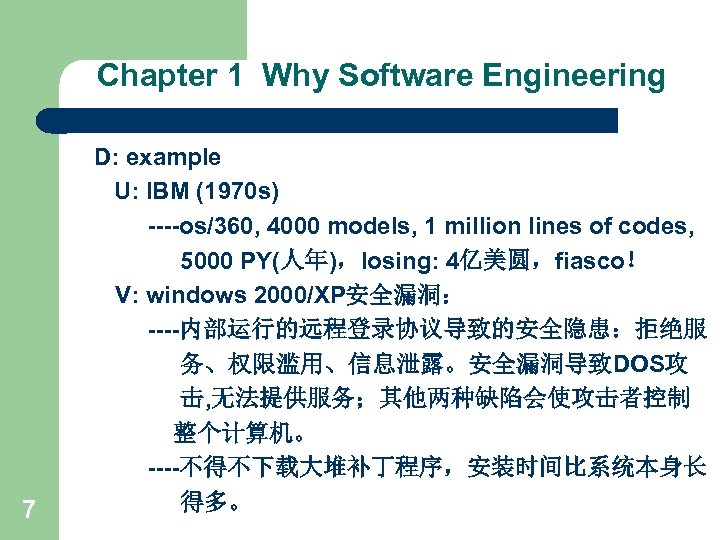
Chapter 1 Why Software Engineering 7 D: example U: IBM (1970 s) ----os/360, 4000 models, 1 million lines of codes, 5000 PY(人年),losing: 4亿美圆,fiasco! V: windows 2000/XP安全漏洞: ----内部运行的远程登录协议导致的安全隐患:拒绝服 务、权限滥用、信息泄露。安全漏洞导致DOS攻 击, 无法提供服务;其他两种缺陷会使攻击者控制 整个计算机。 ----不得不下载大堆补丁程序,安装时间比系统本身长 得多。
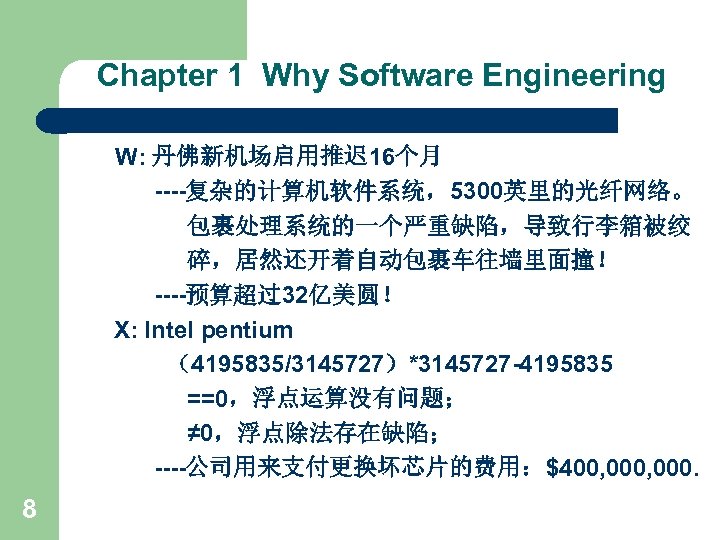
Chapter 1 Why Software Engineering W: 丹佛新机场启用推迟 16个月 ----复杂的计算机软件系统,5300英里的光纤网络。 包裹处理系统的一个严重缺陷,导致行李箱被绞 碎,居然还开着自动包裹车往墙里面撞! ----预算超过32亿美圆! X: Intel pentium (4195835/3145727)*3145727 -4195835 ==0,浮点运算没有问题; ≠ 0,浮点除法存在缺陷; ----公司用来支付更换坏芯片的费用:$400, 000. 8
Chapter 1 Why Software Engineering E: What’s the new approach ? assumption(设想)--system engineering—use in SE— --emphasize administrable developing approach (a software--several parts—detail specifications on every part—detail development—tie parts together -------high quality software ) Introduction to “ SE ”(软件 程简介) 9 A: importance ( good SE ensure high quality life) B: key issues in SE (at both theory and practice) C: goal (give solutions incorporating quality software, and consider characteristics that contribute to the quality)
Chapter 1 Why Software Engineering 10 D: approach analysis----analyze problems, examine examples of software failure or success(正反两方面). design----give solutions. developing team----peoples involved in developing, describing their roles and responsibilities. develop----realize the solutions (realize objects, activities, enclosing, etc. ) project management----divide system in parts, define process in steps, schedule control , deal with every changes, etc. .
Chapter 1 Why Software Engineering 1. 1 What is SE (什么是软件 程) SE= nature(making the problem clearly) + solution (by developing tools) Solving Problems(用系统科学的方法解决问题) 11 analyzing: large problems={ subproblems }+ { relationships } (Fig 1. 1) synthesis: composition of the individual solutions several notions: tool : instrument / automatic systems/programming environment /software tool module procedure: combination of tools, technique, method.
Chapter 1 Why Software Engineering paradigm : (model / approach / philosophy) (模式--开发软件时特定的方法或哲学) ---- 面向对象模式 ---- 结构化模式 Where does the software engineer fit in ? (软件 程师的任务) 12 task: 以计算机科学理论和计算机功能为基础,通过对要 解决问题的本质的了解,采用相应的 具和技术,实现设 计方案,推出高质量的软件产品。 SE = a method using tools and technique to solve problem (采用 具、技术等用来解决现实问题的 综合过程) (如下页图 1. 2所示)
Chapter 1 Why Software Engineering 1. 2 How successful have we been ? (软件 程方面的进展)(成就及存在的问题) Several aspects: 13 SE is an art(学问) of generating high quality software。 (include: designing art, ingenuity, skills goal: robust, efficient, easy developing and maintain) Great changes in today’s living and working Problems ( not acceptable when deliver to users ) Influence of software problems(软件问题的影响) error: a human made mistakes in software producing (misunderstand requirement, wrong codes, etc. )
Chapter 1 Why Software Engineering fault: problem in function implementation (one error----several faults) (static exist) failure: failure in running software (because of faults) ( dynamic exist) Failure Example: A: Sperry Corporation ----project: income tax form processing system ----cause: “inadequate planning”(计划不周) ----Skepticism: (fault-free software is not practical) ----Practical reason: reliability of safety-critical software----10 -9 B: radar vs. jet fighter 14 ----cause: “unanticipated use” (未能预期的使用)
Chapter 1 Why Software Engineering Zero-defect software(零缺陷软件) : ---- is impossible , because of “market forces” ⑦ Discussing about “bugs” A: fixing(改正) is more difficult than rewriting(重写) B: cost (the latter period of life cycle is more costly) C: review(复审) is very important ----is a criteria(规范) in formal developing team ----classes and statistics (分类及统计数字) v. Self check: (by running test cases) --- reveal 1/5 faults v. Peer review (by colleagues) ---- reveal 4/5 faults 15
Chapter 1 Why Software Engineering 1. 3 What is good software ? (什么是高质量软件) § Purpose (about SE)--assure software has quality and § § 16 utility (确保软件具有技术高质量和实际商业用途) What we mean by high-quality? v different perspectives----sidebar 1. 2 v different context(应用背景) have different answer about quality (P 10) conclusion : made by special issue of IEEE software on quality) v Quality of the product v Quality of the process v Business value
Chapter 1 Why Software Engineering The quality of the product(最终)产品的质量 judging quality A: users (enough functionality, easy to learn and easy to use) B: developers (internal characteristics) Figure 1. 5: The left--external quality factors(因素)(from user) The right--quality criteria(细则) (from developer) users: track number of failures, etc. developers: track number and type of faults, and faults distributing area(缺陷分布的开 发阶段区间) 17
Chapter 1 Why Software Engineering The quality of the process(软件开发及维护)过程的质量 many activities----influence the quality of final product (so, the process has the same importance) Questions in Page 11 ----只有量化的过程才能回答之! In 1990 s: modeling the process is a “pop” topic CMM----Capability Maturity Model (5 levels) Models: ISO 9000 ----(该标准影响很小) SPICE----软件过程改进和能力测定模型 A: CMU-SEI的CMM/PSP/TSP; • 美国卡纳基梅隆大学软件 程研究所 (SEI) • 能力成熟度模型(Capability Maturity Model) 18 • 个体软件过程(Personal Software Process )
Chapter 1 Why Software Engineering 19 B: ISO 9000质量标准体系 ; • 国际标准化组织 (ISO) • ISO 9003是专门为软件行业定制的 C: 以上两种质量体系都强调了软件产品的质量。 D: 区别 ----ISO 9000强调的是衡量的准则,该做什么、什么算好、 什么算不好;没有告诉软件开发人员如何达到好的目 标,如何避免差错,它实际上是由英国学院派一批没 有做过复杂系统的人制定出来的标准. (八股味道浓厚) ---- CMM则提供了一整套较为完善的软件研发项目管理 的方法。美国先后在这上面投资了5亿多美元,做了很 多实践 作来改进软件研发项目管理,而且其内容还 在不断地改进。
Chapter 1 Why Software Engineering ---- CMM亦有其缺点: ----重量级方法强调以开发过程为中心,而不是以人为中心,这 在中国有点“水土不服”。 ----CMM/CMMI的评估耗资不菲:一个CMM 2级评估就可能达到 数百万之巨,而且耗时很长,过程十分复杂,常常导致效果不太理想。 不少企业的认证流于形式,评估完成后就只留下一大堆文档,而真正 的软件开发过程却依然故我。而且,CMM/CMMI只告诉我们应该怎么 做,而没有具体地告诉如何做。比如说,它要求必须改进需求管理, 那么到底该如何做需求管理?CMM/CMMI没有提供答案。 20 E: question--How the software development organization update their CMM level ? (CMM等级评价的实测过程之一: 检查 5个大 的代表性项目,几十个一般性项目,随机抽取 项目 组成员然后 “克隆”一个项目全过程。)
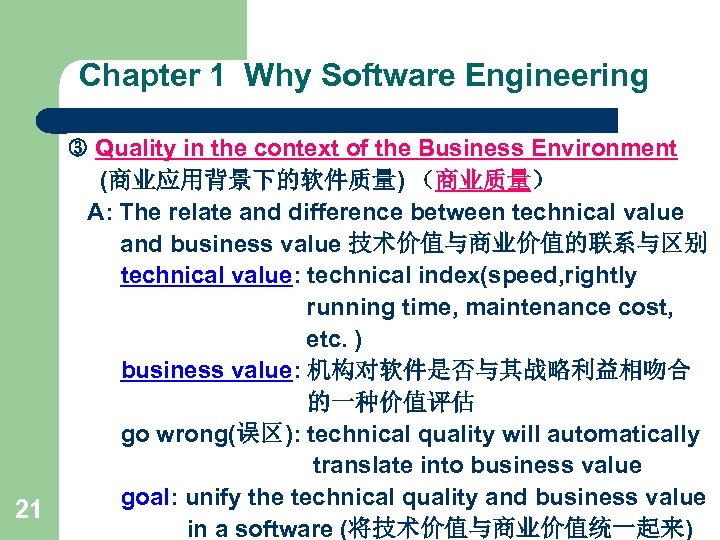
Chapter 1 Why Software Engineering Quality in the context of the Business Environment (商业应用背景下的软件质量) (商业质量) A: The relate and difference between technical value and business value 技术价值与商业价值的联系与区别 technical value: technical index(speed, rightly running time, maintenance cost, etc. ) business value: 机构对软件是否与其战略利益相吻合 的一种价值评估 go wrong(误区): technical quality will automatically translate into business value goal: unify the technical quality and business value 21 in a software (将技术价值与商业价值统一起来)
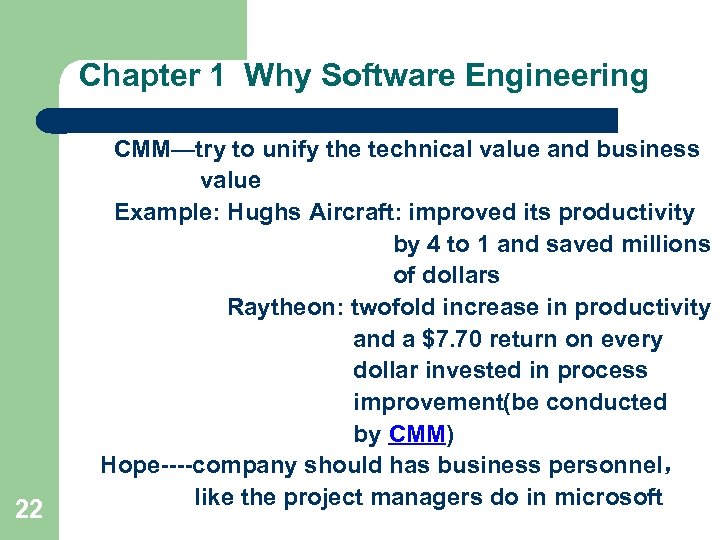
Chapter 1 Why Software Engineering 22 CMM—try to unify the technical value and business value Example: Hughs Aircraft: improved its productivity by 4 to 1 and saved millions of dollars Raytheon: twofold increase in productivity and a $7. 70 return on every dollar invested in process improvement(be conducted by CMM) Hope----company should has business personnel, like the project managers do in microsoft
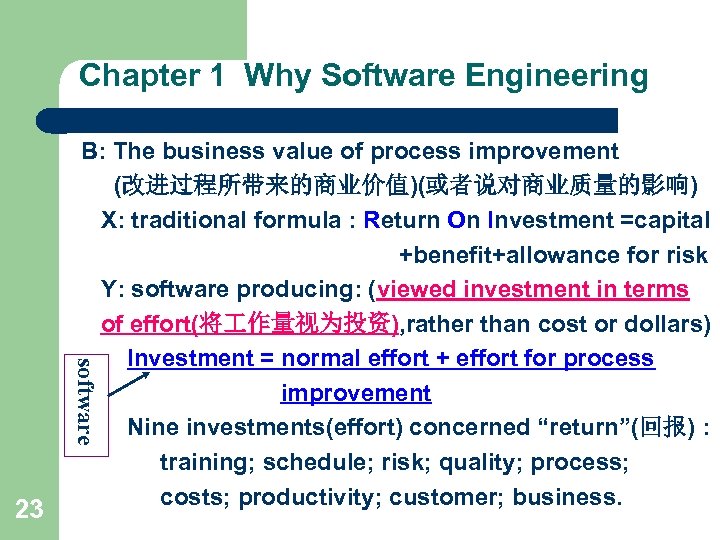
Chapter 1 Why Software Engineering software B: The business value of process improvement (改进过程所带来的商业价值)(或者说对商业质量的影响) X: traditional formula : Return On Investment =capital +benefit+allowance for risk Y: software producing: (viewed investment in terms of effort(将 作量视为投资), rather than cost or dollars) Investment = normal effort + effort for process improvement Nine investments(effort) concerned “return”(回报) : training; schedule; risk; quality; process; costs; productivity; customer; business. 23
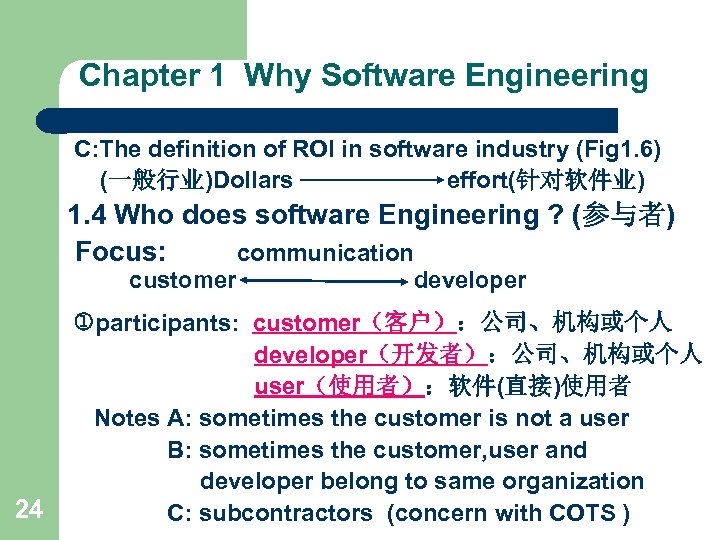
Chapter 1 Why Software Engineering C: The definition of ROI in software industry (Fig 1. 6) (一般行业)Dollars effort(针对软件业) 1. 4 Who does software Engineering ? (参与者) Focus: communication customer 24 developer participants: customer(客户):公司、机构或个人 developer(开发者):公司、机构或个人 user(使用者):软件(直接)使用者 Notes A: sometimes the customer is not a user B: sometimes the customer, user and developer belong to same organization C: subcontractors (concern with COTS )
Chapter 1 Why Software Engineering Conclusion: SE is a system engineering A: include the analysis and synthesis about technical problems (project development) B: includes the management about the process and the anticipants (project management) 核心思想:是把软件产品(就像其他 业品一样)看作是 一个 程产品来处理,把需求计划、可行性研 究、 程审核、质量监督等 程化的概念引入 到软件生产中,期望达到一般 程项目的三要 素:进度、经费、质量。 25
Chapter 1 Why Software Engineering 1. 5 A System Approach(一种系统的开发方法) Cause: Boundary(边界) is important(description to what is included in the project and what is not) software = { objects and activities} + { relationships } an activity = inputs+actions+outputs The Elements of a System (系统的要素) A : Activities and Objects activity : something happens in a system (transfer one thing to another thing ) object : the element(元素) involved in the activities which includes : characteristics + actions 26 [ note: the object is different from that one in OOP,有些需要合并 才演化成为后来OOP中的对象,有些只是些属性类的实体 ]
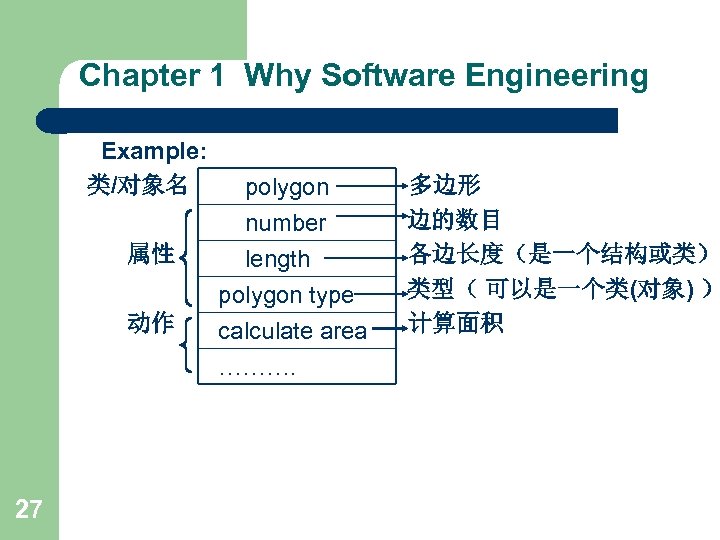
Chapter 1 Why Software Engineering Example: 类/对象名 属性 动作 27 polygon number length polygon type calculate area ………. 多边形 边的数目 各边长度(是一个结构或类) 类型( 可以是一个类(对象) ) 计算面积
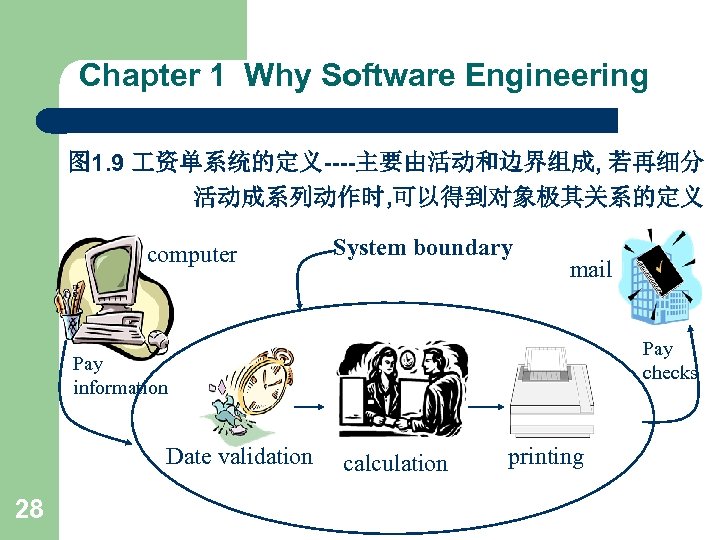
Chapter 1 Why Software Engineering 图 1. 9 资单系统的定义----主要由活动和边界组成, 若再细分 活动成系列动作时, 可以得到对象极其关系的定义 computer System boundary mail Pay checks Pay information Date validation 28 calculation printing
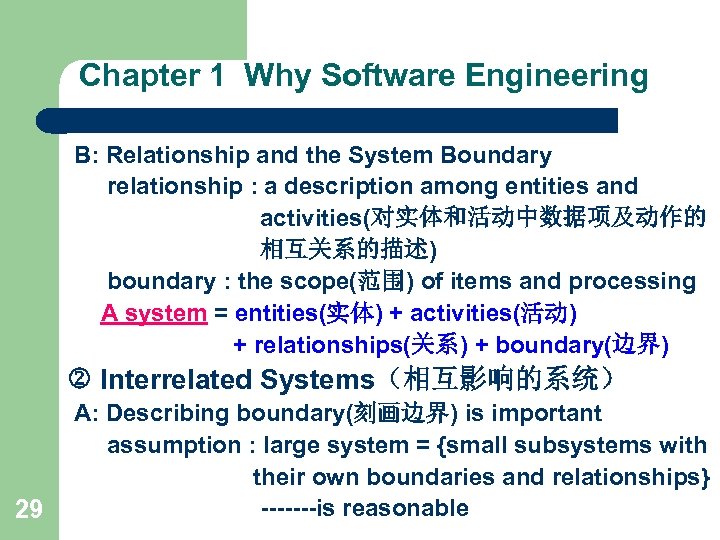
Chapter 1 Why Software Engineering B: Relationship and the System Boundary relationship : a description among entities and activities(对实体和活动中数据项及动作的 相互关系的描述) boundary : the scope(范围) of items and processing A system = entities(实体) + activities(活动) + relationships(关系) + boundary(边界) Interrelated Systems(相互影响的系统) 29 A: Describing boundary(刻画边界) is important assumption : large system = {small subsystems with their own boundaries and relationships} -------is reasonable
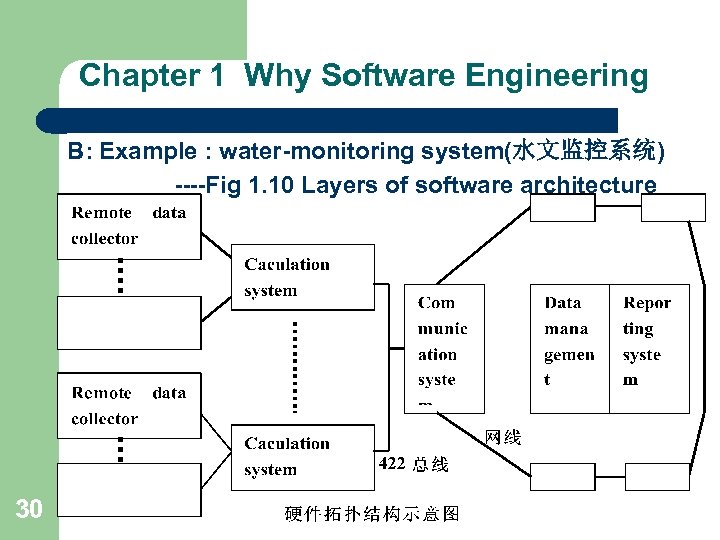
Chapter 1 Why Software Engineering B: Example : water-monitoring system(水文监控系统) ----Fig 1. 10 Layers of software architecture 30
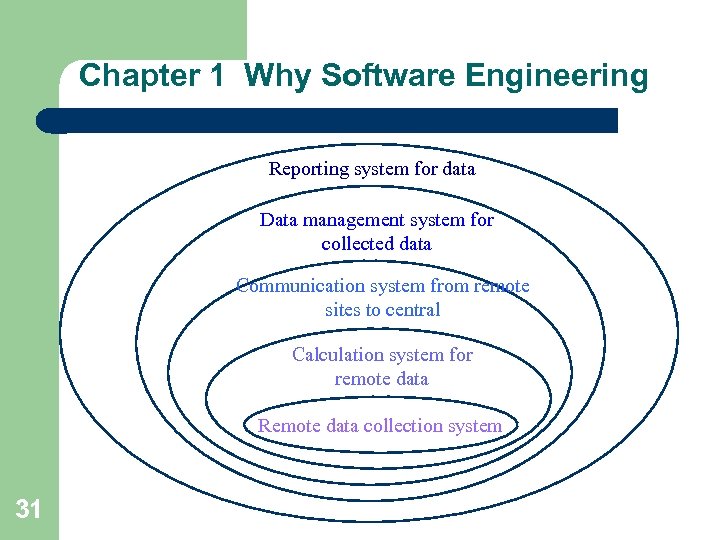
Chapter 1 Why Software Engineering Reporting system for data Data management system for collected data Communication system from remote sites to central Calculation system for remote data Remote data collection system 31
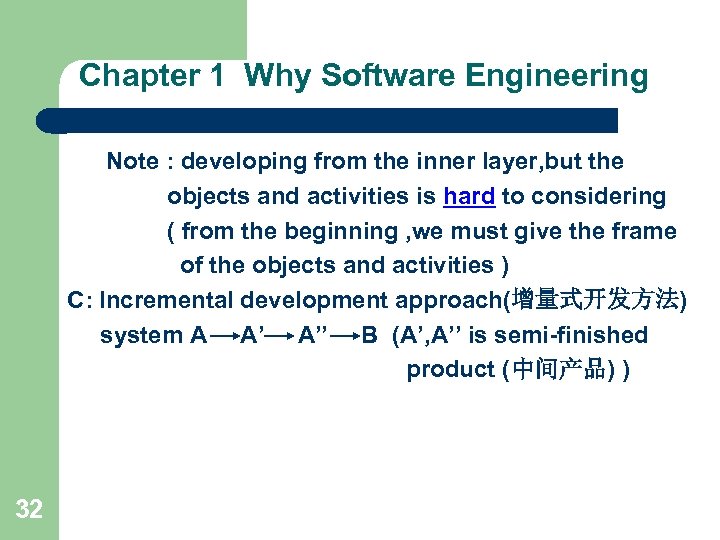
Chapter 1 Why Software Engineering Note : developing from the inner layer, but the objects and activities is hard to considering ( from the beginning , we must give the frame of the objects and activities ) C: Incremental development approach(增量式开发方法) system A A’ A’’ B (A’, A’’ is semi-finished product (中间产品) ) 32
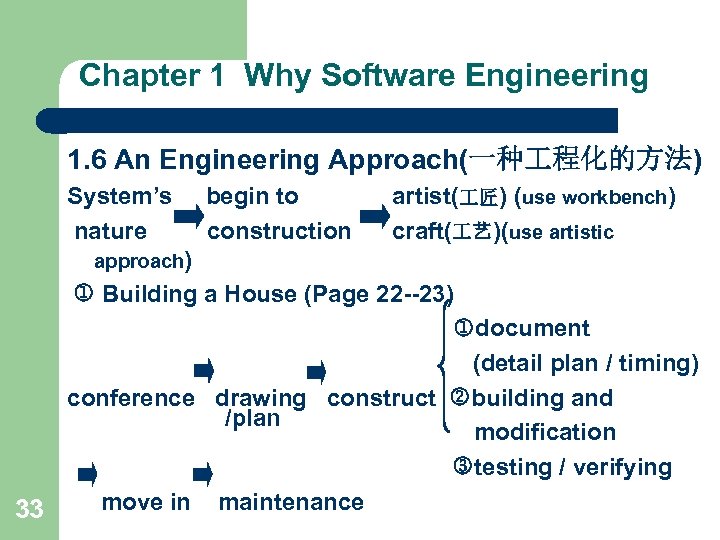
Chapter 1 Why Software Engineering 1. 6 An Engineering Approach(一种 程化的方法) System’s nature begin to construction artist( 匠) (use workbench) craft( 艺)(use artistic approach) Building a House (Page 22 --23) document (detail plan / timing) conference drawing construct building and /plan modification testing / verifying move in maintenance 33
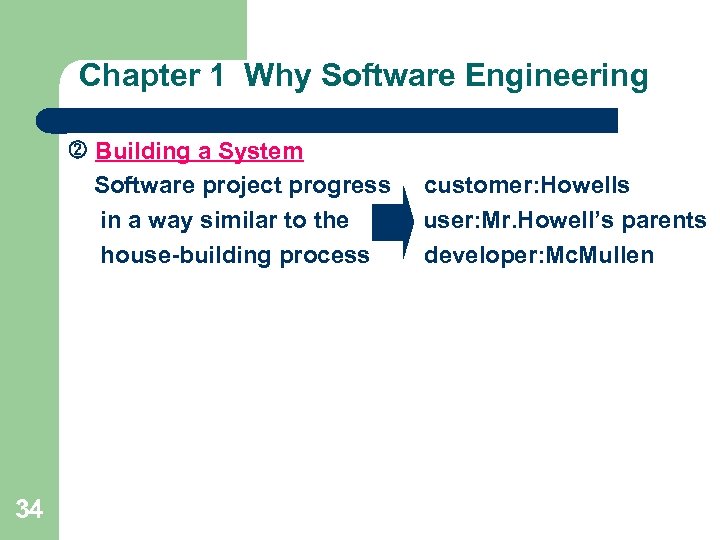
Chapter 1 Why Software Engineering Building a System Software project progress in a way similar to the house-building process 34 customer: Howells user: Mr. Howell’s parents developer: Mc. Mullen
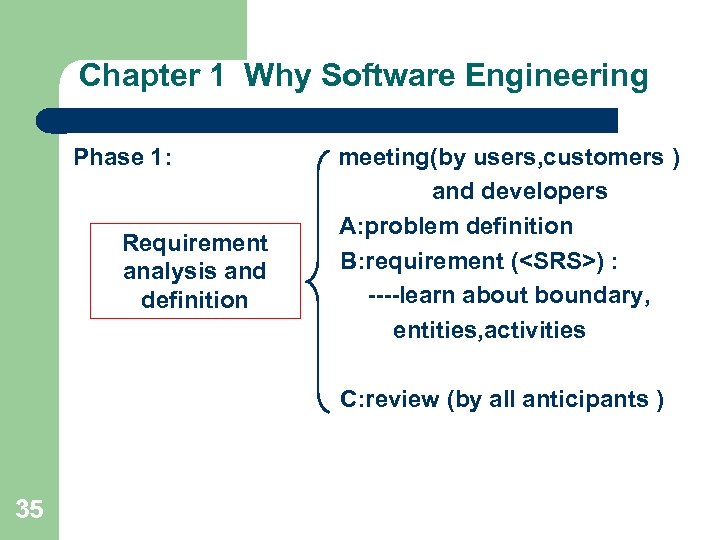
Chapter 1 Why Software Engineering Phase 1: Requirement analysis and definition meeting(by users, customers ) and developers A: problem definition B: requirement (<SRS>) : ----learn about boundary, entities, activities C: review (by all anticipants ) 35
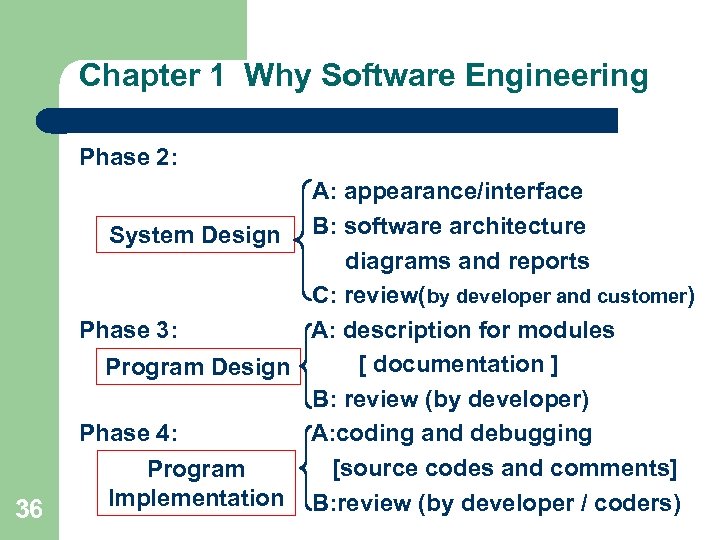
Chapter 1 Why Software Engineering Phase 2: 36 A: appearance/interface System Design B: software architecture diagrams and reports C: review( by developer and customer) Phase 3: A: description for modules [ documentation ] Program Design B: review (by developer) Phase 4: A: coding and debugging [source codes and comments] Program Implementation B: review (by developer / coders)
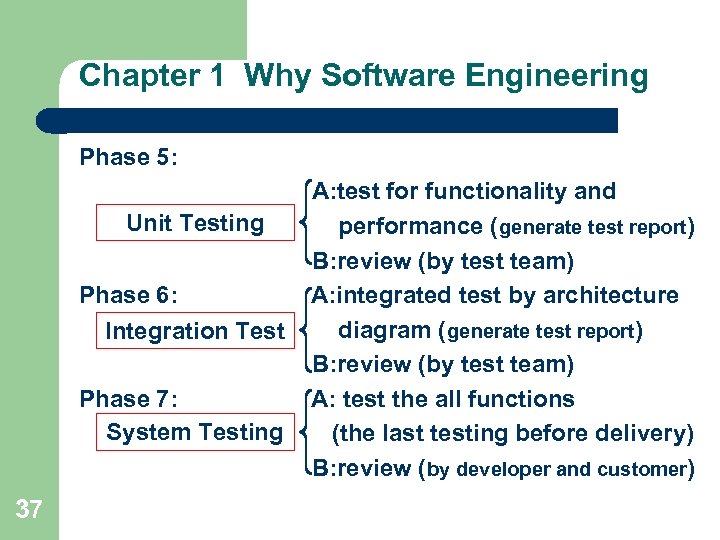
Chapter 1 Why Software Engineering Phase 5: Unit Testing Phase 6: Integration Test Phase 7: System Testing 37 A: test for functionality and performance ( generate test report) B: review (by test team) A: integrated test by architecture diagram ( generate test report) B: review (by test team) A: test the all functions (the last testing before delivery) B: review ( by developer and customer)
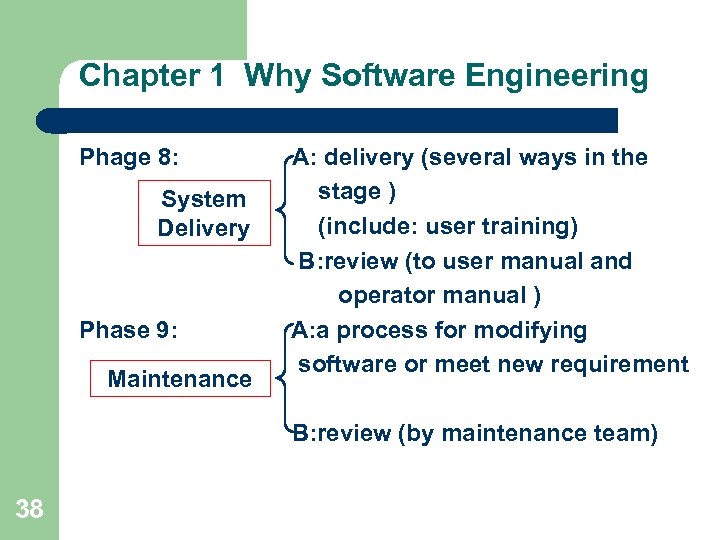
Chapter 1 Why Software Engineering Phage 8: System Delivery Phase 9: Maintenance A: delivery (several ways in the stage ) (include: user training) B: review (to user manual and operator manual ) A: a process for modifying software or meet new requirement B: review (by maintenance team) 38
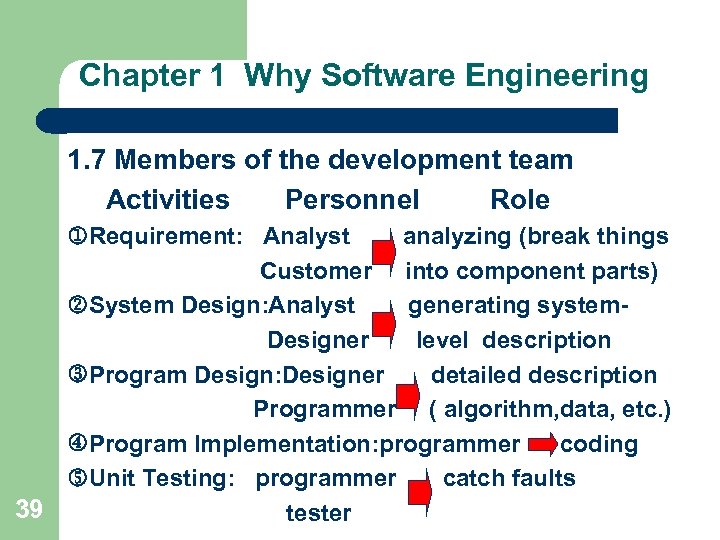
Chapter 1 Why Software Engineering 1. 7 Members of the development team Activities Personnel Role Requirement: Analyst analyzing (break things Customer into component parts) System Design: Analyst generating system. Designer level description Program Design: Designer detailed description Programmer ( algorithm, data, etc. ) Program Implementation: programmer coding Unit Testing: programmer catch faults 39 tester
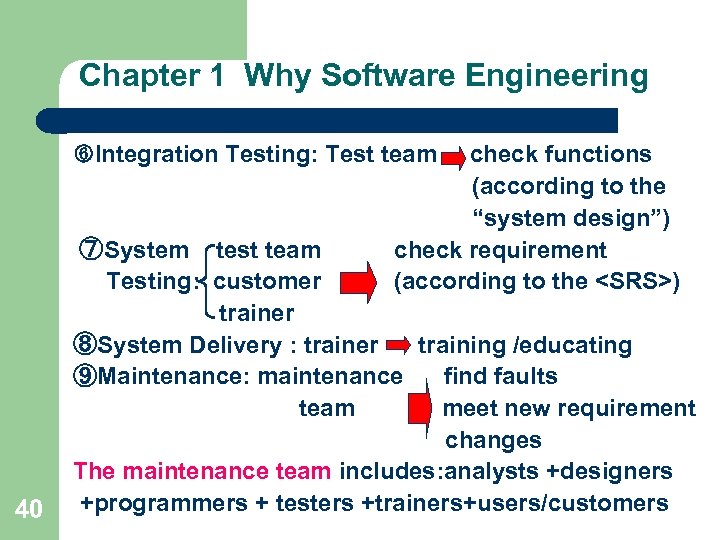
Chapter 1 Why Software Engineering Integration Testing: Test team check functions (according to the “system design”) check requirement (according to the <SRS>) 40 ⑦System test team Testing: customer trainer ⑧System Delivery : trainer training /educating ⑨Maintenance: maintenance find faults team meet new requirement changes The maintenance team includes: analysts +designers +programmers + testers +trainers+users/customers
Chapter 1 Why Software Engineering Explaining : 41 Class projects: demonstrate ability, but not necessarily to solve a problem for a real customer Facing real customer v different context: scale, complexity, great desire for document and maintenance v project management is hard: develop team is relatively stable Librarians: managing documents, do simple test Configuration management: 维持一个软件的不同版本 之间的对应关系
Different SE different number and species of personnel in developing 软件架构师:属于高级程序员,侧重开发过程和模式的选 择和论证(在分析员之上)。 42
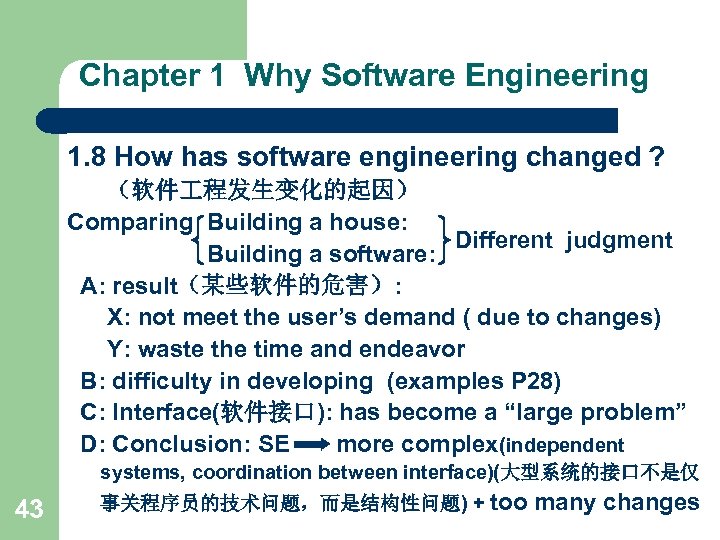
Chapter 1 Why Software Engineering 1. 8 How has software engineering changed ? (软件 程发生变化的起因) Comparing Building a house: Different judgment Building a software: A: result(某些软件的危害): X: not meet the user’s demand ( due to changes) Y: waste the time and endeavor B: difficulty in developing (examples P 28) C: Interface(软件接口): has become a “large problem” D: Conclusion: SE more complex(independent systems, coordination between interface)(大型系统的接口不是仅 43 事关程序员的技术问题,而是结构性问题) + too many changes
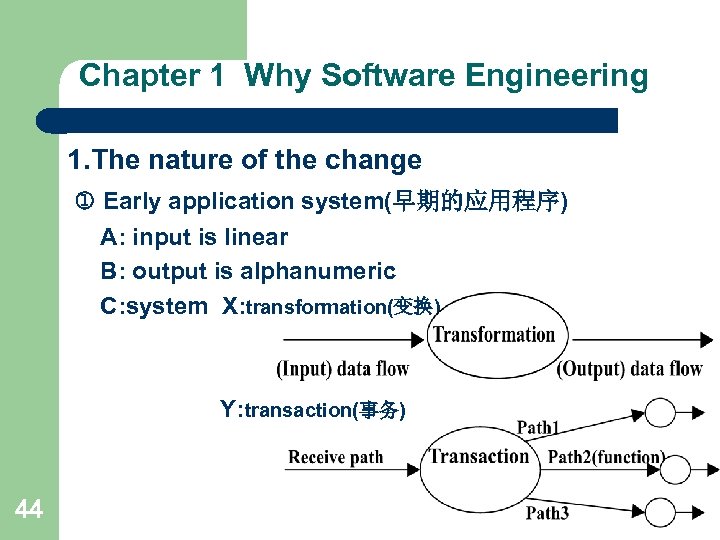
Chapter 1 Why Software Engineering 1. The nature of the change Early application system(早期的应用程序) A: input is linear B: output is alphanumeric C: system X: transformation(变换) Y: transaction(事务) 44
Chapter 1 Why Software Engineering D: Conclusion: “waterfall” approach is suitable Today’s software—based system:far different and more complex A: run on multiple systems (may be is c/s or b/s architecture with distributed functionality) B: normal functions , network control , security , user-interface , data or object management etc. C: conclusion: great changes the traditional SE approach(waterfall model) is no longer flexible/suitable 45
Chapter 1 Why Software Engineering seven key factors that have altered SE practice (使SE实践发生变化的七个关键因素) [by wasserman] A: criticality of time-to-market for commercial products (商业软件的投放市场时间的紧迫性) B: shifts in economics of computing (lower HW, higher development/maintenance costs)(计算经济学的改变) C: availability of powerful desktop computing (强力的桌面计算平台的出现) D: extensive local- and wide-area networking (局域网和广域网的延伸) 46
Chapter 1 Why Software Engineering E: availability and adoption of OO technology (面向对象技术的出现和采用) F: graphical user interfaces (使用窗口、图标、菜单和指针的图形用户界面) G: unpredictability of waterfall model of development [schedule and fee/expense] (瀑布模型用于软件开发的不可预测性) 因为不再是有 足够的灵活性 和适应性了 47
Chapter 1 Why Software Engineering Examples : (P 29) A: time to market B: shifts in economics C: desktop computing D: networking E: (OO) technology—provide reuse repositories F: graphical user interface conclusion: modern SE requiring a different development model (from “waterfall” model), and try to develop systems in parallel 48
![Chapter 1 Why Software Engineering 2. Wasserman’s Discipline of software engineering [SE的Wasserman规范(或基本概念)] Abstraction (英文见课本):基于某种归纳水平的问题描述。](https://present5.com/presentation/a132a147611629dfceddca61e7029e35/image-49.jpg "Chapter 1 Why Software Engineering 2. Wasserman’s Discipline of software engineering [SE的Wasserman规范(或基本概念)] Abstraction (英文见课本):基于某种归纳水平的问题描述。")
Chapter 1 Why Software Engineering 2. Wasserman’s Discipline of software engineering [SE的Wasserman规范(或基本概念)] Abstraction (英文见课本):基于某种归纳水平的问题描述。 它使我们将注意力集中在问题的关键方面而非细节。 某人逛动物园 第一次被狮子咬了 第二次被老虎咬了 猛兽 第三次逛大森林碰见豹子时自己就提醒: 这可能是猛兽! 高层抽象:展现对象的团体 A:程序员的团体; B:程序员创建的对象的团体。 次高层抽象:各个单元(java:pakage;C++:名空间) 抽象层次 3,4,5:已在OO技术里面介绍过。 49
Chapter 1 Why Software Engineering In OO method: involve identifying classes of objects and identifying the attributes and relations transformation (P 30) example(P 30 -31): sensor (simple hierarchy ) A: the items have properties(not idiographic content) B: we can deal with the class, rather than its elements (in devising a solution) C: we can form hierarchies of abstractions in classes (抽象类的层次)-------see Fig 1. 13 50
Chapter 1 Why Software Engineering Analysis and design methods and notations (分析、设计方法和符号描述系统)(建模原语) 51 A: class assignment(班级练习): informal description B: developing COTS in team work: ------use standard notation , just like a architect does (采用标准的符号表示系统) importance: X: help communication (利于交流) Y: build model and check them for completeness and consistency(利于建模并检查其完整性和一致性) Z: reuse requirements and design components (易于对需求和设计部件进行重用)
Chapter 1 Why Software Engineering User interface prototyping(用户界面原型化) A: prototyping: 建立系统的小型版, 通常具有有限的功能, 以利于用户评价和选择 B: Role(作用) X: identify the key requirement (关键需求) Y: demonstrate feasibility(可行性) 难以评价不同体系结构的优劣 C: Note(说明) X: prototyping iterative process Y: prototyping design a good user interface Software architecture(软件体系结构) A: cause: 一个系统可由不同的体系结构来组成之。 B: importance X: ease(简化) the implementing and testing Y: improve the effectiveness(效益) of maintenance and changing(变更) 52
Chapter 1 Why Software Engineering C: construction: subunits + maps(describe all relations between subunits) (构成: 一系列子结构单元加上它们彼此的联系集) focus on: independence (模块独立性) D: ways of partition(分解的方法) : (1 ---5 see P 32) X: 基于功能的模块化分解 Y: 基于数据的分解 Z: 面向事件的分解 M: 由外到内的分解 N: 面向对象的设计 53
Chapter 1 Why Software Engineering Software process(软件过程) A: definition: 软件开发活动中的各种组织及规范方法 (organization and discipline in developing) B: explain X: 因应用类型和组织文化之间的巨大差异, 故 难以对软件过程本身进行预先指定, 也就是说: 使过程本 身规范化是不可能的. 软件过程不可能以抽象和模块化的 方式作为软件 程的基础(see P 33) Y: small/medium-sized system ----rapid developing method Z: large/complex system -----normal developing method 54
Chapter 1 Why Software Engineering Reuse(重用) A: definition: commonality reusible items new project 重复采用以前开发的软件系统中具有共性的部件, 用到新 的开发项目中去. (这里的重用不仅仅是源代码的重用) B: several barriers in reuse(1, 2, 3, 4, 5, 6 see P 34) ⑦ Measurement(度量)(通用的评价方法和体系) A: definition: quantitative way(approach) describe process, resource, methods improving quality B: importance: empirical, practical model mathematical model 55 (base on element and relation)
Chapter 1 Why Software Engineering Tools and integrated environments A: introduction: frameworks compare environments decide which is best B: tool integration unifying development life cycle difficult integrating particular activities practical wasserman’s five issues in tool integration(P 35) ⑨ Conclusion eight concepts making SE as scientific discipline ⑧ 56
Chapter 1 Why Software Engineering 1. 9 Information System Example(信息管理系统实例) The advertising time selling system of Piccadilly Television (Piccadilly 电视台广告时段销售信息系统) 1. Government’s management(政府管理办法) A: franchise(广播特权的发放) problem B: content(keep balance in it)(广播内容的规定) C: restrictions and rules(广播节目种类、时段以 及广告的约束与限制规定) the problem is both interesting and difficult 2. Background Analysis 57 A: Piccadily Television high audience rating
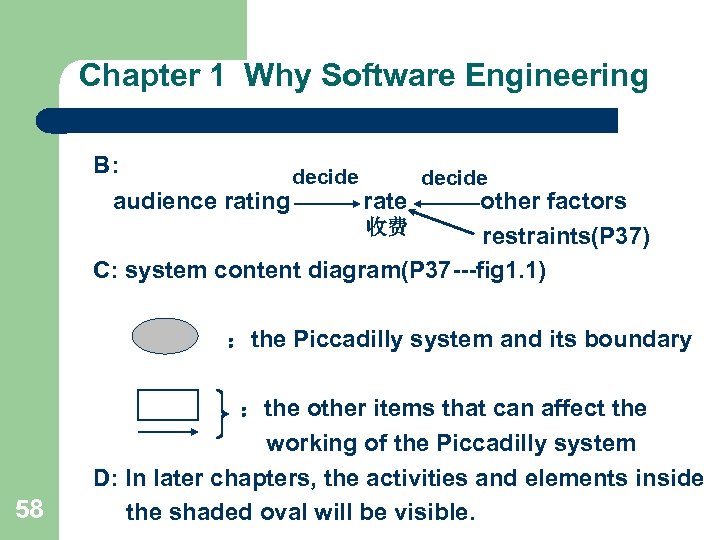
Chapter 1 Why Software Engineering B: audience rating decide rate decide other factors 收费 restraints(P 37) C: system content diagram(P 37 ---fig 1. 1) :the Piccadilly system and its boundary 58 :the other items that can affect the working of the Piccadilly system D: In later chapters, the activities and elements inside the shaded oval will be visible.
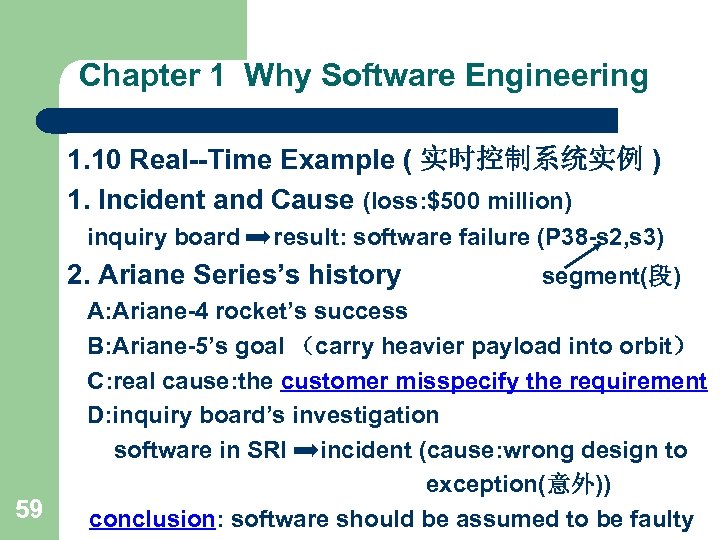
Chapter 1 Why Software Engineering 1. 10 Real--Time Example ( 实时控制系统实例 ) 1. Incident and Cause (loss: $500 million) inquiry board result: software failure (P 38 -s 2, s 3) 2. Ariane Series’s history 59 segment(段) A: Ariane-4 rocket’s success B: Ariane-5’s goal (carry heavier payload into orbit) C: real cause: the customer misspecify the requirement D: inquiry board’s investigation software in SRI incident (cause: wrong design to exception(意外)) conclusion: software should be assumed to be faulty
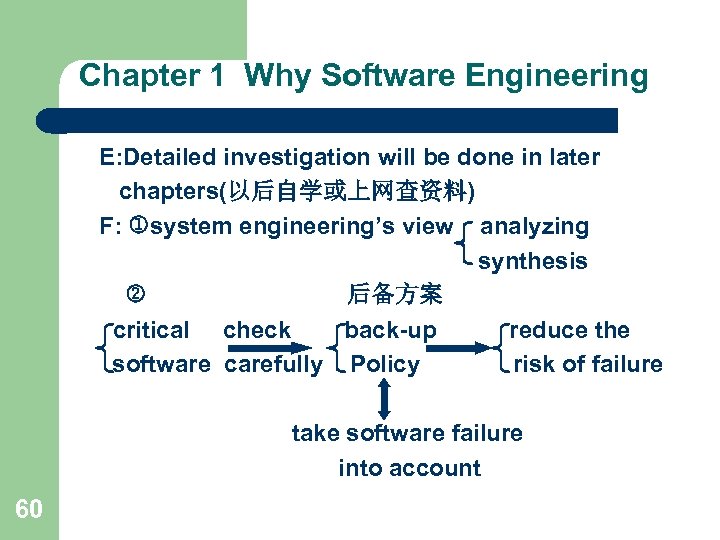
Chapter 1 Why Software Engineering E: Detailed investigation will be done in later chapters(以后自学或上网查资料) F: system engineering’s view analyzing synthesis 后备方案 critical check back-up reduce the software carefully Policy risk of failure take software failure into account 60
Software Engineering ⑦ ⑧⑨⑩ 61
Скачать презентацию 软 件 程 Software Engineering 主讲教师 鹿旭东 Instructor Lu
a132a147611629dfceddca61e7029e35.ppt