 Скачать презентацию 英语综合课教学中 多媒体资源的搜索 获取与应用 以何兆熊 综合教程4 为例 陈 龙 上海外国语大学网络教育学院
c91c11226d6f6a3cfe99f20b2e81c6fe.ppt
- Количество слайдов: 95



英语综合课教学中 多媒体资源的搜索、获取与应用: 以何兆熊《综合教程4 》为例 陈 龙 上海外国语大学网络教育学院
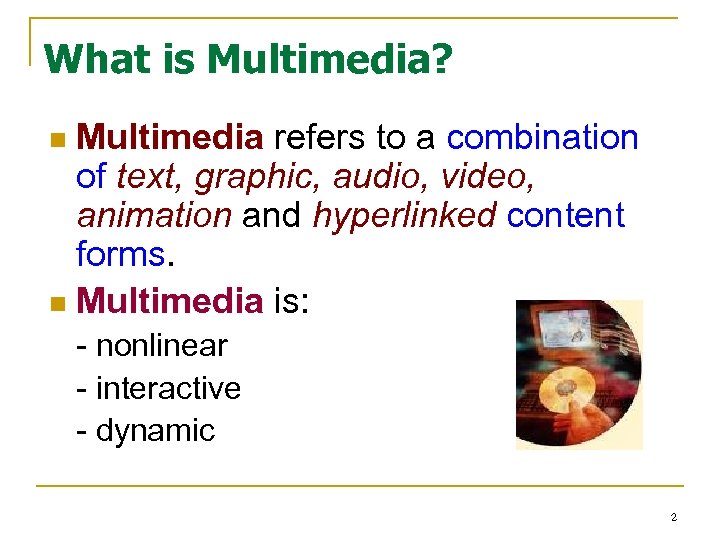
What is Multimedia? Multimedia refers to a combination of text, graphic, audio, video, animation and hyperlinked content forms. n Multimedia is: n nonlinear interactive dynamic 2
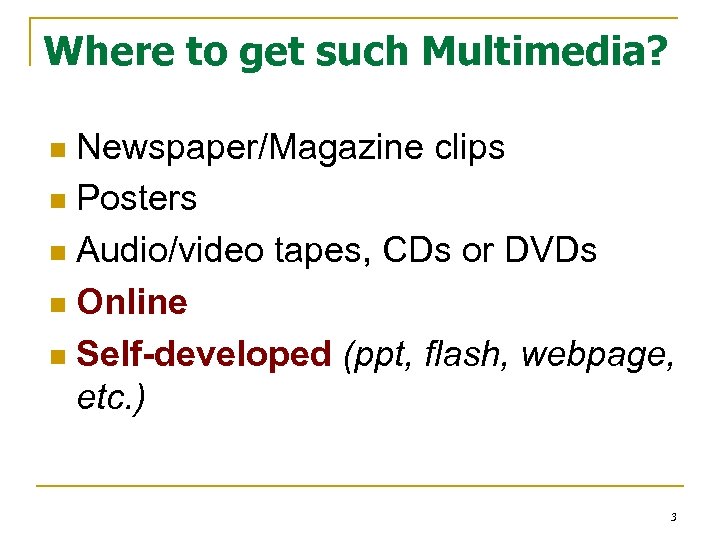
Where to get such Multimedia? Newspaper/Magazine clips n Posters n Audio/video tapes, CDs or DVDs n Online n Self-developed (ppt, flash, webpage, etc. ) n 3
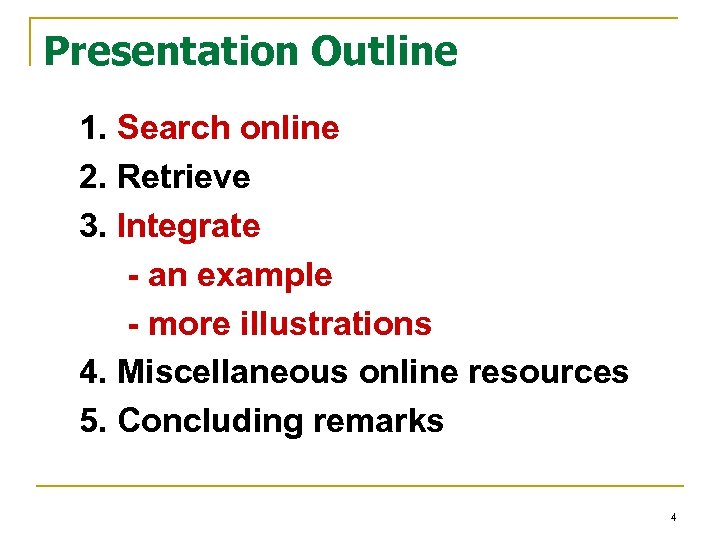
Presentation Outline 1. Search online 2. Retrieve 3. Integrate - an example - more illustrations 4. Miscellaneous online resources 5. Concluding remarks 4
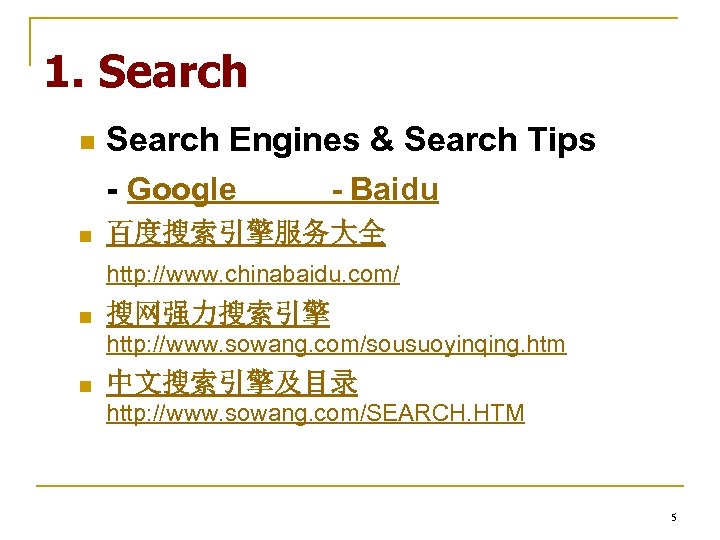
1. Search n n Search Engines & Search Tips - Google - Baidu 百度搜索引擎服务大全 http: //www. chinabaidu. com/ n 搜网强力搜索引擎 http: //www. sowang. com/sousuoyinqing. htm n 中文搜索引擎及目录 http: //www. sowang. com/SEARCH. HTM 5
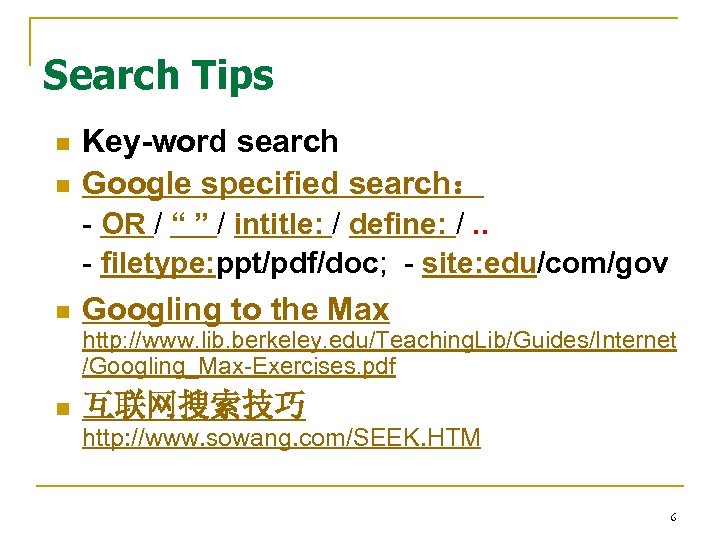
Search Tips n n Key-word search Google specified search: OR / “ ” / intitle: / define: /. . filetype: ppt/pdf/doc; site: edu/com/gov n Googling to the Max http: //www. lib. berkeley. edu/Teaching. Lib/Guides/Internet /Googling_Max Exercises. pdf n 互联网搜索技巧 http: //www. sowang. com/SEEK. HTM 6
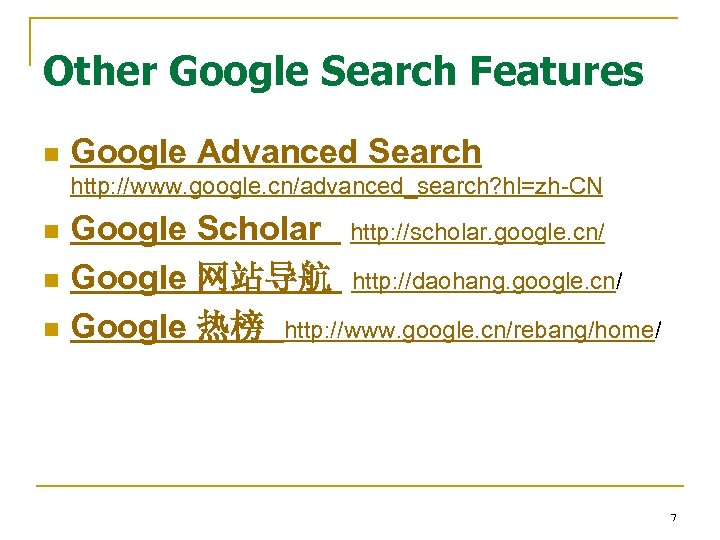
Other Google Search Features n Google Advanced Search http: //www. google. cn/advanced_search? hl=zh CN Google Scholar http: //scholar. google. cn/ n Google 网站导航 http: //daohang. google. cn/ n Google 热榜 http: //www. google. cn/rebang/home/ n 7
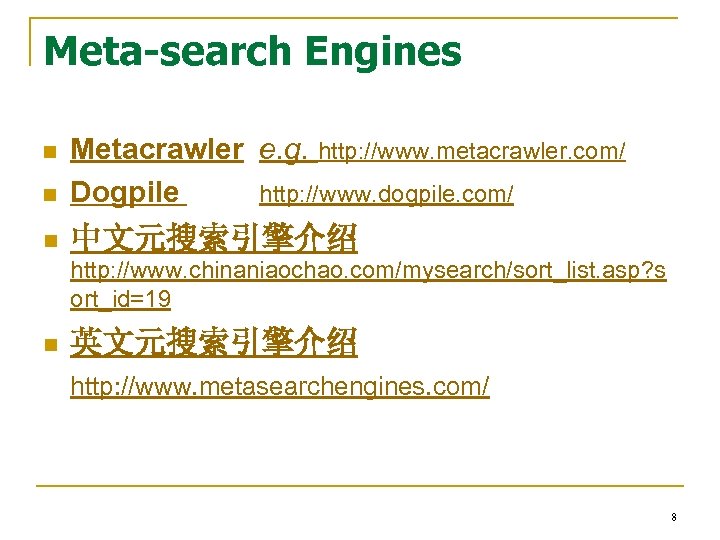
Meta-search Engines n Metacrawler e. g. http: //www. metacrawler. com/ Dogpile http: //www. dogpile. com/ n 中文元搜索引擎介绍 n http: //www. chinaniaochao. com/mysearch/sort_list. asp? s ort_id=19 n 英文元搜索引擎介绍 http: //www. metasearchengines. com/ 8
2. Retrieve and Save webpages n Save graphics n Save audio/video clips/streams n 9
3. Integrate Power. Point Presentation n Instructional Webpage n Audio/Video presentation n Illustration n 10
A Sample Lesson Presentation of Unit 2 Space Invader An Integrated English Course Book 4 11
Preview “Space Invaders” Read the Text of “Space Invader”, & try to find the author’s view concerning: n personal space for himself n examples of “space invasion” n causes attribute to “space invasion” n factors related to “space invasion” 12
In-class Pre-reading Activities (10 -15 min’s) What is “personal space”? n What is your personal space? n Does your personal space change? Why or why not? n 13
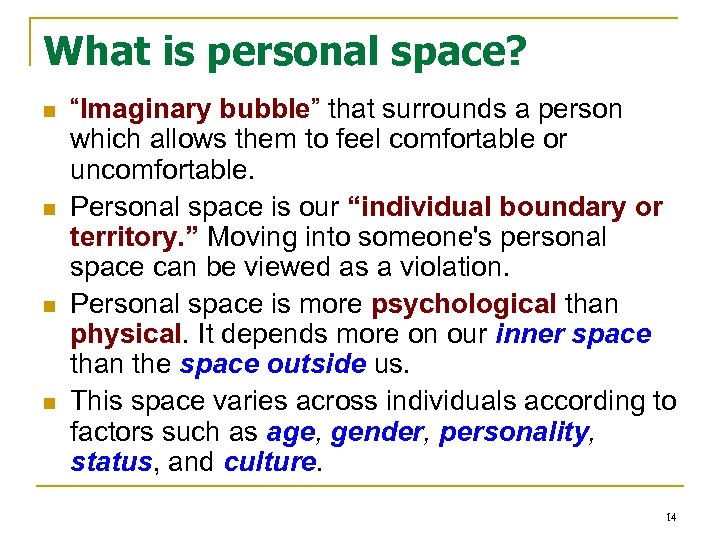
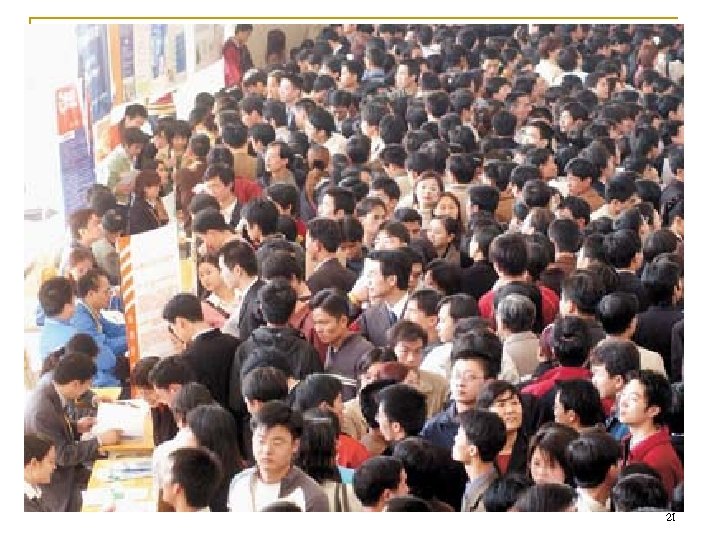
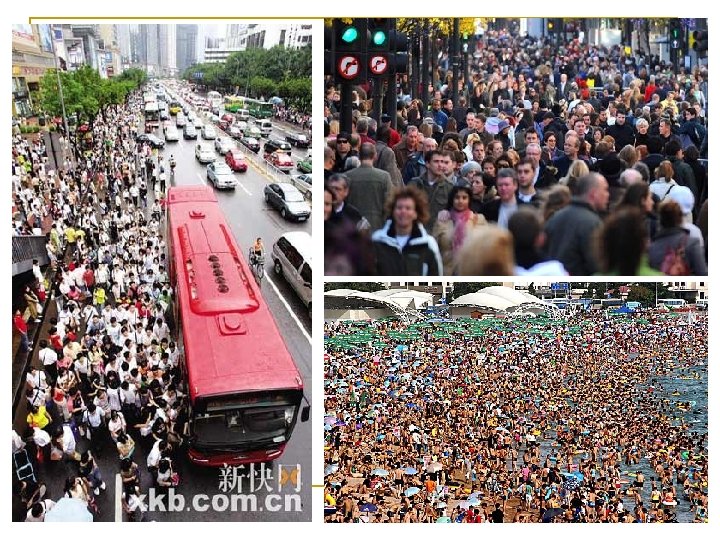
What is personal space? n n “Imaginary bubble” that surrounds a person which allows them to feel comfortable or uncomfortable. Personal space is our “individual boundary or territory. ” Moving into someone's personal space can be viewed as a violation. Personal space is more psychological than physical. It depends more on our inner space than the space outside us. This space varies across individuals according to factors such as age, gender, personality, status, and culture. 14
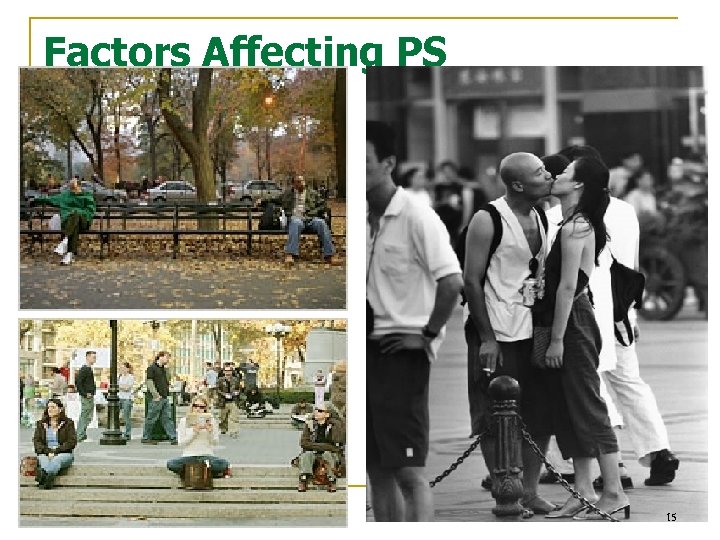
Factors Affecting PS 15
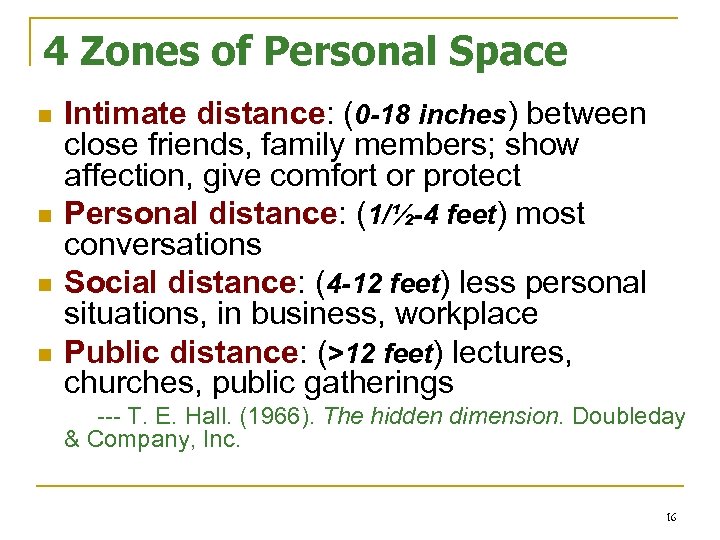
4 Zones of Personal Space n n Intimate distance: (0 -18 inches) between close friends, family members; show affection, give comfort or protect Personal distance: (1/½-4 feet) most conversations Social distance: (4 -12 feet) less personal situations, in business, workplace Public distance: (>12 feet) lectures, churches, public gatherings T. E. Hall. (1966). The hidden dimension. Doubleday & Company, Inc. 16
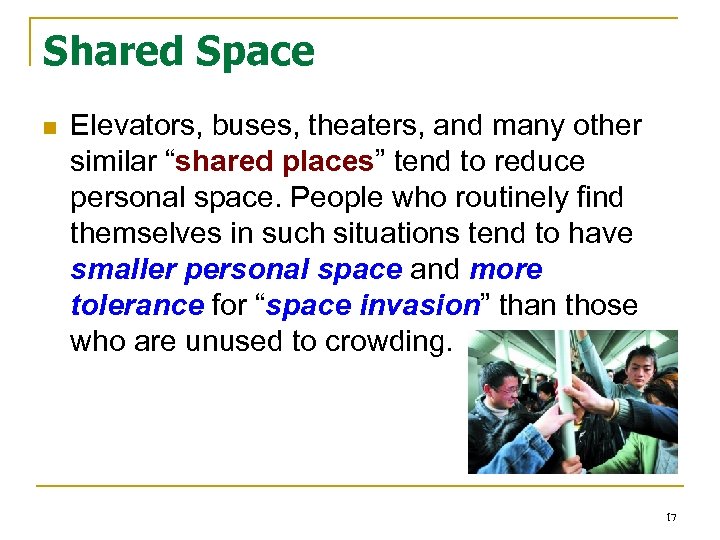
Shared Space n Elevators, buses, theaters, and many other similar “shared places” tend to reduce personal space. People who routinely find themselves in such situations tend to have smaller personal space and more tolerance for “space invasion” than those who are unused to crowding. 17
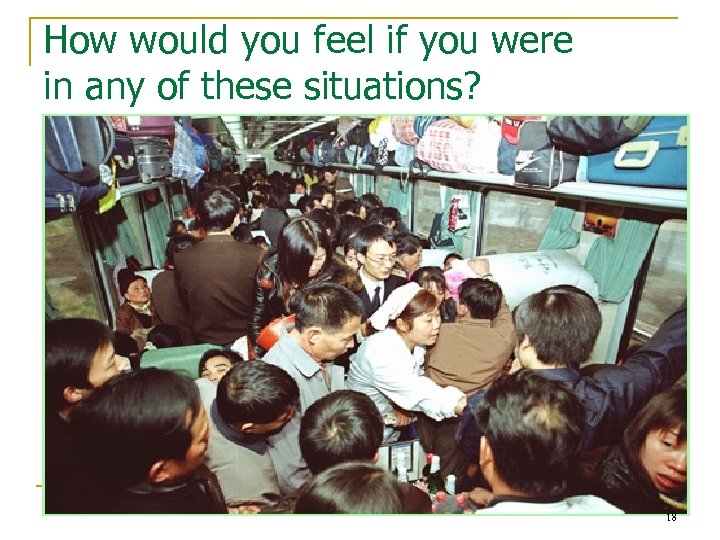
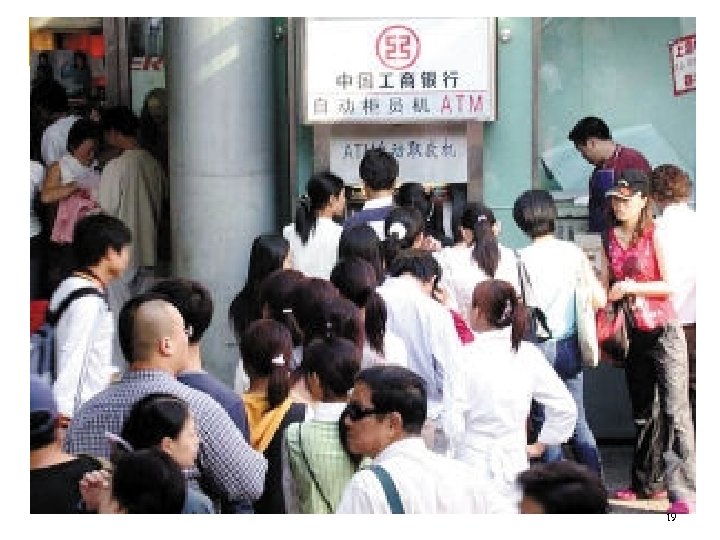
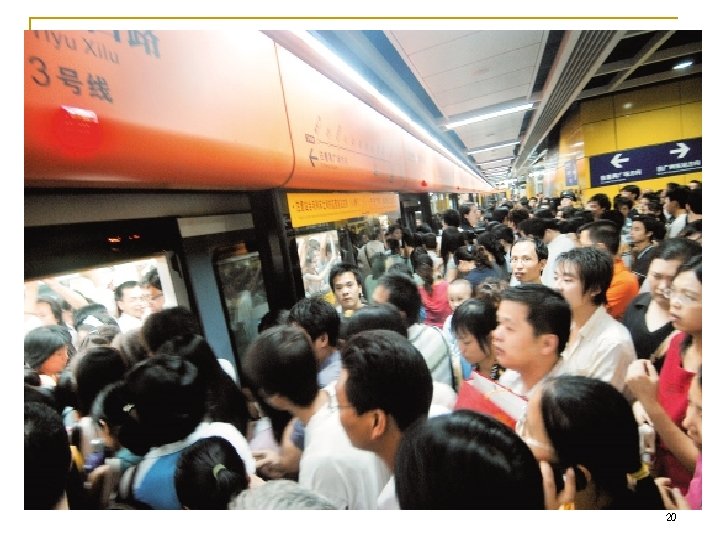
How would you feel if you were in any of these situations? 18
19
20
21
22
We need personal space to feel comfortable 23
But there always “Space Invaders” 24
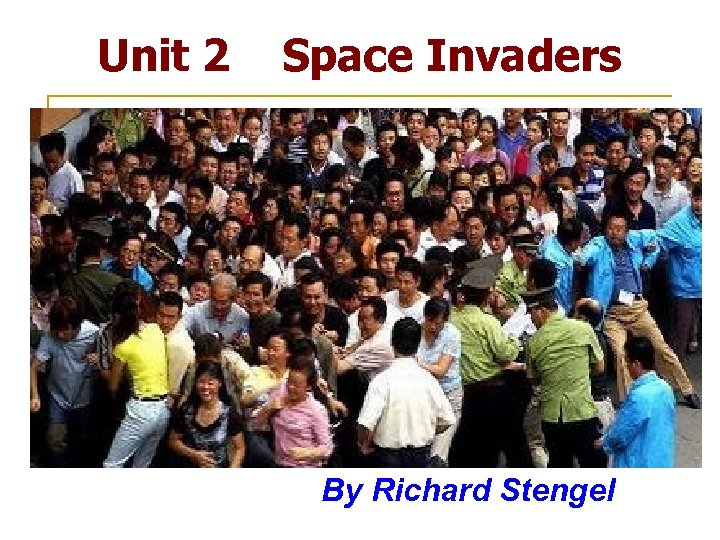
Unit 2 Space Invaders By Richard Stengel
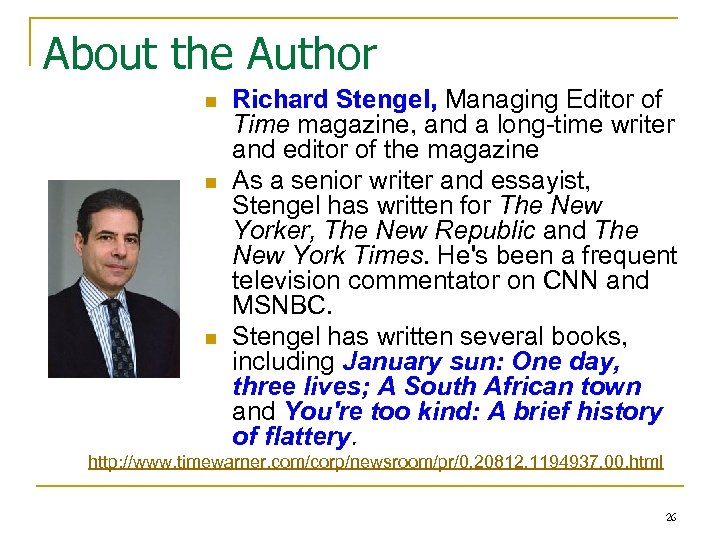
About the Author n n n Richard Stengel, Managing Editor of Time magazine, and a long time writer and editor of the magazine As a senior writer and essayist, Stengel has written for The New Yorker, The New Republic and The New York Times. He's been a frequent television commentator on CNN and MSNBC. Stengel has written several books, including January sun: One day, three lives; A South African town and You're too kind: A brief history of flattery. http: //www. timewarner. com/corp/newsroom/pr/0, 20812, 1194937, 00. html 26
Reading Tasks (10~12 min’s) n Individual: Try to find out the main idea of each of the 9 paragraphs. And try to locate the Topic Sentence in each paragraph. n In pairs: Try to decide how the text is structured. 27
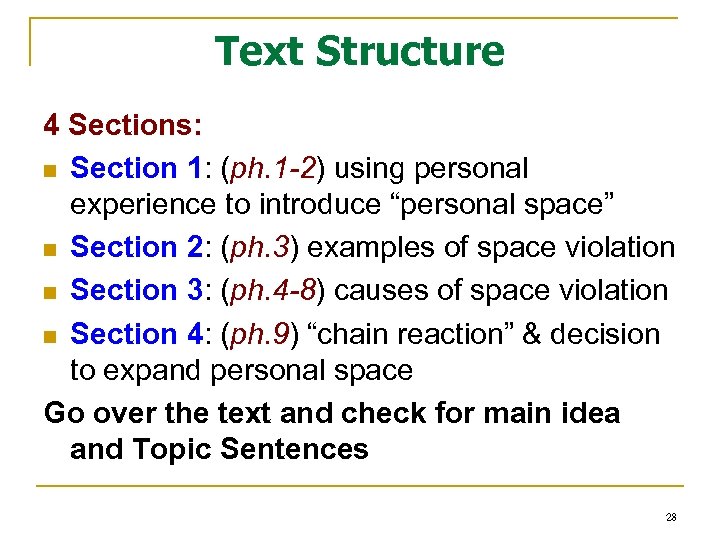
Text Structure 4 Sections: n Section 1: (ph. 1 -2) using personal experience to introduce “personal space” n Section 2: (ph. 3) examples of space violation n Section 3: (ph. 4 -8) causes of space violation n Section 4: (ph. 9) “chain reaction” & decision to expand personal space Go over the text and check for main idea and Topic Sentences 28
Class Interaction (30 -35 min’s) n n n How does the author define “personal space”? What is his personal space? In ph. 1, pick out the words and phrases that depict movement. (a chain of reaction) Work in pairs, try to: find as many examples of personal space being invaded and causes of such phenomena Put together & check Ss’ findings 29
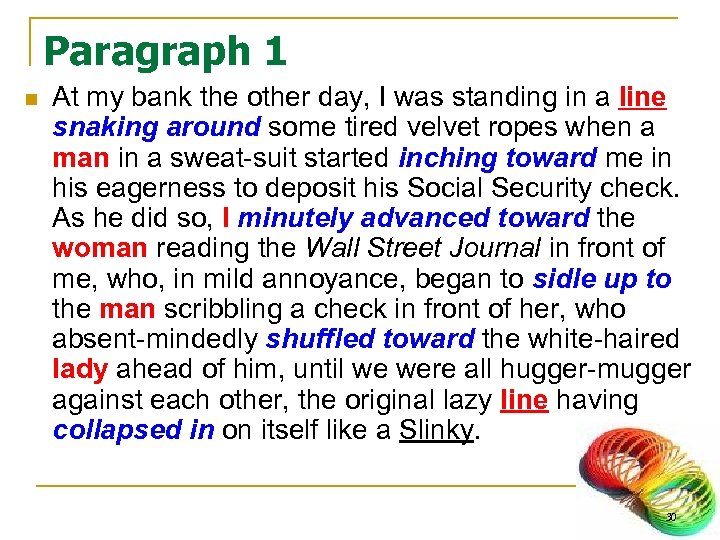
Paragraph 1 n At my bank the other day, I was standing in a line snaking around some tired velvet ropes when a man in a sweat suit started inching toward me in his eagerness to deposit his Social Security check. As he did so, I minutely advanced toward the woman reading the Wall Street Journal in front of me, who, in mild annoyance, began to sidle up to the man scribbling a check in front of her, who absent mindedly shuffled toward the white haired lady ahead of him, until we were all hugger mugger against each other, the original lazy line having collapsed in on itself like a Slinky. 30
Paragraph 2 n I estimate that my personal space extends eighteen inches in front of my face, one foot to each side, and about ten inches in back — though it is nearly impossible to measure exactly how far behind you someone is standing. The phrase "personal space" has a quaint, seventies ring to it ("You're invading my space, man"), but it is one of those gratifying expressions that are intuitively understood by all human beings. Like the twelve mile limit around our national shores, personal space is our individual border beyond which no stranger can penetrate without making us uneasy. 31
Paragraph 3 n Lately, I've found that my personal space is being invaded more than ever before. In elevators, people are wedging themselves in just before the doors close; on the street, pedestrians are zigzagging through the human traffic, jostling others, refusing to give way; on the subway, riders are no longer taking pains to carve out little zones of space between themselves and fellow passengers; in lines at airports, people are pressing forward like fidgety taxis at red lights. 32
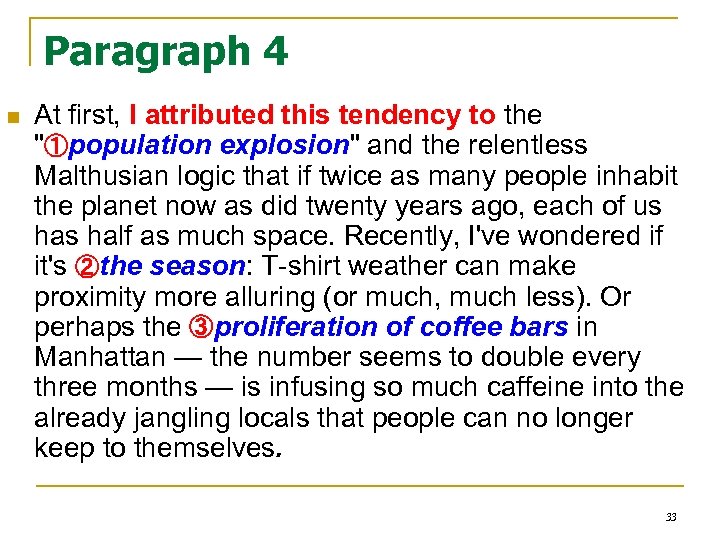
Paragraph 4 n At first, I attributed this tendency to the "①population explosion" and the relentless Malthusian logic that if twice as many people inhabit the planet now as did twenty years ago, each of us half as much space. Recently, I've wondered if it's ②the season: T shirt weather can make proximity more alluring (or much, much less). Or perhaps the ③proliferation of coffee bars in Manhattan — the number seems to double every three months — is infusing so much caffeine into the already jangling locals that people can no longer keep to themselves. 33
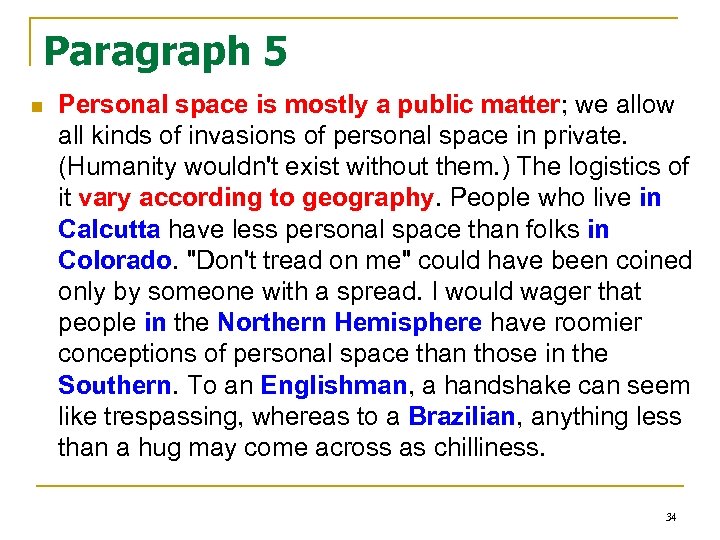
Paragraph 5 n Personal space is mostly a public matter; we allow all kinds of invasions of personal space in private. (Humanity wouldn't exist without them. ) The logistics of it vary according to geography. People who live in Calcutta have less personal space than folks in Colorado. "Don't tread on me" could have been coined only by someone with a spread. I would wager that people in the Northern Hemisphere have roomier conceptions of personal space than those in the Southern. To an Englishman, a handshake can seem like trespassing, whereas to a Brazilian, anything less than a hug may come across as chilliness. 34
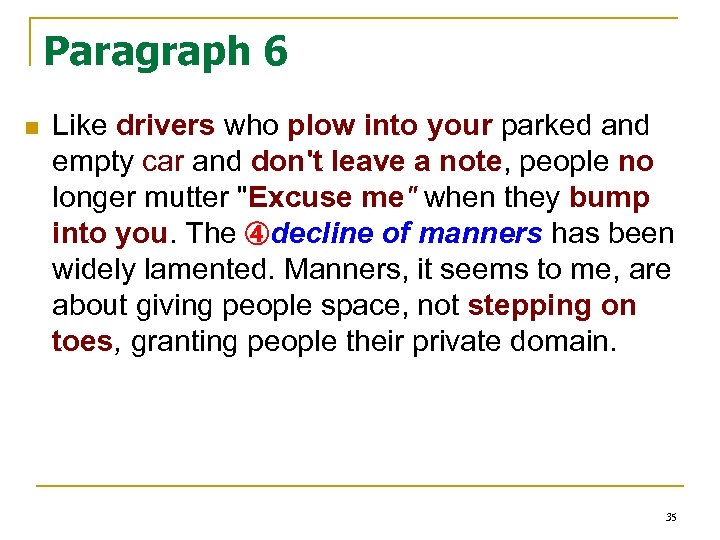
Paragraph 6 n Like drivers who plow into your parked and empty car and don't leave a note, people no longer mutter "Excuse me" when they bump into you. The ④decline of manners has been widely lamented. Manners, it seems to me, are about giving people space, not stepping on toes, granting people their private domain. 35
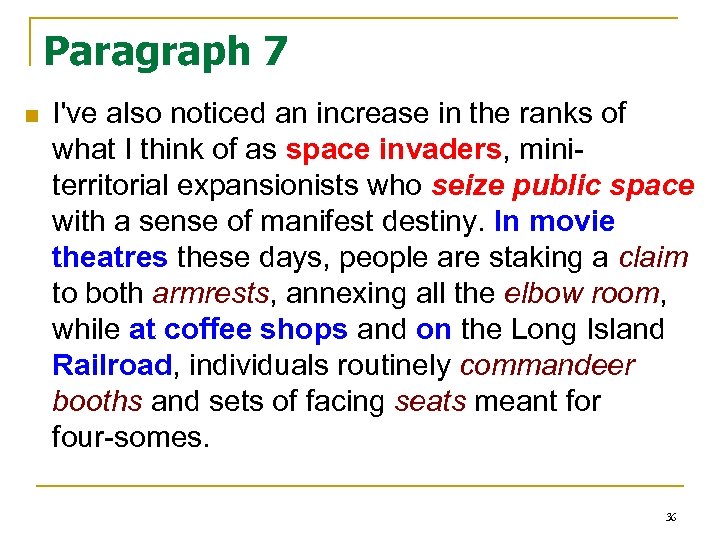
Paragraph 7 n I've also noticed an increase in the ranks of what I think of as space invaders, mini territorial expansionists who seize public space with a sense of manifest destiny. In movie theatres these days, people are staking a claim to both armrests, annexing all the elbow room, while at coffee shops and on the Long Island Railroad, individuals routinely commandeer booths and sets of facing seats meant for four somes. 36
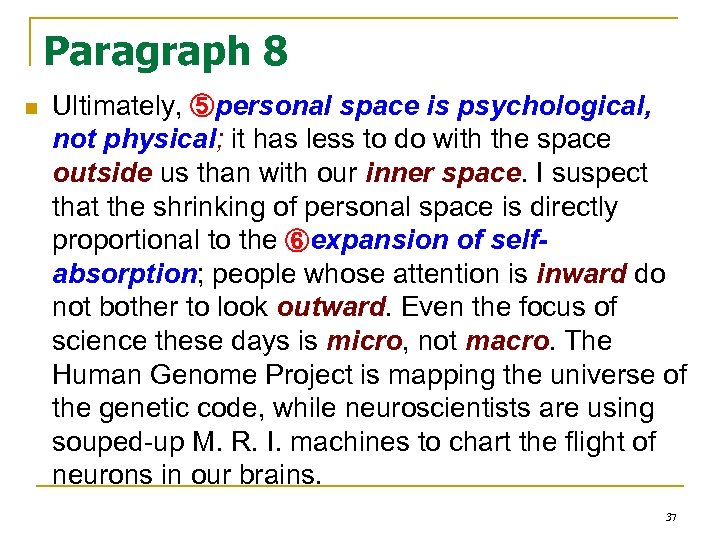
Paragraph 8 n Ultimately, ⑤personal space is psychological, not physical; it has less to do with the space outside us than with our inner space. I suspect that the shrinking of personal space is directly proportional to the ⑥expansion of selfabsorption; people whose attention is inward do not bother to look outward. Even the focus of science these days is micro, not macro. The Human Genome Project is mapping the universe of the genetic code, while neuroscientists are using souped up M. R. I. machines to chart the flight of neurons in our brains. 37
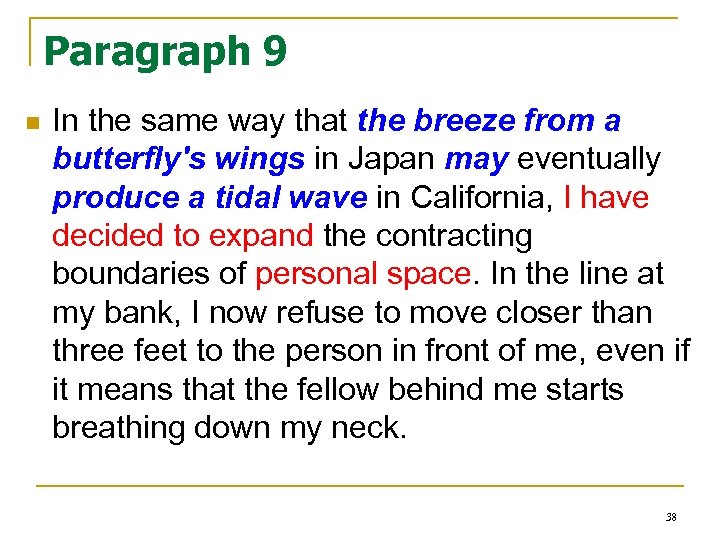
Paragraph 9 n In the same way that the breeze from a butterfly's wings in Japan may eventually produce a tidal wave in California, I have decided to expand the contracting boundaries of personal space. In the line at my bank, I now refuse to move closer than three feet to the person in front of me, even if it means that the fellow behind me starts breathing down my neck. 38
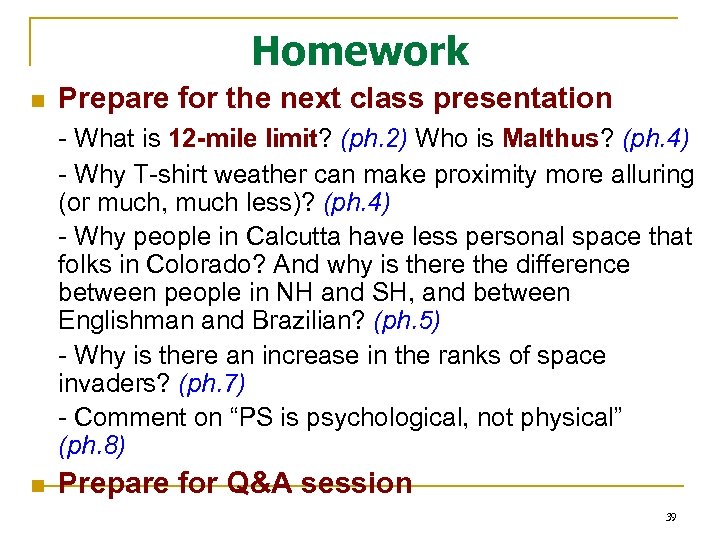
Homework n Prepare for the next class presentation What is 12 -mile limit? (ph. 2) Who is Malthus? (ph. 4) Why T shirt weather can make proximity more alluring (or much, much less)? (ph. 4) Why people in Calcutta have less personal space that folks in Colorado? And why is there the difference between people in NH and SH, and between Englishman and Brazilian? (ph. 5) Why is there an increase in the ranks of space invaders? (ph. 7) Comment on “PS is psychological, not physical” (ph. 8) n Prepare for Q&A session 39
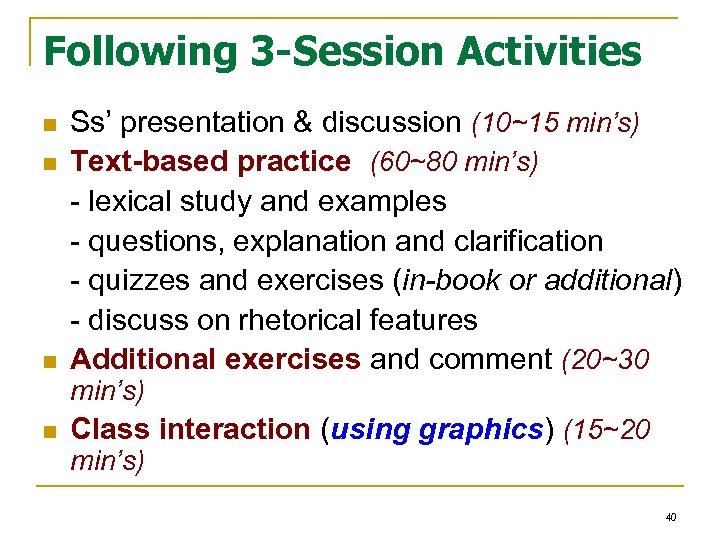
Following 3 -Session Activities n n n Ss’ presentation & discussion (10~15 min’s) Text-based practice (60~80 min’s) lexical study and examples questions, explanation and clarification quizzes and exercises (in-book or additional) discuss on rhetorical features Additional exercises and comment (20~30 min’s) n Class interaction (using graphics) (15~20 min’s) 40
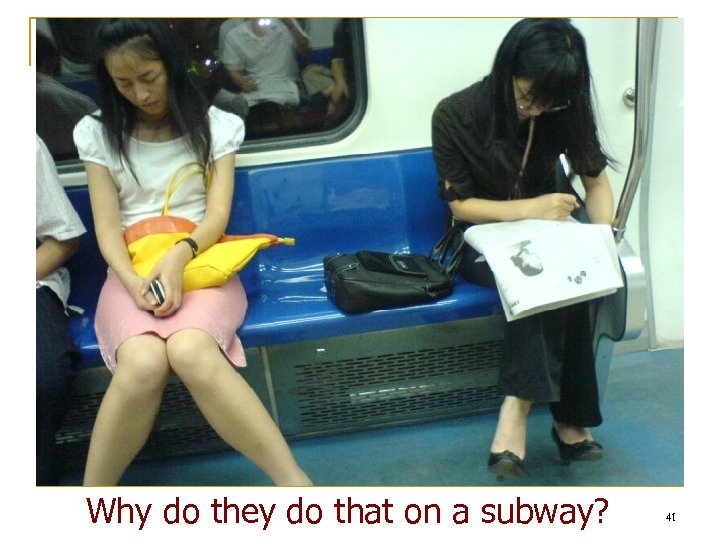
Why do they do that on a subway? 41
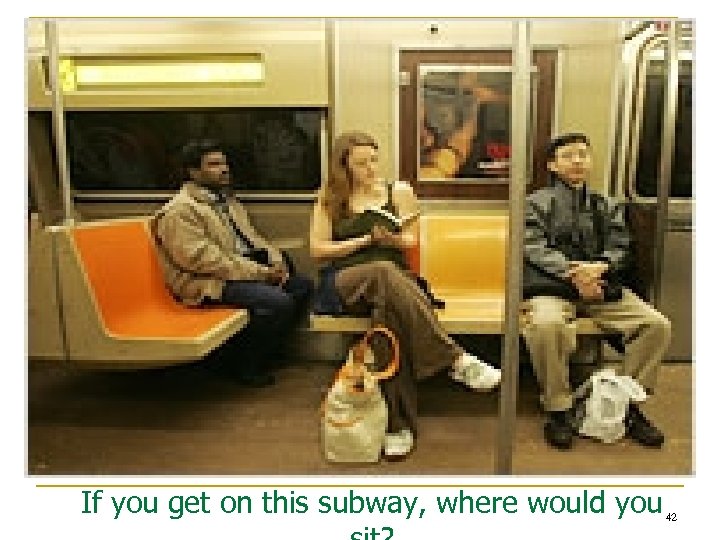
If you get on this subway, where would you 42
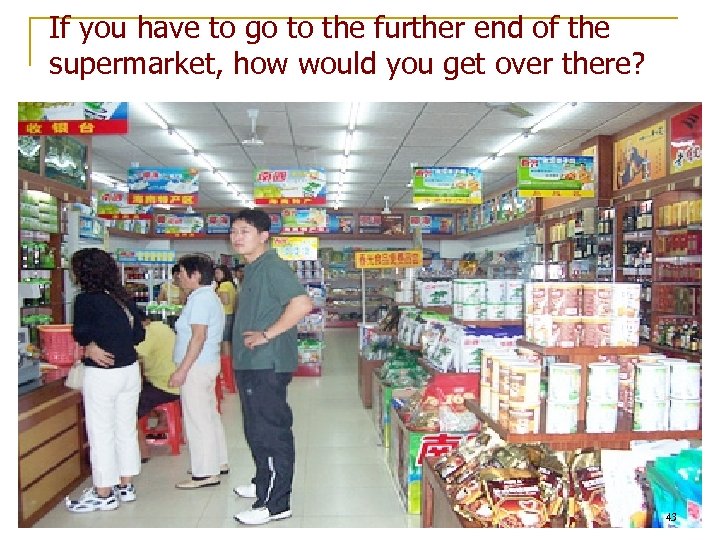
If you have to go to the further end of the supermarket, how would you get over there? 43
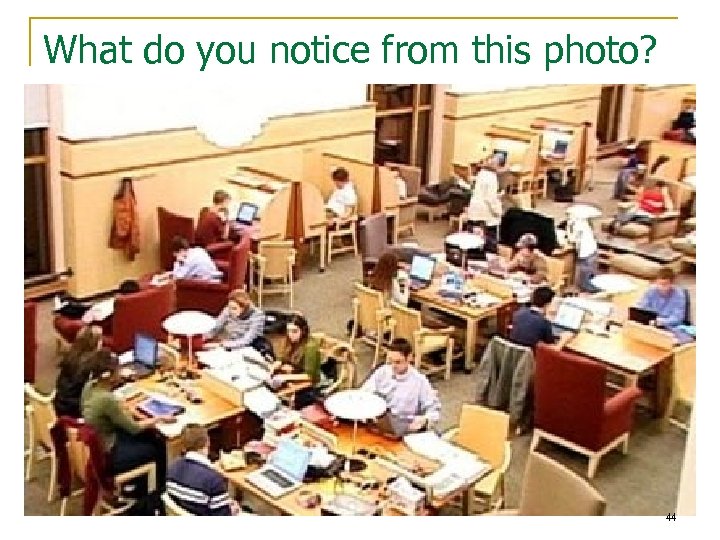
What do you notice from this photo? 44
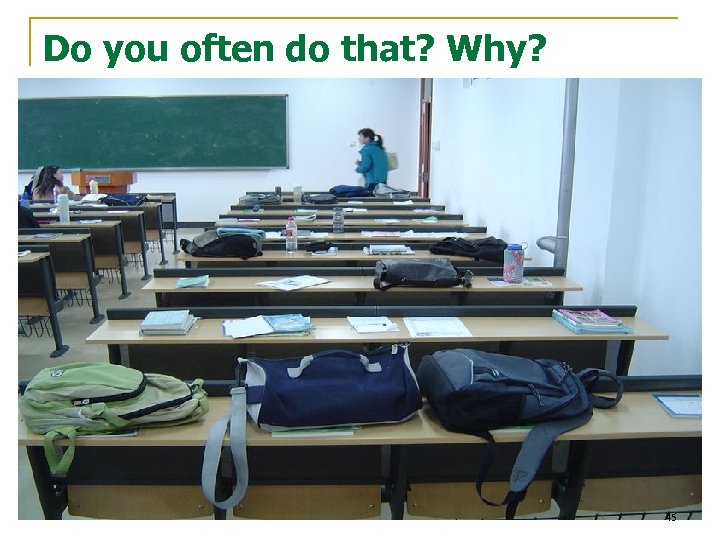
Do you often do that? Why? 45
End of Presentation 46
More Examples of Multimedia Integration in Instruction n Graphics for illustration n Introduction to text author or background n Using ppt to present various vocabulary exercise 47
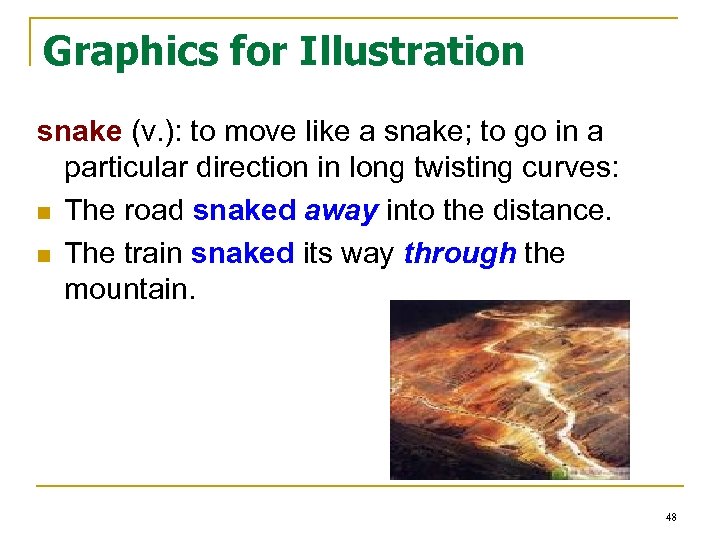
Graphics for Illustration snake (v. ): to move like a snake; to go in a particular direction in long twisting curves: n The road snaked away into the distance. n The train snaked its way through the mountain. 48
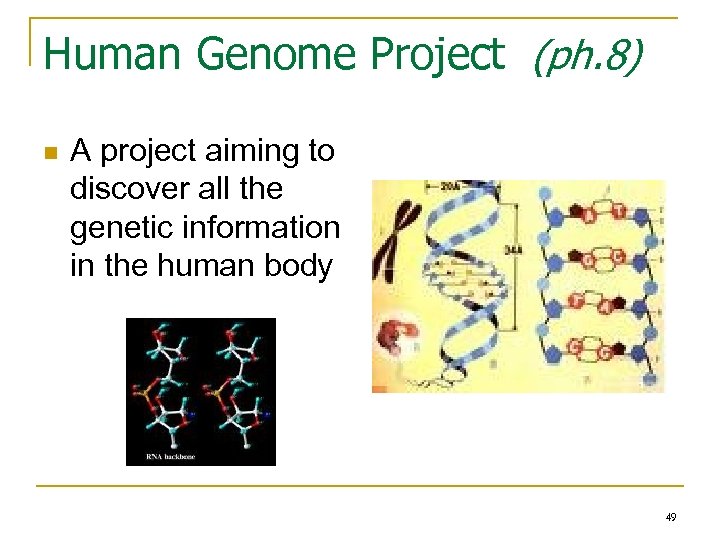
Human Genome Project (ph. 8) n A project aiming to discover all the genetic information in the human body 49
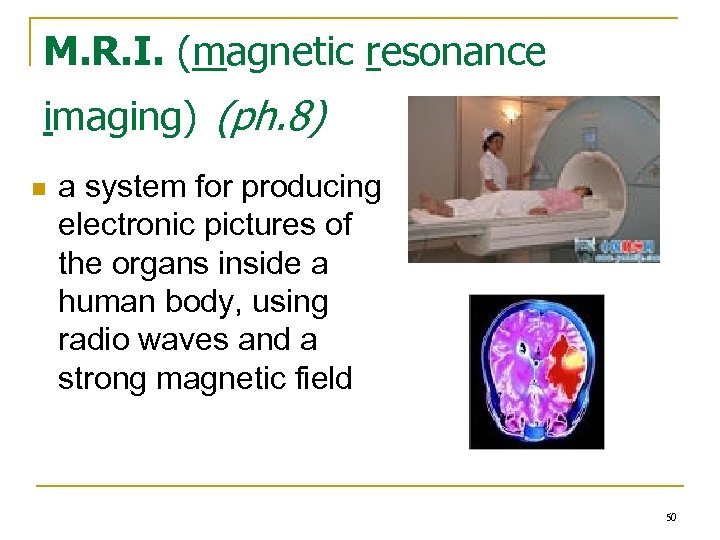
M. R. I. (magnetic resonance imaging) (ph. 8) n a system for producing electronic pictures of the organs inside a human body, using radio waves and a strong magnetic field 50
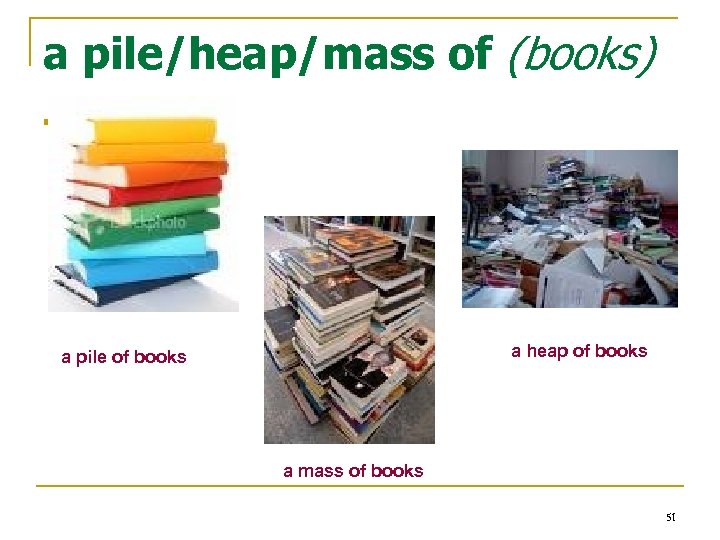
a pile/heap/mass of (books) n a heap of books a pile of books a mass of books 51
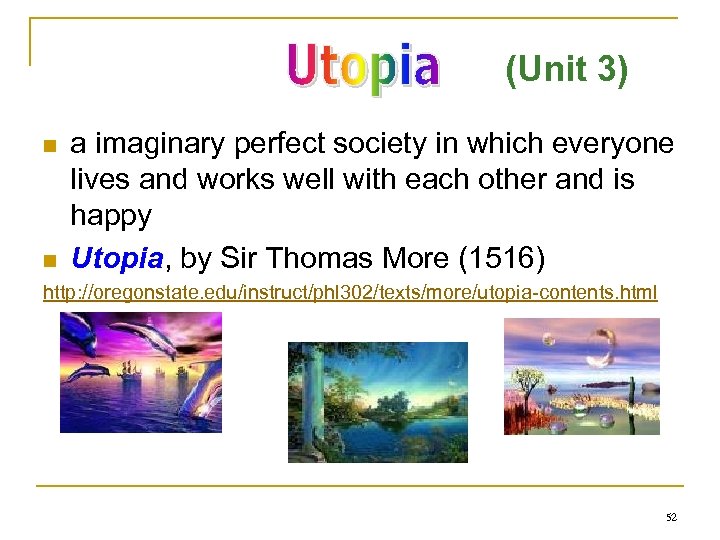
(Unit 3) n n a imaginary perfect society in which everyone lives and works well with each other and is happy Utopia, by Sir Thomas More (1516) http: //oregonstate. edu/instruct/phl 302/texts/more/utopia contents. html 52
Unit 13 Promise of Bluebirds
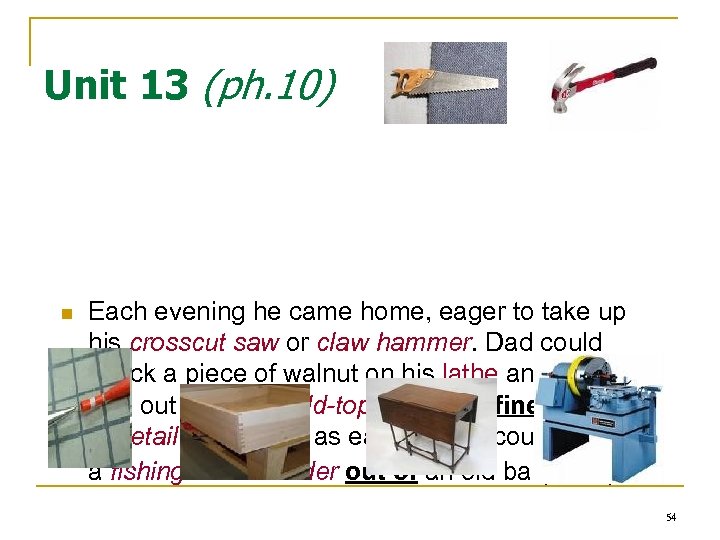
Unit 13 (ph. 10) n Each evening he came home, eager to take up his crosscut saw or claw hammer. Dad could chock a piece of walnut on his lathe and deftly turn out a cherry fold-top desk with fine, dovetailed drawers as easily as he could fashion a fishing-line threader out of an old ballpoint pen. 54
Introduction to Text Author or Background 55
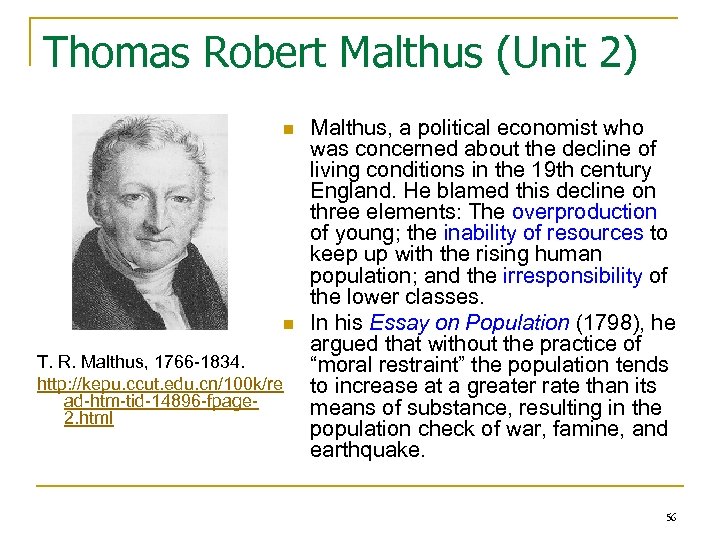
Thomas Robert Malthus (Unit 2) n n T. R. Malthus, 1766 1834. http: //kepu. ccut. edu. cn/100 k/re ad htm tid 14896 fpage 2. html Malthus, a political economist who was concerned about the decline of living conditions in the 19 th century England. He blamed this decline on three elements: The overproduction of young; the inability of resources to keep up with the rising human population; and the irresponsibility of the lower classes. In his Essay on Population (1798), he argued that without the practice of “moral restraint” the population tends to increase at a greater rate than its means of substance, resulting in the population check of war, famine, and earthquake. 56
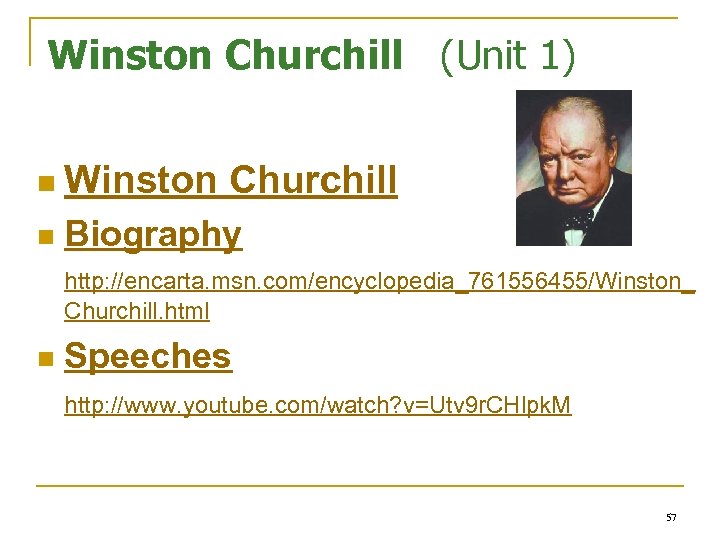
Winston Churchill (Unit 1) n Winston n Churchill Biography http: //encarta. msn. com/encyclopedia_761556455/Winston_ Churchill. html n Speeches http: //www. youtube. com/watch? v=Utv 9 r. CHlpk. M 57
Yosuke Yamahata (Unit 4) n Yosuke Yamahata http: //www. peacemuseum. org/gallery. JPM/galler y_yamahata/p_memo/photo_memo_e. htm n Nagasaki Journey http: //www. exploratorium. edu/nagasaki/journey/j ourney 1. html 58
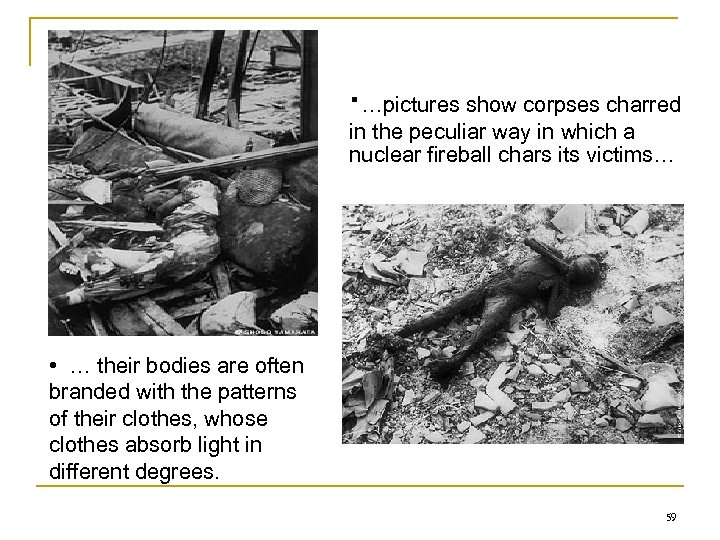
Photos ·…pictures show corpses charred in the peculiar way in which a nuclear fireball chars its victims… • … their bodies are often branded with the patterns of their clothes, whose clothes absorb light in different degrees. 59
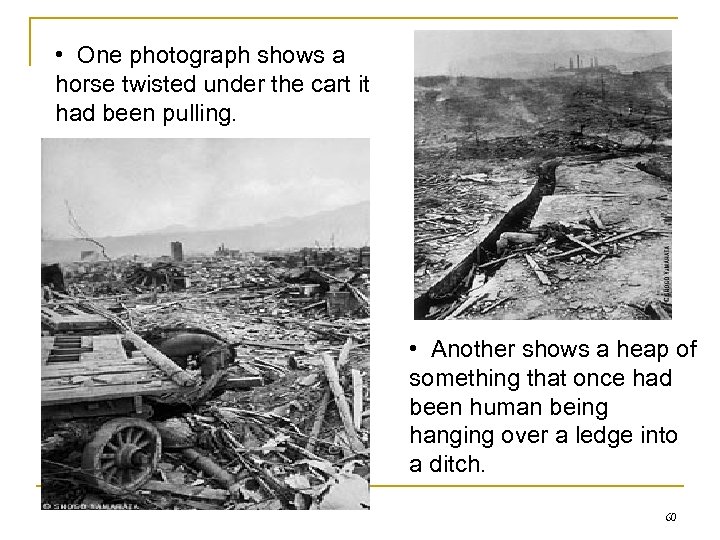
• One photograph shows a horse twisted under the cart it had been pulling. • Another shows a heap of something that once had been human being hanging over a ledge into a ditch. 60
Using ppt to Present Various Vocabulary Exercises 61
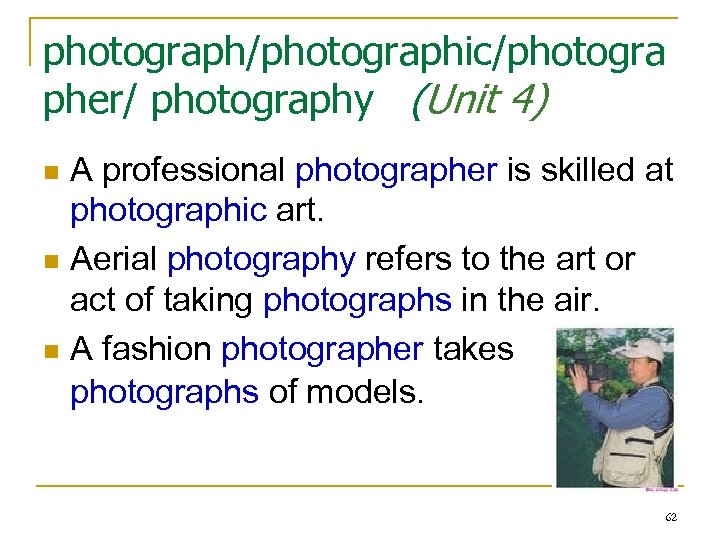
photograph/photographic/photogra pher/ photography (Unit 4) A professional photographer is skilled at photographic art. n Aerial photography refers to the art or act of taking photographs in the air. n A fashion photographer takes photographs of models. n 62
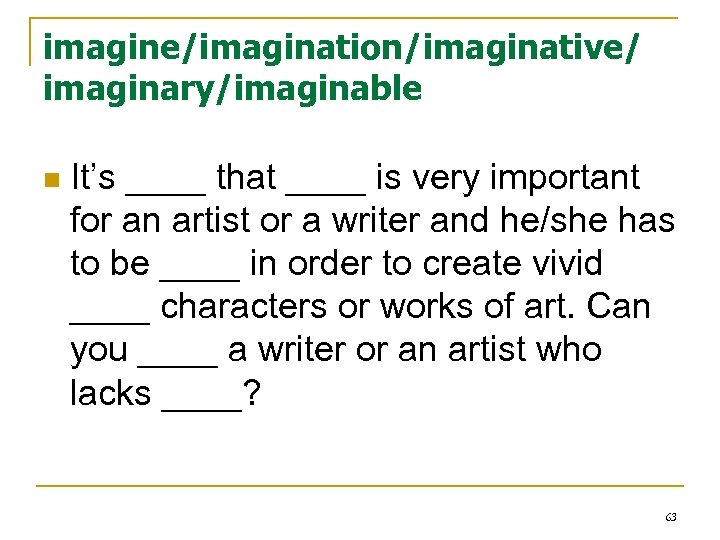
imagine/imagination/imaginative/ imaginary/imaginable n It’s ____ that ____ is very important for an artist or a writer and he/she has to be ____ in order to create vivid ____ characters or works of art. Can you ____ a writer or an artist who lacks ____? 63
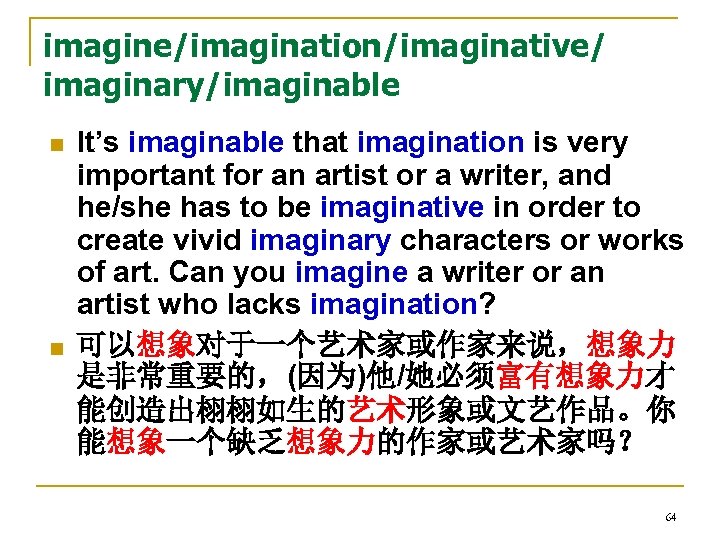
imagine/imagination/imaginative/ imaginary/imaginable n n It’s imaginable that imagination is very important for an artist or a writer, and he/she has to be imaginative in order to create vivid imaginary characters or works of art. Can you imagine a writer or an artist who lacks imagination? 可以想象对于一个艺术家或作家来说,想象力 是非常重要的,(因为)他/她必须富有想象力才 能创造出栩栩如生的艺术形象或文艺作品。你 能想象一个缺乏想象力的作家或艺术家吗? 64
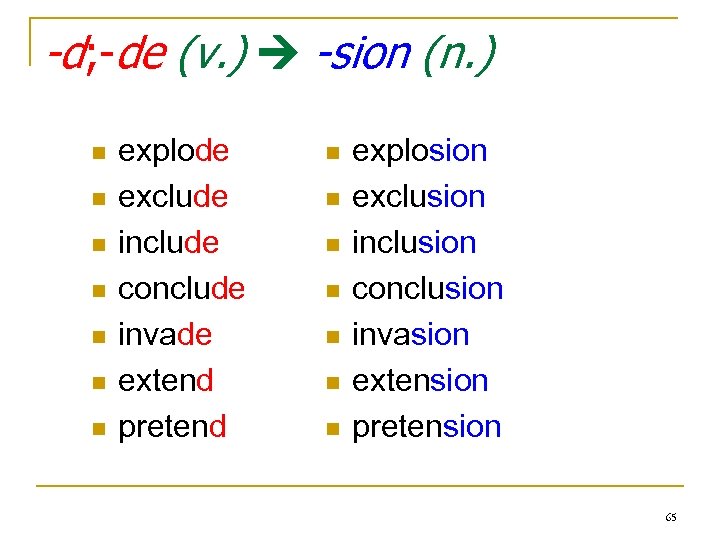
-d; -de (v. ) -sion (n. ) n n n n explode exclude include conclude invade extend pretend n n n n explosion exclusion inclusion conclusion invasion extension pretension 65
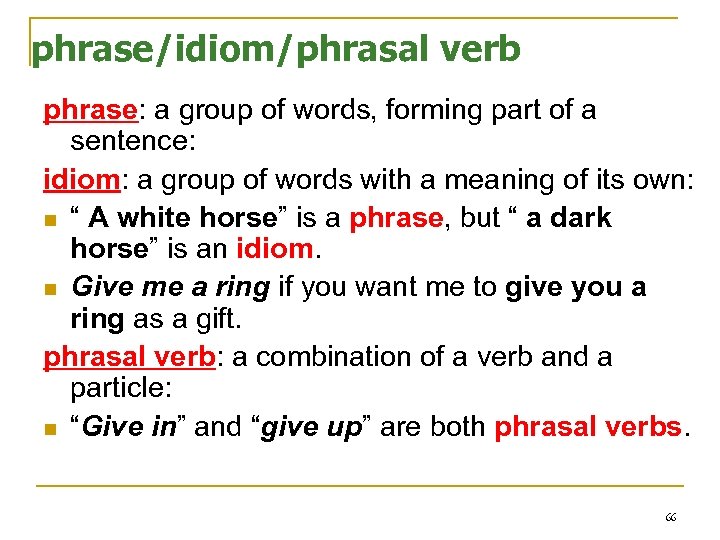
phrase/idiom/phrasal verb phrase: a group of words, forming part of a sentence: idiom: a group of words with a meaning of its own: n “ A white horse” is a phrase, but “ a dark horse” is an idiom. n Give me a ring if you want me to give you a ring as a gift. phrasal verb: a combination of a verb and a particle: n “Give in” and “give up” are both phrasal verbs. 66
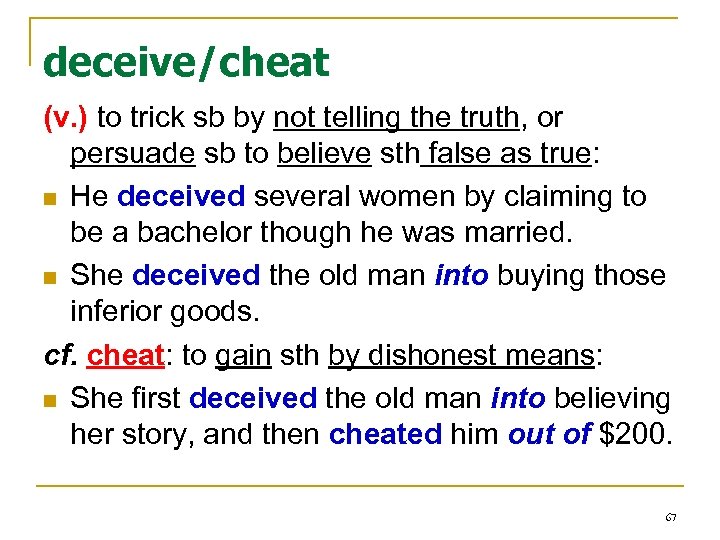
deceive/cheat (v. ) to trick sb by not telling the truth, or persuade sb to believe sth false as true: n He deceived several women by claiming to be a bachelor though he was married. n She deceived the old man into buying those inferior goods. cf. cheat: to gain sth by dishonest means: n She first deceived the old man into believing her story, and then cheated him out of $200. 67
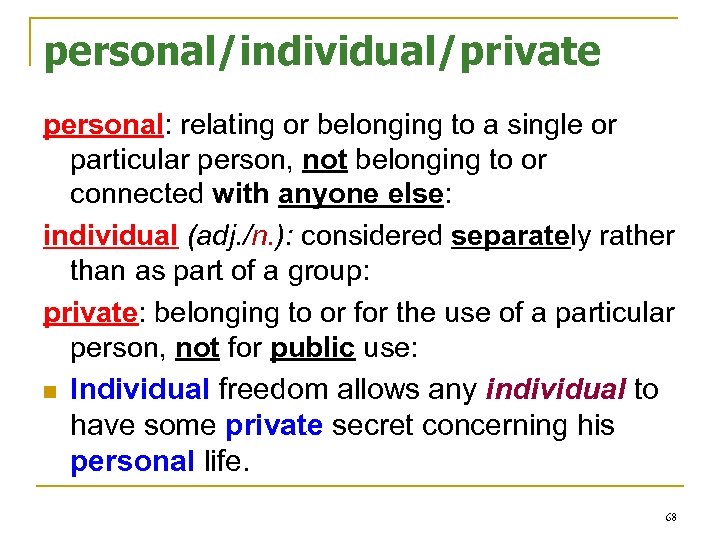
personal/individual/private personal: relating or belonging to a single or particular person, not belonging to or connected with anyone else: individual (adj. /n. ): considered separately rather than as part of a group: private: belonging to or for the use of a particular person, not for public use: n Individual freedom allows any individual to have some private secret concerning his personal life. 68
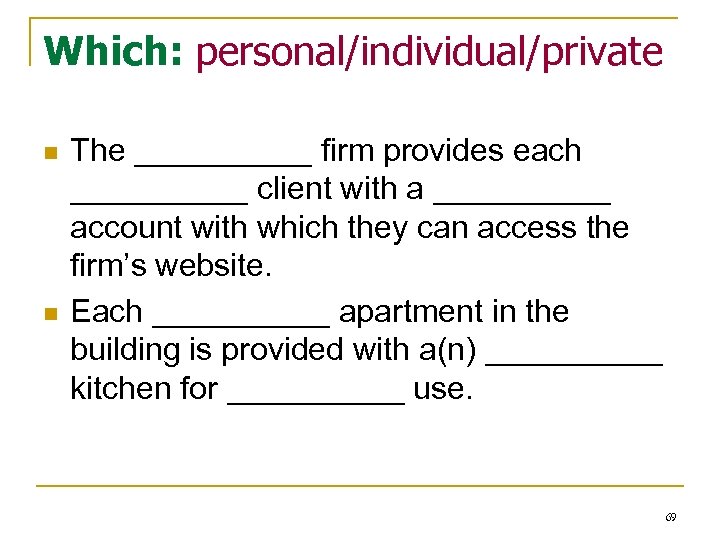
Which: personal/individual/private n n The _____ firm provides each _____ client with a _____ account with which they can access the firm’s website. Each _____ apartment in the building is provided with a(n) _____ kitchen for _____ use. 69
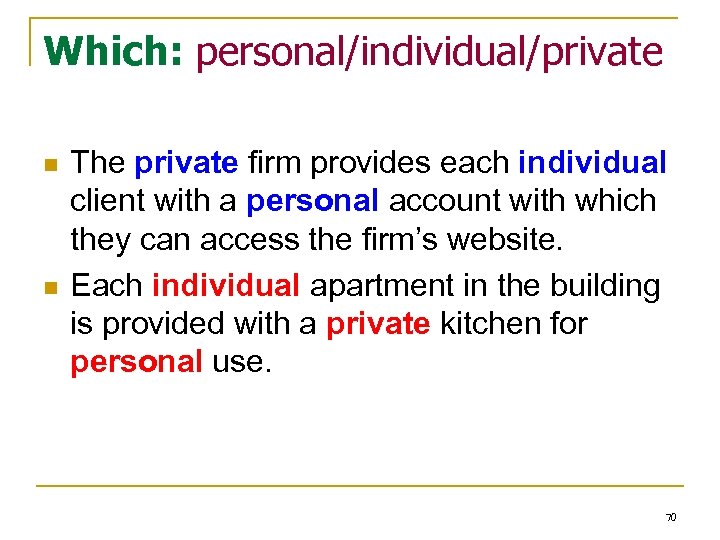
Which: personal/individual/private n n The private firm provides each individual client with a personal account with which they can access the firm’s website. Each individual apartment in the building is provided with a private kitchen for personal use. 70
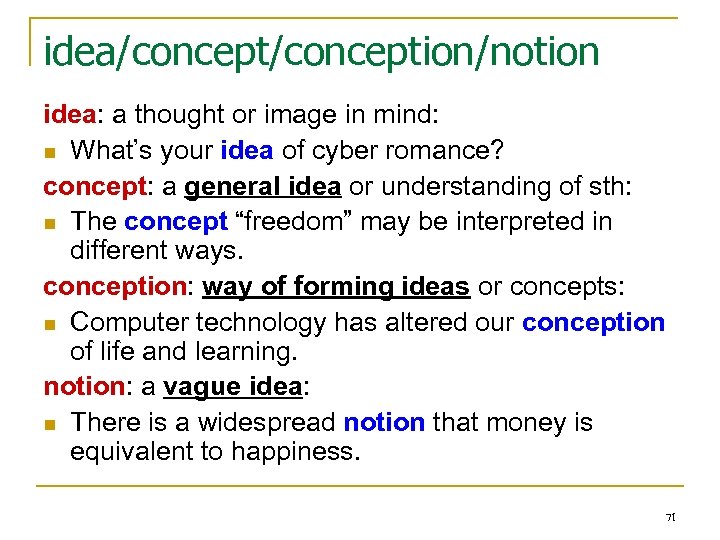
idea/conception/notion idea: a thought or image in mind: n What’s your idea of cyber romance? concept: a general idea or understanding of sth: n The concept “freedom” may be interpreted in different ways. conception: way of forming ideas or concepts: n Computer technology has altered our conception of life and learning. notion: a vague idea: n There is a widespread notion that money is equivalent to happiness. 71
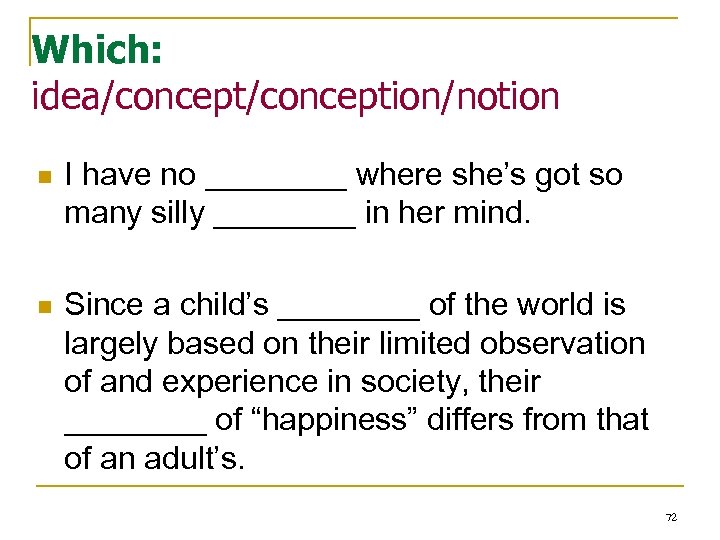
Which: idea/conception/notion n I have no ____ where she’s got so many silly ____ in her mind. n Since a child’s ____ of the world is largely based on their limited observation of and experience in society, their ____ of “happiness” differs from that of an adult’s. 72
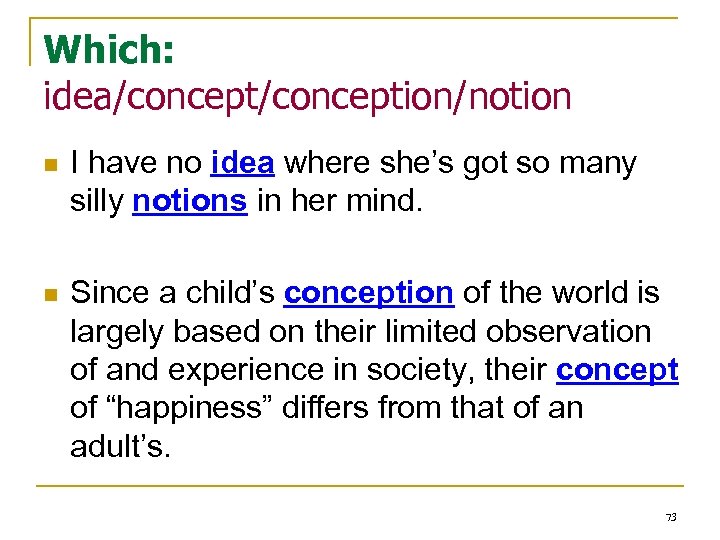
Which: idea/conception/notion n I have no idea where she’s got so many silly notions in her mind. n Since a child’s conception of the world is largely based on their limited observation of and experience in society, their concept of “happiness” differs from that of an adult’s. 73
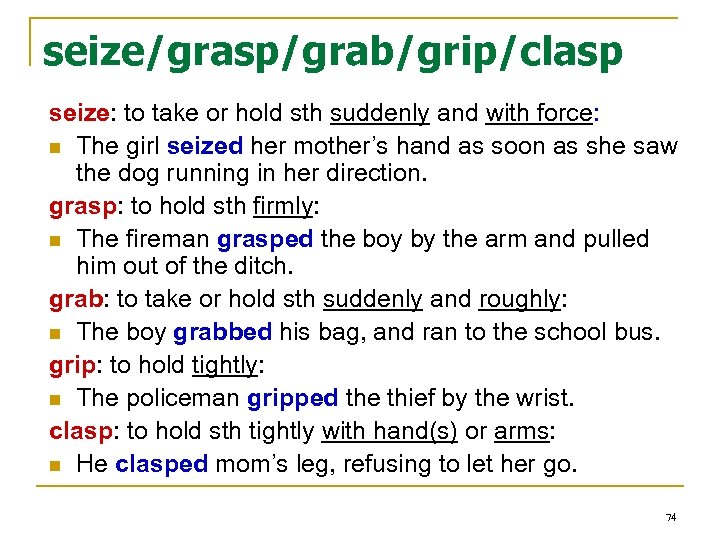
seize/grasp/grab/grip/clasp seize: to take or hold sth suddenly and with force: n The girl seized her mother’s hand as soon as she saw the dog running in her direction. grasp: to hold sth firmly: n The fireman grasped the boy by the arm and pulled him out of the ditch. grab: to take or hold sth suddenly and roughly: n The boy grabbed his bag, and ran to the school bus. grip: to hold tightly: n The policeman gripped the thief by the wrist. clasp: to hold sth tightly with hand(s) or arms: n He clasped mom’s leg, refusing to let her go. 74
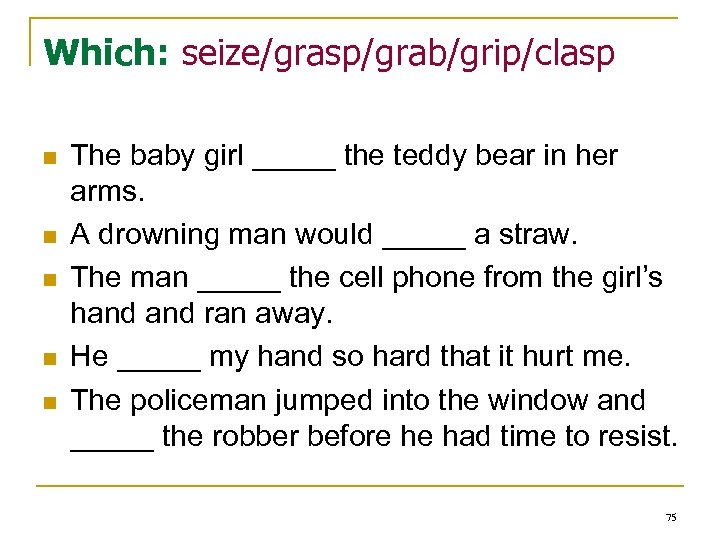
Which: seize/grasp/grab/grip/clasp n n n The baby girl _____ the teddy bear in her arms. A drowning man would _____ a straw. The man _____ the cell phone from the girl’s hand ran away. He _____ my hand so hard that it hurt me. The policeman jumped into the window and _____ the robber before he had time to resist. 75
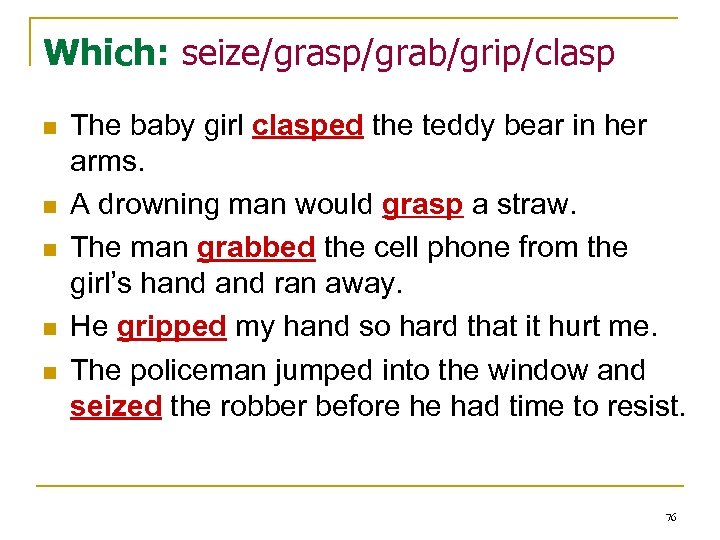
Which: seize/grasp/grab/grip/clasp n n n The baby girl clasped the teddy bear in her arms. A drowning man would grasp a straw. The man grabbed the cell phone from the girl’s hand ran away. He gripped my hand so hard that it hurt me. The policeman jumped into the window and seized the robber before he had time to resist. 76
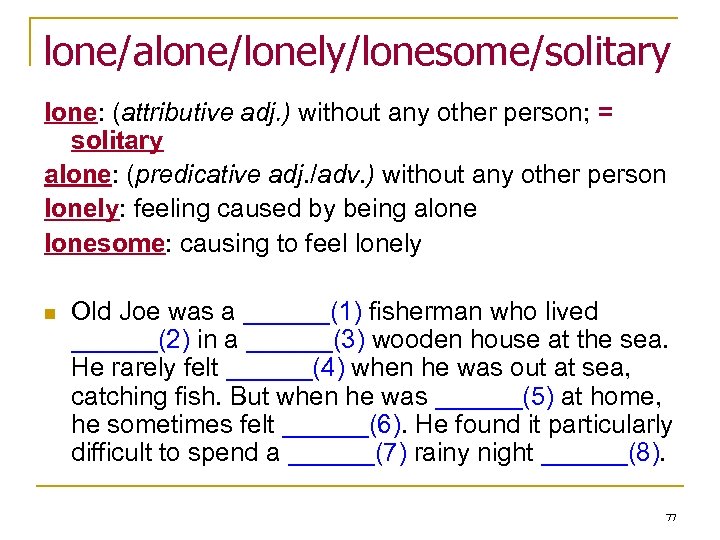
lone/alone/lonely/lonesome/solitary lone: (attributive adj. ) without any other person; = solitary alone: (predicative adj. /adv. ) without any other person lonely: feeling caused by being alonesome: causing to feel lonely n Old Joe was a ______(1) fisherman who lived ______(2) in a ______(3) wooden house at the sea. He rarely felt ______(4) when he was out at sea, catching fish. But when he was ______(5) at home, he sometimes felt ______(6). He found it particularly difficult to spend a ______(7) rainy night ______(8). 77
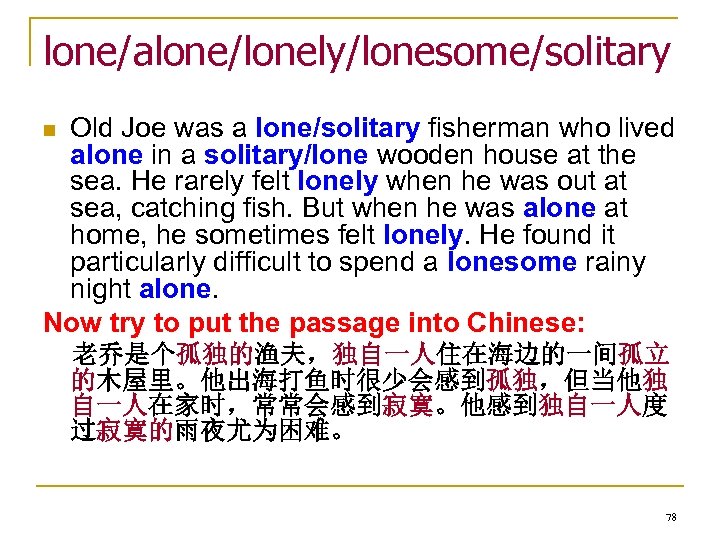
lone/alone/lonely/lonesome/solitary Old Joe was a lone/solitary fisherman who lived alone in a solitary/lone wooden house at the sea. He rarely felt lonely when he was out at sea, catching fish. But when he was alone at home, he sometimes felt lonely. He found it particularly difficult to spend a lonesome rainy night alone. Now try to put the passage into Chinese: n 老乔是个孤独的渔夫,独自一人住在海边的一间孤立 的木屋里。他出海打鱼时很少会感到孤独,但当他独 自一人在家时,常常会感到寂寞。他感到独自一人度 过寂寞的雨夜尤为困难。 78
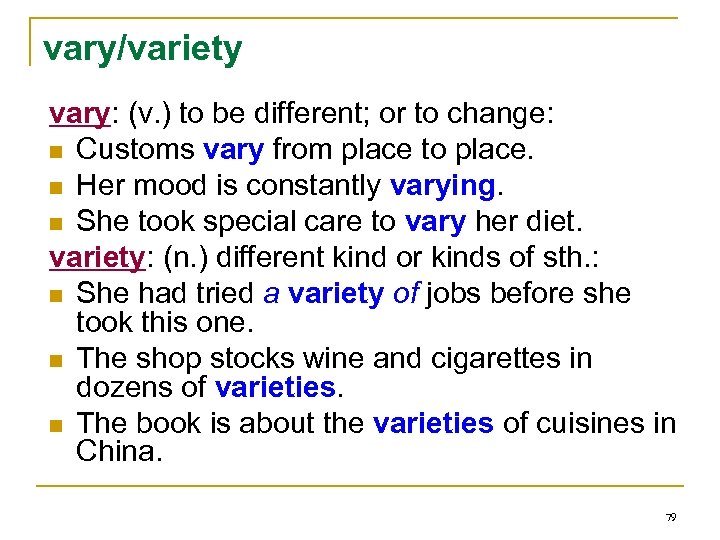
vary/variety vary: (v. ) to be different; or to change: n Customs vary from place to place. n Her mood is constantly varying. n She took special care to vary her diet. variety: (n. ) different kind or kinds of sth. : n She had tried a variety of jobs before she took this one. n The shop stocks wine and cigarettes in dozens of varieties. n The book is about the varieties of cuisines in China. 79
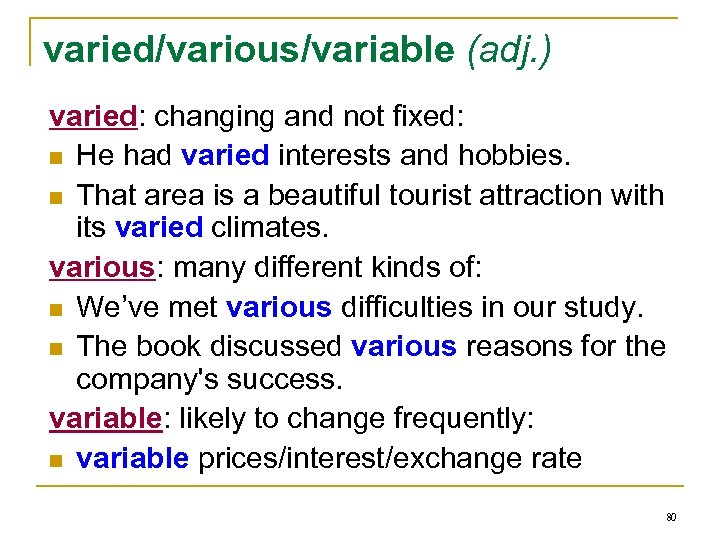
varied/various/variable (adj. ) varied: changing and not fixed: n He had varied interests and hobbies. n That area is a beautiful tourist attraction with its varied climates. various: many different kinds of: n We’ve met various difficulties in our study. n The book discussed various reasons for the company's success. variable: likely to change frequently: n variable prices/interest/exchange rate 80
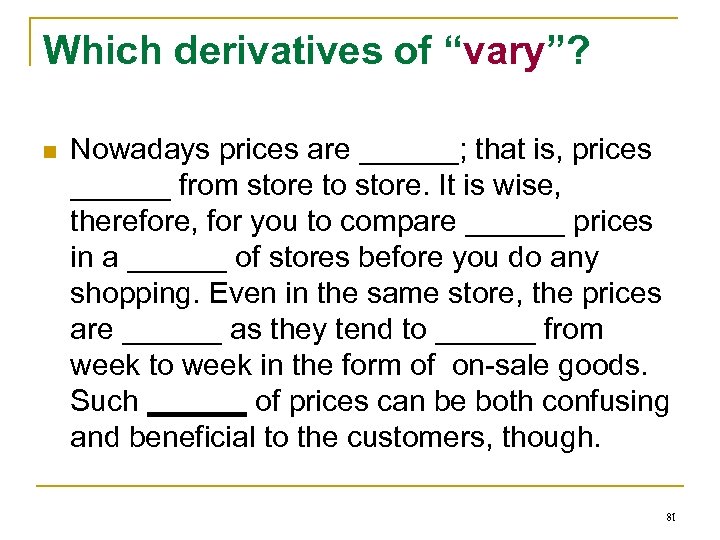
Which derivatives of “vary”? n Nowadays prices are ______; that is, prices ______ from store to store. It is wise, therefore, for you to compare ______ prices in a ______ of stores before you do any shopping. Even in the same store, the prices are ______ as they tend to ______ from week to week in the form of on sale goods. Such ______ of prices can be both confusing and beneficial to the customers, though. 81
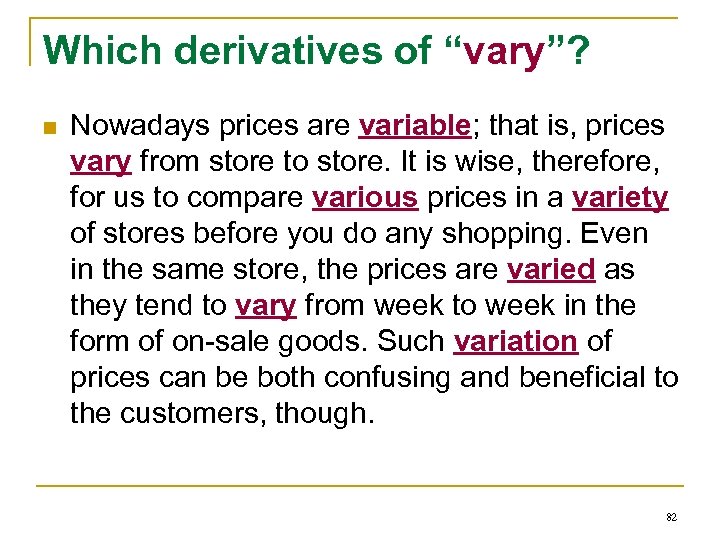
Which derivatives of “vary”? n Nowadays prices are variable; that is, prices vary from store to store. It is wise, therefore, for us to compare various prices in a variety of stores before you do any shopping. Even in the same store, the prices are varied as they tend to vary from week to week in the form of on sale goods. Such variation of prices can be both confusing and beneficial to the customers, though. 82
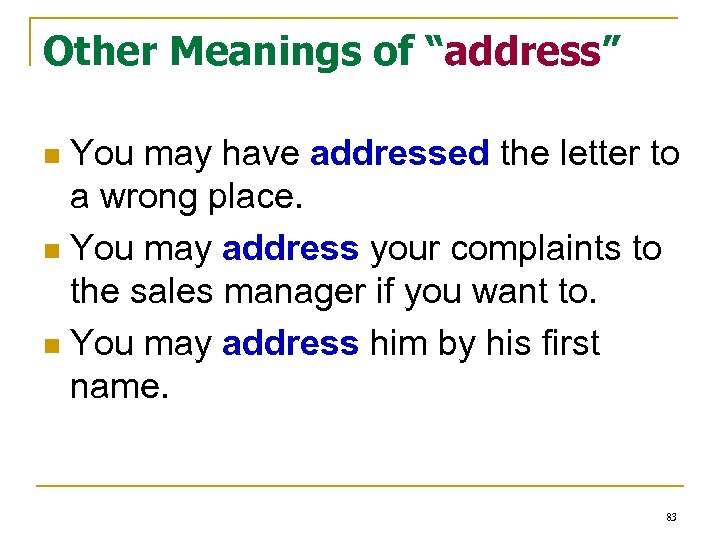
Other Meanings of “address” You may have addressed the letter to a wrong place. n You may address your complaints to the sales manager if you want to. n You may address him by his first name. n 83
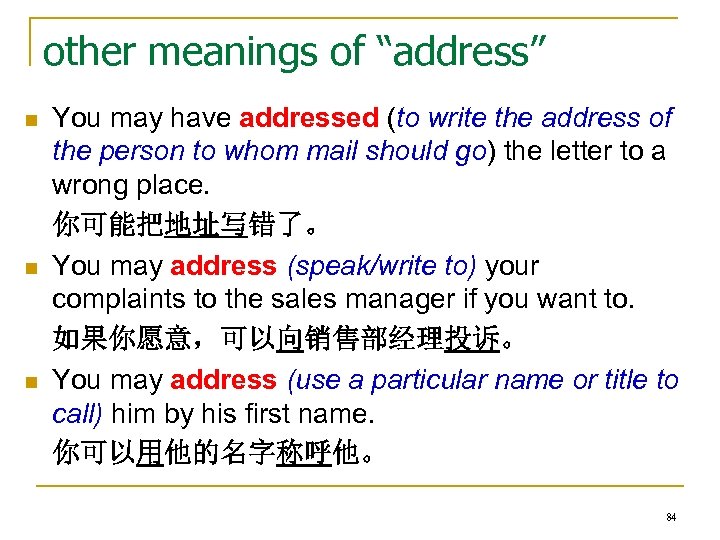
other meanings of “address” n n n You may have addressed (to write the address of the person to whom mail should go) the letter to a wrong place. 你可能把地址写错了。 You may address (speak/write to) your complaints to the sales manager if you want to. 如果你愿意,可以向销售部经理投诉。 You may address (use a particular name or title to call) him by his first name. 你可以用他的名字称呼他。 84
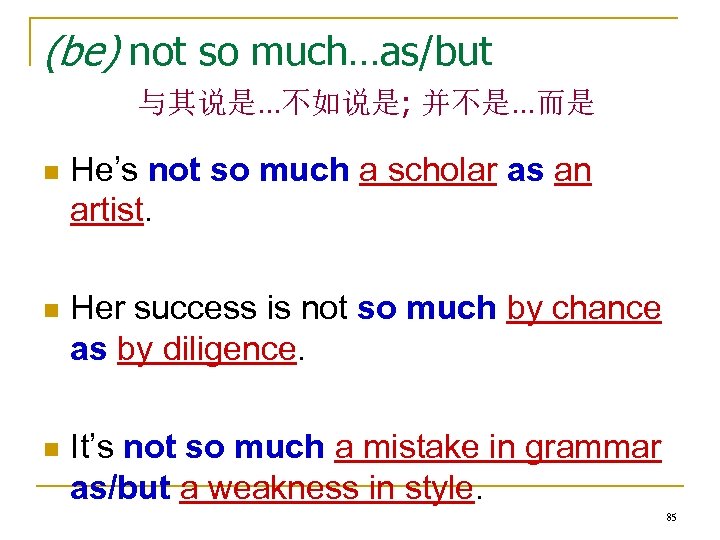
(be) not so much…as/but 与其说是…不如说是; 并不是…而是 n He’s not so much a scholar as an artist. n Her success is not so much by chance as by diligence. n It’s not so much a mistake in grammar as/but a weakness in style. 85
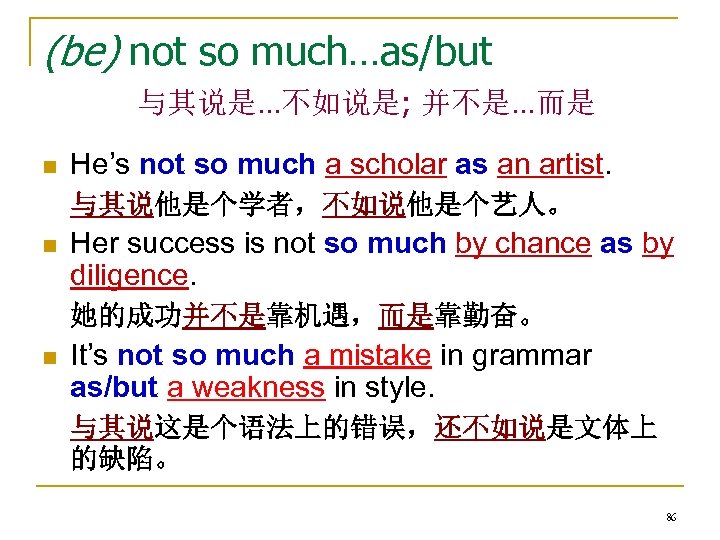
(be) not so much…as/but 与其说是…不如说是; 并不是…而是 n He’s not so much a scholar as an artist. 与其说他是个学者,不如说他是个艺人。 n Her success is not so much by chance as by diligence. 她的成功并不是靠机遇,而是靠勤奋。 n It’s not so much a mistake in grammar as/but a weakness in style. 与其说这是个语法上的错误,还不如说是文体上 的缺陷。 86
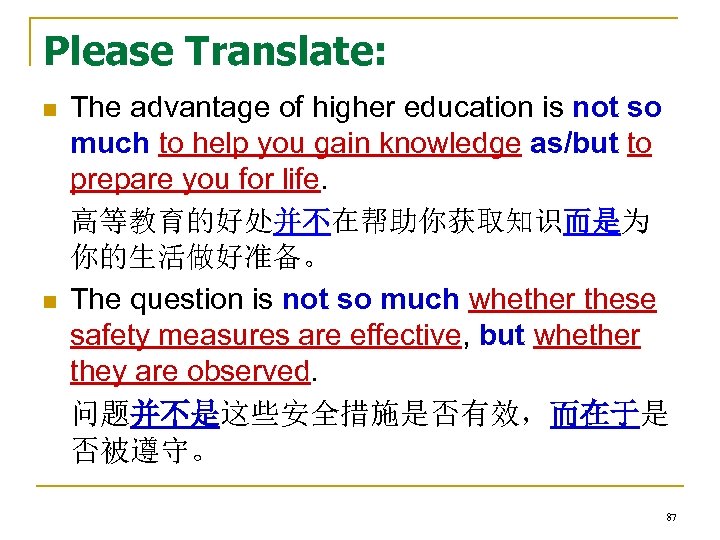
Please Translate: n n The advantage of higher education is not so much to help you gain knowledge as/but to prepare you for life. 高等教育的好处并不在帮助你获取知识而是为 你的生活做好准备。 The question is not so much whether these safety measures are effective, but whether they are observed. 问题并不是这些安全措施是否有效,而在于是 否被遵守。 87
4. Online Resources n Dictionaries n Encyclopedia n Wikipedia 88
Online Dictionaries n 金山词霸 http: //www. iciba. com/ 词海词典 http: //dict. cn/ n Cambridge Dictionaries Online n http: //dictionary. cambridge. org/ n One. Look Dictionary Search http: //www. onelook. com/? w=instruction&ls=a 89
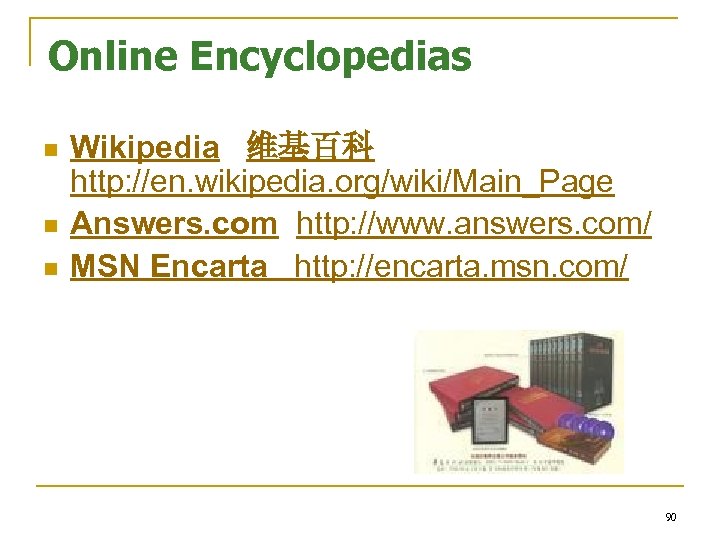
Online Encyclopedias n n n Wikipedia 维基百科 http: //en. wikipedia. org/wiki/Main_Page Answers. com http: //www. answers. com/ MSN Encarta http: //encarta. msn. com/ 90
Miscellaneous Web Resources n Randall’s ESL Cyber Listening Lab http: //www. esl lab. com/ n BBC Learning English http: //www. bbc. co. uk/worldservice/learningenglish/ n Cliff Notes http: //www. cliffsnotes. com/Wiley. CDA/Section/id 305321. html n Teaching English as Second Language http: //tesl ej. org/ej 48/toc. html n Language Learning & Technology http: //llt. msu. edu/ 91
Miscellaneous Resources (cont’d) n Teaching Tips Index http: //honolulu. hawaii. edu/intranet/committees/Fac. Dev. Com/guidebk/t eachtip/teachtip. htm n Online Image Directory http: //www. picsearch. com/image dir. html n Text Analyzer ph. 4 ph. 8 http: //www. usingenglish. com/resources/text statistics. php n VARK printable questionnaire http: //www. vark learn. com/english/page. asp? p=questionnaire http: //www. vark learn. com/documents/The%20 VARK%20 Questionnaire. pdf 92
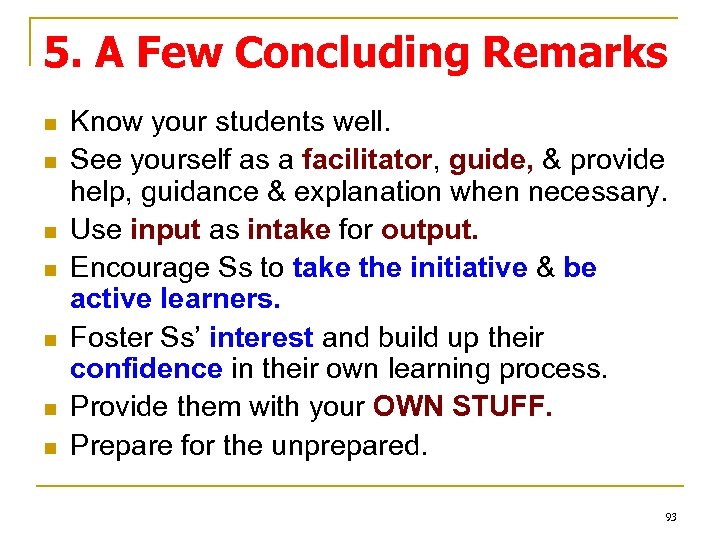
5. A Few Concluding Remarks n n n n Know your students well. See yourself as a facilitator, guide, & provide help, guidance & explanation when necessary. Use input as intake for output. Encourage Ss to take the initiative & be active learners. Foster Ss’ interest and build up their confidence in their own learning process. Provide them with your OWN STUFF. Prepare for the unprepared. 93
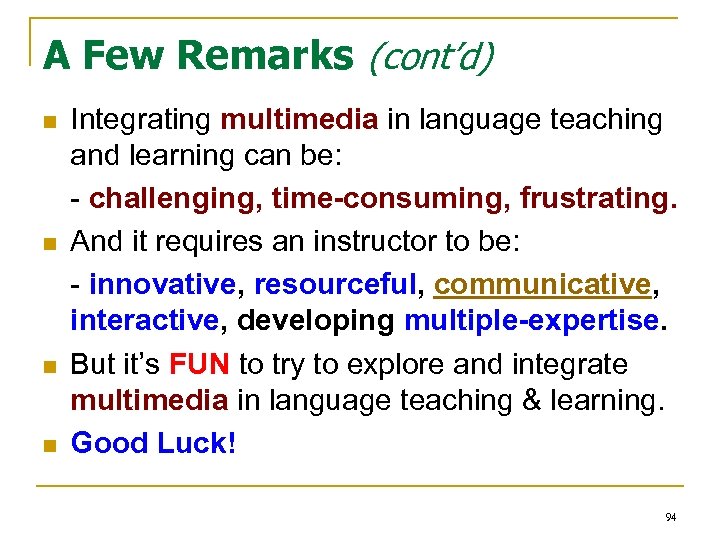
A Few Remarks (cont’d) n n Integrating multimedia in language teaching and learning can be: challenging, time-consuming, frustrating. And it requires an instructor to be: innovative, resourceful, communicative, interactive, developing multiple-expertise. But it’s FUN to try to explore and integrate multimedia in language teaching & learning. Good Luck! 94
lchen@shisu. edu. cn 95
Скачать презентацию 英语综合课教学中 多媒体资源的搜索 获取与应用 以何兆熊 综合教程4 为例 陈 龙 上海外国语大学网络教育学院
c91c11226d6f6a3cfe99f20b2e81c6fe.ppt