 Скачать презентацию 简单 句的五种基本句型 词类及基本用法 组成句子的各个组成部分叫句子成分 主语 谓语
8e999e99967837996a54896207e1e1b6.ppt
- Количество слайдов: 25



简单 句的五种基本句型
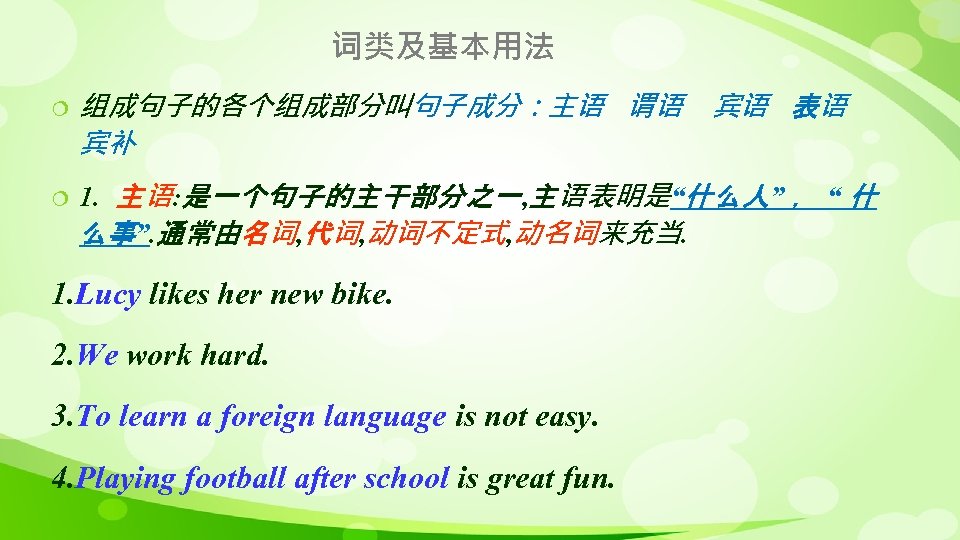
词类及基本用法 ¦ ¦ 组成句子的各个组成部分叫句子成分:主语 谓语 宾补 宾语 表语 1. 主语: 是一个句子的主干部分之一, 主语表明是“什么人” , “ 什 么事”. 通常由名词, 代词, 动词不定式, 动名词来充当. 1. Lucy likes her new bike. 2. We work hard. 3. To learn a foreign language is not easy. 4. Playing football after school is great fun.
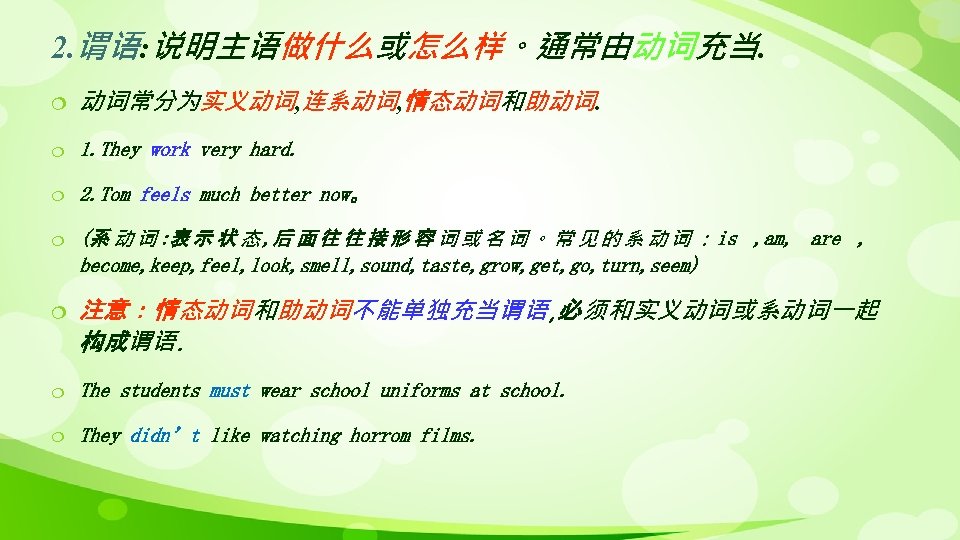
2. 谓语: 说明主语做什么或怎么样。通常由动词充当. ¦ 动词常分为实义动词, 连系动词, 情态动词和助动词. ¦ 1. They work very hard. ¦ 2. Tom feels much better now。 ¦ ¦ (系 动 词 : 表 示 状 态 , 后 面 往 往 接 形 容 词 或 名 词 。 常 见 的 系 动 词 : is , am, are , become, keep, feel, look, smell, sound, taste, grow, get, go, turn, seem) 注意:情态动词和助动词不能单独充当谓语, 必须和实义动词或系动词一起 构成谓语. ¦ The students must wear school uniforms at school. ¦ They didn’t like watching horrom films.
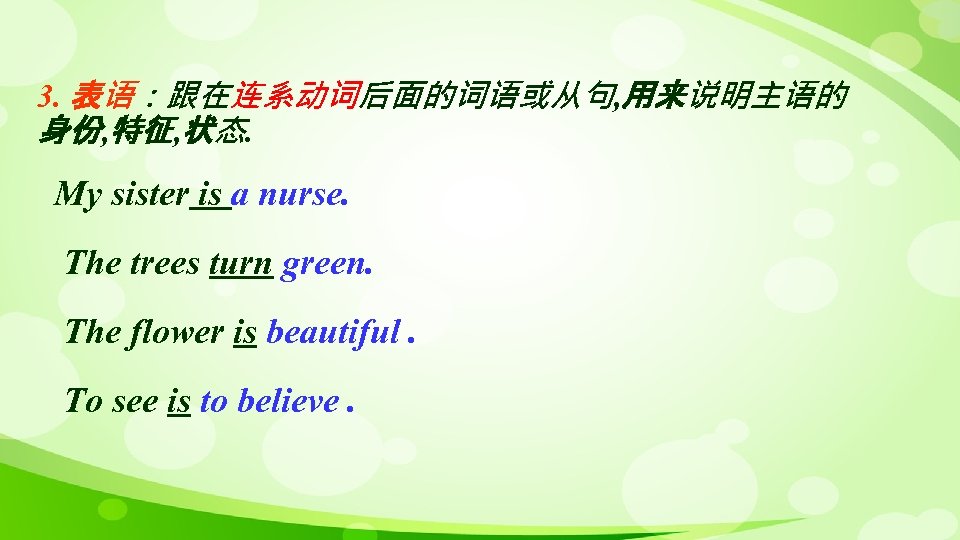
3. 表语:跟在连系动词后面的词语或从句, 用来说明主语的 身份, 特征, 状态. My sister is a nurse. The trees turn green. The flower is beautiful. To see is to believe.
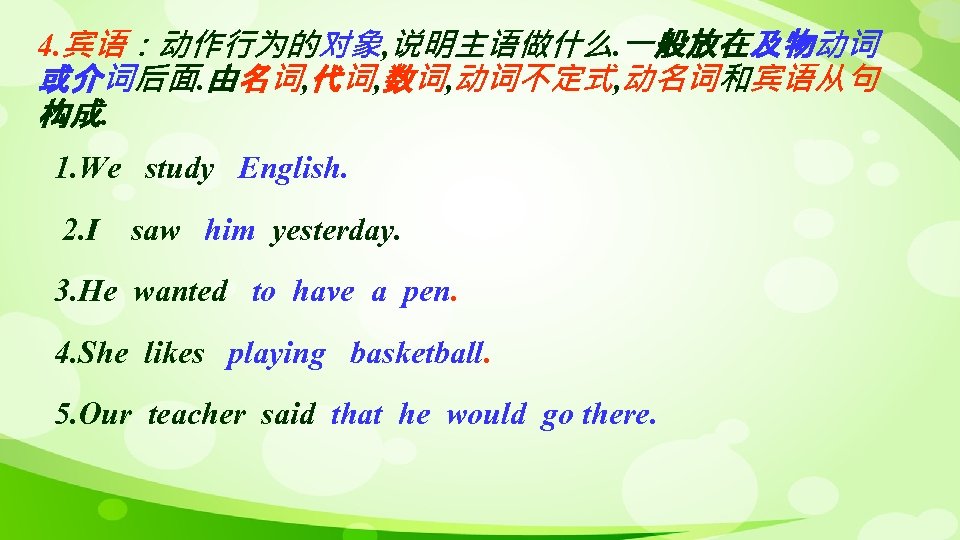
4. 宾语:动作行为的对象, 说明主语做什么. 一般放在及物动词 或介词后面. 由名词, 代词, 数词, 动词不定式, 动名词和宾语从句 构成. 1. We study English. 2. I saw him yesterday. 3. He wanted to have a pen. 4. She likes playing basketball. 5. Our teacher said that he would go there.
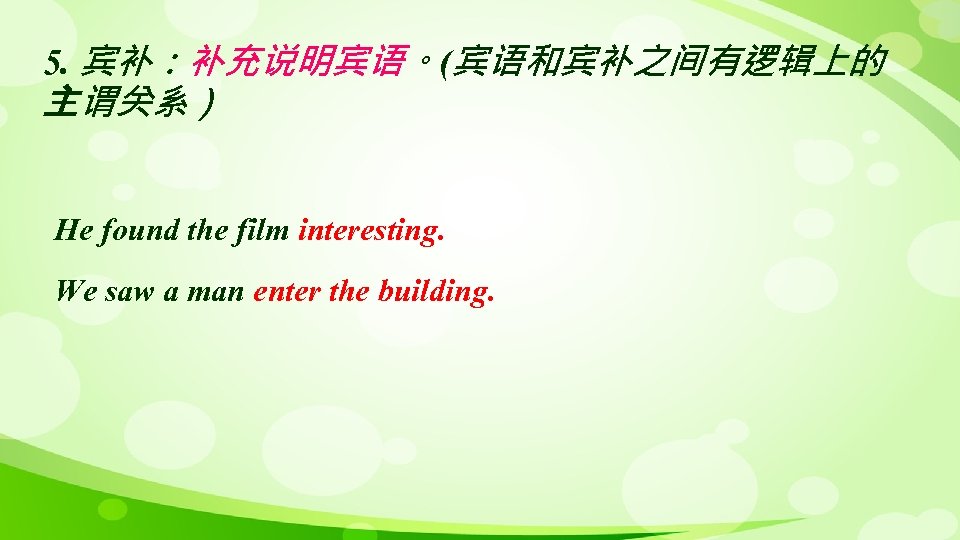
5. 宾补:补充说明宾语。(宾语和宾补之间有逻辑上的 主谓关系) He found the film interesting. We saw a man enter the building.
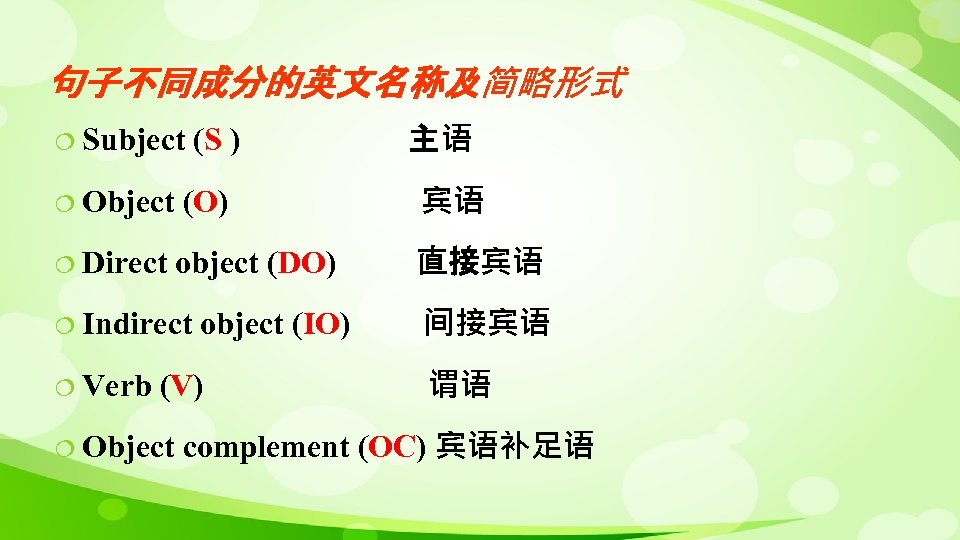
句子不同成分的英文名称及简略形式 ¦ Subject ¦ Object ¦ Direct 宾语 object (DO) 直接宾语 object (IO) (V) ¦ Object 主语 (O) ¦ Indirect ¦ Verb (S ) 间接宾语 谓语 complement (OC) 宾语补足语
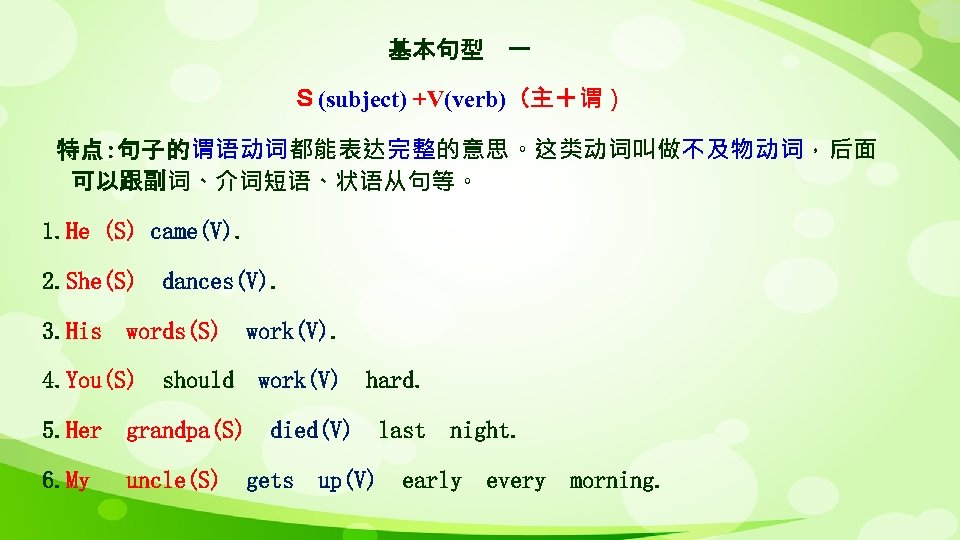
基本句型 一 S(subject) +V(verb)(主+谓) 特点: 句子的谓语动词都能表达完整的意思。这类动词叫做不及物动词,后面 可以跟副词、介词短语、状语从句等。 1. He (S) came(V). 2. She(S) dances(V). 3. His words(S) work(V). 4. You(S) should work(V) 5. Her grandpa(S) died(V) 6. My uncle(S) hard. gets up(V) last night. early every morning.
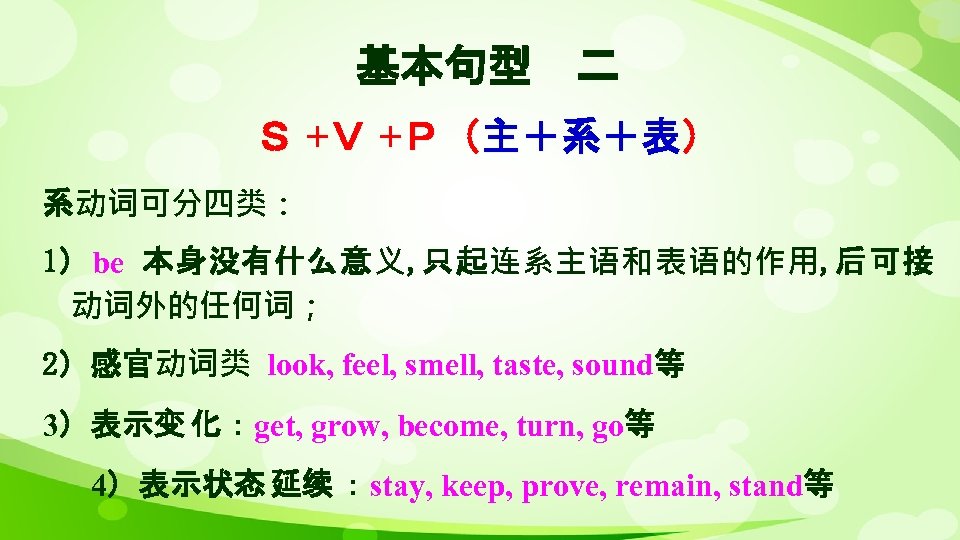
基本句型 二 S +V +P(主+系+表) 系动词可分四类: 1)be 本身没有什么意义, 只起连系主语和表语的作用, 后可接 动词外的任何词; 2)感官动词类 look, feel, smell, taste, sound等 3)表示变 化:get, grow, become, turn, go等 4)表示状态 延续 :stay, keep, prove, remain, stand等
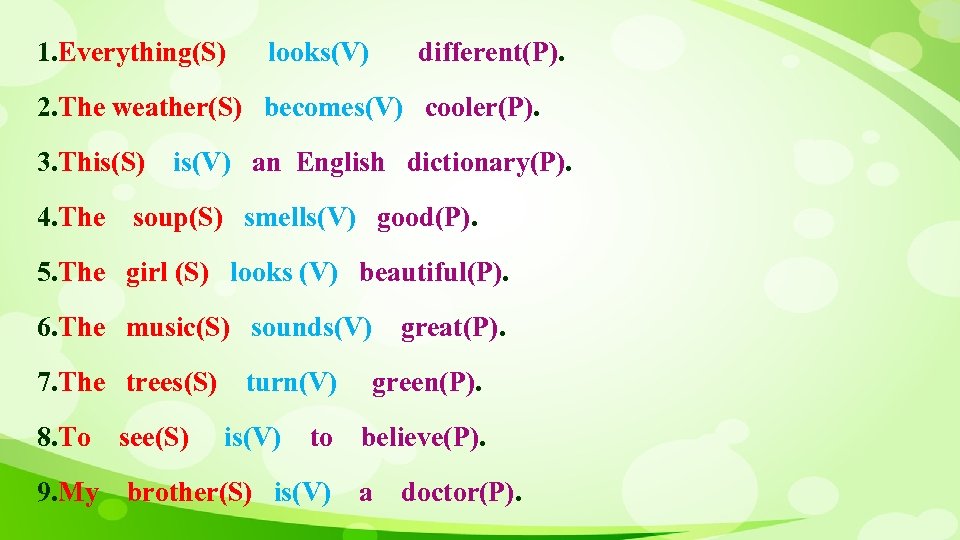
1. Everything(S) looks(V) different(P). 2. The weather(S) becomes(V) cooler(P). 3. This(S) 4. The is(V) an English dictionary(P). soup(S) smells(V) good(P). 5. The girl (S) looks (V) beautiful(P). 6. The music(S) sounds(V) 7. The trees(S) turn(V) 8. To see(S) is(V) to 9. My brother(S) is(V) great(P). green(P). believe(P). a doctor(P).
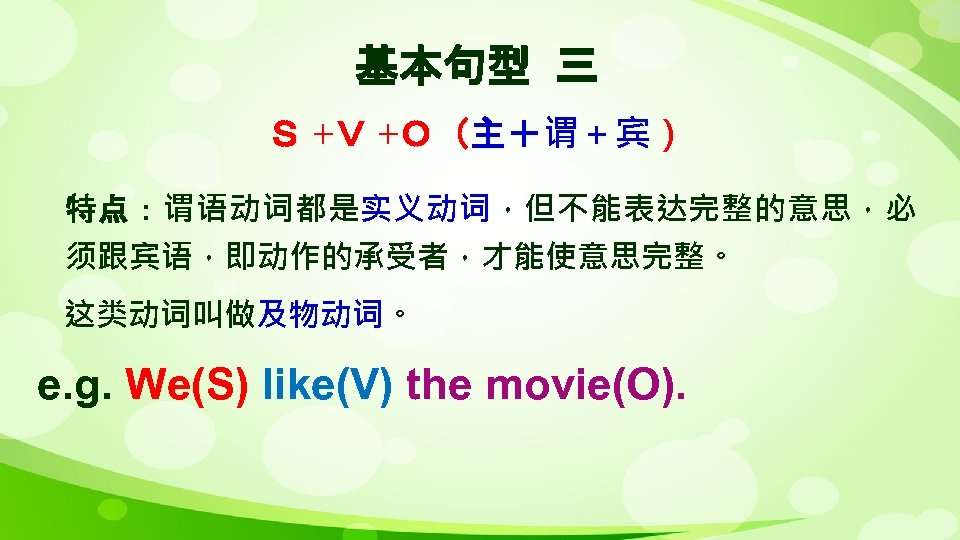
基本句型 三 S +V +O(主+谓+宾) 特点:谓语动词都是实义动词,但不能表达完整的意思,必 须跟宾语,即动作的承受者,才能使意思完整。 这类动词叫做及物动词。 e. g. We(S) like(V) the movie(O).
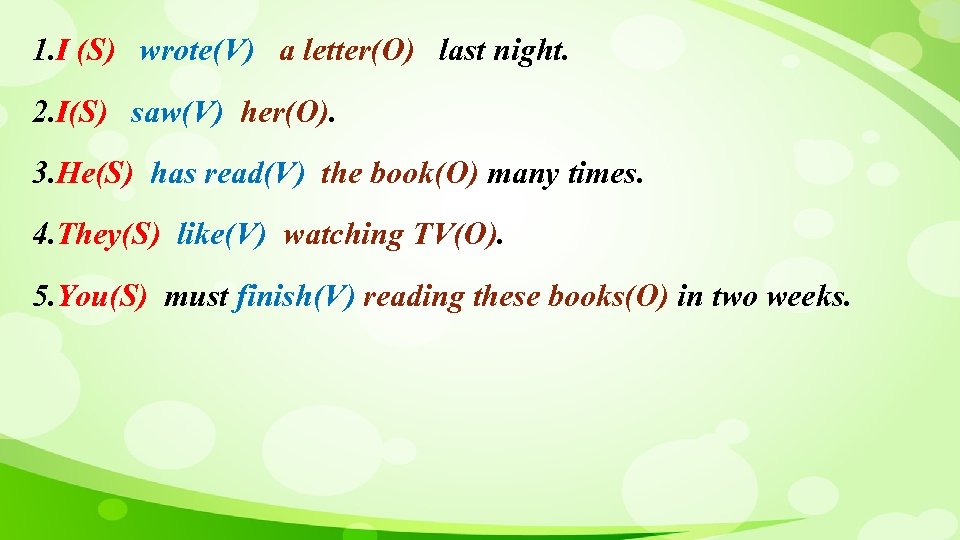
1. I (S) wrote(V) a letter(O) last night. 2. I(S) saw(V) her(O). 3. He(S) has read(V) the book(O) many times. 4. They(S) like(V) watching TV(O). 5. You(S) must finish(V) reading these books(O) in two weeks.
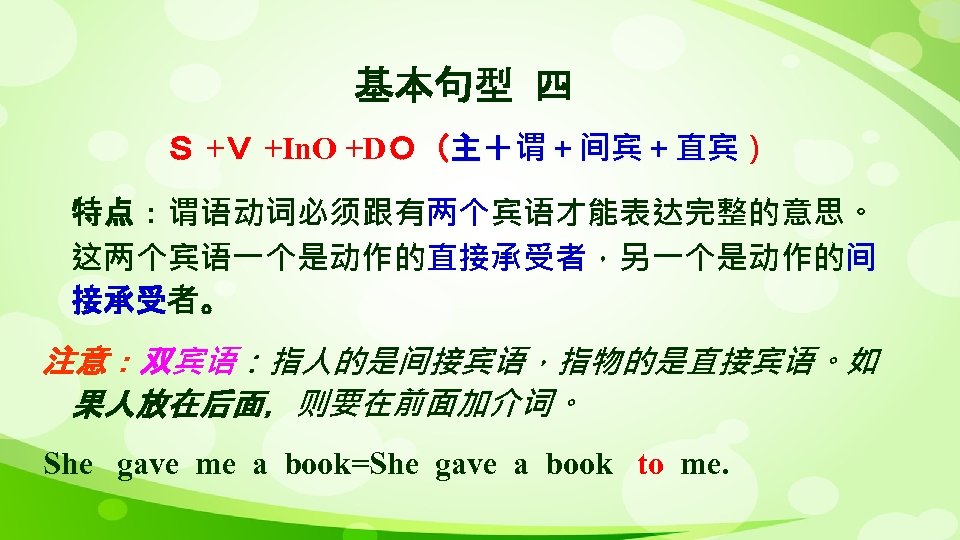
基本句型 四 S +V +In. O +DO(主+谓+间宾+直宾) 特点:谓语动词必须跟有两个宾语才能表达完整的意思。 这两个宾语一个是动作的直接承受者,另一个是动作的间 接承受者。 注意:双宾语:指人的是间接宾语,指物的是直接宾语。如 果人放在后面,则要在前面加介词。 She gave me a book=She gave a book to me.
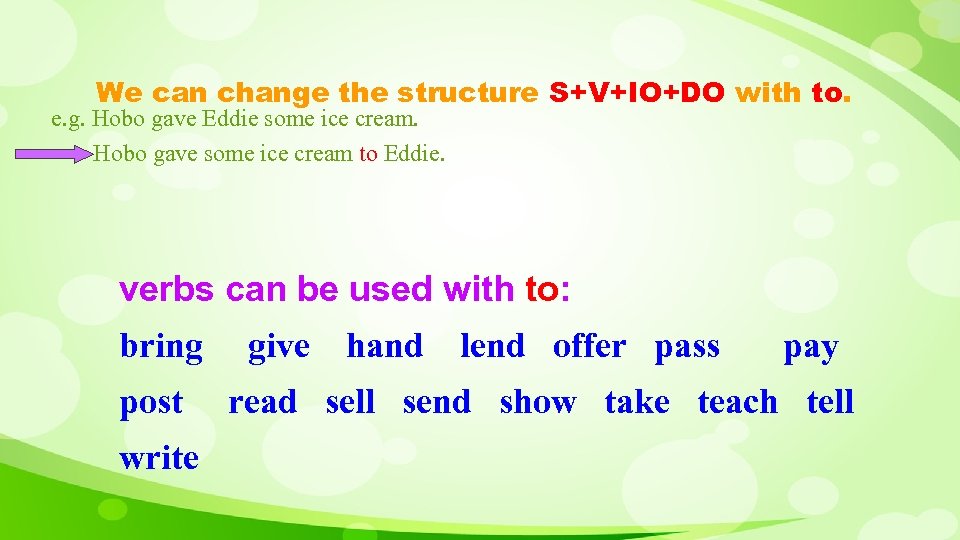
We can change the structure S+V+IO+DO with to. e. g. Hobo gave Eddie some ice cream. Hobo gave some ice cream to Eddie. verbs can be used with to: bring post write give hand lend offer pass pay read sell send show take teach tell
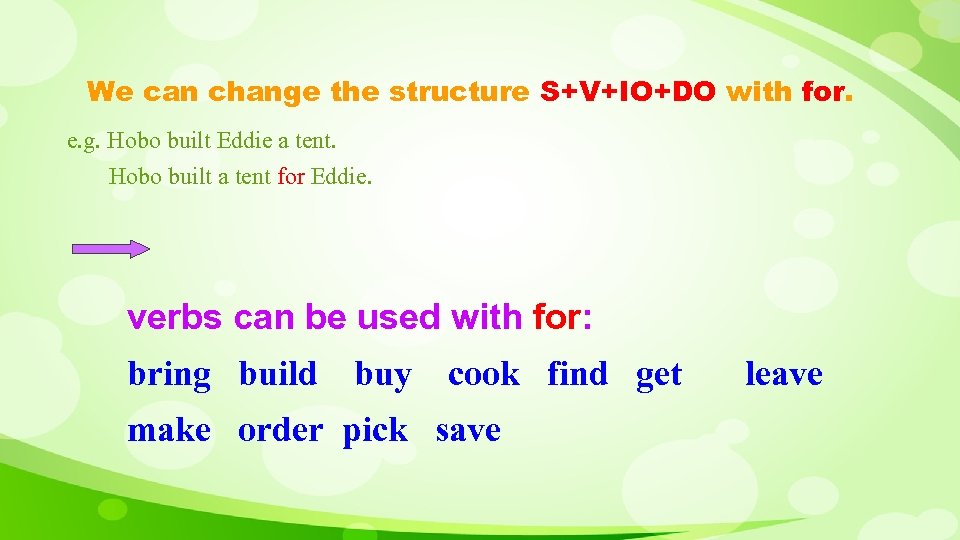
We can change the structure S+V+IO+DO with for. e. g. Hobo built Eddie a tent. Hobo built a tent for Eddie. verbs can be used with for: bring build buy cook find get make order pick save leave
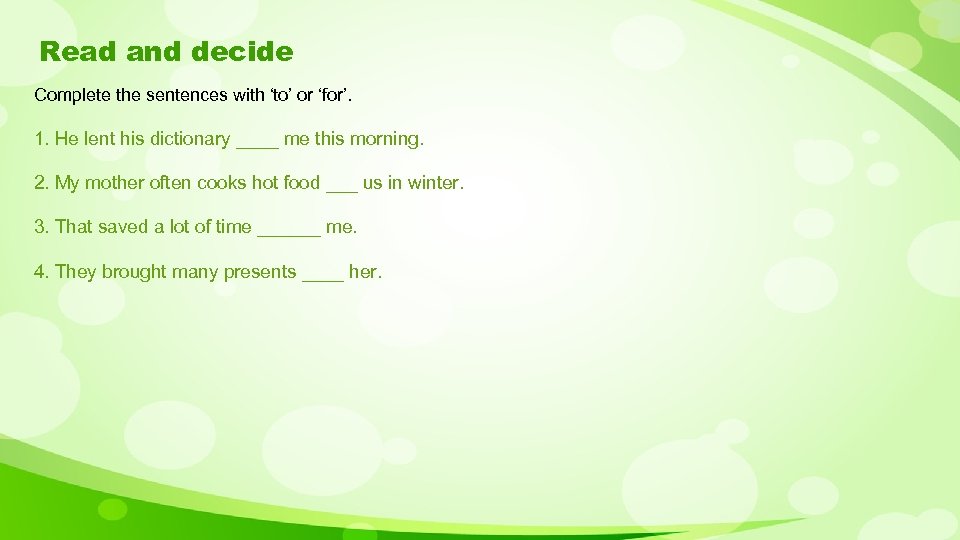
Read and decide Complete the sentences with ‘to’ or ‘for’. 1. He lent his dictionary ____ me this morning. 2. My mother often cooks hot food ___ us in winter. 3. That saved a lot of time ______ me. 4. They brought many presents ____ her.
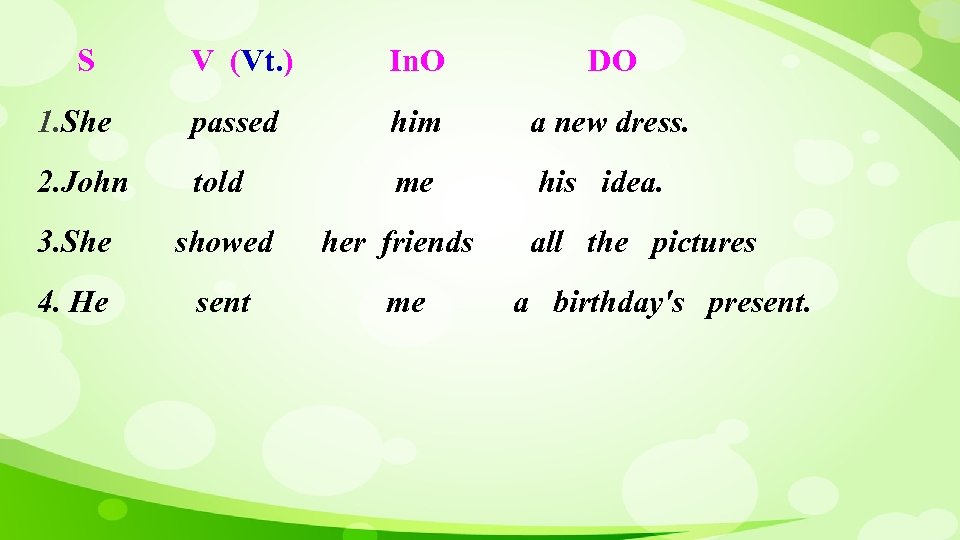
S V (Vt. ) In. O DO 1. She passed him a new dress. 2. John told me his idea. 3. She showed her friends 4. He sent me all the pictures a birthday's present.
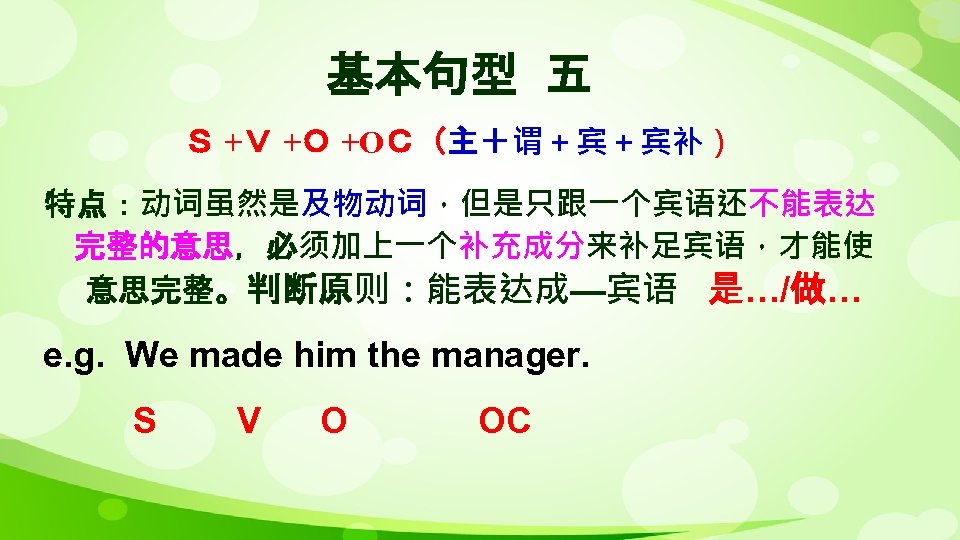
基本句型 五 S +V +O +OC(主+谓+宾+宾补) 特点:动词虽然是及物动词,但是只跟一个宾语还不能表达 完整的意思,必须加上一个补充成分来补足宾语,才能使 意思完整。判断原则:能表达成—宾语 是…/做… e. g. We made him the manager. S V O OC
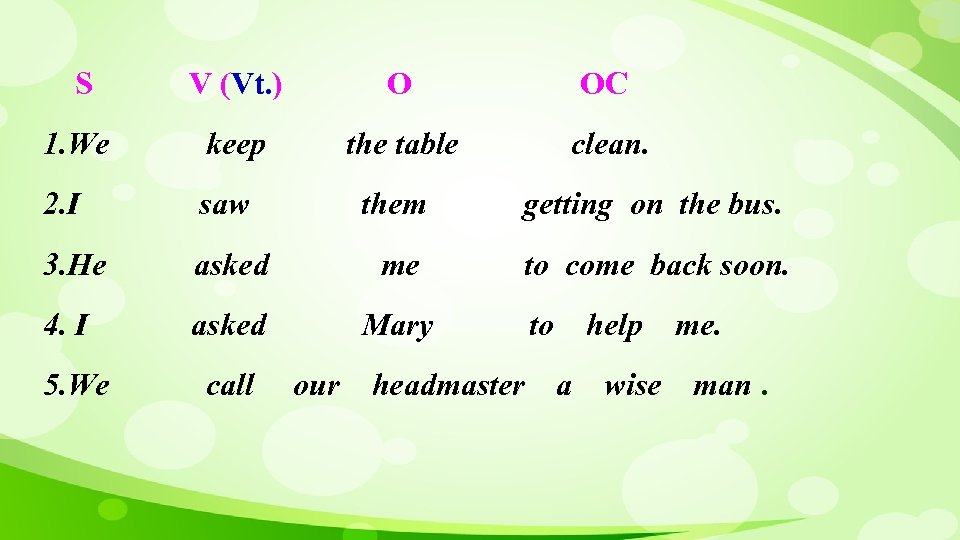
S V (Vt. ) O OC 1. We keep the table clean. 2. I saw them getting on the bus. 3. He asked me to come back soon. 4. I asked Mary 5. We call our headmaster to help a wise me. man.
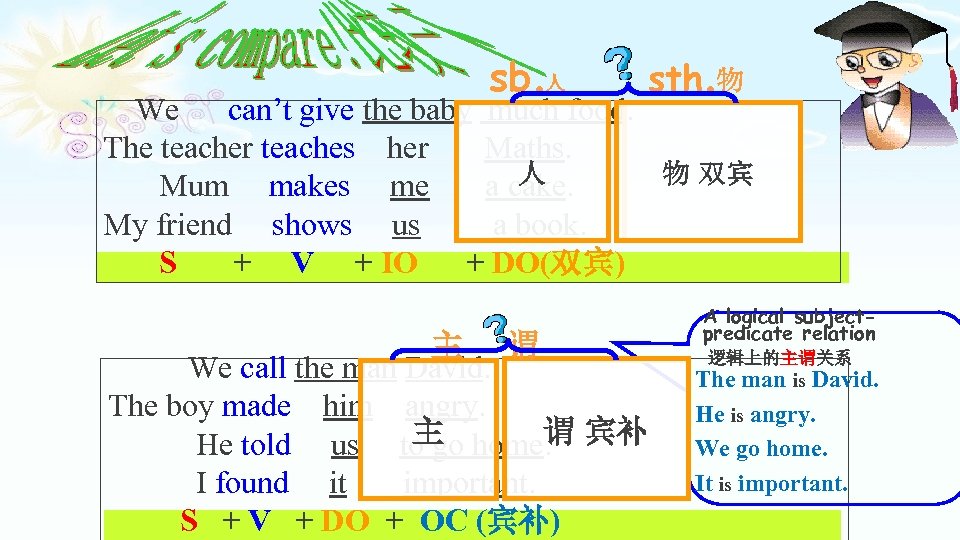
sb. 人 sth. 物 We can’t give the baby much food. The teacher teaches her Maths. 人 物 双宾 Mum makes me a cake. My friend shows us a book. S + V + IO + DO(双宾) 主 谓 We call the man David. The boy made him angry. 谓 主 He told us to go home. 宾补 I found it important. S + V + DO + OC (宾补) A logical subjectpredicate relation 逻辑上的主谓关系 The man is David. He is angry. We go home. It is important.
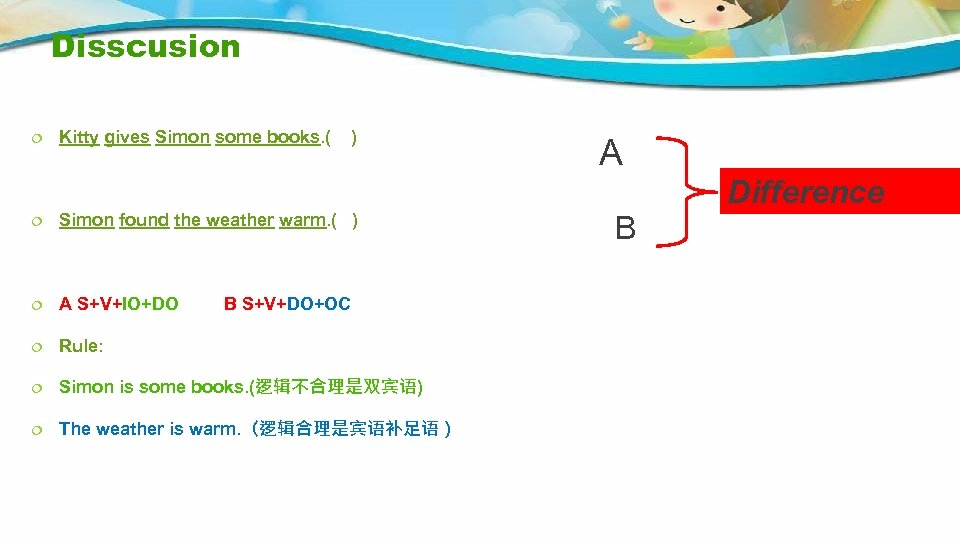
Disscusion ¦ Kitty gives Simon some books. ( ) A Difference ¦ Simon found the weather warm. ( ) ¦ A S+V+IO+DO ¦ Rule: ¦ Simon is some books. (逻辑不合理是双宾语) ¦ The weather is warm. (逻辑合理是宾语补足语) B S+V+DO+OC B
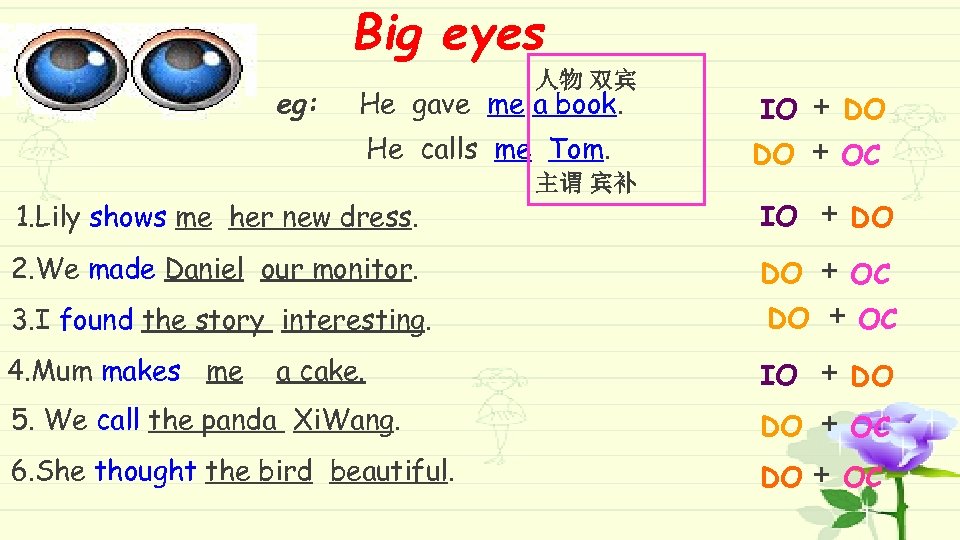
Big eyes eg: 人物 双宾 He gave me a book. IO + DO He calls me Tom. DO + OC 主谓 宾补 1. Lily shows me her new dress. IO + DO 2. We made Daniel our monitor. DO + OC 3. I found the story interesting. DO + OC 4. Mum makes me IO + DO a cake. 5. We call the panda Xi. Wang. DO + OC 6. She thought the bird beautiful. DO + OC

典型例题分析
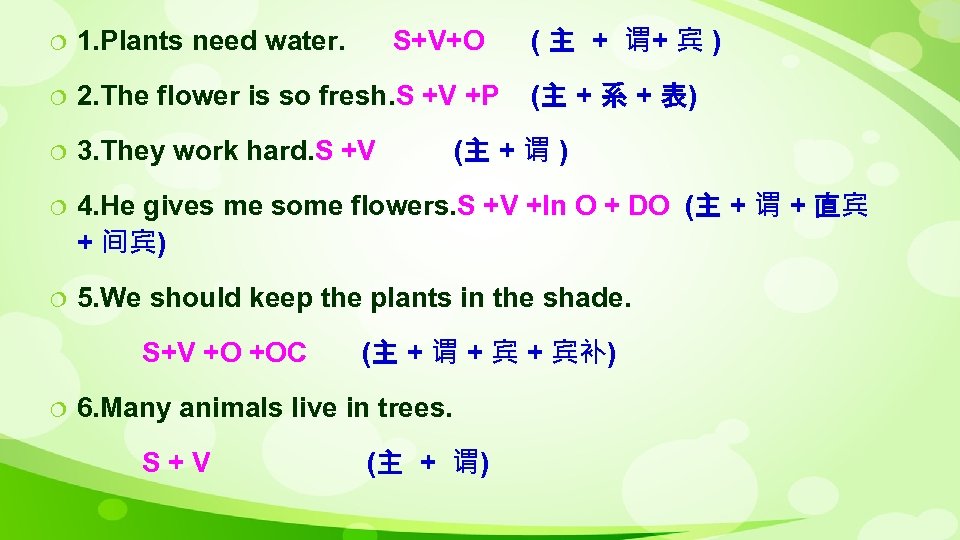
¦ 1. Plants need water. ¦ 2. The flower is so fresh. S +V +P ¦ 3. They work hard. S +V ¦ ¦ ( 主 + 谓+ 宾 ) (主 + 系 + 表) (主 + 谓 ) 4. He gives me some flowers. S +V +In O + DO (主 + 谓 + 直宾 + 间宾) 5. We should keep the plants in the shade. S+V +O +OC ¦ S+V+O (主 + 谓 + 宾补) 6. Many animals live in trees. S+V (主 + 谓)
 Скачать презентацию 简单 句的五种基本句型 词类及基本用法 组成句子的各个组成部分叫句子成分 主语 谓语
8e999e99967837996a54896207e1e1b6.ppt