 Скачать презентацию 第一單元 時態 C 2 過去式 目錄 A
ca9d3585e99507aeff29a9b7f6e2519f.ppt
- Количество слайдов: 16



第一單元:時態 C. 2 過去式
目錄 • A. 過去式(Simple Present Tense) • B. 過去進行式(Past Progressive) • C. 比較:過去式 與過去進行式 • D. “Used to”用法
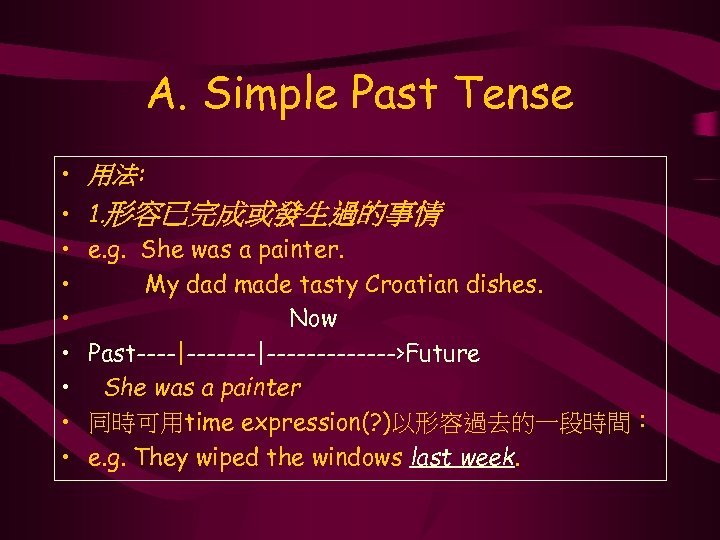
A. Simple Past Tense • 用法: • • 1. 形容已完成或發生過的事情 e. g. She was a painter. My dad made tasty Croatian dishes. Now Past----|-------->Future She was a painter 同時可用time expression(? )以形容過去的一段時間: e. g. They wiped the windows last week.
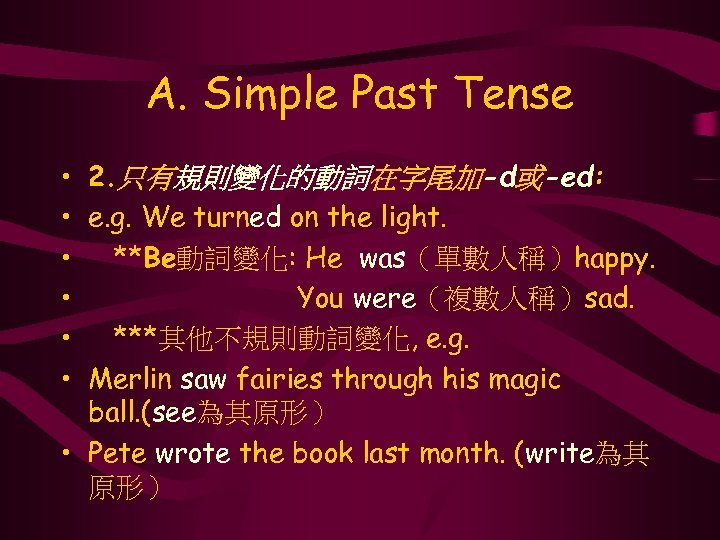
A. Simple Past Tense • 2. 只有規則變化的動詞在字尾加-d或-ed: • e. g. We turned on the light. • **Be動詞變化: He was(單數人稱)happy. • You were(複數人稱)sad. • ***其他不規則動詞變化, e. g. • Merlin saw fairies through his magic ball. (see為其原形) • Pete wrote the book last month. (write為其 原形)
A. Simple Past Tense • • 否定句 Be----> S + was(單數)+ not + V原形 were (複數) 其他不/規則動詞-----> S + did not (didn’t) + V原形 e. g. We didn’t have fun at the party. The president didn’t address to the nation properly.
![A. Simple Past Tense • Yes/No Q & A, e. g. • [Be]Were you](https://present5.com/presentation/ca9d3585e99507aeff29a9b7f6e2519f/image-6.jpg "A. Simple Past Tense • Yes/No Q & A, e. g. • [Be]Were you")
A. Simple Past Tense • Yes/No Q & A, e. g. • [Be]Were you out last night? Yes, I was. / • No, I wasn’t (was not). • [其他動詞]Did you buy the pen? • Yes, I did. / • No, I didn’t. • Wh- Q & A, e. g. • [Be]Why was he late to school yesterday? • [其他動詞] Who did she meet four days ago? • What piece of classical music did the orchestra band play last night?
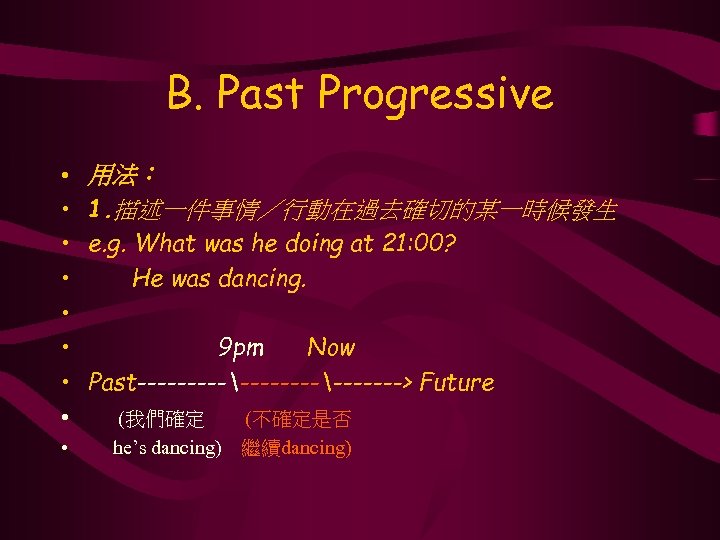
B. Past Progressive • • • 用法: 1. 描述一件事情/行動在過去確切的某一時候發生 e. g. What was he doing at 21: 00? He was dancing. 9 pm Now Past------------> Future (我們確定 he’s dancing) (不確定是否 繼續dancing)
B. Past Progressive • 2. 用過去式強調已完成的事 • e. g. I did the dishes last night. (碗已洗好了) • 用過去進行式強調“時間持續的長短“(不論完成與否) • e. g. I was doing the dishes last night. • (不知碗是否洗好了) • 注意!非行動動詞不能用過去進行式(同現在式的規 則)e. g. I am sick. (NOT I’m being sick. )
B. Past Progressive • Yes/No Q & A, e. g. • Was Jodie typing her paper? • Yes, she was. / • No, she wasn’t. • Wh- Q. , e. g. • Where were the clowns performing? • Who was teasing my brother?
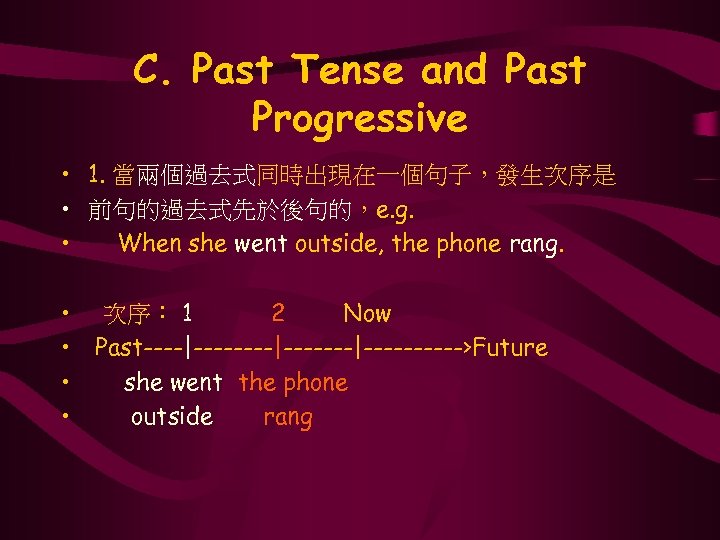
C. Past Tense and Past Progressive • 1. 當兩個過去式同時出現在一個句子,發生次序是 • 前句的過去式先於後句的,e. g. • When she went outside, the phone rang. • • 次序: 1 2 Now Past----|-------|----->Future she went the phone outside rang
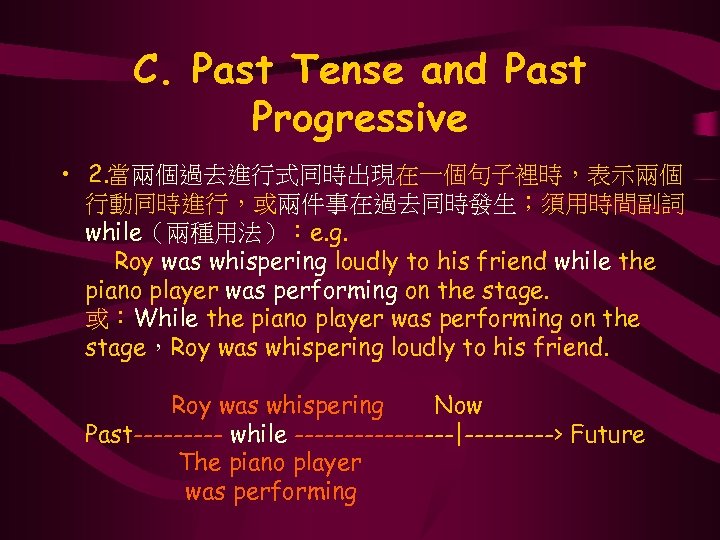
C. Past Tense and Past Progressive • 2. 當兩個過去進行式同時出現在一個句子裡時,表示兩個 行動同時進行,或兩件事在過去同時發生;須用時間副詞 while(兩種用法):e. g. Roy was whispering loudly to his friend while the piano player was performing on the stage. 或:While the piano player was performing on the stage,Roy was whispering loudly to his friend. Roy was whispering Now Past----- while --------|-----> Future The piano player was performing
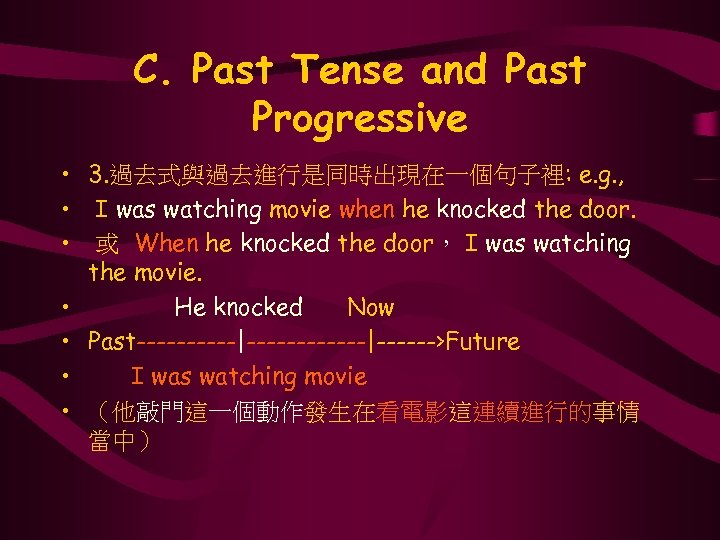
C. Past Tense and Past Progressive • 3. 過去式與過去進行是同時出現在一個句子裡: e. g. , • I was watching movie when he knocked the door. • 或 When he knocked the door, I was watching the movie. • He knocked Now • Past----------|------>Future • I was watching movie • (他敲門這一個動作發生在看電影這連續進行的事情 當中)
C. Past Tense and Past Progressive • 注意!While 與 when 之區分: • while用於持續性的描述,而when強調發生的當下 (Kate, I don‘t know if this one’s well-interpreted): • e. g. He was studying while his brother was playing video games. • When Susan came, I was cooking. • 其他常見的subordinator(? ): before, after, until, since, as soon as • e. g. I was cooking before Susan came.
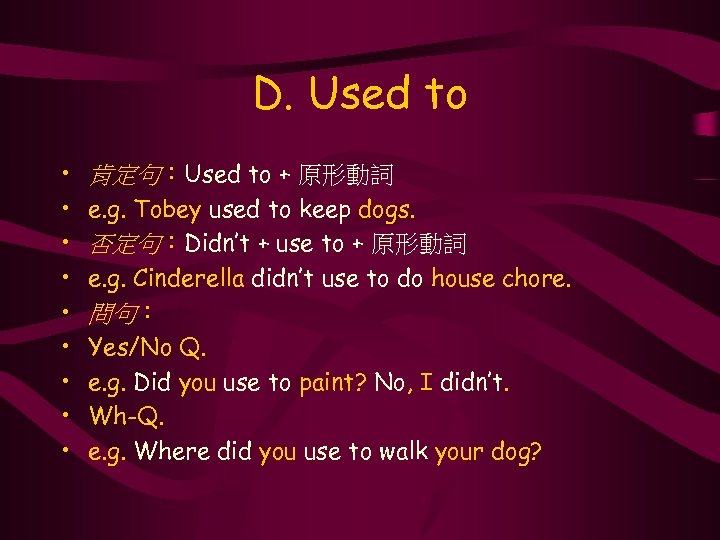
D. Used to • • • 肯定句:Used to + 原形動詞 e. g. Tobey used to keep dogs. 否定句:Didn’t + use to + 原形動詞 e. g. Cinderella didn’t use to do house chore. 問句: Yes/No Q. e. g. Did you use to paint? No, I didn’t. Wh-Q. e. g. Where did you use to walk your dog?
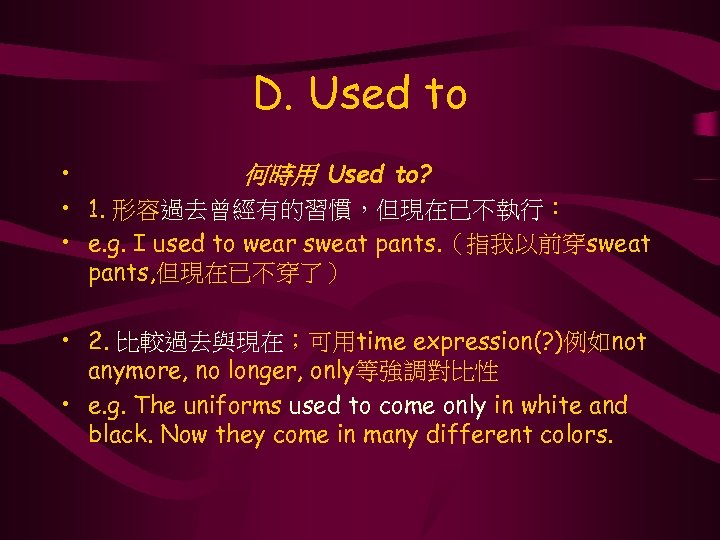
D. Used to • 何時用 Used to? • 1. 形容過去曾經有的習慣,但現在已不執行: • e. g. I used to wear sweat pants. (指我以前穿sweat pants, 但現在已不穿了) • 2. 比較過去與現在;可用time expression(? )例如not anymore, no longer, only等強調對比性 • e. g. The uniforms used to come only in white and black. Now they come in many different colors.
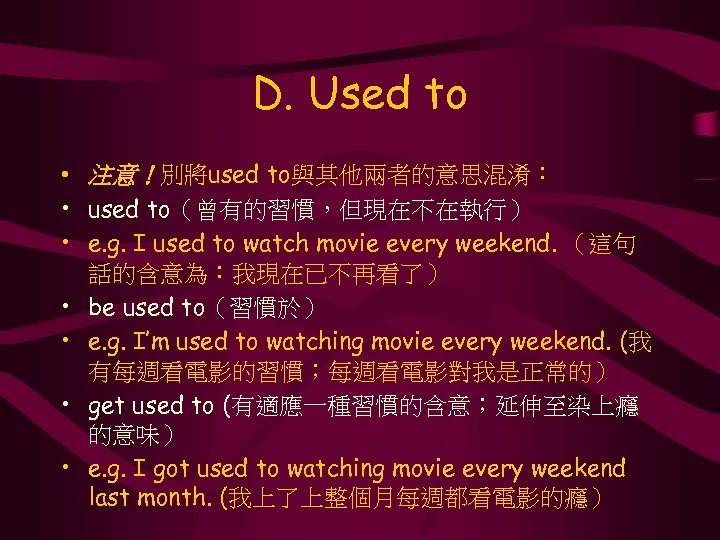
D. Used to • 注意!別將used to與其他兩者的意思混淆: • used to(曾有的習慣,但現在不在執行) • e. g. I used to watch movie every weekend. (這句 話的含意為:我現在已不再看了) • be used to(習慣於) • e. g. I’m used to watching movie every weekend. (我 有每週看電影的習慣;每週看電影對我是正常的) • get used to (有適應一種習慣的含意;延伸至染上癮 的意味) • e. g. I got used to watching movie every weekend last month. (我上了上整個月每週都看電影的癮)
Скачать презентацию 第一單元 時態 C 2 過去式 目錄 A
ca9d3585e99507aeff29a9b7f6e2519f.ppt