 Скачать презентацию 狂牛病的警訊 周晉澄 Chin-Cheng Chou DVM Ph D 國立台灣大學獸醫學系教授
64c4febe11abf727e74fb422645202b7.ppt
- Количество слайдов: 51



狂牛病的警訊 周晉澄 Chin-Cheng Chou, DVM, Ph. D. 國立台灣大學獸醫學系教授 Institute of Veterinary Medicine National Taiwan University Taipei, Taiwan chouchin@ntu. edu. tw 02 -23630495; 02 -33661292 1

專業目的 畜產業生產人類食用的優質動物性 蛋白,獸醫則確認各種動物的健康 及動物性產品的安全與衛生 2
獸醫畜產環境 各類型經濟動物養殖場 : 豬、牛、 羊、鹿、兔、雞、鴨、鵝、魚、 蝦、甲魚、牛蛙等; 野生動物園 ; 寵物畜養場 ; 動物醫院 ; 屠宰場、化製廠等 3
獸醫畜產環境公 害 旨揭該環境引起人們不愉快之感受, 即構成公害的條件。這些感受可能經 由空氣、水、廢棄物等途徑引起,不悅 的感受不一定必須以引起疾病之有無 作為判斷的依據。獸醫畜產環境的維 護在於公共衛生的認知,尤其是獸醫 公共衛生的充分發揮。 4
獸醫公共衛生 Veterinary Public Health (VPH) was defined by the WHO consultation on "future trends in veterinary public health" held in Teramo, Italy in 1999 as "the sum of all contributions to the physical, mental and social well-being of humans through an understanding and application of veterinary science". -- 即以獸醫科技來促進人類的身心健康福 祉! 5
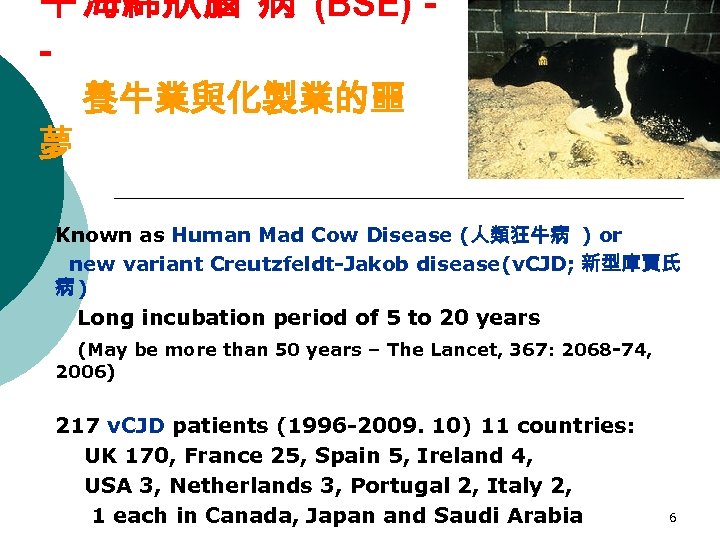
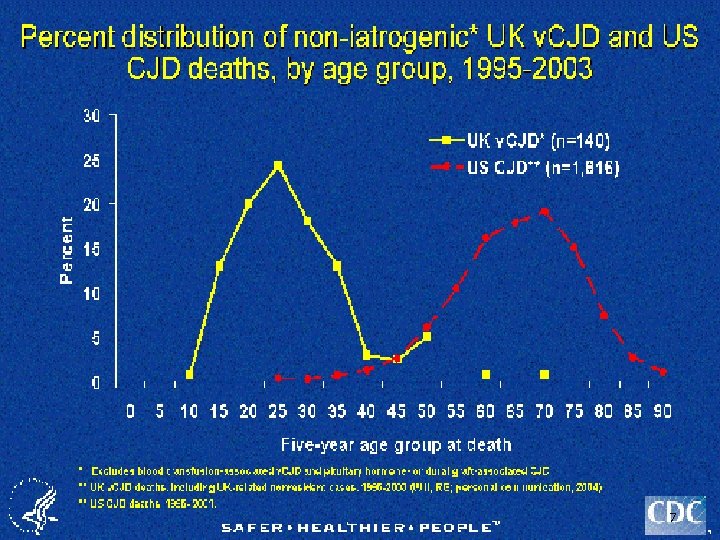
牛 海綿狀腦 病 (BSE) 夢 養牛業與化製業的噩 Known as Human Mad Cow Disease (人類狂牛病 ) or new variant Creutzfeldt-Jakob disease(v. CJD; 新型庫賈氏 病) Long incubation period of 5 to 20 years (May be more than 50 years – The Lancet, 367: 2068 -74, 2006) 217 v. CJD patients (1996 -2009. 10) 11 countries: UK 170, France 25, Spain 5, Ireland 4, USA 3, Netherlands 3, Portugal 2, Italy 2, 1 each in Canada, Japan and Saudi Arabia 6
7
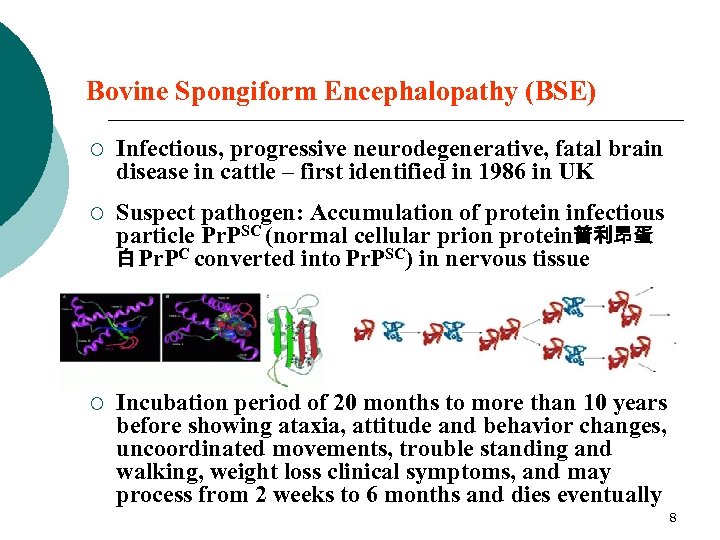
Bovine Spongiform Encephalopathy (BSE) ¡ Infectious, progressive neurodegenerative, fatal brain disease in cattle – first identified in 1986 in UK ¡ Suspect pathogen: Accumulation of protein infectious particle Pr. PSC (normal cellular prion protein普利昂蛋 白 Pr. PC converted into Pr. PSC) in nervous tissue ¡ Incubation period of 20 months to more than 10 years before showing ataxia, attitude and behavior changes, uncoordinated movements, trouble standing and walking, weight loss clinical symptoms, and may process from 2 weeks to 6 months and dies eventually 8
Pathogenesis of BSE ¡ ¡ ¡ Oral exposure – trapping of BSE agent in lymphoid tissue of gut l After oral challenge, detect BSE first in distal ileum associated with Peyer’s patches in 6 months Transport the agent (abnormal prion protein) to Central Nervous System (CNS) – (along nerve tracks? ) Accumulation of abnormal prion protein in brain, spinal cord, and nervous tissue l Detectable only 3 -6 months prior to clinical signs 9
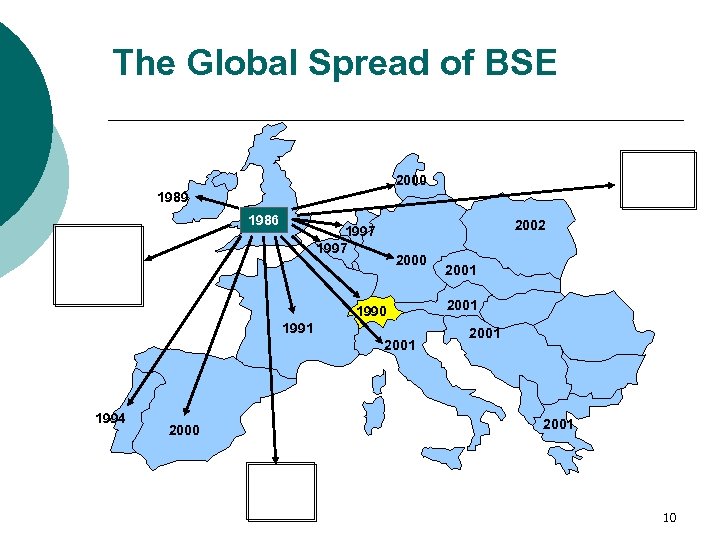
The Global Spread of BSE Japan 2001 2000 1989 1986 2002 1997 Canada USA 2003 2000 1991 2001 1994 2001 2000 Israel 2002 10
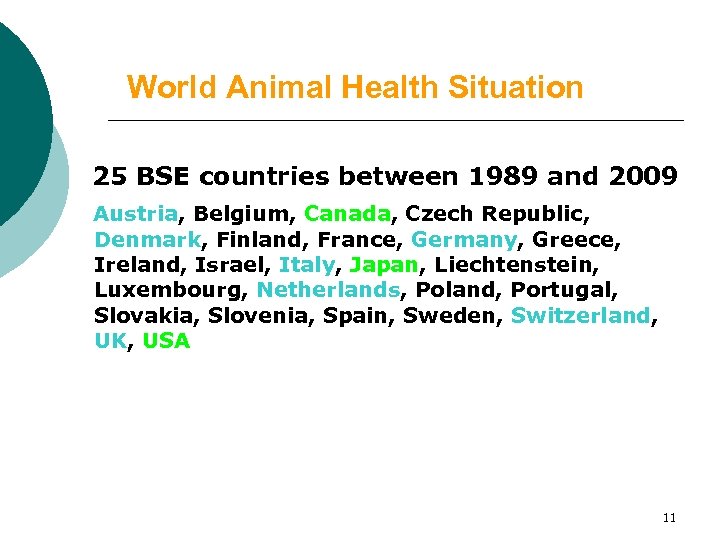
World Animal Health Situation 25 BSE countries between 1989 and 2009 Austria, Belgium, Canada, Czech Republic, Denmark, Finland, France, Germany, Greece, Ireland, Israel, Italy, Japan, Liechtenstein, Luxembourg, Netherlands, Poland, Portugal, Slovakia, Slovenia, Spain, Sweden, Switzerland, UK, USA 11
12
狂牛病的警訊 18世紀就有羊的搔癢症了,為何沒 有人類的病例傳出呢 ? 變性蛋白質病原經一次的跨物種傳 播後可能獲得改變宿主範圍的能力, 因此當羊的搔癢症病原感染牛後,可 能改變病原特性,而可以感染另一物 種人類了 ! 13
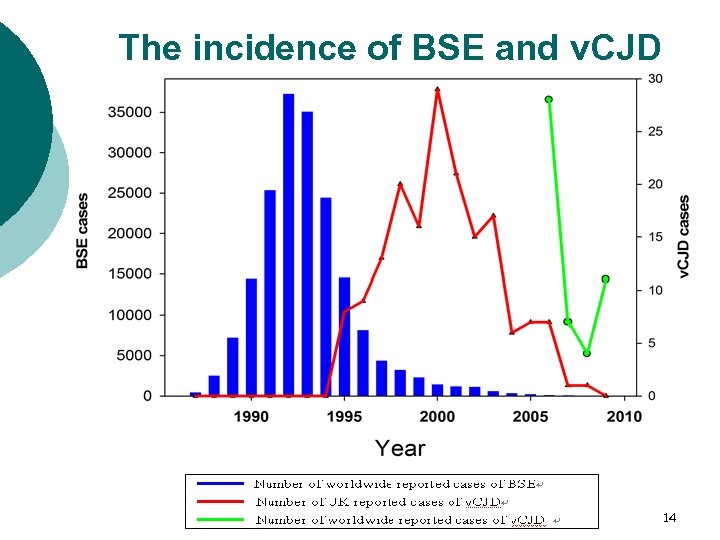
The incidence of BSE and v. CJD 14
Risk Goods ¡ Cattle feed with meat and bone meal (MBM) containing infectious prion protein ¡ Significant accumulation of prion at cattle body - Specific Risk Materials (SRM): Brain, trigeminal ganglia, spinal cord, dorsal root ganglion, eyes of cattle age > 30 months, and distal ileum of the small intestine and tonsil from all ages (OIE) 15
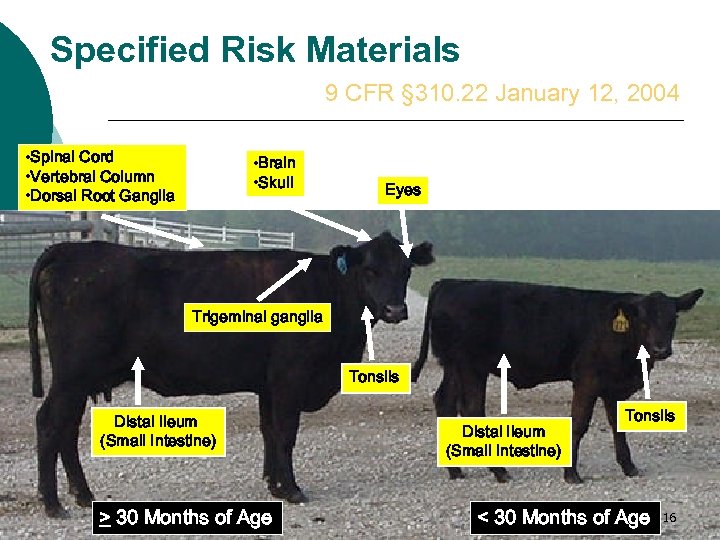
Specified Risk Materials 9 CFR § 310. 22 January 12, 2004 • Spinal Cord • Vertebral Column • Dorsal Root Ganglia • Brain • Skull Eyes Trigeminal ganglia Tonsils Distal Ileum (Small Intestine) > 30 Months of Age Distal Ileum (Small Intestine) Tonsils < 30 Months of Age 16
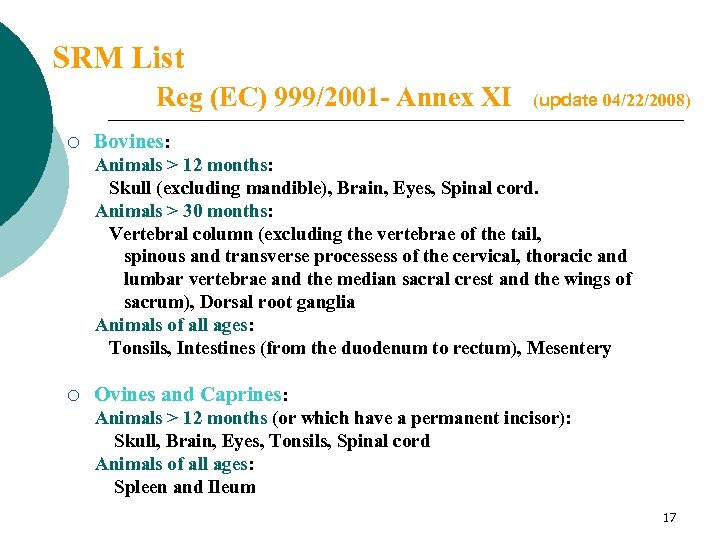
SRM List Reg (EC) 999/2001 - Annex XI ¡ (update 04/22/2008) Bovines: Animals > 12 months: Skull (excluding mandible), Brain, Eyes, Spinal cord. Animals > 30 months: Vertebral column (excluding the vertebrae of the tail, spinous and transverse processess of the cervical, thoracic and lumbar vertebrae and the median sacral crest and the wings of sacrum), Dorsal root ganglia Animals of all ages: Tonsils, Intestines (from the duodenum to rectum), Mesentery ¡ Ovines and Caprines: Animals > 12 months (or which have a permanent incisor): Skull, Brain, Eyes, Tonsils, Spinal cord Animals of all ages: Spleen and Ileum 17
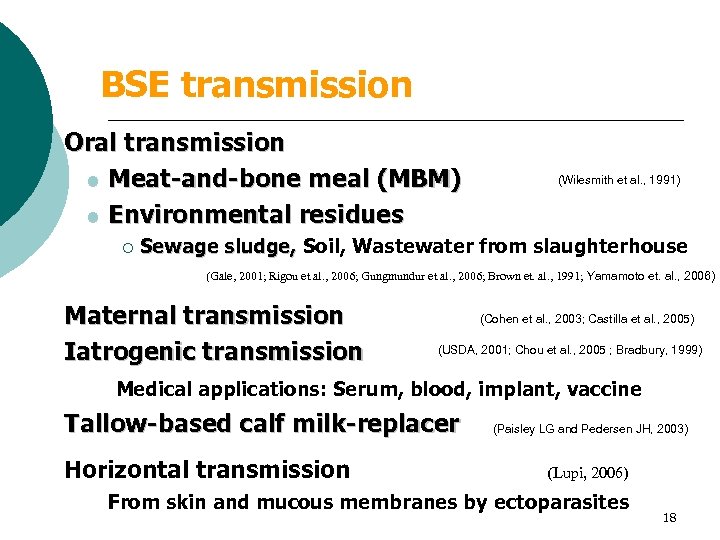
BSE transmission Oral transmission l Meat-and-bone meal (MBM) l Environmental residues ¡ (Wilesmith et al. , 1991) Sewage sludge, Soil, Wastewater from slaughterhouse (Gale, 2001; Rigou et al. , 2006; Gungmundur et al. , 2006; Brown et. al. , 1991; Yamamoto et. al. , 2006) Maternal transmission Iatrogenic transmission (Cohen et al. , 2003; Castilla et al. , 2005) (USDA, 2001; Chou et al. , 2005 ; Bradbury, 1999) Medical applications: Serum, blood, implant, vaccine Tallow-based calf milk-replacer Horizontal transmission (Paisley LG and Pedersen JH, 2003) (Lupi, 2006) From skin and mucous membranes by ectoparasites 18
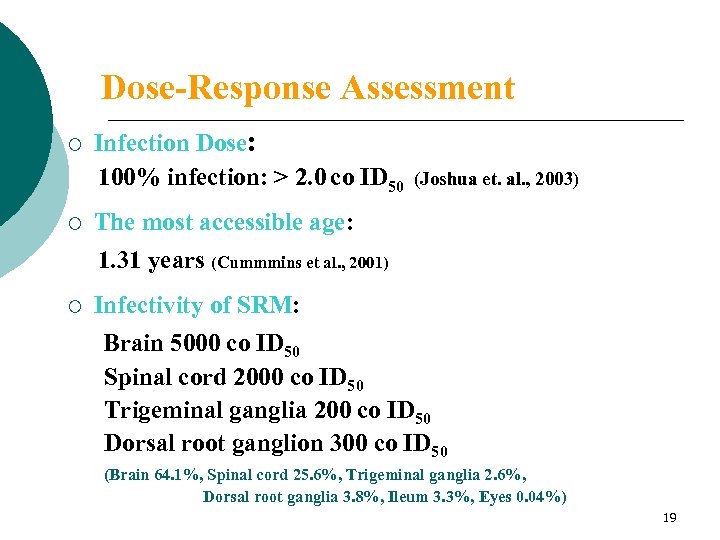
Dose-Response Assessment ¡ Infection Dose: 100% infection: > 2. 0 co ID 50 (Joshua et. al. , 2003) ¡ The most accessible age: 1. 31 years (Cummmins et al. , 2001) ¡ Infectivity of SRM: Brain 5000 co ID 50 Spinal cord 2000 co ID 50 Trigeminal ganglia 200 co ID 50 Dorsal root ganglion 300 co ID 50 (Brain 64. 1%, Spinal cord 25. 6%, Trigeminal ganglia 2. 6%, Dorsal root ganglia 3. 8%, Ileum 3. 3%, Eyes 0. 04%) 19
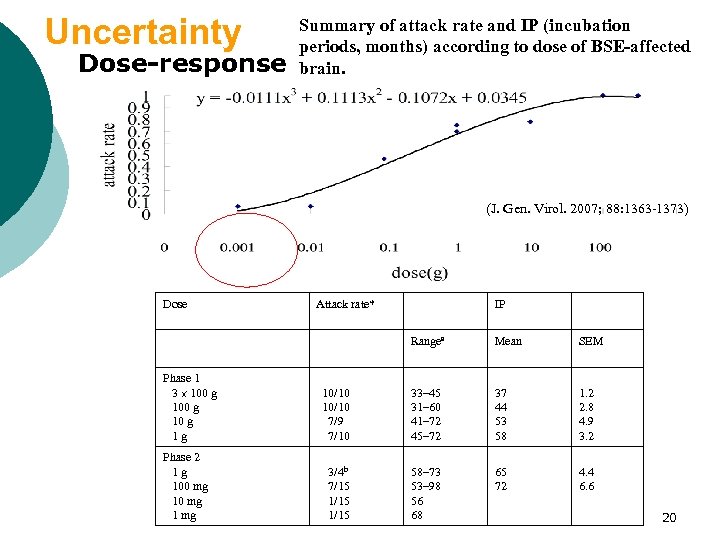
Uncertainty Dose-response Summary of attack rate and IP (incubation periods, months) according to dose of BSE-affected brain. (J. Gen. Virol. 2007; 88: 1363 -1373) Dose Attack rate* IP Rangea Phase 1 3 × 100 g 10 g 1 g Phase 2 1 g 100 mg 1 mg Mean SEM 10/10 7/9 7/10 33– 45 31– 60 41– 72 45– 72 37 44 53 58 1. 2 2. 8 4. 9 3. 2 3/4 b 7/15 1/15 58– 73 53– 98 56 68 65 72 4. 4 6. 6 20
Infectivity of the beef, bone, blood, and milk? ¡ ¡ ¡ OIE: no infectivity, free trade 老鼠肌肉發現普利昂蛋白,打破動物肌肉不會含有狂牛症病 原的迷思 (Prusiner, 2002) 2008年,日本在牛的舌頭和骨骼肌的周邊神經組織中檢驗 出了狂牛症病原!(如舌下、 迷走、 胸腺、 腎上腺、 內臟、 交 感、 臂叢、 坐骨神經等) ¡ ¡ (陳順勝) Infectivity in skeletal muscle of BASEinfected cattle (Silvia Suardi 1, 2009) 骨呢 ? -- 骨髓 , 骨附屬物等有明顯感染力 21
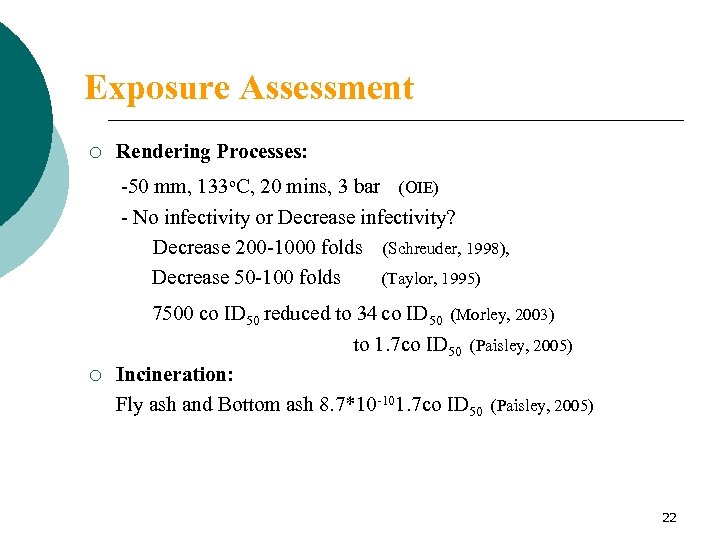
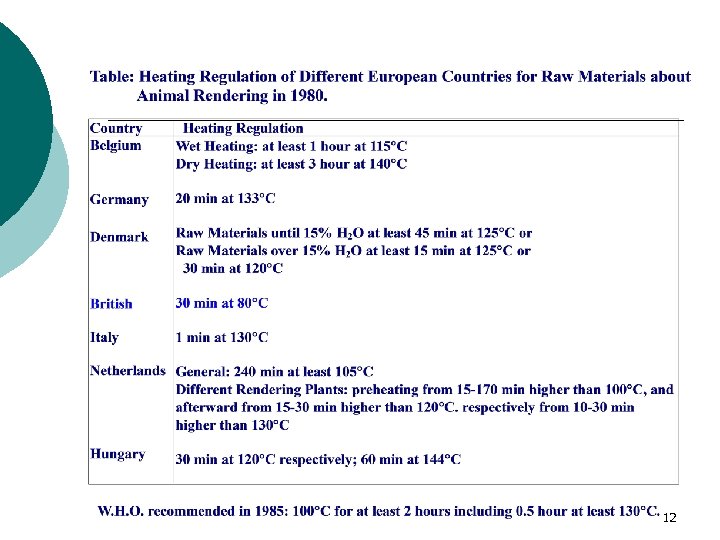
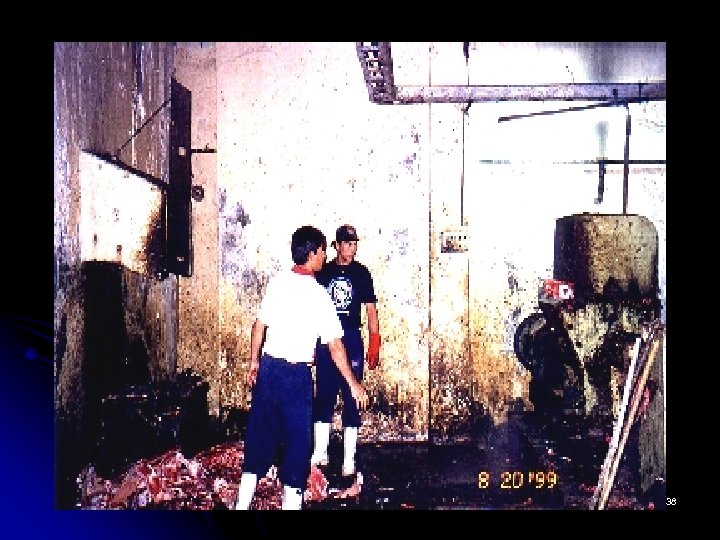
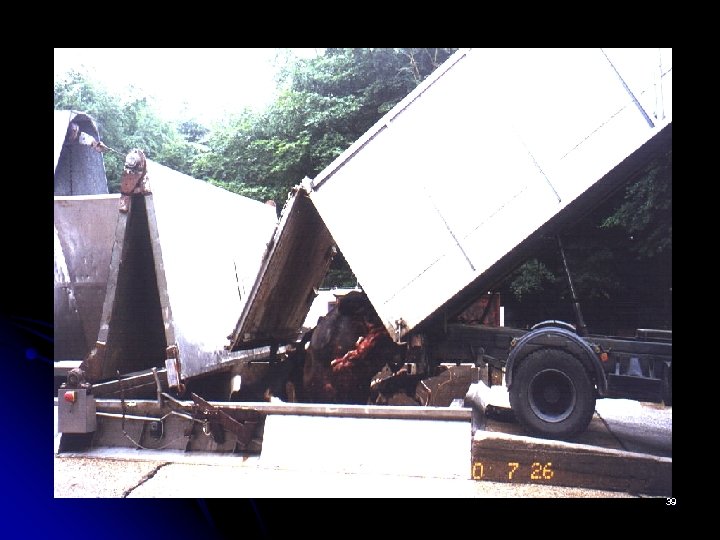
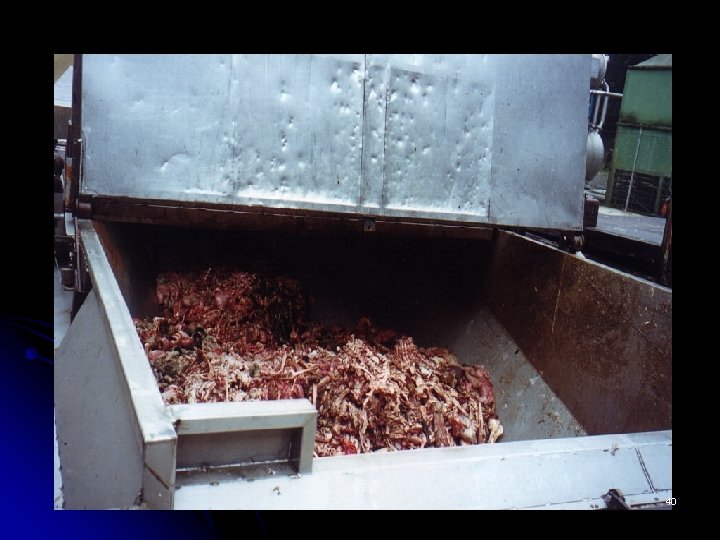
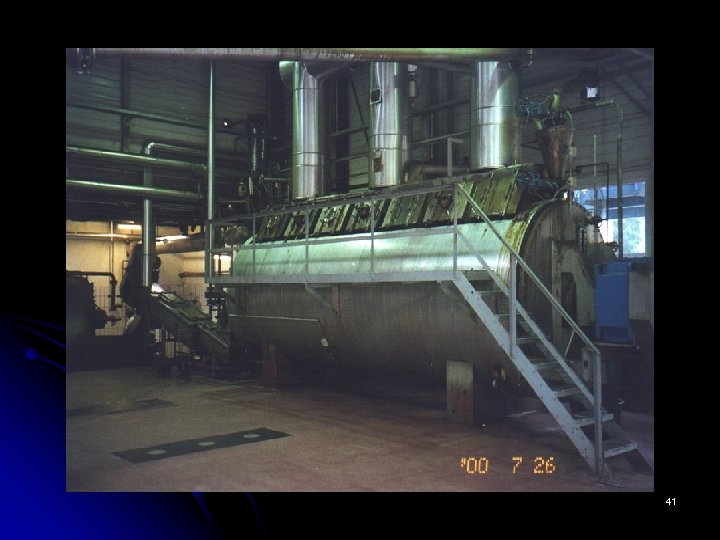
Exposure Assessment ¡ Rendering Processes: -50 mm, 133 o. C, 20 mins, 3 bar (OIE) - No infectivity or Decrease infectivity? Decrease 200 -1000 folds (Schreuder, 1998), Decrease 50 -100 folds (Taylor, 1995) ¡ 7500 co ID 50 reduced to 34 co ID 50 (Morley, 2003) to 1. 7 co ID 50 (Paisley, 2005) Incineration: Fly ash and Bottom ash 8. 7*10 -101. 7 co ID 50 (Paisley, 2005) 22
Risk Control ¡ ¡ Feed ban SRM removal Death, Disable, Diseased, Downer Testing Active surveillance and monitoring 23
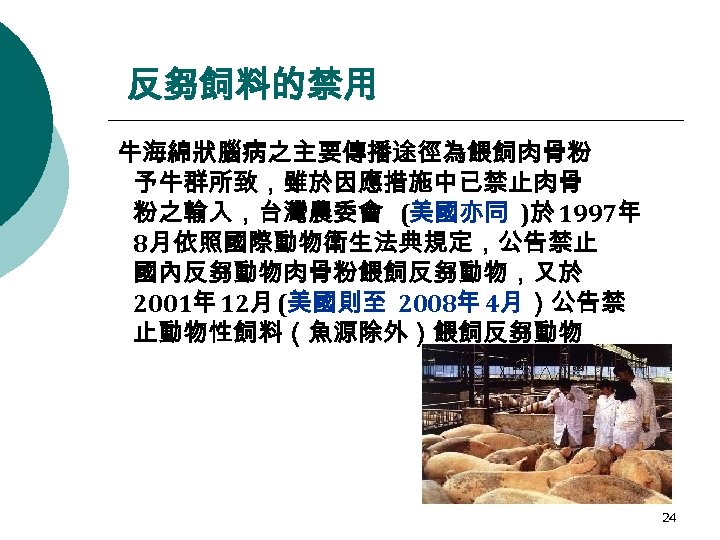
反芻飼料的禁用 牛海綿狀腦病之主要傳播途徑為餵飼肉骨粉 予牛群所致,雖於因應措施中已禁止肉骨 粉之輸入,台灣農委會 (美國亦同 )於 1997年 8月依照國際動物衛生法典規定,公告禁止 國內反芻動物肉骨粉餵飼反芻動物,又於 2001年 12月 (美國則至 2008年 4月 )公告禁 止動物性飼料(魚源除外)餵飼反芻動物 24
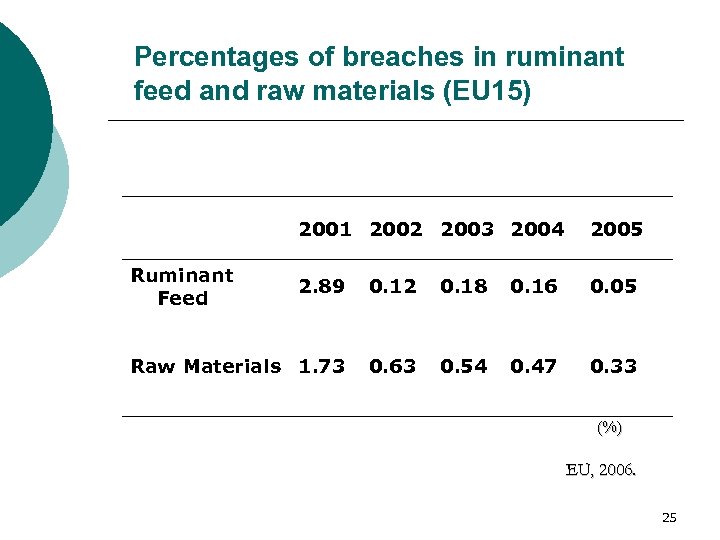
Percentages of breaches in ruminant feed and raw materials (EU 15) 2001 2002 2003 2004 2005 2. 89 0. 12 0. 18 0. 16 0. 05 Raw Materials 1. 73 0. 63 0. 54 0. 47 0. 33 Ruminant Feed (%) EU, 2006. 25
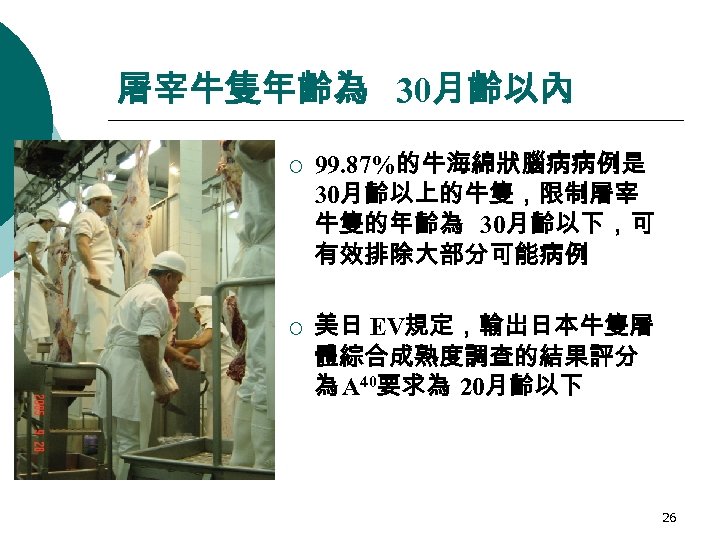
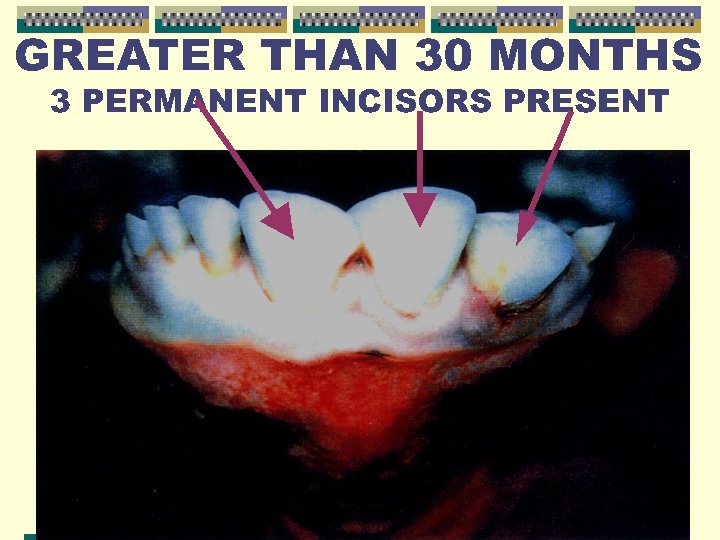
屠宰牛隻年齡為 30月齡以內 ¡ ¡ 99. 87%的牛海綿狀腦病病例是 30月齡以上的牛隻,限制屠宰 牛隻的年齡為 30月齡以下,可 有效排除大部分可能病例 美日 EV規定,輸出日本牛隻屠 體綜合成熟度調查的結果評分 為 A 40要求為 20月齡以下 26
27
牛籍回溯系統 ¡ ¡ 2005年 7月美國開始執行牛籍管理制度 (非強迫性 ) : 假使輸入的牛隻ㄧ旦發現有病原存在,能回溯追蹤 到原來的飼養場、族群及屠宰場等。 如果不限制來 源證明,是有回溯盲點 。加拿大與日本則都納入管理。 整體上在制度面與資料的透明公開管理,孰勝孰非? 美日 EV規定,屠牛必須做牛海綿狀腦病篩檢及屠 宰場、飼養場和製造者亦必須符合規定,牛隻 (包 含個體和族群 )必須能追溯到屠畜生前之出生與製 造記錄 ¡ 美韓 EV規定中要求必須保留屠宰記錄 ¡ 台灣並沒有類似要求 2年 28
EU 27 BSE monitoring of 2007 ¡ Active monitoring: - 1, 445, 280 risk bovine animals (Fallen, Emergency slaughter, Clinical signs at AM). - 8, 262, 517 healthy slaughtered animals - 1, 466 animals culled in connection to BSE case ¡ Passive monitoring: - 1860 official BSE suspects. ¡ Results of 174 BSE positives: 91% from Active and 9% from passive monitoring. 29
BSE普測還是高風險檢測? ¡ ¡ 美國在 2004 -2006年 8月採樣了約 79萬個牛隻樣本 (每二百 五十頭採樣一頭 ),包含健康與高風險族群,共篩檢出兩個 病例。之後至今則降低約十倍 (每二千五百頭採樣一頭 ), 主要為高風險族群。在一億頭飼養牛隻的美國至今共發現 三個病例。 日本上市者都要接受測試的,每年大約檢測 125萬頭。四 百四十萬飼養牛隻頭數的日本有 36個病例 (2009年亦有 )。 加拿大自 2004年後每年採樣高風險族群至少 3萬頭牛隻檢 測 (約 500頭採樣一隻,但實際每年採樣測試約 5萬個樣本 )。 在一千五百萬飼養牛隻頭數的加拿大有 18個病例發現 (2009年仍有 )。 加拿大飼養方式與美國類似,美加邊境牛隻來往頻繁,很 多加拿大牛隻肥育期是在美國境內牧場完成並屠宰,所以 很難分彼我。就這種管理、測試比例及技術等,美國真的 30
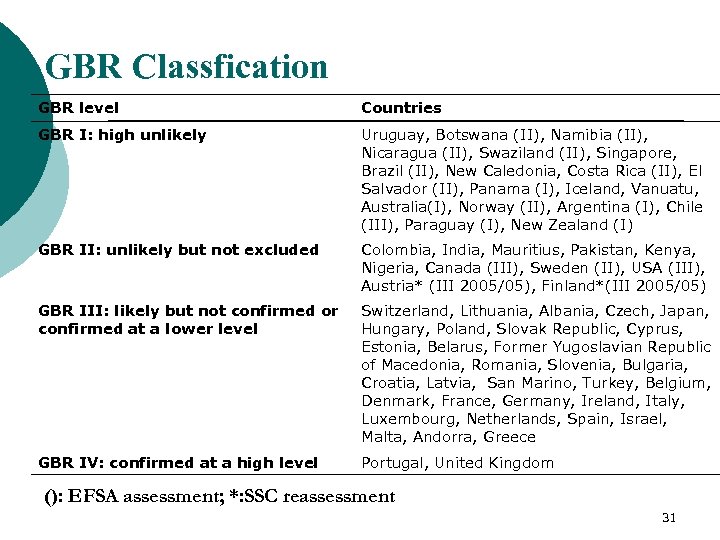
GBR Classfication GBR level Countries GBR I: high unlikely Uruguay, Botswana (II), Namibia (II), Nicaragua (II), Swaziland (II), Singapore, Brazil (II), New Caledonia, Costa Rica (II), El Salvador (II), Panama (I), Iceland, Vanuatu, Australia(I), Norway (II), Argentina (I), Chile (III), Paraguay (I), New Zealand (I) GBR II: unlikely but not excluded Colombia, India, Mauritius, Pakistan, Kenya, Nigeria, Canada (III), Sweden (II), USA (III), Austria* (III 2005/05), Finland*(III 2005/05) GBR III: likely but not confirmed or confirmed at a lower level Switzerland, Lithuania, Albania, Czech, Japan, Hungary, Poland, Slovak Republic, Cyprus, Estonia, Belarus, Former Yugoslavian Republic of Macedonia, Romania, Slovenia, Bulgaria, Croatia, Latvia, San Marino, Turkey, Belgium, Denmark, France, Germany, Ireland, Italy, Luxembourg, Netherlands, Spain, Israel, Malta, Andorra, Greece GBR IV: confirmed at a high level Portugal, United Kingdom (): EFSA assessment; *: SSC reassessment 31
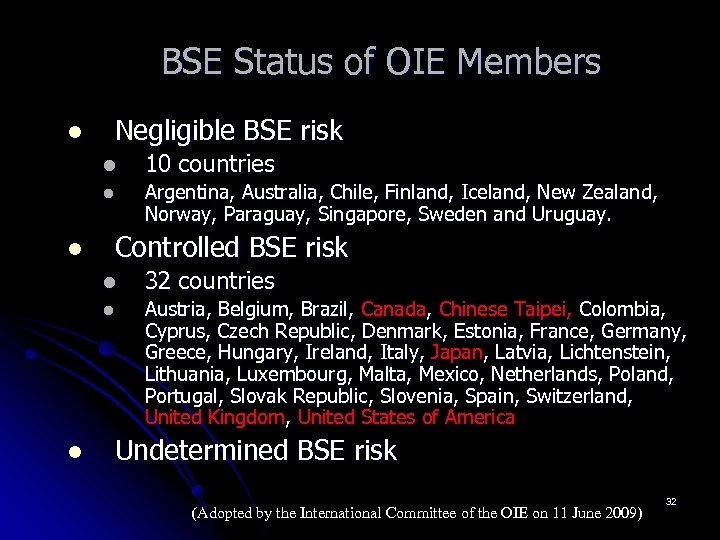
BSE Status of OIE Members l Negligible BSE risk l l l 10 countries Argentina, Australia, Chile, Finland, Iceland, New Zealand, Norway, Paraguay, Singapore, Sweden and Uruguay. Controlled BSE risk l l l 32 countries Austria, Belgium, Brazil, Canada, Chinese Taipei, Colombia, Cyprus, Czech Republic, Denmark, Estonia, France, Germany, Greece, Hungary, Ireland, Italy, Japan, Latvia, Lichtenstein, Lithuania, Luxembourg, Malta, Mexico, Netherlands, Poland, Portugal, Slovak Republic, Slovenia, Spain, Switzerland, United Kingdom, United States of America Undetermined BSE risk (Adopted by the International Committee of the OIE on 11 June 2009) 32
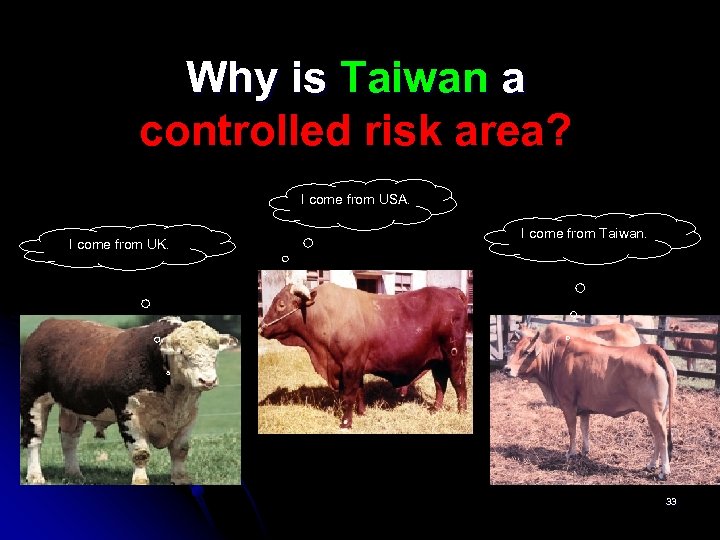
Why is Taiwan a controlled risk area? I come from USA. I come from UK. I come from Taiwan. 33
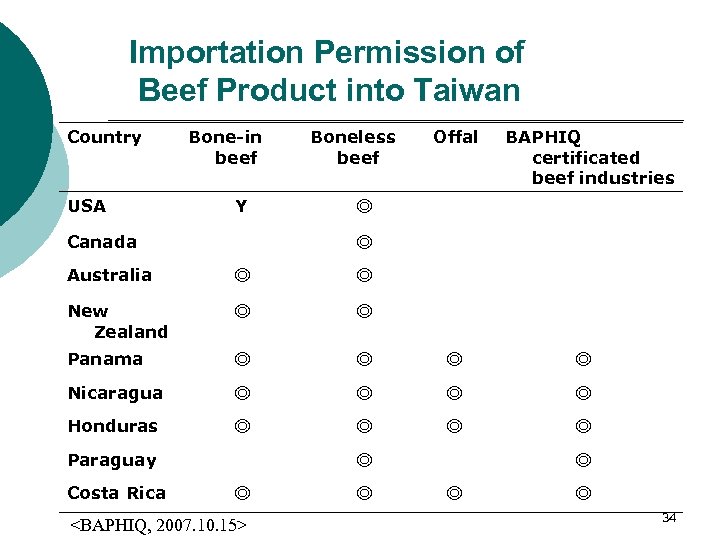
Importation Permission of Beef Product into Taiwan Country USA Bone-in beef Y Canada Boneless beef Offal BAPHIQ certificated beef industries ◎ ◎ Australia ◎ ◎ New Zealand ◎ ◎ Panama ◎ ◎ Nicaragua ◎ ◎ Honduras ◎ ◎ Paraguay Costa Rica ◎ ◎ <BAPHIQ, 2007. 10. 15> ◎ ◎ 34
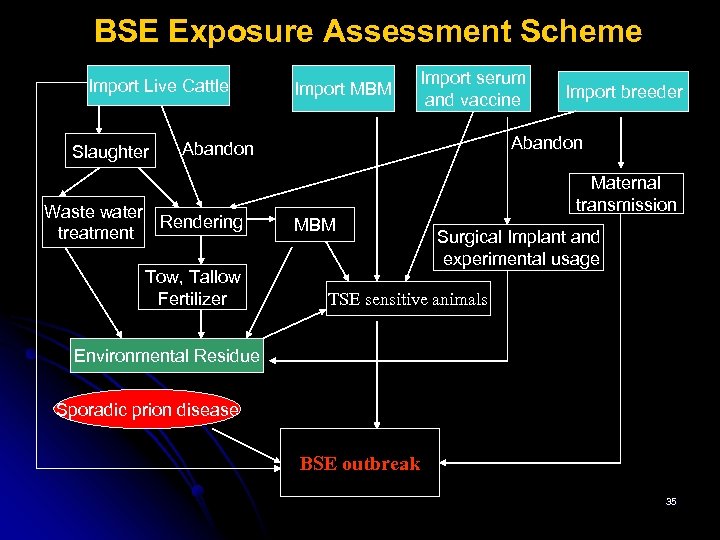
BSE Exposure Assessment Scheme Import Live Cattle Slaughter Import MBM Import serum and vaccine Abandon Waste water Rendering treatment Tow, Tallow Fertilizer Import breeder Maternal transmission MBM Surgical Implant and experimental usage TSE sensitive animals Environmental Residue Sporadic prion disease BSE outbreak 35
36
37
38
39
40
41
人類為了一己之私,強迫牛隻改變食 性,終於架禍於自己 ¡ ¡ 科學的知識是相當薄弱的,通常是出事後才能找 出原因或才能證明的。如果動物化製原料沒有分 種別而專一處理且再餵食經濟動物或寵物,難保 類似狂牛病的案例不會再發生。再者,同類相食 的情況涉及到道德與倫理的問題。 台灣對化製業的管理要好好的思考,不要造成另 一公共衛生的浩劫。 42
是全牛還是 30個月齡以 下? 美台協議書英文版並未談及30個月以下的 牛肉與產品的事, 只有定義高風險物質 時才用到 30個月齡以上的限制要求, 即 協議書是可以開放不分年齡所有的帶或 不帶骨牛肉. 43
密室協商是什米碗 糕? 美國給肉商的輸出產品說明(Export Requirements for Taiwan (Dec 2, 2009)提到"As a temporary market transition measure, U. S. exporters will ship only U. S. deboned and bone-in beef products from cattle less than 30 months of age. ", 可知這是一個暫時性的措施, 也因此可知為何 180天後要檢討開放情形. 不過美國USDA AMS目前公告Export Verification (EV) Program Specified Product Requirements for Beef Taiwan仍然是 2007年的不帶骨牛肉版. 這些所有資料都不一致, 雙方政府秘室協商後在中英文公 告上有相當多套不同的要求, 兩者在變通處置上果然默契 是有一套! 44
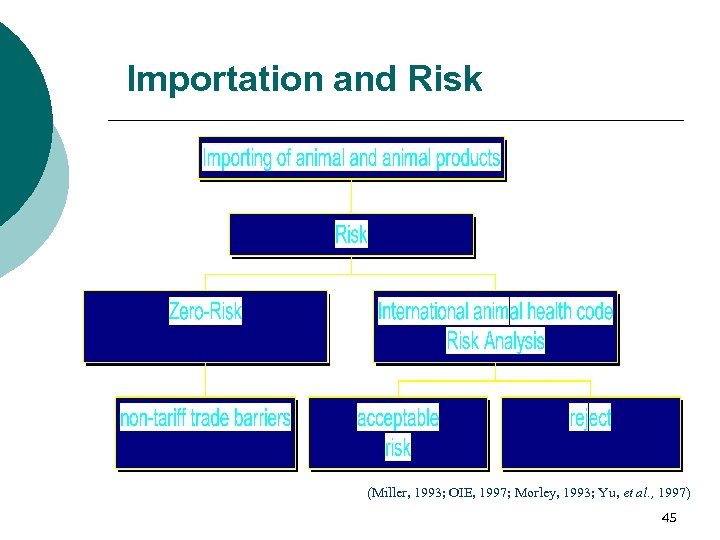
Importation and Risk (Miller, 1993; OIE, 1997; Morley, 1993; Yu, et al. , 1997) 45
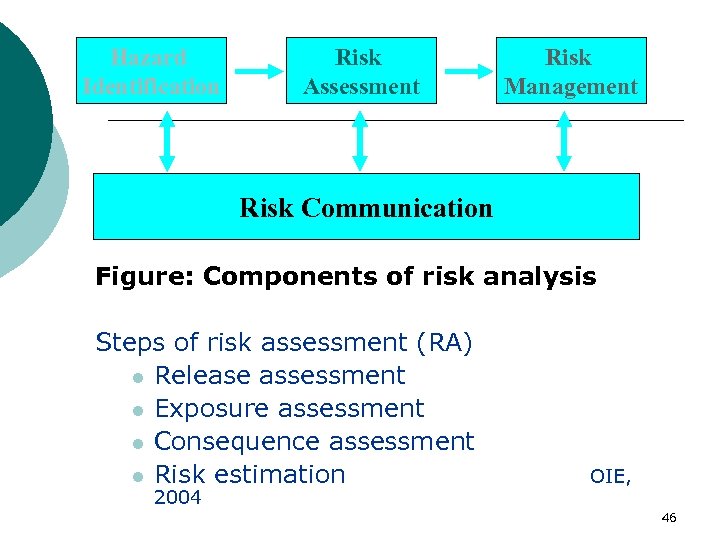
Hazard Identification Risk Assessment Risk Management Risk Communication Figure: Components of risk analysis Steps of risk assessment (RA) l Release assessment l Exposure assessment l Consequence assessment l Risk estimation 2004 OIE, 46
世界動物衛生組織的規 範 WTO委由世界動物衛生組織訂定各會員國 協商時的基本標準 , 這是一個參考性的規範 準則 , 不是絕對的. 比如說歐盟訂出的高風險 物質就比世界動物衛生組織標準嚴格 , 日本 與美國的協議就完全不適用該標準 , 我們是 模範生要完全遵守該規範 ? 同樣的 , 因為中 國的關係 , 我們在世界動物衛生組織的會籍 名稱也同意改了兩次 , 模範生必備的條件看 來難道就是只有忍辱負重嗎 ? 為什麼台灣公 民的我們不能自主! 47
結論 ¡ 牛海綿狀腦病的疫情已有效控制住但仍未 完全滅絕 ,人類狂牛病病例仍有繼續發現 , 要有耐心的觀察與等待, 不屈服威脅與接 受利誘 ¡ ¡ 牛隻與牛肉及其產品的輸出入 疫區規範認真確實嚴加執行外 ,除要依循 ,充份的 風險溝通是必須的, 阻絕於境外是優 先的選項 雖然經由肉製品輸入而傳入台灣的風險非 常的低 ,但 因應可能的人類病例,除了重 新思考輸入國之牛源與牛籍管理要求外, 48
期許與勉勵 畜產 業強權耗用畜牧業糧食、產生糞尿污 染、砍伐森林與使用長程冷凍運輸,產生 了大量的溫室氣體,是地球殺手。大家該 少吃外來牛肉,少用動物皮草油脂與化妝 品,除了讓自己免遭狂牛病天譴外,更可 以 為子孫救地球。 49
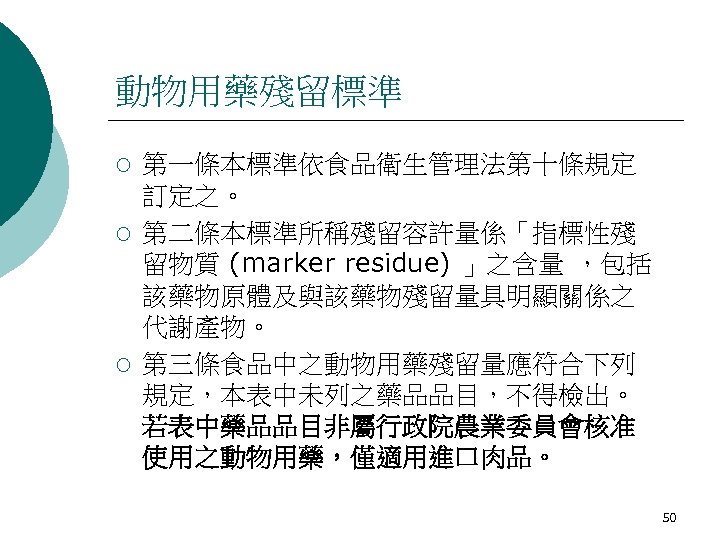
動物用藥殘留標準 ¡ ¡ ¡ 第一條本標準依食品衛生管理法第十條規定 訂定之。 第二條本標準所稱殘留容許量係「指標性殘 留物質 (marker residue) 」之含量 ,包括 該藥物原體及與該藥物殘留量具明顯關係之 代謝產物。 第三條食品中之動物用藥殘留量應符合下列 規定,本表中未列之藥品品目,不得檢出。 若表中藥品品目非屬行政院農業委員會核准 使用之動物用藥,僅適用進口肉品。 50
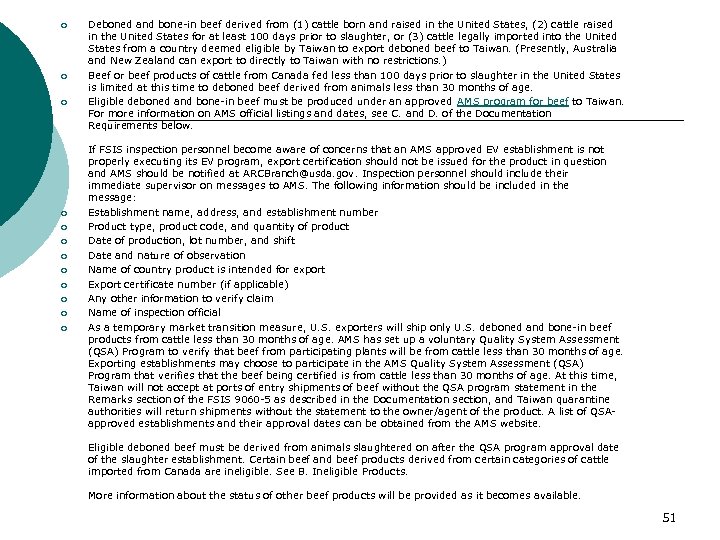
¡ ¡ ¡ Deboned and bone-in beef derived from (1) cattle born and raised in the United States, (2) cattle raised in the United States for at least 100 days prior to slaughter, or (3) cattle legally imported into the United States from a country deemed eligible by Taiwan to export deboned beef to Taiwan. (Presently, Australia and New Zealand can export to directly to Taiwan with no restrictions. ) Beef or beef products of cattle from Canada fed less than 100 days prior to slaughter in the United States is limited at this time to deboned beef derived from animals less than 30 months of age. Eligible deboned and bone-in beef must be produced under an approved AMS program for beef to Taiwan. For more information on AMS official listings and dates, see C. and D. of the Documentation Requirements below. If FSIS inspection personnel become aware of concerns that an AMS approved EV establishment is not properly executing its EV program, export certification should not be issued for the product in question and AMS should be notified at ARCBranch@usda. gov. Inspection personnel should include their immediate supervisor on messages to AMS. The following information should be included in the message: Establishment name, address, and establishment number Product type, product code, and quantity of product Date of production, lot number, and shift Date and nature of observation Name of country product is intended for export Export certificate number (if applicable) Any other information to verify claim Name of inspection official As a temporary market transition measure, U. S. exporters will ship only U. S. deboned and bone-in beef products from cattle less than 30 months of age. AMS has set up a voluntary Quality System Assessment (QSA) Program to verify that beef from participating plants will be from cattle less than 30 months of age. Exporting establishments may choose to participate in the AMS Quality System Assessment (QSA) Program that verifies that the beef being certified is from cattle less than 30 months of age. At this time, Taiwan will not accept at ports of entry shipments of beef without the QSA program statement in the Remarks section of the FSIS 9060 -5 as described in the Documentation section, and Taiwan quarantine authorities will return shipments without the statement to the owner/agent of the product. A list of QSAapproved establishments and their approval dates can be obtained from the AMS website. Eligible deboned beef must be derived from animals slaughtered on after the QSA program approval date of the slaughter establishment. Certain beef and beef products derived from certain categories of cattle imported from Canada are ineligible. See B. Ineligible Products. More information about the status of other beef products will be provided as it becomes available. 51
Скачать презентацию 狂牛病的警訊 周晉澄 Chin-Cheng Chou DVM Ph D 國立台灣大學獸醫學系教授
64c4febe11abf727e74fb422645202b7.ppt