 Скачать презентацию 片山研究室の無線制御研究 最近の学会発表より 名古屋大学 エコトピア科学研究所 情報 通信科学研究部門 大学院 学研究科 電子情報システム専攻 兼担
3098af101653fff9595e6e82e14d22f6.ppt
- Количество слайдов: 105



片山研究室の無線制御研究 最近の学会発表より 名古屋大学 エコトピア科学研究所 情報・通信科学研究部門 (大学院 学研究科 電子情報システム専攻 兼担) 片山 正昭
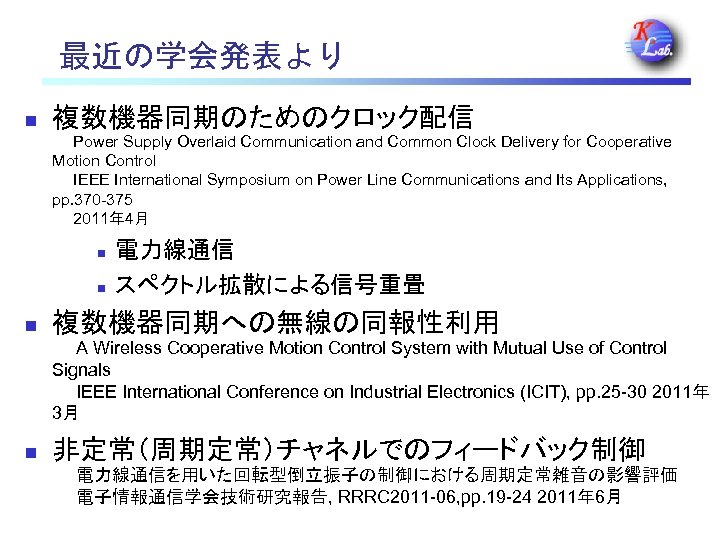
最近の学会発表より n 複数機器同期のためのクロック配信 Power Supply Overlaid Communication and Common Clock Delivery for Cooperative Motion Control IEEE International Symposium on Power Line Communications and Its Applications, pp. 370 -375 2011年 4月 n n n 電力線通信 スペクトル拡散による信号重畳 複数機器同期への無線の同報性利用 A Wireless Cooperative Motion Control System with Mutual Use of Control Signals IEEE International Conference on Industrial Electronics (ICIT), pp. 25 -30 2011年 3月 n 非定常(周期定常)チャネルでのフィードバック制御 電力線通信を用いた回転型倒立振子の制御における周期定常雑音の影響評価 電子情報通信学会技術研究報告, RRRC 2011 -06, pp. 19 -24 2011年 6月
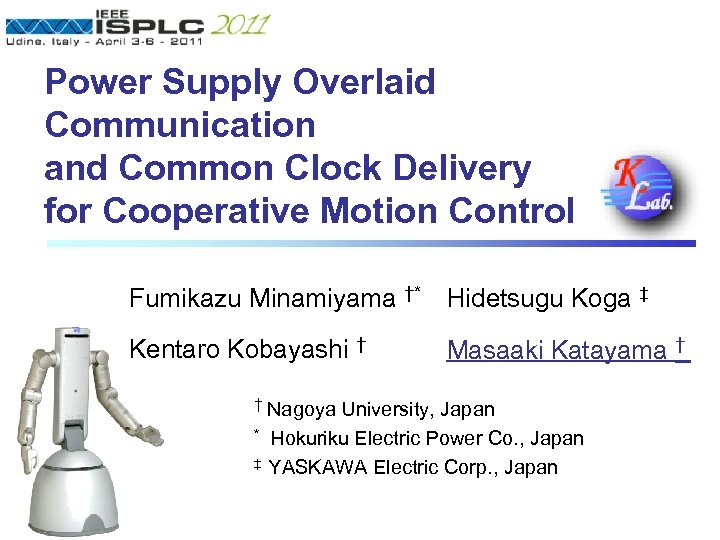
Power Supply Overlaid Communication and Common Clock Delivery for Cooperative Motion Control Fumikazu Minamiyama †* Hidetsugu Koga ‡ Kentaro Kobayashi † † Nagoya * ‡ Masaaki Katayama † University, Japan Hokuriku Electric Power Co. , Japan YASKAWA Electric Corp. , Japan
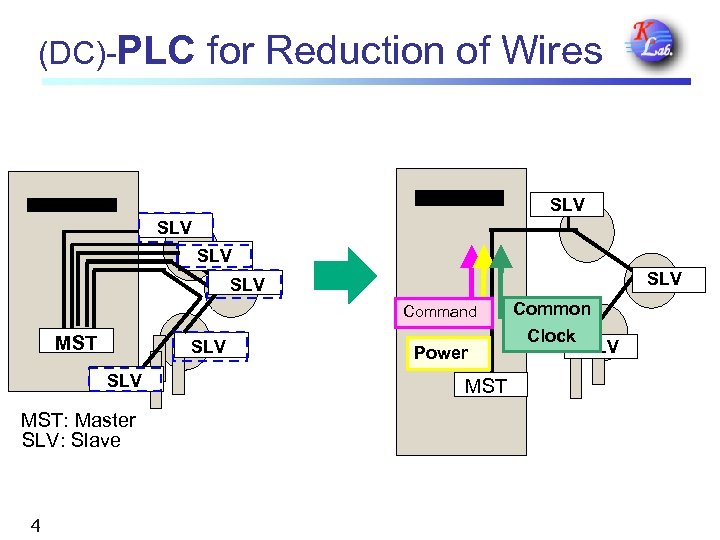
(DC)-PLC for Reduction of Wires SLV SLV SLV Command MST SLV MST: Master SLV: Slave 4 Power MST Common Clock SLV
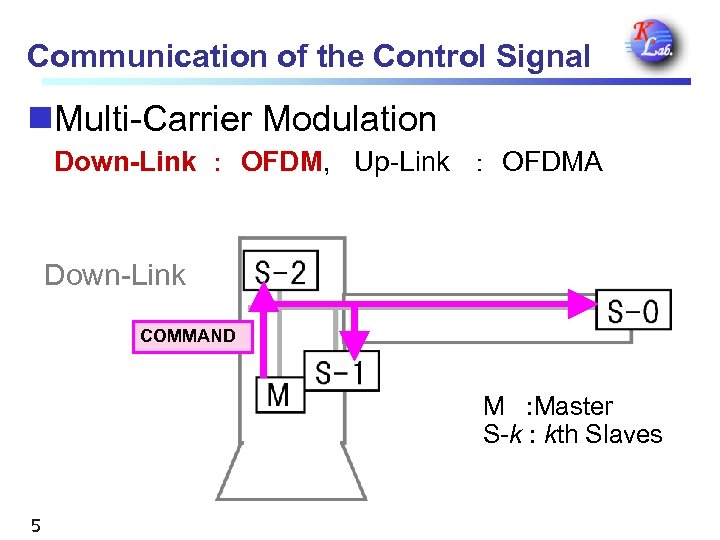
Communication of the Control Signal n. Multi-Carrier Modulation Down-Link : OFDM, Up-Link : OFDMA Down-Link COMMAND M : Master S-k : kth Slaves 5

Communication of the Control Signal n Multi-Carrier Modulation Down-Link : OFDM, Up-Link : OFDMA n OFDM Up-Link and OFDMA by TDD RESPONSE M : Master S-k : kth Slaves 6
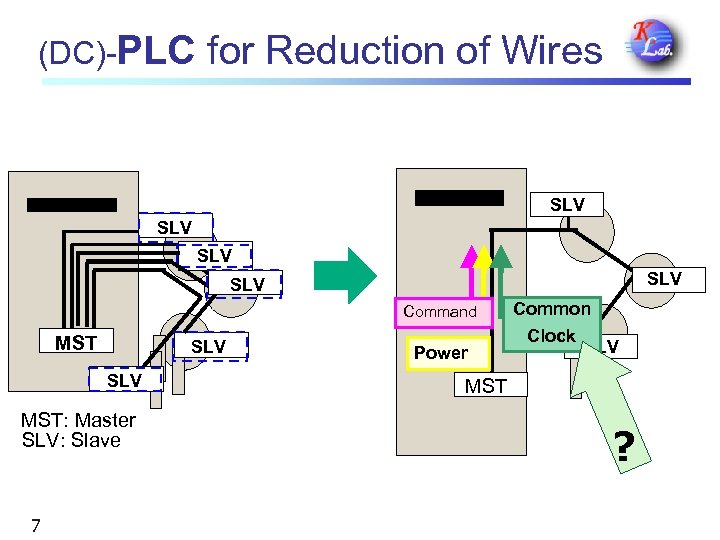
(DC)-PLC for Reduction of Wires SLV SLV SLV Command MST SLV MST: Master SLV: Slave 7 Power Common Clock SLV MST ?
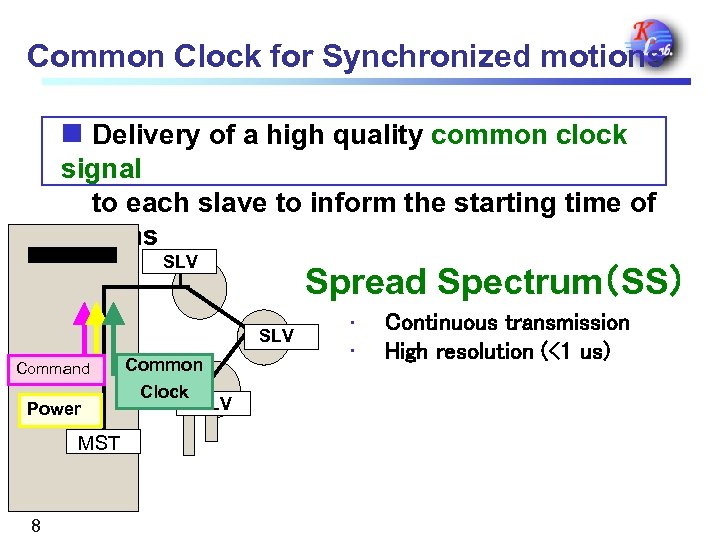
Common Clock for Synchronized motions n Delivery of a high quality common clock signal to each slave to inform the starting time of actions SLV Spread Spectrum(SS) SLV Command Power MST 8 Common Clock SLV • • Continuous transmission High resolution (<1 us)
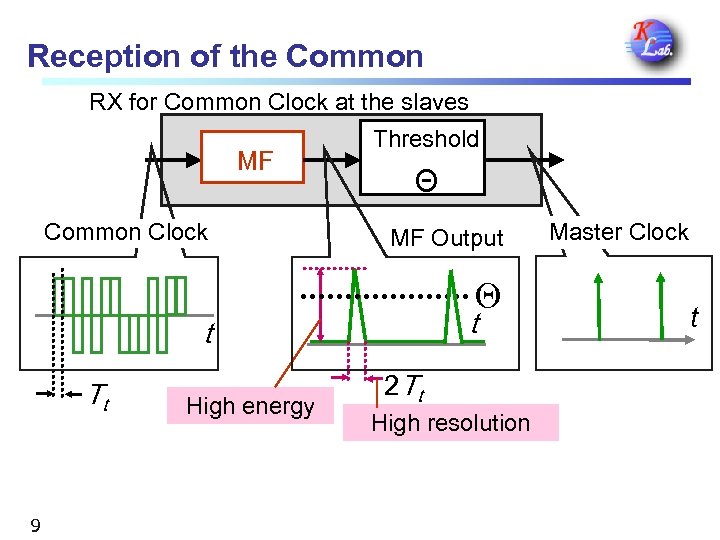
Reception of the Common RX for Common Clock at the slaves MF Common Clock Threshold Θ MF Output Q t t Tt 9 High energy 2 T t High resolution Master Clock t
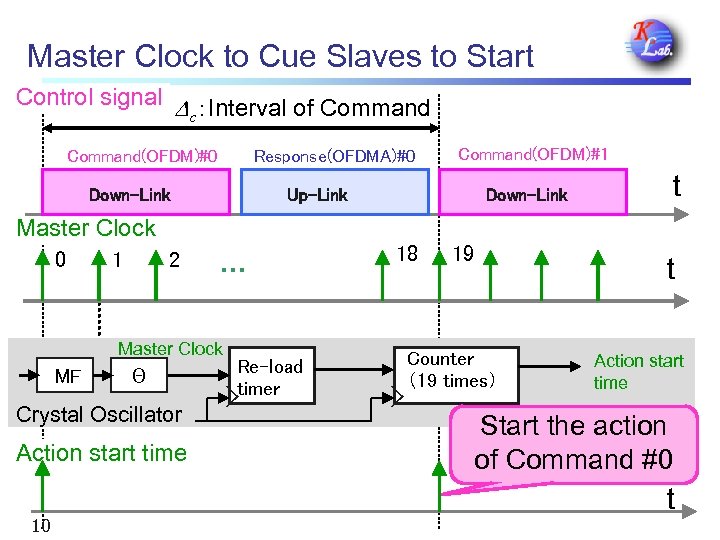
Master Clock to Cue Slaves to Start Control signal D :Interval of Command c Command(OFDM)#0 Response(OFDMA)#0 Down-Link Command(OFDM)#1 Up-Link Down-Link t Master Clock 0 1 2 ・・・ Master Clock MF Θ Crystal Oscillator Action start time 10 Re-load timer > 18 > 19 t Counter (19 times) Action start time Start the action of Command #0 t
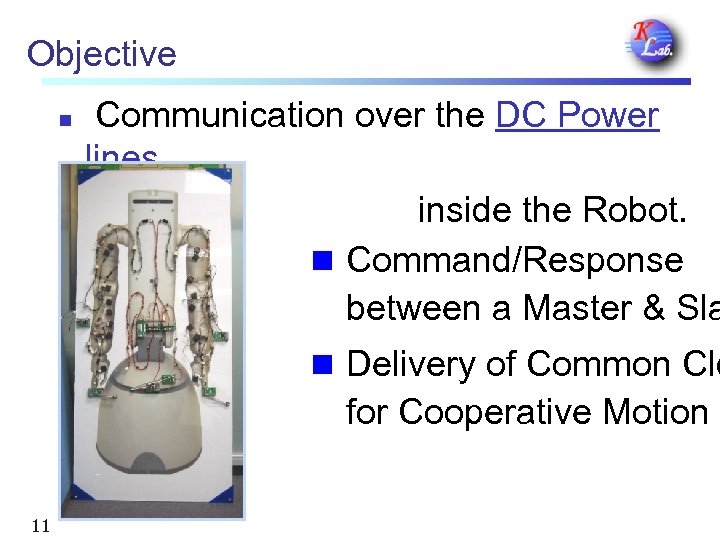
Objective n Communication over the DC Power lines inside the Robot. n Command/Response between a Master & Sla n Delivery of Common Clo for Cooperative Motion 11
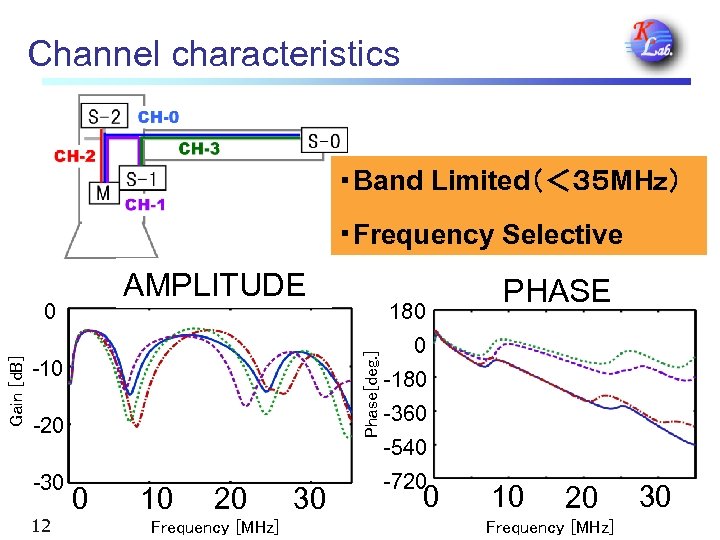
Channel characteristics ・Band Limited(<35 MHz) ・Frequency Selective AMPLITUDE -10 -20 -30 12 180 Phase[deg. ] Gain [d. B] 0 0 10 20 Frequency [MHz] 30 PHASE 0 -180 -360 -540 -720 0 10 20 Frequency [MHz] 30
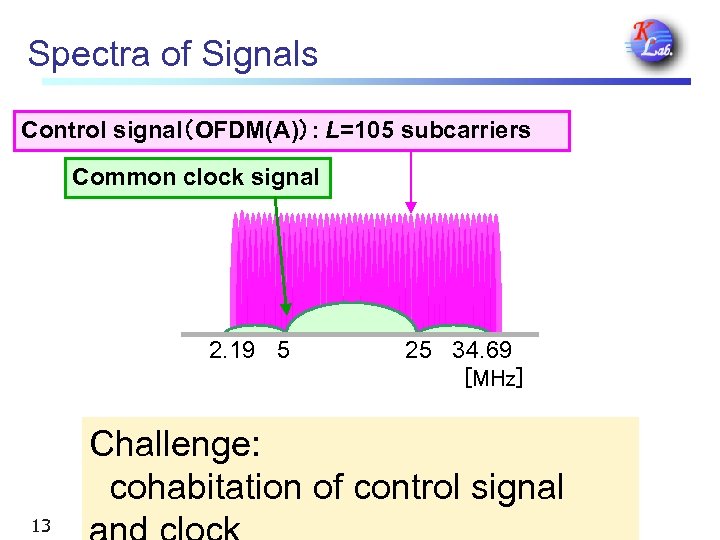
Spectra of Signals Control signal(OFDM(A)): L=105 subcarriers Common clock signal 2. 19 5 25 34. 69 [MHz] Challenge: cohabitation of control signal 13
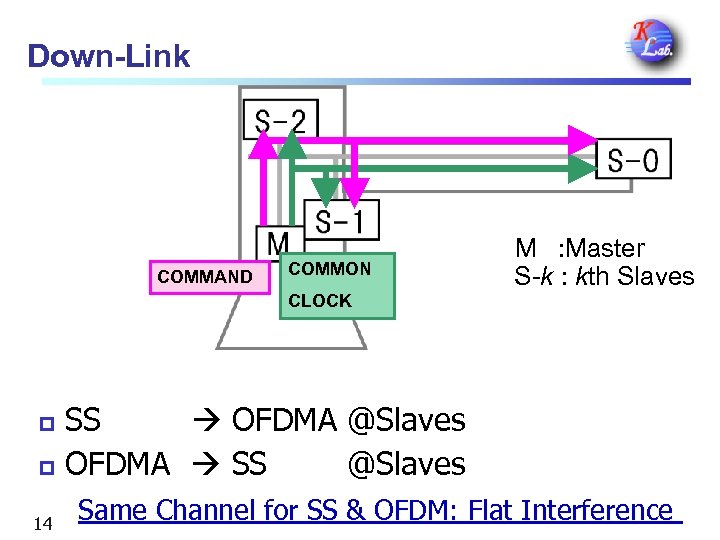
Down-Link COMMAND COMMON M : Master S-k : kth Slaves CLOCK SS OFDMA @Slaves p OFDMA SS @Slaves p 14 Same Channel for SS & OFDM: Flat Interference
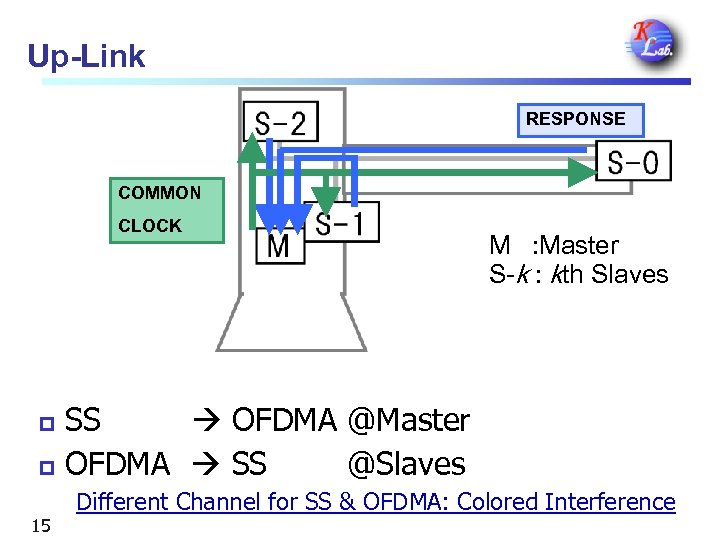
Up-Link RESPONSE COMMON CLOCK M : Master S-k : kth Slaves SS OFDMA @Master p OFDMA SS @Slaves p 15 Different Channel for SS & OFDMA: Colored Interference

Solution of Mutual Interference 2. 19 5 25 34. 69 OFDM(A) SS : Process Gain of SS n SS OFDM(A) : Interference Cancellation n 16 [MHz]
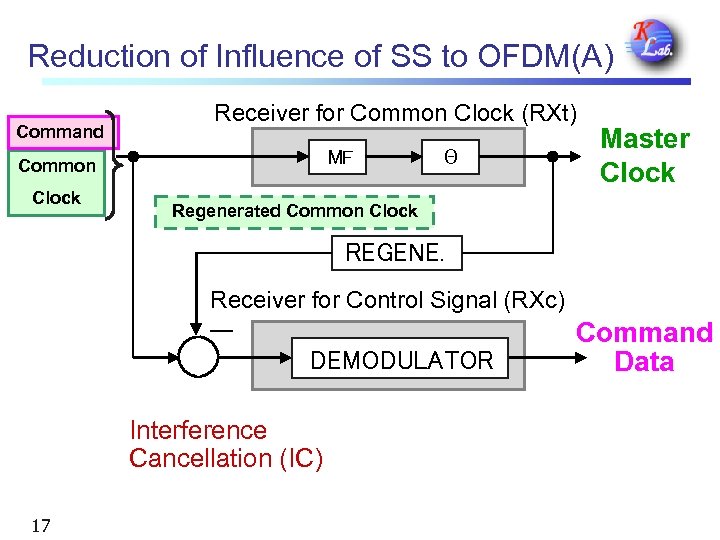
Reduction of Influence of SS to OFDM(A) Command Receiver for Common Clock (RXt) MF Common Clock Θ Master Clock Regenerated Common Clock REGENE. Receiver for Control Signal (RXc) ー DEMODULATOR Interference Cancellation (IC) 17 Command Data

System Parameters Number of Slaves K 3 Channel Measured Noise None Common Clock Signal Carrier Frequency 15 [MHz] Chip Interval 0. 1[ms] PN Sequence (Interval N) M sequences + 0 padding (2048(=211) [bit]) Control Signal The Lowest Carrier Frequency 2. 19 [MHz] Symbol duration Time 3. 2 [ms] The number of Subcarriers /Allocation 106/Slave with High Gain Modulation QPSK 18
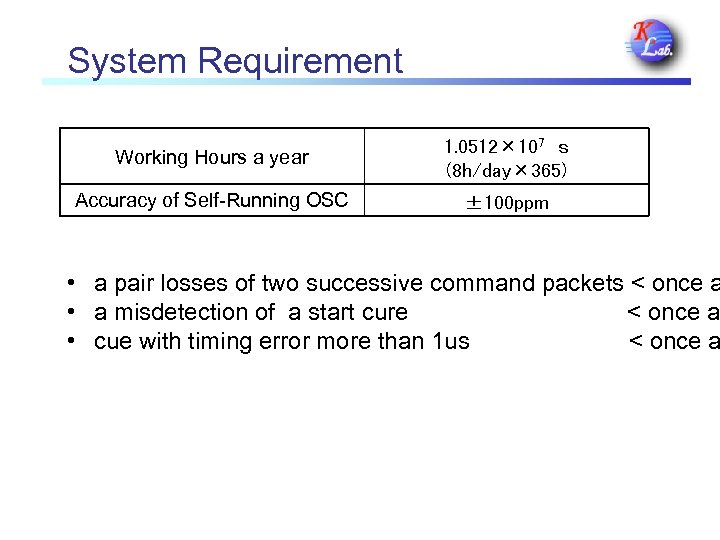
System Requirement Working Hours a year 1. 0512× 107 s (8 h/day× 365) Accuracy of Self-Running OSC ± 100 ppm • a pair losses of two successive command packets < once a • a misdetection of a start cure < once a • cue with timing error more than 1 us < once a
![Requirements for Communication Part [Reception performance] Common Clock Signal(SS) : Prob. of False Alarm Prob.](https://present5.com/presentation/3098af101653fff9595e6e82e14d22f6/image-20.jpg "Requirements for Communication Part [Reception performance] Common Clock Signal(SS) : Prob. of False Alarm Prob.")
Requirements for Communication Part [Reception performance] Common Clock Signal(SS) : Prob. of False Alarm Prob. of Miss Detection Control Signal(OFDM(A)) : Symbol Error Required Conditions for Reception Performance Rate (SER) Prob. of False Alarm ef 2. 1 x 10 -7 Prob. of Miss Detection 3. 2 x 10 -1 em SER for Control Signal es 3. 19 x 10 -8 20
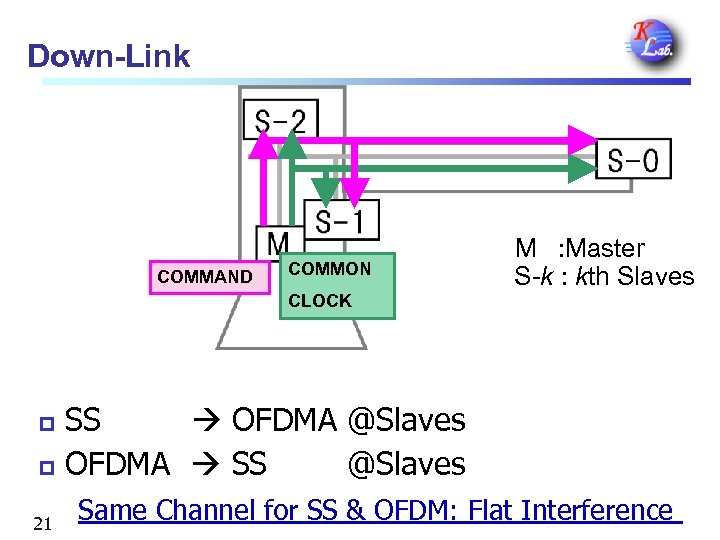
Down-Link COMMAND COMMON M : Master S-k : kth Slaves CLOCK SS OFDMA @Slaves p OFDMA SS @Slaves p 21 Same Channel for SS & OFDM: Flat Interference
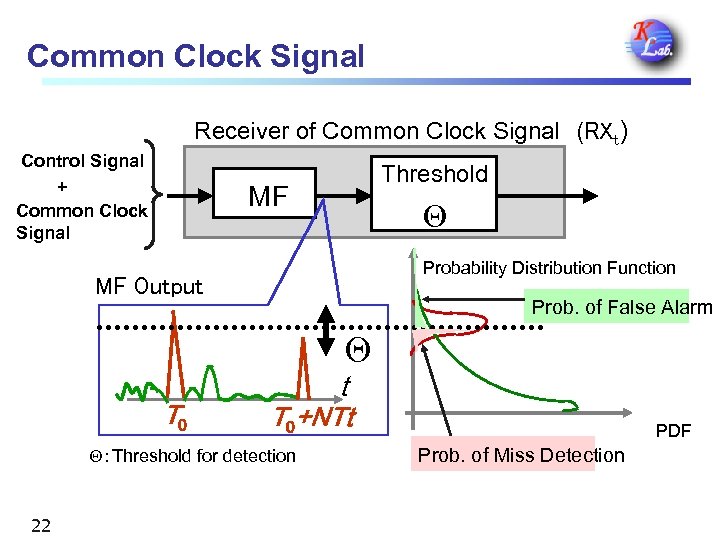
Common Clock Signal Receiver of Common Clock Signal (RXt) Control Signal + Common Clock Signal Threshold MF Q Probability Distribution Function MF Output Prob. of False Alarm Q T 0+NTt Q:Threshold for detection 22 t PDF Prob. of Miss Detection
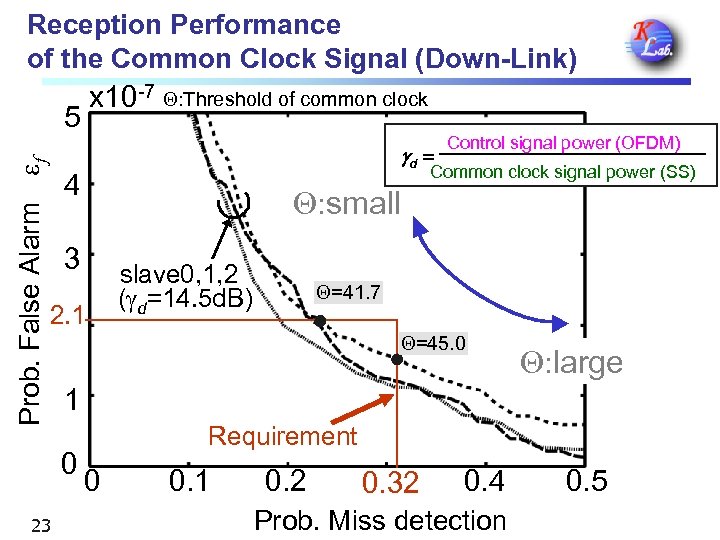
Reception Performance of the Common Clock Signal (Down-Link) x 10 -7 Q: Threshold of common clock Prob. False Alarm ef 5 gd = Common clock signal power (SS) 4 Q: small 3 2. 1 slave 0, 1, 2 (gd=14. 5 d. B) Q=41. 7 Q=45. 0 Q: large 1 0 23 Control signal power (OFDM) Requirement 0 0. 1 0. 2 0. 32 0. 4 Prob. Miss detection 0. 5
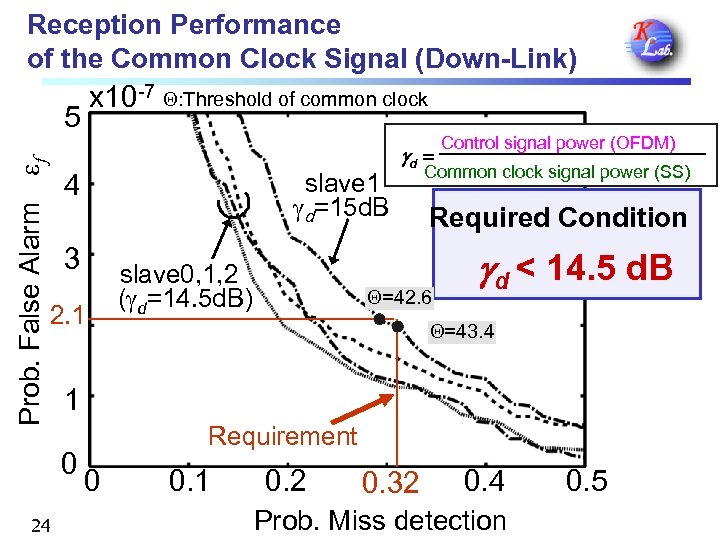
Reception Performance of the Common Clock Signal (Down-Link) x 10 -7 Q: Threshold of common clock Prob. False Alarm ef 5 slave 1 gd=15 d. B 4 3 2. 1 Control signal power (OFDM) Common clock signal power (SS) Required Condition Q=42. 6 gd < 14. 5 d. B Q=43. 4 1 0 24 slave 0, 1, 2 (gd=14. 5 d. B) gd = Requirement 0 0. 1 0. 2 0. 32 0. 4 Prob. Miss detection 0. 5
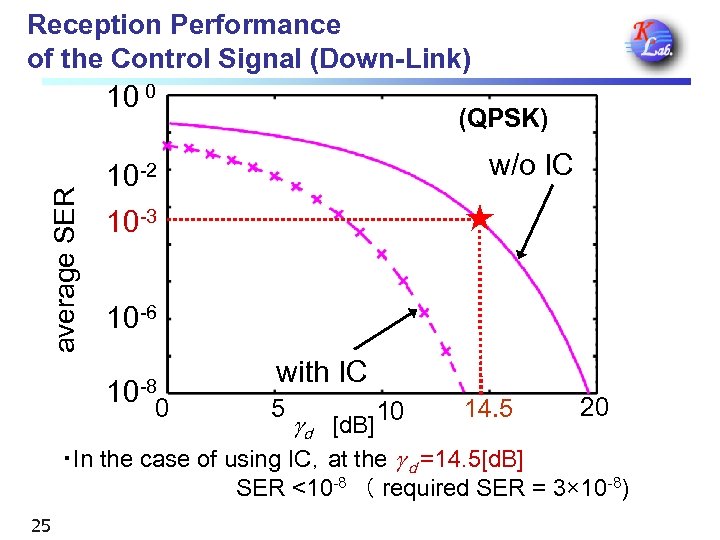
Reception Performance of the Control Signal (Down-Link) average SER 10 0 (QPSK) w/o IC 10 -2 ★ 10 -3 10 -6 10 -8 0 with IC 5 gd [d. B] 10 14. 5 20 ・In the case of using IC,at the gd=14. 5[d. B] SER <10 -8 ( required SER = 3× 10 -8) 25
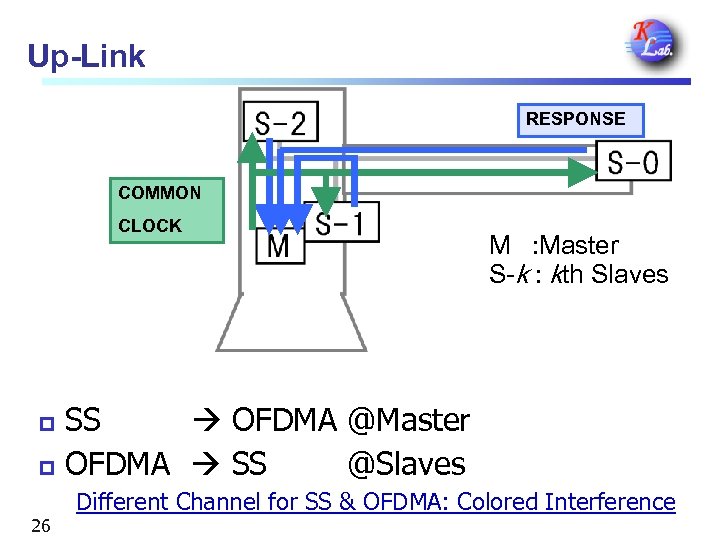
Up-Link RESPONSE COMMON CLOCK M : Master S-k : kth Slaves SS OFDMA @Master p OFDMA SS @Slaves p 26 Different Channel for SS & OFDMA: Colored Interference
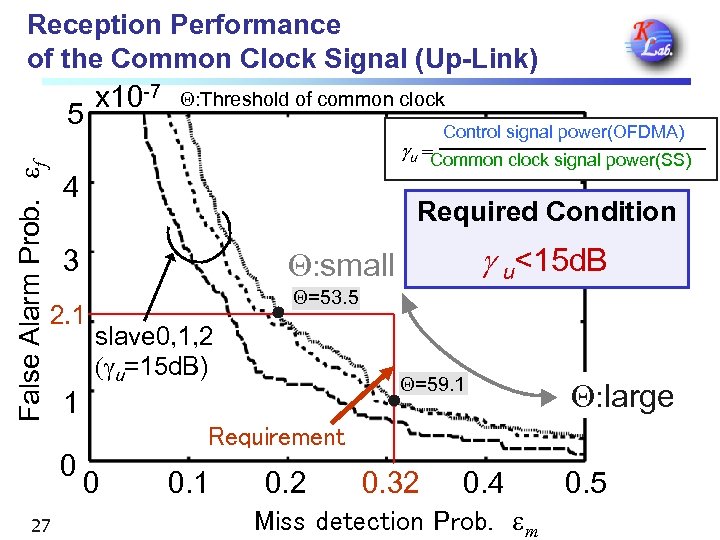
Reception Performance of the Common Clock Signal (Up-Link) False Alarm Prob. ef 5 x 10 -7 Q: Threshold of common clock Control signal power(OFDMA) gu =Common clock signal power(SS) 4 Required Condition 3 2. 1 1 g u<15 d. B Q: small Q=53. 5 slave 0, 1, 2 (gu=15 d. B) Q=59. 1 Q: large Requirement 0 27 0 0. 1 0. 2 0. 32 0. 4 Miss detection Prob. em 0. 5
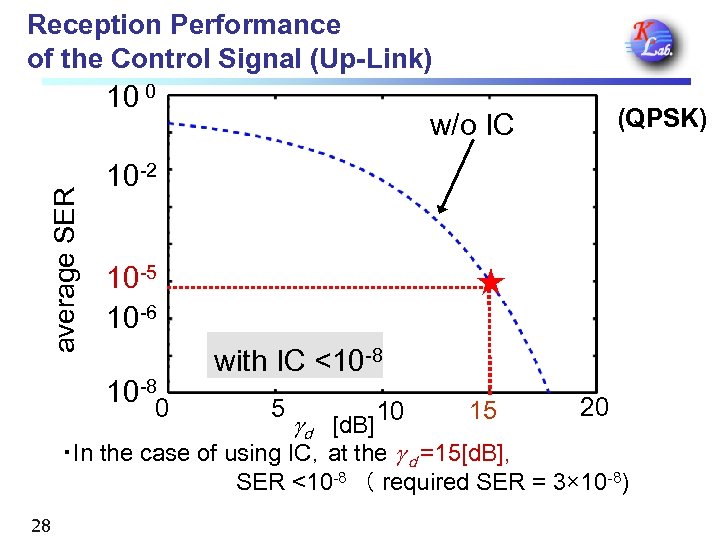
Reception Performance of the Control Signal (Up-Link) average SER 10 0 (QPSK) w/o IC 10 -2 10 -5 10 -6 10 -8 0 ★ with IC <10 -8 5 gd [d. B] 10 15 20 ・In the case of using IC,at the gd=15[d. B], SER <10 -8 ( required SER = 3× 10 -8) 28
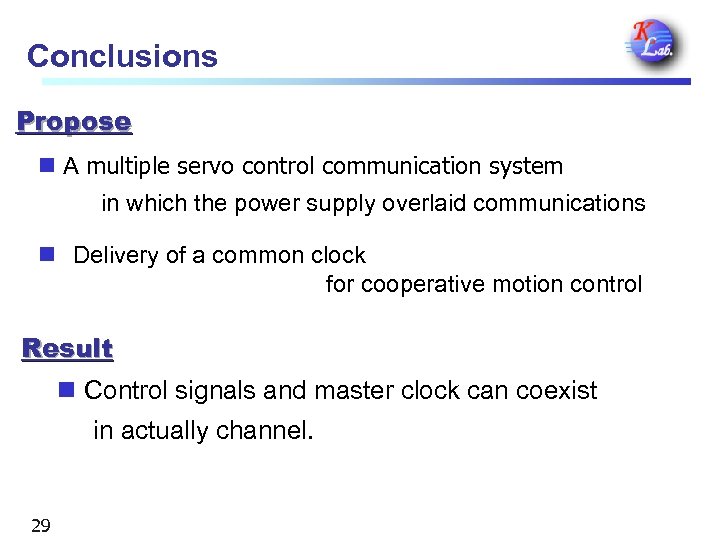
Conclusions Propose n A multiple servo control communication system in which the power supply overlaid communications n Delivery of a common clock for cooperative motion control Result n Control signals and master clock can coexist in actually channel. 29

ICIT-SSST 2011 March 15 th Auburn Univ. Alabama A Wireless Cooperative Motion Control System with Mutual Use of Control Signals Tsugunori Kondo Kentaro Kobayashi Masaaki Katayama Nagoya University, Japan
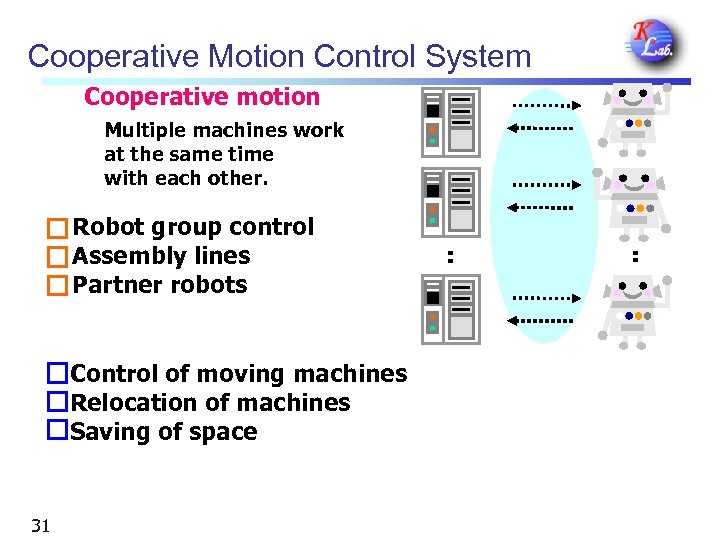
Cooperative Motion Control System Cooperative motion Multiple machines work at the same time with each other. 31 . . Control of moving machines Relocation of machines Saving of space . . Robot group control Assembly lines Partner robots

Performance of Wireless Cooperative Control Packet errors Control performance of each machine (stability, etc. ) New measurement of performance is “the synchronization of all machines”. 32 . . Synchronization of all machines
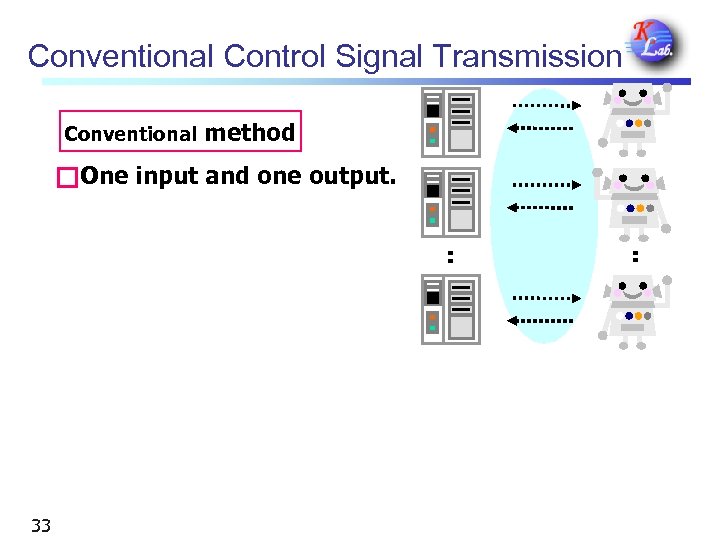
Conventional Control Signal Transmission Conventional method One input and one output. . . 33

Mutual Use of Control Signals Conventional method One input and one output . . The nature of wireless Proposed method Multiple input and one output We consider to use the control signals of the other machines. 34
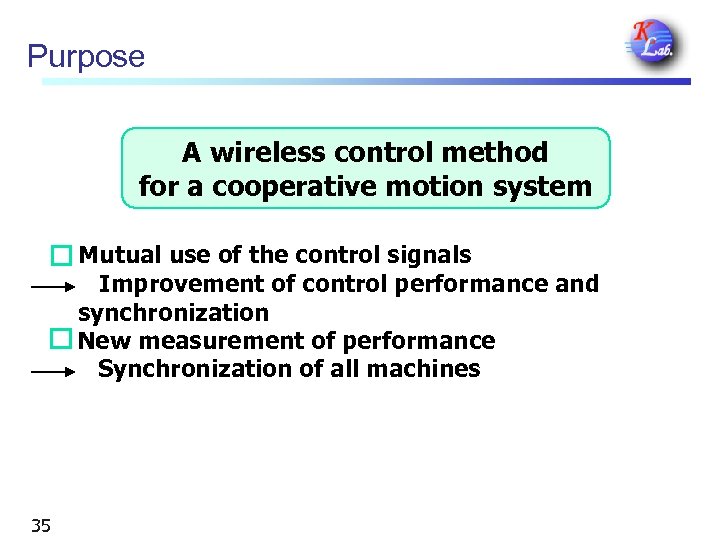
Purpose A wireless control method for a cooperative motion system Mutual use of the control signals Improvement of control performance and synchronization New measurement of performance Synchronization of all machines 35

Rotary Inverted Pendulum The pendulums are controlled to make their arm angles follow the target value while keeping the pendulums in an upright position ( =0). Basic model Bipedal walking robot Crane Rocket launching pad Underactuated system One actuator for two degrees of freedom : Control information (torque) : State information 36

Rotary Inverted Pendulum Controller TRx : Control information (torque) : State information TRx Plant In wireless channels, packet errors may occur. :Success :Failure Success:Input the transmitted signal Failure:Reuse the last received value 37
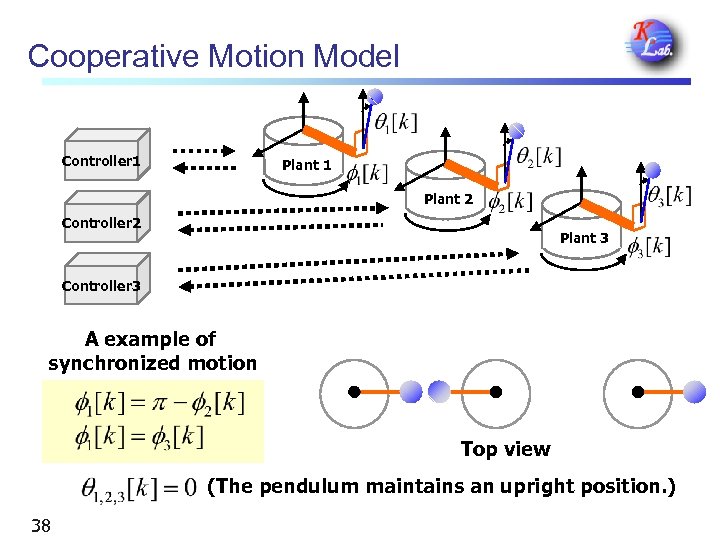
Cooperative Motion Model Controller 1 Plant 2 Controller 2 Plant 3 Controller 3 A example of synchronized motion Top view (The pendulum maintains an upright position. ) 38
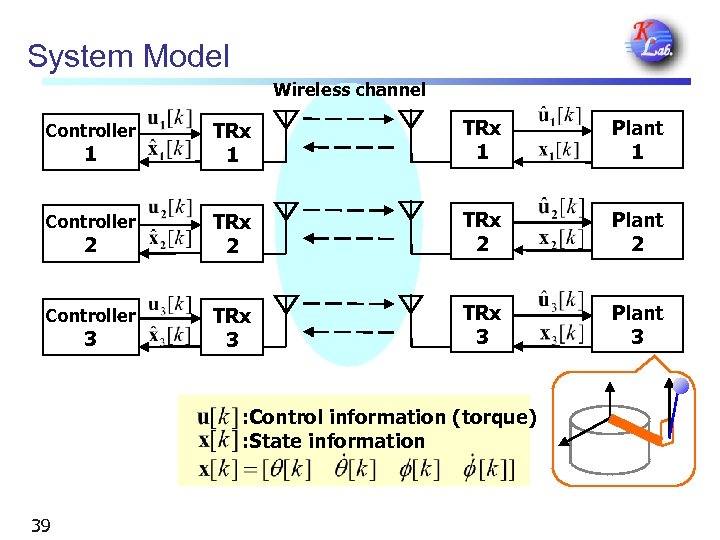
System Model Wireless channel Controller TRx 1 Plant 1 Controller TRx 2 Plant 2 Controller TRx 3 Plant 3 1 2 3 : Control information (torque) : State information 39
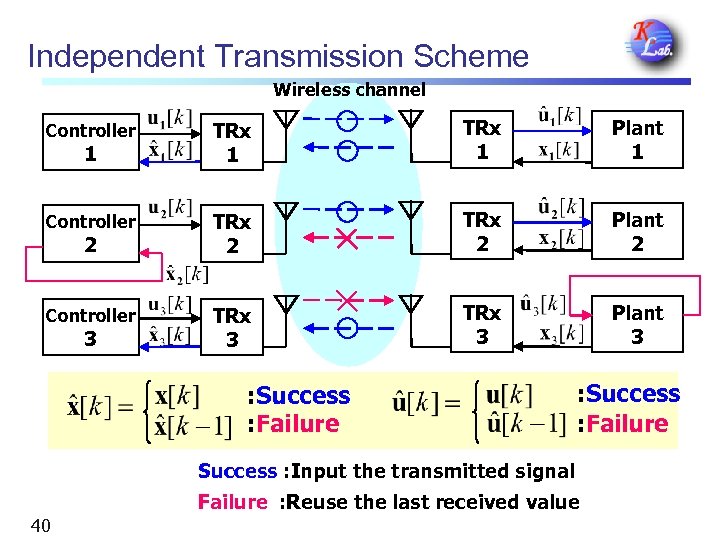
Independent Transmission Scheme Wireless channel Controller TRx 1 Plant 1 Controller TRx 2 Plant 2 Controller TRx 3 Plant 3 1 2 3 : Success : Failure Success : Input the transmitted signal Failure : Reuse the last received value 40
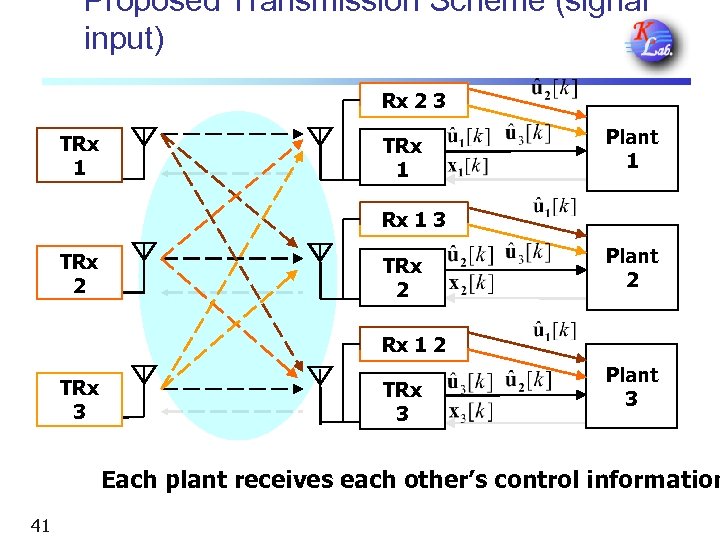
Proposed Transmission Scheme (signal input) Rx 2 3 TRx 1 Plant 1 Rx 1 3 TRx 2 Plant 2 Rx 1 2 TRx 3 Plant 3 Each plant receives each other’s control information 41
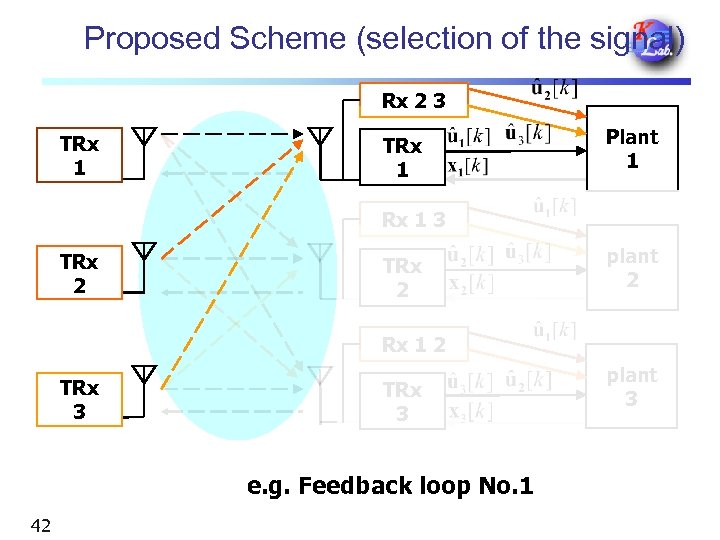
Proposed Scheme (selection of the signal) Rx 2 3 TRx 1 Plant 1 Rx 1 3 TRx 2 plant 2 Rx 1 2 TRx 3 e. g. Feedback loop No. 1 42 plant 3
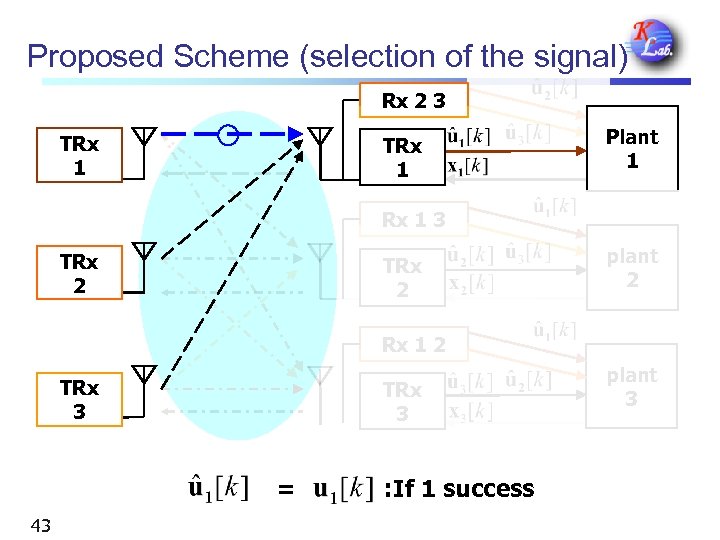
Proposed Scheme (selection of the signal) Rx 2 3 TRx 1 Plant 1 Rx 1 3 TRx 2 plant 2 Rx 1 2 TRx 3 = 43 : If 1 success plant 3
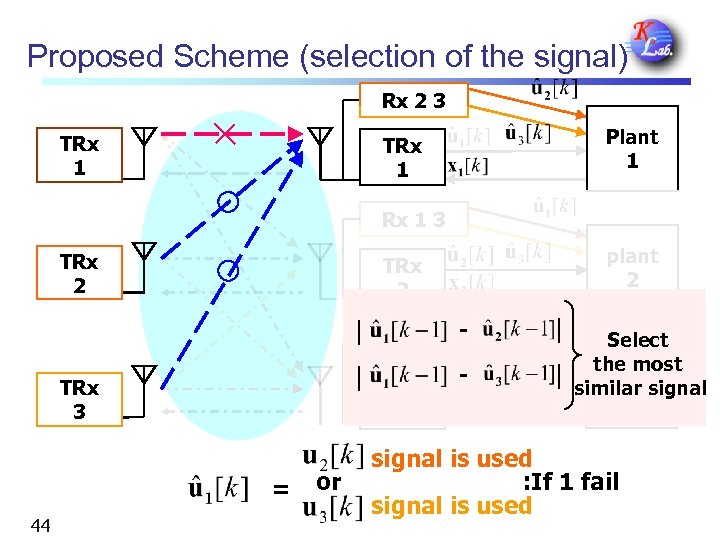
Proposed Scheme (selection of the signal) Rx 2 3 TRx 1 Plant 1 TRx 1 3 TRx 2 Rx 1 2 TRx 3 = 44 plant 2 TRx 2 or - Select the most plant similar signal 3 signal is used : If 1 fail signal is used
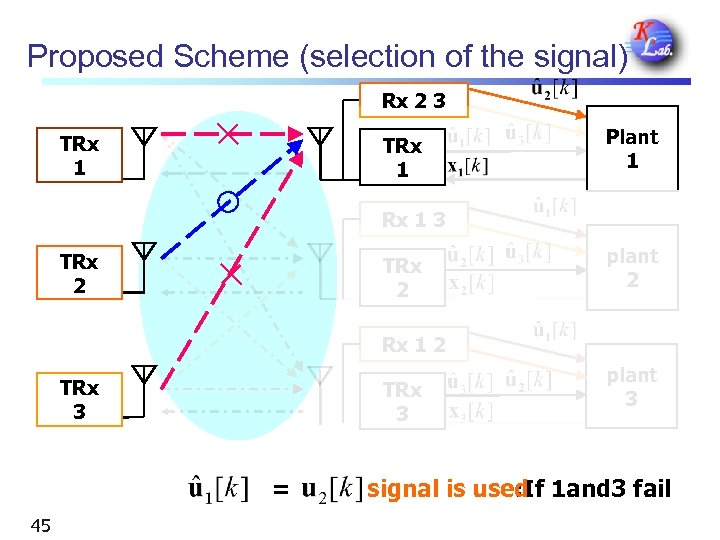
Proposed Scheme (selection of the signal) Rx 2 3 TRx 1 Plant 1 Rx 1 3 TRx 2 plant 2 Rx 1 2 TRx 3 = 45 plant 3 signal is used 1 and 3 fail : If
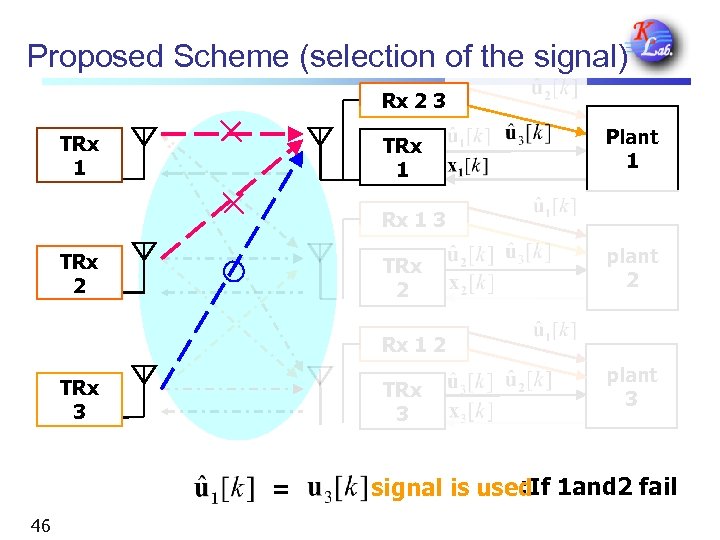
Proposed Scheme (selection of the signal) Rx 2 3 TRx 1 Plant 1 Rx 1 3 TRx 2 plant 2 Rx 1 2 TRx 3 = 46 plant 3 : If signal is used 1 and 2 fail

Proposed Scheme (selection of the signal) Rx 2 3 TRx 1 Plant 1 Rx 1 3 TRx 2 plant 2 Rx 1 2 TRx 3 = 47 : If all fail plant 3
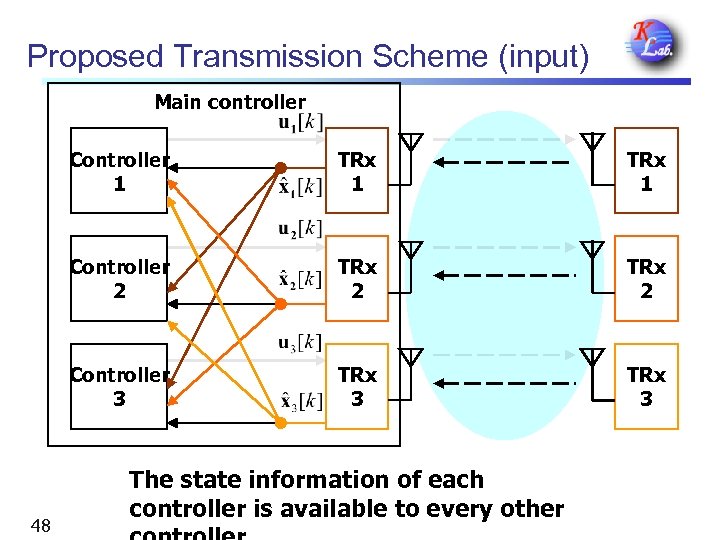
Proposed Transmission Scheme (input) Main controller Controller 1 TRx 1 Controller 2 TRx 2 Controller 3 48 TRx 1 TRx 3 The state information of each controller is available to every other
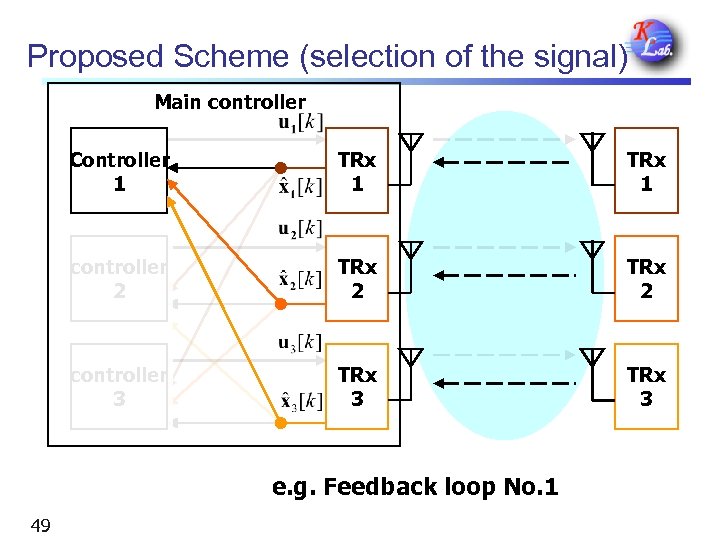
Proposed Scheme (selection of the signal) Main controller Controller 1 TRx 1 controller 2 TRx 2 controller 3 TRx 3 e. g. Feedback loop No. 1 49
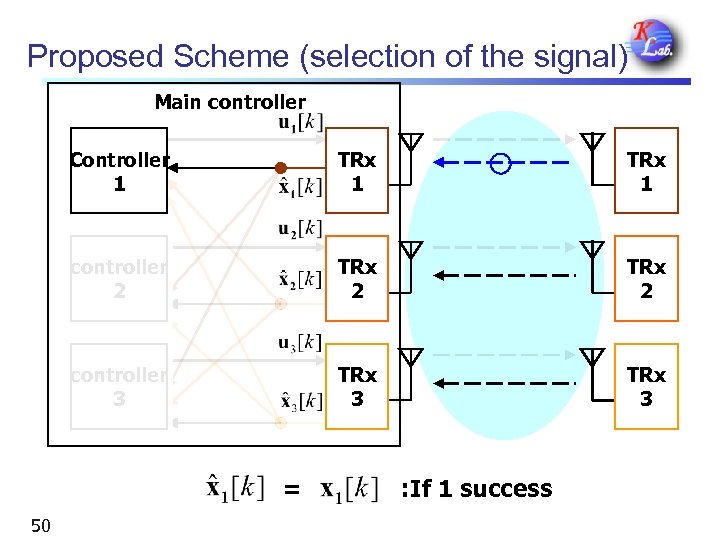
Proposed Scheme (selection of the signal) Main controller Controller 1 TRx 1 controller 2 TRx 2 controller 3 TRx 3 = 50 : If 1 success
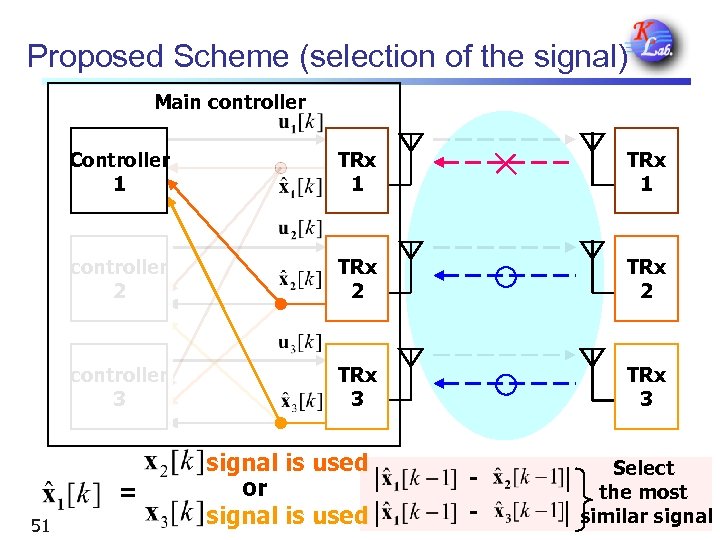
Proposed Scheme (selection of the signal) Main controller Controller 1 TRx 1 controller 2 TRx 2 controller 3 TRx 3 = 51 signal is used or signal is used - Select the most similar signal
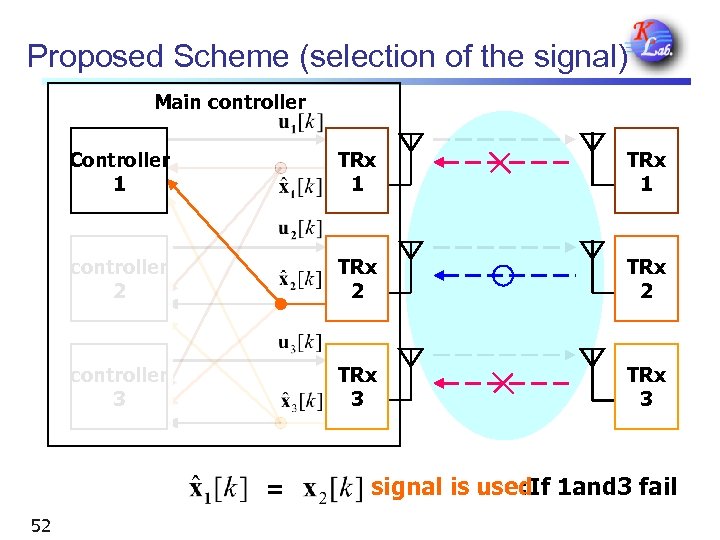
Proposed Scheme (selection of the signal) Main controller Controller 1 TRx 1 controller 2 TRx 2 controller 3 TRx 3 = 52 signal is used 1 and 3 fail : If
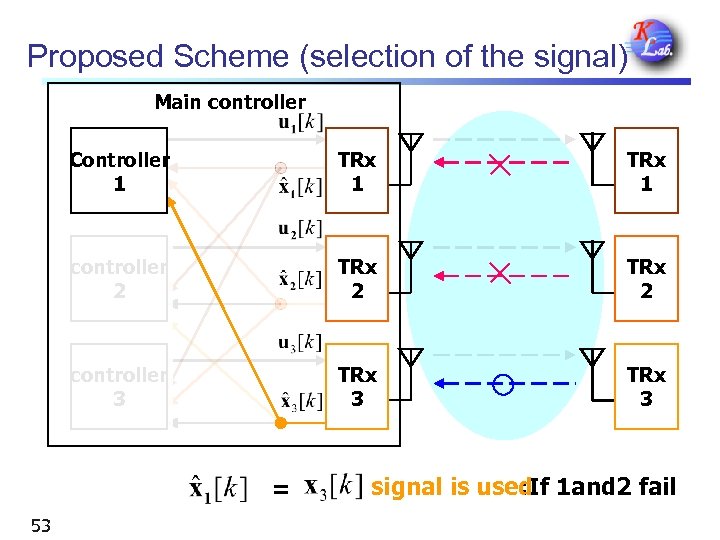
Proposed Scheme (selection of the signal) Main controller Controller 1 TRx 1 controller 2 TRx 2 controller 3 TRx 3 = 53 signal is used 1 and 2 fail : If
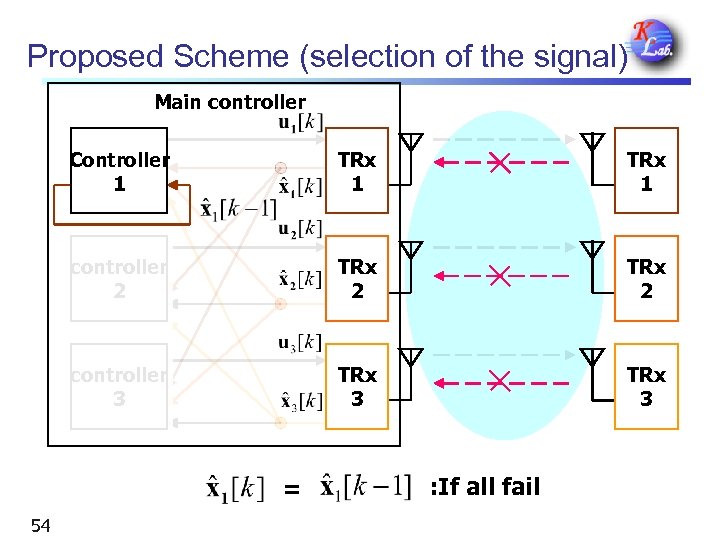
Proposed Scheme (selection of the signal) Main controller Controller 1 TRx 1 controller 2 TRx 2 controller 3 TRx 3 = 54 : If all fail

Simulation 1. Control performance : The rate at which the pendulum collapses 2. Synchronization performance : The difference among arm angles Packet loss : Random Top view Desired value Pendulum angle( Arm angle( ) ) ) Plant 1 Plant 2 0 [rad] Period of arm motion (T) 10 [s] Precision level 10 -3[rad] Falling down range of pendulum 55 /6[rad] Plant 3 Every 5 seconds, the desired values are flipped. The motion of plants 1 and 3 is equal
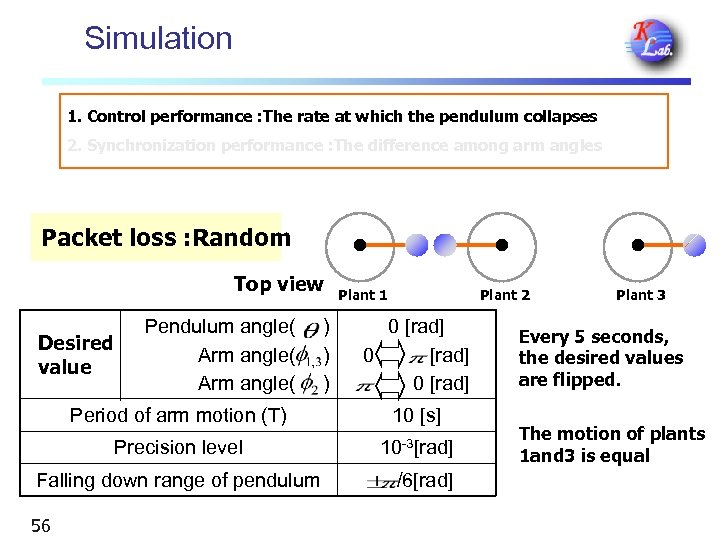
Simulation 1. Control performance : The rate at which the pendulum collapses 2. Synchronization performance : The difference among arm angles Packet loss : Random Top view Desired value Pendulum angle( Arm angle( ) ) ) Plant 1 Plant 2 0 [rad] Period of arm motion (T) 10 [s] Precision level 10 -3[rad] Falling down range of pendulum 56 /6[rad] Plant 3 Every 5 seconds, the desired values are flipped. The motion of plants 1 and 3 is equal
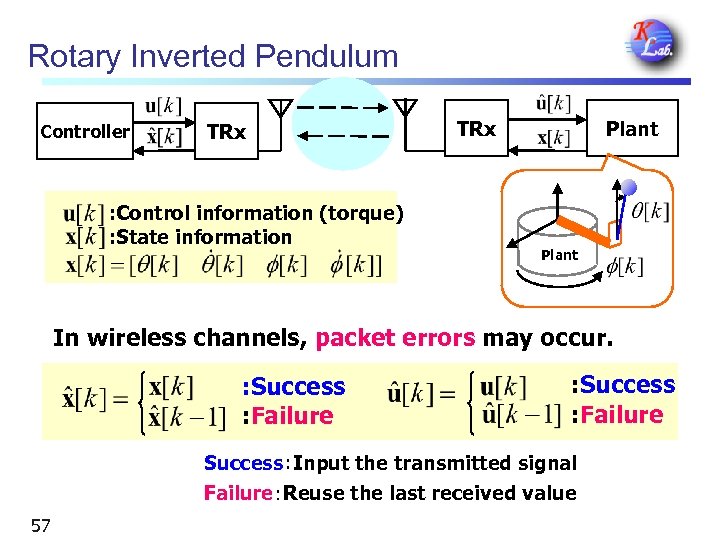
Rotary Inverted Pendulum Controller TRx : Control information (torque) : State information TRx Plant In wireless channels, packet errors may occur. : Success : Failure Success:Input the transmitted signal Failure:Reuse the last received value 57
![Pendulum angle [rad] Pendulum Angle Low packet loss (p=0. 01) Controller Transmission Success Time](https://present5.com/presentation/3098af101653fff9595e6e82e14d22f6/image-58.jpg "Pendulum angle [rad] Pendulum Angle Low packet loss (p=0. 01) Controller Transmission Success Time")
Pendulum angle [rad] Pendulum Angle Low packet loss (p=0. 01) Controller Transmission Success Time [s] Transmission Failure :Packet transmission rate (20 Hz) The pendulum can maintain its upright position. 58 Plant
![Pendulum Angle Pendulum angle [rad] The pendulum is considered to fall down when its](https://present5.com/presentation/3098af101653fff9595e6e82e14d22f6/image-59.jpg "Pendulum Angle Pendulum angle [rad] The pendulum is considered to fall down when its")
Pendulum Angle Pendulum angle [rad] The pendulum is considered to fall down when its angle goes over /6 or below - /6 rad High packet loss (p=0. 2) Controller Plant Transmission Success Time [s] Transmission Failure :Packet transmission rate (20 Hz) Packet errors occur before the pendulum can restore its upright position. 59 The pendulum falls down.
![Pendulum angle [rad] Pendulum Angle High packet loss (p=0. 2) Plant Controller Transmission Success](https://present5.com/presentation/3098af101653fff9595e6e82e14d22f6/image-60.jpg "Pendulum angle [rad] Pendulum Angle High packet loss (p=0. 2) Plant Controller Transmission Success")
Pendulum angle [rad] Pendulum Angle High packet loss (p=0. 2) Plant Controller Transmission Success Time [s] Transmission Failure :Packet transmission rate (50 Hz) If packet transmission rate is high, the pendulum can maintain its upright position. 60
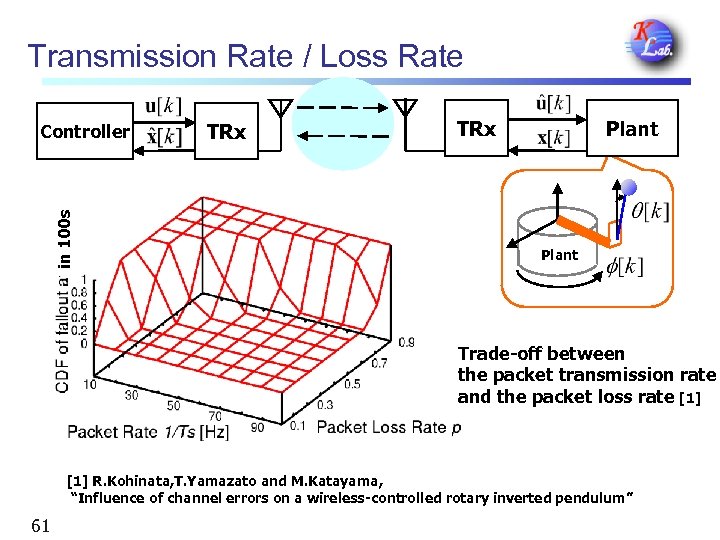
Transmission Rate / Loss Rate in 100 s Controller TRx Plant Trade-off between the packet transmission rate and the packet loss rate [1] R. Kohinata, T. Yamazato and M. Katayama, “Influence of channel errors on a wireless-controlled rotary inverted pendulum” 61
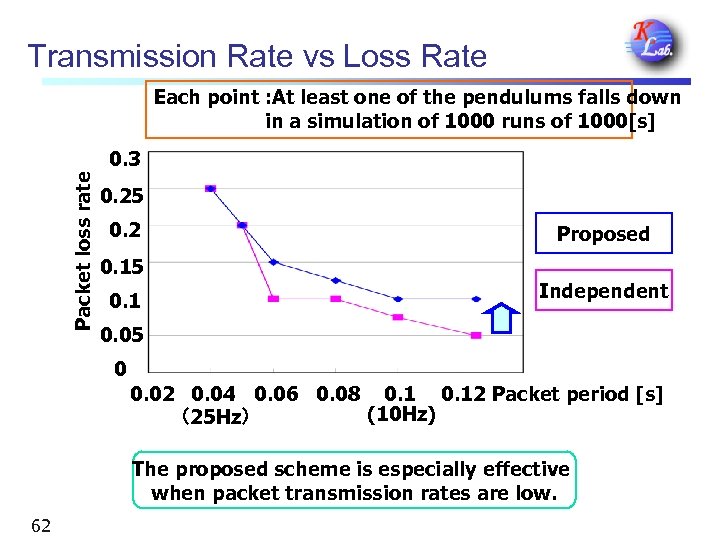
Transmission Rate vs Loss Rate Each point : At least one of the pendulums falls down in a simulation of 1000 runs of 1000[s] Packet loss rate 0. 3 0. 25 0. 2 Proposed 0. 15 0. 1 Independent 0. 05 0 0. 02 0. 04 0. 06 0. 08 0. 12 Packet period [s] (10 Hz) (25 Hz) The proposed scheme is especially effective when packet transmission rates are low. 62
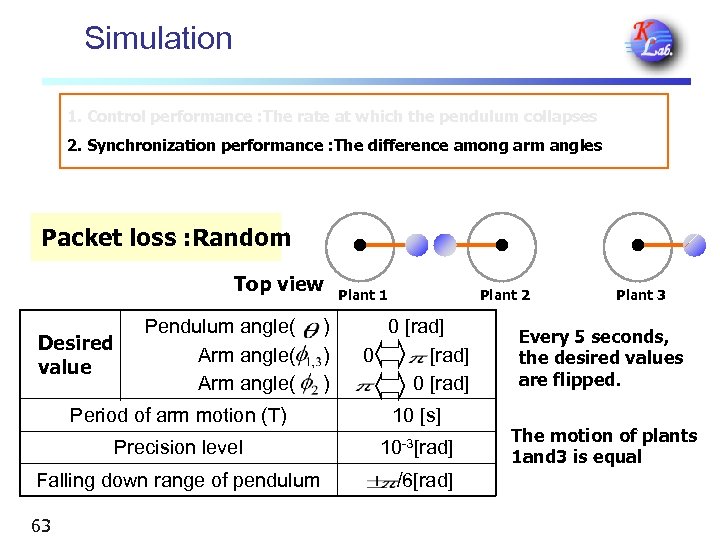
Simulation 1. Control performance : The rate at which the pendulum collapses 2. Synchronization performance : The difference among arm angles Packet loss : Random Top view Desired value Pendulum angle( Arm angle( ) ) ) Plant 1 Plant 2 0 [rad] Period of arm motion (T) 10 [s] Precision level 10 -3[rad] Falling down range of pendulum 63 /6[rad] Plant 3 Every 5 seconds, the desired values are flipped. The motion of plants 1 and 3 is equal
![Arm Angle (no packet loss) Arm angle [rad] Every 5 seconds, the desired values](https://present5.com/presentation/3098af101653fff9595e6e82e14d22f6/image-64.jpg "Arm Angle (no packet loss) Arm angle [rad] Every 5 seconds, the desired values")
Arm Angle (no packet loss) Arm angle [rad] Every 5 seconds, the desired values are flipped. Time [s] 64 Desired value 1 Output 1 Time [s] Desired value 2 Output 2
![Arm angle [rad] Arm Angle (Independent) Packet loss rate : 0. 05 Output 1( )](https://present5.com/presentation/3098af101653fff9595e6e82e14d22f6/image-65.jpg "Arm angle [rad] Arm Angle (Independent) Packet loss rate : 0. 05 Output 1( )")
Arm angle [rad] Arm Angle (Independent) Packet loss rate : 0. 05 Output 1( ) Output 2( ) Output 3( ) 65 Arm angle [rad] Time(s)
![Arm angle [rad] Arm Angle (Proposed) Packet loss rate : 0. 05 Output 1( )](https://present5.com/presentation/3098af101653fff9595e6e82e14d22f6/image-66.jpg "Arm angle [rad] Arm Angle (Proposed) Packet loss rate : 0. 05 Output 1( )")
Arm angle [rad] Arm Angle (Proposed) Packet loss rate : 0. 05 Output 1( ) Output 2( ) Output 3( ) 66 Arm angle [rad] Time(s)
![Arm angle [rad] Output 1 Output 2 Synchronization error of arm angle [rad] Synchronization](https://present5.com/presentation/3098af101653fff9595e6e82e14d22f6/image-67.jpg "Arm angle [rad] Output 1 Output 2 Synchronization error of arm angle [rad] Synchronization")
Arm angle [rad] Output 1 Output 2 Synchronization error of arm angle [rad] Synchronization Error of Arm Angle Time [s] Synchronization error: The difference between the two arm angles 67 Time [s]
![Independent Time [s] Synchronization error of arm angle [rad] Synchronization Error of Arm Angle](https://present5.com/presentation/3098af101653fff9595e6e82e14d22f6/image-68.jpg "Independent Time [s] Synchronization error of arm angle [rad] Synchronization Error of Arm Angle")
Independent Time [s] Synchronization error of arm angle [rad] Synchronization Error of Arm Angle Proposed Time [s] Synchronization error between output 1 and output 2 The proposed scheme reduces the synchronization error. 68
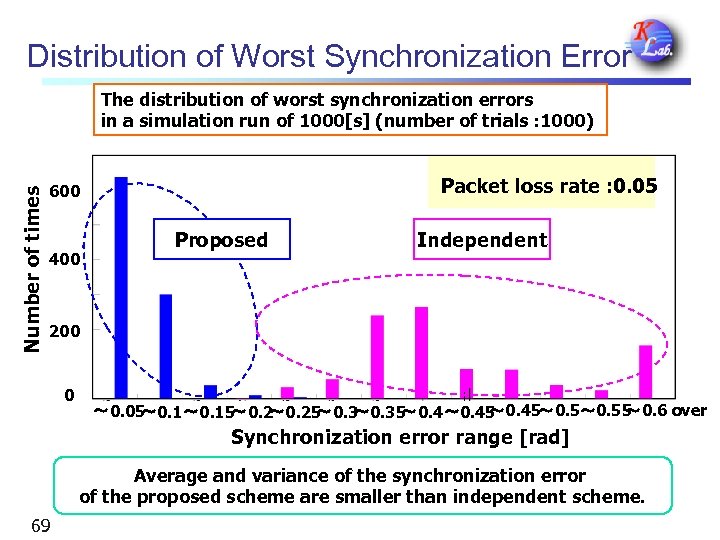
Distribution of Worst Synchronization Error Number of times The distribution of worst synchronization errors in a simulation run of 1000[s] (number of trials : 1000) Packet loss rate : 0. 05 600 400 Proposed Independent 200 0 ~ 0. 45~ 0. 55 ~ 0. 6 over ~ 0. 05 ~ 0. 15~ 0. 25 ~ 0. 35 ~ 0. 45 Synchronization error range [rad] Average and variance of the synchronization error of the proposed scheme are smaller than independent scheme. 69

Synchronization Error for Packet Transmission Rate The average of worst synchronization errors in a simulation run of 1000[s] (number of trials : 1000) Average of worst synchronization error [rad] 1 Packet loss rate : 0. 05 10 -1 Independent Proposed 10 -2 10 -3 10 20 30 40 Packet transmission rate [Hz] The proposed scheme reduces the synchronization error for whole packet transmission rate. 70
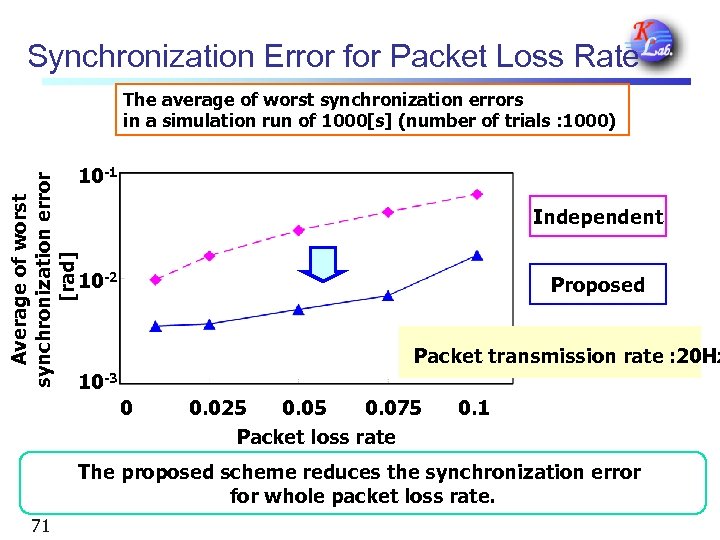
Synchronization Error for Packet Loss Rate The average of worst synchronization errors in a simulation run of 1000[s] (number of trials : 1000) Average of worst synchronization error [rad] 10 -1 Independent 10 -2 Proposed Packet transmission rate : 20 Hz 10 -3 0 0. 025 0. 075 Packet loss rate 0. 1 The proposed scheme reduces the synchronization error for whole packet loss rate. 71
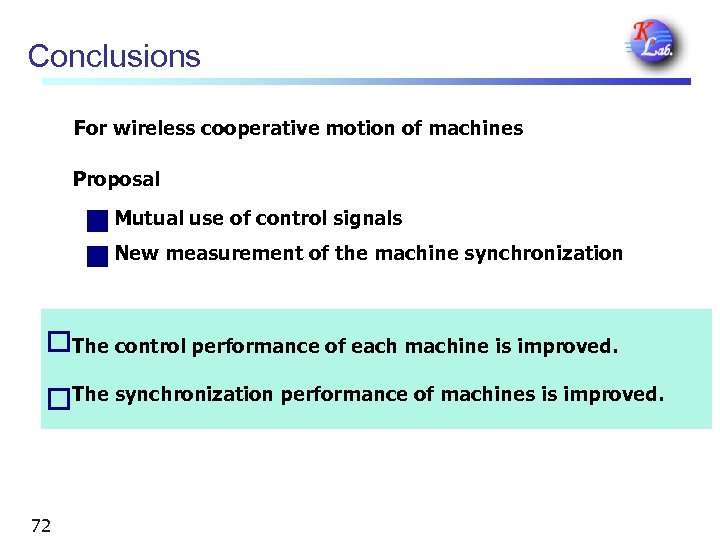
Conclusions For wireless cooperative motion of machines Proposal Mutual use of control signals New measurement of the machine synchronization The control performance of each machine is improved. The synchronization performance of machines is improved. 72
2011年度 RRRC(2011. 06. 17) 電力線通信を用いた回転型倒立振子の制御における 周期定常雑音の影響評価 ○カリソセサル 小林健太郎 岡田啓 片山正昭 名古屋大学

場内の機器の制御通信 場内 多くの通信線が邪魔になる 通信線を一緒にすると 配線とコストが減る
電力線を用いた制御の既存研究例 n パルス幅変調(PWM) を用いて制御されて いるモータの電源線上のフィードバックルー プとしてもPLC を用いることを検討 n N. Ginot, M. A. Mannah, C. Batard, and M. Machmoum, “Application of power line communication for data transmission over pwm network, ” IEEE Transactions on Smart Grid, vol. 1, pp. 178– 185, Sept. 2010. n 電力線通信の雑音が制御品質に与える評 価が明らかされてない
![電圧[V] 電力線通信路の雑音(波形の例) 周期定常雑音 (瞬時電力が周期 的に変化する) TAC/2 平均電力: 1. 00 商用電源 時間[ms] ※[1]より 雑音の周期 TAC/2=1/120秒](https://present5.com/presentation/3098af101653fff9595e6e82e14d22f6/image-76.jpg "電圧[V] 電力線通信路の雑音(波形の例) 周期定常雑音 (瞬時電力が周期 的に変化する) TAC/2 平均電力: 1. 00 商用電源 時間[ms] ※[1]より 雑音の周期 TAC/2=1/120秒")
電圧[V] 電力線通信路の雑音(波形の例) 周期定常雑音 (瞬時電力が周期 的に変化する) TAC/2 平均電力: 1. 00 商用電源 時間[ms] ※[1]より 雑音の周期 TAC/2=1/120秒 ※[1] M. Katayama, T. Yamazato, H. Okada, “A Mathematical Model of Noise in Narrowband Power-Line Communication Systems, ” IEEE Journal on Selected Areas in Communications, vol. 24, No.
![電圧[V] 定常雑音波形の例 平均電力: 1. 00 時間[ms]](https://present5.com/presentation/3098af101653fff9595e6e82e14d22f6/image-77.jpg "電圧[V] 定常雑音波形の例 平均電力: 1. 00 時間[ms]")
電圧[V] 定常雑音波形の例 平均電力: 1. 00 時間[ms]
目的 電力線通信を用いたフィードバック制御システム (の制御品質)に対する 雑音の周期定常性の影響を明らかにする
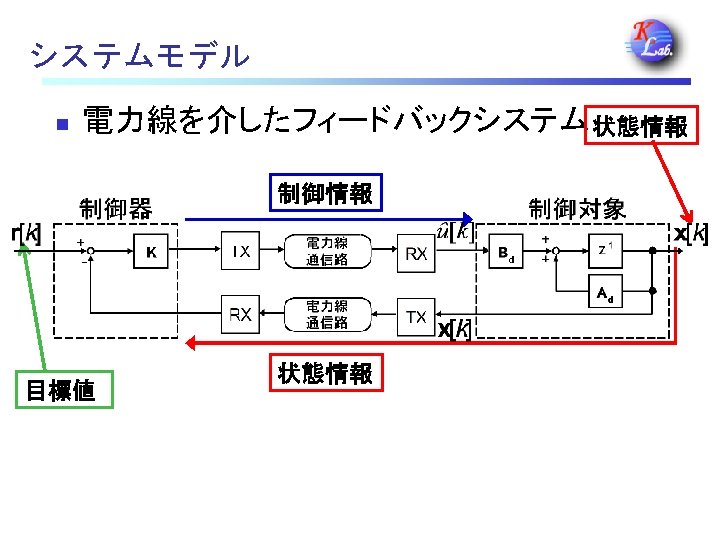
システムモデル n 電力線を介したフィードバックシステム 状態情報 制御情報 目標値 状態情報
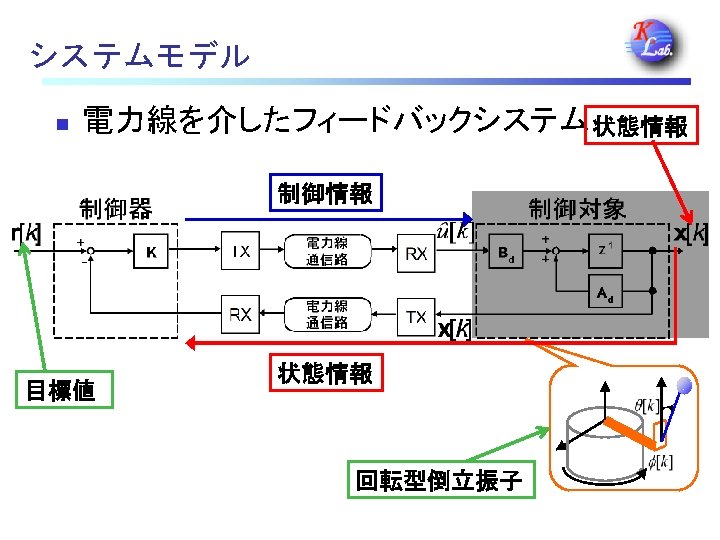
システムモデル n 電力線を介したフィードバックシステム 状態情報 制御情報 目標値 状態情報 回転型倒立振子
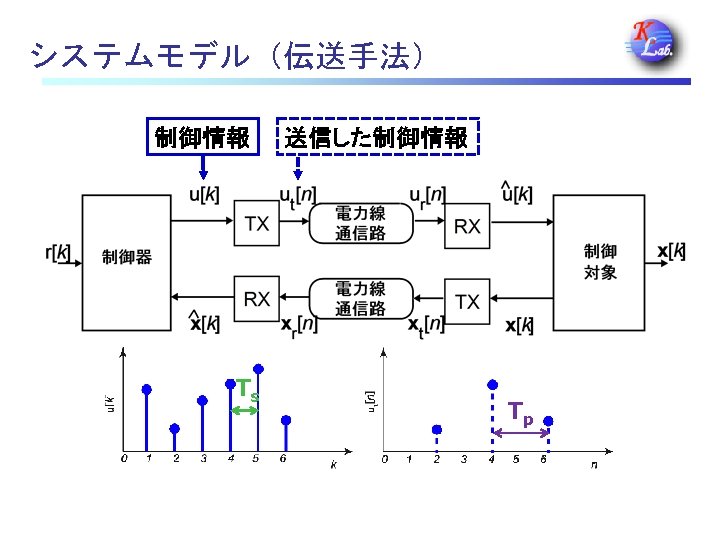
システムモデル(伝送手法) 制御情報 Ts 送信した制御情報 Tp
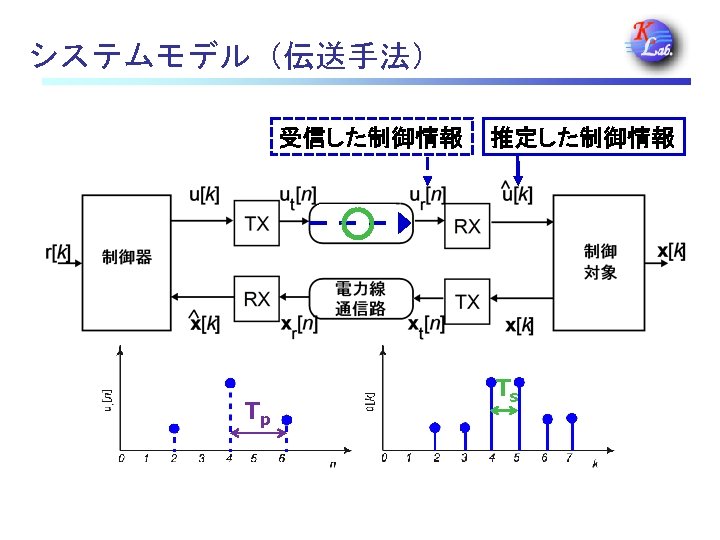
システムモデル(伝送手法) 受信した制御情報 Tp 推定した制御情報 Ts
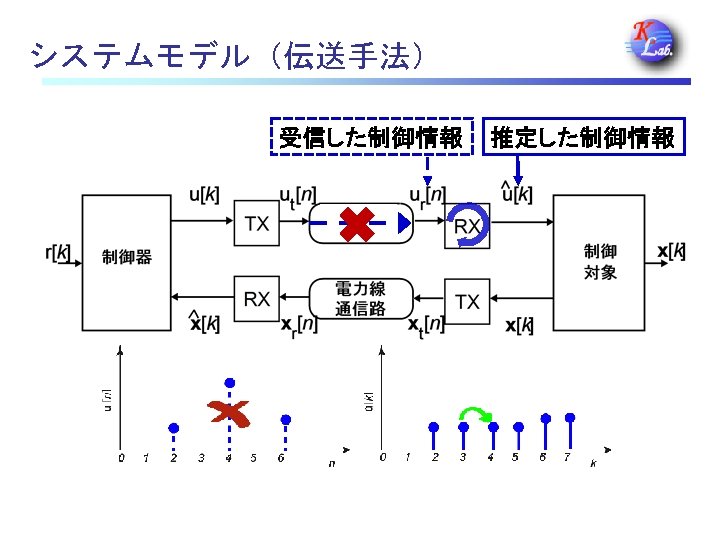
システムモデル(伝送手法) 受信した制御情報 推定した制御情報
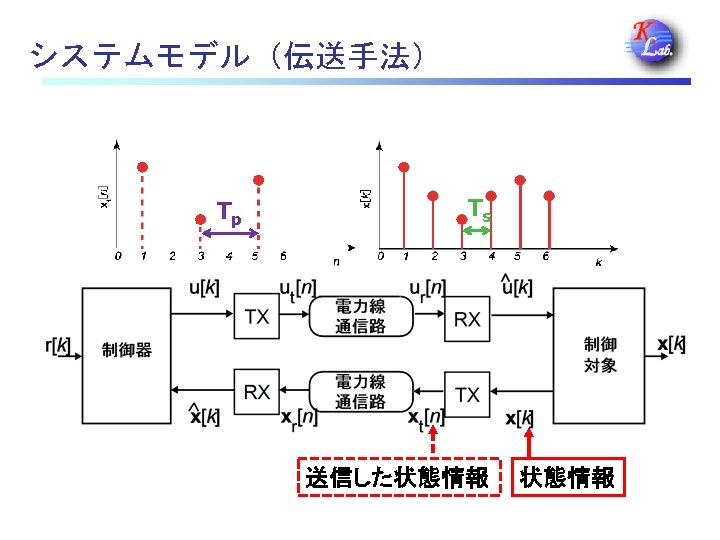
システムモデル(伝送手法) Tp Ts 送信した状態情報
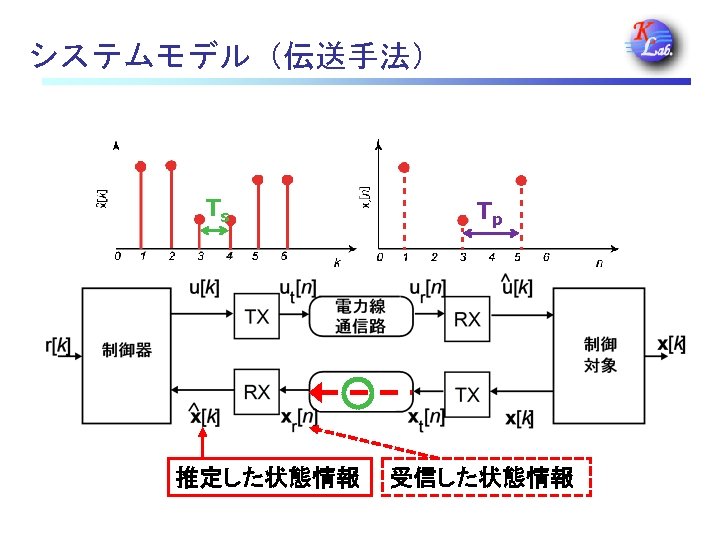
システムモデル(伝送手法) Ts 推定した状態情報 Tp 受信した状態情報
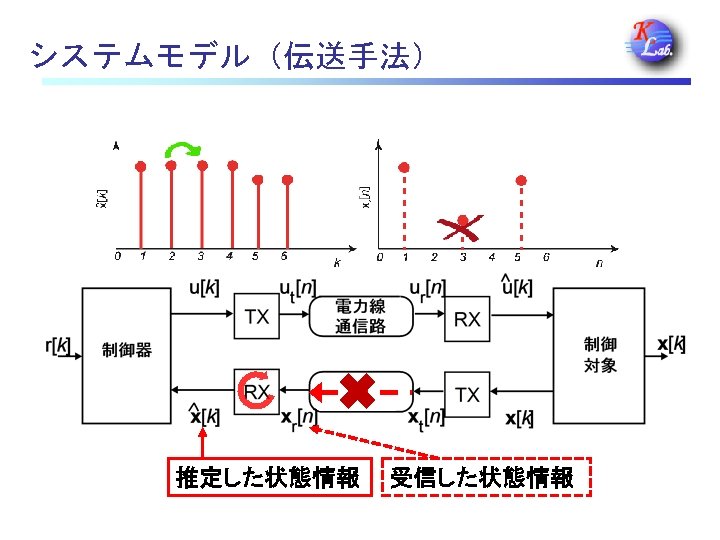
システムモデル(伝送手法) 推定した状態情報 受信した状態情報
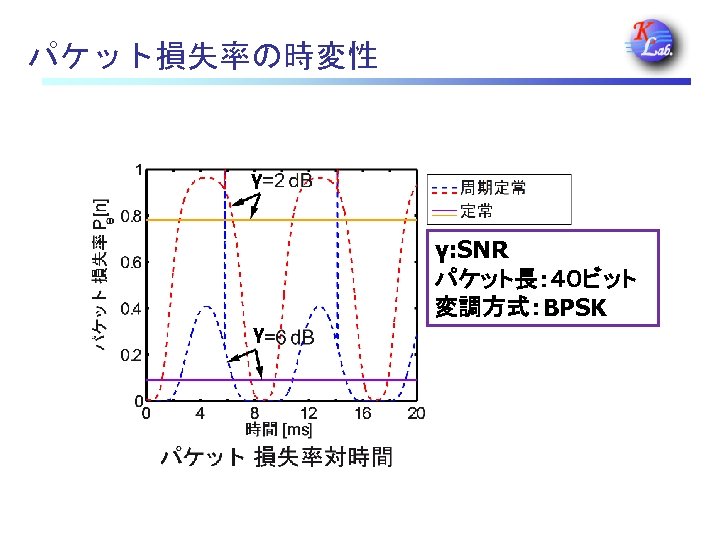
パケット損失率の時変性 γ γ: SNR パケット長:40ビット 変調方式:BPSK γ
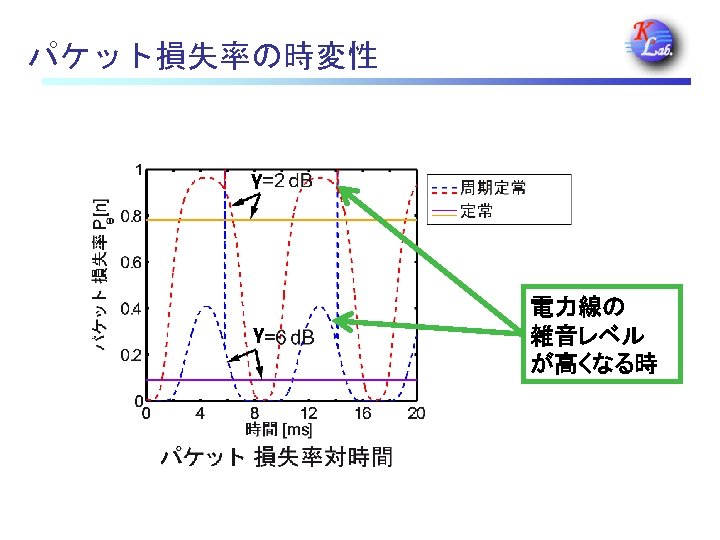
パケット損失率の時変性 γ γ 電力線の 雑音レベル が高くなる時
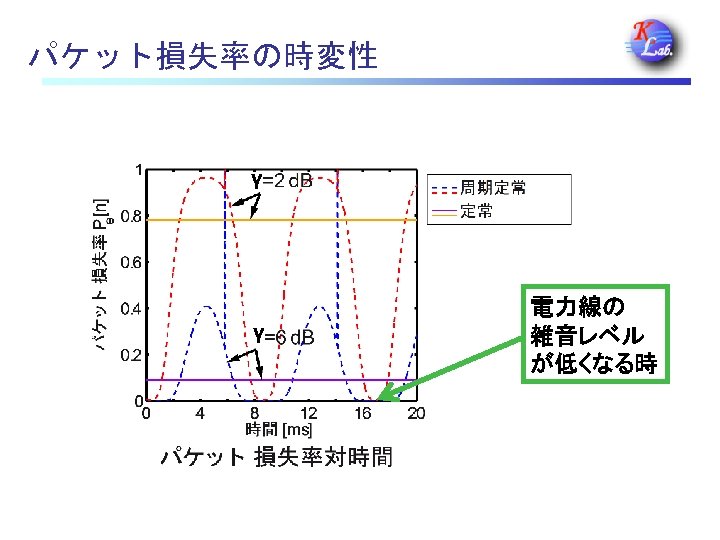
パケット損失率の時変性 γ γ 電力線の 雑音レベル が低くなる時
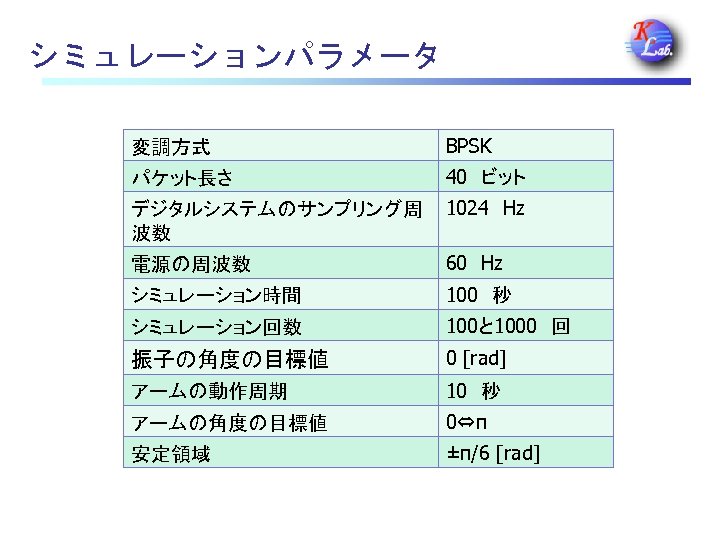
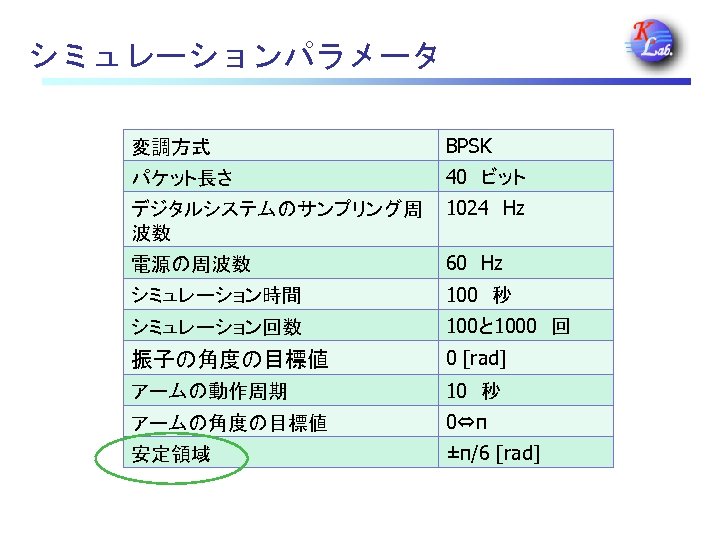
シミュレーションパラメータ 変調方式 BPSK パケット長さ 40 ビット デジタルシステムのサンプリング周 波数 1024 Hz 電源の周波数 60 Hz シミュレーション時間 100 秒 シミュレーション回数 100と 1000 回 振子の角度の目標値 0 [rad] アームの動作周期 10 秒 アームの角度の目標値 0⇔π 安定領域 ±π/6 [rad]
シミュレーションパラメータ 変調方式 BPSK パケット長さ 40 ビット デジタルシステムのサンプリング周 波数 1024 Hz 電源の周波数 60 Hz シミュレーション時間 100 秒 シミュレーション回数 100と 1000 回 振子の角度の目標値 0 [rad] アームの動作周期 10 秒 アームの角度の目標値 0⇔π 安定領域 ±π/6 [rad]
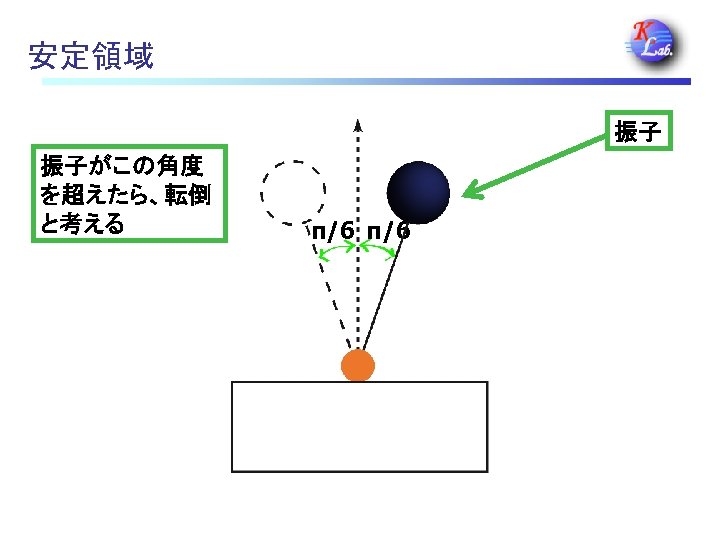
安定領域 振子 振子がこの角度 を超えたら、転倒 と考える π/6
![回転倒立型振子のパラメーター 振子の重りの質量 0. 004 [kg] 振り上げ棒の質量 0. 025 [kg] 振り上げ棒の長さ 0. 241 [m] アームの長さ](https://present5.com/presentation/3098af101653fff9595e6e82e14d22f6/image-93.jpg "回転倒立型振子のパラメーター 振子の重りの質量 0. 004 [kg] 振り上げ棒の質量 0. 025 [kg] 振り上げ棒の長さ 0. 241 [m] アームの長さ")
回転倒立型振子のパラメーター 振子の重りの質量 0. 004 [kg] 振り上げ棒の質量 0. 025 [kg] 振り上げ棒の長さ 0. 241 [m] アームの長さ 0. 152 [m] アームの慣性モーメント 0. 00121 [kgm 2] 重力加速度 9. 81 [m/s 2]
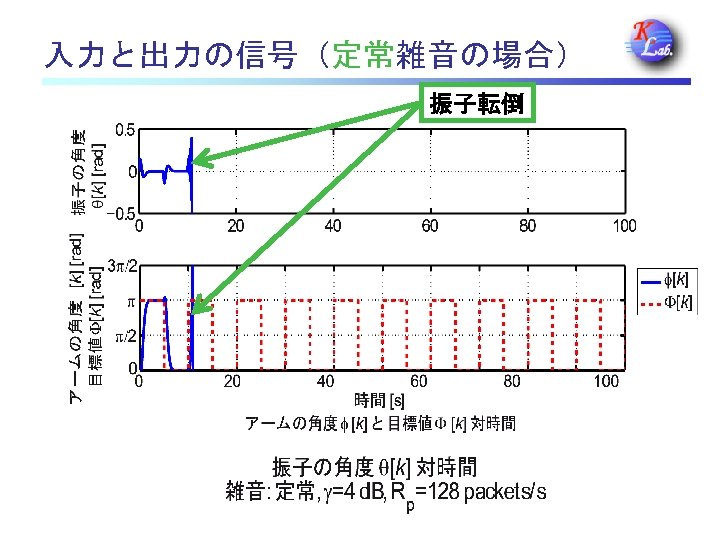
入力と出力の信号(定常雑音の場合) 振子転倒
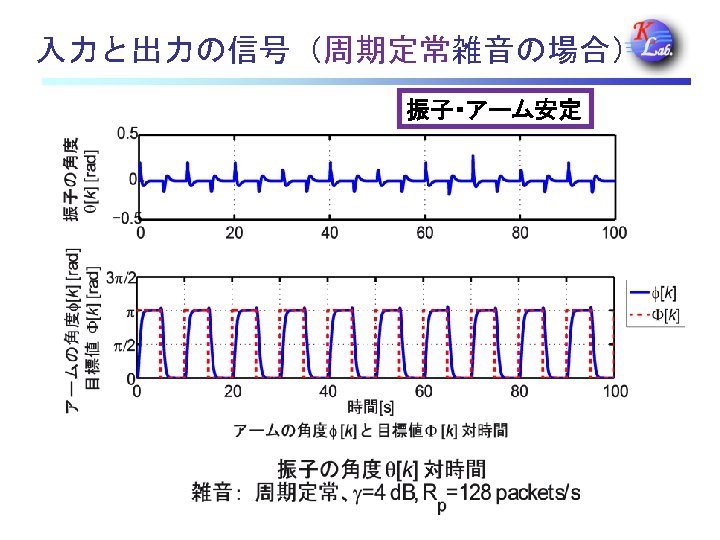
入力と出力の信号(周期定常雑音の場合) 振子・アーム安定

平均SNRに対する制御品質の評価(定常雑音の場合) 雑音:定常
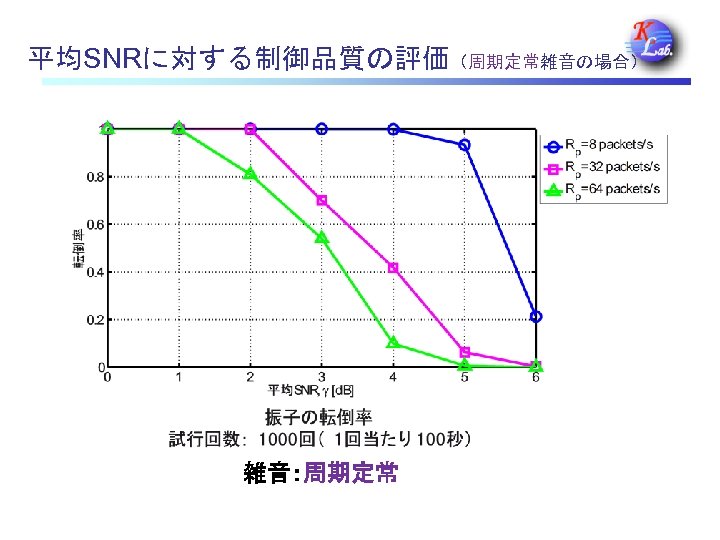
平均SNRに対する制御品質の評価(周期定常雑音の場合) 雑音:周期定常
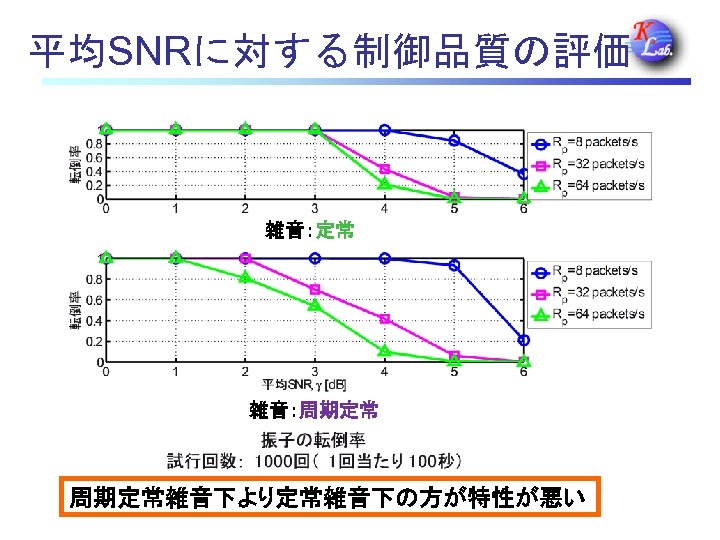
平均SNRに対する制御品質の評価 雑音:定常 雑音:周期定常雑音下より定常雑音下の方が特性が悪い
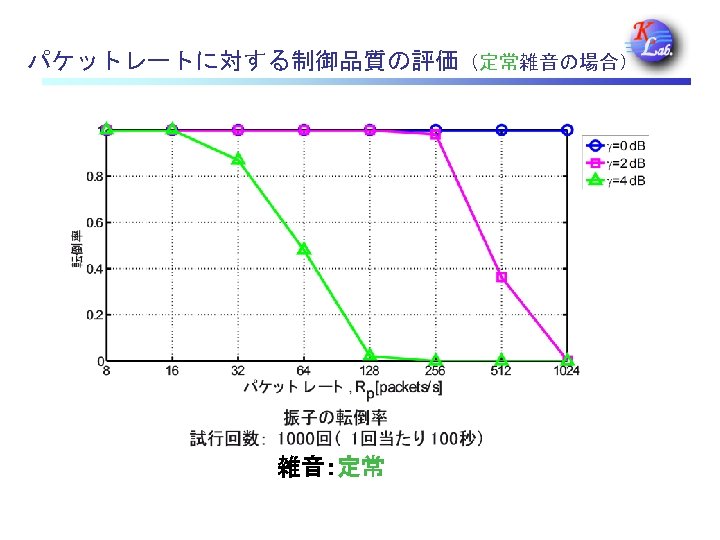
パケットレートに対する制御品質の評価(定常雑音の場合) 雑音:定常
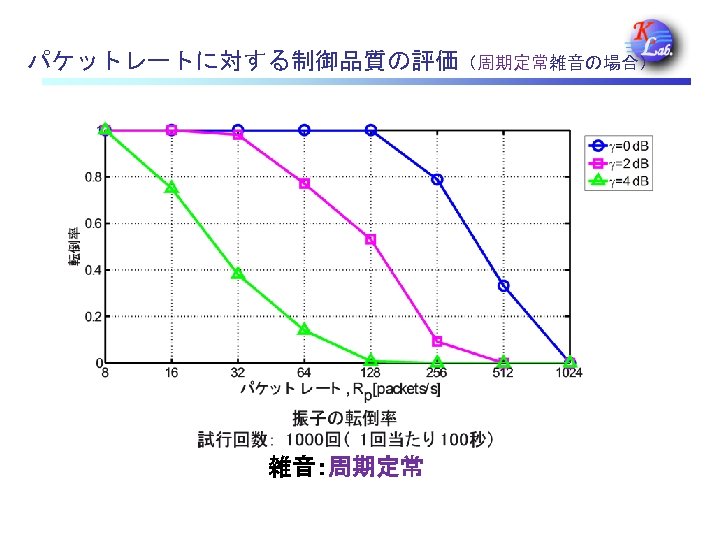
パケットレートに対する制御品質の評価(周期定常雑音の場合) 雑音:周期定常
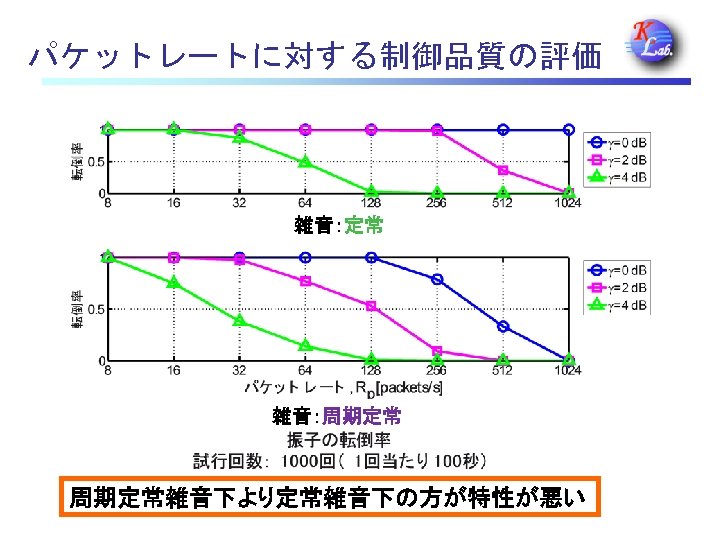
パケットレートに対する制御品質の評価 雑音:定常 雑音:周期定常雑音下より定常雑音下の方が特性が悪い
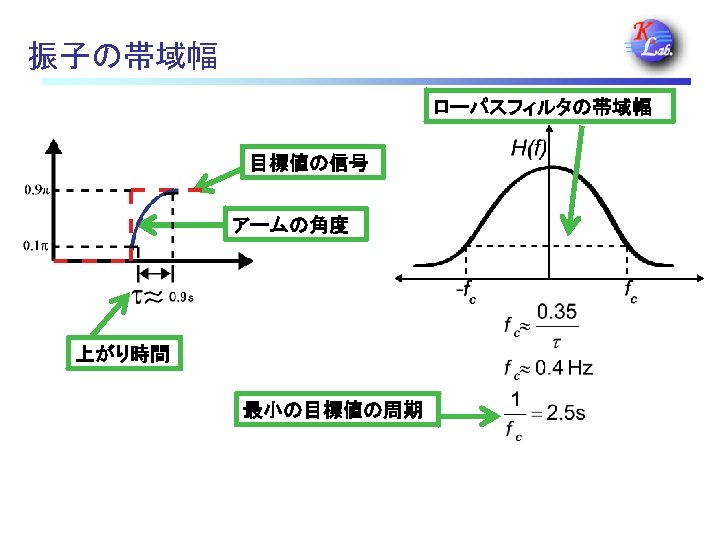
振子の帯域幅 ローパスフィルタの帯域幅 目標値の信号 アームの角度 上がり時間 最小の目標値の周期
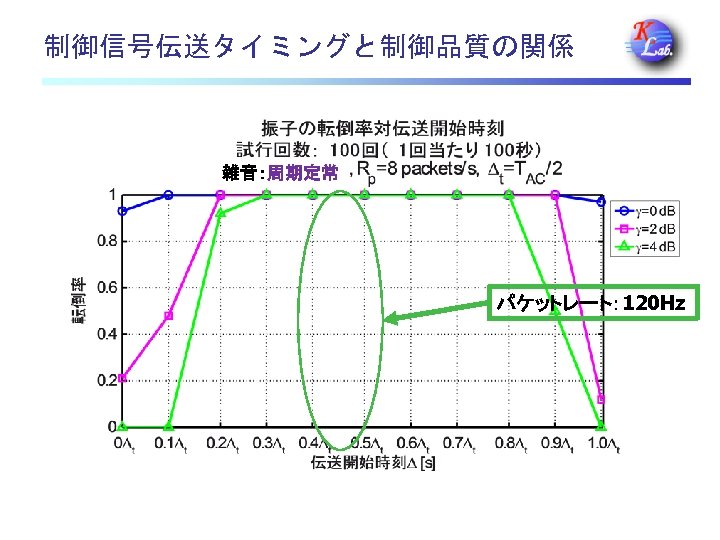
制御信号伝送タイミングと制御品質の関係 雑音:周期定常 パケットレート: 120 Hz
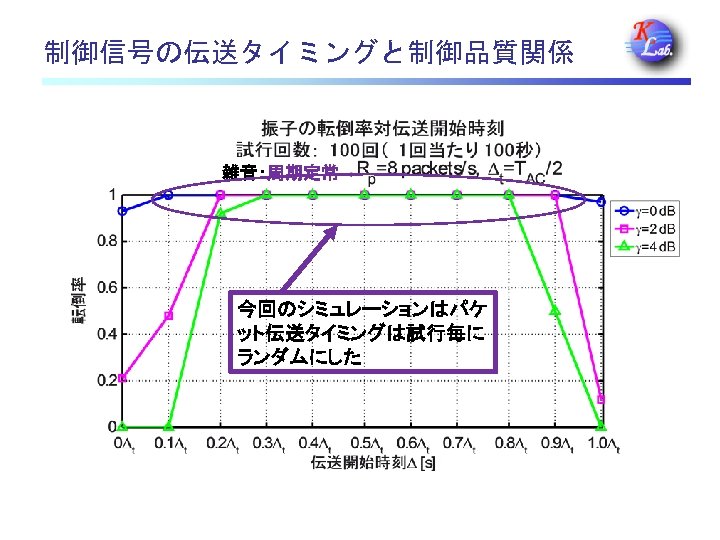
制御信号の伝送タイミングと制御品質関係 雑音:周期定常 今回のシミュレーションはパケ ット伝送タイミングは試行毎に ランダムにした
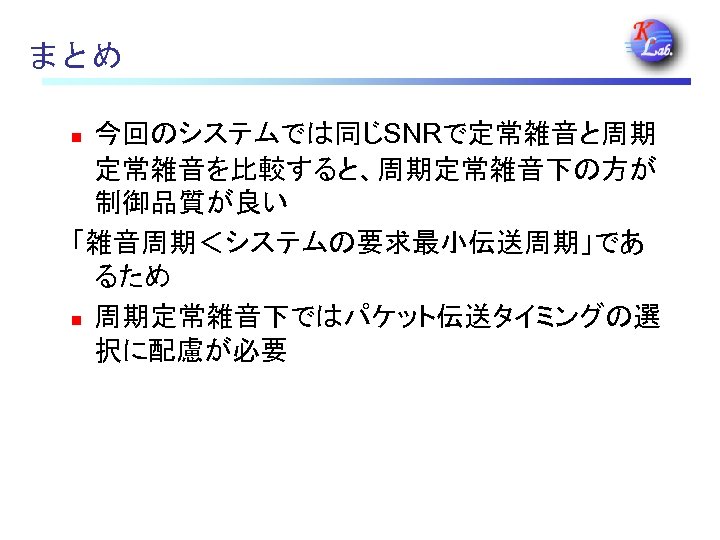
まとめ 今回のシステムでは同じSNRで定常雑音と周期 定常雑音を比較すると、周期定常雑音下の方が 制御品質が良い 「雑音周期<システムの要求最小伝送周期」であ るため n 周期定常雑音下ではパケット伝送タイミングの選 択に配慮が必要 n
Скачать презентацию 片山研究室の無線制御研究 最近の学会発表より 名古屋大学 エコトピア科学研究所 情報 通信科学研究部門 大学院 学研究科 電子情報システム専攻 兼担
3098af101653fff9595e6e82e14d22f6.ppt