 Скачать презентацию 無線通訊技術與法規 報告人 許錫蘭 91 12 24 財團法人電信技術中心 中華民國九十三年十一月十 二日
9bcda4178795c2f372f0b8eac9d12712.ppt
- Количество слайдов: 177




無線通訊技術與法規 報告人:許錫蘭 91. 12. 24. ❧財團法人電信技術中心 ❧中華民國九十三年十一月十 二日 電信技術中心計畫簡報
Outline n 802. 11 a/b/g v 802. 11 Global Regulatory Status v. Wireless LAN Regulations in Taiwan v. Regulatory and testing issues for 802. 11 in the 2. 4/5 GHz band n RFID v. Overview of Radio Frequency Identification (RFID) v. RFID International Regulatory Requirements 2
802. 11 Global Regulatory Status (802. 11 a/b/g and Blue. Tooth) 91. 12. 24. 電信技術中心計畫簡報
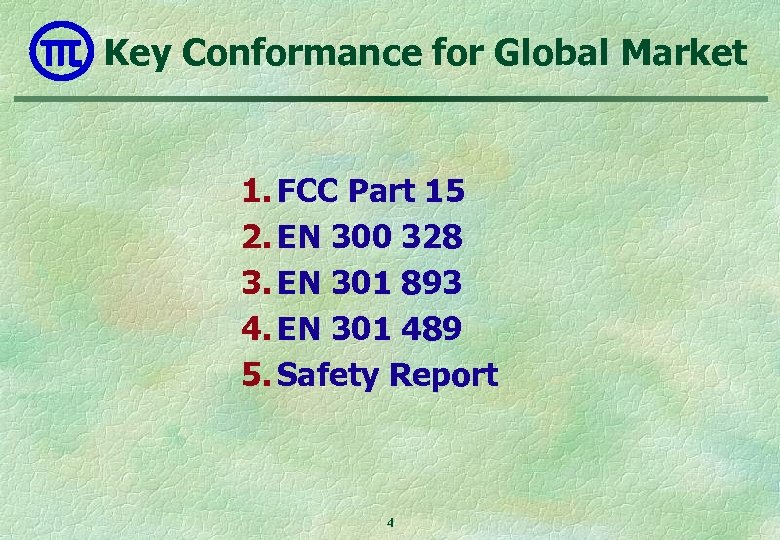
Key Conformance for Global Market 1. FCC Part 15 2. EN 300 328 3. EN 301 893 4. EN 301 489 5. Safety Report 4
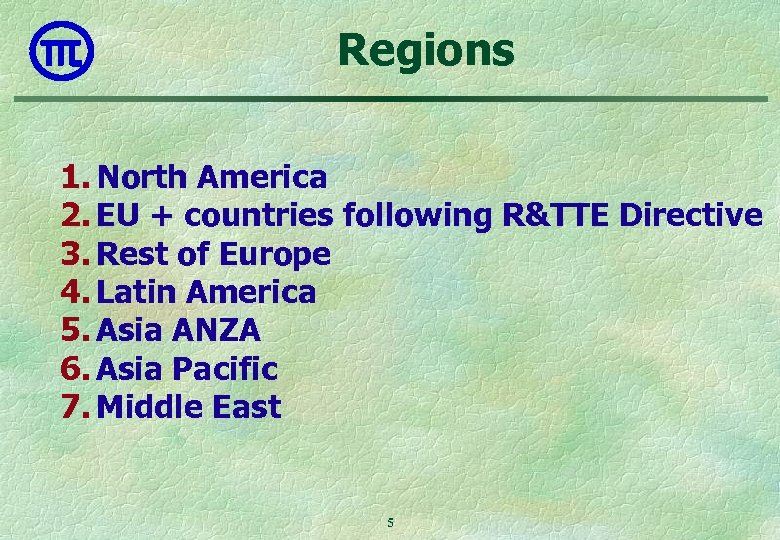
Regions 1. North America 2. EU + countries following R&TTE Directive 3. Rest of Europe 4. Latin America 5. Asia ANZA 6. Asia Pacific 7. Middle East 5
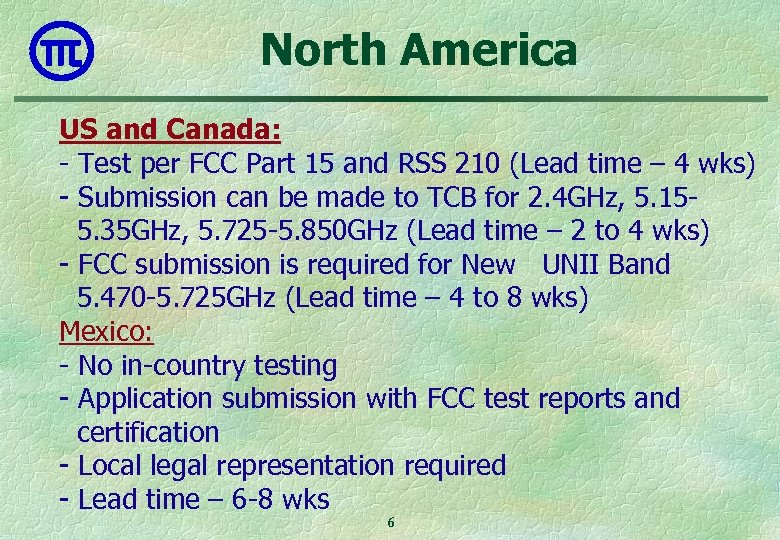
North America US and Canada: - Test per FCC Part 15 and RSS 210 (Lead time – 4 wks) - Submission can be made to TCB for 2. 4 GHz, 5. 15 5. 35 GHz, 5. 725 -5. 850 GHz (Lead time – 2 to 4 wks) - FCC submission is required for New UNII Band 5. 470 -5. 725 GHz (Lead time – 4 to 8 wks) Mexico: - No in-country testing - Application submission with FCC test reports and certification - Local legal representation required - Lead time – 6 -8 wks 6
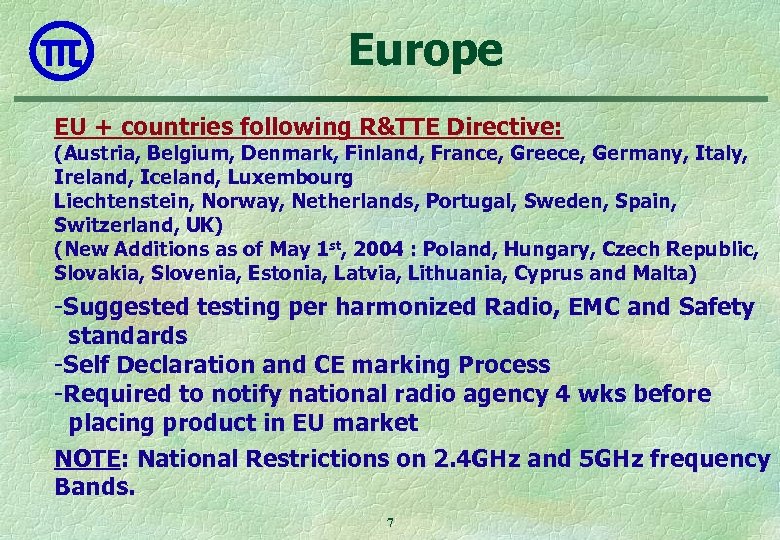
Europe EU + countries following R&TTE Directive: (Austria, Belgium, Denmark, Finland, France, Greece, Germany, Italy, Ireland, Iceland, Luxembourg Liechtenstein, Norway, Netherlands, Portugal, Sweden, Spain, Switzerland, UK) (New Additions as of May 1 st, 2004 : Poland, Hungary, Czech Republic, Slovakia, Slovenia, Estonia, Latvia, Lithuania, Cyprus and Malta) -Suggested testing per harmonized Radio, EMC and Safety standards -Self Declaration and CE marking Process -Required to notify national radio agency 4 wks before placing product in EU market NOTE: National Restrictions on 2. 4 GHz and 5 GHz frequency Bands. 7
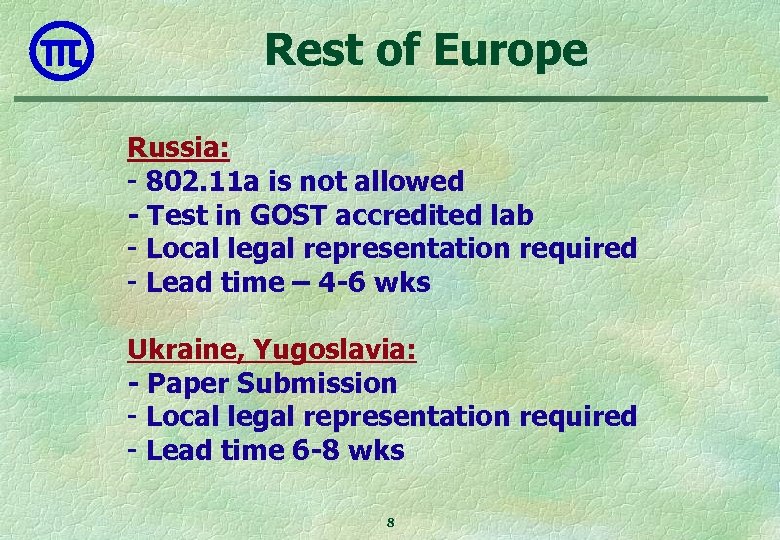
Rest of Europe Russia: - 802. 11 a is not allowed - Test in GOST accredited lab - Local legal representation required - Lead time – 4 -6 wks Ukraine, Yugoslavia: - Paper Submission - Local legal representation required - Lead time 6 -8 wks 8
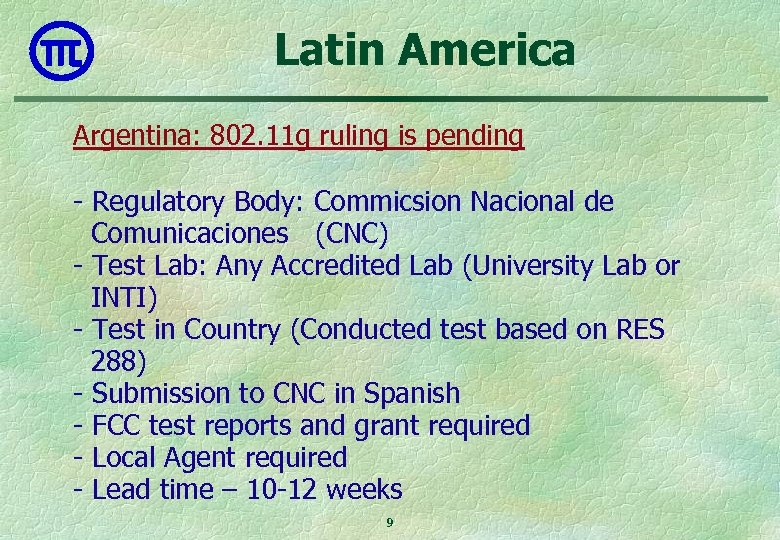
Latin America Argentina: 802. 11 g ruling is pending - Regulatory Body: Commicsion Nacional de Comunicaciones (CNC) - Test Lab: Any Accredited Lab (University Lab or INTI) - Test in Country (Conducted test based on RES 288) - Submission to CNC in Spanish - FCC test reports and grant required - Local Agent required - Lead time – 10 -12 weeks 9
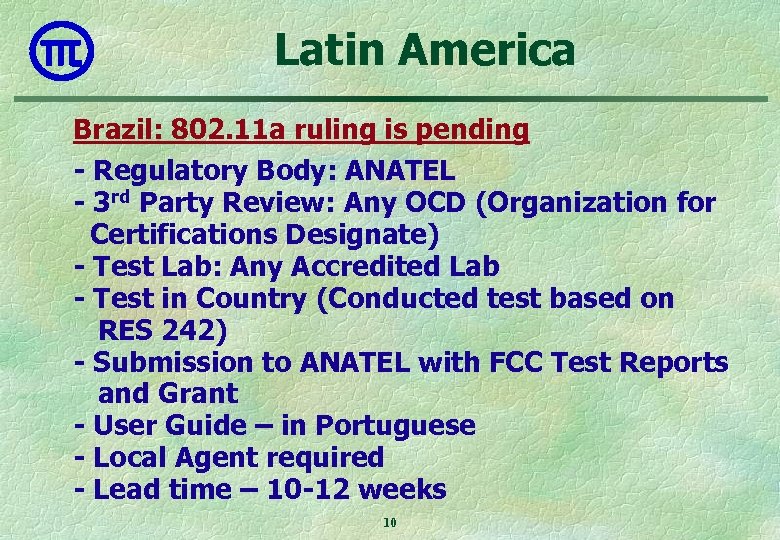
Latin America Brazil: 802. 11 a ruling is pending - Regulatory Body: ANATEL - 3 rd Party Review: Any OCD (Organization for Certifications Designate) - Test Lab: Any Accredited Lab - Test in Country (Conducted test based on RES 242) - Submission to ANATEL with FCC Test Reports and Grant - User Guide – in Portuguese - Local Agent required - Lead time – 10 -12 weeks 10
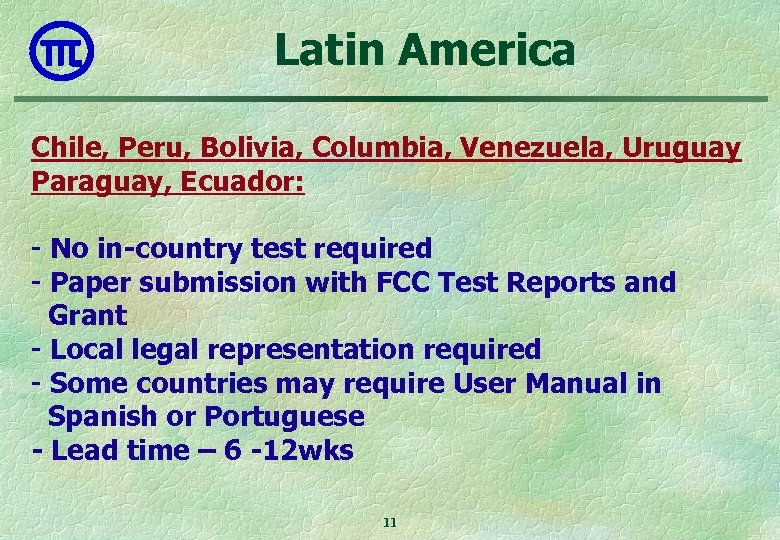
Latin America Chile, Peru, Bolivia, Columbia, Venezuela, Uruguay Paraguay, Ecuador: - No in-country test required - Paper submission with FCC Test Reports and Grant - Local legal representation required - Some countries may require User Manual in Spanish or Portuguese - Lead time – 6 -12 wks 11

Asia ANZA Australia and New Zealand: - Supplier Declaration of Conformity Process - Local legal presence required - Lead time – 2 to 4 days 12
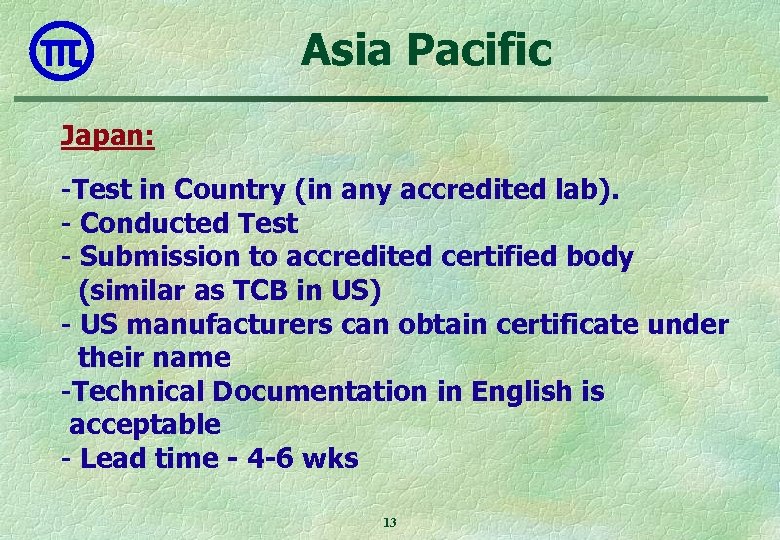
Asia Pacific Japan: -Test in Country (in any accredited lab). - Conducted Test - Submission to accredited certified body (similar as TCB in US) - US manufacturers can obtain certificate under their name -Technical Documentation in English is acceptable - Lead time - 4 -6 wks 13
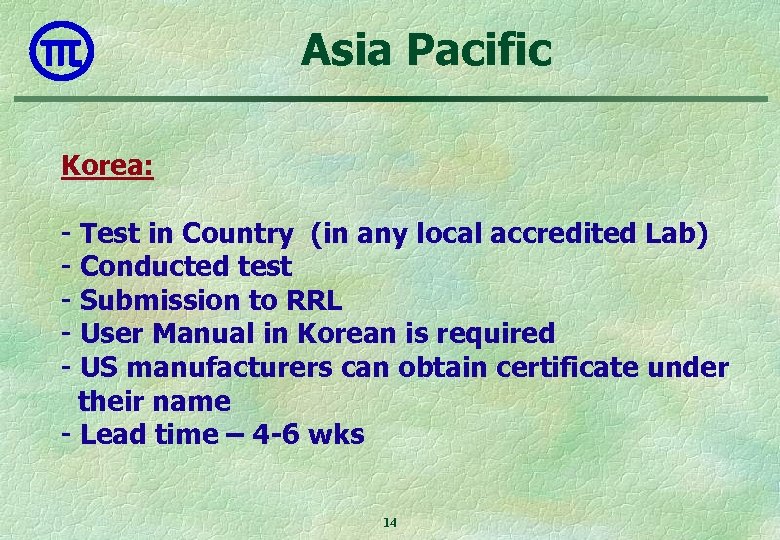
Asia Pacific Korea: - Test in Country (in any local accredited Lab) - Conducted test - Submission to RRL - User Manual in Korean is required - US manufacturers can obtain certificate under their name - Lead time – 4 -6 wks 14
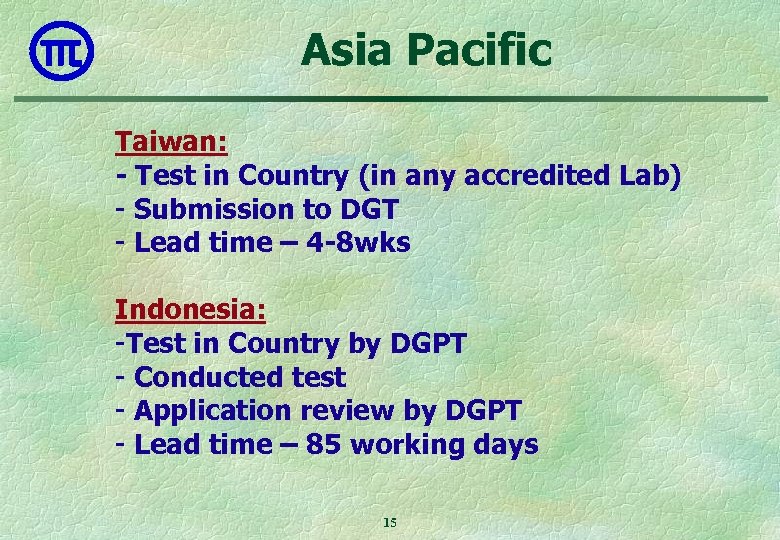
Asia Pacific Taiwan: - Test in Country (in any accredited Lab) - Submission to DGT - Lead time – 4 -8 wks Indonesia: -Test in Country by DGPT - Conducted test - Application review by DGPT - Lead time – 85 working days 15
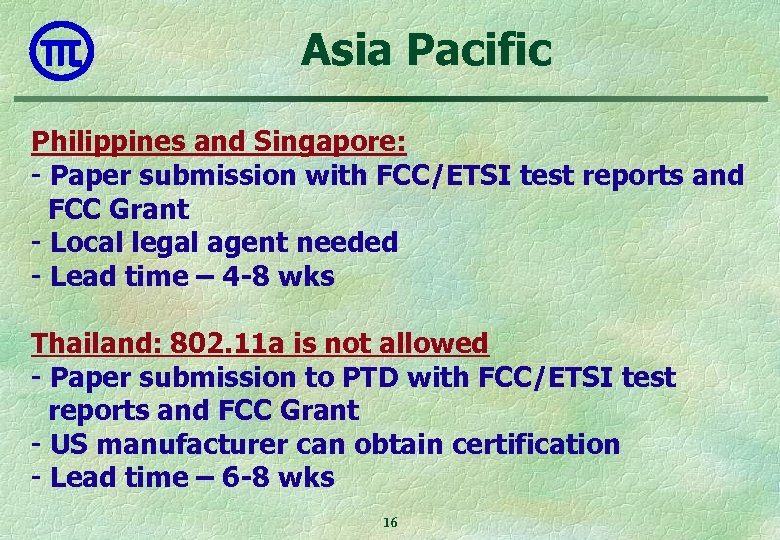
Asia Pacific Philippines and Singapore: - Paper submission with FCC/ETSI test reports and FCC Grant - Local legal agent needed - Lead time – 4 -8 wks Thailand: 802. 11 a is not allowed - Paper submission to PTD with FCC/ETSI test reports and FCC Grant - US manufacturer can obtain certification - Lead time – 6 -8 wks 16
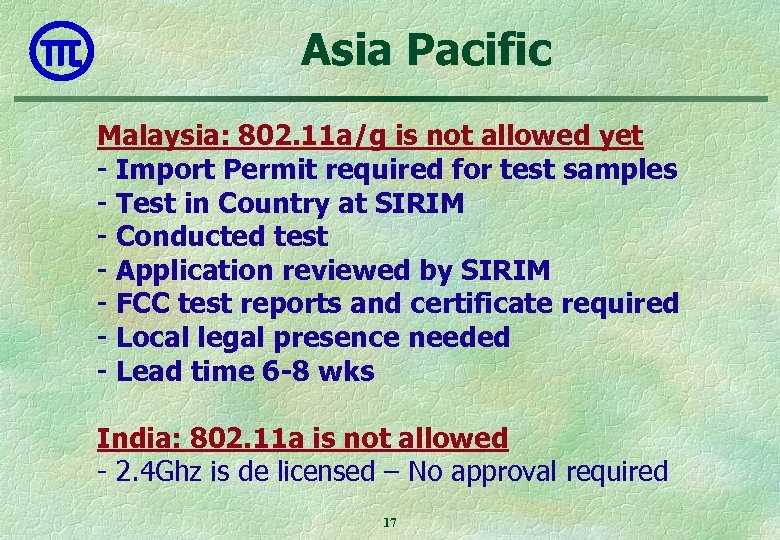
Asia Pacific Malaysia: 802. 11 a/g is not allowed yet - Import Permit required for test samples - Test in Country at SIRIM - Conducted test - Application reviewed by SIRIM - FCC test reports and certificate required - Local legal presence needed - Lead time 6 -8 wks India: 802. 11 a is not allowed - 2. 4 Ghz is de licensed – No approval required 17
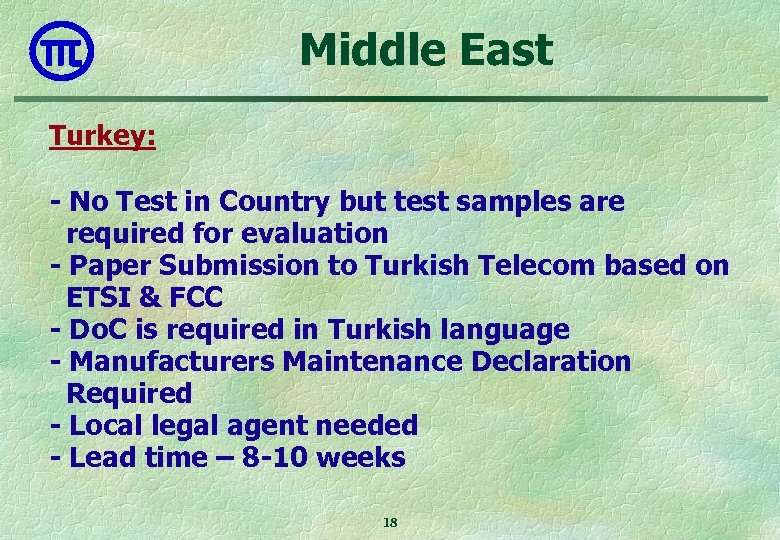
Middle East Turkey: - No Test in Country but test samples are required for evaluation - Paper Submission to Turkish Telecom based on ETSI & FCC - Do. C is required in Turkish language - Manufacturers Maintenance Declaration Required - Local legal agent needed - Lead time – 8 -10 weeks 18
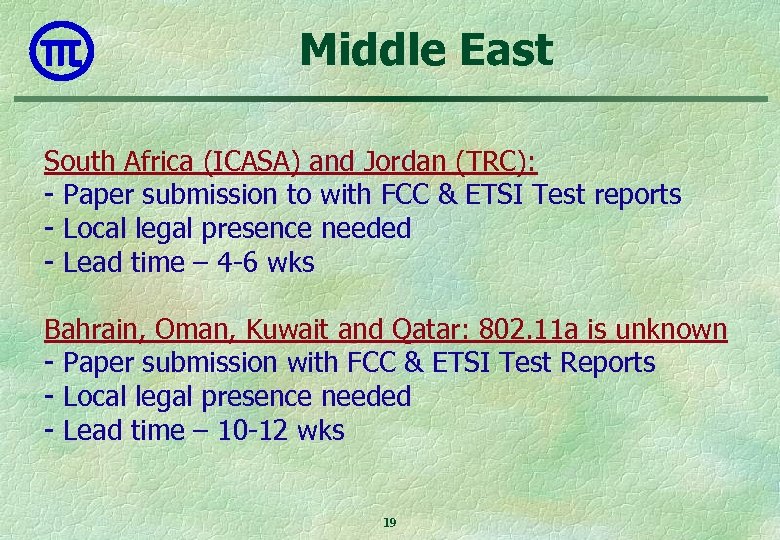
Middle East South Africa (ICASA) and Jordan (TRC): - Paper submission to with FCC & ETSI Test reports - Local legal presence needed - Lead time – 4 -6 wks Bahrain, Oman, Kuwait and Qatar: 802. 11 a is unknown - Paper submission with FCC & ETSI Test Reports - Local legal presence needed - Lead time – 10 -12 wks 19
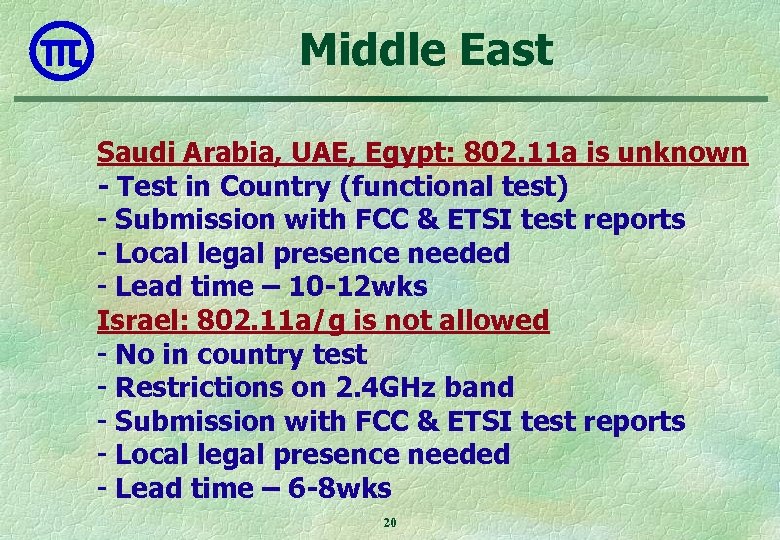
Middle East Saudi Arabia, UAE, Egypt: 802. 11 a is unknown - Test in Country (functional test) - Submission with FCC & ETSI test reports - Local legal presence needed - Lead time – 10 -12 wks Israel: 802. 11 a/g is not allowed - No in country test - Restrictions on 2. 4 GHz band - Submission with FCC & ETSI test reports - Local legal presence needed - Lead time – 6 -8 wks 20
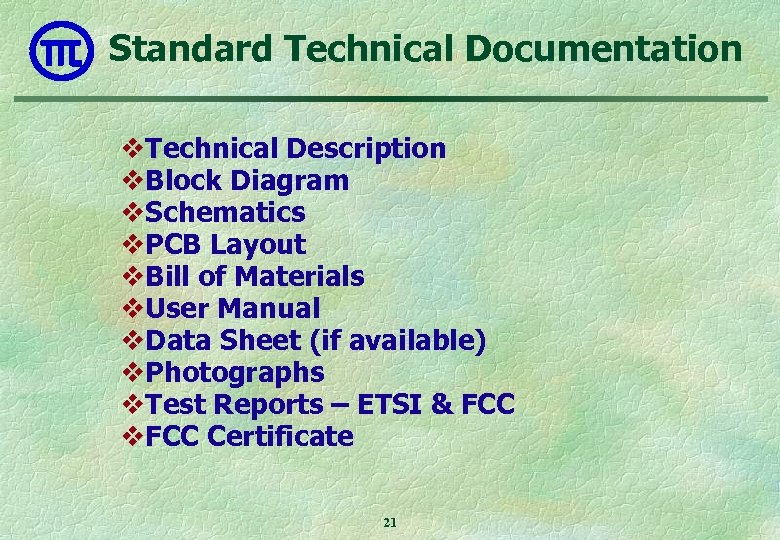
Standard Technical Documentation v. Technical Description v. Block Diagram v. Schematics v. PCB Layout v. Bill of Materials v. User Manual v. Data Sheet (if available) v. Photographs v. Test Reports – ETSI & FCC v. FCC Certificate 21
Wireless LAN Regulations in Taiwan 91. 12. 24. 電信技術中心計畫簡報
Wireless LAN Regulations v On June 5, 2002, DGT announced “Interim Administrative Guidelines on 2. 4 GHz and 5 GHz WLAN”. v Per stipulation, DGT will review WLAN market development and revise the interim guidelines after one year trial. 23
Revised Administrative Guidelines v DGT revised “Administrative Guidelines on 2. 4 GHz and 5 GHz WLAN” and promulgated on July 11, 2003. v Major revision: 1. Abolish the category classification of indoor/out-door usage for Public WLAN. 2. All of the Type I and Type II operators may deploy PWLAN, but shall notify to and register with the DGT in advance. 24
Revised Administrative Guidelines 3. Businesses with attached provision of WLAN, e. g. coffee shops, restaurants, hotels, airports and etc. , which are not involved in the offering of telecom services, need not apply for licenses. 4. For consumer protection, operators shall: Clearly inform consumers of the fact that PWLAN have a characteristic of having to endure interference. notify its prices for PWLAN services to the DGT in advance and the prices to be published in the public. 25
Regulatory Principles of Guidelines v. Unlicensed Band No Frequency Fee at present. v. WLAN equipment used shall be subject to type approval. v. No regulatory restriction on WLAN usage for non-profit purposes. 26
Regulatory Principles of Guidelines v Provision of PWLAN shall possess a license or permit. v All of the Type I and Type II operator may deploy PWLAN to offer telecom services subject to registration with DGT before the commencement of the provision of the service. v To deploy WLAN access equipment such as access points etc. and their extension networks shall obey relative regulations. 27
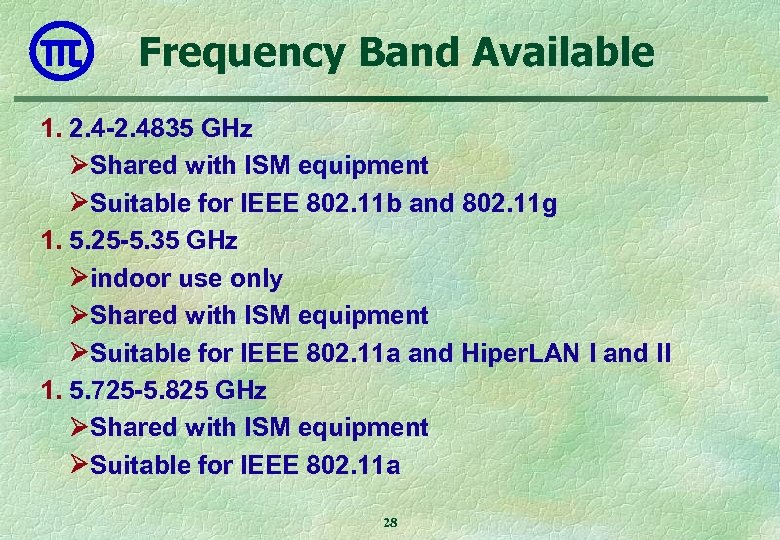
Frequency Band Available 1. 2. 4 -2. 4835 GHz Shared with ISM equipment Suitable for IEEE 802. 11 b and 802. 11 g 1. 5. 25 -5. 35 GHz indoor use only Shared with ISM equipment Suitable for IEEE 802. 11 a and Hiper. LAN I and II 1. 5. 725 -5. 825 GHz Shared with ISM equipment Suitable for IEEE 802. 11 a 28
Frequency Band Available v 5. 47 -5. 725 GHz ØNewly allocated for Wireless access system incl. WLAN 29
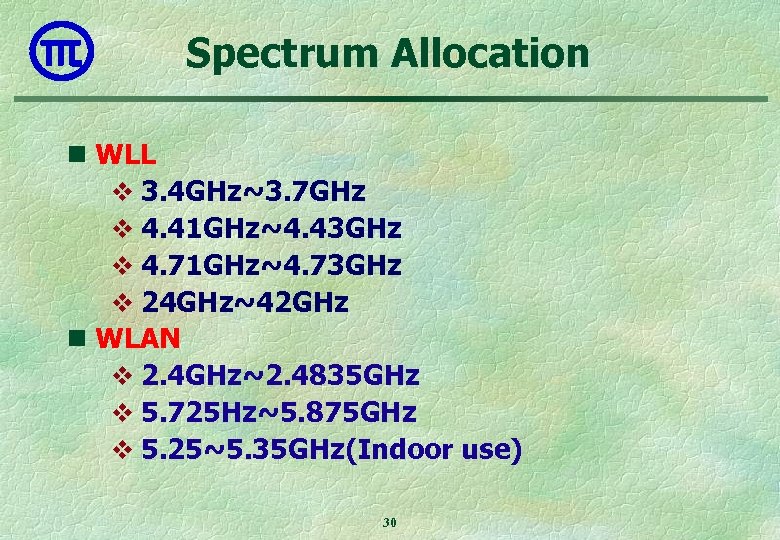
Spectrum Allocation n WLL v 3. 4 GHz~3. 7 GHz v 4. 41 GHz~4. 43 GHz v 4. 71 GHz~4. 73 GHz v 24 GHz~42 GHz n WLAN v 2. 4 GHz~2. 4835 GHz v 5. 725 Hz~5. 875 GHz v 5. 25~5. 35 GHz(Indoor use) 30
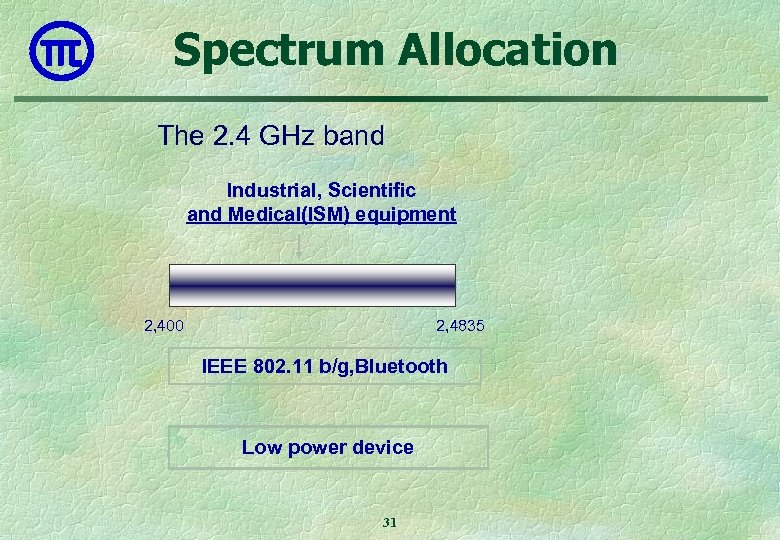
Spectrum Allocation The 2. 4 GHz band Industrial, Scientific and Medical(ISM) equipment 2, 400 2, 4835 IEEE 802. 11 b/g, Bluetooth Low power device 31
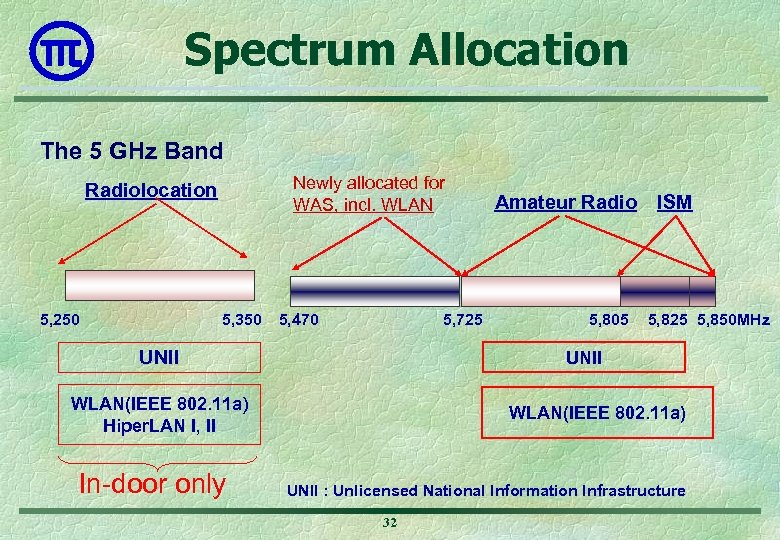
Spectrum Allocation The 5 GHz Band Newly allocated for WAS, incl. WLAN Radiolocation 5, 250 5, 350 5, 470 5, 725 UNII 5, 805 ISM 5, 825 5, 850 MHz UNII WLAN(IEEE 802. 11 a) Hiper. LAN I, II In-door only Amateur Radio WLAN(IEEE 802. 11 a) UNII : Unlicensed National Information Infrastructure 32
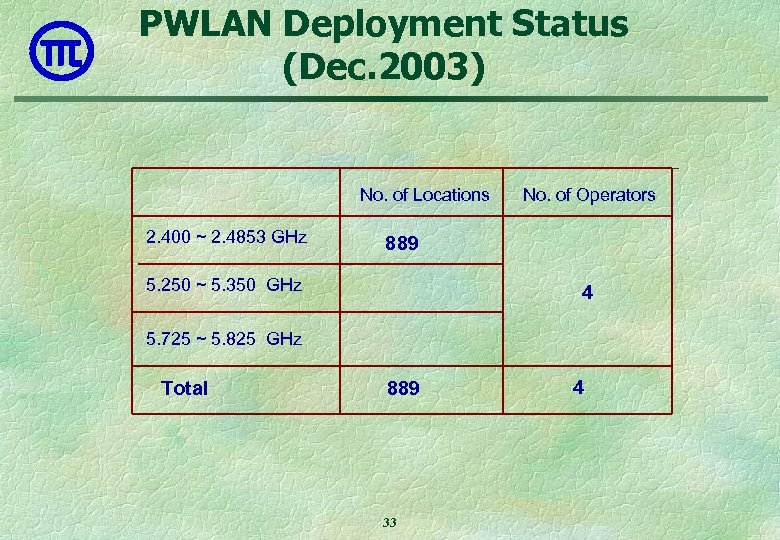
PWLAN Deployment Status (Dec. 2003) No. of Locations 2. 400 ~ 2. 4853 GHz No. of Operators 889 5. 250 ~ 5. 350 GHz 4 5. 725 ~ 5. 825 GHz Total 889 33 4
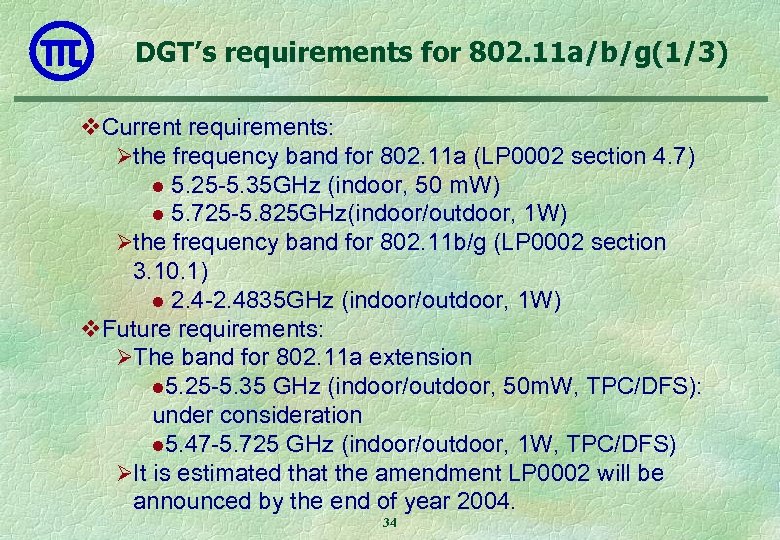
DGT’s requirements for 802. 11 a/b/g(1/3) v. Current requirements: Øthe frequency band for 802. 11 a (LP 0002 section 4. 7) l 5. 25 -5. 35 GHz (indoor, 50 m. W) l 5. 725 -5. 825 GHz(indoor/outdoor, 1 W) Øthe frequency band for 802. 11 b/g (LP 0002 section 3. 10. 1) l 2. 4 -2. 4835 GHz (indoor/outdoor, 1 W) v. Future requirements: ØThe band for 802. 11 a extension l 5. 25 -5. 35 GHz (indoor/outdoor, 50 m. W, TPC/DFS): under consideration l 5. 47 -5. 725 GHz (indoor/outdoor, 1 W, TPC/DFS) ØIt is estimated that the amendment LP 0002 will be announced by the end of year 2004. 34
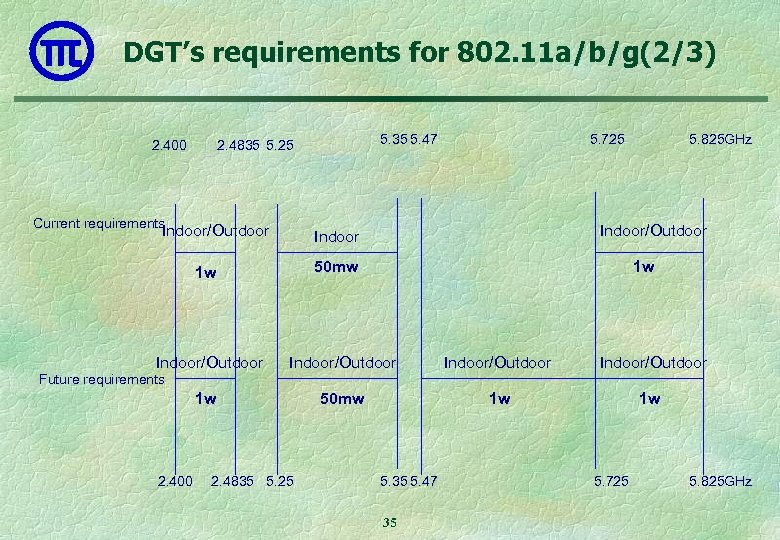
DGT’s requirements for 802. 11 a/b/g(2/3) 2. 400 5. 35 5. 47 2. 4835 5. 25 Current requirements Indoor/Outdoor 5. 725 Indoor/Outdoor Indoor 50 mw 1 w 5. 825 GHz 1 w Indoor/Outdoor 1 w 50 mw 1 w 1 w Future requirements 2. 400 2. 4835 5. 25 5. 35 5. 47 35 5. 725 5. 825 GHz
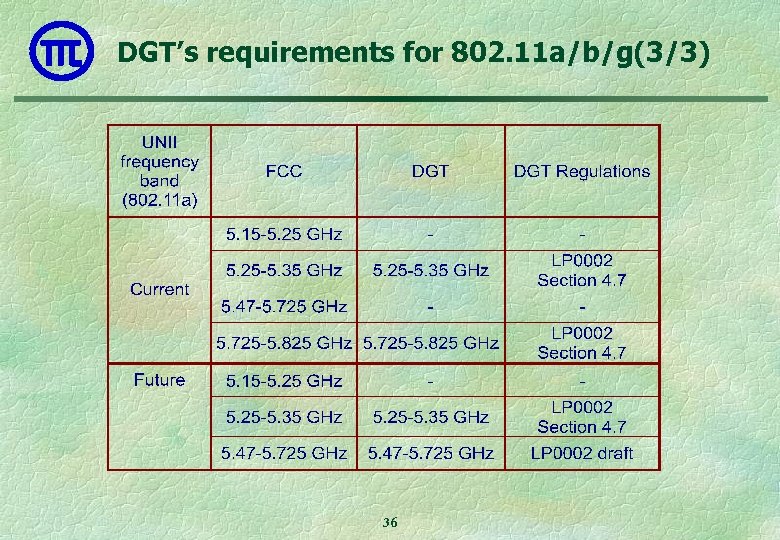
DGT’s requirements for 802. 11 a/b/g(3/3) 36
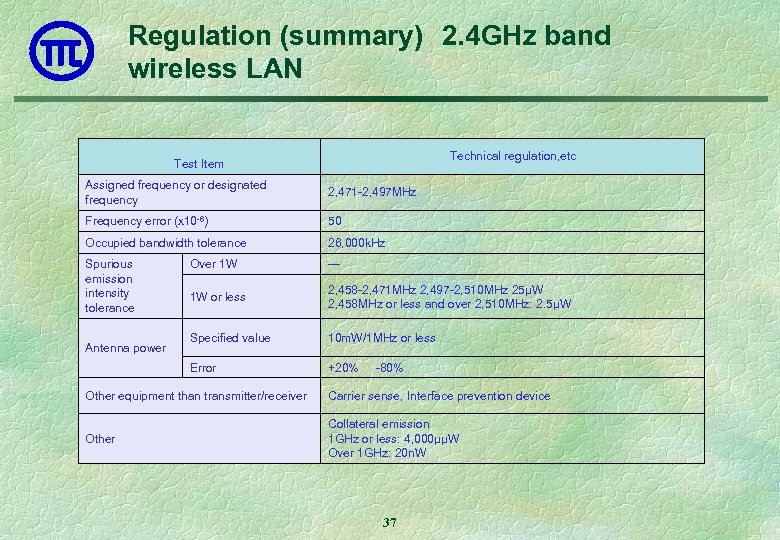
Regulation (summary) 2. 4 GHz band wireless LAN Technical regulation, etc Test Item Assigned frequency or designated frequency 2, 471 -2, 497 MHz Frequency error (x 10 -6) 50 Occupied bandwidth tolerance 26, 000 k. Hz Spurious emission intensity tolerance Over 1 W --- 1 W or less 2, 458 -2, 471 MHz 2, 497 -2, 510 MHz 25µW 2, 458 MHz or less and over 2, 510 MHz: 2. 5µW Specified value 10 m. W/1 MHz or less Error +20% -80% Antenna power Other equipment than transmitter/receiver Carrier sense, Interface prevention device Other Collateral emission 1 GHz or less: 4, 000µµW Over 1 GHz: 20 n. W 37
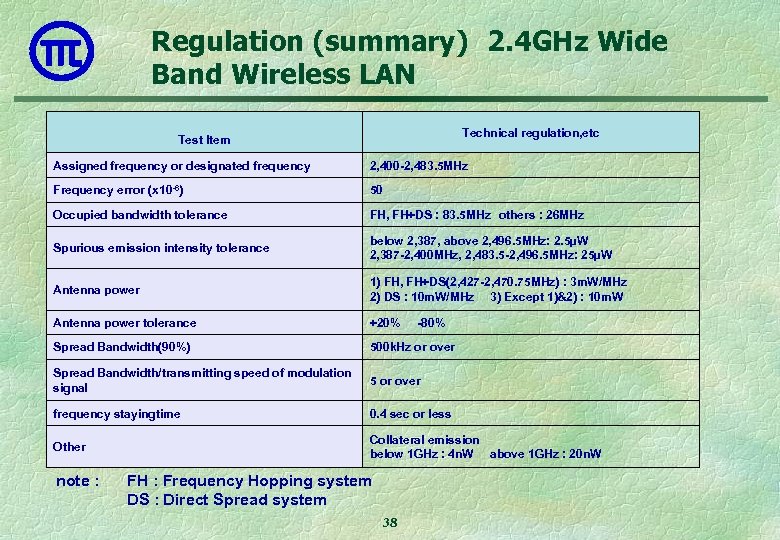
Regulation (summary) 2. 4 GHz Wide Band Wireless LAN Technical regulation, etc Test Item Assigned frequency or designated frequency 2, 400 -2, 483. 5 MHz Frequency error (x 10 -6) 50 Occupied bandwidth tolerance FH, FH+DS : 83. 5 MHz others : 26 MHz Spurious emission intensity tolerance below 2, 387, above 2, 496. 5 MHz: 2. 5µW 2, 387 -2, 400 MHz, 2, 483. 5 -2, 496. 5 MHz: 25µW Antenna power 1) FH, FH+DS(2, 427 -2, 470. 75 MHz) : 3 m. W/MHz 2) DS : 10 m. W/MHz 3) Except 1)&2) : 10 m. W Antenna power tolerance +20% -80% Spread Bandwidth(90%) 500 k. Hz or over Spread Bandwidth/transmitting speed of modulation signal 5 or over frequency stayingtime 0. 4 sec or less Other Collateral emission below 1 GHz : 4 n. W above 1 GHz : 20 n. W note : FH : Frequency Hopping system DS : Direct Spread system 38
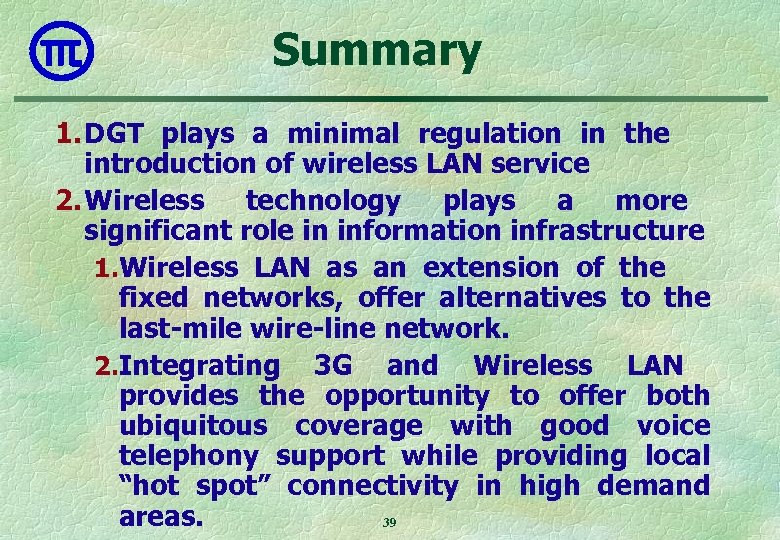
Summary 1. DGT plays a minimal regulation in the introduction of wireless LAN service 2. Wireless technology plays a more significant role in information infrastructure 1. Wireless LAN as an extension of the fixed networks, offer alternatives to the last-mile wire-line network. 2. Integrating 3 G and Wireless LAN provides the opportunity to offer both ubiquitous coverage with good voice telephony support while providing local “hot spot” connectivity in high demand areas. 39
Regulatory and Testing Issues for 802. 11 in the 2. 4/5 GHz band 91. 12. 24. 電信技術中心計畫簡報
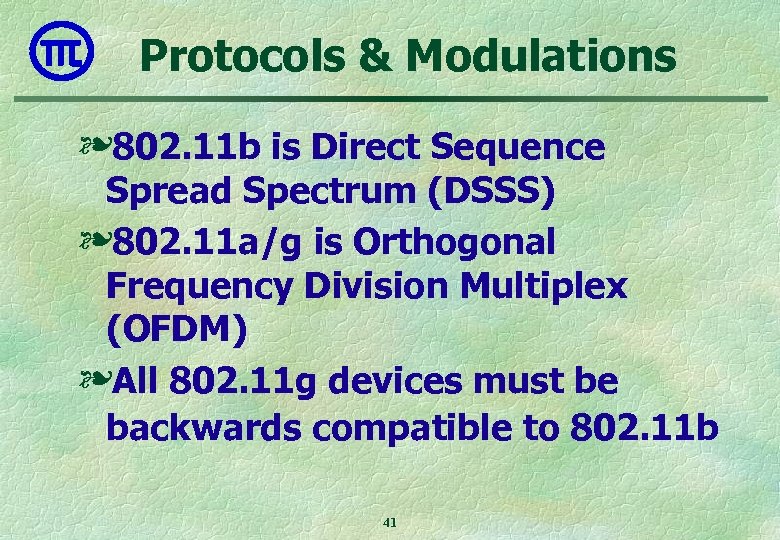
Protocols & Modulations ❧ 802. 11 b is Direct Sequence Spread Spectrum (DSSS) ❧ 802. 11 a/g is Orthogonal Frequency Division Multiplex (OFDM) ❧All 802. 11 g devices must be backwards compatible to 802. 11 b 41
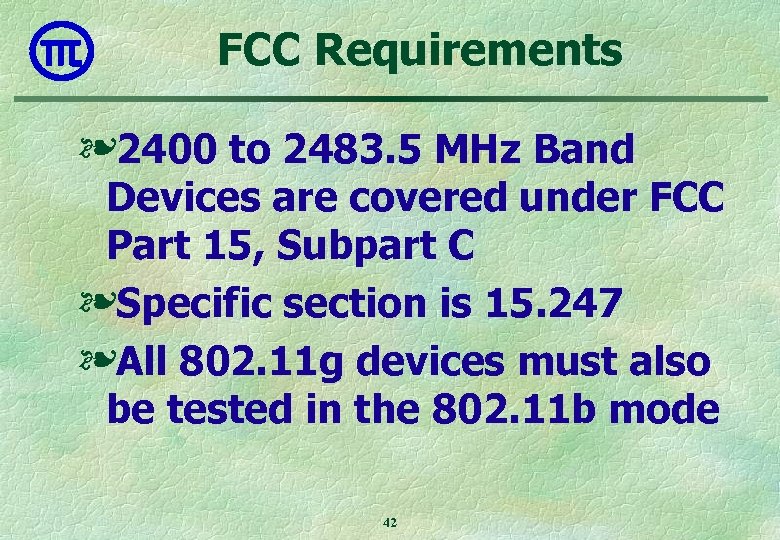
FCC Requirements ❧ 2400 to 2483. 5 MHz Band Devices are covered under FCC Part 15, Subpart C ❧Specific section is 15. 247 ❧All 802. 11 g devices must also be tested in the 802. 11 b mode 42
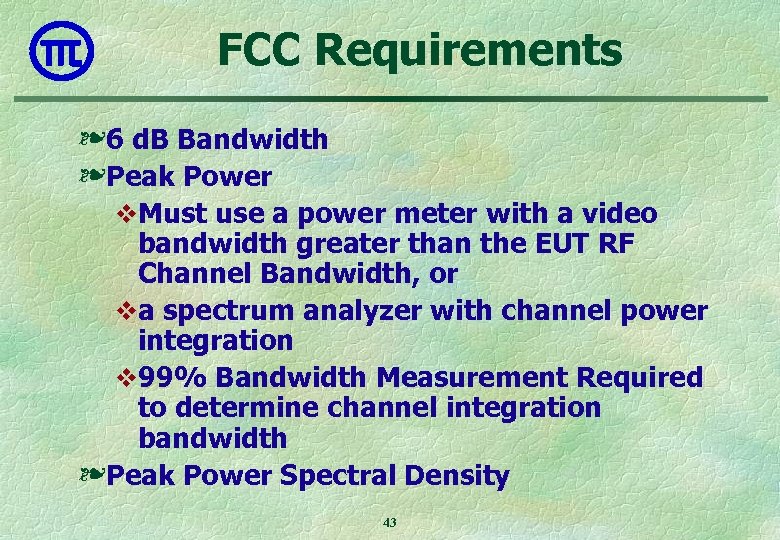
FCC Requirements ❧ 6 d. B Bandwidth ❧ Peak Power v. Must use a power meter with a video bandwidth greater than the EUT RF Channel Bandwidth, or va spectrum analyzer with channel power integration v 99% Bandwidth Measurement Required to determine channel integration bandwidth ❧ Peak Power Spectral Density 43
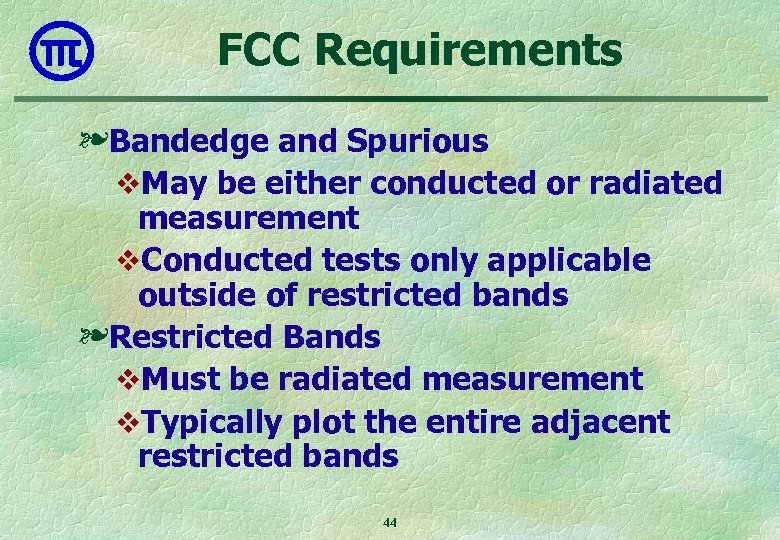
FCC Requirements ❧Bandedge and Spurious v. May be either conducted or radiated measurement v. Conducted tests only applicable outside of restricted bands ❧Restricted Bands v. Must be radiated measurement v. Typically plot the entire adjacent restricted bands 44
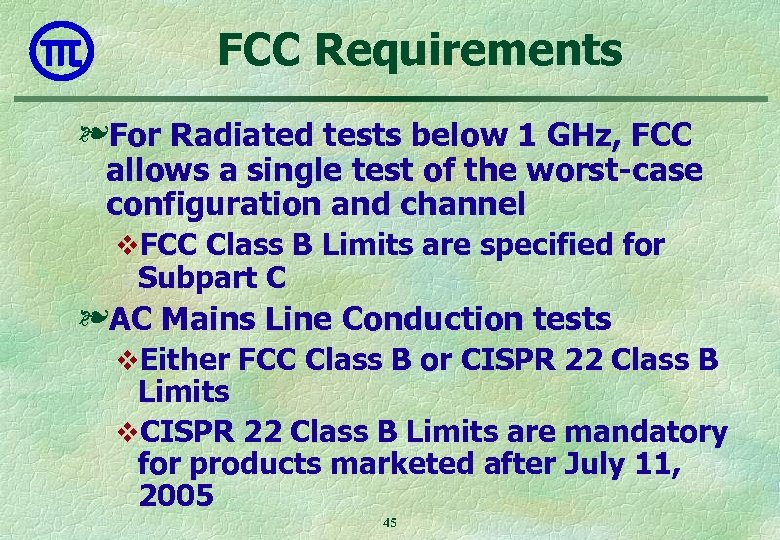
FCC Requirements ❧For Radiated tests below 1 GHz, FCC allows a single test of the worst-case configuration and channel v. FCC Class B Limits are specified for Subpart C ❧AC Mains Line Conduction tests v. Either FCC Class B or CISPR 22 Class B Limits v. CISPR 22 Class B Limits are mandatory for products marketed after July 11, 2005 45
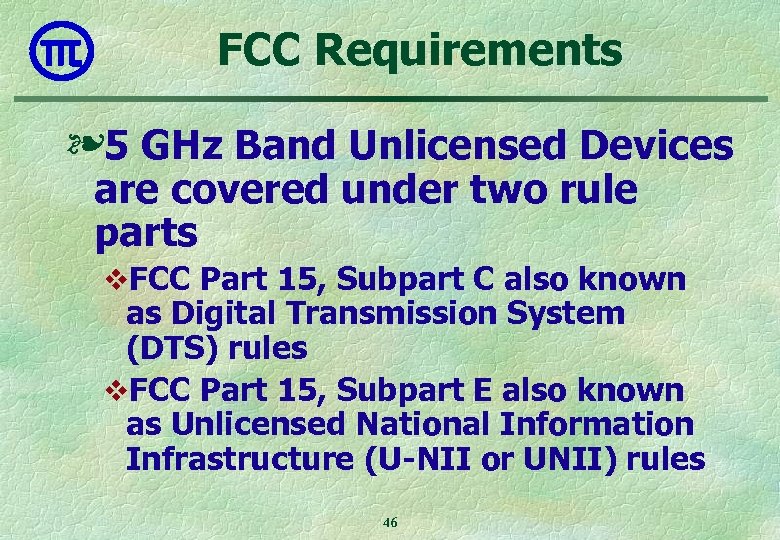
FCC Requirements ❧ 5 GHz Band Unlicensed Devices are covered under two rule parts v. FCC Part 15, Subpart C also known as Digital Transmission System (DTS) rules v. FCC Part 15, Subpart E also known as Unlicensed National Information Infrastructure (U-NII or UNII) rules 46
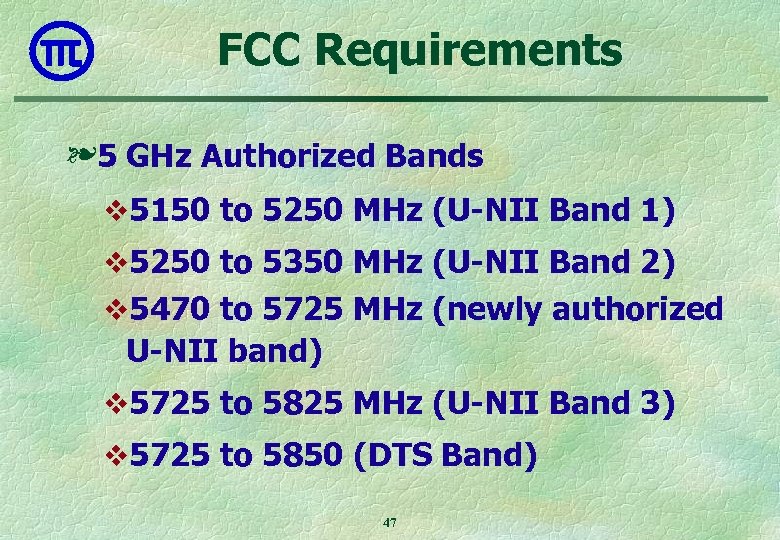
FCC Requirements ❧ 5 GHz Authorized Bands v 5150 to 5250 MHz (U-NII Band 1) v 5250 to 5350 MHz (U-NII Band 2) v 5470 to 5725 MHz (newly authorized U-NII band) v 5725 to 5825 MHz (U-NII Band 3) v 5725 to 5850 (DTS Band) 47
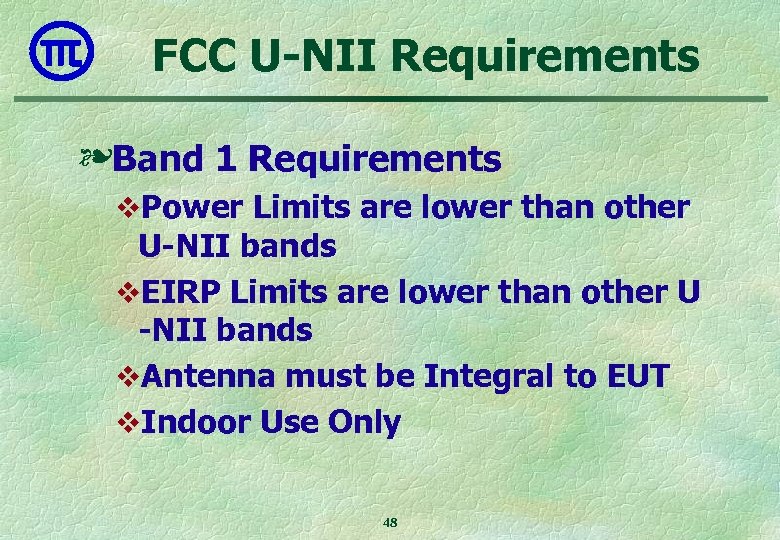
FCC U-NII Requirements ❧Band 1 Requirements v. Power Limits are lower than other U-NII bands v. EIRP Limits are lower than other U -NII bands v. Antenna must be Integral to EUT v. Indoor Use Only 48
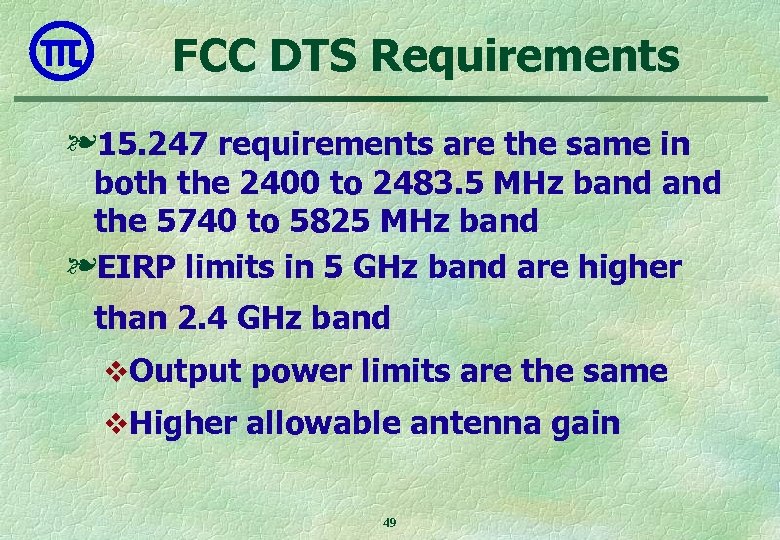
FCC DTS Requirements ❧ 15. 247 requirements are the same in both the 2400 to 2483. 5 MHz band the 5740 to 5825 MHz band ❧EIRP limits in 5 GHz band are higher than 2. 4 GHz band v. Output power limits are the same v. Higher allowable antenna gain 49
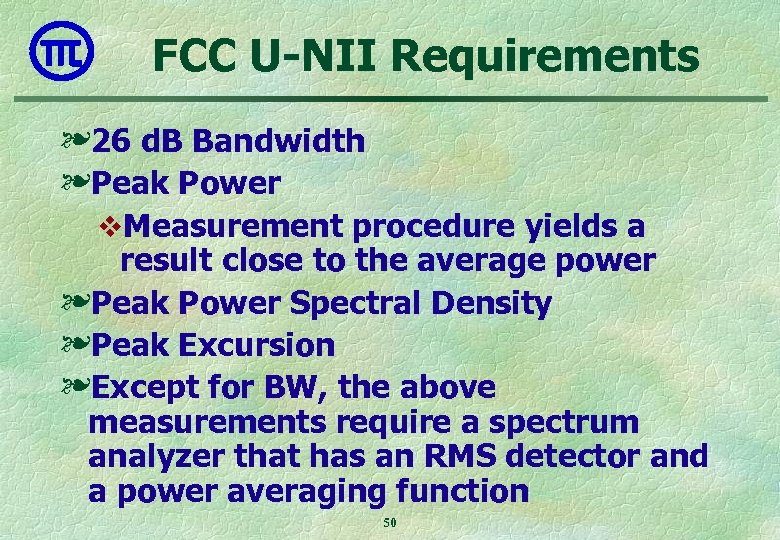
FCC U-NII Requirements ❧ 26 d. B Bandwidth ❧Peak Power v. Measurement procedure yields a result close to the average power ❧Peak Power Spectral Density ❧Peak Excursion ❧Except for BW, the above measurements require a spectrum analyzer that has an RMS detector and a power averaging function 50
FCC U-NII Requirements ❧Bandedge and Spurious v. May be either conducted or radiated measurement v. Conducted tests only applicable outside of restricted bands ❧Restricted Bands v. Must be radiated measurement v. Typically plot the entire adjacent restricted bands 51
FCC U-NII Requirements ❧For Radiated tests below 1 GHz, FCC allows a single test of the worst-case configuration and channel v. FCC Class B Limits are specified for Subpart C ❧AC Mains Line Conduction tests v. Either FCC Class B or CISPR 22 Class B Limits v. CISPR 22 Class B Limits are mandatory for products marketed after July 11, 2005 52
Industry Canada Requirements ❧ IC Standard is RSS-210 ❧ Very similar to FCC requirements v Must perform 99% bandwidth test v Power Spectral Density test procedure is different ❧ Add Receiver Spurious Radiated Test v Upper frequency of investigation is Third Harmonic ❧ Radiated Limit below 1 GHz is FCC Class B v Will not accept CISPR 22 Class B Limit ❧ AC Mains Conducted Limit is FCC Class B v Will not accept CISPR 22 Class B Limit 53
Industry Canada Requirements ❧ IC RSS-210 (o) covers DTS v. Authorized bands are the same as FCC v. Regulations are very similar to FCC ØThe FCC/IC comparison comments regarding the 2. 4 GHz DTS band also apply to the 5 GHz DTS band ❧ IC RSS-210 (q 1) covers U-NII v. Canada has not adopted the new FCC band v. Channel Tests are different from FCC v. Spurious tests are similar to FCC 54
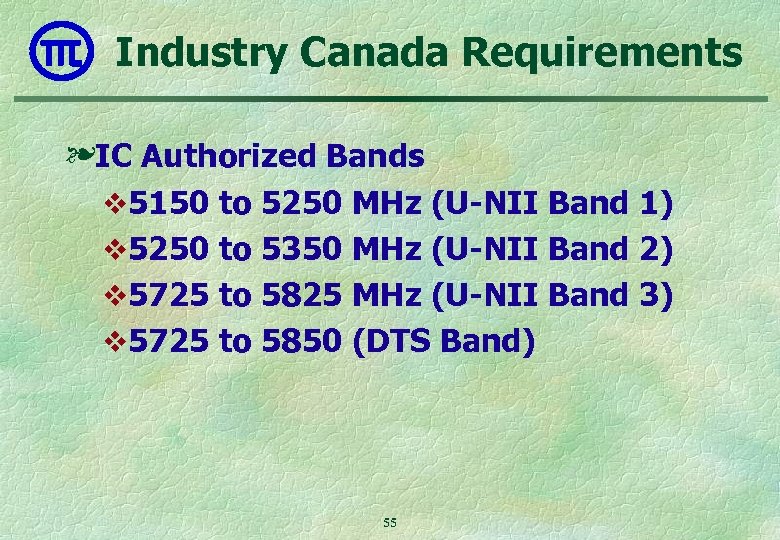
Industry Canada Requirements ❧IC Authorized Bands v 5150 to 5250 MHz (U-NII Band 1) v 5250 to 5350 MHz (U-NII Band 2) v 5725 to 5825 MHz (U-NII Band 3) v 5725 to 5850 (DTS Band) 55
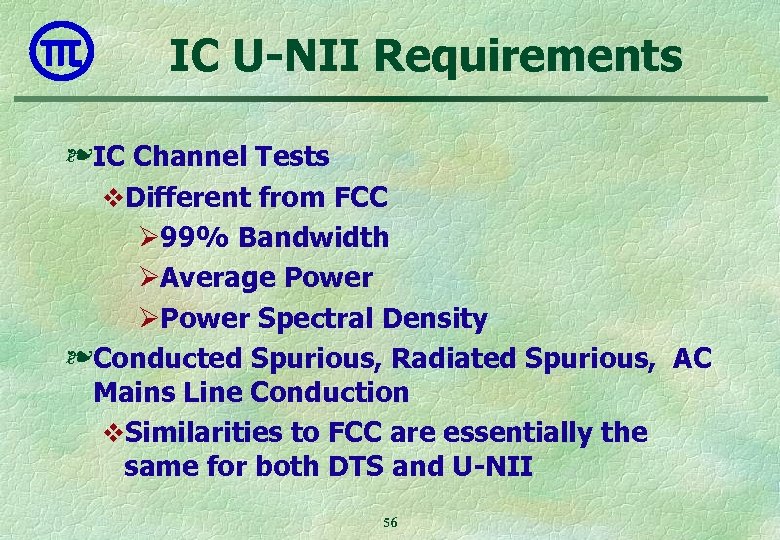
IC U-NII Requirements ❧ IC Channel Tests v. Different from FCC Ø 99% Bandwidth ØAverage Power ØPower Spectral Density ❧ Conducted Spurious, Radiated Spurious, AC Mains Line Conduction v. Similarities to FCC are essentially the same for both DTS and U-NII 56
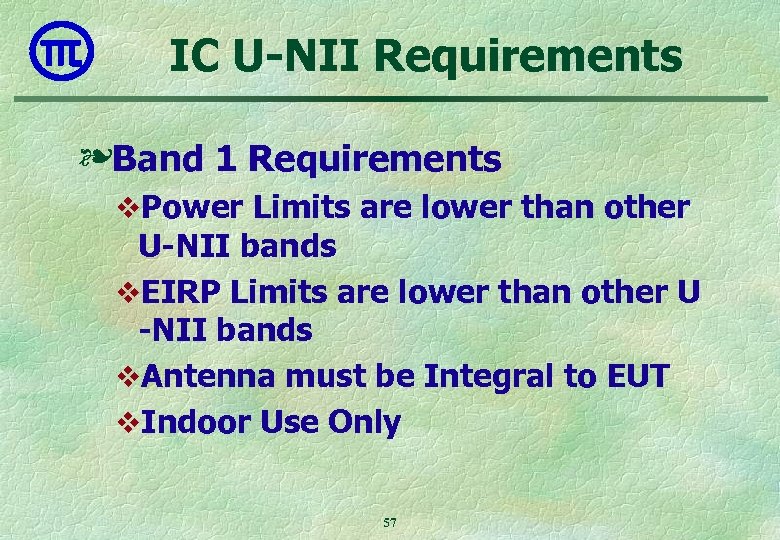
IC U-NII Requirements ❧Band 1 Requirements v. Power Limits are lower than other U-NII bands v. EIRP Limits are lower than other U -NII bands v. Antenna must be Integral to EUT v. Indoor Use Only 57
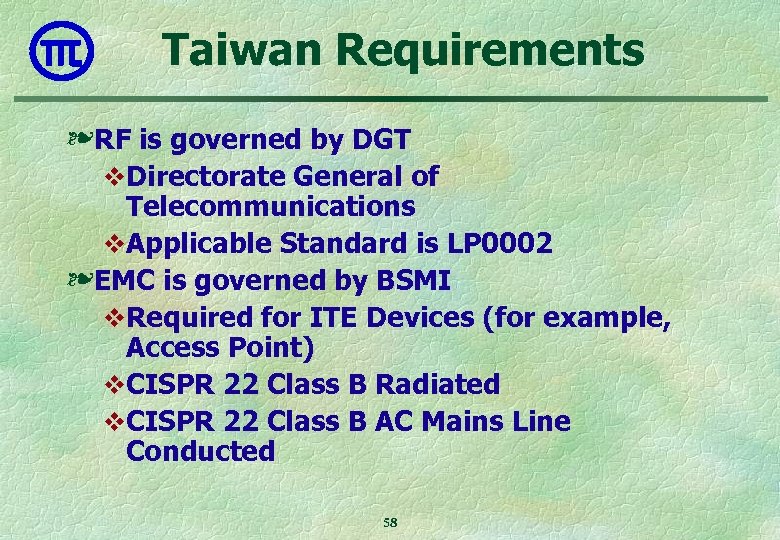
Taiwan Requirements ❧ RF is governed by DGT v. Directorate General of Telecommunications v. Applicable Standard is LP 0002 ❧ EMC is governed by BSMI v. Required for ITE Devices (for example, Access Point) v. CISPR 22 Class B Radiated v. CISPR 22 Class B AC Mains Line Conducted 58
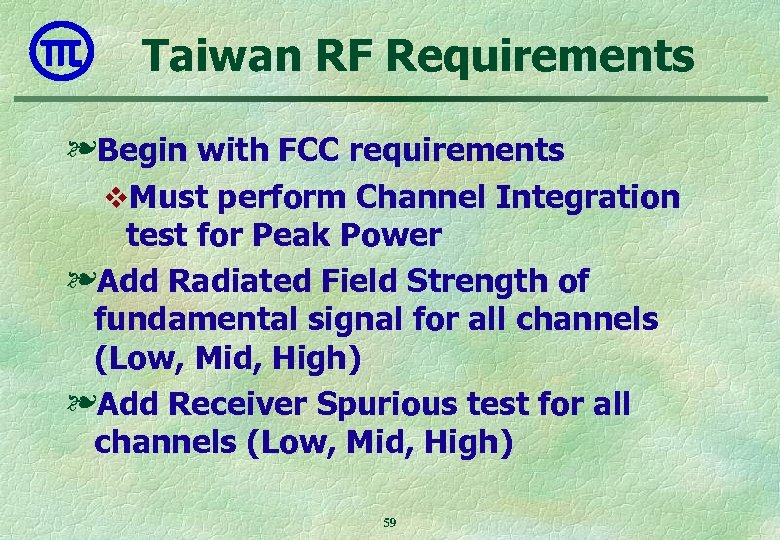
Taiwan RF Requirements ❧Begin with FCC requirements v. Must perform Channel Integration test for Peak Power ❧Add Radiated Field Strength of fundamental signal for all channels (Low, Mid, High) ❧Add Receiver Spurious test for all channels (Low, Mid, High) 59
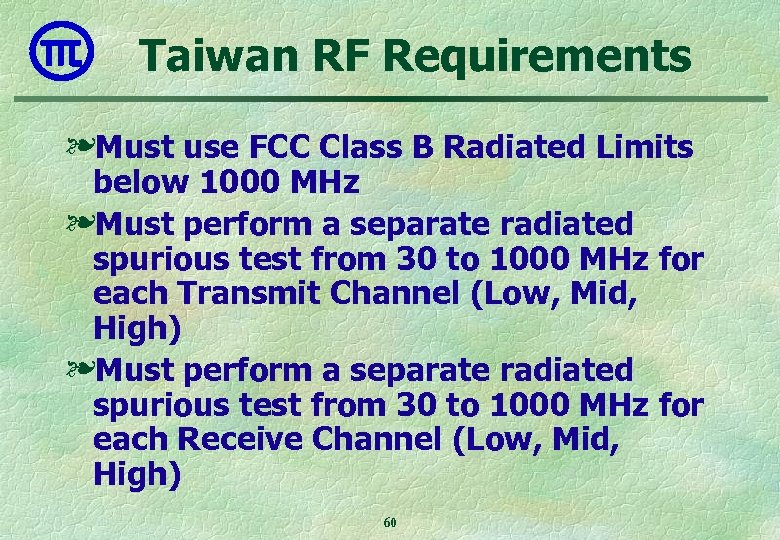
Taiwan RF Requirements ❧Must use FCC Class B Radiated Limits below 1000 MHz ❧Must perform a separate radiated spurious test from 30 to 1000 MHz for each Transmit Channel (Low, Mid, High) ❧Must perform a separate radiated spurious test from 30 to 1000 MHz for each Receive Channel (Low, Mid, High) 60
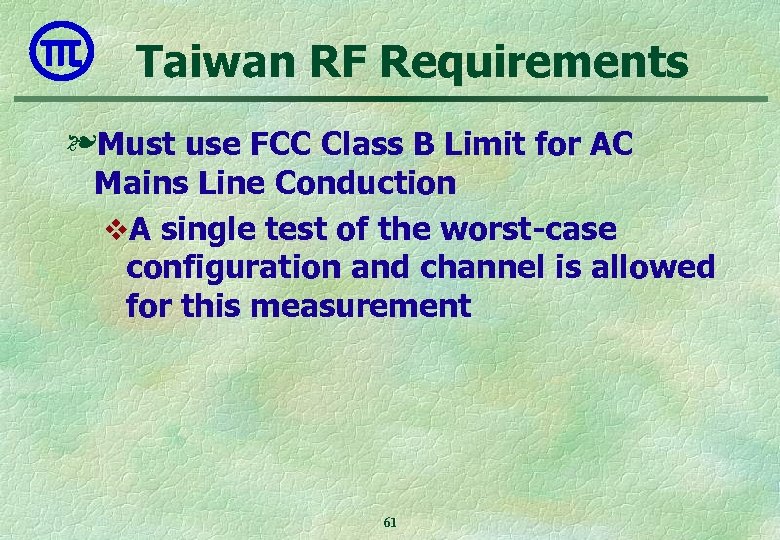
Taiwan RF Requirements ❧Must use FCC Class B Limit for AC Mains Line Conduction v. A single test of the worst-case configuration and channel is allowed for this measurement 61
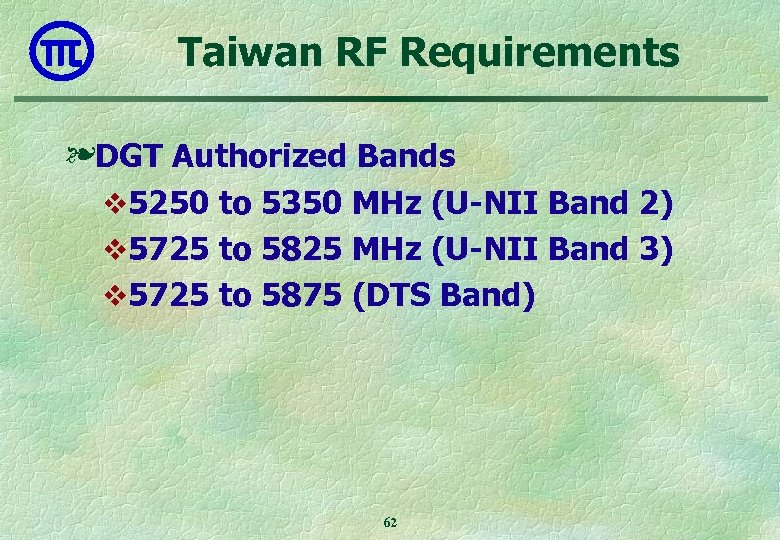
Taiwan RF Requirements ❧DGT Authorized Bands v 5250 to 5350 MHz (U-NII Band 2) v 5725 to 5825 MHz (U-NII Band 3) v 5725 to 5875 (DTS Band) 62
Taiwan RF Requirements ❧ DTS Requirements v. The FCC/DGT comparison comments regarding the 2. 4 GHz DTS band also apply to the 5 GHz DTS band ❧ U-NII Requirements v 5250 to 5350 MHz DGT in-band limits are the same amplitude as 5150 to 5250 MHz FCC in-band limits v. Indoor use only allowed from 5250 to 5350 MHz v. Spurious limits are similar to FCC 63
Japan Requirements ❧ Radio is governed by MPHPT v. Ministry of Public Management, Home Affairs, Posts and Telecommunication v. Applicable Standards ØRCR STD-33 for 802. 11 b ØARIB STD-T 66 for 802. 11 b/g ØARIB STD-T 71 for 802. 11 a v. Authorized Band Ø 5150 to 5250 MHz (U-NII Band 1) 64
Japan EMC Requirements ❧ EMC is administered by VCCI v. Voluntary Control Council for Interference by Information Technology Equipment v. Applicable to Access Points, for example v. Limits ØCISPR 22 Class B Radiated ØCISPR 22 Class B AC Mains Line Conducted 65
Japan Radio Requirements ❧ Low, Mid, and High Channels 1 to 13 ❧ Separate Requirements for Channel 14 v. Legacy devices continue to be in service v. Channel Center Frequency = 2484 MHz v. Authorized Band Ø 2471 to 2497 MHz Ø 5150 to 5250 MHz (U-NII Band 1) v 802. 11 b mode operation only v. Indoor Use Only(5 GHz) 66
Japan Radio Requirements ❧ All Testing is Antenna Port Conducted v. Average Power v. Power Spectral Density (d. Bm/MHz) v. EIRP = PSD + Antenna Gain v 99% Occupied Bandwidth v 90%Spreading Bandwidth v. Frequency Tolerance v. Adjacent Channel Power (5 GHz only) v. Transmit Spurious v. Receive Spurious 67
European Requirements ❧ 2. 4 GHz Radio Spectral Matters (RSM) Standard is ETSI EN 300 328 1. Current Harmonized version is v. 1. 4. 1 2. Version v. 1. 5. 1 is released by ETSI, but not yet published in Official Journal 1. Technical Construction File (TCF) is required to use v. 1. 5. 1 ❧ 5 GHz Radio Spectral Matters (RSM) Standard is ETSI EN 301 893 v. Current Harmonized version is v. 1. 2. 3 ❧ EMC Standard is ETSI EN 301 489 -17 1. Applies to the radio, even if not ITE equipment 68
European 2. 4 GHz RSM Requirements ❧ EIRP v. Peak and Average required under v. 1. 4. 1 v. Only Average required under v. 1. 5. 1 ❧ Power Density ❧ Frequency Range ❧ Regarding all the above tests v. May be Conducted plus antenna gain, or radiated v. Measured over Normal and Extreme environmental conditions 69
European 5 GHz RSM Requirements ❧Average Power / EIRP / TPC ❧Power Density ❧Regarding all the above tests v. May be Conducted plus antenna gain, or radiated v. Measured over Normal and Extreme environmental conditions 70
European RSM Requirements ❧Emission Mask(5 GHz) ❧Transmit Spurious ❧Receive Spurious ❧Regarding the above tests v. May test Antenna port conducted plus Cabinet radiation (Radiated with a load), or v. Antenna and cabinet radiation (Radiated with the Antenna) 71
European RSM Requirements ❧European Authorized Bands v 5150 to 5350 MHz v 5740 to 5725 MHz 72
European EMC Requirements ❧Emissions v. Radiated 30 to 1000 MHz, CISPR 22 B v. AC Mains ØLine Conducted ØHarmonic Currents ØVoltage Fluctuations and Flicker 73
European EMC Requirements ❧ Immunity v. Enclosure Port ØESD ØRF Radiated Field – 80 to 1000 MHz and 1. 4 to 2 GHz v. AC Mains Port ØSurge ØEFT Burst ØRF Conducted 150 k. Hz to 80 MHz ØVoltage Dips and Interruptions 74
European EMC Requirements ❧Immunity v. I/O Ports (If Applicable) ØSurge ØEFT Burst ØRF Conducted 150 k. Hz to 80 MHz 75
An Overview of Radio Frequency Identification (RFID) 91. 12. 24. 電信技術中心計畫簡報
RF ID BASICS ❧ An RF ID tag is an IC attached to an antenna, which is usually printed or etched on a substrate material. ❧ An RFID system typically consists of a radioenabled device that communicates with or "interrogates" a tag or label, which is embedded with a single chip processor and an antenna. ❧ The "interrogator" or RFID reader may be a fixed antenna or it may be portable ❧ Host computer stores all collected data within a database. 77
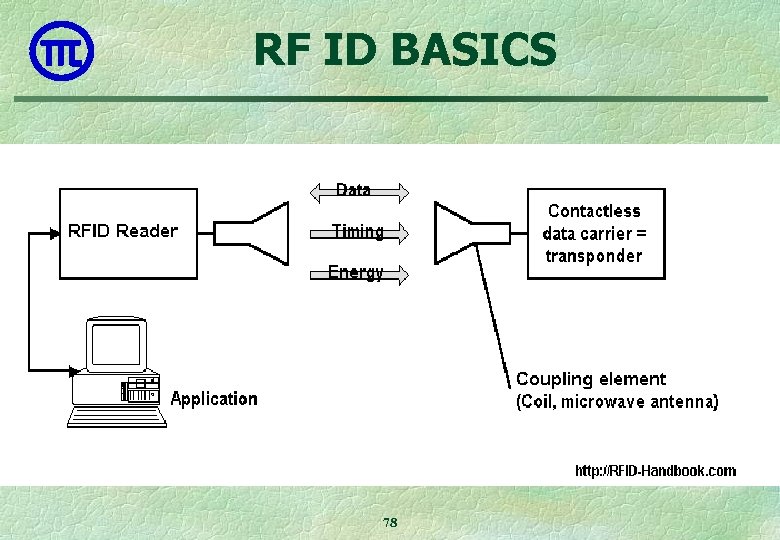
RF ID BASICS. 78
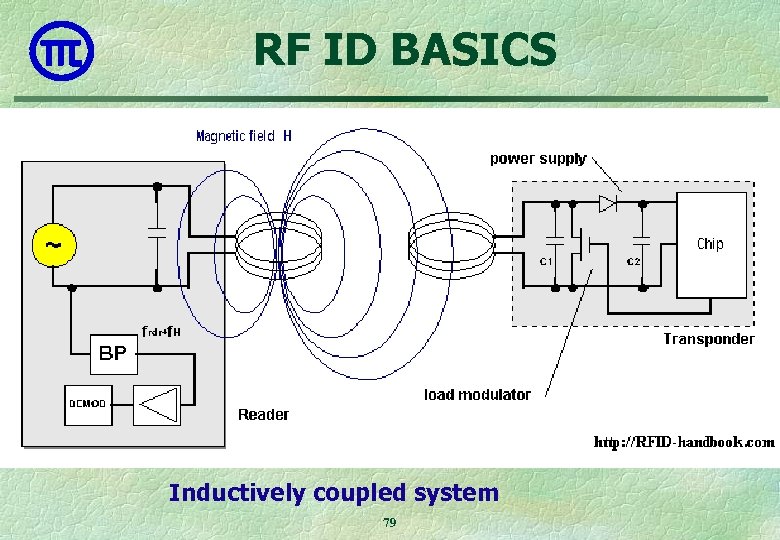
RF ID BASICS. Inductively coupled system 79
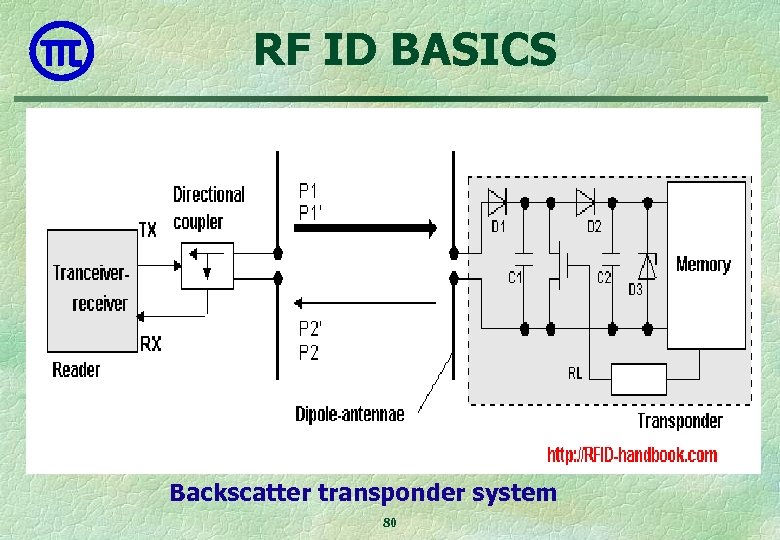
RF ID BASICS Backscatter transponder system 80
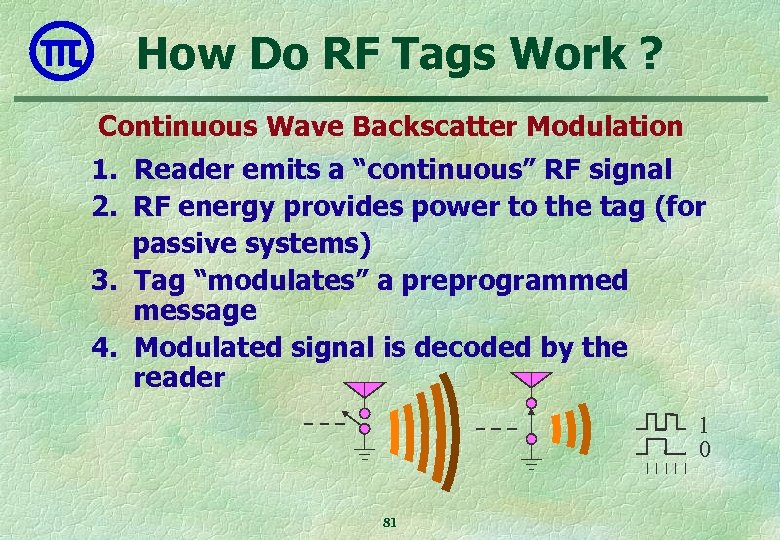
How Do RF Tags Work ? Continuous Wave Backscatter Modulation 1. Reader emits a “continuous” RF signal 2. RF energy provides power to the tag (for passive systems) 3. Tag “modulates” a preprogrammed message 4. Modulated signal is decoded by the reader 81
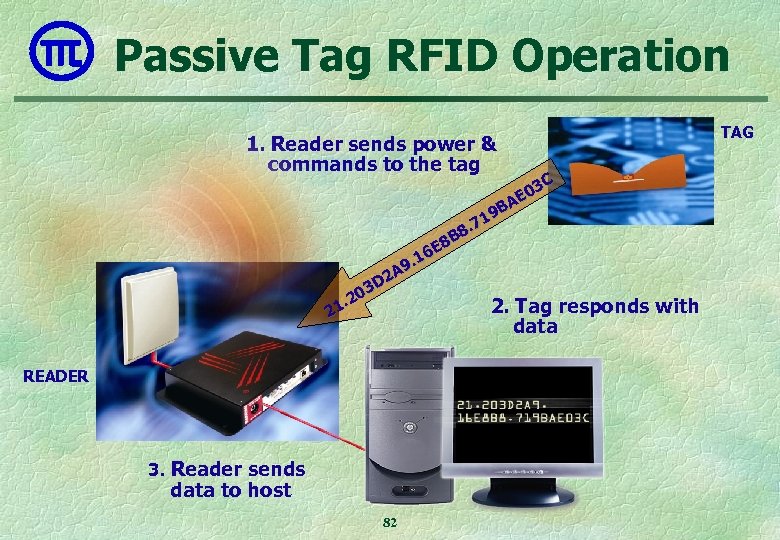
Passive Tag RFID Operation TAG 1. Reader sends power & commands to the tag C 03 E BA 9 71. B 8 8 6 E. 1 A 9 2 3 D. 20 2. Tag responds 21 data READER 3. Reader sends data to host 82 with

Some tags can be very small! 83
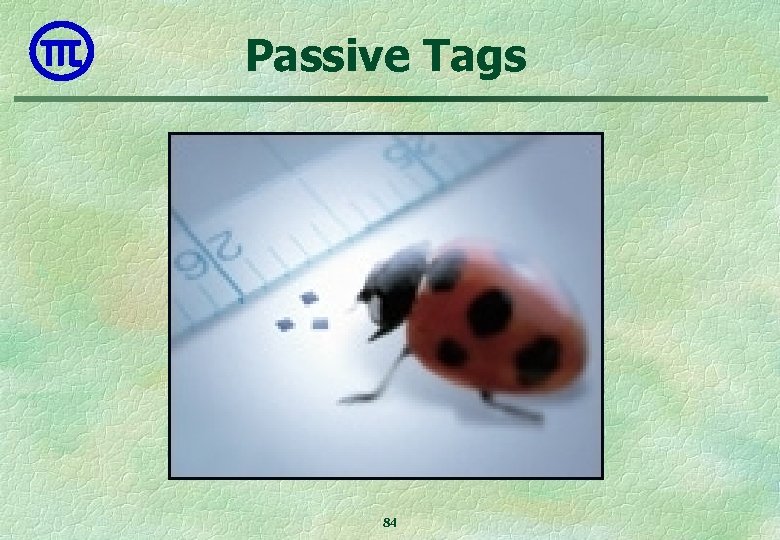
Passive Tags 84
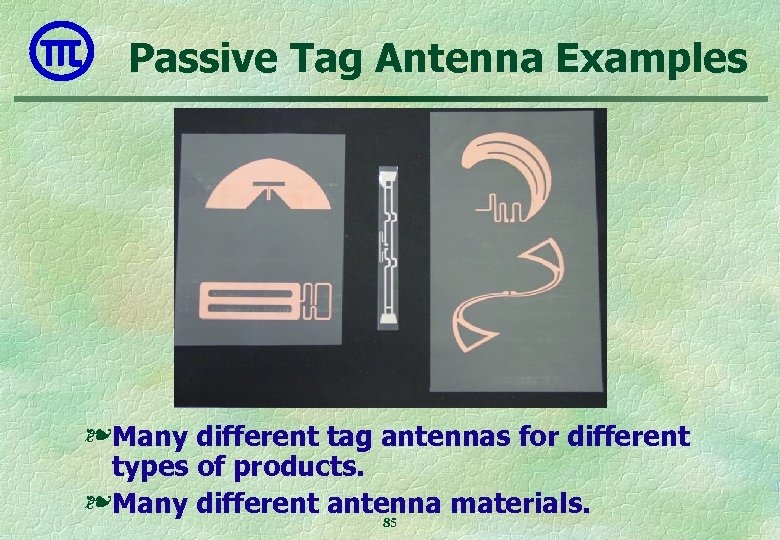
Passive Tag Antenna Examples ❧ Many different tag antennas for different types of products. ❧ Many different antenna materials. 85
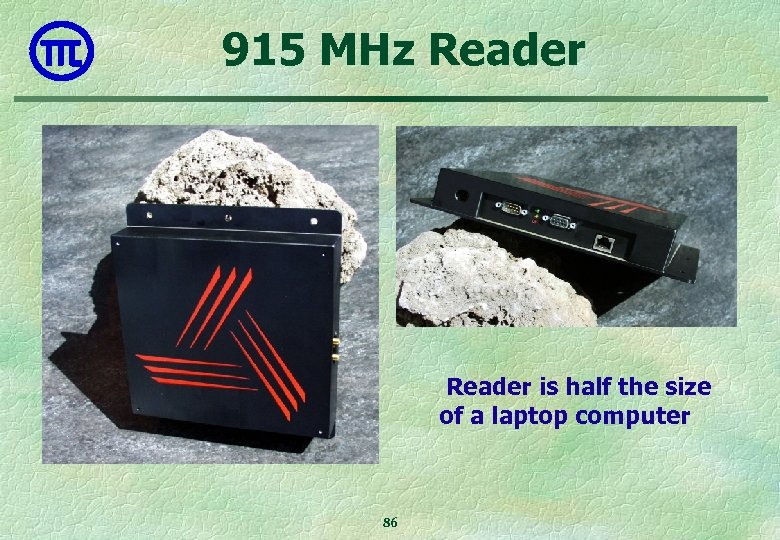
915 MHz Reader is half the size of a laptop computer 86
AIDC Tag Classes ❧ Class-1 v. Identity code only, RF user programmable v. Lowest cost (5¢ in 2 -3 years) ❧ Class-2 v. RF READ and WRITE tags (256 bits to 16 Kbits) v. Medium cost (8 -15¢ moving down to 5 -8¢ in 3 -5 years) ❧ Class-3 v. Self-Powered (battery, photovoltaic Nano. Block™ IC, etc) v. Ability to monitor inputs and control outputs v. Up to 100 meter range (Lots of Margin) v. Higher cost – (but still less than transmitter tags) ❧ Class-4 v. Direct communication with other tags without readers 87
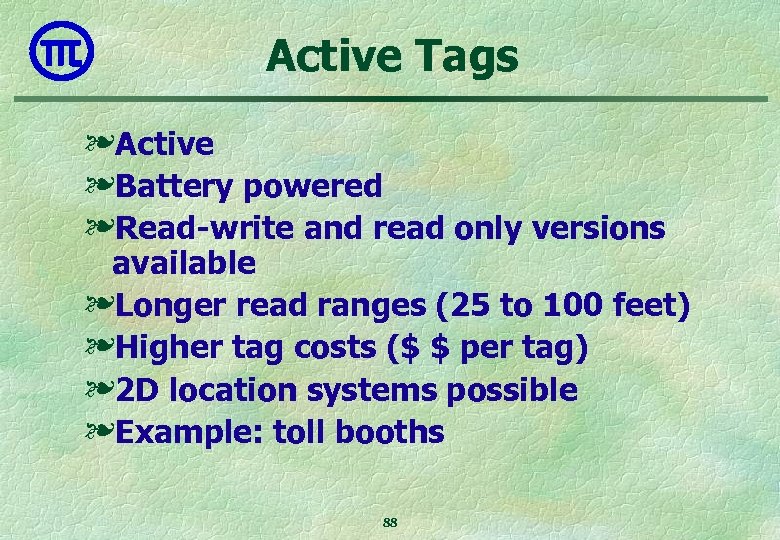
Active Tags ❧Active ❧Battery powered ❧Read-write and read only versions available ❧Longer read ranges (25 to 100 feet) ❧Higher tag costs ($ $ per tag) ❧ 2 D location systems possible ❧Example: toll booths 88
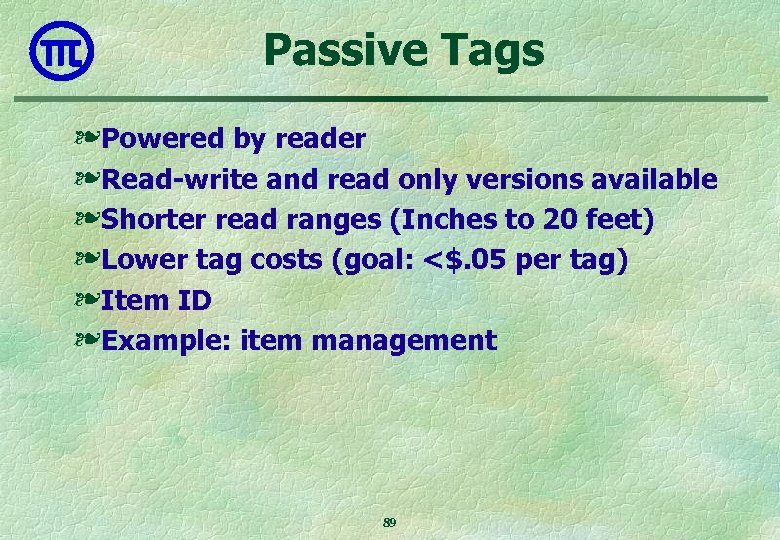
Passive Tags ❧ Powered by reader ❧ Read-write and read only versions available ❧ Shorter read ranges (Inches to 20 feet) ❧ Lower tag costs (goal: <$. 05 per tag) ❧ Item ID ❧ Example: item management 89
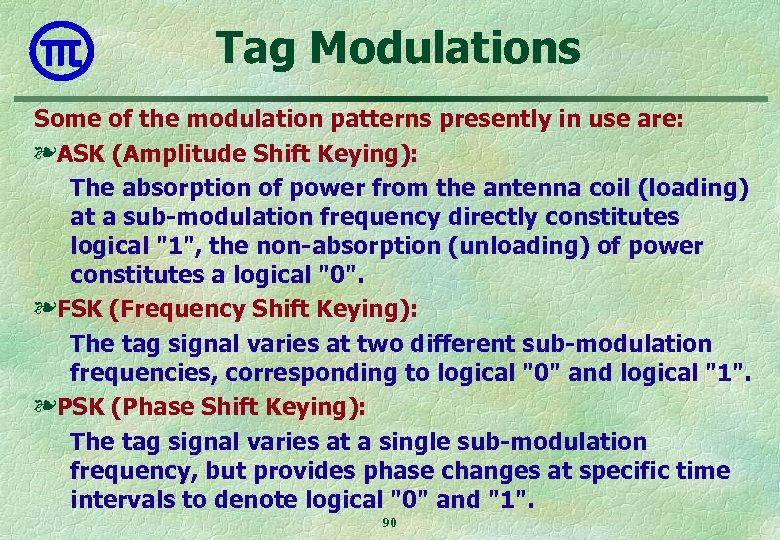
Tag Modulations Some of the modulation patterns presently in use are: ❧ASK (Amplitude Shift Keying): The absorption of power from the antenna coil (loading) at a sub-modulation frequency directly constitutes logical "1", the non-absorption (unloading) of power constitutes a logical "0". ❧FSK (Frequency Shift Keying): The tag signal varies at two different sub-modulation frequencies, corresponding to logical "0" and logical "1". ❧PSK (Phase Shift Keying): The tag signal varies at a single sub-modulation frequency, but provides phase changes at specific time intervals to denote logical "0" and "1". 90
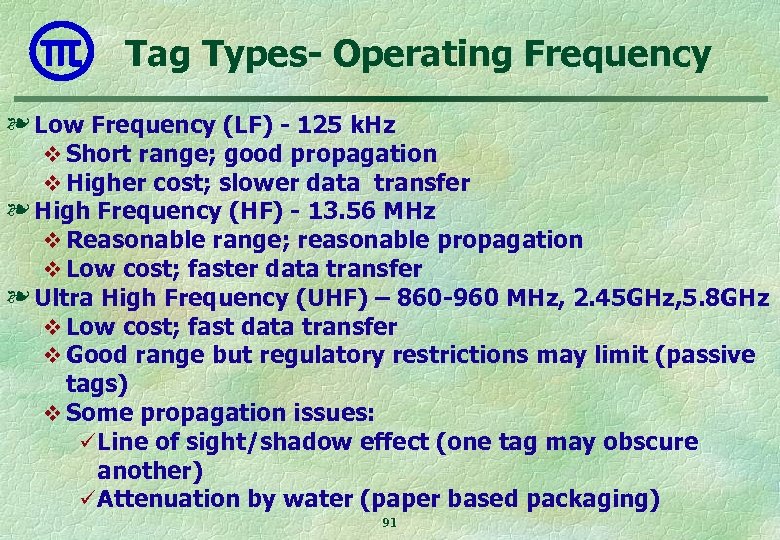
Tag Types- Operating Frequency ❧ Low Frequency (LF) - 125 k. Hz v Short range; good propagation v Higher cost; slower data transfer ❧ High Frequency (HF) - 13. 56 MHz v Reasonable range; reasonable propagation v Low cost; faster data transfer ❧ Ultra High Frequency (UHF) – 860 -960 MHz, 2. 45 GHz, 5. 8 GHz v Low cost; fast data transfer v Good range but regulatory restrictions may limit (passive tags) v Some propagation issues: üLine of sight/shadow effect (one tag may obscure another) üAttenuation by water (paper based packaging) 91
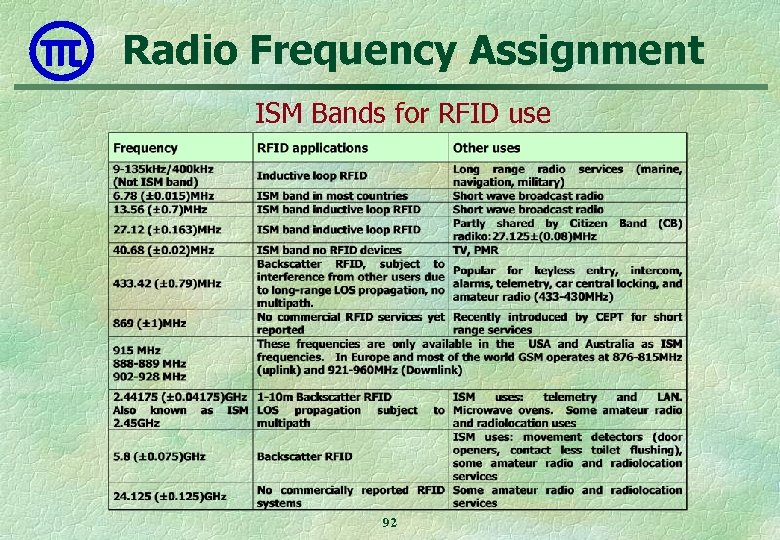
Radio Frequency Assignment ISM Bands for RFID use 92
RFID INTERNATIONAL REGULATORY REQUIREMENTS 91. 12. 24. 電信技術中心計畫簡報
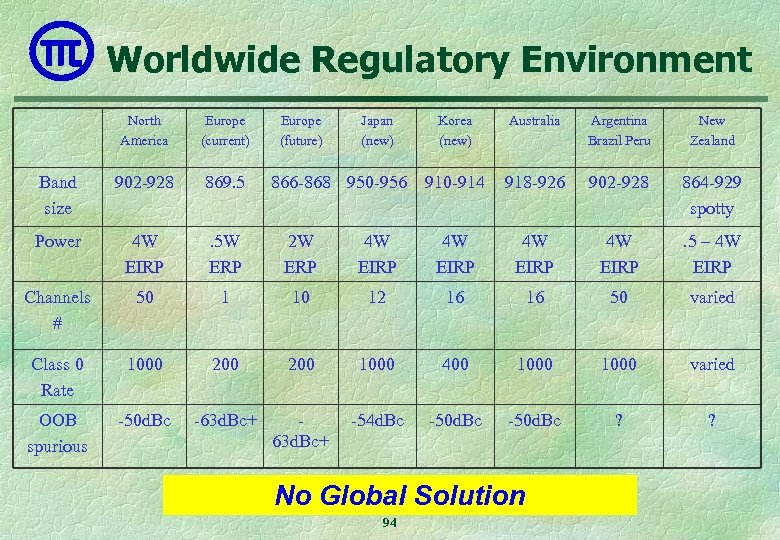
Worldwide Regulatory Environment North America Europe (current) Europe (future) Band size 902 -928 869. 5 Power 4 W EIRP . 5 W ERP 2 W ERP Channels # 50 1 Class 0 Rate 1000 OOB spurious -50 d. Bc Japan (new) Korea (new) Australia Argentina Brazil Peru New Zealand 910 -914 918 -926 902 -928 864 -929 spotty 4 W EIRP . 5 – 4 W EIRP 10 12 16 16 50 varied 200 1000 400 1000 varied -63 d. Bc+ -54 d. Bc -50 d. Bc ? ? 866 -868 950 -956 No Global Solution 94
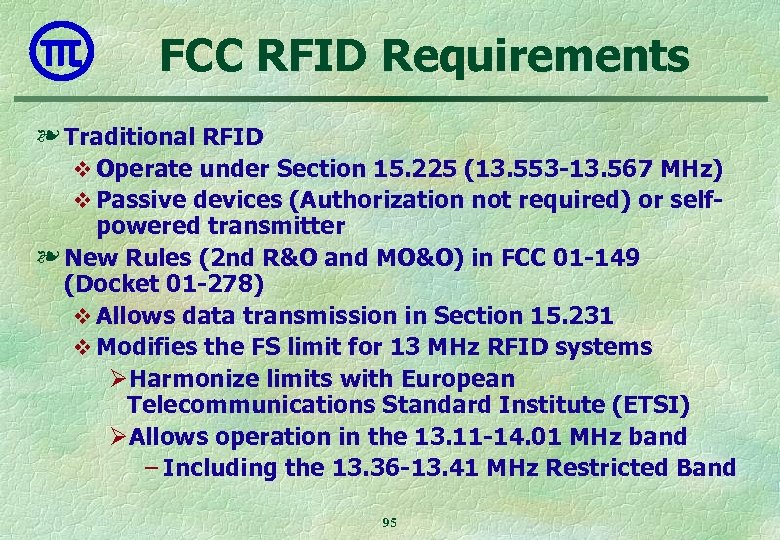
FCC RFID Requirements ❧ Traditional RFID v Operate under Section 15. 225 (13. 553 -13. 567 MHz) v Passive devices (Authorization not required) or self- powered transmitter ❧ New Rules (2 nd R&O and MO&O) in FCC 01 -149 (Docket 01 -278) v Allows data transmission in Section 15. 231 v Modifies the FS limit for 13 MHz RFID systems ØHarmonize limits with European Telecommunications Standard Institute (ETSI) ØAllows operation in the 13. 11 -14. 01 MHz band – Including the 13. 36 -13. 41 MHz Restricted Band 95
FCC RFID Requirements ❧ Third R &O FCC 04 -98 (Docket 01 -278) v. SAVI Petition for Reconsideration (Under 15. 231) ØRFID in the 433. 5 -434. 5 MHz Band (433 MHz Band) ØCommercial and Shipping ØIncrease field strength for control signals ØIncrease the 15. 231(e) transmission duration to 120 seconds 96
FCC RFID Requirements ❧ New Final Rules (Section 15. 240) v Commercial and industrial shipping containers (ie: ports, rail terminals, and warehouses v Two way operation to interrogate and load data into devices v FS 11, 000 microvolts/meter @ 3 m (average detector) v Peak not to exceed 55, 000 microvolts/meter @ 3 m v Transmission duration not to exceed 60 seconds v Reinitiate interrogation in case of transmission error v Silent period between transmissions not less than 10 seconds v Section 15. 209 limits outside band v Tag can be authorized with device or separately 97
FCC RFID Requirements ❧ Additional Provisions to the Rule v 40 kilometer distance from certain Do. D radar sites v. FCC and NTIA receive device location information 98
FCC RFID Requirements RFID and FCC Certification BELOW 30 MHz: 15. 209 Radiated emission limits, general requirements 15. 223 Operation in the band 1. 705 - 10 MHz 15. 225 Operation within the band 13. 110 – 14. 010 MHz 99
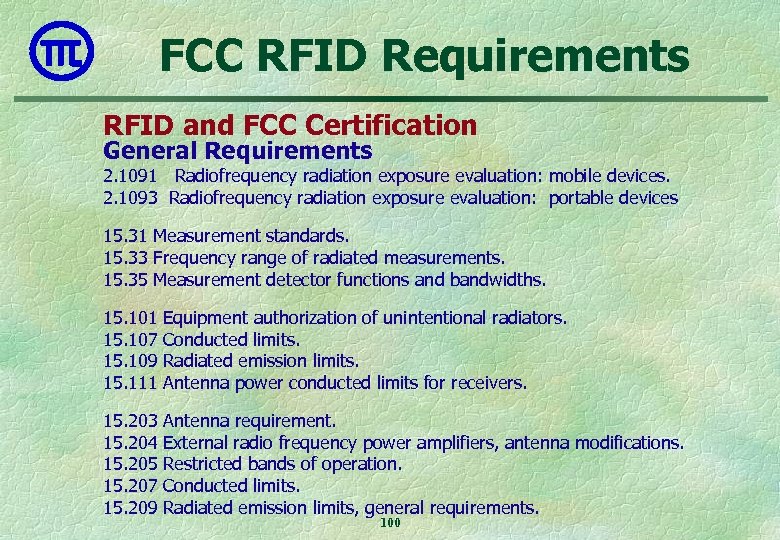
FCC RFID Requirements RFID and FCC Certification General Requirements 2. 1091 Radiofrequency radiation exposure evaluation: mobile devices. 2. 1093 Radiofrequency radiation exposure evaluation: portable devices 15. 31 Measurement standards. 15. 33 Frequency range of radiated measurements. 15. 35 Measurement detector functions and bandwidths. 15. 101 Equipment authorization of unintentional radiators. 15. 107 Conducted limits. 15. 109 Radiated emission limits. 15. 111 Antenna power conducted limits for receivers. 15. 203 Antenna requirement. 15. 204 External radio frequency power amplifiers, antenna modifications. 15. 205 Restricted bands of operation. 15. 207 Conducted limits. 15. 209 Radiated emission limits, general requirements. 100
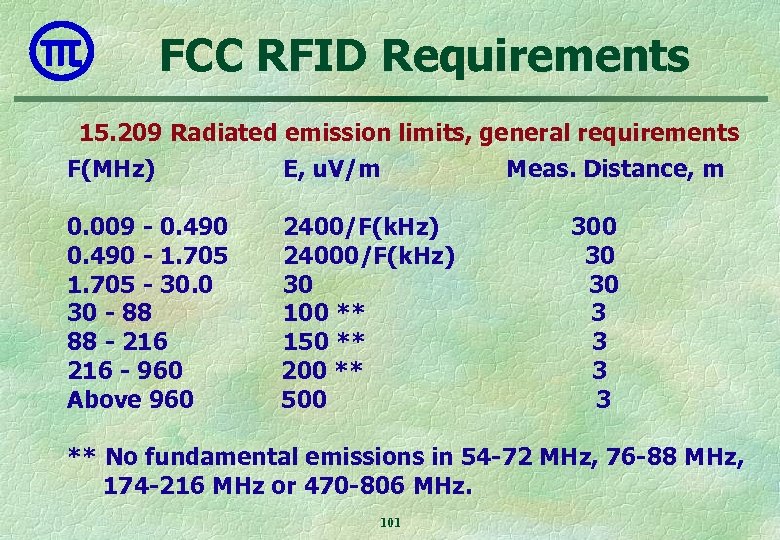
FCC RFID Requirements 15. 209 Radiated emission limits, general requirements F(MHz) E, u. V/m 0. 009 - 0. 490 - 1. 705 - 30. 0 30 - 88 88 - 216 - 960 Above 960 2400/F(k. Hz) 24000/F(k. Hz) 30 100 ** 150 ** 200 ** 500 Meas. Distance, m 300 30 30 3 3 ** No fundamental emissions in 54 -72 MHz, 76 -88 MHz, 174 -216 MHz or 470 -806 MHz. 101
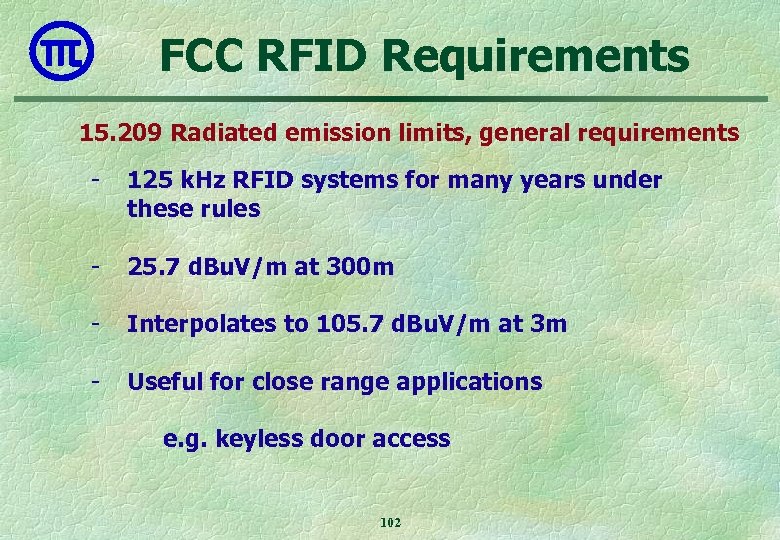
FCC RFID Requirements 15. 209 Radiated emission limits, general requirements - 125 k. Hz RFID systems for many years under these rules - 25. 7 d. Bu. V/m at 300 m - Interpolates to 105. 7 d. Bu. V/m at 3 m - Useful for close range applications e. g. keyless door access 102
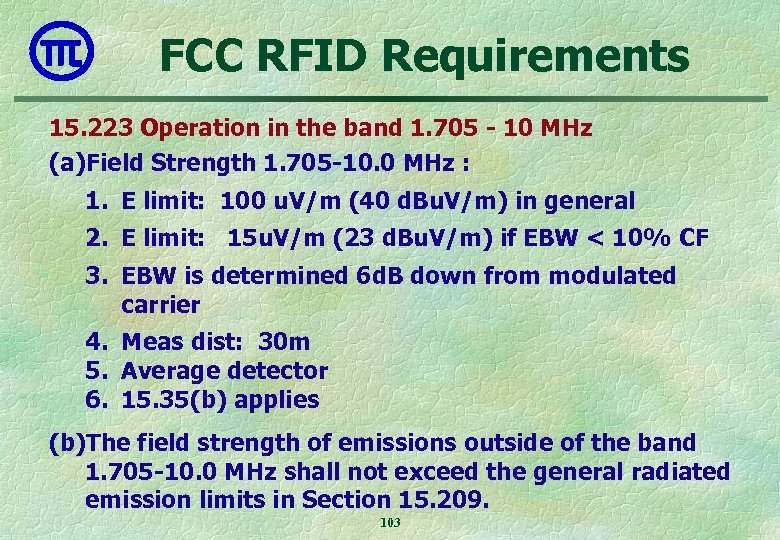
FCC RFID Requirements 15. 223 Operation in the band 1. 705 - 10 MHz (a)Field Strength 1. 705 -10. 0 MHz : 1. E limit: 100 u. V/m (40 d. Bu. V/m) in general 2. E limit: 15 u. V/m (23 d. Bu. V/m) if EBW < 10% CF 3. EBW is determined 6 d. B down from modulated carrier 4. Meas dist: 30 m 5. Average detector 6. 15. 35(b) applies (b)The field strength of emissions outside of the band 1. 705 -10. 0 MHz shall not exceed the general radiated emission limits in Section 15. 209. 103
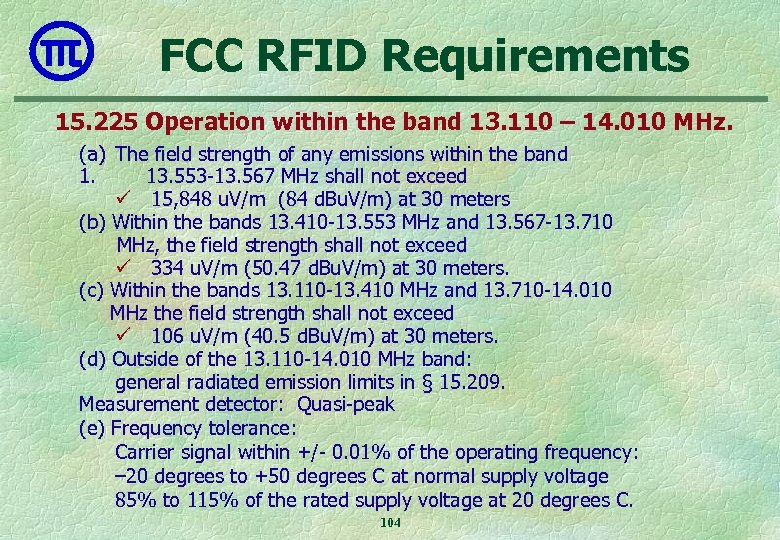
FCC RFID Requirements 15. 225 Operation within the band 13. 110 – 14. 010 MHz. (a) The field strength of any emissions within the band 1. 13. 553 -13. 567 MHz shall not exceed ü 15, 848 u. V/m (84 d. Bu. V/m) at 30 meters (b) Within the bands 13. 410 -13. 553 MHz and 13. 567 -13. 710 MHz, the field strength shall not exceed ü 334 u. V/m (50. 47 d. Bu. V/m) at 30 meters. (c) Within the bands 13. 110 -13. 410 MHz and 13. 710 -14. 010 MHz the field strength shall not exceed ü 106 u. V/m (40. 5 d. Bu. V/m) at 30 meters. (d) Outside of the 13. 110 -14. 010 MHz band: general radiated emission limits in § 15. 209. Measurement detector: Quasi-peak (e) Frequency tolerance: Carrier signal within +/- 0. 01% of the operating frequency: – 20 degrees to +50 degrees C at normal supply voltage 85% to 115% of the rated supply voltage at 20 degrees C. 104
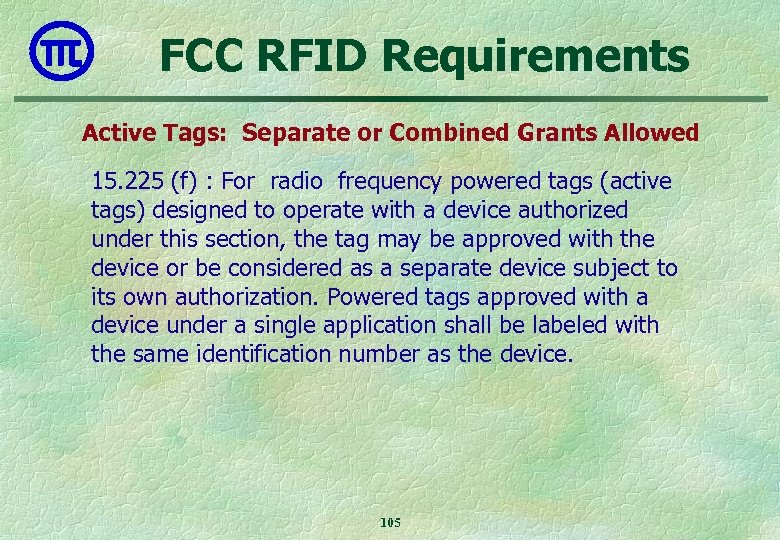
FCC RFID Requirements Active Tags: Separate or Combined Grants Allowed 15. 225 (f) : For radio frequency powered tags (active tags) designed to operate with a device authorized under this section, the tag may be approved with the device or be considered as a separate device subject to its own authorization. Powered tags approved with a device under a single application shall be labeled with the same identification number as the device. 105
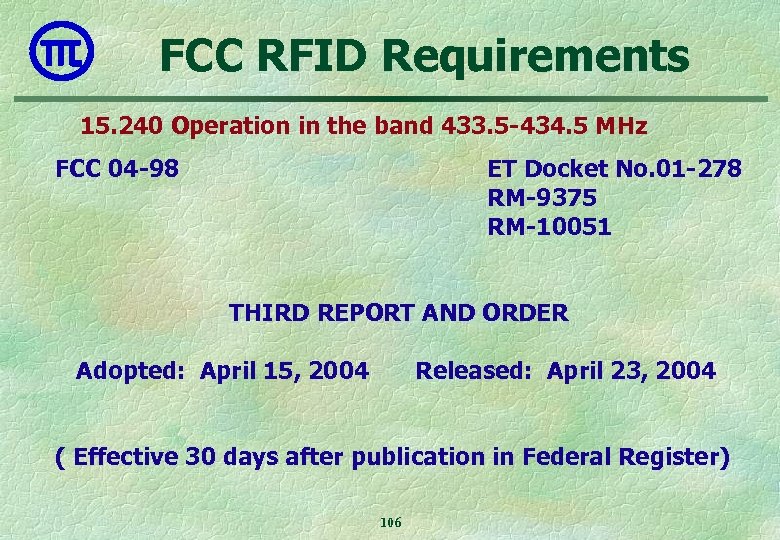
FCC RFID Requirements 15. 240 Operation in the band 433. 5 -434. 5 MHz FCC 04 -98 ET Docket No. 01 -278 RM-9375 RM-10051 THIRD REPORT AND ORDER Adopted: April 15, 2004 Released: April 23, 2004 ( Effective 30 days after publication in Federal Register) 106
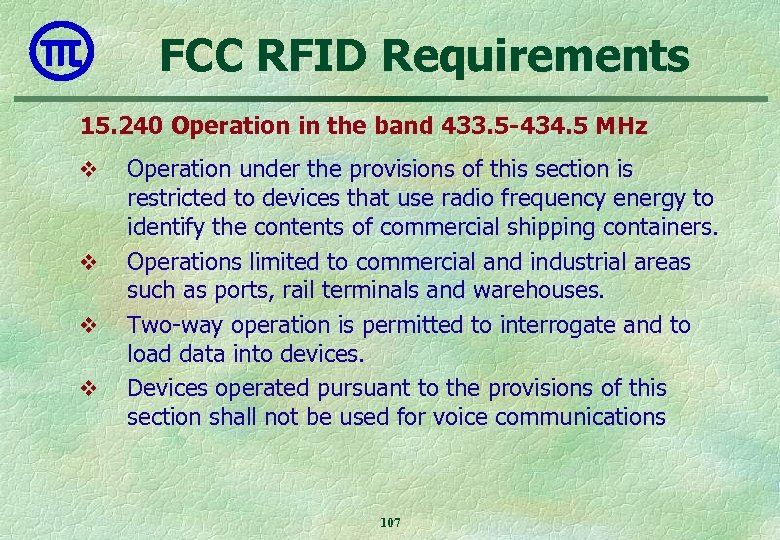
FCC RFID Requirements 15. 240 Operation in the band 433. 5 -434. 5 MHz v v Operation under the provisions of this section is restricted to devices that use radio frequency energy to identify the contents of commercial shipping containers. Operations limited to commercial and industrial areas such as ports, rail terminals and warehouses. Two-way operation is permitted to interrogate and to load data into devices. Devices operated pursuant to the provisions of this section shall not be used for voice communications 107
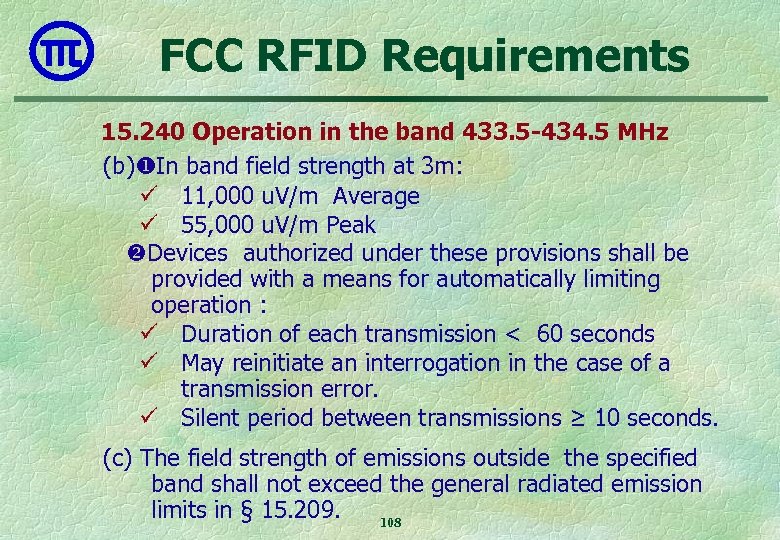
FCC RFID Requirements 15. 240 Operation in the band 433. 5 -434. 5 MHz (b) In band field strength at 3 m: ü 11, 000 u. V/m Average ü 55, 000 u. V/m Peak Devices authorized under these provisions shall be provided with a means for automatically limiting operation : ü Duration of each transmission < 60 seconds ü May reinitiate an interrogation in the case of a transmission error. ü Silent period between transmissions ≥ 10 seconds. (c) The field strength of emissions outside the specified band shall not exceed the general radiated emission limits in § 15. 209. 108
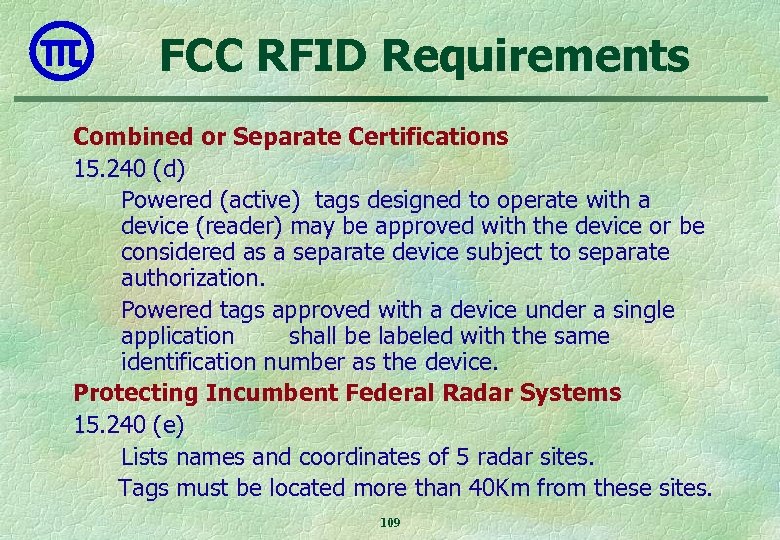
FCC RFID Requirements Combined or Separate Certifications 15. 240 (d) Powered (active) tags designed to operate with a device (reader) may be approved with the device or be considered as a separate device subject to separate authorization. Powered tags approved with a device under a single application shall be labeled with the same identification number as the device. Protecting Incumbent Federal Radar Systems 15. 240 (e) Lists names and coordinates of 5 radar sites. Tags must be located more than 40 Km from these sites. 109
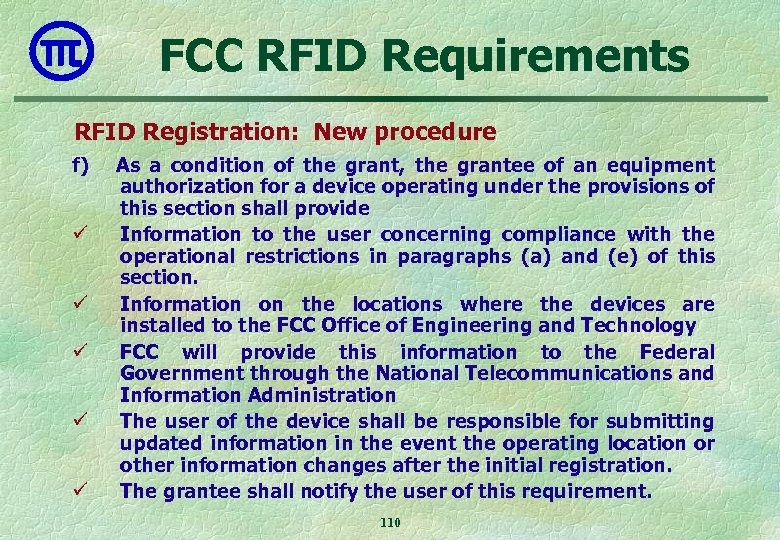
FCC RFID Requirements RFID Registration: New procedure f) ü ü ü As a condition of the grant, the grantee of an equipment authorization for a device operating under the provisions of this section shall provide Information to the user concerning compliance with the operational restrictions in paragraphs (a) and (e) of this section. Information on the locations where the devices are installed to the FCC Office of Engineering and Technology FCC will provide this information to the Federal Government through the National Telecommunications and Information Administration The user of the device shall be responsible for submitting updated information in the event the operating location or other information changes after the initial registration. The grantee shall notify the user of this requirement. 110
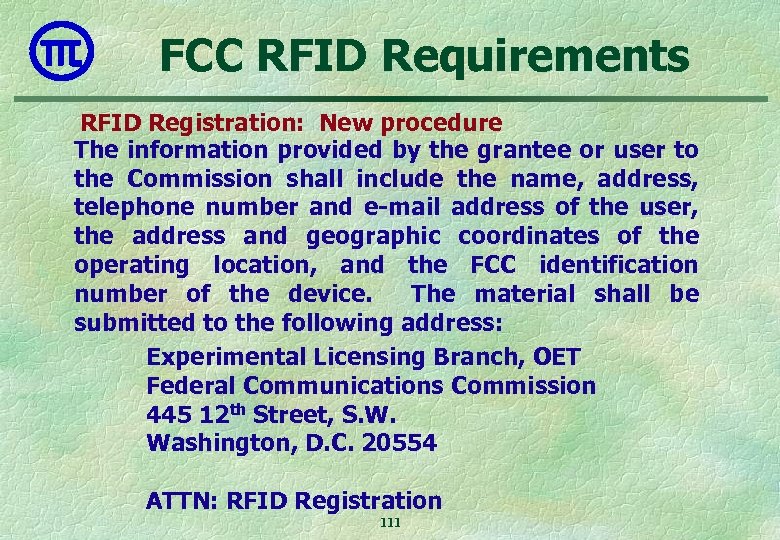
FCC RFID Requirements RFID Registration: New procedure The information provided by the grantee or user to the Commission shall include the name, address, telephone number and e-mail address of the user, the address and geographic coordinates of the operating location, and the FCC identification number of the device. The material shall be submitted to the following address: Experimental Licensing Branch, OET Federal Communications Commission 445 12 th Street, S. W. Washington, D. C. 20554 ATTN: RFID Registration 111
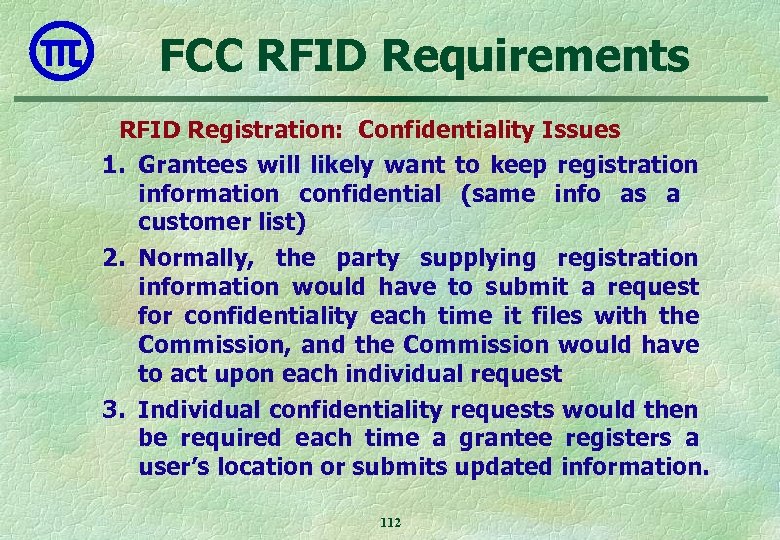
FCC RFID Requirements RFID Registration: Confidentiality Issues 1. Grantees will likely want to keep registration information confidential (same info as a customer list) 2. Normally, the party supplying registration information would have to submit a request for confidentiality each time it files with the Commission, and the Commission would have to act upon each individual request 3. Individual confidentiality requests would then be required each time a grantee registers a user’s location or submits updated information. 112
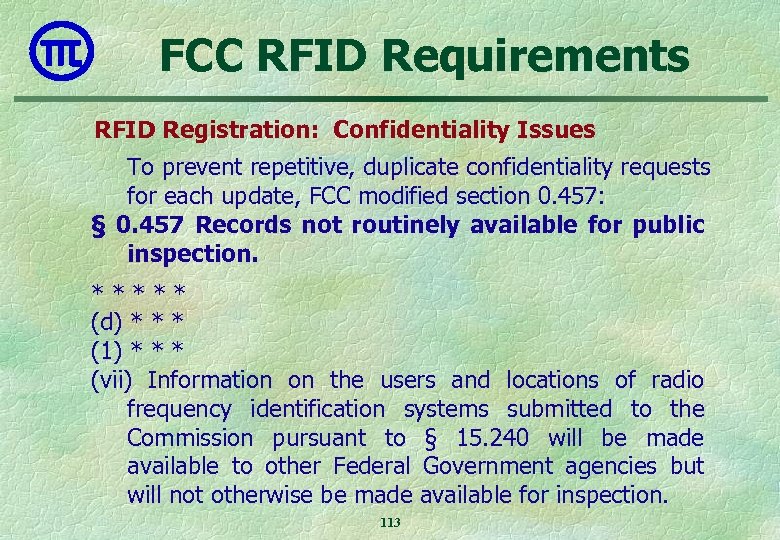
FCC RFID Requirements RFID Registration: Confidentiality Issues To prevent repetitive, duplicate confidentiality requests for each update, FCC modified section 0. 457: § 0. 457 Records not routinely available for public inspection. * * * (d) * * * (1) * * * (vii) Information on the users and locations of radio frequency identification systems submitted to the Commission pursuant to § 15. 240 will be made available to other Federal Government agencies but will not otherwise be made available for inspection. 113
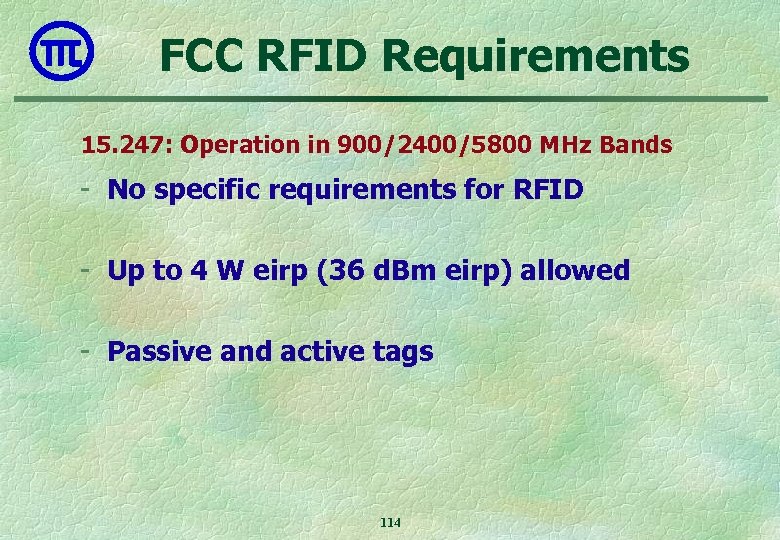
FCC RFID Requirements 15. 247: Operation in 900/2400/5800 MHz Bands - No specific requirements for RFID - Up to 4 W eirp (36 d. Bm eirp) allowed - Passive and active tags 114
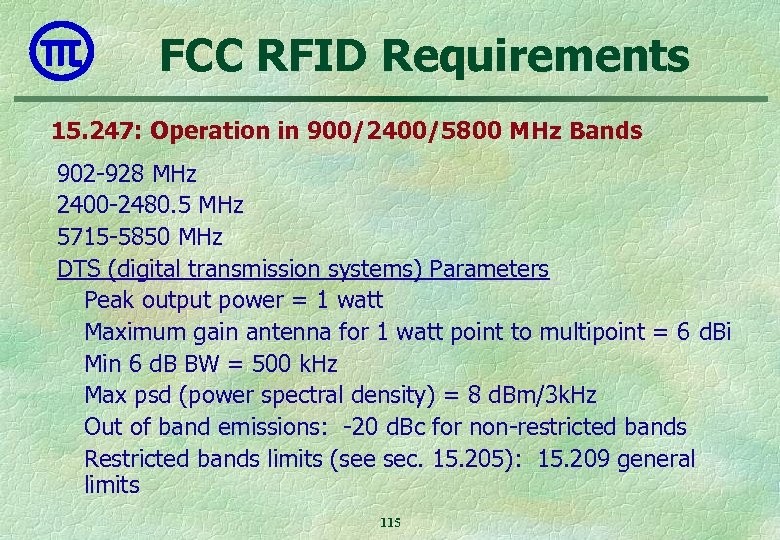
FCC RFID Requirements 15. 247: Operation in 900/2400/5800 MHz Bands 902 -928 MHz 2400 -2480. 5 MHz 5715 -5850 MHz DTS (digital transmission systems) Parameters Peak output power = 1 watt Maximum gain antenna for 1 watt point to multipoint = 6 d. Bi Min 6 d. B BW = 500 k. Hz Max psd (power spectral density) = 8 d. Bm/3 k. Hz Out of band emissions: -20 d. Bc for non-restricted bands Restricted bands limits (see sec. 15. 205): 15. 209 general limits 115
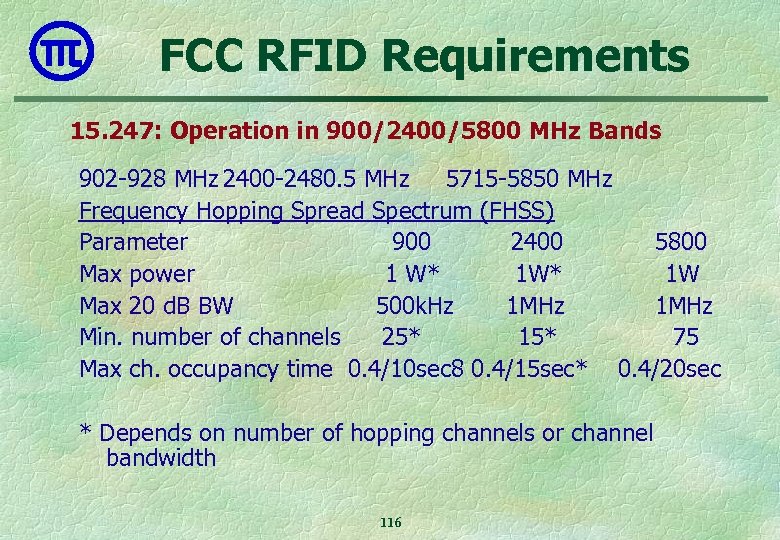
FCC RFID Requirements 15. 247: Operation in 900/2400/5800 MHz Bands 902 -928 MHz 2400 -2480. 5 MHz 5715 -5850 MHz Frequency Hopping Spread Spectrum (FHSS) Parameter 900 2400 5800 Max power 1 W* 1 W* 1 W Max 20 d. B BW 500 k. Hz 1 MHz Min. number of channels 25* 15* 75 Max ch. occupancy time 0. 4/10 sec 8 0. 4/15 sec* 0. 4/20 sec * Depends on number of hopping channels or channel bandwidth 116
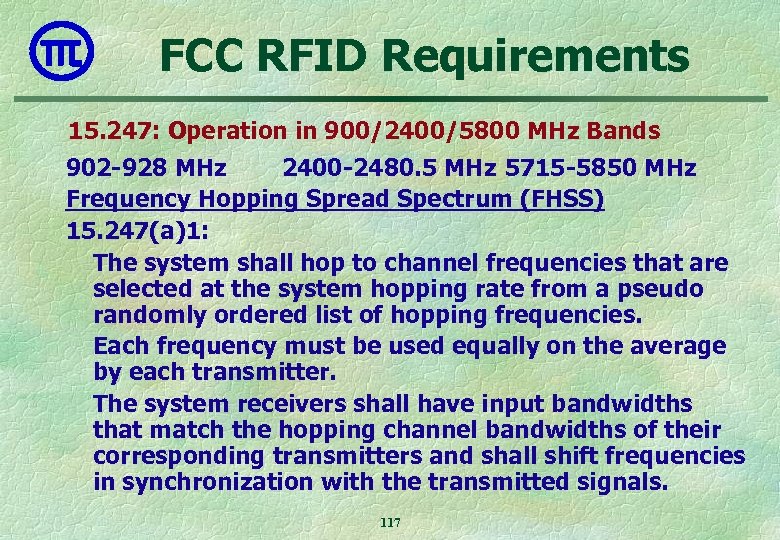
FCC RFID Requirements 15. 247: Operation in 900/2400/5800 MHz Bands 902 -928 MHz 2400 -2480. 5 MHz 5715 -5850 MHz Frequency Hopping Spread Spectrum (FHSS) 15. 247(a)1: The system shall hop to channel frequencies that are selected at the system hopping rate from a pseudo randomly ordered list of hopping frequencies. Each frequency must be used equally on the average by each transmitter. The system receivers shall have input bandwidths that match the hopping channel bandwidths of their corresponding transmitters and shall shift frequencies in synchronization with the transmitted signals. 117
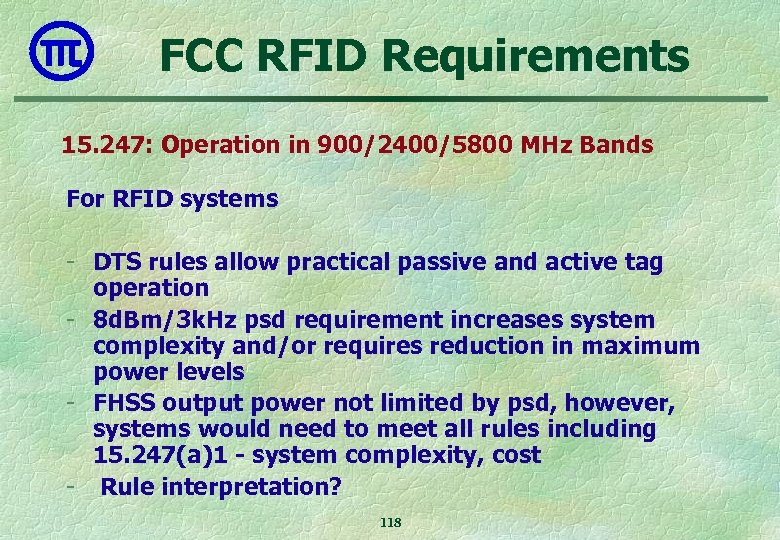
FCC RFID Requirements 15. 247: Operation in 900/2400/5800 MHz Bands For RFID systems - DTS rules allow practical passive and active tag operation - 8 d. Bm/3 k. Hz psd requirement increases system complexity and/or requires reduction in maximum power levels - FHSS output power not limited by psd, however, systems would need to meet all rules including 15. 247(a)1 - system complexity, cost - Rule interpretation? 118
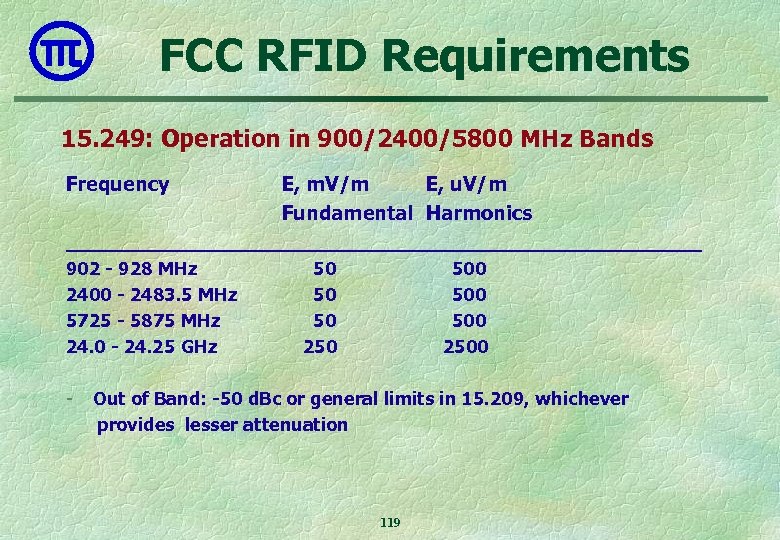
FCC RFID Requirements 15. 249: Operation in 900/2400/5800 MHz Bands Frequency E, m. V/m E, u. V/m Fundamental Harmonics _________________________ 902 - 928 MHz 2400 - 2483. 5 MHz 5725 - 5875 MHz 24. 0 - 24. 25 GHz - 50 50 50 250 500 500 2500 Out of Band: -50 d. Bc or general limits in 15. 209, whichever provides lesser attenuation 119
FCC RFID Requirements 15. 249: Operation in 900/2400/5800 MHz Bands - RF levels too low for practical passive tag operation at large distance - Active tags up to 1250 ft per some mfr claims (900 MHz) 120
Do. D RFID Requirements Military RFID regulations ❧ Testing requirements vary depending on installation environment ❧ Testing would normally include : v Radiated susceptibility (Mil. Std 461) v ESD (Mil. Std 461) v Radiated emissions for EMCON under (Mil. Std 464) v Testing would be on tags as well as readers 121
Do. D RFID Requirements Product Integrity Verification ❧ False Product ❧ Tampered Product v Adulteration v Substitution v Re Labeling ❧ Unacceptable Status of Product v Expired v Discarded v Recalled v Poor Quality 122
Do. D RFID Requirements EPC Testing ❧ EPCglobal owns the Certification Program criteria ❧ Program Implementation will be through the Member Organization network on a national/regional basis ❧ Testing Centers will only be launched through EPCglobal ❧ First Lab will be located in North America ❧ EPC testing does not include FCC regulatory testing ❧ Do. D requires no additional testing beyond FCC regulatory testing for inventory purposes at this time. 123
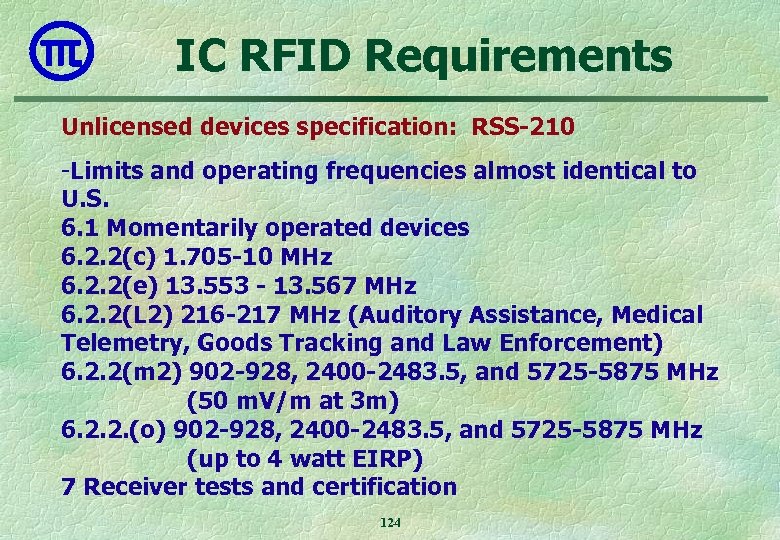
IC RFID Requirements Unlicensed devices specification: RSS-210 -Limits and operating frequencies almost identical to U. S. 6. 1 Momentarily operated devices 6. 2. 2(c) 1. 705 -10 MHz 6. 2. 2(e) 13. 553 - 13. 567 MHz 6. 2. 2(L 2) 216 -217 MHz (Auditory Assistance, Medical Telemetry, Goods Tracking and Law Enforcement) 6. 2. 2(m 2) 902 -928, 2400 -2483. 5, and 5725 -5875 MHz (50 m. V/m at 3 m) 6. 2. 2. (o) 902 -928, 2400 -2483. 5, and 5725 -5875 MHz (up to 4 watt EIRP) 7 Receiver tests and certification 124
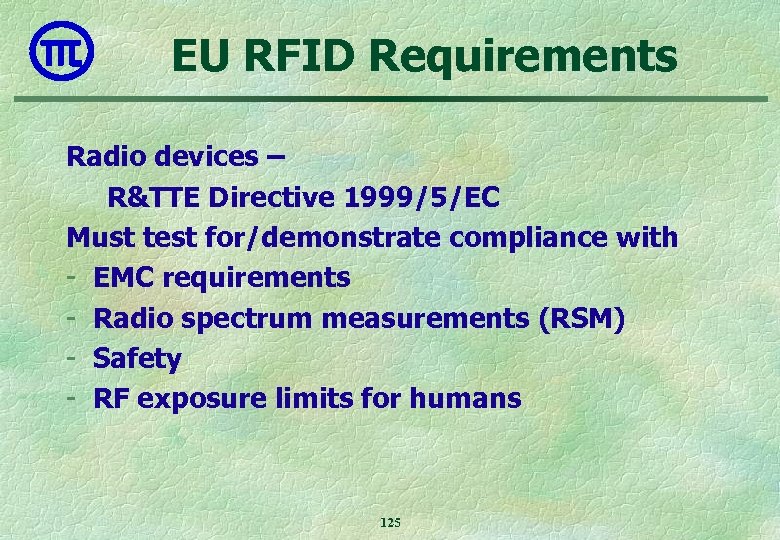
EU RFID Requirements Radio devices – R&TTE Directive 1999/5/EC Must test for/demonstrate compliance with - EMC requirements - Radio spectrum measurements (RSM) - Safety - RF exposure limits for humans 125
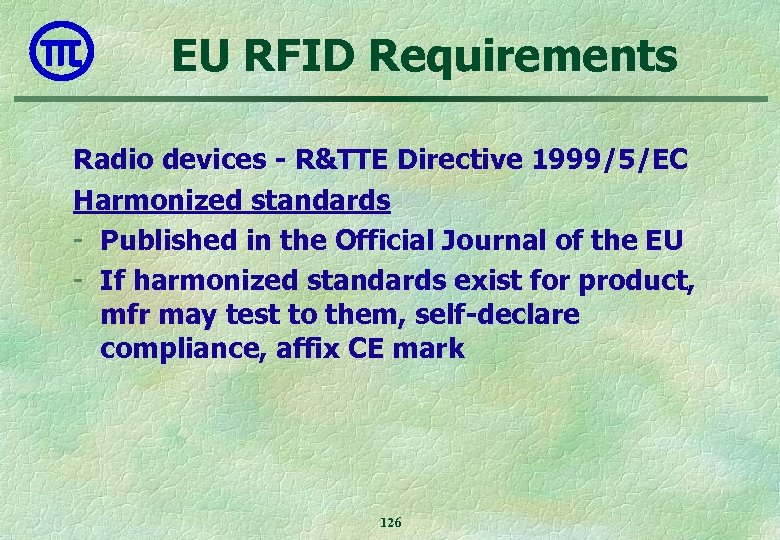
EU RFID Requirements Radio devices - R&TTE Directive 1999/5/EC Harmonized standards - Published in the Official Journal of the EU - If harmonized standards exist for product, mfr may test to them, self-declare compliance, affix CE mark 126
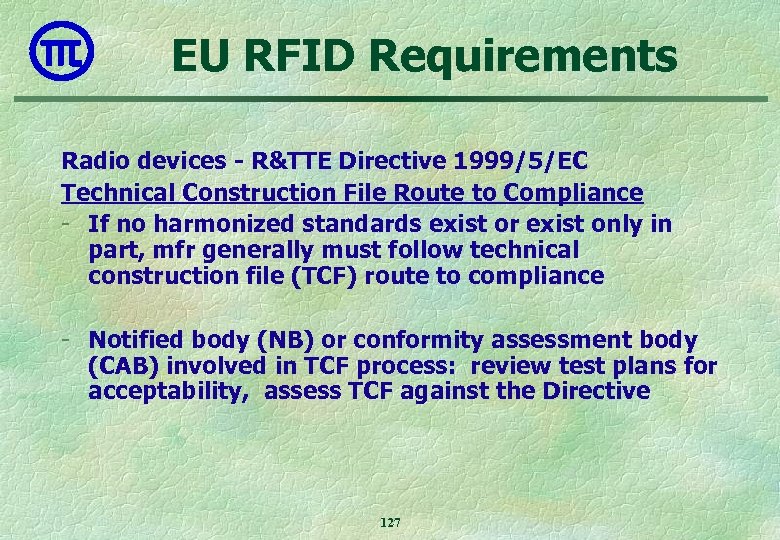
EU RFID Requirements Radio devices - R&TTE Directive 1999/5/EC Technical Construction File Route to Compliance - If no harmonized standards exist or exist only in part, mfr generally must follow technical construction file (TCF) route to compliance - Notified body (NB) or conformity assessment body (CAB) involved in TCF process: review test plans for acceptability, assess TCF against the Directive 127
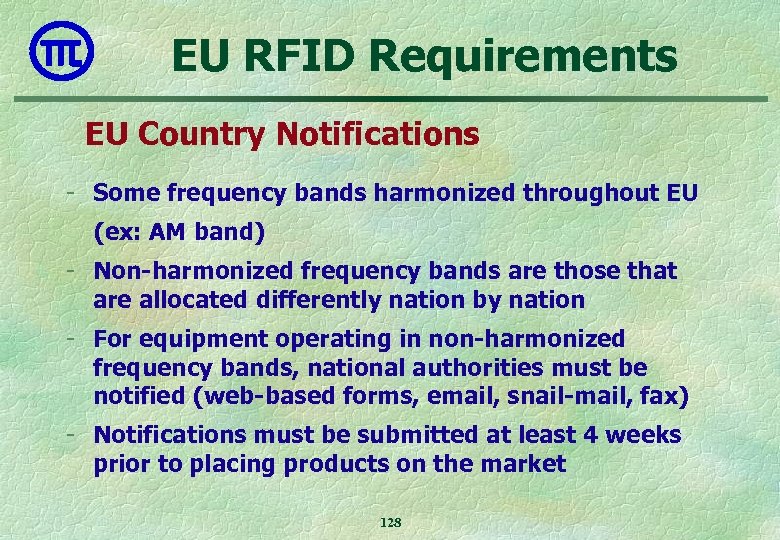
EU RFID Requirements EU Country Notifications - Some frequency bands harmonized throughout EU (ex: AM band) - Non-harmonized frequency bands are those that are allocated differently nation by nation - For equipment operating in non-harmonized frequency bands, national authorities must be notified (web-based forms, email, snail-mail, fax) - Notifications must be submitted at least 4 weeks prior to placing products on the market 128
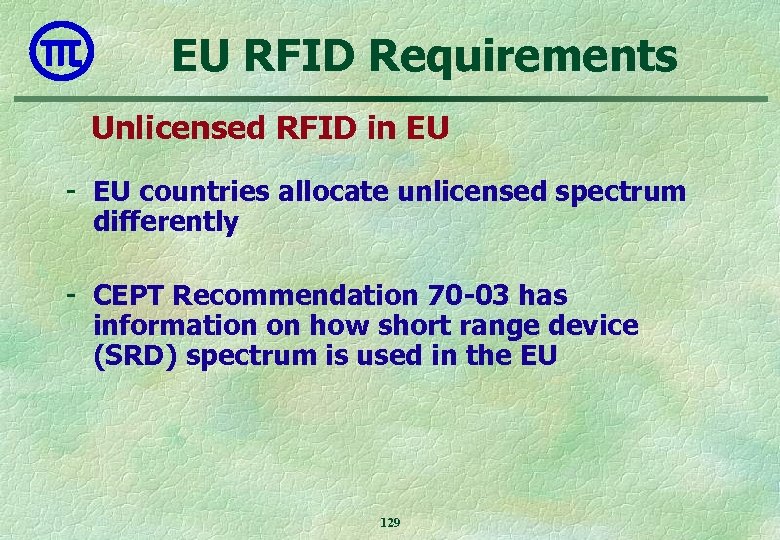
EU RFID Requirements Unlicensed RFID in EU - EU countries allocate unlicensed spectrum differently - CEPT Recommendation 70 -03 has information on how short range device (SRD) spectrum is used in the EU 129
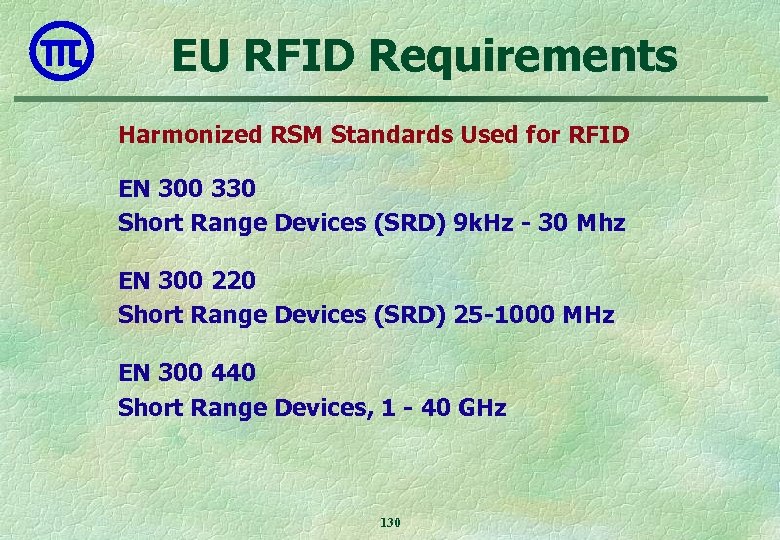
EU RFID Requirements Harmonized RSM Standards Used for RFID EN 300 330 Short Range Devices (SRD) 9 k. Hz - 30 Mhz EN 300 220 Short Range Devices (SRD) 25 -1000 MHz EN 300 440 Short Range Devices, 1 - 40 GHz 130
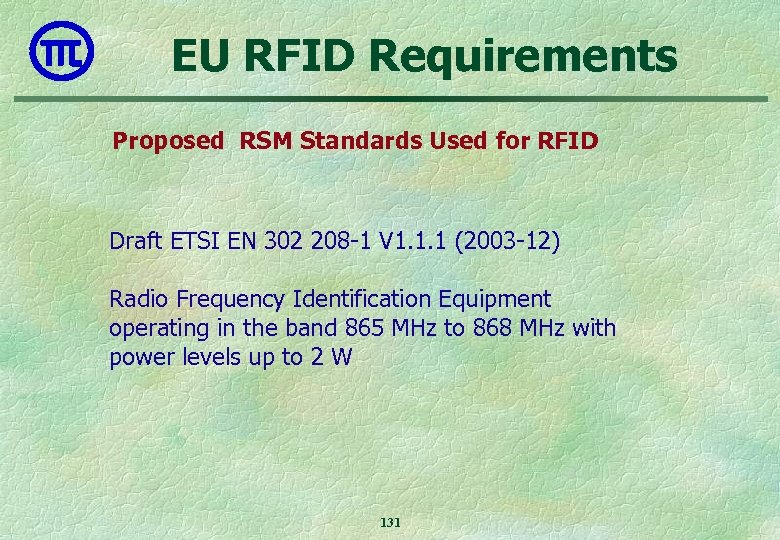
EU RFID Requirements Proposed RSM Standards Used for RFID Draft ETSI EN 302 208 -1 V 1. 1. 1 (2003 -12) Radio Frequency Identification Equipment operating in the band 865 MHz to 868 MHz with power levels up to 2 W 131
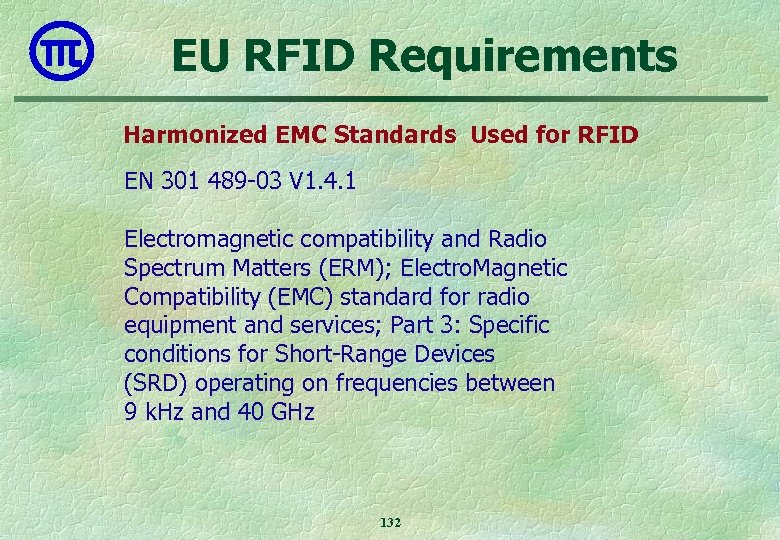
EU RFID Requirements Harmonized EMC Standards Used for RFID EN 301 489 -03 V 1. 4. 1 Electromagnetic compatibility and Radio Spectrum Matters (ERM); Electro. Magnetic Compatibility (EMC) standard for radio equipment and services; Part 3: Specific conditions for Short-Range Devices (SRD) operating on frequencies between 9 k. Hz and 40 GHz 132
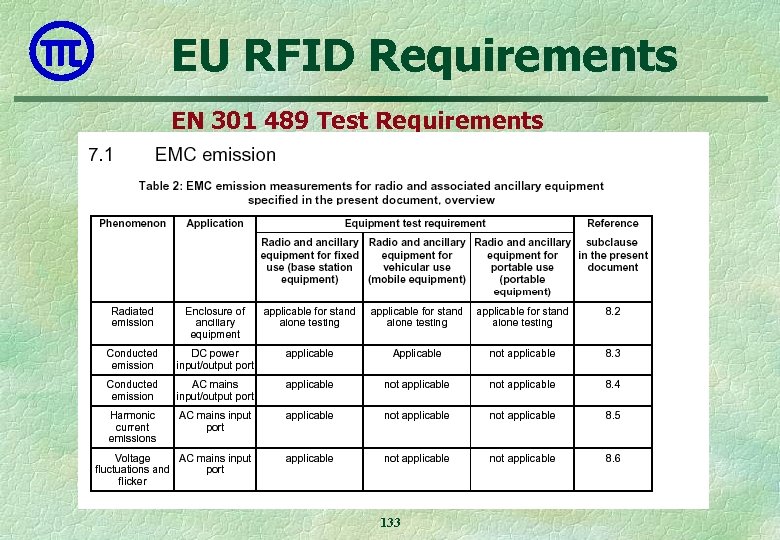
EU RFID Requirements EN 301 489 Test Requirements 133
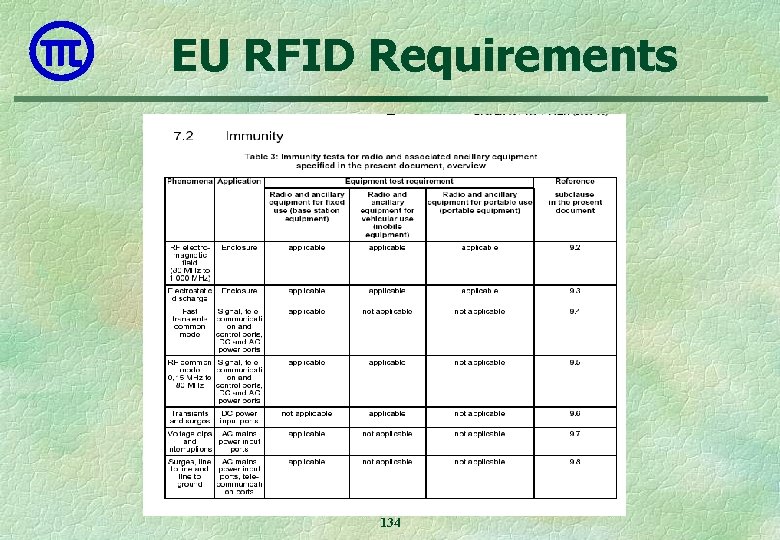
EU RFID Requirements 134
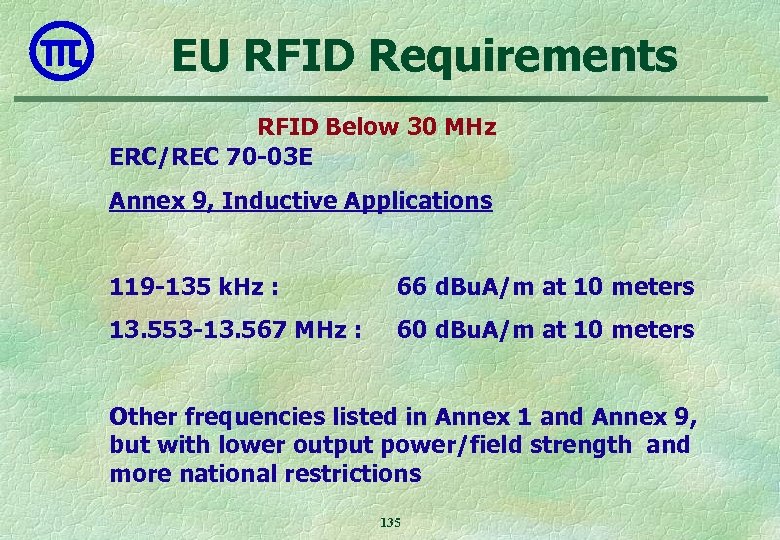
EU RFID Requirements RFID Below 30 MHz ERC/REC 70 -03 E Annex 9, Inductive Applications 119 -135 k. Hz : 66 d. Bu. A/m at 10 meters 13. 553 -13. 567 MHz : 60 d. Bu. A/m at 10 meters Other frequencies listed in Annex 1 and Annex 9, but with lower output power/field strength and more national restrictions 135
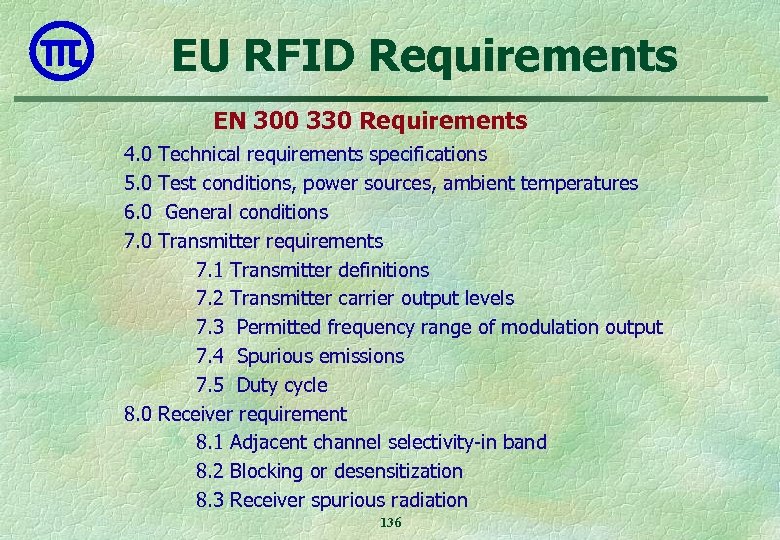
EU RFID Requirements EN 300 330 Requirements 4. 0 Technical requirements specifications 5. 0 Test conditions, power sources, ambient temperatures 6. 0 General conditions 7. 0 Transmitter requirements 7. 1 Transmitter definitions 7. 2 Transmitter carrier output levels 7. 3 Permitted frequency range of modulation output 7. 4 Spurious emissions 7. 5 Duty cycle 8. 0 Receiver requirement 8. 1 Adjacent channel selectivity-in band 8. 2 Blocking or desensitization 8. 3 Receiver spurious radiation 136
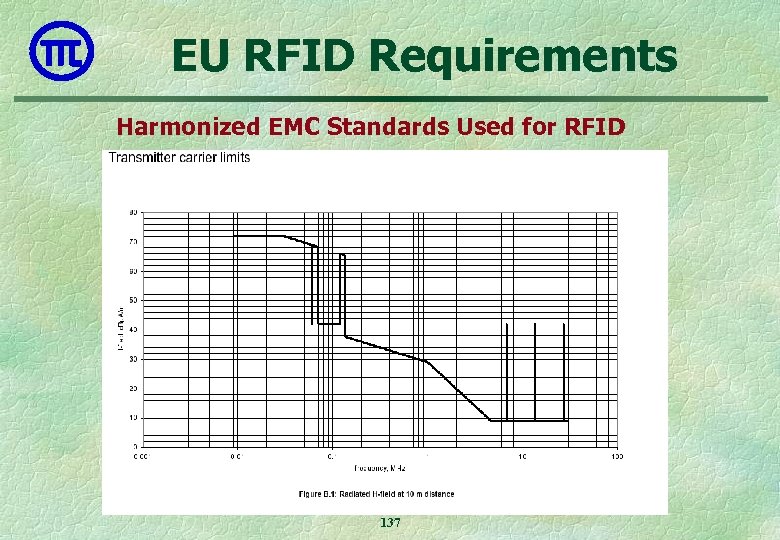
EU RFID Requirements Harmonized EMC Standards Used for RFID 137
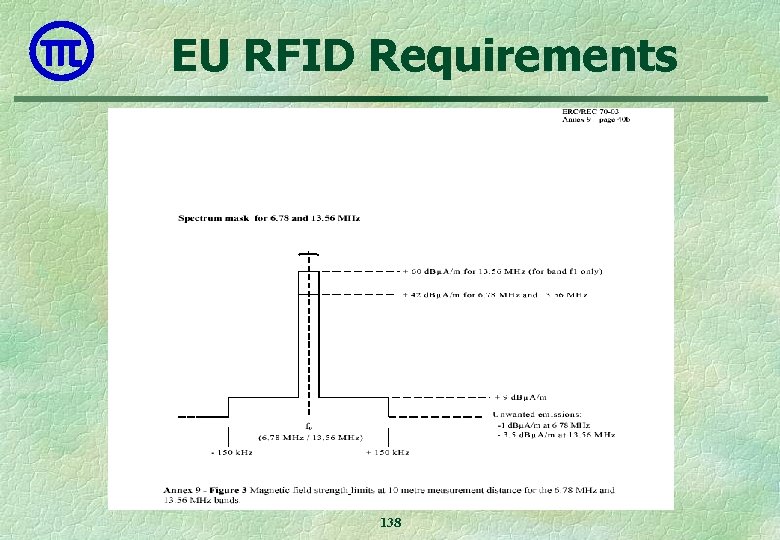
EU RFID Requirements 138
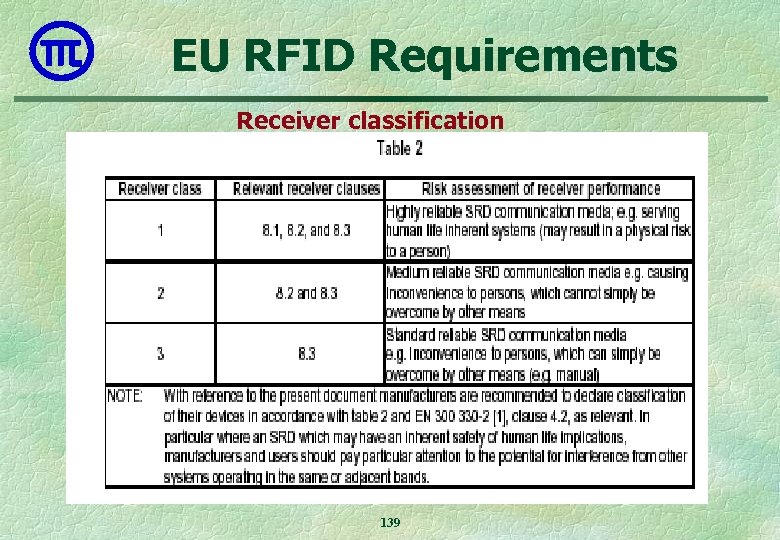
EU RFID Requirements Receiver classification 139
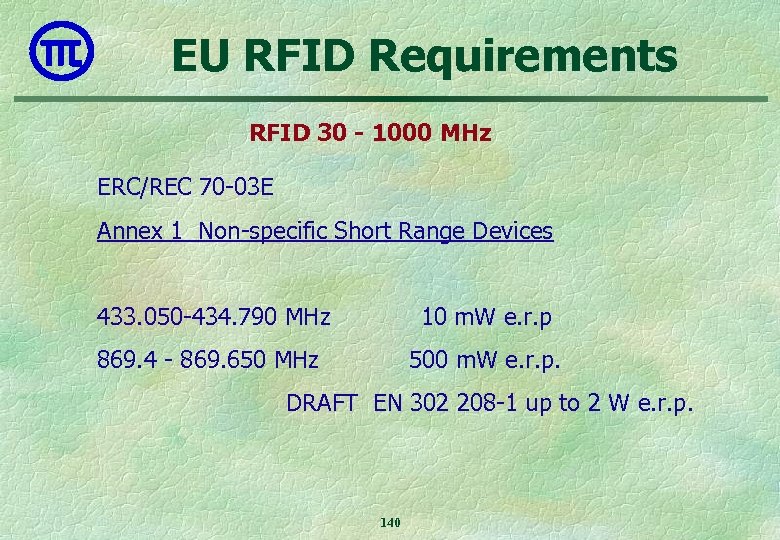
EU RFID Requirements RFID 30 - 1000 MHz ERC/REC 70 -03 E Annex 1 Non-specific Short Range Devices 433. 050 -434. 790 MHz 10 m. W e. r. p 869. 4 - 869. 650 MHz 500 m. W e. r. p. DRAFT EN 302 208 -1 up to 2 W e. r. p. 140
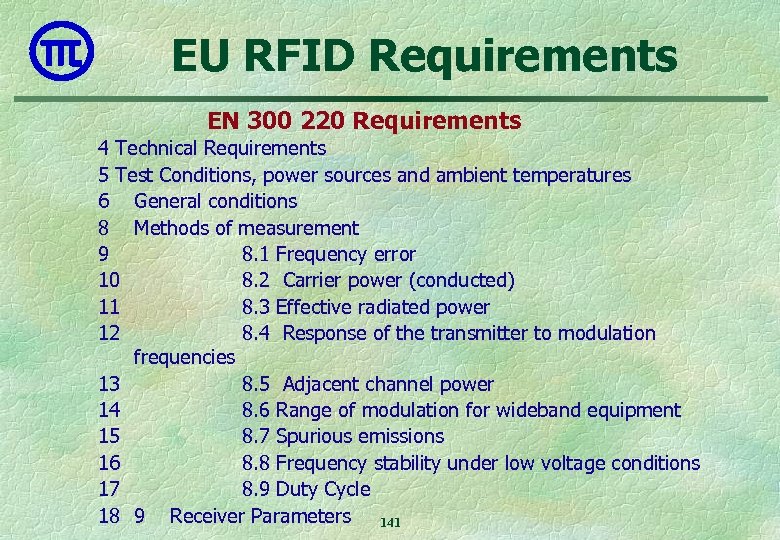
EU RFID Requirements EN 300 220 Requirements 4 Technical Requirements 5 Test Conditions, power sources and ambient temperatures 6 General conditions 8 Methods of measurement 9 8. 1 Frequency error 10 8. 2 Carrier power (conducted) 11 8. 3 Effective radiated power 12 8. 4 Response of the transmitter to modulation frequencies 13 8. 5 Adjacent channel power 14 8. 6 Range of modulation for wideband equipment 15 8. 7 Spurious emissions 16 8. 8 Frequency stability under low voltage conditions 17 8. 9 Duty Cycle 18 9 Receiver Parameters 141
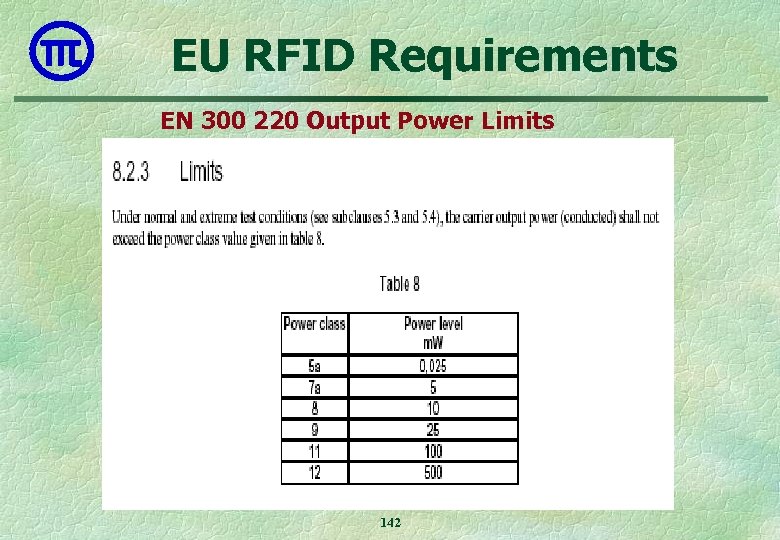
EU RFID Requirements EN 300 220 Output Power Limits 142
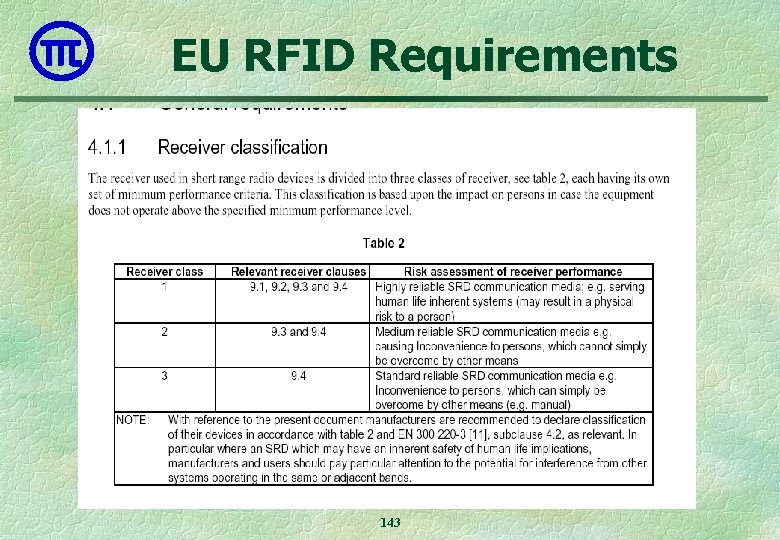
EU RFID Requirements 143
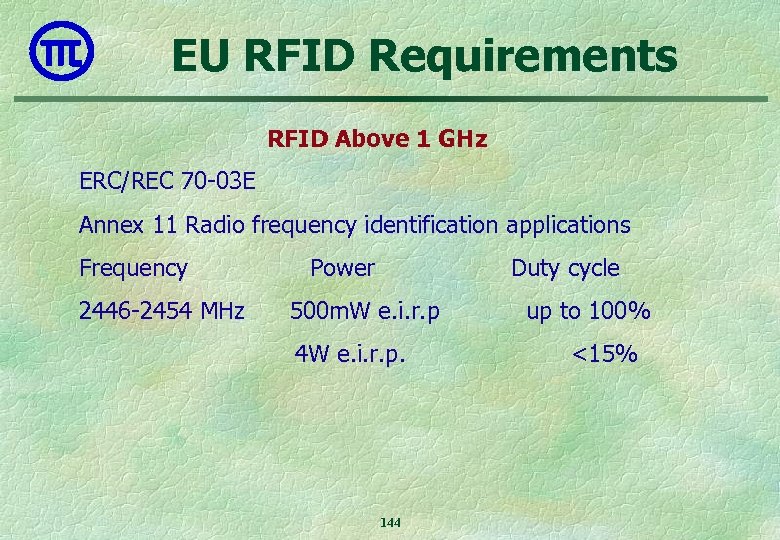
EU RFID Requirements RFID Above 1 GHz ERC/REC 70 -03 E Annex 11 Radio frequency identification applications Frequency Power Duty cycle 2446 -2454 MHz 500 m. W e. i. r. p up to 100% 4 W e. i. r. p. <15% 144
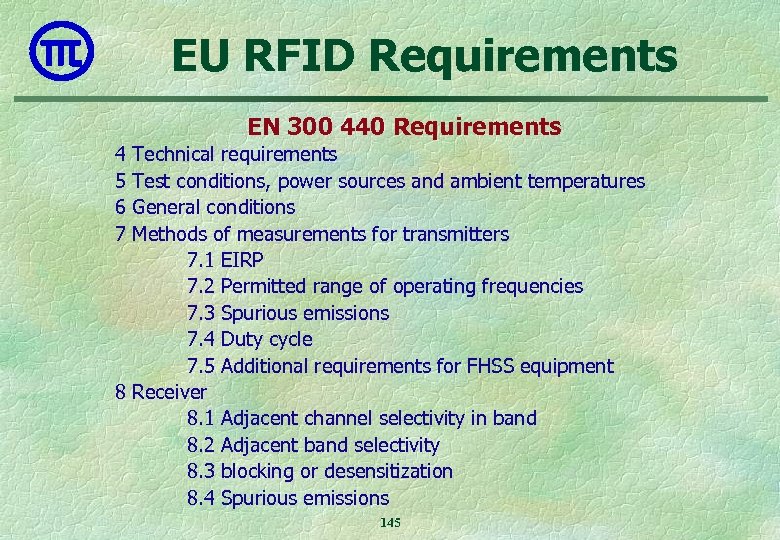
EU RFID Requirements EN 300 440 Requirements 4 Technical requirements 5 Test conditions, power sources and ambient temperatures 6 General conditions 7 Methods of measurements for transmitters 7. 1 EIRP 7. 2 Permitted range of operating frequencies 7. 3 Spurious emissions 7. 4 Duty cycle 7. 5 Additional requirements for FHSS equipment 8 Receiver 8. 1 Adjacent channel selectivity in band 8. 2 Adjacent band selectivity 8. 3 blocking or desensitization 8. 4 Spurious emissions 145
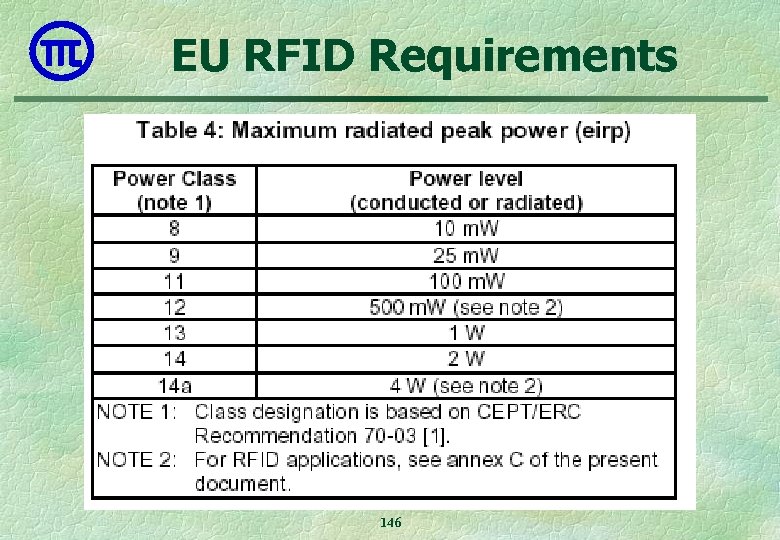
EU RFID Requirements 146
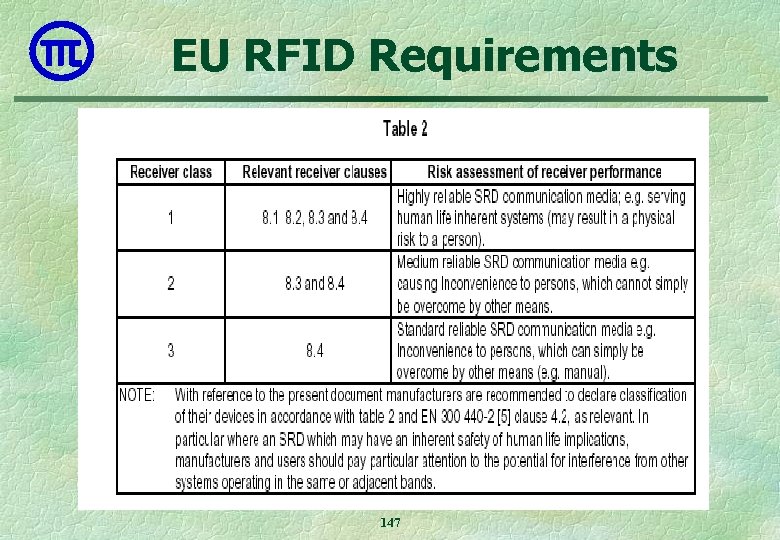
EU RFID Requirements 147
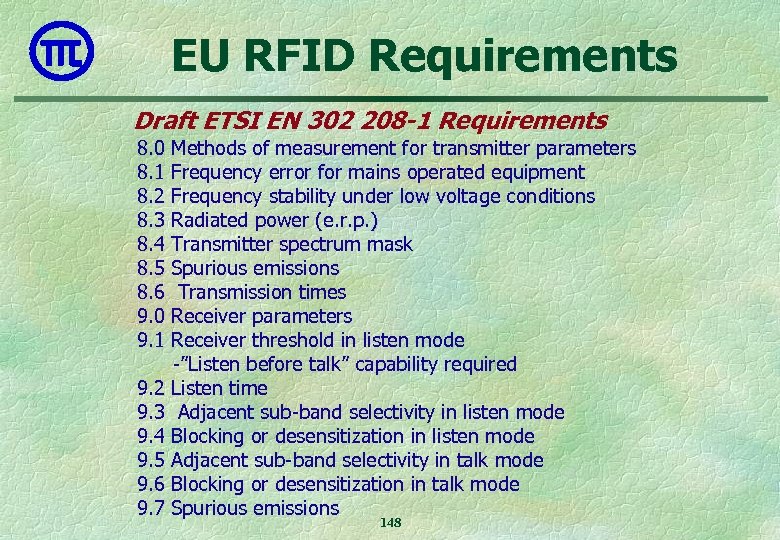
EU RFID Requirements Draft ETSI EN 302 208 -1 Requirements 8. 0 Methods of measurement for transmitter parameters 8. 1 Frequency error for mains operated equipment 8. 2 Frequency stability under low voltage conditions 8. 3 Radiated power (e. r. p. ) 8. 4 Transmitter spectrum mask 8. 5 Spurious emissions 8. 6 Transmission times 9. 0 Receiver parameters 9. 1 Receiver threshold in listen mode -”Listen before talk” capability required 9. 2 Listen time 9. 3 Adjacent sub-band selectivity in listen mode 9. 4 Blocking or desensitization in listen mode 9. 5 Adjacent sub-band selectivity in talk mode 9. 6 Blocking or desensitization in talk mode 9. 7 Spurious emissions 148
EU RFID Requirements Draft ETSI EN 302 208 -1 Requirements 149
EU RFID Requirements Draft ETSI EN 302 208 -1 Requirements 150
EU RFID Requirements Draft ETSI EN 302 208 -1 Requirements 151
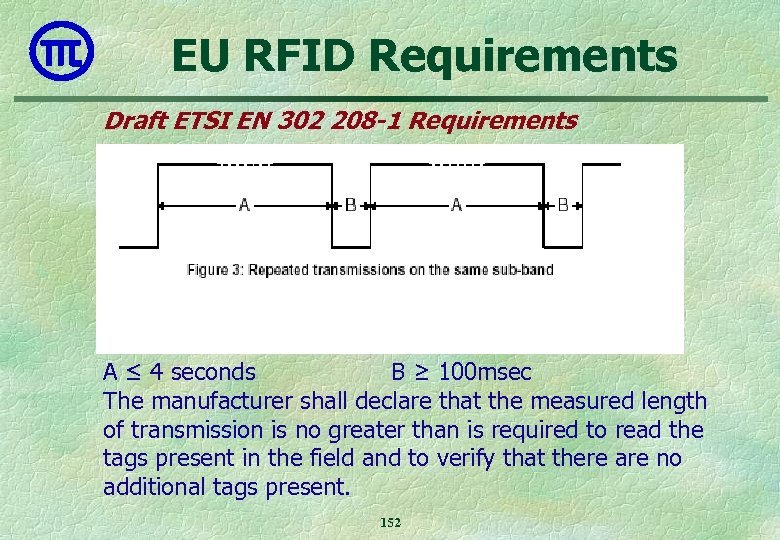
EU RFID Requirements Draft ETSI EN 302 208 -1 Requirements A ≤ 4 seconds B ≥ 100 msec The manufacturer shall declare that the measured length of transmission is no greater than is required to read the tags present in the field and to verify that there are no additional tags present. 152
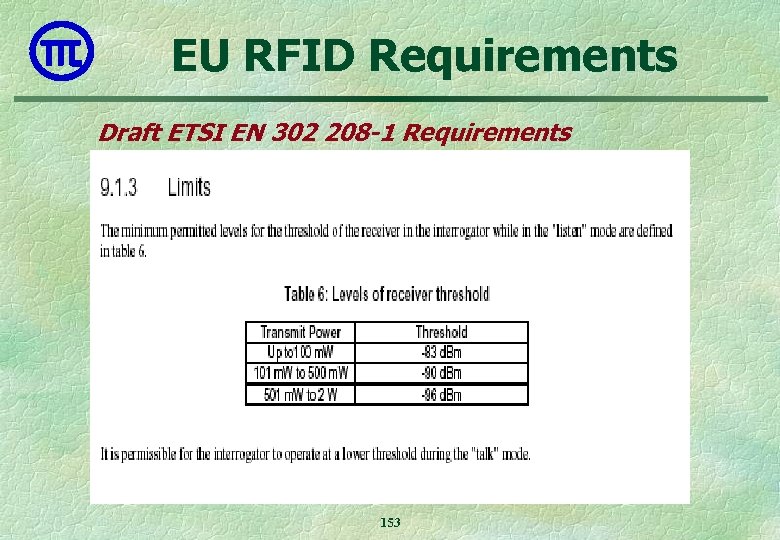
EU RFID Requirements Draft ETSI EN 302 208 -1 Requirements 153
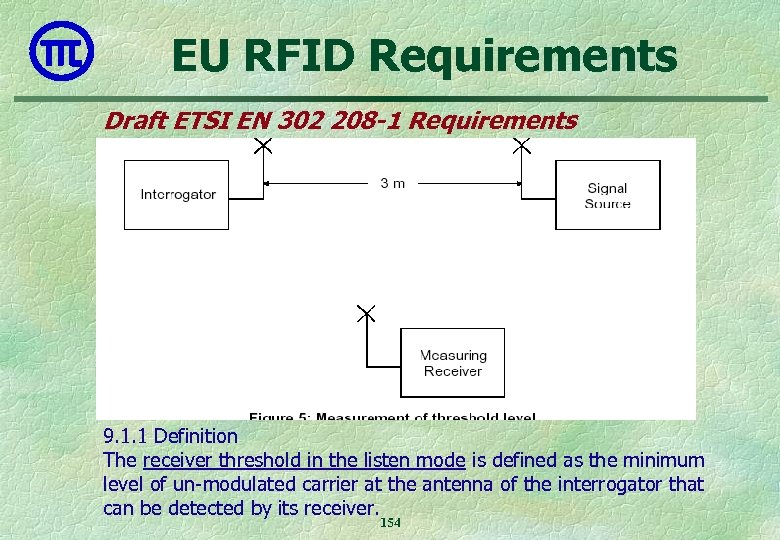
EU RFID Requirements Draft ETSI EN 302 208 -1 Requirements 9. 1. 1 Definition The receiver threshold in the listen mode is defined as the minimum level of un-modulated carrier at the antenna of the interrogator that can be detected by its receiver. 154
EU RFID Requirements Draft ETSI EN 302 208 -1 Requirements 9. 2 Listen Time The manufacturers shall declare that immediately prior to each transmission the receiver in the interrogator shall first monitor for a period of at least 1 msec for the presence of another signal within its intended subband of transmission. 155
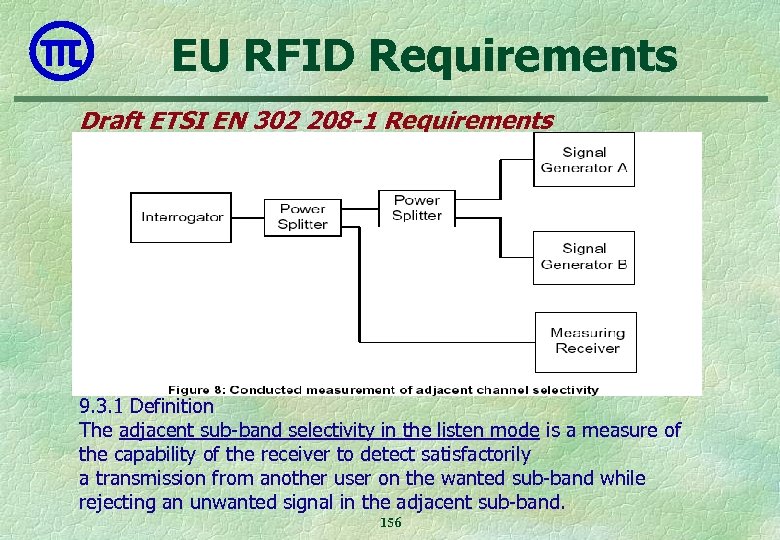
EU RFID Requirements Draft ETSI EN 302 208 -1 Requirements 9. 3. 1 Definition The adjacent sub-band selectivity in the listen mode is a measure of the capability of the receiver to detect satisfactorily a transmission from another user on the wanted sub-band while rejecting an unwanted signal in the adjacent sub-band. 156
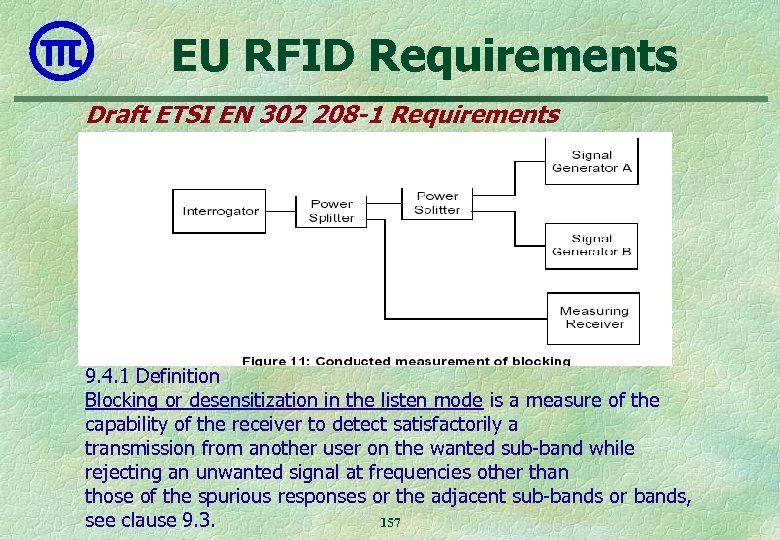
EU RFID Requirements Draft ETSI EN 302 208 -1 Requirements 9. 4. 1 Definition Blocking or desensitization in the listen mode is a measure of the capability of the receiver to detect satisfactorily a transmission from another user on the wanted sub-band while rejecting an unwanted signal at frequencies other than those of the spurious responses or the adjacent sub-bands or bands, 157 see clause 9. 3.
EU RFID Requirements Draft ETSI EN 302 208 -1 Requirements 9. 5. 1 Definition The adjacent sub-band selectivity in the talk mode is a measure of the capability of the receiver to identify a tag while rejecting an unwanted signal in the adjacent sub-band. 9. 6. 1 Definition Blocking or desensitization in the talk mode is a measure of the capability of the receiver to identify a tag in the presence of an unwanted input signal at frequencies other than those of the spurious responses or the adjacent sub-bands or bands, see clause 9. 1. 9. 7. 3 Spurious emissions limits The limits are applicable to all receiver classes. The power of any spurious emission, radiated or conducted, shall not exceed the values given below: 2 n. W below 1 000 MHz; 20 n. W above 1 000 MHz. 158
Japan RFID Requirements National Telecommunications Authority. MPHPT: Ministry of Public Management, Home Affairs, Posts and Telecommunications: http: //www. soumu. go. jp/joho_tsusin/eng/ “The Radio Use Website” - includes link to radio equipment regulations: http : //www. tele. soumu. go. jp/e/index. htm 159
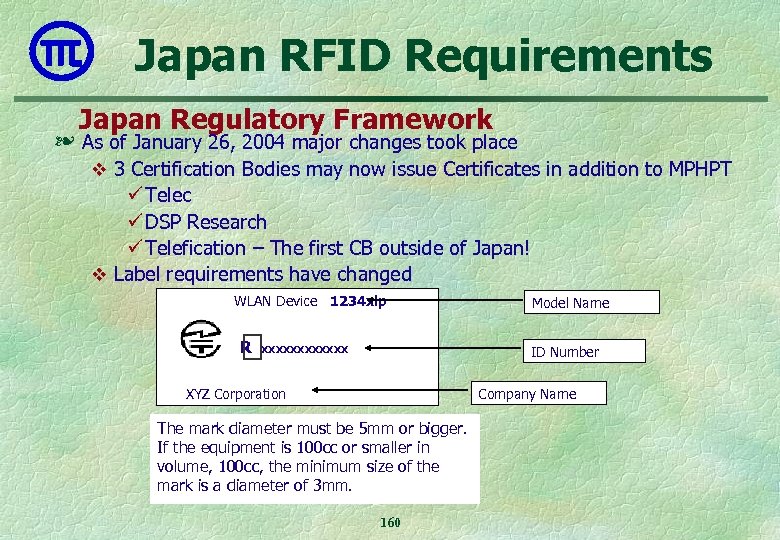
Japan RFID Requirements Japan Regulatory Framework ❧ As of January 26, 2004 major changes took place v 3 Certification Bodies may now issue Certificates in addition to MPHPT ü Telec ü DSP Research ü Telefication – The first CB outside of Japan! v Label requirements have changed WLAN Device 1234 xlp Model Name R xxxxxx ID Number XYZ Corporation Company Name The mark diameter must be 5 mm or bigger. If the equipment is 100 cc or smaller in volume, 100 cc, the minimum size of the mark is a diameter of 3 mm. 160
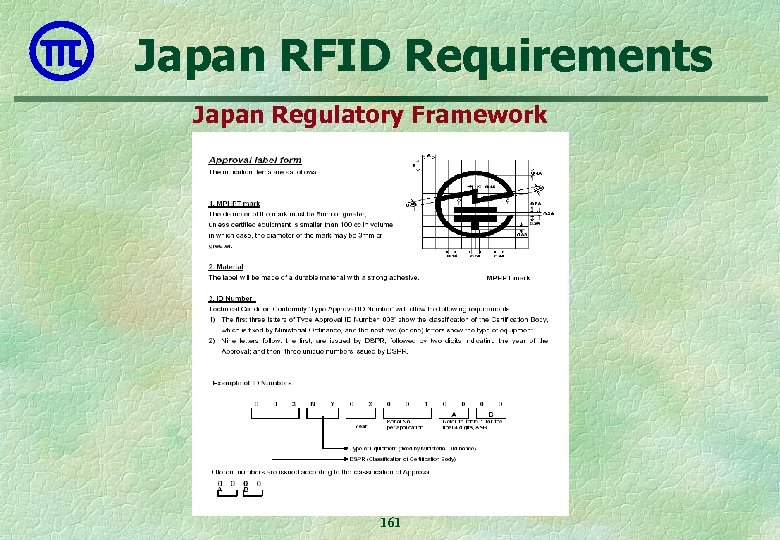
Japan RFID Requirements Japan Regulatory Framework 161
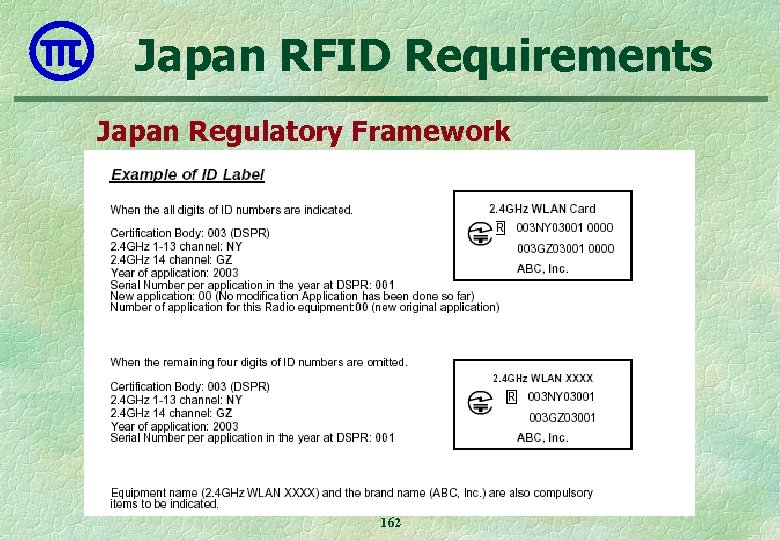
Japan RFID Requirements Japan Regulatory Framework 162
Japan RFID Requirements TELEC - provide a technical regulations conformity certification service and a calibration service for measuring devices under designation by MPHPT TELEC url: http: //www. telec. or. jp/ENG/e-002. htm 163
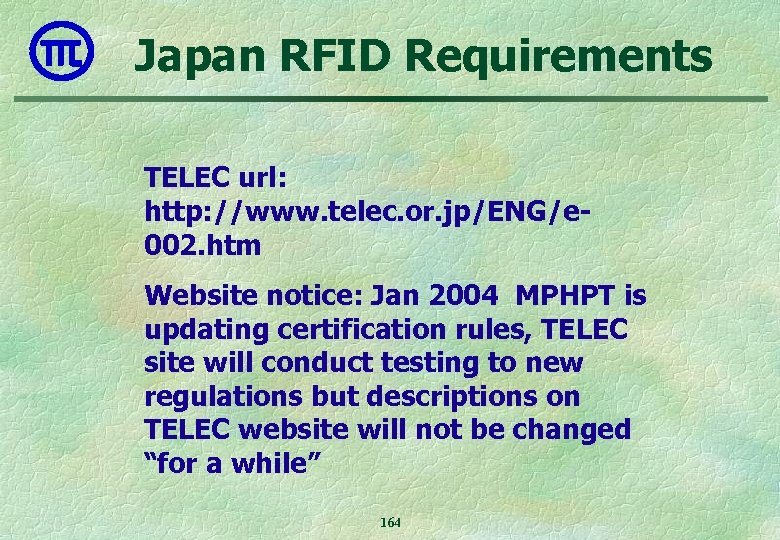
Japan RFID Requirements TELEC url: http: //www. telec. or. jp/ENG/e 002. htm Website notice: Jan 2004 MPHPT is updating certification rules, TELEC site will conduct testing to new regulations but descriptions on TELEC website will not be changed “for a while” 164
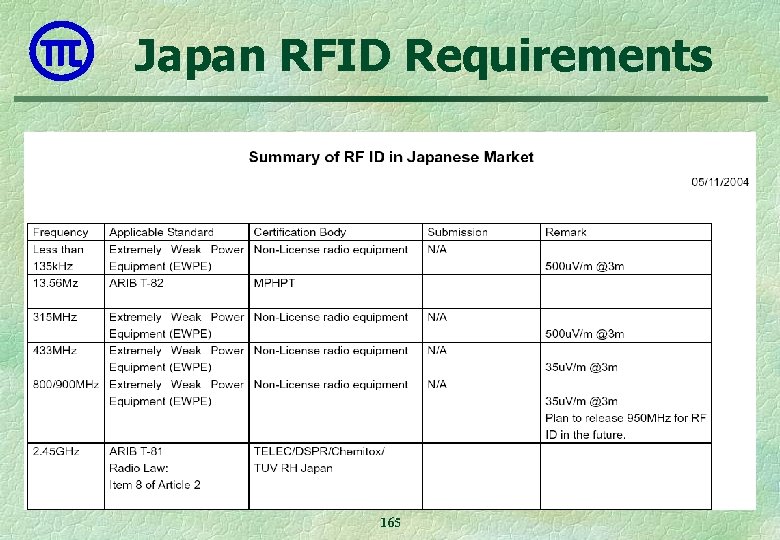
Japan RFID Requirements 165
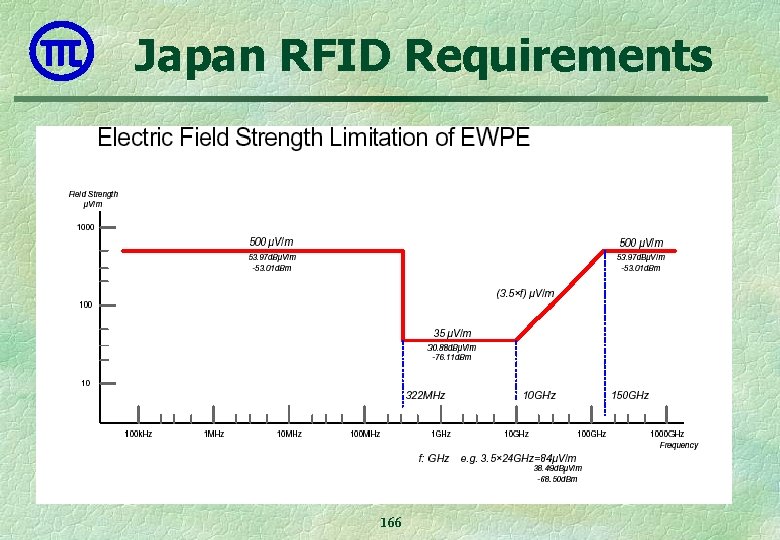
Japan RFID Requirements 166
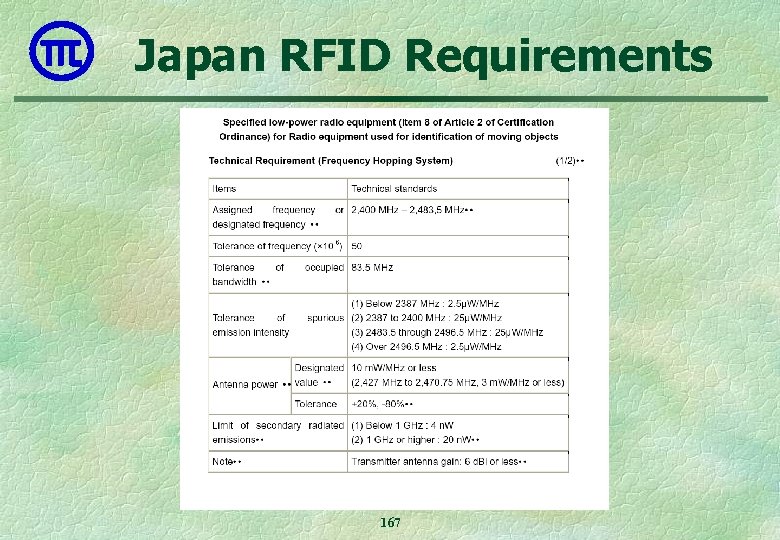
Japan RFID Requirements 167
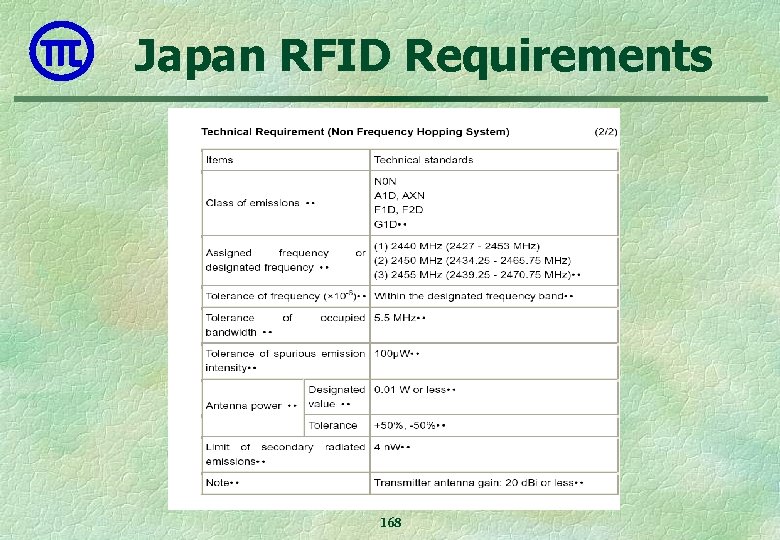
Japan RFID Requirements 168
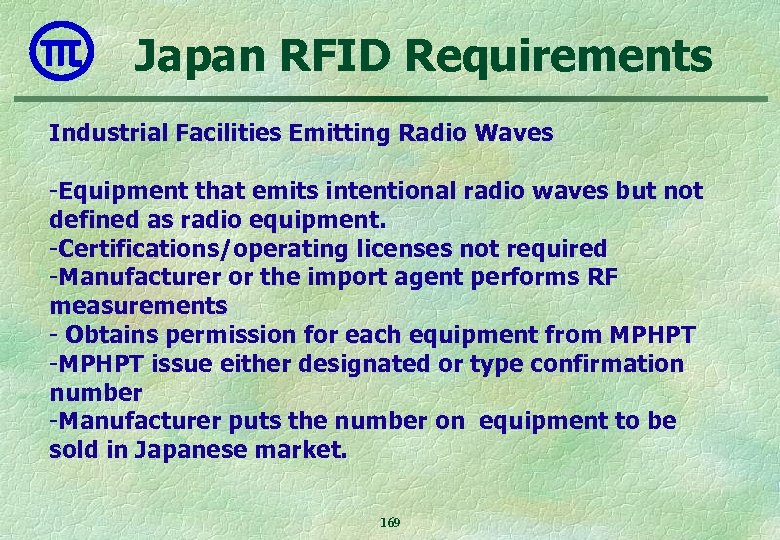
Japan RFID Requirements Industrial Facilities Emitting Radio Waves -Equipment that emits intentional radio waves but not defined as radio equipment. -Certifications/operating licenses not required -Manufacturer or the import agent performs RF measurements - Obtains permission for each equipment from MPHPT -MPHPT issue either designated or type confirmation number -Manufacturer puts the number on equipment to be sold in Japanese market. 169
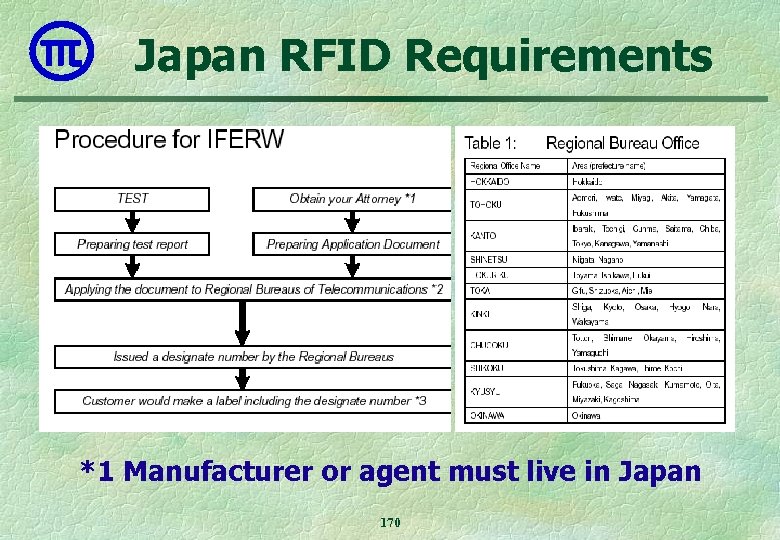
Japan RFID Requirements *1 Manufacturer or agent must live in Japan 170
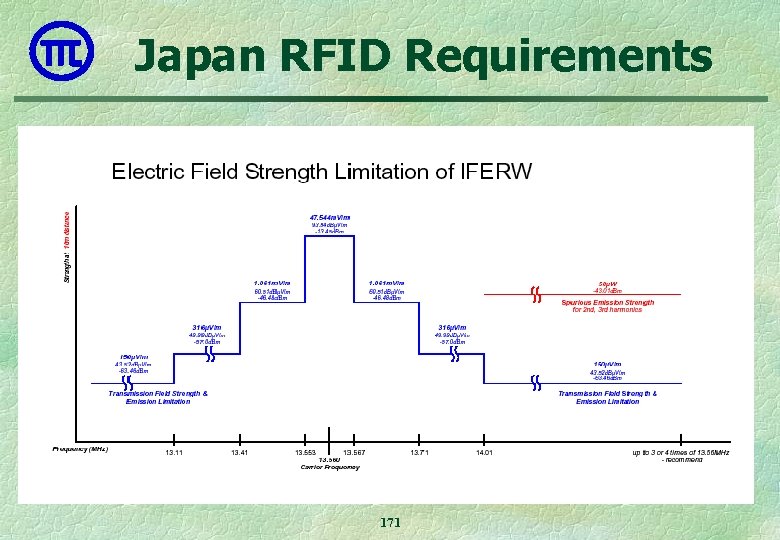
Japan RFID Requirements 171
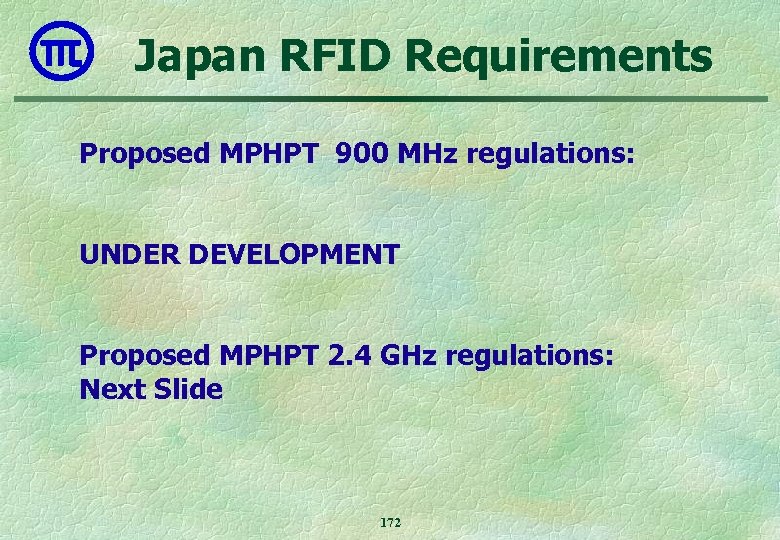
Japan RFID Requirements Proposed MPHPT 900 MHz regulations: UNDER DEVELOPMENT Proposed MPHPT 2. 4 GHz regulations: Next Slide 172
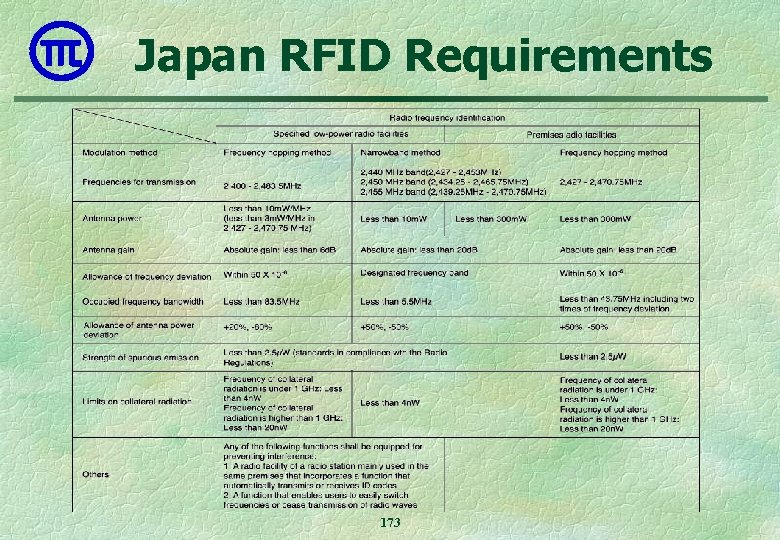
Japan RFID Requirements 173
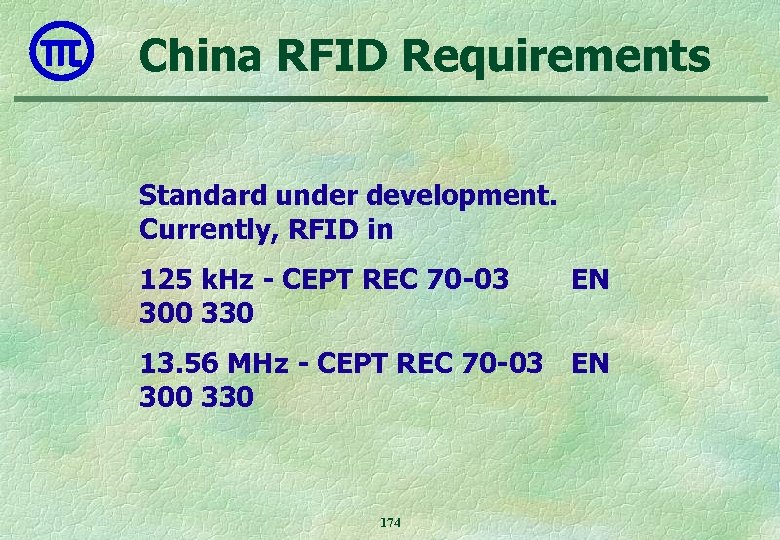
China RFID Requirements Standard under development. Currently, RFID in 125 k. Hz - CEPT REC 70 -03 300 330 EN 13. 56 MHz - CEPT REC 70 -03 EN 300 330 174
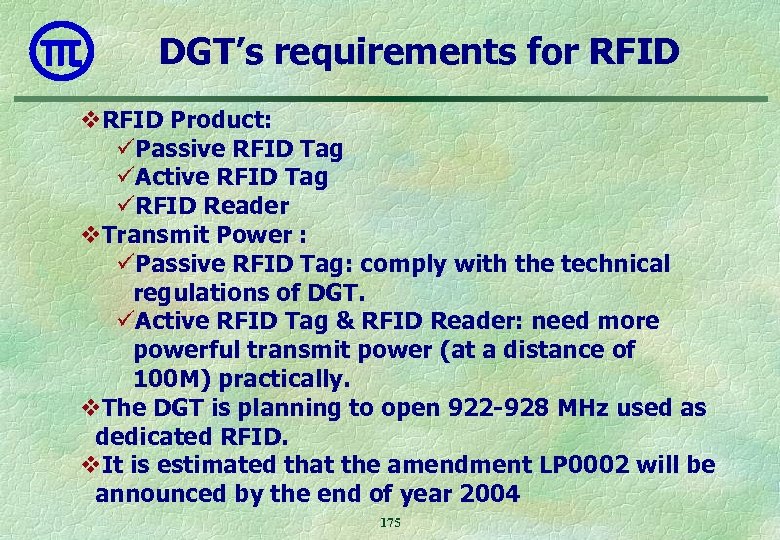
DGT’s requirements for RFID v. RFID Product: üPassive RFID Tag üActive RFID Tag üRFID Reader v. Transmit Power : üPassive RFID Tag: comply with the technical regulations of DGT. üActive RFID Tag & RFID Reader: need more powerful transmit power (at a distance of 100 M) practically. v. The DGT is planning to open 922 -928 MHz used as dedicated RFID. v. It is estimated that the amendment LP 0002 will be announced by the end of year 2004 175
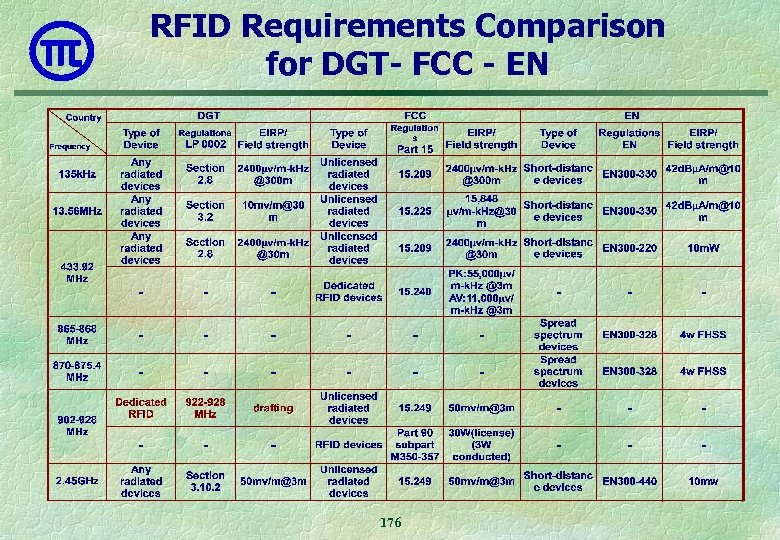
RFID Requirements Comparison for DGT- FCC - EN 176

簡報完畢 敬請指教 91. 12. 24. 電信技術中心計畫簡報
Скачать презентацию 無線通訊技術與法規 報告人 許錫蘭 91 12 24 財團法人電信技術中心 中華民國九十三年十一月十 二日
9bcda4178795c2f372f0b8eac9d12712.ppt