 Скачать презентацию 會計學 Accounting Summer 2010 09 012009 05 22 NTUIB 2010
dca59f5721a29f0f000af3cb80684949.ppt
- Количество слайдов: 138



會計學 / Accounting Summer 2010/09/012009/05/ 22 NTUIB 2010. 09. 01
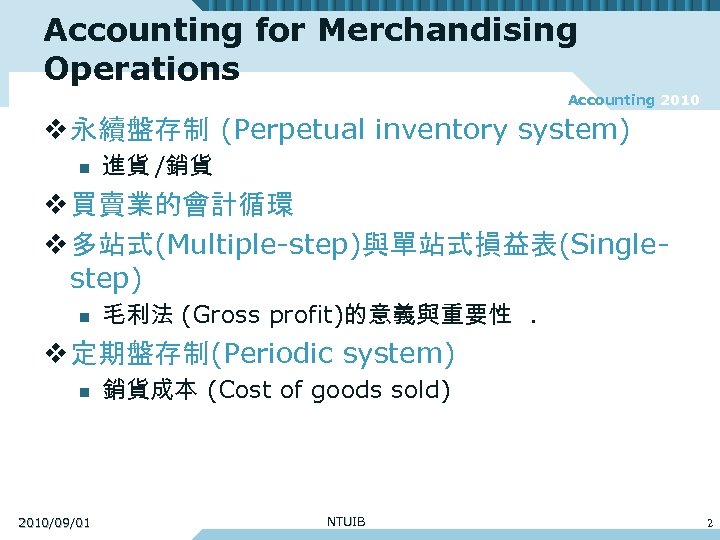
Accounting for Merchandising Operations Accounting 2010 v 永續盤存制 (Perpetual inventory system) n 進貨 /銷貨 v 買賣業的會計循環 v 多站式(Multiple-step)與單站式損益表(Singlestep) n 毛利法 (Gross profit)的意義與重要性. v 定期盤存制(Periodic system) n 2010/09/01 銷貨成本 (Cost of goods sold) NTUIB 2
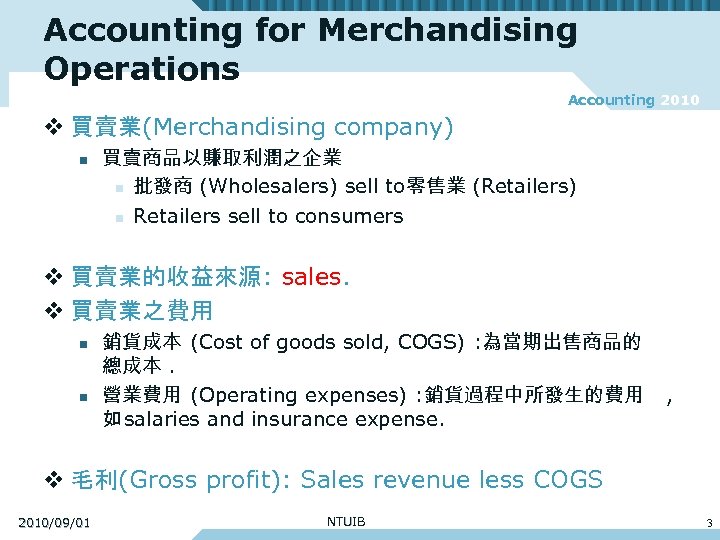
Accounting for Merchandising Operations Accounting 2010 v 買賣業(Merchandising company) n 買賣商品以賺取利潤之企業 n 批發商 (Wholesalers) sell to零售業 (Retailers) n Retailers sell to consumers v 買賣業的收益來源: sales. v 買賣業之費用 n n 銷貨成本 (Cost of goods sold, COGS) : 為當期出售商品的 總成本. 營業費用 (Operating expenses) : 銷貨過程中所發生的費用 如 salaries and insurance expense. , v 毛利(Gross profit): Sales revenue less COGS 2010/09/01 NTUIB 3
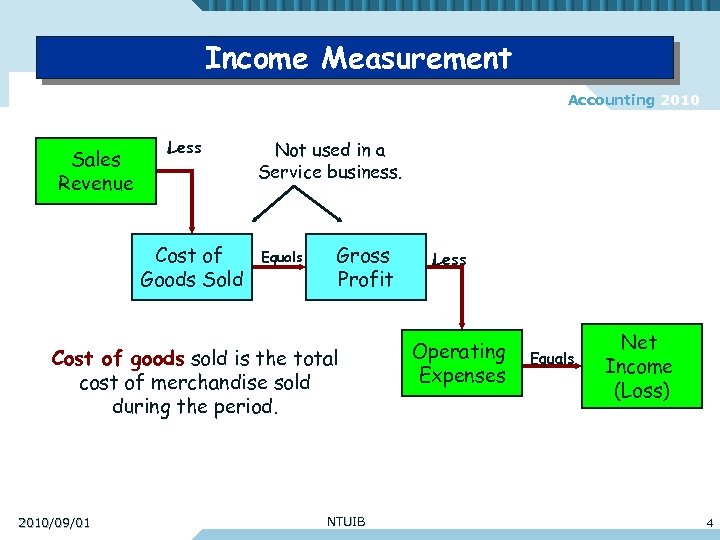
Income Measurement Accounting 2010 Sales Revenue Less Cost of Goods Sold Not used in a Service business. Equals Gross Profit Cost of goods sold is the total cost of merchandise sold during the period. 2010/09/01 NTUIB Less Operating Expenses Equals Net Income (Loss) 4
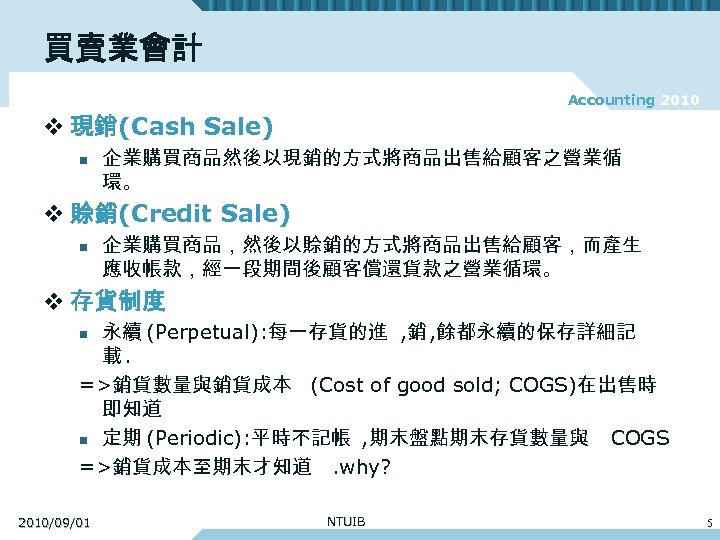
買賣業會計 Accounting 2010 v 現銷(Cash Sale) n 企業購買商品然後以現銷的方式將商品出售給顧客之營業循 環。 v 賒銷(Credit Sale) n 企業購買商品,然後以賒銷的方式將商品出售給顧客,而產生 應收帳款,經一段期間後顧客償還貨款之營業循環。 v 存貨制度 永續 (Perpetual): 每一存貨的進 , 銷 , 餘都永續的保存詳細記 載. =>銷貨數量與銷貨成本 (Cost of good sold; COGS)在出售時 即知道 n 定期 (Periodic): 平時不記帳 , 期末盤點期末存貨數量與 COGS =>銷貨成本至期末才知道. why? n 2010/09/01 NTUIB 5
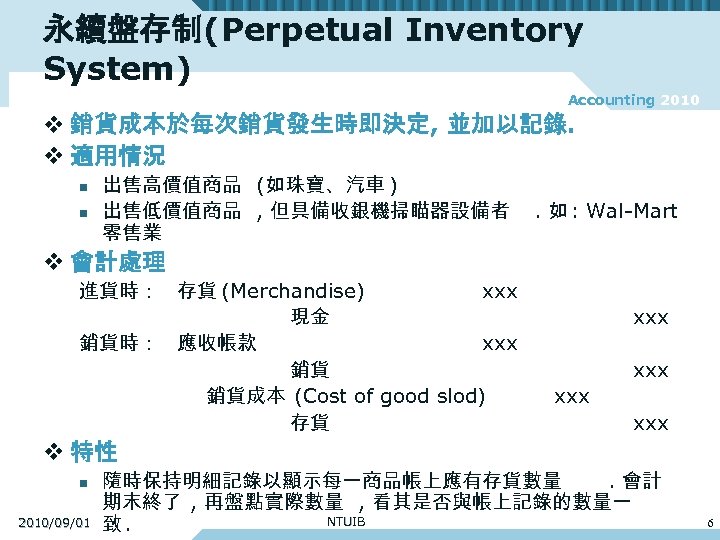
永續盤存制(Perpetual Inventory System) Accounting 2010 v 銷貨成本於每次銷貨發生時即決定, 並加以記錄. v 適用情況 n n 出售高價值商品 (如珠寶、汽車 ) 出售低價值商品 , 但具備收銀機掃瞄器設備者 零售業 . 如 : Wal-Mart v 會計處理 進貨時: 存貨 (Merchandise) xxx 現金 銷貨時: 應收帳款 xxx 銷貨 銷貨成本 (Cost of good slod) 存貨 xxx xxx v 特性 n 2010/09/01 隨時保持明細記錄以顯示每一商品帳上應有存貨數量. 會計 期末終了 , 再盤點實際數量 , 看其是否與帳上記錄的數量一 NTUIB 致. 6
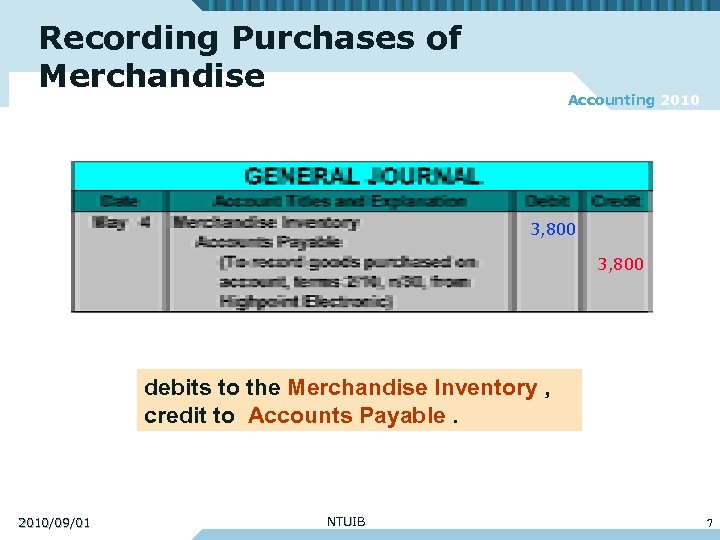
Recording Purchases of Merchandise Accounting 2010 3, 800 debits to the Merchandise Inventory , credit to Accounts Payable. 2010/09/01 NTUIB 7
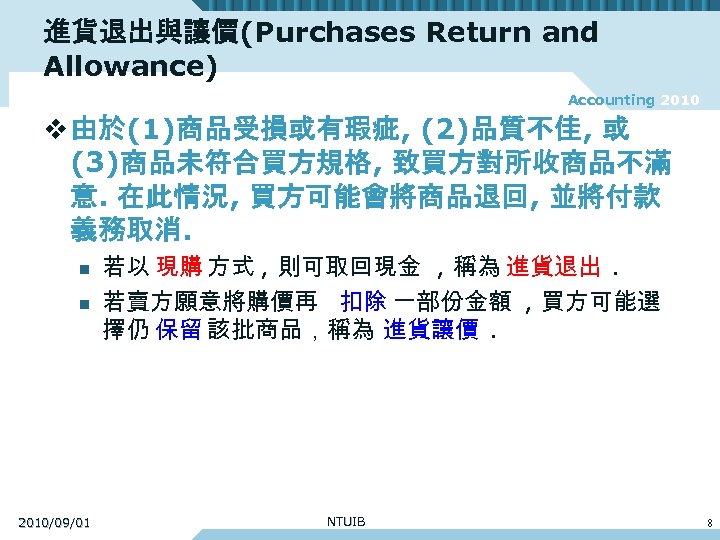
進貨退出與讓價(Purchases Return and Allowance) Accounting 2010 v 由於(1)商品受損或有瑕疵, (2)品質不佳, 或 (3)商品未符合買方規格, 致買方對所收商品不滿 意. 在此情況, 買方可能會將商品退回, 並將付款 義務取消. n n 2010/09/01 若以 現購 方式 , 則可取回現金 , 稱為 進貨退出. 若賣方願意將購價再 扣除 一部份金額 , 買方可能選 擇仍 保留 該批商品,稱為 進貨讓價. NTUIB 8
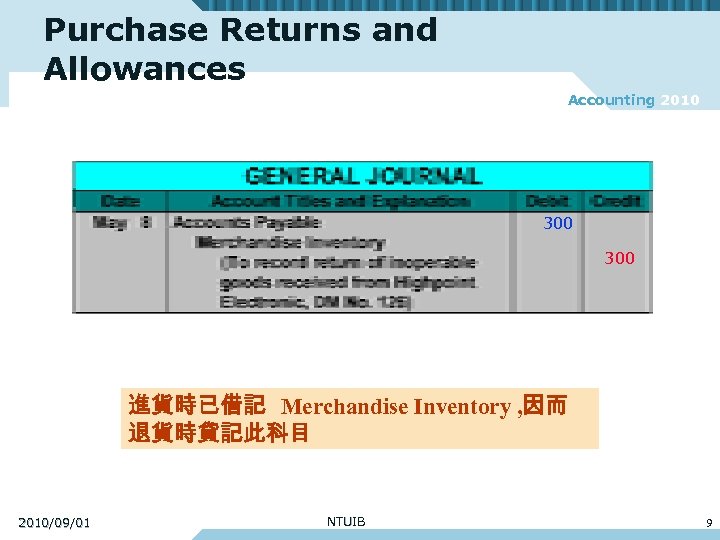
Purchase Returns and Allowances Accounting 2010 300 進貨時已借記 Merchandise Inventory , 因而 退貨時貸記此科目 2010/09/01 NTUIB 9
進貨運費(Freight-in) Accounting 2010 v 銷售契約應該載明賣方或買方負擔運費. 貨運條件以FOB 起運點或FOB目的地表示. v FOB shipping point(起運點交貨) n n Free on board shipping point 即商品在起運地即由賣方移交給共同承運人 方 方負擔. , 故運費應由 買 v FOB destination(目的地交貨) n n n 2010/09/01 Free on board destination 係商品在到達買方營業所在地後才移交給買方 , 故運費應由 賣方負擔 , 應列為 賣方之營業費用. 這些成本應列記銷貨運費 (Freight-out, or Delivery Expense) =>推銷費用 NTUIB 10
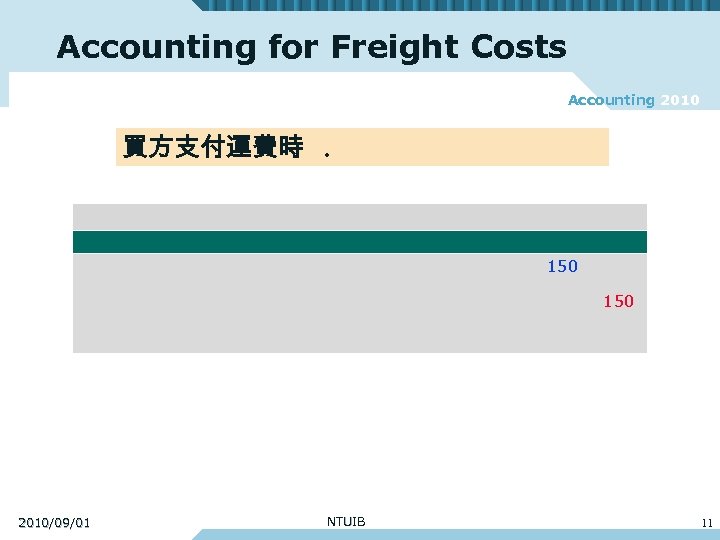
Accounting for Freight Costs Accounting 2010 買方支付運費時. 150 2010/09/01 NTUIB 11
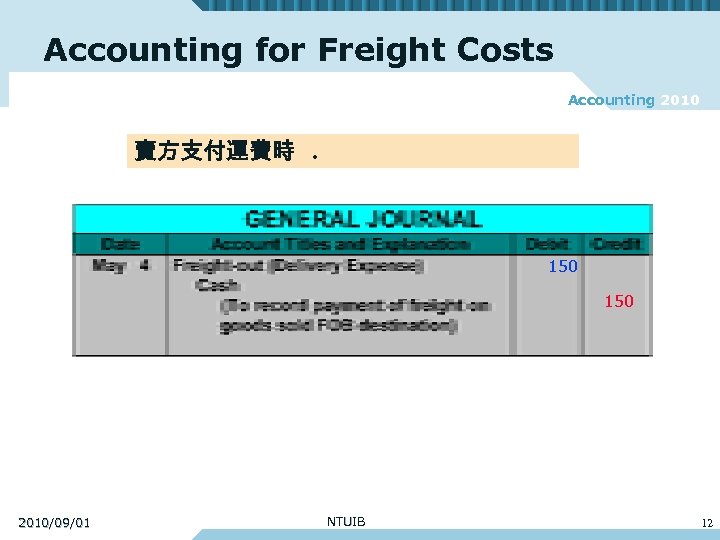
Accounting for Freight Costs Accounting 2010 賣方支付運費時. 150 2010/09/01 NTUIB 12
進貨折扣(Purchase Discount) Accounting 2010 v 賒購之信用條件(Credit terms), 同意買方若及 早付款, 得享有現金折扣. v 這項因對買賣雙方各有好處, 買方節省現金支出, 而賣方得以儘早將應收帳款轉成現金. v 進貨折扣以進貨成本減除進貨退回與讓價的餘額 為計算基礎. 2010/09/01 NTUIB 13
信用條件(Credit terms) Accounting 2010 v 現金折扣之金額與期間 v Case 1 n 信用條件為 2/10, n/30: 指於發票次日起算 , 10天內付款 (授 信期間 10天 , discount period), 則取得發票總價 2% 的現金 折扣 ; 超過期限即無折扣 , 最長的授信期間 (credit period)為 30天 , 也就是發票價格扣除任何退回與讓價之淨額 , 將於發 票次日起 30日到期. 「 n」原文為nil,表示不予折扣) v Case 2 n EOM (end of month), 折扣期間展延至銷貨發票日次月起算. v Case 3 n 2010/09/01 2/10/EOM, 次月 10付款得 2%discount, 否則次月起 30日內 一定要付款. NTUIB 14
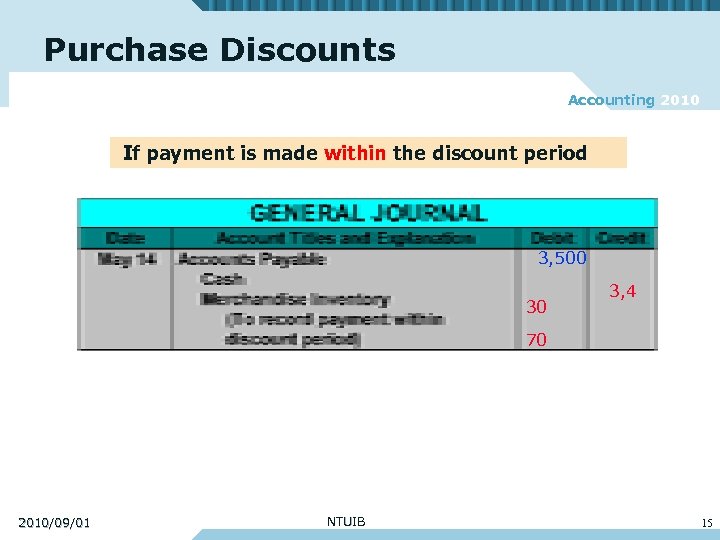
Purchase Discounts Accounting 2010 If payment is made within the discount period 3, 500 30 3, 4 70 2010/09/01 NTUIB 15
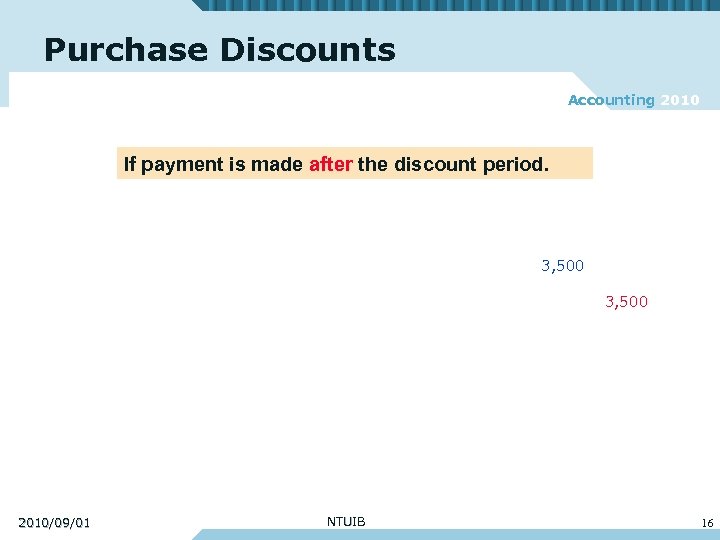
Purchase Discounts Accounting 2010 If payment is made after the discount period. 3, 500 2010/09/01 NTUIB 16
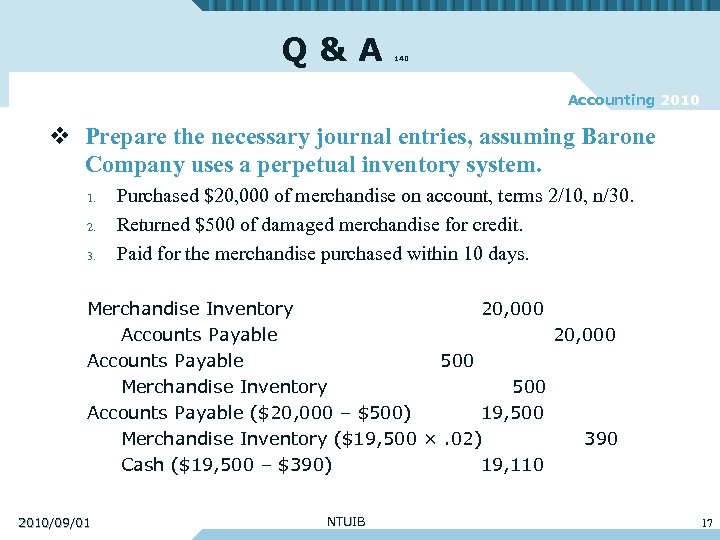
Q&A 140 Accounting 2010 v Prepare the necessary journal entries, assuming Barone Company uses a perpetual inventory system. 1. 2. 3. Purchased $20, 000 of merchandise on account, terms 2/10, n/30. Returned $500 of damaged merchandise for credit. Paid for the merchandise purchased within 10 days. Merchandise Inventory 20, 000 Accounts Payable 500 Merchandise Inventory 500 Accounts Payable ($20, 000 – $500) 19, 500 Merchandise Inventory ($19, 500 ×. 02) 390 Cash ($19, 500 – $390) 19, 110 2010/09/01 NTUIB 17
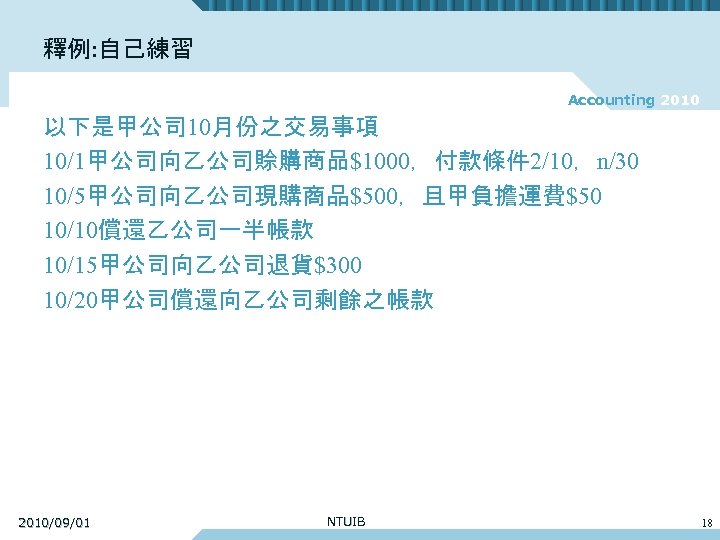
釋例: 自己練習 Accounting 2010 以下是甲公司 10月份之交易事項 10/1甲公司向乙公司賒購商品$1000,付款條件 2/10,n/30 10/5甲公司向乙公司現購商品$500,且甲負擔運費$50 10/10償還乙公司一半帳款 10/15甲公司向乙公司退貨$300 10/20甲公司償還向乙公司剩餘之帳款 2010/09/01 NTUIB 18
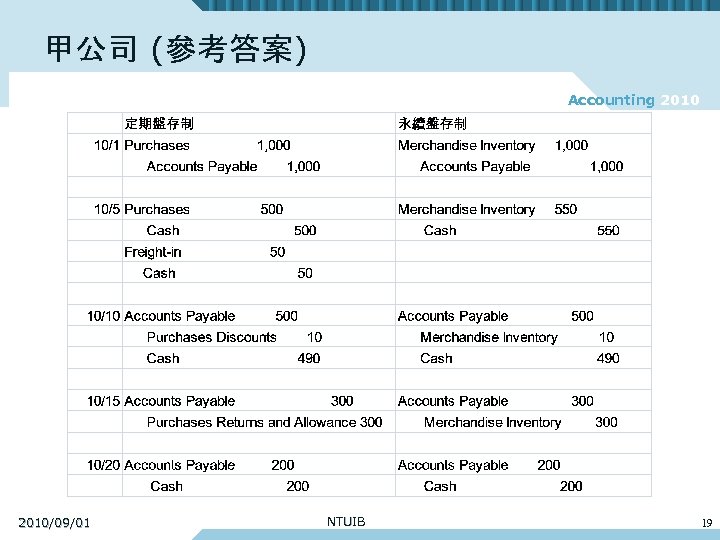
甲公司 (參考答案) Accounting 2010/09/01 NTUIB 19
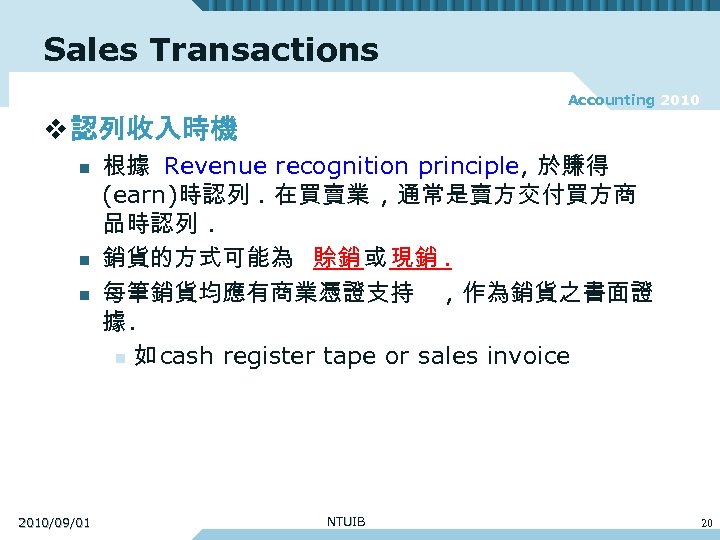
Sales Transactions Accounting 2010 v 認列收入時機 n n n 2010/09/01 根據 Revenue recognition principle, 於賺得 (earn)時認列. 在買賣業 , 通常是賣方交付買方商 品時認列. 銷貨的方式可能為 賒銷 或 現銷. 每筆銷貨均應有商業憑證支持 , 作為銷貨之書面證 據. n 如 cash register tape or sales invoice NTUIB 20
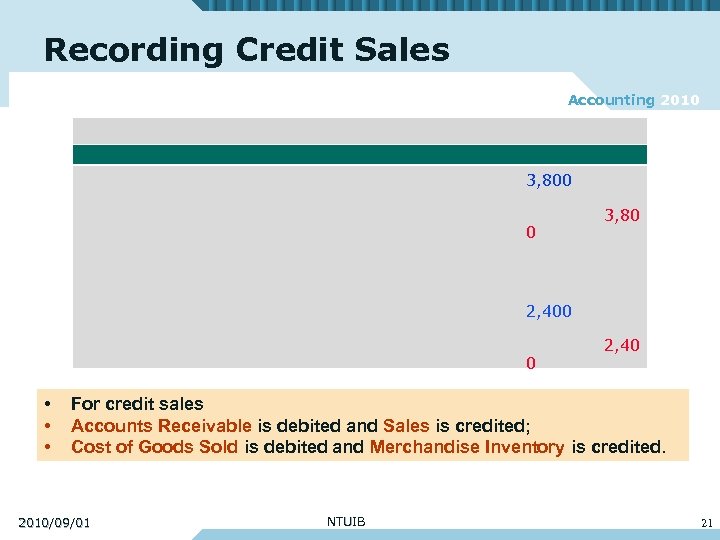
Recording Credit Sales Accounting 2010 3, 800 0 3, 80 2, 400 0 • • • 2, 40 For credit sales Accounts Receivable is debited and Sales is credited; Cost of Goods Sold is debited and Merchandise Inventory is credited. 2010/09/01 NTUIB 21
銷貨退回與讓價(Sales Returns and Allowances) Accounting 2010 v Sales returns n 客戶對於商品不滿意而 退貨. v Sales allowances n 客戶對於商品不滿意而賣方願 減價. v 會計處理 n n n 2010/09/01 買方 帳上之 進貨 退出與讓價 , 在 賣方 帳上為 銷貨 退 回與讓價. 若賣方同意買方銷貨退回與讓價 , 寄出「貸項通知 單 (Credit Memorandum)」. 銷貨退回與讓價為 Sales的 抵銷科目 (contra account), 正常餘額在借方. NTUIB 22
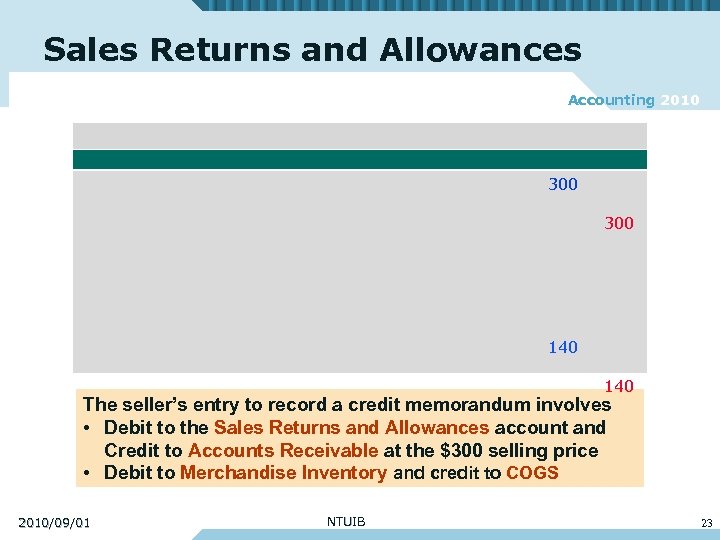
Sales Returns and Allowances Accounting 2010 300 140 The seller’s entry to record a credit memorandum involves • Debit to the Sales Returns and Allowances account and Credit to Accounts Receivable at the $300 selling price • Debit to Merchandise Inventory and credit to COGS 2010/09/01 NTUIB 23
銷貨折扣(Sales Discount) Accounting 2010 v 賒銷之授信條件訂有現金折扣, 提供及早支付帳款 之顧客現金折扣的優惠. v Sales Discounts is a contra revenue account with a normal debit balance v 例: 3/10, n/30. 2010/09/01 NTUIB 24
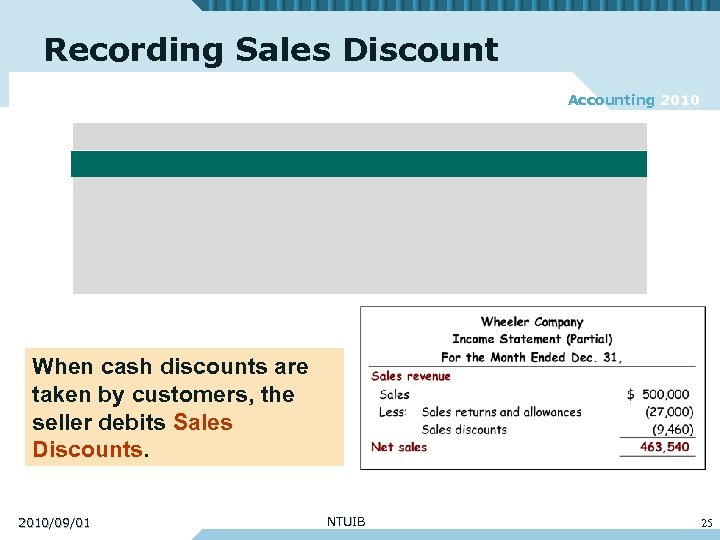
Recording Sales Discount Accounting 2010 When cash discounts are taken by customers, the seller debits Sales Discounts. 2010/09/01 NTUIB 25
Q&A Accounting 2010 v Boggs Company sold merchandise to Wilsey Company on account for $53, 000 with credit terms of 2/10, n/30. The cost of the merchandise sold was $31, 800. During the discount period, Wilsey Company returned $3, 000 of merchandise and paid its account in full (minus the discount) by remitting $49, 000 in cash. Both companies use a perpetual inventory system. Prepare the journal entries that Boggs Company made to record: (1) The sale of merchandise. (2) The return of merchandise. (3) The collection on account. 2010/09/01 NTUIB 26
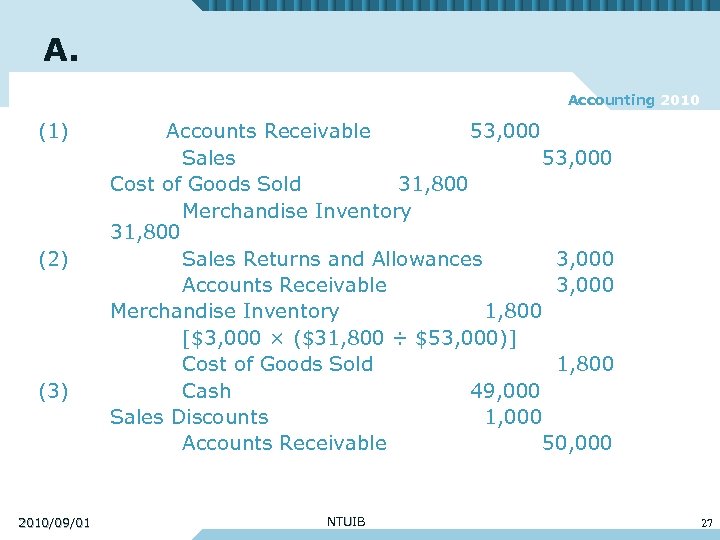
A. Accounting 2010 (1) (2) (3) 2010/09/01 Accounts Receivable 53, 000 Sales 53, 000 Cost of Goods Sold 31, 800 Merchandise Inventory 31, 800 Sales Returns and Allowances 3, 000 Accounts Receivable 3, 000 Merchandise Inventory 1, 800 [$3, 000 × ($31, 800 ÷ $53, 000)] Cost of Goods Sold 1, 800 Cash 49, 000 Sales Discounts 1, 000 Accounts Receivable 50, 000 NTUIB 27
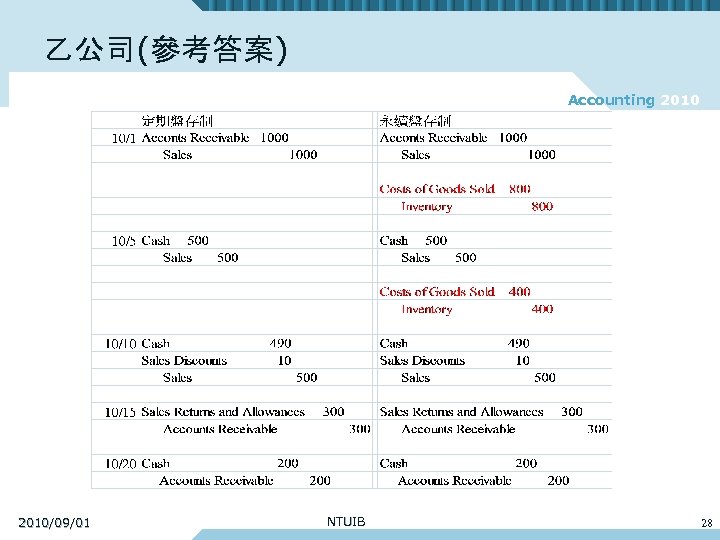
乙公司(參考答案) Accounting 2010/09/01 NTUIB 28
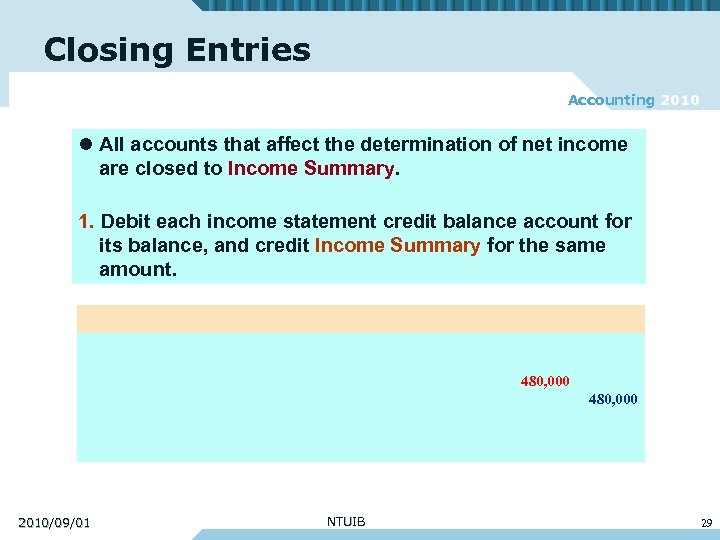
Closing Entries Accounting 2010 l All accounts that affect the determination of net income are closed to Income Summary. 1. Debit each income statement credit balance account for its balance, and credit Income Summary for the same amount. 480, 000 2010/09/01 NTUIB 29
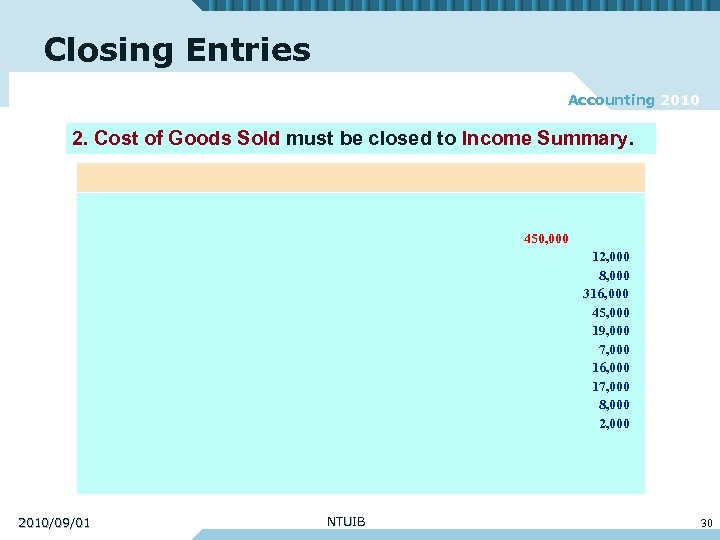
Closing Entries Accounting 2010 2. Cost of Goods Sold must be closed to Income Summary. 450, 000 12, 000 8, 000 316, 000 45, 000 19, 000 7, 000 16, 000 17, 000 8, 000 2010/09/01 NTUIB 30
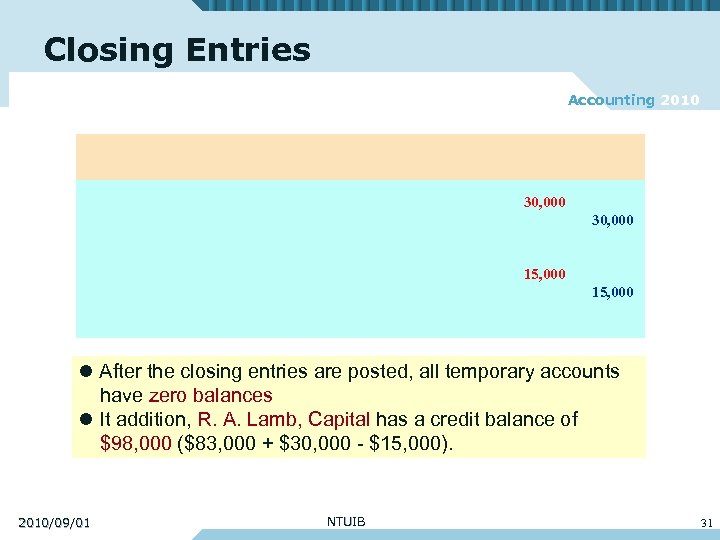
Closing Entries Accounting 2010 30, 000 15, 000 l After the closing entries are posted, all temporary accounts have zero balances l It addition, R. A. Lamb, Capital has a credit balance of $98, 000 ($83, 000 + $30, 000 - $15, 000). 2010/09/01 NTUIB 31
Income Statement Accounting 2010 v 單站式損益表(Single-step Income Statement) n 將所有收入及所有費用分別加總 出本期損益。 , 兩者相減一次得 v 多站式損益表(Multiple-step Income Statement) n 2010/09/01 將收入與費用分別加以分類 求出本期損益。 NTUIB , 排列 , 經過三個階段 32
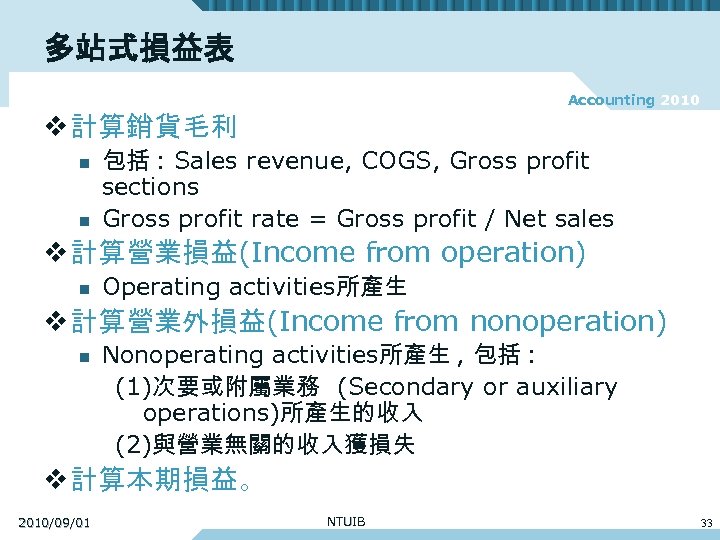
多站式損益表 Accounting 2010 v 計算銷貨毛利 n n 包括 : Sales revenue, COGS, Gross profit sections Gross profit rate = Gross profit / Net sales v 計算營業損益(Income from operation) n Operating activities所產生 v 計算營業外損益(Income from nonoperation) n Nonoperating activities所產生 , 包括 : (1)次要或附屬業務 (Secondary or auxiliary operations)所產生的收入 (2)與營業無關的收入獲損失 v 計算本期損益。 2010/09/01 NTUIB 33
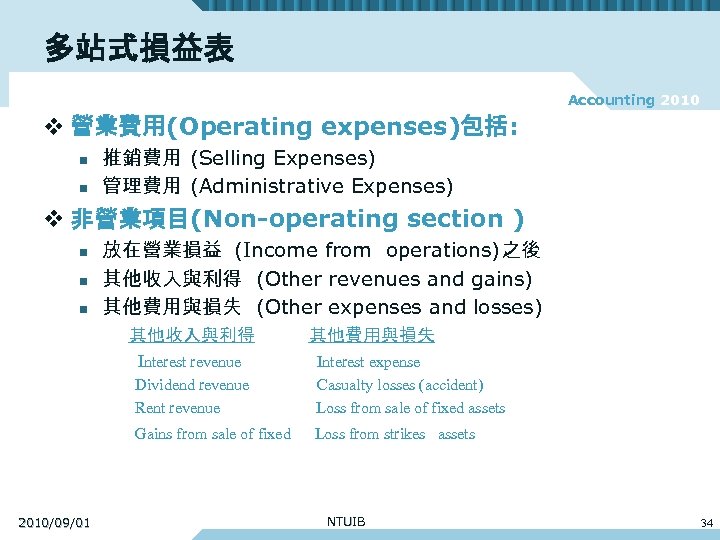
多站式損益表 Accounting 2010 v 營業費用(Operating expenses)包括: n n 推銷費用 (Selling Expenses) 管理費用 (Administrative Expenses) v 非營業項目(Non-operating section ) n n n 放在營業損益 (Income from operations)之後 其他收入與利得 (Other revenues and gains) 其他費用與損失 (Other expenses and losses) 其他收入與利得 Interest revenue 其他費用與損失 Dividend revenue Rent revenue Gains from sale of fixed 2010/09/01 Interest expense Casualty losses (accident) Loss from sale of fixed assets Loss from strikes assets NTUIB 34
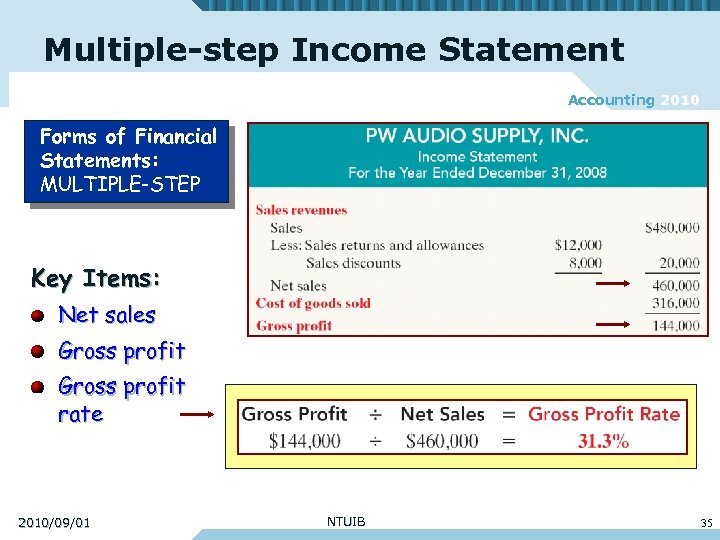
Multiple-step Income Statement Accounting 2010 Forms of Financial Statements: MULTIPLE-STEP Key Items: Net sales Gross profit rate 2010/09/01 NTUIB 35
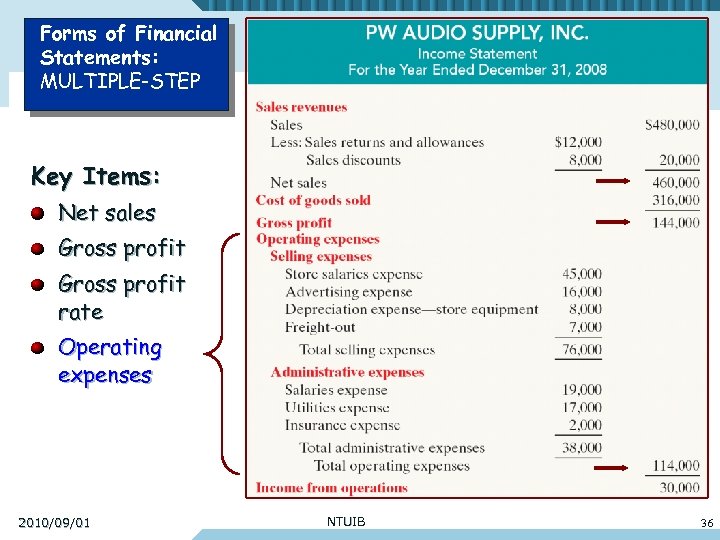
Forms of Financial Statements: MULTIPLE-STEP Accounting 2010 Key Items: Net sales Gross profit rate Operating expenses 2010/09/01 NTUIB 36
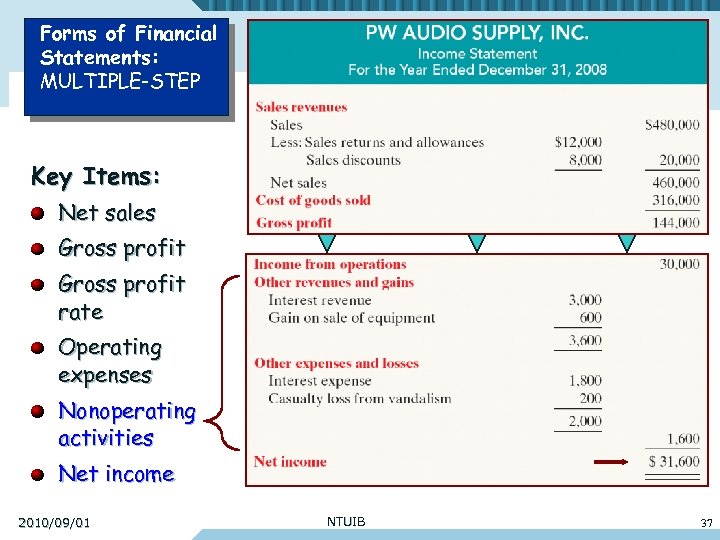
Forms of Financial Statements: MULTIPLE-STEP Accounting 2010 Key Items: Net sales Gross profit rate Operating expenses Nonoperating activities Net income 2010/09/01 NTUIB 37
Single-Step Income Statement Accounting 2010 v Subtract total expenses from total revenues v Two reasons for using the single-step format: n n 2010/09/01 Company does not realize any type of profit until total revenues exceed total expenses. Format is simpler and easier to read. NTUIB 38
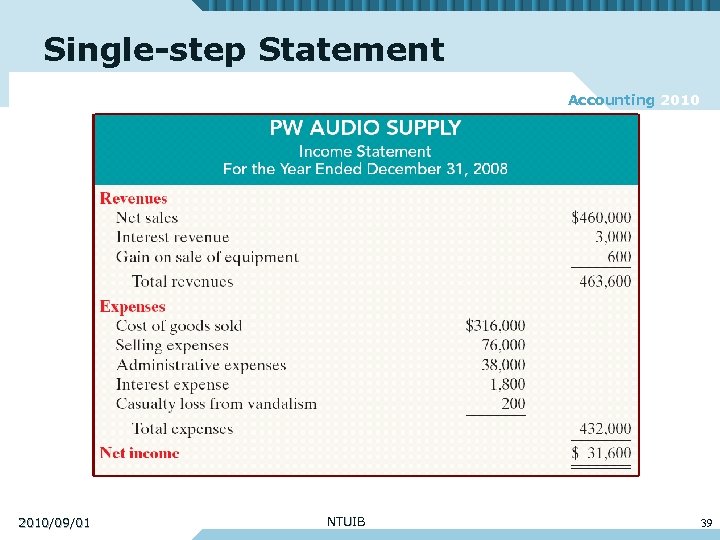
Single-step Statement Accounting 2010/09/01 NTUIB 39
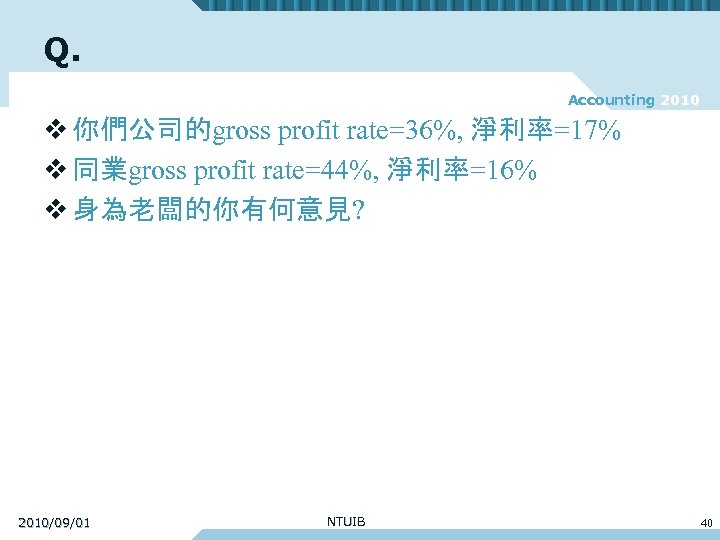
Q. Accounting 2010 v 你們公司的gross profit rate=36%, 淨利率=17% v 同業gross profit rate=44%, 淨利率=16% v 身為老闆的你有何意見? 2010/09/01 NTUIB 40
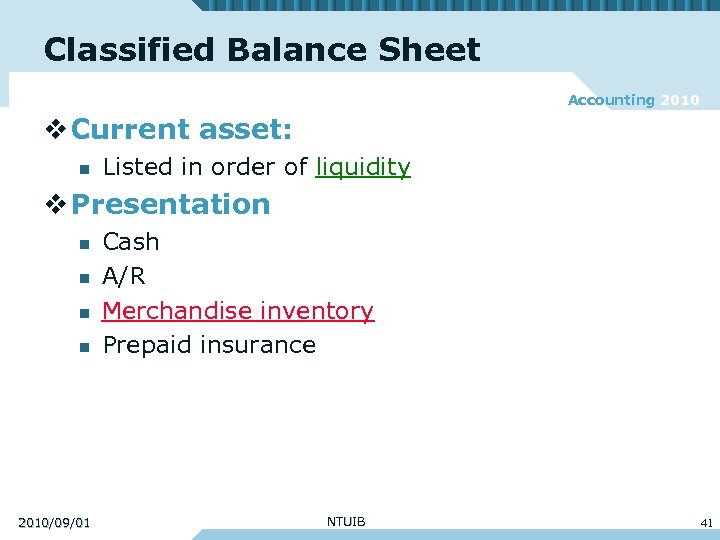
Classified Balance Sheet Accounting 2010 v Current asset: n Listed in order of liquidity v Presentation n n 2010/09/01 Cash A/R Merchandise inventory Prepaid insurance NTUIB 41
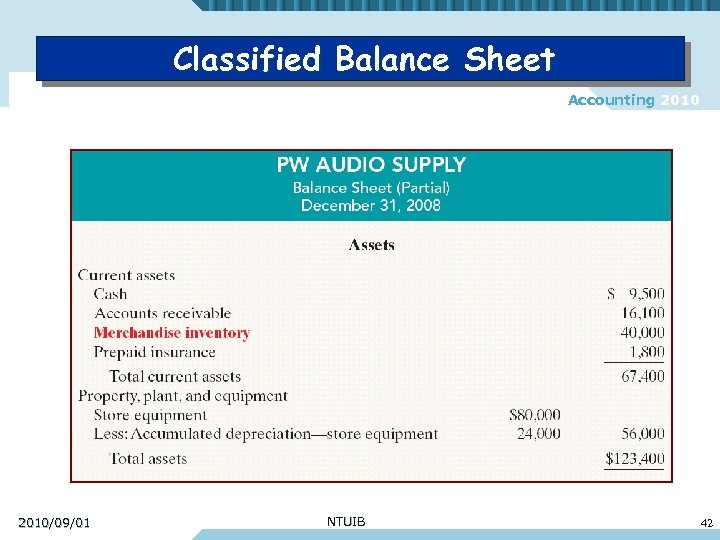
Classified Balance Sheet Accounting 2010/09/01 NTUIB 42
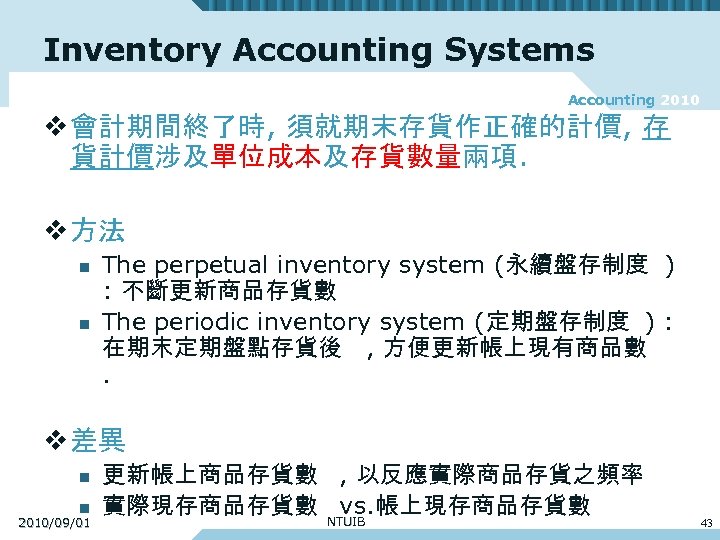
Inventory Accounting Systems Accounting 2010 v 會計期間終了時, 須就期末存貨作正確的計價, 存 貨計價涉及單位成本及存貨數量兩項. v 方法 n n The perpetual inventory system (永續盤存制度 ) : 不斷更新商品存貨數 The periodic inventory system (定期盤存制度 ) : 在期末定期盤點存貨後 , 方便更新帳上現有商品數. v 差異 n n 2010/09/01 更新帳上商品存貨數 , 以反應實際商品存貨之頻率 實際現存商品存貨數 NTUIB vs. 帳上現存商品存貨數 NTUIB 43
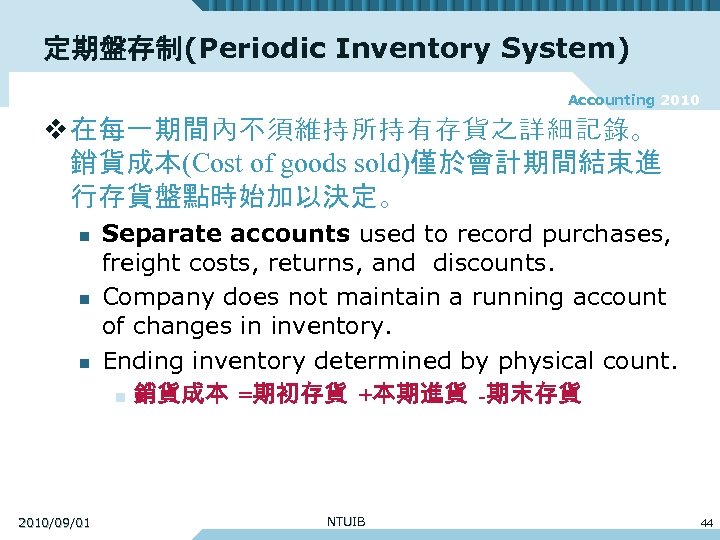
定期盤存制(Periodic Inventory System) Accounting 2010 v 在每一期間內不須維持所持有存貨之詳細記錄。 銷貨成本(Cost of goods sold)僅於會計期間結束進 行存貨盤點時始加以決定。 n n n 2010/09/01 Separate accounts used to record purchases, freight costs, returns, and discounts. Company does not maintain a running account of changes in inventory. Ending inventory determined by physical count. n 銷貨成本 =期初存貨 +本期進貨 -期末存貨 NTUIB 44
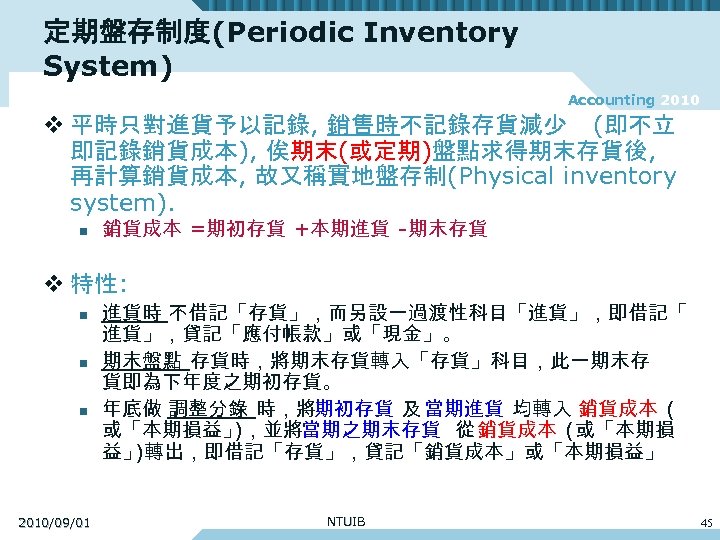
定期盤存制度(Periodic Inventory System) Accounting 2010 v 平時只對進貨予以記錄, 銷售時不記錄存貨減少 (即不立 即記錄銷貨成本), 俟期末(或定期)盤點求得期末存貨後, 再計算銷貨成本, 故又稱實地盤存制(Physical inventory system). n 銷貨成本 =期初存貨 +本期進貨 -期末存貨 v 特性: n n n 2010/09/01 進貨時 不借記「存貨」,而另設一過渡性科目「進貨」,即借記「 進貨」,貸記「應付帳款」或「現金」。 期末盤點 存貨時,將期末存貨轉入「存貨」科目,此一期末存 貨即為下年度之期初存貨。 年底做 調整分錄 時,將期初存貨 及 當期進貨 均轉入 銷貨成本 ( 或「本期損益」 ),並將當期之期末存貨 從 銷貨成本 (或「本期損 益」 )轉出,即借記「存貨」,貸記「銷貨成本」或「本期損益」 NTUIB 45
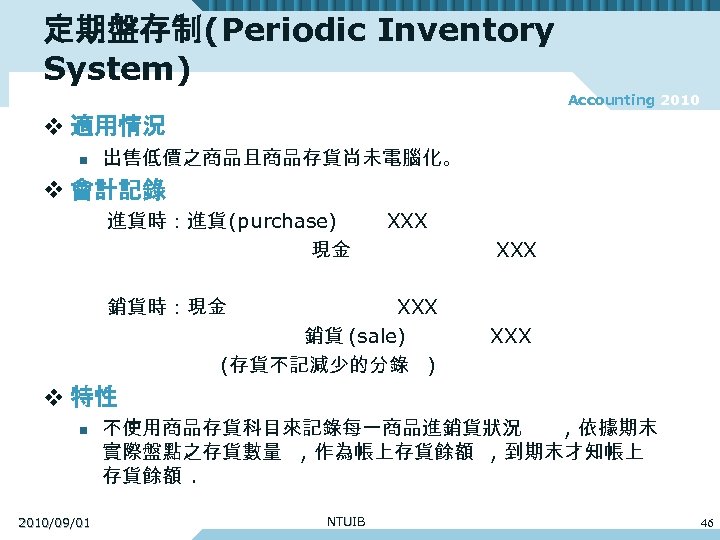
定期盤存制(Periodic Inventory System) Accounting 2010 v 適用情況 n 出售低價之商品且商品存貨尚未電腦化。 v 會計記錄 進貨時:進貨(purchase) 現金 XXX 銷貨時:現金 XXX 銷貨 (sale) (存貨不記減少的分錄 ) XXX v 特性 n 2010/09/01 不使用商品存貨科目來記錄每一商品進銷貨狀況 , 依據期末 實際盤點之存貨數量 , 作為帳上存貨餘額 , 到期末才知帳上 存貨餘額. NTUIB 46
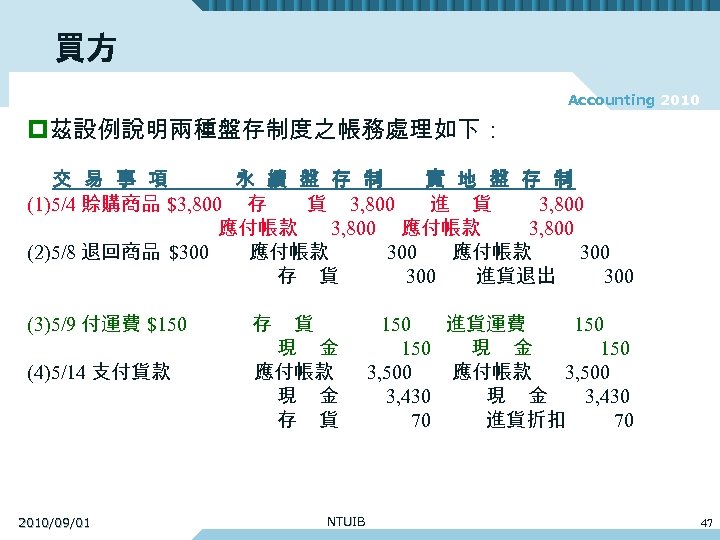
買方 Accounting 2010 p茲設例說明兩種盤存制度之帳務處理如下: 交 易 事 項 永 續 盤 存 制 實 地 盤 存 制 (1)5/4 賒購商品 $3, 800 存 貨 3, 800 進 貨 3, 800 應付帳款 3, 800 應付帳款 3, 800 (2)5/8 退回商品 $300 應付帳款 300 存 貨 300 進貨退出 300 (3)5/9 付運費 $150 (4)5/14 支付貨款 2010/09/01 存 貨 現 金 應付帳款 現 金 存 貨 NTUIB 150 進貨運費 150 現 金 150 3, 500 應付帳款 3, 500 3, 430 現 金 3, 430 70 進貨折扣 70 47
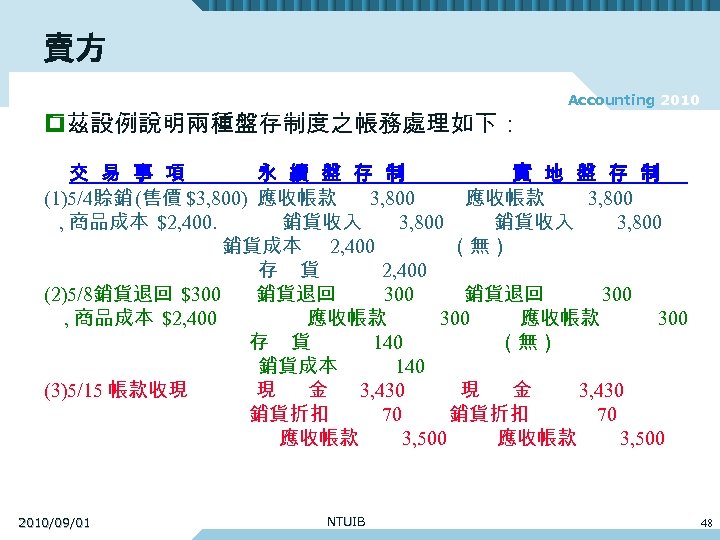
賣方 p茲設例說明兩種盤存制度之帳務處理如下: Accounting 2010 交 易 事 項 永 續 盤 存 制 實 地 盤 存 制 (1)5/4賒銷 (售價 $3, 800) 應收帳款 3, 800 商品成本 $2, 400. 銷貨收入 , 3, 800 銷貨收入 3, 800 銷貨成本 2, 400 (無) 存 貨 2, 400 (2)5/8銷貨退回 $300 銷貨退回 300 , 商品成本 $2, 400 應收帳款 300 存 貨 140 (無) 銷貨成本 140 (3)5/15 帳款收現 現 金 3, 430 銷貨折扣 70 應收帳款 3, 500 2010/09/01 NTUIB 48
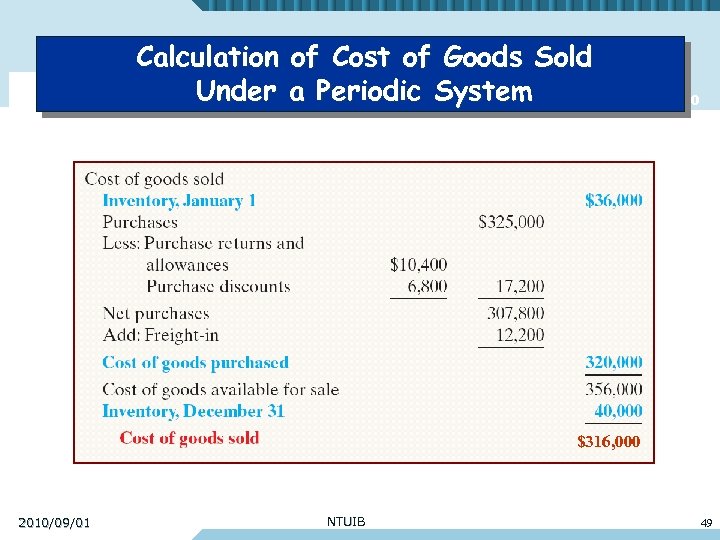
Calculation of Cost of Goods Sold Under a Periodic System Accounting 2010 $316, 000 2010/09/01 NTUIB 49
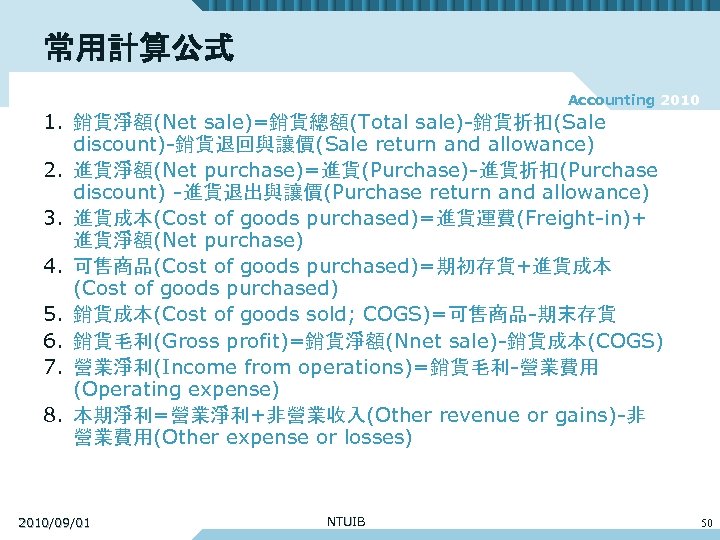
常用計算公式 Accounting 2010 1. 銷貨淨額(Net sale)=銷貨總額(Total sale)-銷貨折扣(Sale discount)-銷貨退回與讓價(Sale return and allowance) 2. 進貨淨額(Net purchase)=進貨(Purchase)-進貨折扣(Purchase discount) -進貨退出與讓價(Purchase return and allowance) 3. 進貨成本(Cost of goods purchased)=進貨運費(Freight-in)+ 進貨淨額(Net purchase) 4. 可售商品(Cost of goods purchased)=期初存貨+進貨成本 (Cost of goods purchased) 5. 銷貨成本(Cost of goods sold; COGS)=可售商品-期末存貨 6. 銷貨毛利(Gross profit)=銷貨淨額(Nnet sale)-銷貨成本(COGS) 7. 營業淨利(Income from operations)=銷貨毛利-營業費用 (Operating expense) 8. 本期淨利=營業淨利+非營業收入(Other revenue or gains)-非 營業費用(Other expense or losses) 2010/09/01 NTUIB 50
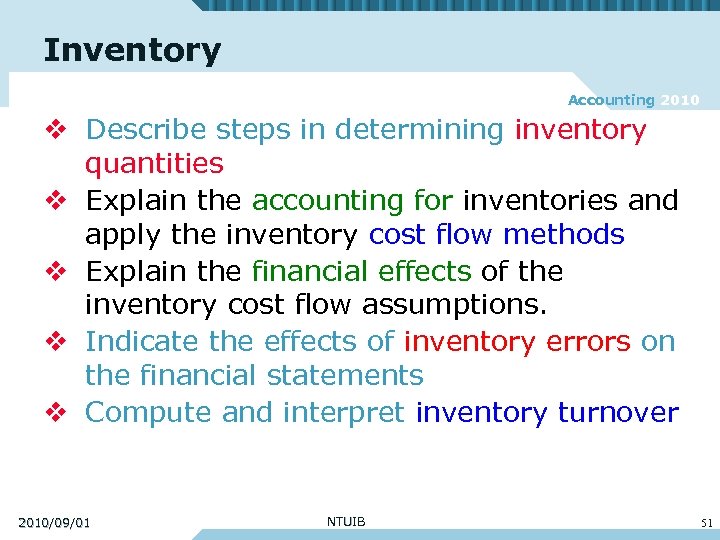
Inventory Accounting 2010 v Describe steps in determining inventory quantities v Explain the accounting for inventories and apply the inventory cost flow methods v Explain the financial effects of the inventory cost flow assumptions. v Indicate the effects of inventory errors on the financial statements v Compute and interpret inventory turnover 2010/09/01 NTUIB 51
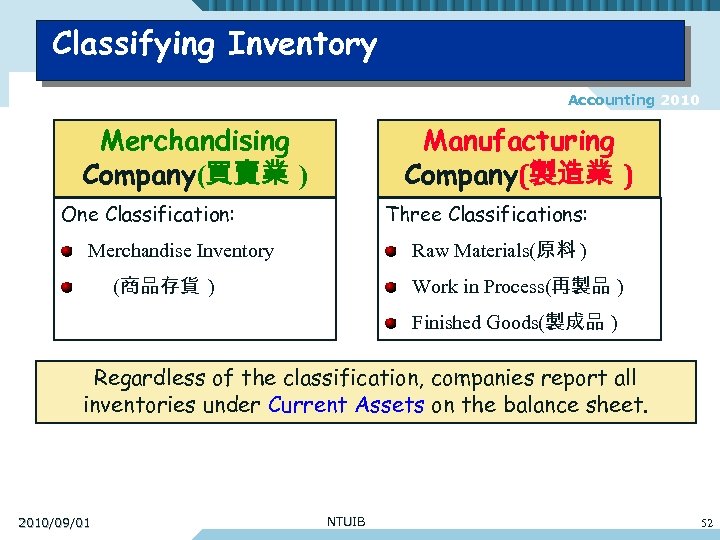
Classifying Inventory Accounting 2010 Manufacturing Company(製造業 ) Merchandising Company(買賣業 ) One Classification: Three Classifications: Merchandise Inventory Raw Materials(原料 ) (商品存貨 ) Work in Process(再製品 ) Finished Goods(製成品 ) Regardless of the classification, companies report all inventories under Current Assets on the balance sheet. 2010/09/01 NTUIB 52
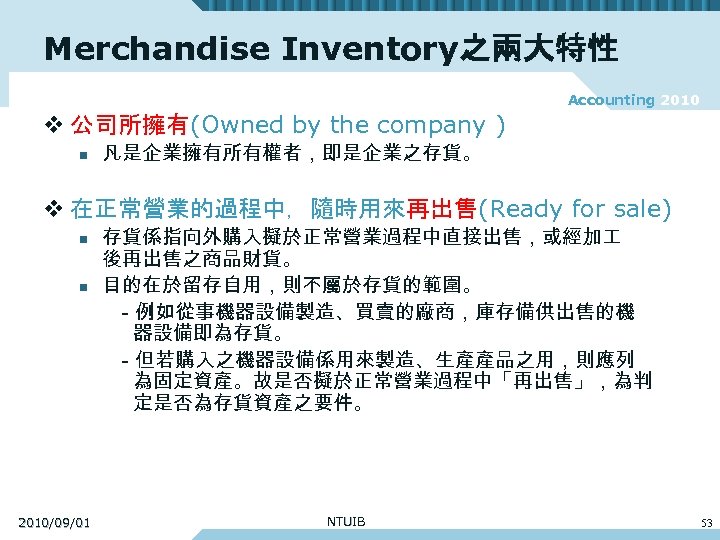
Merchandise Inventory之兩大特性 Accounting 2010 v 公司所擁有(Owned by the company ) n 凡是企業擁有所有權者,即是企業之存貨。 v 在正常營業的過程中,隨時用來再出售(Ready for sale) n n 2010/09/01 存貨係指向外購入擬於正常營業過程中直接出售,或經加 後再出售之商品財貨。 目的在於留存自用,則不屬於存貨的範圍。 -例如從事機器設備製造、買賣的廠商,庫存備供出售的機 器設備即為存貨。 -但若購入之機器設備係用來製造、生產產品之用,則應列 為固定資產。故是否擬於正常營業過程中「再出售」,為判 定是否為存貨資產之要件。 NTUIB 53
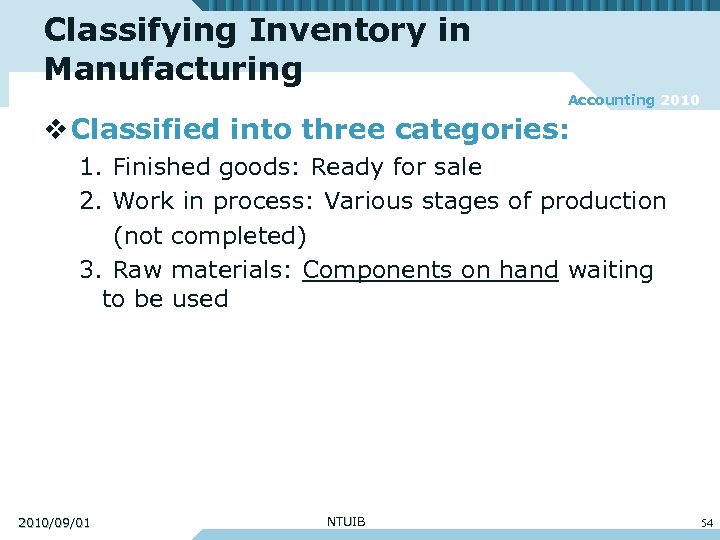
Classifying Inventory in Manufacturing Accounting 2010 v Classified into three categories: 1. Finished goods: Ready for sale 2. Work in process: Various stages of production (not completed) 3. Raw materials: Components on hand waiting to be used 2010/09/01 NTUIB 54
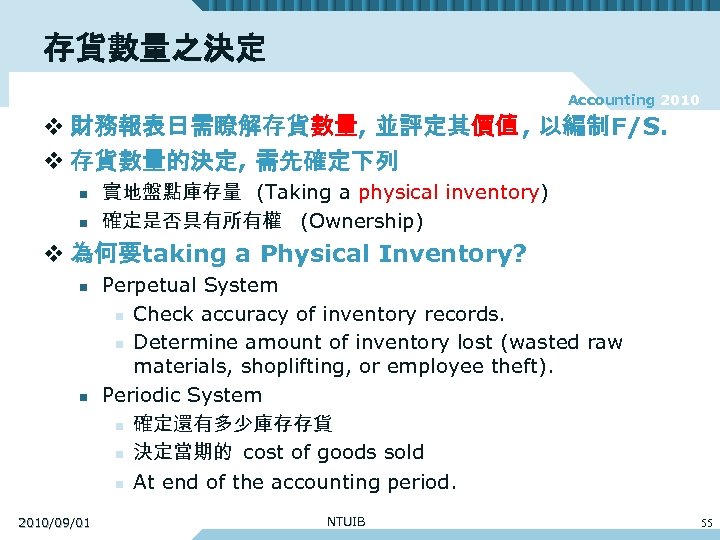
存貨數量之決定 Accounting 2010 v 財務報表日需瞭解存貨數量, 並評定其價值 , 以編制F/S. v 存貨數量的決定, 需先確定下列 n n 實地盤點庫存量 (Taking a physical inventory) 確定是否具有所有權 (Ownership) v 為何要taking a Physical Inventory? n n 2010/09/01 Perpetual System n Check accuracy of inventory records. n Determine amount of inventory lost (wasted raw materials, shoplifting, or employee theft). Periodic System n 確定還有多少庫存存貨 n 決定當期的 cost of goods sold n At end of the accounting period. NTUIB 55
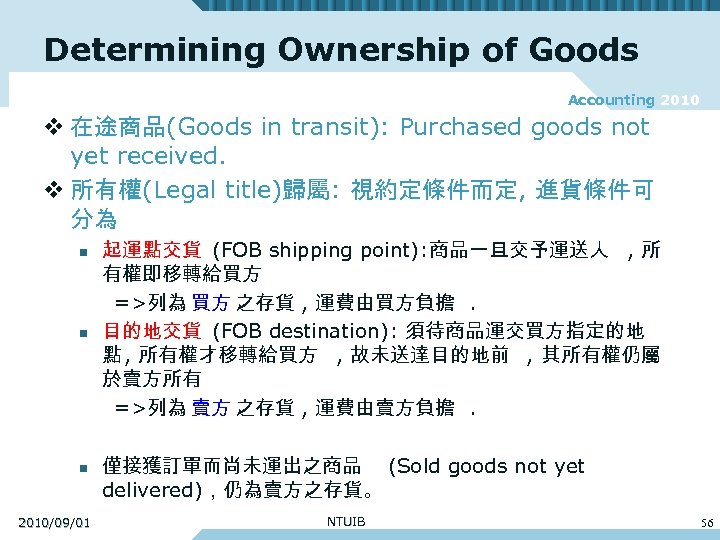
Determining Ownership of Goods Accounting 2010 v 在途商品(Goods in transit): Purchased goods not yet received. v 所有權(Legal title)歸屬: 視約定條件而定, 進貨條件可 分為 n n n 2010/09/01 起運點交貨 (FOB shipping point): 商品一旦交予運送人 , 所 有權即移轉給買方 =>列為 買方 之存貨 , 運費由買方負擔. 目的地交貨 (FOB destination): 須待商品運交買方指定的地 點 , 所有權才移轉給買方 , 故未送達目的地前 , 其所有權仍屬 於賣方所有 =>列為 賣方 之存貨 , 運費由賣方負擔. 僅接獲訂單而尚未運出之商品 (Sold goods not yet delivered),仍為賣方之存貨。 NTUIB 56
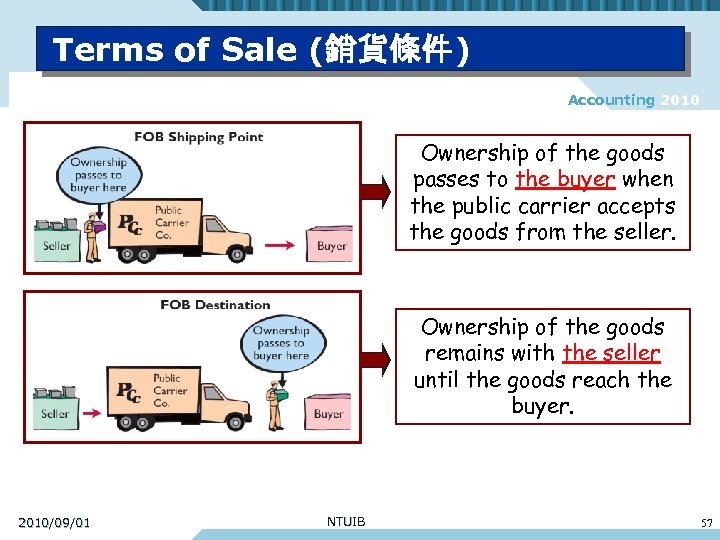
Terms of Sale (銷貨條件) Accounting 2010 Ownership of the goods passes to the buyer when the public carrier accepts the goods from the seller. Ownership of the goods remains with the seller until the goods reach the buyer. 2010/09/01 NTUIB 57
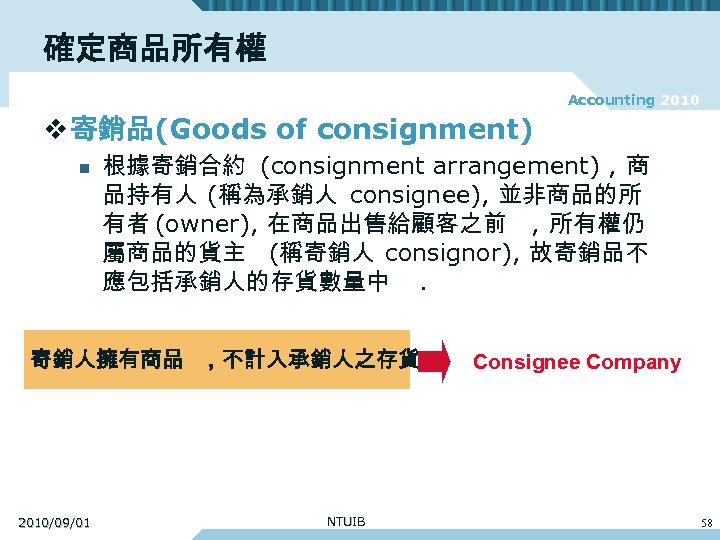
確定商品所有權 Accounting 2010 v 寄銷品(Goods of consignment) n 根據寄銷合約 (consignment arrangement) , 商 品持有人 (稱為承銷人 consignee), 並非商品的所 有者 (owner), 在商品出售給顧客之前 , 所有權仍 屬商品的貨主 (稱寄銷人 consignor), 故寄銷品不 應包括承銷人的存貨數量中. 寄銷人擁有商品 ,不計入承銷人之存貨 2010/09/01 NTUIB Consignee Company 58
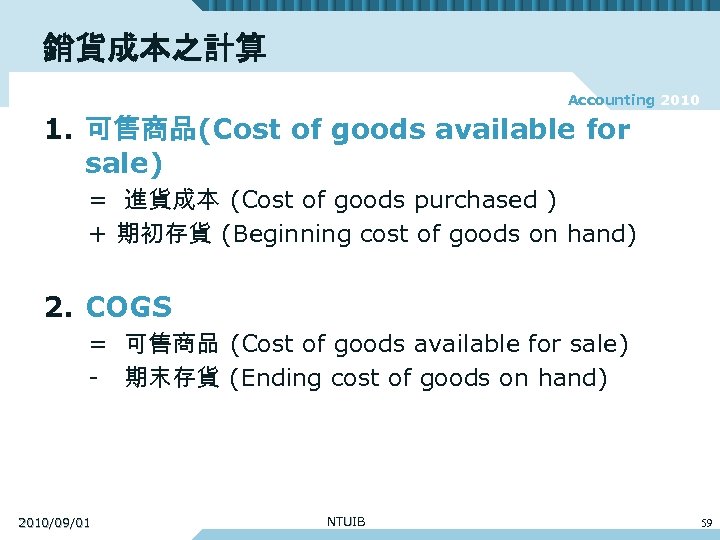
銷貨成本之計算 Accounting 2010 1. 可售商品(Cost of goods available for sale) = 進貨成本 (Cost of goods purchased ) + 期初存貨 (Beginning cost of goods on hand) 2. COGS = 可售商品 (Cost of goods available for sale) - 期末存貨 (Ending cost of goods on hand) 2010/09/01 NTUIB 59
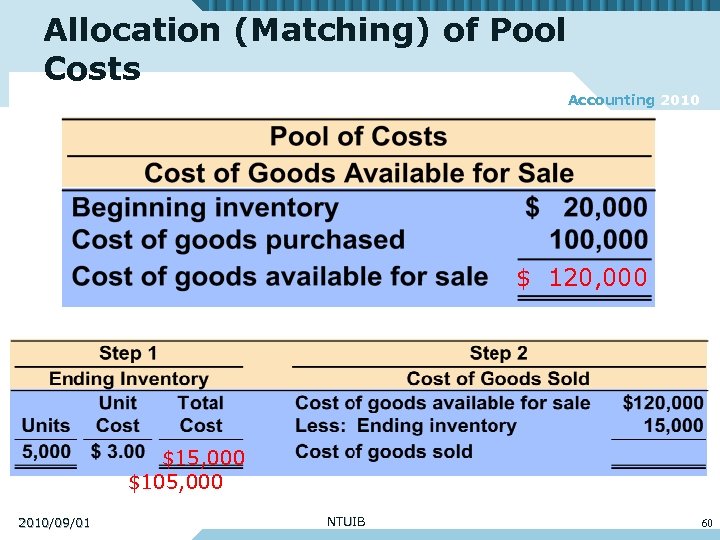
Allocation (Matching) of Pool Costs Accounting 2010 $ 120, 000 $15, 000 $105, 000 2010/09/01 NTUIB 60
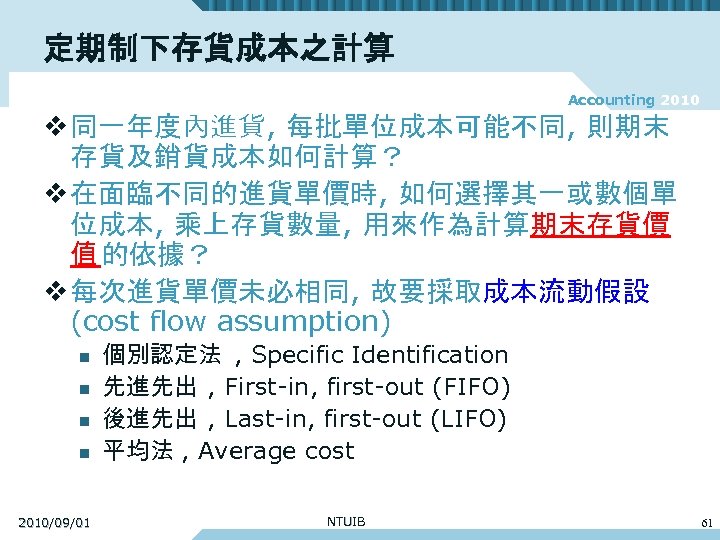
定期制下存貨成本之計算 Accounting 2010 v 同一年度內進貨, 每批單位成本可能不同, 則期末 存貨及銷貨成本如何計算? v 在面臨不同的進貨單價時, 如何選擇其一或數個單 位成本, 乘上存貨數量, 用來作為計算期末存貨價 值 的依據? v 每次進貨單價未必相同, 故要採取成本流動假設 (cost flow assumption) n n 2010/09/01 個別認定法 , Specific Identification 先進先出 , First-in, first-out (FIFO) 後進先出 , Last-in, first-out (LIFO) 平均法 , Average cost NTUIB 61
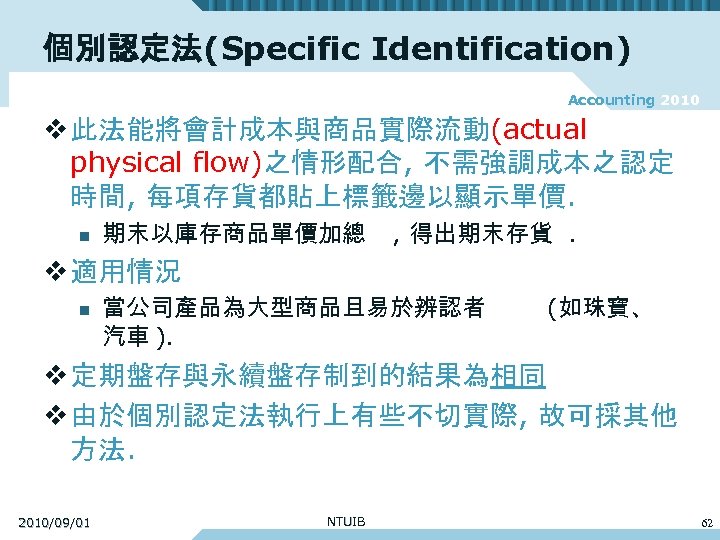
個別認定法(Specific Identification) Accounting 2010 v 此法能將會計成本與商品實際流動(actual physical flow)之情形配合, 不需強調成本之認定 時間, 每項存貨都貼上標籤邊以顯示單價. n 期末以庫存商品單價加總 , 得出期末存貨. v 適用情況 n 當公司產品為大型商品且易於辨認者 汽車 ). (如珠寶、 v 定期盤存與永續盤存制到的結果為相同 v 由於個別認定法執行上有些不切實際, 故可採其他 方法. 2010/09/01 NTUIB 62
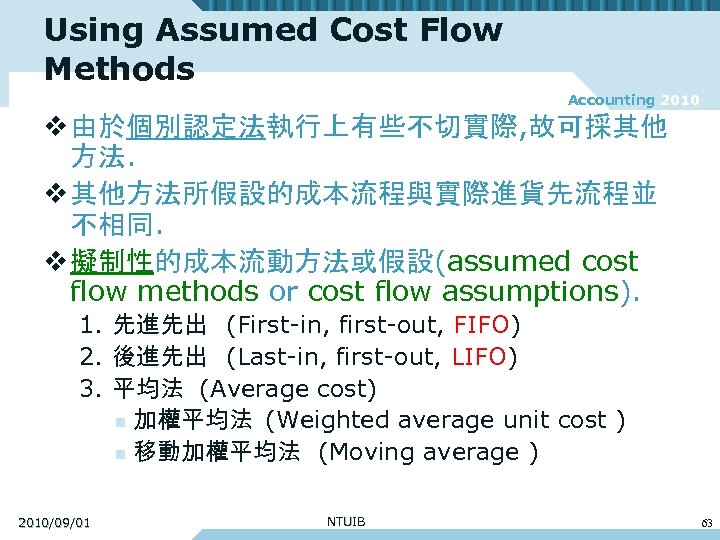
Using Assumed Cost Flow Methods Accounting 2010 v 由於個別認定法執行上有些不切實際, 故可採其他 方法. v 其他方法所假設的成本流程與實際進貨先流程並 不相同. v 擬制性的成本流動方法或假設(assumed cost flow methods or cost flow assumptions). 1. 先進先出 (First-in, first-out, FIFO) 2. 後進先出 (Last-in, first-out, LIFO) 3. 平均法 (Average cost) n 加權平均法 (Weighted average unit cost ) n 移動加權平均法 (Moving average ) 2010/09/01 NTUIB 63
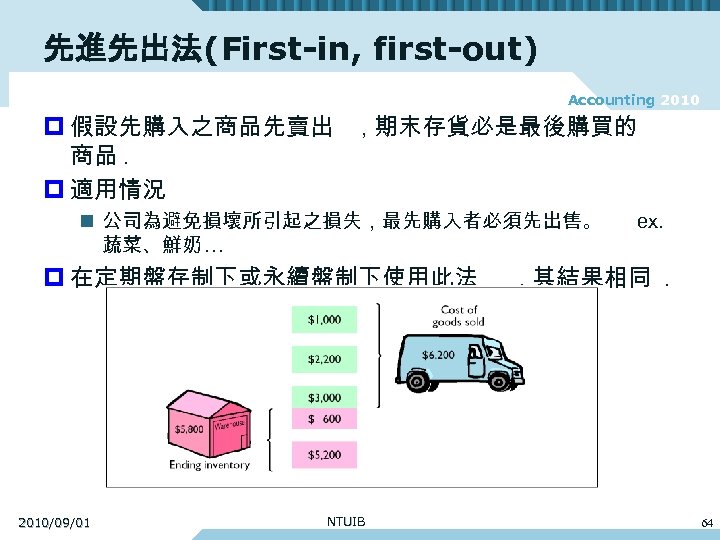
先進先出法(First-in, first-out) Accounting 2010 p 假設先購入之商品先賣出 商品. p 適用情況 , 期末存貨必是最後購買的 n 公司為避免損壞所引起之損失,最先購入者必須先出售。 蔬菜、鮮奶 … p 在定期盤存制下或永續盤制下使用此法 2010/09/01 NTUIB ex. , 其結果相同. 64
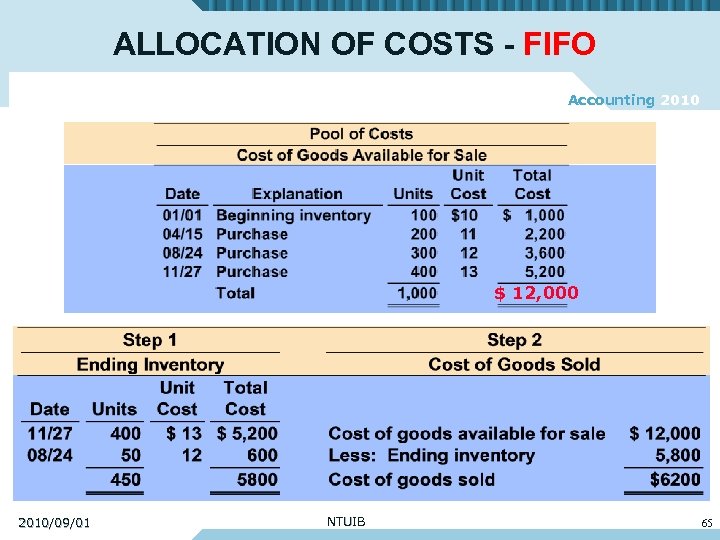
ALLOCATION OF COSTS - FIFO Accounting 2010 $ 12, 000 2010/09/01 NTUIB 65
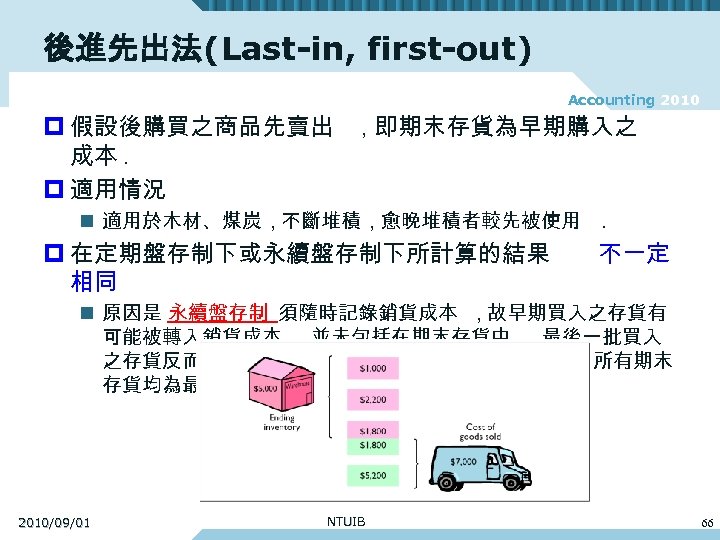
後進先出法(Last-in, first-out) Accounting 2010 p 假設後購買之商品先賣出 成本. p 適用情況 , 即期末存貨為早期購入之 n 適用於木材、煤炭 , 不斷堆積 , 愈晚堆積者較先被使用. p 在定期盤存制下或永續盤存制下所計算的結果 相同 不一定 n 原因是 永續盤存制 須隨時記錄銷貨成本 , 故早期買入之存貨有 可能被轉入銷貨成本 , 並未包括在期末存貨中 , 最後一批買入 之存貨反而包括在期末存貨中. 而在 定期盤存制 下,所有期末 存貨均為最早購入者。 2010/09/01 NTUIB 66
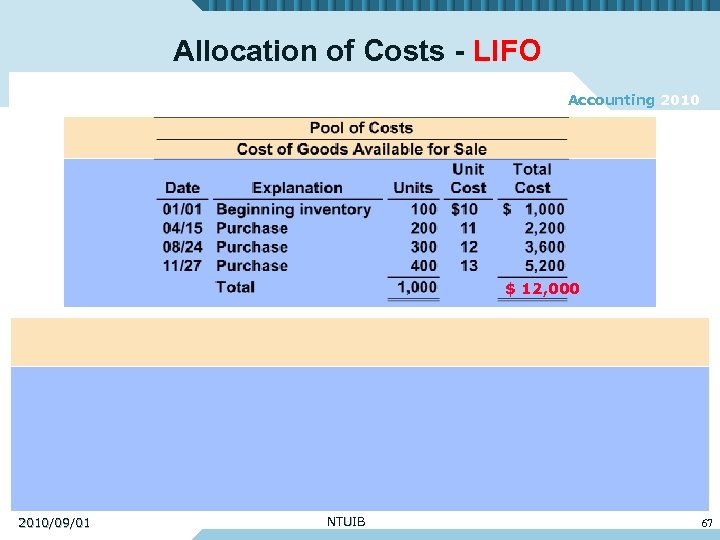
Allocation of Costs - LIFO Accounting 2010 $ 12, 000 2010/09/01 NTUIB 67
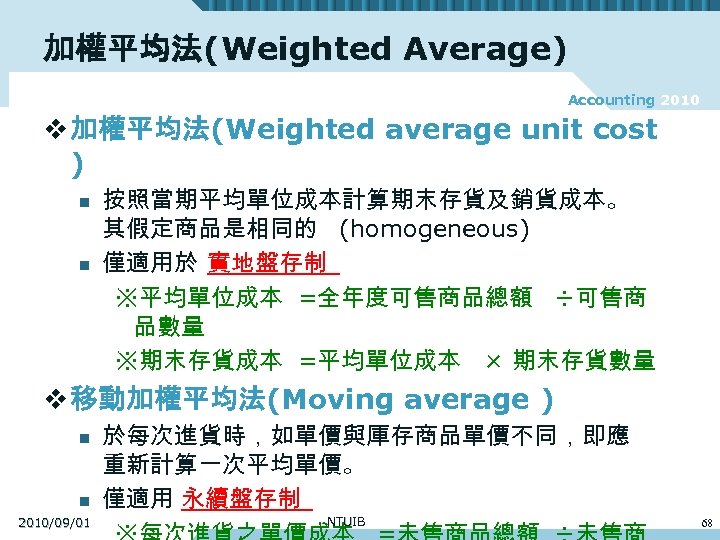
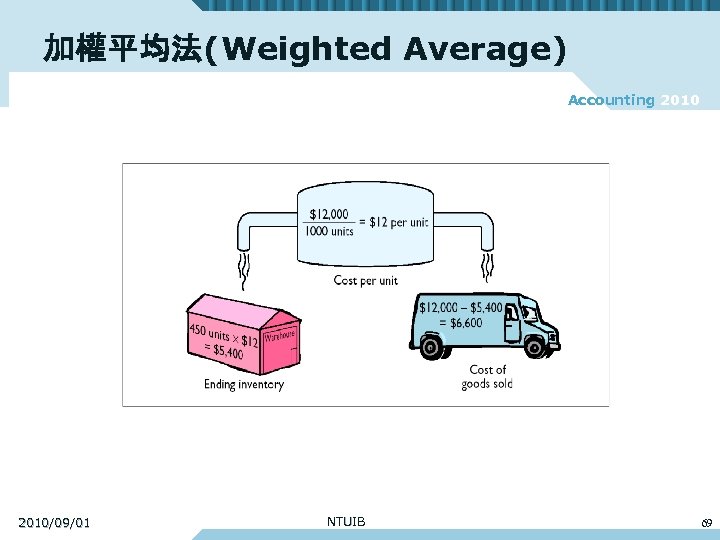
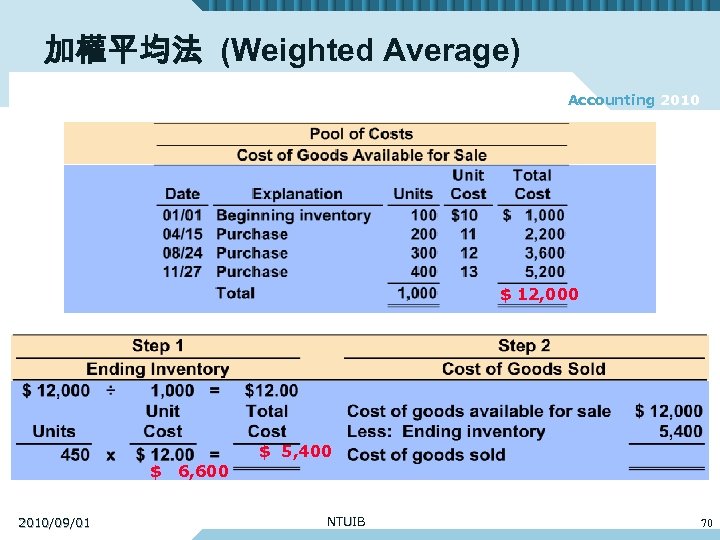
加權平均法(Weighted Average) Accounting 2010 v 加權平均法(Weighted average unit cost ) n n 按照當期平均單位成本計算期末存貨及銷貨成本。 其假定商品是相同的 (homogeneous) 僅適用於 實地盤存制 ※平均單位成本 =全年度可售商品總額 ÷可售商 品數量 ※期末存貨成本 =平均單位成本 × 期末存貨數量 v 移動加權平均法(Moving average ) n n 2010/09/01 於每次進貨時,如單價與厙存商品單價不同,即應 重新計算一次平均單價。 僅適用 永續盤存制 NTUIB 68
加權平均法(Weighted Average) Accounting 2010/09/01 NTUIB 69
加權平均法 (Weighted Average) Accounting 2010 $ 12, 000 $ 2010/09/01 6, 600 $ 5, 400 NTUIB 70
Inventory Costing – Cost Flow Assumptions Accounting 2010 Example Y Company makes the following purchases: 1. One item on 2/2/07 for $10 2. One item on 2/15/07 for $15 3. One item on 2/25/07 for $20 Y Company sells one item on 2/28/07 for $90. Assume a tax rate of 30%. 2010/09/01 NTUIB 71
Inventory Costing – Cost Flow Assumptions “First-In-First-Out (FIFO)” Inventory Balance = $ 35 Young & Crazy Company Income Statement For the Month of Feb. 2007 Sales Cost of goods sold Gross profit Expenses: Administrative Selling Interest Total expenses Income before tax Taxes Net Income Purchase on 2/25/07 for $20 Purchase on 2/15/07 for $15 Purchase on 2/2/07 for $10 2010/09/01 Accounting 2010 NTUIB $ 90 10 80 14 12 7 33 47 14 $ 33 72
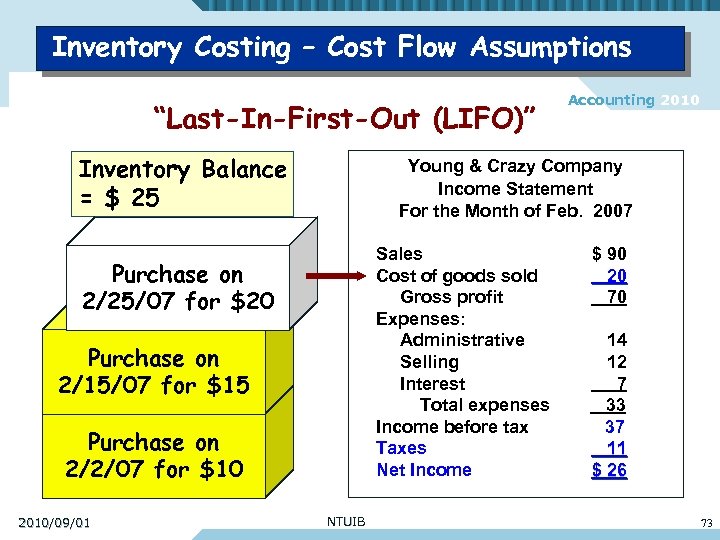
Inventory Costing – Cost Flow Assumptions “Last-In-First-Out (LIFO)” Inventory Balance = $ 25 Young & Crazy Company Income Statement For the Month of Feb. 2007 Sales Cost of goods sold Gross profit Expenses: Administrative Selling Interest Total expenses Income before tax Taxes Net Income Purchase on 2/25/07 for $20 Purchase on 2/15/07 for $15 Purchase on 2/2/07 for $10 2010/09/01 Accounting 2010 NTUIB $ 90 20 70 14 12 7 33 37 11 $ 26 73
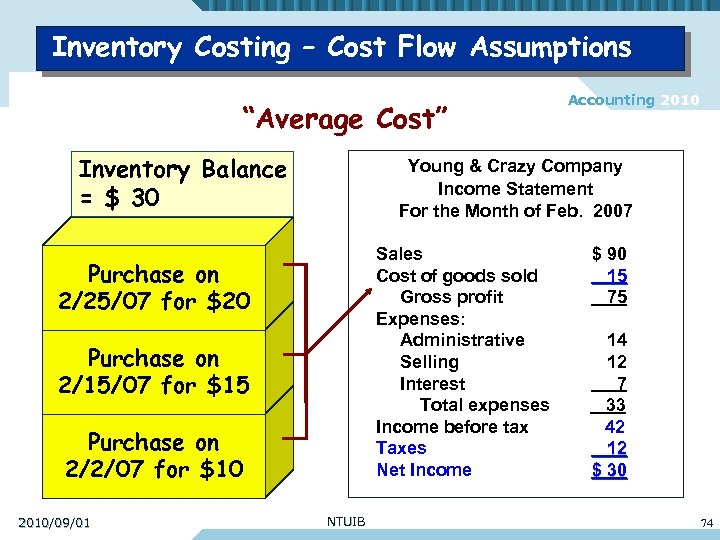
Inventory Costing – Cost Flow Assumptions “Average Cost” Inventory Balance = $ 30 Young & Crazy Company Income Statement For the Month of Feb. 2007 Sales Cost of goods sold Gross profit Expenses: Administrative Selling Interest Total expenses Income before tax Taxes Net Income Purchase on 2/25/07 for $20 Purchase on 2/15/07 for $15 Purchase on 2/2/07 for $10 2010/09/01 Accounting 2010 NTUIB $ 90 15 75 14 12 7 33 42 12 $ 30 74
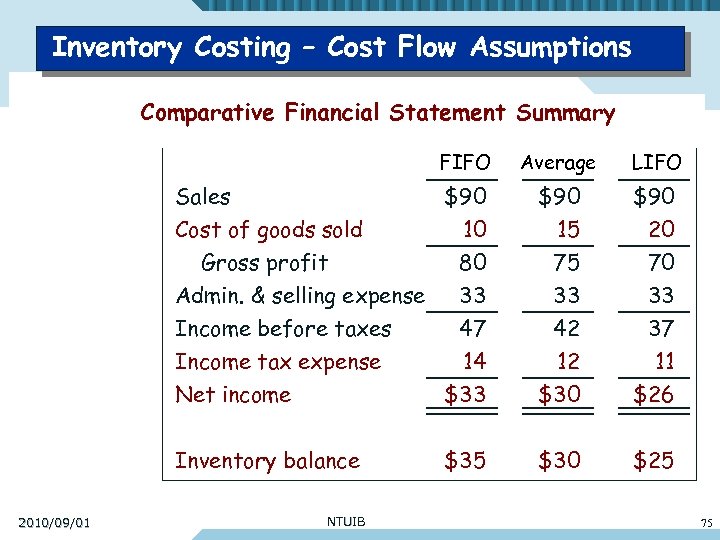
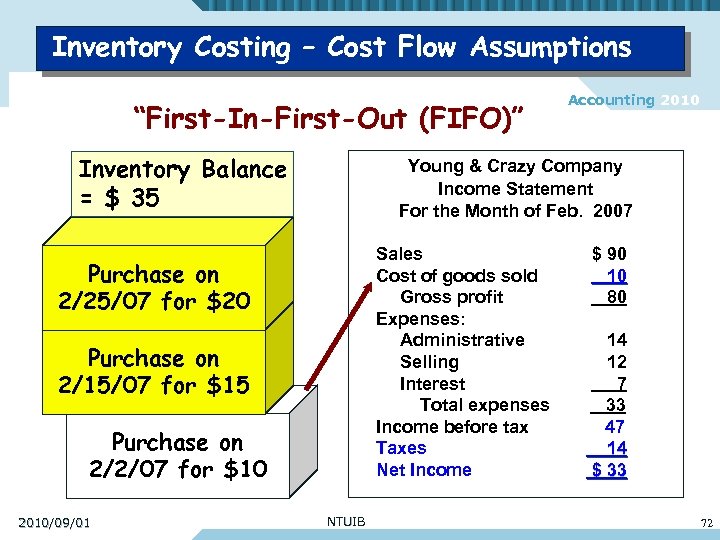
Inventory Costing – Cost Flow Assumptions Accounting 2010 Comparative Financial Statement Summary FIFO LIFO Sales $90 Cost of goods sold 10 Gross profit 80 Admin. & selling expense 33 Income before taxes 47 Income tax expense 14 Net income $33 $90 15 75 33 42 12 $30 $90 20 70 33 37 11 $26 Inventory balance 2010/09/01 Average $30 $25 NTUIB $35 75
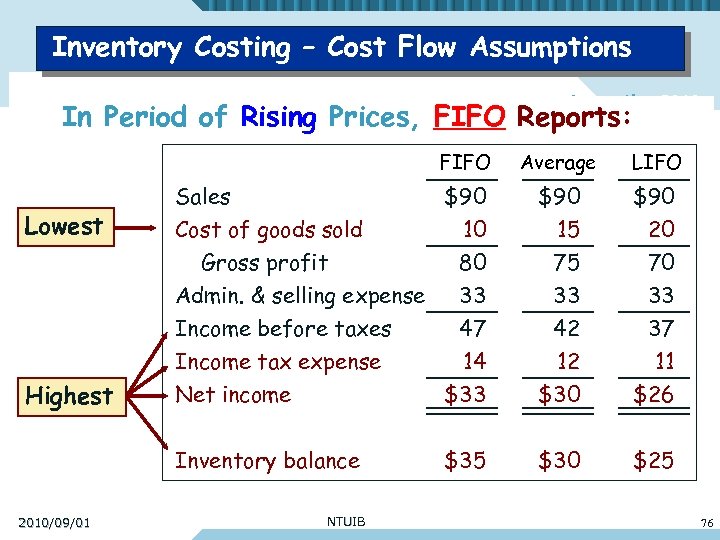
Inventory Costing – Cost Flow Assumptions Accounting 2010 In Period of Rising Prices, FIFO Reports: FIFO Highest 2010/09/01 LIFO Sales $90 Cost of goods sold 10 Gross profit 80 Admin. & selling expense 33 Income before taxes 47 Income tax expense 14 Net income $33 $90 15 75 33 42 12 $30 $90 20 70 33 37 11 $26 Inventory balance Lowest Average $30 $25 NTUIB $35 76
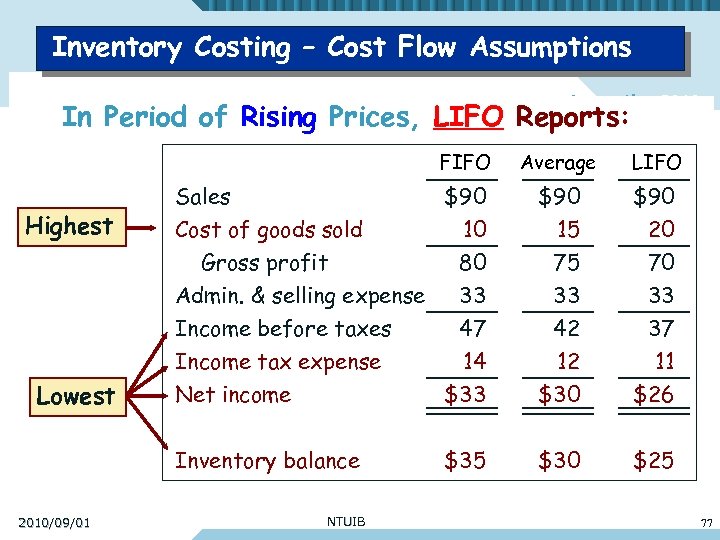
Inventory Costing – Cost Flow Assumptions Accounting 2010 In Period of Rising Prices, LIFO Reports: FIFO Lowest 2010/09/01 LIFO Sales $90 Cost of goods sold 10 Gross profit 80 Admin. & selling expense 33 Income before taxes 47 Income tax expense 14 Net income $33 $90 15 75 33 42 12 $30 $90 20 70 33 37 11 $26 Inventory balance Highest Average $30 $25 NTUIB $35 77
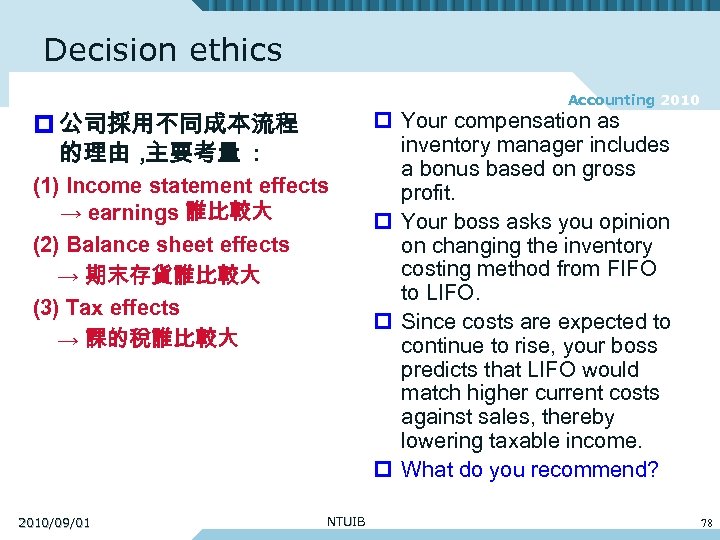
Decision ethics Accounting 2010 p 公司採用不同成本流程 的理由 , 主要考量 : (1) Income statement effects → earnings 誰比較大 (2) Balance sheet effects → 期末存貨誰比較大 (3) Tax effects → 課的稅誰比較大 2010/09/01 NTUIB p Your compensation as inventory manager includes a bonus based on gross profit. p Your boss asks you opinion on changing the inventory costing method from FIFO to LIFO. p Since costs are expected to continue to rise, your boss predicts that LIFO would match higher current costs against sales, thereby lowering taxable income. p What do you recommend? 78
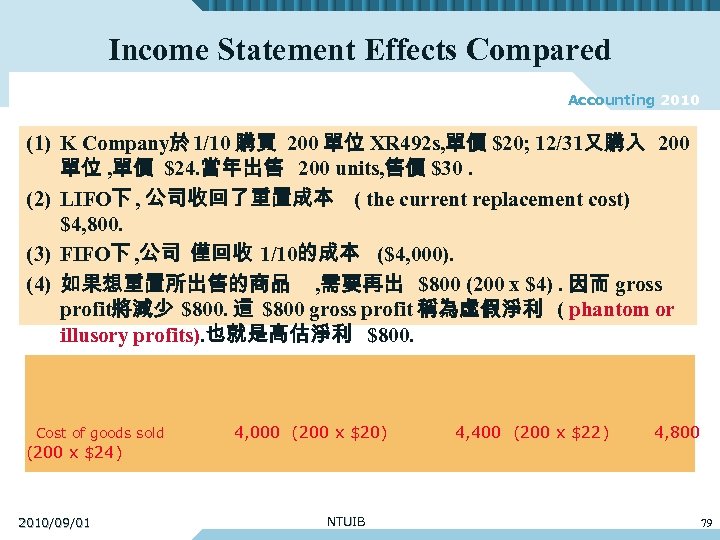
Income Statement Effects Compared Accounting 2010 (1) K Company於 1/10 購買 200 單位 XR 492 s, 單價 $20; 12/31又購入 200 單位 , 單價 $24. 當年出售 200 units, 售價 $30. (2) LIFO下 , 公司收回了重置成本 ( the current replacement cost) $4, 800. (3) FIFO下 , 公司 僅回收 1/10的成本 ($4, 000). (4) 如果想重置所出售的商品 , 需要再出 $800 (200 x $4). 因而 gross profit將減少 $800. 這 $800 gross profit 稱為虛假淨利 ( phantom or illusory profits). 也就是高估淨利 $800. Cost of goods sold (200 x $24) 2010/09/01 4, 000 (200 x $20) NTUIB 4, 400 (200 x $22) 4, 800 79
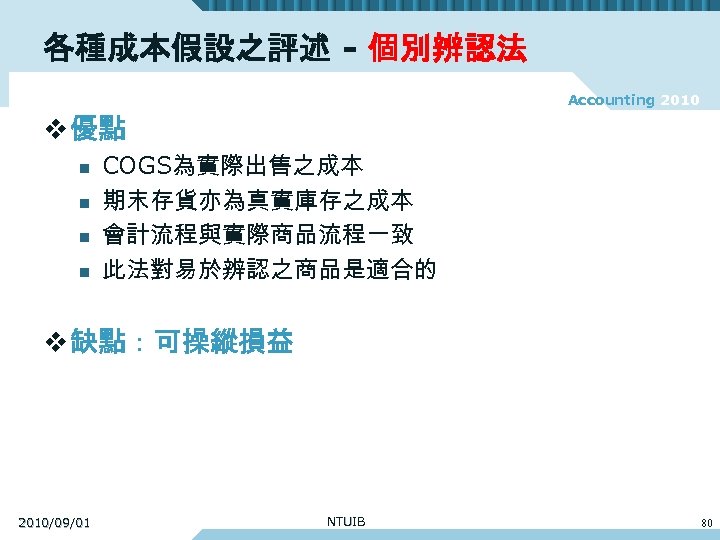
各種成本假設之評述 - 個別辨認法 Accounting 2010 v 優點 n n COGS為實際出售之成本 期末存貨亦為真實庫存之成本 會計流程與實際商品流程一致 此法對易於辨認之商品是適合的 v 缺點:可操縱損益 2010/09/01 NTUIB 80
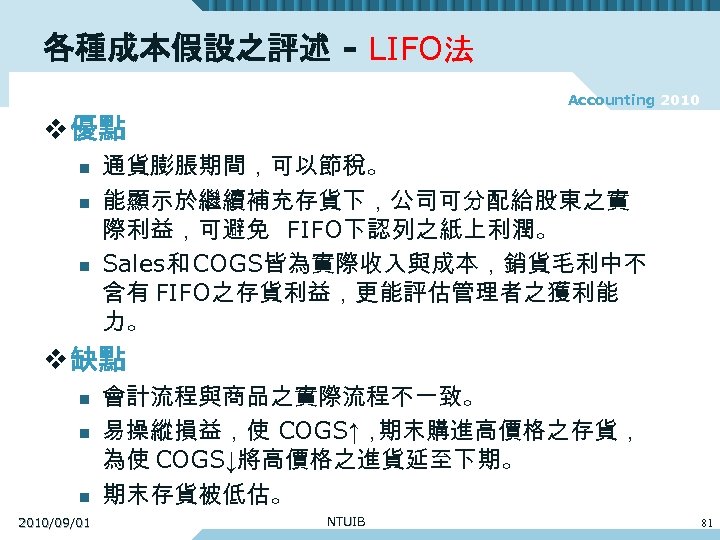
各種成本假設之評述 - LIFO法 Accounting 2010 v 優點 n n n 通貨膨脹期間,可以節稅。 能顯示於繼續補充存貨下,公司可分配給股東之實 際利益,可避免 FIFO下認列之紙上利潤。 Sales和 COGS皆為實際收入與成本,銷貨毛利中不 含有 FIFO之存貨利益,更能評估管理者之獲利能 力。 v 缺點 n n n 2010/09/01 會計流程與商品之實際流程不一致。 易操縱損益,使 COGS↑, 期末購進高價格之存貨, 為使 COGS↓將高價格之進貨延至下期。 期末存貨被低估。 NTUIB 81
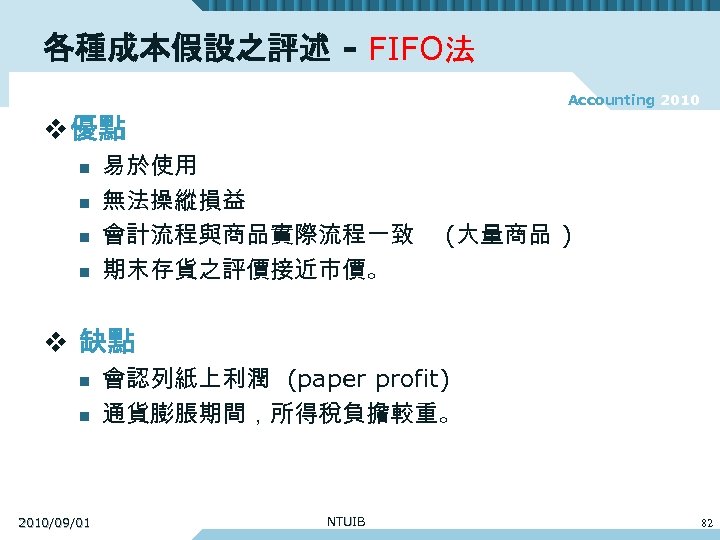
各種成本假設之評述 - FIFO法 Accounting 2010 v 優點 n n 易於使用 無法操縱損益 會計流程與商品實際流程一致 期末存貨之評價接近市價。 (大量商品 ) v 缺點 n n 2010/09/01 會認列紙上利潤 (paper profit) 通貨膨脹期間,所得稅負擔較重。 NTUIB 82
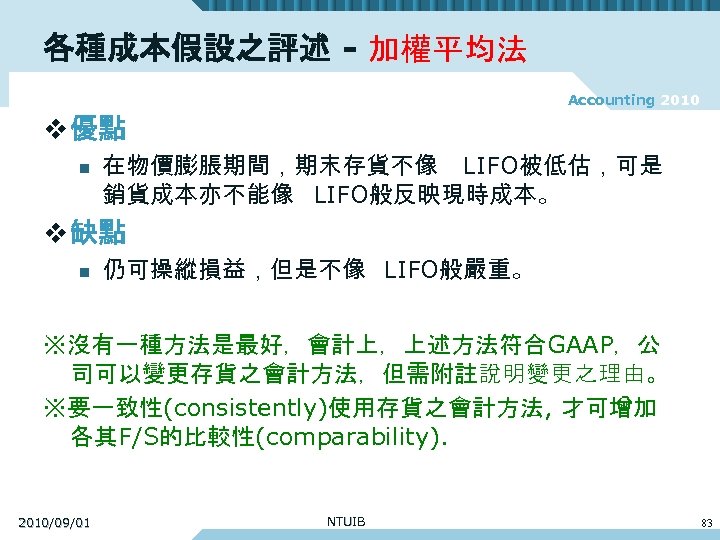
各種成本假設之評述 - 加權平均法 Accounting 2010 v 優點 n 在物價膨脹期間,期末存貨不像 LIFO被低估,可是 銷貨成本亦不能像 LIFO般反映現時成本。 v 缺點 n 仍可操縱損益,但是不像 LIFO般嚴重。 ※沒有一種方法是最好,會計上,上述方法符合GAAP,公 司可以變更存貨之會計方法,但需附註說明變更之理由。 ※要一致性(consistently)使用存貨之會計方法, 才可增加 各其F/S的比較性(comparability). 2010/09/01 NTUIB 83
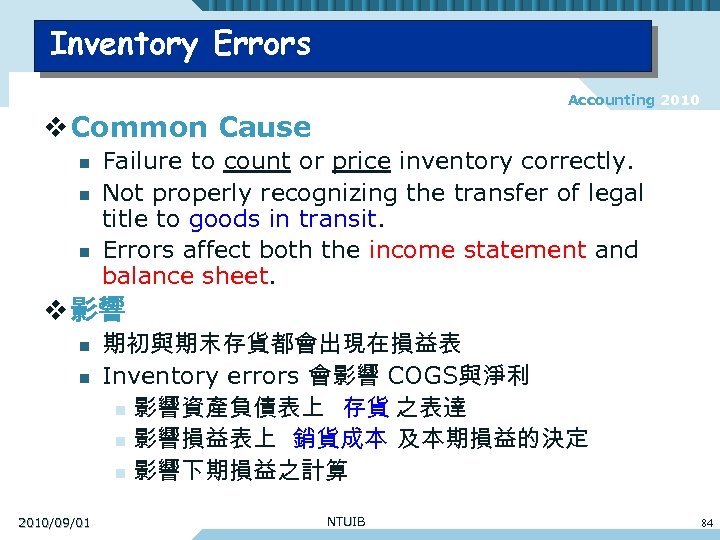
Inventory Errors Accounting 2010 v Common Cause n n n Failure to count or price inventory correctly. Not properly recognizing the transfer of legal title to goods in transit. Errors affect both the income statement and balance sheet. v 影響 n n 2010/09/01 期初與期末存貨都會出現在損益表 Inventory errors 會影響 COGS與淨利 n 影響資產負債表上 存貨 之表達 n 影響損益表上 銷貨成本 及本期損益的決定 n 影響下期損益之計算 NTUIB 84
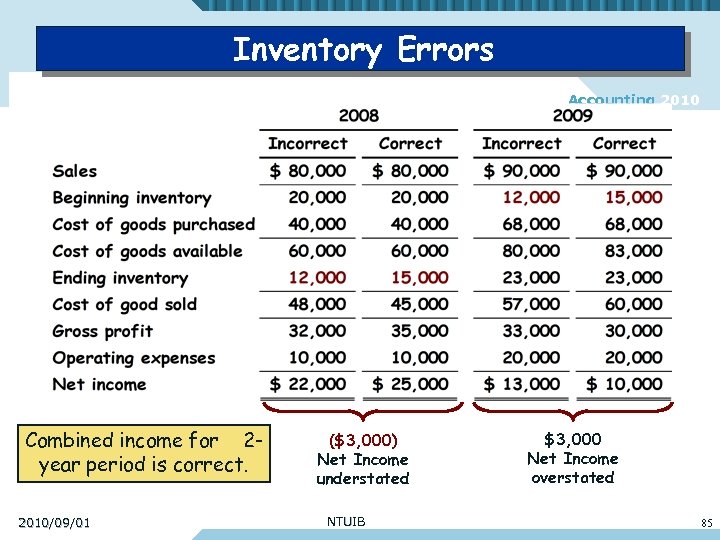
Inventory Errors Accounting 2010 Combined income for 2 year period is correct. 2010/09/01 ($3, 000) Net Income understated NTUIB $3, 000 Net Income overstated 85
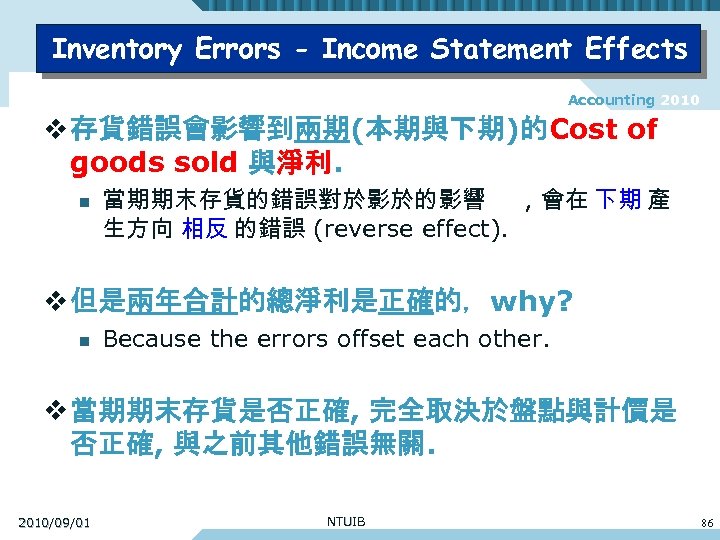
Inventory Errors - Income Statement Effects Accounting 2010 v 存貨錯誤會影響到兩期(本期與下期)的Cost of goods sold 與淨利. n 當期期末存貨的錯誤對於影於的影響 , 會在 下期 產 生方向 相反 的錯誤 (reverse effect). v 但是兩年合計的總淨利是正確的,why? n Because the errors offset each other. v 當期期末存貨是否正確, 完全取決於盤點與計價是 否正確, 與之前其他錯誤無關. 2010/09/01 NTUIB 86
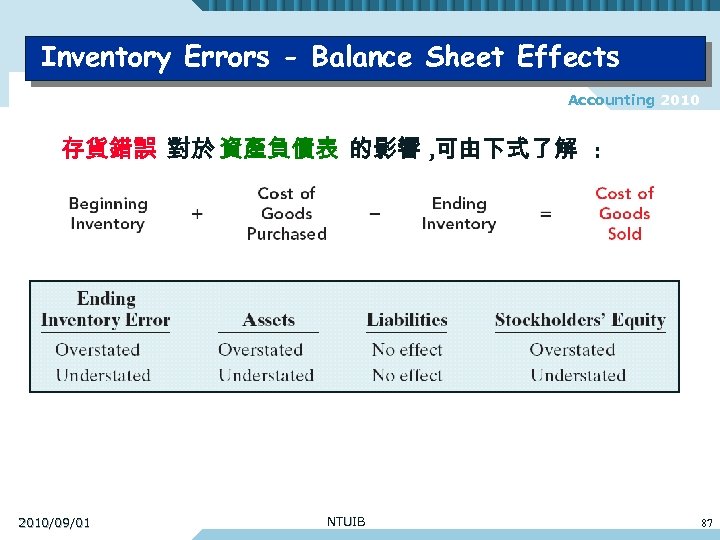
Inventory Errors - Balance Sheet Effects Accounting 2010 存貨錯誤 對於 資產負債表 的影響 , 可由下式了解 : 2010/09/01 NTUIB 87
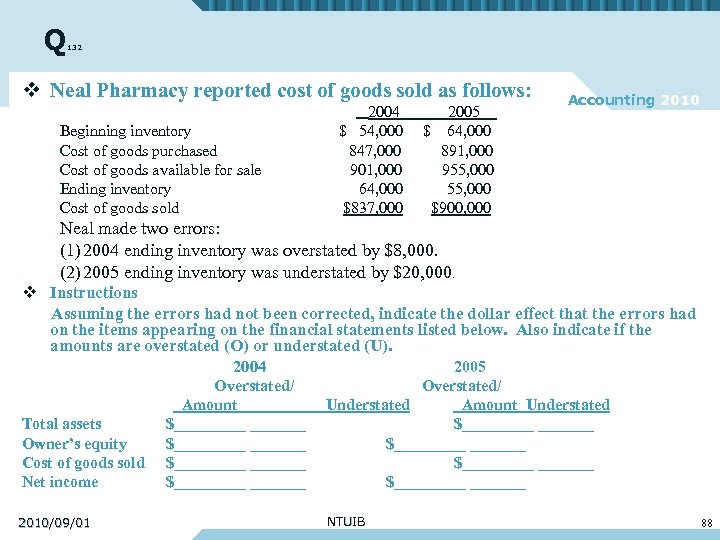
Q 132 v Neal Pharmacy reported cost of goods sold as follows: Beginning inventory Cost of goods purchased Cost of goods available for sale Ending inventory Cost of goods sold 2004 $ 54, 000 847, 000 901, 000 64, 000 $837, 000 2005 $ 64, 000 891, 000 955, 000 $900, 000 Accounting 2010 Neal made two errors: (1) 2004 ending inventory was overstated by $8, 000. (2) 2005 ending inventory was understated by $20, 000. v Instructions Assuming the errors had not been corrected, indicate the dollar effect that the errors had on the items appearing on the financial statements listed below. Also indicate if the amounts are overstated (O) or understated (U). 2004 2005 Total assets Owner’s equity Cost of goods sold Net income 2010/09/01 Overstated/ Amount $_________ _______ Overstated/ Understated Amount Understated $_________ _______ NTUIB 88
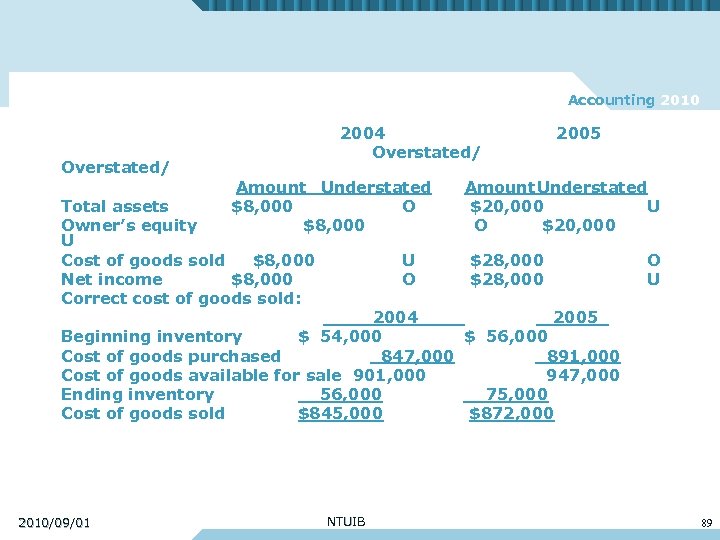
Accounting 2010 v v Overstated/ 2004 Overstated/ v Amount Understated v Total assets $8, 000 O v Owner’s equity $8, 000 U v Cost of goods sold $8, 000 U v Net income $8, 000 O v Correct cost of goods sold: v 2004 v Beginning inventory $ 54, 000 v Cost of goods purchased 847, 000 v Cost of goods available for sale 901, 000 v Ending inventory 56, 000 v Cost of goods sold $845, 000 2010/09/01 NTUIB 2005 Amount Understated $20, 000 U O $20, 000 $28, 000 O U 2005 $ 56, 000 891, 000 947, 000 75, 000 $872, 000 89
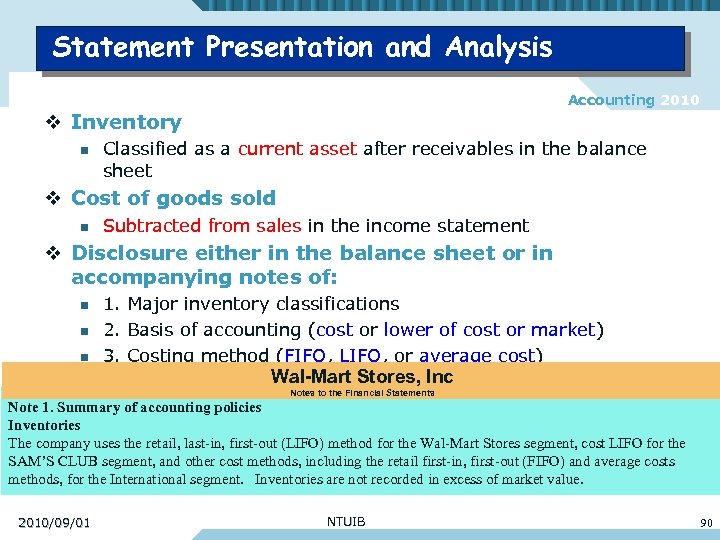
Statement Presentation and Analysis Accounting 2010 v Inventory n Classified as a current asset after receivables in the balance sheet v Cost of goods sold n Subtracted from sales in the income statement v Disclosure either in the balance sheet or in accompanying notes of: n n n 1. Major inventory classifications 2. Basis of accounting (cost or lower of cost or market) 3. Costing method (FIFO, LIFO, or average cost) Wal-Mart Stores, Inc Notes to the Financial Statements Note 1. Summary of accounting policies Inventories The company uses the retail, last-in, first-out (LIFO) method for the Wal-Mart Stores segment, cost LIFO for the SAM’S CLUB segment, and other cost methods, including the retail first-in, first-out (FIFO) and average costs methods, for the International segment. Inventories are not recorded in excess of market value. 2010/09/01 NTUIB 90
Statement Presentation and Analysis Accounting 2010 Analysis Inventory management is a double-edged sword 1. High Inventory Levels - may incur high carrying costs (e. g. , investment, storage, insurance, obsolescence, and damage). 2. Low Inventory Levels – may lead to stockouts and lost sales. 2010/09/01 NTUIB 91
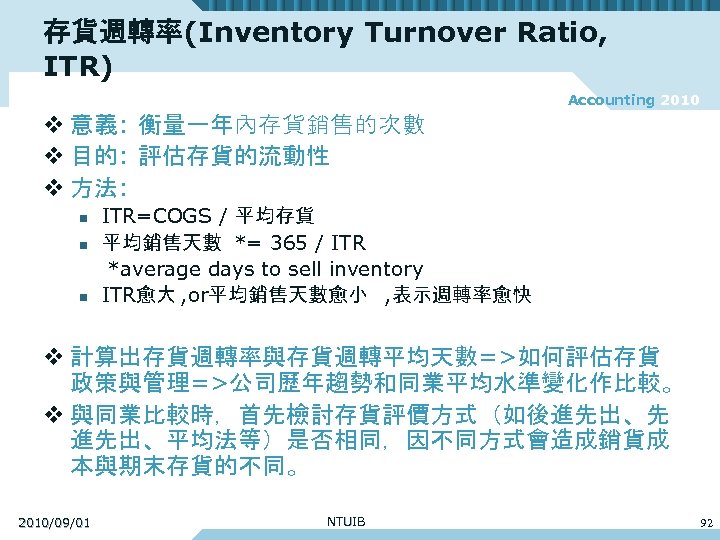
存貨週轉率(Inventory Turnover Ratio, ITR) Accounting 2010 v 意義: 衡量一年內存貨銷售的次數 v 目的: 評估存貨的流動性 v 方法: n n n ITR=COGS / 平均存貨 平均銷售天數 *= 365 / ITR *average days to sell inventory ITR愈大 , or平均銷售天數愈小 , 表示週轉率愈快 v 計算出存貨週轉率與存貨週轉平均天數=>如何評估存貨 政策與管理=>公司歷年趨勢和同業平均水準變化作比較。 v 與同業比較時,首先檢討存貨評價方式(如後進先出、先 進先出、平均法等)是否相同,因不同方式會造成銷貨成 本與期末存貨的不同。 2010/09/01 NTUIB 92
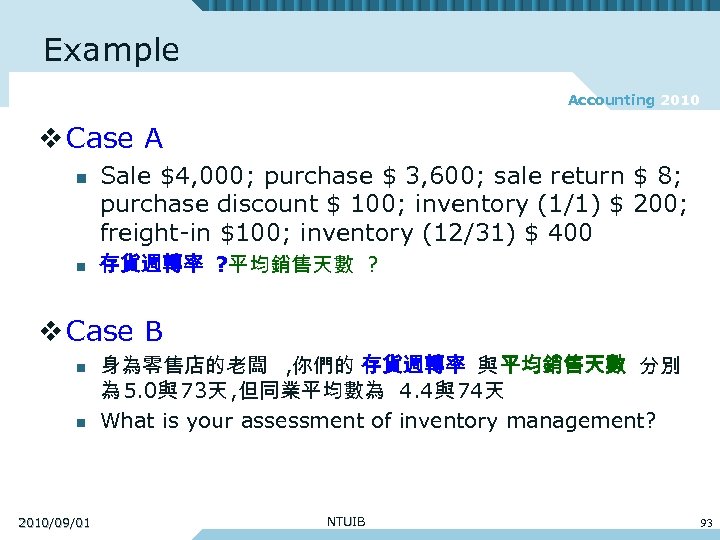
Example Accounting 2010 v Case A n n Sale $4, 000; purchase $ 3, 600; sale return $ 8; purchase discount $ 100; inventory (1/1) $ 200; freight-in $100; inventory (12/31) $ 400 存貨週轉率 ? 平均銷售天數 ? v Case B n n 2010/09/01 身為零售店的老闆 , 你們的 存貨週轉率 與 平均銷售天數 分別 為 5. 0與 73天 , 但同業平均數為 4. 4與 74天 What is your assessment of inventory management? NTUIB 93
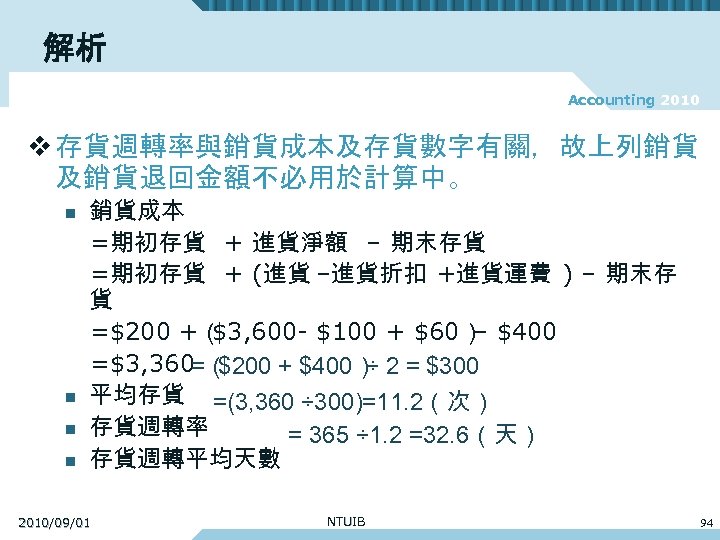
解析 Accounting 2010 v 存貨週轉率與銷貨成本及存貨數字有關,故上列銷貨 及銷貨退回金額不必用於計算中。 n n 銷貨成本 =期初存貨 + 進貨淨額 – 期末存貨 =期初存貨 + (進貨 –進貨折扣 +進貨運費 ) – 期末存 貨 =$200 +( $3, 600 - $100 + $60) $400 – =$3, 360=( $200 + $400) 2 = $300 ÷ 平均存貨 =(3, 360 ÷ 300)=11. 2(次) 存貨週轉率 = 365 ÷ 1. 2 =32. 6(天) 存貨週轉平均天數 2010/09/01 NTUIB 94
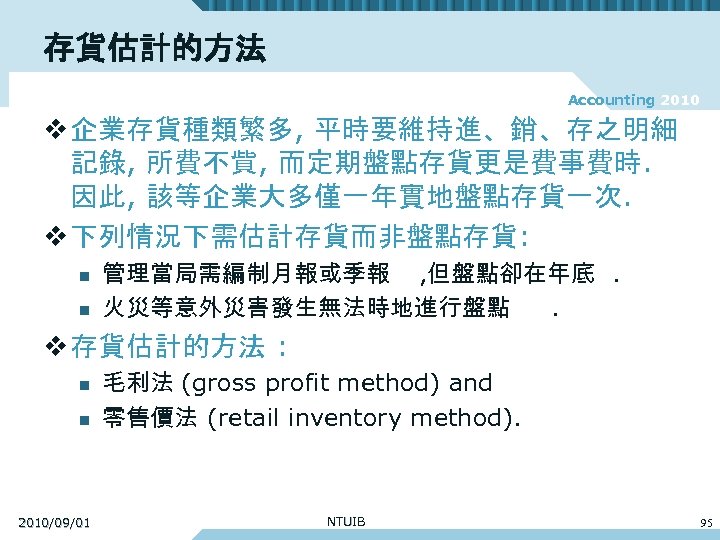
存貨估計的方法 Accounting 2010 v 企業存貨種類繁多, 平時要維持進、銷、存之明細 記錄, 所費不貲, 而定期盤點存貨更是費事費時. 因此, 該等企業大多僅一年實地盤點存貨一次. v 下列情況下需估計存貨而非盤點存貨: n n 管理當局需編制月報或季報 , 但盤點卻在年底. 火災等意外災害發生無法時地進行盤點. v 存貨估計的方法 : n n 2010/09/01 毛利法 (gross profit method) and 零售價法 (retail inventory method). NTUIB 95
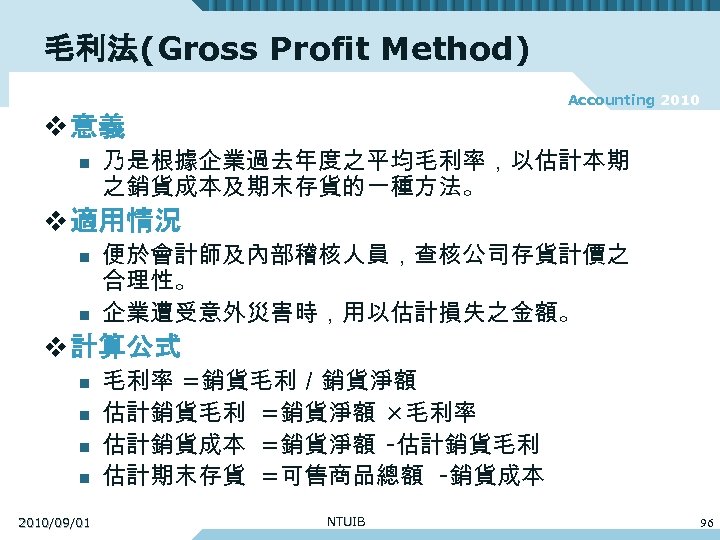
毛利法(Gross Profit Method) Accounting 2010 v 意義 n 乃是根據企業過去年度之平均毛利率,以估計本期 之銷貨成本及期末存貨的一種方法。 v 適用情況 n n 便於會計師及內部稽核人員,查核公司存貨計價之 合理性。 企業遭受意外災害時,用以估計損失之金額。 v 計算公式 n n 2010/09/01 毛利率 =銷貨毛利/銷貨淨額 估計銷貨毛利 =銷貨淨額 ×毛利率 估計銷貨成本 =銷貨淨額 -估計銷貨毛利 估計期末存貨 =可售商品總額 -銷貨成本 NTUIB 96
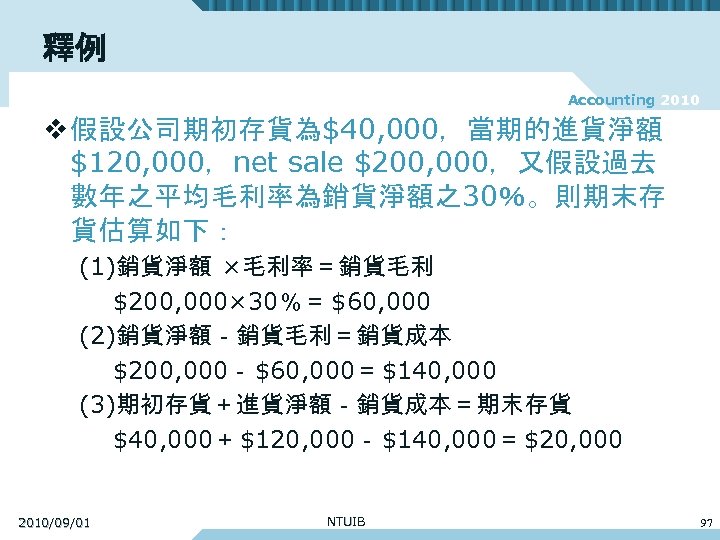
釋例 Accounting 2010 v 假設公司期初存貨為$40, 000,當期的進貨淨額 $120, 000,net sale $200, 000,又假設過去 數年之平均毛利率為銷貨淨額之30%。則期末存 貨估算如下: (1)銷貨淨額 ×毛利率=銷貨毛利 $200, 000× 30%= $60, 000 (2)銷貨淨額-銷貨毛利=銷貨成本 $200, 000- $60, 000= $140, 000 (3)期初存貨+進貨淨額-銷貨成本=期末存貨 $40, 000+ $120, 000- $140, 000= $20, 000 2010/09/01 NTUIB 97
說明 Accounting 2010 v 凡是業務有顯著季節性的行業,於淡季或旺季估 計存貨時,也應注意毛利率有所不同。通常旺季 時售價高,毛利率高,淡季時可能降價求售,毛 利率會降低,估計存貨時應適用不同的毛利率。 v 以毛利法估計存貨時,能否得到可靠的數值,關 鍵在於毛利率。因此若本年度之售價、進貨成本 有大幅異動,或銷貨組合有改變,以致於影響本 期毛利率與前期毛利率有顯著不同時,應作適度 調整。 2010/09/01 NTUIB 98
零售價法(Retail Inventory Method) Accounting 2010 v 意義 乃是利用本期可供銷售商品之成本率 , 以 估計期末 存貨成本 的方法. 零售價法廣泛使用於連鎖商店、 百貨公司及其他零售商店. n 採零售價法 , 須有 期初存貨 與 當期所有進貨 之 零售 價與成本 的記錄. =>即平時買進商品時要記錄成本 , 也需將售價資料 加以記載 , 以計算當期可供銷售商品之成本與零售 價資料. n 2010/09/01 NTUIB 99
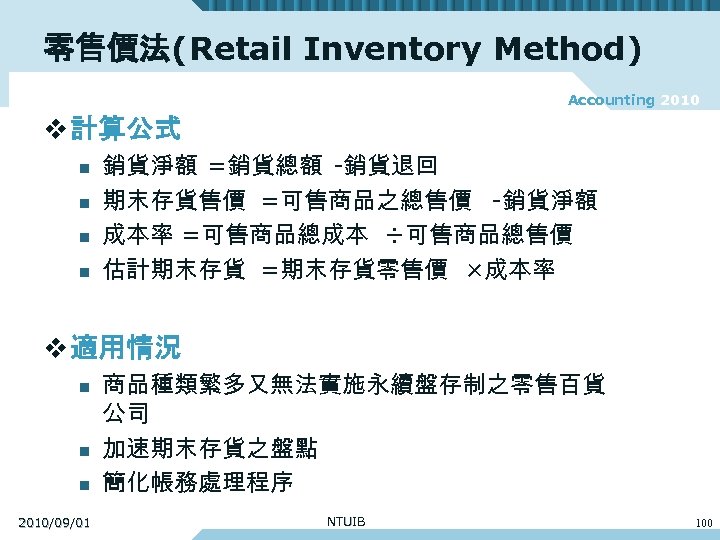
零售價法(Retail Inventory Method) Accounting 2010 v 計算公式 n n 銷貨淨額 =銷貨總額 -銷貨退回 期末存貨售價 =可售商品之總售價 -銷貨淨額 成本率 =可售商品總成本 ÷可售商品總售價 估計期末存貨 =期末存貨零售價 ×成本率 v 適用情況 n n n 2010/09/01 商品種類繁多又無法實施永續盤存制之零售百貨 公司 加速期末存貨之盤點 簡化帳務處理程序 NTUIB 100
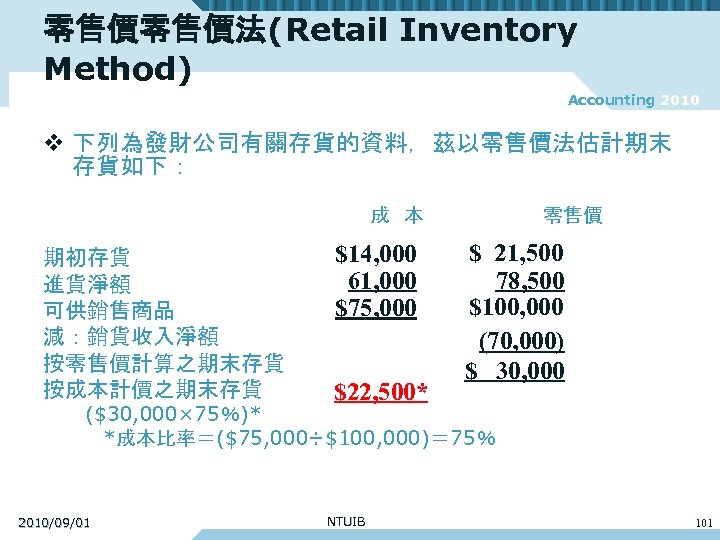
零售價零售價法(Retail Inventory Method) Accounting 2010 v 下列為發財公司有關存貨的資料,茲以零售價法估計期末 存貨如下: 期初存貨 進貨淨額 可供銷售商品 減:銷貨收入淨額 按零售價計算之期末存貨 按成本計價之期末存貨 成 本 $14, 000 61, 000 $75, 000 $22, 500* 零售價 $ 21, 500 78, 500 $100, 000 (70, 000) $ 30, 000 ($30, 000× 75%)* *成本比率=($75, 000÷$100, 000)= 75% 2010/09/01 NTUIB 101
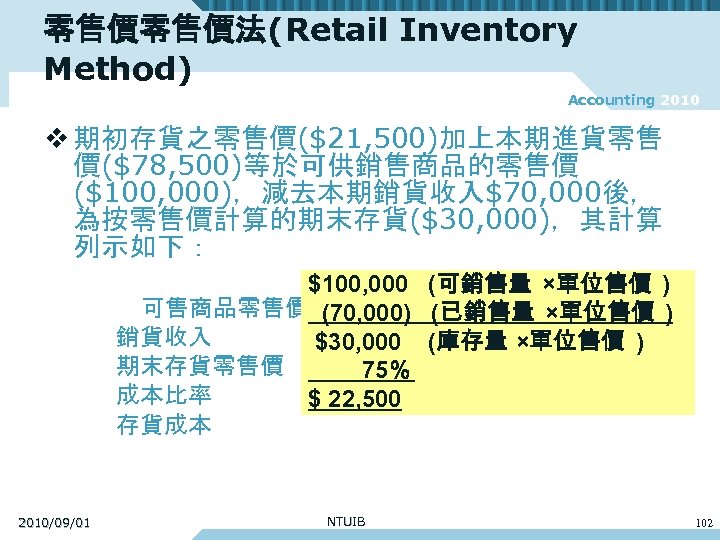
零售價零售價法(Retail Inventory Method) Accounting 2010 v 期初存貨之零售價($21, 500)加上本期進貨零售 價($78, 500)等於可供銷售商品的零售價 ($100, 000),減去本期銷貨收入$70, 000後, 為按零售價計算的期末存貨($30, 000),其計算 列示如下: $100, 000 (可銷售量 ×單位售價 ) 可售商品零售價 (70, 000) (已銷售量 ×單位售價 ) 銷貨收入 $30, 000 (庫存量 ×單位售價 ) 期末存貨零售價 75% 成本比率 $ 22, 500 存貨成本 2010/09/01 NTUIB 102
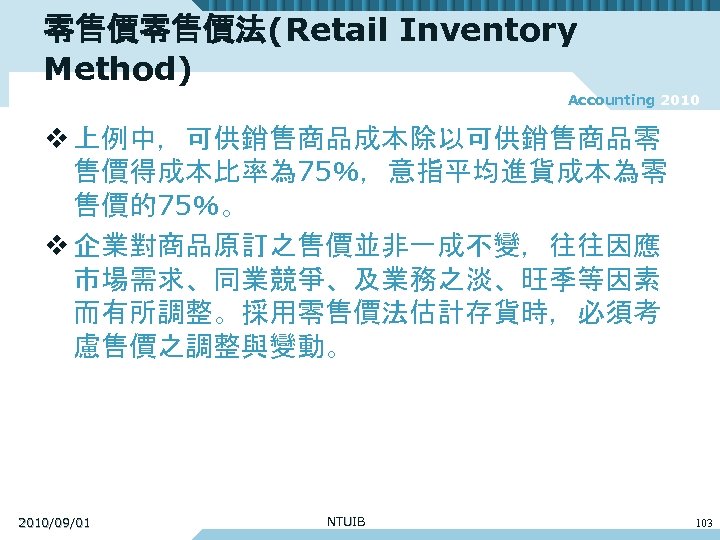
零售價零售價法(Retail Inventory Method) Accounting 2010 v 上例中,可供銷售商品成本除以可供銷售商品零 售價得成本比率為 75%,意指平均進貨成本為零 售價的75%。 v 企業對商品原訂之售價並非一成不變,往往因應 市場需求、同業競爭、及業務之淡、旺季等因素 而有所調整。採用零售價法估計存貨時,必須考 慮售價之調整與變動。 2010/09/01 NTUIB 103
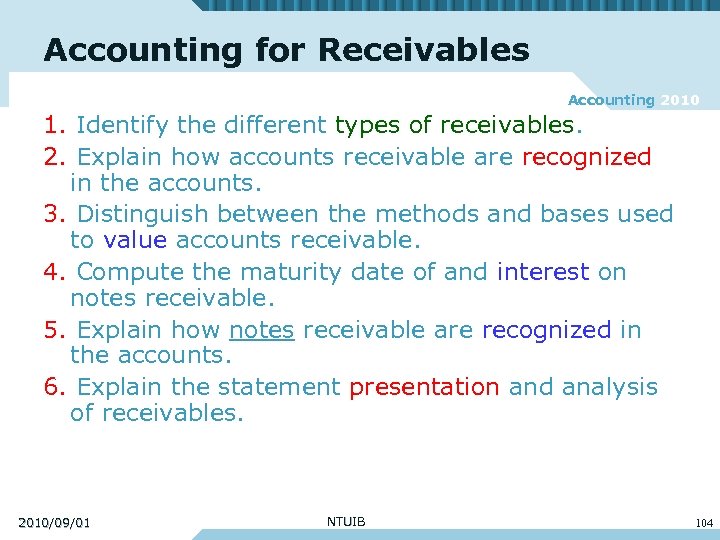
Accounting for Receivables Accounting 2010 1. Identify the different types of receivables. 2. Explain how accounts receivable are recognized in the accounts. 3. Distinguish between the methods and bases used to value accounts receivable. 4. Compute the maturity date of and interest on notes receivable. 5. Explain how notes receivable are recognized in the accounts. 6. Explain the statement presentation and analysis of receivables. 2010/09/01 NTUIB 104
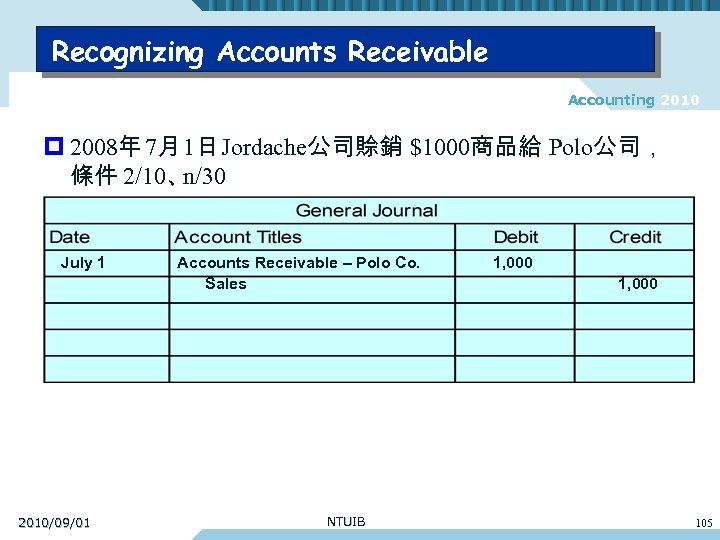
Recognizing Accounts Receivable Accounting 2010 p 2008年 7月 1日 Jordache公司賒銷 $1000商品給 Polo公司, 條件 2/10、 n/30 July 1 2010/09/01 Accounts Receivable – Polo Co. Sales NTUIB 1, 000 105
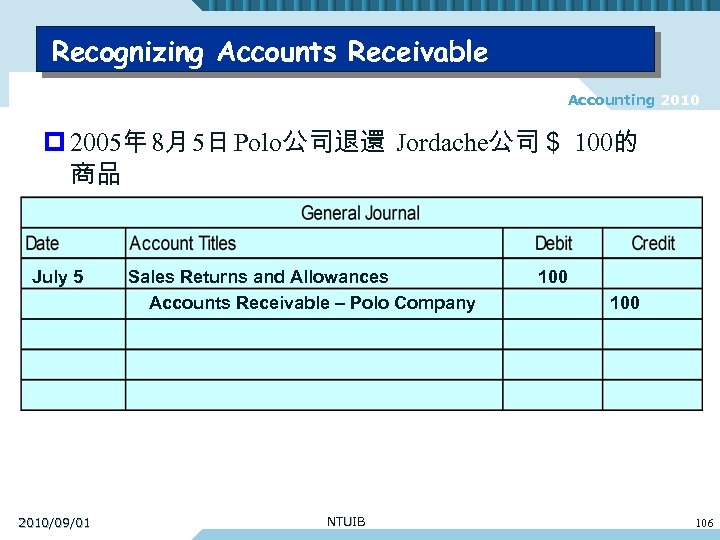
Recognizing Accounts Receivable Accounting 2010 p 2005年 8月 5日 Polo公司退還 Jordache公司$ 100的 商品 July 5 2010/09/01 Sales Returns and Allowances Accounts Receivable – Polo Company NTUIB 100 106
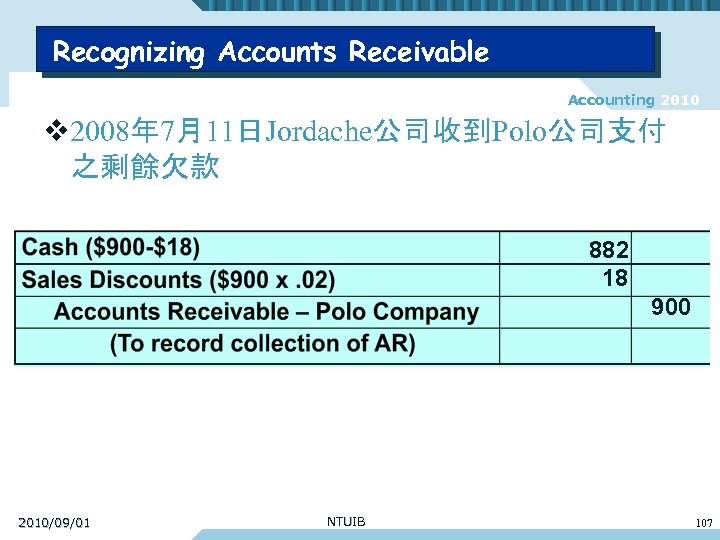
Recognizing Accounts Receivable Accounting 2010 v 2008年 7月11日Jordache公司收到Polo公司支付 之剩餘欠款 882 18 900 2010/09/01 NTUIB 107
Valuing Accounts Receivable: Trade discount Accounting 2010 v 商業折扣係企業因應市場供需, 及對不同形態的顧 客(如批發商或零售商), 按定價給予折減的金額. n 例如定價 $1, 000之貨品 , 折減 30%出售 , 實際售價 為 $700,商業折扣為 30% , 即 $300, 一般習稱 七折. v 商業買賣交易亦有就減除折扣後之金額再予折扣, 即所謂的連鎖折扣. n 如折減 30%後再折減 20% , 俗稱七折八扣 , 實際成 交價為 $560。 v 商業折扣: 不入帳, 以實際成交價格認列進貨成本 及銷貨收入. 2010/09/01 NTUIB 108
Valuing Accounts Receivable: Cash discount Accounting 2010 v 企業於同意賒銷後, 通常訂有收款的最後期限, 稱 為信用期限(credit period), 在信用期限內並不 催收貨款. v 在美國為鼓勵顧客儘早付款, 多另訂有折扣期限 (discount period), 若能在折扣期限內付款者, 可以再減收若干金額, 而使實際的現金收入減少, 此種情況稱之為現金折扣. v 現金折扣的條件如: 2/10, n/30 2010/09/01 NTUIB 109
Valuing Accounts Receivable: Bad Debt Accounting 2010 v 壞帳或呆帳(bad debt) n n n 賒銷產生的應收帳款 , 發生無法收回的情形. 賒銷前應對顧客信用嚴加審核. 但過度嚴苛 , 導致銷貨減少 , 故兩者間須取得均衡 , 企業通常係採利潤最大化的授信政策。 Debited to Bad Debts Expense v 壞帳費用之根據: n n Matching principle: 因銷貨而發生 , 故應在銷貨 當年 認列. Conservatism principle: 無法回收之 AR, 應沖銷 , 以免 高估 資產. v 應收帳款能否收回, 銷貨時無法確知, 因此年底須估計應 收帳款收現的可能性, 即估計壞帳及應收帳款的Cash (net) realizable value. 2010/09/01 NTUIB 110
Valuing Accounts Receivable: Bad Debt Accounting 2010 v 直接沖銷法(Direct write-off method): v 備抵法(Allowance method) n n 2010/09/01 銷貨收入百分比法 (Percentage of sales) 帳款餘額百分比法 (Percentage of receivables) 1. 綜合比率法 2. 帳齡分析法 (Aging of AR) NTUIB 111
直接沖銷法(Direct write-off method) Accounting 2010 v 意義 即賒銷後 , 直到帳款確定無法收回時 , 才認列壞帳 損失 , 其分錄如下: Debts Expense Bad ××× Accounts Receivable ××× n v 缺點 n n 收益與費用可能分別列於不同會計期間 原則. 高估資產 , 違反 穩健原則. , 不符 配合 v GAAP不採行 2010/09/01 NTUIB 112
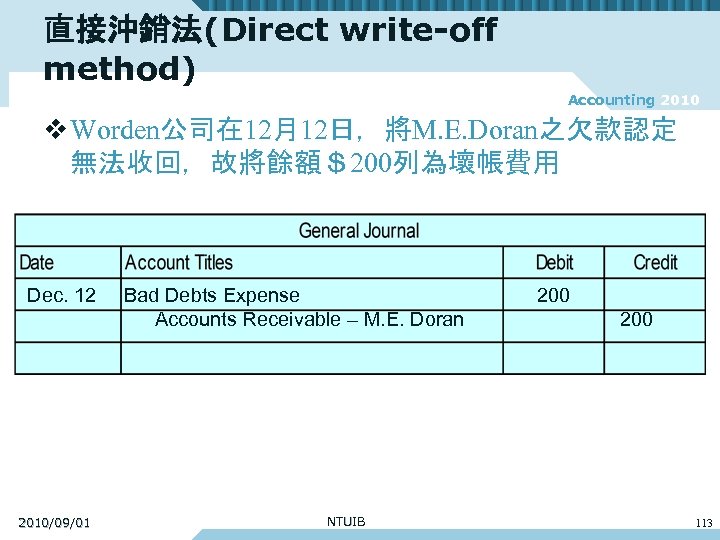
直接沖銷法(Direct write-off method) Accounting 2010 v Worden公司在 12月12日,將M. E. Doran之欠款認定 無法收回,故將餘額$200列為壞帳費用 Dec. 12 2010/09/01 Bad Debts Expense Accounts Receivable – M. E. Doran NTUIB 200 113
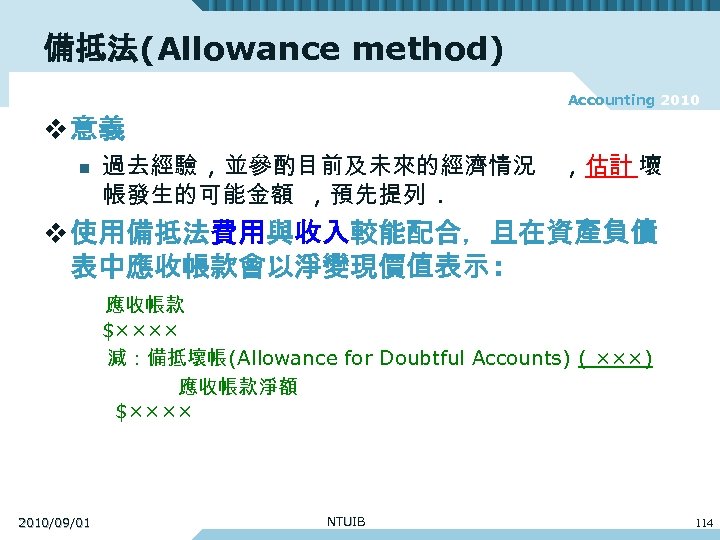
備抵法(Allowance method) Accounting 2010 v 意義 n 過去經驗 , 並參酌目前及未來的經濟情況 帳發生的可能金額 , 預先提列. , 估計 壞 v 使用備抵法費用與收入較能配合,且在資產負債 表中應收帳款會以淨變現價值表示 : 應收帳款 $×××× 減:備抵壞帳(Allowance for Doubtful Accounts) ( ×××) 應收帳款淨額 $×××× 2010/09/01 NTUIB 114
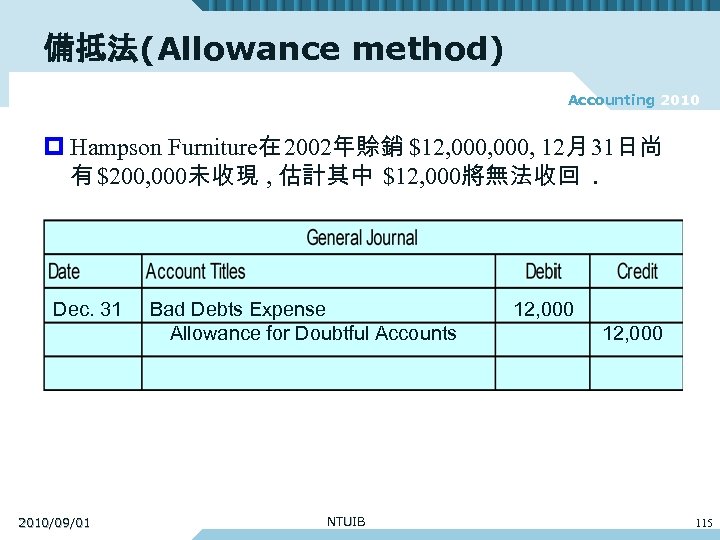
備抵法(Allowance method) Accounting 2010 p Hampson Furniture在 2002年賒銷 $12, 000, 12月 31日尚 有 $200, 000未收現 , 估計其中 $12, 000將無法收回. Dec. 31 2010/09/01 Bad Debts Expense Allowance for Doubtful Accounts NTUIB 12, 000 115
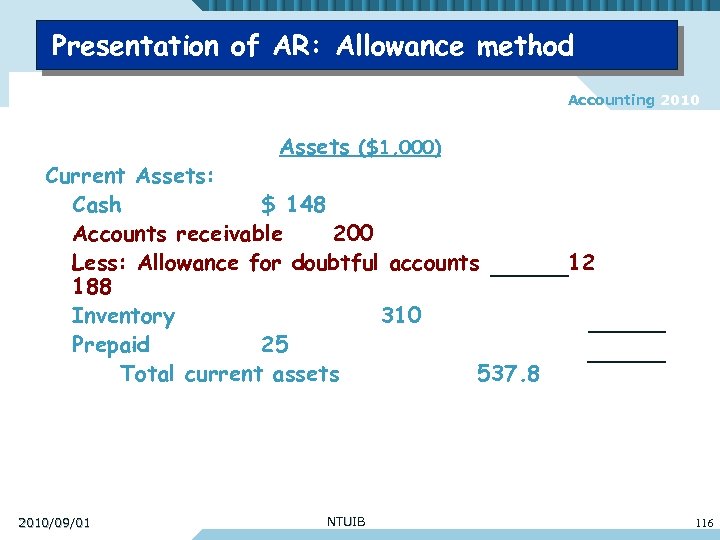
Presentation of AR: Allowance method Accounting 2010 Assets ($1, 000) Current Assets: Cash $ 148 Accounts receivable 200 Less: Allowance for doubtful accounts 188 Inventory 310 Prepaid 25 Total current assets 537. 8 2010/09/01 NTUIB 12 116
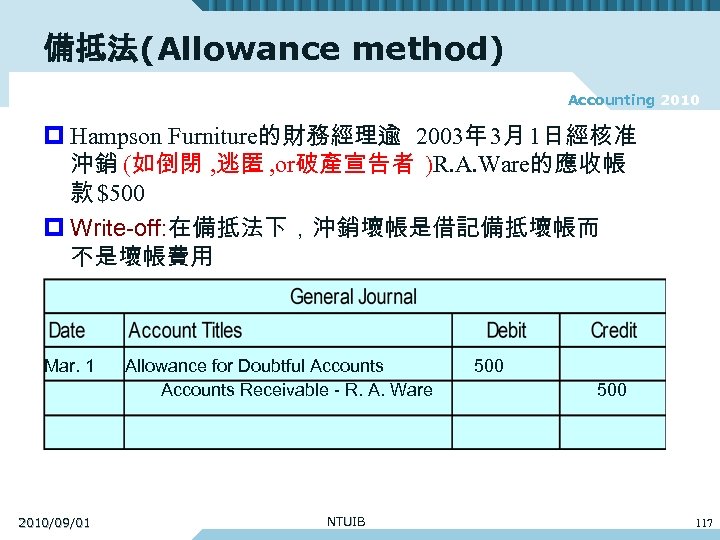
備抵法(Allowance method) Accounting 2010 p Hampson Furniture的財務經理逾 2003年 3月 1日經核准 沖銷 (如倒閉 , 逃匿 , or破產宣告者 )R. A. Ware的應收帳 款 $500 p Write-off: 在備抵法下,沖銷壞帳是借記備抵壞帳而 不是壞帳費用 Mar. 1 2010/09/01 Allowance for Doubtful Accounts Receivable - R. A. Ware NTUIB 500 117
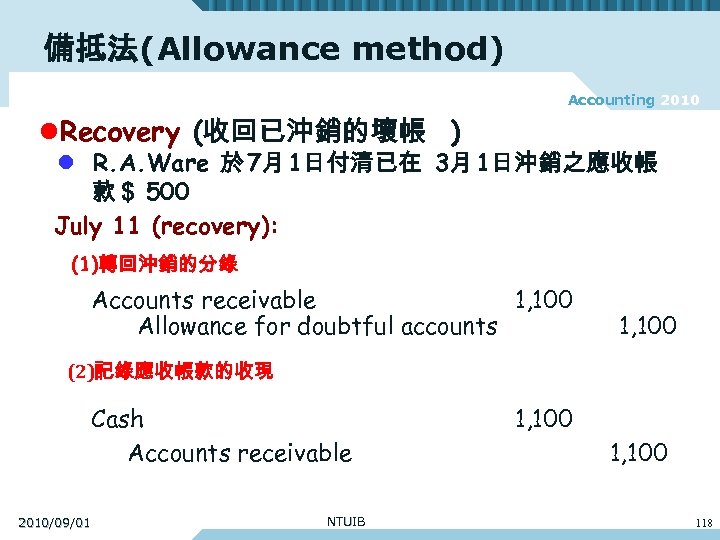
備抵法(Allowance method) Accounting 2010 l. Recovery (收回已沖銷的壞帳 ) l R. A. Ware 於 7月 1日付清已在 3月 1日沖銷之應收帳 款$ 500 July 11 (recovery): (1)轉回沖銷的分錄 Accounts receivable 1, 100 Allowance for doubtful accounts 1, 100 (2)記錄應收帳款的收現 Cash Accounts receivable 2010/09/01 NTUIB 1, 100 118
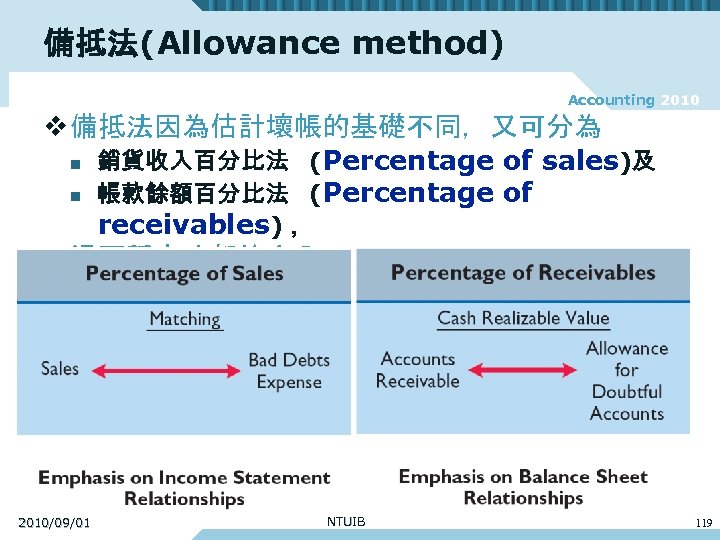
備抵法(Allowance method) Accounting 2010 v 備抵法因為估計壞帳的基礎不同,又可分為 n n 銷貨收入百分比法 (Percentage of sales)及 帳款餘額百分比法 (Percentage of receivables), v 這兩種方法都符合GAAP。 2010/09/01 NTUIB 119
Percentage of Sale (又稱損益表法) Accounting 2010 v 意義: n Expected bad debt losses are determined by applying the percentage to the sales base of the current period(並參考本年度經濟 情況,加以調整 )。 v 方法: 壞帳時係以當期銷貨收入乘上壞帳率,即 可計算出當期壞帳費用 v 優點: 這個方法是強調收入與費用的配合 2010/09/01 NTUIB 120
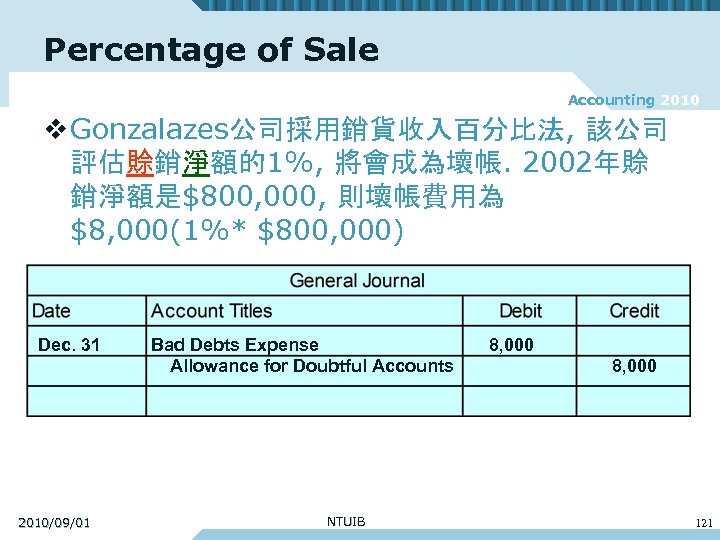
Percentage of Sale Accounting 2010 v Gonzalazes公司採用銷貨收入百分比法, 該公司 評估賒銷淨額的1%, 將會成為壞帳. 2002年賒 銷淨額是$800, 000, 則壞帳費用為 $8, 000(1%* $800, 000) Dec. 31 2010/09/01 Bad Debts Expense Allowance for Doubtful Accounts NTUIB 8, 000 121
Percentage of A/R (又稱資產負債法) Accounting 2010 p 意義 : 以 應收帳款 餘額估列壞帳 n 綜合比率法 n 帳齡分析法 1. 綜合比率法 n 期末應收帳款 *壞帳率 =應有之備抵壞帳餘額 n 應提列之壞帳費用 =應有之備抵壞帳餘額 + or – 調整 前備抵壞帳借貸餘額 2010/09/01 NTUIB 122
Percentage of A/R Accounting 2010 n A公司年底應收帳款餘額為$200, 000,壞帳率是應收帳 款餘額之4%,則本年底應有之備抵壞帳餘額為$8, 000, 假設原有之貸方餘額為$3, 000,則本年度應提列之壞帳 費用為$5, 000,其分錄如下: Bad debt expense 5, 000 Allowance for doubtful account 5, 000 n 若備抵壞帳原為借餘$1, 500,為了產生應有之備抵壞帳 貸餘$8, 000,則本年度應認列壞帳費用$9, 500(即 $8, 000+$1, 500)。 2010/09/01 NTUIB 123
Percentage of A/R Accounting 2010 2. 帳齡分析法(Aging of AR) n n n 2010/09/01 以帳款餘額為基礎估列壞帳,應收帳款明細帳按 欠 款時間 的長短分類。 凡欠款時間愈 長 者,推定其發生壞帳的風險愈大, 壞帳比率會比較 高 ;反之,則較低。 採用此法,亦應先計算出應有的備抵壞帳餘額,再 與原有備抵壞帳數額相比較, 差額 即為本年度之壞 帳費用。 NTUIB 124
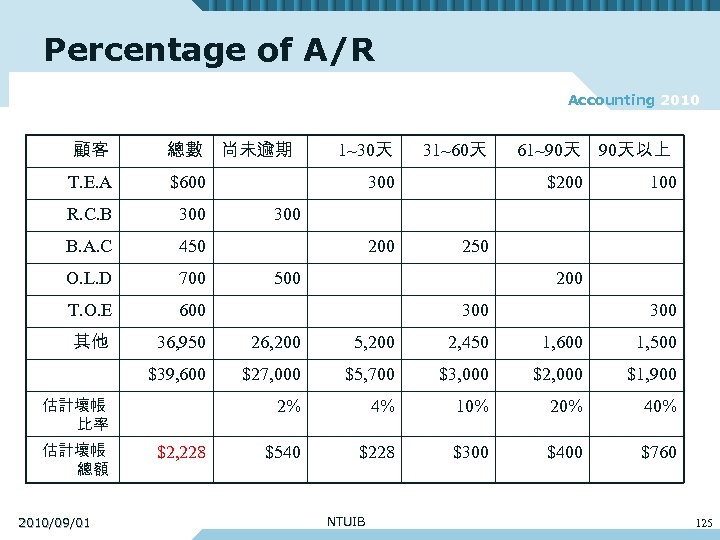
Percentage of A/R Accounting 2010 顧客 總數 T. E. A $600 R. C. B 300 B. A. C 450 O. L. D 700 T. O. E 600 其他 36, 950 26, 200 5, 200 2, 450 1, 600 1, 500 $39, 600 $27, 000 $5, 700 $3, 000 $2, 000 $1, 900 2% 4% 10% 20% 40% $540 $228 $300 $400 $760 估計壞帳 比率 估計壞帳 總額 2010/09/01 $2, 228 尚未逾期 1~30天 31~60天 300 61~90天 $200 90天以上 100 300 250 500 200 300 NTUIB 300 125
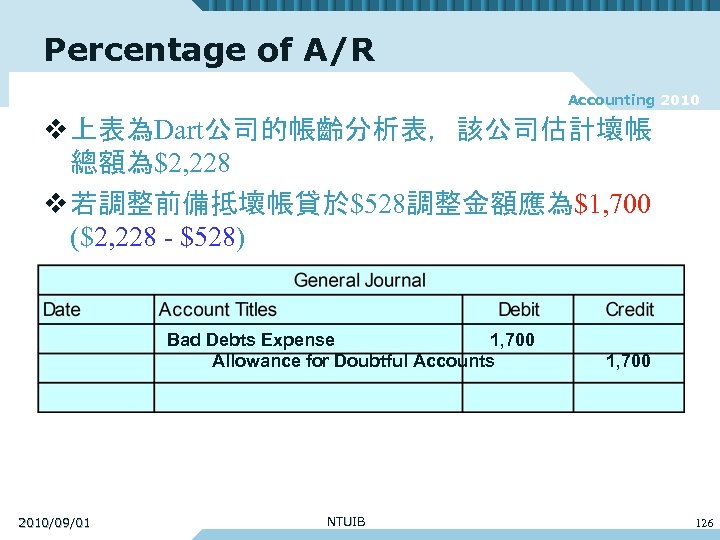
Percentage of A/R Accounting 2010 v 上表為Dart公司的帳齡分析表,該公司估計壞帳 總額為$2, 228 v 若調整前備抵壞帳貸於$528調整金額應為$1, 700 ($2, 228 - $528) Bad Debts Expense 1, 700 Allowance for Doubtful Accounts 2010/09/01 NTUIB 1, 700 126
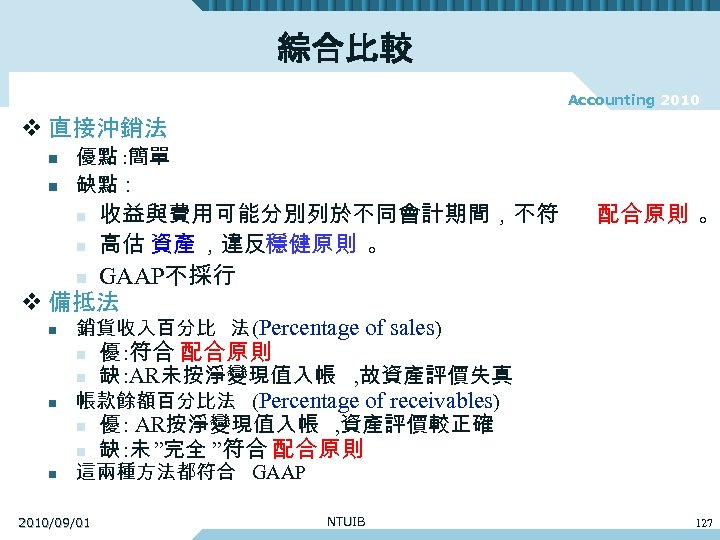
綜合比較 Accounting 2010 v 直接沖銷法 n n 優點 : 簡單 缺點: 收益與費用可能分別列於不同會計期間,不符 n 高估 資產 ,違反穩健原則 。 n GAAP不採行 v 備抵法 n 銷貨收入百分比 法 (Percentage of sales) n 優 : 符合 配合原則 n 缺 : AR未按淨變現值入帳 , 故資產評價失真 n 帳款餘額百分比法 (Percentage of receivables) n 優 : AR按淨變現值入帳 , 資產評價較正確 n 缺 : 未 ”完全 ”符合 配合原則 n n 配合原則 。 這兩種方法都符合 GAAP 2010/09/01 NTUIB 127
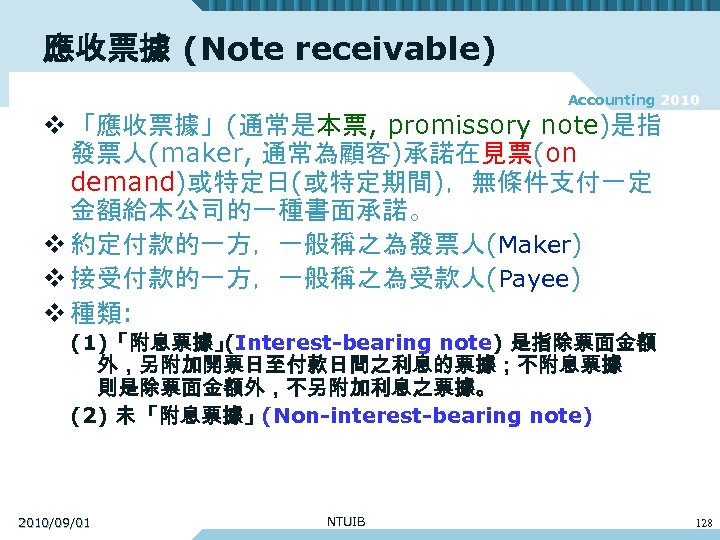
應收票據 (Note receivable) Accounting 2010 v 「應收票據」(通常是本票, promissory note)是指 發票人(maker, 通常為顧客)承諾在見票(on demand)或特定日(或特定期間),無條件支付一定 金額給本公司的一種書面承諾。 v 約定付款的一方,一般稱之為發票人(Maker) v 接受付款的一方,一般稱之為受款人(Payee) v 種類: (1)「附息票據」 (Interest-bearing note) 是指除票面金額 外,另附加開票日至付款日間之利息的票據;不附息票據 則是除票面金額外,不另附加利息之票據。 (2) 未 「附息票據」(Non-interest-bearing note) 2010/09/01 NTUIB 128
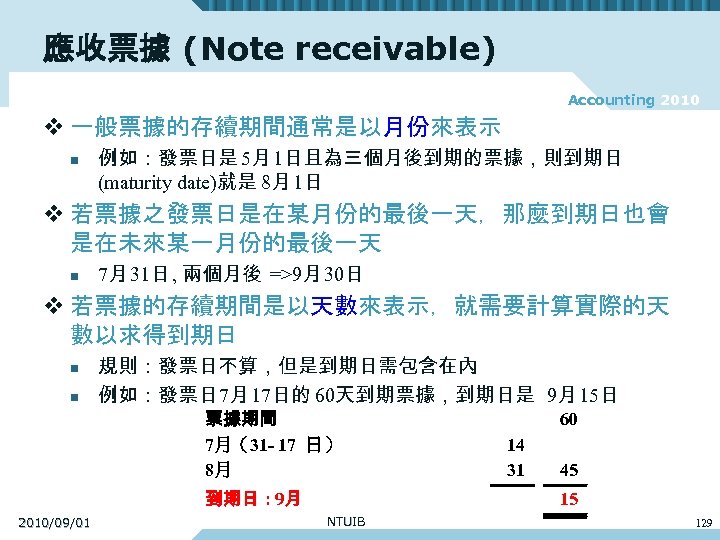
應收票據 (Note receivable) Accounting 2010 v 一般票據的存續期間通常是以月份來表示 n 例如:發票日是 5月 1日且為三個月後到期的票據,則到期日 (maturity date)就是 8月 1日 v 若票據之發票日是在某月份的最後一天,那麼到期日也會 是在未來某一月份的最後一天 n 7月 31日 , 兩個月後 =>9月 30日 v 若票據的存續期間是以天數來表示,就需要計算實際的天 數以求得到期日 n n 規則:發票日不算,但是到期日需包含在內 例如:發票日 7月 17日的 60天到期票據,到期日是 9月 15日 票據期間 7月(31 - 17 日) 8月 到期日 : 9月 2010/09/01 60 14 31 45 15 NTUIB 129
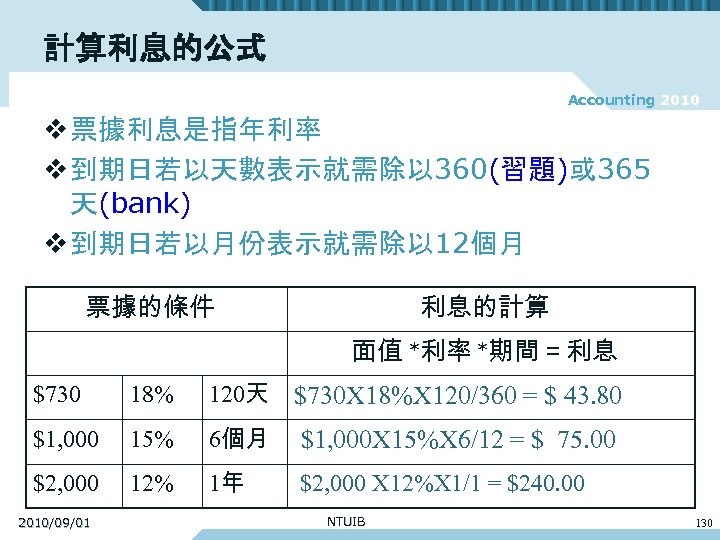
計算利息的公式 Accounting 2010 v 票據利息是指年利率 v 到期日若以天數表示就需除以 360(習題)或 365 天(bank) v 到期日若以月份表示就需除以 12個月 票據的條件 利息的計算 面值 *利率 *期間=利息 $730 18% 120天 $730 X 18%X 120/360 = $ 43. 80 $1, 000 15% 6個月 $1, 000 X 15%X 6/12 = $ 75. 00 $2, 000 12% 1年 $2, 000 X 12%X 1/1 = $240. 00 2010/09/01 NTUIB 130
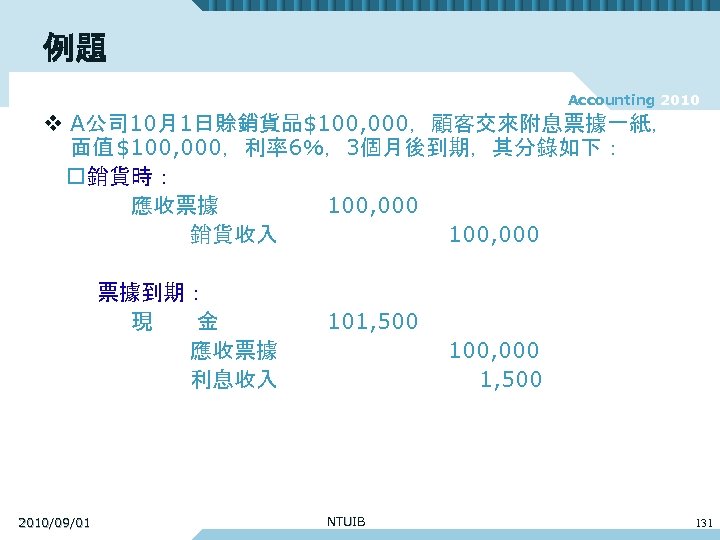
例題 Accounting 2010 v A公司 10月1日賒銷貨品$100, 000,顧客交來附息票據一紙, 面值 $100, 000,利率6%,3個月後到期,其分錄如下: 銷貨時: 應收票據 100, 000 銷貨收入 100, 000 票據到期: 現 金 應收票據 利息收入 2010/09/01 101, 500 100, 000 1, 500 NTUIB 131
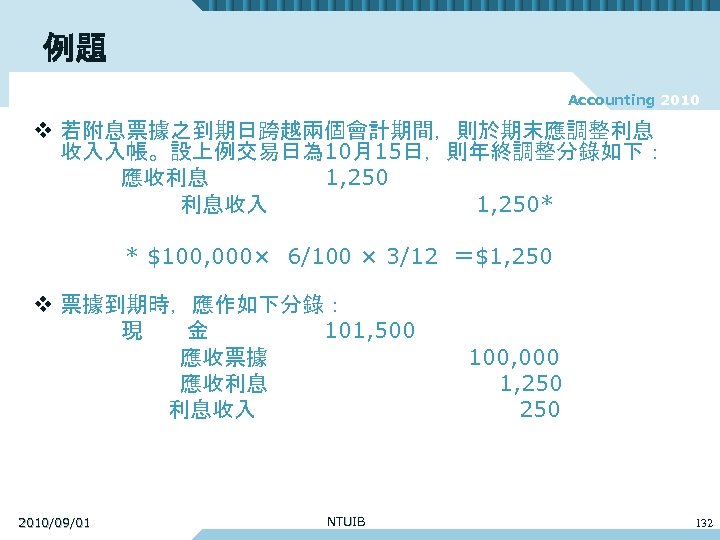
例題 Accounting 2010 v 若附息票據之到期日跨越兩個會計期間,則於期末應調整利息 收入入帳。設上例交易日為 10月15日,則年終調整分錄如下: 應收利息 1, 250 利息收入 1, 250* * $100, 000× 6/100 × 3/12 =$1, 250 v 票據到期時,應作如下分錄: 現 金 101, 500 應收票據 應收利息 利息收入 2010/09/01 NTUIB 100, 000 1, 250 132
Balance Sheet Presentation of Receivables Accounting 2010 v 短期應收款項應列於資產負債表流動資產中,短 期投資(Short-term investments)之下 v 應收帳款則需以淨變現價值 列示 2010/09/01 NTUIB 133
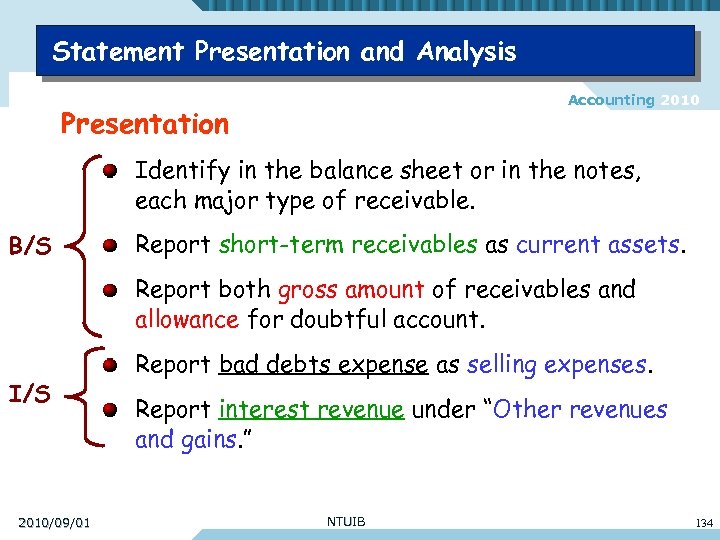
Statement Presentation and Analysis Accounting 2010 Presentation Identify in the balance sheet or in the notes, each major type of receivable. B/S Report short-term receivables as current assets. Report both gross amount of receivables and allowance for doubtful account. I/S 2010/09/01 Report bad debts expense as selling expenses. Report interest revenue under “Other revenues and gains. ” NTUIB 134
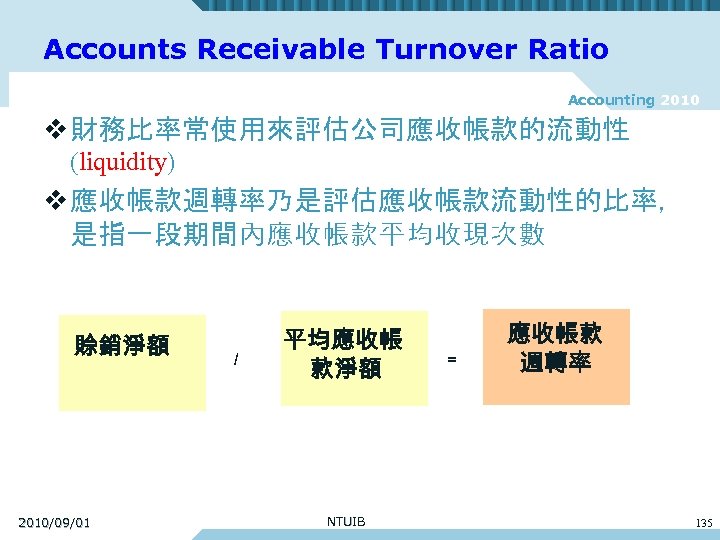
Accounts Receivable Turnover Ratio Accounting 2010 v 財務比率常使用來評估公司應收帳款的流動性 (liquidity) v 應收帳款週轉率乃是評估應收帳款流動性的比率, 是指一段期間內應收帳款平均收現次數 賒銷淨額 2010/09/01 / 平均應收帳 款淨額 NTUIB = 應收帳款 週轉率 135
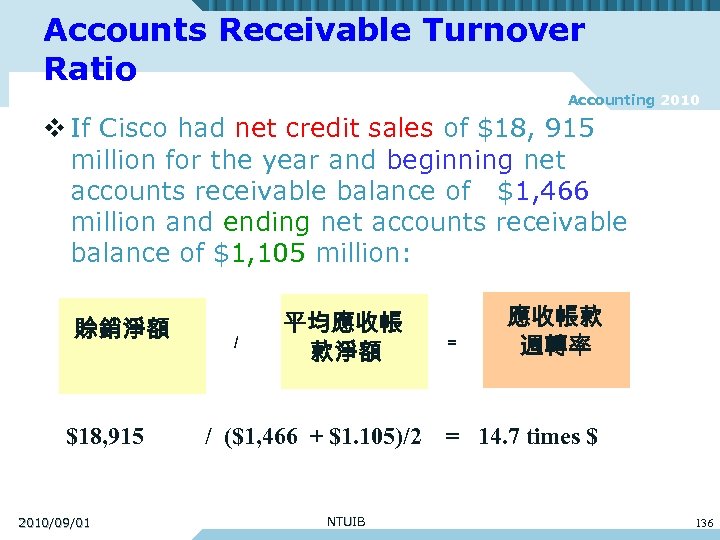
Accounts Receivable Turnover Ratio Accounting 2010 v If Cisco had net credit sales of $18, 915 million for the year and beginning net accounts receivable balance of $1, 466 million and ending net accounts receivable balance of $1, 105 million: 賒銷淨額 $18, 915 2010/09/01 / 平均應收帳 款淨額 / ($1, 466 + $1. 105)/2 NTUIB = 應收帳款 週轉率 = 14. 7 times $ 136
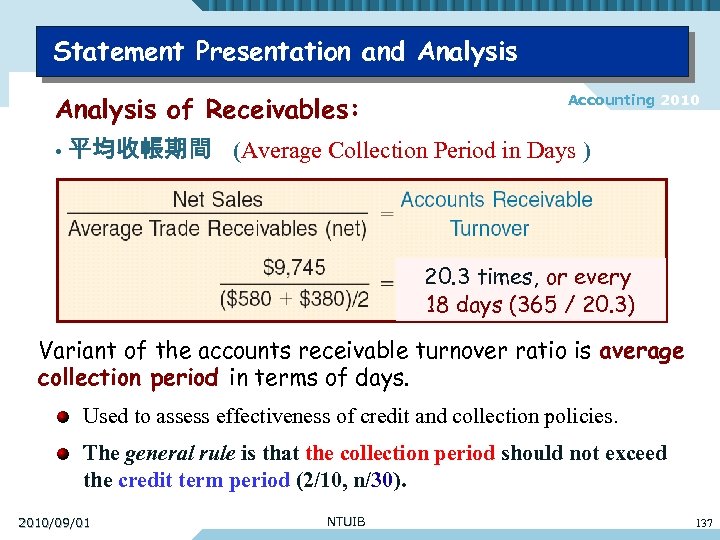
Statement Presentation and Analysis of Receivables: • Accounting 2010 平均收帳期間 (Average Collection Period in Days ) 20. 3 times, or every 18 days (365 / 20. 3) Variant of the accounts receivable turnover ratio is average collection period in terms of days. Used to assess effectiveness of credit and collection policies. The general rule is that the collection period should not exceed the credit term period (2/10, n/30). 2010/09/01 NTUIB 137
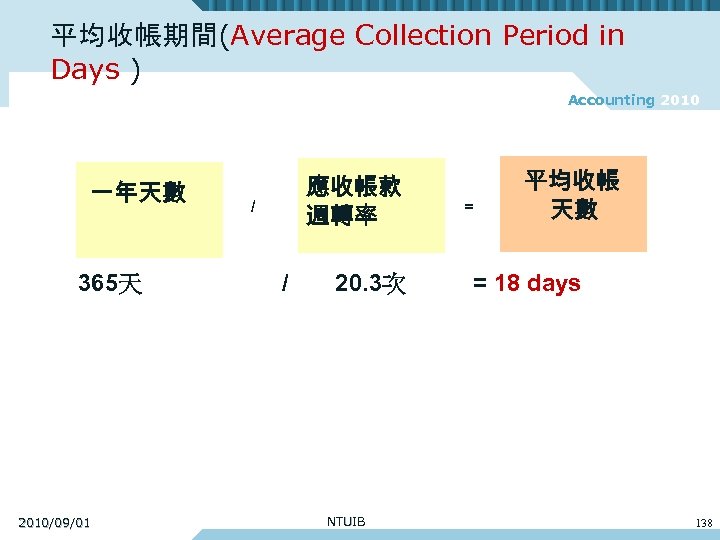
平均收帳期間(Average Collection Period in Days ) Accounting 2010 一年天數 365天 2010/09/01 應收帳款 週轉率 / / 20. 3次 NTUIB = 平均收帳 天數 = 18 days 138
Скачать презентацию 會計學 Accounting Summer 2010 09 012009 05 22 NTUIB 2010
dca59f5721a29f0f000af3cb80684949.ppt