 Скачать презентацию 成本效益分析 評估技術 1 社會折現率 折現乃反應社會大眾對時間偏好之選擇
49030bb0856fb4be45e59c37d1a0d222.ppt
- Количество слайдов: 84




成本效益分析 評估技術 1
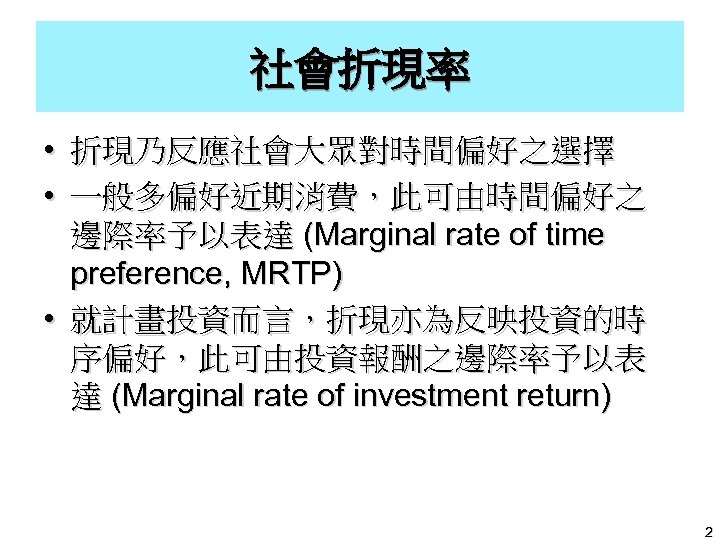
社會折現率 • 折現乃反應社會大眾對時間偏好之選擇 • 一般多偏好近期消費,此可由時間偏好之 邊際率予以表達 (Marginal rate of time preference, MRTP) • 就計畫投資而言,折現亦為反映投資的時 序偏好,此可由投資報酬之邊際率予以表 達 (Marginal rate of investment return) 2
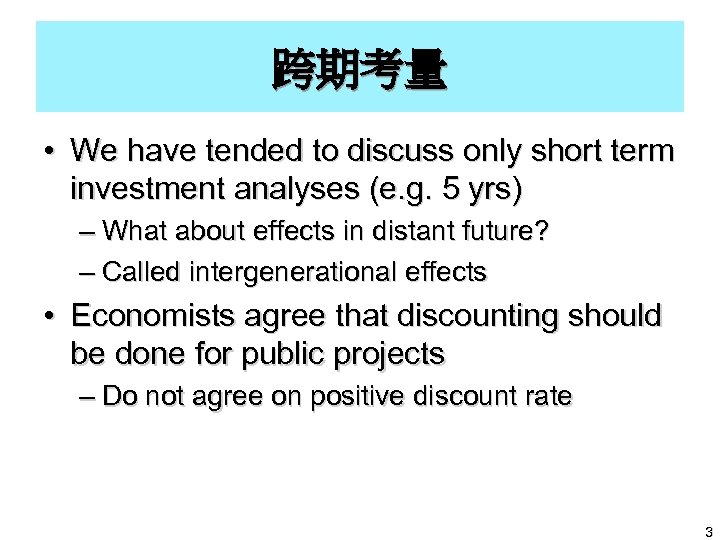
跨期考量 • We have tended to discuss only short term investment analyses (e. g. 5 yrs) – What about effects in distant future? – Called intergenerational effects • Economists agree that discounting should be done for public projects – Do not agree on positive discount rate 3
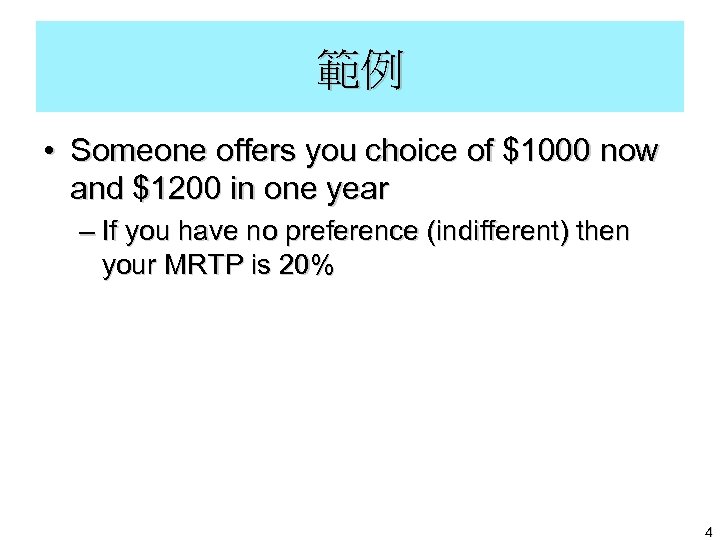
範例 • Someone offers you choice of $1000 now and $1200 in one year – If you have no preference (indifferent) then your MRTP is 20% 4
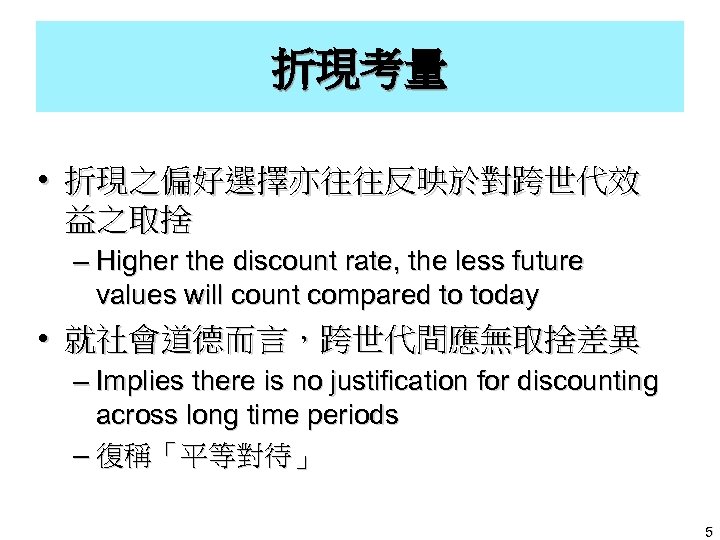
折現考量 • 折現之偏好選擇亦往往反映於對跨世代效 益之取捨 – Higher the discount rate, the less future values will count compared to today • 就社會道德而言,跨世代間應無取捨差異 – Implies there is no justification for discounting across long time periods – 復稱「平等對待」 5
範例︰環境取捨 • Discussions ongoing about how best to manage global CO 2 emissions to limit effects of global change • Should we sacrifice short-run economic growth to do something to improve environment and leave resources for the future? – Really asking 2 separate questions! 6
折現課題 • 對後代之責任為何?是否需犧牲其利益? • 若需犧牲,如何將淨效益極大化? – So we should compare global change proposals with alternatives – Perhaps higher R&D spending on science or medicing would have higher benefits! 7
實證 • Cropper et al surveyed 3000 homes – Asked about saving lives in the future – Found a 4% discount rate for lives 100 years per now • Equal standing does not imply different generations have equal claims to present resources! – Harsanyi says only do so if their marginal gain is higher than our loss 8
實證 • If future generations will be better off than us anyway – Then we might have no reason to make additional sacrifices • 世代或社群間確無「公平對待」之現象 – Immediate relatives vs. distant relatives – Different discount rates over time – Why do we care so much about future and ignore some present needs (poverty) 9
評估種類︰評價觀點 • Valuations can be put on either stocks or flows ─ 使用價值 ─ 非使用價值 ─ (選擇)權值 10
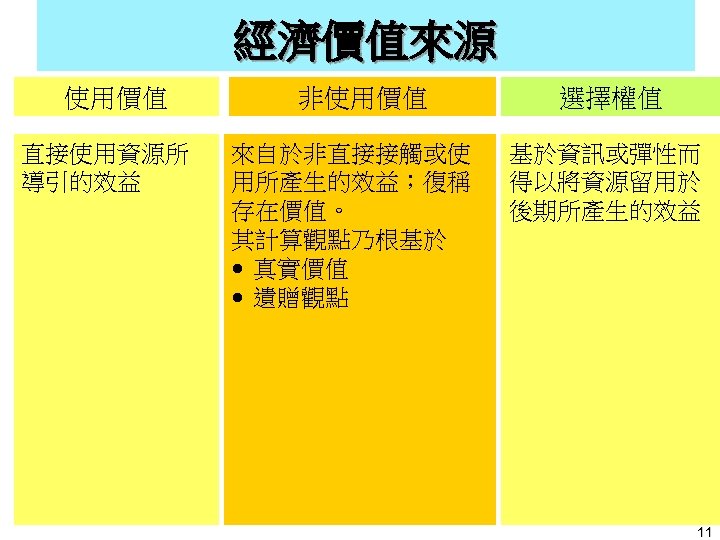
經濟價值來源 使用價值 直接使用資源所 導引的效益 非使用價值 來自於非直接接觸或使 用所產生的效益;復稱 存在價值。 其計算觀點乃根基於 • 真實價值 • 遺贈觀點 選擇權值 基於資訊或彈性而 得以將資源留用於 後期所產生的效益 11

經濟價值範例 12

經濟價值範例 The analyst should be sure that the values to be counted are not mutually exclusive or that they are not already captured by other value components. 13
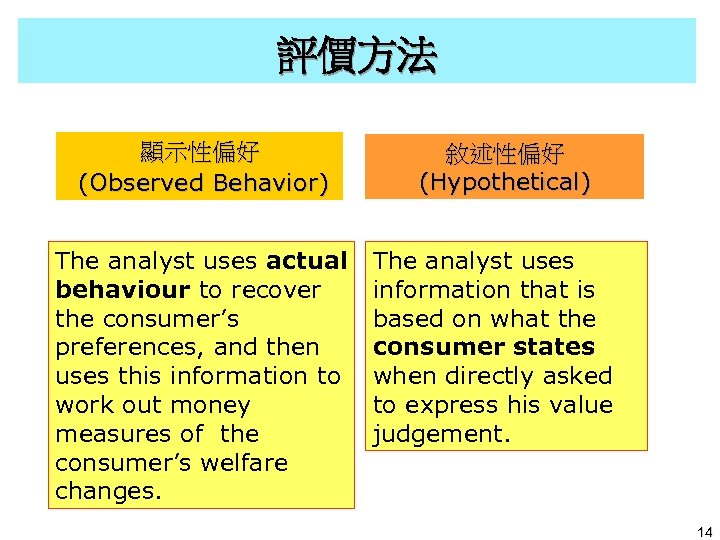
評價方法 顯示性偏好 (Observed Behavior) The analyst uses actual behaviour to recover the consumer’s preferences, and then uses this information to work out money measures of the consumer’s welfare changes. 敘述性偏好 (Hypothetical) The analyst uses information that is based on what the consumer states when directly asked to express his value judgement. 14
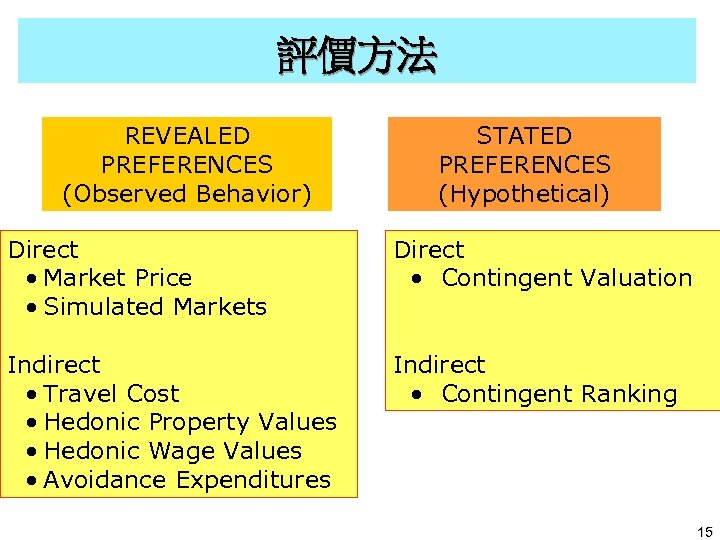
評價方法 REVEALED PREFERENCES (Observed Behavior) STATED PREFERENCES (Hypothetical) Direct • Market Price • Simulated Markets Direct • Contingent Valuation Indirect • Travel Cost • Hedonic Property Values • Hedonic Wage Values • Avoidance Expenditures Indirect • Contingent Ranking 15
直接表達顯示偏好 Examples • Medical costs for increased Asthma treatment due to air pollution • Lost income to fishermen, from oil spill. Issues • Scientific uncertainty • Example: identifying relationship between pollution and health (without being able to do controlled experiments). 16
間接表達顯示偏好 Cannot directly observe the cost of pollution Might be able to infer those costs, from market behavior • • Avoidance Expenditures Hedonic Property Values Hedonic Wage Values Travel Cost 17
避免損壞之成本估算法 此如特定地區之地下水遭汙染,則其不飲用地下 水的成本為何? 如有三種不飲用方案,分為︰ 1. 瓶裝水 2. 煮沸水 3. 淨水器 由三種方案可估算因環境衝擊之所衍生的社會成 本增益或效益抑減 18
特徵與旅行成本法 • 旅行成本法: 經由用路人之實際旅運成本 計算,以推估其至某一特定目的地的需 求曲線 • 特徵價格法: 經由比較不同方案之特徵上 的差異,以推估需求曲線. – Derive demand for the environmental good. • House prices influenced by environmental amenity (e. g. noise) • Wages influenced by riskiness of job 19
旅行成本法之優點 • Site is primarily valuable to people as a recreational site. There are no endangered species or other highly unique qualities that would make non-use values for the site significant. • The expenditures for projects to protect the site are relatively low. Thus, using a relatively inexpensive method like travel cost makes the most sense. • Relatively simple compared to other methods 20
旅行成本法之優點 • Time is a valuable commodity (time is $) • Most major transportation/infrastructure projects built to ‘save travel costs’ – Need to tradeoff project costs with benefits – Ex: new highway that shortens commutes • Differences between ‘travel’ and ‘waiting’ – Waiting time disutility might be orders of magnitude higher than just ‘travel disutility’ – Why? Travelling itself might be fun 21
旅行成本法 • 基本概念 - 用路人前往目的地所花的旅運成 本及時間即為其前往該地之價格 • 是以,以不同旅運成本(涵括旅行時間貨 幣化之價值)可估算用路人前往特定目的 地之發生旅次數及其願付價格 – This is analogous to estimating peoples’ WTP for a marketed good based on the quantity demanded at different prices. 22
旅行成本法 • Goal: To derive demand curve for park visits (note: this reflects use value only) • Current entrance fee = $20. • Typical visitor – L = # hours worked by person at wage w. – P 0 = out-of-pocket expenses to visit National Park, – F = entrance fee. – t = travel time, s = visit time 23
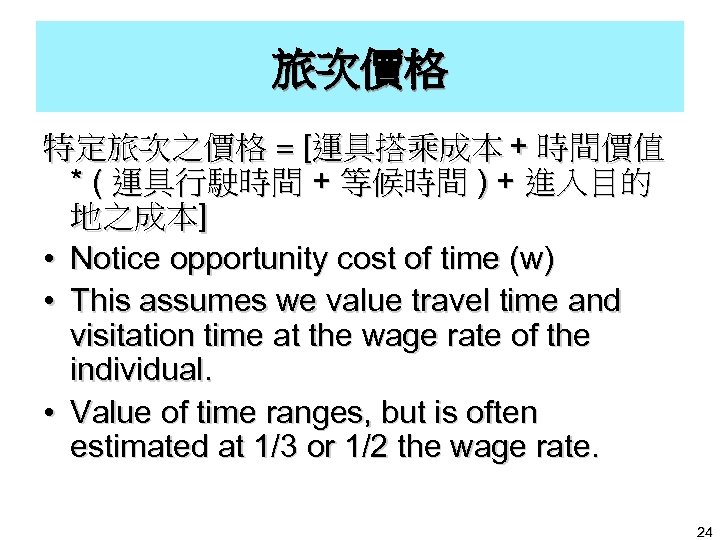
旅次價格 特定旅次之價格 = [運具搭乘成本 + 時間價值 * ( 運具行駛時間 + 等候時間 ) + 進入目的 地之成本] • Notice opportunity cost of time (w) • This assumes we value travel time and visitation time at the wage rate of the individual. • Value of time ranges, but is often estimated at 1/3 or 1/2 the wage rate. 24
估算目標 • Want to derive a demand curve for visits to National Park. • What can we do with a demand curve? – Calculate consumer surplus (benefits) – review concept on board… – Can calculate use-value of National Park – Can determine cost to consumers from e. g. entrance fee (from F 0 to F 1) 25
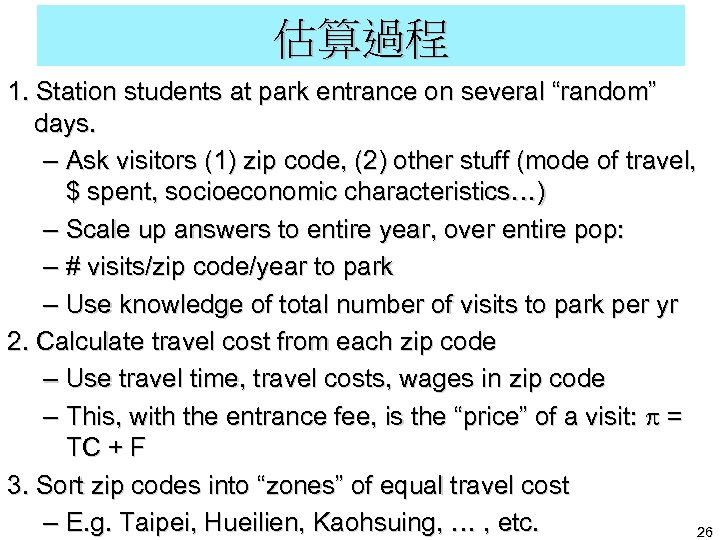
估算過程 1. Station students at park entrance on several “random” days. – Ask visitors (1) zip code, (2) other stuff (mode of travel, $ spent, socioeconomic characteristics…) – Scale up answers to entire year, over entire pop: – # visits/zip code/year to park – Use knowledge of total number of visits to park per yr 2. Calculate travel cost from each zip code – Use travel time, travel costs, wages in zip code – This, with the entrance fee, is the “price” of a visit: p = TC + F 3. Sort zip codes into “zones” of equal travel cost – E. g. Taipei, Hueilien, Kaohsuing, … , etc. 26
需求曲線推導 We now have data on • the differing “prices” paid by individuals and… • the “amount” bought at each price point. • Combined, price and quantity data allow us to estimate demand curve. 27
旅行成本法之限制 • Our travel cost approach gives us a good estimate of the overall willingness to pay for National Park. • 難以反映不同目的地的差異性 • What is the decreased value of the park if we allow noise from helicopter rides or snowmobiling? • 建議︰採用「間斷選擇模型」 – Consider visitors choices between several possible sites, which each have different travel costs and different amenities (noise level). – Need several sites that are similar except for the amenities (difficult for National Park). 28
旅行成本法估算之方法 • A simple 分區旅行成本法, using mostly secondary data, with some simple data collected from visitors. • An 個別旅行成本法, using a more detailed survey of visitors. • A 隨機效用法 using survey and other data, and more complicated statistical techniques. 29
分區估算法 • Simplest approach, estimates a value for recreational services of the site as a whole. • Collect info. on number of visits to site from different distances. Calculate number of visits “purchased” at different “prices. ” • Used to construct demand function for site, estimate consumer surplus for recreational services of the site. 30
分區估算法步驟 1. 界定分區組合 May be defined by concentric circles around the site, or by geographic divisions, such as metropolitan areas or counties surrounding the site 2. 蒐集分區前往特定地之旅次產生資料 collect info. on number of visitors from each zone, and the number of visits made in the last year. 3. 估算分區每千人前往特定地之造訪次數calculate the visitation rates per 1000 population in each zone. This is simply the total visits per year from the zone, divided by the zone’s population in thousands. 31
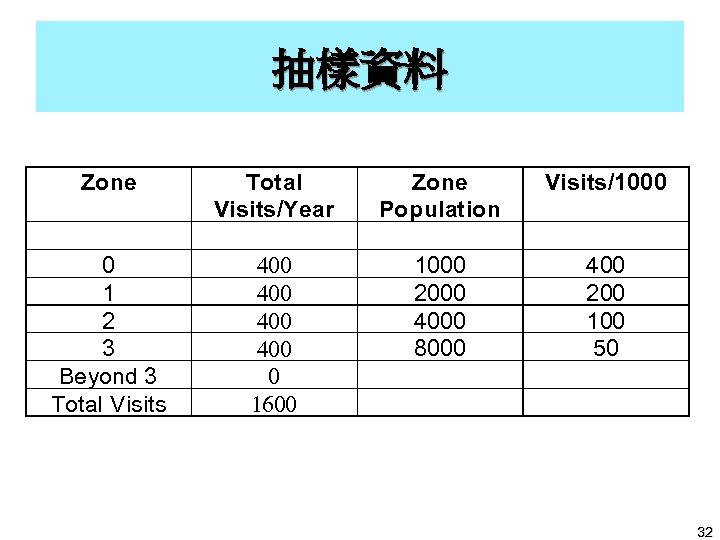
抽樣資料 Zone Total Visits/Year Zone Population Visits/1000 0 1 2 3 Beyond 3 Total Visits 400 400 0 1600 1000 2000 4000 8000 400 200 100 50 32
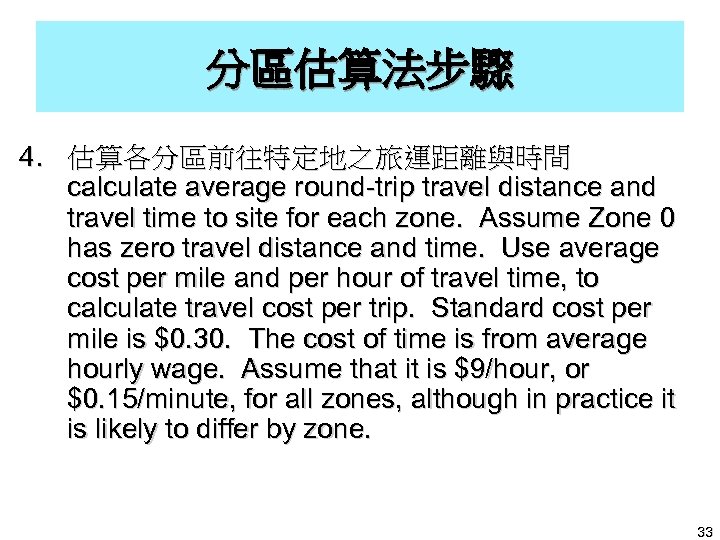
分區估算法步驟 4. 估算各分區前往特定地之旅運距離與時間 calculate average round-trip travel distance and travel time to site for each zone. Assume Zone 0 has zero travel distance and time. Use average cost per mile and per hour of travel time, to calculate travel cost per trip. Standard cost per mile is $0. 30. The cost of time is from average hourly wage. Assume that it is $9/hour, or $0. 15/minute, for all zones, although in practice it is likely to differ by zone. 33
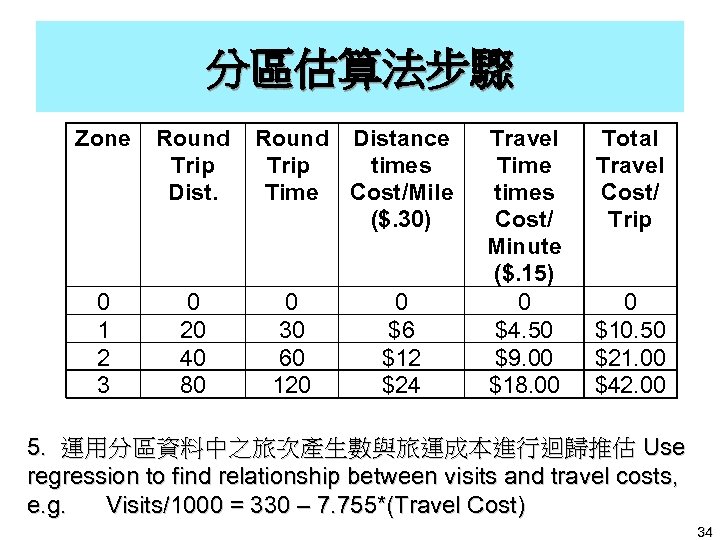
分區估算法步驟 Zone Round Trip Dist. 0 1 2 3 0 20 40 80 Round Distance Trip times Time Cost/Mile ($. 30) 0 30 60 120 0 $6 $12 $24 Travel Time times Cost/ Minute ($. 15) 0 $4. 50 $9. 00 $18. 00 Total Travel Cost/ Trip 0 $10. 50 $21. 00 $42. 00 5. 運用分區資料中之旅次產生數與旅運成本進行迴歸推估 Use regression to find relationship between visits and travel costs, e. g. Visits/1000 = 330 – 7. 755*(Travel Cost) 34
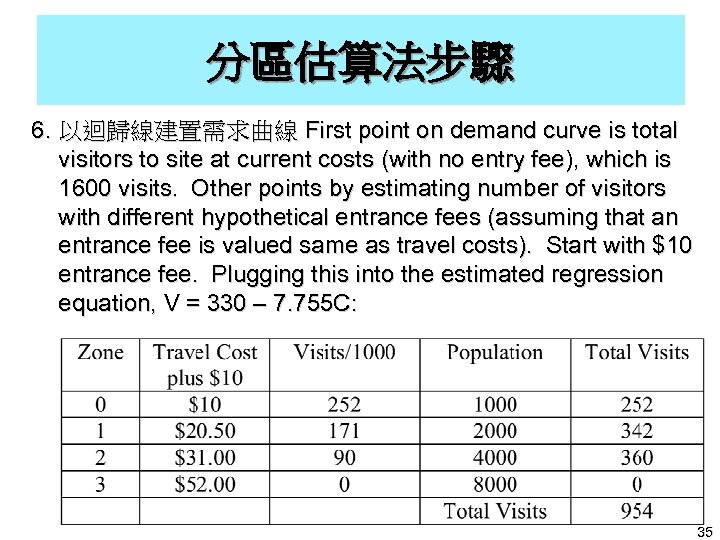
分區估算法步驟 6. 以迴歸線建置需求曲線 First point on demand curve is total visitors to site at current costs (with no entry fee), which is 1600 visits. Other points by estimating number of visitors with different hypothetical entrance fees (assuming that an entrance fee is valued same as travel costs). Start with $10 entrance fee. Plugging this into the estimated regression equation, V = 330 – 7. 755 C: 35
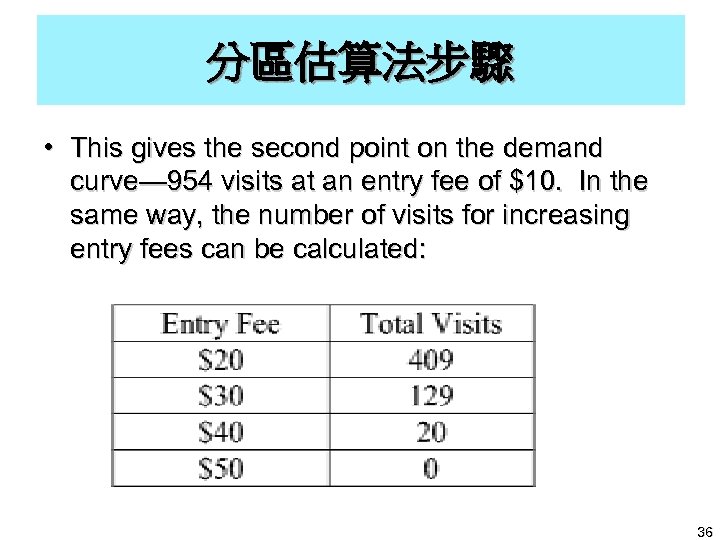
分區估算法步驟 • This gives the second point on the demand curve— 954 visits at an entry fee of $10. In the same way, the number of visits for increasing entry fees can be calculated: 36
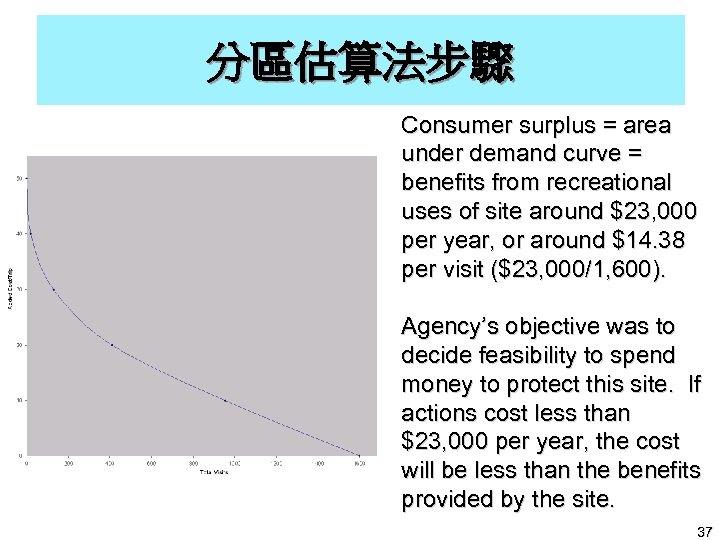
分區估算法步驟 Consumer surplus = area under demand curve = benefits from recreational uses of site around $23, 000 per year, or around $14. 38 per visit ($23, 000/1, 600). Agency’s objective was to decide feasibility to spend money to protect this site. If actions cost less than $23, 000 per year, the cost will be less than the benefits provided by the site. 37
旅行時間節省價值 • Many studies seek to estimate VTTS – Can then be used easily in CBAs • Book reminds us of Waters 1993 (56 studies) – – Many different methods used in studies Route, speed, mode, location choices Mean value of 48% of wage rate (median 40) North America: 59% / 42% • Miller (1989): 60% drivers, 40% passengers – 90% drivers / 60% passengers in congested areas 38
旅行時間價值實證研究 • NCHRP 2 -18 (1995): National Cooperative Highway Research Program – Stated preference survey method – $15, 000 income => $2. 64/hour VTTS – $55, 000 @ $5. 34/hour – $95, 000 @ $8. 05/hour (decreasing) 39
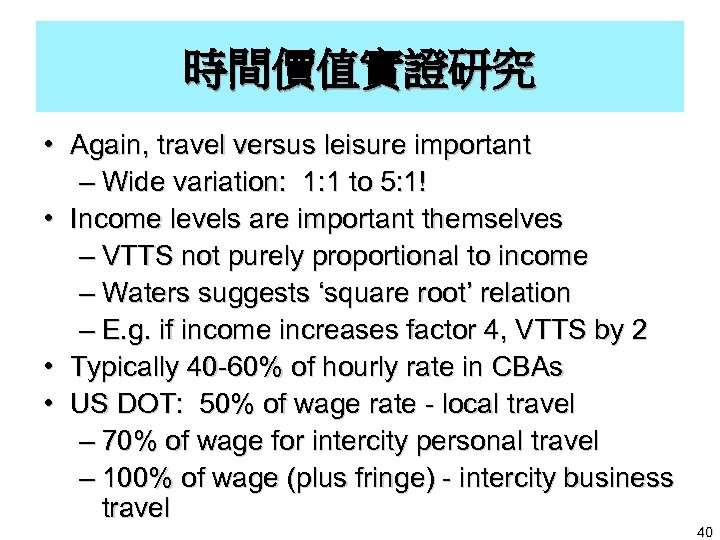
時間價值實證研究 • Again, travel versus leisure important – Wide variation: 1: 1 to 5: 1! • Income levels are important themselves – VTTS not purely proportional to income – Waters suggests ‘square root’ relation – E. g. if income increases factor 4, VTTS by 2 • Typically 40 -60% of hourly rate in CBAs • US DOT: 50% of wage rate - local travel – 70% of wage for intercity personal travel – 100% of wage (plus fringe) - intercity business travel 40
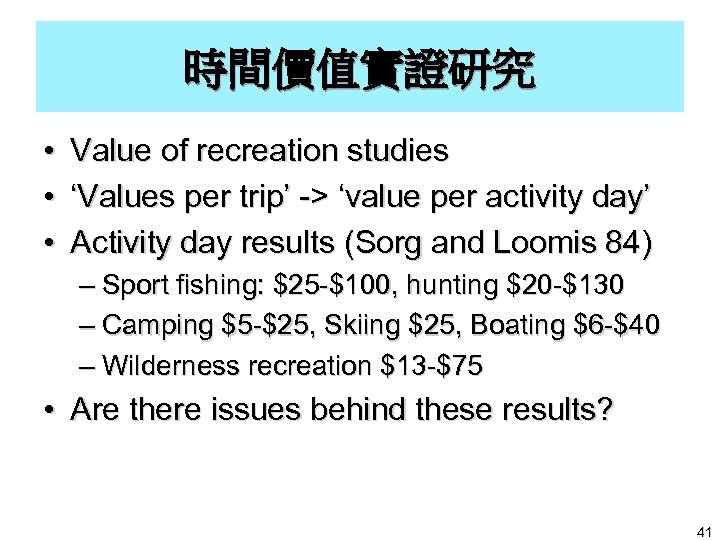
時間價值實證研究 • • • Value of recreation studies ‘Values per trip’ -> ‘value per activity day’ Activity day results (Sorg and Loomis 84) – Sport fishing: $25 -$100, hunting $20 -$130 – Camping $5 -$25, Skiing $25, Boating $6 -$40 – Wilderness recreation $13 -$75 • Are there issues behind these results? 41
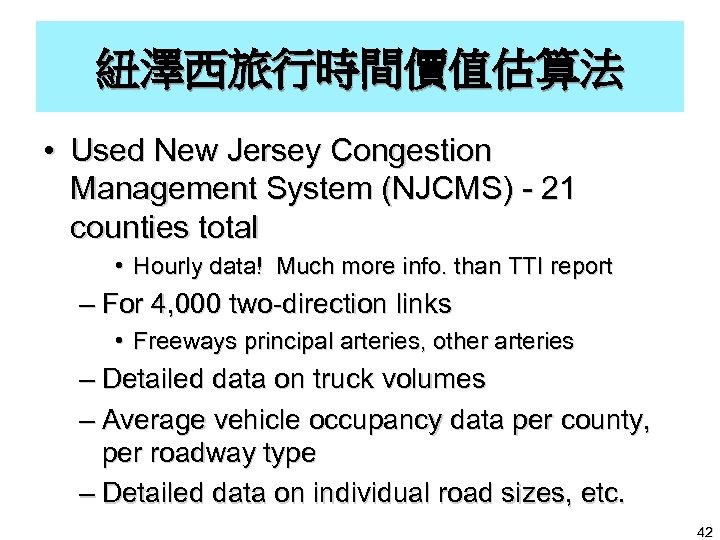
紐澤西旅行時間價值估算法 • Used New Jersey Congestion Management System (NJCMS) - 21 counties total • Hourly data! Much more info. than TTI report – For 4, 000 two-direction links • Freeways principal arteries, other arteries – Detailed data on truck volumes – Average vehicle occupancy data per county, per roadway type – Detailed data on individual road sizes, etc. 42
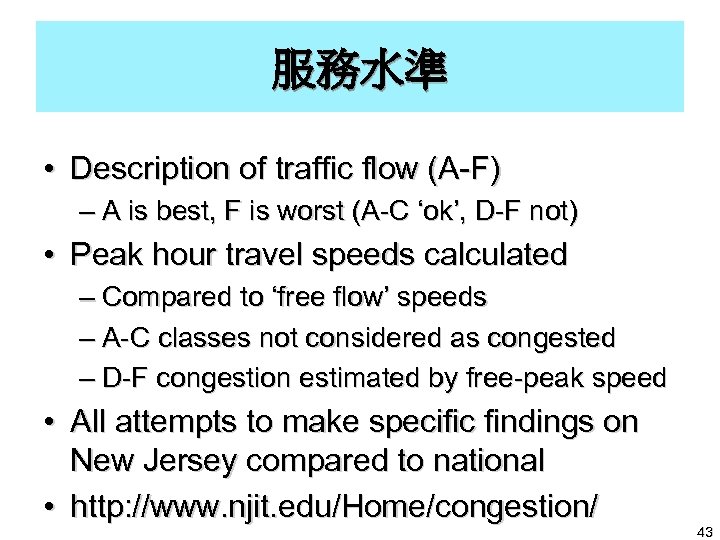
服務水準 • Description of traffic flow (A-F) – A is best, F is worst (A-C ‘ok’, D-F not) • Peak hour travel speeds calculated – Compared to ‘free flow’ speeds – A-C classes not considered as congested – D-F congestion estimated by free-peak speed • All attempts to make specific findings on New Jersey compared to national • http: //www. njit. edu/Home/congestion/ 43
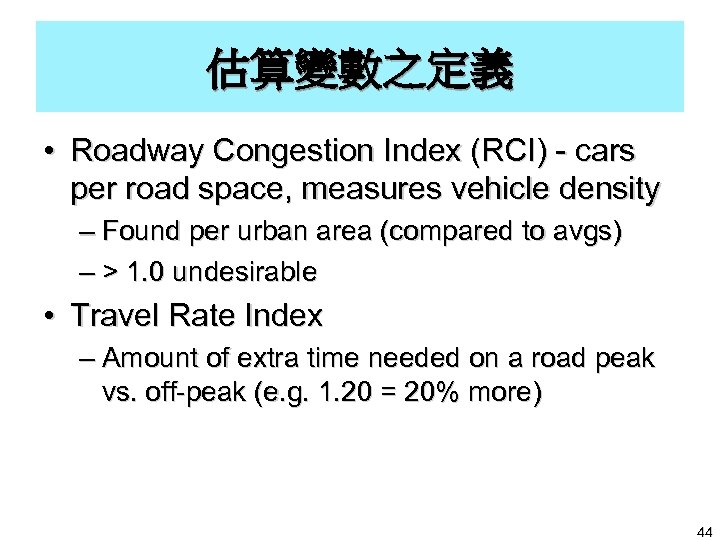
估算變數之定義 • Roadway Congestion Index (RCI) - cars per road space, measures vehicle density – Found per urban area (compared to avgs) – > 1. 0 undesirable • Travel Rate Index – Amount of extra time needed on a road peak vs. off-peak (e. g. 1. 20 = 20% more) 44
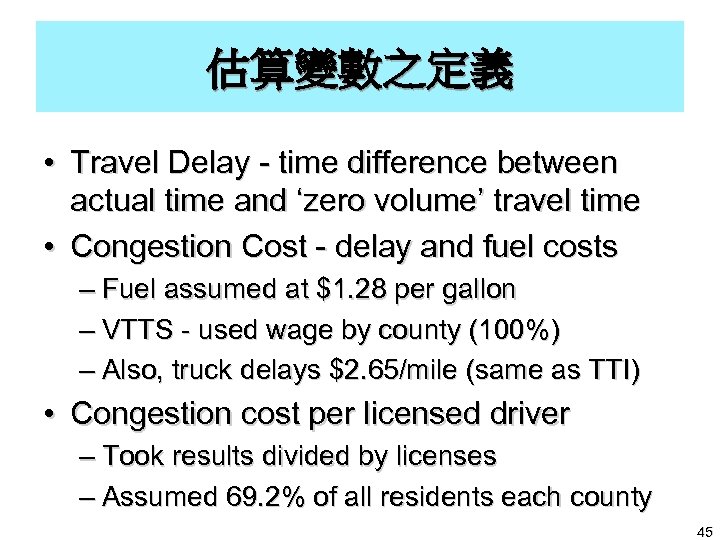
估算變數之定義 • Travel Delay - time difference between actual time and ‘zero volume’ travel time • Congestion Cost - delay and fuel costs – Fuel assumed at $1. 28 per gallon – VTTS - used wage by county (100%) – Also, truck delays $2. 65/mile (same as TTI) • Congestion cost per licensed driver – Took results divided by licenses – Assumed 69. 2% of all residents each county 45
旅行時間價值資料範例 • County wages $10. 83 -$23. 20 per hour • Found RCI for each roadway link in NJ – Aggregated by class for each county 46
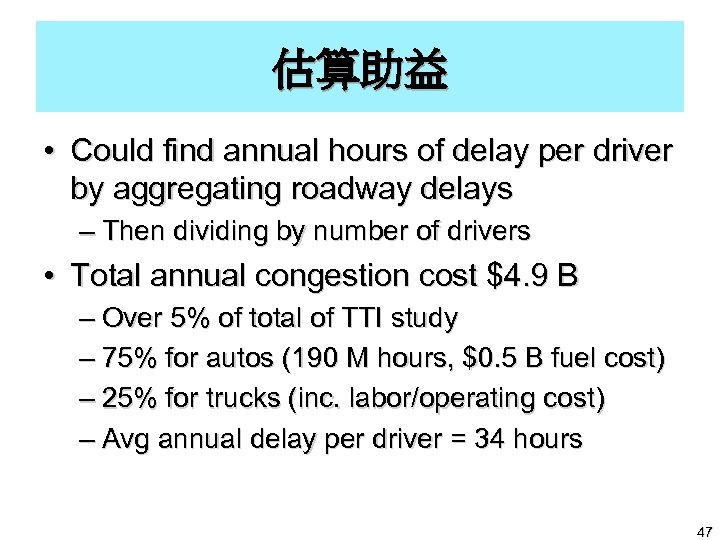
估算助益 • Could find annual hours of delay per driver by aggregating roadway delays – Then dividing by number of drivers • Total annual congestion cost $4. 9 B – Over 5% of total of TTI study – 75% for autos (190 M hours, $0. 5 B fuel cost) – 25% for trucks (inc. labor/operating cost) – Avg annual delay per driver = 34 hours 47
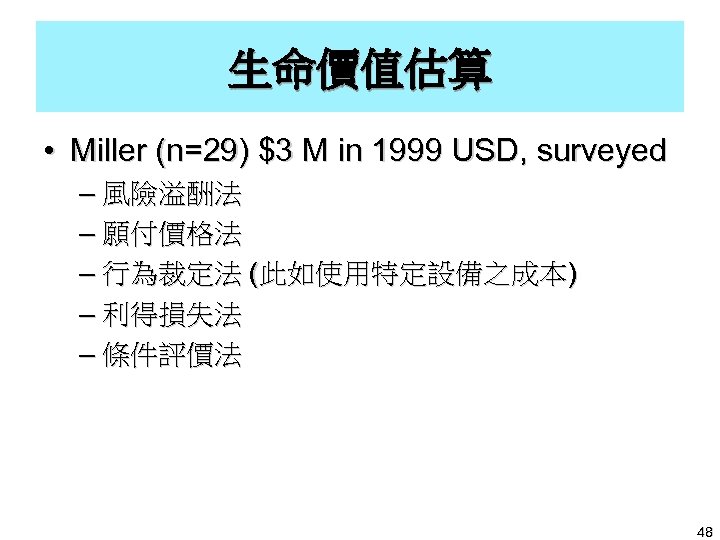
生命價值估算 • Miller (n=29) $3 M in 1999 USD, surveyed – 風險溢酬法 – 願付價格法 – 行為裁定法 (此如使用特定設備之成本) – 利得損失法 – 條件評價法 48
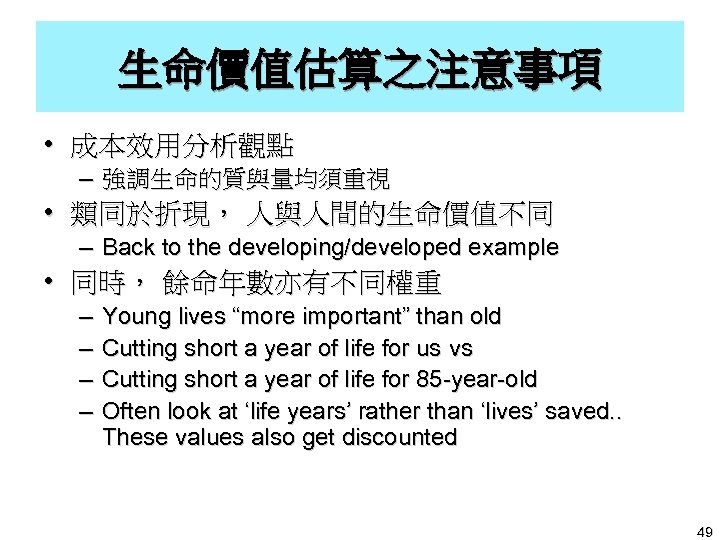
生命價值估算之注意事項 • 成本效用分析觀點 – 強調生命的質與量均須重視 • 類同於折現, 人與人間的生命價值不同 – Back to the developing/developed example • 同時, 餘命年數亦有不同權重 – – Young lives “more important” than old Cutting short a year of life for us vs Cutting short a year of life for 85 -year-old Often look at ‘life years’ rather than ‘lives’ saved. . These values also get discounted 49
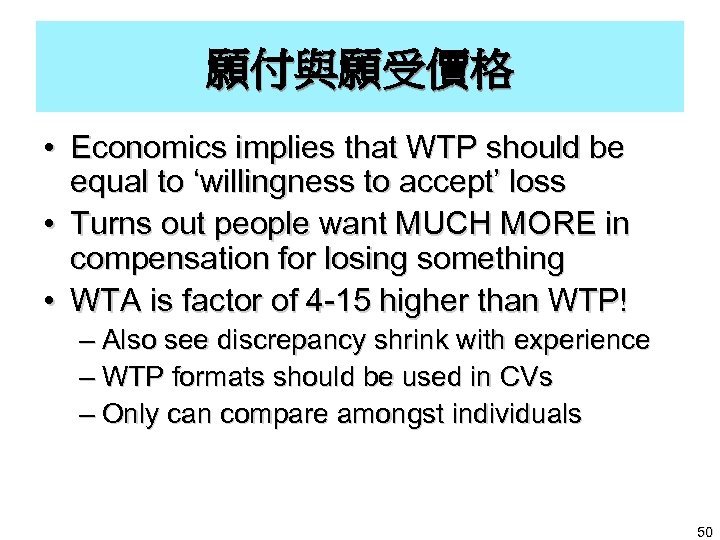
願付與願受價格 • Economics implies that WTP should be equal to ‘willingness to accept’ loss • Turns out people want MUCH MORE in compensation for losing something • WTA is factor of 4 -15 higher than WTP! – Also see discrepancy shrink with experience – WTP formats should be used in CVs – Only can compare amongst individuals 50
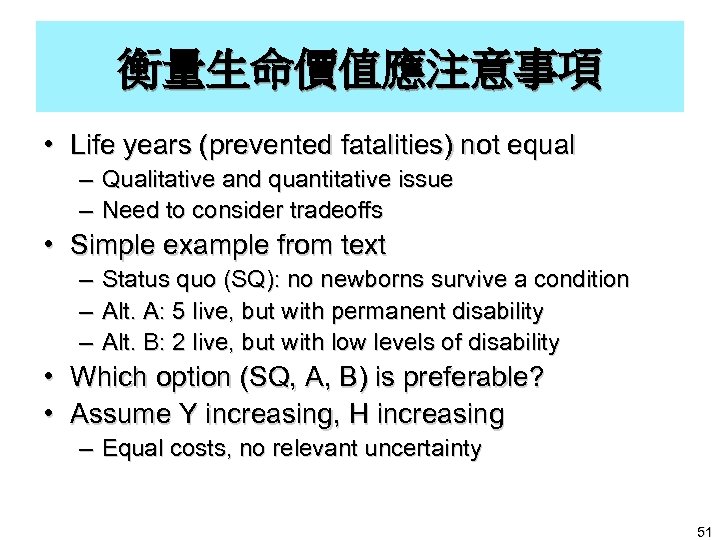
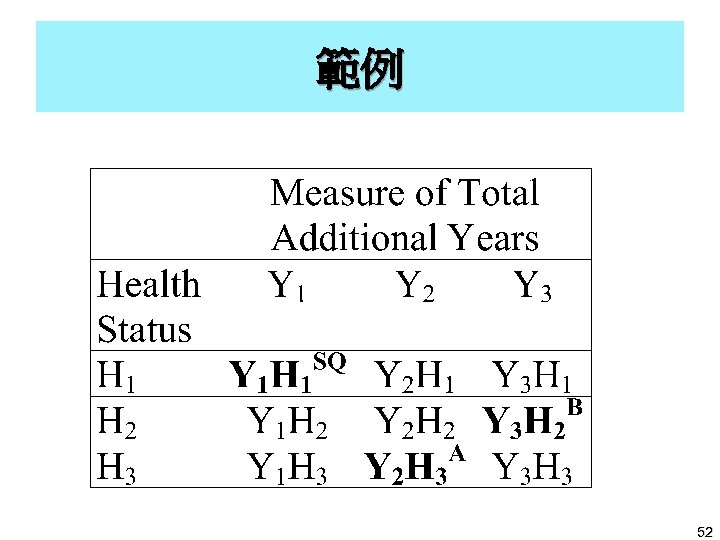
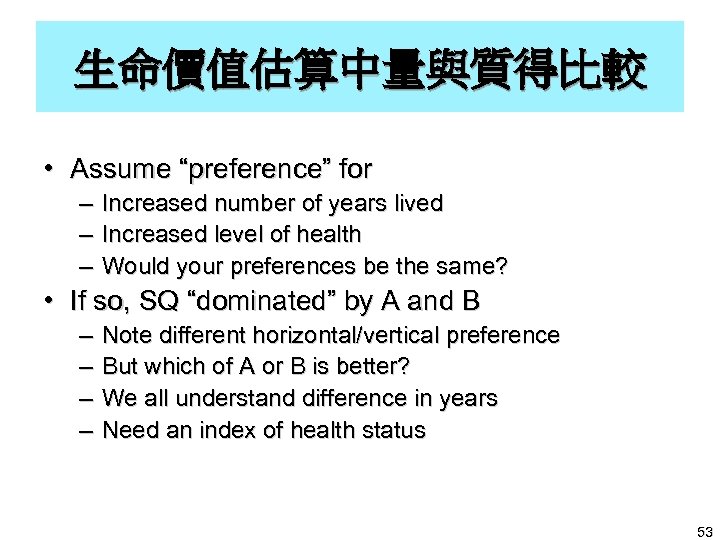
衡量生命價值應注意事項 • Life years (prevented fatalities) not equal – Qualitative and quantitative issue – Need to consider tradeoffs • Simple example from text – Status quo (SQ): no newborns survive a condition – Alt. A: 5 live, but with permanent disability – Alt. B: 2 live, but with low levels of disability • Which option (SQ, A, B) is preferable? • Assume Y increasing, H increasing – Equal costs, no relevant uncertainty 51
範例 52
生命價值估算中量與質得比較 • Assume “preference” for – Increased number of years lived – Increased level of health – Would your preferences be the same? • If so, SQ “dominated” by A and B – – Note different horizontal/vertical preference But which of A or B is better? We all understand difference in years Need an index of health status 53
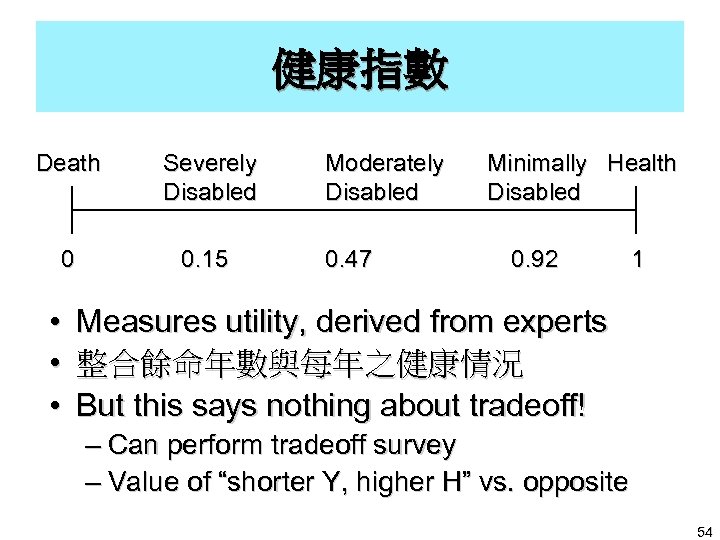
健康指數 Death Severely Disabled 0 0. 15 • • • Moderately Disabled 0. 47 Minimally Health Disabled 0. 92 1 Measures utility, derived from experts 整合餘命年數與每年之健康情況 But this says nothing about tradeoff! – Can perform tradeoff survey – Value of “shorter Y, higher H” vs. opposite 54
範例 - MAIS scale • 簡要受傷度量 (AIS) is an anatomically based system that classifies individual injuries by body region on a six point ordinal scale of risk to life. • AIS does not assess the combined effects of multiple injuries. • The maximum AIS (MAIS) is the highest single AIS code for an occupant with multiple injuries. 55
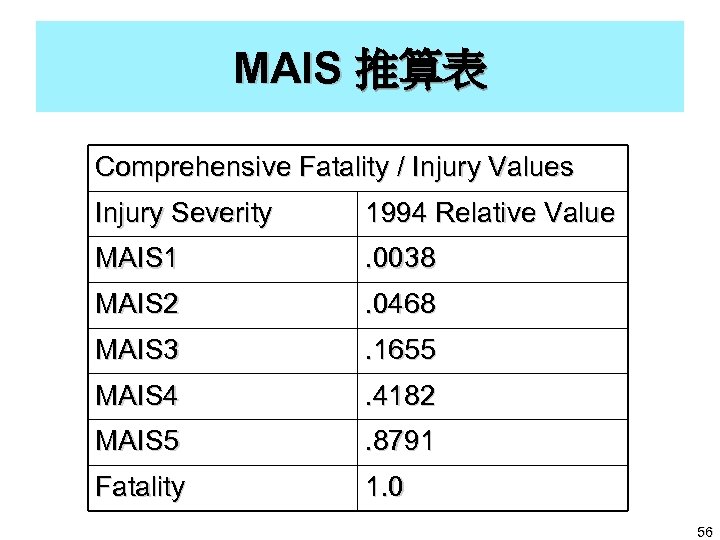
MAIS 推算表 Comprehensive Fatality / Injury Values Injury Severity 1994 Relative Value MAIS 1 . 0038 MAIS 2 . 0468 MAIS 3 . 1655 MAIS 4 . 4182 MAIS 5 . 8791 Fatality 1. 0 56
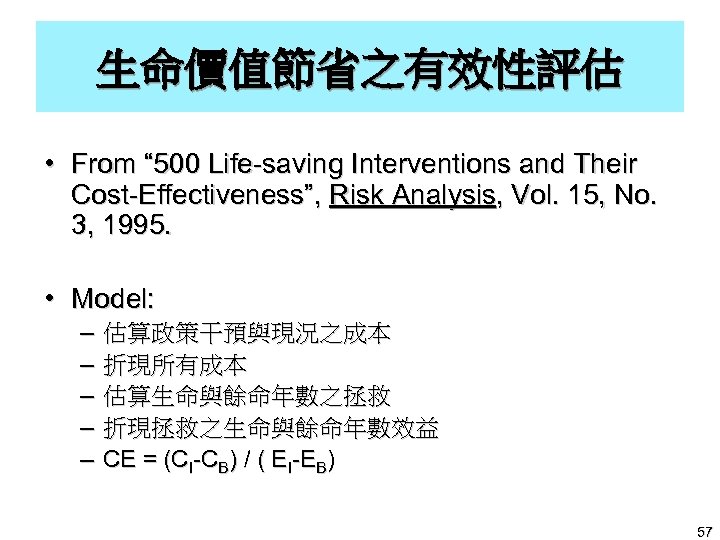
生命價值節省之有效性評估 • From “ 500 Life-saving Interventions and Their Cost-Effectiveness”, Risk Analysis, Vol. 15, No. 3, 1995. • Model: – – – 估算政策干預與現況之成本 折現所有成本 估算生命與餘命年數之拯救 折現拯救之生命與餘命年數效益 CE = (CI-CB) / ( EI-EB) 57
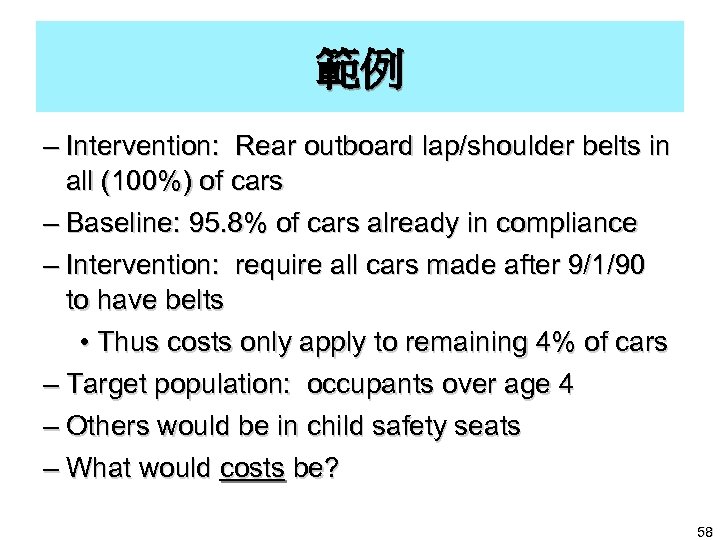
範例 – Intervention: Rear outboard lap/shoulder belts in all (100%) of cars – Baseline: 95. 8% of cars already in compliance – Intervention: require all cars made after 9/1/90 to have belts • Thus costs only apply to remaining 4% of cars – Target population: occupants over age 4 – Others would be in child safety seats – What would costs be? 58
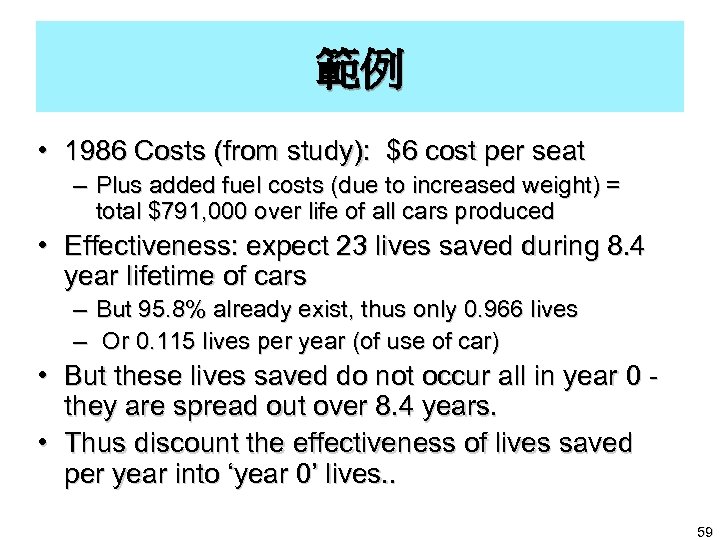
範例 • 1986 Costs (from study): $6 cost per seat – Plus added fuel costs (due to increased weight) = total $791, 000 over life of all cars produced • Effectiveness: expect 23 lives saved during 8. 4 year lifetime of cars – But 95. 8% already exist, thus only 0. 966 lives – Or 0. 115 lives per year (of use of car) • But these lives saved do not occur all in year 0 - they are spread out over 8. 4 years. • Thus discount the effectiveness of lives saved per year into ‘year 0’ lives. . 59
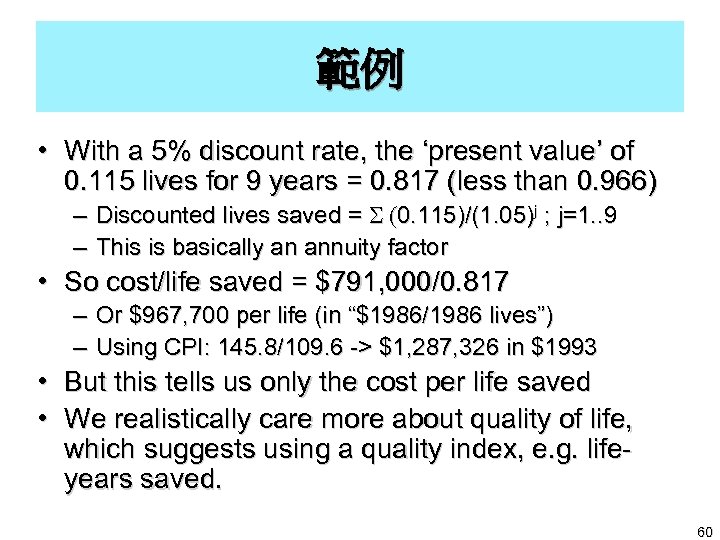
範例 • With a 5% discount rate, the ‘present value’ of 0. 115 lives for 9 years = 0. 817 (less than 0. 966) – Discounted lives saved = S (0. 115)/(1. 05)j ; j=1. . 9 – This is basically an annuity factor • So cost/life saved = $791, 000/0. 817 – Or $967, 700 per life (in “$1986/1986 lives”) – Using CPI: 145. 8/109. 6 -> $1, 287, 326 in $1993 • • But this tells us only the cost per life saved We realistically care more about quality of life, which suggests using a quality index, e. g. lifeyears saved. 60
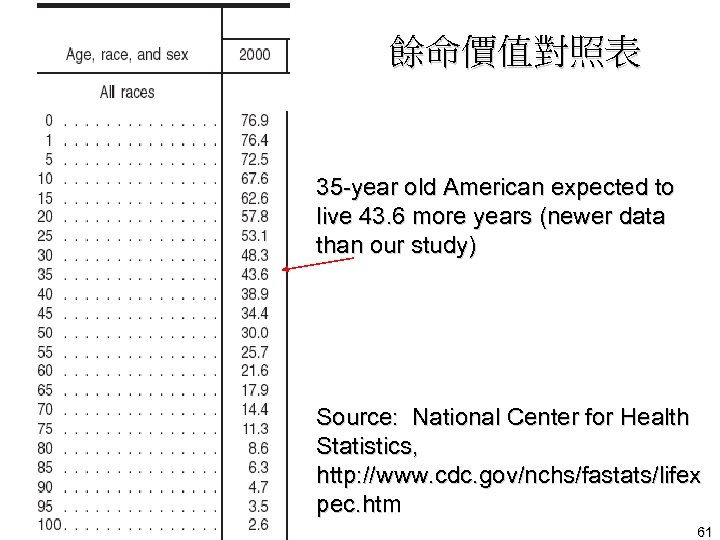
餘命價值對照表 35 -year old American expected to live 43. 6 more years (newer data than our study) Source: National Center for Health Statistics, http: //www. cdc. gov/nchs/fastats/lifex pec. htm 61
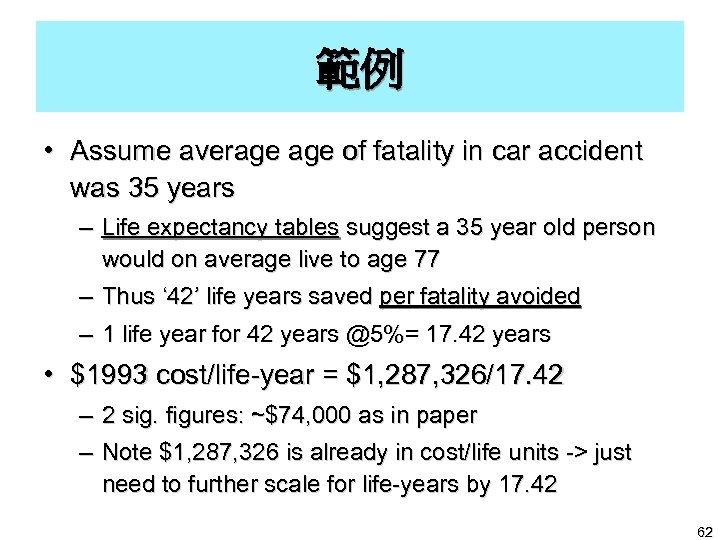
範例 • Assume average of fatality in car accident was 35 years – Life expectancy tables suggest a 35 year old person would on average live to age 77 – Thus ‘ 42’ life years saved per fatality avoided – 1 life year for 42 years @5%= 17. 42 years • $1993 cost/life-year = $1, 287, 326/17. 42 – 2 sig. figures: ~$74, 000 as in paper – Note $1, 287, 326 is already in cost/life units -> just need to further scale for life-years by 17. 42 62
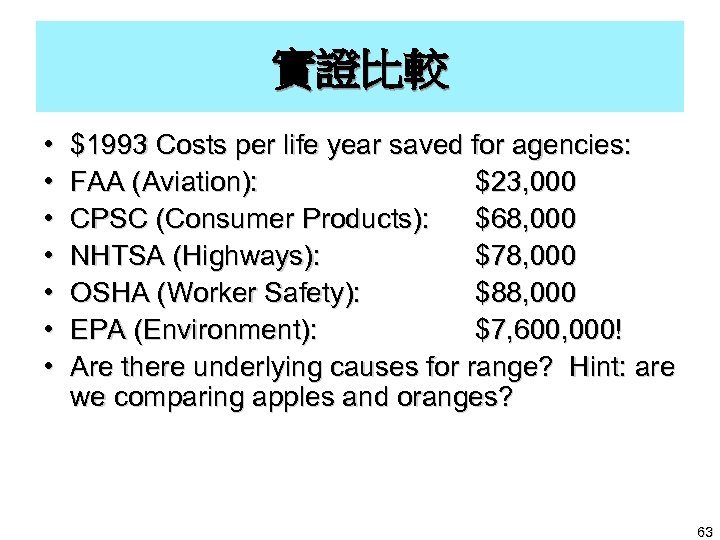
實證比較 • • $1993 Costs per life year saved for agencies: FAA (Aviation): $23, 000 CPSC (Consumer Products): $68, 000 NHTSA (Highways): $78, 000 OSHA (Worker Safety): $88, 000 EPA (Environment): $7, 600, 000! Are there underlying causes for range? Hint: are we comparing apples and oranges? 63
貨幣化評估的必要性 • Economists think of welfare measures in terms of opportunity cost • Opportunity costs are generally defined in terms other than money. • Money is a useful way to measure and compare opportunity costs. Money is a “measuring rod. ” • We could use other measuring rods • Measuring benefits in money terms does not imply that money itself is an objective to be traded off against environmental quality. 64
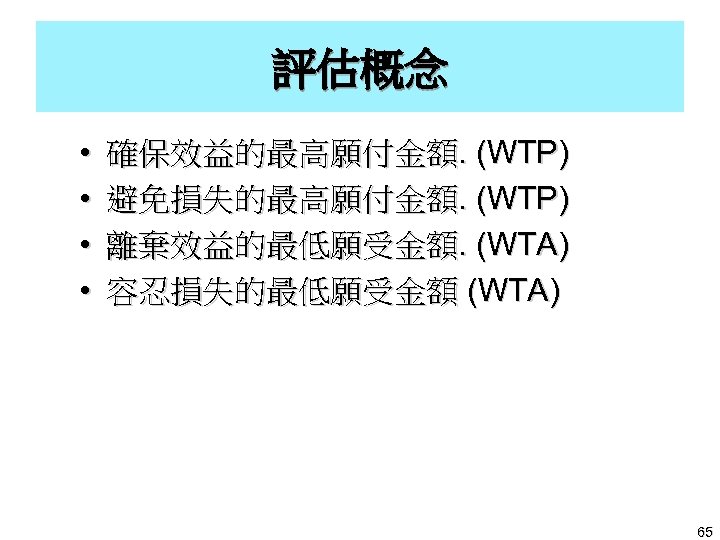
評估概念 • • 確保效益的最高願付金額. (WTP) 避免損失的最高願付金額. (WTP) 離棄效益的最低願受金額. (WTA) 容忍損失的最低願受金額 (WTA) 65
評估概念 • Not necessarily, based on consumer theory – income effects • Not necessarily, based on empirical psychology literature – Loss aversion 66
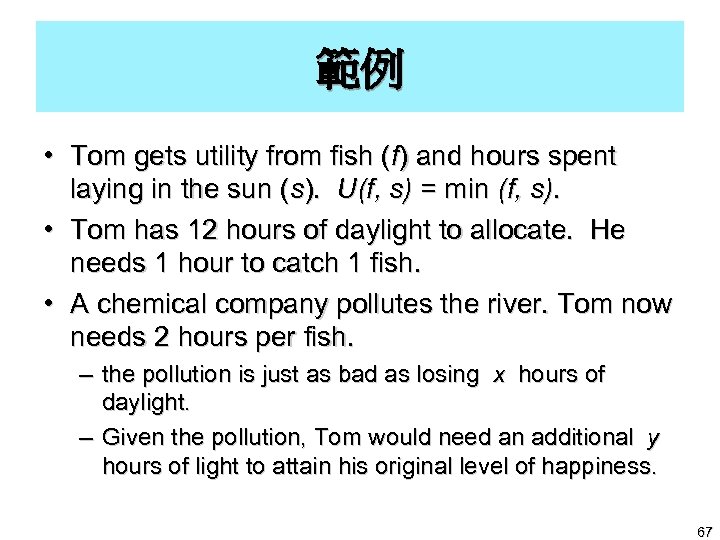
範例 • Tom gets utility from fish (f) and hours spent laying in the sun (s). U(f, s) = min (f, s). • Tom has 12 hours of daylight to allocate. He needs 1 hour to catch 1 fish. • A chemical company pollutes the river. Tom now needs 2 hours per fish. – the pollution is just as bad as losing x hours of daylight. – Given the pollution, Tom would need an additional y hours of light to attain his original level of happiness. 67
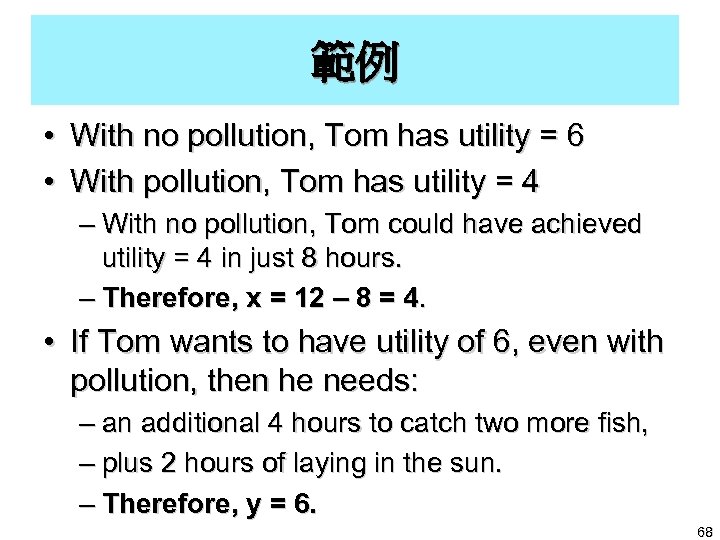
範例 • With no pollution, Tom has utility = 6 • With pollution, Tom has utility = 4 – With no pollution, Tom could have achieved utility = 4 in just 8 hours. – Therefore, x = 12 – 8 = 4. • If Tom wants to have utility of 6, even with pollution, then he needs: – an additional 4 hours to catch two more fish, – plus 2 hours of laying in the sun. – Therefore, y = 6. 68
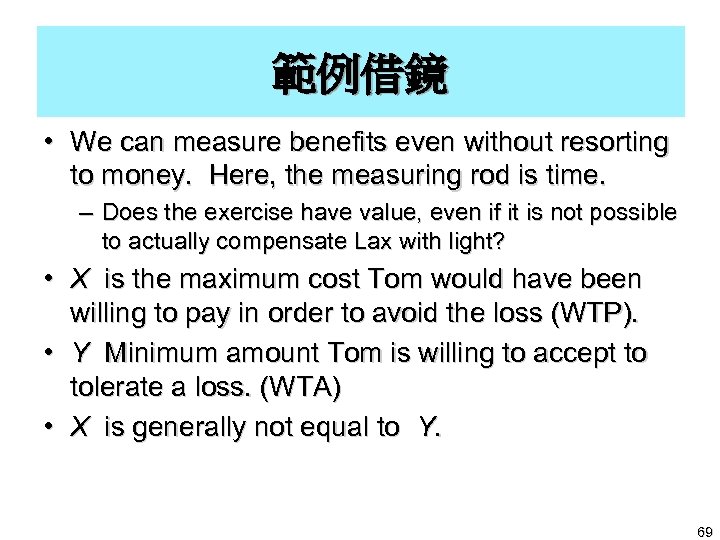
範例借鏡 • We can measure benefits even without resorting to money. Here, the measuring rod is time. – Does the exercise have value, even if it is not possible to actually compensate Lax with light? • X is the maximum cost Tom would have been willing to pay in order to avoid the loss (WTP). • Y Minimum amount Tom is willing to accept to tolerate a loss. (WTA) • X is generally not equal to Y. 69
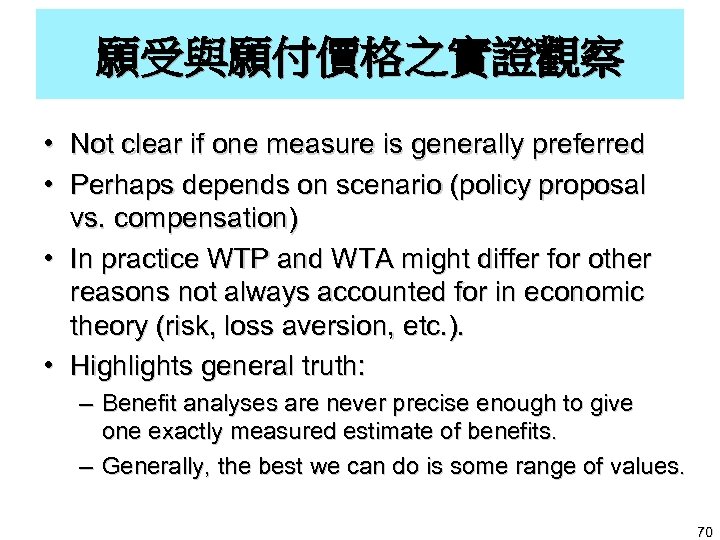
願受與願付價格之實證觀察 • Not clear if one measure is generally preferred • Perhaps depends on scenario (policy proposal vs. compensation) • In practice WTP and WTA might differ for other reasons not always accounted for in economic theory (risk, loss aversion, etc. ). • Highlights general truth: – Benefit analyses are never precise enough to give one exactly measured estimate of benefits. – Generally, the best we can do is some range of values. 70
特徵價格估算法 • 範例: 如估算機場噪音對房價之影響. • 假定房價之決定係受房字之整體內外在環 境所影響,如 – 室內坪數 – 衛浴套數 – 建坪 – 與市中心、市場…距離 – 環境因素,如噪音、污染、視野… 71
特徵價格估算法 • 一般多運用多變量迴歸法進行推估 – Potential problem #1: 變數少計 • Suppose that you forgot to include distance from airport. (biased estimate) – Potential problem #2: 變數間具高度相關性 • Suppose that all the noisy neighborhoods also have high crime rates. • Compute price effects of reduced noise at airport • Approximation of willingness-to-pay for noise reduction. – Question: Is the estimated value valid, even if all of the houses in the flight path are currently occupied by the hard of hearing, who don’t seem to mind so 72
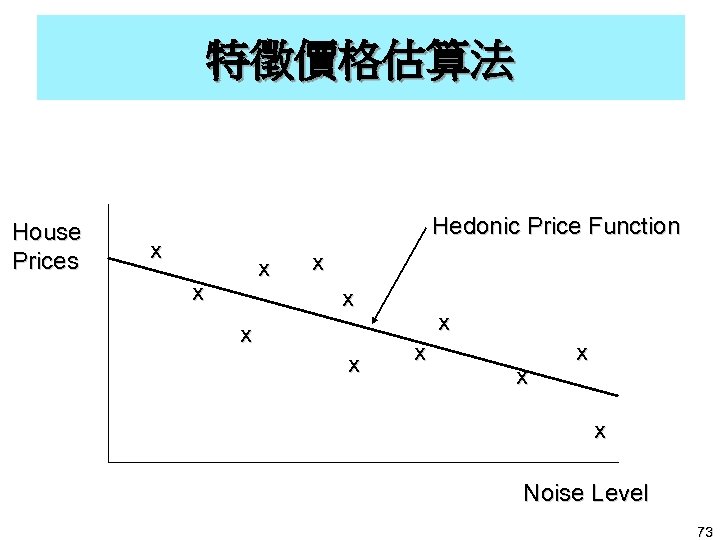
特徵價格估算法 House Prices Hedonic Price Function x x x Noise Level 73
特徵價格估算法與風險評價 • Workers willing to undertake risk for increased pay • Observes wage-risk tradeoffs in labor market • Hedonics Wage Values: Compare different occupations with different risks of mortality • Important Assumptions – Workers are aware of risks and that they are perfectly internalized. – Only real difference between occupations is level of risk. 74
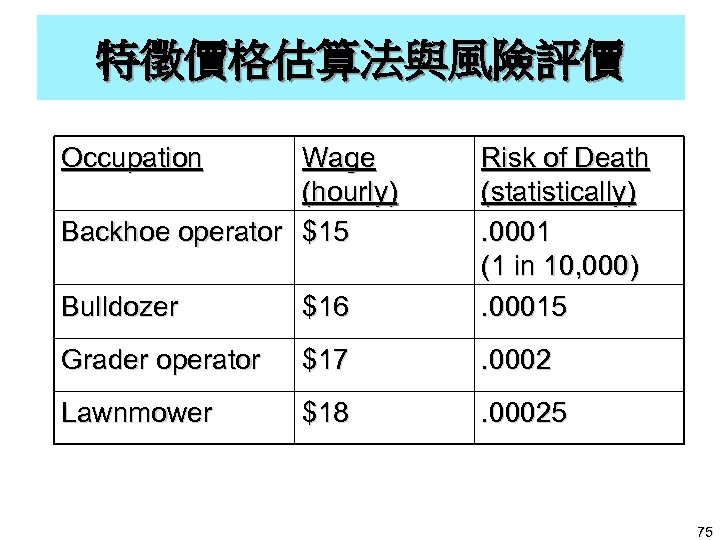
特徵價格估算法與風險評價 Occupation Wage (hourly) Backhoe operator $15 Bulldozer $16 Risk of Death (statistically). 0001 (1 in 10, 000). 00015 Grader operator $17 . 0002 Lawnmower $18 . 00025 75
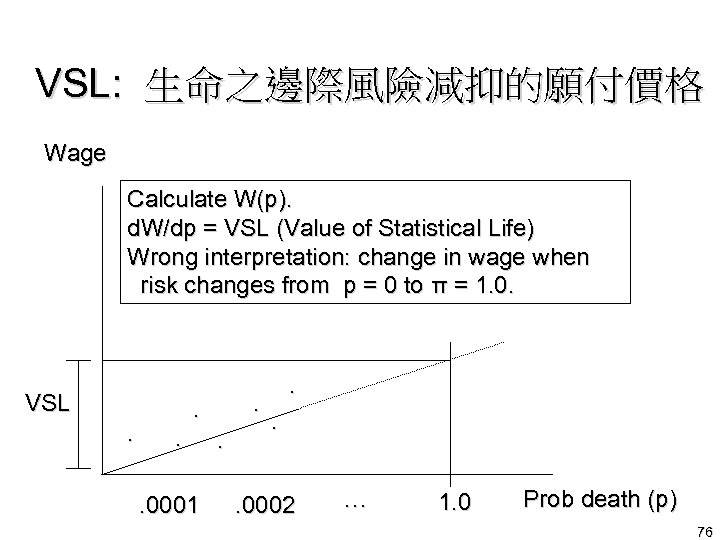
VSL: 生命之邊際風險減抑的願付價格 Wage Calculate W(p). d. W/dp = VSL (Value of Statistical Life) Wrong interpretation: change in wage when risk changes from p = 0 to π = 1. 0. VSL. . . 0001 . . 0002 … 1. 0 Prob death (p) 76
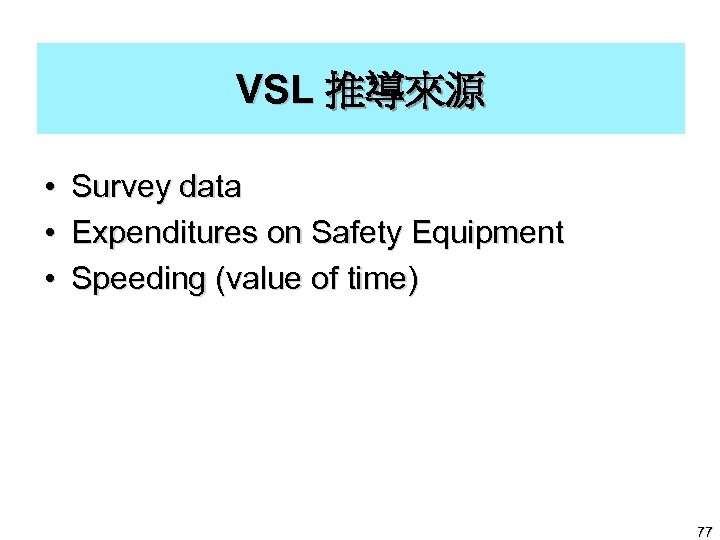
VSL 推導來源 • • • Survey data Expenditures on Safety Equipment Speeding (value of time) 77
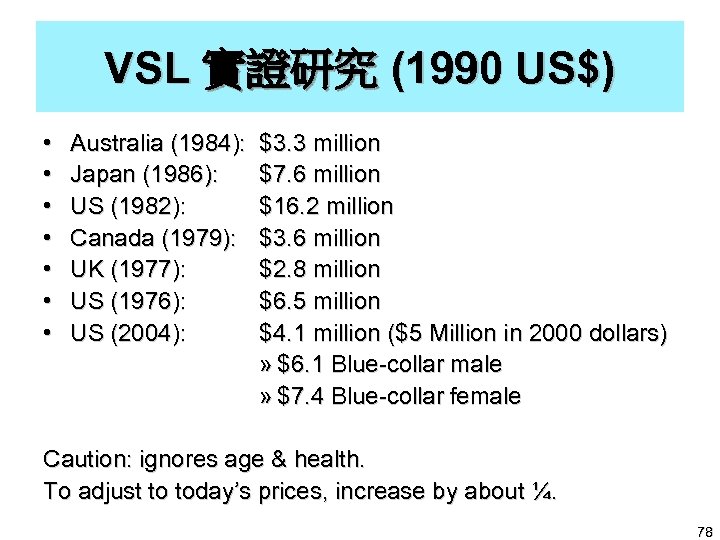
VSL 實證研究 (1990 US$) • • Australia (1984): $3. 3 million Japan (1986): $7. 6 million US (1982): $16. 2 million Canada (1979): $3. 6 million UK (1977): $2. 8 million US (1976): $6. 5 million US (2004): $4. 1 million ($5 Million in 2000 dollars) » $6. 1 Blue-collar male » $7. 4 Blue-collar female Caution: ignores age & health. To adjust to today’s prices, increase by about ¼. 78
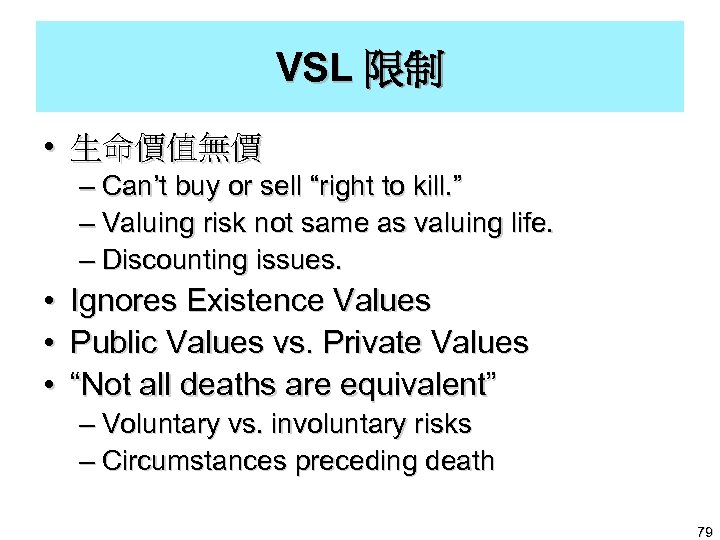
VSL 限制 • 生命價值無價 – Can’t buy or sell “right to kill. ” – Valuing risk not same as valuing life. – Discounting issues. • • • Ignores Existence Values Public Values vs. Private Values “Not all deaths are equivalent” – Voluntary vs. involuntary risks – Circumstances preceding death 79
VSL 估算特色 • “It is useful to collect quantitative information about lives saved and health improved through public policy, but it may be pointless or confusing to translate that information into dollars. ” • “Quantify, but don’t monetize” 80

選擇權價值 • 權值來自 – 彈性 – 資訊 81
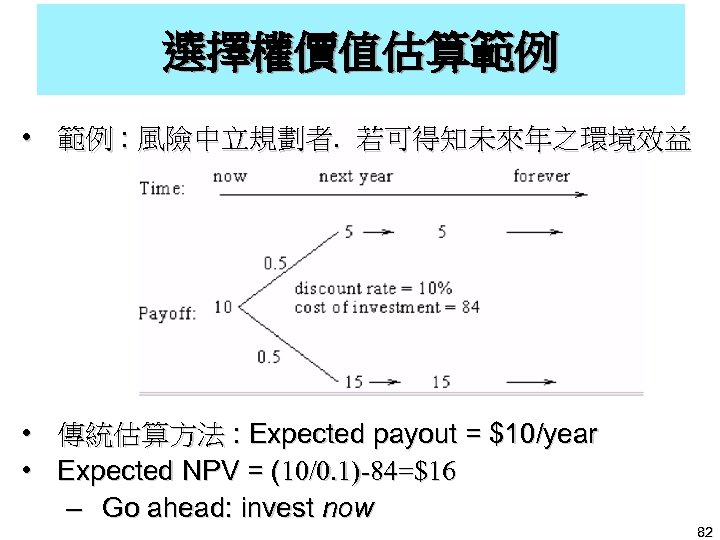
選擇權價值估算範例 • 範例 : 風險中立規劃者. 若可得知未來年之環境效益 • 傳統估算方法 : Expected payout = $10/year • Expected NPV = (10/0. 1)-84=$16 – Go ahead: invest now 82
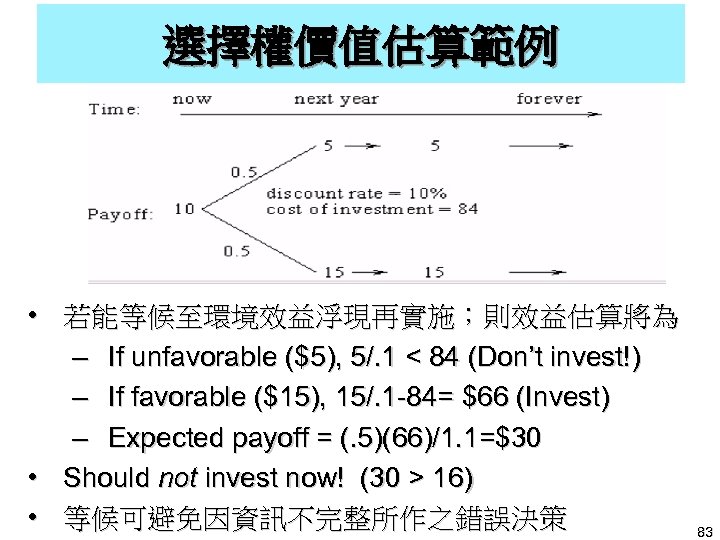
選擇權價值估算範例 • 若能等候至環境效益浮現再實施;則效益估算將為 – If unfavorable ($5), 5/. 1 < 84 (Don’t invest!) – If favorable ($15), 15/. 1 -84= $66 (Invest) – Expected payoff = (. 5)(66)/1. 1=$30 • Should not invest now! (30 > 16) • 等候可避免因資訊不完整所作之錯誤決策 83
選擇權估算法之涵義 • Hysteresis: 等候具價值之條件 – There is 不確定性 in payoff of investment – You can 得知 in the future by delaying – Investment is 不可回復 or costly reversible • The value is called 選擇權值 (ov) – Much like financial option value • Example: call option: opportunity to invest in year two • Value is $30 – Investment now kills this option – Invest now only if ENPV > OV, or if the benefit can cover both the cost and the OV • 計畫是否執行之評估,非僅在於是否進行,尚在現在 與未來之比較 84
Скачать презентацию 成本效益分析 評估技術 1 社會折現率 折現乃反應社會大眾對時間偏好之選擇
49030bb0856fb4be45e59c37d1a0d222.ppt