 Скачать презентацию 天体からの宇宙線電子 陽電子放射と CTAなどの将来計画 川中 宣太 KEK 共同研究者 井岡邦仁 大平豊 KEK 樫山和巳
3365fef58c179515c22799042e177189.ppt
- Количество слайдов: 18



天体からの宇宙線電子・陽電子放射と CTAなどの将来計画 川中 宣太 (KEK) 共同研究者 井岡邦仁、大平豊 (KEK) 樫山和巳 (京都大学) ガンマ線天文学~日本の戦略~@東大宇宙線研 2010/11/17
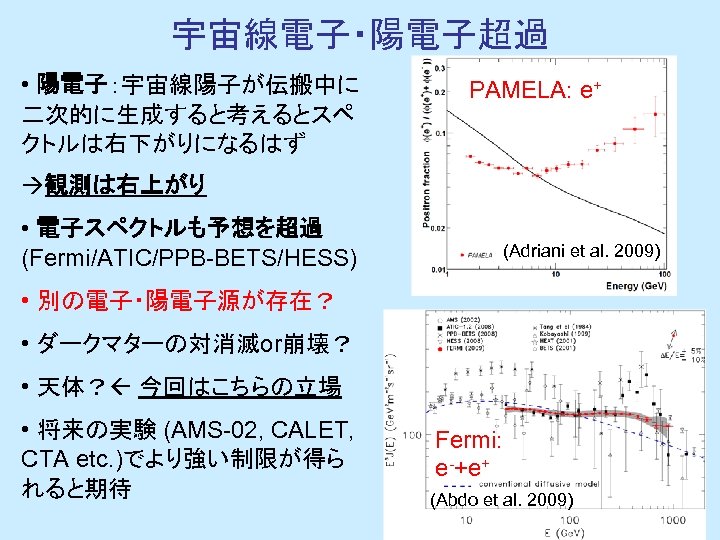
宇宙線電子・陽電子超過 • 陽電子:宇宙線陽子が伝搬中に 二次的に生成すると考えるとスペ クトルは右下がりになるはず PAMELA: e+ 観測は右上がり • 電子スペクトルも予想を超過 (Fermi/ATIC/PPB-BETS/HESS) (Adriani et al. 2009) • 別の電子・陽電子源が存在? • ダークマターの対消滅or崩壊? • 天体? 今回はこちらの立場 • 将来の実験 (AMS-02, CALET, CTA etc. )でより強い制限が得ら れると期待 Fermi: e-+e+ (Abdo et al. 2009)
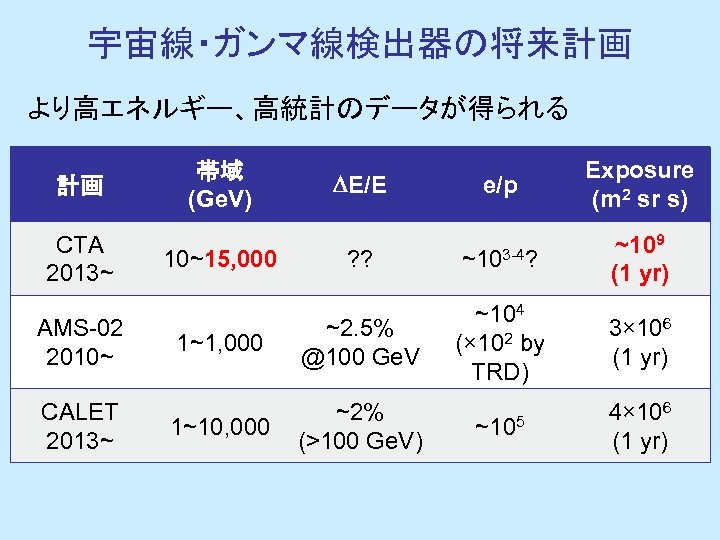
宇宙線・ガンマ線検出器の将来計画 より高エネルギー、高統計のデータが得られる 計画 CTA 2013~ AMS-02 2010~ CALET 2013~ DE/E e/p Exposure (m 2 sr s) ? ? ~103 -4? ~109 (1 yr) 1~1, 000 ~2. 5% @100 Ge. V ~104 (× 102 by TRD) 3× 10⁶ (1 yr) 1~10, 000 ~2% (>100 Ge. V) ~105 4× 10⁶ (1 yr) 帯域 (Ge. V) 10~15, 000
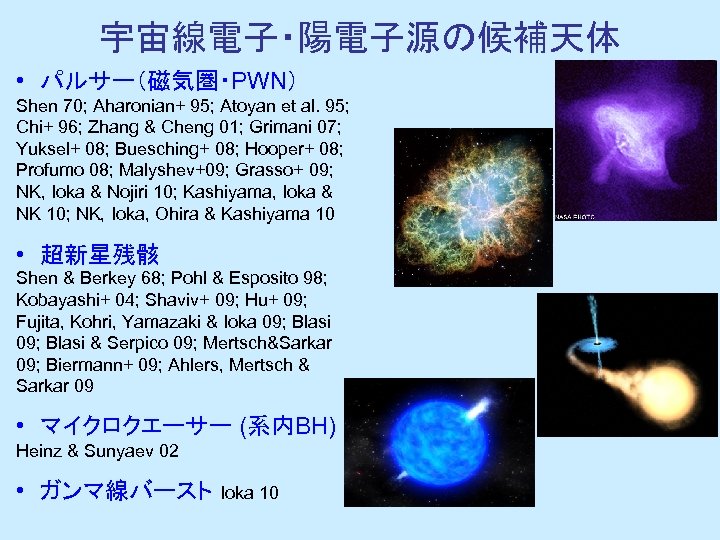
宇宙線電子・陽電子源の候補天体 • パルサー(磁気圏・PWN) Shen 70; Aharonian+ 95; Atoyan et al. 95; Chi+ 96; Zhang & Cheng 01; Grimani 07; Yuksel+ 08; Buesching+ 08; Hooper+ 08; Profumo 08; Malyshev+09; Grasso+ 09; NK, Ioka & Nojiri 10; Kashiyama, Ioka & NK 10; NK, Ioka, Ohira & Kashiyama 10 • 超新星残骸 Shen & Berkey 68; Pohl & Esposito 98; Kobayashi+ 04; Shaviv+ 09; Hu+ 09; Fujita, Kohri, Yamazaki & Ioka 09; Blasi & Serpico 09; Mertsch&Sarkar 09; Biermann+ 09; Ahlers, Mertsch & Sarkar 09 • マイクロクエーサー (系内BH) Heinz & Sunyaev 02 • ガンマ線バースト Ioka 10
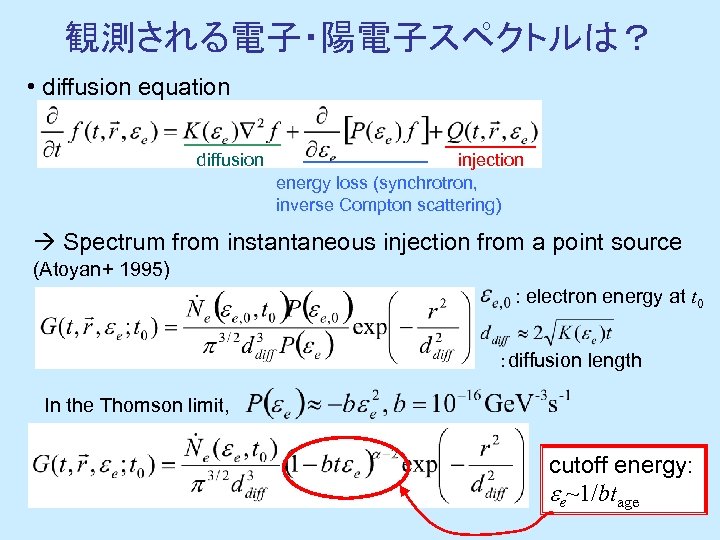
観測される電子・陽電子スペクトルは? • diffusion equation diffusion injection energy loss (synchrotron, inverse Compton scattering) Spectrum from instantaneous injection from a point source (Atoyan+ 1995) : electron energy at t 0 :diffusion length In the Thomson limit, cutoff energy: ee~1/btage
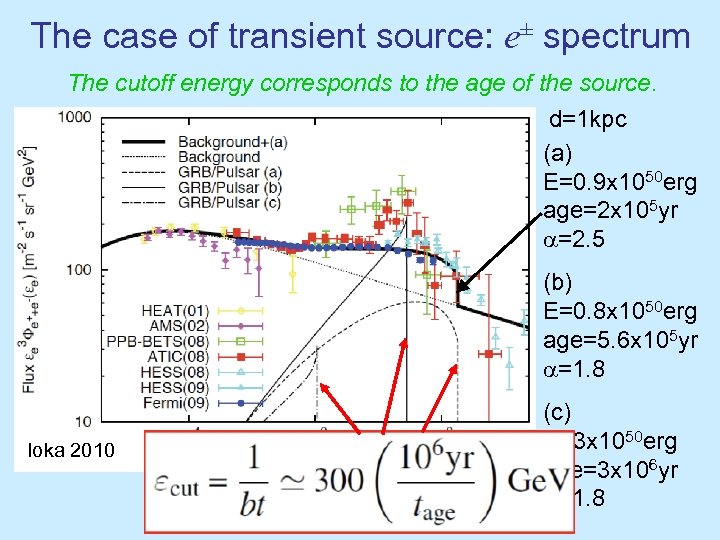
The case of transient source: e± spectrum The cutoff energy corresponds to the age of the source. d=1 kpc (a) E=0. 9 x 1050 erg age=2 x 10⁵ yr a=2. 5 (b) E=0. 8 x 1050 erg age=5. 6 x 10⁵ yr a=1. 8 Ioka 2010 (c) E=3 x 1050 erg age=3 x 10⁶ yr a=1. 8
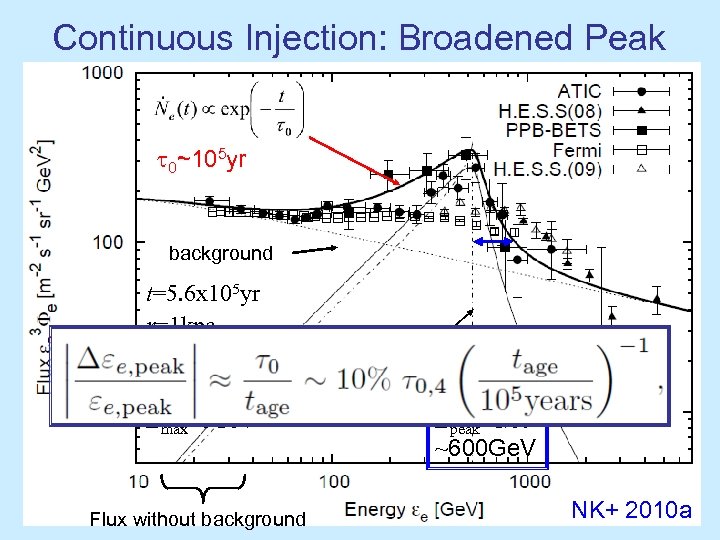
Continuous Injection: Broadened Peak t 0~105 yr background t=5. 6 x 10⁵ yr r=1 kpc Ee+ ~Ee-~1050 erg a=1. 7 Emax=5 Te. V Flux without background Burst-like event (e. g. GRB) Epeak~1/bt ~600 Ge. V NK+ 2010 a
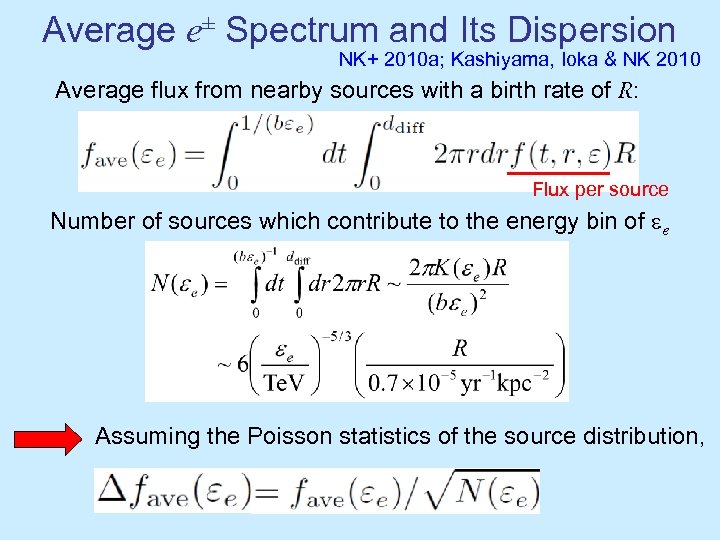
Average e± Spectrum and Its Dispersion NK+ 2010 a; Kashiyama, Ioka & NK 2010 Average flux from nearby sources with a birth rate of R: Flux per source Number of sources which contribute to the energy bin of ee Assuming the Poisson statistics of the source distribution,
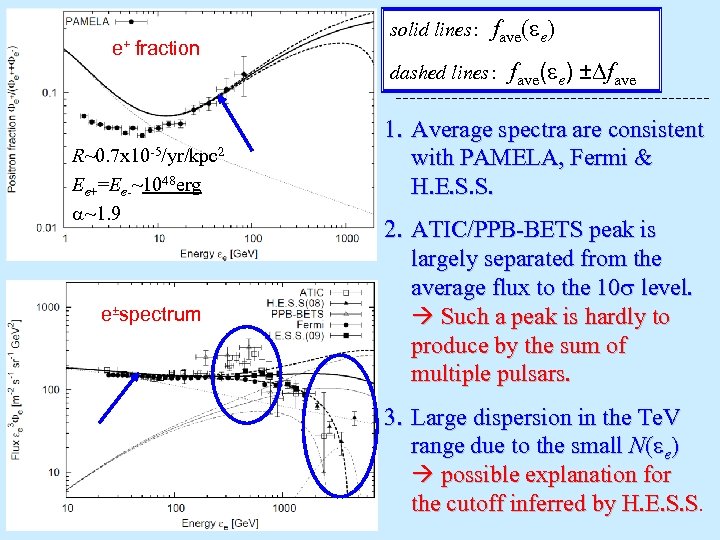
e+ fraction solid lines: fave(ee) dashed lines: R~0. 7 x 10 -5/yr/kpc 2 Ee+=Ee-~1048 erg a~1. 9 e±spectrum fave(ee) ±Dfave 1. Average spectra are consistent with PAMELA, Fermi & H. E. S. S. 2. ATIC/PPB-BETS peak is largely separated from the average flux to the 10 s level. Such a peak is hardly to produce by the sum of multiple pulsars. 3. Large dispersion in the Te. V range due to the small N(ee) possible explanation for the cutoff inferred by H. E. S. S
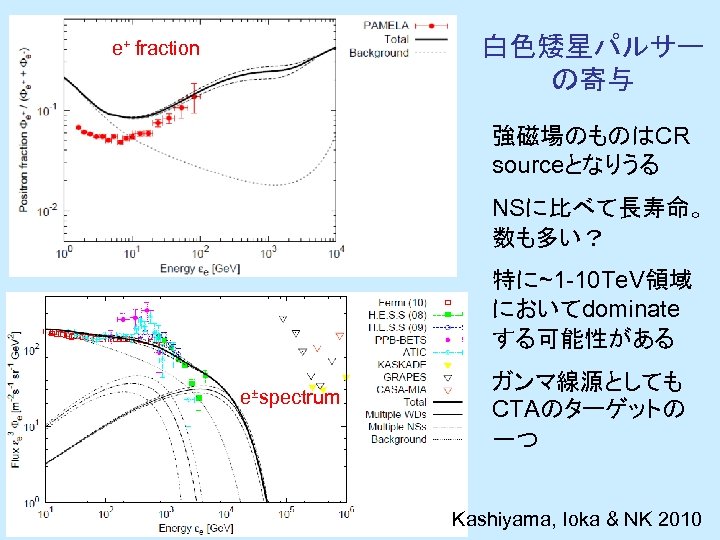
白色矮星パルサー の寄与 e+ fraction 強磁場のものはCR sourceとなりうる NSに比べて長寿命。 数も多い? 特に~1 -10 Te. V領域 においてdominate する可能性がある e±spectrum ガンマ線源としても CTAのターゲットの 一つ Kashiyama, Ioka & NK 2010
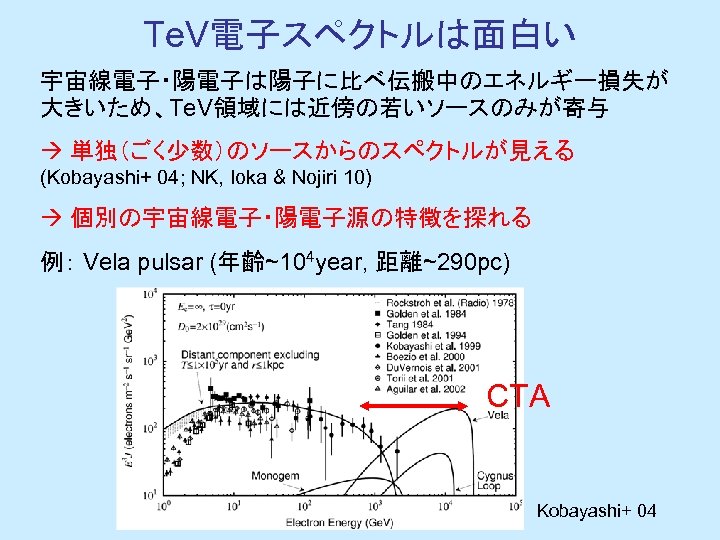
Te. V電子スペクトルは面白い 宇宙線電子・陽電子は陽子に比べ伝搬中のエネルギー損失が 大きいため、Te. V領域には近傍の若いソースのみが寄与 単独(ごく少数)のソースからのスペクトルが見える (Kobayashi+ 04; NK, Ioka & Nojiri 10) 個別の宇宙線電子・陽電子源の特徴を探れる 例: Vela pulsar (年齢~104 year, 距離~290 pc) CTA Kobayashi+ 04
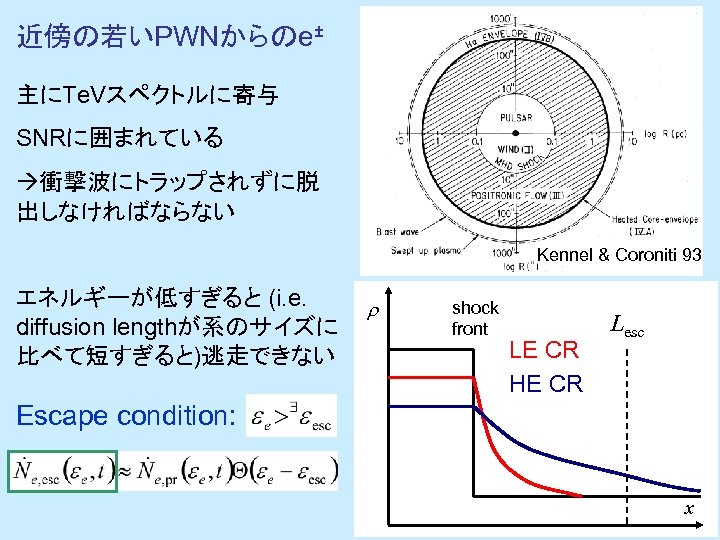
近傍の若いPWNからのe± 主にTe. Vスペクトルに寄与 SNRに囲まれている 衝撃波にトラップされずに脱 出しなければならない Kennel & Coroniti 93 エネルギーが低すぎると (i. e. diffusion lengthが系のサイズに 比べて短すぎると)逃走できない r shock front LE CR HE CR Lesc Escape condition: x
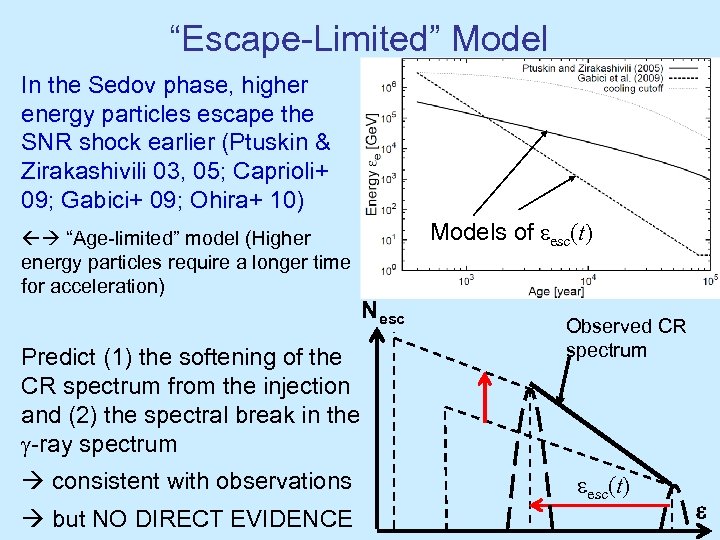
“Escape-Limited” Model In the Sedov phase, higher energy particles escape the SNR shock earlier (Ptuskin & Zirakashivili 03, 05; Caprioli+ 09; Gabici+ 09; Ohira+ 10) “Age-limited” model (Higher energy particles require a longer time for acceleration) Predict (1) the softening of the CR spectrum from the injection and (2) the spectral break in the g-ray spectrum consistent with observations but NO DIRECT EVIDENCE Models of eesc(t) Nesc Observed CR spectrum eesc(t) e
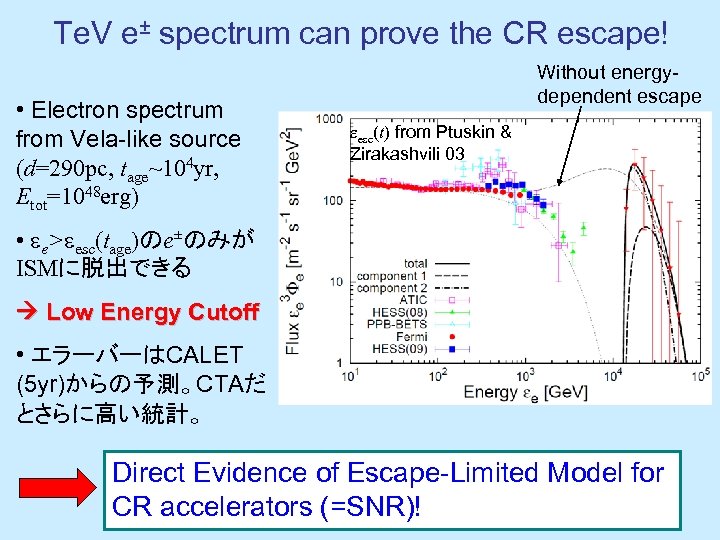
Te. V e± spectrum can prove the CR escape! • Electron spectrum from Vela-like source (d=290 pc, tage~104 yr, Etot=1048 erg) Without energydependent escape eesc(t) from Ptuskin & Zirakashvili 03 • ee>eesc(tage)のe±のみが ISMに脱出できる Low Energy Cutoff • エラーバーはCALET (5 yr)からの予測。CTAだ とさらに高い統計。 Direct Evidence of Escape-Limited Model for CR accelerators (=SNR)!
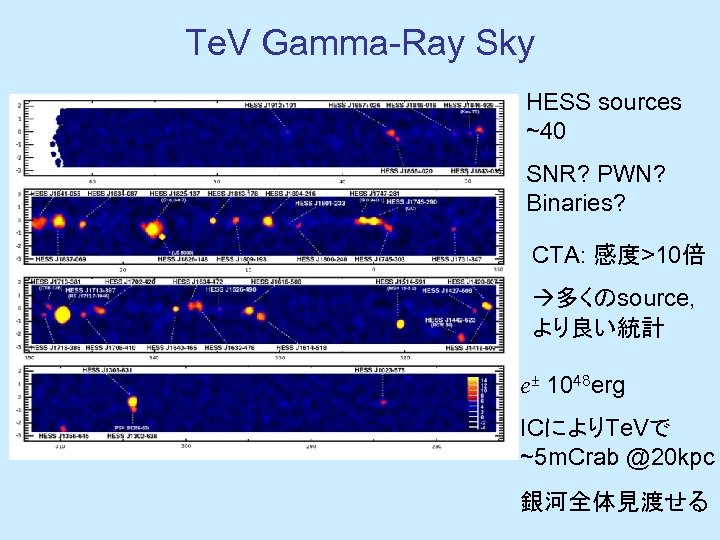
Te. V Gamma-Ray Sky HESS sources ~40 SNR? PWN? Binaries? CTA: 感度>10倍 多くのsource, より良い統計 e± 1048 erg ICによりTe. Vで ~5 m. Crab @20 kpc 銀河全体見渡せる
Summary • 宇宙線電子・陽電子超過 (PAMELA, Fermi 将来: CTA, AMS-02, CALET) 天体起源説・ダークマター説 未決着 • 近傍のパルサー(PWN), 白色矮星が寄与す る可能性 • 天体起源の電子スペクトルに見られる特徴 continuous injectionの効果、>Te. Vでのfluctuation, SNRからのenergy-dependent escapeによる低エ ネルギーカットオフ • CTA, CALET, AMS-02による直接観測 • 天体がe±を閉じ込めていれば、ガンマ線源に なる。Escapeしていれば拡がったソースに?
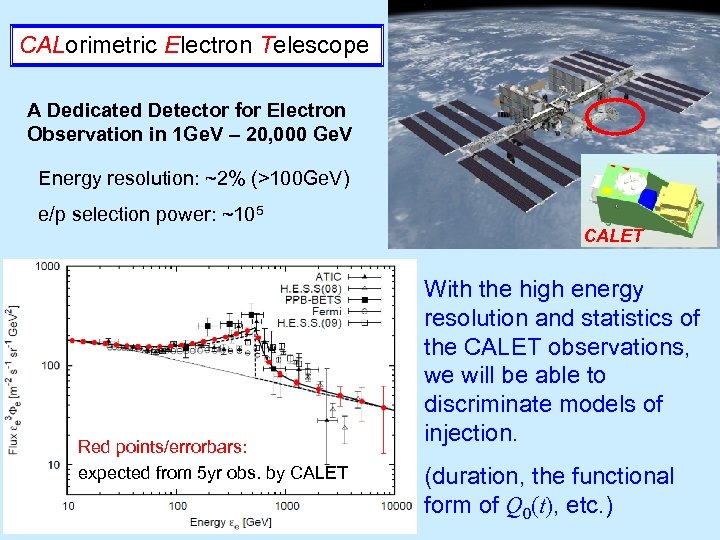
CALorimetric Electron Telescope A Dedicated Detector for Electron Observation in 1 Ge. V – 20, 000 Ge. V Energy resolution: ~2% (>100 Ge. V) e/p selection power: ~105 CALET Red points/errorbars: expected from 5 yr obs. by CALET With the high energy resolution and statistics of the CALET observations, we will be able to discriminate models of injection. (duration, the functional form of Q 0(t), etc. )
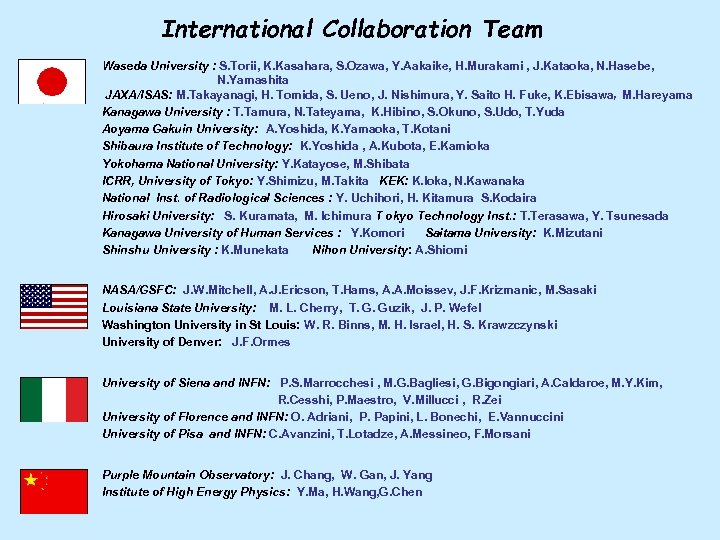
International Collaboration Team Waseda University : S. Torii, K. Kasahara, S. Ozawa, Y. Aakaike, H. Murakami , J. Kataoka, N. Hasebe, N. Yamashita JAXA/ISAS: M. Takayanagi, H. Tomida, S. Ueno, J. Nishimura, Y. Saito H. Fuke, K. Ebisawa,M. Hareyama Kanagawa University : T. Tamura, N. Tateyama, K. Hibino, S. Okuno, S. Udo, T. Yuda Aoyama Gakuin University: A. Yoshida, K. Yamaoka, T. Kotani Shibaura Institute of Technology: K. Yoshida , A. Kubota, E. Kamioka Yokohama National University: Y. Katayose, M. Shibata ICRR, University of Tokyo: Y. Shimizu, M. Takita KEK: K. Ioka, N. Kawanaka National Inst. of Radiological Sciences : Y. Uchihori, H. Kitamura S. Kodaira Hirosaki University: S. Kuramata, M. Ichimura T okyo Technology Inst. : T. Terasawa, Y. Tsunesada Kanagawa University of Human Services : Y. Komori Saitama University: K. Mizutani Shinshu University : K. Munekata Nihon University: A. Shiomi NASA/GSFC: J. W. Mitchell, A. J. Ericson, T. Hams, A. A. Moissev, J. F. Krizmanic, M. Sasaki Louisiana State University: M. L. Cherry, T. G. Guzik, J. P. Wefel Washington University in St Louis: W. R. Binns, M. H. Israel, H. S. Krawzczynski University of Denver: J. F. Ormes University of Siena and INFN: P. S. Marrocchesi , M. G. Bagliesi, G. Bigongiari, A. Caldaroe, M. Y. Kim, R. Cesshi, P. Maestro, V. Millucci , R. Zei University of Florence and INFN: O. Adriani, P. Papini, L. Bonechi, E. Vannuccini University of Pisa and INFN: C. Avanzini, T. Lotadze, A. Messineo, F. Morsani Purple Mountain Observatory: J. Chang, W. Gan, J. Yang Institute of High Energy Physics: Y. Ma, H. Wang, G. Chen
Скачать презентацию 天体からの宇宙線電子 陽電子放射と CTAなどの将来計画 川中 宣太 KEK 共同研究者 井岡邦仁 大平豊 KEK 樫山和巳
3365fef58c179515c22799042e177189.ppt