 Скачать презентацию 商务英语 Unit 6 Retailing 教材 新视野商务英语 上 Unit 6
85bce4429b42801da2b64a56c3c98153.ppt
- Количество слайдов: 22



商务英语 Unit 6 Retailing 教材:新视野商务英语(上)
Unit 6 Retailing ¡ Objectives ¡ Key vocabulary ¡ Lead-in ¡ Language focus ¡ Skills ¡ Business communication ¡ Homework
Objectives When the learners finish learning this unit, they should be able to ¡ providing information on retailing ¡ collecting information on retailing
Language focus ¡ Indefinite, definite and zero articles ¡ Defining relative clauses ¡ Pronunciation
Skills ¡ Writing: expanding notes ¡ Reading: bar codes ¡ Listening: shopping at IKEA
Key vocabulary 1. provision: 提供, 供应 ~ of sth to sb e. g. The provision of a new library has been of great benefit to the students. 新图书馆的设立对学生大有好处。 2. retail: 零售 retailer wholesale:批发 wholesaler
3. margin ① 书页的空白处 ② 余地,差数,差额,利润:profit margin毛 利润 ③ 边缘 4. retail outlet: 零售处,零售渠道 5. purchase: buy 6. department store: 百货商店 7. TV shopping channels: 电视购物频道 8. mail-order catalogue: 邮购目录
Lead-in Work in pairs. Look at the bar chart which shows reasons why people don’t like shopping. Discuss these questions. 1. What are the two main reasons people don’t like shopping? 2. What can retailers do about these two problems in your opinion?
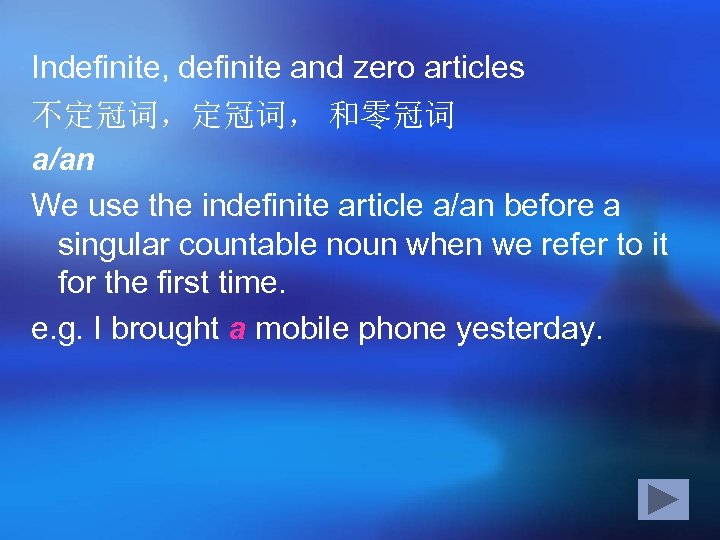
Indefinite, definite and zero articles 不定冠词, 和零冠词 a/an We use the indefinite article a/an before a singular countable noun when we refer to it for the first time. e. g. I brought a mobile phone yesterday.
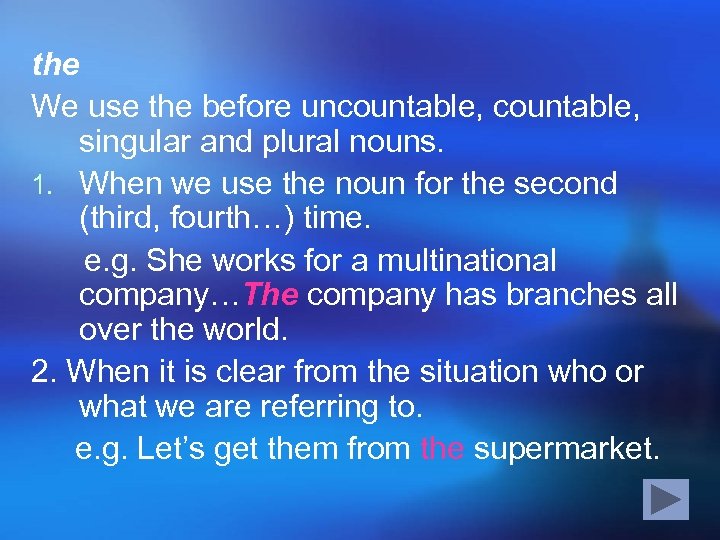
the We use the before uncountable, singular and plural nouns. 1. When we use the noun for the second (third, fourth…) time. e. g. She works for a multinational company…The company has branches all over the world. 2. When it is clear from the situation who or what we are referring to. e. g. Let’s get them from the supermarket.
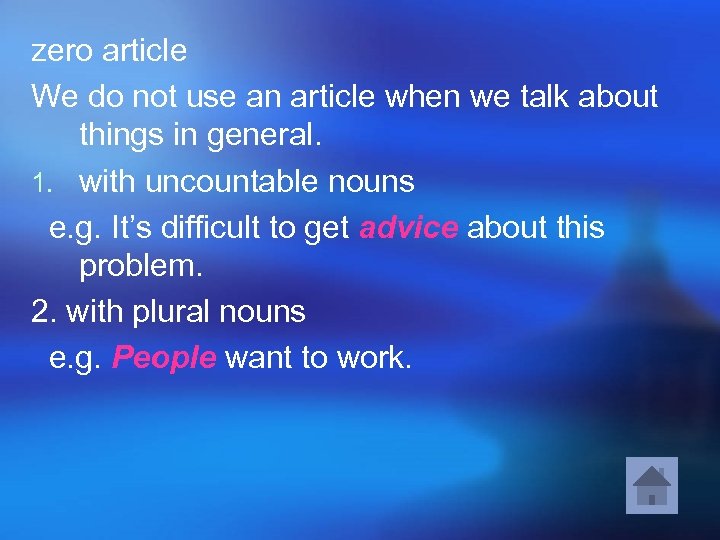
zero article We do not use an article when we talk about things in general. 1. with uncountable nouns e. g. It’s difficult to get advice about this problem. 2. with plural nouns e. g. People want to work.
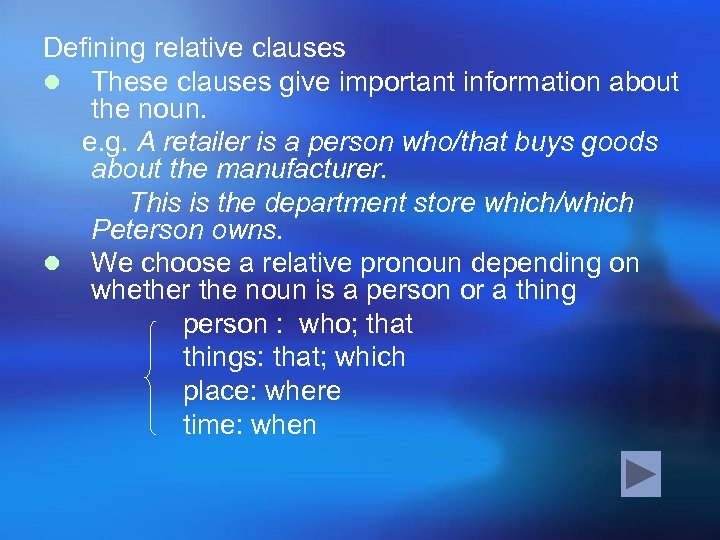
Defining relative clauses l These clauses give important information about the noun. e. g. A retailer is a person who/that buys goods about the manufacturer. This is the department store which/which Peterson owns. l We choose a relative pronoun depending on whether the noun is a person or a thing person : who; that things: that; which place: where time: when
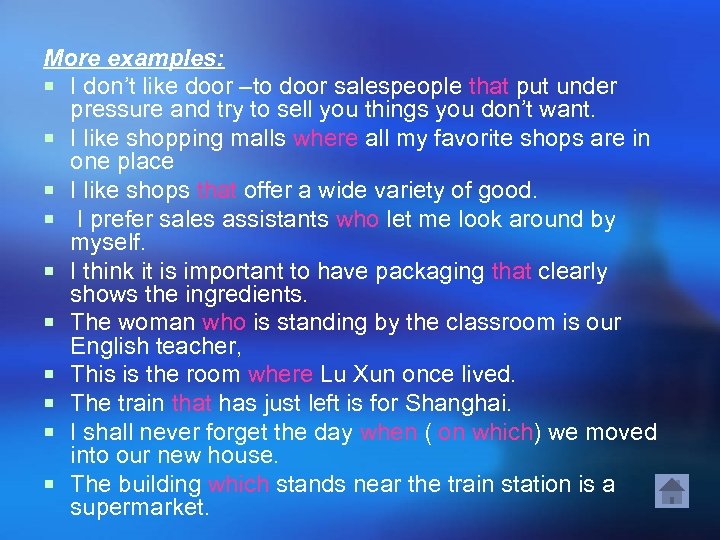
More examples: ¡ I don’t like door –to door salespeople that put under pressure and try to sell you things you don’t want. ¡ I like shopping malls where all my favorite shops are in one place ¡ I like shops that offer a wide variety of good. ¡ I prefer sales assistants who let me look around by myself. ¡ I think it is important to have packaging that clearly shows the ingredients. ¡ The woman who is standing by the classroom is our English teacher, ¡ This is the room where Lu Xun once lived. ¡ The train that has just left is for Shanghai. ¡ I shall never forget the day when ( on which) we moved into our new house. ¡ The building which stands near the train station is a supermarket.
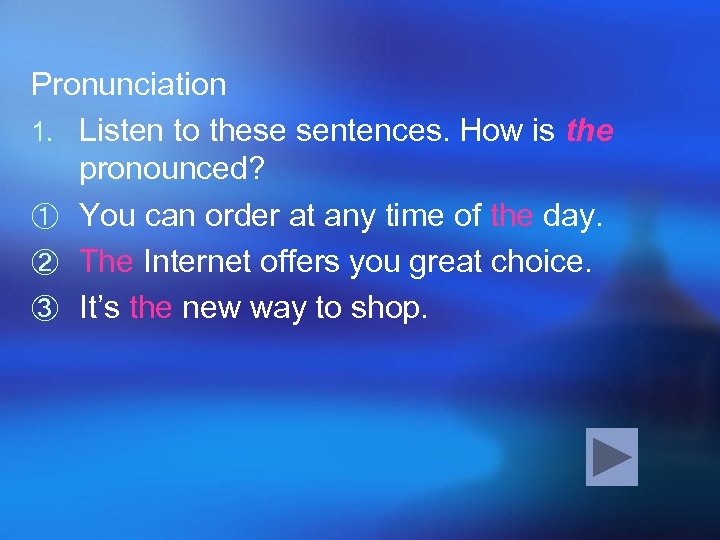
Pronunciation 1. Listen to these sentences. How is the pronounced? ① You can order at any time of the day. ② The Internet offers you great choice. ③ It’s the new way to shop.
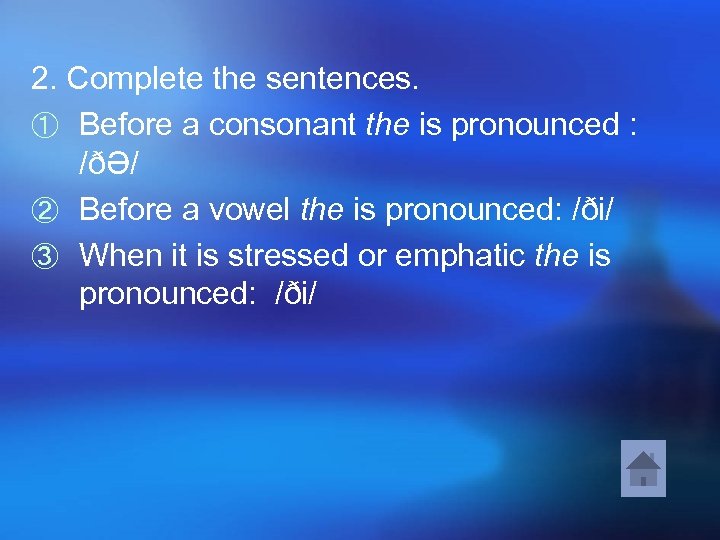
2. Complete the sentences. ① Before a consonant the is pronounced : /ðƏ/ ② Before a vowel the is pronounced: /ði/ ③ When it is stressed or emphatic the is pronounced: /ði/
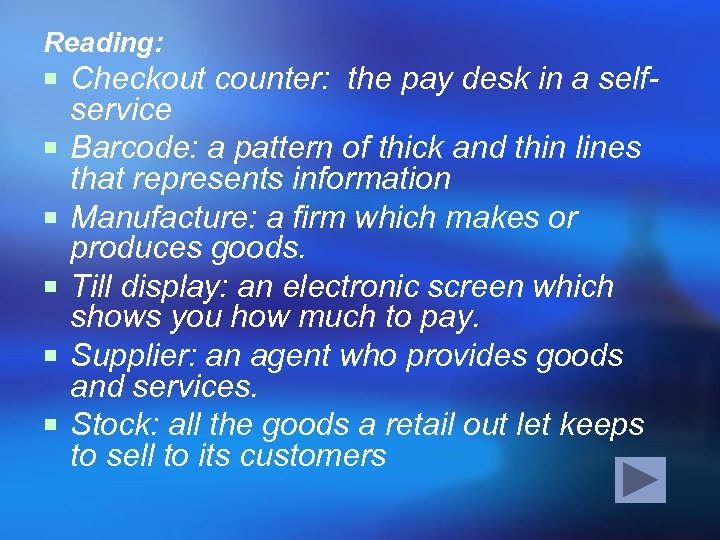
Reading: ¡ Checkout counter: the pay desk in a self¡ ¡ ¡ service Barcode: a pattern of thick and thin lines that represents information Manufacture: a firm which makes or produces goods. Till display: an electronic screen which shows you how much to pay. Supplier: an agent who provides goods and services. Stock: all the goods a retail out let keeps to sell to its customers
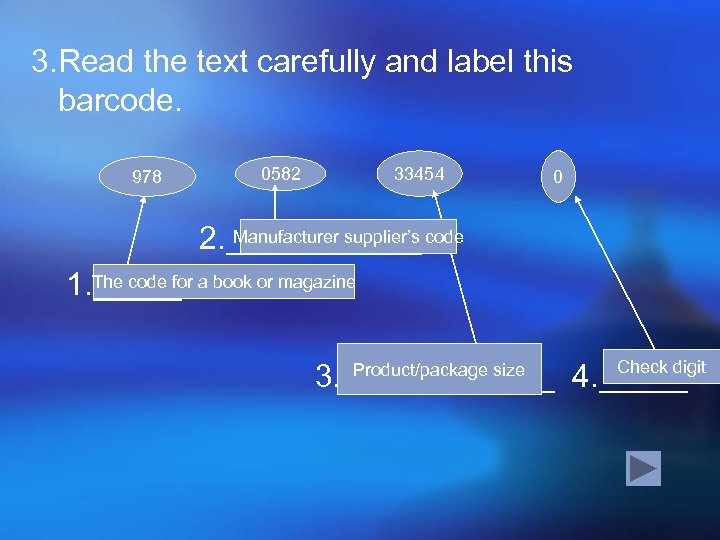
3. Read the text carefully and label this barcode. 978 33454 0582 0 Manufacturer supplier’s 2. ______ code The code for 1. _____ a book or magazine Check digit Product/package size 3. ______ 4. _____
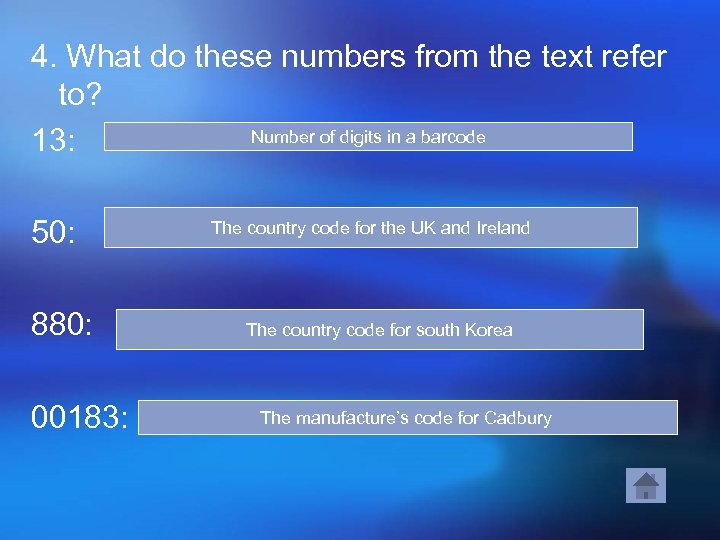
4. What do these numbers from the text refer to? Number of digits in a barcode 13: 50: 880: 00183: The country code for the UK and Ireland The country code for south Korea The manufacture’s code for Cadbury
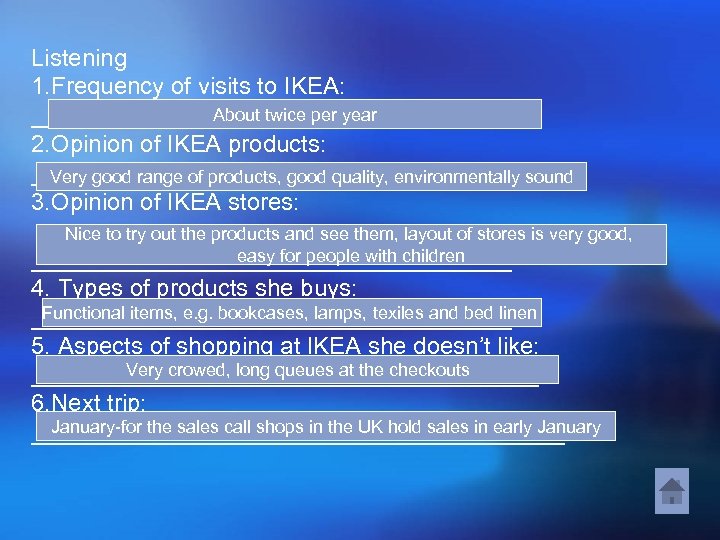
Listening 1. Frequency of visits to IKEA: About twice per year __________________ 2. Opinion of IKEA products: __________________ sound Very good range of products, good quality, environmentally 3. Opinion of IKEA stores: Nice to try out the products and see them, layout of stores is very good, easy for people with children __________________ 4. Types of products she buys: Functional items, e. g. bookcases, lamps, texiles and bed linen __________________ 5. Aspects of shopping at IKEA she doesn’t like: Very crowed, long queues at the checkouts ___________________ 6. Next trip: January-for the sales call shops in the UK hold sales in early January ____________________
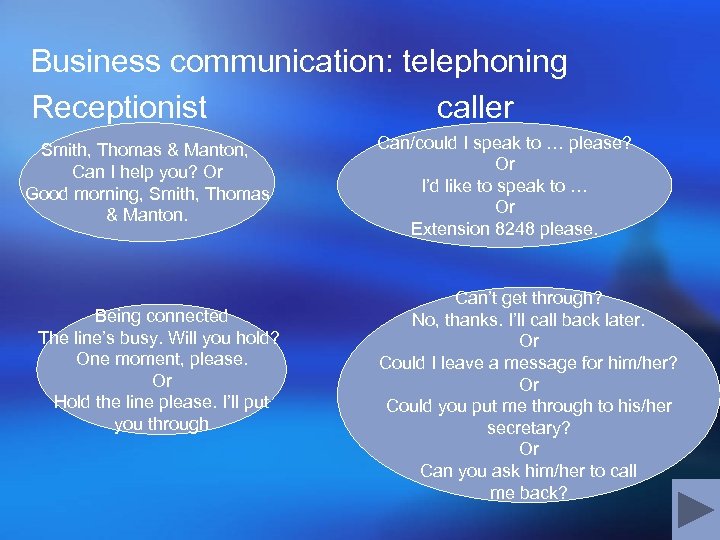
Business communication: telephoning Receptionist caller Smith, Thomas & Manton, Can I help you? Or Good morning, Smith, Thomas & Manton. Being connected The line’s busy. Will you hold? One moment, please. Or Hold the line please. I’ll put you through Can/could I speak to … please? Or I’d like to speak to … Or Extension 8248 please. Can’t get through? No, thanks. I’ll call back later. Or Could I leave a message for him/her? Or Could you put me through to his/her secretary? Or Can you ask him/her to call me back?
Getting through Hello. Barry Smith speaking. My name is …(the first call only) Or It’s Chenchen Ju here.
Homework and checklist for Unit 6 1. Name five different types of retail outlet. 2. What information do bar codes contain? Why are they important? 3. Which of these nouns can we use the indefinite article with? Why? 4. Which of these nouns can we use the indefinite article with? Why?
Скачать презентацию 商务英语 Unit 6 Retailing 教材 新视野商务英语 上 Unit 6
85bce4429b42801da2b64a56c3c98153.ppt