 Скачать презентацию 到底有多大 2003年被全球10000名主管票選為Fortune雜誌 全球聲望最佳企業榜首 Wal-Mart百貨在 1962年 由山姆 華頓 Sam Walton 所創立 華頓把 Wal-Mart百貨帶入全球第一的舞臺 信念 誰是我們的老闆
b235699a0fd45d223aff4264f3aa0b39.ppt
- Количество слайдов: 36



到底有多大? 2003年被全球10000名主管票選為Fortune雜誌『全球聲望最佳企業榜首 』 Wal-Mart百貨在 1962年,由山姆·華頓(Sam Walton)所創立,華頓把 Wal-Mart百貨帶入全球第一的舞臺. 信念:誰是我們的老闆? 1992華頓去世後,由其長子羅伯·華頓接手經營,時規模只有今天的1/5, 10年後取代艾克森美芙石油成為全球最大企業 2002年營收 2445億美元橫跨全球11個國家分店總數 4395家,Fortune的 統計: 1. 去年秋天沃爾瑪光一天營收 14. 2億美元比 26個國家的GDP總合還多。 2. 他是全美21個州最大的雇主,雇用人數比美國軍方還多。 3. 他今年成長的目標相當增加一家百事可樂或微軟的規模。 4. 歷年店內被偷竊而損失產品的總金額(USD 20 e)相當財星 1000大排名 694企業的金額。
作風 1. 新經濟的狠角色(從資訊科技與管理創新上獲得的效 率連電腦通訊界也望塵莫及) 2. 嚴格又公道(麥肯席 02年一項研究:美國經濟 9599年的成長超過1/8的生產力貢獻都要歸功於三個 字;沃爾瑪。所謂沃爾瑪效應)。山姆華頓名言:我 門浪費一塊就等於要顧客多掏一塊 3. 改變全世界購物模式〈新聞週刊形容:每當沃爾瑪 進入一個新市場,就好像有頭蠻牛被放進瓷器店裡 撒野一樣)。幫助墨西哥抑制通膨、降低英國生活成 本、改革中國配銷系統、收購日本西友6%股權衝 擊日本零售市場。
做法 1. 供應商議價優勢 2. 衛星通訊網,分店與供應商連線 3. 資料採礦。預測補貨和商品配置 4. 計算商品與幾百項變數(T&P)之間的關聯(如 相機與地圖) (又如飲料與氣候之關聯)
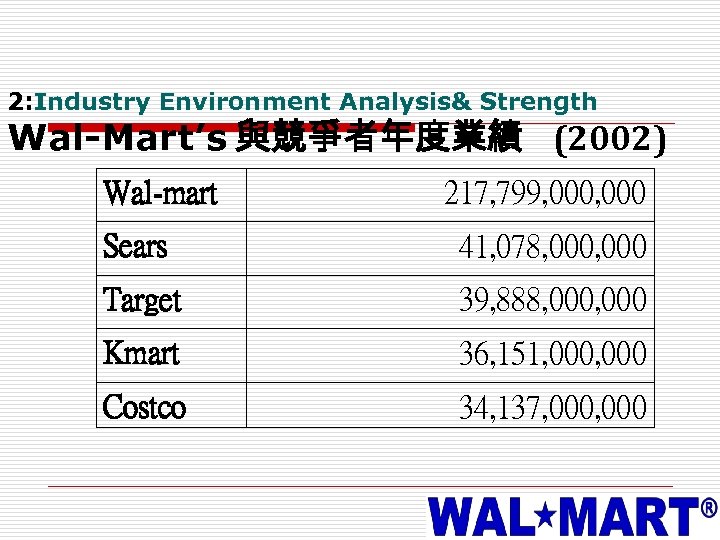
2: Industry Environment Analysis& Strength Wal-Mart’s 與競爭者年度業績 (2002) Wal-mart 217, 799, 000 Sears 41, 078, 000 Target 39, 888, 000 Kmart 36, 151, 000 Costco 34, 137, 000
Wal-Mart 建立的優勢 : *商品的多樣和完整性,建構出巨大的經濟規模 *Wal-Mart 龐大的採購量及議價能力使得能夠壓 低進貨價格 *Wal-Mart天天都便宜(Every Day Low price)的 – 口號做,到完全滿意的承諾 *「消費快速回應」(Quick Response/Efficient – Consumer Response)的概念,滿足客戶需求, 也是Wal-Mart成功的模式之一
Wal-Mart 在美國 *依據美國調查集團的研究,現在美國人民買耐 久性消費物,在下決定之前平均只逛 1. 3家店, 而這個數字在 80年代是 3. 5家,在 90年代初期是 2. 1家,到 1995年則是 1. 8家,到 2000年到來時, 已降到 1. 3家。 *Wal-Mart 的營收是 K-Mart 的五倍 *『強者生存,贏者通吃』。
3: Wal-Marts Supply Chain o o o 在各大商場透過與物料供應商之間,即時銷售 資料線上傳輸系統,讓中央電腦可以立即蒐集 各商場的銷售數字。 供應商也可以即時為商場添補存貨。 有效滿足顧客需求,同時控制倉儲作業及存貨 管理,並且大幅降低固定費用支出。
Wal-Marts Supply Chain o 供應鏈管理的主要關鍵策略: 1. 與供應商成為夥伴 2. 視顧客為夥伴 3. 確實掌握庫存與顧客需求
Wal-Marts Supply Chain o 供應鏈管理的四個主要發展: 1. 電子資料的快速而有效的交流 2. 簡化供應鏈流程 3. 更有效率的整合上、中、下游 4. 促進商務合作 Wal-Mats使用SCM使得跨國的物流與 資訊流能更加有效率。
4: 庫存管理 VMI : 供應商管理庫存 VMI (Vendor Managed Inventory) VMI為供應商管理存貨,其機制為供應商收到下游 顧客的銷售資料及目前的存貨水準後,再依據預先 制定的存貨水準來補顧客的存貨。所以,VMI就是 一種庫存管理方案,以掌控銷售資料和庫存量,作 為市場需求預測和庫存補貨的解決方法
VMI (Vendor Managed Inventory) o 藉由銷售資料得到消費需求資訊,供應商可以 更有效的計劃、更快速的反應市場變化和消費 者的需求,因此VMI可以用來作為降低庫存量、 改善庫存週轉率,進而維持庫存量的最佳化, 而且供應商與批發商分享重要資訊,所以雙方 都可以改善需求預測、補貨計畫、促銷管理和 運輸裝載計畫⋯等等
VMI 系統主要考慮兩項模組 o o 1. 需求預測計劃:即使用統計 具的設定來確 認實際需求。目的要協助供應商,銷售何種商 品、銷售給誰商品、以何種價格銷售、何時銷 售等。 2. 補貨配送計劃:指派可利用的成品庫存以平 衡顧客服務需求,及產品出貨能達到成本效益。 透過實際即時庫存的配置,配銷需求計劃能改 善顧客服務,降低庫存水準及最小運輸成本。 最主要是有效的管理庫存量。
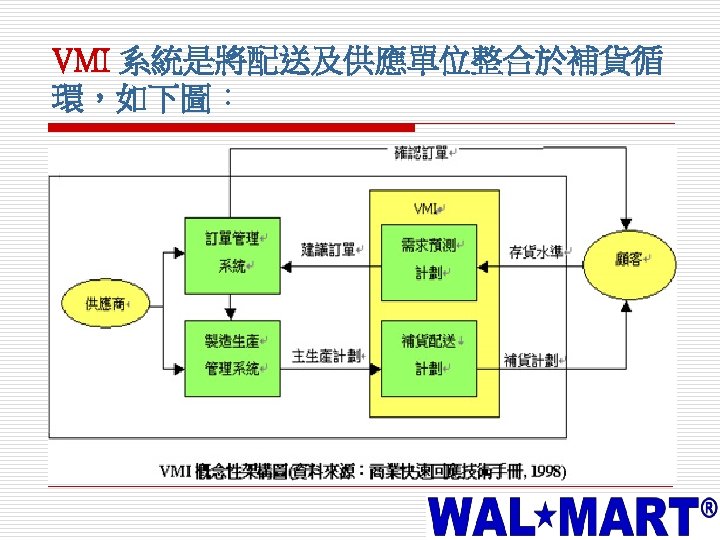
VMI 系統是將配送及供應單位整合於補貨循 環,如下圖:
VMI (Vendor Managed Inventory) o o *依顧客存貨水準及銷售狀況進行需求預測計 劃,經統計計算後提出建議訂購量。 *依建議訂購量,訂單管理系統發出補貨通知 單,由客戶進行訂單確認。 *依訂單管理系統、製造管理系統排定主生產 計劃,以計畫排定配送計劃。 *依配送計劃將補貨計劃通知客戶並進行實際 補貨
VMI 的優點: o o o VMI管理機制對供應鏈的整體效益: 1. 建立上下游廠商緊密的合夥關係,提昇企業 供應鏈的競爭力。 2. 有效運用資訊科技技術整合企業內部與外部 資訊流的活動,可發揮供應鏈之效率。 3. 供應鏈成員共同承擔風險、成本、分享利益, 可維繫雙方合作關係。 4. 可改善預測、需求計劃的相關技術,可促進 供應鏈整體運作之績效。 5. 設定適合VMI管理機制的績效衡量指標,可以 幫助企業檢核實施成效與改進方向。
5: IT in Wal_Mart: Three basic philosophies for the Wal. Mart IS team 1. Run a centralized IS system for the worldwide operations from Arkansas 2. Common systems & platforms 3. Merchants first and technologists second
Information System Timeline o o 1979: Switched to computerized system to track Inventory 1983: Used barcodes on most goods, equipped all stores with checkout scanners 1990: Implemented a collaborative planning, forecasting, and replenishment (CPFR) process to bring suppliers and distributors together to build a combined planning calendar 1996: Launched E-commerce website
EDI (Electronic Data Interchange) o o o Provides standardized electronic forms that allow computer systems to communicate. Helps reduce costs, delays and errors with documents between companies. Organized messaging, fields, and structure for information.
From EDI to Retail Link EDI o o o Starting in the late 1980’s and mid 1990’s Wal-Mart made use of EDI so that suppliers could connect with their supply chain as well as interact with other suppliers. This allowed them to the suppliers to instantly connect with Wal-Mart to instantly track the sales of their products. EDI was expensive to maintain in that each supplier had to dial-in to a large bank of modems at relatively slow speeds and software had to be distributed to each individual supplier.
From EDI to Retail Link o o Retail Link was developed in the mid 1990’s by Wal-Mart to connect suppliers via internet. This system is much more robust than traditional EDI. Provides real-time forecasting tools and what-if analysis. This also provides faster speeds and automatic software updates Much easier for international suppliers to connect

Electronic Auctions o o o Provides different methods for the procurement of goods. Minimizes costs on transactions between buyers and sellers Three different types n n n Reverse Auctions-buyer initiated Forward Auctions-seller initiated Exchange Auctions-operated by a third party
Wal-Mart’s Reverse Auctioning o o o Wal-Mart uses reverse auctioning as its method of procuring goods. It requires all participating companies to go through an extensive background check, and agree to a legally binding contract Furthermore, it requires that all participating companies have a certain level of technology that cooperates with its technology to minimize costs of transactions.
Wal-Mart and Cross Docking o What Wal-Mart has that allows Cross Docking n n n Interlocking support systems over and above traditional ROI criteria Continuous contact among Wal-Mart’s distribution centers, suppliers and every point of sale Logistics infrastructure for fast and responsive transportation o Supported by its 19 distribution centers and nearly 2000 company owned trucks
Wal-Mart and Cross Docking o By saving this money and stabilizing there shipping system, through Cross Docking, Wal-Mart is able to achieve: n n n Low prices by eliminating frequent promotions Stable prices and predictable sales which in turn reduces stock-outs and excess inventory Lower prices bring in more customers which increases sales per retail square foot
Wal-Mart and Cross Docking o In Wal-Mart’s Cross Docking system, good never spend more than 48 hours at one loading dock. n o o Good are in one door, and out the other. Wal-Mart has its own trucking to make this easier and again to minimize costs. Runs 85% of its goods through its warehouse system (Kmart runs at 50%)
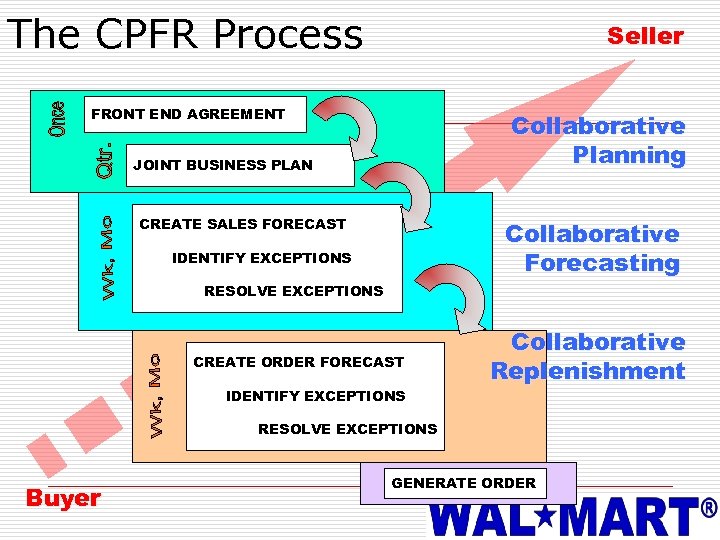
The CPFR Process Seller FRONT END AGREEMENT Collaborative Planning JOINT BUSINESS PLAN CREATE SALES FORECAST Collaborative IDENTIFY Link buyer and Seller Goal : EXCEPTIONS Forecasting Electronically RESOLVE EXCEPTIONS CREATE ORDER FORECAST IDENTIFY EXCEPTIONS Collaborative Replenishment RESOLVE EXCEPTIONS Buyer GENERATE ORDER
Wal-Mart’s CPFR Program o o o CPFR has “blurred the lines between supplier and customer” Suppliers buy into their program because they have to to work with Wal-Mart, but more importantly, because Wal-Mart’s Systems provide increased profits for Wal-Mart and their suppliers Wal-Mart “teaches” their suppliers how to minimize shipping, inventory and other costs by showing them their own model.
E-Commerce o o o Defined as transactions conducted electronically between businesses via networks. n Internet n Ethernet n Private Networks Includes: Ordering, shipping, payment, planning collaboration and performance agreements. Over $700 million in transactions in 2001
Benefits of E-Commerce o Minimize Costs n n o o Inventory Storage Shipping Maximize Efficiency Improve both customer and supplier relations
Wal-Mart and E-Commerce o o Wal-Mart is a leader in E-Commerce Uses Supply Chain Management, Automated Order Entry Systems, EDI, Cross Docking and Private Industrial Networks Cost of Goods Sold is 5 -10% less than its competitors CPFR program
Conclusions o Wal-Mart 同時擁有高獲利與高顧客滿意度之 主要因素: n n n 高效率顧客回應(ECR)或稱快速回應(QR) 零售商與供應商夥伴關係(RSP)之建立 越庫作業(Cross-docking)之運用 良好的顧客關係管理(CRM) 成本利益(Cost advantages)
高效率顧客回應(ECR ﹔ QR) o o o 電子資料整合(EDI) 銷售點資訊(POS) 聯合規劃預測及補貨( Collaborative Planning, Forecasting, and Replenishment — CPFR) n n 不同企業與組織之間﹐ 不僅在資料﹐ 且更在程序 皆以電子化方式共享 此系統為利用聯合預測﹐ 以提昇VMI與CRS之 網路資訊系統﹐ 重點在於預測差異之協調
零售商與供應商夥伴關係(RSP)之建立 o 零售商與供應商夥伴關係(Retailer-suppler partnerships)之要求 n n o 資訊系統(IS) 減少存貨成本影響(inventory reduction cost impact) 管理承諾 信任關係 零售商與供應商夥伴關係(RSP)之類型 n n 持續補貨系統(CRS)之運用 賣方管理存貨系統(VMI)之運用
越庫作業(Cross-docking)之運用 o 配銷策略之選擇 n n o 利用中央倉庫供貨流程的協調者以及商品的轉運 點﹐ 但本身並不具有存貨﹐ 此即為越庫據點 選項:傳統存倉→直接配送→越庫策略 Wal-Mart 以CRS為存貨管理的策略重心,經 由Cross-docking的物流技術達成目標。藉此 降低庫存、運輸及銷貨成本﹐ 並提供顧客多樣而 低價的產品
良好的顧客關係管理(CRM) o 顧客導向的價值管理 n n o 遵循顧客的要求 產品選擇—大量而多樣,讓顧客一次購足 價格與品牌 關係與經驗—掌握每一接觸經驗建立互動關係 顧客導向與利潤導向的連結 將創造價值視為企業的基本任務,而非創造利潤
成本利益(Cost advantages) o 國際供應鏈(International supply chain)之運用 n n o 國際性配銷系統 國際供應商 國外製造 完全整合的國際供應鏈 電子商務之運用以降低成本 n n n just-in-time inventory Point of Sale(POS) & Retail Link CRS & VMI Electronic Data Interchange (EDI) collaborative planning, forecasting, and replenishment (CPFR)
Скачать презентацию 到底有多大 2003年被全球10000名主管票選為Fortune雜誌 全球聲望最佳企業榜首 Wal-Mart百貨在 1962年 由山姆 華頓 Sam Walton 所創立 華頓把 Wal-Mart百貨帶入全球第一的舞臺 信念 誰是我們的老闆
b235699a0fd45d223aff4264f3aa0b39.ppt