 Скачать презентацию 今晩の最新 9 Thermal Principles March 19 continued
ca6736dabfa79dbbe36a723531a6fe05.ppt
- Количество слайдов: 20



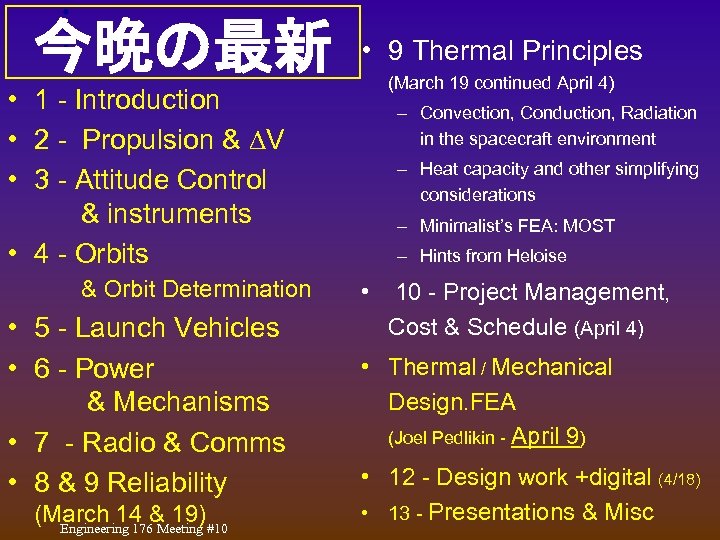
今晩の最新 • 9 Thermal Principles (March 19 continued April 4) • 1 - Introduction • 2 - Propulsion & ∆V • 3 - Attitude Control & instruments • 4 - Orbits & Orbit Determination • 5 - Launch Vehicles • 6 - Power & Mechanisms • 7 - Radio & Comms • 8 & 9 Reliability (March 14 & 19)#10 Engineering 176 Meeting – Convection, Conduction, Radiation in the spacecraft environment – Heat capacity and other simplifying considerations – Minimalist’s FEA: MOST – Hints from Heloise • 10 - Project Management, Cost & Schedule (April 4) • Thermal / Mechanical Design. FEA (Joel Pedlikin - April 9) • 12 - Design work +digital (4/18) • 13 - Presentations & Misc
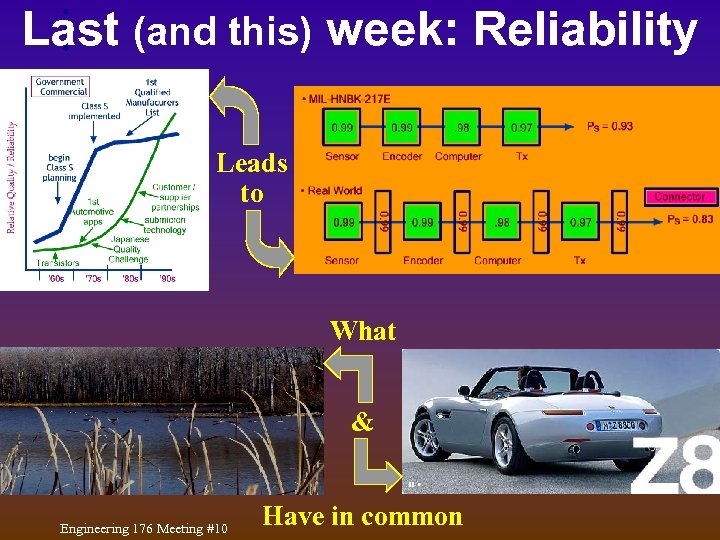
Last (and this) week: Reliability Leads to What & Engineering 176 Meeting #10 Have in common
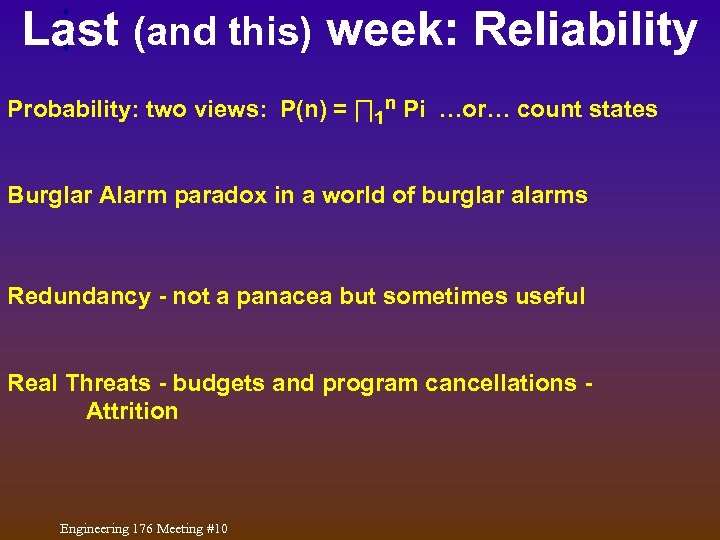
Last (and this) week: Reliability Probability: two views: P(n) = ∏ 1 n Pi …or… count states Burglar Alarm paradox in a world of burglar alarms Redundancy - not a panacea but sometimes useful Real Threats - budgets and program cancellations Attrition Engineering 176 Meeting #10
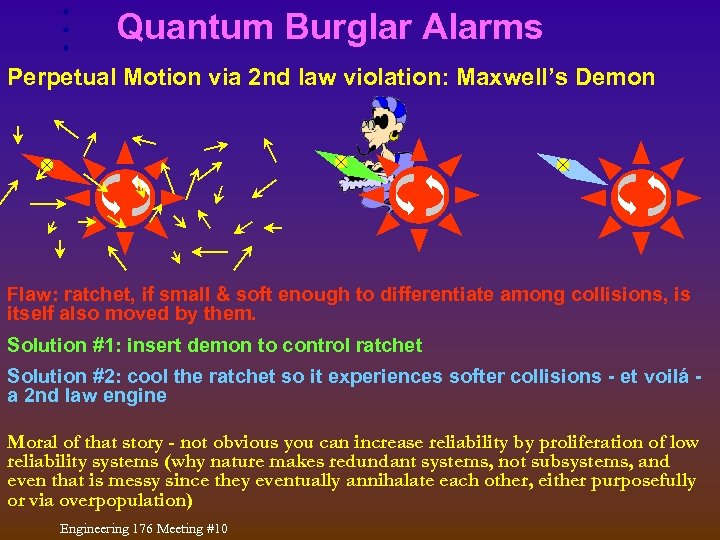
Quantum Burglar Alarms Perpetual Motion via 2 nd law violation: Maxwell’s Demon Flaw: ratchet, if small & soft enough to differentiate among collisions, is itself also moved by them. Solution #1: insert demon to control ratchet Solution #2: cool the ratchet so it experiences softer collisions - et voilá a 2 nd law engine Moral of that story - not obvious you can increase reliability by proliferation of low reliability systems (why nature makes redundant systems, not subsystems, and even that is messy since they eventually annihalate each other, either purposefully or via overpopulation) Engineering 176 Meeting #10
Engineering 176 Meeting #10
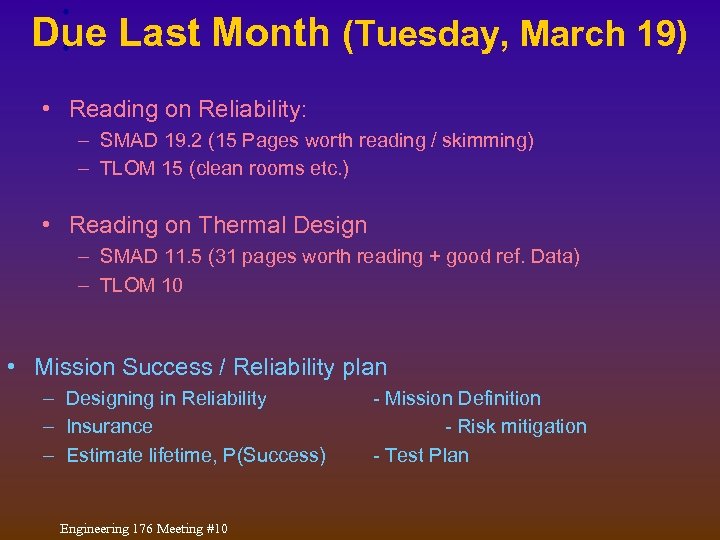
Due Last Month (Tuesday, March 19) • Reading on Reliability: – SMAD 19. 2 (15 Pages worth reading / skimming) – TLOM 15 (clean rooms etc. ) • Reading on Thermal Design – SMAD 11. 5 (31 pages worth reading + good ref. Data) – TLOM 10 • Mission Success / Reliability plan – Designing in Reliability – Insurance – Estimate lifetime, P(Success) Engineering 176 Meeting #10 - Mission Definition - Risk mitigation - Test Plan
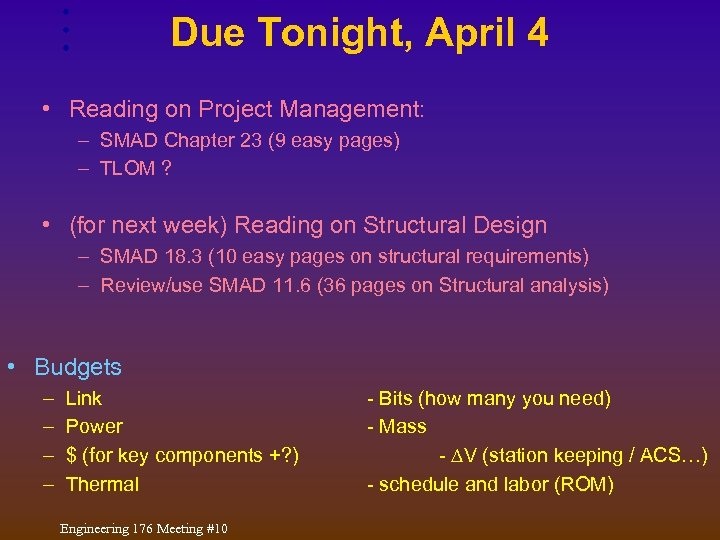
Due Tonight, April 4 • Reading on Project Management: – SMAD Chapter 23 (9 easy pages) – TLOM ? • (for next week) Reading on Structural Design – SMAD 18. 3 (10 easy pages on structural requirements) – Review/use SMAD 11. 6 (36 pages on Structural analysis) • Budgets – – Link Power $ (for key components +? ) Thermal Engineering 176 Meeting #10 - Bits (how many you need) - Mass - ∆V (station keeping / ACS…) - schedule and labor (ROM)
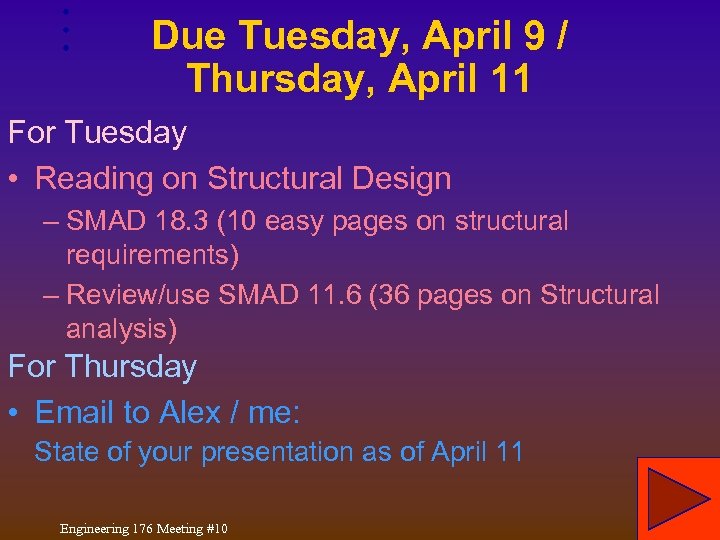
Due Tuesday, April 9 / Thursday, April 11 For Tuesday • Reading on Structural Design – SMAD 18. 3 (10 easy pages on structural requirements) – Review/use SMAD 11. 6 (36 pages on Structural analysis) For Thursday • Email to Alex / me: State of your presentation as of April 11 Engineering 176 Meeting #10
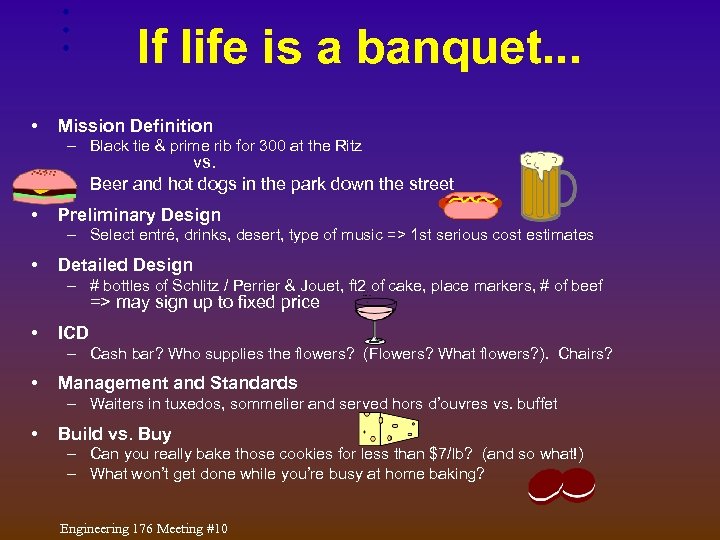
If life is a banquet. . . • Mission Definition – Black tie & prime rib for 300 at the Ritz vs. – Beer and hot dogs in the park down the street • Preliminary Design – Select entré, drinks, desert, type of music => 1 st serious cost estimates • Detailed Design – # bottles of Schlitz / Perrier & Jouet, ft 2 of cake, place markers, # of beef => may sign up to fixed price • ICD – Cash bar? Who supplies the flowers? (Flowers? What flowers? ). Chairs? • Management and Standards – Waiters in tuxedos, sommelier and served hors d’ouvres vs. buffet • Build vs. Buy – Can you really bake those cookies for less than $7/lb? (and so what!) – What won’t get done while you’re busy at home baking? Engineering 176 Meeting #10
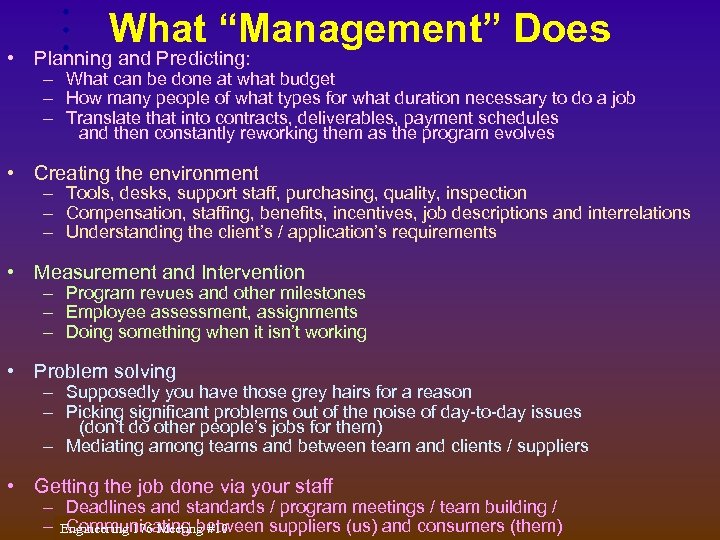
What “Management” Does • Planning and Predicting: – What can be done at what budget – How many people of what types for what duration necessary to do a job – Translate that into contracts, deliverables, payment schedules and then constantly reworking them as the program evolves • Creating the environment – Tools, desks, support staff, purchasing, quality, inspection – Compensation, staffing, benefits, incentives, job descriptions and interrelations – Understanding the client’s / application’s requirements • Measurement and Intervention – Program revues and other milestones – Employee assessment, assignments – Doing something when it isn’t working • Problem solving – Supposedly you have those grey hairs for a reason – Picking significant problems out of the noise of day-to-day issues (don’t do other people’s jobs for them) – Mediating among teams and between team and clients / suppliers • Getting the job done via your staff – Deadlines and standards / program meetings / team building / – Engineering 176 Meeting #10 Communicating between suppliers (us) and consumers (them)
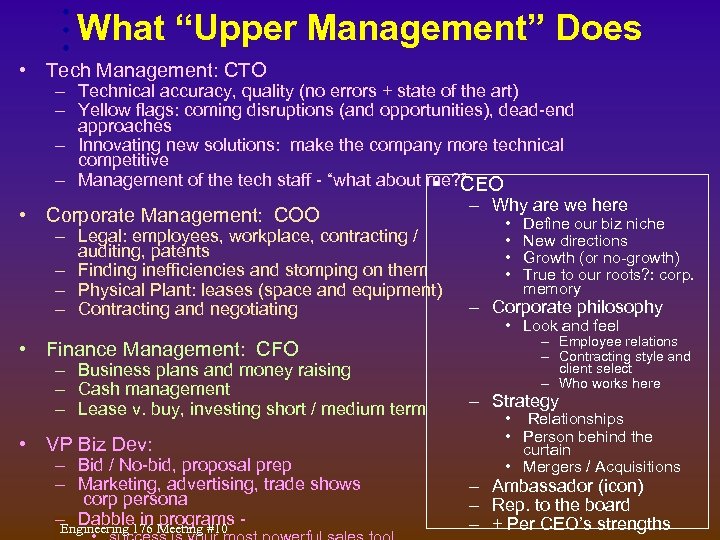
What “Upper Management” Does • Tech Management: CTO – Technical accuracy, quality (no errors + state of the art) – Yellow flags: coming disruptions (and opportunities), dead-end approaches – Innovating new solutions: make the company more technical competitive – Management of the tech staff - “what about me? ” • CEO – Why are we here • Corporate Management: COO – Legal: employees, workplace, contracting / auditing, patents – Finding inefficiencies and stomping on them – Physical Plant: leases (space and equipment) – Contracting and negotiating • Finance Management: CFO – Business plans and money raising – Cash management – Lease v. buy, investing short / medium term • VP Biz Dev: – Bid / No-bid, proposal prep – Marketing, advertising, trade shows corp persona – Dabble 176 Meeting #10 in programs Engineering • • Define our biz niche New directions Growth (or no-growth) True to our roots? : corp. memory – Corporate philosophy • Look and feel – Employee relations – Contracting style and client select – Who works here – Strategy • Relationships • Person behind the curtain • Mergers / Acquisitions – Ambassador (icon) – Rep. to the board – + Per CEO’s strengths
Engineering 176 Meeting #10
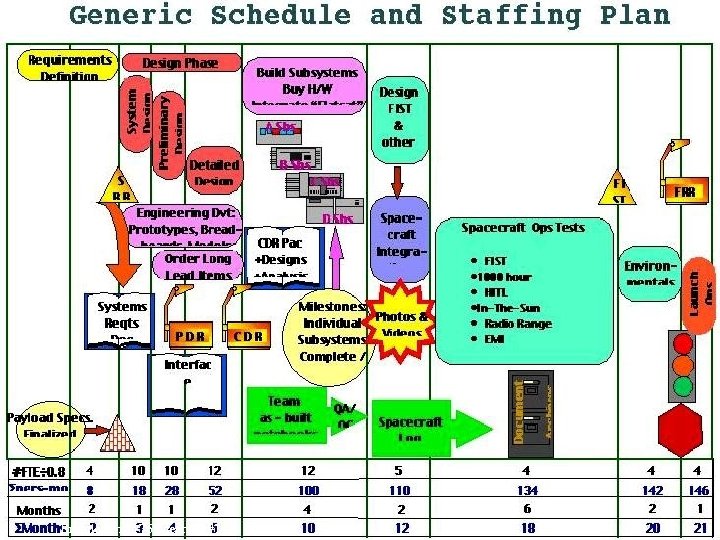
Generic Schedule and Staffing Plan Engineering 176 Meeting #10
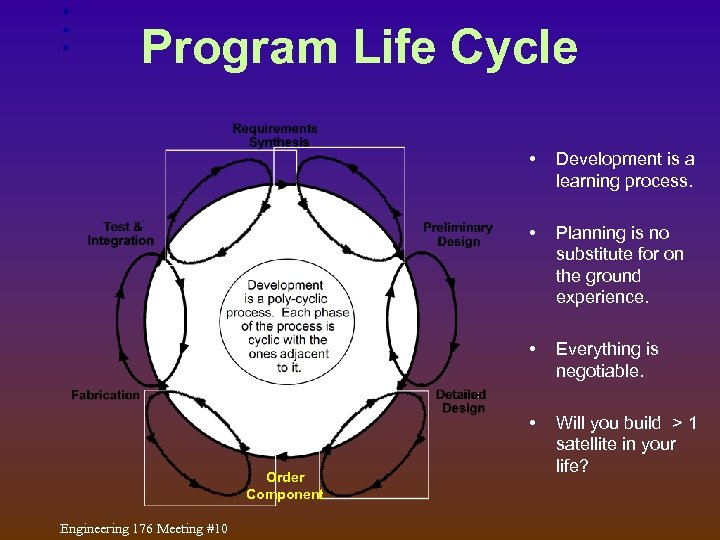
Program Life Cycle • • Everything is negotiable. • Engineering 176 Meeting #10 Planning is no substitute for on the ground experience. • Order Component Development is a learning process. Will you build > 1 satellite in your life?
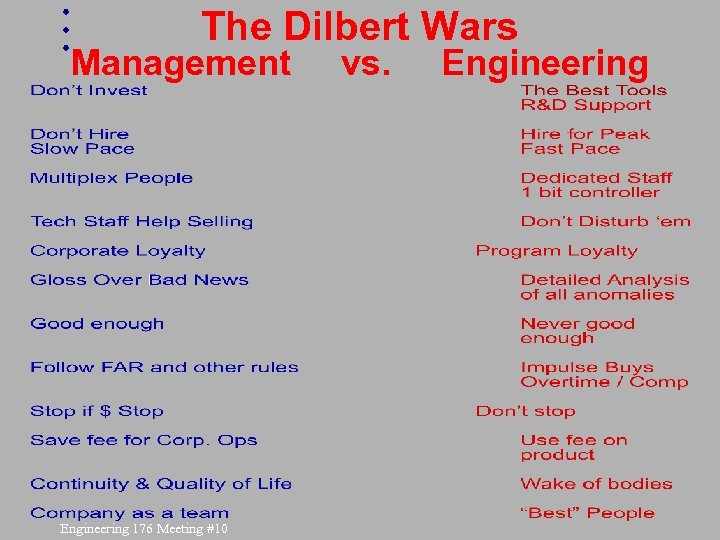
The Dilbert Wars Management Engineering 176 Meeting #10 vs. Engineering
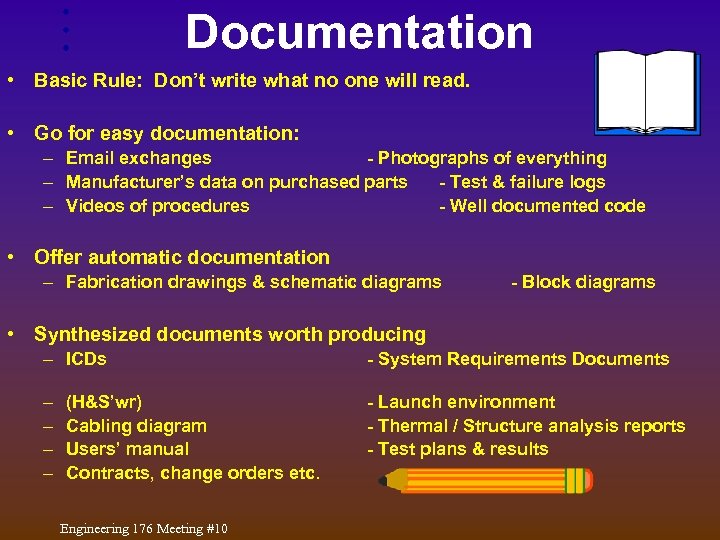
Documentation • Basic Rule: Don’t write what no one will read. • Go for easy documentation: – Email exchanges - Photographs of everything – Manufacturer’s data on purchased parts - Test & failure logs – Videos of procedures - Well documented code • Offer automatic documentation – Fabrication drawings & schematic diagrams - Block diagrams • Synthesized documents worth producing – ICDs - System Requirements Documents – – - Launch environment - Thermal / Structure analysis reports - Test plans & results (H&S’wr) Cabling diagram Users’ manual Contracts, change orders etc. Engineering 176 Meeting #10
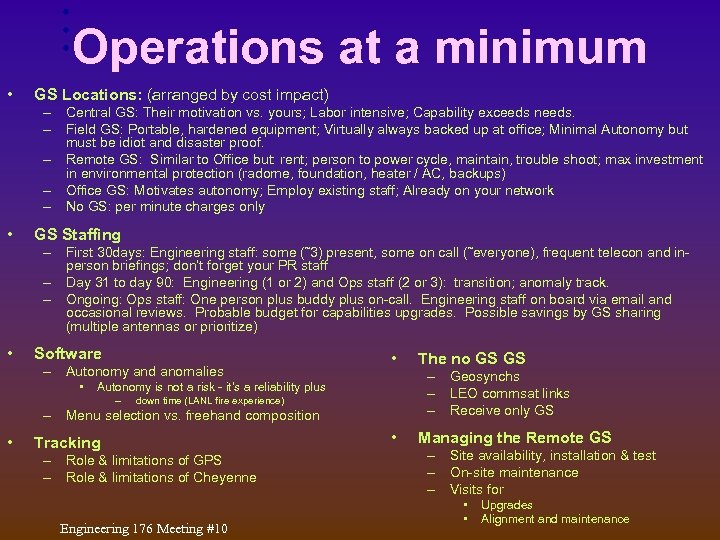
Operations at a minimum • GS Locations: (arranged by cost impact) – Central GS: Their motivation vs. yours; Labor intensive; Capability exceeds needs. – Field GS: Portable, hardened equipment; Virtually always backed up at office; Minimal Autonomy but must be idiot and disaster proof. – Remote GS: Similar to Office but: rent; person to power cycle, maintain, trouble shoot; max investment in environmental protection (radome, foundation, heater / AC, backups) – Office GS: Motivates autonomy; Employ existing staff; Already on your network – No GS: per minute charges only • GS Staffing – First 30 days: Engineering staff: some (˜ 3) present, some on call (˜everyone), frequent telecon and inperson briefings; don’t forget your PR staff – Day 31 to day 90: Engineering (1 or 2) and Ops staff (2 or 3): transition; anomaly track. – Ongoing: Ops staff: One person plus buddy plus on-call. Engineering staff on board via email and occasional reviews. Probable budget for capabilities upgrades. Possible savings by GS sharing (multiple antennas or prioritize) • Software – Autonomy and anomalies • • – Geosynchs – LEO commsat links – Receive only GS Autonomy is not a risk - it’s a reliability plus – down time (LANL fire experience) – Menu selection vs. freehand composition • Tracking – Role & limitations of GPS – Role & limitations of Cheyenne Engineering 176 Meeting #10 The no GS GS • Managing the Remote GS – Site availability, installation & test – On-site maintenance – Visits for • • Upgrades Alignment and maintenance
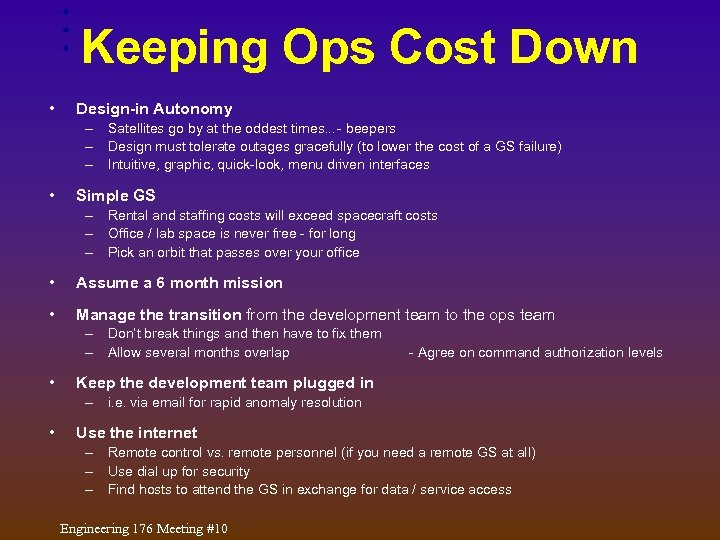
Keeping Ops Cost Down • Design-in Autonomy – Satellites go by at the oddest times. . . - beepers – Design must tolerate outages gracefully (to lower the cost of a GS failure) – Intuitive, graphic, quick-look, menu driven interfaces • Simple GS – Rental and staffing costs will exceed spacecraft costs – Office / lab space is never free - for long – Pick an orbit that passes over your office • Assume a 6 month mission • Manage the transition from the development team to the ops team – Don’t break things and then have to fix them – Allow several months overlap • - Agree on command authorization levels Keep the development team plugged in – i. e. via email for rapid anomaly resolution • Use the internet – Remote control vs. remote personnel (if you need a remote GS at all) – Use dial up for security – Find hosts to attend the GS in exchange for data / service access Engineering 176 Meeting #10
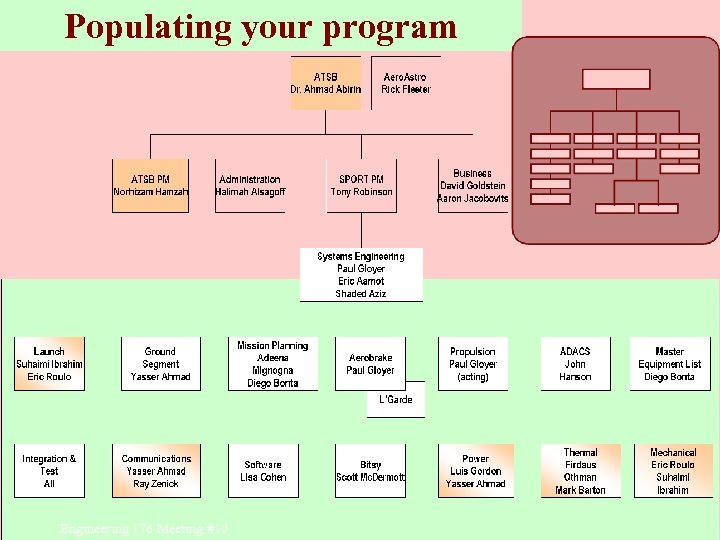
Populating your program Engineering 176 Meeting #10
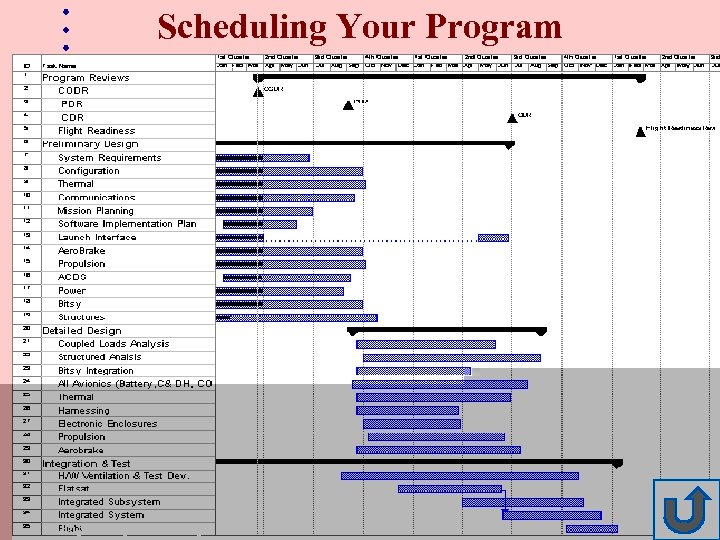
Scheduling Your Program Engineering 176 Meeting #10
Скачать презентацию 今晩の最新 9 Thermal Principles March 19 continued
ca6736dabfa79dbbe36a723531a6fe05.ppt