

ンn チ e

ンn チ e ッ ch Я キ kit Н の e УХ 本 es Я К 日 an А p СК Ja ОН Я П
Japanese kitchen - national kitchen Japan. Different preference for natural, minimally processed foods, extensive use of seafood, seasonal, typical dishes, specific rules of registration of dishes, serving, table etiquette. Japanese dishes, as a rule, are a key attraction for tourists from other countries.
Use chopsticks Almost all Japanese dishes are designed for use chopsticks. Use chopsticks etiquette associated with many subtleties. It is appropriate here to note only some of the most important rules for handling sticks: Ø Do not insert sticks upright in the food, especially rice. Do not pass food sticks to stick to another person, do not put it with your chopsticks to someone else's plate. All of these actions are similar in appearance to the customs associated with the burial of the dead and funeral, so the usual meal, they are considered indecent. Do not take anything in one hand with the chopsticks. Ø Not to move the dish with chopsticks. Ø Omit the sticks. Ø Do not grip the stick in his hand (this is considered an unfriendly sign a declaration of war). Ø Do not put sticks across the bowl. Ø Before you ask for more rice, chopsticks should be placed.
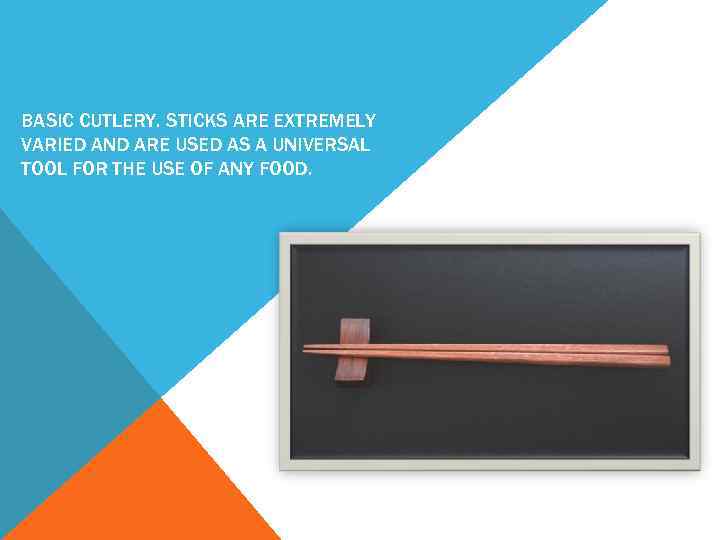
BASIC CUTLERY. STICKS ARE EXTREMELY VARIED AND ARE USED AS A UNIVERSAL TOOL FOR THE USE OF ANY FOOD.
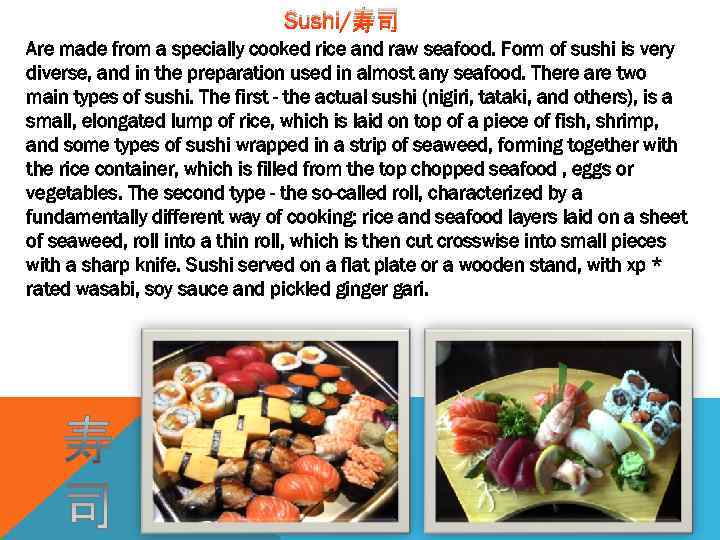
Sushi/寿司 Are made from a specially cooked rice and raw seafood. Form of sushi is very diverse, and in the preparation used in almost any seafood. There are two main types of sushi. The first - the actual sushi (nigiri, tataki, and others), is a small, elongated lump of rice, which is laid on top of a piece of fish, shrimp, and some types of sushi wrapped in a strip of seaweed, forming together with the rice container, which is filled from the top chopped seafood , eggs or vegetables. The second type - the so-called roll, characterized by a fundamentally different way of cooking: rice and seafood layers laid on a sheet of seaweed, roll into a thin roll, which is then cut crosswise into small pieces with a sharp knife. Sushi served on a flat plate or a wooden stand, with xp * rated wasabi, soy sauce and pickled ginger gari.
The general procedure for the meal Ø Before you begin the meal, pronounced itadakimasu (Jap. いただき ます? , «Accept with gratitude") - an expression of gratitude to the owner of the house or the gods for food, used corresponds to the Russian "bon appetit. “ Ø Before the meal is usually served wet, sometimes hot, after sterilization, towel osibori (Jap. お 絞り? ) Rolled into a tube. It is used to clean hands before eating, but it can wipe his face and hands as after, and during the meal, as some food can be eaten by hand. Ø Traditionally, food is served at the same time (in catering, however, this tradition is usually broken), is allowed (and is decent) to try all the dishes a little, and only then begin to eat "in earnest. “ Ø If the dish is served in a bowl, covered with a lid, then after it is eaten, the bowl should be covered again. Ø At home or the official dinner of the dish (usually snacks such as sushi, rolls, pieces of fish or meat, etc. ) are laid on the common dishes, and each participant is given a small plate of dinner, which he puts what he wants to try. Food from a common dish shifted sticks to personal plate. Take common dish in hand is not accepted. Ø Drinks neighbors on the table is filled with each other. Pour yourself alone is not accepted. Toast in a traditional Japanese meal is not taken, drinking alcohol may be preceded by the word "Kampai" ("Bottoms up!"). Ø It is believed that the guest did not finish the meal, while he remained in the cup rice. Eat rice to the last grain. Get up from the table, not Doev rice - impolite. Ø During the meal, you should not put your elbows on the table. After completing the meal should say gotiso: she [desita] (Jap. ご馳走様 "でし た"? , «It was very tasty") - is an expression of gratitude for the meal (similar to the traditional "thank you" in European etiquette).
