 Скачать презентацию アウリガ The AURIGA experiment updates and prospects バッジョ
f06b967d4a8380d5e9c5fdb960e5bf36.ppt
- Количество слайдов: 39



アウリガ The AURIGA experiment: updates and prospects バッジョ ルーチョ BAGGIO Lucio ICRR on behalf of AURIGA collaboration The AURIGA detector re-started data taking in Dec 2003, after 4 years of research and developement, in order to improve the sensitivity. A brief overview of the results during last year will be given. Present international collaborations and future prospects will be reviewed. lbaggio@icrr. u-tokyo. ac. jp
Topics of this presentation The AURIGA experiment: run 2 Characteristics and setup of the second run (after Dec 2003) Burst analysis Main issues with burst search: duty cycle, detection efficiency, background events Collaborations Memorandum of Understanding with LIGO, IGEC-2 agreement, contacts with VIRGO Other activities New cryogenic detector with optical transducer; the DUAL project Next steps and Summary New low-frequency suspensions, ultra-cryogenic cooling,
The AURIGA experiment: run 2
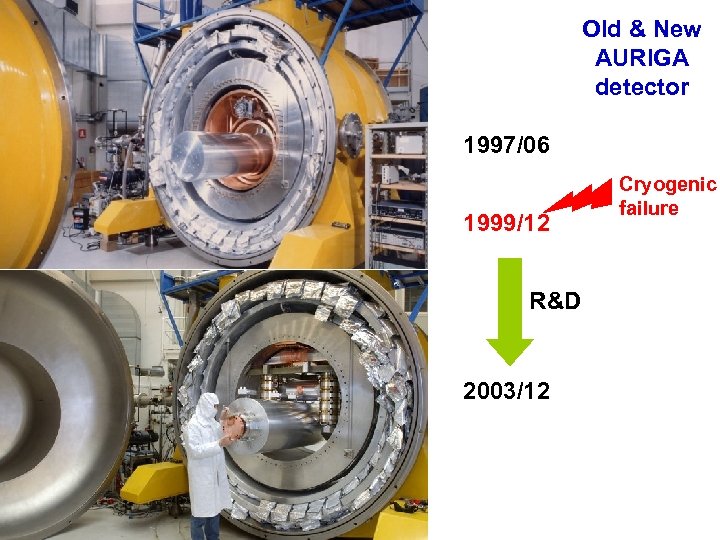
Old & New AURIGA detector 1997/06 1999/12 R&D 2003/12 Cryogenic failure
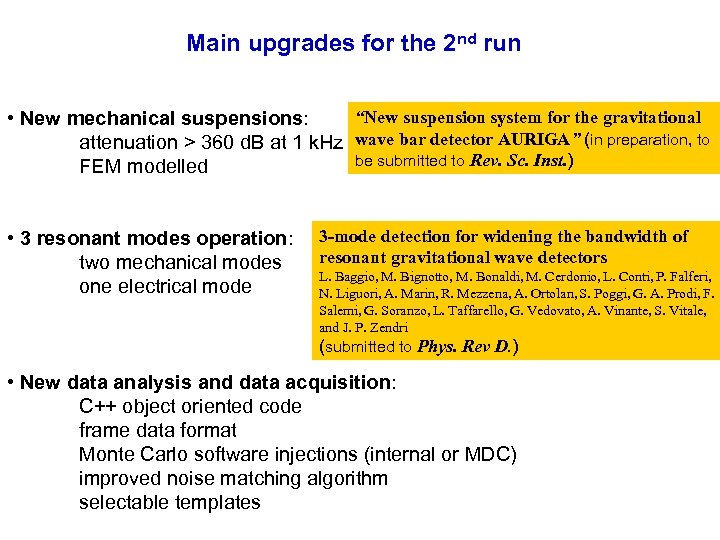
Main upgrades for the 2 nd run “New suspension system for the gravitational • New mechanical suspensions: attenuation > 360 d. B at 1 k. Hz wave bar detector AURIGA” (in preparation, to be submitted to Rev. Sc. Inst. ) FEM modelled • 3 resonant modes operation: two mechanical modes one electrical mode 3 -mode detection for widening the bandwidth of resonant gravitational wave detectors L. Baggio, M. Bignotto, M. Bonaldi, M. Cerdonio, L. Conti, P. Falferi, N. Liguori, A. Marin, R. Mezzena, A. Ortolan, S. Poggi, G. A. Prodi, F. Salemi, G. Soranzo, L. Taffarello, G. Vedovato, A. Vinante, S. Vitale, and J. P. Zendri (submitted to Phys. Rev D. ) • New data analysis and data acquisition: C++ object oriented code frame data format Monte Carlo software injections (internal or MDC) improved noise matching algorithm selectable templates
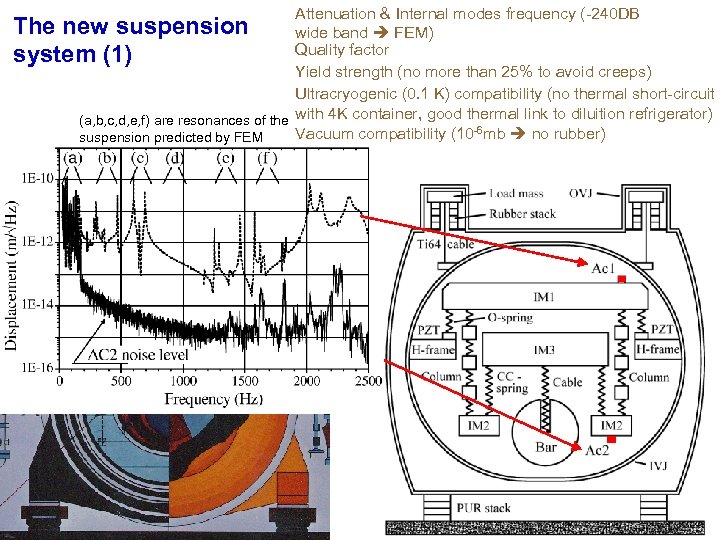
Attenuation & Internal modes frequency (-240 DB The new suspension wide band FEM) Quality factor system (1) Yield strength (no more than 25% to avoid creeps) Ultracryogenic (0. 1 K) compatibility (no thermal short-circuit (a, b, c, d, e, f) are resonances of the with 4 K container, good thermal link to diluition refrigerator) Vacuum compatibility (10 -6 mb no rubber) suspension predicted by FEM
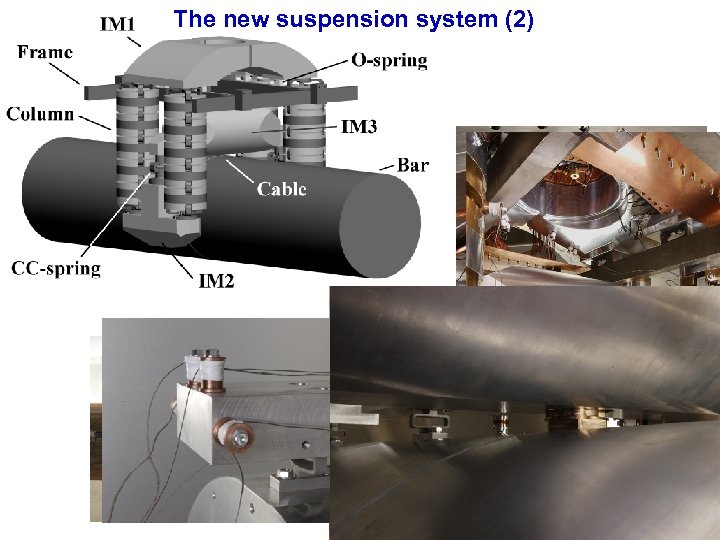
The new suspension system (2)
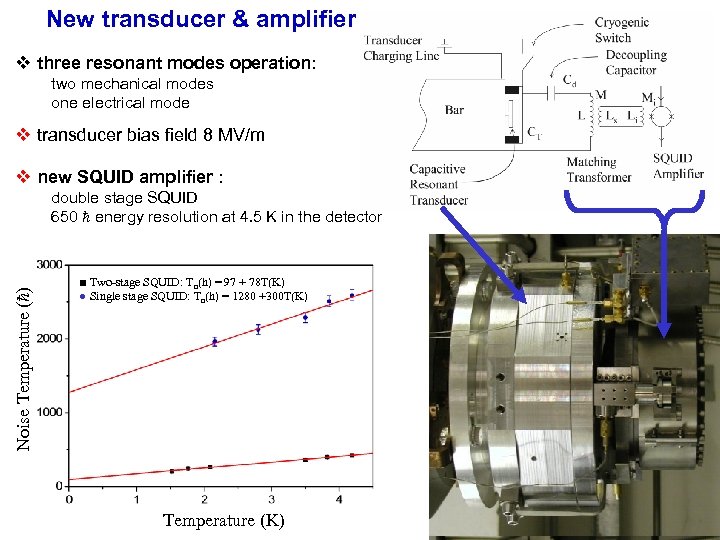
New transducer & amplifier v three resonant modes operation: two mechanical modes one electrical mode v transducer bias field 8 MV/m v new SQUID amplifier : Noise Temperature ( ) double stage SQUID 650 energy resolution at 4. 5 K in the detector ■ Two-stage SQUID: Tn(h) = 97 + 78 T(K) ● Single stage SQUID: Tn(h) = 1280 +300 T(K) Temperature (K)
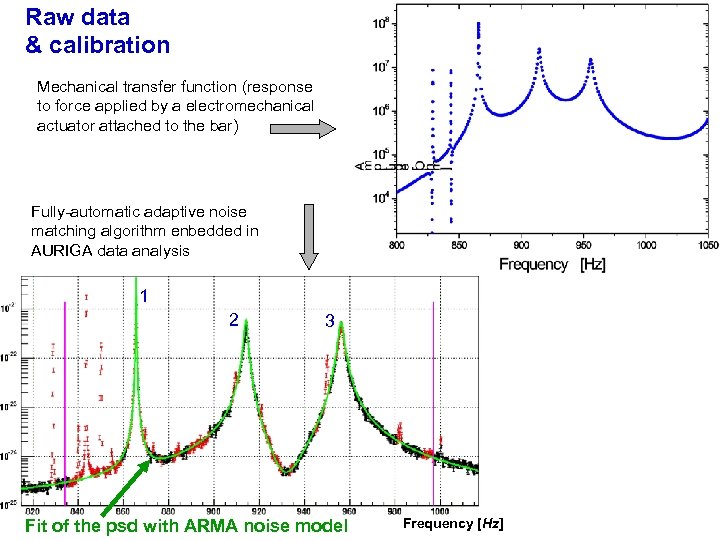
Raw data & calibration Mechanical transfer function (response to force applied by a electromechanical actuator attached to the bar) Fully-automatic adaptive noise matching algorithm enbedded in AURIGA data analysis 1 2 3 Fit of the psd with ARMA noise model Frequency [Hz]
![Temperature of normal modes Monday morning mode 1 mode 2 mode 3 T[K] date](https://present5.com/presentation/f06b967d4a8380d5e9c5fdb960e5bf36/image-10.jpg "Temperature of normal modes Monday morning mode 1 mode 2 mode 3 T[K] date")
Temperature of normal modes Monday morning mode 1 mode 2 mode 3 T[K] date 13 -15 Nov. 2004
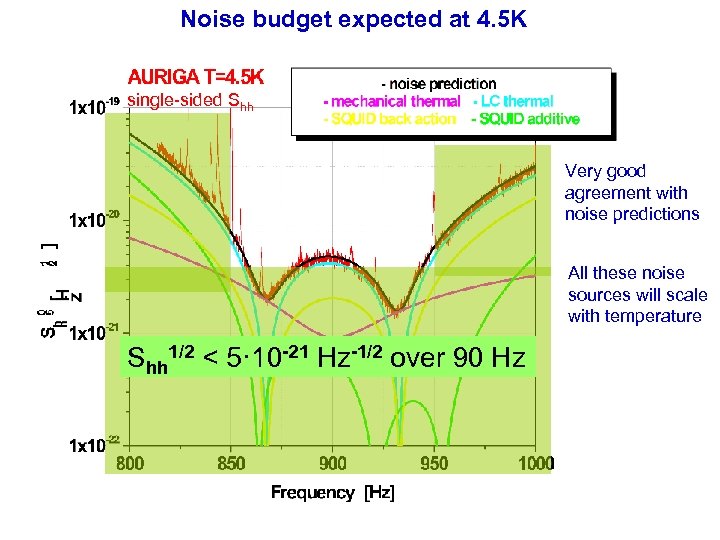
Noise budget expected at 4. 5 K single-sided Shh Very good agreement with noise predictions All these noise sources will scale with temperature Shh 1/2 < 5· 10 -21 Hz-1/2 over 90 Hz
Burst analysis (matched filter)
![Typical sensitivity to bursts Template: H [Hz-1] 10 -21 – 2004, Nov 13 -15](https://present5.com/presentation/f06b967d4a8380d5e9c5fdb960e5bf36/image-13.jpg "Typical sensitivity to bursts Template: H [Hz-1] 10 -21 – 2004, Nov 13 -15")
Typical sensitivity to bursts Template: H [Hz-1] 10 -21 – 2004, Nov 13 -15 (weekend) [Hz-1]
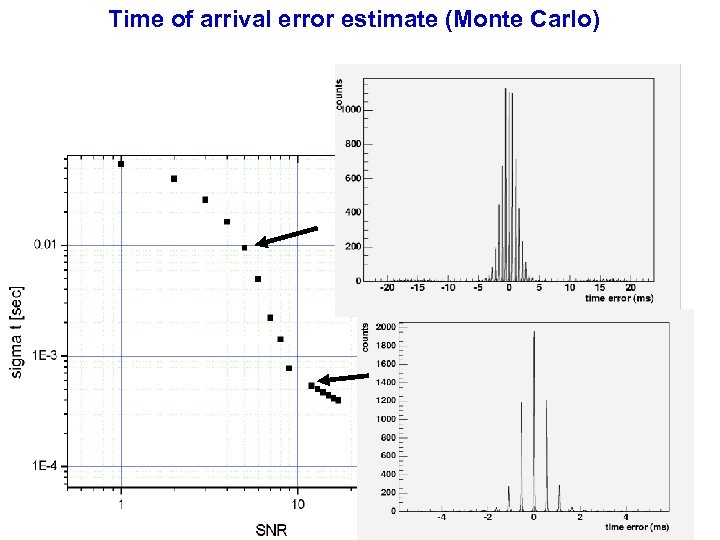
Time of arrival error estimate (Monte Carlo)
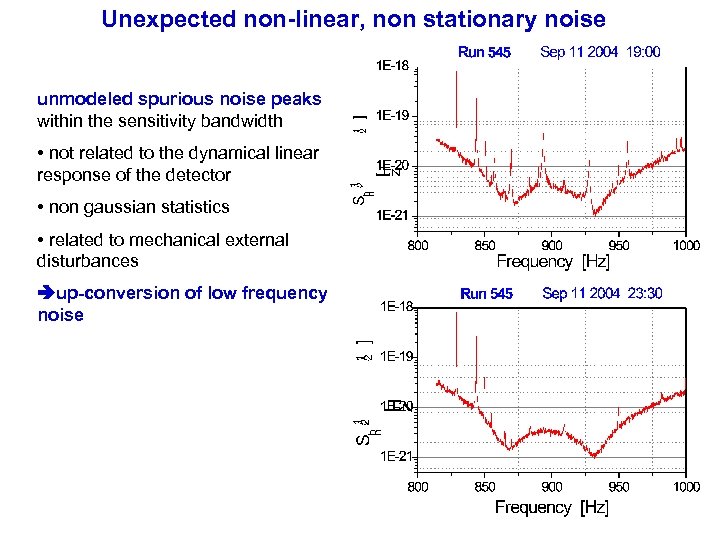
Unexpected non-linear, non stationary noise unmodeled spurious noise peaks within the sensitivity bandwidth • not related to the dynamical linear response of the detector • non gaussian statistics • related to mechanical external disturbances up-conversion of low frequency noise
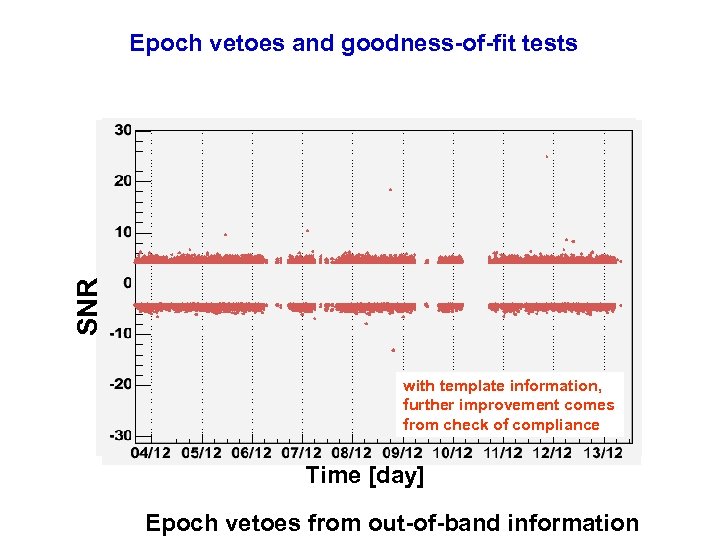
SNR Epoch vetoes and goodness-of-fit tests with template information, further improvement comes from check of compliance Time [day] Epoch vetoes from out-of-band information
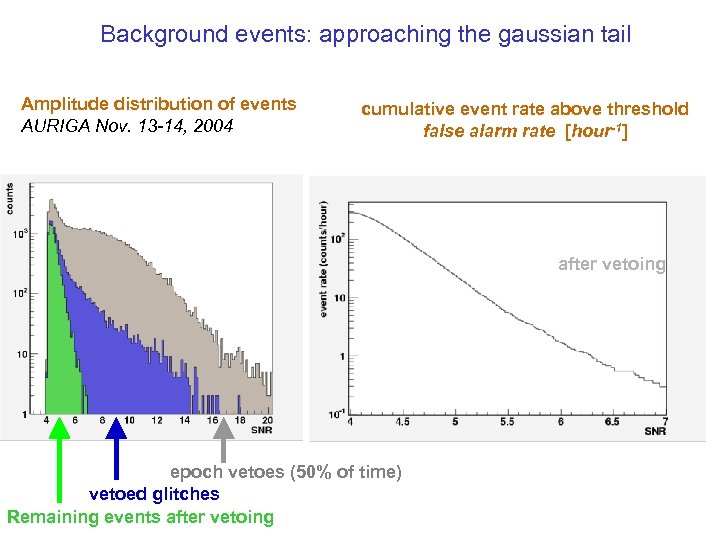
Background events: approaching the gaussian tail Amplitude distribution of events AURIGA Nov. 13 -14, 2004 cumulative event rate above threshold false alarm rate [hour-1] after vetoing epoch vetoes (50% of time) vetoed glitches Remaining events after vetoing
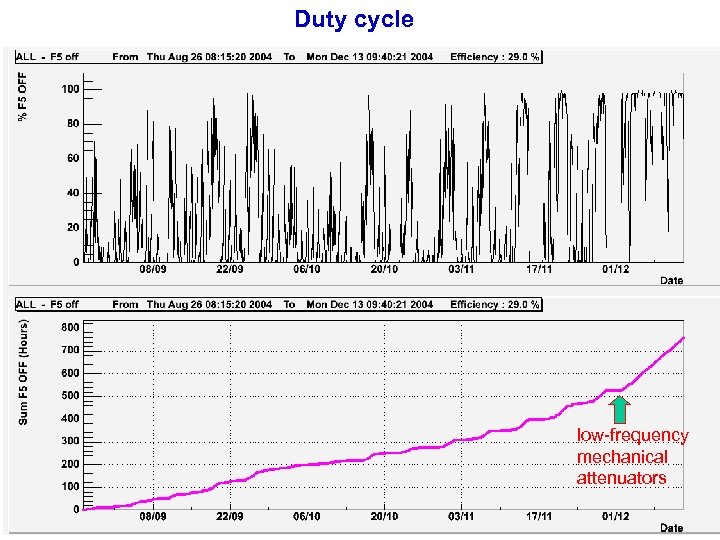
Duty cycle low-frequency mechanical attenuators
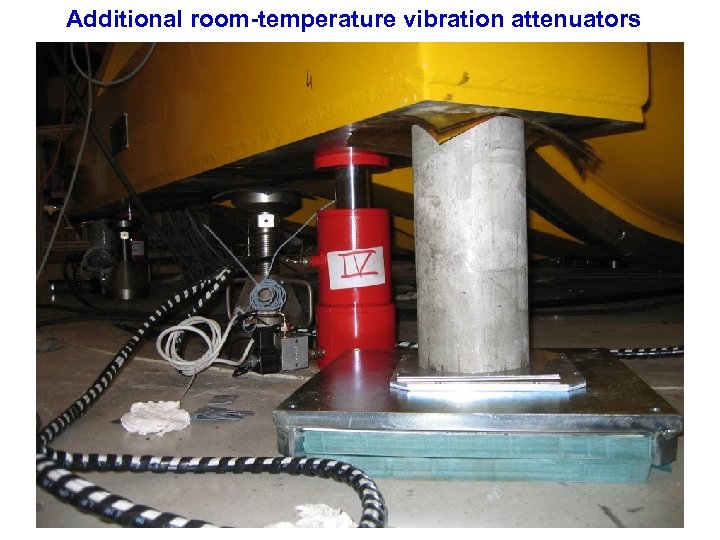
Additional room-temperature vibration attenuators
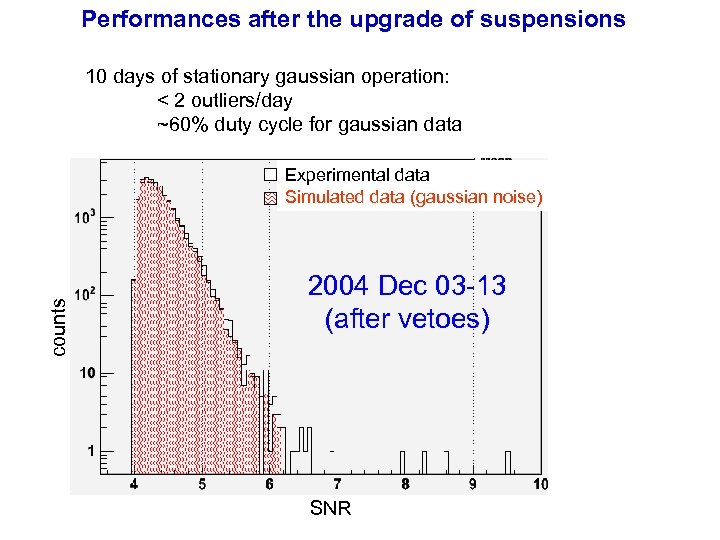
Performances after the upgrade of suspensions 10 days of stationary gaussian operation: < 2 outliers/day ~60% duty cycle for gaussian data counts Experimental data Simulated data (gaussian noise) 2004 Dec 03 -13 (after vetoes) SNR
Collaborations
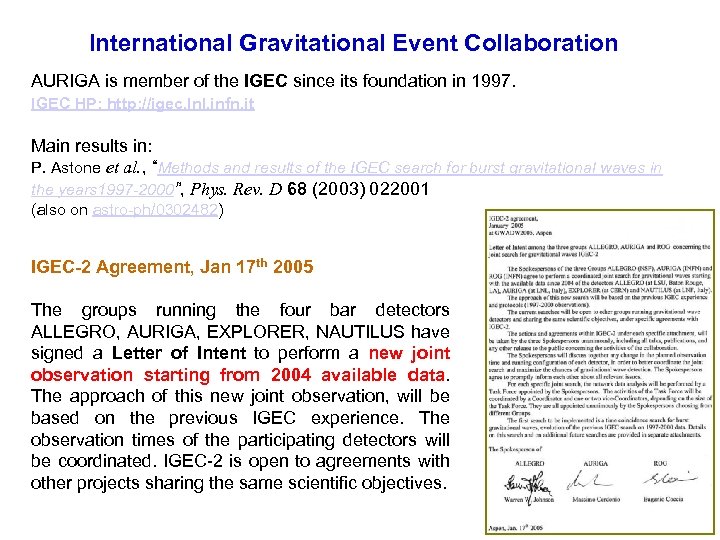
International Gravitational Event Collaboration AURIGA is member of the IGEC since its foundation in 1997. IGEC HP: http: //igec. lnl. infn. it Main results in: P. Astone et al. , “Methods and results of the IGEC search for burst gravitational waves in the years 1997 -2000”, Phys. Rev. D 68 (2003) 022001 (also on astro-ph/0302482) IGEC-2 Agreement, Jan 17 th 2005 The groups running the four bar detectors ALLEGRO, AURIGA, EXPLORER, NAUTILUS have signed a Letter of Intent to perform a new joint observation starting from 2004 available data. The approach of this new joint observation, will be based on the previous IGEC experience. The observation times of the participating detectors will be coordinated. IGEC-2 is open to agreements with other projects sharing the same scientific objectives.
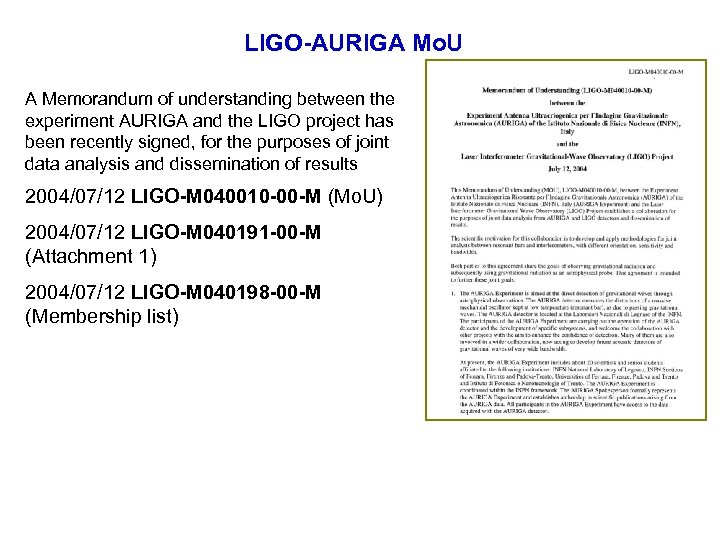
LIGO-AURIGA Mo. U A Memorandum of understanding between the experiment AURIGA and the LIGO project has been recently signed, for the purposes of joint data analysis and dissemination of results 2004/07/12 LIGO-M 040010 -00 -M (Mo. U) 2004/07/12 LIGO-M 040191 -00 -M (Attachment 1) 2004/07/12 LIGO-M 040198 -00 -M (Membership list)
Joint LIGO-AURIGA working group activity STEP-ZERO Outline of the most interesting analysis to be performed based on preliminary study of sensitivity and efficiency of the detectors Document Type LIGO-T 040202 -00 2004/10/13 Proposal for the First AURIGA-LIGO Joint Analysis L. Baggio, L Cadonati, S. Heng, W. Johnson, A. Mion, S. Poggi, G. A. Prodi, A. Ortolan, F. Salemi, P. Sutton, G. Vedovato, M. Zanolin 1 st STEP Cross-correlation between LIGOs (L 1, H 1 & H 2) around the times of AURIGA triggers Analysis of S 3 data in progress 2 nd STEP Implementation of IGEC-like analysis (self adapting directional coincidence search between candidate event lists from each detector) <in preparation >
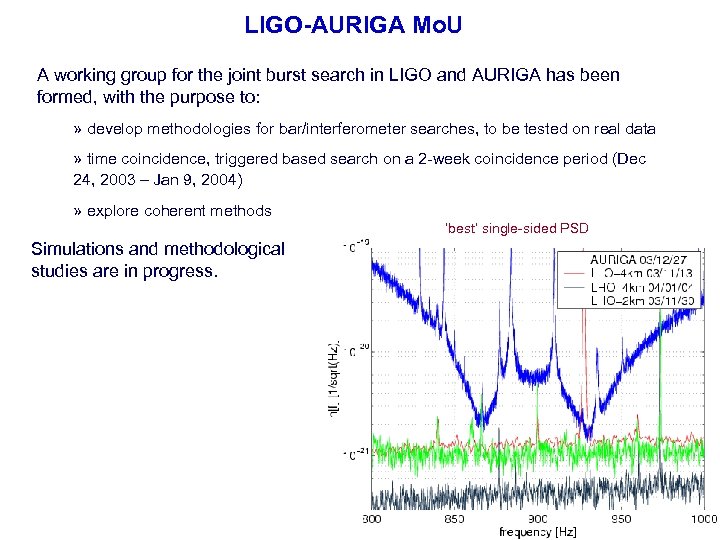
LIGO-AURIGA Mo. U A working group for the joint burst search in LIGO and AURIGA has been formed, with the purpose to: » develop methodologies for bar/interferometer searches, to be tested on real data » time coincidence, triggered based search on a 2 -week coincidence period (Dec 24, 2003 – Jan 9, 2004) » explore coherent methods ‘best’ single-sided PSD Simulations and methodological studies are in progress.
White paper on joint analysis Two methods will be explored in parallel: Method 1: • IGEC style, but with a new definition of consistent amplitude estimator in order to face the radically different spectral densities of the two kind of detectors (interferometers and bars). • To fully exploit IGEC philosophy, as the detectors are not parallel, polarization effects should be taken into account (multiple trials on polarization grid). Method 2: • No assumptions are made on direction or waveform. • A Corr. Power search (see poster) is applied to the LIGO interferometers around the time of the AURIGA triggers. • Efficiency for classes of waveforms and source population is performed through Monte Carlo simulation, LIGO-style (see talks by Zweizig, Yakushin, Klimenko). • The accidental rate (background) is obtained with unphysical time-shifts between data streams.
Other activities
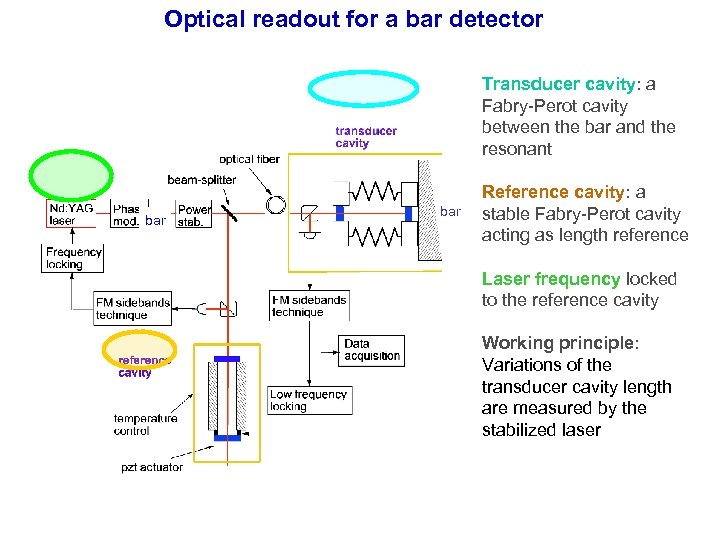
Optical readout for a bar detector Transducer cavity: a Fabry-Perot cavity between the bar and the resonant bar Reference cavity: a stable Fabry-Perot cavity acting as length reference Laser frequency locked to the reference cavity Working principle: Variations of the transducer cavity length are measured by the stabilized laser
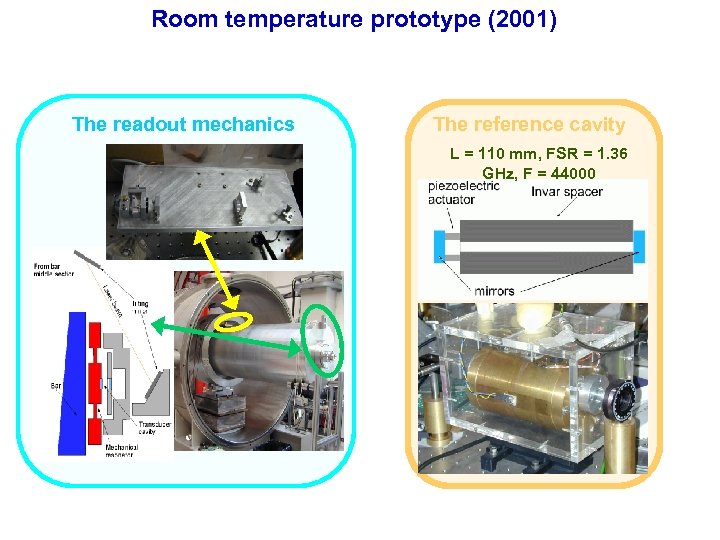
Room temperature prototype (2001) The readout mechanics The reference cavity L = 110 mm, FSR = 1. 36 GHz, F = 44000
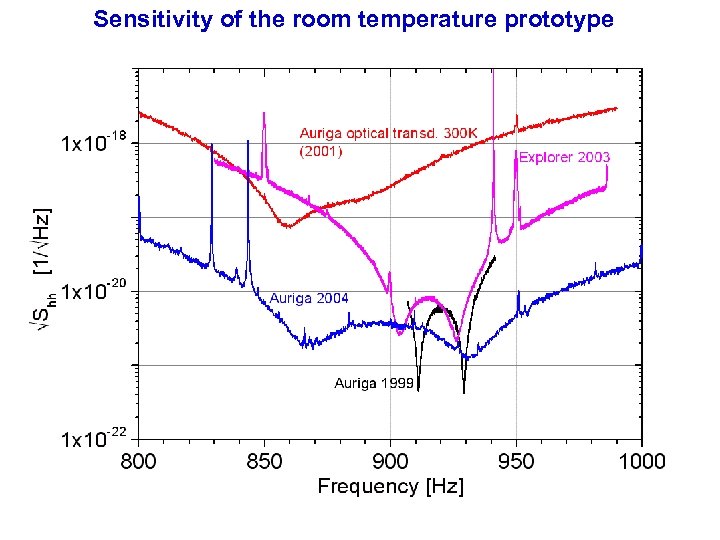
Sensitivity of the room temperature prototype
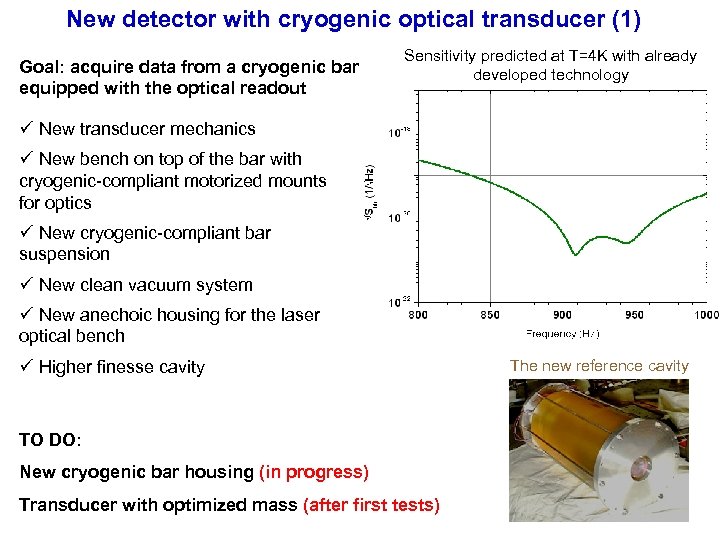
New detector with cryogenic optical transducer (1) Goal: acquire data from a cryogenic bar equipped with the optical readout Sensitivity predicted at T=4 K with already developed technology ü New transducer mechanics ü New bench on top of the bar with cryogenic-compliant motorized mounts for optics ü New cryogenic-compliant bar suspension ü New clean vacuum system ü New anechoic housing for the laser optical bench ü Higher finesse cavity TO DO: New cryogenic bar housing (in progress) Transducer with optimized mass (after first tests) The new reference cavity
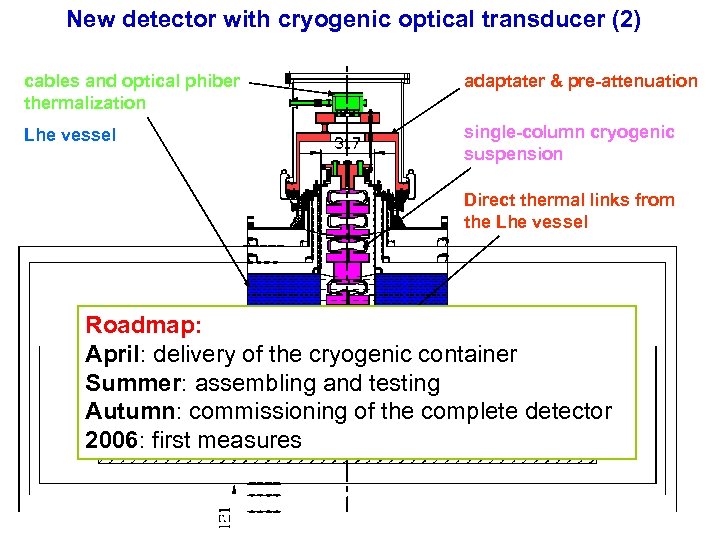
New detector with cryogenic optical transducer (2) cables and optical phiber thermalization adaptater & pre-attenuation Lhe vessel single-column cryogenic suspension Direct thermal links from the Lhe vessel Roadmap: April: delivery of the cryogenic container Summer: assembling and testing Autumn: commissioning of the complete detector 2006: first measures
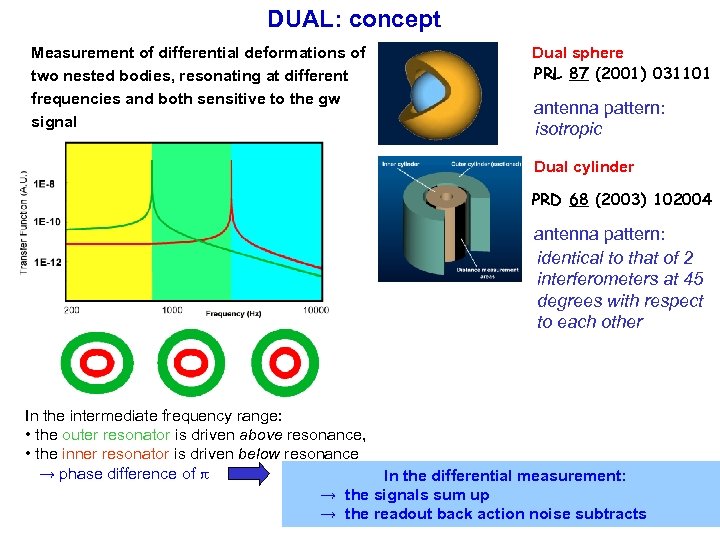
DUAL: concept Measurement of differential deformations of two nested bodies, resonating at different frequencies and both sensitive to the gw signal Dual sphere PRL 87 (2001) 031101 antenna pattern: isotropic Dual cylinder PRD 68 (2003) 102004 antenna pattern: identical to that of 2 interferometers at 45 degrees with respect to each other In the intermediate frequency range: • the outer resonator is driven above resonance, • the inner resonator is driven below resonance → phase difference of In the differential measurement: → the signals sum up → the readout back action noise subtracts
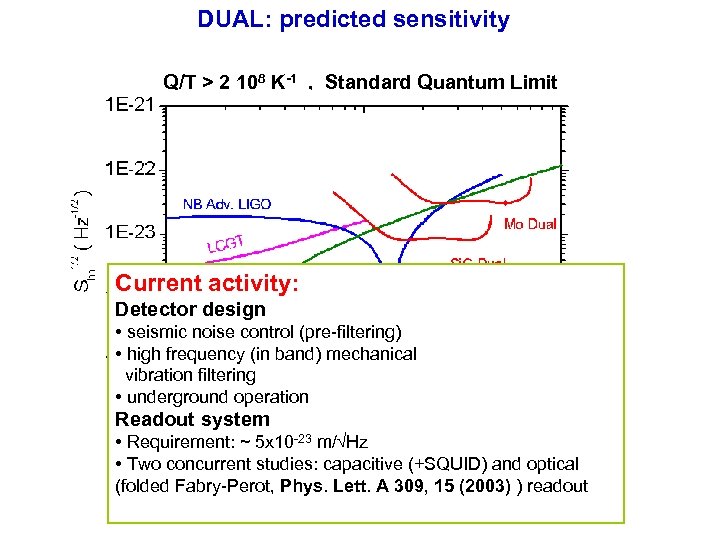
DUAL: predicted sensitivity Q/T > 2 108 K-1 , Standard Quantum Limit Current activity: Detector design • seismic noise control (pre-filtering) • high frequency (in band) mechanical vibration filtering • underground operation Readout system • Requirement: ~ 5 x 10 -23 m/√Hz Mo Dual 16. 4 ton height 2. 3 m Ø 0. 94 m • Two concurrent studies: capacitive (+SQUID) and optical (folded Fabry-Perot, Phys. Lett. A 309, 15 (2003) ) readout Si. C Dual 62. 2 ton height 3 m Ø 2. 9 m

Next steps
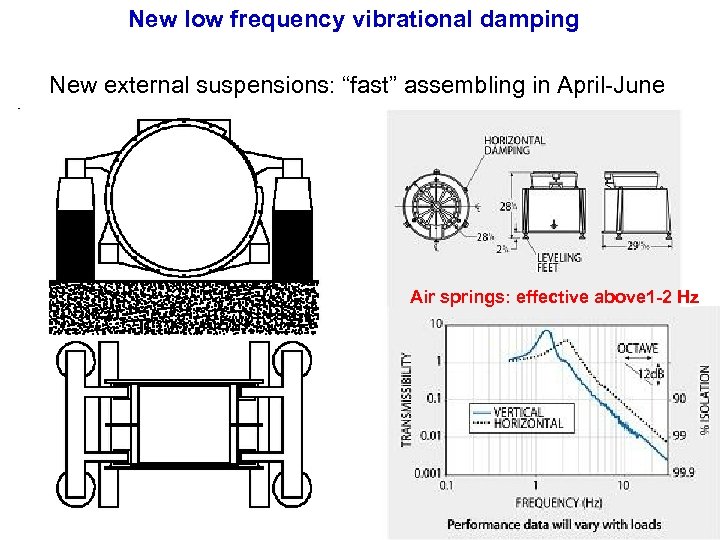
New low frequency vibrational damping New external suspensions: “fast” assembling in April-June Air springs: effective above 1 -2 Hz
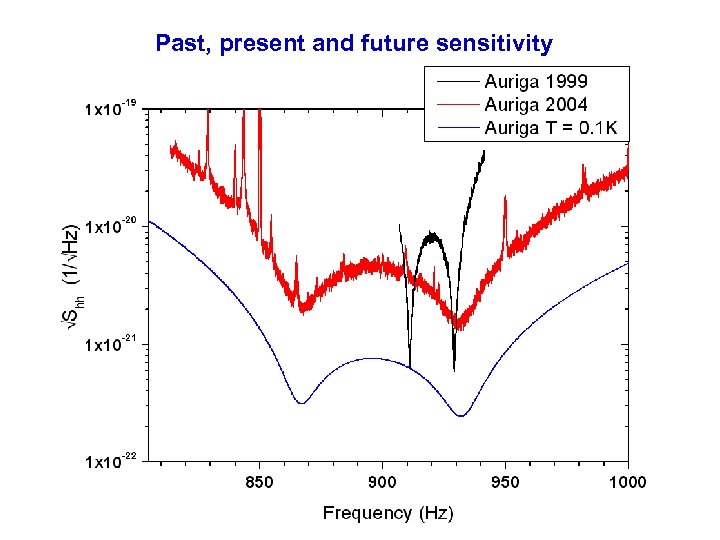
Past, present and future sensitivity
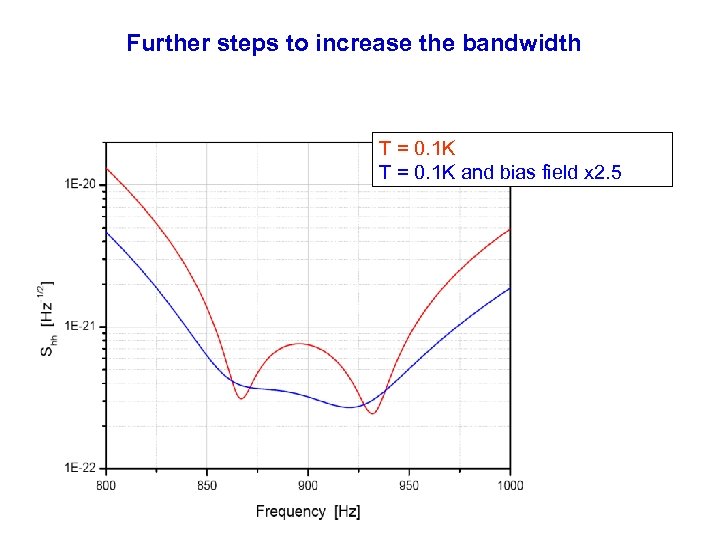
Further steps to increase the bandwidth T = 0. 1 K and bias field x 2. 5
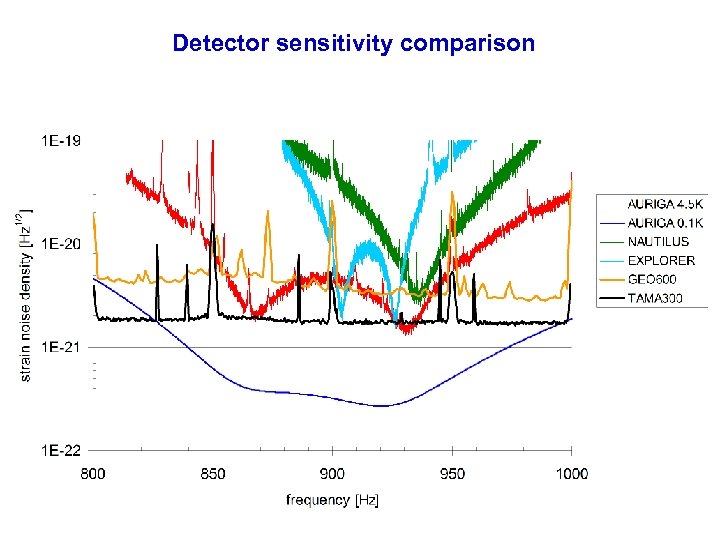
Detector sensitivity comparison
Скачать презентацию アウリガ The AURIGA experiment updates and prospects バッジョ
f06b967d4a8380d5e9c5fdb960e5bf36.ppt