 Скачать презентацию きょうだい関係における自己評価維持機制と 友人関係に及ぼす出生順位効果 Self-Evaluation Maintenance Processes in Sibling Relationships
A0-sized Poster.pptx
- Количество слайдов: 1



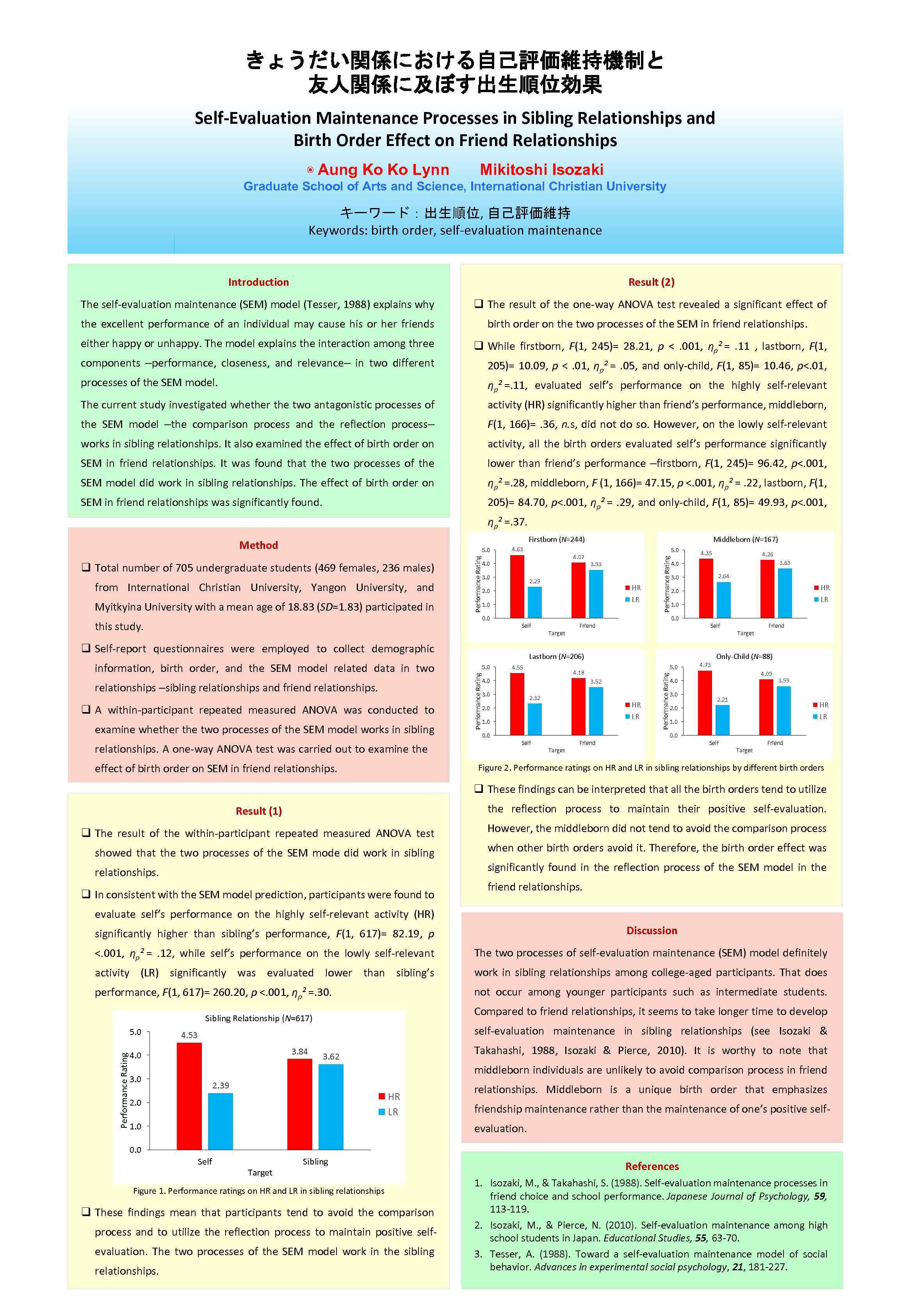
きょうだい関係における自己評価維持機制と 友人関係に及ぼす出生順位効果 Self-Evaluation Maintenance Processes in Sibling Relationships and Birth Order Effect on Friend Relationships ◉ Aung Ko Ko Lynn Mikitoshi Isozaki Graduate School of Arts and Science, International Christian University キーワード:出生順位, 自己評価維持 Keywords: birth order, self-evaluation maintenance Introduction Result (2) The self-evaluation maintenance (SEM) model (Tesser, 1988) explains why q The result of the one-way ANOVA test revealed a significant effect of the excellent performance of an individual may cause his or her friends birth order on the two processes of the SEM in friend relationships. either happy or unhappy. The model explains the interaction among three q While firstborn, F(1, 245)= 28. 21, p < . 001, ηp² = . 11 , lastborn, F(1, components –performance, closeness, and relevance– in two different 205)= 10. 09, p < . 01, ηp² = . 05, and only-child, F(1, 85)= 10. 46, p<. 01, processes of the SEM model. ηp² =. 11, evaluated self’s performance on the highly self-relevant The current study investigated whether the two antagonistic processes of activity (HR) significantly higher than friend’s performance, middleborn, the SEM model –the comparison process and the reflection process– F(1, 166)=. 36, n. s, did not do so. However, on the lowly self-relevant works in sibling relationships. It also examined the effect of birth order on activity, all the birth orders evaluated self’s performance significantly SEM in friend relationships. It was found that the two processes of the lower than friend’s performance –firstborn, F(1, 245)= 96. 42, p<. 001, SEM model did work in sibling relationships. The effect of birth order on ηp² =. 28, middleborn, F (1, 166)= 47. 15, p <. 001, ηp² =. 22, lastborn, F(1, SEM in friend relationships was significantly found. 205)= 84. 70, p<. 001, ηp² =. 29, and only-child, F(1, 85)= 49. 93, p<. 001, ηp² =. 37. Firstborn (N=244) q Total number of 705 undergraduate students (469 females, 236 males) from International Christian University, Yangon University, and Myitkyina University with a mean age of 18. 83 (SD=1. 83) participated in Performance Rating 5. 0 4. 63 4. 07 4. 0 3. 0 5. 0 3. 53 2. 29 HR LR 2. 0 1. 0 Performance Rating Method Middleborn (N=167) 0. 0 this study. q Self-report questionnaires were employed to collect demographic examine whether the two processes of the SEM model works in sibling relationships. A one-way ANOVA test was carried out to examine the effect of birth order on SEM in friend relationships. 2. 64 3. 0 HR LR 2. 0 1. 0 Target Friend Self 4. 55 5. 0 4. 18 4. 0 3. 52 3. 0 2. 32 HR LR 2. 0 1. 0 0. 0 Performance Rating q A within-participant repeated measured ANOVA was conducted to Performance Rating relationships –sibling relationships and friend relationships. 3. 63 4. 0 Lastborn (N=206) 5. 0 4. 26 0. 0 Self information, birth order, and the SEM model related data in two 4. 35 4. 73 Target Only-Child (N=88) 4. 09 4. 0 3. 0 Friend 3. 59 2. 21 HR LR 2. 0 1. 0 0. 0 Self Target Friend Figure 2. Performance ratings on HR and LR in sibling relationships by different birth orders q These findings can be interpreted that all the birth orders tend to utilize Result (1) the reflection process to maintain their positive self-evaluation. q The result of the within-participant repeated measured ANOVA test However, the middleborn did not tend to avoid the comparison process showed that the two processes of the SEM mode did work in sibling when other birth orders avoid it. Therefore, the birth order effect was relationships. significantly found in the reflection process of the SEM model in the q In consistent with the SEM model prediction, participants were found to friend relationships. evaluate self’s performance on the highly self-relevant activity (HR) significantly higher than sibling’s performance, F(1, 617)= 82. 19, p Discussion <. 001, ηp² = . 12, while self’s performance on the lowly self-relevant The two processes of self-evaluation maintenance (SEM) model definitely activity (LR) significantly was evaluated lower than sibling’s work in sibling relationships among college-aged participants. That does performance, F(1, 617)= 260. 20, p <. 001, ηp² =. 30. not occur among younger participants such as intermediate students. Compared to friend relationships, it seems to take longer time to develop Sibling Relationship (N=617) Performance Rating 5. 0 self-evaluation maintenance in sibling relationships (see Isozaki & 4. 53 3. 84 4. 0 Takahashi, 1988, Isozaki & Pierce, 2010). It is worthy to note that 3. 62 middleborn individuals are unlikely to avoid comparison process in friend 3. 0 2. 39 HR LR 2. 0 1. 0 relationships. Middleborn is a unique birth order that emphasizes friendship maintenance rather than the maintenance of one’s positive selfevaluation. 0. 0 Self Target Sibling Figure 1. Performance ratings on HR and LR in sibling relationships q These findings mean that participants tend to avoid the comparison process and to utilize the reflection process to maintain positive selfevaluation. The two processes of the SEM model work in the sibling relationships. References 1. Isozaki, M. , & Takahashi, S. (1988). Self-evaluation maintenance processes in friend choice and school performance. Japanese Journal of Psychology, 59, 113 -119. 2. Isozaki, M. , & Pierce, N. (2010). Self-evaluation maintenance among high school students in Japan. Educational Studies, 55, 63 -70. 3. Tesser, A. (1988). Toward a self-evaluation maintenance model of social behavior. Advances in experimental social psychology, 21, 181 -227.
Скачать презентацию きょうだい関係における自己評価維持機制と 友人関係に及ぼす出生順位効果 Self-Evaluation Maintenance Processes in Sibling Relationships
A0-sized Poster.pptx