


 Скачать презентацию אמידה סימולטנית של התנהגות היזם ומחירי קרקע
da2d43e5e80514db31da45b20ce32205.ppt
- Количество слайдов: 24
 אמידה סימולטנית של התנהגות היזם ומחירי קרקע - המקרה של שינויים בשימושי קרקע במטרופולין תל אביב דניאל פלזנשטיין, אייל אשבל וצבי וינוקור כנס האיגוד הישראלי למדע האזור, אוניברסיטת חיפה, 01. 11. 82 1
 The Motivation • In land use models, developer behavior and land prices modeled independently • In practice, the two occur simultaneously • LU models treat land prices as exogenous. But, developer behavior depends on land prices and vice versa, therefore endogeneity issue. • Prices also fixed by expectations of price (rational expectations world) 2
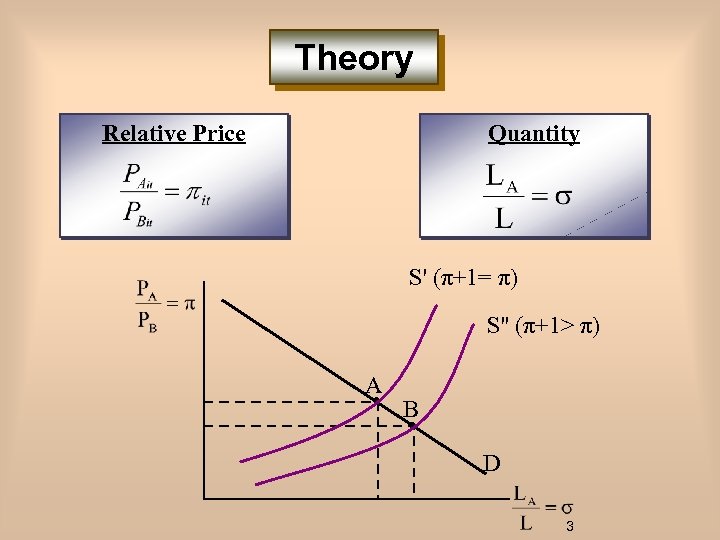 Theory Relative Price Quantity S' (π+1= π) S'' (π+1> π) A B D 3
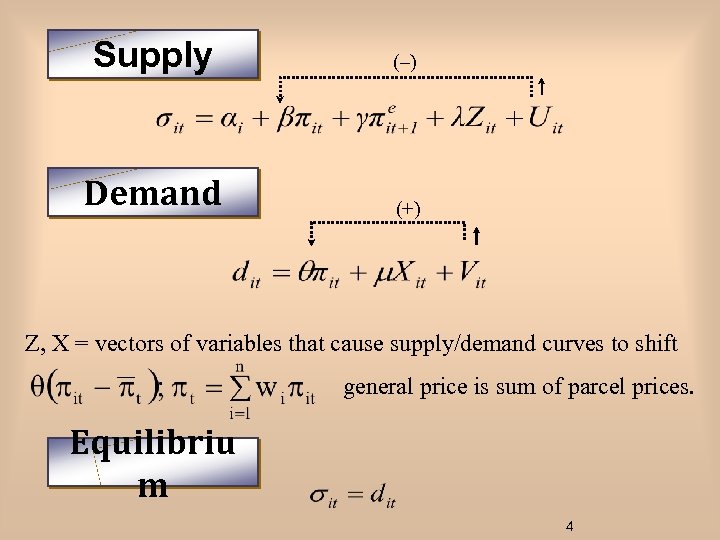 Supply (–) Demand (+) Z, X = vectors of variables that cause supply/demand curves to shift general price is sum of parcel prices. Equilibriu m 4
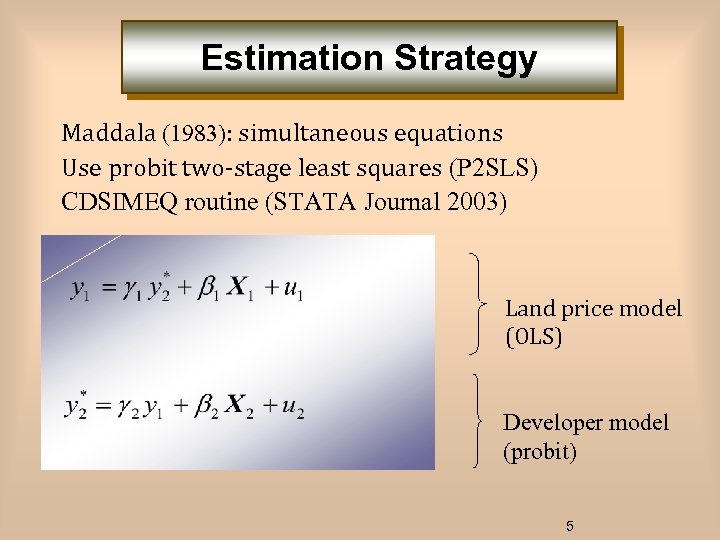 Estimation Strategy Maddala (1983): simultaneous equations Use probit two-stage least squares (P 2 SLS) CDSIMEQ routine (STATA Journal 2003) Land price model (OLS) Developer model (probit) 5
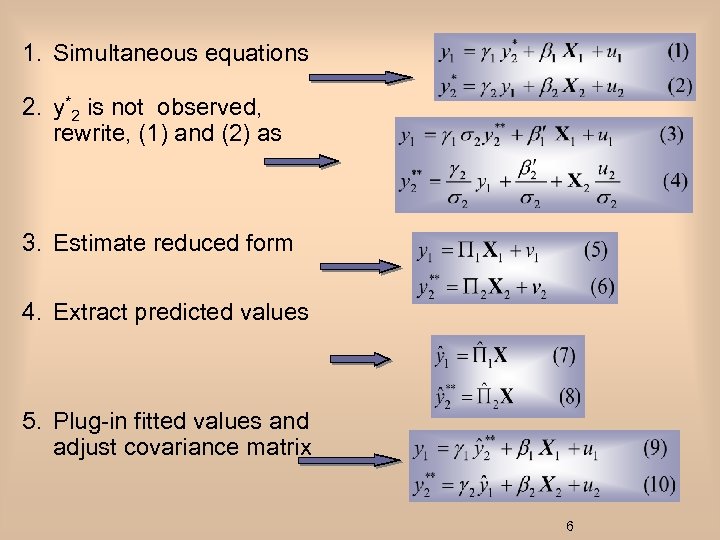 1. Simultaneous equations 2. y*2 is not observed, rewrite, (1) and (2) as 3. Estimate reduced form 4. Extract predicted values 5. Plug-in fitted values and adjust covariance matrix 6
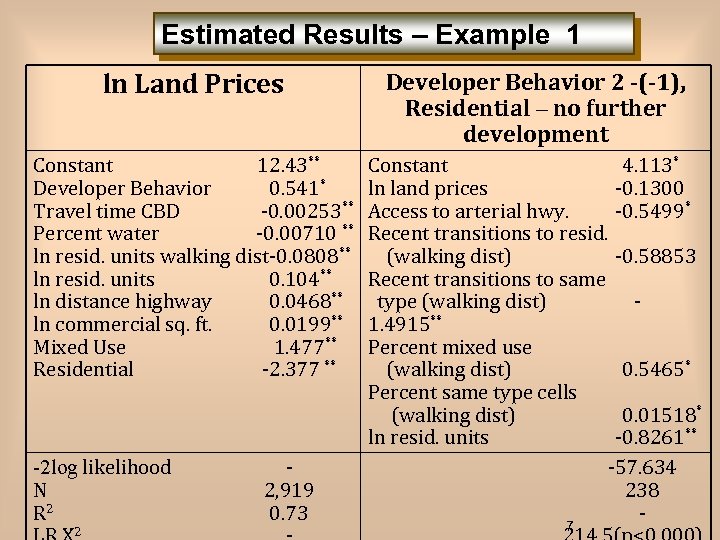 Estimated Results – Example 1 ln Land Prices Developer Behavior 2 -(-1), Residential – no further development Constant 12. 43** Developer Behavior 0. 541* Travel time CBD -0. 00253** Percent water -0. 00710 ** ln resid. units walking dist-0. 0808** ln resid. units 0. 104** ln distance highway 0. 0468** ln commercial sq. ft. 0. 0199** Mixed Use 1. 477** Residential -2. 377 ** Constant 4. 113* ln land prices -0. 1300 Access to arterial hwy. -0. 5499* Recent transitions to resid. (walking dist) -0. 58853 Recent transitions to same type (walking dist) 1. 4915** Percent mixed use (walking dist) 0. 5465* Percent same type cells (walking dist) 0. 01518* ln resid. units -0. 8261** -57. 634 238 - -2 log likelihood N R 2 2 2, 919 0. 73 7
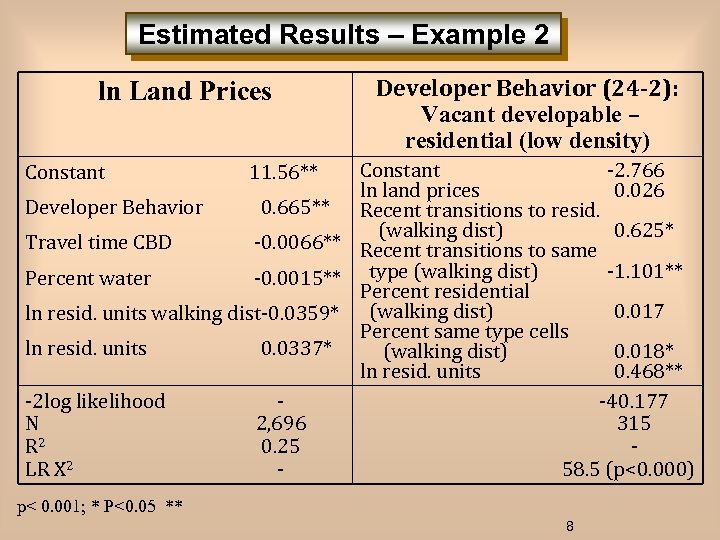 Estimated Results – Example 2 ln Land Prices Developer Behavior (24 -2): Vacant developable – residential (low density) Constant -2. 766 ln land prices 0. 026 Developer Behavior 0. 665** Recent transitions to resid. (walking dist) 0. 625* Travel time CBD -0. 0066** Recent transitions to same -1. 101** Percent water -0. 0015** type (walking dist) Percent residential 0. 017 ln resid. units walking dist-0. 0359* (walking dist) Percent same type cells ln resid. units 0. 0337* (walking dist) 0. 018* ln resid. units 0. 468** -2 log likelihood -40. 177 N 2, 696 315 R 2 0. 25 LR X 2 58. 5 (p<0. 000) Constant 11. 56** p< 0. 001; * P<0. 05 ** 8
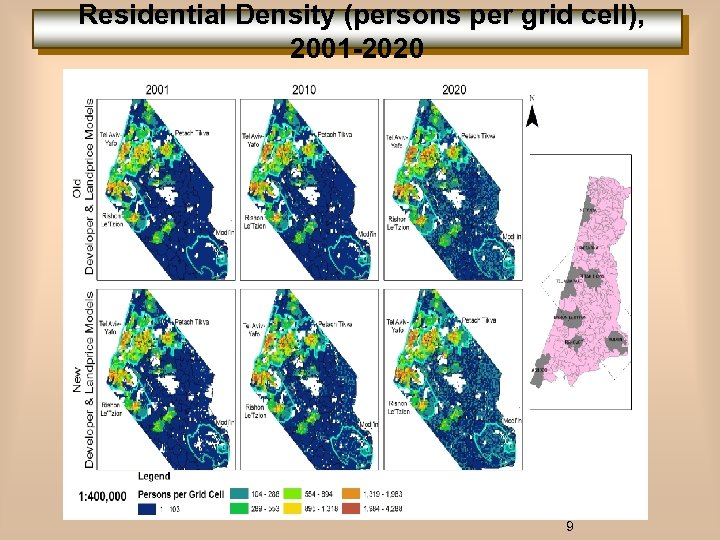 Residential Density (persons per grid cell), 2001 -2020 9
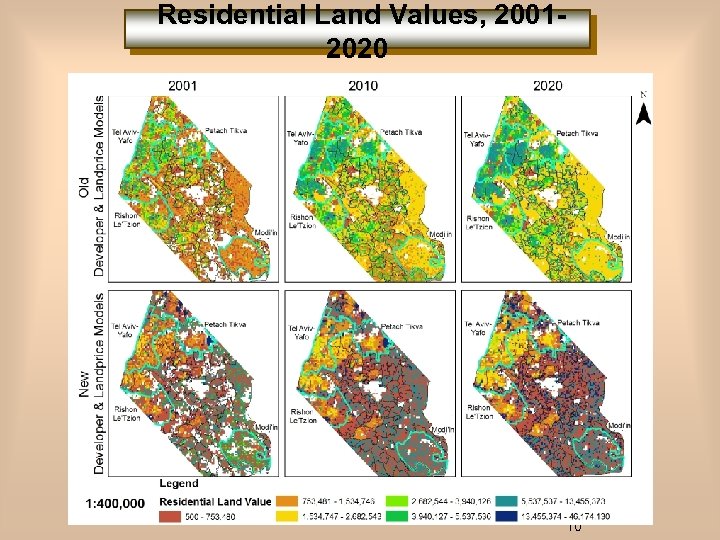 Residential Land Values, 20012020 10
 Residential • Simultaneous estimation predicts more population deconcentration. • Residential land values are estimated to be higher in suburban locations than in CBD (using sim. estimation). • Indiv. estimation gives opposite picture: higher residential prices closer to CBD: opposite trend. 11
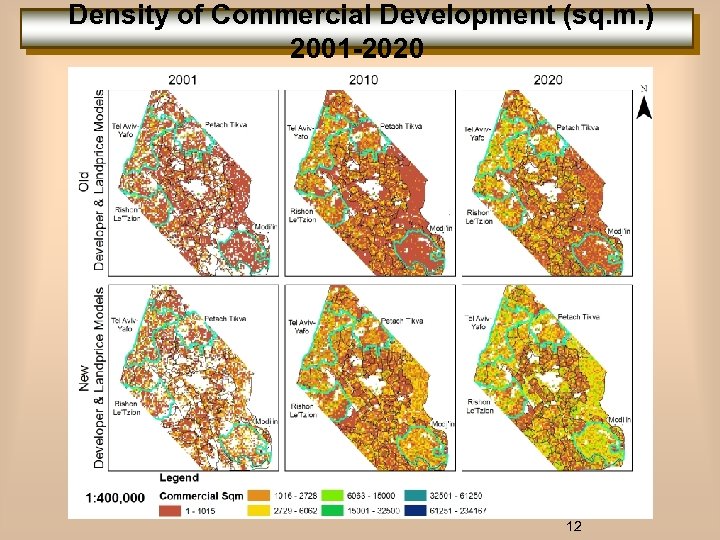 Density of Commercial Development (sq. m. ) 2001 -2020 12
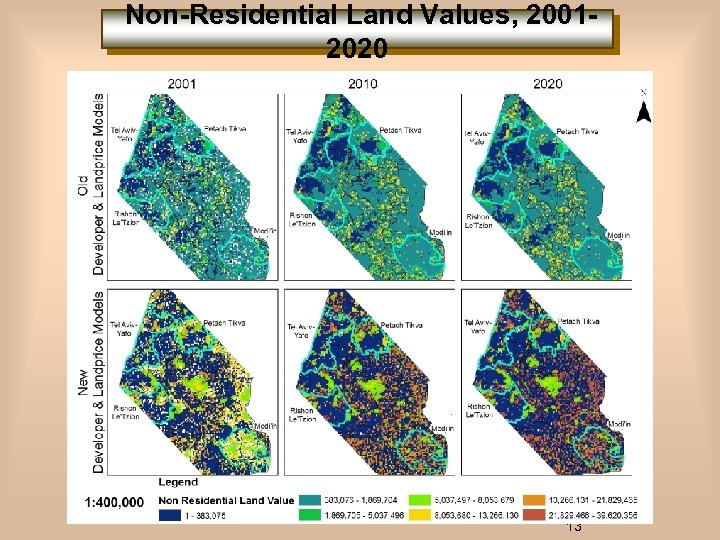 Non-Residential Land Values, 20012020 13
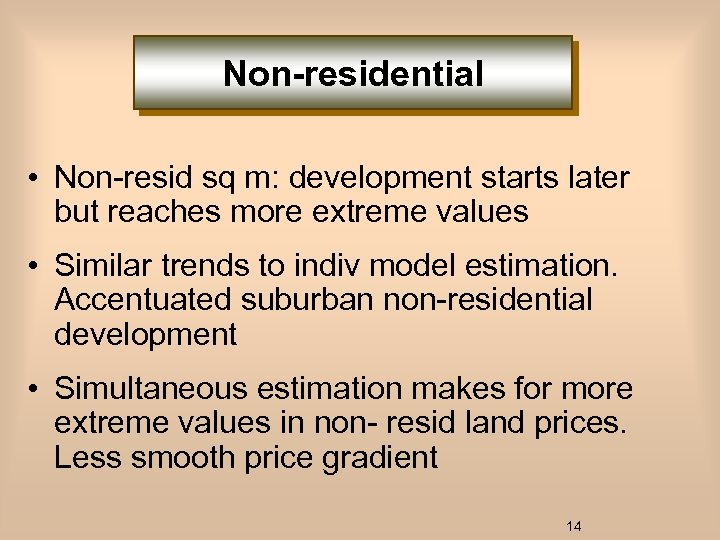 Non-residential • Non-resid sq m: development starts later but reaches more extreme values • Similar trends to indiv model estimation. Accentuated suburban non-residential development • Simultaneous estimation makes for more extreme values in non- resid land prices. Less smooth price gradient 14
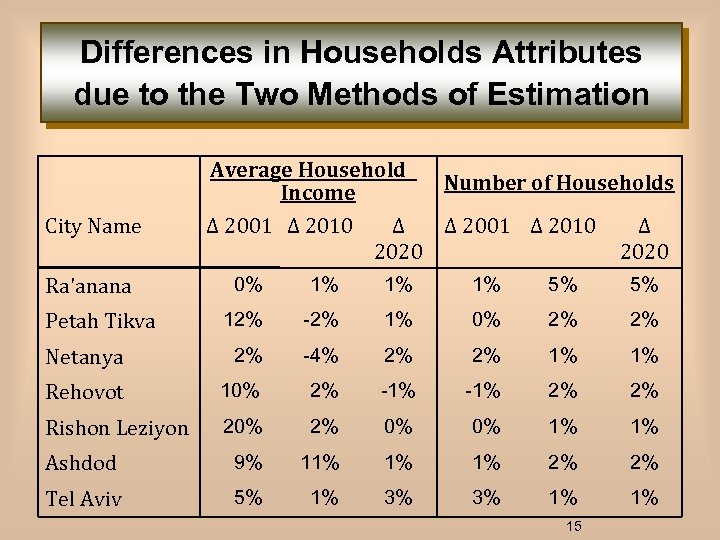 Differences in Households Attributes due to the Two Methods of Estimation City Name Ra'anana Average Household Number of Households Income Δ 2001 Δ 2010 Δ 2020 0% 1% 1% 1% 5% 5% 12% -2% 1% 0% 2% 2% Netanya 2% -4% 2% 2% 1% 1% Rehovot 10% 2% -1% 2% 2% Rishon Leziyon 20% 2% 0% 0% 1% 1% Ashdod 9% 11% 1% 1% 2% 2% Tel Aviv 5% 1% 3% 3% 1% 1% Petah Tikva 15
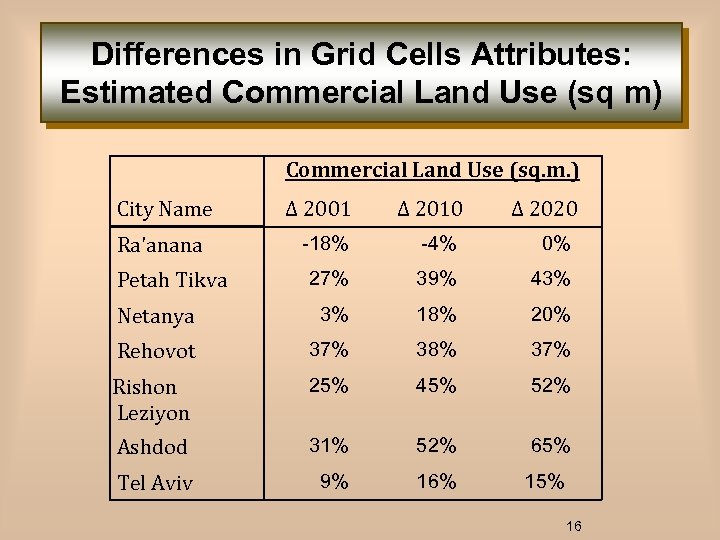 Differences in Grid Cells Attributes: Estimated Commercial Land Use (sq m) Commercial Land Use (sq. m. ) City Name Ra'anana Δ 2001 Δ 2010 Δ 2020 -18% -4% 0% 27% 39% 43% Netanya 3% 18% 20% Rehovot 37% 38% 37% Rishon Leziyon 25% 45% 52% Ashdod 31% 52% 65% Tel Aviv 9% 16% Petah Tikva 15% 16
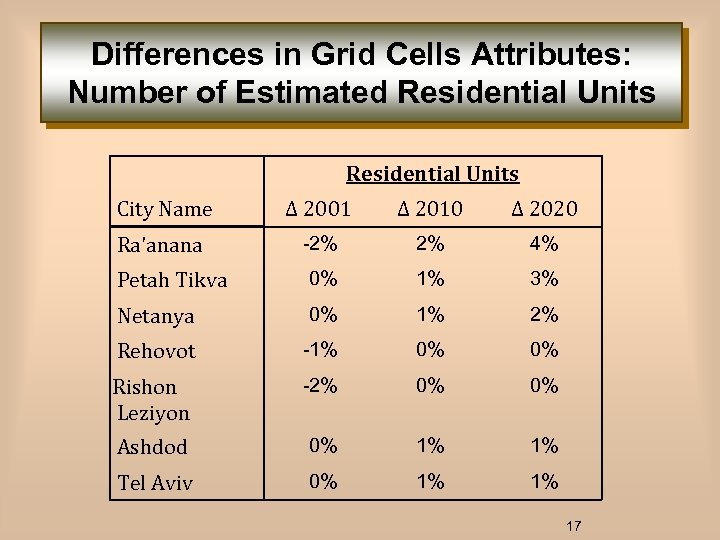 Differences in Grid Cells Attributes: Number of Estimated Residential Units City Name Δ 2001 Δ 2010 Δ 2020 Ra'anana -2% 2% 4% Petah Tikva 0% 1% 3% Netanya 0% 1% 2% Rehovot -1% 0% 0% Rishon Leziyon -2% 0% 0% Ashdod 0% 1% 1% Tel Aviv 0% 1% 1% 17
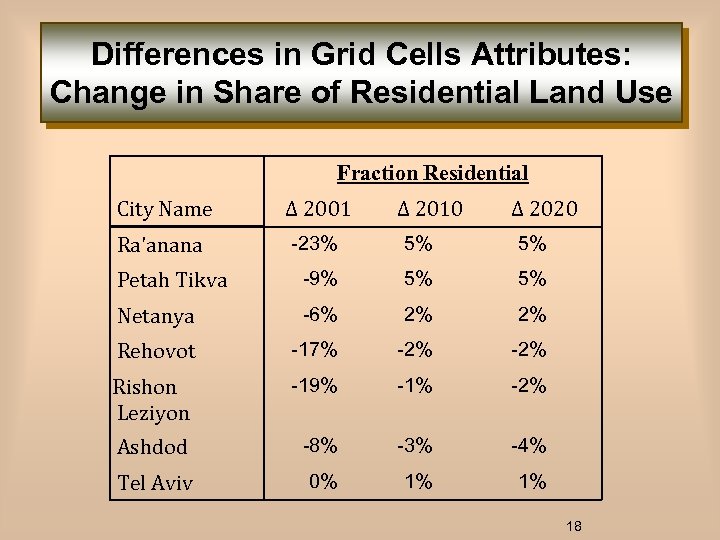 Differences in Grid Cells Attributes: Change in Share of Residential Land Use Fraction Residential City Name Δ 2001 Δ 2010 Δ 2020 Ra'anana -23% 5% 5% Petah Tikva -9% 5% 5% Netanya -6% 2% 2% Rehovot -17% -2% Rishon Leziyon -19% -1% -2% Ashdod -8% -3% -4% Tel Aviv 0% 1% 1% 18
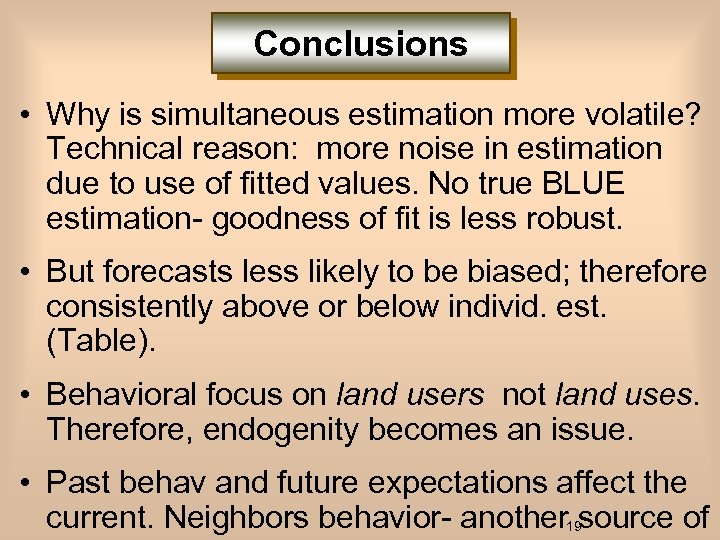 Conclusions • Why is simultaneous estimation more volatile? Technical reason: more noise in estimation due to use of fitted values. No true BLUE estimation- goodness of fit is less robust. • But forecasts less likely to be biased; therefore consistently above or below individ. est. (Table). • Behavioral focus on land users not land uses. Therefore, endogenity becomes an issue. • Past behav and future expectations affect the current. Neighbors behavior- another 19 source of
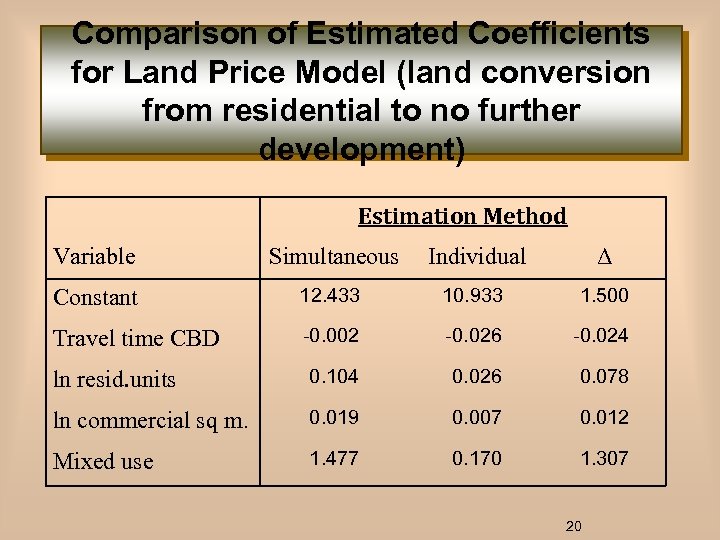 Comparison of Estimated Coefficients for Land Price Model (land conversion from residential to no further development) Estimation Method Variable Simultaneous Individual Δ Constant 12. 433 10. 933 1. 500 Travel time CBD -0. 002 -0. 026 -0. 024 ln resid. units 0. 104 0. 026 0. 078 ln commercial sq m. 0. 019 0. 007 0. 012 Mixed use 1. 477 0. 170 1. 307 20
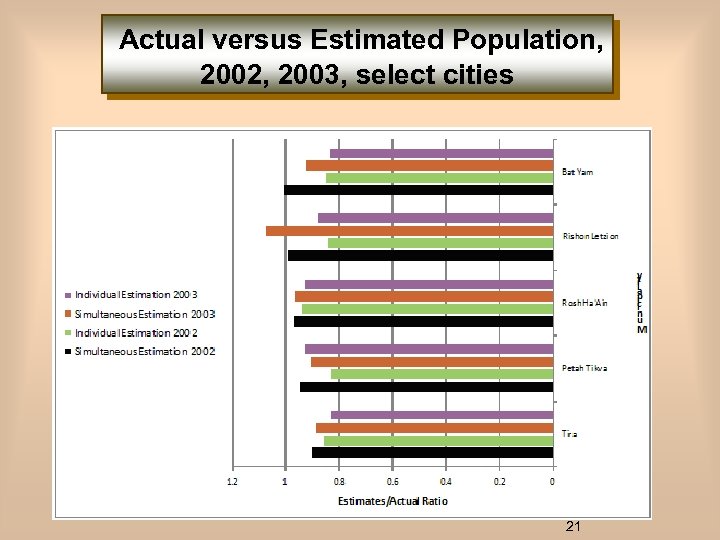 Actual versus Estimated Population, 2002, 2003, select cities 21
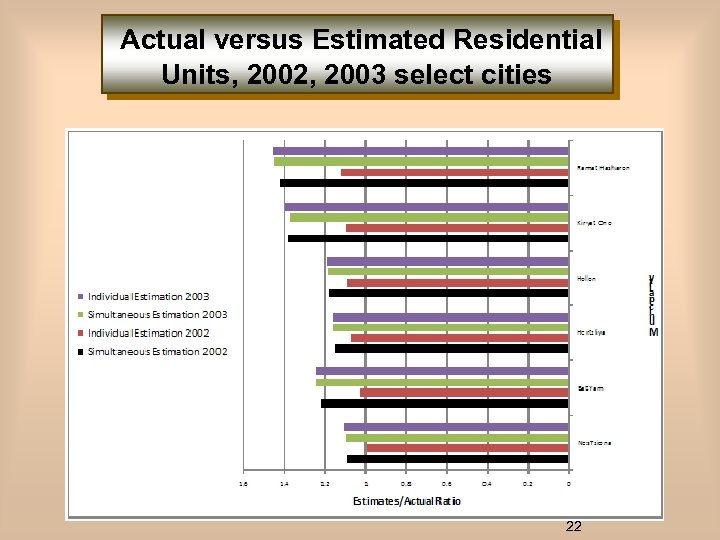 Actual versus Estimated Residential Units, 2002, 2003 select cities 22
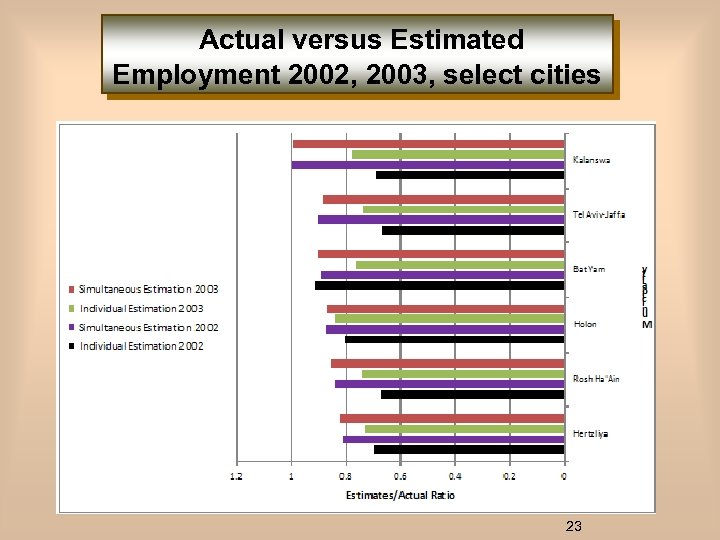 Actual versus Estimated Employment 2002, 2003, select cities 23
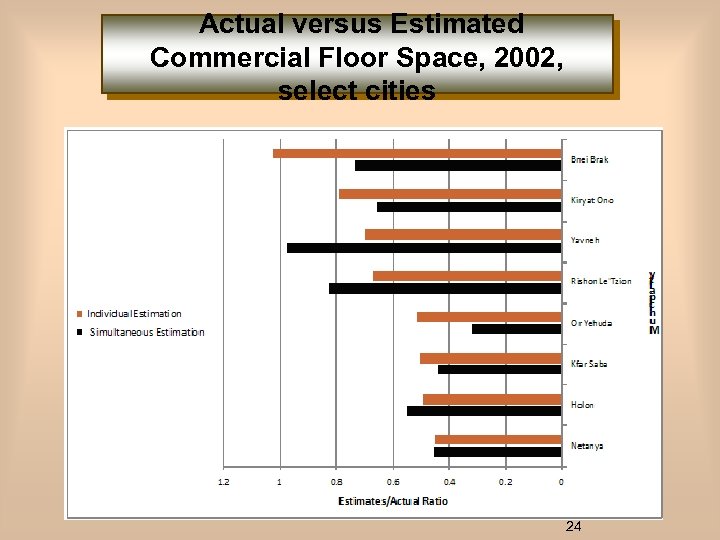 Actual versus Estimated Commercial Floor Space, 2002, select cities 24