


 Скачать презентацию π0 Lifetime from the Prim Ex Experiments Liping
677554d03e8165af34af6d9d78d685fb.ppt
- Количество слайдов: 37
 π0 Lifetime from the Prim. Ex Experiments Liping Gan University of North Carolina Wilmington (for the Prim. Ex Collaboration) Outline Ø 0 and QCD symmetries Ø Prim. Ex-I result Ø Prim. Ex-II status Ø Summary
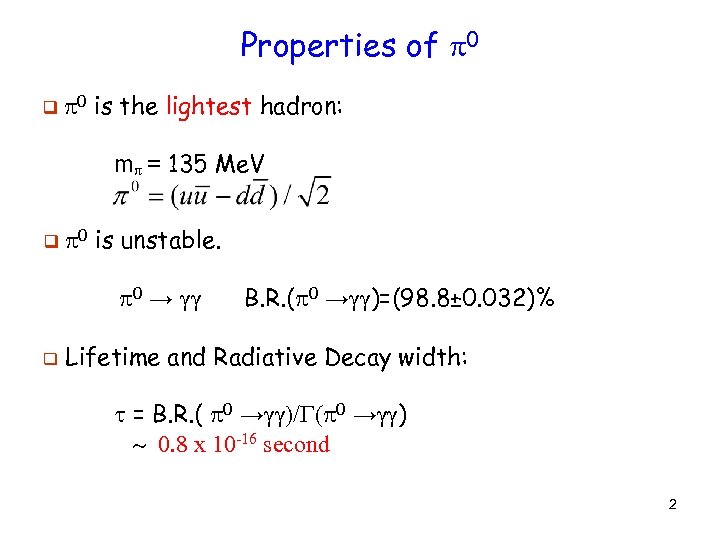 Properties of 0 q 0 is the lightest hadron: m = 135 Me. V q 0 is unstable. 0 → γγ q B. R. ( 0 →γγ)=(98. 8± 0. 032)% Lifetime and Radiative Decay width: = B. R. ( 0 →γγ)/ ( 0 →γγ) 0. 8 x 10 -16 second 2
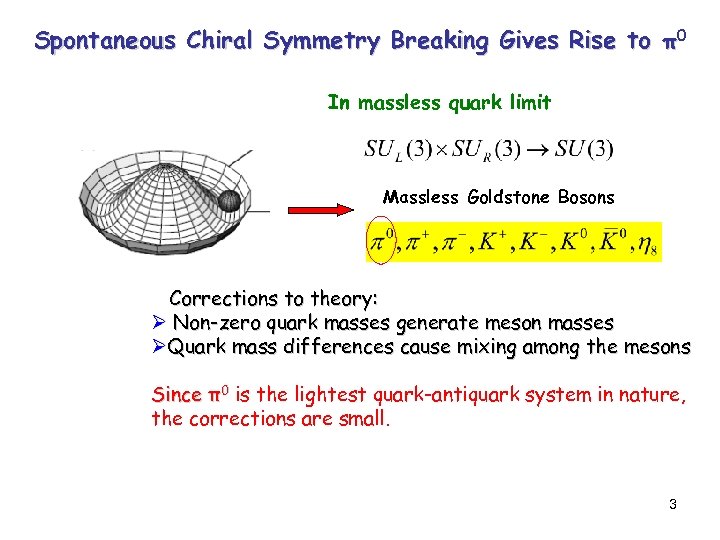 Spontaneous Chiral Symmetry Breaking Gives Rise to π0 In massless quark limit Massless Goldstone Bosons Corrections to theory: Ø Non-zero quark masses generate meson masses ØQuark mass differences cause mixing among the mesons Since π0 is the lightest quark-antiquark system in nature, the corrections are small. 3
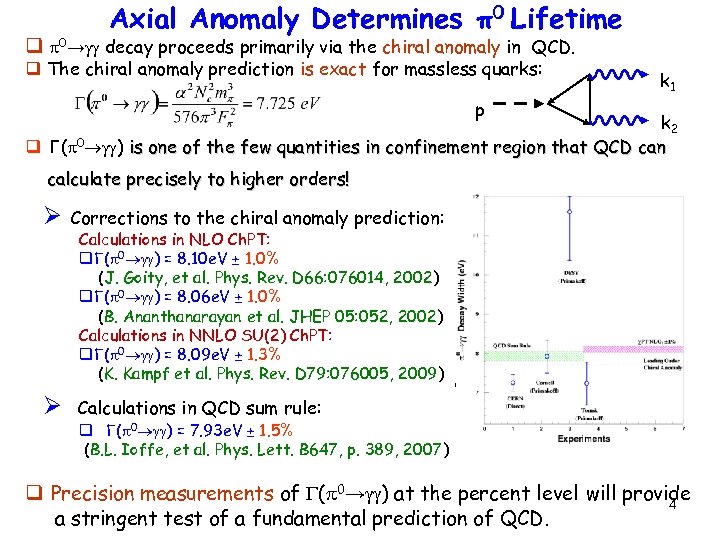 Axial Anomaly Determines π0 Lifetime q 0→ decay proceeds primarily via the chiral anomaly in QCD. q The chiral anomaly prediction is exact for massless quarks: k 1 p k 2 q Γ( 0 ) is one of the few quantities in confinement region that QCD can calculate precisely to higher orders! Calculations in NLO Ch. PT: qΓ( 0 ) = 8. 10 e. V ± 1. 0% (J. Goity, et al. Phys. Rev. D 66: 076014, 2002) qΓ( 0 ) = 8. 06 e. V ± 1. 0% (B. Ananthanarayan et al. JHEP 05: 052, 2002) Calculations in NNLO SU(2) Ch. PT: qΓ( 0 ) = 8. 09 e. V ± 1. 3% (K. Kampf et al. Phys. Rev. D 79: 076005, 2009) Ø Calculations in QCD sum rule: 0→ Ø Corrections to the chiral anomaly prediction: q Γ( 0 ) = 7. 93 e. V ± 1. 5% (B. L. Ioffe, et al. Phys. Lett. B 647, p. 389, 2007) q Precision measurements of ( 0→ ) at the percent level will provide 4 a stringent test of a fundamental prediction of QCD.
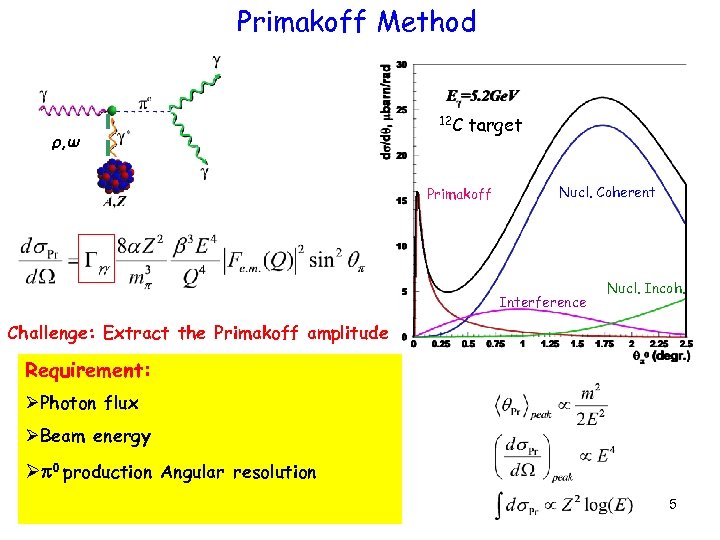 Primakoff Method ρ, ω 12 C target Primakoff Nucl. Coherent Interference Nucl. Incoh. Challenge: Extract the Primakoff amplitude Requirement: ØPhoton flux ØBeam energy Ø 0 production Angular resolution 5
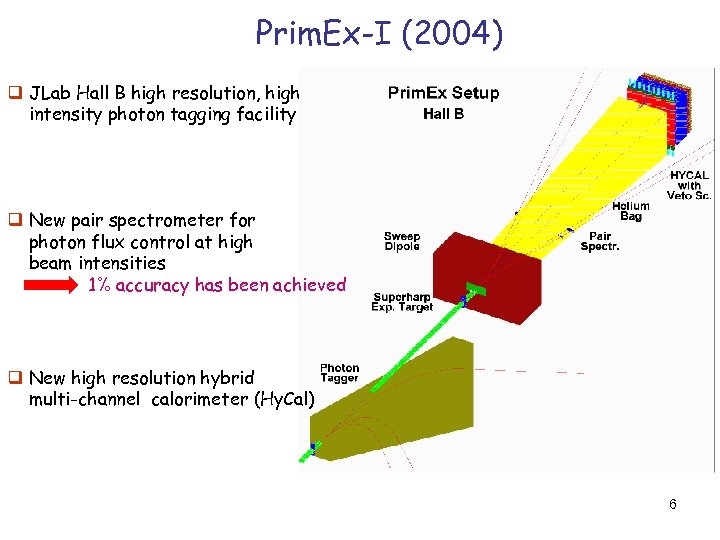 Pri Prim. Ex-I (2004) q JLab Hall B high resolution, high intensity photon tagging facility q New pair spectrometer for photon flux control at high beam intensities 1% accuracy has been achieved q New high resolution hybrid multi-channel calorimeter (Hy. Cal) 6
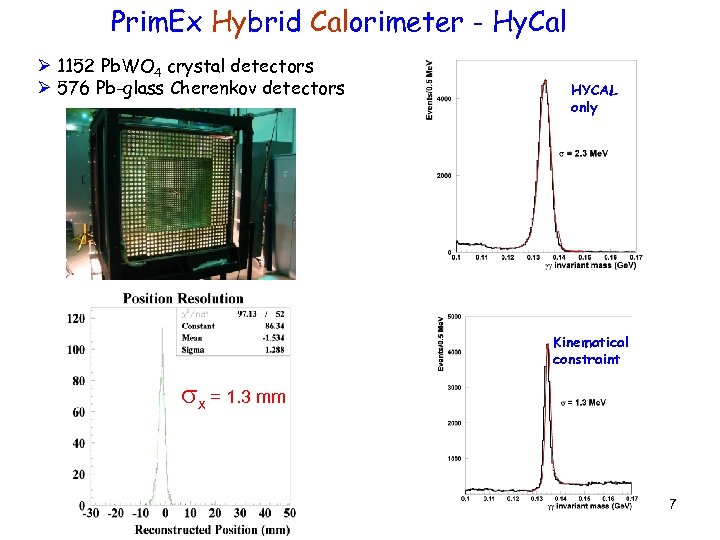 Prim. Ex Hybrid Calorimeter - Hy. Cal Ø 1152 Pb. WO 4 crystal detectors Ø 576 Pb-glass Cherenkov detectors HYCAL only Kinematical constraint x = 1. 3 mm 7
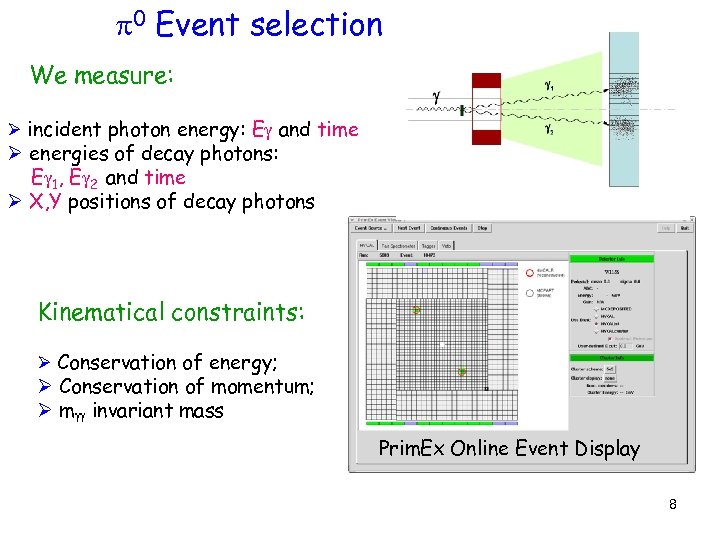 0 Event selection We measure: Ø incident photon energy: E and time Ø energies of decay photons: E 1, E 2 and time Ø X, Y positions of decay photons Kinematical constraints: Ø Conservation of energy; Ø Conservation of momentum; Ø m invariant mass Prim. Ex Online Event Display 8
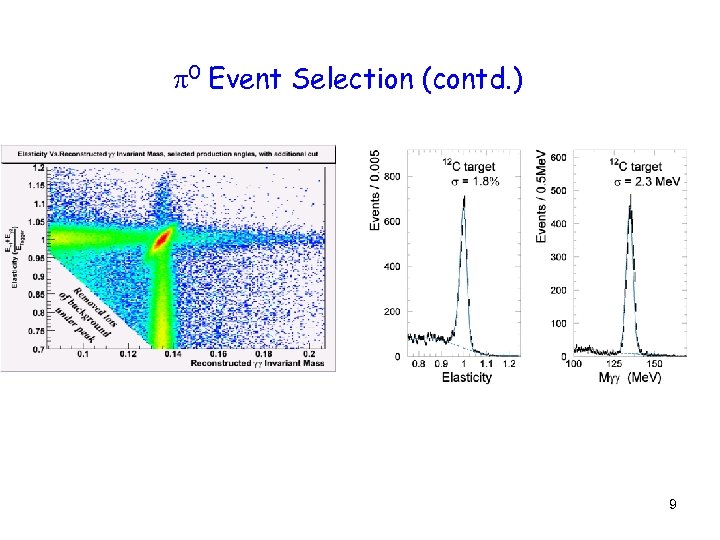 0 Event Selection (contd. ) 9
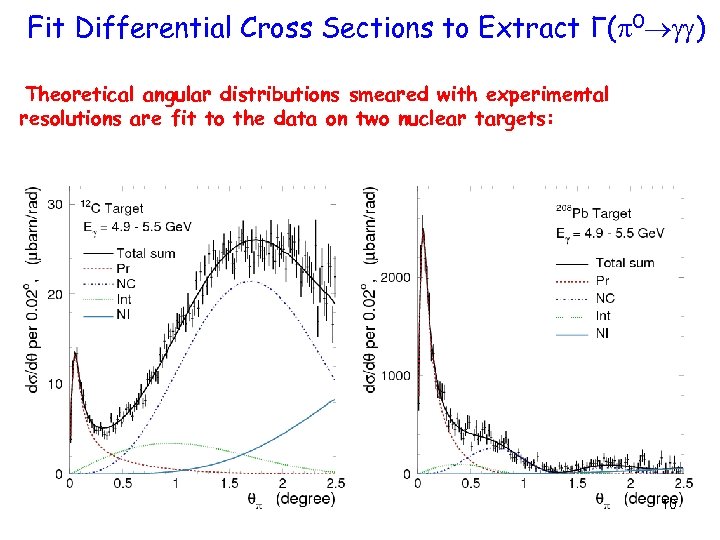 Fit Differential Cross Sections to Extract Γ( 0 ) Theoretical angular distributions smeared with experimental resolutions are fit to the data on two nuclear targets: 10
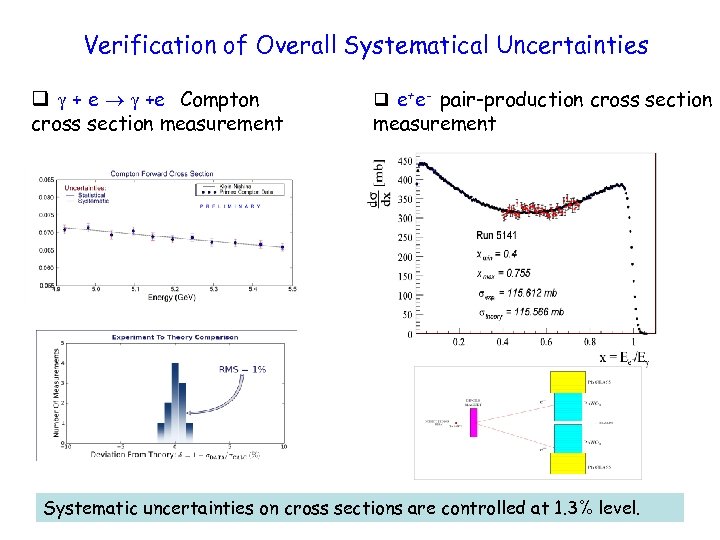 Verification of Overall Systematical Uncertainties q + e +e Compton cross section measurement q e+e- pair-production cross section measurement Systematic uncertainties on cross sections are controlled at 1. 3% level.
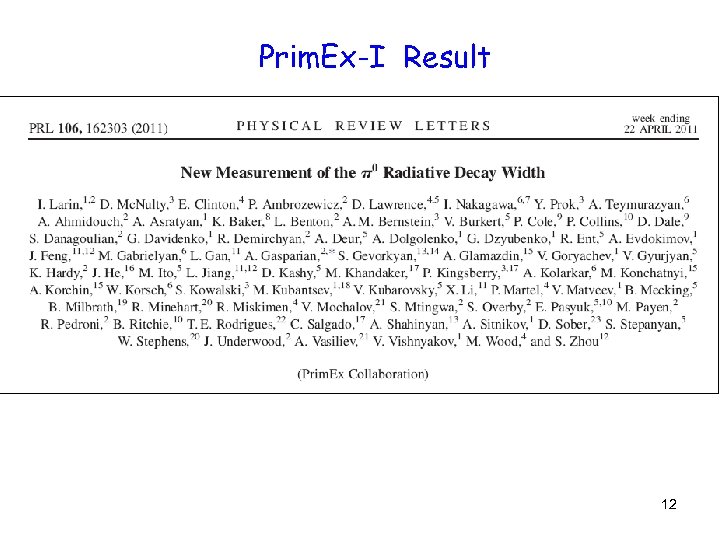 Prim. Ex-I Result 12
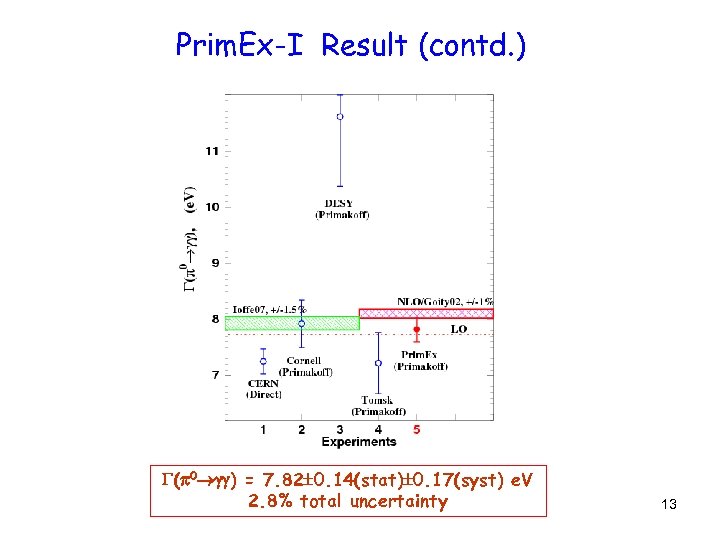 Prim. Ex-I Result (contd. ) ( 0 ) = 7. 82 0. 14(stat) 0. 17(syst) e. V 2. 8% total uncertainty 13
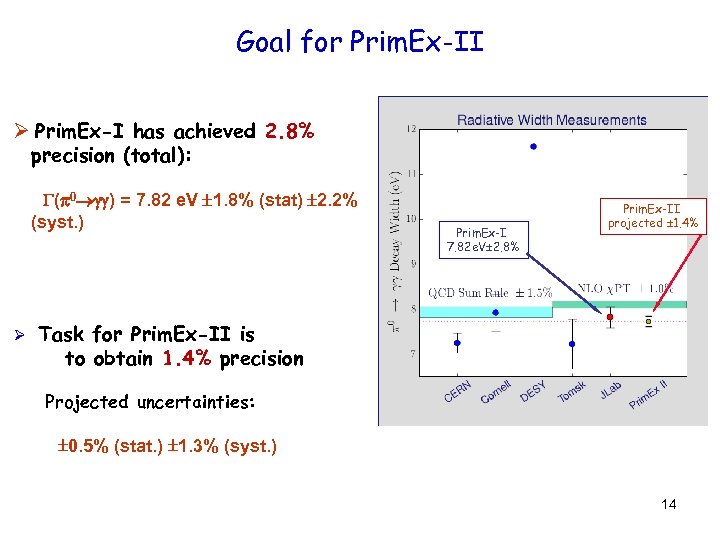 Goal for Prim. Ex-II Ø Prim. Ex-I has achieved 2. 8% precision (total): ( 0 ) = 7. 82 e. V 1. 8% (stat) 2. 2% (syst. ) Ø Prim. Ex-I 7. 82 e. V 2. 8% Prim. Ex-II projected 1. 4% Task for Prim. Ex-II is to obtain 1. 4% precision Projected uncertainties: 0. 5% (stat. ) 1. 3% (syst. ) 14
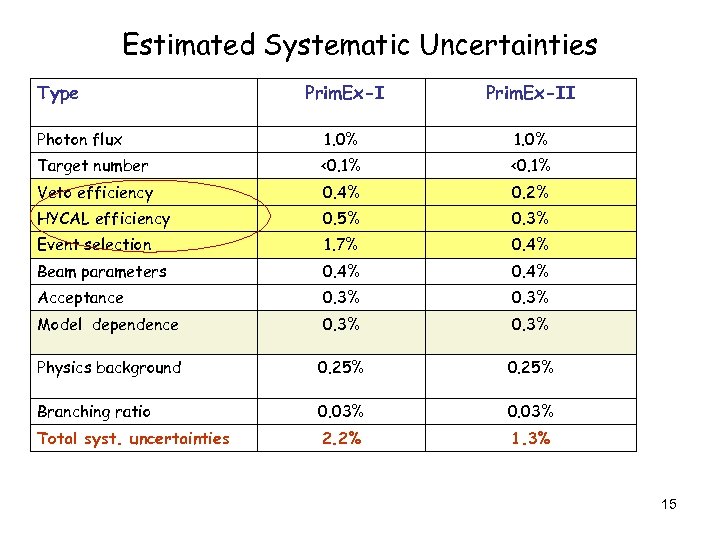 Estimated Systematic Uncertainties Type Prim. Ex-II Photon flux 1. 0% Target number <0. 1% Veto efficiency 0. 4% 0. 2% HYCAL efficiency 0. 5% 0. 3% Event selection 1. 7% 0. 4% Beam parameters 0. 4% Acceptance 0. 3% Model dependence 0. 3% Physics background 0. 25% Branching ratio 0. 03% Total syst. uncertainties 2. 2% 1. 3% 15
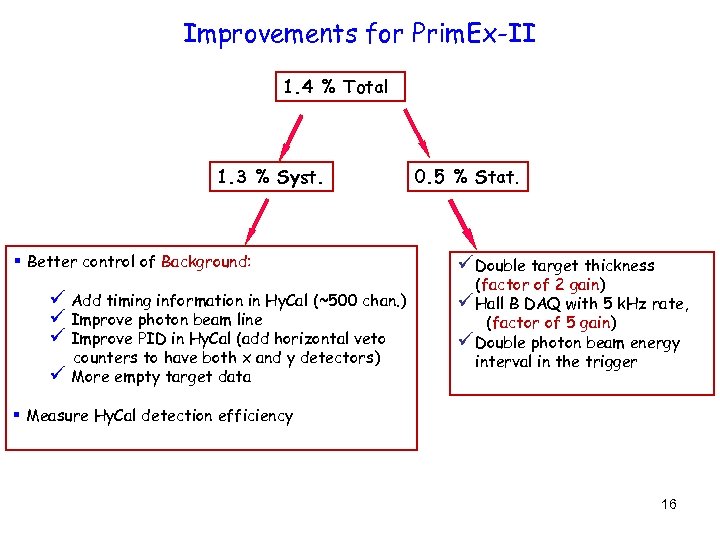 Improvements for Prim. Ex-II 1. 4 % Total 1. 3 % Syst. § Better control of Background: ü Add timing information in Hy. Cal (~500 chan. ) ü Improve photon beam line ü Improve PID in Hy. Cal (add horizontal veto counters to have both x and y detectors) ü More empty target data 0. 5 % Stat. ü Double target thickness (factor of 2 gain) ü Hall B DAQ with 5 k. Hz rate, (factor of 5 gain) ü Double photon beam energy interval in the trigger § Measure Hy. Cal detection efficiency 16
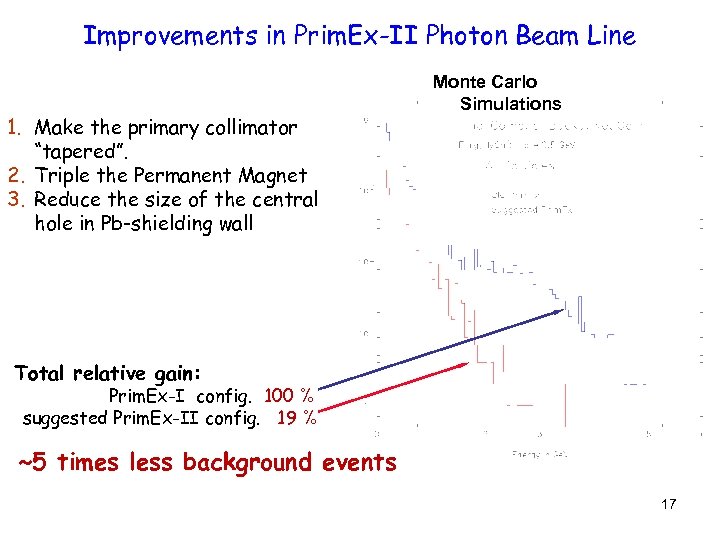 Improvements in Prim. Ex-II Photon Beam Line 1. Make the primary collimator “tapered”. 2. Triple the Permanent Magnet 3. Reduce the size of the central hole in Pb-shielding wall Monte Carlo Simulations Total relative gain: Prim. Ex-I config. 100 % suggested Prim. Ex-II config. 19 % ~5 times less background events 17
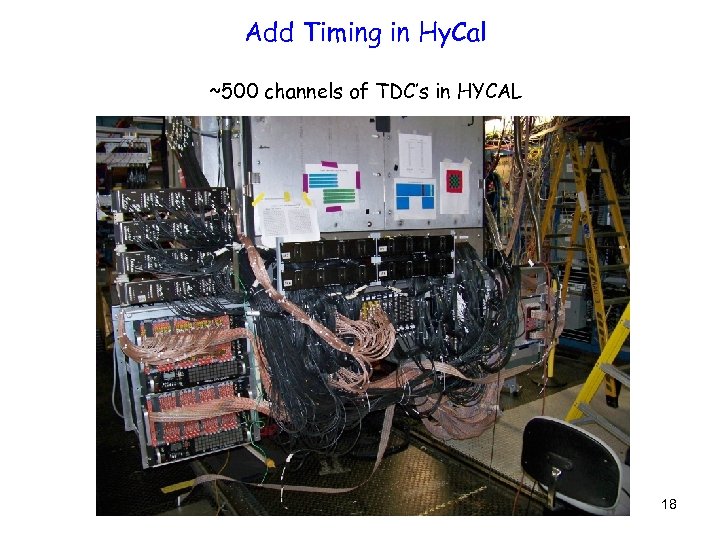 Add Timing in Hy. Cal ~500 channels of TDC’s in HYCAL 18
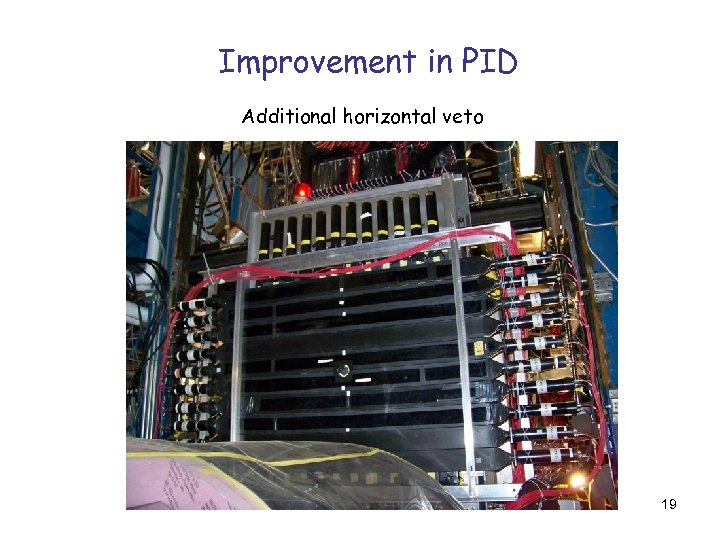 Improvement in PID Additional horizontal veto 19
 Prim. Ex-II Run Status § Experiment was performed from Sep. 27 to Nov. 10 in 2010. § Physics data collected: v π0 production run on two nuclear targets: and 12 C (1. 1% statistics). 28 Si (0. 6% statistics) v Good statistics for two well-known QED processes to verify the systematic uncertainties: Compton scattering and e +e- pair production. 20
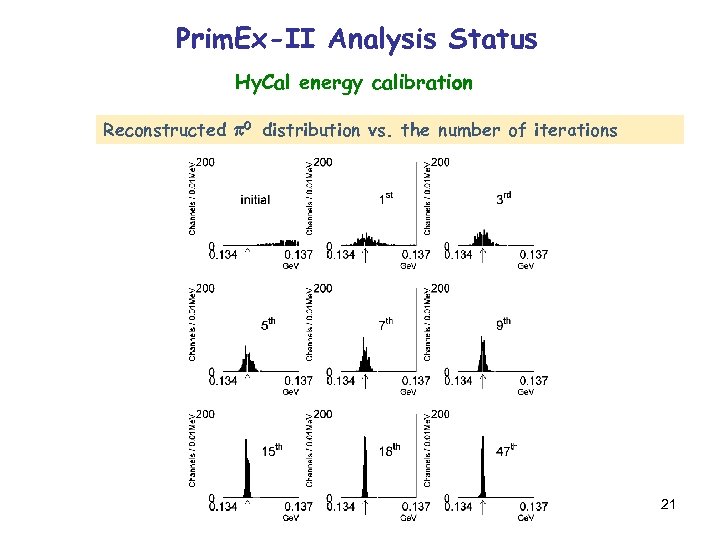 Prim. Ex-II Analysis Status Hy. Cal energy calibration Reconstructed 0 distribution vs. the number of iterations 21
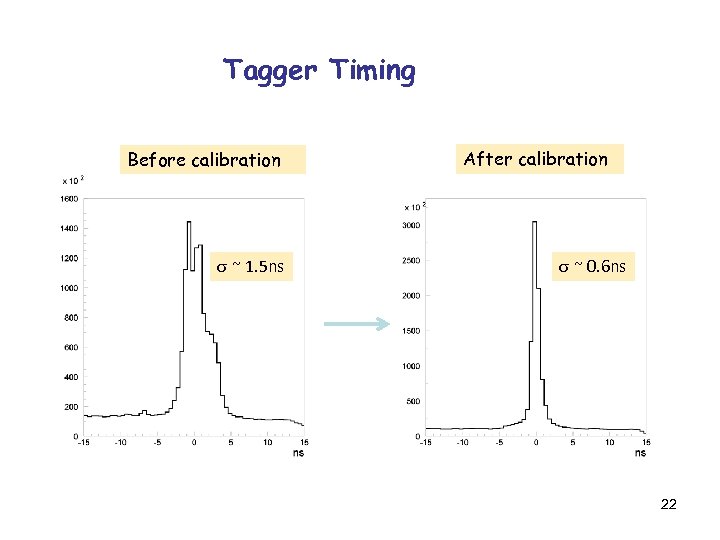 Tagger Timing Before calibration ~ 1. 5 ns After calibration ~ 0. 6 ns 22
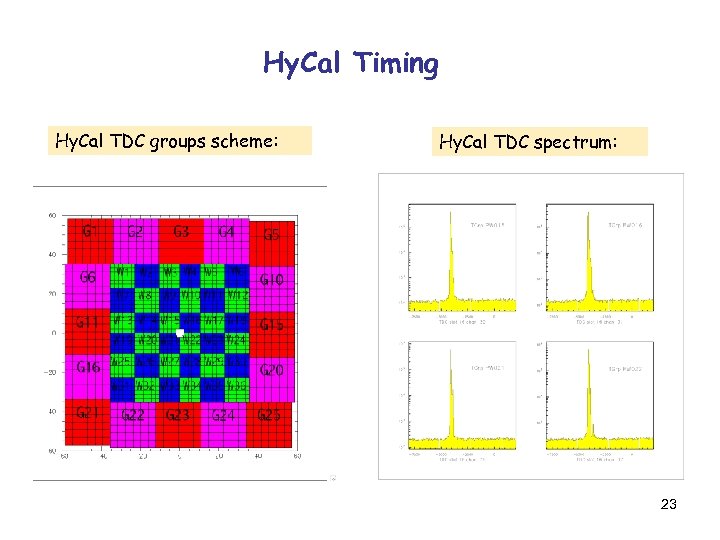 Hy. Cal Timing Hy. Cal TDC groups scheme: Hy. Cal TDC spectrum: 23
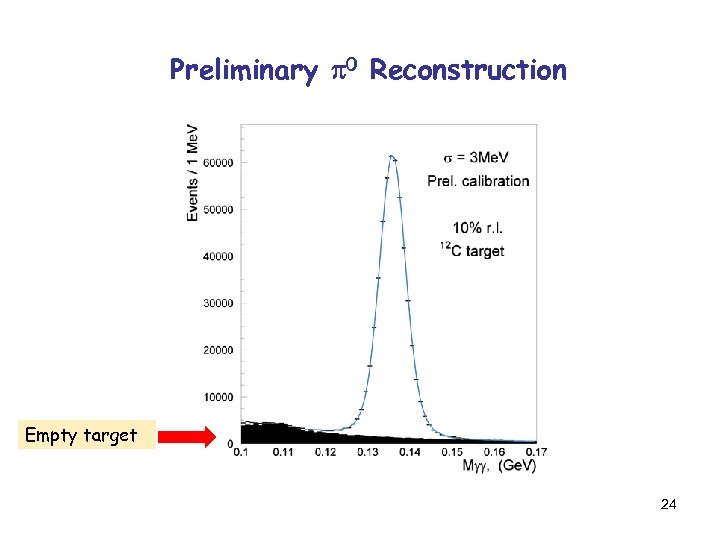 Preliminary 0 Reconstruction Empty target 24
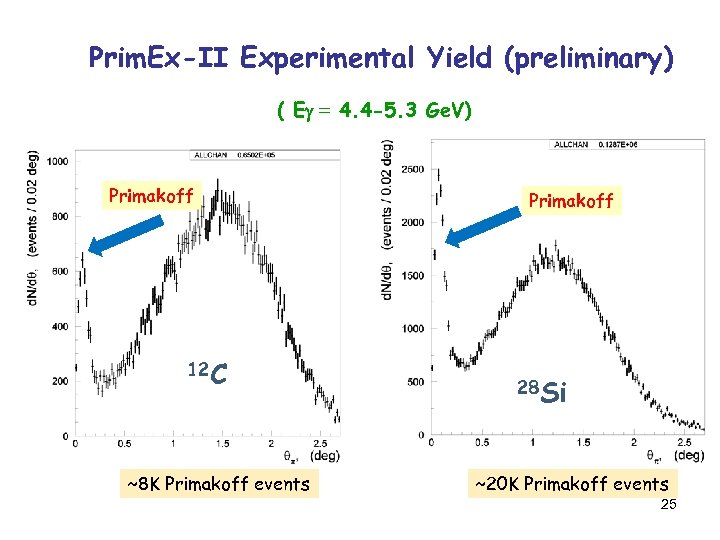 Prim. Ex-II Experimental Yield (preliminary) ( E = 4. 4 -5. 3 Ge. V) Primakoff 12 C ~8 K Primakoff events Primakoff 28 Si ~20 K Primakoff events 25
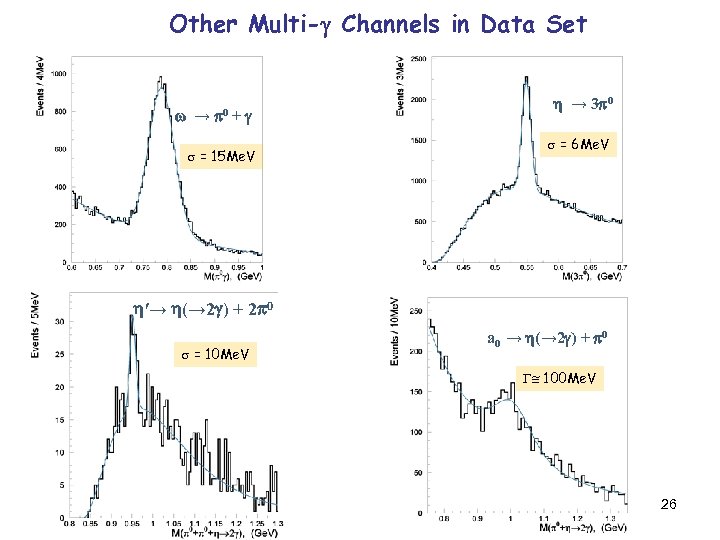 Other Multi- Channels in Data Set → 0 + = 15 Me. V → 3 0 = 6 Me. V ʹ→ (→ 2 ) + 2 0 = 10 Me. V a 0 → (→ 2 ) + 0 100 Me. V 26
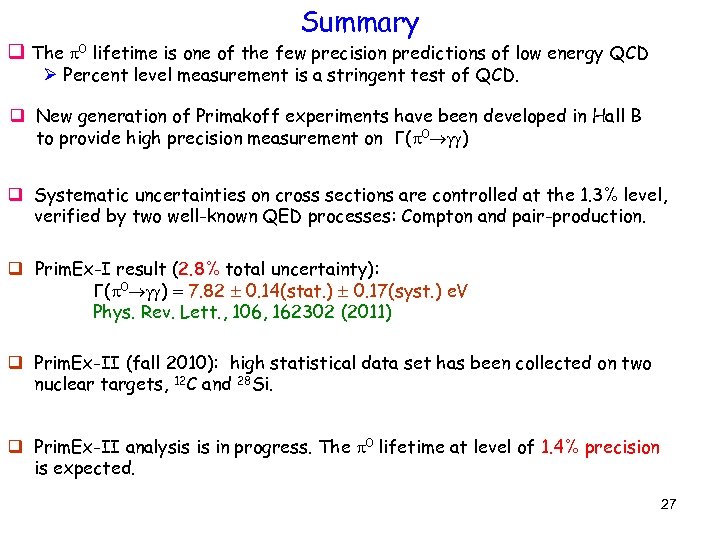 Summary q The 0 lifetime is one of the few precision predictions of low energy QCD Ø Percent level measurement is a stringent test of QCD. q New generation of Primakoff experiments have been developed in Hall B to provide high precision measurement on Γ( 0 ) q Systematic uncertainties on cross sections are controlled at the 1. 3% level, verified by two well-known QED processes: Compton and pair-production. q Prim. Ex-I result (2. 8% total uncertainty): Γ( 0 ) 7. 82 0. 14(stat. ) 0. 17(syst. ) e. V Phys. Rev. Lett. , 106, 162302 (2011) q Prim. Ex-II (fall 2010): high statistical data set has been collected on two nuclear targets, 12 C and 28 Si. q Prim. Ex-II analysis is in progress. The 0 lifetime at level of 1. 4% precision is expected. 27
 This project is supported by: q NSF MRI (PHY-0079840) q Jlab under DOE contract (DE-AC 05 -84 ER 40150) Thank You! 28
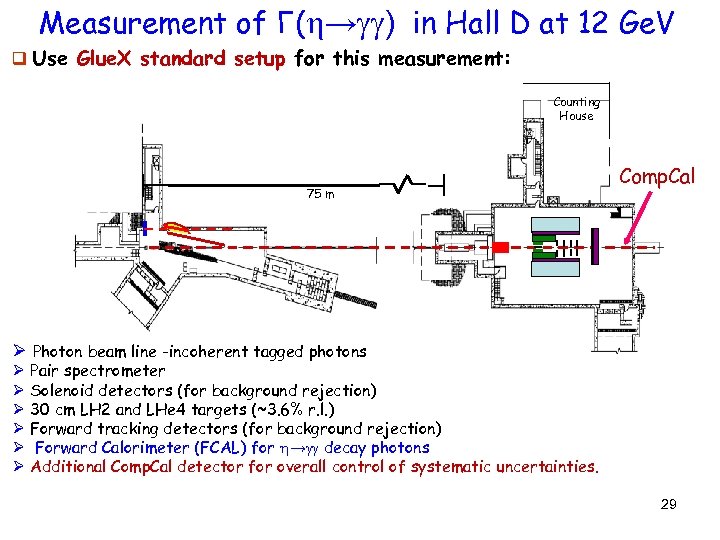 Measurement of Γ( → ) in Hall D at 12 Ge. V q Use Glue. X standard setup for this measurement: Counting House 75 m Comp. Cal Ø Photon beam line -incoherent tagged photons Ø Pair spectrometer Ø Solenoid detectors (for background rejection) Ø 30 cm LH 2 and LHe 4 targets (~3. 6% r. l. ) Ø Forward tracking detectors (for background rejection) Ø Forward Calorimeter (FCAL) for → decay photons Ø Additional Comp. Cal detector for overall control of systematic uncertainties. 29
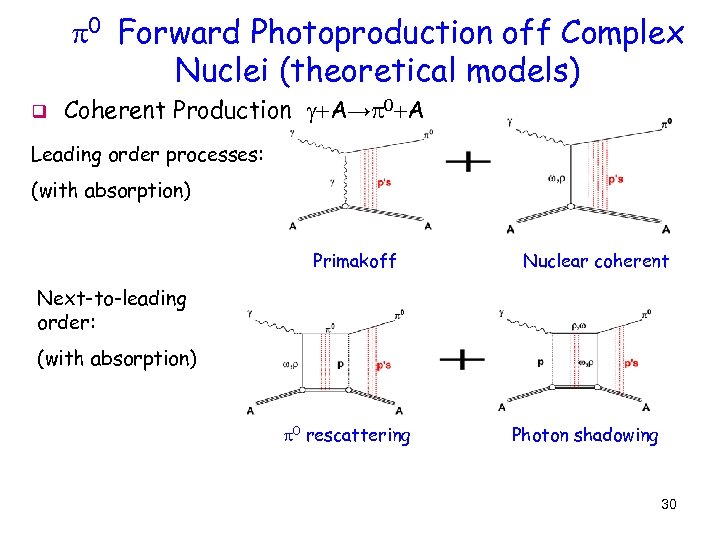 0 Forward Photoproduction off Complex Nuclei (theoretical models) q Coherent Production A→ 0 A Leading order processes: (with absorption) Primakoff Nuclear coherent Next-to-leading order: (with absorption) 0 rescattering Photon shadowing 30
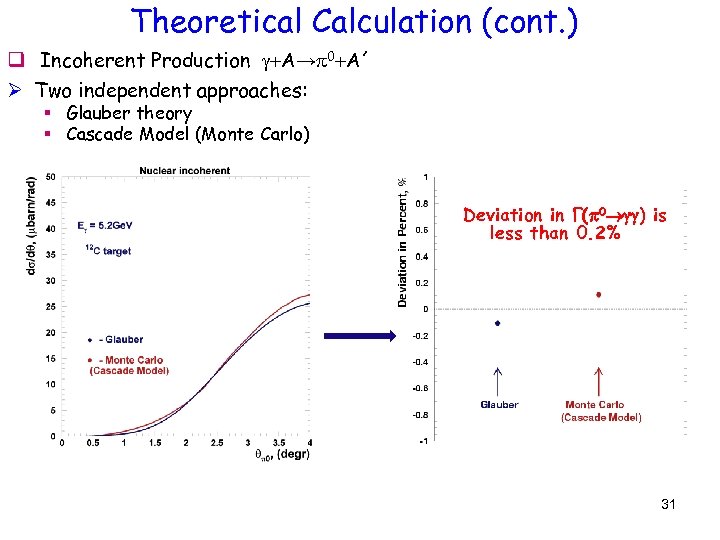 Theoretical Calculation (cont. ) q Incoherent Production A→ 0 A´ Ø Two independent approaches: § Glauber theory § Cascade Model (Monte Carlo) Deviation in Γ( 0 ) is less than 0. 2% 31
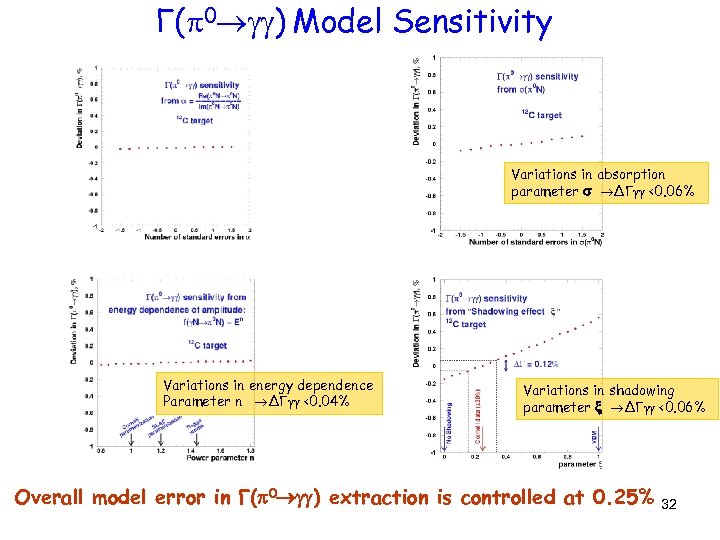 Γ( 0 ) Model Sensitivity Variations in absorption parameter s ΔΓ <0. 06% Variations in energy dependence Parameter n ΔΓ <0. 04% Variations in shadowing parameter x ΔΓ <0. 06% Overall model error in Γ( 0 ) extraction is controlled at 0. 25% 32
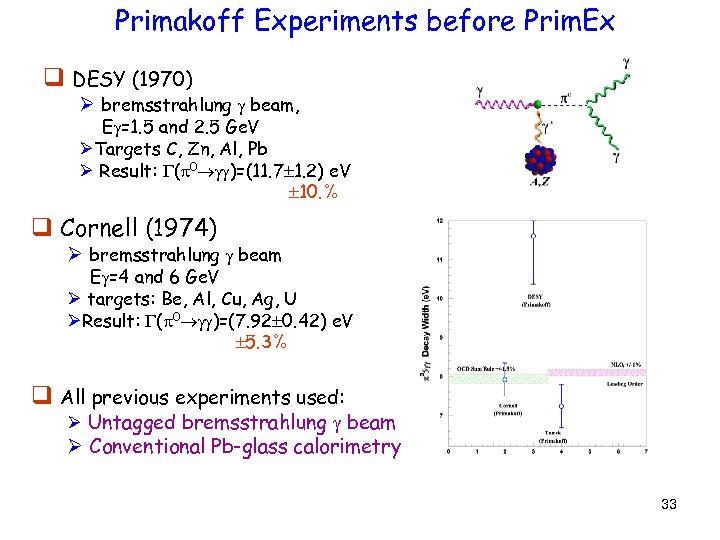 Primakoff Experiments before Prim. Ex q DESY (1970) Ø bremsstrahlung beam, E =1. 5 and 2. 5 Ge. V ØTargets C, Zn, Al, Pb Ø Result: ( 0 )=(11. 7 1. 2) e. V 10. % q Cornell (1974) Ø bremsstrahlung beam E =4 and 6 Ge. V Ø targets: Be, Al, Cu, Ag, U ØResult: ( 0 )=(7. 92 0. 42) e. V 5. 3% q All previous experiments used: Ø Untagged bremsstrahlung beam Ø Conventional Pb-glass calorimetry 33
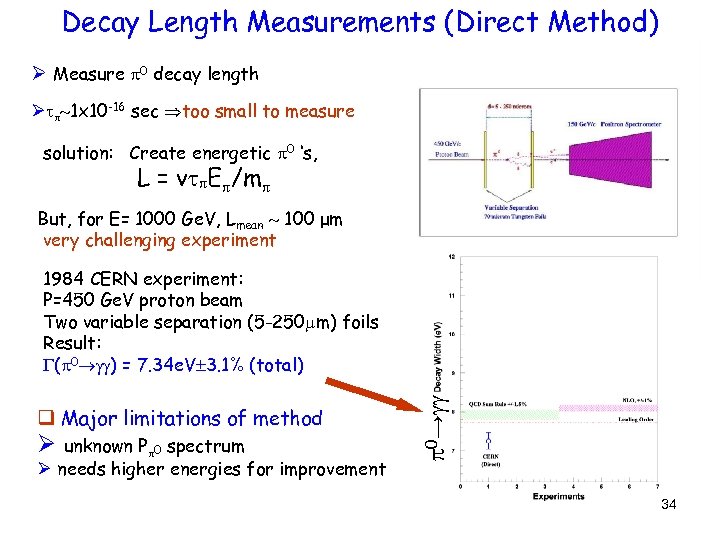 Decay Length Measurements (Direct Method) Ø Measure 0 decay length Ø 1 x 10 -16 sec too small to measure solution: Create energetic 0 ‘s, L = v E /m But, for E= 1000 Ge. V, Lmean 100 μm very challenging experiment q Major limitations of method Ø unknown P 0 spectrum Ø needs higher energies for improvement 0→ 1984 CERN experiment: P=450 Ge. V proton beam Two variable separation (5 -250 m) foils Result: ( 0 ) = 7. 34 e. V 3. 1% (total) 34
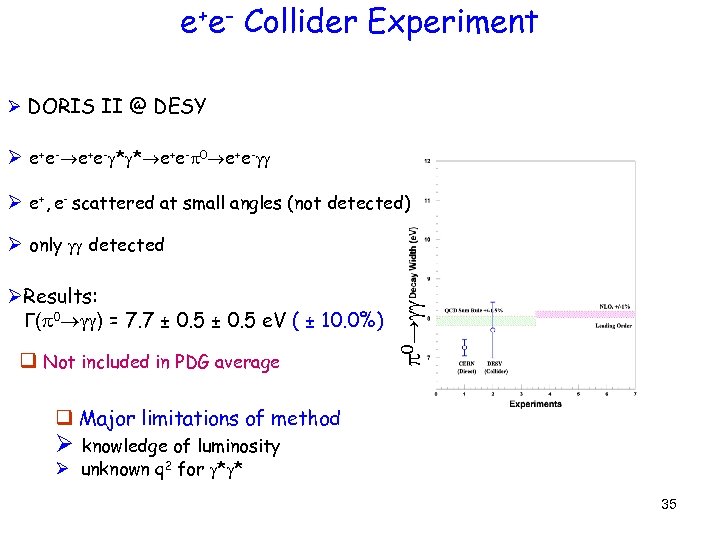 e+e- Collider Experiment Ø DORIS II @ DESY Ø e+e- * * e+e- 0 e+e- Ø e+, e- scattered at small angles (not detected) ØResults: Γ( 0 ) = 7. 7 ± 0. 5 e. V ( ± 10. 0%) q Not included in PDG average 0→ Ø only detected q Major limitations of method Ø knowledge of luminosity Ø unknown q 2 for * * 35
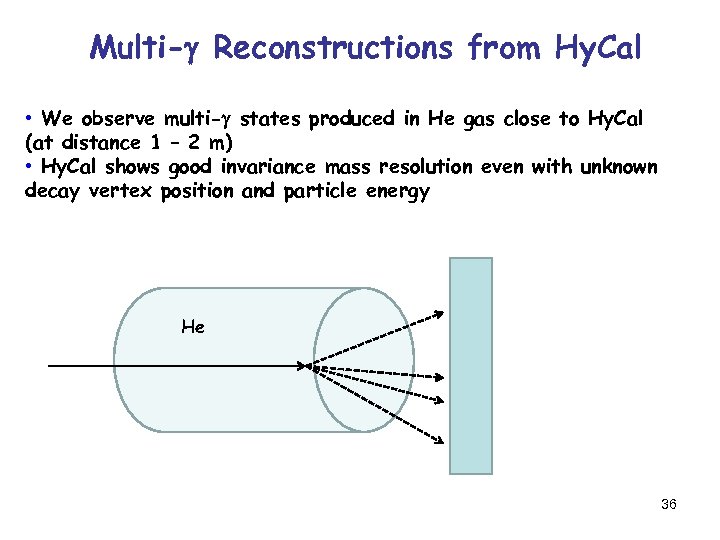 Multi- Reconstructions from Hy. Cal • We observe multi- states produced in He gas close to Hy. Cal (at distance 1 – 2 m) • Hy. Cal shows good invariance mass resolution even with unknown decay vertex position and particle energy He 36
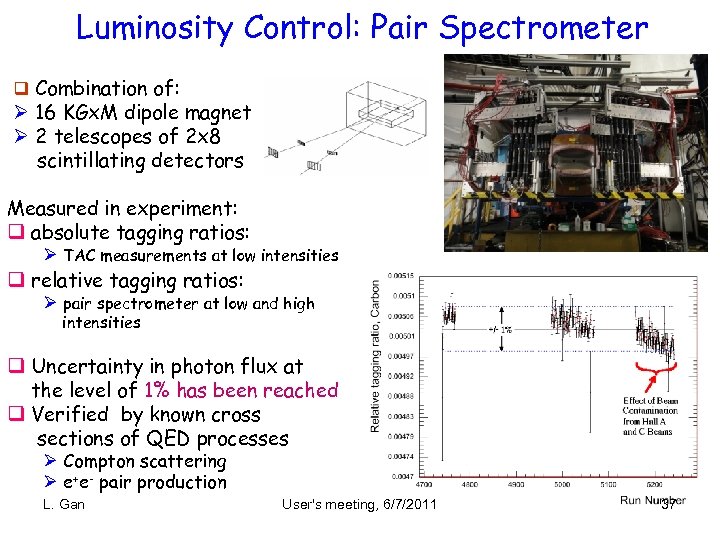 Luminosity Control: Pair Spectrometer q Combination of: Ø 16 KGx. M dipole magnet Ø 2 telescopes of 2 x 8 scintillating detectors Measured in experiment: q absolute tagging ratios: Ø TAC measurements at low intensities q relative tagging ratios: Ø pair spectrometer at low and high intensities q Uncertainty in photon flux at the level of 1% has been reached q Verified by known cross sections of QED processes Ø Compton scattering Ø e+e- pair production L. Gan User's meeting, 6/7/2011 37