 Скачать презентацию Προχωρημένα Θέματα Ηλεκτρονικού Επιχειρείν Διάλεξη 2η Organizational
7eb4e5610125624b3ae40b0eadb162c0.ppt
- Количество слайдов: 18



“Προχωρημένα Θέματα Ηλεκτρονικού Επιχειρείν” Διάλεξη 2η – Organizational Webs Δρ. Κώστας Κούτσικος
Η ατζέντα της ημέρας • Σύνδεση με τα προηγούμενα • Organizational webs – collaboration and coordination through emerging technologies • ‘E-markets’ article • Τελικά σχόλια
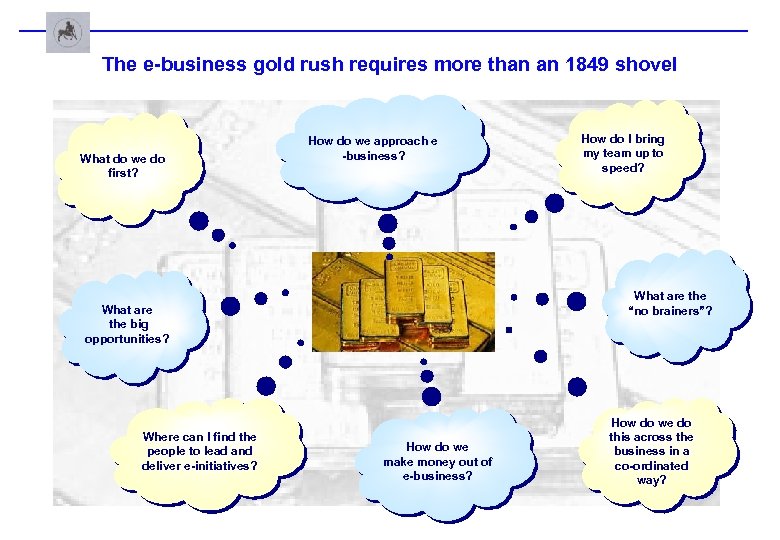
The e-business gold rush requires more than an 1849 shovel What do we do first? How do we approach e -business? What are the “no brainers”? What are the big opportunities? Where can I find the people to lead and deliver e-initiatives? How do I bring my team up to speed? How do we make money out of e-business? How do we do this across the business in a co-ordinated way?
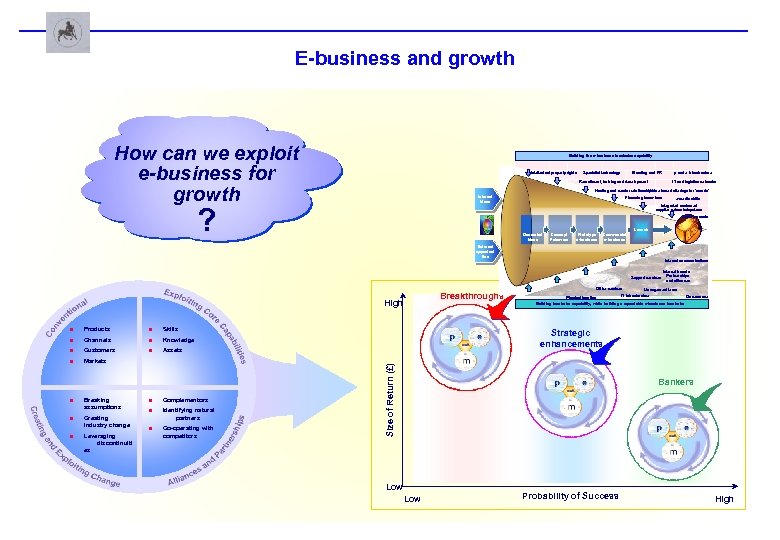
E-business and growth How can we exploit e-business for growth Building the e-business incubator capability Intellectual property rights Specialist technology Branding and PR Recruitment, training and development p and e infrastructure IT and logistics networks Hosting and vendor relationships Value based offerings for ‘smarts’ Internal ideas ? Financing know-how e-media skills Integrated customer/ supplier networks/systems Scale-up costs Launch Generated ideas Concept Fakeware Prototype e-business Commercial e-business External opportuni ties Internal communications Internet brands Partnerships Support services and alliances Office services Breakthroughs High Products n Skills n Channels n Knowledge n Customers n Assets n Markets n Breaking assumptions n Creating industry change n Leveraging discontinuiti es n Complementors n Identifying natural partners n Co-operating with competitors Management team IT Infrastructure Governance Building incubator capability, while building a repeatable e-business incubator Strategic enhancements Size of Return (£) n Physical location Bankers Low Probability of Success High
Organizational Webs
Some words of wisdom on organizational webs “The last wave of productivity gains came from knocking down departmental walls …The next wave is about knocking down company walls - getting multiple companies to work together as one. It is much bigger, and the early leaders have achieved dramatic success…” Dr. Michael Hammer
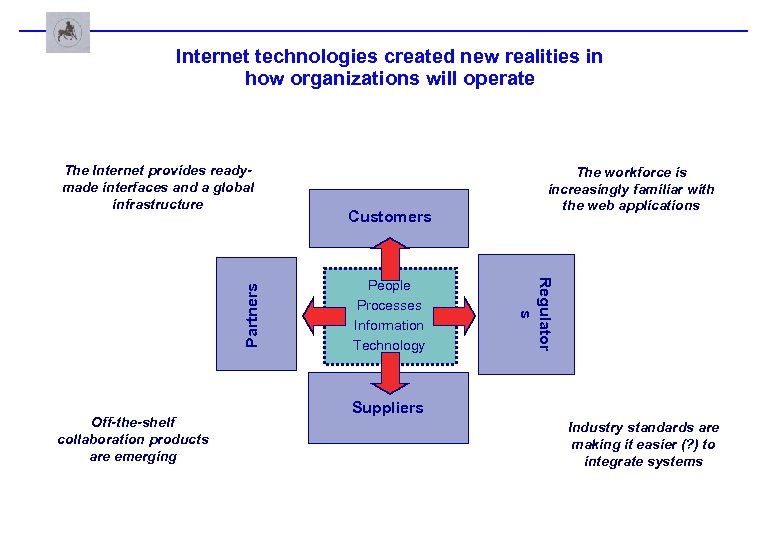
Internet technologies created new realities in how organizations will operate Off-the-shelf collaboration products are emerging Customers People Processes Information Technology The workforce is increasingly familiar with the web applications Regulator s Partners The Internet provides readymade interfaces and a global infrastructure Suppliers Industry standards are making it easier (? ) to integrate systems
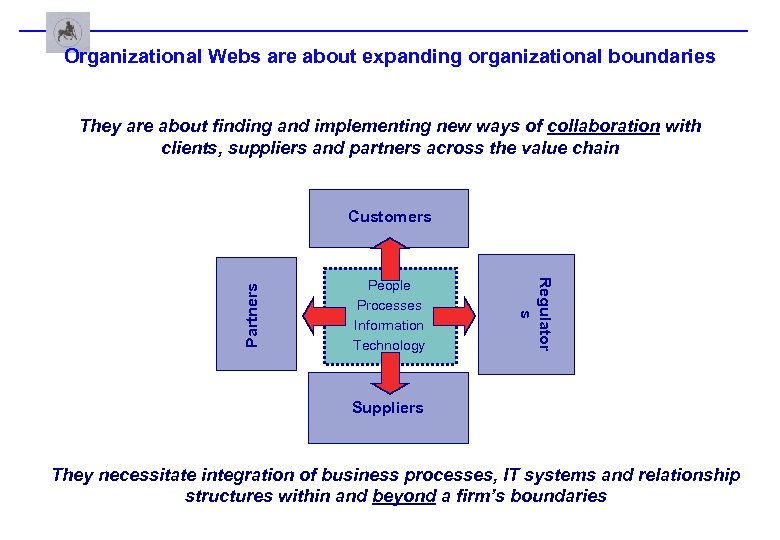
Organizational Webs are about expanding organizational boundaries They are about finding and implementing new ways of collaboration with clients, suppliers and partners across the value chain People Processes Information Technology Regulator s Partners Customers Suppliers They necessitate integration of business processes, IT systems and relationship structures within and beyond a firm’s boundaries
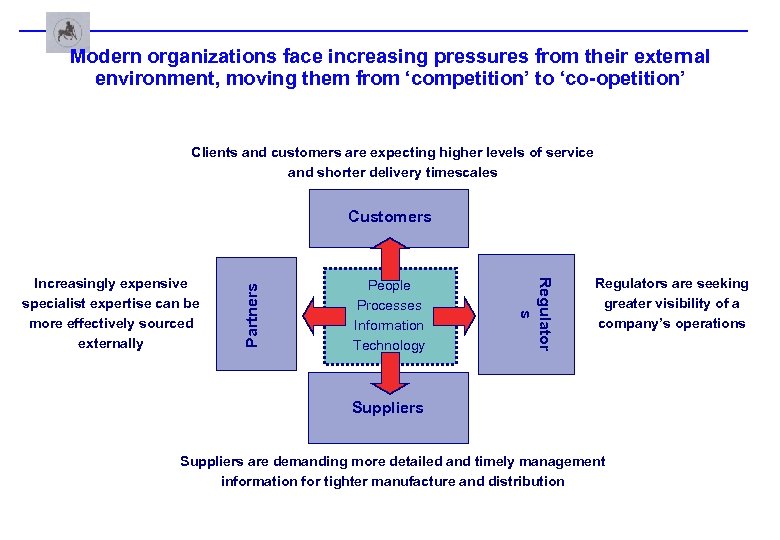
Modern organizations face increasing pressures from their external environment, moving them from ‘competition’ to ‘co-opetition’ Clients and customers are expecting higher levels of service and shorter delivery timescales People Processes Information Technology Regulator s Increasingly expensive specialist expertise can be more effectively sourced externally Partners Customers Regulators are seeking greater visibility of a company’s operations Suppliers are demanding more detailed and timely management information for tighter manufacture and distribution
How can organizations collaborate ?
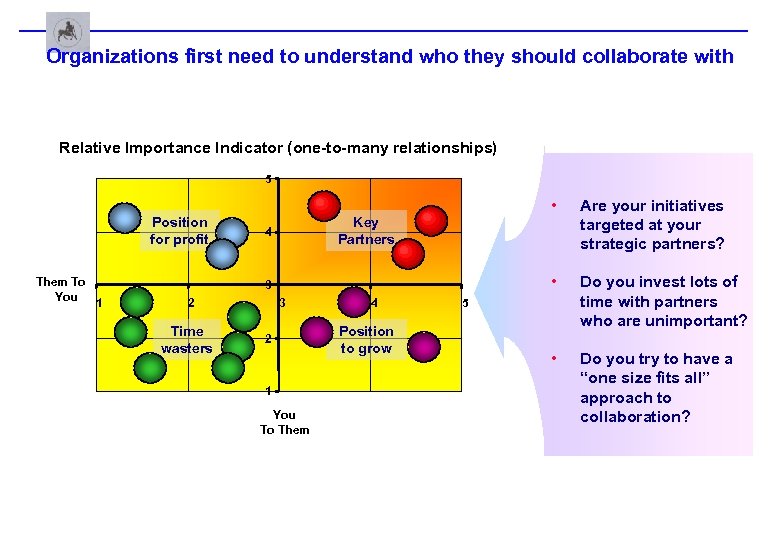
Organizations first need to understand who they should collaborate with Relative Importance Indicator (one-to-many relationships) 5 • Position for profit Them To You 1 • 3 Time wasters Do you invest lots of time with partners who are unimportant? • Do you try to have a “one size fits all” approach to collaboration? Key Partners 4 2 Are your initiatives targeted at your strategic partners? 3 2 1 You To Them 4 Position to grow 5
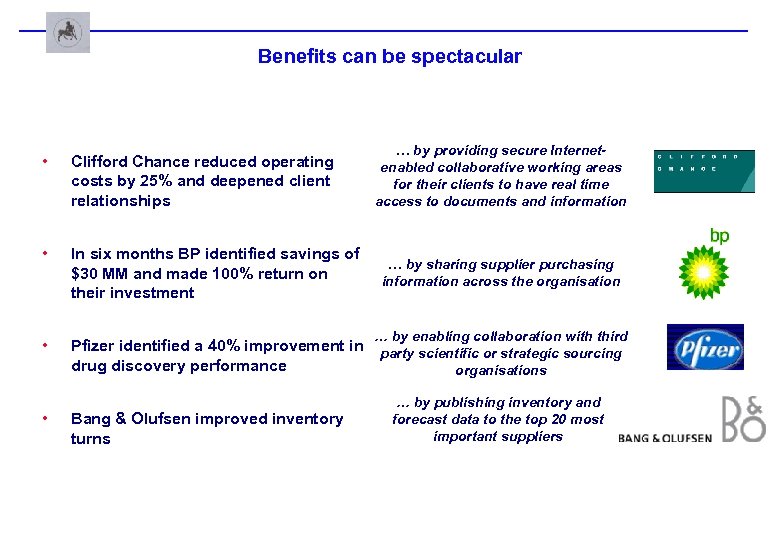
Benefits can be spectacular … by providing secure Internetenabled collaborative working areas for their clients to have real time access to documents and information • Clifford Chance reduced operating costs by 25% and deepened client relationships • In six months BP identified savings of $30 MM and made 100% return on their investment … by sharing supplier purchasing information across the organisation • Pfizer identified a 40% improvement in drug discovery performance … by enabling collaboration with third party scientific or strategic sourcing organisations • Bang & Olufsen improved inventory turns … by publishing inventory and forecast data to the top 20 most important suppliers
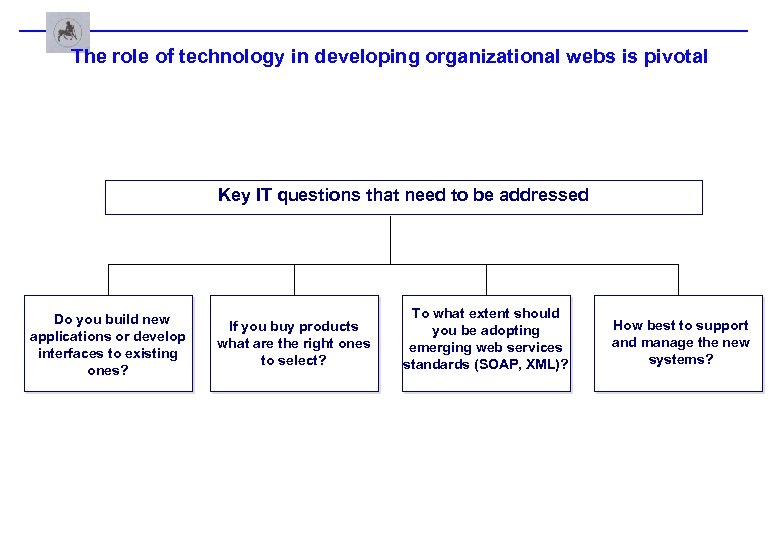
The role of technology in developing organizational webs is pivotal Key IT questions that need to be addressed Do you build new applications or develop interfaces to existing ones? If you buy products what are the right ones to select? To what extent should you be adopting emerging web services standards (SOAP, XML)? How best to support and manage the new systems?
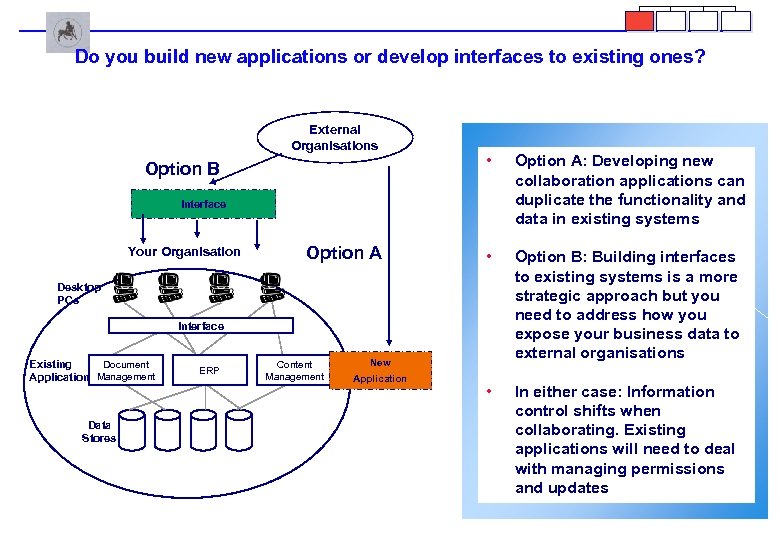
Do you build new applications or develop interfaces to existing ones? External Organisations Option B • Option A: Developing new collaboration applications can duplicate the functionality and data in existing systems • Option B: Building interfaces to existing systems is a more strategic approach but you need to address how you expose your business data to external organisations • In either case: Information control shifts when collaborating. Existing applications will need to deal with managing permissions and updates Interface Your Organisation Option A Desktop PCs Interface Document Existing Management Applications Data Stores ERP Content Management New Application
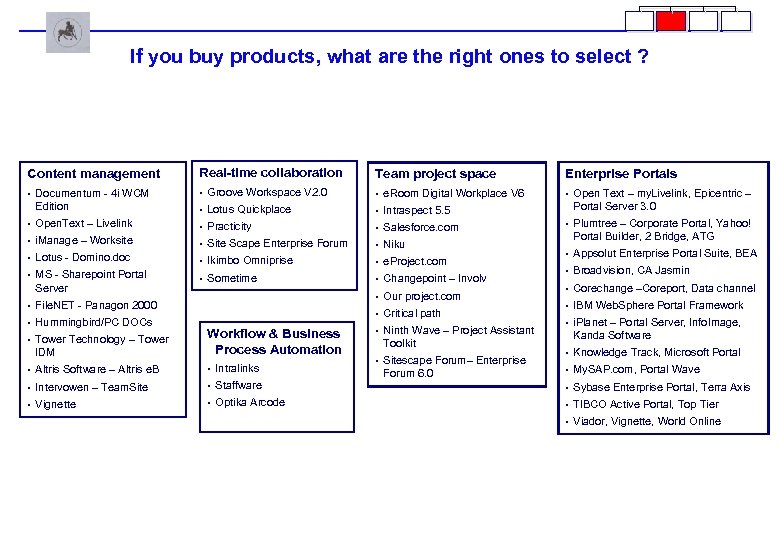
If you buy products, what are the right ones to select ? Content management Real-time collaboration Team project space • Groove Workspace V 2. 0 • e. Room Digital Workplace V 6 • Lotus Quickplace • Intraspect 5. 5 • Practicity • Salesforce. com i. Manage – Worksite • Site Scape Enterprise Forum • Niku • Lotus - Domino. doc • Ikimbo Omniprise • e. Project. com • MS - Sharepoint Portal Server • Sometime • Changepoint – Involv • Our project. com • Critical path • Ninth Wave – Project Assistant Toolkit • Sitescape Forum– Enterprise Forum 6. 0 Enterprise Portals • Documentum - 4 i WCM Edition • Open. Text – Livelink • • File. NET - Panagon 2000 • Hummingbird/PC DOCs • Tower Technology – Tower IDM Workflow & Business Process Automation • Altris Software – Altris e. B • Intralinks • Intervowen – Team. Site • Staffware • Vignette • Optika Arcode • Open Text – my. Livelink, Epicentric – Portal Server 3. 0 • Plumtree – Corporate Portal, Yahoo! Portal Builder, 2 Bridge, ATG • Appsolut Enterprise Portal Suite, BEA • Broadvision, CA Jasmin • Corechange –Coreport, Data channel • IBM Web. Sphere Portal Framework • i. Planet – Portal Server, Info. Image, Kanda Software • Knowledge Track, Microsoft Portal • My. SAP. com, Portal Wave • Sybase Enterprise Portal, Terra Axis • TIBCO Active Portal, Top Tier • Viador, Vignette, World Online
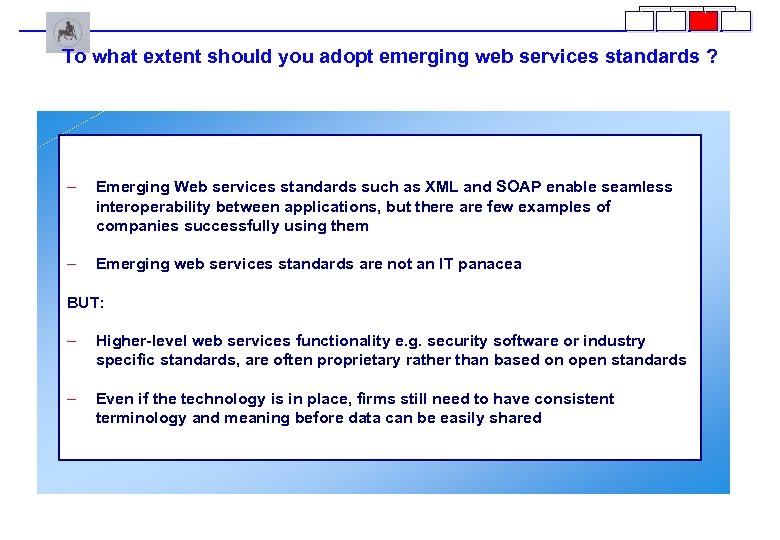
To what extent should you adopt emerging web services standards ? – Emerging Web services standards such as XML and SOAP enable seamless interoperability between applications, but there are few examples of companies successfully using them – Emerging web services standards are not an IT panacea BUT: – Higher-level web services functionality e. g. security software or industry specific standards, are often proprietary rather than based on open standards – Even if the technology is in place, firms still need to have consistent terminology and meaning before data can be easily shared
How to best support and manage the new systems ? • External facing systems are likely to have higher service expectations. People are far less tolerant of performance and reliability problems when they start working real-time e. g. ATM • The expectations for service reliability and performance will be high and potentially difficult to achieve • Is your IT Help desk up to the job or do you establish a new service centre? • There are often multiple parties involved (e. g. your IT provider, ISP, the partner’s IT organisation) so getting agreed service levels in place is key • Do your disaster recovery plans adequately cover the new system? • Is an exit strategy in place? Who owns the data in the event of termination of contract? • Effective security often has more to do with putting in place well-organised processes than IT
Emerging insights from PA Consulting Group’s ‘Collaboration Survey’ • Over 70% of initiatives are for strategic rather than tactical reasons • The top 3 benefits sought are to reduce costs, enhance service and improve revenue • The most important aspects to get right are having a shared vision and a strong level of trust between both parties
Скачать презентацию Προχωρημένα Θέματα Ηλεκτρονικού Επιχειρείν Διάλεξη 2η Organizational
7eb4e5610125624b3ae40b0eadb162c0.ppt