 Скачать презентацию ΝΕΑ ΔΕΔΟΜΕΝΑ ΣΤΗΝ ΥΓΙΕΙΝΗ ΤΩΝ ΚΟΛΥΜΒΗΤΗΡΙΩΝ Καθ Αθηνά
5166b6c72cac720a6ce3ec259318232a.ppt
- Количество слайдов: 58



ΝΕΑ ΔΕΔΟΜΕΝΑ ΣΤΗΝ ΥΓΙΕΙΝΗ ΤΩΝ ΚΟΛΥΜΒΗΤΗΡΙΩΝ Καθ Αθηνά Μαυρίδου Τμήμα Ιατρικών Εργαστηρίων ΤΕΙ Αθήνας
David Hockney 1966
David Hockney Swimming Pool (1980)
ΠΡΟΒΛΗΜΑΤΑ • Τεκμηριώνεται υδατογενής μετάδοση λοιμώξεων μέσω κολύμβησης. • Τεχνητά περιβάλλοντα κολύμβησης υπεύθυνα για το 90% των περιστατικών. • Επιπτώσεις στην δημόσια υγεία • Επιπτώσεις στην τουριστική βιομηχανία Στην παρούσα παρουσίαση • επισκόπηση της έρευνας • highlight ασυνήθιστων περιστατικών/ επιδημιών • ειδικές περιπτώσεις /φυσικές δεξαμενές • Το μέλλον της έρευνας
Τι προκαλούν • • Ωτίτιδες, δερματοπάθειες Επιπεφυκίτιδες κερατίτιδες Λοιμώξεις του άνω αναπνευστικού Γαστρεντερίτιδες Ηπατίτιδα A και άλλες ιογενείς λοιμώξεις Πνευμονία Μηνιγγίτιδα
Από που προέρχονται • • Από την παροχή του νερού Από τον περιβάλλοντα χώρο Μέσω του δέρματος των κολυμβητών Από το άνω αναπνευστικό των κολυμβητών Από εμετούς Από κόπρανα ανθρώπων, ζώων και πτηνών Από τα αποδητήρια και αποχωρητήρια Από ρύπους μέσω της ατμόσφαιρας και μεταφορά μέ τον αέρα
Πύλες εισόδου • • • Ασυνέχεια δέρματος Κατάποση Μύτη Εξω γενητικό σύστημα Τραύματα αναπνοή
ΥΛΙΚΟ ΕΠΙΣΚΟΠΗΣΗΣ • Proceedings of 5 European Swimming Pool and Spa Conferences. • Review της δημοσιευμένης βιβλιογραφίας. • Στοιχεία διεθνών Οργανισμών. • Μελέτη στην Μεσόγειο (Mavridou, WHO)
Eρώτημα üΜήπως οι ερευνητές προσανατολίζονται σε συγκεκριμένα παθογόνα?
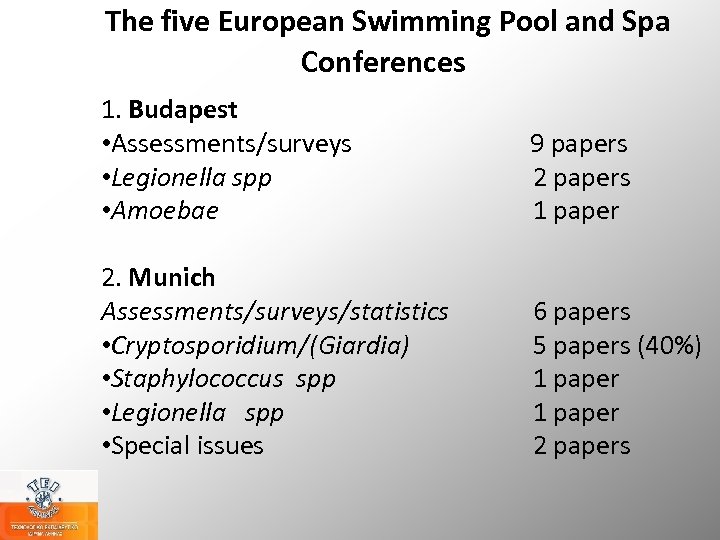
The five European Swimming Pool and Spa Conferences 1. Budapest • Αssessments/surveys • Legionella spp • Amoebae 2. Munich Assessments/surveys/statistics • Cryptosporidium/(Giardia) • Staphylococcus spp • Legionella spp • Special issues 9 papers 2 papers 1 paper 6 papers 5 papers (40%) 1 paper 2 papers
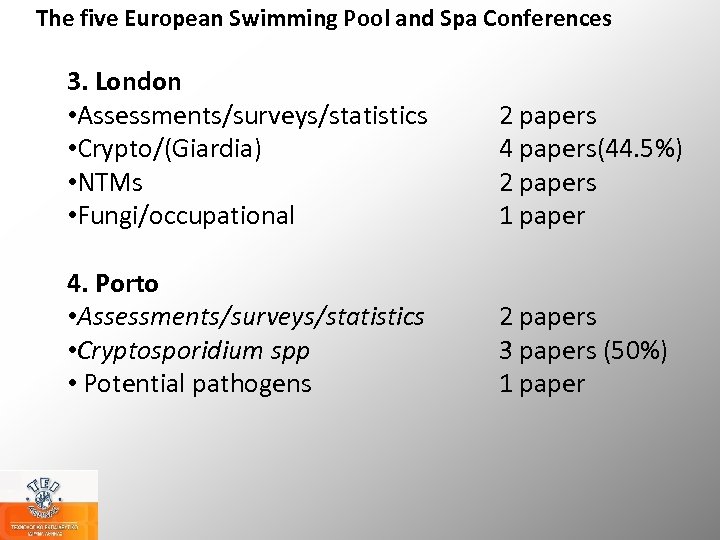
The five European Swimming Pool and Spa Conferences 3. London • Assessments/surveys/statistics • Crypto/(Giardia) • NTMs • Fungi/occupational 2 papers 4 papers(44. 5%) 2 papers 1 paper 4. Porto • Assessments/surveys/statistics • Cryptosporidium spp • Potential pathogens 2 papers 3 papers (50%) 1 paper
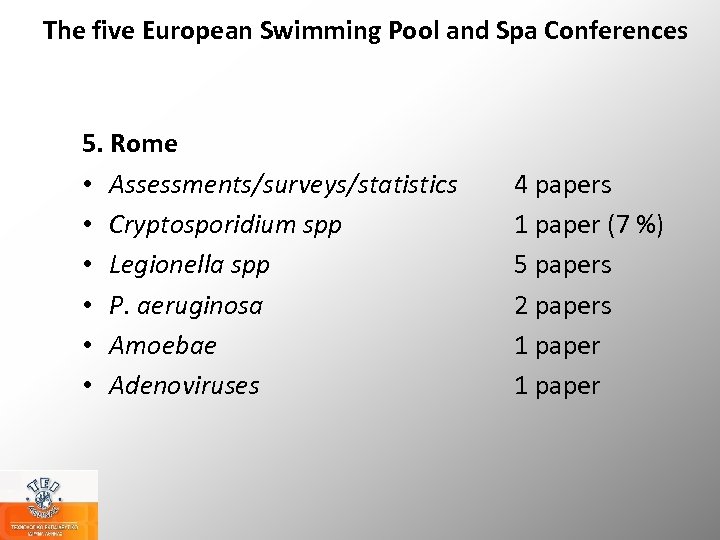
The five European Swimming Pool and Spa Conferences 5. Rome • Assessments/surveys/statistics • Cryptosporidium spp • Legionella spp • P. aeruginosa • Amoebae • Adenoviruses 4 papers 1 paper (7 %) 5 papers 2 papers 1 paper
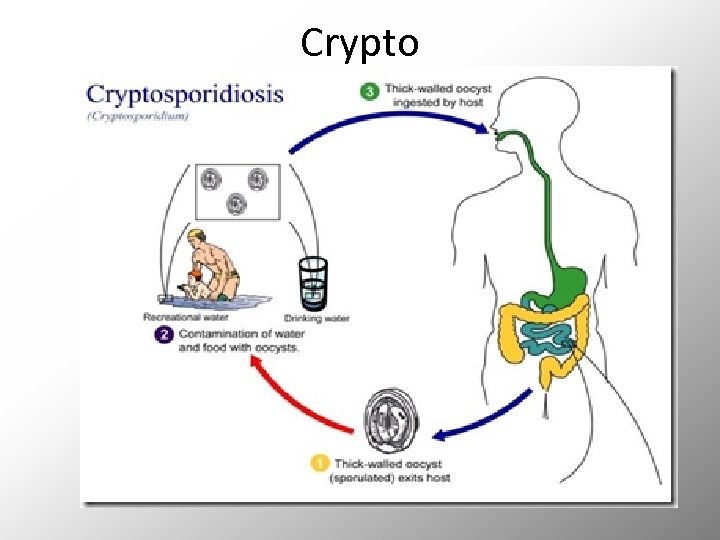
Crypto
ΕΠΙΣΚΟΠΗΣΗ ΒΙΒΛΙΟΓΡΑΦΙΑΣ
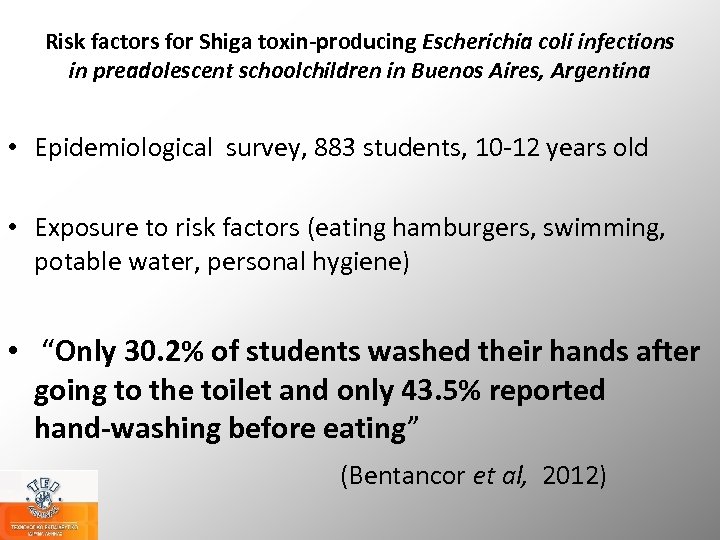
Risk factors for Shiga toxin‐producing Escherichia coli infections in preadolescent schoolchildren in Buenos Aires, Argentina • Epidemiological survey, 883 students, 10 -12 years old • Exposure to risk factors (eating hamburgers, swimming, potable water, personal hygiene) • “Only 30. 2% of students washed their hands after going to the toilet and only 43. 5% reported hand‐washing before eating” (Bentancor et al, 2012)
THE INTERNATIONAL LITERATURE • 181 διεθνείς μελέτες • 43 (24%) στη Μεσόγειο WHO MED‐ Project : – Διερεύνηση νομοθεσιών στιςΜεσογειακές χώρες Εργαλεία: – Ερωτηματολόγια – Βιβλιογραφία – CDC, ECDC Eurosurveillance
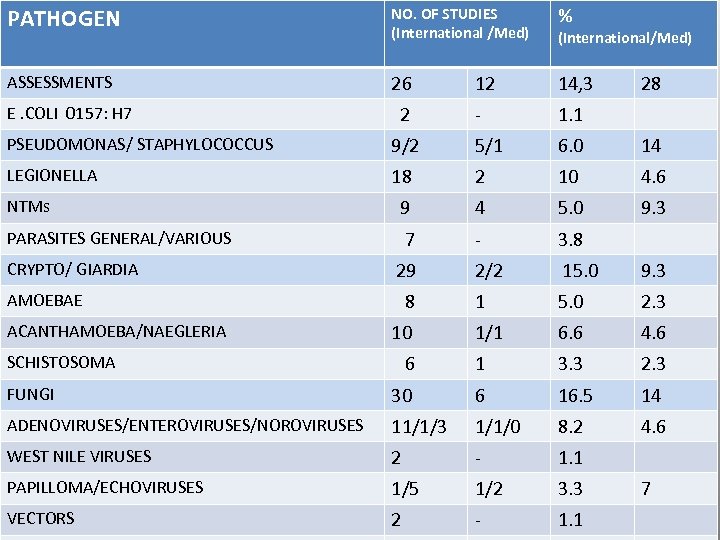
PATHOGEN NO. OF STUDIES (International /Med) % ASSESSMENTS 26 12 14, 3 E. COLI 0157: H 7 2 - 1. 1 PSEUDOMONAS/ STAPHYLOCOCCUS 9/2 5/1 6. 0 14 LEGIONELLA 18 2 10 4. 6 NTMs 9 4 5. 0 9. 3 PARASITES GENERAL/VARIOUS 7 - 3. 8 CRYPTO/ GIARDIA 29 2/2 15. 0 9. 3 AMOEBAE 8 1 5. 0 2. 3 ACANTHAMOEBA/NAEGLERIA 10 1/1 6. 6 4. 6 SCHISTOSOMA 6 1 3. 3 2. 3 FUNGI 30 6 16. 5 14 ADENOVIRUSES/ENTEROVIRUSES/NOROVIRUSES 11/1/3 1/1/0 8. 2 4. 6 WEST NILE VIRUSES 2 - 1. 1 PAPILLOMA/ECHOVIRUSES 1/5 1/2 3. 3 VECTORS 2 - 1. 1 (International/Med) 28 7
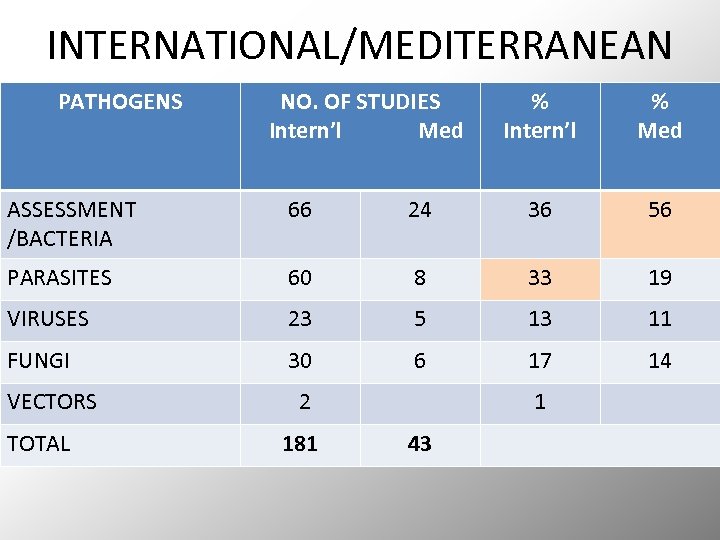
INTERNATIONAL/MEDITERRANEAN PATHOGENS NO. OF STUDIES Intern’l Med % Intern’l % Med ΑSSESSMENT /BACTERIA 66 24 36 56 PARASITES 60 8 33 19 VIRUSES 23 5 13 11 FUNGI 30 6 17 14 VECTORS 2 TOTAL 181 1 43
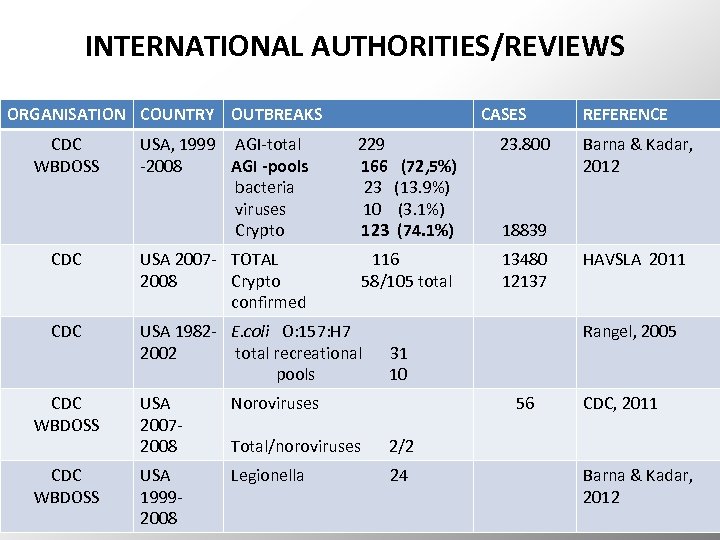
INTERNATIONAL AUTHORITIES/REVIEWS ORGANISATION COUNTRY OUTBREAKS CDC WBDOSS CASES USA, 1999 AGI-total 229 -2008 AGI ‐pools 166 (72, 5%) bacteria 23 (13. 9%) viruses 10 (3. 1%) Crypto 123 (74. 1%) 23. 800 CDC USA 2007 - TOTAL 116 2008 Crypto 58/105 total confirmed 13480 12137 CDC USA 1982 - E. coli O: 157: H 7 2002 total recreational 31 pools 10 CDC WBDOSS USA 20072008 Noroviruses CDC WBDOSS USA 19992008 Legionella 24 REFERENCE Barna & Kadar, 2012 18839 HAVSLA 2011 Rangel, 2005 56 CDC, 2011 Total/noroviruses 2/2 Barna & Kadar, 2012
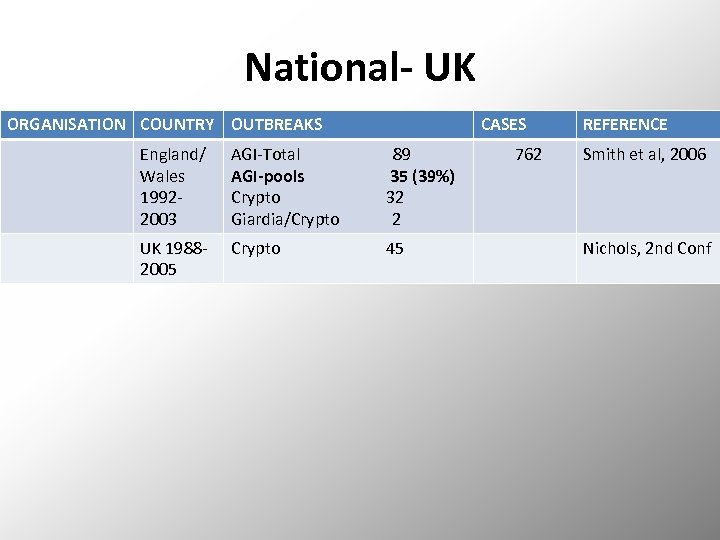
National‐ UK ORGANISATION COUNTRY OUTBREAKS England/ Wales 19922003 AGI-Total 89 AGI‐pools 35 (39%) Crypto 32 Giardia/Crypto 2 UK 19882005 Crypto 45 CASES 762 REFERENCE Smith et al, 2006 Nichols, 2 nd Conf
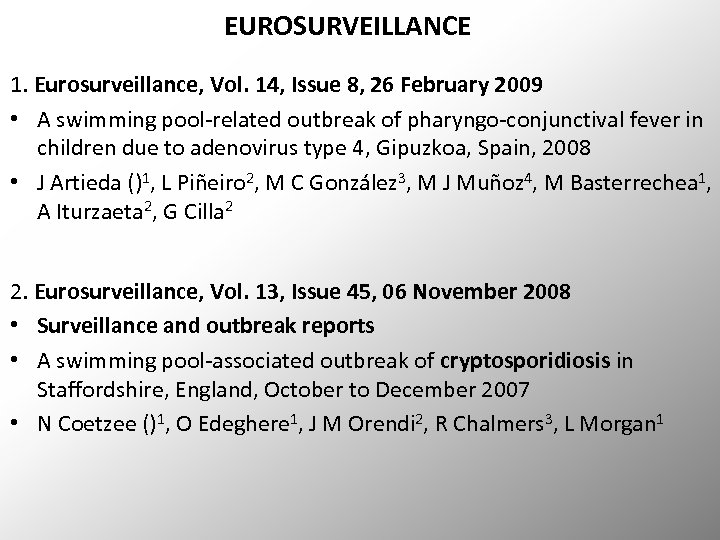
EUROSURVEILLANCE 1. Eurosurveillance, Vol. 14, Issue 8, 26 February 2009 • A swimming pool-related outbreak of pharyngo-conjunctival fever in children due to adenovirus type 4, Gipuzkoa, Spain, 2008 • J Artieda ()1, L Piñeiro 2, M C González 3, M J Muñoz 4, M Basterrechea 1, A Iturzaeta 2, G Cilla 2 2. Eurosurveillance, Vol. 13, Issue 45, 06 November 2008 • Surveillance and outbreak reports • A swimming pool-associated outbreak of cryptosporidiosis in Staffordshire, England, October to December 2007 • N Coetzee ()1, O Edeghere 1, J M Orendi 2, R Chalmers 3, L Morgan 1
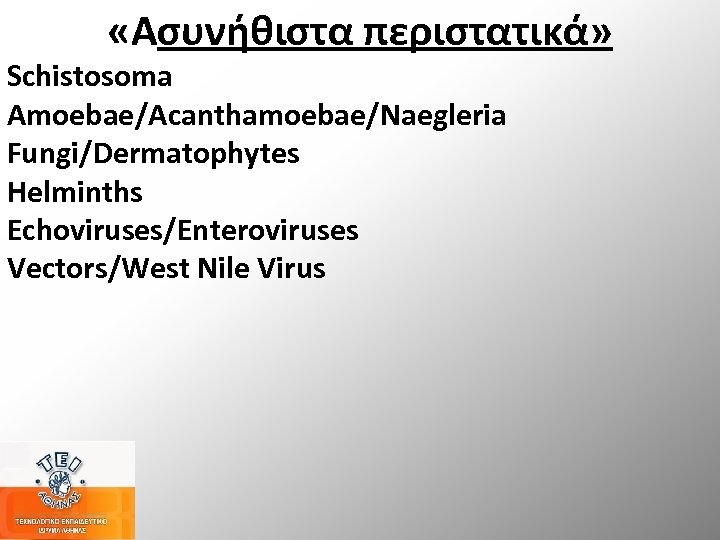
«Ασυνήθιστα περιστατικά» Schistosoma Amoebae/Acanthamoebae/Naegleria Fungi/Dermatophytes Helminths Echoviruses/Enteroviruses Vectors/West Nile Virus
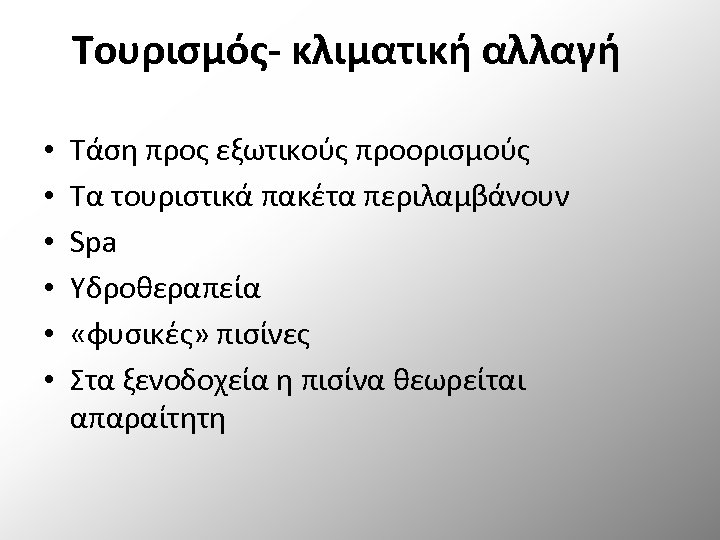
Τουρισμός‐ κλιματική αλλαγή • • • Τάση προς εξωτικούς προορισμούς Τα τουριστικά πακέτα περιλαμβάνουν Spa Υδροθεραπεία «φυσικές» πισίνες Στα ξενοδοχεία η πισίνα θεωρείται απαραίτητη
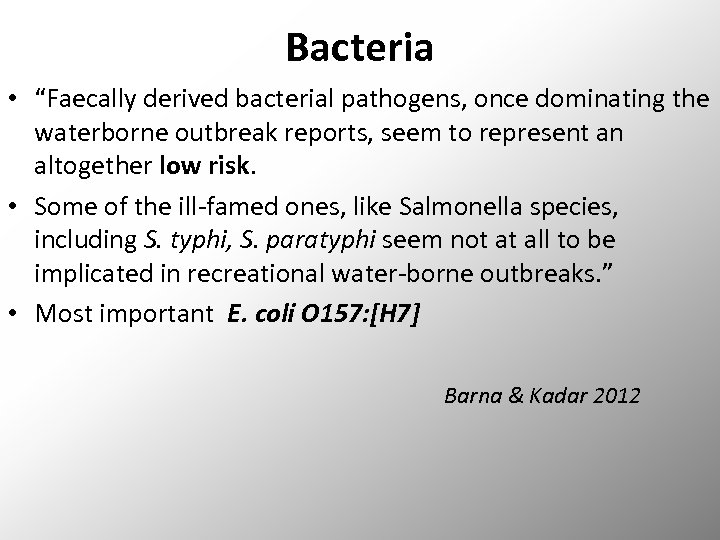
Bacteria • “Faecally derived bacterial pathogens, once dominating the waterborne outbreak reports, seem to represent an altogether low risk. • Some of the ill-famed ones, like Salmonella species, including S. typhi, S. paratyphi seem not at all to be implicated in recreational water-borne outbreaks. ” • Most important E. coli O 157: [H 7] Barna & Kadar 2012
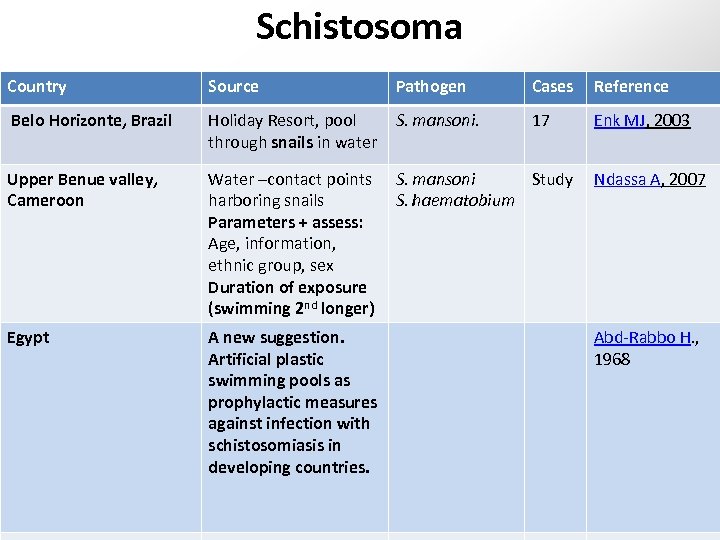
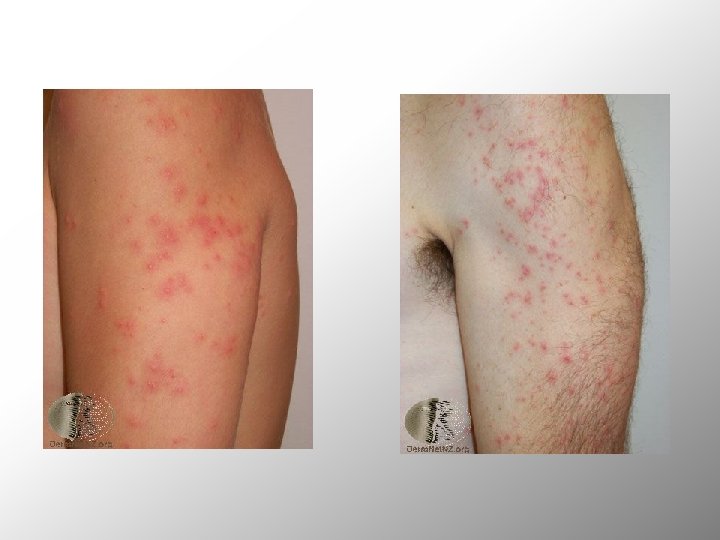
Schistosoma Country Source Pathogen Cases Reference Belo Horizonte, Brazil Holiday Resort, pool through snails in water S. mansoni. 17 Enk MJ, 2003 Upper Benue valley, Cameroon Water –contact points harboring snails Parameters + assess: Age, information, ethnic group, sex Duration of exposure (swimming 2 nd longer) S. mansoni Study S. haematobium Egypt A new suggestion. Artificial plastic swimming pools as prophylactic measures against infection with schistosomiasis in developing countries. Ndassa A, 2007 Abd-Rabbo H. , 1968
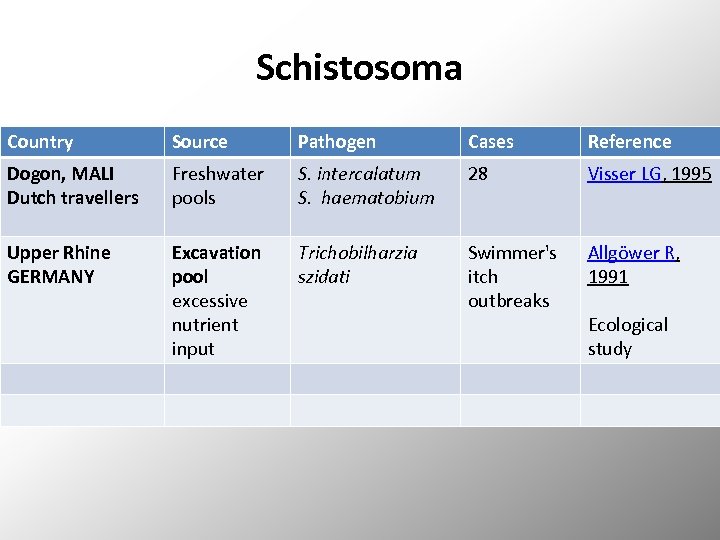
Schistosoma Country Source Pathogen Cases Reference Dogon, MALI Dutch travellers Freshwater pools S. intercalatum S. haematobium 28 Visser LG, 1995 Upper Rhine GERMANY Excavation pool excessive nutrient input Trichobilharzia szidati Swimmer's itch outbreaks Allgöwer R, 1991 Ecological study
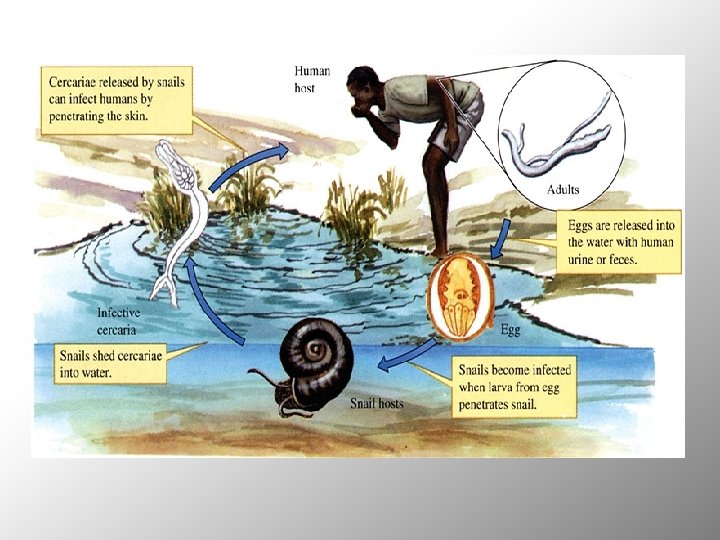
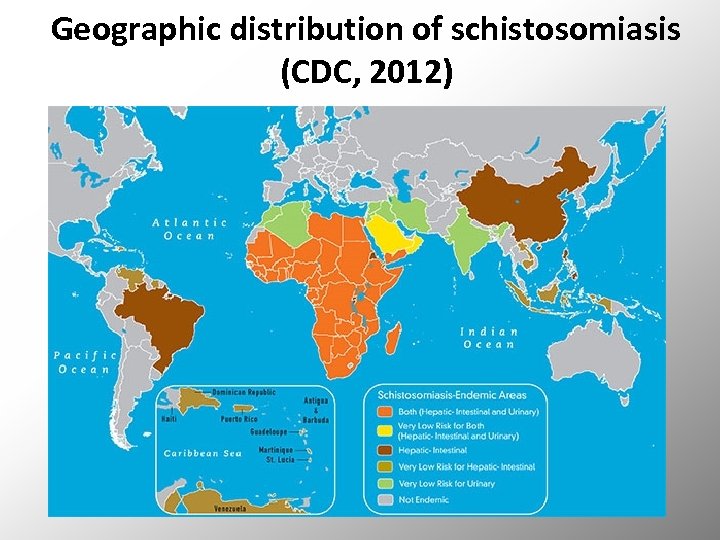
Geographic distribution of schistosomiasis (CDC, 2012)
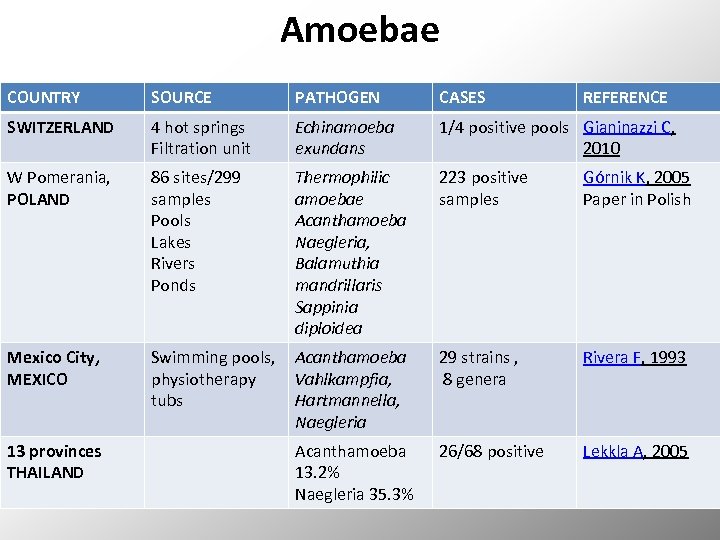
Amoebae COUNTRY SOURCE PATHOGEN CASES SWITZERLAND 4 hot springs Filtration unit Echinamoeba exundans 1/4 positive pools Gianinazzi C, 2010 W Pomerania, POLAND 86 sites/299 samples Pools Lakes Rivers Ponds Thermophilic amoebae Acanthamoeba Naegleria, Balamuthia mandrillaris Sappinia diploidea 223 positive samples Górnik K, 2005 Paper in Polish Mexico City, MEXICO Swimming pools, Acanthamoeba physiotherapy Vahlkampfia, tubs Hartmannella, Naegleria 29 strains , 8 genera Rivera F, 1993 26/68 positive Lekkla A, 2005 13 provinces THAILAND Acanthamoeba 13. 2% Naegleria 35. 3% REFERENCE
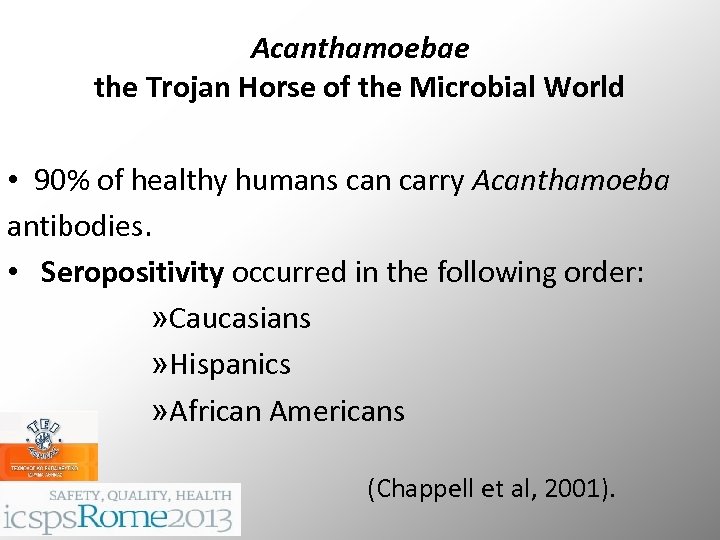
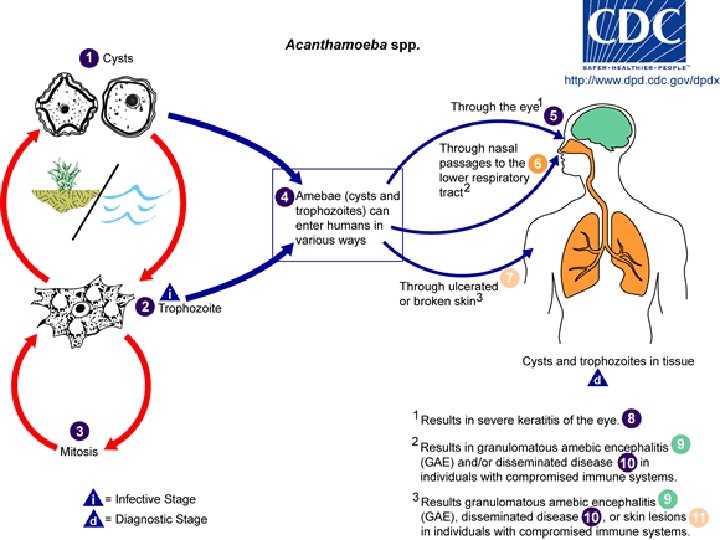
Acanthamoebae the Trojan Horse of the Microbial World • 90% of healthy humans can carry Acanthamoeba antibodies. • Seropositivity occurred in the following order: » Caucasians » Hispanics » African Americans (Chappell et al, 2001).
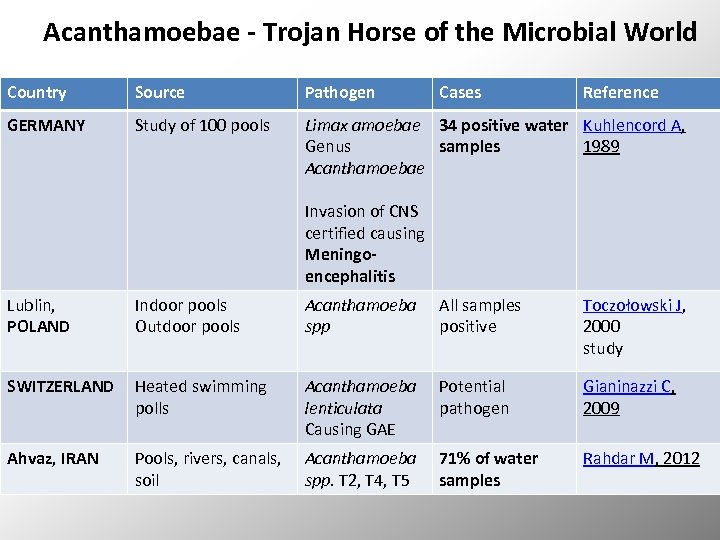
Acanthamoebae ‐ Trojan Horse of the Microbial World Country Source Pathogen Cases Reference GERMANY Study of 100 pools Limax amoebae 34 positive water Kuhlencord A, Genus samples 1989 Acanthamoebae Invasion of CNS certified causing Meningo‐ encephalitis Lublin, POLAND Indoor pools Outdoor pools Acanthamoeba spp All samples positive Toczołowski J, 2000 study SWITZERLAND Heated swimming polls Acanthamoeba lenticulata Causing GAE Potential pathogen Gianinazzi C, 2009 Ahvaz, IRAN Pools, rivers, canals, soil Acanthamoeba spp. T 2, T 4, T 5 71% of water samples Rahdar M, 2012
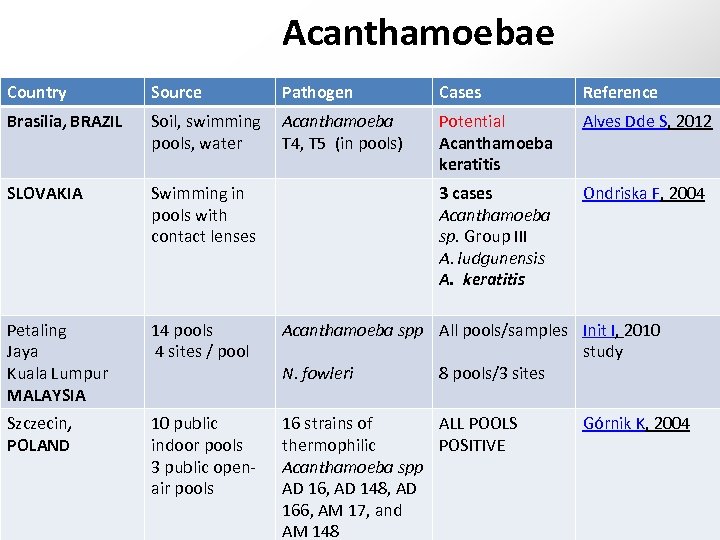
Acanthamoebae Country Source Brasilia, BRAZIL Pathogen Cases Reference Soil, swimming Acanthamoeba pools, water T 4, T 5 (in pools) Potential Acanthamoeba keratitis Alves Dde S, 2012 SLOVAKIA Swimming in pools with contact lenses 3 cases Acanthamoeba sp. Group III A. ludgunensis A. keratitis Ondriska F, 2004 Petaling Jaya Kuala Lumpur MALAYSIA 14 pools 4 sites / pool Acanthamoeba spp All pools/samples Init I, 2010 study N. fowleri 8 pools/3 sites Szczecin, POLAND 10 public indoor pools 3 public openair pools 16 strains of ALL POOLS thermophilic POSITIVE Acanthamoeba spp AD 16, AD 148, AD 166, AM 17, and AM 148 Górnik K, 2004
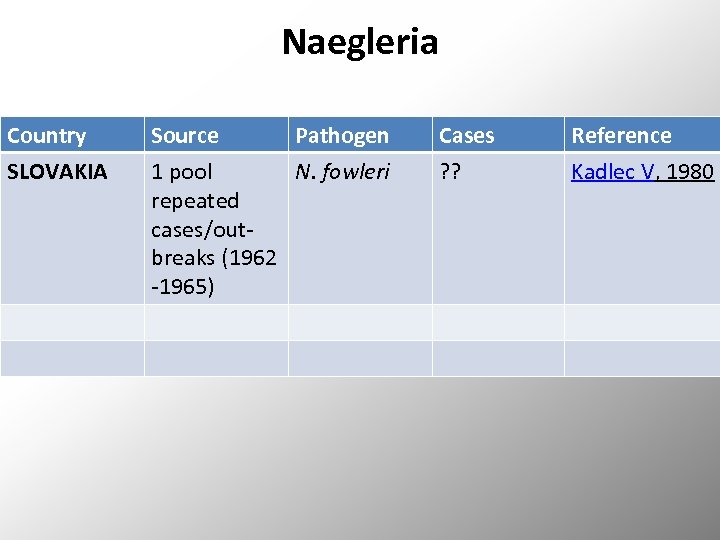
Naegleria Country SLOVAKIA Source Pathogen 1 pool N. fowleri repeated cases/outbreaks (1962 -1965) Cases ? ? Reference Kadlec V, 1980
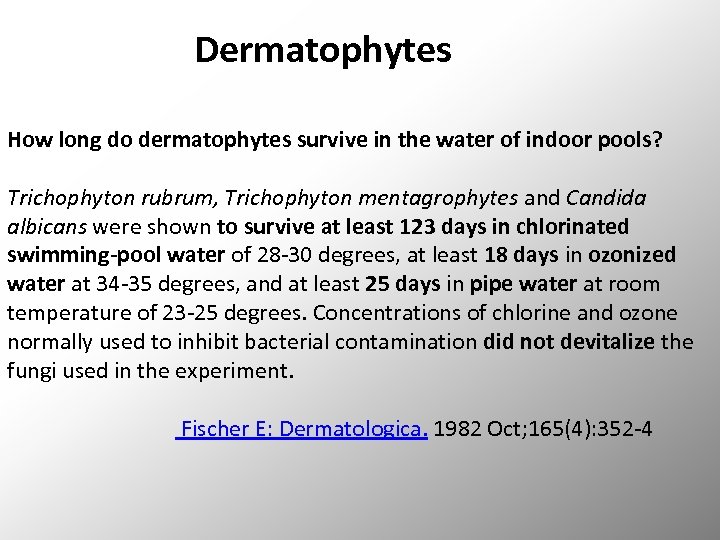
Dermatophytes How long do dermatophytes survive in the water of indoor pools? Trichophyton rubrum, Trichophyton mentagrophytes and Candida albicans were shown to survive at least 123 days in chlorinated swimming‐pool water of 28 -30 degrees, at least 18 days in ozonized water at 34 -35 degrees, and at least 25 days in pipe water at room temperature of 23 -25 degrees. Concentrations of chlorine and ozone normally used to inhibit bacterial contamination did not devitalize the fungi used in the experiment. Fischer E: Dermatologica. 1982 Oct; 165(4): 352 -4
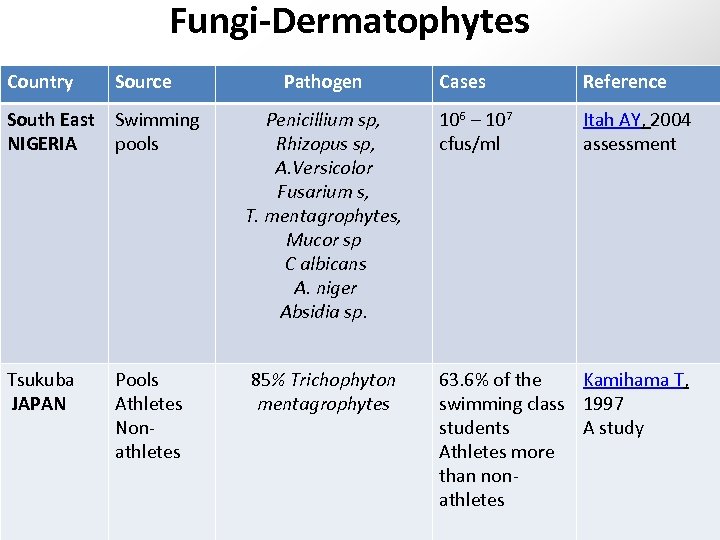
Fungi‐Dermatophytes Country Source Pathogen Cases Reference Itah AY, 2004 assessment South East Swimming NIGERIA pools Penicillium sp, Rhizopus sp, A. Versicolor Fusarium s, T. mentagrophytes, Mucor sp C albicans A. niger Absidia sp. 106 – 107 cfus/ml Tsukuba JAPAN 85% Trichophyton mentagrophytes 63. 6% of the Kamihama T, swimming class 1997 students A study Athletes more than non- athletes Pools Athletes Non- athletes
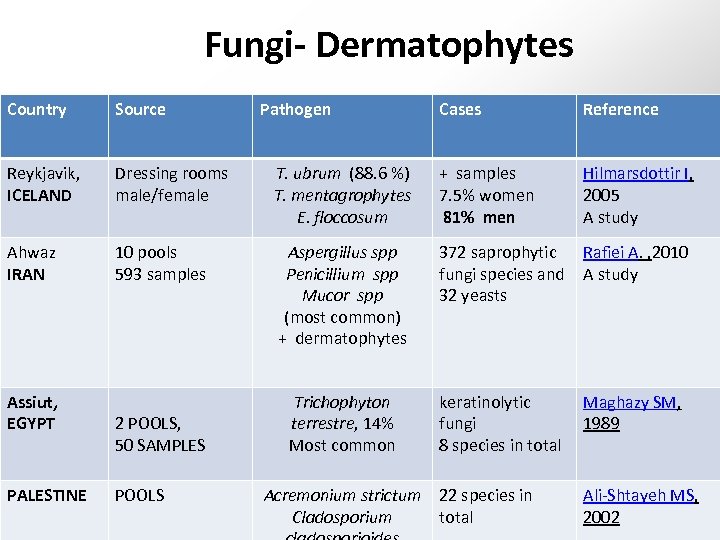
Fungi‐ Dermatophytes Country Source Reykjavik, ICELAND Dressing rooms male/female Ahwaz IRAN 10 pools 593 samples Assiut, EGYPT PALESTINE 2 POOLS, 50 SAMPLES POOLS Pathogen Cases Reference T. ubrum (88. 6 %) T. mentagrophytes E. floccosum + samples 7. 5% women 81% men Hilmarsdottir I, 2005 A study Aspergillus spp Penicillium spp Mucor spp (most common) + dermatophytes 372 saprophytic Rafiei A. , 2010 fungi species and A study 32 yeasts Trichophyton terrestre, 14% Most common Acremonium strictum Cladosporium keratinolytic fungi 8 species in total Maghazy SM, 1989 22 species in total Ali-Shtayeh MS, 2002
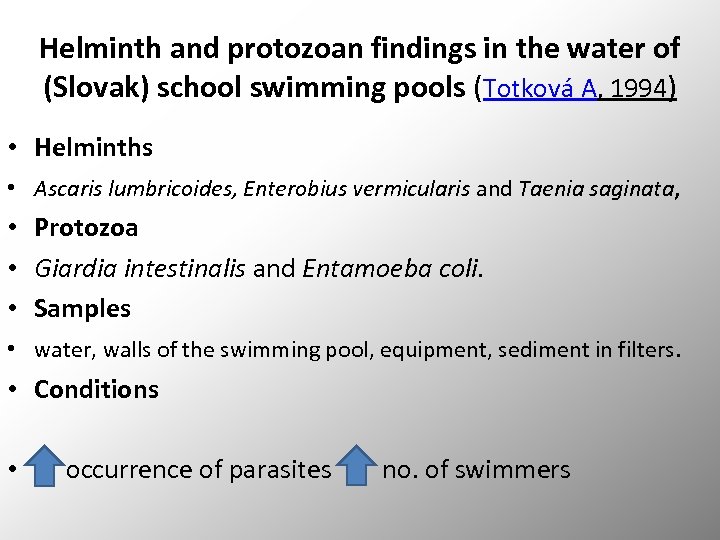
Helminth and protozoan findings in the water of (Slovak) school swimming pools (Totková A, 1994) • Helminths • Ascaris lumbricoides, Enterobius vermicularis and Taenia saginata, • Protozoa • Giardia intestinalis and Entamoeba coli. • Samples • water, walls of the swimming pool, equipment, sediment in filters. • Conditions • occurrence of parasites no. of swimmers
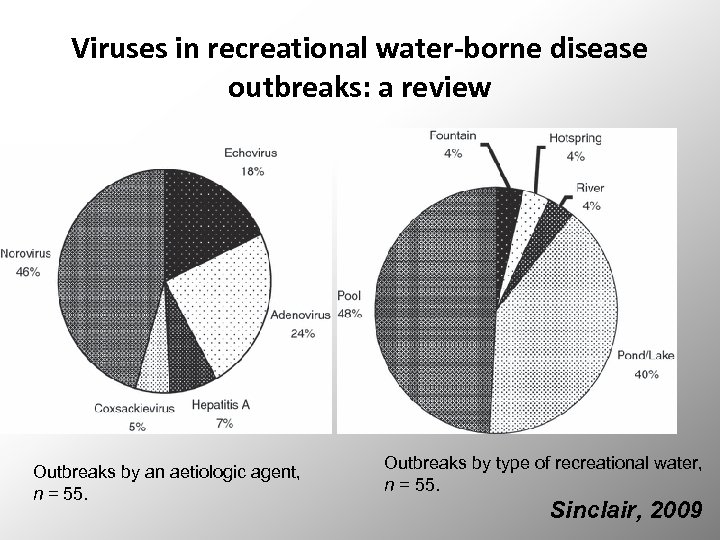
Viruses in recreational water‐borne disease outbreaks: a review Outbreaks by an aetiologic agent, n = 55. Outbreaks by type of recreational water, n = 55. Sinclair, 2009
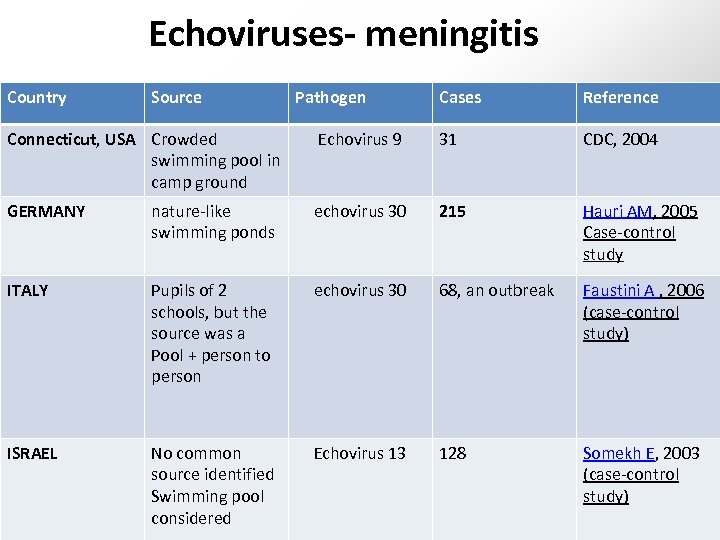
Echoviruses‐ meningitis Country Source Pathogen Cases Reference Connecticut, USA Crowded swimming pool in camp ground Echovirus 9 31 CDC, 2004 GERMANY nature-like swimming ponds echovirus 30 215 Hauri AM, 2005 Case-control study ITALY Pupils of 2 schools, but the source was a Pool + person to person echovirus 30 68, an outbreak Faustini A , 2006 (case-control study) ISRAEL No common source identified Swimming pool considered Echovirus 13 128 Somekh E, 2003 (case-control study)
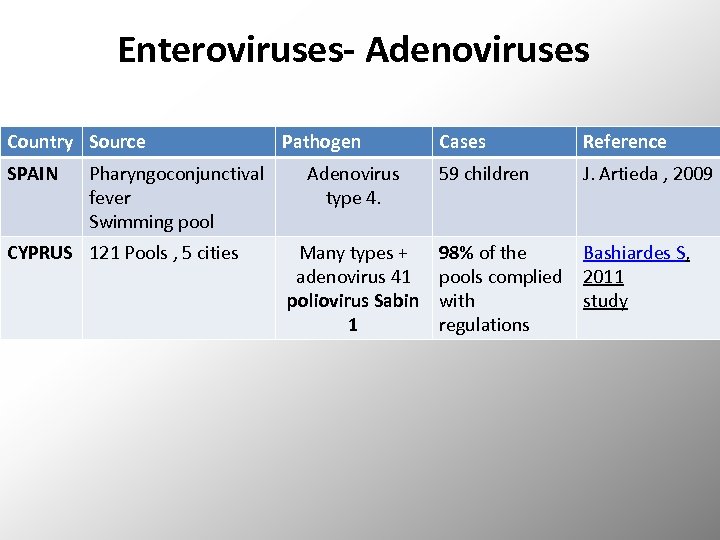
Enteroviruses‐ Adenoviruses Country Source SPAIN Pharyngoconjunctival fever Swimming pool CYPRUS 121 Pools , 5 cities Pathogen Adenovirus type 4. Many types + adenovirus 41 poliovirus Sabin 1 Cases Reference 59 children J. Artieda , 2009 98% of the Bashiardes S, pools complied 2011 with study regulations
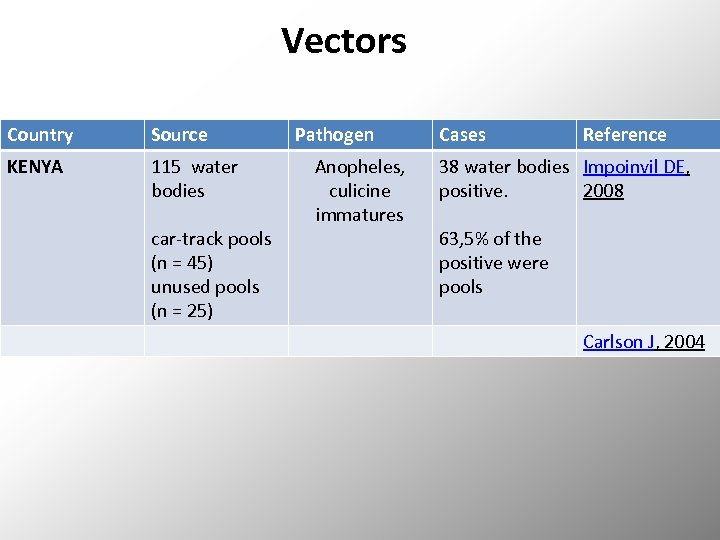
Vectors Country Source KENYA 115 water bodies car-track pools (n = 45) unused pools (n = 25) Pathogen Anopheles, culicine immatures Cases Reference 38 water bodies Impoinvil DE, positive. 2008 63, 5% of the positive were pools Carlson J, 2004
West NILE VIRUS • Epidemic in Kern County, CA, 2004 -2007 when the human case annual incidence increased from 6 -8 to 17 per 100, 000, respectively. • The 2007 increase in human infection was associated with contradictory surveillance indicators: • severe drought, warm spring but cool summer, decreased rural and urban mosquito abundance but increased early season infection in urban Culex quinquefasciatus Say, moderate avian "herd immunity, " and declines in the catch of competent (western scrub-jay and house finch) and non-competent (California quail and mourning dove) avian species. • The marked increase in home foreclosures and associated neglected swimming pools increased urban mosquito production sites (Reisen WK et al. 2009) • Kern County’s West Nile Virus Strategic Response Plan: • Fight the Bite campaign, which calls for reporting of neglected swimming pools
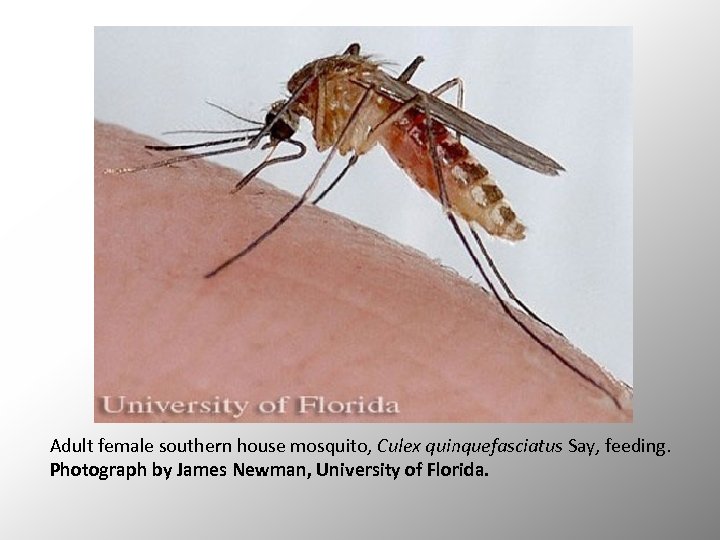
Adult female southern house mosquito, Culex quinquefasciatus Say, feeding. Photograph by James Newman, University of Florida.
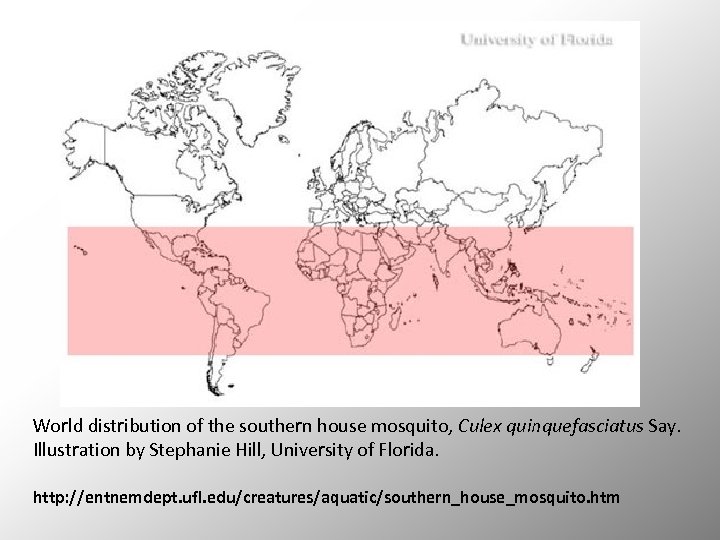
World distribution of the southern house mosquito, Culex quinquefasciatus Say. Illustration by Stephanie Hill, University of Florida. http: //entnemdept. ufl. edu/creatures/aquatic/southern_house_mosquito. htm
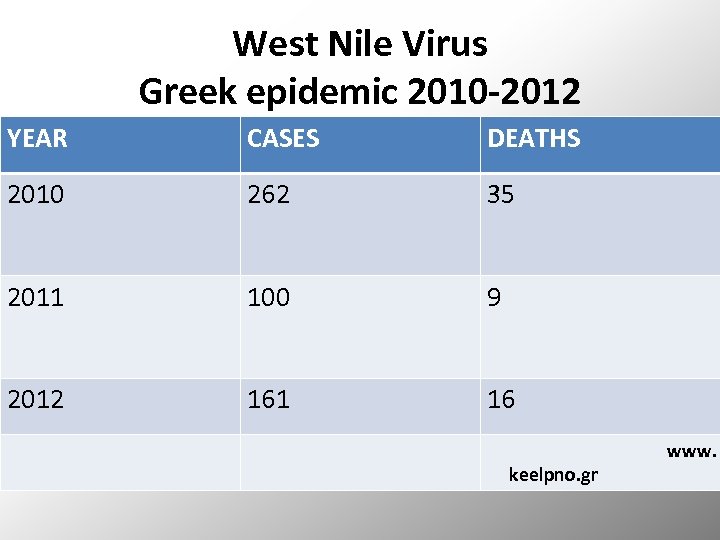
West Nile Virus Greek epidemic 2010‐ 2012 YEAR CASES DEATHS 2010 262 35 2011 100 9 2012 161 16 www. keelpno. gr
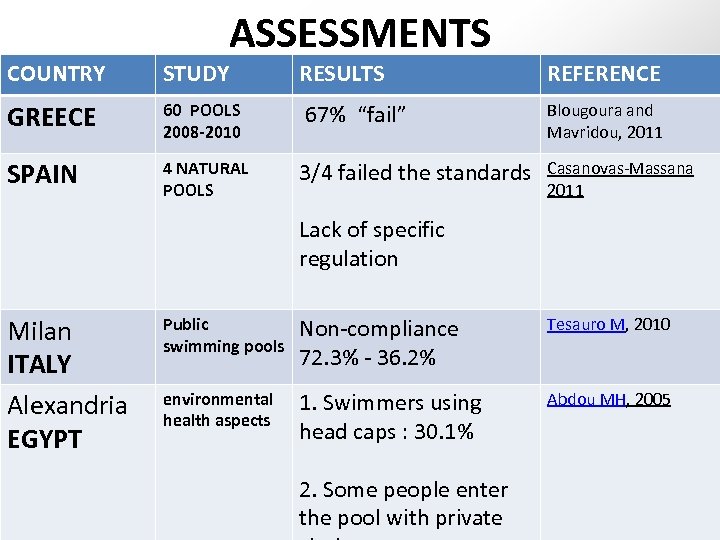
ASSESSMENTS COUNTRY STUDY RESULTS REFERENCE GREECE 60 POOLS 2008‐ 2010 67% “fail” Blougoura and Mavridou, 2011 SPAIN 4 NATURAL POOLS 3/4 failed the standards Casanovas-Massana 2011 Lack of specific regulation Milan ITALY Alexandria EGYPT Public swimming pools Non-compliance 72. 3% - 36. 2% Tesauro M, 2010 environmental health aspects 1. Swimmers using head caps : 30. 1% Abdou MH, 2005 2. Some people enter the pool with private
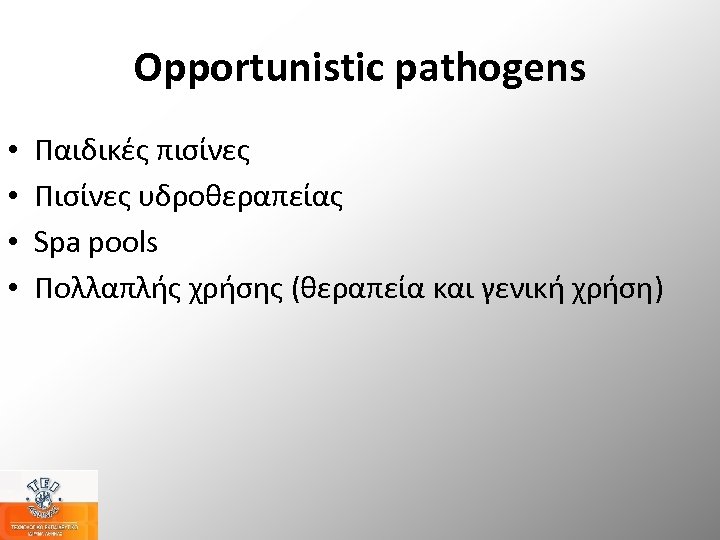
Opportunistic pathogens • • Παιδικές πισίνες Πισίνες υδροθεραπείας Spa pools Πολλαπλής χρήσης (θεραπεία και γενική χρήση)
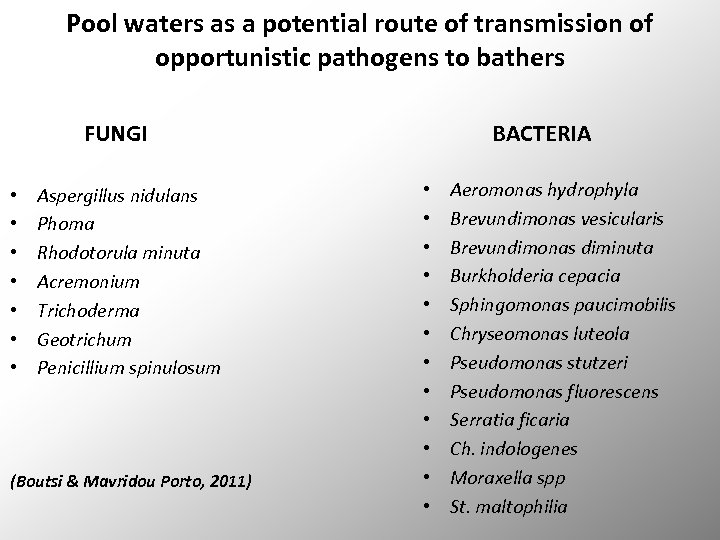
Pool waters as a potential route of transmission of opportunistic pathogens to bathers BACTERIA FUNGI • • Aspergillus nidulans Phoma Rhodotorula minuta Acremonium Trichoderma Geotrichum Penicillium spinulosum (Boutsi & Mavridou Porto, 2011) • • • Aeromonas hydrophyla Brevundimonas vesicularis Brevundimonas diminuta Burkholderia cepacia Sphingomonas paucimobilis Chryseomonas luteola Pseudomonas stutzeri Pseudomonas fluorescens Serratia ficaria Ch. indologenes Moraxella spp St. maltophilia
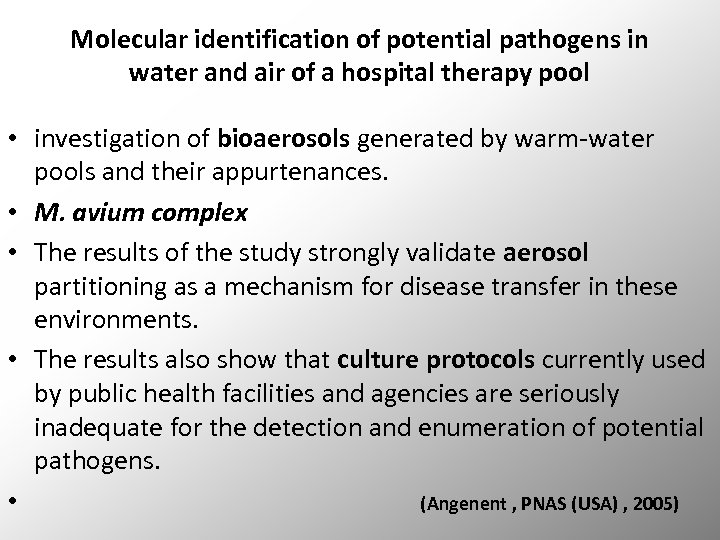
Molecular identification of potential pathogens in water and air of a hospital therapy pool • investigation of bioaerosols generated by warm-water pools and their appurtenances. • M. avium complex • The results of the study strongly validate aerosol partitioning as a mechanism for disease transfer in these environments. • The results also show that culture protocols currently used by public health facilities and agencies are seriously inadequate for the detection and enumeration of potential pathogens. • (Angenent , PNAS (USA) , 2005)
Microsporidia • They are considered as the 4 th most prevalent protozoans causing diarrhoeal disease. • Immuno-compromised persons are at highest risk of severe disease. • Infections – enteric – cornea – kidney – central nervous system Barna & Kadar, 2012
ΦΥΣΙΚΕΣ ΠΙΣΙΝΕΣ • Aντικατάσταση επεξεργασιών με φυσικά συστήματα • Ψευδαίσθηση φυσικού περιβάλλοντος • Περιβάλλεται από ζώνη αναζωογόνησης • Επιλέγονται φυτά που αποδομούν Ν, P • Eμπλουτισμός με σαπροφάγα, ασπόνδυλα • Εν ανάγκει προστίθεται ζώνη με φίλτρα • Απουσία ειδικής νομοθεσίας, σε κάποιες χώρες μερικές ρυθμίσεις • Μεγαλύτερη καταγεγραμένη επιδημία στοKassel, 2001, ιογενούς μηνιγγίτιδας.
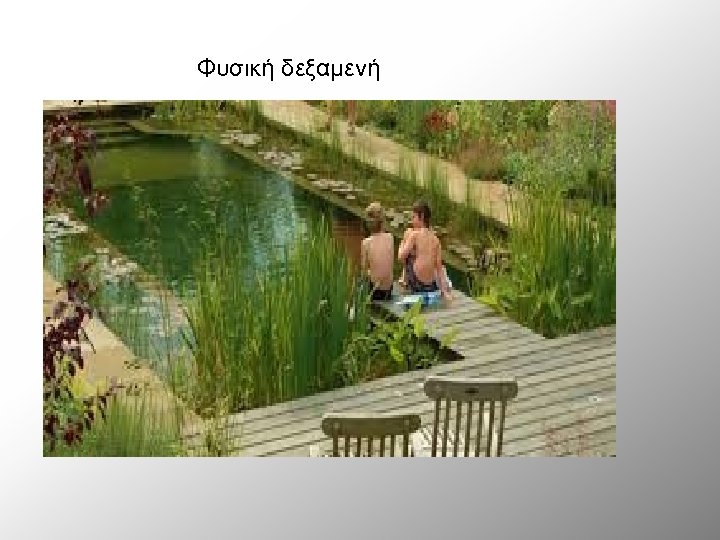
Φυσική δεξαμενή
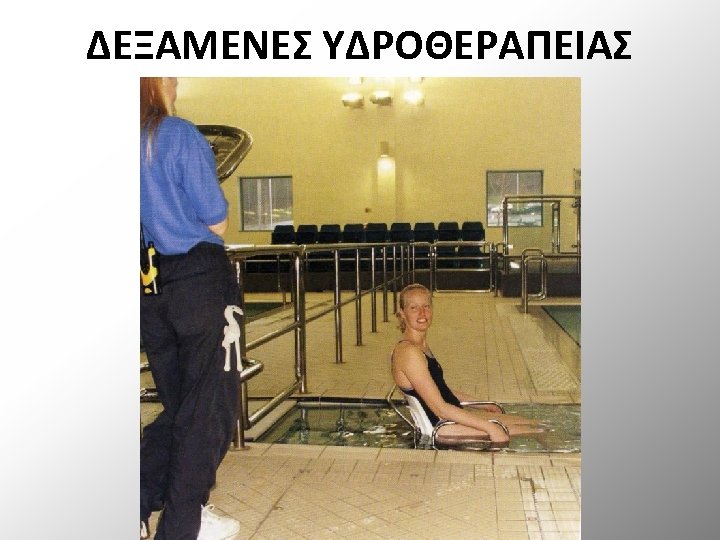
ΔΕΞΑΜΕΝΕΣ ΥΔΡΟΘΕΡΑΠΕΙΑΣ
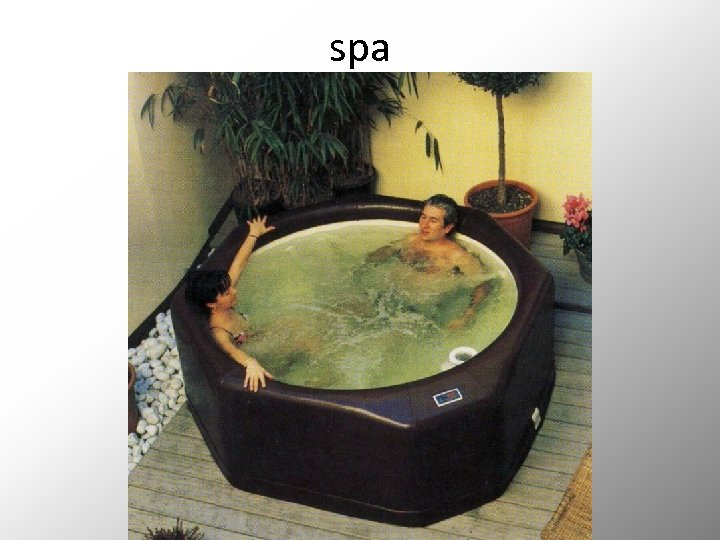
spa
Μελλοντικές εξελίξεις • WHO Guidelines • Toυρισμός (κυρίως εξωτικός) και πισίνες • Εννιαία Ευρωπαϊκή Νομοθεσία
Скачать презентацию ΝΕΑ ΔΕΔΟΜΕΝΑ ΣΤΗΝ ΥΓΙΕΙΝΗ ΤΩΝ ΚΟΛΥΜΒΗΤΗΡΙΩΝ Καθ Αθηνά
5166b6c72cac720a6ce3ec259318232a.ppt