 Скачать презентацию Ηλεκτρονικές Υπηρεσίες Ηλεκτρονικό Επιχειρείν Διάλεξη 7η
bae0bfecb9a2b347c21de9f143feb251.ppt
- Количество слайдов: 51



“Ηλεκτρονικές Υπηρεσίες – Ηλεκτρονικό Επιχειρείν” Διάλεξη 7η – IT Architecture Design Δρ. Κώστας Κούτσικος
Agenda • Σύνδεση με τα προηγούμενα • Technical architecture development overview • Technical architecture design • Τελικά σχόλια
Technical Architecture Development - Overview
The technical architecture design is based on the previous steps of our web service development model Functional Architecture
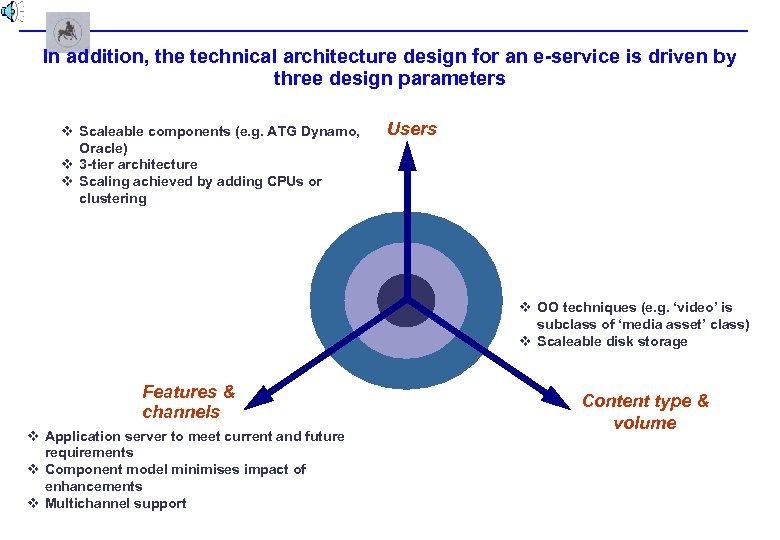
In addition, the technical architecture design for an e-service is driven by three design parameters v Scaleable components (e. g. ATG Dynamo, Oracle) v 3 -tier architecture v Scaling achieved by adding CPUs or clustering Users v OO techniques (e. g. ‘video’ is subclass of ‘media asset’ class) v Scaleable disk storage Features & channels v Application server to meet current and future requirements v Component model minimises impact of enhancements v Multichannel support Content type & volume
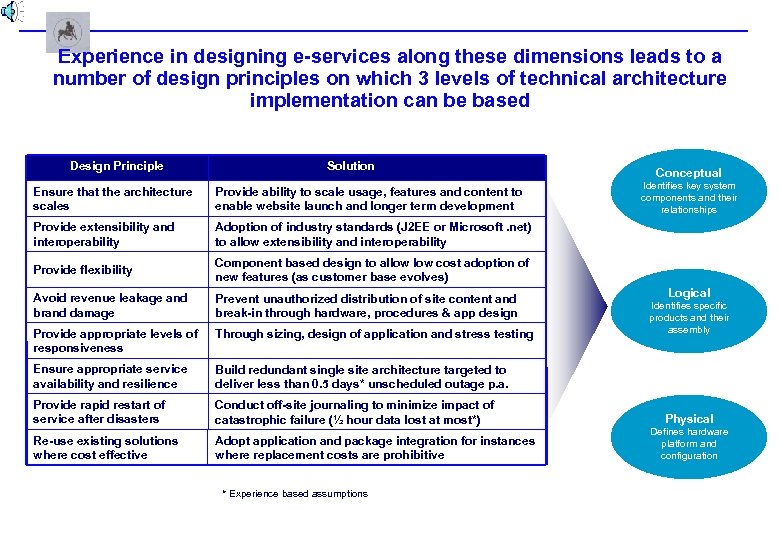
Experience in designing e-services along these dimensions leads to a number of design principles on which 3 levels of technical architecture implementation can be based Design Principle Solution Ensure that the architecture scales Provide ability to scale usage, features and content to enable website launch and longer term development Provide extensibility and interoperability Adoption of industry standards (J 2 EE or Microsoft. net) to allow extensibility and interoperability Provide flexibility Component based design to allow cost adoption of new features (as customer base evolves) Avoid revenue leakage and brand damage Prevent unauthorized distribution of site content and break-in through hardware, procedures & app design Provide appropriate levels of responsiveness Through sizing, design of application and stress testing Ensure appropriate service availability and resilience Build redundant single site architecture targeted to deliver less than 0. 5 days* unscheduled outage p. a. Provide rapid restart of service after disasters Conduct off-site journaling to minimize impact of catastrophic failure (½ hour data lost at most*) Conceptual Identifies key system components and their relationships Re-use existing solutions where cost effective Adopt application and package integration for instances where replacement costs are prohibitive * Experience based assumptions Logical Identifies specific products and their assembly Physical Defines hardware platform and configuration
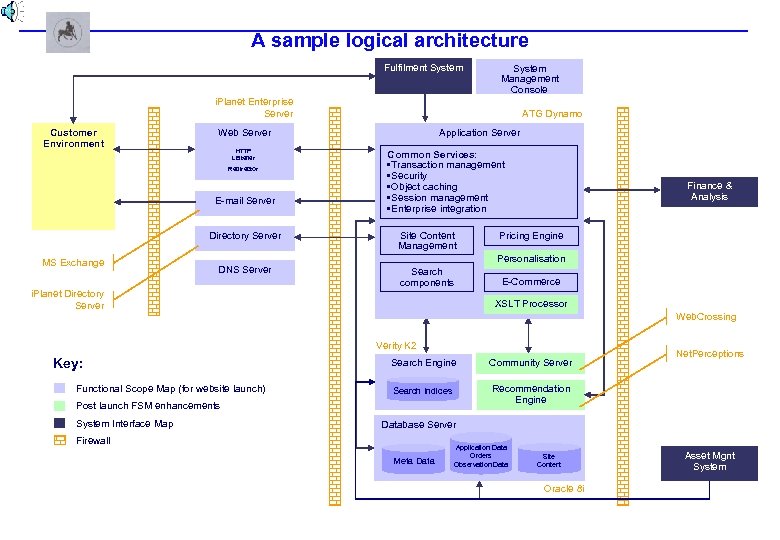
A sample logical architecture Fulfilment System Management Console i. Planet Enterprise Server Customer Environment ATG Dynamo Application Server Web Server HTTP Listener Redirector E-mail Server Common Services: • Transaction management • Security • Object caching • Session management • Enterprise integration Directory Server MS Exchange Site Content Management DNS Server Search components Finance & Analysis Pricing Engine Personalisation i. Planet Directory Server E-Commerce XSLT Processor Web. Crossing Verity K 2 Key: Functional Scope Map (for website launch) Search Engine Community Server Search Indices Recommendation Engine Post launch FSM enhancements System Interface Map Net. Perceptions Database Server Firewall Meta Data Application Data Orders Observation Data Site Content Oracle 8 i Asset Mgnt System
Technical Architecture Design
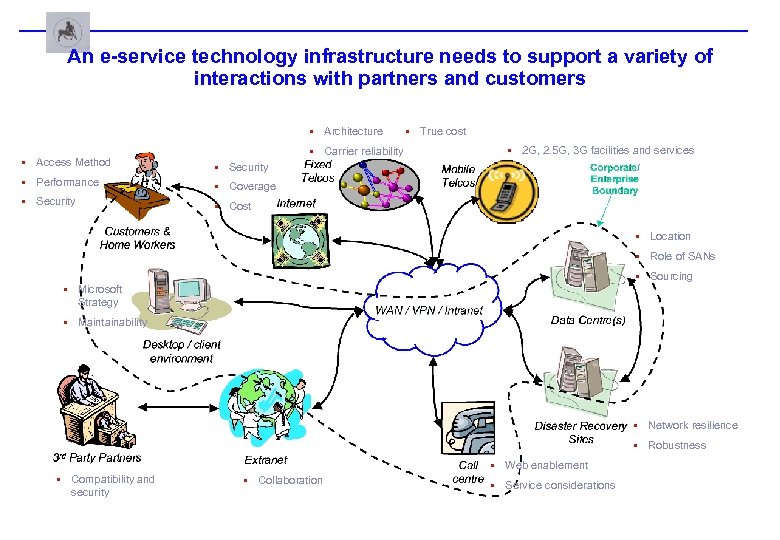
An e-service technology infrastructure needs to support a variety of interactions with partners and customers • Architecture • Carrier reliability • Access Method • Coverage • Security • 2 G, 2. 5 G, 3 G facilities and services • Security • Performance • True cost • Cost • Location • Role of SANs • Sourcing • Microsoft Strategy • Maintainability • Network resilience • Robustness • Web enablement • Compatibility and security • Collaboration • Service considerations
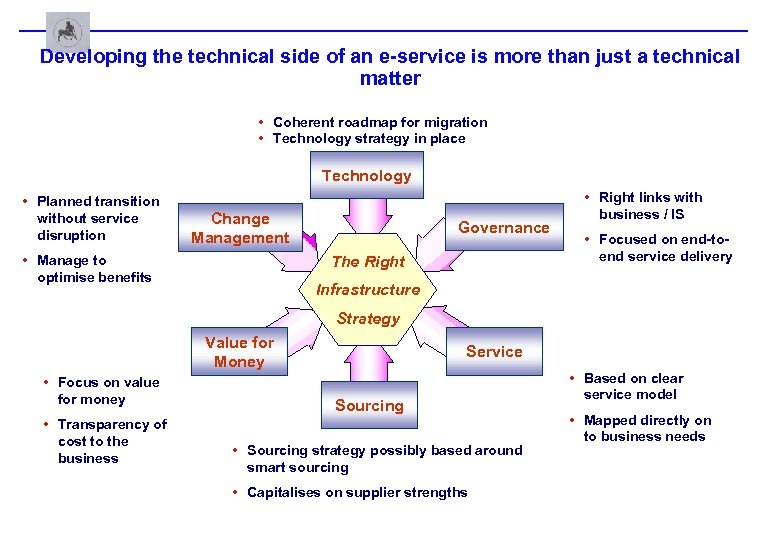
Developing the technical side of an e-service is more than just a technical matter • Coherent roadmap for migration • Technology strategy in place Technology • Planned transition without service disruption Change Management • Manage to optimise benefits Governance The Right • Right links with business / IS • Focused on end-toend service delivery Infrastructure Strategy Value for Money • Focus on value for money • Transparency of cost to the business Service Sourcing • Sourcing strategy possibly based around smart sourcing • Capitalises on supplier strengths • Based on clear service model • Mapped directly on to business needs
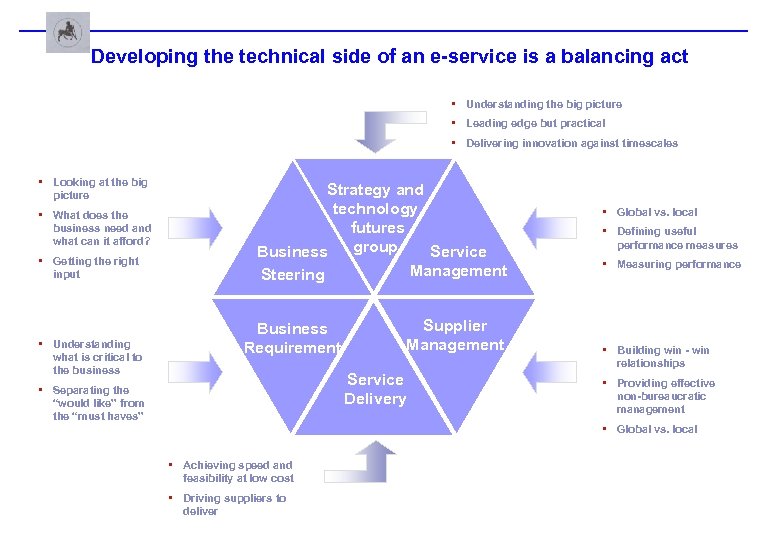
Developing the technical side of an e-service is a balancing act • Understanding the big picture • Leading edge but practical • Delivering innovation against timescales • Looking at the big picture • What does the business need and what can it afford? • Getting the right input • Understanding what is critical to the business Strategy and technology futures group Business Service Management Steering Business Requirement Supplier Management Service Delivery • Separating the “would like” from the “must haves” • Global vs. local • Defining useful performance measures • Measuring performance • Building win - win relationships • Providing effective non-bureaucratic management • Global vs. local • Achieving speed and feasibility at low cost • Driving suppliers to deliver
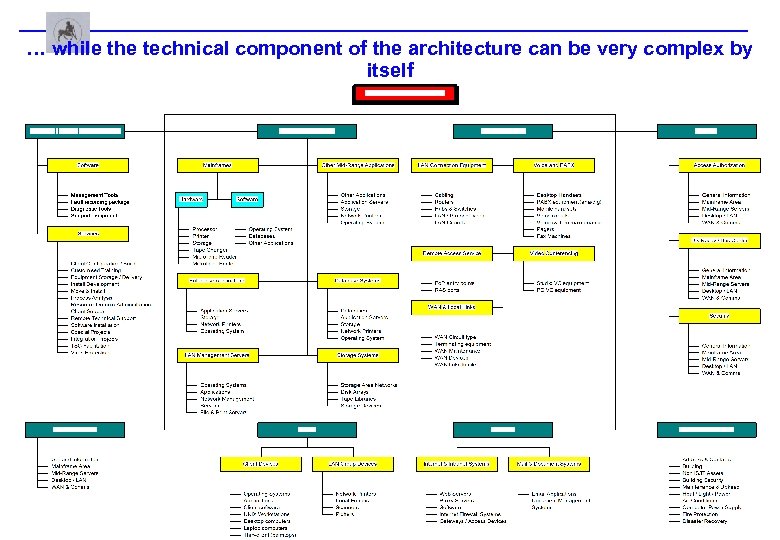
… while the technical component of the architecture can be very complex by itself
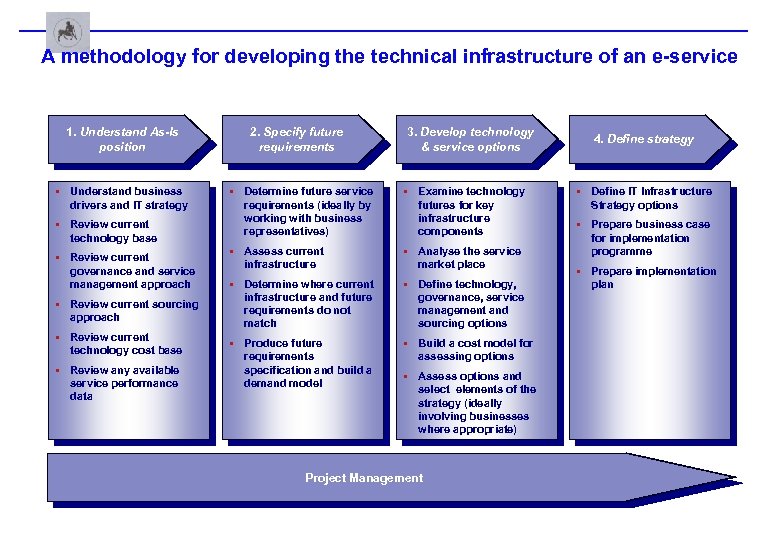
A methodology for developing the technical infrastructure of an e-service 1. Understand As-Is position • Understand business drivers and IT strategy • Review current technology base • Review current governance and service management approach • Review current sourcing approach • Review current technology cost base • Review any available service performance data 2. Specify future requirements 3. Develop technology & service options • Determine future service requirements (ideally by working with business representatives) • Examine technology futures for key infrastructure components • Assess current infrastructure • Analyse the service market place • Determine where current infrastructure and future requirements do not match • Define technology, governance, service management and sourcing options • Produce future requirements specification and build a demand model • Build a cost model for assessing options • Assess options and select elements of the strategy (ideally involving businesses where appropriate) Project Management 4. Define strategy • Define IT Infrastructure Strategy options • Prepare business case for implementation programme • Prepare implementation plan
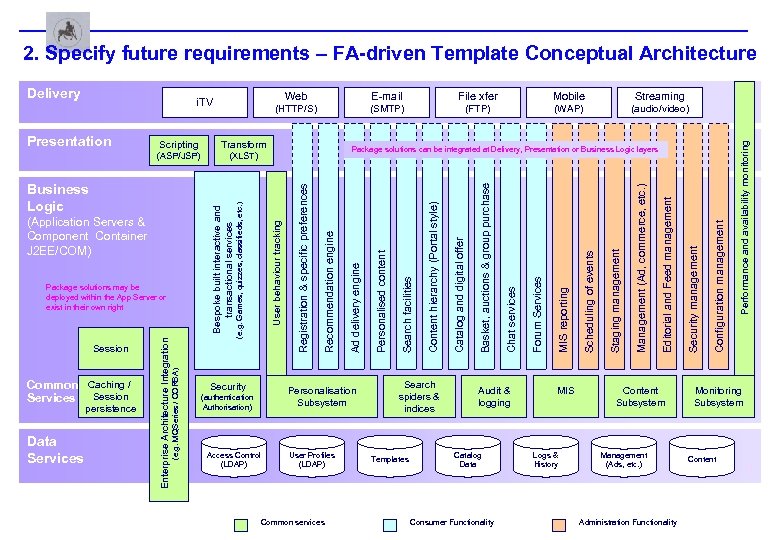
2. Specify future requirements – FA-driven Template Conceptual Architecture Security Personalisation Subsystem (authentication Authorisation) Access Control (LDAP) User Profiles (LDAP) Common services Search spiders & indices Templates Audit & logging Catalog Data Consumer Functionality MIS Logs & History Content Subsystem Management (Ads, etc. ) Administration Functionality Configuration management Security management Editorial and Feed management Management (Ad, commerce, etc. ) Staging management Scheduling of events MIS reporting Forum Services Chat services Basket, auctions & group purchase Catalog and digital offer Content hierarchy (Portal style) Search facilities Personalised content Recommendation engine Package solutions can be integrated at Delivery, Presentation or Business Logic layers Monitoring Subsystem Content Imam Hoque 2000 (e. g. MQSeries / CORBA) Data Services Enterprise Architecture Integration Package solutions may be deployed within the App Server or exist in their own right persistence (audio/video) User behaviour tracking Bespoke built interactive and transactional services (Application Servers & Component Container J 2 EE/COM) Common Caching / Services Session Streaming (WAP) (XLST) Business Logic Session Mobile (FTP) Transform (e. g. Games, quizzes, classifieds, etc. ) Scripting (ASP/JSP) File xfer Registration & specific preferences Presentation E-mail (SMTP) Performance and availability monitoring Web (HTTP/S) i. TV Ad delivery engine Delivery
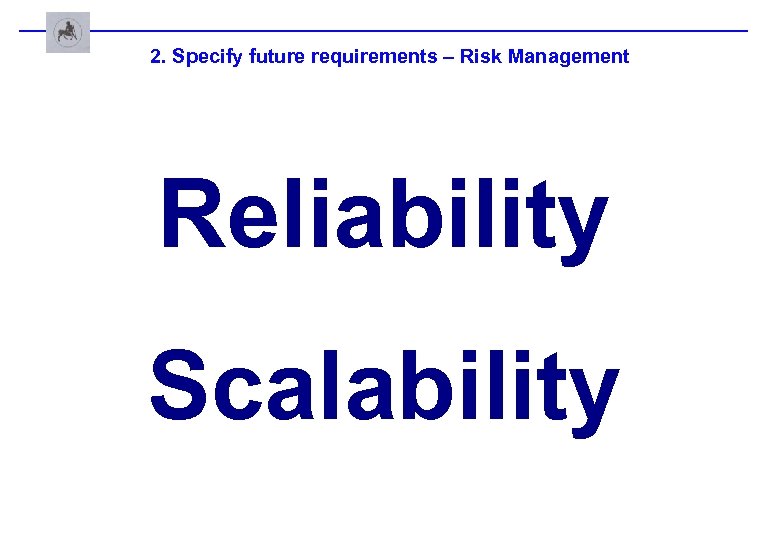
2. Specify future requirements – Risk Management Reliability Scalability
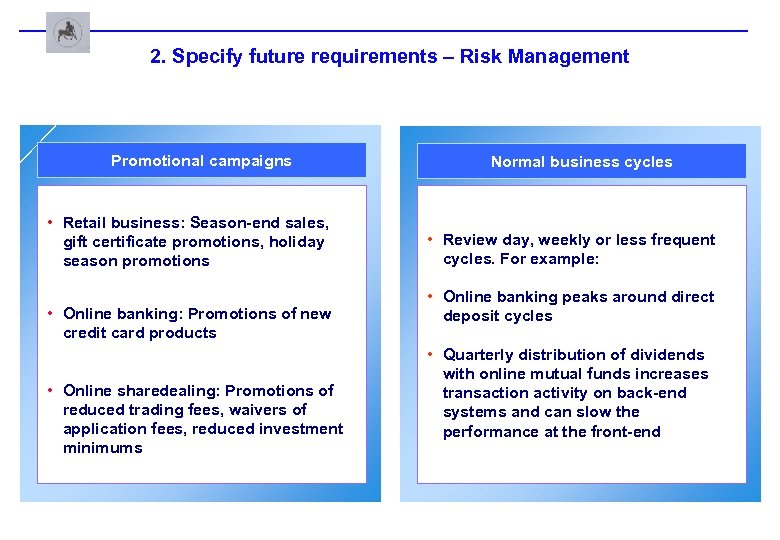
2. Specify future requirements – Risk Management Promotional campaigns • Retail business: Season-end sales, gift certificate promotions, holiday season promotions • Online banking: Promotions of new credit card products • Online sharedealing: Promotions of reduced trading fees, waivers of application fees, reduced investment minimums Normal business cycles • Review day, weekly or less frequent cycles. For example: • Online banking peaks around direct deposit cycles • Quarterly distribution of dividends with online mutual funds increases transaction activity on back-end systems and can slow the performance at the front-end
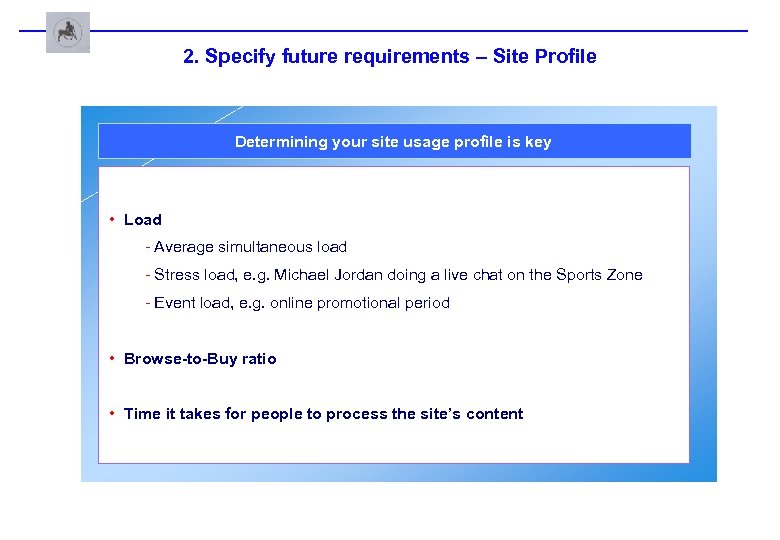
2. Specify future requirements – Site Profile Determining your site usage profile is key • Load - Average simultaneous load - Stress load, e. g. Michael Jordan doing a live chat on the Sports Zone - Event load, e. g. online promotional period • Browse-to-Buy ratio • Time it takes for people to process the site’s content
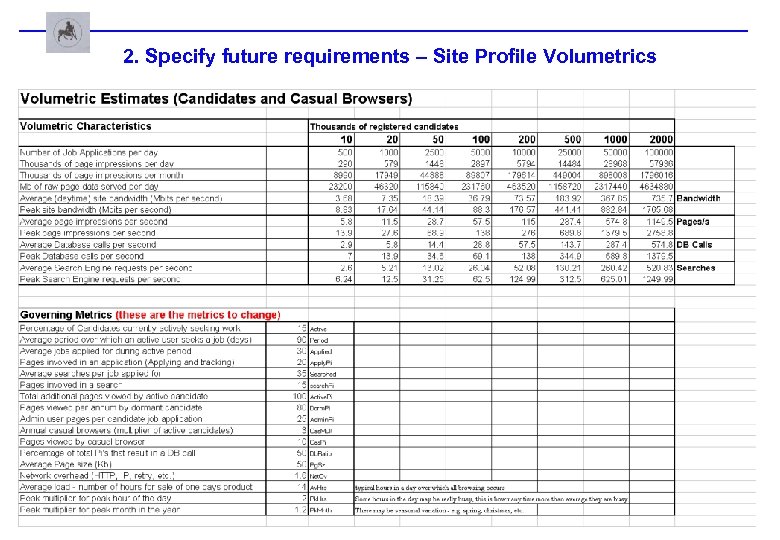
2. Specify future requirements – Site Profile Volumetrics
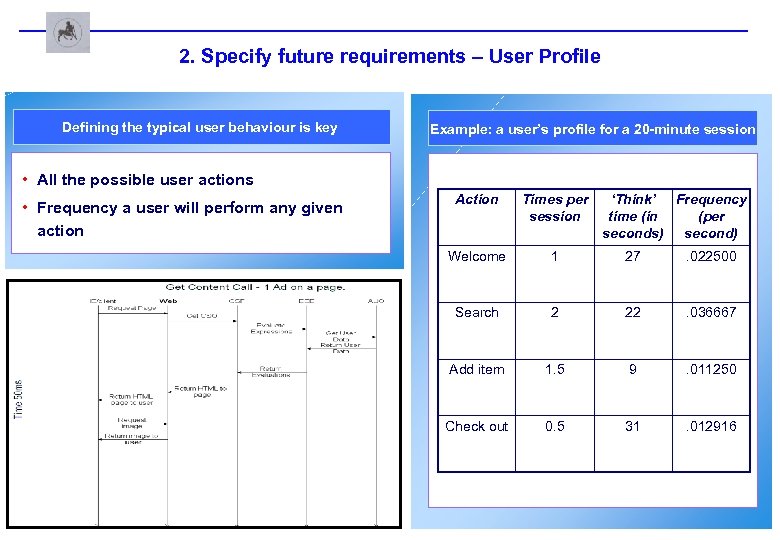
2. Specify future requirements – User Profile Defining the typical user behaviour is key Example: a user’s profile for a 20 -minute session • All the possible user actions • Frequency a user will perform any given action Action Times per session ‘Think’ Frequency time (in (per seconds) second) Welcome 1 27 . 022500 Search 2 22 . 036667 Add item 1. 5 9 . 011250 Check out 0. 5 31 . 012916
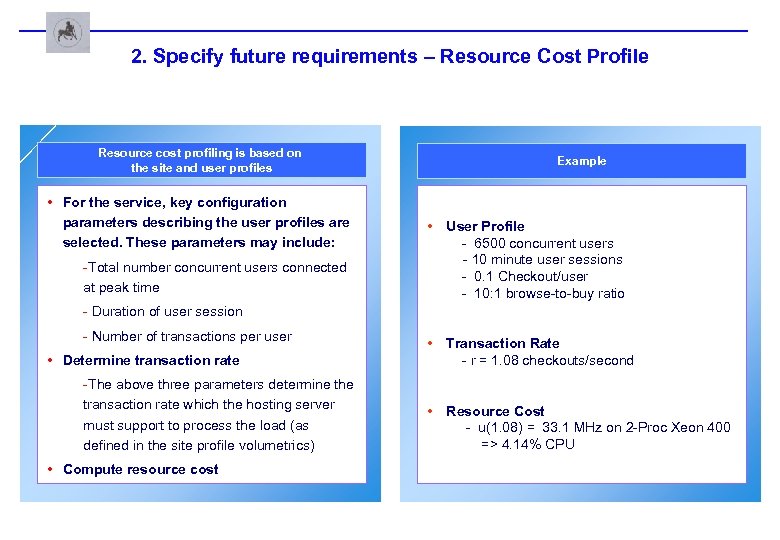
2. Specify future requirements – Resource Cost Profile Resource cost profiling is based on the site and user profiles • For the service, key configuration parameters describing the user profiles are selected. These parameters may include: -Total number concurrent users connected at peak time Example • User Profile - 6500 concurrent users - 10 minute user sessions - 0. 1 Checkout/user - 10: 1 browse-to-buy ratio - Duration of user session - Number of transactions per user • Determine transaction rate -The above three parameters determine the transaction rate which the hosting server must support to process the load (as defined in the site profile volumetrics) • Compute resource cost • Transaction Rate - r = 1. 08 checkouts/second • Resource Cost - u(1. 08) = 33. 1 MHz on 2 -Proc Xeon 400 => 4. 14% CPU
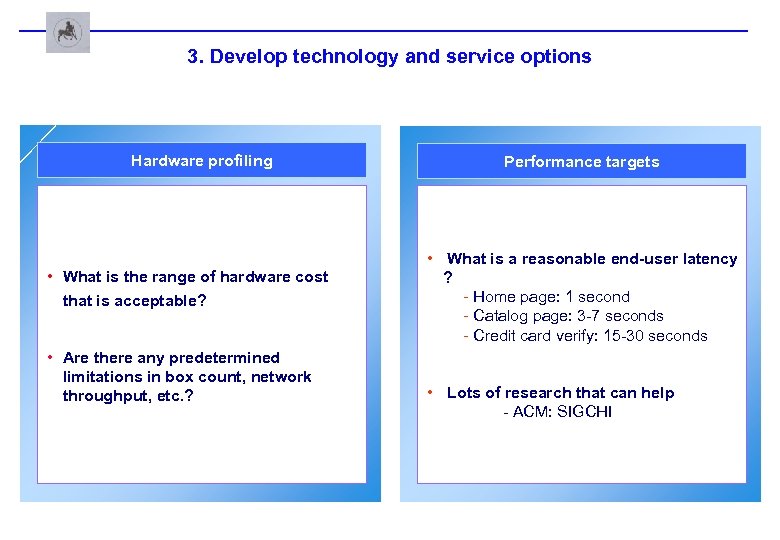
3. Develop technology and service options Hardware profiling • What is the range of hardware cost that is acceptable? • Are there any predetermined limitations in box count, network throughput, etc. ? Performance targets • What is a reasonable end-user latency ? - Home page: 1 second - Catalog page: 3 -7 seconds - Credit card verify: 15 -30 seconds • Lots of research that can help - ACM: SIGCHI
Develop technology and service options Case Study
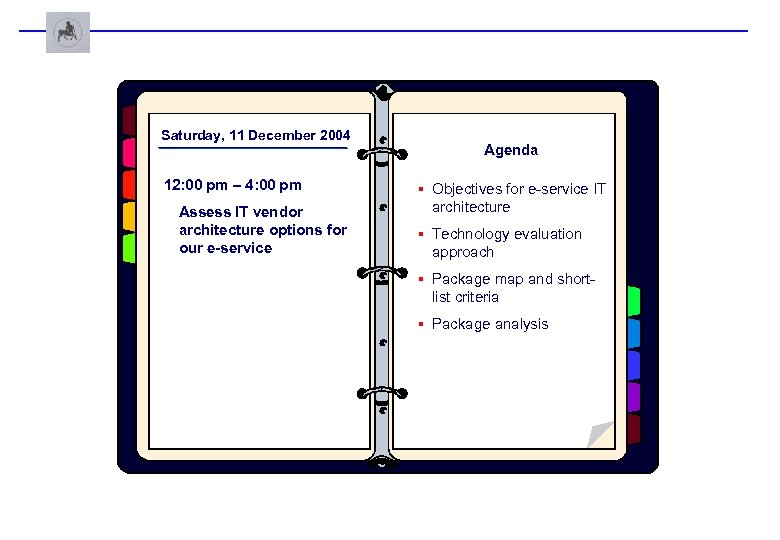
Saturday, 11 December 2004 12: 00 pm – 4: 00 pm Assess IT vendor architecture options for our e-service Agenda § Objectives for e-service IT architecture § Technology evaluation approach § Package map and shortlist criteria § Package analysis
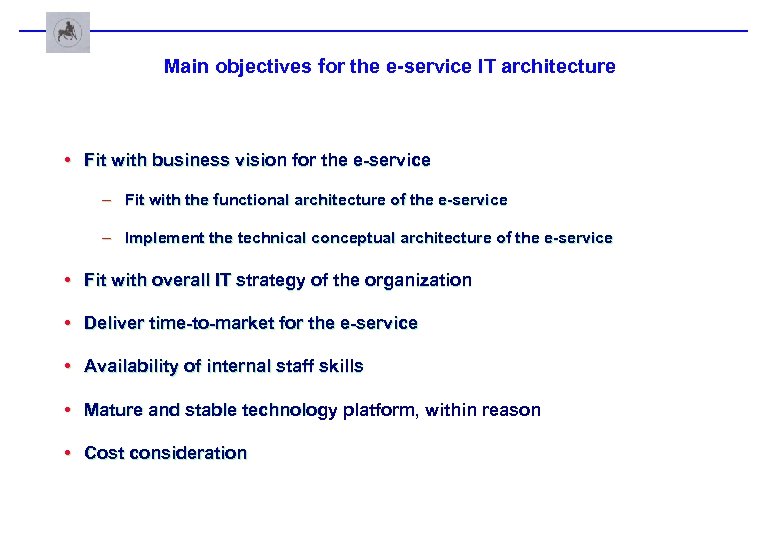
Main objectives for the e-service IT architecture • Fit with business vision for the e-service – Fit with the functional architecture of the e-service – Implement the technical conceptual architecture of the e-service • Fit with overall IT strategy of the organization • Deliver time-to-market for the e-service • Availability of internal staff skills • Mature and stable technology platform, within reason • Cost consideration
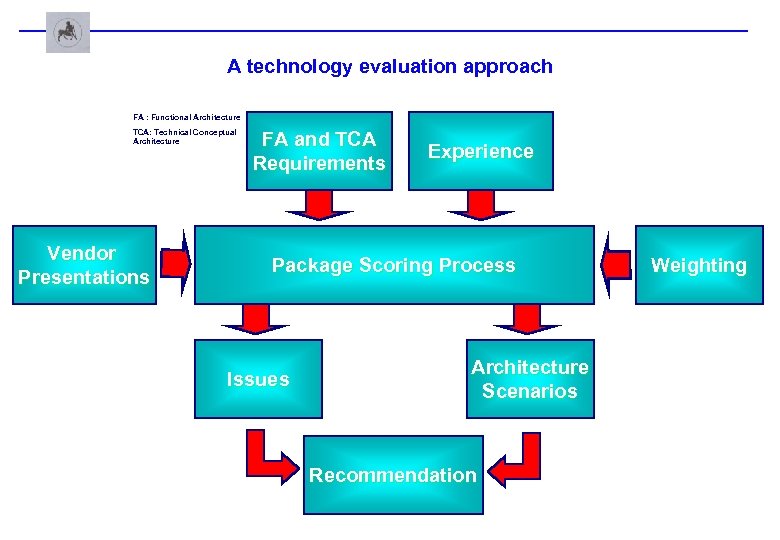
A technology evaluation approach FA : Functional Architecture TCA: Technical Conceptual Architecture Vendor Presentations FA and TCA Requirements Experience Package Scoring Process Issues Architecture Scenarios Recommendation Weighting
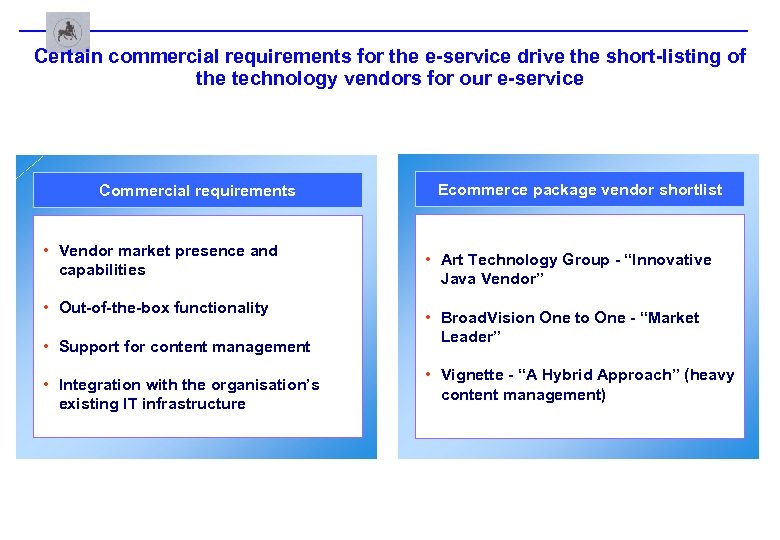
Certain commercial requirements for the e-service drive the short-listing of the technology vendors for our e-service Commercial requirements • Vendor market presence and capabilities • Out-of-the-box functionality • Support for content management • Integration with the organisation’s existing IT infrastructure Ecommerce package vendor shortlist • Art Technology Group - “Innovative Java Vendor” • Broad. Vision One to One - “Market Leader” • Vignette - “A Hybrid Approach” (heavy content management)
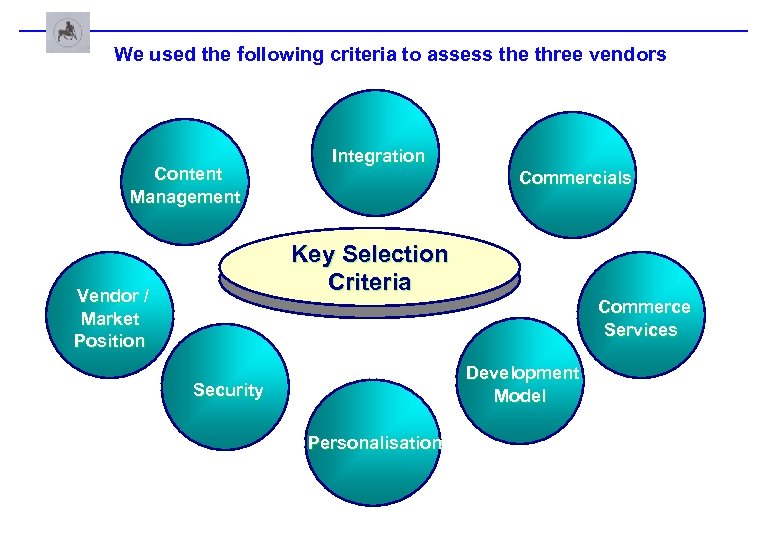
We used the following criteria to assess the three vendors Content Management Integration Commercials Key Selection Criteria Vendor / Market Position Commerce Services Development Model Security Personalisation
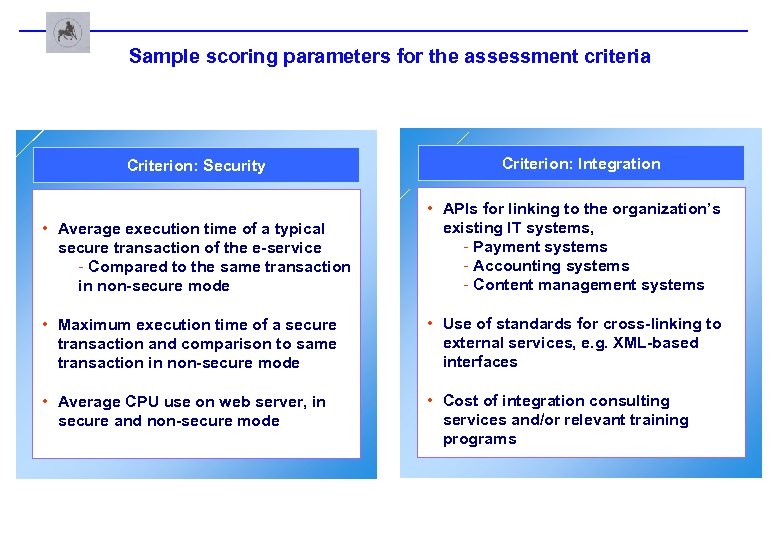
Sample scoring parameters for the assessment criteria Criterion: Security Criterion: Integration • Average execution time of a typical secure transaction of the e-service - Compared to the same transaction in non-secure mode • APIs for linking to the organization’s existing IT systems, - Payment systems - Accounting systems - Content management systems • Maximum execution time of a secure transaction and comparison to same transaction in non-secure mode • Use of standards for cross-linking to external services, e. g. XML-based interfaces • Average CPU use on web server, in secure and non-secure mode • Cost of integration consulting services and/or relevant training programs
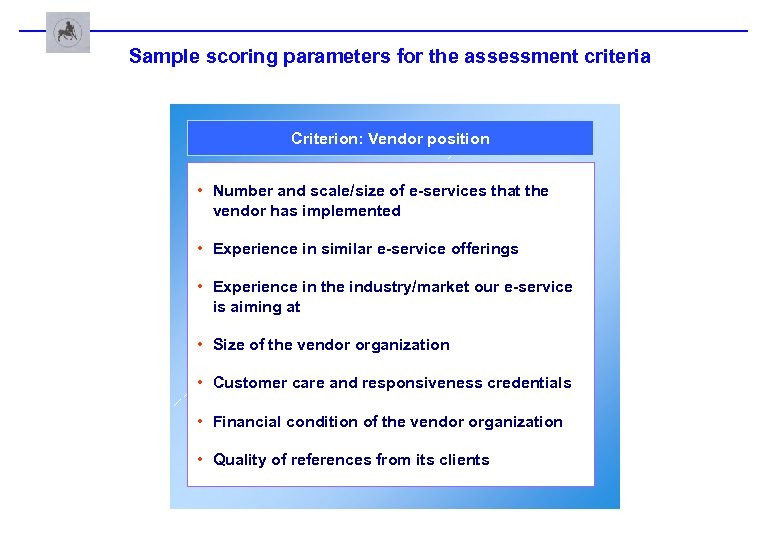
Sample scoring parameters for the assessment criteria Criterion: Vendor position • Number and scale/size of e-services that the vendor has implemented • Experience in similar e-service offerings • Experience in the industry/market our e-service is aiming at • Size of the vendor organization • Customer care and responsiveness credentials • Financial condition of the vendor organization • Quality of references from its clients
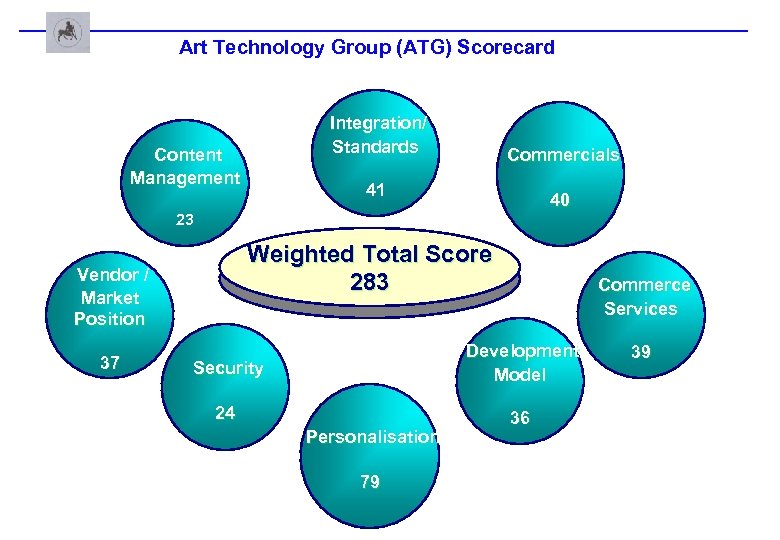
Art Technology Group (ATG) Scorecard Integration/ Standards Content Management Commercials 41 40 23 Weighted Total Score Key Selection 283 Criteria Vendor / Market Position 37 Commerce Services Security Development Model 24 36 Personalisation 79 39
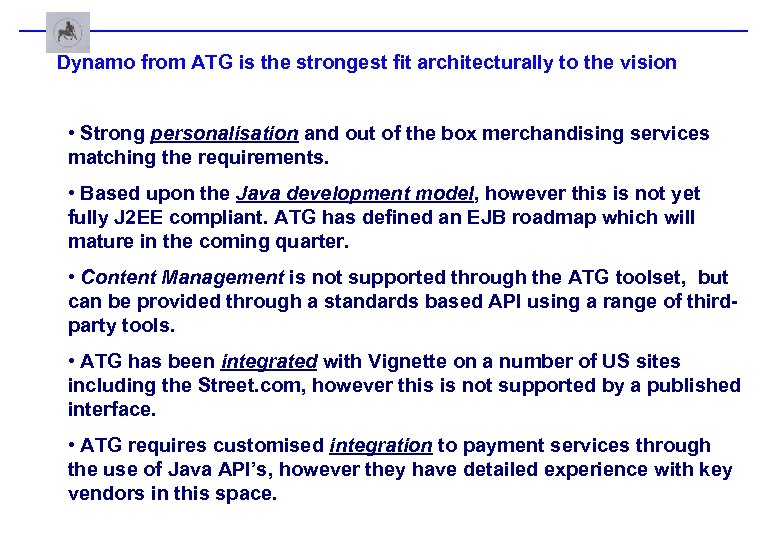
Dynamo from ATG is the strongest fit architecturally to the vision • Strong personalisation and out of the box merchandising services matching the requirements. • Based upon the Java development model, however this is not yet fully J 2 EE compliant. ATG has defined an EJB roadmap which will mature in the coming quarter. • Content Management is not supported through the ATG toolset, but can be provided through a standards based API using a range of thirdparty tools. • ATG has been integrated with Vignette on a number of US sites including the Street. com, however this is not supported by a published interface. • ATG requires customised integration to payment services through the use of Java API’s, however they have detailed experience with key vendors in this space.
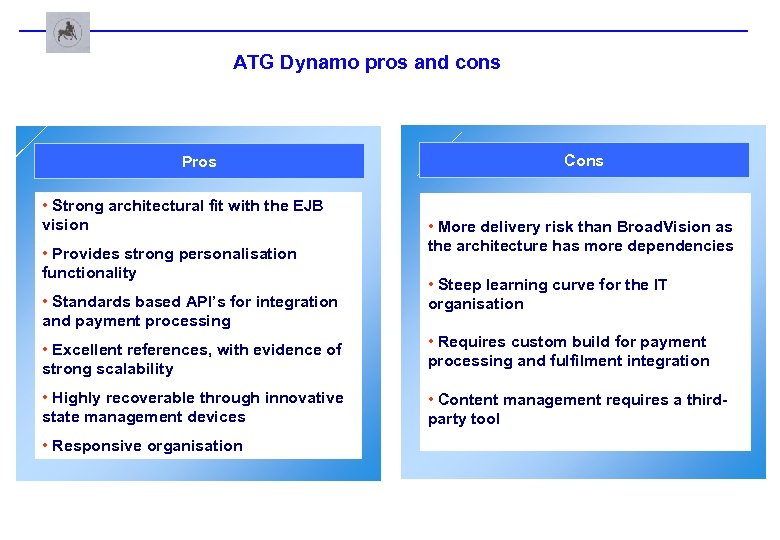
ATG Dynamo pros and cons Pros • Strong architectural fit with the EJB vision • Provides strong personalisation functionality • Standards based API’s for integration and payment processing Cons • More delivery risk than Broad. Vision as the architecture has more dependencies • Steep learning curve for the IT organisation • Excellent references, with evidence of strong scalability • Requires custom build for payment processing and fulfilment integration • Highly recoverable through innovative state management devices • Content management requires a thirdparty tool • Responsive organisation
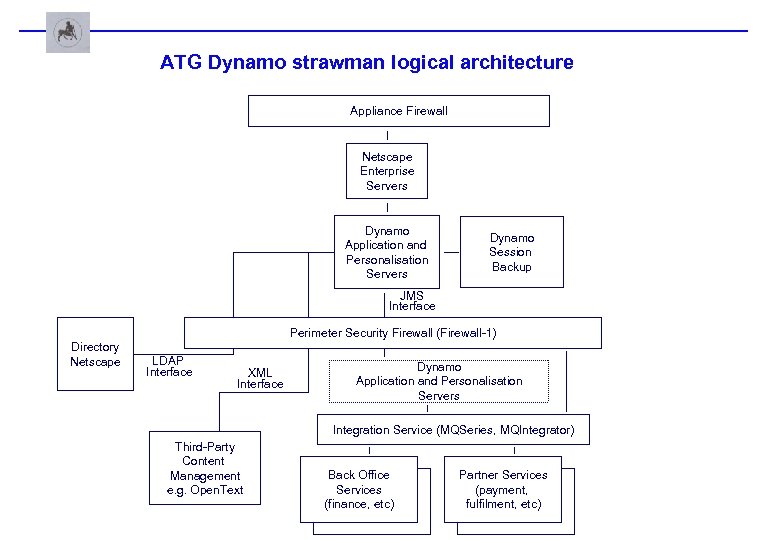
ATG Dynamo strawman logical architecture Appliance Firewall Netscape Enterprise Servers Dynamo Application and Personalisation Servers Dynamo Session Backup JMS Interface Perimeter Security Firewall (Firewall-1) Directory Netscape LDAP Interface XML Interface Dynamo Application and Personalisation Servers Integration Service (MQSeries, MQIntegrator) Third-Party Content Management e. g. Open. Text Back Office Services (finance, etc) Partner Services (payment, fulfilment, etc)
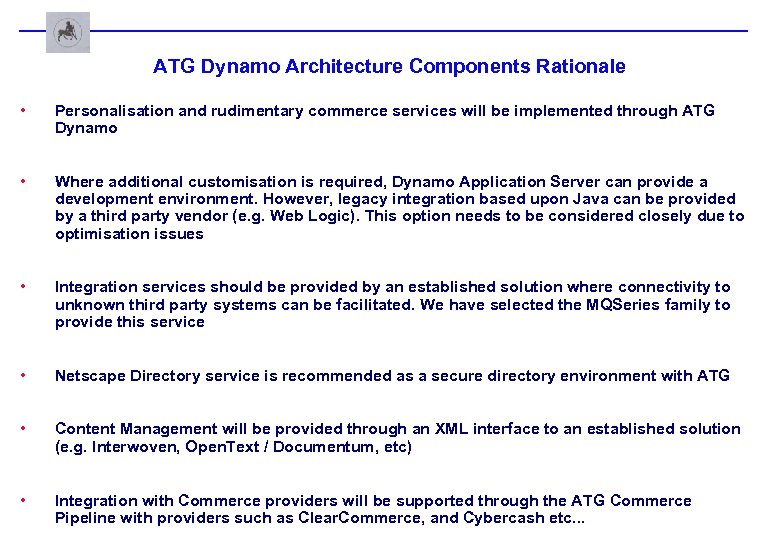
ATG Dynamo Architecture Components Rationale • Personalisation and rudimentary commerce services will be implemented through ATG Dynamo • Where additional customisation is required, Dynamo Application Server can provide a development environment. However, legacy integration based upon Java can be provided by a third party vendor (e. g. Web Logic). This option needs to be considered closely due to optimisation issues • Integration services should be provided by an established solution where connectivity to unknown third party systems can be facilitated. We have selected the MQSeries family to provide this service • Netscape Directory service is recommended as a secure directory environment with ATG • Content Management will be provided through an XML interface to an established solution (e. g. Interwoven, Open. Text / Documentum, etc) • Integration with Commerce providers will be supported through the ATG Commerce Pipeline with providers such as Clear. Commerce, and Cybercash etc. . .
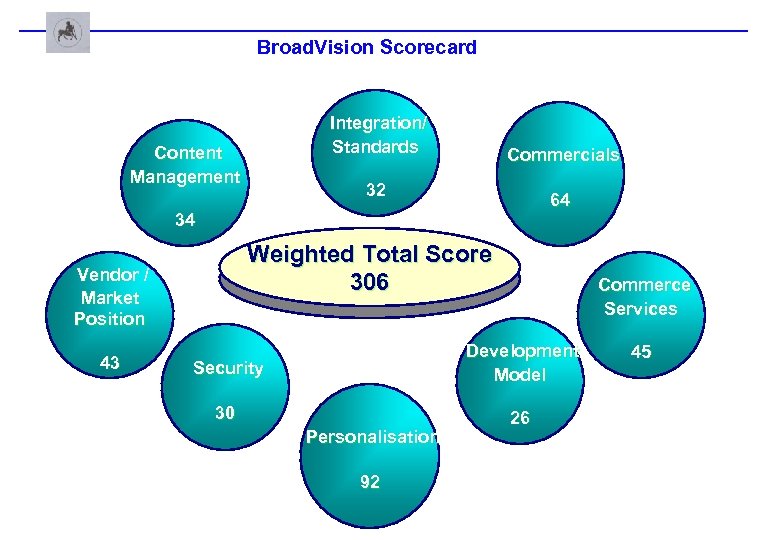
Broad. Vision Scorecard Integration/ Standards Content Management Commercials 32 64 34 Weighted Total Score Key Selection 306 Criteria Vendor / Market Position 43 Commerce Services Security Development Model 30 26 Personalisation 92 45
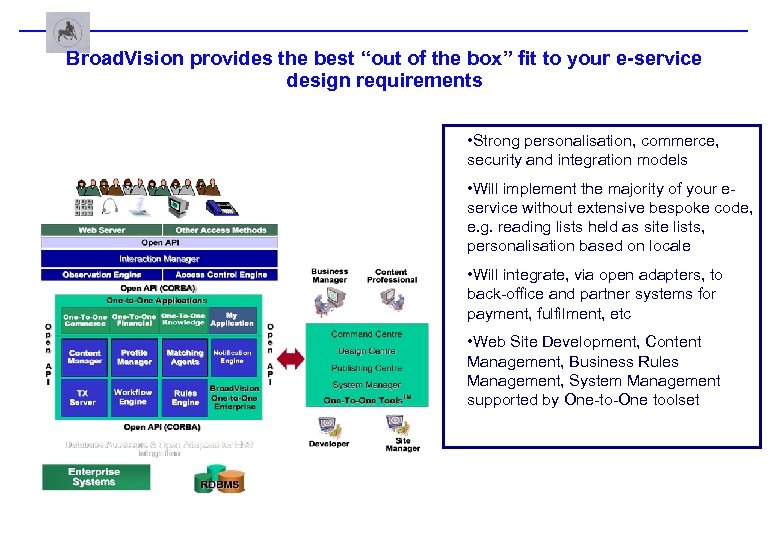
Broad. Vision provides the best “out of the box” fit to your e-service design requirements • Strong personalisation, commerce, security and integration models • Will implement the majority of your eservice without extensive bespoke code, e. g. reading lists held as site lists, personalisation based on locale • Will integrate, via open adapters, to back-office and partner systems for payment, fulfilment, etc • Web Site Development, Content Management, Business Rules Management, System Management supported by One-to-One toolset
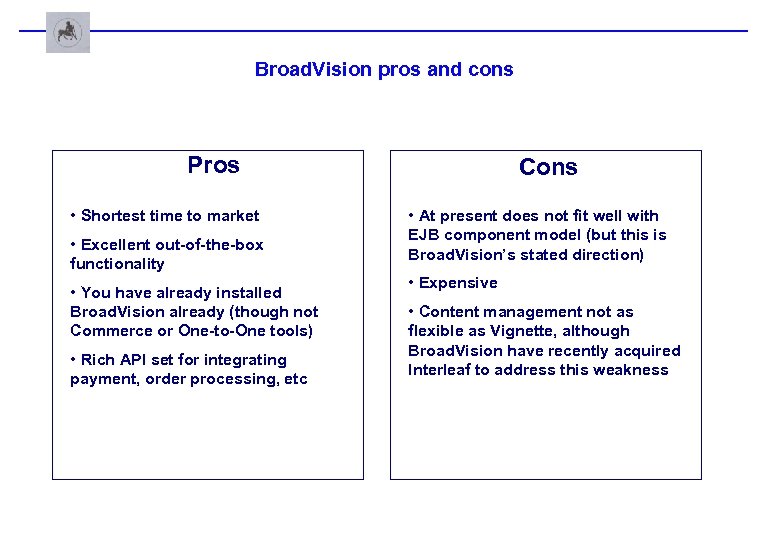
Broad. Vision pros and cons Pros • Shortest time to market • Excellent out-of-the-box functionality • You have already installed Broad. Vision already (though not Commerce or One-to-One tools) • Rich API set for integrating payment, order processing, etc Cons • At present does not fit well with EJB component model (but this is Broad. Vision’s stated direction) • Expensive • Content management not as flexible as Vignette, although Broad. Vision have recently acquired Interleaf to address this weakness
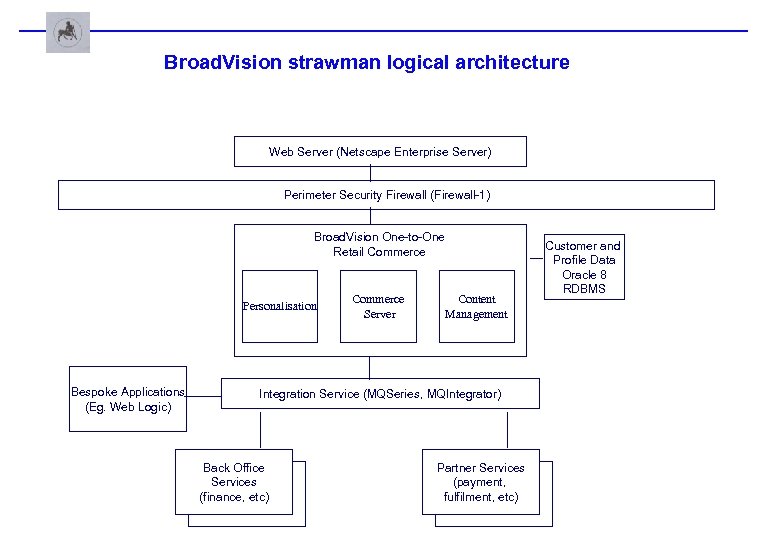
Broad. Vision strawman logical architecture Web Server (Netscape Enterprise Server) Perimeter Security Firewall (Firewall-1) Broad. Vision One-to-One Retail Commerce Personalisation Bespoke Applications (Eg. Web Logic) Commerce Server Content Management Integration Service (MQSeries, MQIntegrator) Back Office Services (finance, etc) Partner Services (payment, fulfilment, etc) Customer and Profile Data Oracle 8 RDBMS
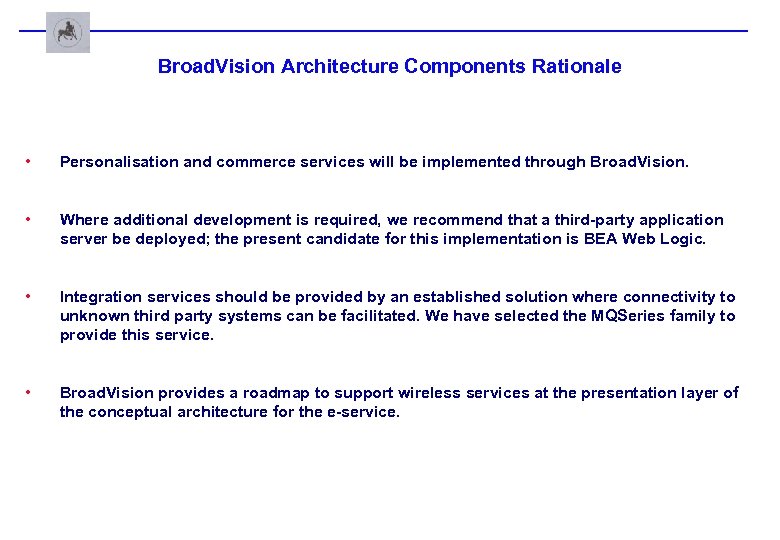
Broad. Vision Architecture Components Rationale • Personalisation and commerce services will be implemented through Broad. Vision. • Where additional development is required, we recommend that a third-party application server be deployed; the present candidate for this implementation is BEA Web Logic. • Integration services should be provided by an established solution where connectivity to unknown third party systems can be facilitated. We have selected the MQSeries family to provide this service. • Broad. Vision provides a roadmap to support wireless services at the presentation layer of the conceptual architecture for the e-service.
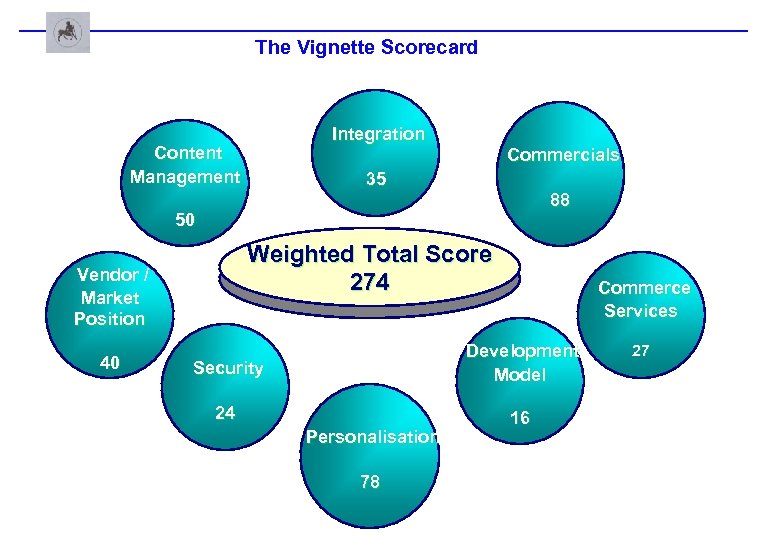
The Vignette Scorecard Integration Content Management Commercials 35 88 50 Weighted Total Score Key Selection 274 Criteria Vendor / Market Position 40 Commerce Services Security Development Model 24 16 Personalisation 78 27
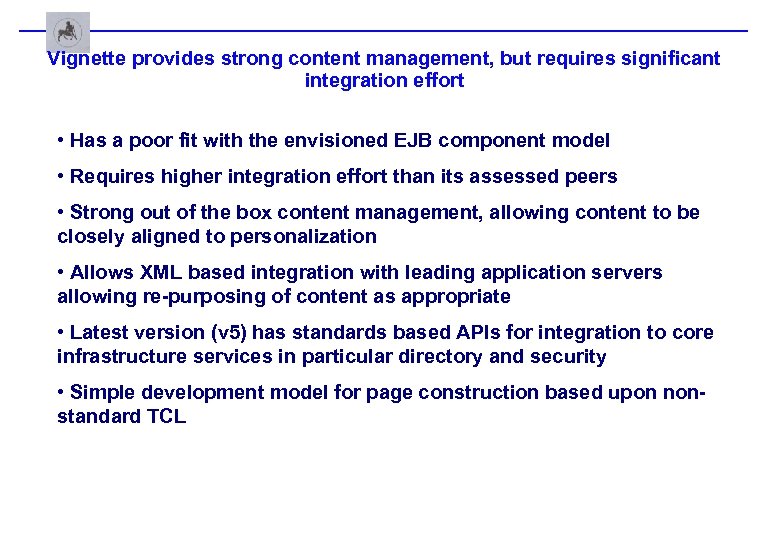
Vignette provides strong content management, but requires significant integration effort • Has a poor fit with the envisioned EJB component model • Requires higher integration effort than its assessed peers • Strong out of the box content management, allowing content to be closely aligned to personalization • Allows XML based integration with leading application servers allowing re-purposing of content as appropriate • Latest version (v 5) has standards based APIs for integration to core infrastructure services in particular directory and security • Simple development model for page construction based upon nonstandard TCL
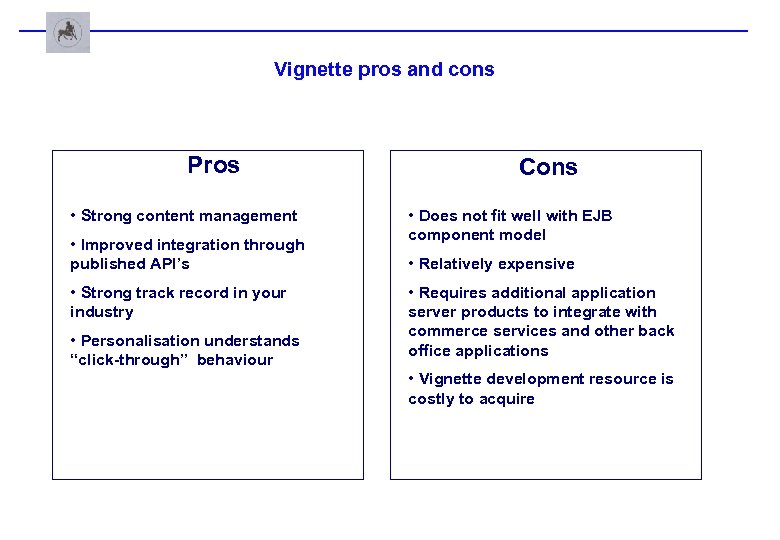
Vignette pros and cons Pros • Strong content management • Improved integration through published API’s • Strong track record in your industry • Personalisation understands “click-through” behaviour Cons • Does not fit well with EJB component model • Relatively expensive • Requires additional application server products to integrate with commerce services and other back office applications • Vignette development resource is costly to acquire
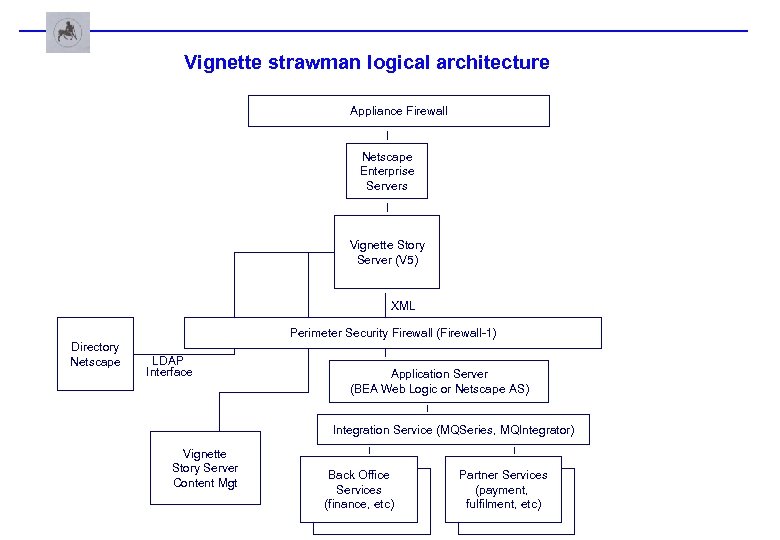
Vignette strawman logical architecture Appliance Firewall Netscape Enterprise Servers Vignette Story Server (V 5) XML Perimeter Security Firewall (Firewall-1) Directory Netscape LDAP Interface Application Server (BEA Web Logic or Netscape AS) Integration Service (MQSeries, MQIntegrator) Vignette Story Server Content Mgt Back Office Services (finance, etc) Partner Services (payment, fulfilment, etc)
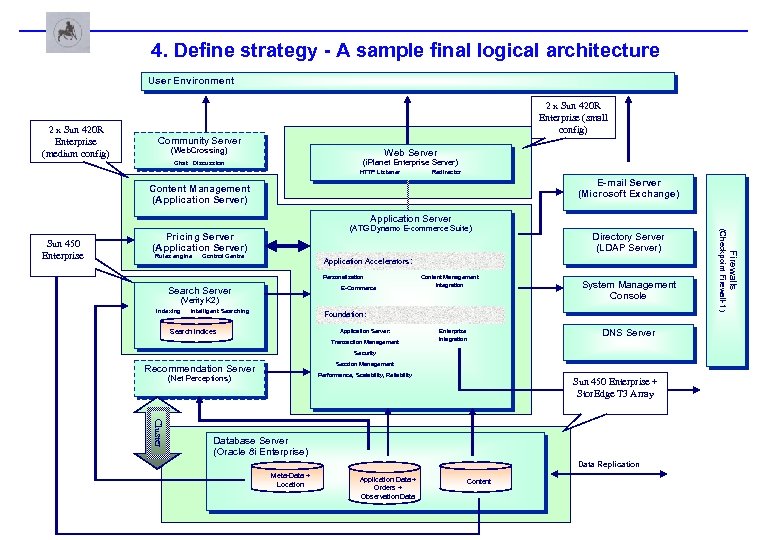
4. Define strategy - A sample final logical architecture User Environment 2 x Sun 420 R Enterprise (medium config) 2 x Sun 420 R Enterprise (small config) Community Server (Web. Crossing) Web Server (i. Planet Enterprise Server) Chat Discussion HTTP Listener Redirector E-mail Server (Microsoft Exchange) Content Management (Application Server) Application Server Rules engine Control Centre Application Accelerators : Personalization E-Commerce Search Server Content Management Integration (Verity K 2) Indexing Directory Server (LDAP Server) Intelligent Searching System Management Console Foundation: Application Server: Search Indices Transaction Management Enterprise Integration DNS Server Security Session Management Recommendation Server Performance, Scalability, Reliability (Net Perceptions) Sun 450 Enterprise + Stor. Edge T 3 Array Cluster Database Server (Oracle 8 i Enterprise) Data Replication Meta-Data + Location Application Data + Orders + Observation Data Content Firewalls Pricing Server (Application Server) (Checkpoint Firewall-1) Sun 450 Enterprise (ATG Dynamo E-commerce Suite)
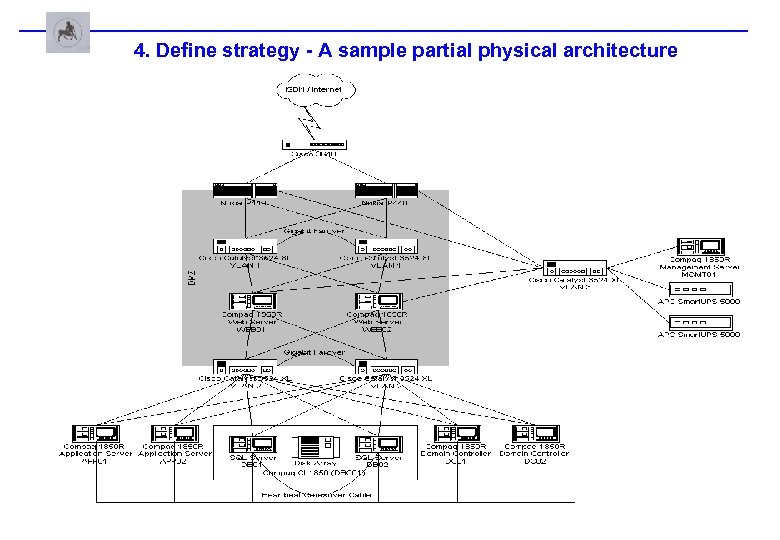
4. Define strategy - A sample partial physical architecture
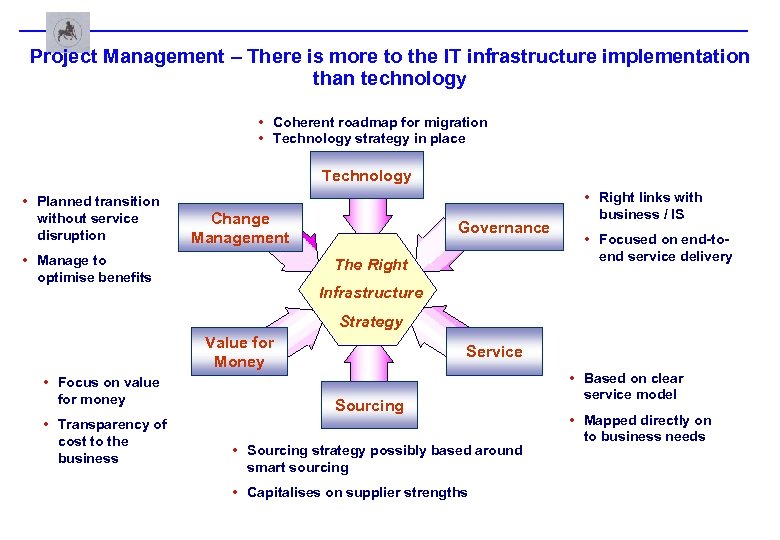
Project Management – There is more to the IT infrastructure implementation than technology • Coherent roadmap for migration • Technology strategy in place Technology • Planned transition without service disruption Change Management • Manage to optimise benefits Governance The Right • Right links with business / IS • Focused on end-toend service delivery Infrastructure Strategy Value for Money • Focus on value for money • Transparency of cost to the business Service Sourcing • Sourcing strategy possibly based around smart sourcing • Capitalises on supplier strengths • Based on clear service model • Mapped directly on to business needs
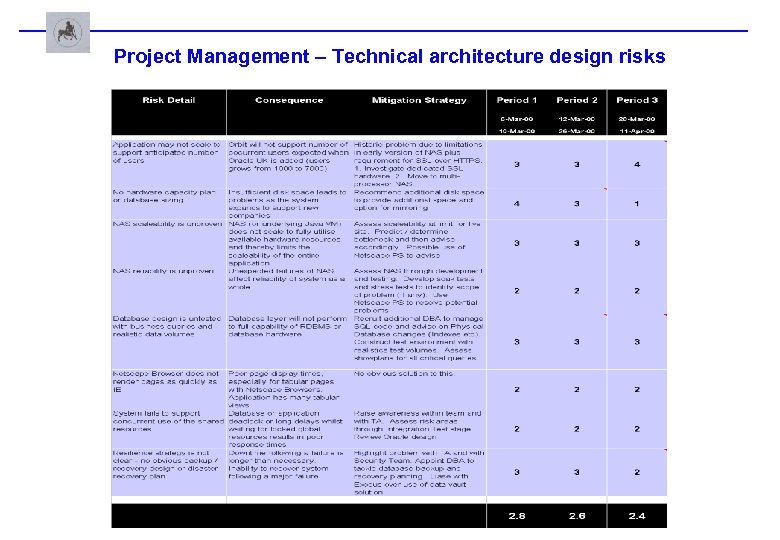
Project Management – Technical architecture design risks
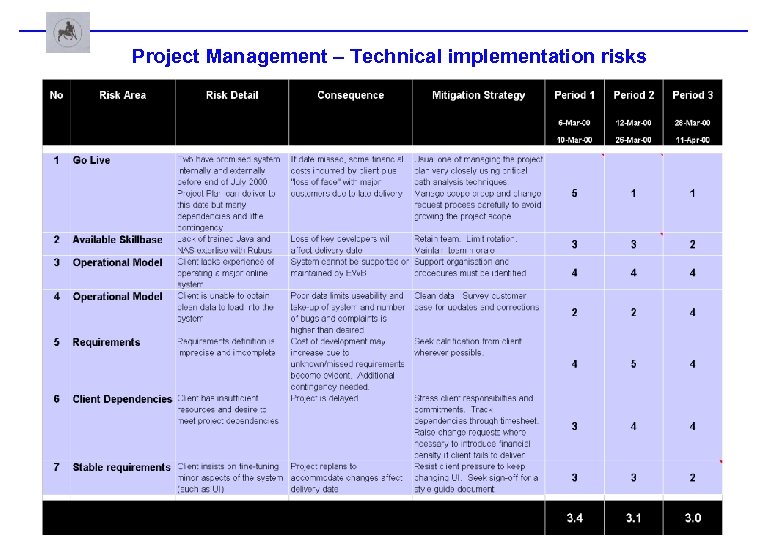
Project Management – Technical implementation risks
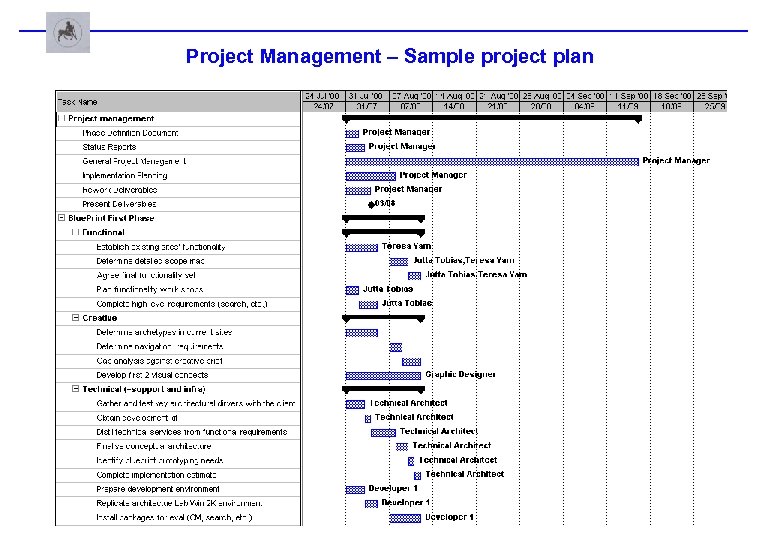
Project Management – Sample project plan
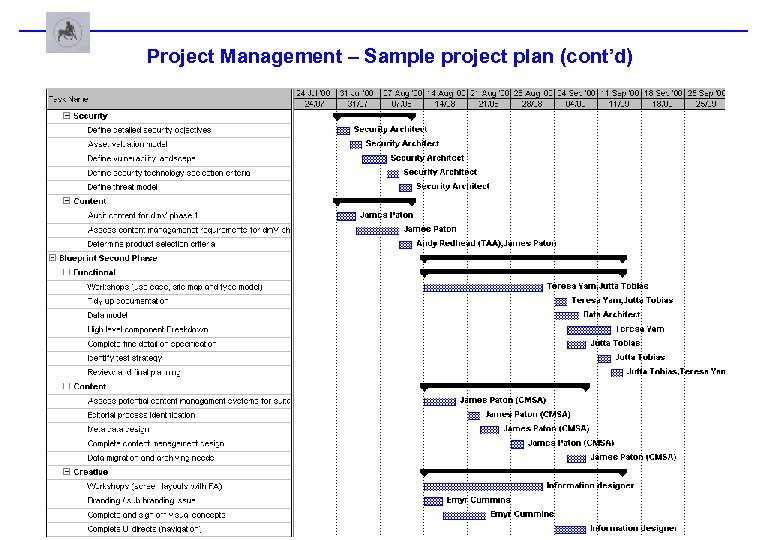
Project Management – Sample project plan (cont’d)
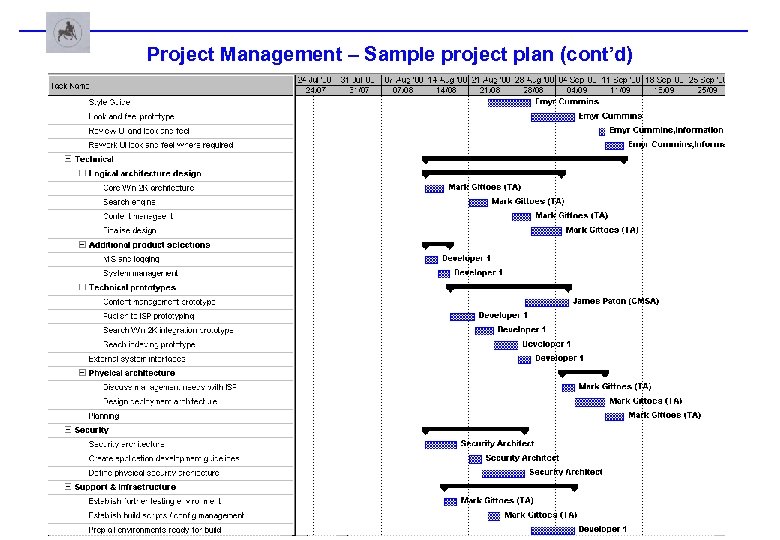
Project Management – Sample project plan (cont’d)
Скачать презентацию Ηλεκτρονικές Υπηρεσίες Ηλεκτρονικό Επιχειρείν Διάλεξη 7η
bae0bfecb9a2b347c21de9f143feb251.ppt