 Скачать презентацию µ Progress towards a feasible blood test
b6dcbe2982ad054fefa0093451ca9c60.ppt
- Количество слайдов: 19




µ

Progress towards a feasible blood test
Problems with proteinase K • Problems with standardisation – lab to lab; sample to sample; tissue to tissue leading to false positives • Problems with automation • No guarantee that all rogue prion is protease resistant – Atypical scrapie (nor 98) and BSE – Is rogue prion in blood resistant to proteinase K?
Introduction to the Seprion ligand platform
Summary There is a wealth of scientific literature demonstrating that polyionic polymers can bind to rogue prion protein: histopathological stains, curing infected cell lines, delaying or preventing disease http: //www. priondata. org/ We have developed the use of polyionic polymers to specifically capture rogue prion protein and avoid the need for proteinase K?
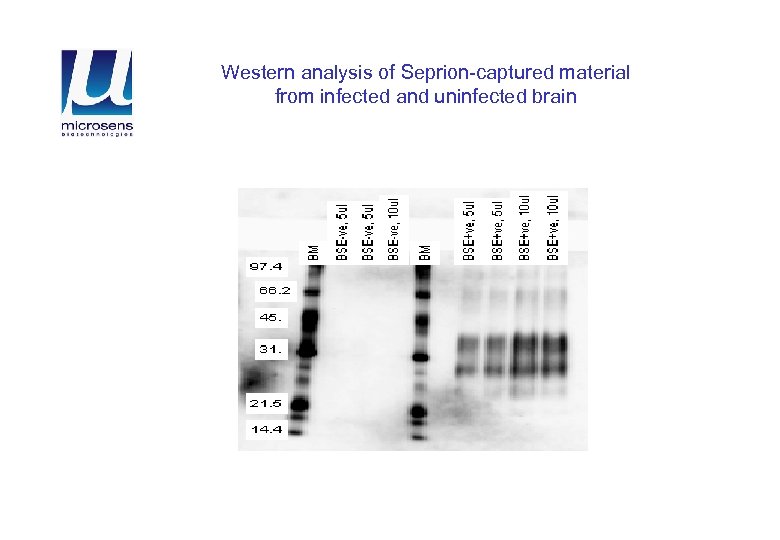
Western analysis of Seprion-captured material from infected and uninfected brain
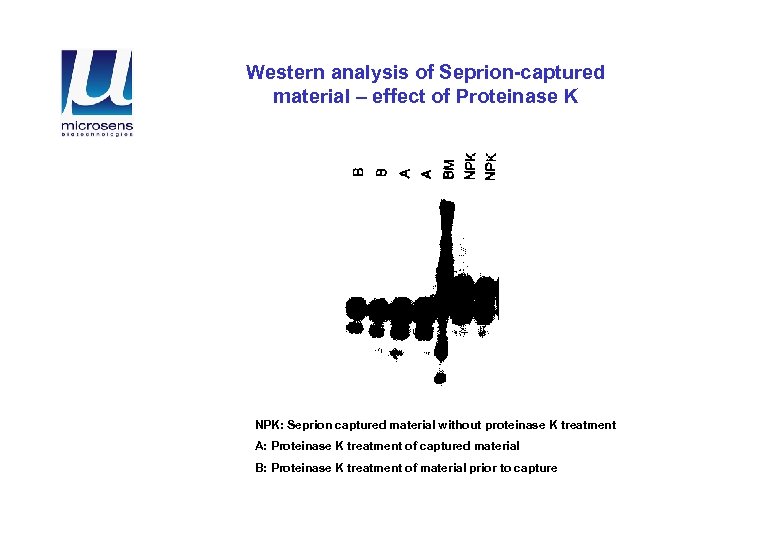
Western analysis of Seprion-captured material – effect of Proteinase K NPK: Seprion captured material without proteinase K treatment A: Proteinase K treatment of captured material B: Proteinase K treatment of material prior to capture

TSE ante-mortem (towards a feasible blood test)
What we have found • There is a lot of Pr. Pd in blood so sensitivity is not an issue • But the Pr. Pd in blood, in our experience, is not the same as the Pr. Pd in brain • Thus - spiking studies are completely inadequate to mimic blood borne Pr. Pd
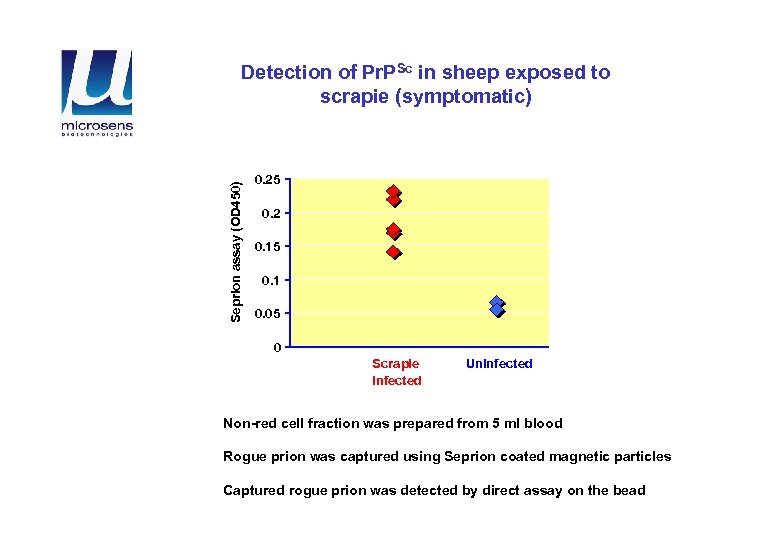
Seprion assay (OD 450) Detection of Pr. PSc in sheep exposed to scrapie (symptomatic) 0. 25 0. 2 0. 15 0. 1 0. 05 0 Scrapie infected Uninfected Non-red cell fraction was prepared from 5 ml blood Rogue prion was captured using Seprion coated magnetic particles Captured rogue prion was detected by direct assay on the bead
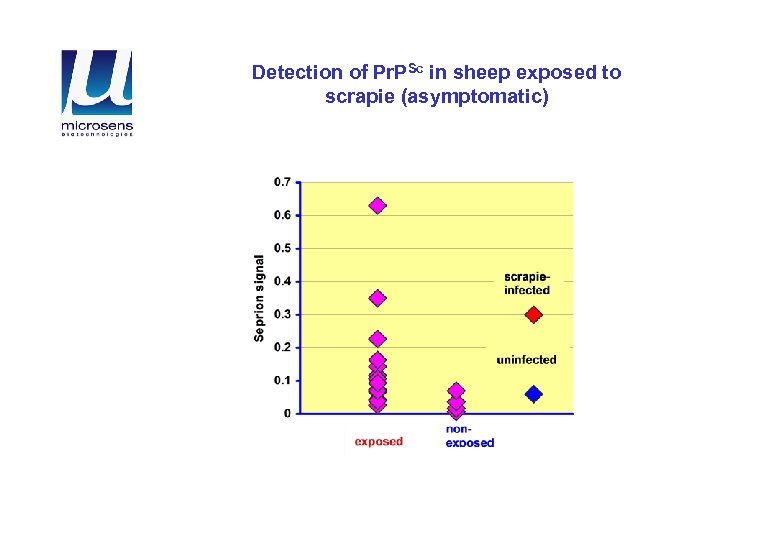
Detection of Pr. PSc in sheep exposed to scrapie (asymptomatic)
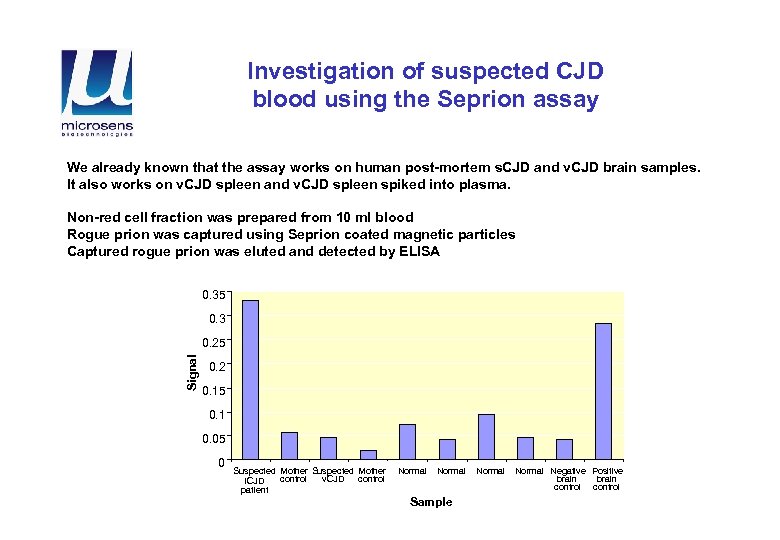
Investigation of suspected CJD blood using the Seprion assay We already known that the assay works on human post-mortem s. CJD and v. CJD brain samples. It also works on v. CJD spleen and v. CJD spleen spiked into plasma. Non-red cell fraction was prepared from 10 ml blood Rogue prion was captured using Seprion coated magnetic particles Captured rogue prion was eluted and detected by ELISA 0. 35 0. 3 Signal 0. 25 0. 2 0. 15 0. 1 0. 05 0 Suspected Mother control v. CJD control i. CJD patient Normal Sample Normal Negative Positive brain control
Evaluation of the Seprion technology on a blind panel A blind panel of Scrapie-infected and uninfected ovine blood was received in August 2004 from the VLA archive New protocols were developed to handle frozen whole blood Results were obtained and the codes broken
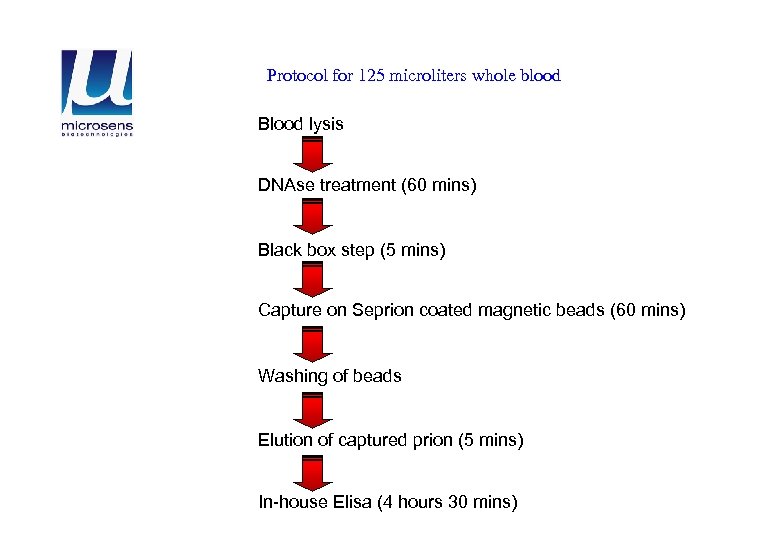
Protocol for 125 microliters whole blood Blood lysis DNAse treatment (60 mins) Black box step (5 mins) Capture on Seprion coated magnetic beads (60 mins) Washing of beads Elution of captured prion (5 mins) In-house Elisa (4 hours 30 mins)
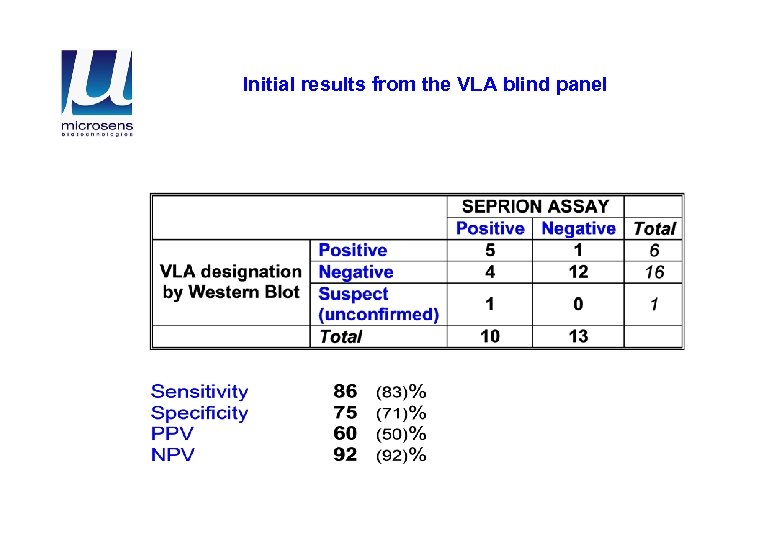
Initial results from the VLA blind panel
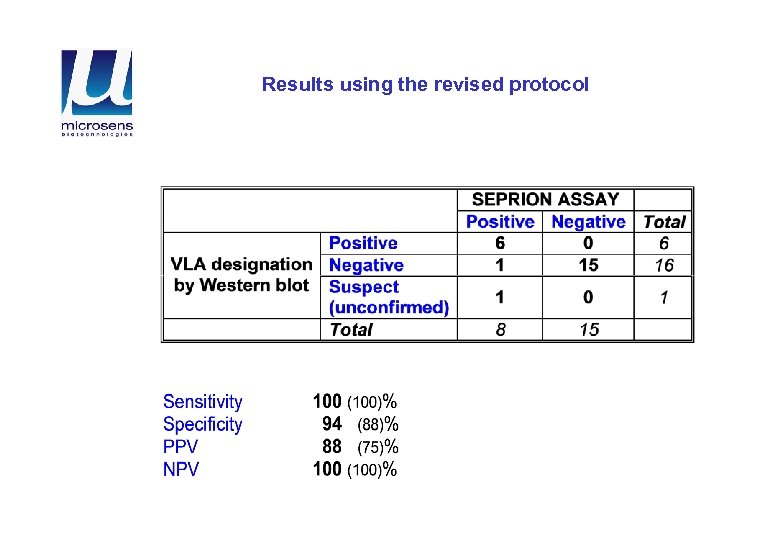
Results using the revised protocol
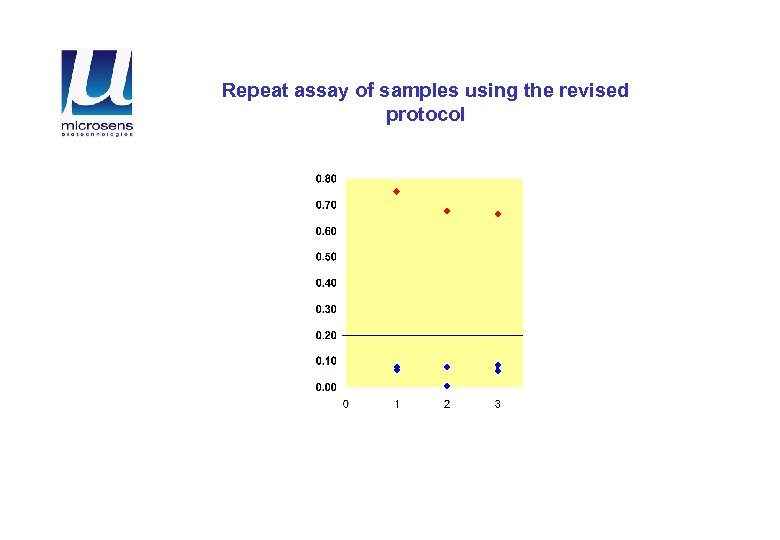
Repeat assay of samples using the revised protocol
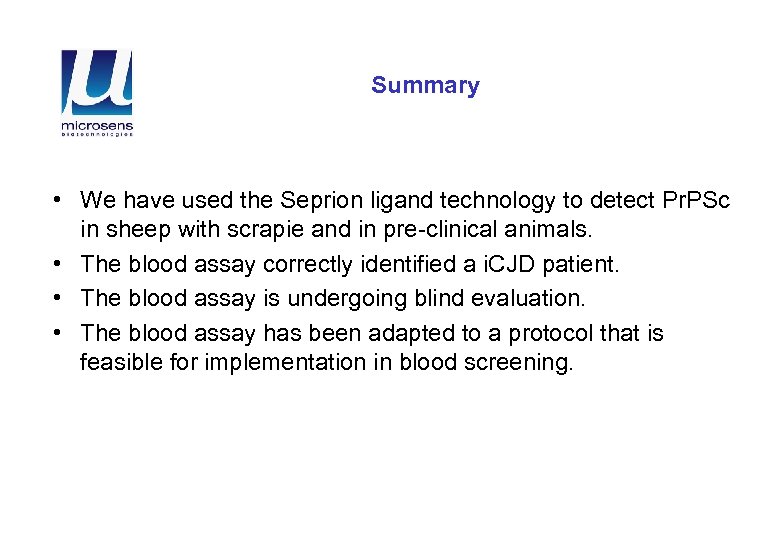
Summary • We have used the Seprion ligand technology to detect Pr. PSc in sheep with scrapie and in pre-clinical animals. • The blood assay correctly identified a i. CJD patient. • The blood assay is undergoing blind evaluation. • The blood assay has been adapted to a protocol that is feasible for implementation in blood screening.
Microsens: Amin Lane Jo Oliver Emma Quarterman Jay Patel Sharon Banin Stuart Wilson Chris Stanley Roger Rosedale
Скачать презентацию µ Progress towards a feasible blood test
b6dcbe2982ad054fefa0093451ca9c60.ppt